21 Home Office in Living Room Ideas That Blend In Seamlessly

My manager paused mid-sentence on our Tuesday video call and said, “Your living room looks so nice today. Did you repaint or something?”
I laughed. “You have been staring at my office for six months,” I told her.
She leaned closer to her camera. “Wait. Where is your desk?”
Right behind my chair. A slim wooden desk she had been looking at through the screen all along, and she never once saw it as a desk. That was the moment I knew I had finally done it.
Here is what I learned from three years of working at the dining table, then at a wobbly desk in the bedroom, and finally here in the living room. A Home Office in Living Room does not have to look like an office at all. The best ones hide in plain sight.
This list is everything I tried, borrowed from friends, and saw in real homes. Twenty one ideas that make your desk melt into your living room so well your guests will ask the same question my manager asked. Where is your desk?
Let us start with my favorite trick first.
1. The Desk That Lives Behind the Sofa
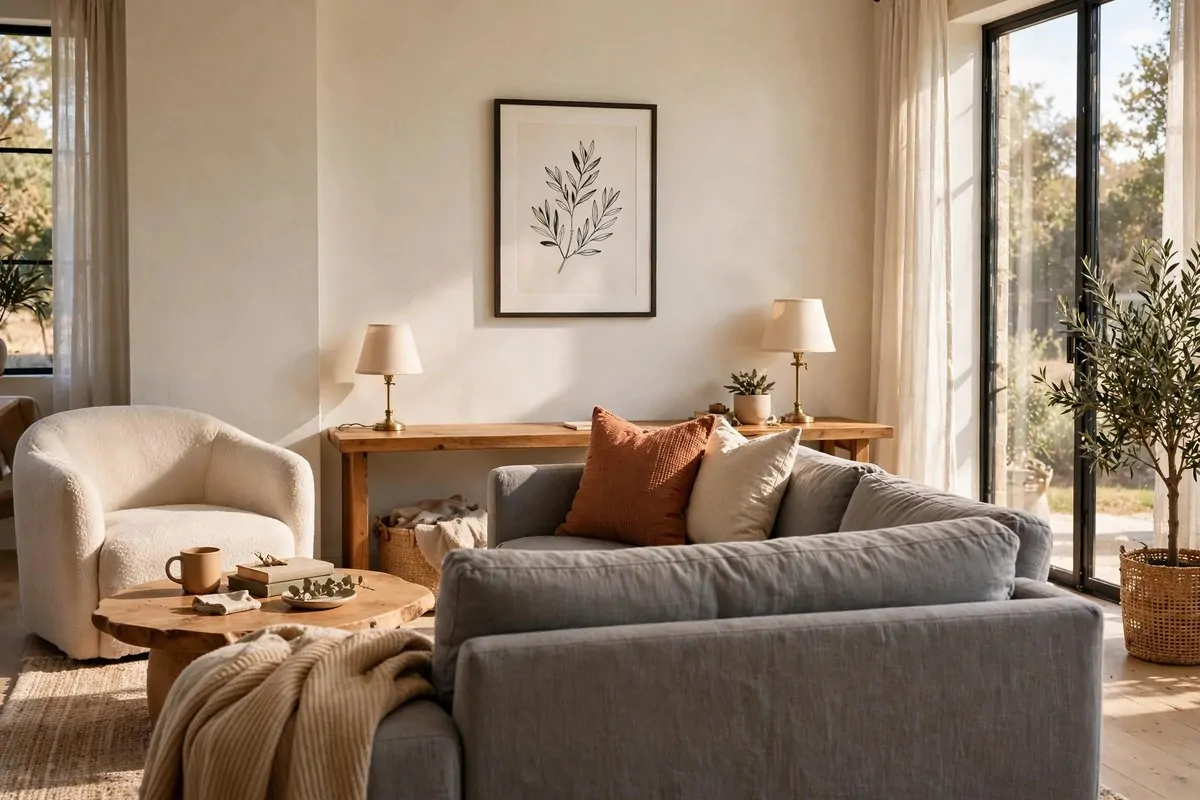
The back of your sofa is the most wasted strip of space in your whole home. It just sits there, facing a wall, doing nothing. I put my desk there one rainy Saturday and I have never moved it since.
Here is why it works so well. From the front of the room, all anyone sees is a nice console table behind the couch. It holds lamps. It holds books. It looks like decor. Only you know it is your office.
Pick a desk that is about the same height as your sofa back. Mine lines up almost perfectly, so from the entryway the top edge just disappears. Measure first. It takes two minutes and it makes all the difference.
Keep the desk slim. A deep desk will stick out and eat your walkway. Mine is only about sixteen inches deep, and that is plenty for a laptop, a notebook, and my coffee mug. Small is the whole point.
Now the fun part. Style it like a console table, not a desk. Put a real lamp on one end. Stack two pretty books. Add a small plant. Your desk becomes part of the living room story.
When work starts, I sit behind the sofa with my back to the room. It feels like my own little zone. The sofa blocks the view of the screen from the rest of the room, which means I can work while my family watches TV. Nobody bothers me.
When work ends, I close the laptop. The desk goes back to being a console table. The room looks exactly like a living room again, because it never stopped being one.
One warning. Cords are the giveaway here. Run them down the back of the desk and along the floor behind the sofa. Nobody will ever see them. I will show you exactly how in idea twenty.
The behind-the-sofa desk is my number one pick for a reason. It costs nothing extra, it fits almost any room, and it fools everyone. My manager can confirm.
2. The Floating Shelf Desk That Barely Touches the Room
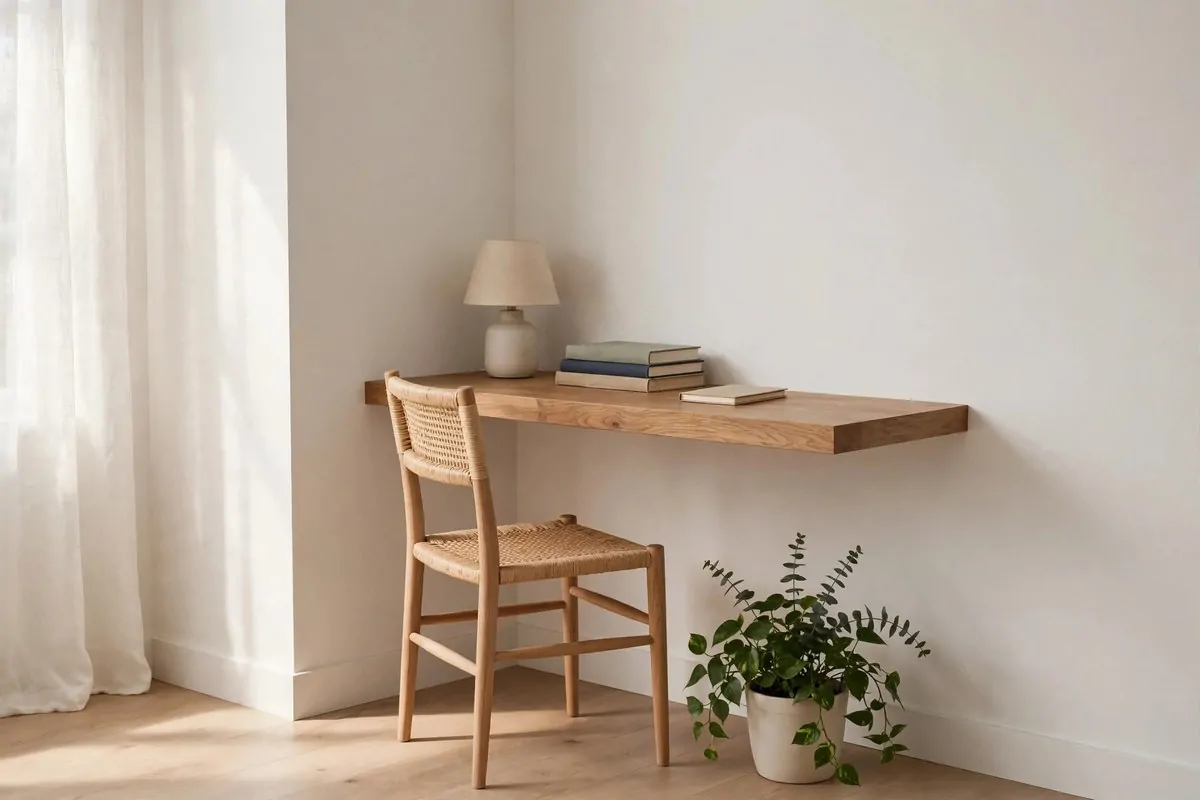
A floating shelf is not really a desk. That is the trick. It mounts right to the wall, no legs, no bulky frame. When the laptop is closed, it just looks like a shelf. A nice one.
I hung mine at normal desk height in a bare spot of wall between two bookcases. It took one bracket and about forty minutes. Then I slid a small chair underneath. Done.
The magic is the floor space. Your eye sees the floor continue under the shelf, so the whole corner looks bigger and lighter. A normal desk with legs would break that up. This one keeps it clean.
Choose a shelf deep enough to hold your laptop and your arms. About twelve to fourteen inches is the sweet spot. Too shallow and your wrists hang off the edge, which hurts after an hour.
Put a little drawer unit or a basket under one end for pens and chargers. Or hang a small shelf above it for books. The whole setup still reads as wall decor, not office furniture.
I love this one for renters too. One bracket leaves a tiny hole you can fill later. No big furniture to move out on moving day. It is the lightest office you will ever own.
When friends come over, I put a candle and a small vase on it. It is a shelf again in ten seconds. Then in the morning, laptop open, and it is my office. The fastest costume change in home decor.
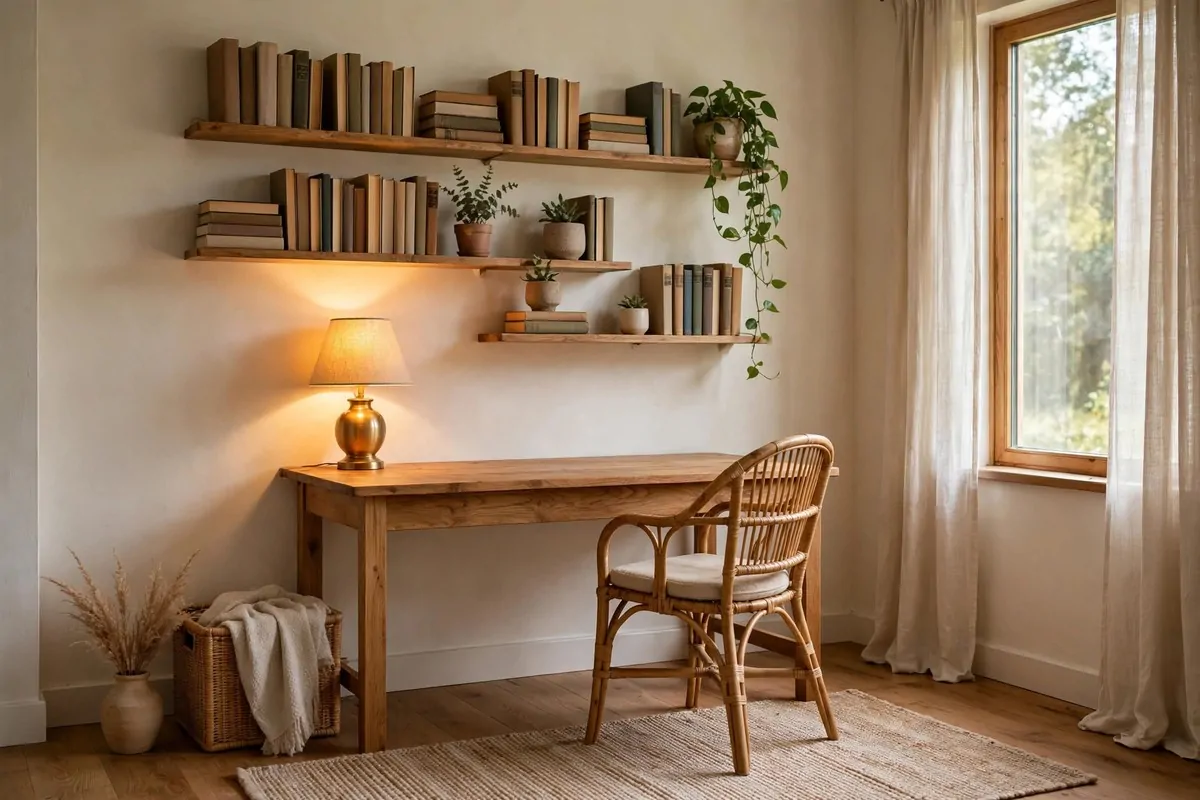
Small detail that matters. Pick a shelf color that matches your wall or your other wood tones. Mine is warm oak, same as my floor. It blends instead of shouting.
3. The Fold-Down Desk That Becomes Wall Decor
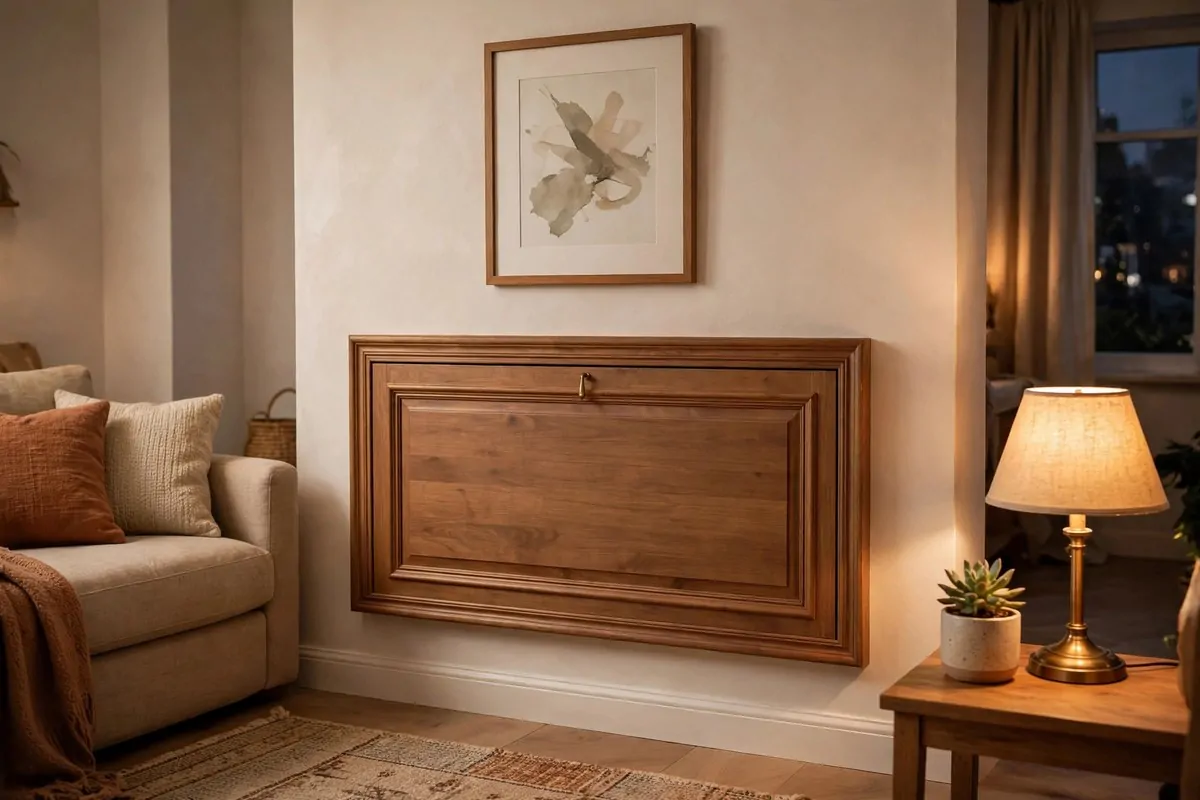
There is a piece of furniture that is a desk and then it is not a desk. You fold it down in the morning and fold it up at night. When it is closed, it looks like a flat cabinet on your wall. Sometimes it even has art on the front.
This is the best choice if your living room is small and you feel every inch. I have one in my reading corner. Open, it holds my laptop and a notebook. Closed, my guests lean against the wall next to it and have no idea.
Look for one with little storage slots inside the lid. Mine has spots for pens, a charger, and sticky notes. So when I fold it up, everything hides inside too. No stray office bits lying around.
Mount it on a stud. A fold-down desk holds weight when it is open, and you do not want it ripping off the wall. If you are not sure where the stud is, get the little magnetic stud finder. Ten dollars. Worth it.
Style the closed desk like a wall piece. Hang a picture above it. Put a small plant on the floor beside it. The closed desk should blend with your art, not sit there looking lonely.
One thing I learned the hard way. Do not overload the inside storage. If it is too heavy to fold up easily, you will stop folding it. Then it stays open and the magic is gone. Keep it light.
Kids love these, by the way. It feels like a secret compartment. My niece opens and closes mine every visit like it is a toy. Adults just think it is a nice wooden panel.
The fold-down desk is perfect for people who only work from home two or three days a week. On office days, your living room is just a living room. Full stop.
4. The Secretary Desk That Closes Up After Work
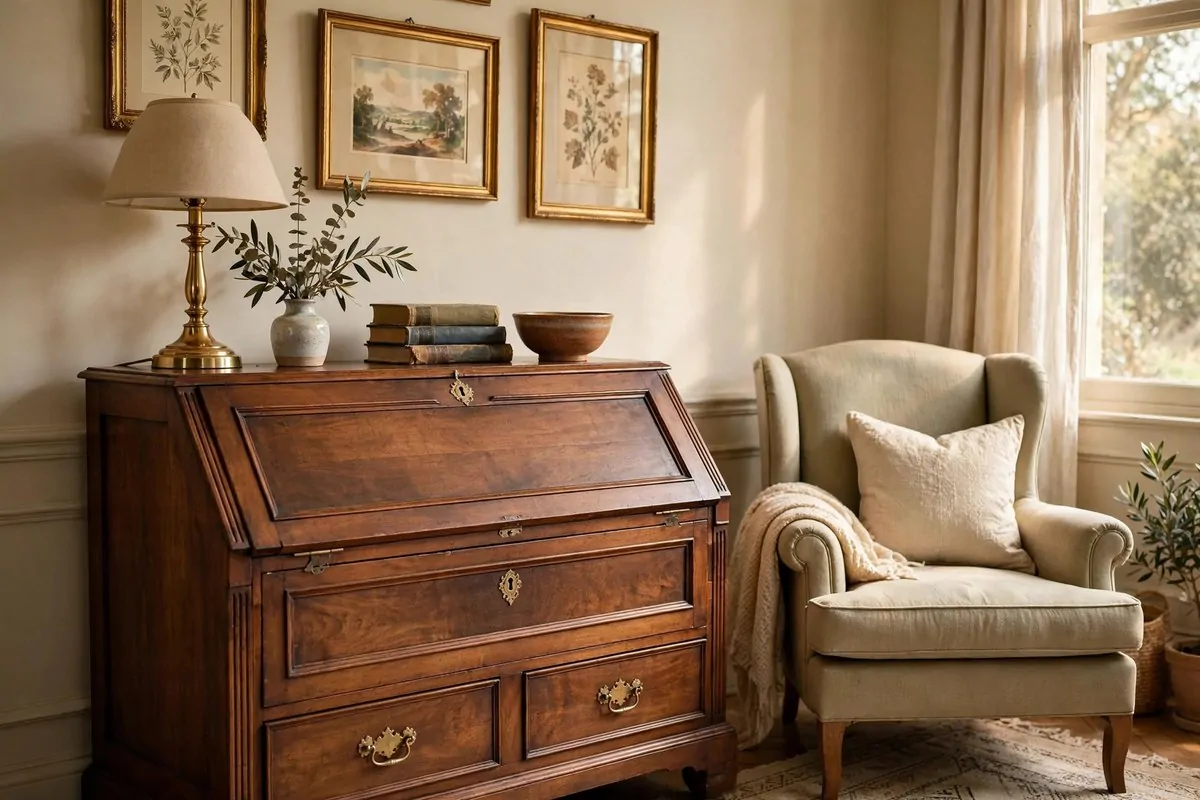
My grandmother had one of these. A secretary desk. You fold the front down to write on, and fold it back up when you are done. Inside there are little cubbies and drawers. Outside it is just a pretty wooden cabinet.
I found mine at a secondhand shop for almost nothing. It sat in my living room for a month before anyone asked about it. A guest finally said, “Oh, is that an office?” Only because I left the front open once.
This is the original work-life balance furniture. When you close that front panel, work is literally shut away. Papers, laptop, the half-finished email. Gone behind wood. Your brain gets the message too.
Vintage ones have real charm. The wood is warm, the hardware is old brass, and the little drawers inside are perfect for paper clips and sticky notes. It looks like a family heirloom because it basically is one.
They are not huge inside, so this suits laptop workers best. If you have a big monitor and two keyboards, skip this idea. But for a laptop and a notebook, it is plenty.
Place it against a wall where it gets nice light. Style the top with a lamp and a small vase. The top of a closed secretary desk is prime decorating space, and it never moves. Perfect spot for a plant you always forget to water.
One more thing. The fold-down front is also your desk surface, so keep it clear. I use a little tray for my laptop, pens, and phone. Tray lifts off, front folds up. Ten seconds.
Honestly, this idea taught me the biggest lesson of all. Hiding your office is not about being sneaky. It is about giving your room permission to be a living room again at night.
5. The Matching-Tones Trick
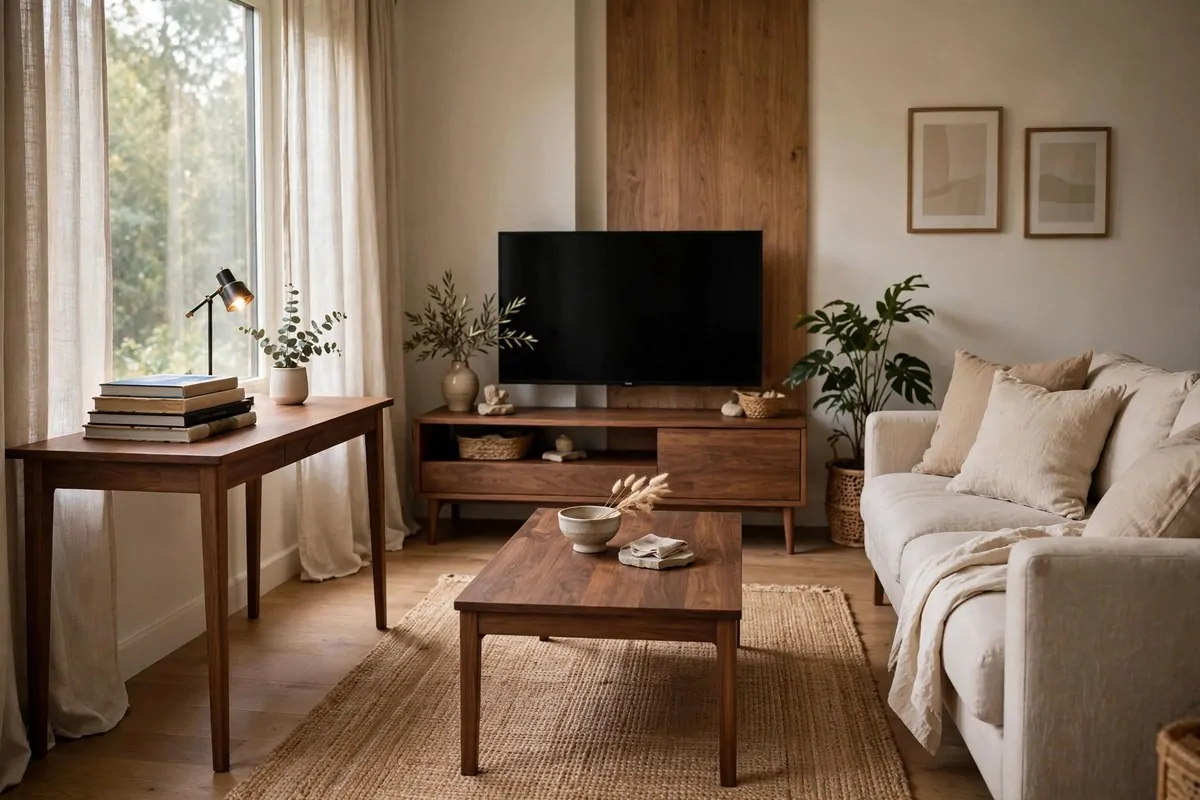
This one sounds almost too simple. Match your desk to the wood tones already in your living room. If your coffee table is walnut, get a walnut desk. If your shelves are light oak, get a light oak desk.
Your brain is lazy in the best way. When two things match, it files them as one family and stops noticing the odd one out. A black metal desk in a warm wood room screams office. A warm wood desk in a warm wood room just whispers furniture.
Here is a quick cheat sheet I use when I shop.
| If your room has this | Look for a desk in this |
|---|---|
| Walnut or dark wood tones | Walnut or espresso finish |
| Light oak or beech | Natural oak or light pine |
| White or painted furniture | White or soft cream finish |
| Gray or black metal accents | Gray wood or black metal frame |
It does not have to be exact. Close is fine. Your eye forgives small differences as long as the overall feeling matches. Warm with warm. Cool with cool.
This trick works on chairs too. My desk chair is the same gray as my sofa cushions. From across the room it just looks like extra seating. That is the goal.
The same goes for your storage. A wooden box that matches your coffee table can hold all your office supplies. It sits on the shelf looking like decor. I have three of these boxes. Nobody has ever opened one.
If you are buying new, take a photo of your living room on your phone. Hold it up next to desk listings. It takes two minutes and it stops you from buying the wrong tone. I wish I had done this before my first desk purchase.
Honestly, this is the cheapest idea on the list. You are not buying anything extra. You are just buying the right thing the first time.
6. The Glass Desk That Is Almost Invisible
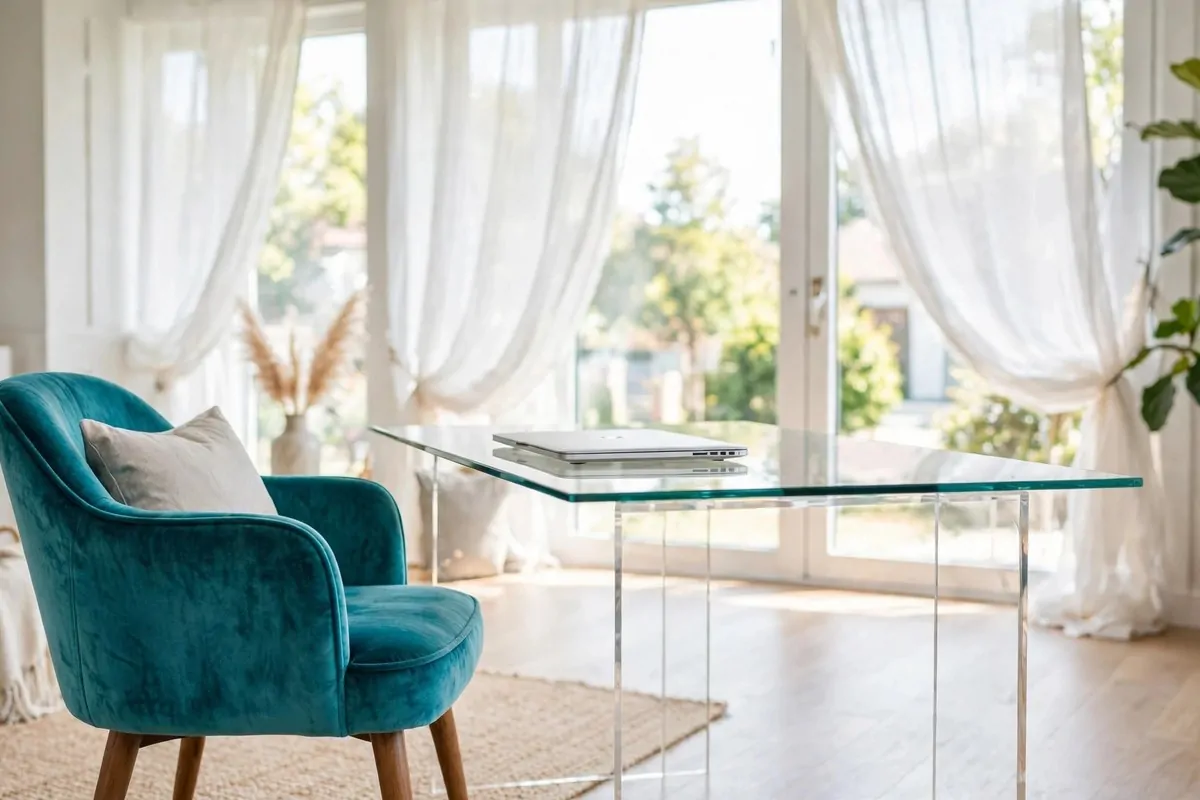
Glass is the closest thing to no desk at all. A clear glass desk lets your eye pass straight through it. The room stays open and airy, and the desk barely registers.
This one shines in small living rooms where a solid desk would feel like a wall. I tried it in my old apartment. The room looked the same size with the desk as without it. I could not believe it.
Pair it with a chair that has some color. Since the desk disappears, the chair gets to be the star. A velvet chair in mustard or deep green looks amazing next to glass. It is the only bold move the setup needs.
The downside is fingerprints. Glass shows every smudge. Keep a microfiber cloth in a nearby drawer and wipe it once a day. Thirty seconds. It becomes a habit fast, like making the bed.
Here are my quick glass desk rules.
- Choose thick tempered glass. It feels sturdy and safe.
- Keep the surface minimal. One laptop, one lamp, one small plant. That is it.
- Use a desk pad under your laptop so it does not slide or scratch.
- Wipe it in the evening so you wake up to a clean desk.
Glass desks also photograph beautifully. If you ever show your home on a video call, a glass desk looks like you are floating in a bright, clean room. My manager noticed. That is how this whole story started.
One more perk. Light passes through glass, so a desk by a window never blocks your daylight. The whole corner stays bright. Plants nearby will thank you too.
Just be honest with yourself. If you are a spreader, someone who needs papers everywhere, glass will stress you out because every mess shows. Minimal workers only.
7. The Cozy Corner Nook With a Pegboard
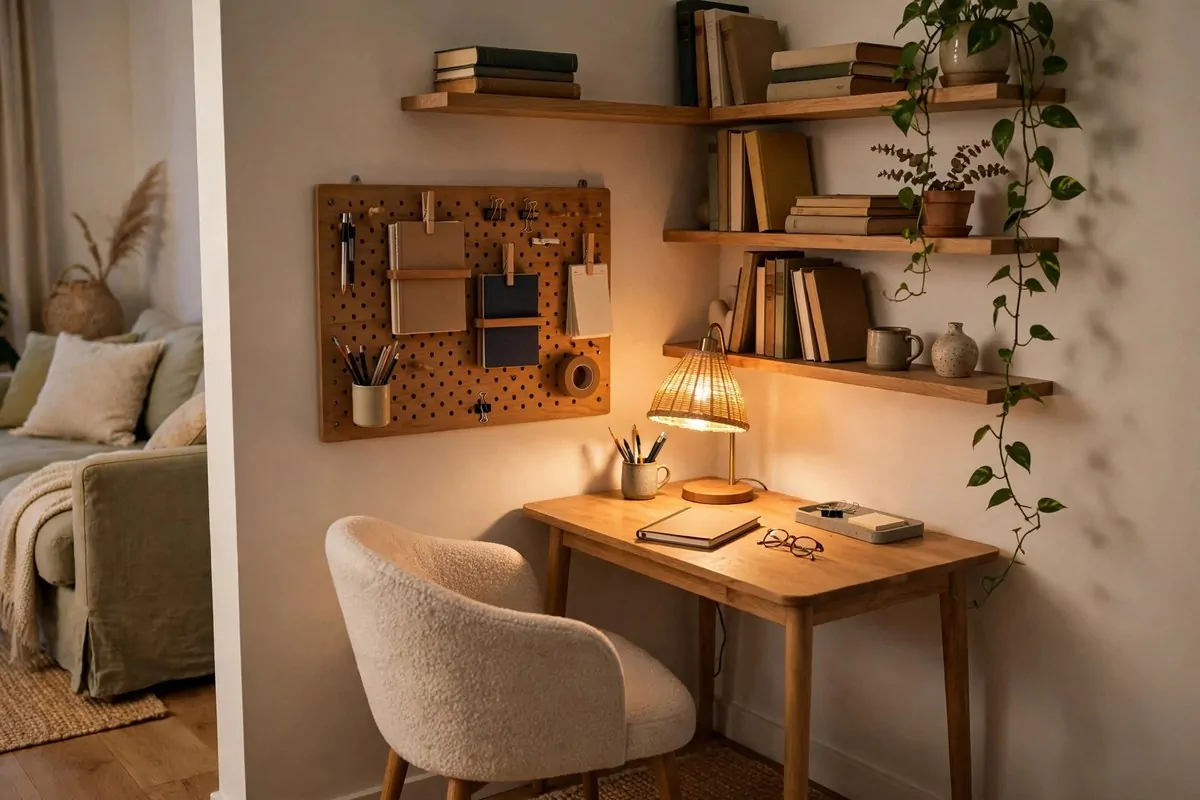
Every living room has a dead corner. The spot where nothing fits, so a sad plant goes there to be forgotten. That corner is your future office.
Tuck a small desk into it at an angle. An L shape or a corner desk uses both walls, so you get more surface without stealing floor space. The room keeps its open middle. Everybody wins.
Now add a pegboard above the desk. This is the part that changed everything for me. Pegs and little hooks hold your pens, scissors, headphones, and notebook right on the wall. Your desk stays clear because everything has a home in the air.
Paint the pegboard the same color as your wall. Mine is soft white on a white wall. It holds twenty things and still looks like wall art. Visitors notice the plant and the lamp first. The office stuff hides in plain sight.
Hang a small shelf above the pegboard for books and a trailing plant. Now the corner looks styled on purpose, not like a workstation squeezed in. That styling is what makes it blend.
The corner nook also gives you a feeling of being tucked in. Your back is to the room, your sides are walled. It is like a little cocoon. I focus better here than anywhere else in the house.
Add a warm lamp for late afternoons. Corners get dark fast, and one small lamp fixes it. I use one with a warm bulb, so at night the corner glows like the rest of the room.
Keep the chair simple and small. A big office chair in a corner nook eats the coziness. A wooden chair with a cushion fits better and matches the living room look.
8. The Window-Ledge Work Spot
If you have a deep windowsill, you might already own a desk. Some older homes have sills wide enough to hold a laptop. All you have to do is extend it a little.
A narrow board on top of the sill makes a slim desk with the best view in the house. I worked from a window spot for a whole summer. Watching clouds during boring meetings was the best part.
Natural light is free office lighting. It also makes you look amazing on video calls. Face the window, not the room, and your face gets soft daylight instead of a ceiling shadow. Big difference.
Add a small stool that tucks fully under the sill when you are done. Stools with a cushion feel like extra living room seating. One of my stools is where guests sit at parties. Dual purpose again.
Use the windowsill itself as a shelf. Plants, a candle, a small stack of books. The ledge was already decorated before you arrived, so your office just borrows its style. Very sneaky, very pretty.
Watch the glare, though. A screen facing bright daylight can wash out. A sheer curtain solves it. It softens the light and looks lovely from outside too. Two wins.
In winter, window spots get chilly. I keep a small throw blanket on my stool. It is cozy and it fits the living room look. Nobody questions a blanket in a living room.
This idea costs almost nothing. A board, two brackets, a stool you may already own. The view is free.
9. The Desk Framed by Bookcases
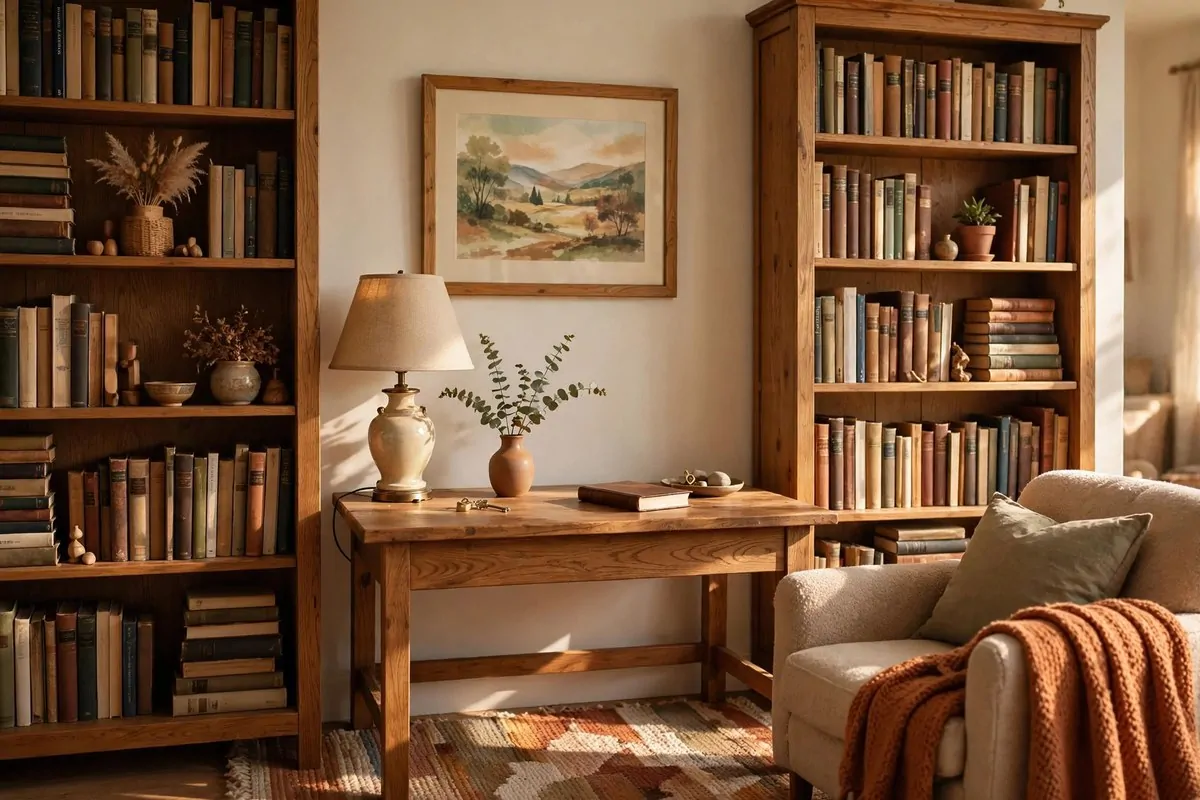
Put your desk between two bookcases and something magical happens. The bookcases frame it like a picture. Your eye reads the whole wall as one beautiful bookshelf unit, and the desk becomes the middle shelf that happens to hold a laptop.
I did this with two simple tall bookcases I already owned. Desk in the middle, bookcases on the sides. It looked so intentional that a friend asked which designer I hired. Nobody was hired. It was just me and a Saturday.
Style the bookcases with books, baskets, and a few pretty objects. Mix in your office supplies as decor. Pens in a ceramic cup. Notebooks stacked like art books. A small clock. The line between office and living room gets very blurry, which is the point.
This layout gives you tons of storage without a filing cabinet. Books, boxes, baskets on the shelves hold everything. Your desk can stay almost empty, which makes the whole wall look calm.
Center a piece of art or a small mirror above the desk. It becomes the focal point of the wall, like a fireplace would be. The desk sits under it quietly. Very living room, not very office.
Keep the bookcase tops clear or lightly styled. A plant on one, a framed photo on the other. These details pull the whole thing into the living room family.
One caution. Bookcases are deep, so make sure your desk does not get pushed too far back into the dark. A small lamp on the desk fixes any shadow. I use one that clips to the shelf. Cheap and cheerful.
If your bookcases are different heights, do not worry. Mine were off by an inch. Nobody notices once books are in them. Perfectly matched furniture is a myth anyway.
10. The Built-In Study Wall
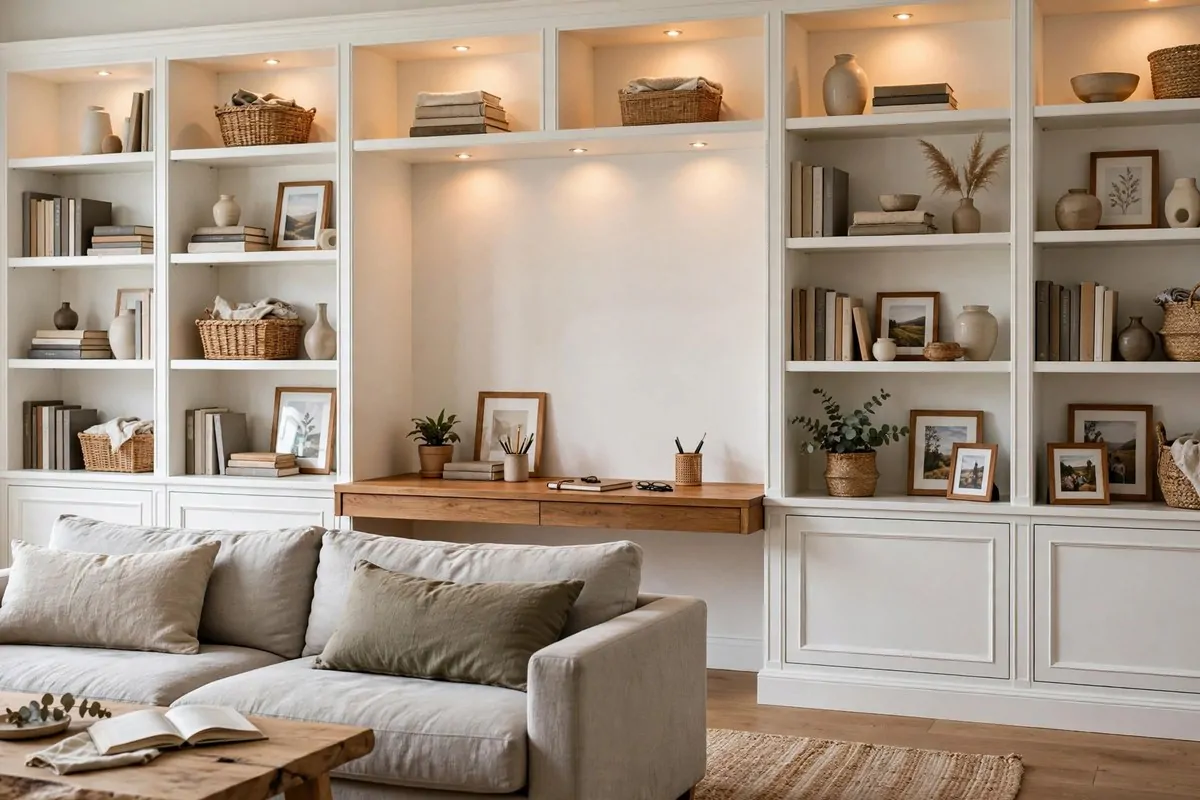
Built-ins are the king of blending. When a desk is surrounded by floor-to-ceiling shelving painted the same color as the walls, it looks like it was always there. Like the house was built around it.
You do not need a carpenter for this look anymore. There are shelving units made to look built-in when you line them up. I used three white units, a desk board between two of them, and some trim on top. It looks custom. It was not.
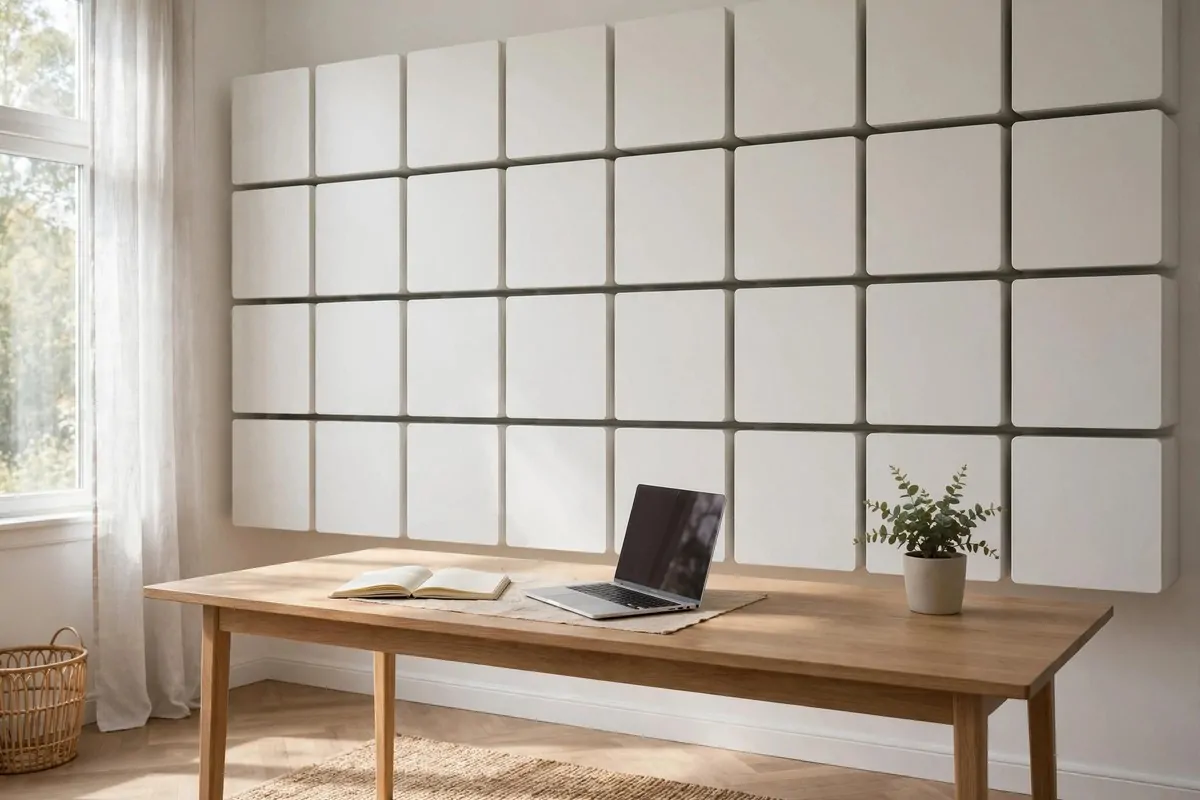
The secret is one paint color. Paint the shelves, the desk board, and even the trim the exact same white as your wall. The whole thing melts into the architecture. The eye skims right over it.
Use the shelves for living room things too, not just office stuff. Books, photo frames, a vase, a candle. Maybe forty percent office, sixty percent home. That ratio is what keeps it from reading as a workstation.
Add small warm lights under one shelf. I used a stick-on LED strip. At night the whole wall glows softly and looks like the coziest part of the room. My video call background is this wall, and people always compliment it.
The desk nook feels private even in an open room. The shelves on both sides create a little alcove. Sit in it and the rest of the living room fades away. It is the closest thing to a separate office without a door.
This is the priciest idea on the list if you go full custom. But the fake-it version cost me less than a nice dinner out. Start simple. You can always add trim later.
Dust the top shelves. I am serious. Built-ins collect dust where you cannot reach, and a dusty top shelf ruins the fancy look. A long duster, once a month. Done.
11. The Curtain Divider Zone
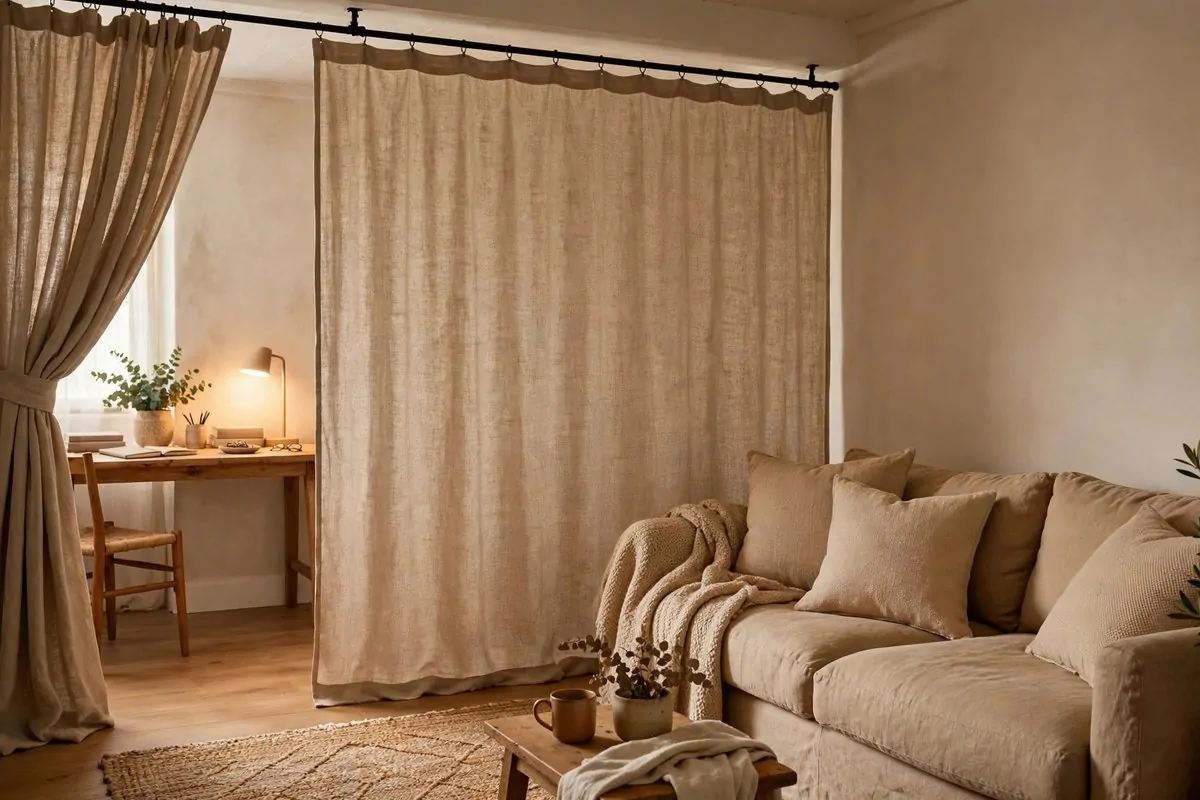
Sometimes the best way to blend in is to disappear on command. A curtain on a ceiling rail can close off your desk area in one pull. Open in the morning, closed at night.
I hung a linen curtain in my living room last year, and it changed how the whole room feels. During work hours, the curtain stays open and the desk is just part of the room. At six, I pull it closed. The office is gone. The living room is a living room again.
Pick a fabric that matches your other soft things. Curtains, cushions, throws. If your sofa has cream cushions, get a cream curtain. The divider should feel like a soft wall, not a stage curtain.
Ceiling rails are cheap and easy to install. They curve, so you can make an L shape around your desk. Tension rods work too if you have two walls close together. No drilling into anything permanent.
The curtain also hides the mess mid-day if someone drops by. Pull it halfway and your monitor is out of sight. I did this when my landlord visited. He never knew.
Keep the curtain simple. No busy patterns. A calm solid color in a natural fabric looks like a design choice, which it is. This is one of those ideas that looks better in real life than you expect.
One tip. Get the curtain long enough to touch the floor. Short curtains look like a shower. Floor-length looks like a room feature. Measure twice, buy once.
At night, when the curtain is closed, the room feels cozier too. Like the living room shrank into a snug nest. I was not expecting that bonus, but I love it.
12. The Lift-Top Coffee Table
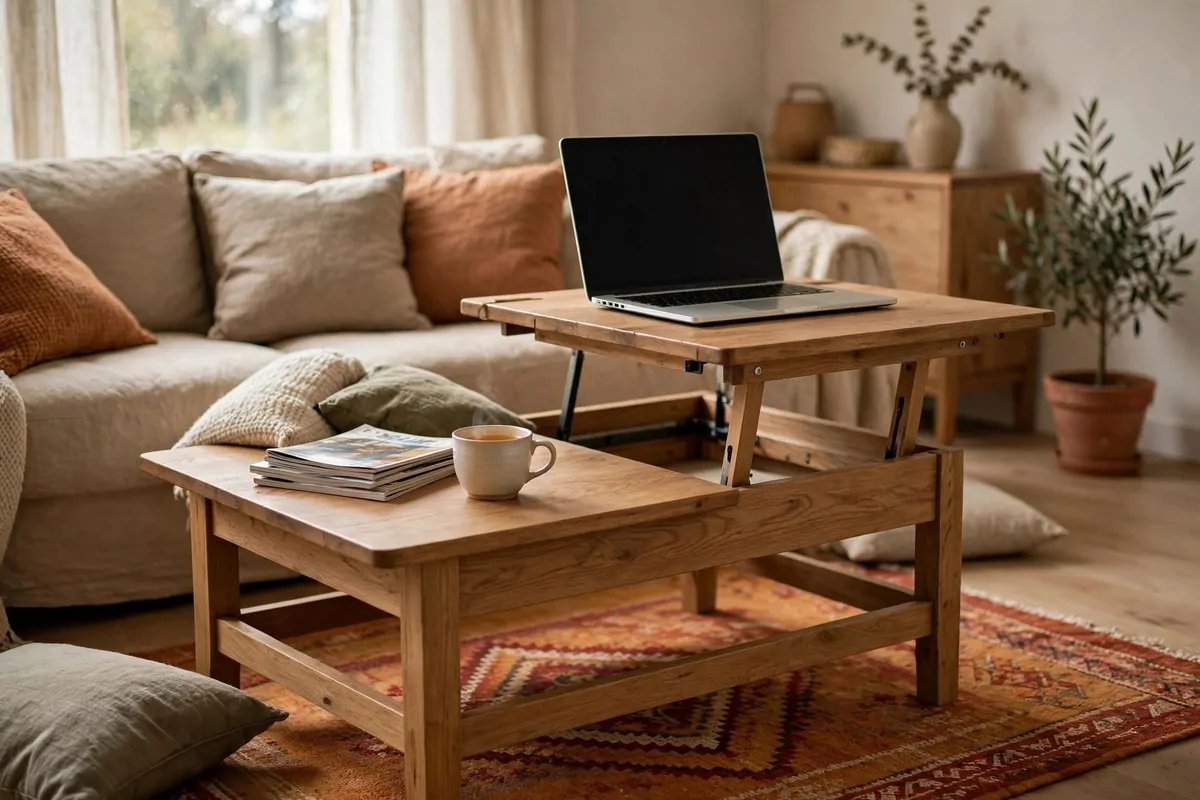
Your coffee table might already be a desk in disguise. Lift-top coffee tables have a top that rises and pulls toward you. Up, it is a work surface. Down, it is a coffee table. Nobody can tell.
I use mine for light work days. Emails, planning, reading. It is not for eight-hour typing marathons. But for half the work week, it is perfect, and my living room never looks any different.
The raised top sits at a comfortable height for typing from the sofa. Put a firm cushion behind your back. Feet up on nothing, laptop in front of you. It is the most relaxed office posture on this list.
Choose one with storage inside. Mine holds my laptop, charger, and notebook. When I am done, everything goes inside, the top goes down, and the table holds the TV remote and a candle like nothing happened.
This is the best idea for tiny living rooms. No extra furniture at all. The table you already needed just works harder. Zero new floor space required.
If you are buying one, test the lift mechanism in the store. Some are stiff and clunky. A smooth one lifts with one hand. You will use it daily, so it should feel easy, not like a gym exercise.
Style it like a normal coffee table. A small tray, a candle, a book. The office part only appears when the top rises. My guests have sat around it for months without knowing.
One honest limit. Your posture will not be perfect. Take breaks, stretch, and save the long work days for a real desk. This one is for light days and lazy mornings.
13. The Gallery Wall Anchor
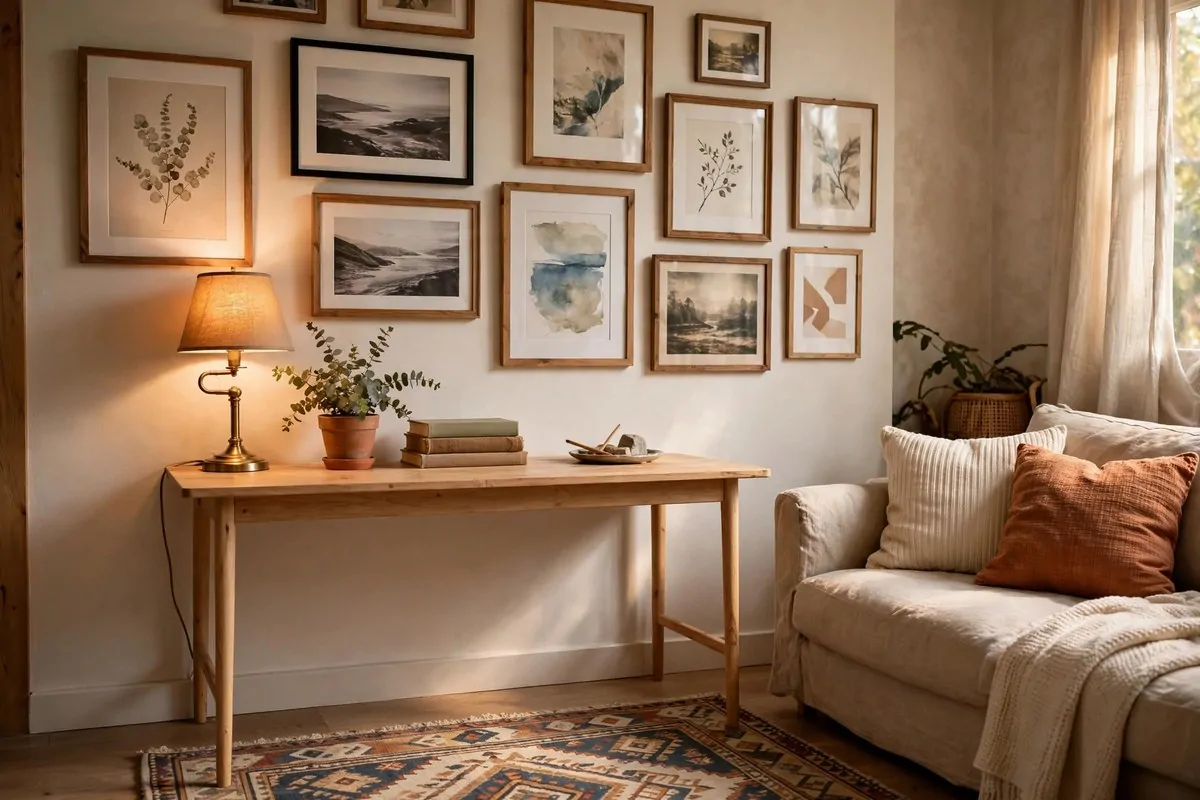
A desk under a great gallery wall stops looking like a desk. The art above it steals all the attention. People walk in and look at the pictures, not the laptop.
I built my gallery wall slowly, one frame at a time. Flea market finds, a photo I took on holiday, a print from a friend. The wall became the most interesting thing in the room. The desk below it just benefits.
Mix frame sizes and colors. Small ones, big ones, wood, black, gold. The organized chaos of a gallery wall reads as pure living room decor. It is the opposite of a corporate office, which is the whole point.
Hang the wall low enough to feel connected to the desk. The bottom frames should sit just above the desk surface. When art and desk touch like that, they become one unit in your eye.
Keep the desk styled to match the wall. A lamp, a plant, a stack of books with pretty covers. Your work stuff can live in a drawer or a box. The surface should look gallery-worthy.
This idea is also a great video call background. My gallery wall gets compliments on calls constantly. It looks curated and personal. Nobody thinks office. They think home.
Rotate the art sometimes. I swap two frames every few months and the whole corner feels new. It is the cheapest refresh in home decor.
The gallery wall works in any style. Minimal black frames for modern rooms. Mixy vintage frames for cozy rooms. The desk below just goes along for the ride.
14. The Chair That Looks Like It Belongs to the Living Room
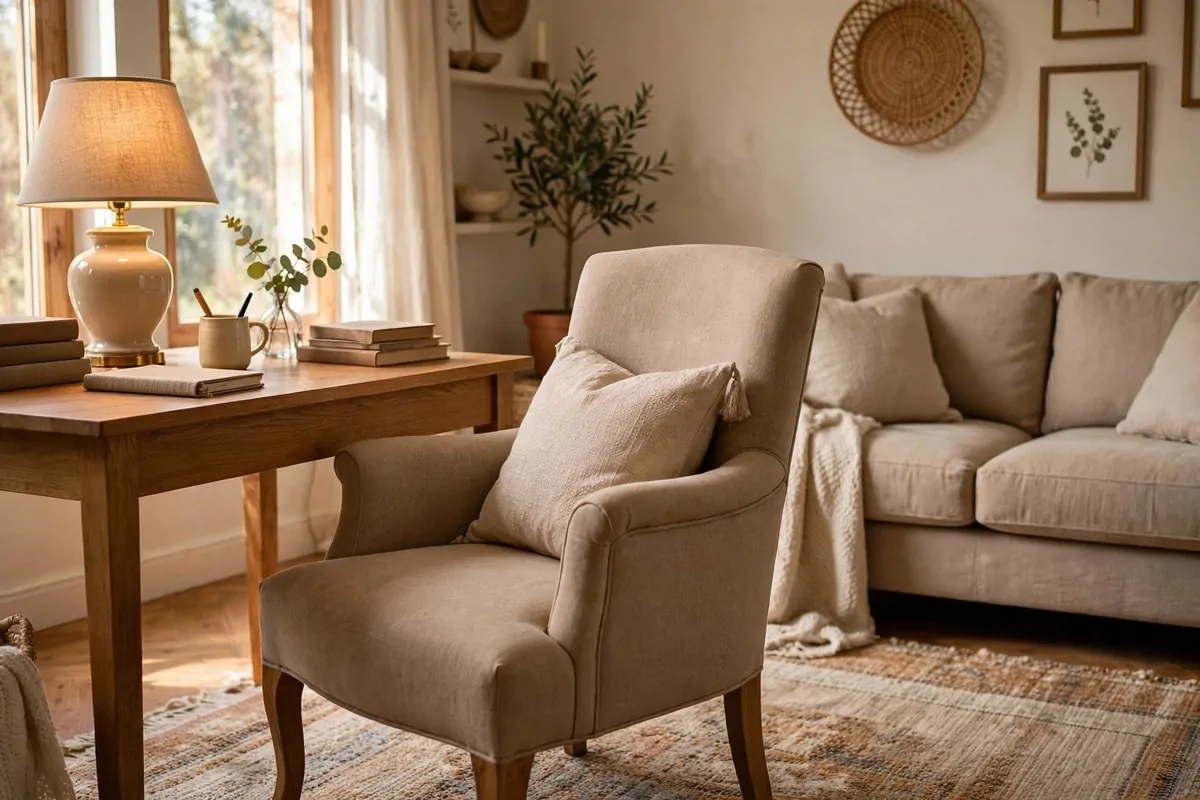
Nothing says office faster than a big black rolling chair with armrests. So do not use one. Use a chair that looks like it belongs in a living room.
I swapped my office chair for an upholstered dining-style chair in a soft fabric. Same color family as my sofa. From across the room, it looks like extra seating. It is extra seating. It just happens to be where I sit to work.
Comfort matters, so choose well. Look for a chair with a padded seat and a back that supports you. You can add a small lumbar cushion behind you. Mine is from a home store, not an office store, and my back is fine.
Add a throw pillow to it. This one detail does so much. A pillow turns any chair into living room furniture in the eyes of every guest. Pick one that matches your sofa cushions.
Wooden chairs work too if they match your other wood. A simple wooden chair with a flat cushion is classic and light. It slides under the desk easily, which keeps the room tidy.
Here is the honest trade. A pretty chair will not adjust in twelve ways like an office chair. Take walking breaks. Stand up between meetings. Your body will tell you what it needs.
If you game the system a little, you can have both. I keep my comfy office chair in the bedroom for long work days, and the pretty chair lives at the living room desk. Best of both worlds.
The chair is the single fastest way to change how your setup reads. Swap the chair, and a home office becomes a living room corner. Try it this weekend.
15. The Rug That Draws the Line
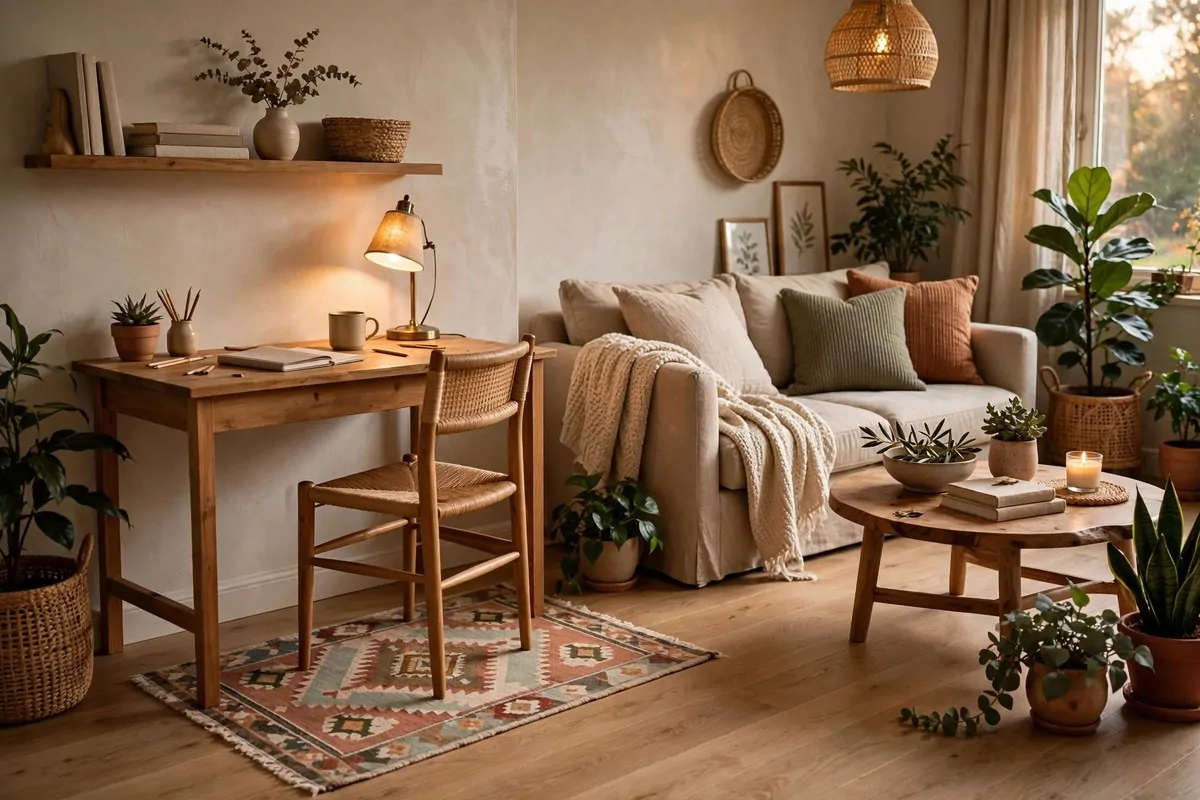
A rug under your desk draws an invisible line. On one side is the office. On the other side is the living room. No walls, no dividers, just a rectangle of fabric doing the zoning work.
I put a small patterned rug under my desk and chair. The rest of the room has a bigger neutral rug. The contrast quietly says, this corner is its own little world. Guests feel it without knowing why.
Choose a rug that fits under the desk and lets the chair roll or slide on it. Flat-weave rugs work best. Thick shag will fight your chair wheels and drive you crazy. Ask me how I know.
The rug also softens the sound. Typing, chair scraping, all of it gets quieter on fabric. In an open living room, that matters. The whole room feels calmer.
Match the rug to your room, not your office. Pick colors from your curtains or cushions. The work zone should feel like it grew out of the living room, not like it landed there from somewhere else.
This trick helps your brain too. When I sit on the rug, I am at work. When I step off it, I am home. It sounds silly, but that little border became my commute. Off the rug means the day is done.
Rugs are easy to change. If you get tired of the look, roll it up and try another one. No drilling, no painting, no commitment. Decorating with training wheels.
One practical note. Get a rug pad underneath. It keeps the rug from sliding when you push your chair back. A sliding rug under a desk is a daily annoyance you do not need.
16. The Statement Pendant That Zones the Desk
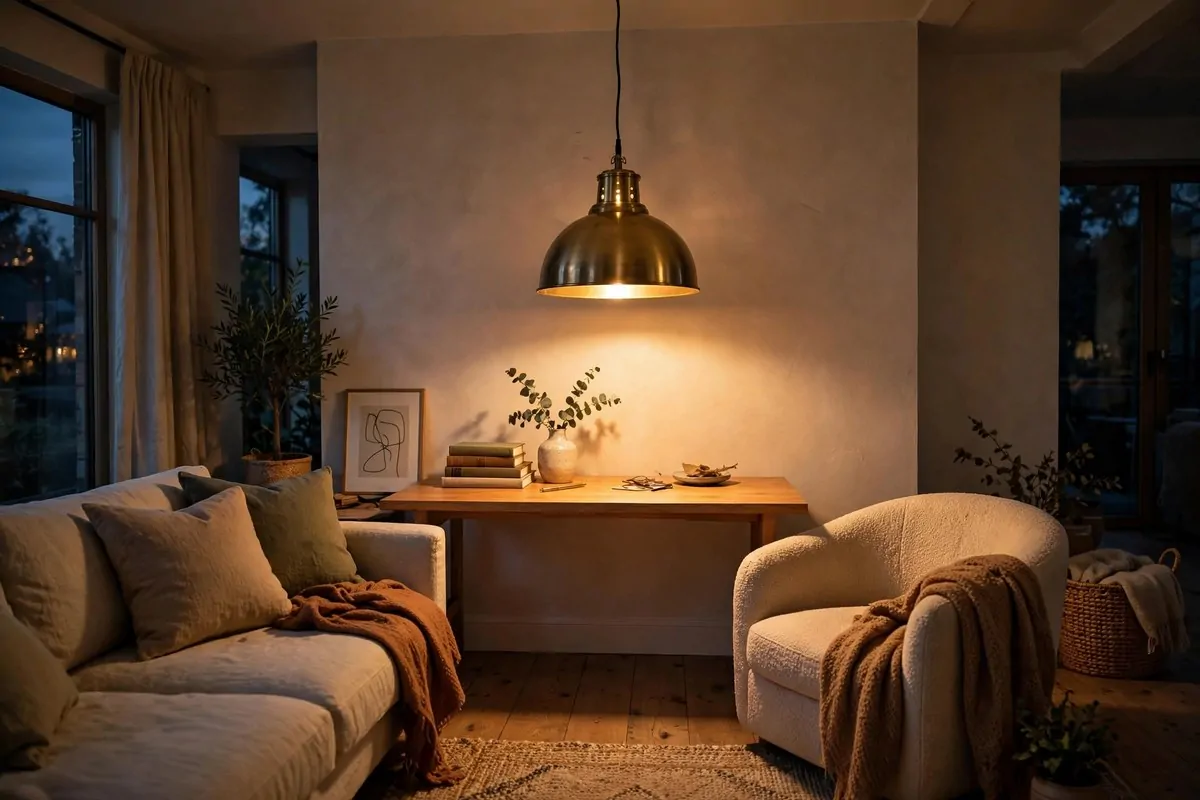
Hang a beautiful pendant light over your desk and watch what happens. The light becomes the star. People notice the lamp, not the laptop. The desk becomes a styled corner instead of a workstation.
I hung a simple brass pendant over mine. It cost less than a nice dinner. Now that corner is the prettiest spot in the room at night. The warm pool of light makes the desk look like a reading nook.
The pendant also gives you real task lighting. Overhead room lights are too flat for working. A pendant right above the desk puts light exactly where your hands are. Fewer headaches, happier eyes.
Pick a style that fits your room. Here is how I think about it.
| Your room style | Pendant to try |
|---|---|
| Modern and clean | Simple black or white dome |
| Warm and cozy | Rattan or woven basket shade |
| Classic and elegant | Brass or gold metal shade |
| Eclectic and fun | Colored glass or paper globe |
Hang it low enough to feel intentional, about two feet above the desk. Too high and it lights the whole room. Too low and you will bump your head. Measure from the desk surface.
Use a warm bulb. Cool white bulbs feel like a dentist office. Warm light feels like a living room. This tiny choice changes the whole mood after dark.
If you rent and cannot wire a new light, use a plug-in pendant with a long cord. They hang from a ceiling hook and plug into a wall outlet. The cord can be part of the look if you pick a nice fabric one.
At night, turn off the big overhead light and just use the pendant. The desk corner glows, the rest of the room goes soft. It feels like evening in a cafe. I love working late like this.
17. The Desk on Wheels You Can Roll Away
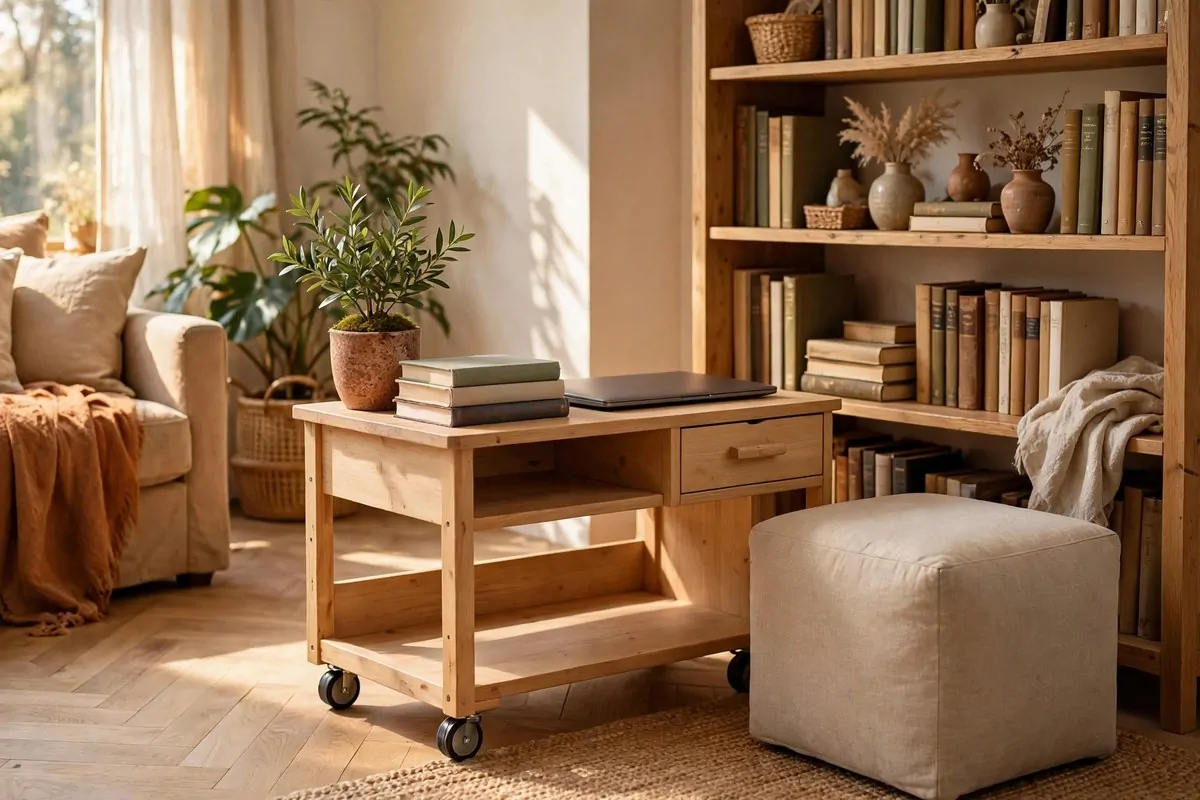
Some days you need an office. Some days you need a living room for a party. A desk on wheels gives you both. Roll it out to work, roll it away to play.
I have a small wooden desk on caster wheels. In the morning it sits by the window where the light is good. In the evening I roll it beside the bookshelf and throw a cloth over it. It becomes a side table with a plant on top.
Locking wheels are a must. Lock them while you work or the desk will drift every time you lean. Mine has little foot brakes. One tap with your toe. Easy.
Keep the top styled and light. A laptop, a small lamp, a notebook. If the desk is too heavy or too cluttered, you will stop rolling it. The whole point is that moving it feels effortless.
The wheels should match your floor. Hard wheels for rugs, soft wheels for wood floors. The wrong wheels will scratch or get stuck. Check the little label when you buy them.
This is a great pick for open-plan rooms where the layout changes a lot. Movie night? Roll the desk to the corner. Guests coming? Roll it behind the sofa. You are the boss of your floor plan.
One more idea. A rolling cart works as a mini desk too. The top holds your laptop, the shelves below hold supplies. When work ends, roll the whole thing into a closet. The living room is untouched.
Wheels make the desk feel temporary, and temporary is the secret to blending. A desk that can leave never overstays its welcome.
18. The Closet That Became an Office
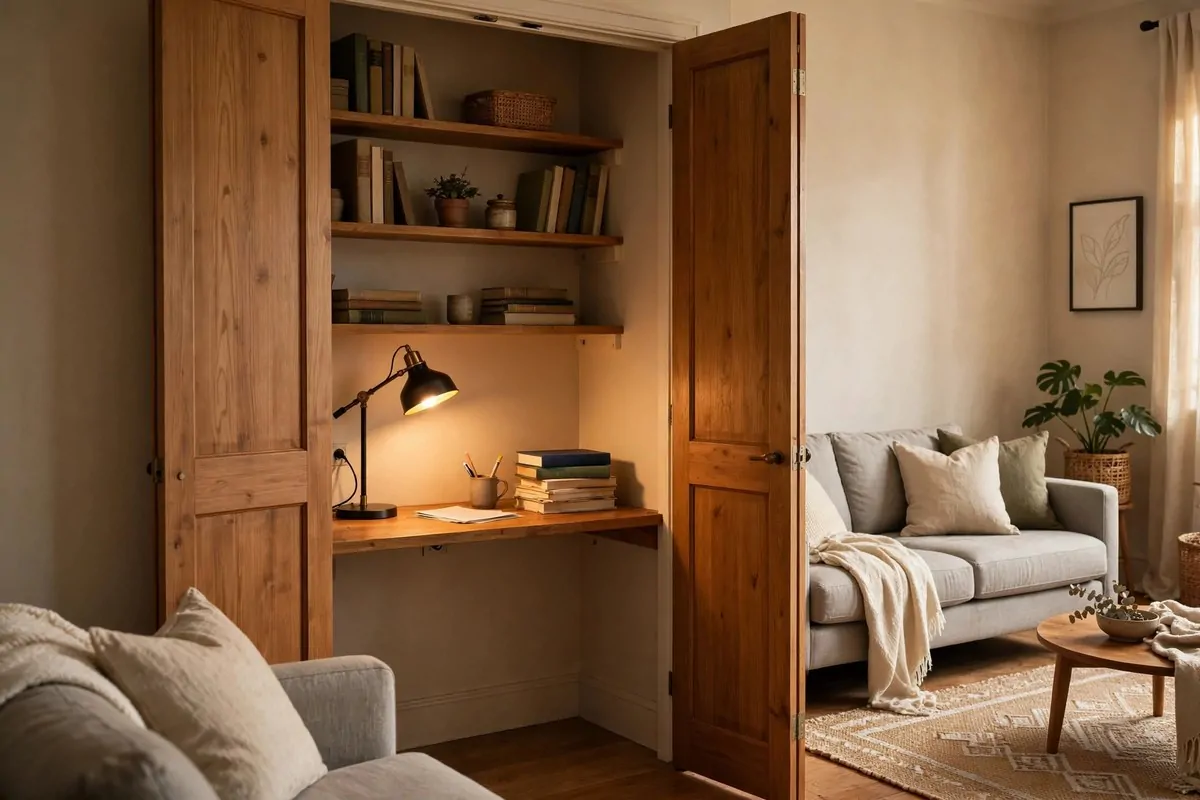
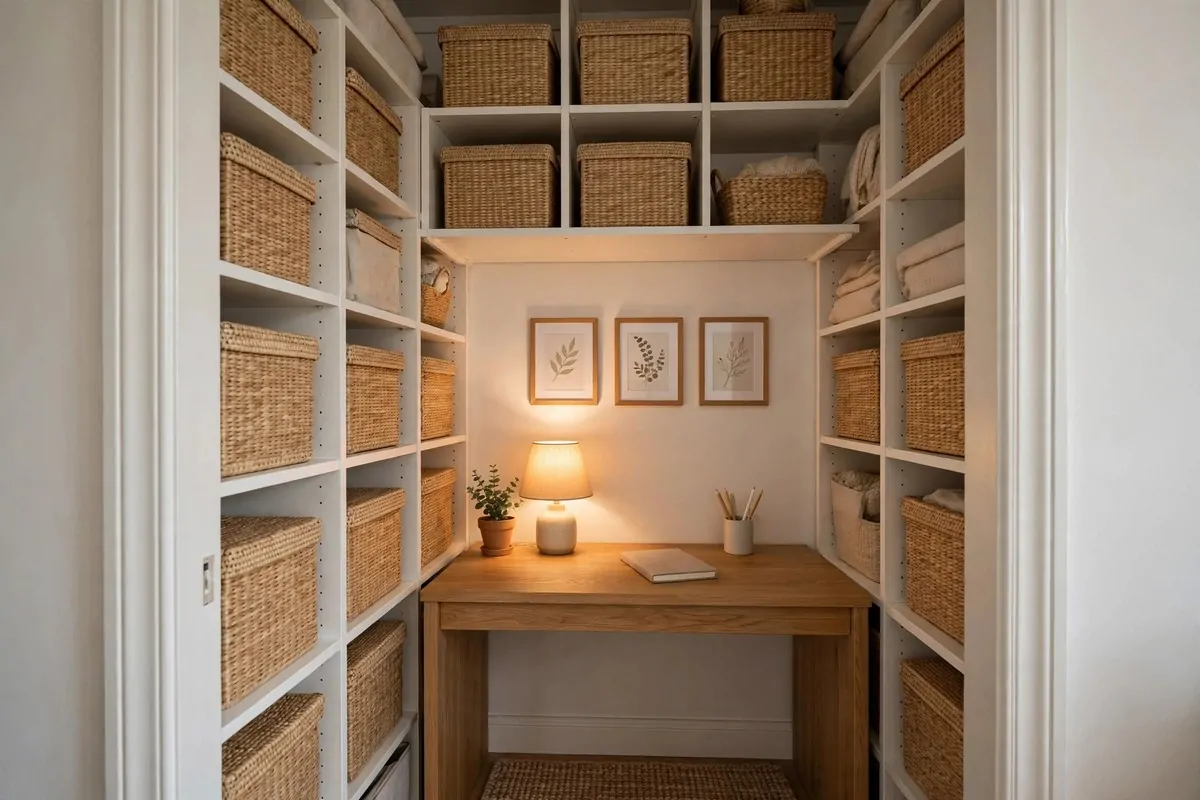
If your living room has a closet, you might already own an office with a door. Take out the stuff you never touch, add a desk board and a light, and you have a workspace that closes shut.
I helped my sister do this in her living room closet. We cleared the coats, put a wood board across at desk height, added a plug-in light and two shelves. Her office now hides behind closet doors. When guests visit, they see a closet. That is all.
Paint the inside a light, happy color. Closets are dark boxes, and a coat of white or soft yellow paint makes a huge difference. It feels bigger instantly. We painted hers on a Sunday morning.
Add real lighting. A closet has no window, so a good lamp is not optional. We used a small plug-in wall light and a desk lamp. Two light sources, no dark corners.
The doors are the magic. Close them and work disappears completely. No laptop in sight, no papers, nothing. It is the most complete hide on this list. Your living room keeps one hundred percent of its living room-ness.
Keep the closet office simple. Laptop, notebook, a few supplies on the shelves. If it gets crammed, the doors will not close nicely, and the magic breaks. Less is more in here.
Ventilation is worth thinking about. Closets get warm with a laptop running. Leave the doors open while you work, close them when you are done. Simple rhythm.
This one takes a weekend of work, but it lasts for years. My sister has used hers daily for two years now. Best weekend project she ever did, in her words.
19. The Console Table That Doubles as a Desk
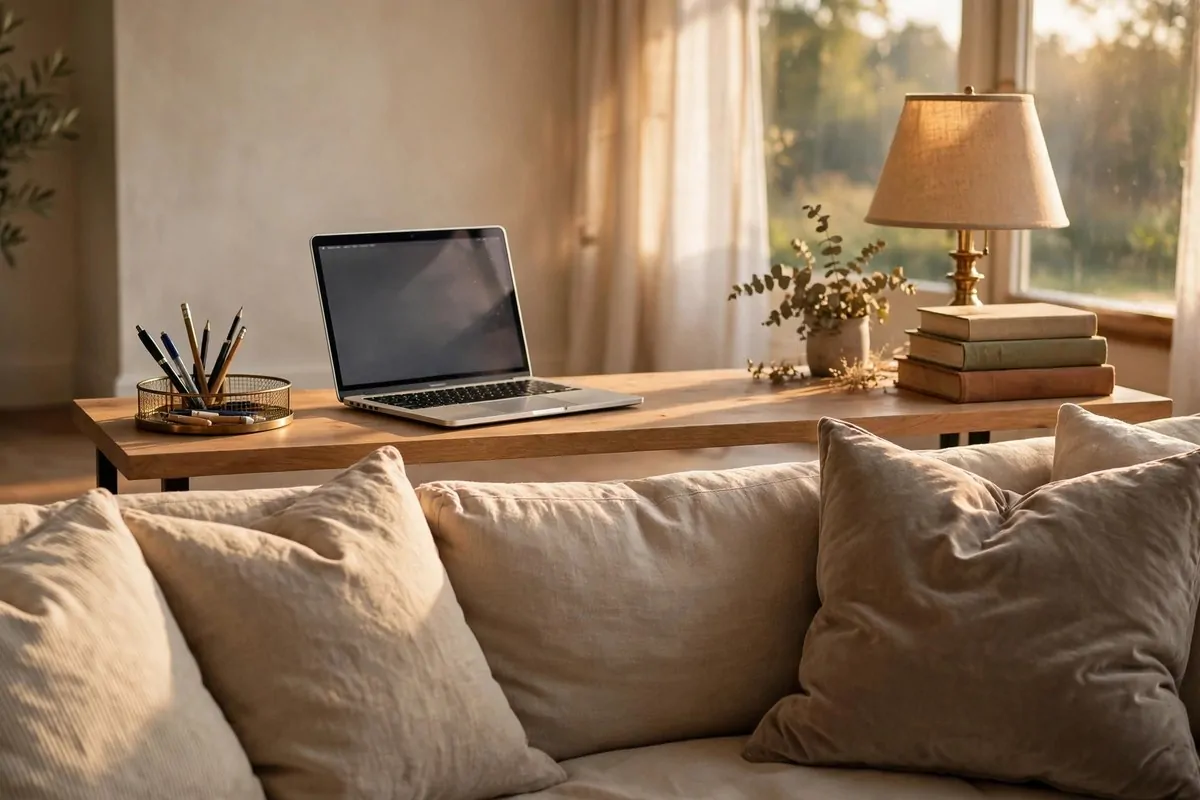
A slim console table is already halfway to being a desk. It is the right height, the right depth, and it lives against walls and behind sofas looking pretty. All it needs is you and a laptop.
I keep a console table behind my sofa that does double duty. Most of the time it holds a lamp, books, and a little tray for keys. When I need to work, I clear one end and open my laptop. Thirty seconds of setup.
This is perfect for people who work from home only sometimes. If your office days are two or three a week, you do not need a permanent desk. You need a surface that moonlights.
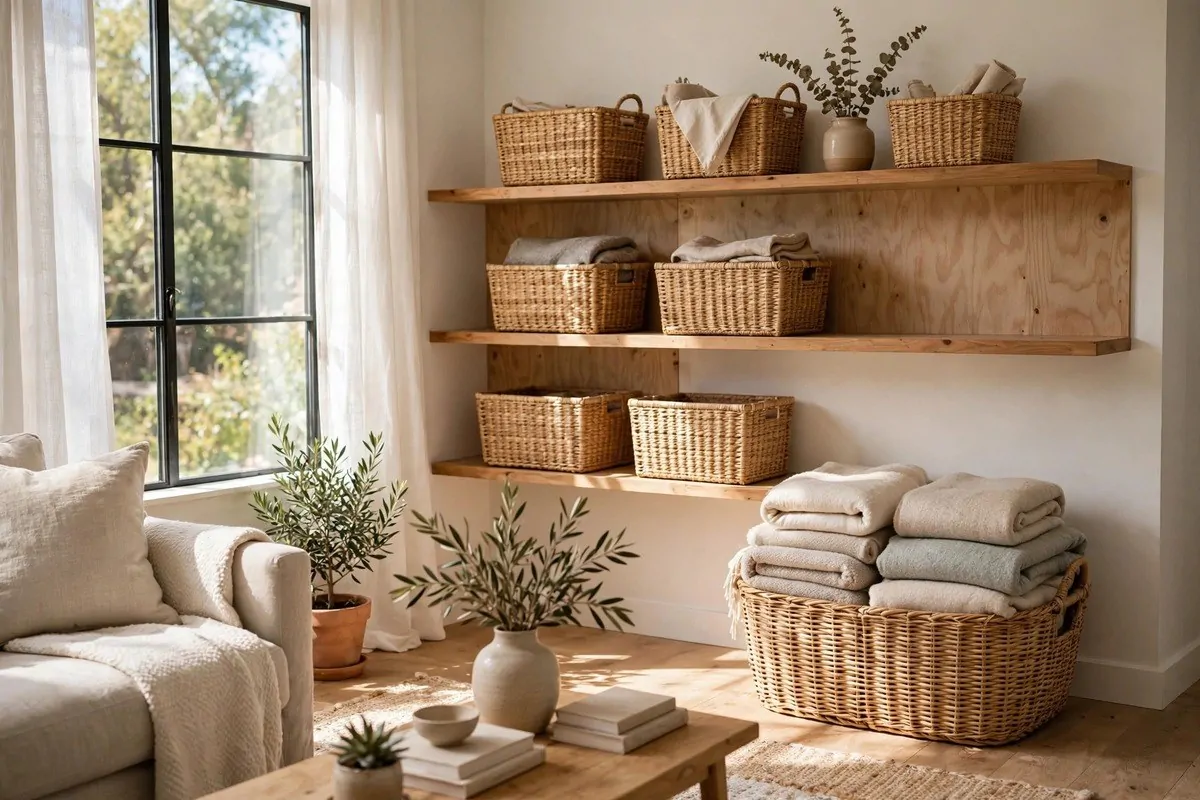
Keep a small basket or drawer nearby for your work things. Laptop, charger, notebook, pens. One basket, everything inside. Grab it, sit down, work. Put it back when you are done. That basket is your whole office.
Style the table like a console always. Lamp at one end, books in the middle, a plant or a photo frame. The work setup is a guest that visits and leaves. The decor is the permanent resident.
A stool or a dining chair that slides under the table completes it. When the chair is pushed in, the table reads as pure decor. Nobody looks twice.
This is also the cheapest idea here if you already own a console table. Which most living rooms do. Look behind your sofa right now. You might already have a desk and not know it.
20. The Cord-Camouflage Plan
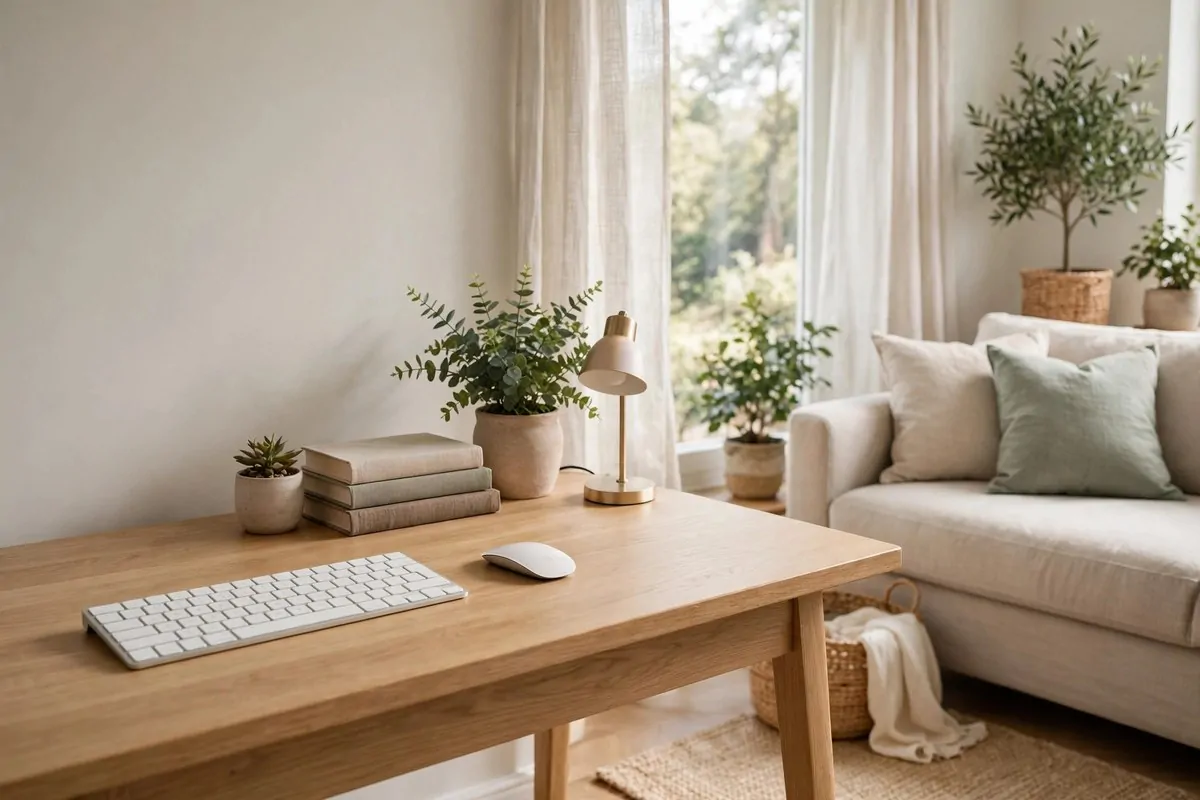
Cords are the one thing that can ruin every other idea on this list. A beautiful blended desk with cables snaking everywhere still looks like an office. Hide the cords and the illusion is complete.
I spent one Saturday on my cords and it was the highest-impact hour of my whole setup. Here is the whole plan.
- Use a wireless keyboard and mouse. Two cords gone instantly.
- Plug everything into one power strip behind the desk. One cord to the wall instead of five.
- Run cords down the back leg of the desk with little clips. They cost almost nothing.
- Try a fabric cord sleeve for the bunch that runs to the wall. It looks like a tidy tube, not spaghetti.
- Put the power strip in a small box or behind a basket. Out of sight, still reachable.
Route cords along the floor behind furniture. Behind the sofa, under the rug edge, along the baseboard. The cord path should never cross open floor. That is the rule.
Charge devices in a drawer. I put a power strip inside my desk drawer with a little hole drilled in the back. Phones and earbuds charge out of sight. The desk surface stays clean.
Go wireless where you can. Printer, speakers, headphones. Every wireless swap is one less cord to hide. I know printers are stubborn, but most new ones connect without a cable now.
Label your cords with little tags. It sounds fussy, but when you need to unplug one thing, you will thank yourself. I use masking tape and a pen. Very fancy. Very effective.
Do this one idea and every other idea on this list works twice as well. Cords are the tell. Remove the tell and nobody guesses.
21. The Desk Dressed Up Like Living Room Decor
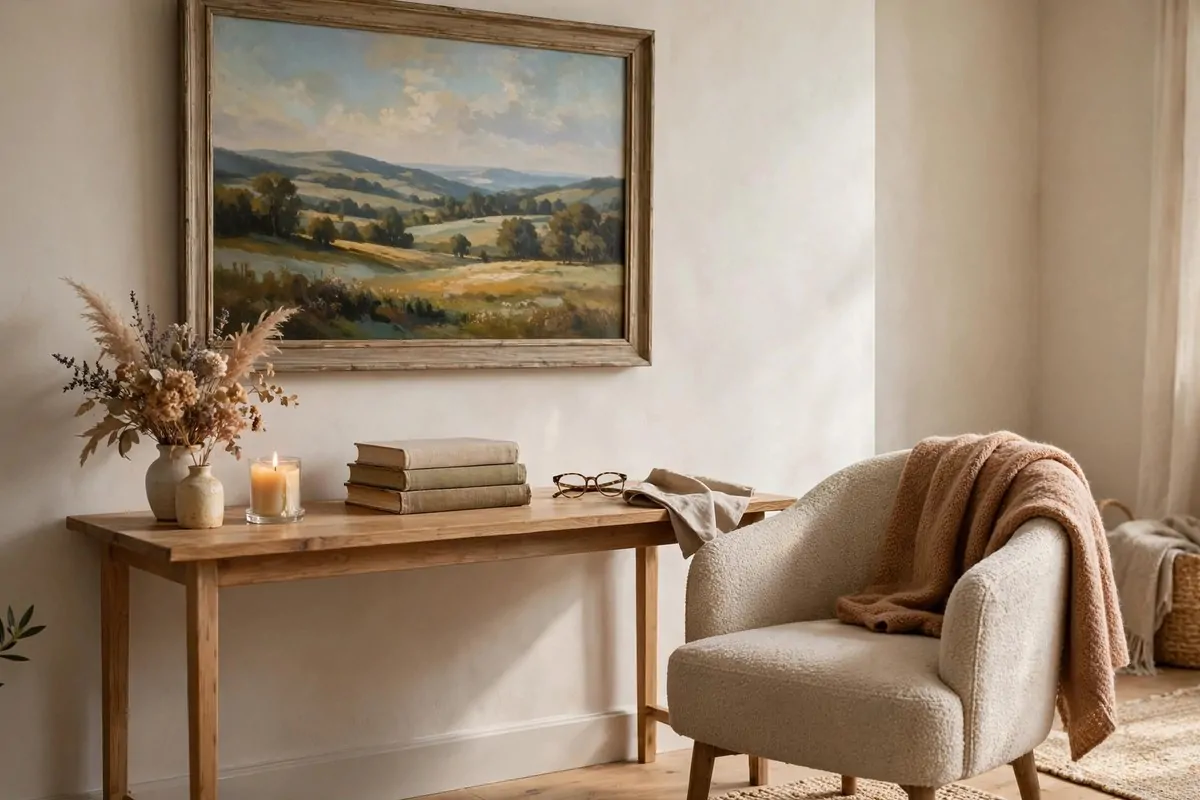
The last idea is not about furniture at all. It is about styling. Dress your desk like a living room surface and it becomes one, at least to every eye that walks in.
Think about what sits on your side tables. A candle. A small vase. A stack of pretty books. A framed photo. Now put those same things on your desk. The desk stops looking like a workstation and starts looking like a styled vignette.
I keep my laptop on a wooden tray. When I close it, the tray just looks like a decorative board. Around it sit a candle, a small plant, and two art books. If you walked in right now, you would see a pretty corner, not an office.
Hang art above the desk, not a whiteboard. A big framed print does more blending work than any furniture swap. It tells the room, this wall is for looking at, not for working under.
Use pretty containers for office things. Pens in a ceramic mug. Paper clips in a tiny bowl. Sticky notes in a wooden box. The rule is simple. If it would look odd on a coffee table, hide it in something that would not.
Keep one third of the desk surface clear of work stuff at all times. That breathing room is what makes it read as decor. A desk buried in papers can never blend, no matter how pretty the lamp is.
This styling trick stacks with every other idea here. Behind-the-sofa desk plus pretty styling? Invisible. Glass desk plus pretty styling? A showroom. The styling is the finishing layer.
And here is my favorite part. A well-styled desk makes you want to sit down and work. It is not just camouflage. It is motivation disguised as decor.