22 Home Office Nook Designs Tucked Into Tiny Corners

A desk in a corner is not a home office nook. I will tell you the difference, because once you see it, you will spot it everywhere.
A desk in a corner is just furniture pushed against a wall. It wobbles a little. The chair bumps the radiator. There is nowhere to put your papers, and the corner still feels like a dead spot in the room. A home office nook is different. It is a corner that started working for you. The light is right. Things have a place. You sit down and your brain knows it is work time.
You do not need a spare room to get that feeling. You need a corner, a flat surface, and a few smart choices. I have looked at dozens of real nook setups in tiny flats, busy family homes and rented apartments. The best ones all share the same secret. They use the corner on purpose, not by accident.
These 22 home office nook designs do exactly that. Each one fits into a corner you already own. Pick the one that matches your space, your budget and your day.
1. A Floating Desk That Leaves the Floor Empty
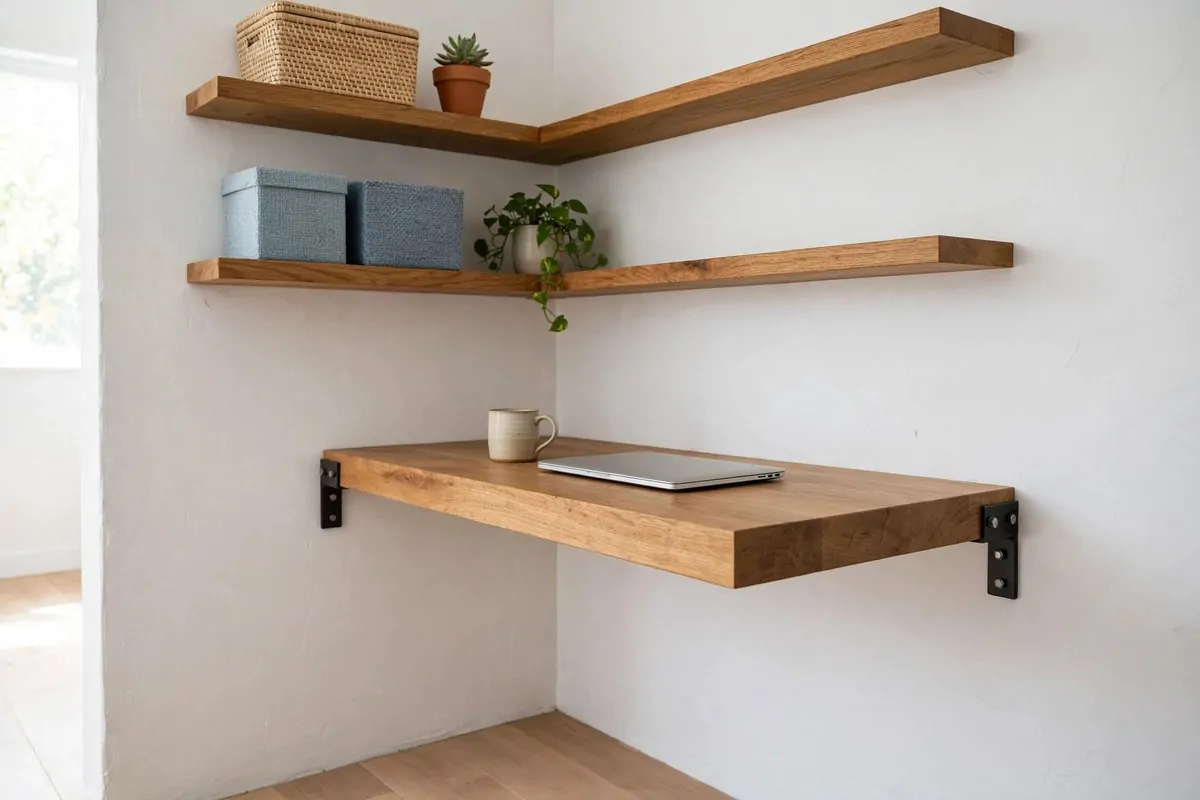
A floating desk is just a strong shelf bolted to the wall at desk height. It sounds too simple to work. But in a tiny corner, it is pure magic.
The reason is the floor. A normal desk has legs, and legs chop the floor into pieces. Your eyes read the corner as full. A floating desk leaves the whole floor visible underneath. The corner suddenly looks bigger.
You can slide a basket under it for cables and chargers. You can tuck your chair all the way in when you finish. The cleaning is easier too. One sweep of the broom and you are done.
Mount it into wall studs, not just plaster. I cannot say this enough. A wobbly desk will drive you mad in a week. Two solid brackets into studs will hold a laptop, a lamp and your coffee for years.
Add two or three floating shelves above it. They hold your books, your boxes and your little plant. The desk stays clear. The wall does the storing.
Keep the desktop slim. Around forty to fifty centimetres deep is plenty for a laptop and a notebook. Any deeper and it will eat the corner.
A chair with no arms slides under best. Arms catch on the desk edge and leave the chair sticking out. A simple chair keeps the whole nook tidy.
This setup costs less than most desks. A butcher block offcut, two brackets, some paint. It is the cheapest home office nook on this list, and it looks like you hired someone clever.
One more tip. Run a small cable tray under the desk. Floating desks show every wire from below. One tray keeps it all hidden and the nook looking sharp.
2. The L-Shaped Desk That Hugs Both Walls
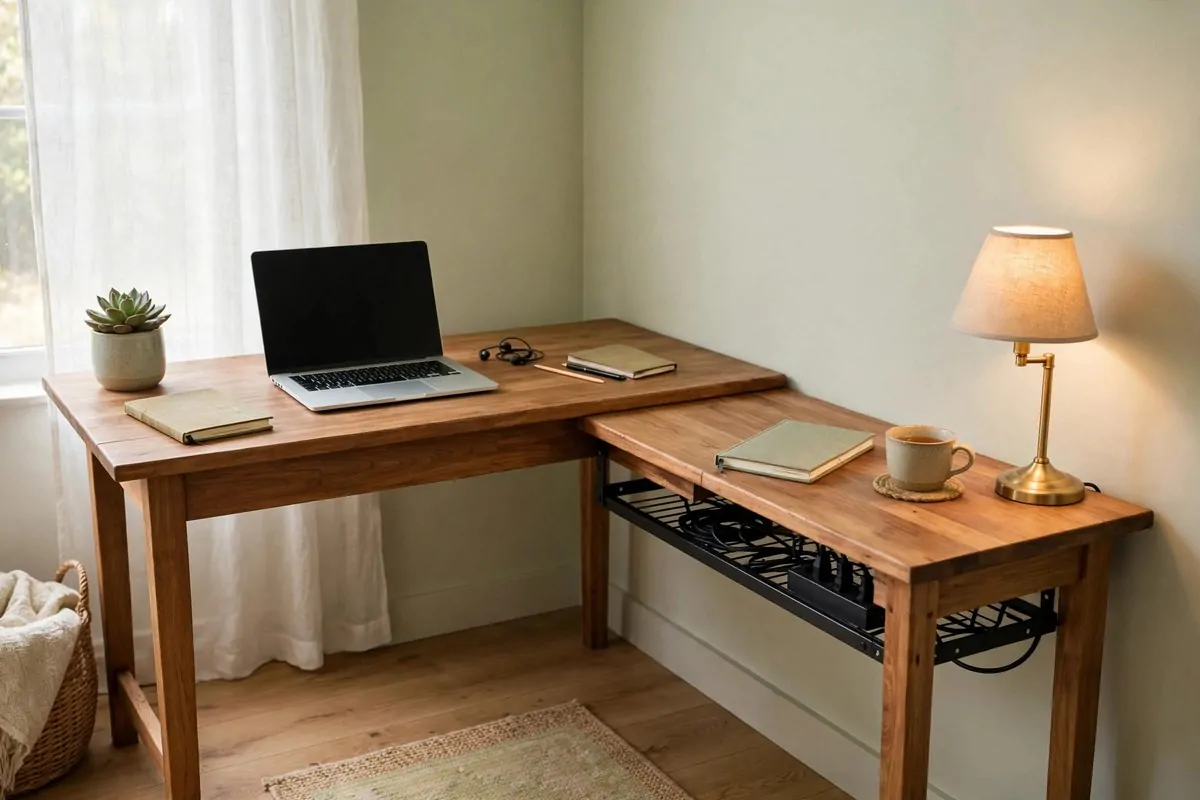
Corners are shaped like the letter L. So desks shaped like the letter L fit them best. It is almost too obvious.
An L-shaped desk gives you two work zones in one corner. Put your laptop on the long arm. Use the short arm for your notebook, your tea, your phone. Your hands barely travel.
It also gives the nook a finished feel. Two walls dressed with desk look planned, not random. It stops the corner from looking like a dumping spot.
Measure the corner first. L desks come in different arm lengths. You want a few centimetres of breathing room on each side. Cramming it wall to wall looks heavy.
Cable management matters more here. Two work zones mean twice the wires. Clip a cable tray under the longer arm. It will save your eyes every time you look down.
Sit facing the longer arm with the short arm on your writing side. If you are right handed, the short arm goes right. Your body will thank you.
The corner joint is the weak spot. Cheap L desks dip in the middle. Put a small leg or bracket right at the corner. It takes five minutes and stops the sag forever.
Add one tall shelf at the far end of the short arm. It balances the shape. The whole nook reads as one neat unit.
This design suits people who spread out. If your desk usually has five things on it at once, you need the extra arm. You really do.
3. A Corner Window Desk With Light From Two Sides
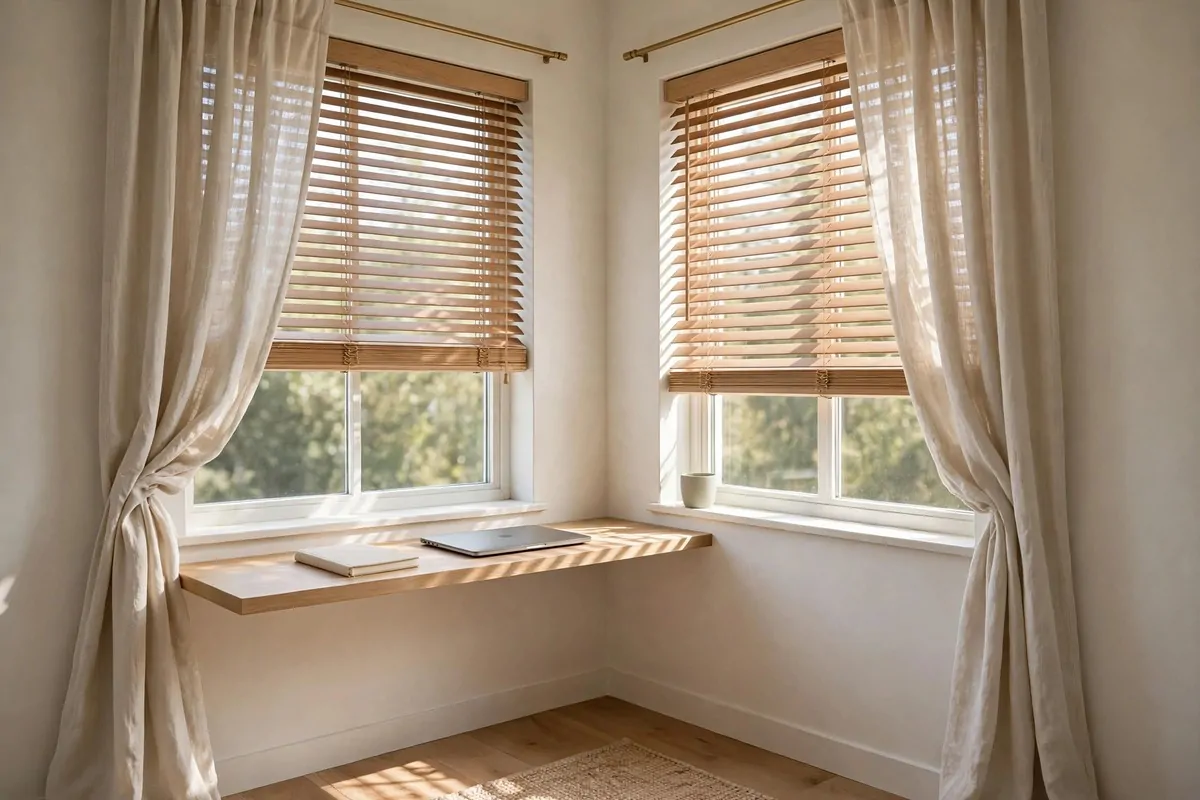
If your corner sits between two windows, you are lucky. Light from two sides is the best light you can get for free. It beats any lamp.
Put the desk right under the window line, low enough that you see out over your screen. Your eyes get to rest on the street or the trees. That rest is gold for long work days.
Glare is the enemy here. Face the desk sideways to the windows, not straight at them. The light falls across your screen instead of straight into it. Your eyes stay relaxed.
Fit blinds you can tilt. Mid afternoon sun can be brutal. Tilted blinds soften it. They still let the daylight in. I keep mine half tilted most days.
A narrow desk works best under windows. The window frame already sets the height limit. A slim top, around thirty five centimetres deep, fits a laptop nicely.
Keep the window ledges clear. They become the overflow shelf for pens and plants. Do not crowd them. A clear ledge keeps the light flowing.
Curtains beat heavy blinds in a nook like this. A light linen panel softens the sun and hides nothing of the view. Pull them at lunch when the sun peaks.
One thing to watch. Check the radiator under the window. In winter it will cook your legs. Move the chair back a touch, or hang a small heat reflector behind it.
This nook feels like a reward. You sit down, the world goes by outside, and your work gets done in real daylight. I love it.
4. The Slim Desk Behind Your Sofa
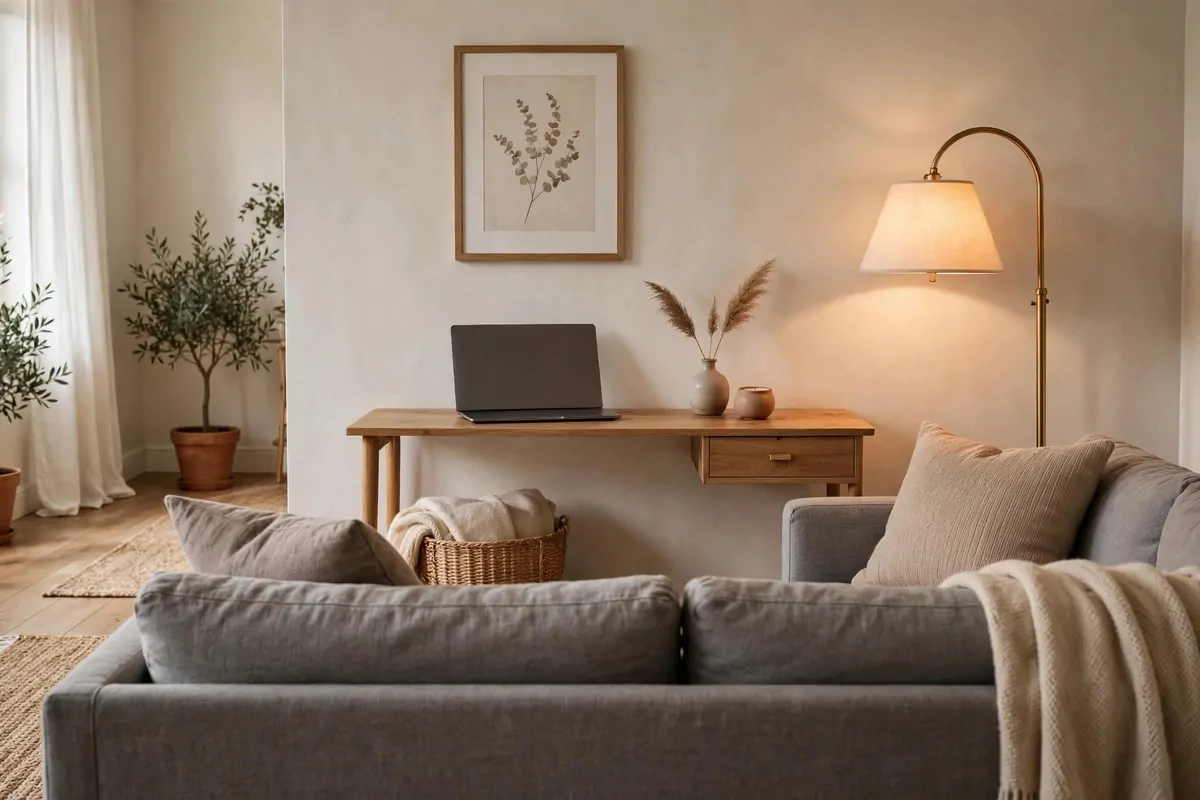
The wall behind your sofa is almost always wasted. It is too narrow for a bookcase. Too plain to leave bare. It is a nook hiding in your living room.
A slim console desk turns that strip into a real office. It sits right behind the sofa, close enough to touch. You work facing the room instead of a wall.
Pick a desk no deeper than thirty centimetres. It must not push the sofa forward. You want the walkway around it to feel normal.
Face your chair toward the sofa back. Sounds odd. But it puts your back to the room traffic and your eyes on your screen. Nobody sneaks up behind your video calls.
Store the office gear in the desk. One drawer for cables. One basket under the desk for papers. When work ends, everything drops into its home and the desk looks like a normal console table.
Hang one picture or shelf above it. That one move tells the room this is a work spot, not a random table. It gives the nook a little frame.
Match the desk to your living room style. Same wood tone as your coffee table. Same colour as your shelves. Then the office blends in instead of shouting.
The best part is the disguise. Guests see a nice console table. You see a full desk. Your living room stays a living room.
5. An Office Hidden Under the Stairs
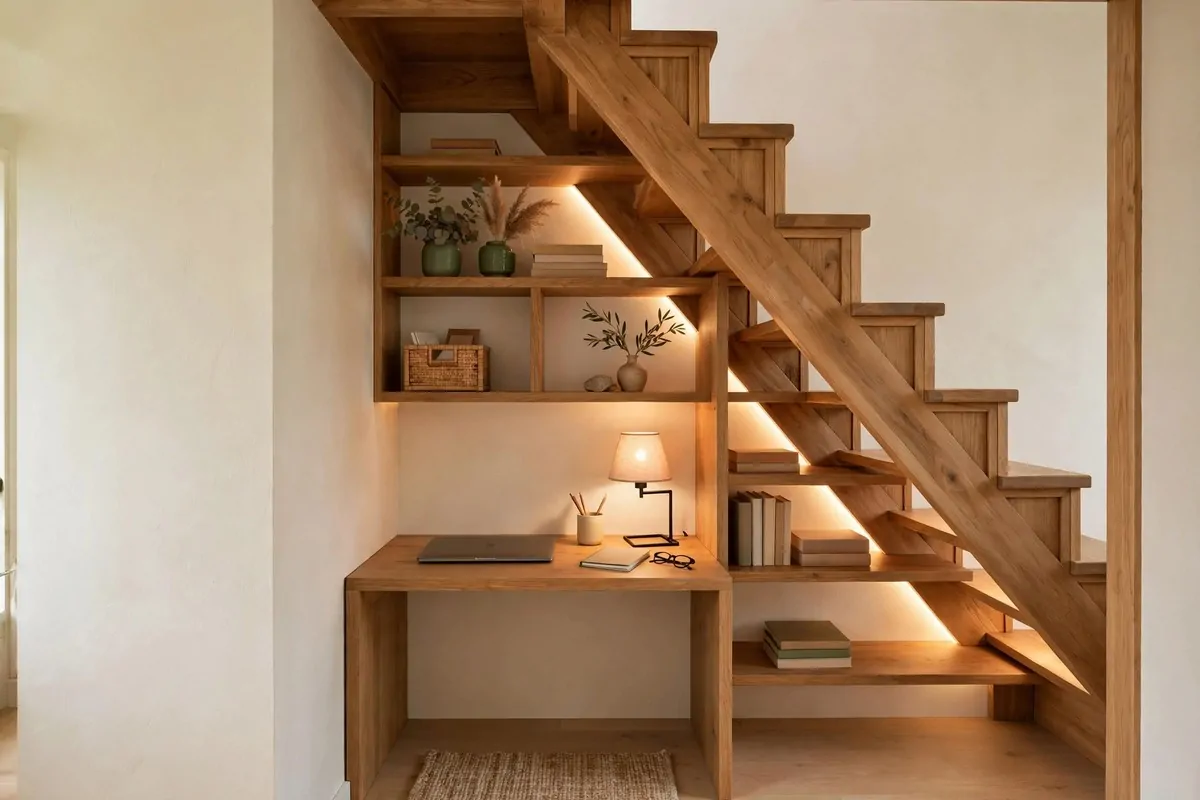
The space under the stairs is the most wasted spot in most houses. Boxes go there. Forgotten things go there. Almost nobody sees it as an office. They should.
Sit down and the low ceiling stops being a problem. It becomes a cozy shell around you. The world narrows to your screen and your lamp. Focus gets easy.
Use a desk that follows the stair slope. Deep on the high side, shallow on the low side. A carpenter can cut one for you, or you can use two box shelves stacked.
Shelves fit the slope too. Short shelves near the low end, tall shelves near the tall end. It looks custom made because it follows the shape of the house.
Lighting is the big job here. Under stair spots are dark. Put a warm LED strip along the underside of the stairs. It throws soft light right onto your desk. Add a small desk lamp for task work.
Paint the inside light. White or pale cream bounces what little light you have. A dark stair nook feels like a cupboard. A light one feels like a hideout.
Check headroom where you sit. You need to stand up without a bump. Sit in your chair and mark the ceiling with tape. If your head clears it with room to spare, you are fine.
Storage goes in the deep end. Stacked boxes on the tall side hold files and gear. They use the dead depth that a desk cannot reach.
This is my favourite nook for people who get distracted. It has no view to stare out of. It has no walkway behind you. It is just you and the work.
6. The Hallway Nook You Walk Past Every Day
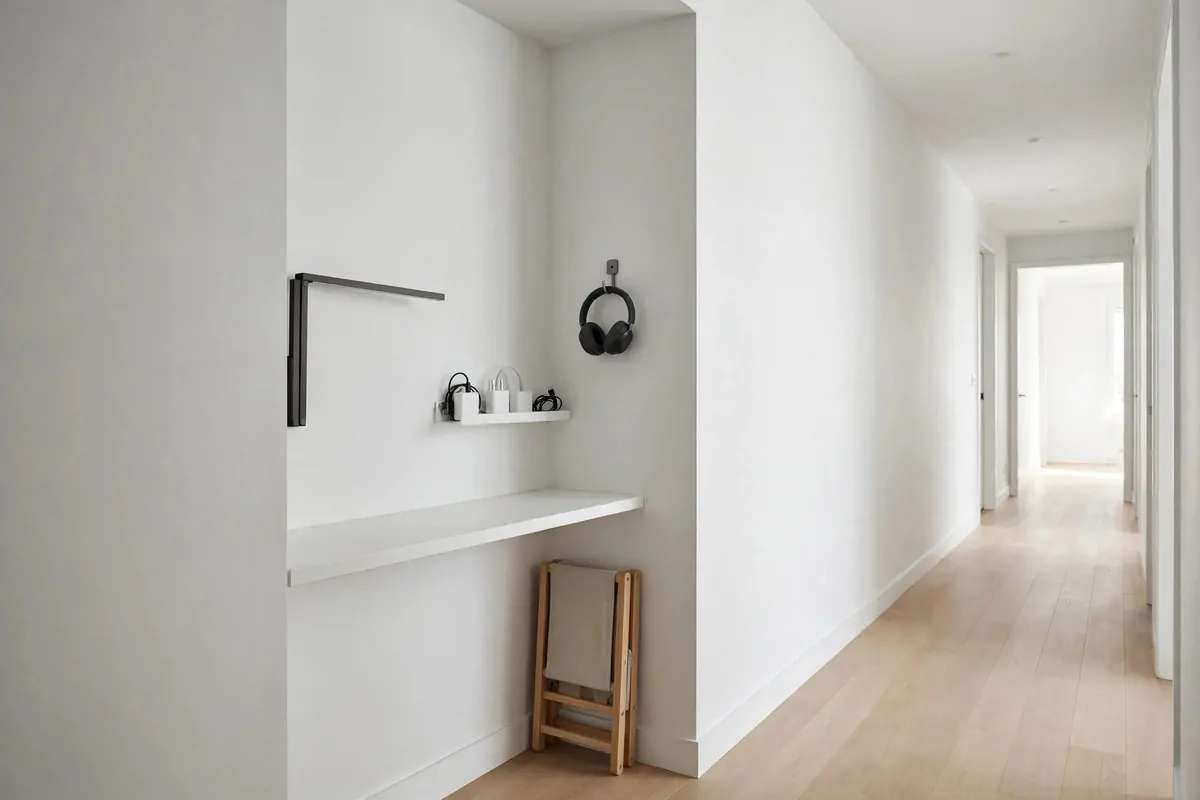
A wide hallway has a corner in it. You just never noticed, because you walk through it thinking about where you are going.
Look for the wider part. Near the front door. Beside the bathroom. Where the hall turns. A shallow desk fits there, and it never blocks anyone.
Go shallow or go home. Thirty centimetres deep is the max. Anything more turns a hallway into an obstacle course. A wall mounted shelf at desk height works perfectly.
Skip the big office chair. Use a slim stool or a folding chair. It tucks flat against the wall when you stand up. The hallway stays a hallway.
Mount a wall lamp instead of a desk lamp. Hallway desks have no room for lamp bases. A swing arm lamp folds flat against the wall. It gives you light and takes zero desk space.
Keep everything wall hung. A slim file holder. A small shelf for chargers. A hook for your bag. The floor stays empty and the walkway stays wide.
Noise is the trade off. Hallways carry sound. Headphones fix that. I keep a cheap pair hanging on a hook right there.
This nook suits quick work best. Answering emails. Paying bills. Planning the week. It is not for deep all day work, but for an hour or two it is perfect.
The bonus is the view. Hallway nooks face interesting things. Windows. Art. The front door. Your work hours get little moments of life passing by.
7. A Bench Seat With a Desk Running Into the Corner
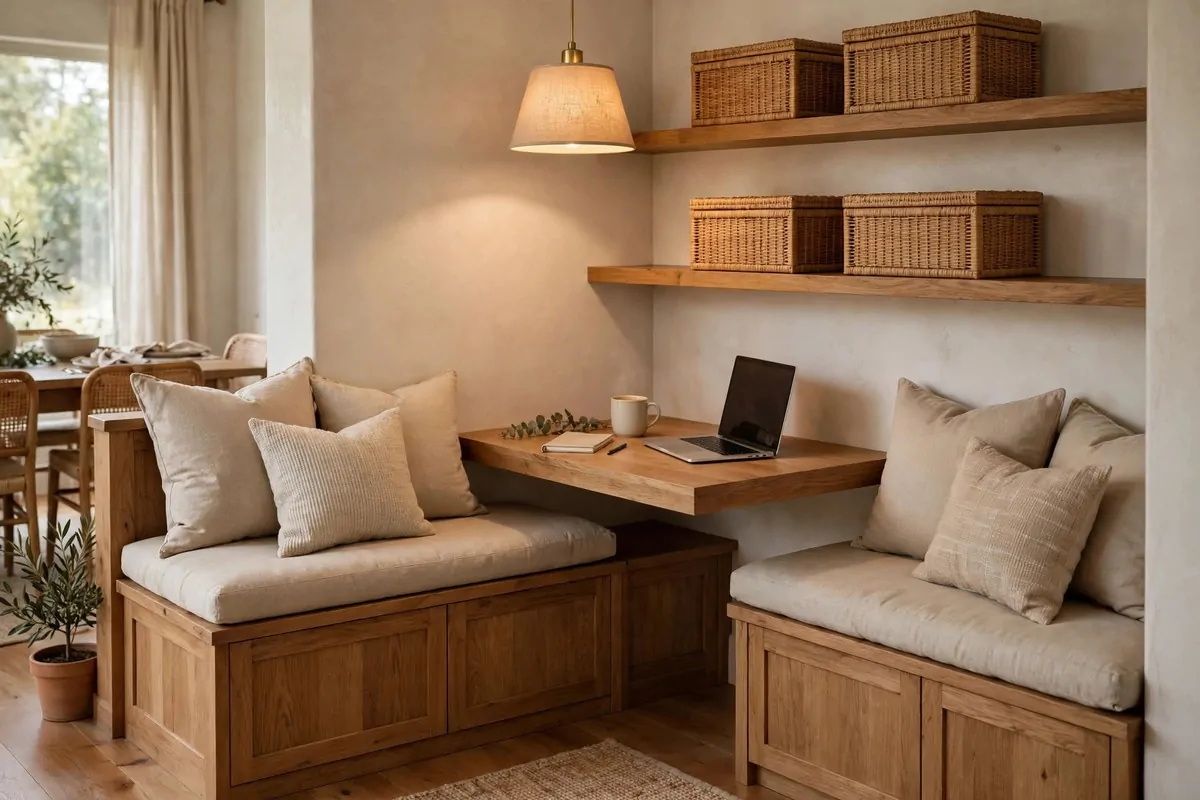
This one is for the very tiniest corners. The kind where a chair will not even fit. A bench seat changes the game.
Build or buy a low bench along one wall. The desk runs from the other wall and meets it in the corner. You sit on the bench, sideways to the room.
The bench hides storage inside. Lift the seat and there is space for files, bags and office bits. A tiny corner suddenly stores a lot.
Cushions make it real. A firm cushion on the seat. A pillow against the wall behind you. It feels like a cafe booth. Work feels less like work.
Keep the desk short. It only needs to reach from the wall to the bench edge. A laptop fits. A notebook fits. That is all you need here.
The corner walls above become your storage. Two shelves hold everything. Boxes on the shelves match each other. It looks calm.
Light it with a pendant hung low over the desk. The bench corner is naturally dark. One warm pendant turns it into a little cave of light.
This setup works in dining rooms and kitchens. The bench matches the dining furniture. Nobody guesses it is an office until they see the laptop.
Friends always ask about this one. It looks like a reading corner. It works like a desk. It might be the hardest working square metre in your home.
8. A Glass Desk That Keeps a Dark Corner Open
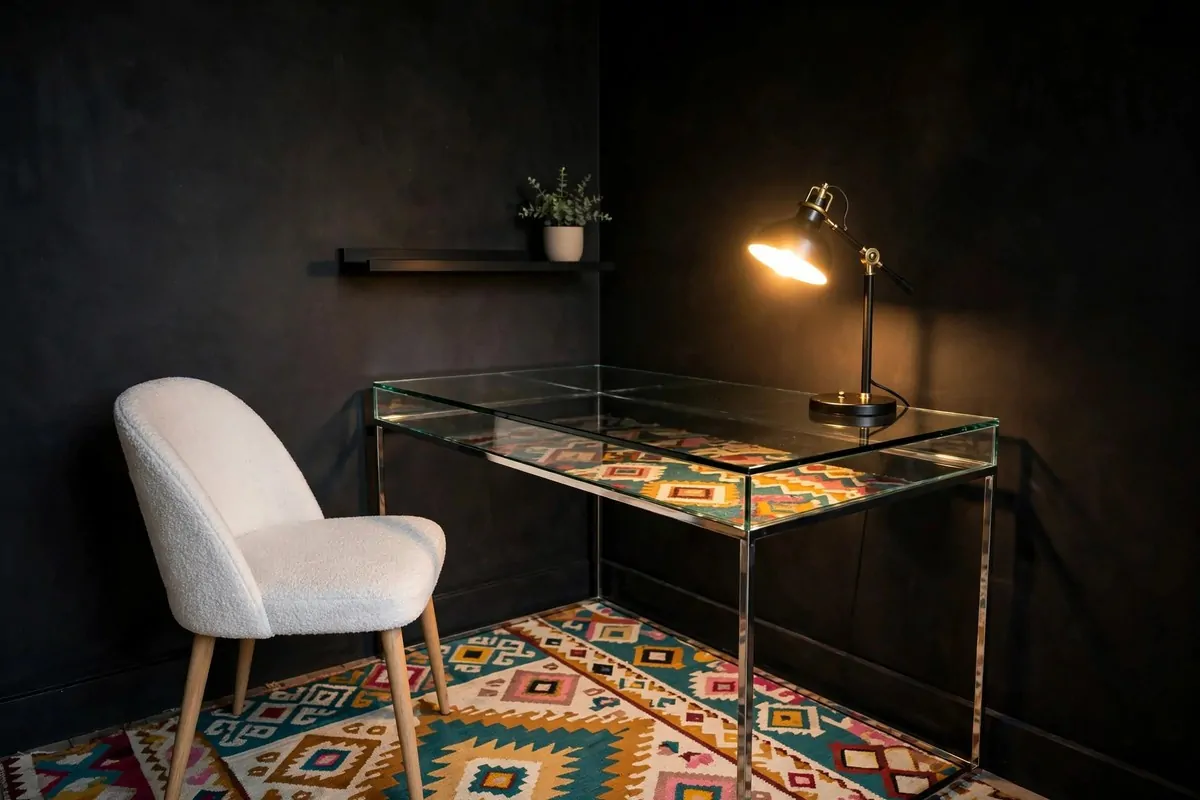
Dark corners swallow furniture. A wooden desk in a dark corner looks heavy. It makes the corner feel smaller. A glass desk does the opposite.
Glass is nearly invisible. Your eyes pass straight through it. The corner keeps its air. The desk barely reads as furniture at all.
This is the trick for gloomy corners. The ones under the stairs on the dark side. The corner by the big wardrobe. Glass lets what little light there is flow through.
Keep the glass clean. Fingerprints show. Keep a microfiber cloth in the drawer. One wipe a day and it stays clear.
Pair it with a light chair. White or pale wood. A dark chair on a glass desk looks like a floating shadow. A light chair keeps the airy feeling.
Use the floor under it. A small rug in a bright pattern wakes the corner up. The rug shows through the glass and doubles the colour.
Storage goes on the wall. A slim shelf above. Glass desks have no drawers. Wall storage keeps the clear look.
Add one strong lamp. Dark corners need light more than furniture. A good lamp does more for this nook than any desk upgrade.
Glass is not for everyone. Some people find it cold. But in a dark corner, nothing opens the space like it.
9. The Fold-Down Desk That Vanishes After Work
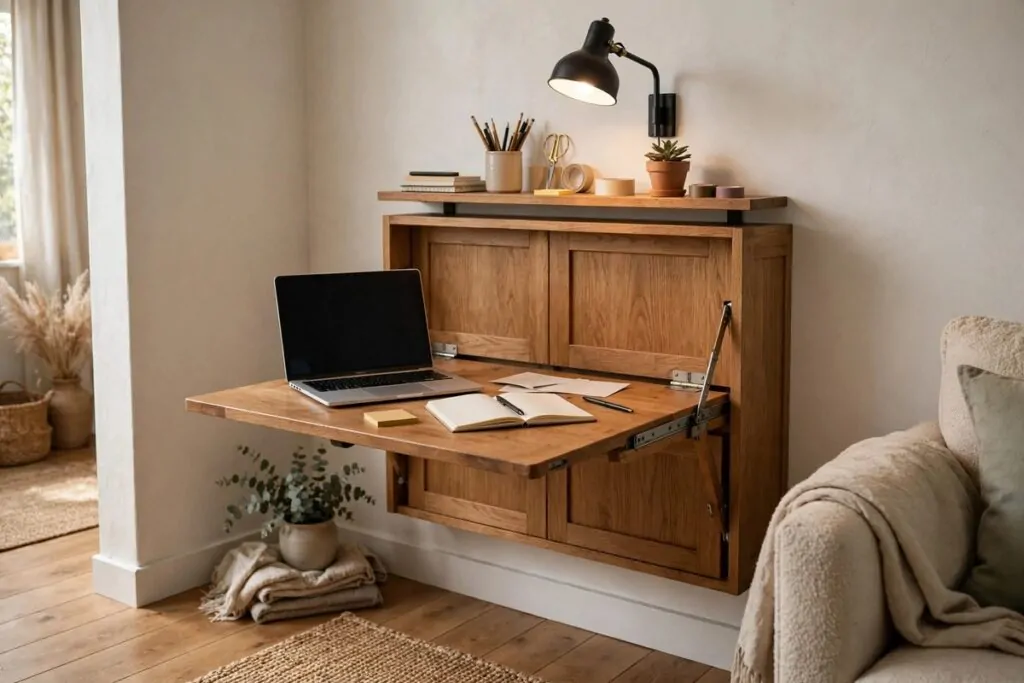
The best office is sometimes the one that is not there. A fold-down desk opens for work and closes to nothing.
Mount it on any free wall in a corner. Open, it is a desk. Closed, it looks like a slim cabinet or a picture frame. Guests never know.
This is gold for small flats. Your living room is your living room. For eight hours it holds a desk. Then it goes back to being a living room.
Pick a model with a lip on the inside. When you close it, loose pens and papers do not fall out. That little detail saves you every day.
Anchor it well. Fold-down desks carry weight on hinges. Screws must hit studs. A full laptop plus a leaning elbow is heavier than you think.
Put a slim shelf above it for the stuff that cannot live on the desk. Your lamp can be wall mounted. Your charger lives in a wall pouch.
The chair is the only visible clue. Use a folding chair that hangs on a wall hook. Or a stool that slides into a closet. Nothing on the floor, nothing seen.
One rule makes this work. Close it every night. Every single night. The habit is the whole point. An open fold-down desk is just a desk. A closed one is freedom.
I know people who work like this for years. They swear their home feels bigger. Because for sixteen hours a day, the office does not exist.
10. A Corner Cabinet That Opens Into an Office
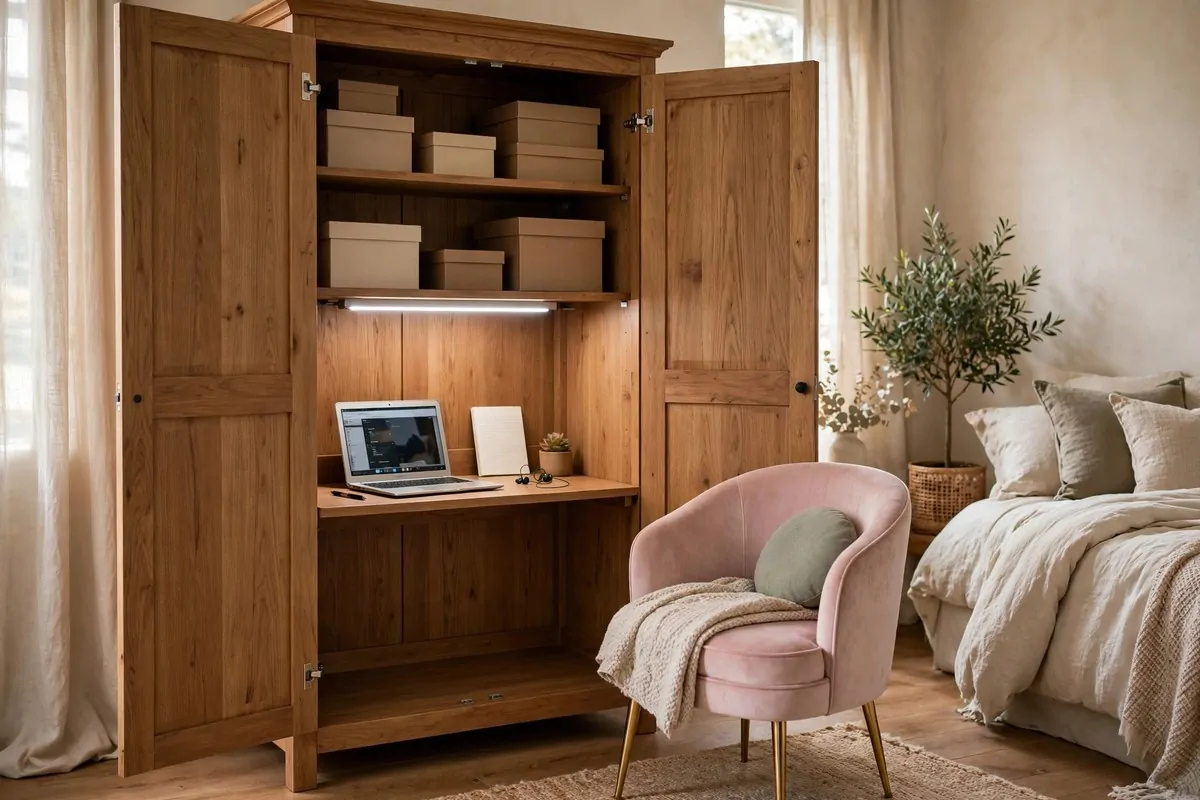
An armoire office is the oldest trick in small space books. And it still works better than most new ideas.
Take a tall cabinet in the corner. Inside it, hide a desk, shelves and your whole office. Close the doors and the office is gone.
You can buy office cabinets made for this. Or convert an old wardrobe. A shelf at desk height. A board for the desktop. Done.
The doors are the magic. Open them in the morning. Your office appears. Close them at night. Your room is a bedroom or a living room again.
Light inside is a must. A stick-on LED bar under the top shelf. It clicks on when you open the doors. Your office is bright from the first second.
Ventilation matters. Cabinets trap warm laptop air. Leave the doors open while you work. Or drill a few hidden holes in the back panel.
The chair lives outside the cabinet. It becomes the only office item in the room. Pick a pretty one. It has to look good all day.
Storage inside is generous. Shelves hold files, printer paper and boxes. The desk holds the laptop. Everything has a door-closed home.
This suits people who hate seeing work at night. When the doors close, your brain gets the message. Work is over. The room belongs to you again.
11. A Slim Standing-Height Desk for the Corner
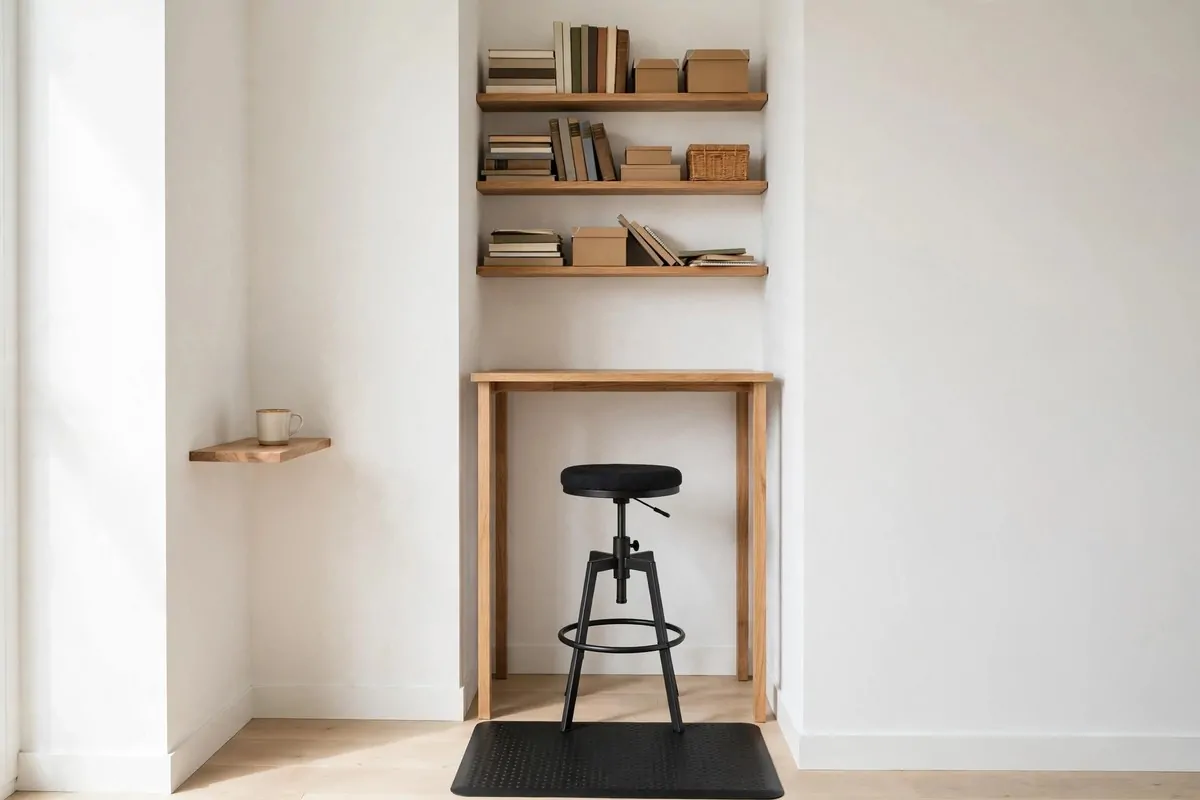
Some of us do our best work standing up. A corner can hold a slim standing desk. It takes less floor than a sitting desk.
The desk is tall and narrow. About a metre high, thirty centimetres deep. It fits a laptop and a notebook. Your feet stay free underneath.
Add a tall stool. You will want to sit sometimes. A drafting stool slides under the desk when you stand. It is the best of both worlds.
Vertical storage is the friend of standing desks. The wall above a standing desk is tall and empty. Use it. Three shelves hold everything within arm reach.
Put an anti-fatigue mat under your feet. Standing on hard floors gets old fast. A soft mat makes an hour feel like twenty minutes.
Cable length matters here. Your charger cables must reach the high desk. Measure before you buy. A short cable will pull your laptop off the edge.
A small shelf at elbow height becomes your coffee spot. Keep the main desk clear for work. The shelf holds the mug, the plant, the little things.
This nook suits short work bursts. Quick emails. Calls. Planning. Standing keeps you alert and moving.
I love that it takes up almost no room. The corner keeps its floor. You keep your energy. Everyone wins.
12. The Bedroom Corner Desk Beside the Wardrobe
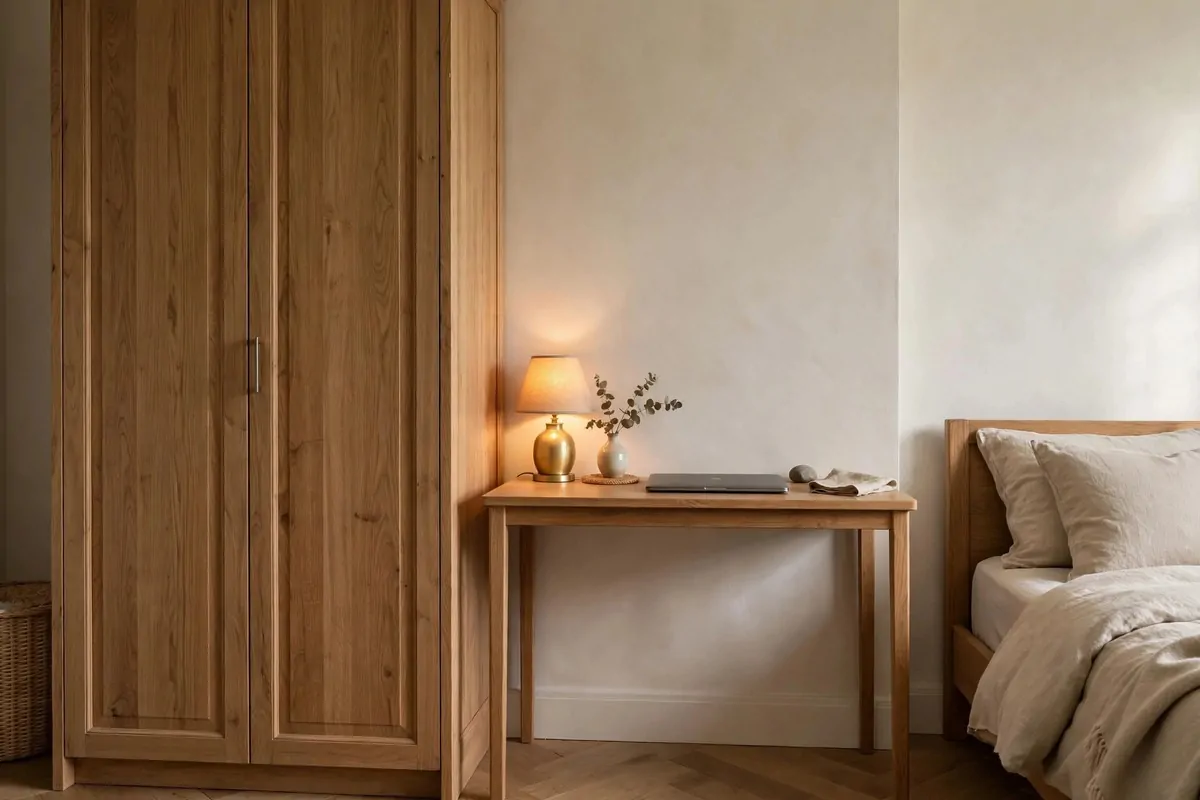
Bedrooms have corners that do nothing. Beside the wardrobe. At the end of the bed wall. A narrow desk fits there like it was planned.
The trick is keeping the bedroom calm. Your office must not look like an office. Match the desk to the bedroom. Same wood as the bed. Same colour as the walls.
Go narrow and low. A slim desk, around thirty five centimetres deep. It reads as a dressing table, not a workstation. The bedroom keeps its restful mood.
Store work things out of sight. A drawer for the laptop. A box for papers. When the drawer closes, the desk is just a desk again.
Light it warm. Bedrooms want warm light. A small lamp with a warm bulb keeps the corner cozy. Cold white light would shout office.
Face the desk toward the room, not the wall. You wake up and see a nice corner. Not a screen. Not a stack of files.
Keep one decorative thing on the desk. A small vase. A framed photo. It tells your brain this corner belongs to the bedroom first.
The danger is working in bed sightline. If your screen faces the bed, you will think about work at night. Angle it away. Protect your sleep.
Done right, this nook disappears into the bedroom. It is there when you need it. Invisible when you do not.
13. A Dining Room Corner That Works Nine to Five
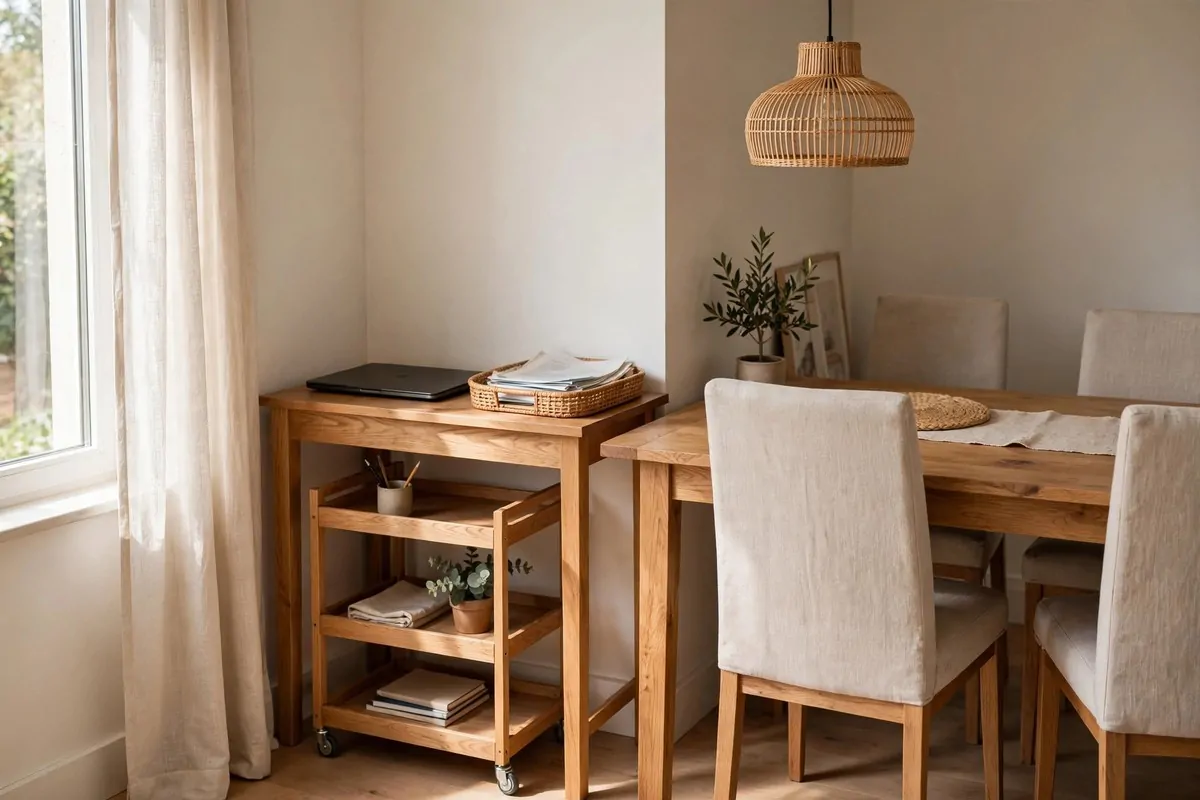
Dining rooms sit empty most of the day. From breakfast to dinner, that is hours of unused space. A corner desk puts it to work.
Pick the corner farthest from the kitchen door. The traffic flows the other way. Your work stays out of the cooking path.
Use a desk that matches the dining table. Same wood, same tone. Then the desk looks like part of the dining set. Nobody questions it.
Meals need a clear desk. Keep your setup light. A laptop you can close. One tray for papers. At dinner time, everything goes in the tray.
A dining chair doubles as your office chair. It is already there. It is comfortable for a few hours. You save the cost and the floor space.
Light from the dining pendant helps. It is usually the best light in the room. Add a small desk lamp for close work.
Storage goes under the desk. A slim rolling cart with three tiers. It rolls away when guests come. Files, chargers and notebooks live there.
Set a firm close time. When the desk closes at five, the dining room is a dining room again. The ritual keeps work from eating dinner.
This nook works because dining rooms are built for sitting. Good light. Good chairs. A table nearby. It is a natural office.
14. The Kitchen Corner Command Post
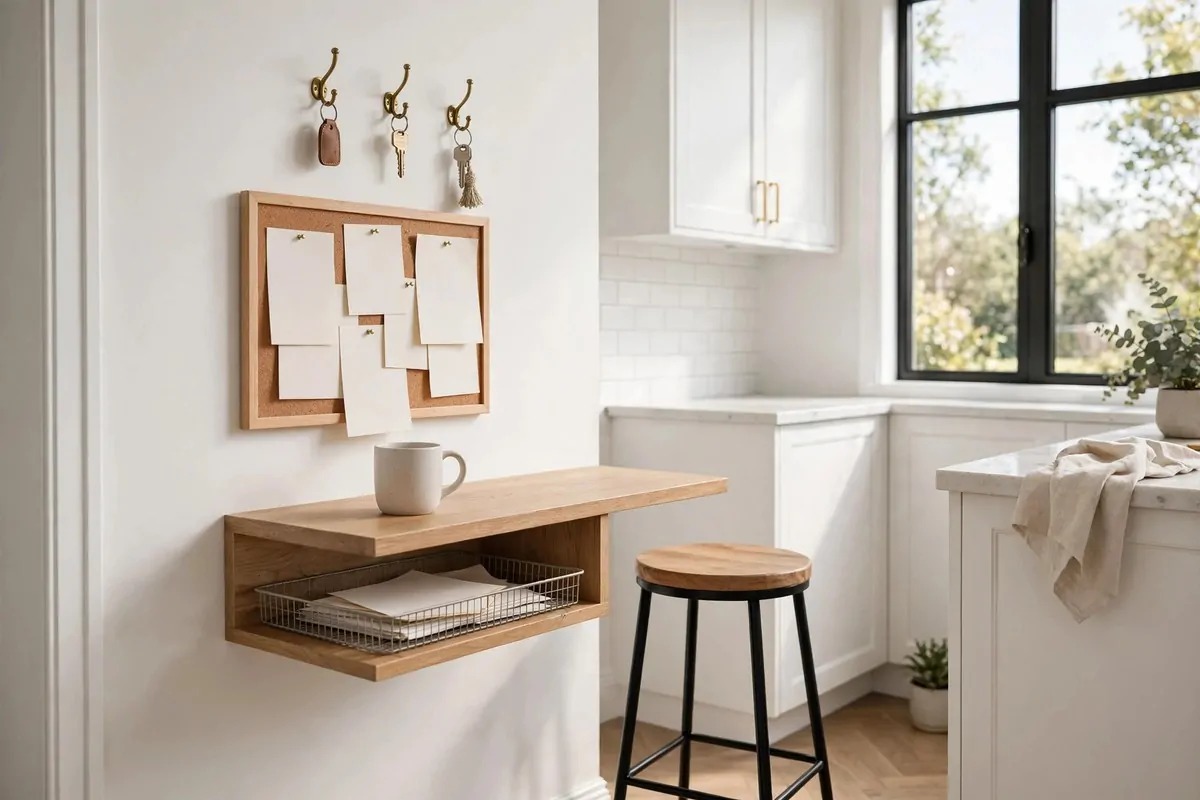
Kitchens have corners too. The end of the counter. Beside the breakfast nook. A small desk there becomes your command post.
This is the planning desk. Bills. Shopping lists. School forms. The quick admin of life. It is not for deep work. It is for getting things handled.
Keep it tiny. A wall shelf at counter height works. You stand or sit on a tall stool. The desk matches the kitchen counter line.
Hang your tools above. A small pin board for lists. Hooks for keys. A shelf for the bills tray. Everything for daily admin lives at arm height.
Coffee is close. That is the whole point. Your kitchen corner desk puts work next to the kettle. Morning admin takes ten minutes, not thirty.
Protect it from cooking mess. A corner away from the stove stays clean. If grease is a risk, pick a wipeable surface. Laminate beats raw wood here.
Power is usually nearby. Kitchens have outlets everywhere. Your laptop charges. Your phone charges. No extension cords across the floor.
One warning. The kitchen is the loudest room. Calls are hard here. Use this nook for quiet admin. Take calls somewhere calmer.
I call it a command post because that is what it is. You sit down, you clear the daily business, you get back to your day.
15. A Guest Room Corner That Earns Its Keep
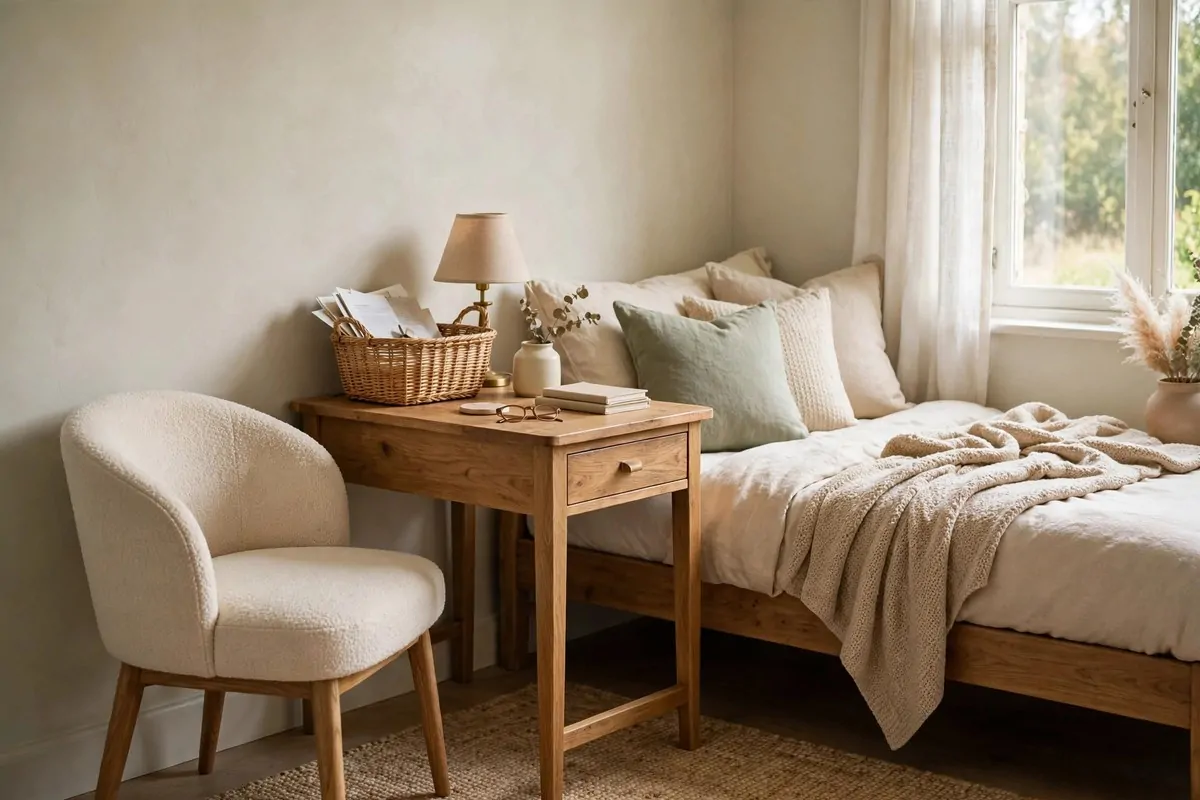
A guest room sits empty most of the year. One corner of it can work for you the other fifty weeks.
Put the desk in the corner farthest from the bed. The guest sleeps without staring at your files. You work without climbing over the bed.
Use a desk that doubles as a side table. A pretty wooden desk with a drawer. When guests come, it holds their lamp and their book. No awkward moves needed.
The chair matters here. Pick one that looks like an accent chair. Guests will use it as a reading chair. You use it as a desk chair. It serves both.
Storage stays minimal. A guest room office cannot look cluttered. One basket for your papers. When guests arrive, the basket goes in the closet.
Keep the colour calm. Guest rooms want to feel welcoming. Your office corner should match that mood. Soft colours. Clean lines. No towers of paper.
A daybed is the perfect partner. It is a sofa by day and a bed by night. Your office corner and the daybed make a room that always works.
When guests come, clear the desk. It takes five minutes. The room becomes theirs. They will never know it is your office the rest of the year.
This nook pays the room’s rent. Every empty room should earn its keep. A desk in the corner does that.
16. The Stair Landing Turned Into a Desk Spot
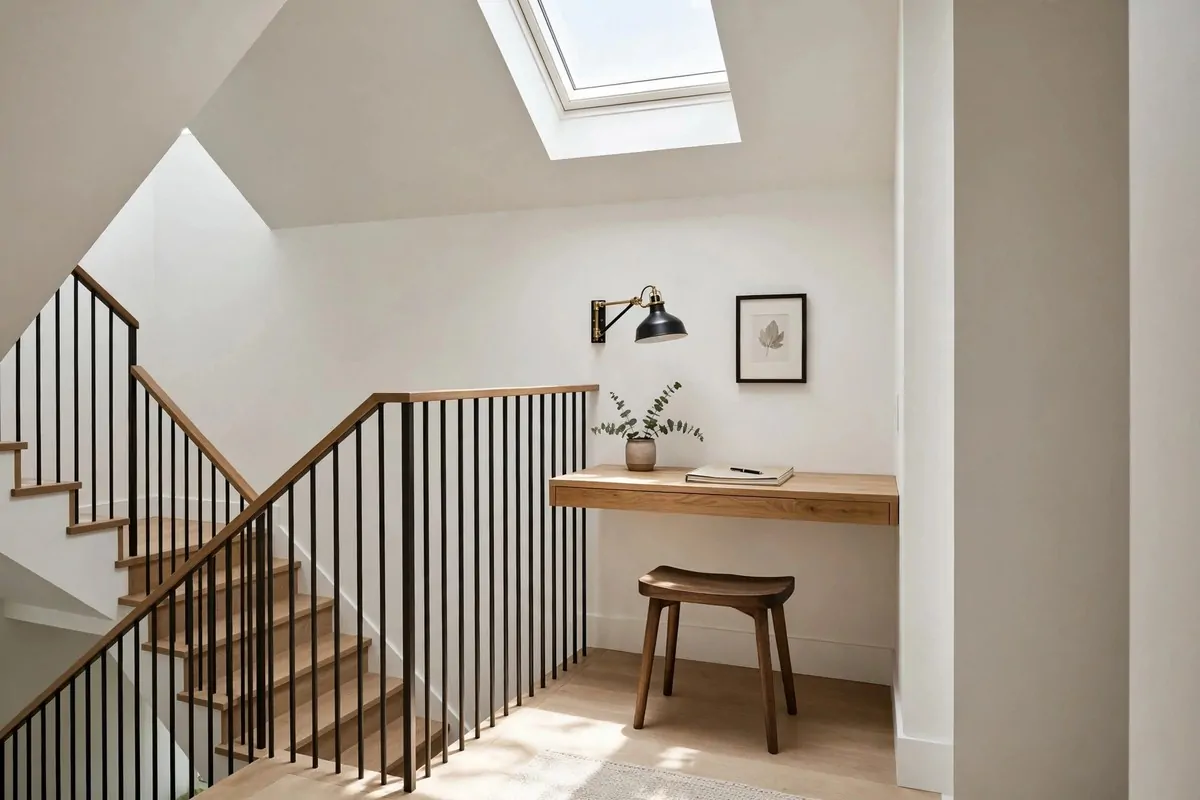
A wide stair landing has a corner. It is the bit where the stairs turn. Nobody uses it for anything. It just holds the air.
Measure the landing. If it is a metre wide or more, a small desk fits. The corner where the two railings meet is your spot.
The desk must be slim. Thirty centimetres deep, max. People still use the stairs. The walkway stays clear. Safety first, always.
A wall lamp is your light. Landings have walls on one side. A swing arm lamp gives you task light with zero desk footprint.
Watch the railing. Your chair back must not poke through the balusters. A low stool or a backless bench is safest here.
This nook gets amazing light. Landings usually sit under skylights or tall windows. Stairs chase light up the house. You get the benefit.
Noise travels on stairs. The whole house walks past your desk. This nook suits short tasks. Not deep focus work. Emails and admin do fine here.
Decorate it like the stairs. Same wall colour. A small picture. It reads as part of the stair design. Not a desk dropped in a walkway.
I love the story of this one. The corner everyone ignores becomes the spot where you get things done. There is poetry in that.
17. A Window Seat That Doubles as a Work Desk
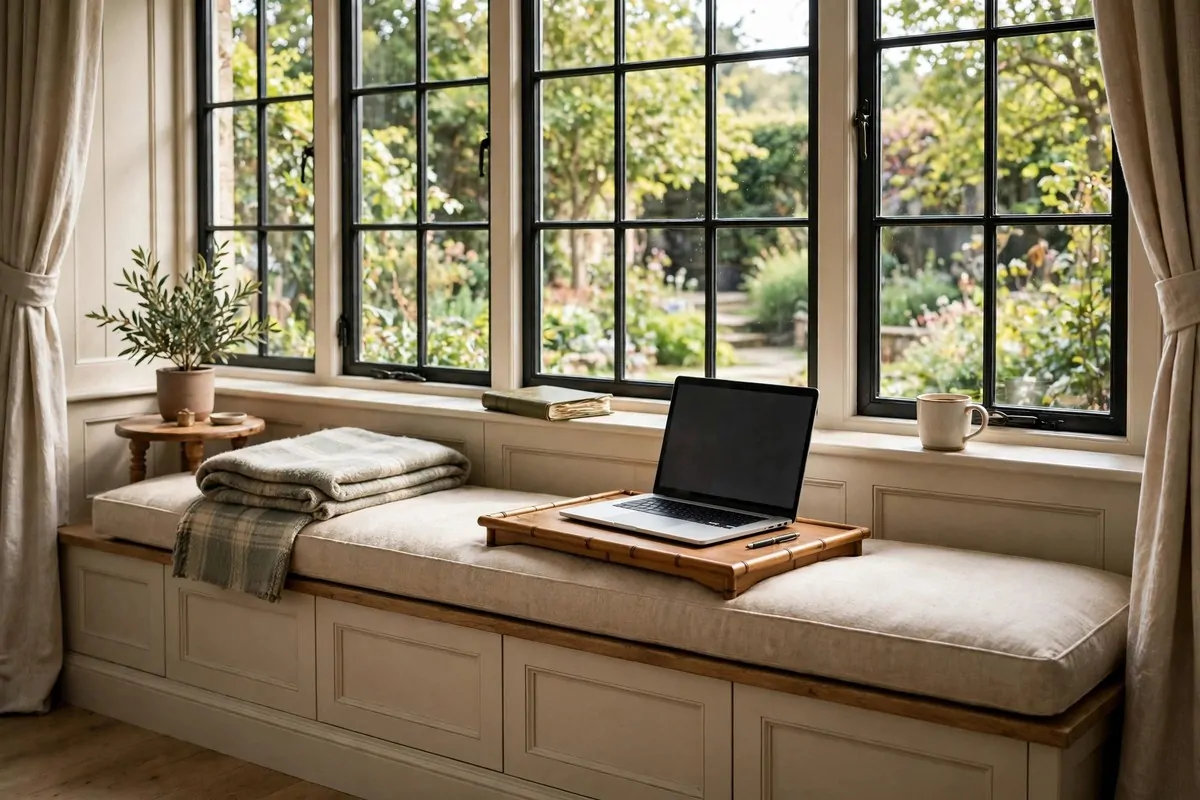
A deep window seat is a desk waiting to happen. It is flat. It is the right height. It has the best light in the house.
Add a cushion and it becomes your chair. A firm cushion, so you sit high enough. Your laptop sits on your knees or a lap desk.
The windowsill becomes your shelf. Pens. Phone. Coffee. All within reach. The sill is the desk accessory shelf.
Light is unbeatable. Full daylight from a big window. You will never need a desk lamp before sunset. Your eyes will thank you.
Build storage into the seat. Most window seats have hollow space under them. A hinged lid turns it into a file box. Office gear hides there.
Add a small side table beside the seat. It holds the mug you should not balance on the cushion. It holds the notebook. It keeps the seat clear.
Warmth matters. Window seats get cold in winter. A thick cushion. A folded blanket over your legs. A draft excluder on the sill. Cozy wins.
This is a sitting nook, not a standing one. It suits reading, writing and laptop work. Long spreadsheet days want a real desk. But for most work, this is heaven.
The view is the secret bonus. A window seat office gives you the world outside your screen. Trees. Rain. People walking dogs. Work feels lighter.
18. The Corner Hidden Behind a Simple Curtain
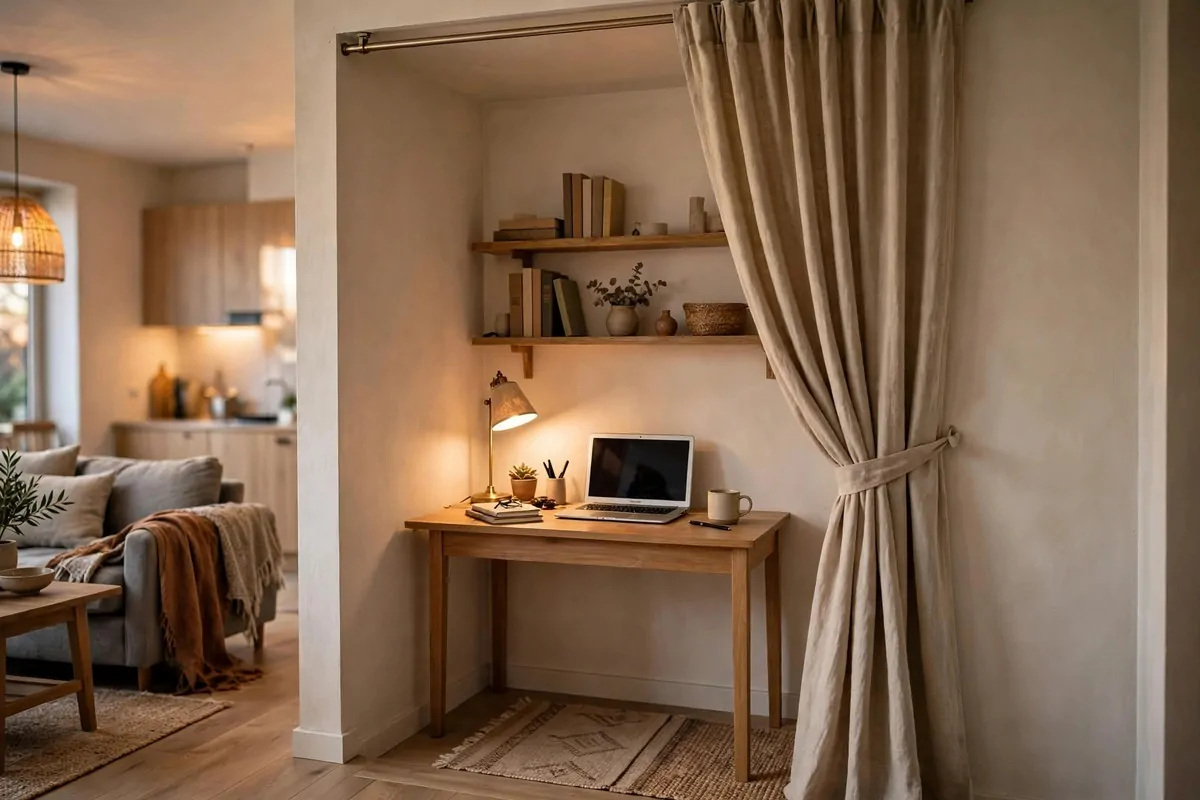
Some corners do not need furniture to become a nook. They need a boundary. A curtain gives you one for the price of a rod.
Hang a ceiling track or a tension rod across the corner. Two panels of fabric. Pull them closed and your office has walls.
This is the renter’s best friend. No drilling for shelves. No big furniture. Just fabric. It comes down clean when you move.
Choose fabric with some weight. Linen or light canvas. It hangs straight. It blocks the sight of your mess. Sheer fabric hides nothing.
The curtain also softens sound. A little. Fabric eats echoes. Your calls sound better. The room feels calmer.
Behind the curtain, the desk can be plain. Nobody sees it closed. Use a simple table. Save your money for the chair and the light.
Add a small rug inside the curtain. It marks the floor as office floor. Your feet know when they cross into work.
When work ends, pull the curtain. The corner is gone. The room is whole again. That one pull is the best off switch I know.
I have seen this in studio flats and it works beautifully. One corner becomes two rooms. Open for work. Closed for life.
19. A Bookcase That Divides Your Office From the Room
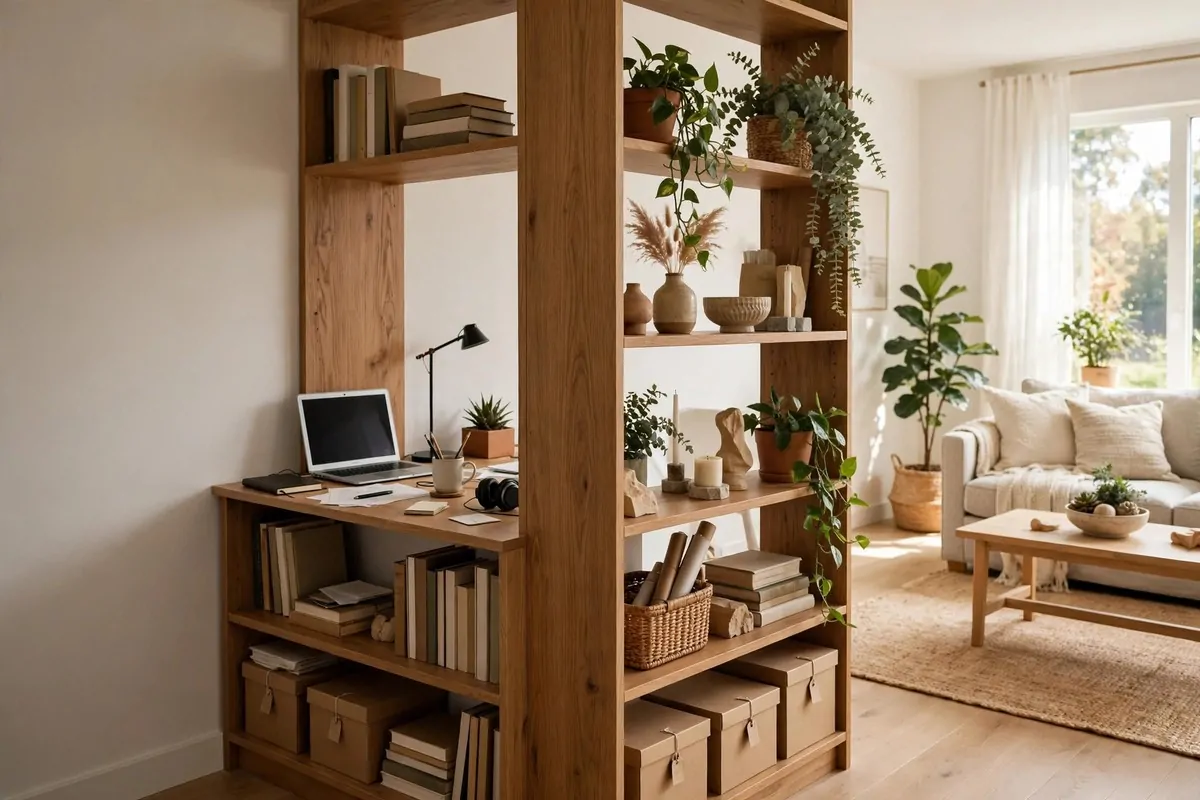
A corner office in an open room has one problem. It is always on display. A bookcase fixes that and adds storage.
Place a low bookcase perpendicular to the wall. It juts out and wraps your desk corner. Suddenly you have three walls of your own.
Use an open back bookcase. Light passes through. The room stays bright. A closed back would make the nook feel boxed in.
The shelves face your desk. Books. Boxes. Office gear. All stored. The other side faces the room. Style it with plants and pretty things.
Keep it low. Waist height or a little more. A tall bookcase in a small room feels like a wall. A low one feels like furniture.
The top of the bookcase is bonus surface. A lamp. A small plant. Your water bottle. It extends your desk without taking more floor.
Anchor it to the wall. A freestanding bookcase can tip. One bracket into a stud. It takes two minutes. It is worth it.
This trick zones the room. The bookcase says office here, living there. Your brain learns the line. Work stays in its box.
It is the most grown up looking nook on this list. It says you have a real office. Even though it is just a corner.
20. A Pegboard Wall Above a Slim Corner Desk
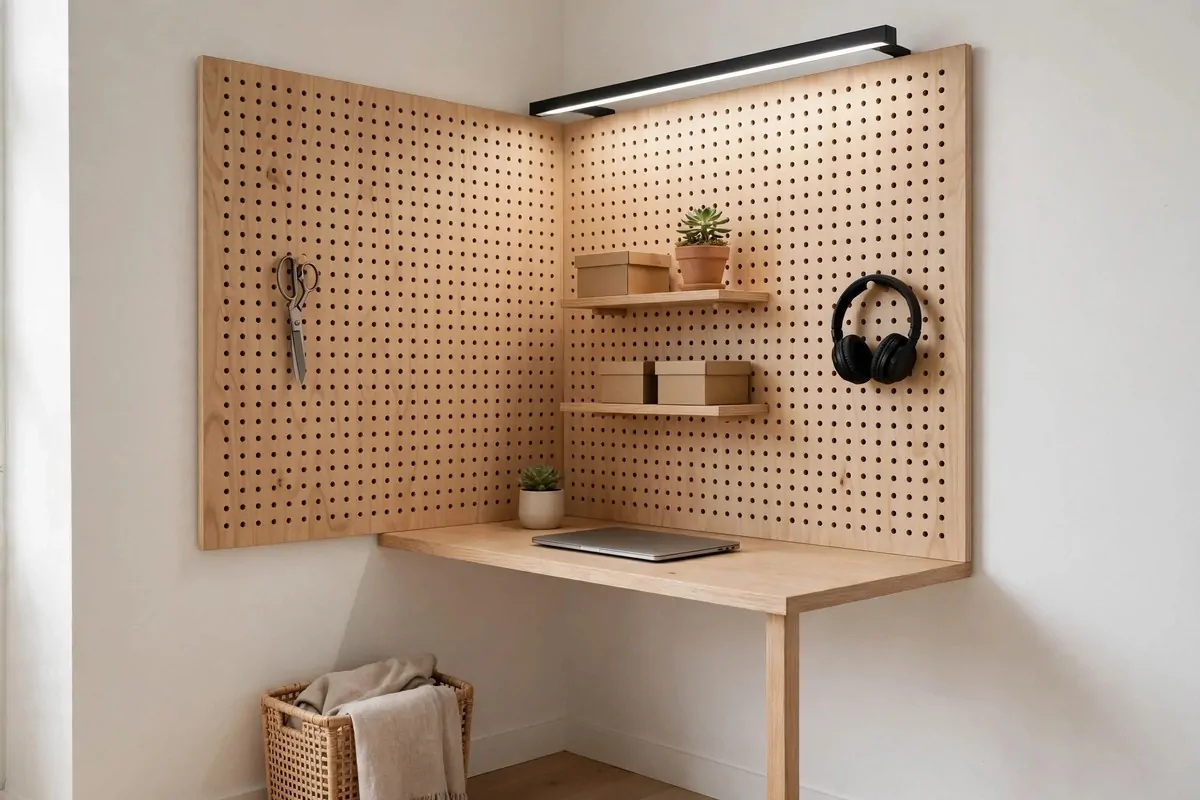
A pegboard is the hardest working square metre of wall you can own. Above a corner desk, it replaces three drawers.
Hang a large pegboard on both corner walls. Hooks hold scissors, headphones, cables. Small shelves hold boxes and plants. Everything floats.
You see everything at a glance. No digging in drawers. Your tools hang where your hands expect them. Work flows faster.
The desk underneath stays clear. That is the whole point. The wall does the storing. The desk does the working.
Paint the pegboard the wall colour. It blends in. Or paint it bold for a feature wall. Both work. The bold choice makes the nook feel designed.
Change it with your week. Hooks move in seconds. Monday needs the calendar up. Friday needs the charging station. The board adapts.
Keep the desk slim. The pegboard handles the bulk. A thirty five centimetre desk is plenty when the wall carries the load.
Lighting the board matters. A small picture light or LED bar above it. You want to see your hooks. Shadowy pegboards get ignored.
This nook suits makers and planners. People with tools and bits and papers. If your work has stuff, give the stuff a wall.
21. The Mirror Trick That Doubles a Tiny Corner
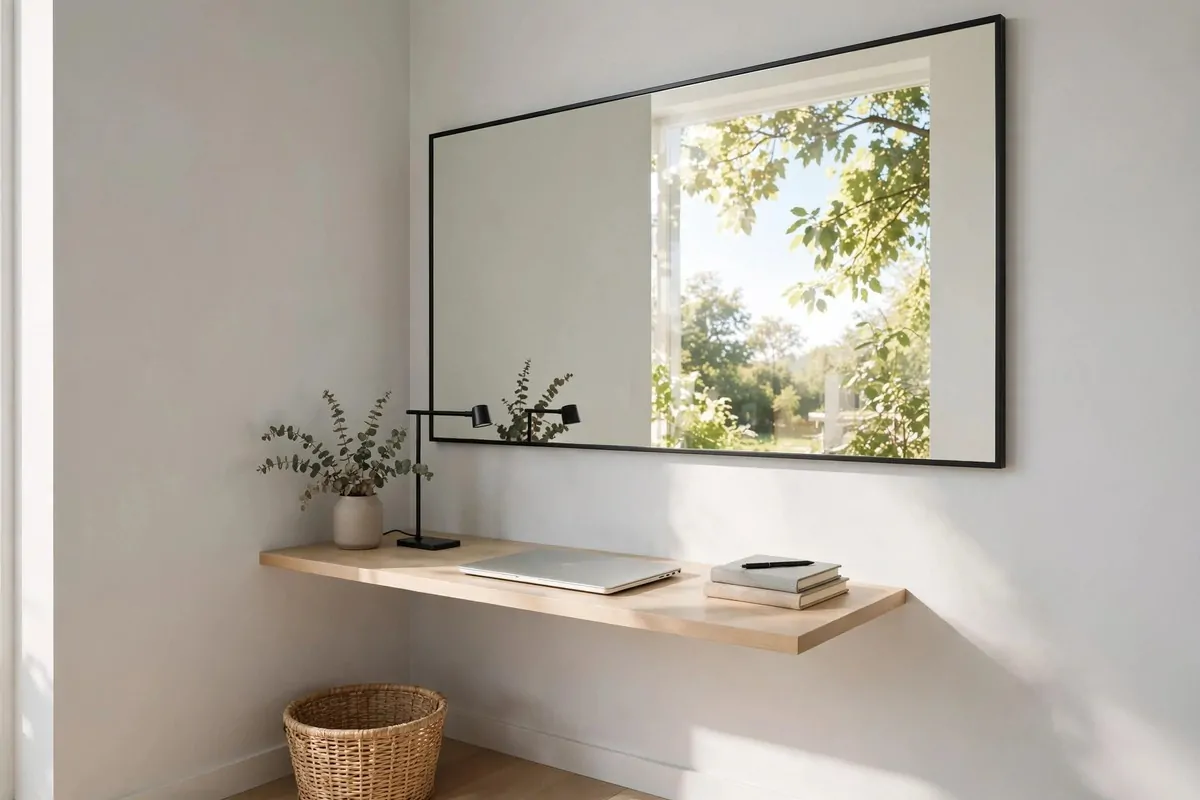
A mirror on the corner wall is the oldest small space trick. It still works. It doubles the light and the room.
Hang it where it catches the window. The mirror throws daylight back into the corner. A dark nook wakes up. You might skip the lamp in daytime.
Size matters. A big mirror works best. It should cover most of the wall above the desk. Small mirrors make small rooms look busy.
Angle it slightly down. You want to see the room reflected, not the ceiling. A tilt of a few degrees changes the whole effect.
The frame sets the mood. A thin black frame looks modern. A wooden frame looks warm. The mirror becomes the art of the nook.
Keep the desk simple under a mirror. Clutter doubles in a mirror. Two messy desks instead of one. A clear desk reflects as a clear room.
One caution. Check the reflection from your chair. You do not want the mirror throwing sun straight into your eyes at three in the afternoon.
Pair the mirror with a light wall colour. White or pale grey. The two tricks stack. Light walls and a mirror make a corner feel twice its size.
This is the cheapest makeover on the list. One mirror. One afternoon. A corner that feels new.
22. A Reading Corner That Moonlights as an Office
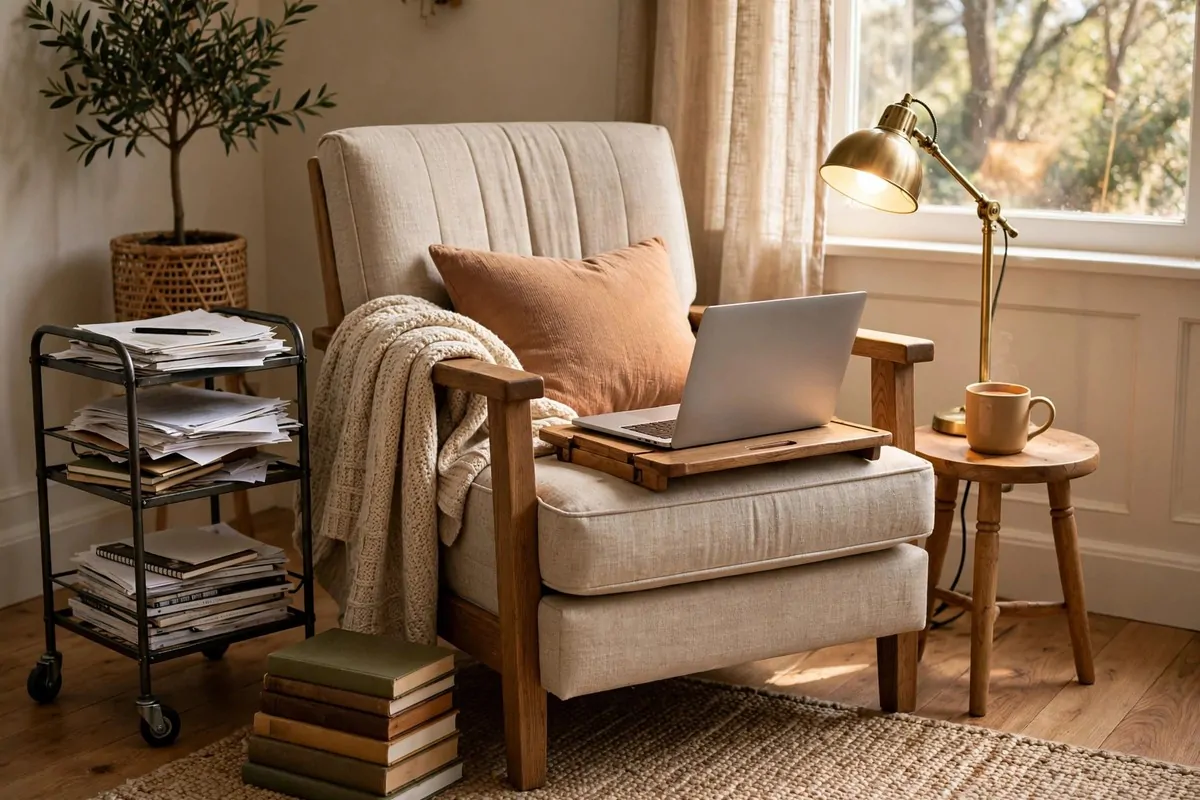
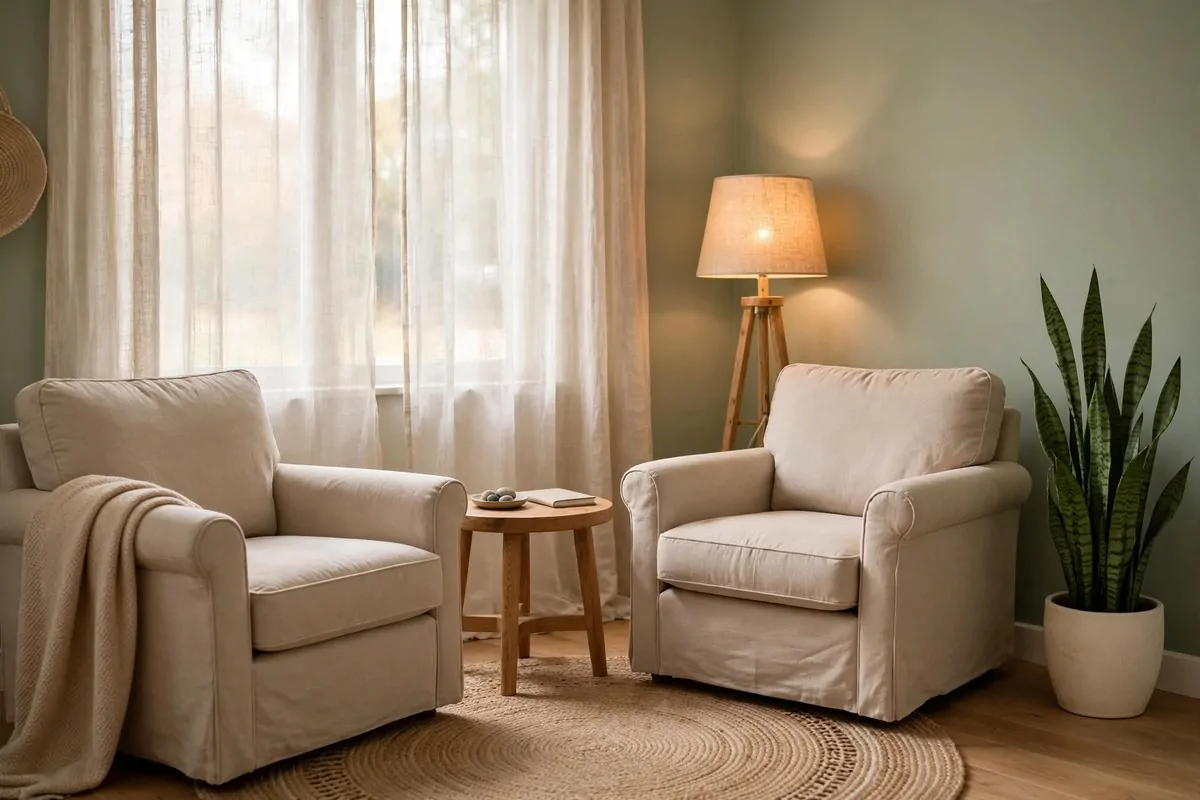
Every home has a reading corner. A chair. A lamp. A small table. Add a lap desk and it is an office too.
The chair is your office chair. Pick a firm one with good back support. Squishy chairs feel nice for ten minutes. They hurt after an hour.
The side table is your desk. A lap desk bridges your knees. Your laptop sits steady. Your notebook fits beside it.
The lamp is your task light. Reading lamps are perfect. They aim light right where you need it. No new lamp to buy.
A small rolling cart beside the chair holds office bits. Papers. Chargers. The work stuff. It rolls away when it is reading time.
Keep the corner styled for reading. A throw. A cushion. A book stack. The office hides inside the cozy. Nobody sees work here.
Set office hours for the corner. Mornings for work. Evenings for reading. The corner changes jobs with the clock. You always know which mode it is in.
This is the gentlest nook on this list. No desk to buy. No wall to drill. Just a corner you already love, working a little harder.
I think this one suits slow workers best. Writers. Readers. Thinkers. The corner already knows how to be calm. Work just borrows that calm.