25 Bedroom Office Ideas That Keep Work Out of Sight

It is 5:47 in the evening. I save my file. I close my laptop. I fold my desk up against the wall with one push, and by 5:48 my bedroom looks like a bedroom again.
That is the whole trick I want to share with you today. Not a prettier desk. Not a bigger room. Just a workspace that knows how to disappear when the workday is done.
Because here is what I learned the hard way. When your desk stares at you all night, your brain keeps working. You see the laptop and you think about emails. You see the papers and you think about tomorrow. Sleep gets harder. Evenings feel shorter.
The ideas below all fix that one problem. Every single one hides your work when you are done. Some fold. Some close like a cupboard. Some slide behind a curtain. And all of them fit in a normal bedroom.
1. The Fold-Down Wall Desk
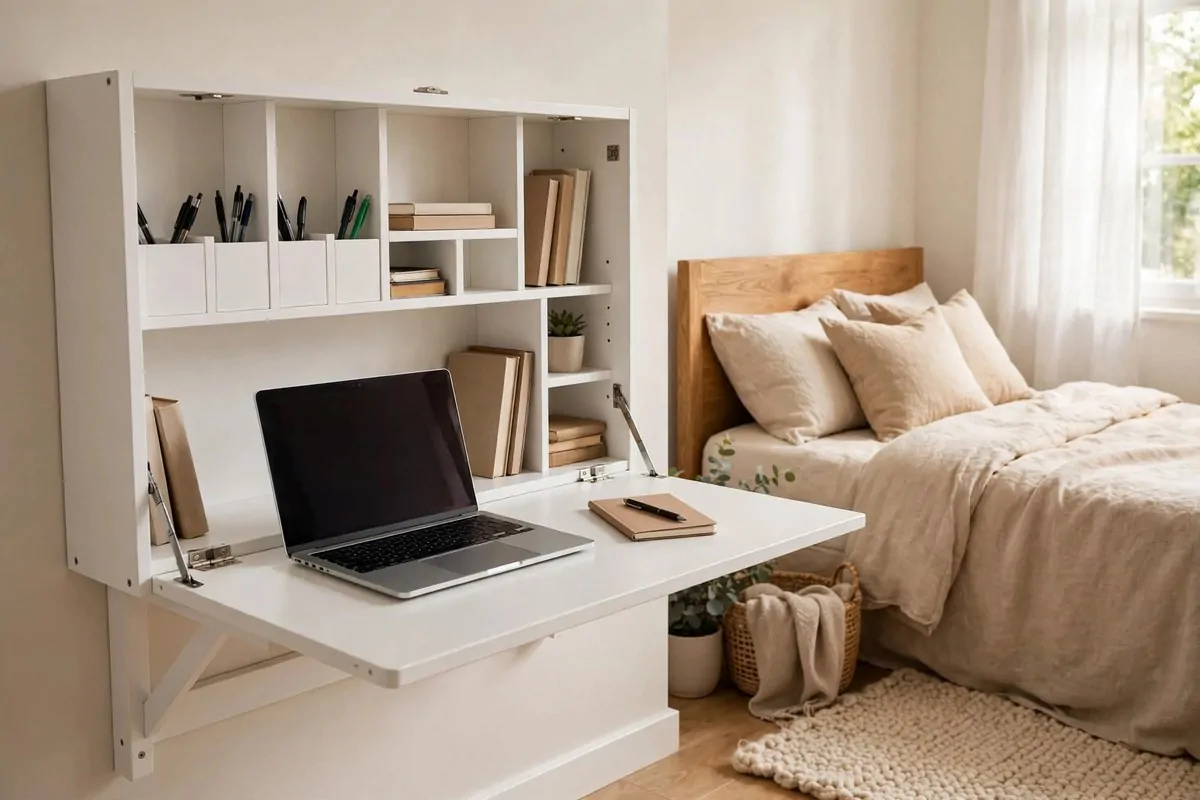
This is the classic move for a reason. A fold-down wall desk hangs on the wall like a flat cabinet when you are not using it.
You pull it down in the morning and you get a full-size work surface. When the day ends, everything gets swept into the little shelves inside, and you fold it shut. Your wall looks neat again.
I love this one for tiny bedrooms. It takes up zero floor space when it is closed. You can hang it anywhere. Behind a door, next to the bed, even in a hallway corner.
Most of them have small cubbies inside. Pens go in one. Notebooks go in another. Your laptop slides into a slot. Nothing is out in the open.
Installation is simple. Two people, a drill, and about thirty minutes. The desk part locks when it is open, so it does not wobble while you type.
One tip I always give. Measure your chair height before you hang it. The desk should sit at the same height as a normal table. Too high or too low and your shoulders will hurt by lunch.
The closed desk looks like a pretty cabinet. Some people hang a small plant on top of it. Others put a framed photo right on the front. Guests never guess there is an office behind it.
Price-wise, these run cheaper than a normal desk. You skip the legs. You skip the big frame. You just pay for the board and the folding hardware.
- Best for: small bedrooms with almost no spare floor space
- Skill level: easy, one afternoon with basic tools
- Hides work: fully, closes into a flat cabinet
2. The Armoire Workstation
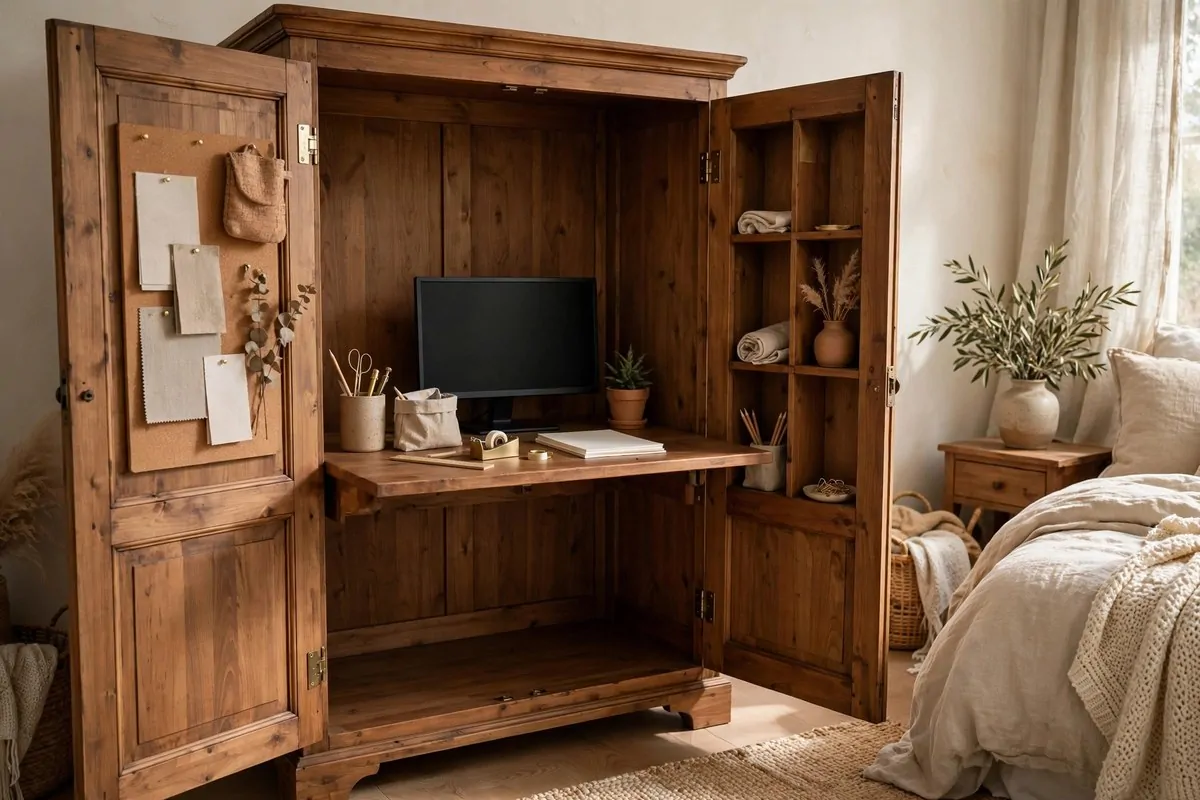
An armoire is a tall cupboard with doors. Inside it, you build a whole office. Desk, shelves, a spot for the printer. Then you close the doors and it is just furniture again.
This one feels almost magic. During the day, the doors swing open and you have a real office with tons of storage. At night, two doors shut and the workday is gone.
Old armoires work best. They are deep enough for a monitor. They already have shelves you can move around. And they look beautiful in a bedroom. Like they were always meant to be there.
You can find them secondhand for very little money. People give these away when they move. Check local listings first before you buy new.
Inside, you will want a power strip. That is the one thing that makes it feel like a real office. All the chargers plug in inside, so no cords spill out onto the floor.
The doors can hold things too. Stick a cork board on the inside of one door. Hang a calendar on the other. That is free storage space most people forget about.
One thing to watch. Armoires are heavy. Put it where you want it and leave it there. Measure your doorways before you bring one home.
3. The Closet Office
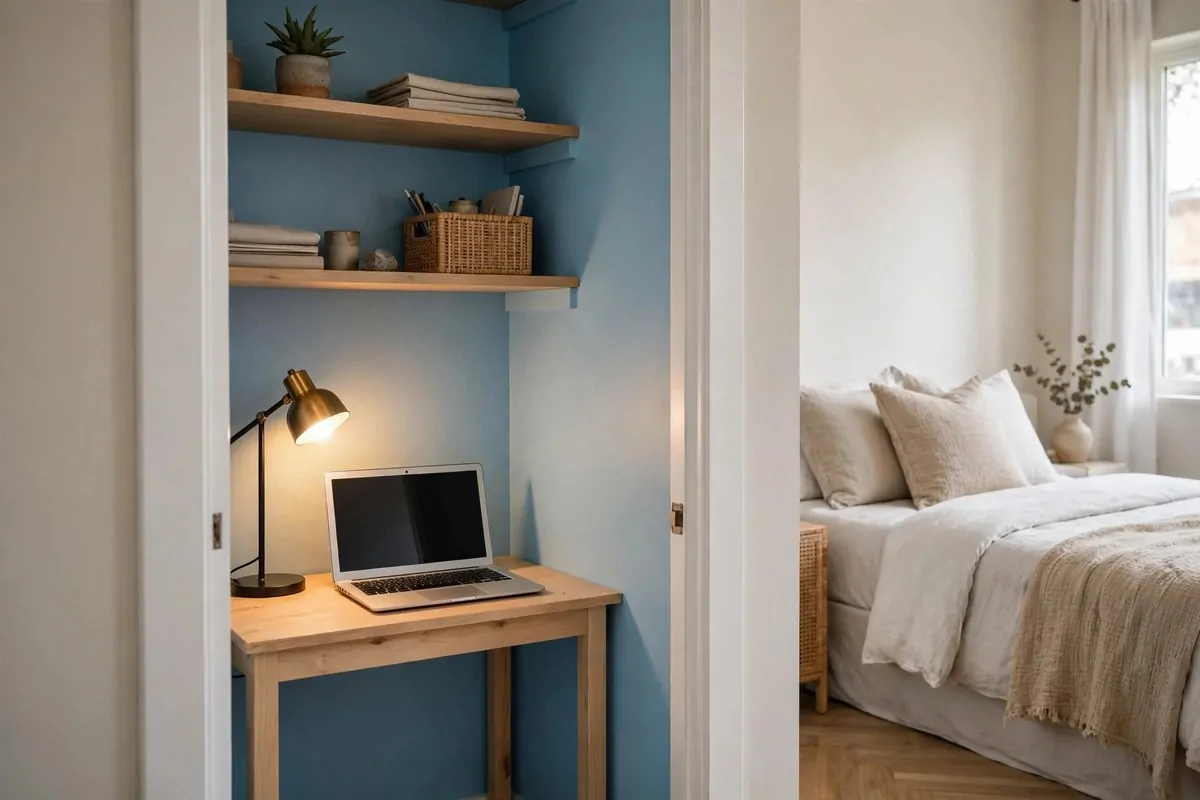
Take the doors off a closet and you have a ready-made office nook. Take the doors off, and honestly, you might not even want to put them back.
A closet is the perfect size for one person and one desk. The walls are close, which feels cozy instead of cramped when you add good lighting. A small lamp or a strip of LED lights changes everything.
Paint the inside a happy color. The closet becomes its own little room. I have seen people paint theirs bright yellow or soft blue. It makes the workspace feel special and separate from the bedroom.
Shelves are the real win here. Closets usually have a top shelf already. Add one or two more at desk height and you have storage most desks can only dream of.
If your closet has sliding doors, you can leave them on. Slide them shut at 6 pm and your office is gone. That is the whole point of this list, and the closet office does it better than almost anything.
The one hard part is the chair. Most closets are narrow, so get a chair without big arms. A simple stool or a backless chair that tucks under the desk works great.
You might need an outlet added. An electrician can do it in an hour. Or use a flat extension cord run neatly along the baseboard for now.
- Best for: bedrooms with a spare closet or a big reach-in closet
- Skill level: medium, painting and shelf work
- Hides work: fully, just slide the doors shut
4. The Curtain Divider
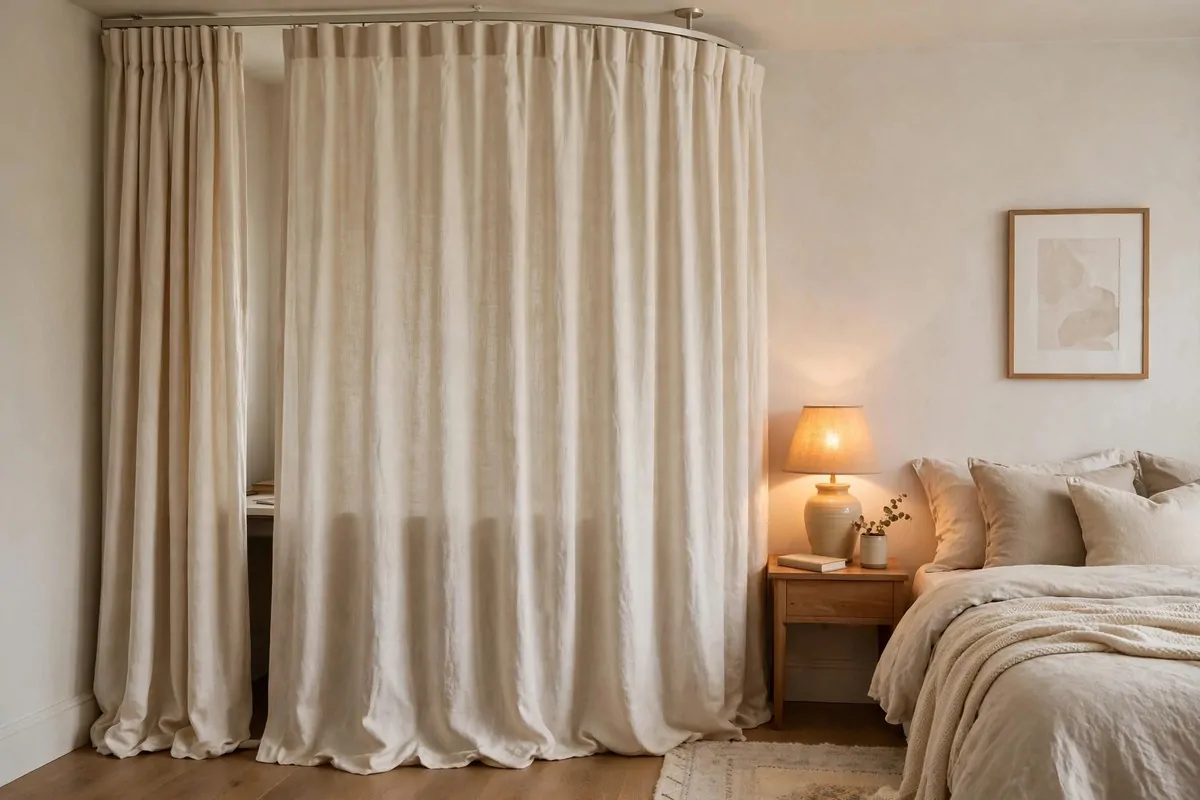
Sometimes you do not need furniture to hide your office. A curtain does the job, and it costs almost nothing.
You hang a ceiling track or a tension rod. The curtain slides open in the morning and closed at night. Your desk sits behind it like it is in its own little room.
Pick a curtain that matches your bedding. Then it looks like a design choice, not a cover-up. Thick fabric works best because it blocks the view and softens sound a little too.
This is my favorite trick for rented bedrooms. No drilling into walls. No heavy furniture to move later. Just a rod, a curtain, and maybe five minutes of your time.
The curtain also helps your brain switch off. There is something about pulling it closed that tells your mind the workday is finished. Like a little ceremony at the end of the day.
Make the curtain long enough to touch the floor. Short curtains look messy and let people see under them. Floor-length fabric looks neat and intentional.
One more idea. Hang the curtain in front of the whole desk wall, not just around the desk. It turns the corner into a proper little zone.
| Curtain type | Why it works |
| Thick blackout curtain | Hides everything and blocks morning light too |
| Linen-look curtain | Soft and airy, matches most bedroom styles |
| Patterned curtain | Turns the divider into a piece of art |
5. The Secretary Drop-Front Desk
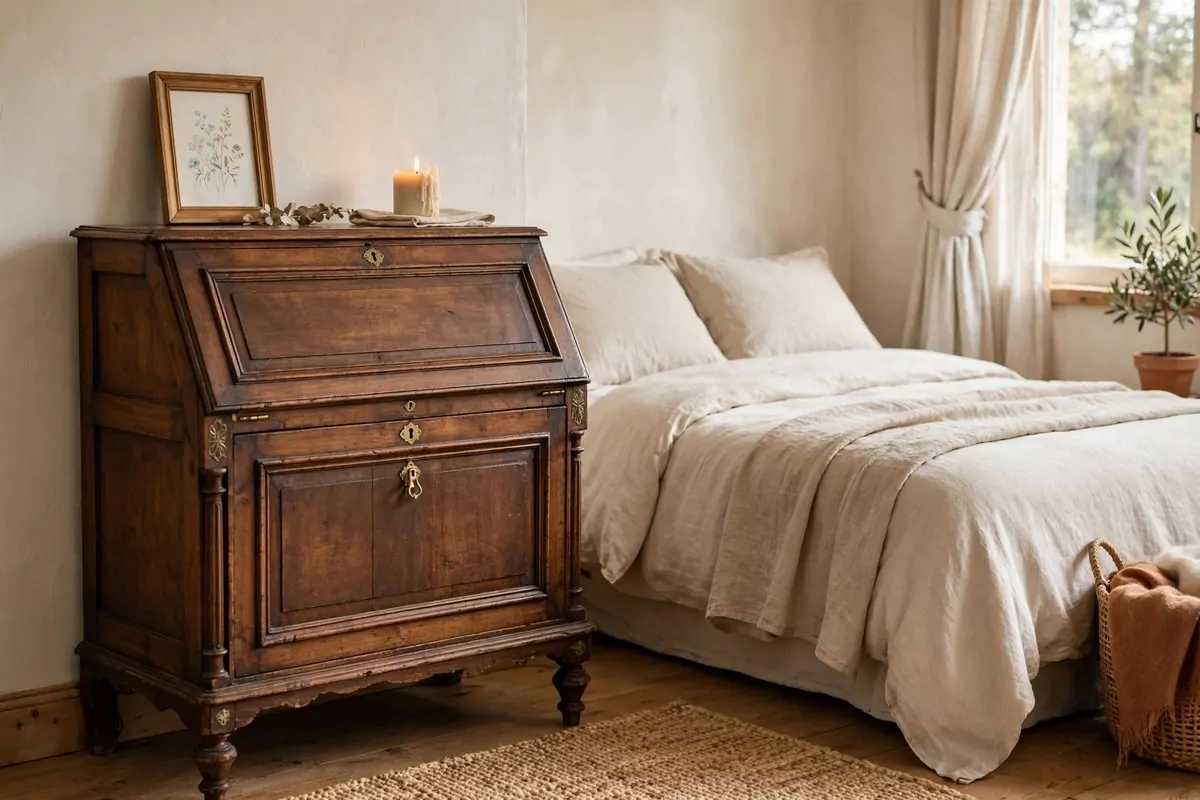
A secretary desk is an old-style piece of furniture with a panel that folds down to make a writing surface. When it is up, the desk is just a pretty cabinet.
I adore these because they are beautiful and sneaky at the same time. Your bedroom keeps its calm, classic look. Nobody knows the middle of it is full of office supplies.
Inside a secretary desk you usually find tiny drawers and pigeonholes. Those little slots are perfect for pens, stamps, sticky notes, and all the small things that clutter a normal desk.
When you fold the front down, it becomes your desk. You can work right there. When you fold it up, everything stays inside. You never have to clear the surface. You just close it.
These desks are easy to find secondhand. They were popular for decades, so thrift stores and online listings are full of them. A little wood polish makes an old one look new.
The size is made for laptops, not big monitors. If you work on a laptop, it is perfect. If you need two big screens, this one might be too small for you.
Pair it with a chair you love. Since the desk looks like bedroom furniture, the chair should too. A pretty wooden chair beats a big office chair here.
6. The Nightstand Desk
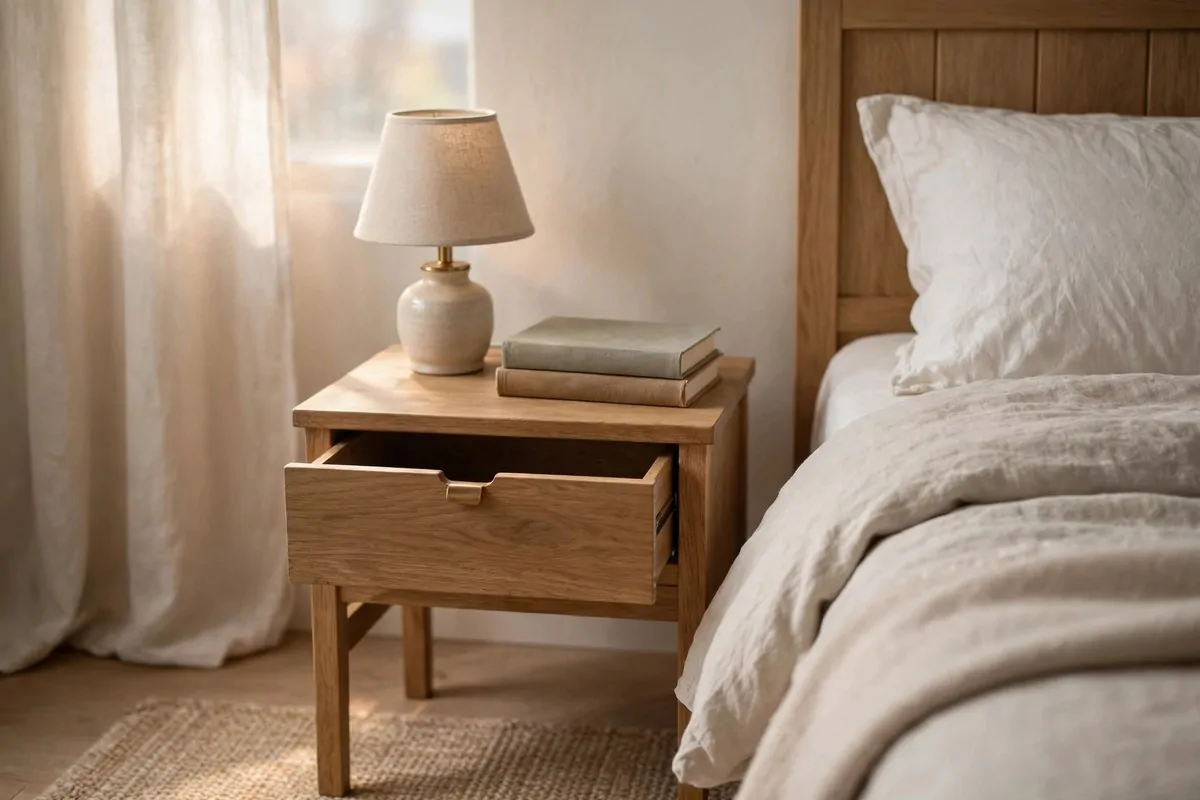
Your nightstand is already the size of a small desk. So why not make it one?
This idea is simple. You pick a nightstand that is a little taller and a little wider than normal. During the day, it holds your laptop. At night, it holds your lamp and your book. Same table, two jobs.
The trick is a drawer. A nightstand desk needs at least one drawer so your notebook and chargers can vanish at bedtime. Closed drawer, clean top, and your brain relaxes.
Put your lamp on the left and your workspace on the right, or the other way around. The lamp stays all day. It is bedroom furniture first. The work part is the guest.
This works best in very small bedrooms. If there is no room for a separate desk, the nightstand desk gives you a workspace without adding a single piece of furniture.
Get one with a back edge or a small lip. Otherwise your laptop slowly slides off the back while you work. I learned that one the annoying way.
Style it like a nightstand, not a desk. A small plant. A candle. A stack of two books. The work stuff leaves every evening, so the styling stays pretty.
- Best for: the tiniest bedrooms where no extra furniture fits
- Skill level: easy, just shop for the right piece
- Hides work: well, one drawer swallows the whole setup
7. The Vanity Desk Combo
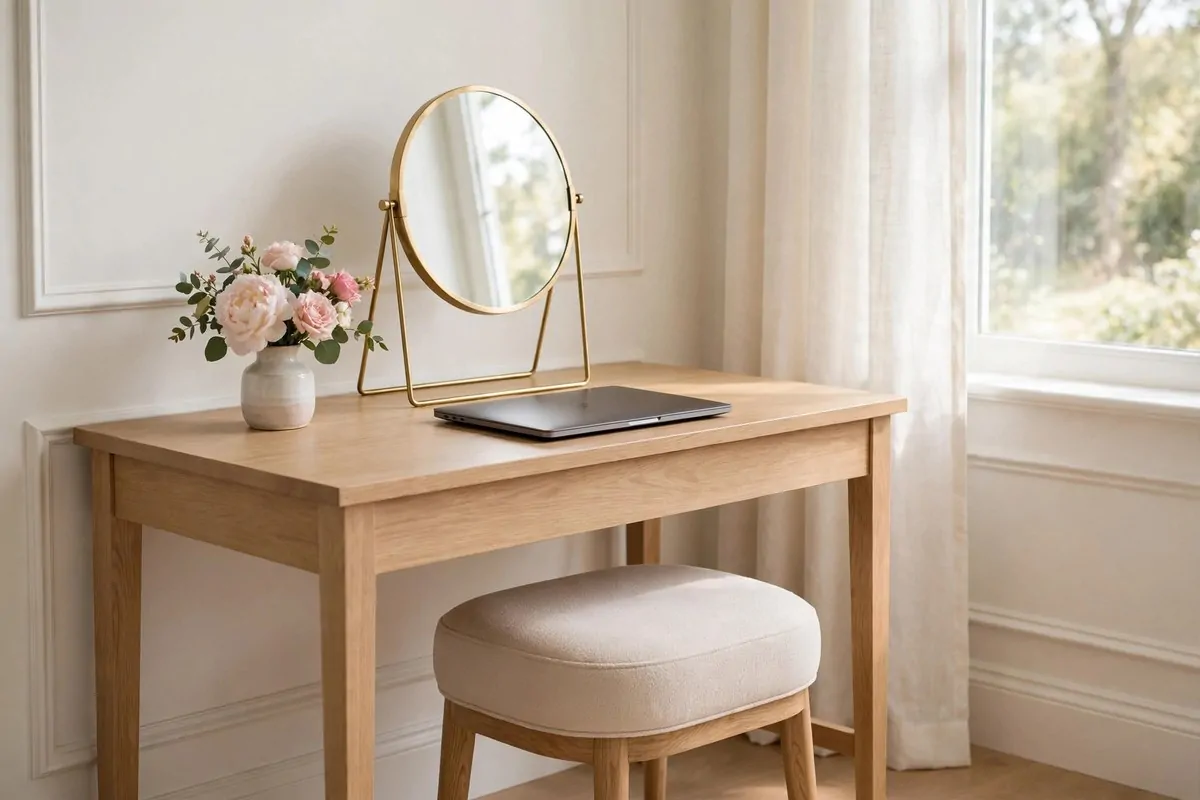
A vanity and a desk are the same shape. A table, a mirror or a screen, and a chair. So let one piece of furniture do both jobs.
In the morning, it is your vanity. You do your hair and makeup there. Then you slide the mirror aside, open your laptop, and it is your office. One flip, two rooms in one spot.
A round mirror on a stand works best. You can move it to the side during work hours. Wall mirrors work too, but then the mirror watches you work all day, which some people find distracting.
Drawers are a must here. Makeup on one side, office supplies on the other. Little drawer dividers keep the two worlds from mixing into a mess.
This idea saves a shocking amount of space. Two pieces of furniture become one. In a small bedroom, that can be the difference between a room that feels fine and a room that feels stuffed.
Pick a chair that suits both jobs. A padded stool or a pretty upholstered chair looks right at a vanity and still feels fine for a few hours of work.
Keep a small tray for your work things. Laptop, notebook, pen. At the end of the day, everything goes on the tray, and the tray goes in the drawer. Done.
8. The Corner Nook Desk
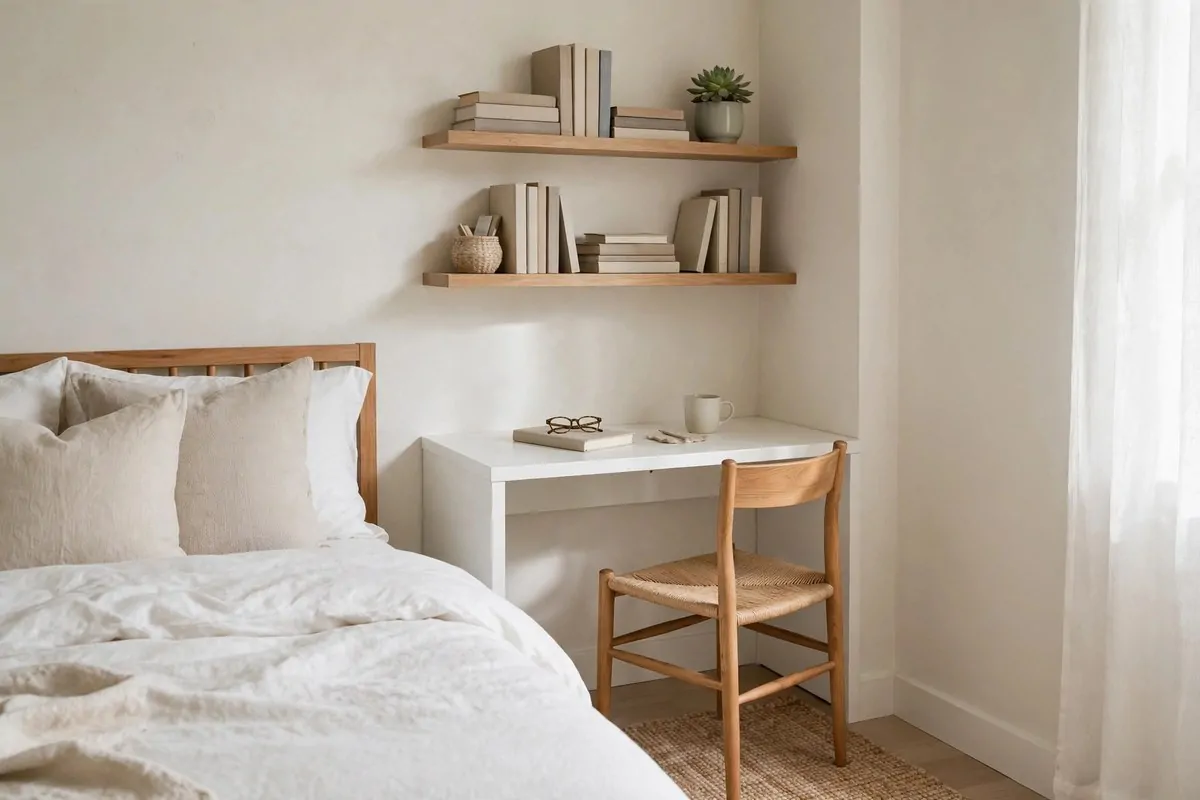
Every bedroom has a dead corner. The spot where nothing fits and nothing happens. That spot is your office waiting to be born.
A small corner desk slides right in. It uses two walls at once, so it feels bigger than it is. You get wall space on both sides for shelves, a pinboard, and a lamp.
The corner has a natural hiding quality. From the bed, you barely see the desk. Your eyes rest on the room, not on your to-do list. That is half the battle this list is fighting.
Add a shelf above the desk on each wall. That gives you storage without a single box on the floor. Books, files, and a plant all live up there, out of your sleep space.
A corner desk also feels private. The walls wrap around you a little. It is easier to focus when the rest of the room is behind you instead of beside you.
Light it well. Corners can be dark. A small clamp lamp on the desk or a wall light above it fixes that in minutes.
The chair should tuck fully under the desk. When you push it in at night, the corner looks empty. An empty corner is a calm corner.
9. The Window Desk
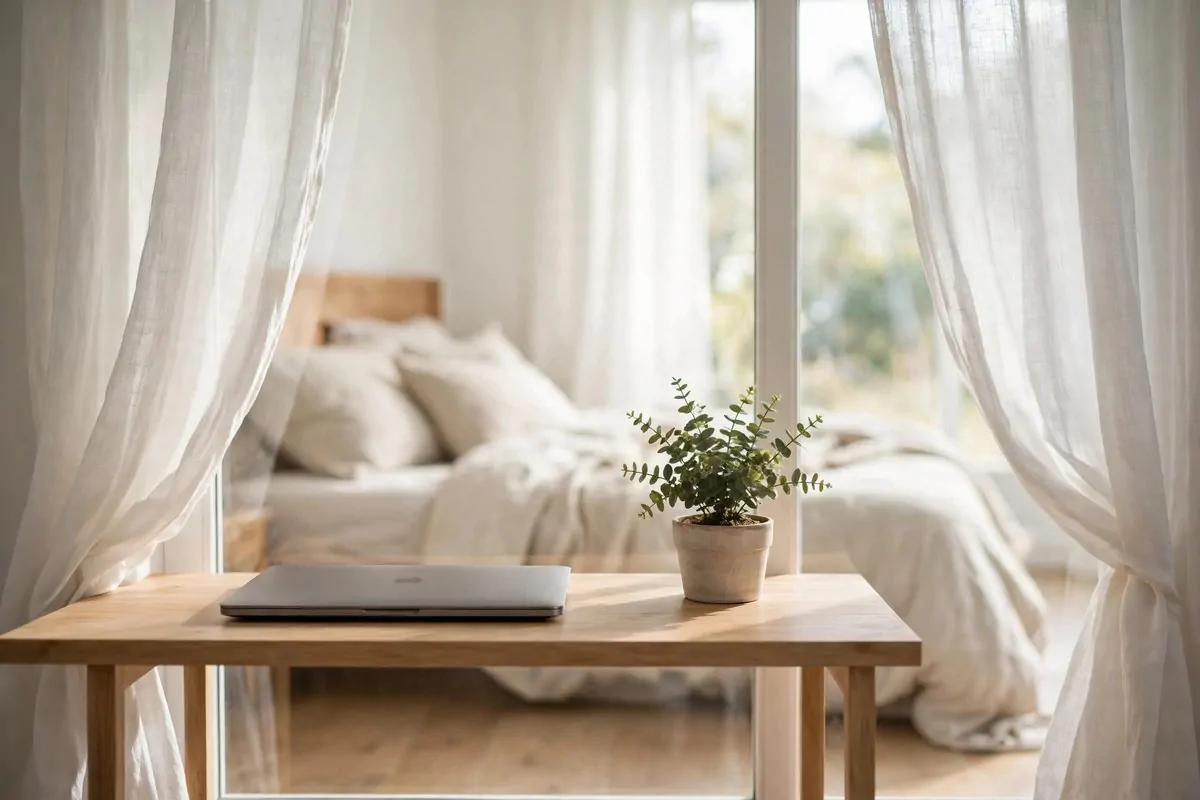
Put your desk in front of the window. You get the best light in the house for free, and the view gives your eyes a place to rest.
There is a hidden benefit here. When you sit facing the window, your back is to the bed. You cannot see the messy bed while you work. And from the bed, all you see is the back of a slim desk. Everybody wins.
Keep this desk slim. A deep desk in front of a window blocks light and air. A narrow one lets the window do its job and keeps the room feeling open.
Skip the big monitor here if you can. A laptop keeps the view open. If you need a screen, mount it on an arm so you can swing it flat against the wall when you are done.
Plants love this spot. Put one on the desk or on the windowsill. It makes the workspace feel like part of the bedroom instead of an intruder.
Watch the glare. If the sun hits your screen directly, a sheer curtain solves it. You keep the light, lose the glare, and the room looks softer too.
- Best for: bedrooms with a big window and a nice view
- Skill level: easy, just move furniture around
- Hides work: partly, slim profile stays quiet from the bed
10. The Alcove Office
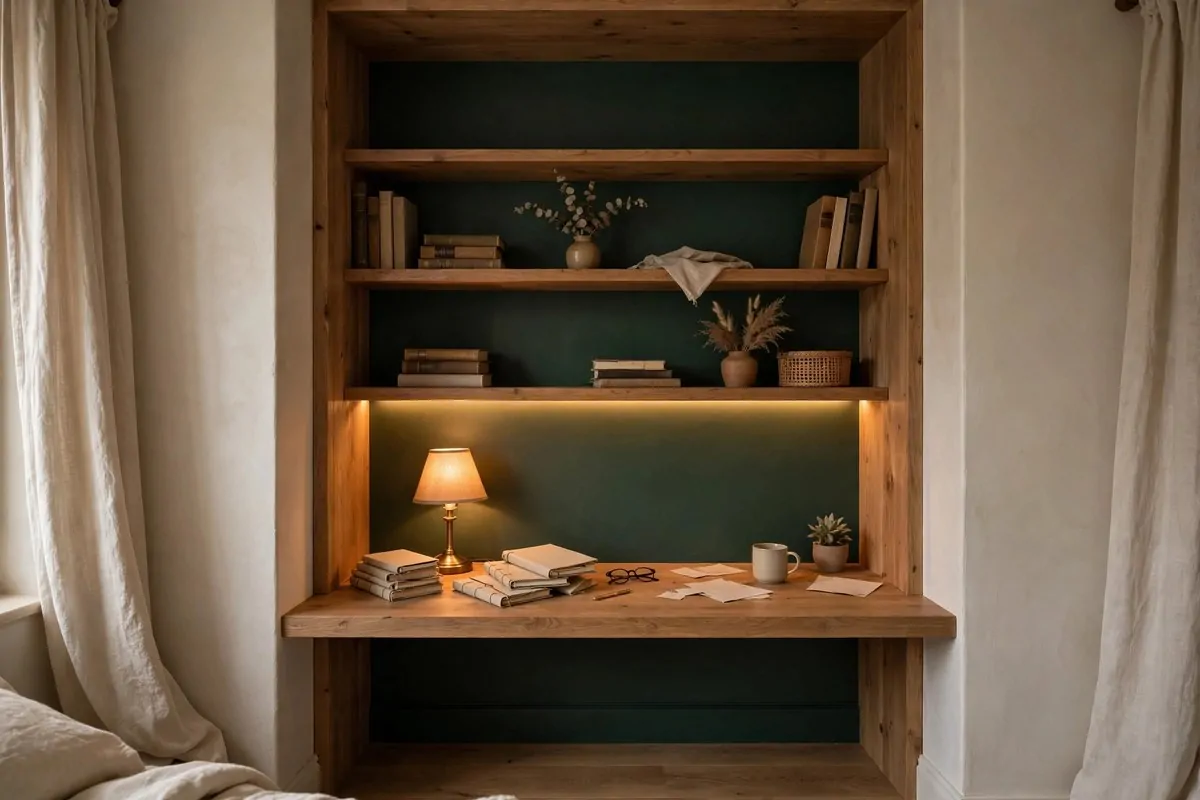
An alcove is a shallow dent in a wall. A little recessed spot that most people fill with a plant or ignore completely. Fill it with a desk instead.
The alcove frames your office like a picture. It already looks separate from the room. Add a desk that fits the width, and you have a workspace with built-in boundaries.
Measure carefully. Alcoves are rarely standard sizes. A custom-cut desktop on two brackets is often cheaper than hunting for a desk that fits perfectly.
Shelves above the desk use the alcove’s height. Because the space is shallow, everything stays within arm’s reach. No more spinning your chair around to grab a file.
Paint the back wall of the alcove a different color. This is a small area, so you can be bold. A deep green or a warm terracotta makes the nook feel like its own room.
Add a small light under the top shelf. It lights your work without lighting the whole bedroom. At night, one switch turns the office off completely.
If the alcove is deep enough, a curtain across the front hides everything. Shallow alcove plus a curtain is one of the cheapest hidden offices you can build.
11. The Room Divider Screen
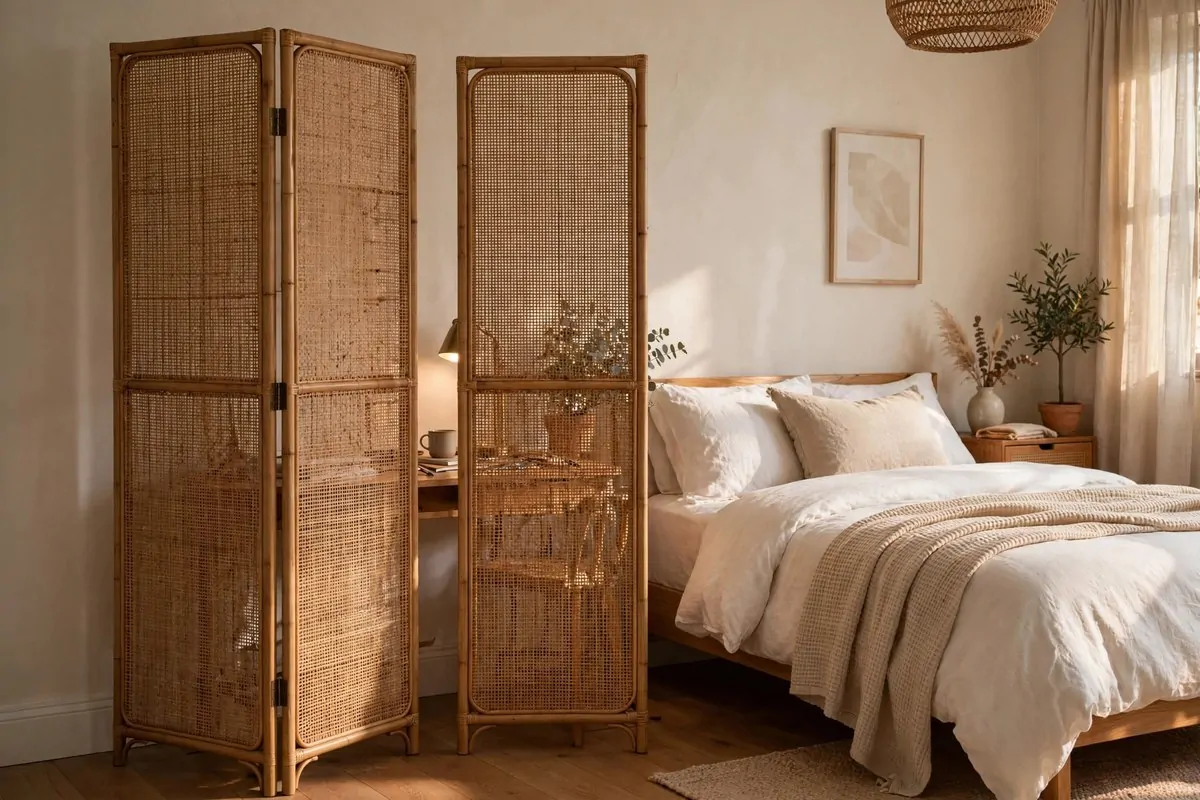
A folding screen is the oldest trick in the book. It stood in bedrooms a hundred years ago, and it still works today.
You unfold it around your desk at the end of the day. Work vanishes. The screen itself looks like decor. A pretty panel with a pattern can be the nicest thing in the room.
Screens come in every style. Wood, fabric, rattan, paper. Pick one that matches your bedroom and it will look like it was always part of the plan.
The beauty is the flexibility. Need the screen elsewhere? Fold it and move it. Having guests? Set it up in seconds. No tools, no holes, no commitment.
Get one tall enough to actually hide the desk. A short screen that shows the monitor over the top defeats the whole purpose. Eye level or higher is the rule.
Two screens make a corner. Angle them into an L shape around your workspace. Now you have a little office room inside your bedroom, and it folds flat when you need the space.
This is also great for couples. One person sleeps, the other works. The screen softens the light and the sight of the desk. It is not perfect, but it helps a lot.
12. The Bookshelf Back Wall
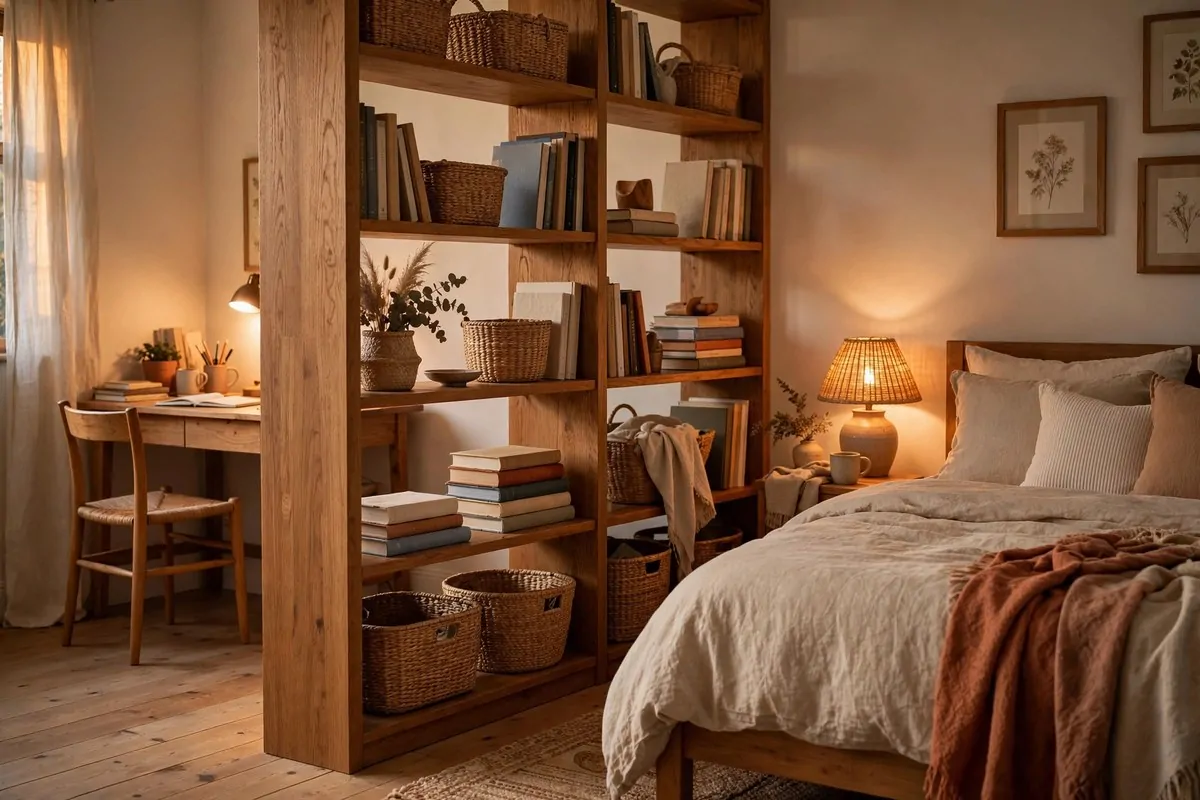
Turn a tall bookshelf around and it becomes a wall. Put your desk on the far side, and your office has a boundary that also stores your stuff.
This is one of my favorite ideas because the divider earns its place. It is not just hiding your desk. It holds books, boxes, and baskets. Every shelf is useful.
Face the shelves toward the bed. Then the pretty side faces your sleep space. Books and baskets look cozy. The desk side can be a little messy during the day, and nobody sees it.
Anchor the bookshelf to the wall. Tall furniture can tip, and a bookshelf full of books is heavy. A small bracket at the top keeps everyone safe.
Leave a gap at one end so you can walk around it. The gap becomes the doorway to your office. It feels surprisingly official, like entering a tiny room.
Baskets on the lower shelves hide office supplies. Label them if you like. Paper, chargers, notebooks. Everything has a home, and the home has doors made of woven baskets.
| Divider option | Best when |
| Tall bookshelf | You need storage and a full visual block |
| Low cube shelf | You want the room to still feel open |
| Folding screen | You rent and cannot move big furniture |
13. The Rolling Cart Office
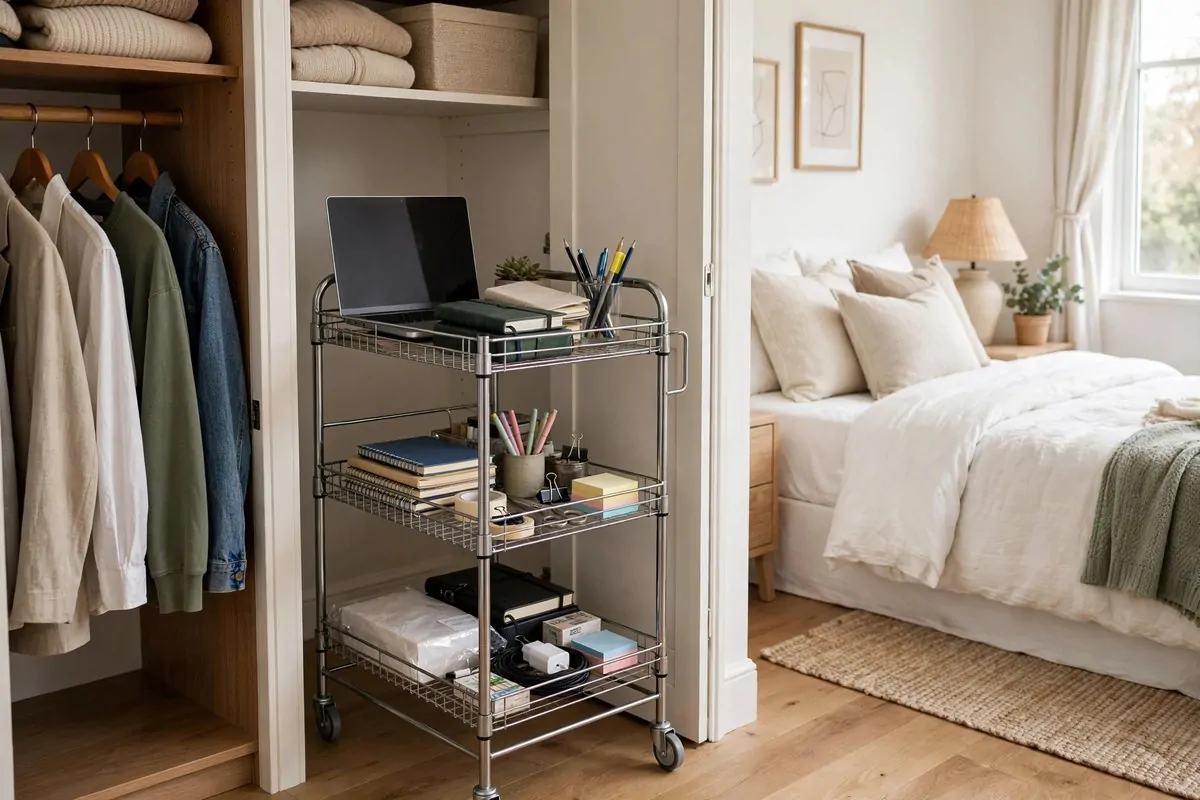
A rolling cart is a tiny office on wheels. Three tiers, a handle, and it goes wherever you need it. Including into the closet at 6 pm.
Load the top tier with your daily things. Laptop, notebook, pen cup. Middle tier holds files and folders. Bottom tier takes the printer paper, the chargers, the backup supplies.
During the day, the cart parks next to any table and that table becomes your desk. The kitchen table. A folding table. Even a sturdy bench. You are not tied to one spot.
At night, you wheel the whole thing into the closet and shut the door. The bedroom shows zero signs of work. It is honestly the fastest disappearing office on this list.
Label the tiers if you share the cart with crafts or schoolwork. Little tags keep everyone honest about what goes where.
Get a cart with locking wheels. Otherwise it drifts while you work and you will chase it around the room. The lock is a tiny feature that makes a big difference.
- Best for: people who work in different spots or have no desk at all
- Skill level: easy, just load it up
- Hides work: fully, wheels into a closet or corner
14. The Wardrobe Desk
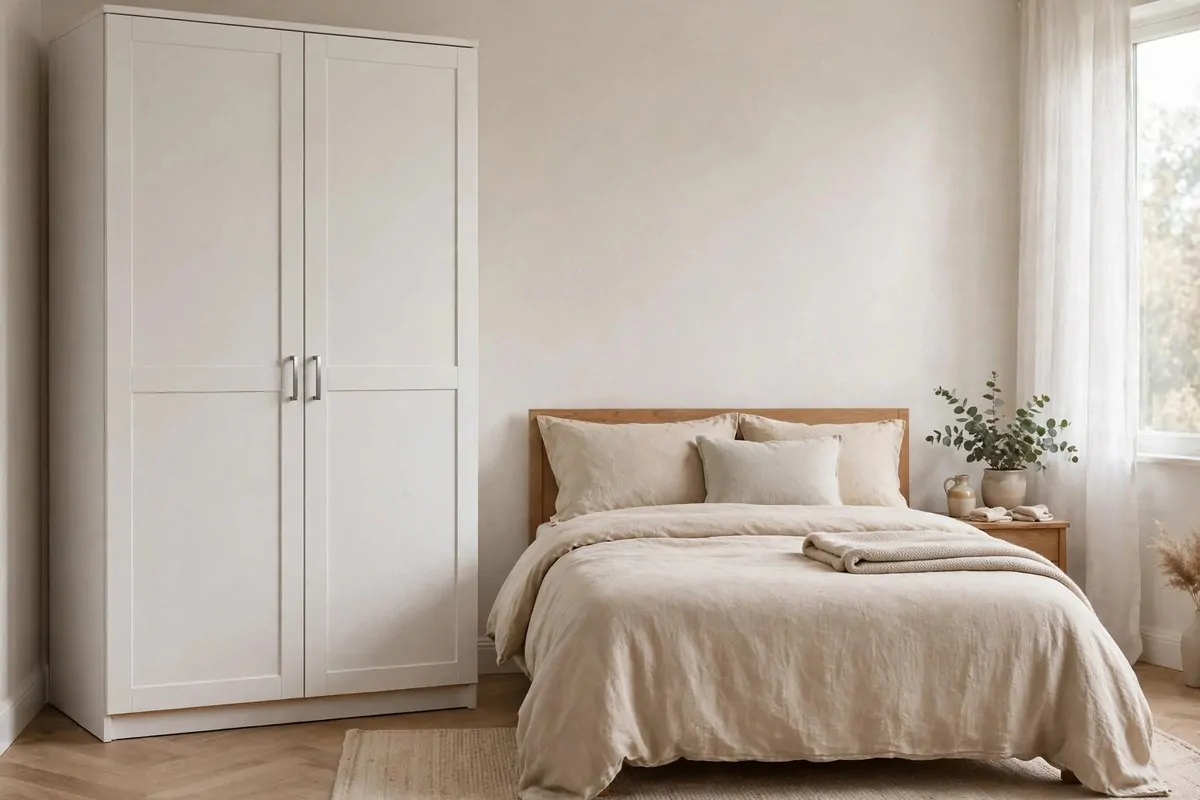
A wardrobe is deeper than an armoire and often cheaper. Take out some hanging space, add a desktop at the right height, and you have a walk-in hidden office.
The depth is the superpower. A wardrobe can hold a monitor, a keyboard, and still have room for shelves above. It feels like a real office when the doors are open.
Keep one side for clothes. Most wardrobes are wide enough to split. Clothes on the left, office on the right. The doors close on both, and the room looks perfectly normal.
Add a motion-sensor light inside. It turns on when you open the doors and off when you close them. It feels fancy, costs very little, and you never work in the dark.
Cut a small hole in the back panel for cords. The cords drop behind the wardrobe and reach the wall outlet. From the front, you see nothing but clean surfaces.
The chair question matters here. You need a chair that fits inside the wardrobe footprint or tucks under the desk completely. Otherwise the doors will not close, and the magic is gone.
If a full wardrobe feels like too much, start with a small one. Even a narrow single-door wardrobe fits a laptop desk. The idea scales to any size.
15. The Lift-Top Trunk Desk
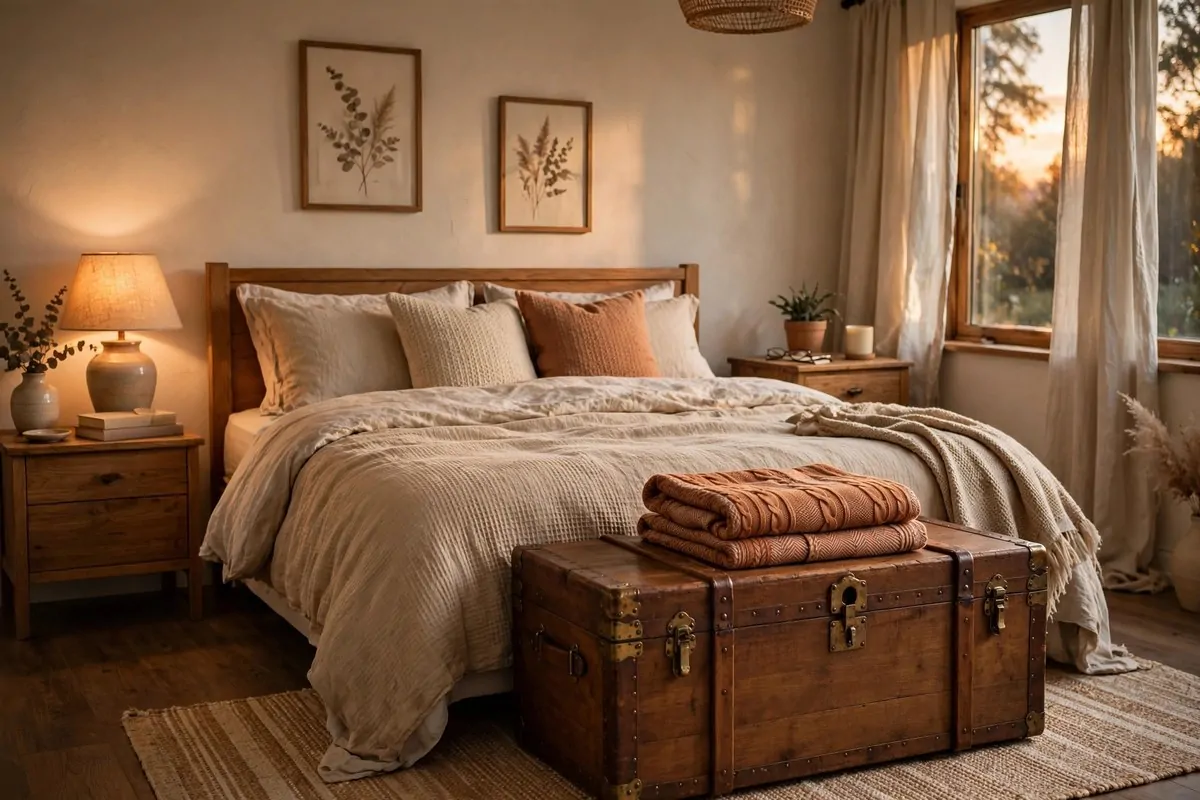
A storage trunk at the foot of the bed is classic bedroom furniture. The lift-top kind opens into a desk-height surface, and inside there is room for everything.
During the day, you open the lid, and the inside of the lid becomes your work surface. Some trunks have a flat panel that locks at just the right angle. Your laptop sits there, steady and fine.
Inside the trunk, your office supplies live in trays. Notebooks, pens, chargers. When you close the lid, all of it disappears. The trunk goes back to being a pretty bedroom piece.
This one is perfect for laptop workers. It is not made for big monitors or heavy equipment. But for writing, email, and video calls, it is more than enough.
Style the closed trunk with a folded throw blanket. It looks like it belongs in a bedroom because it does. No one will ever guess it holds your office.
The trunk also gives you bonus storage. Blankets, out-of-season clothes, the stuff every bedroom needs a home for. It is doing triple duty and asking for nothing in return.
Check the hinges before you buy. They should hold the lid open on their own. Good hinges mean the lid never falls while you work.
16. The Loft Bed Desk
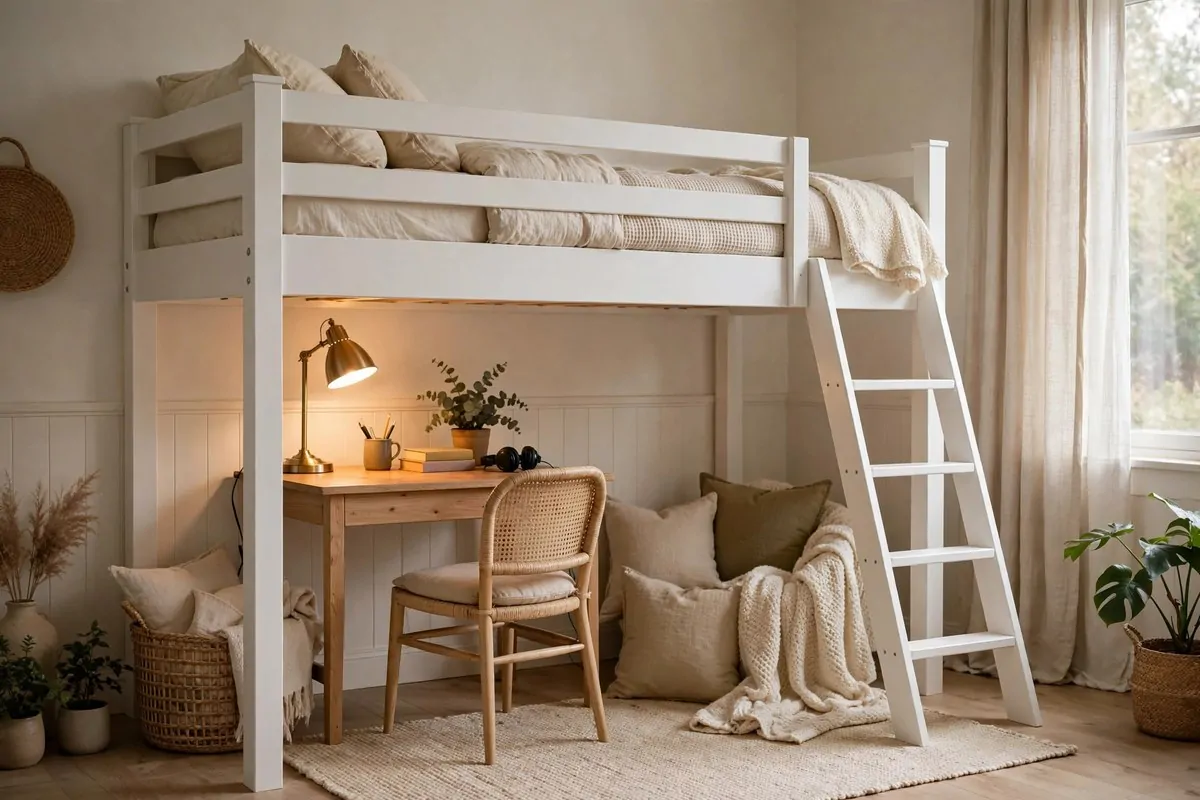
Raise the bed and the office fits underneath. A loft bed turns one footprint into two rooms. Sleep up top, work below.
This is the ultimate small-bedroom move. The floor space your bed used to eat is now your office. Nothing is hidden exactly, but the work zone feels tucked away under the bed, separate from the rest of the room.
Add a curtain around the lower level. Now it is hidden too. Pull the curtain at night and the desk disappears. Open it in the morning and your office is waiting.
Lighting under a loft bed needs thought. It is darker down there. A good desk lamp and maybe a string of warm lights make it cozy instead of cave-like.
Check the weight limit before you buy. Loft beds hold a sleeping person plus a mattress, so most are strong. But check anyway, especially with secondhand frames.
The ladder question is real. You will climb it every night and every morning. Make sure the ladder feels safe and steady. Your sleepy self at midnight will thank you.
- Best for: small bedrooms, studios, and kids’ rooms that need a desk
- Skill level: easy, just load it up
- Hides work: fully, wheels into a closet or corner
17. The Pegboard Wall
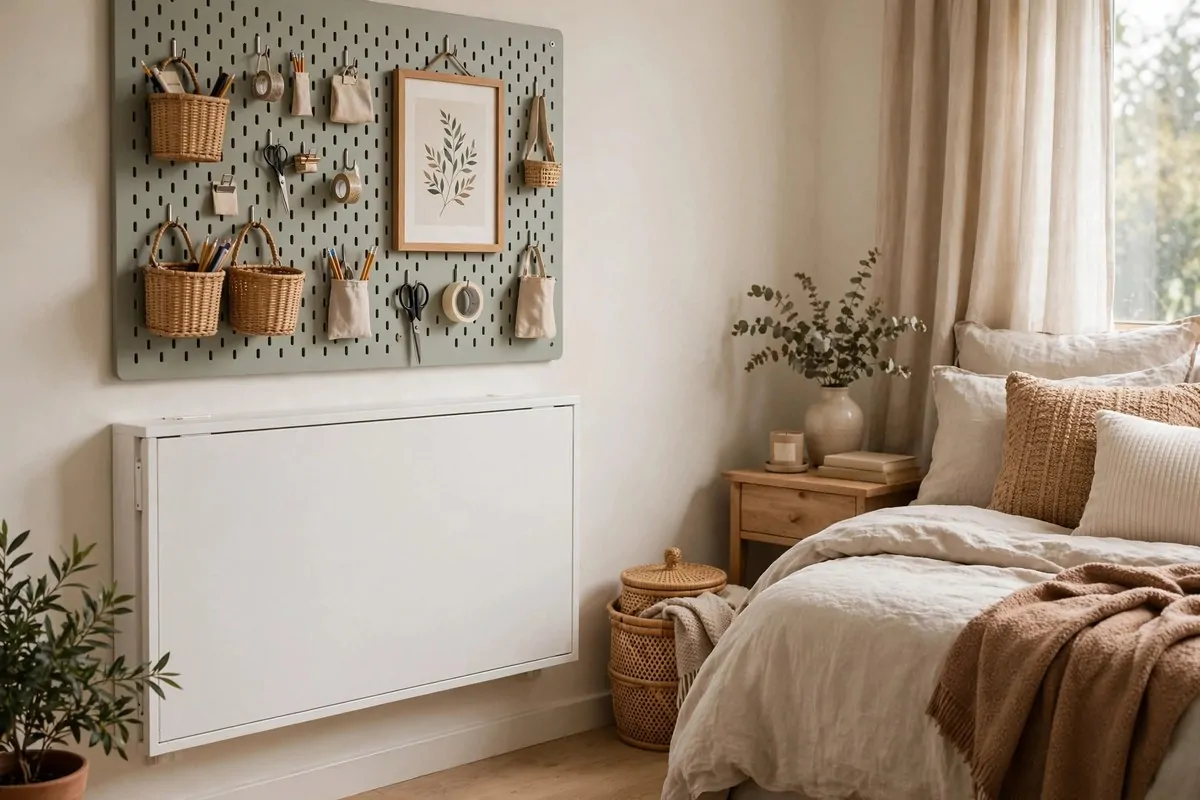
A pegboard above your desk holds everything that used to live on the desk. Scissors, headphones, notebooks, little baskets. It all hangs on the wall in neat rows.
The desk surface stays clear. A clear desk is a desk that looks clean even when you are mid-project. And at night, a clear desk with a pegboard above it reads as decor, not office.
Paint the pegboard to match your wall. Then it blends in. Or paint it a fun color and make it art. Both work. The painted pegboard looks intentional either way.
Hooks and small shelves for pegboards are cheap. You can rearrange them whenever your needs change. New hobby? Move the hooks. New job? Add a shelf. It grows with you.
Pair the pegboard with a fold-down desk and you have the dream team. Supplies on the wall, surface that folds away, and nothing left out when you are done.
One warning. Do not overload it. A pegboard stuffed with stuff looks messy. Leave some empty space. The empty space is what makes it look calm.
At night, hang a small wreath or a framed print on the pegboard. It turns the office wall into bedroom decor in one move.
18. The Keyboard Drawer Trick
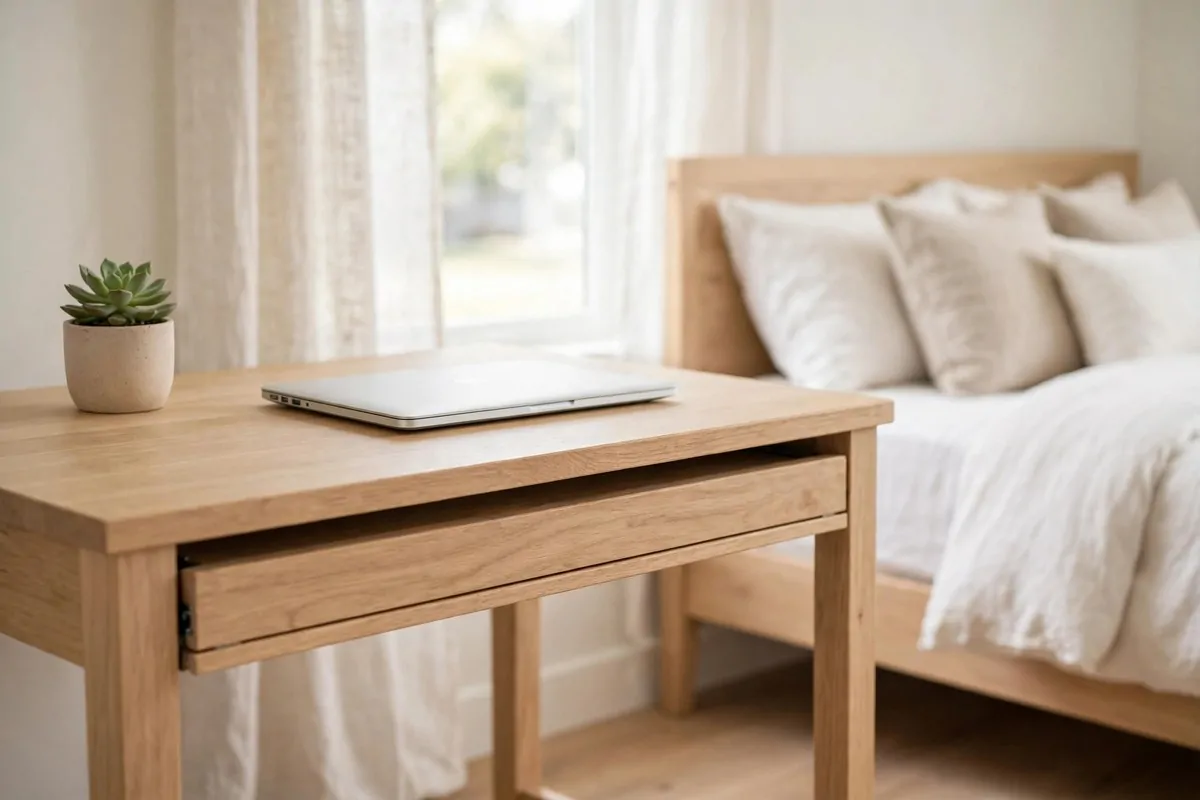
A pull-out keyboard tray hides the messiest part of any desk. The keyboard, the mouse, the wrist rest. They all slide under the desktop and vanish.
Your desk keeps a clean top all day. Just a laptop or a monitor on a clear surface. It looks tidy while you work and even tidier when you stop.
Most desks do not come with this tray, but you can add one. Under-desk keyboard trays clamp or screw on in minutes. It is one of the cheapest upgrades on this list.
The tray also helps your posture. It sits lower than the desktop, which puts your arms at a better angle. Your shoulders drop. Your neck relaxes. Small change, big comfort.
Slide it in when you stand up. That one habit keeps the desk looking clean all the time. Out when you work, in when you do not. It takes one second.
If you use a laptop, the tray holds your notebook and pen instead. Same idea. The work tools hide under the desk, and the top stays clear and calm.
The tray also keeps crumbs and dust off your keyboard. Closed tray, clean keyboard, and one less thing to wipe down on weekends.
19. The Charging Drawer
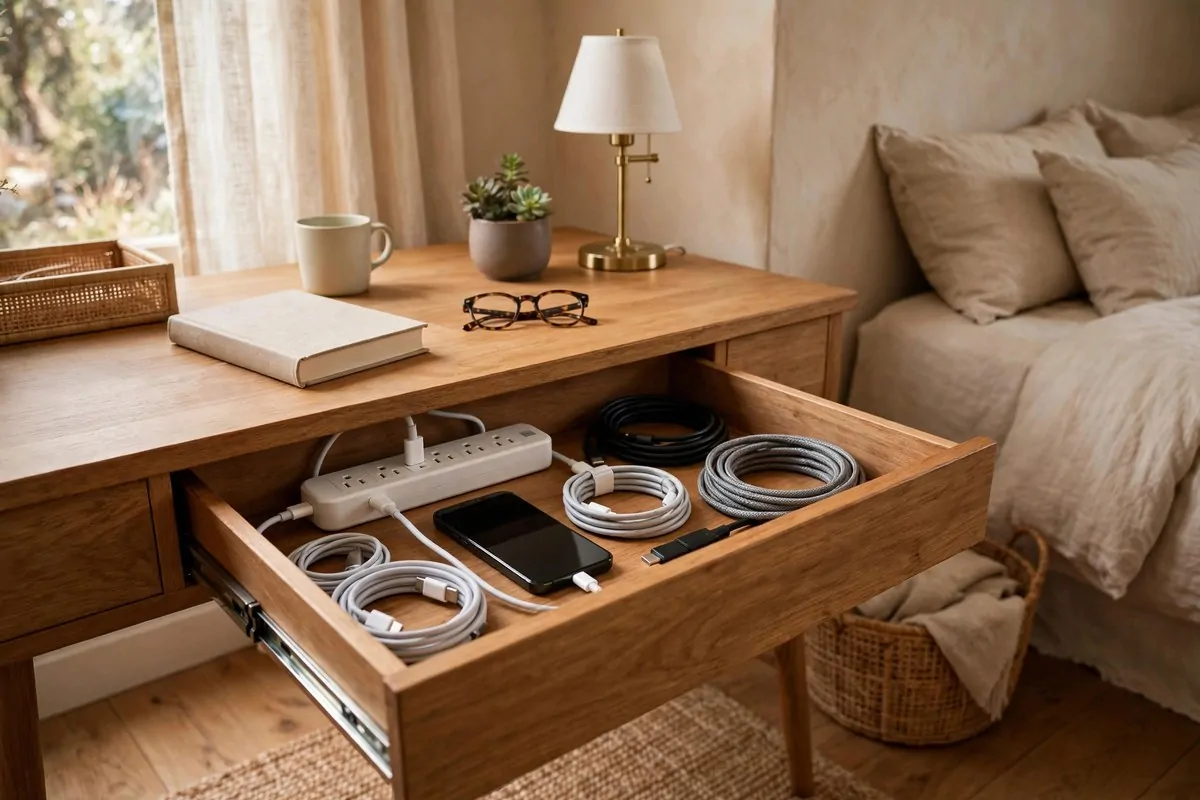
Cables are the reason most desks look like offices. The charging drawer fixes that. All the cords, plugs, and chargers live inside one drawer.
You fit a power strip inside the drawer and drill a small hole in the back for the main cord. Phones, tablets, and earbuds charge inside, out of sight. The desktop stays completely clear.
Close the drawer and the tech disappears. No glowing lights. No tangled cords. Just a normal bedroom drawer. Your brain gets the message that work is over.
This works in nightstands too. A charging drawer in your nightstand means your phone charges hidden away at night. No more scrolling in bed because the phone is right there glowing.
Use a power strip with a flat plug. It fits better in a shallow drawer. And pick one with a switch so you can cut power to everything at once.
Safety first. Do not overstuff the drawer. Cords need a little air. If the drawer feels warm, take something out. Cool and roomy beats packed and hot.
| What to hide | Where it goes |
| Phone and tablet chargers | Charging drawer with a power strip |
| Laptop power brick | Under-desk tray or inside a basket |
| Cable clips along the desk edge | Cable clips along the desk edge |
20. The Monitor Arm Setup
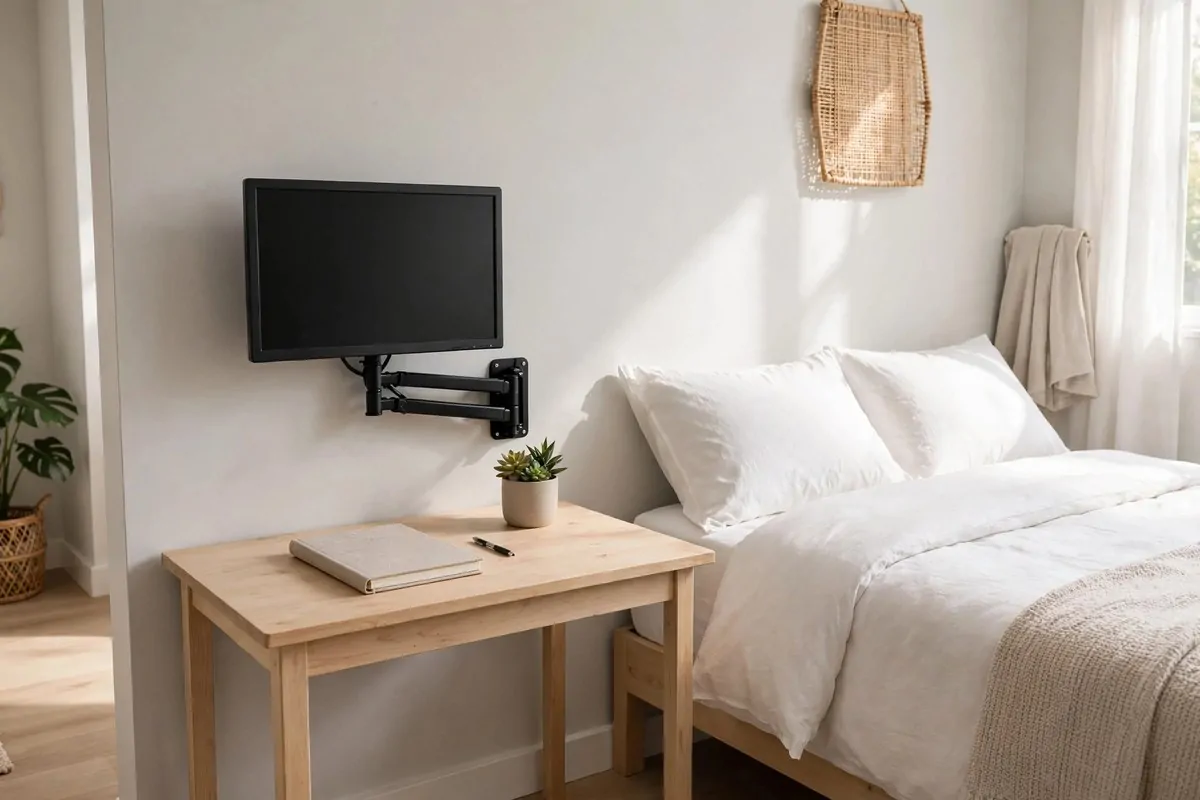
A monitor on an arm folds flat against the wall when you are done. The biggest, most office-looking thing on your desk just disappears.
During the day, you pull the monitor toward you and work normally. The arm holds it steady at the perfect height. Your neck will feel the difference in a week.
At night, you push it back. Flat against the wall, the screen looks like a small dark picture frame. The desk below it is clear. The room feels like a bedroom again.
Monitor arms clamp to the desk edge. No drilling needed. They fit most desks and most monitors. Check the weight rating, but most arms handle a standard screen easily.
This also frees up desk space. The monitor stand is gone. That whole area under the screen is free for notebooks, a plant, or just empty calm space.
Cable management comes built in. Most arms have clips that hold the cords along the arm. One neat line instead of a waterfall of cables.
When friends visit, push the monitor flat and put a small plant on the desk. The office corner becomes a bedroom corner in ten seconds.
21. The Two-Desk Duo
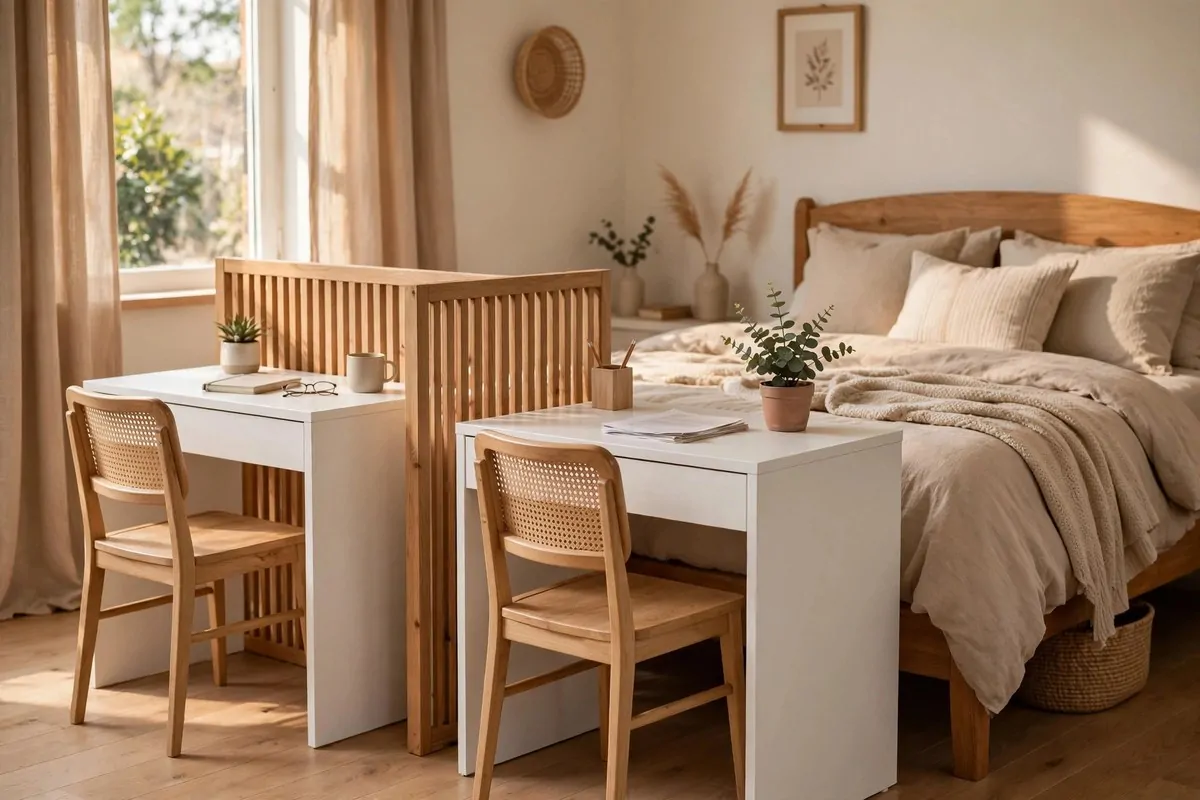
Two people working in one bedroom is tricky. Two small desks with a divider between them make it work.
The divider is the key. It can be a low panel, a row of plants, or a small bookshelf. It gives each person their own zone. You stop seeing each other’s screens, and the room feels bigger for both of you.
Keep the desks small and matching. Two matching desks look like a plan. Two random desks look like a storage problem. Same color, same height, and the room stays calm.
Face the desks in opposite directions if you can. Back to back is the best layout for focus. You each get your own view and your own space.
Sync your shutdown routine. When you both close up at the same time, the whole office disappears together. It becomes a little end-of-day ritual you share.
Storage goes between the desks. A shared drawer unit or a small shelf in the middle holds the things you both use. Printer paper, the stapler, the backup chargers.
- Best for: couples or roommates sharing one bedroom office
- Skill level: easy, just arrange and divide
- Hides work: well, the divider blocks the office view from the bed
22. The Daybed Office
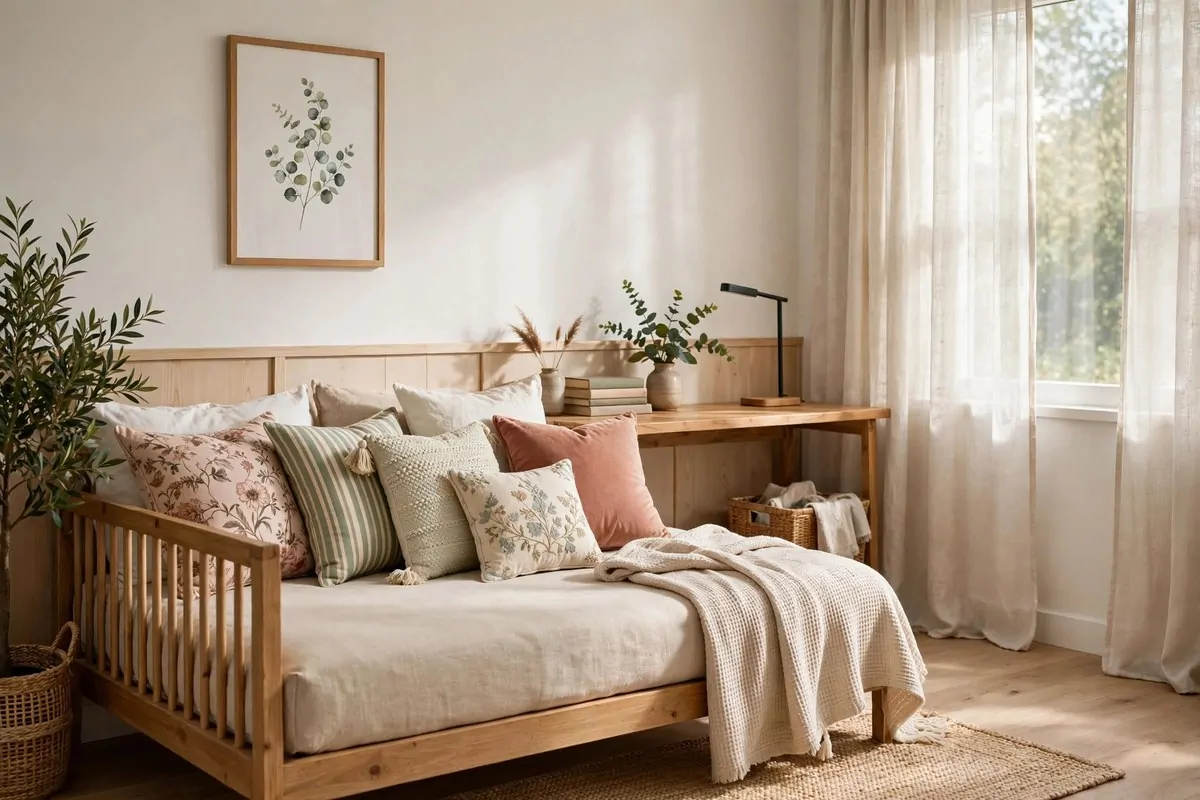
A daybed looks like a sofa by day and a bed by night. Put your desk behind it, and the whole room reads as a sitting room, not an office.
This is the guest room dream. Guests see a pretty daybed with cushions. They never notice the desk tucked behind it. You get an office that does not ruin the guest experience.
The daybed also gives you a thinking spot. Stuck on a problem? Lie back for ten minutes. Some of my best ideas came from staring at the ceiling from a daybed.
Keep the desk low-profile. A slim desk in a bedroom color, not a big black office desk. The goal is for the desk to blend in with the daybed setup.
Pillows are your styling tool. A row of pretty pillows on the daybed draws the eye. The desk behind them fades into the background. Decor does the hiding for you.
At night, throw a soft blanket over the desk chair. It sounds silly, but a draped chair looks like bedroom furniture. An office chair with no cover looks like work.
If the room is small, skip the big desk chair. A simple wooden chair that matches the daybed keeps the whole setup looking like one plan.
23. The Under-Bed Storage System
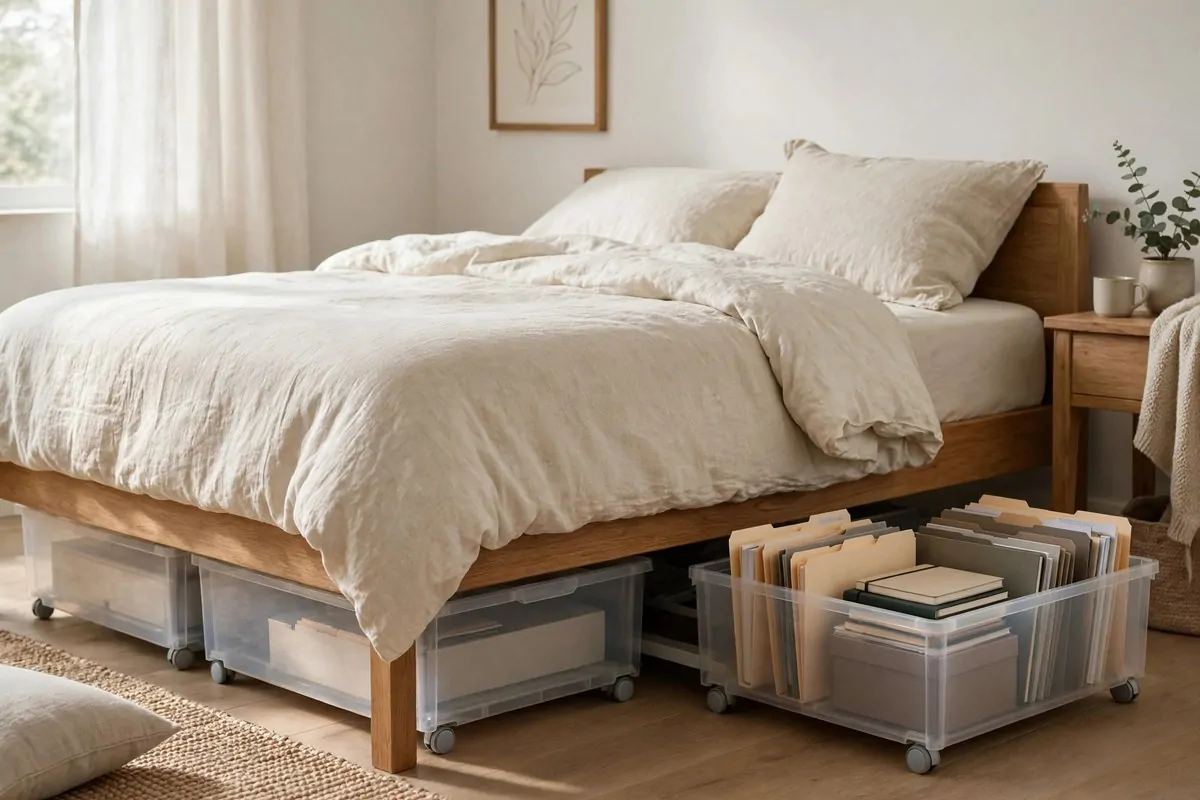
The space under your bed is a whole closet you are not using. Flat boxes on wheels turn it into hidden office storage.
Files, notebooks, backup supplies, the printer paper. It all slides under the bed in low boxes. During the day you pull out what you need. At night it all goes back under.
Wheeled boxes are worth it. They glide in and out without scratching the floor. Get the flat kind made for under-bed use. They are shallow enough to fit and deep enough to hold real stuff.
Label the ends of the boxes. You will see the labels when the boxes are under the bed. Paper, tech, crafts. Grab the right box the first time.
A bed skirt or a low bed frame hides the boxes completely. The bedroom looks clean and simple. All that office stuff is right there, just invisible.
This pairs well with a small desk. The desk holds only what you are using today. Everything else lives under the bed. Small desk, big hidden storage, calm room.
Vacuum under the bed twice a year. Dust loves hiding there, and clean boxes last longer and slide better.
24. The Sliding Barn Door Panel
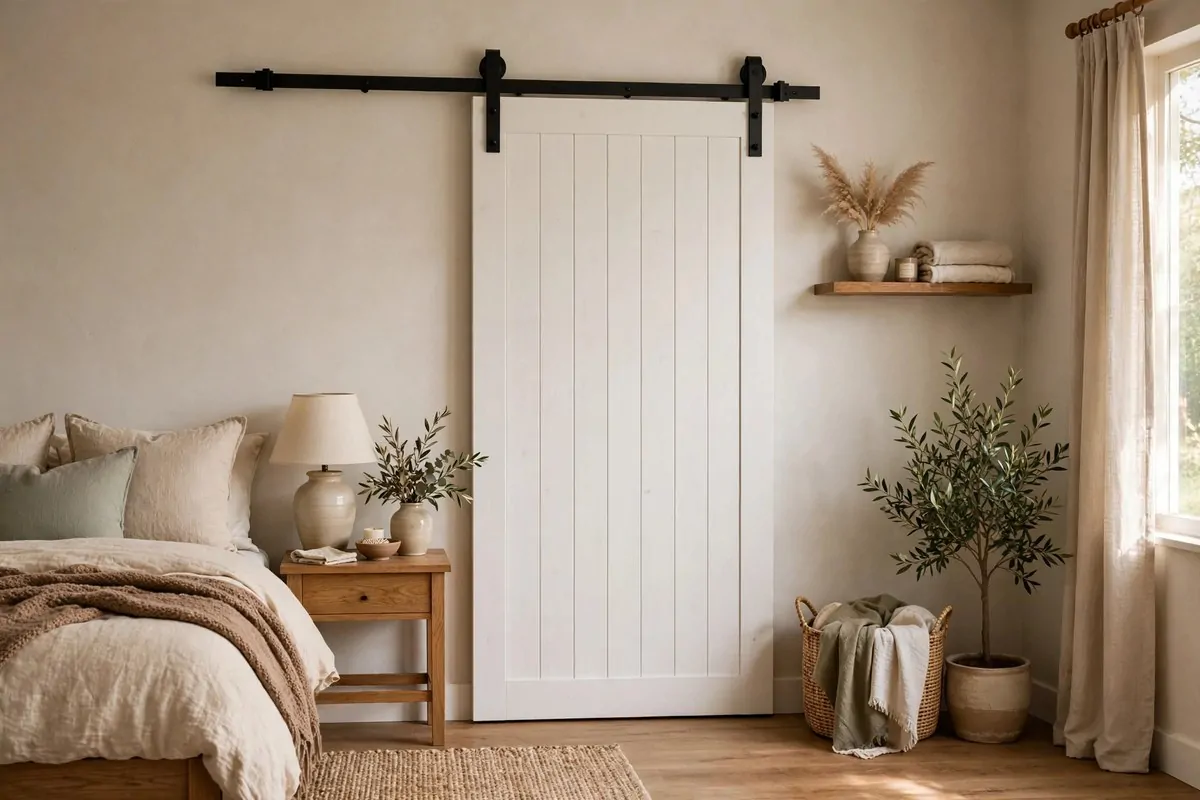
A sliding barn door on a wall track covers your office nook like a piece of art. Slide it open to work. Slide it shut to forget work exists.
The door itself becomes a feature. A pretty wood panel or a painted door adds character to the bedroom. It looks like a design choice, and it is, but it is also a hiding spot.
You need a nook for this one. An alcove, a wide closet opening, or a shallow recess in the wall. The door slides across the front and the office is gone.
The track mounts above the opening. Installation takes an afternoon. The door hangs from rollers, so it glides with one finger. Kids love sliding it, which tells you how smooth it is.
Paint the door to match your bedroom trim. Then it blends in when closed. Or paint it a bold color and let it be the star of the room. Both look great.
Leave a small gap behind the door for cords. The door does not need to seal tight. It just needs to block the view. A finger-wide gap at the bottom is fine and lets cables pass.
Add a small chalkboard to the front of the door. It becomes a message board by day and still hides your office at night.
25. The Cable-Free Finish
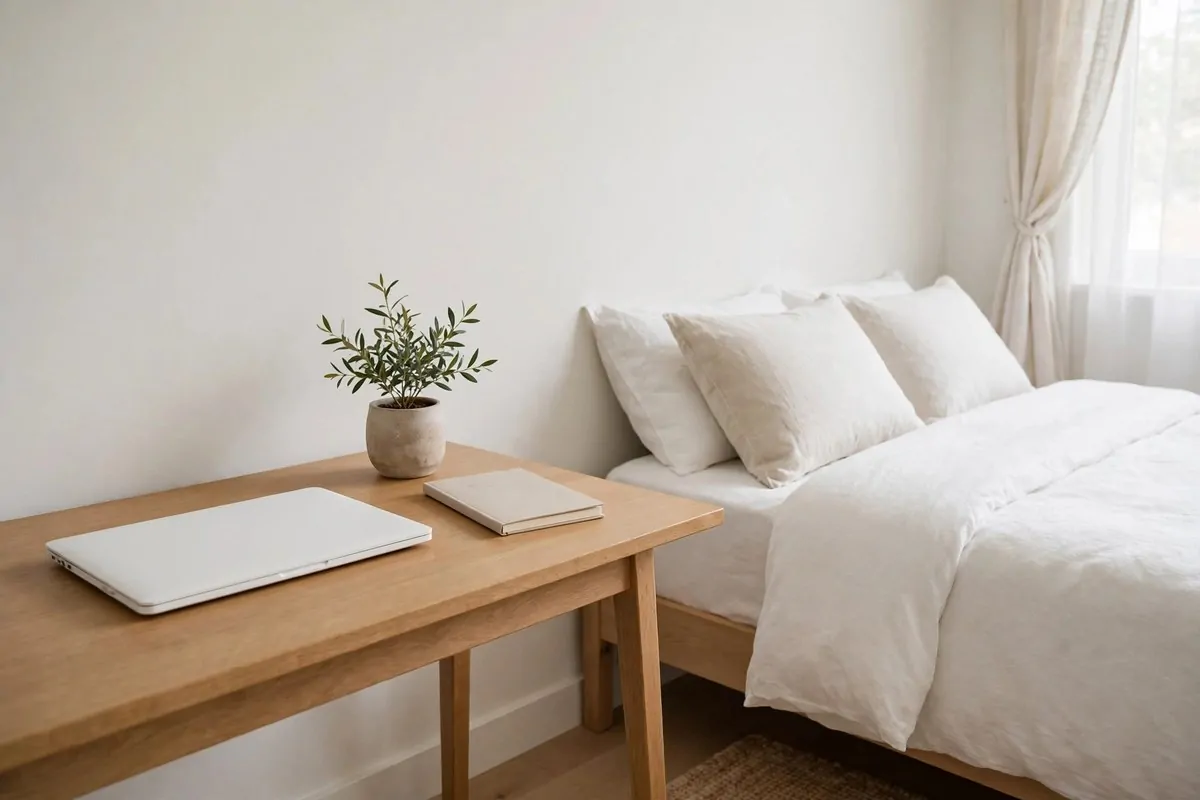
This last idea is not furniture. It is a finish. Hide every cable, and any desk stops looking like an office.
Start with a cable tray under the desk. The power strip and all the plugs live in the tray. One cord drops to the wall outlet. That is the only cord anyone sees.
Add cable clips along the back edge. They hold each cord in a neat line. No drooping, no tangling. The back of your desk looks as clean as the front.
Go wireless where you can. A wireless keyboard, a wireless mouse, wireless earbuds. Every wire you remove is one less thing screaming office at you.
Match your tech to the room. A white laptop on a white desk in a light bedroom almost disappears. A black tower with blinking lights does the opposite. Small choices add up.
End the day with a two-minute reset. Cords in the tray, laptop closed, notebook in the drawer. Two minutes, and the desk looks like it belongs in a bedroom. Because now it does.
Take a photo of your desk when it looks perfect. On messy days, the photo reminds you it only takes two minutes to get back there.