23 Small Office Room Ideas That Make Every Inch Count

Your small office is not too small. Your desk is too big.
I know that sounds rude. But hear me out.
Most home offices I see have the same problem. A big desk sits in the middle of a small room and eats up all the floor space. Then there is no room left for anything else.
I have worked from a room the size of a parking space. I made it work. And the secret was never a bigger room. It was smarter choices.
These 23 small office room ideas come from real homes. Real people. Real tiny rooms that work great every day. Pick the ones that fit your space and try one this weekend.
1. Float Your Desk in the Dead Corner
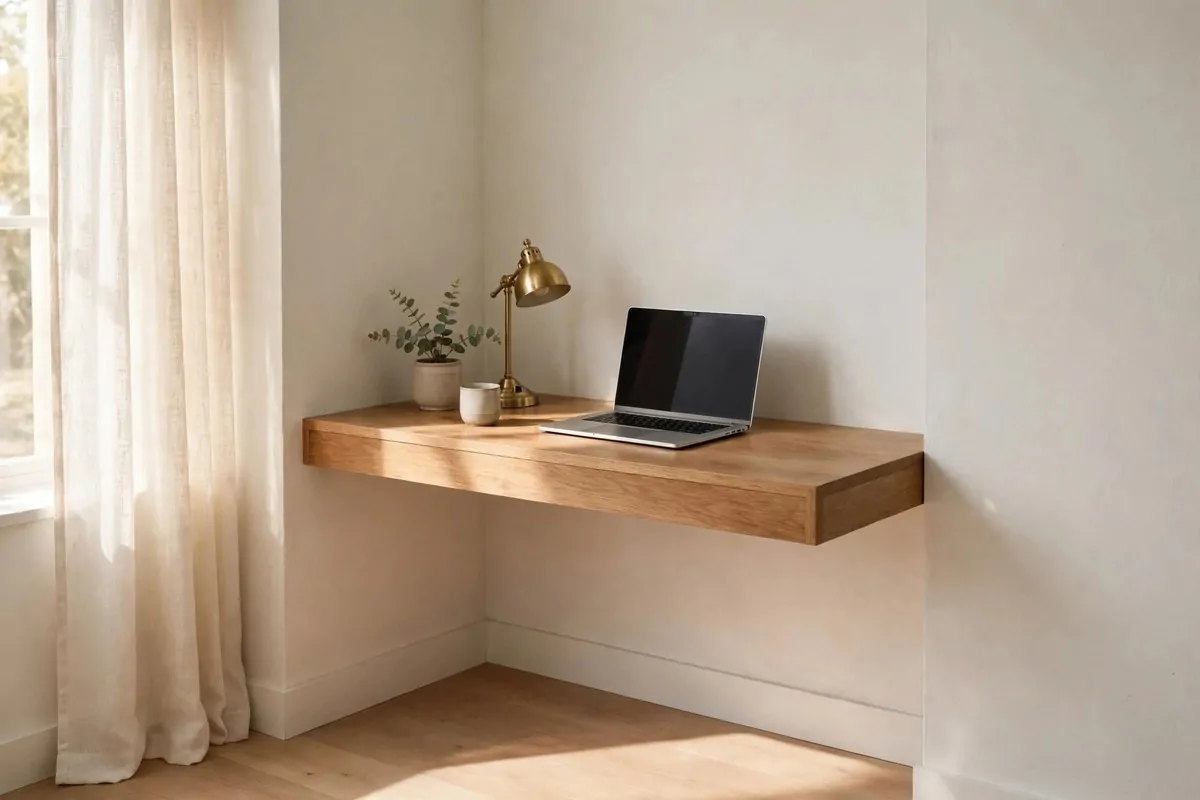
Every room has one. A corner that holds nothing but dust.
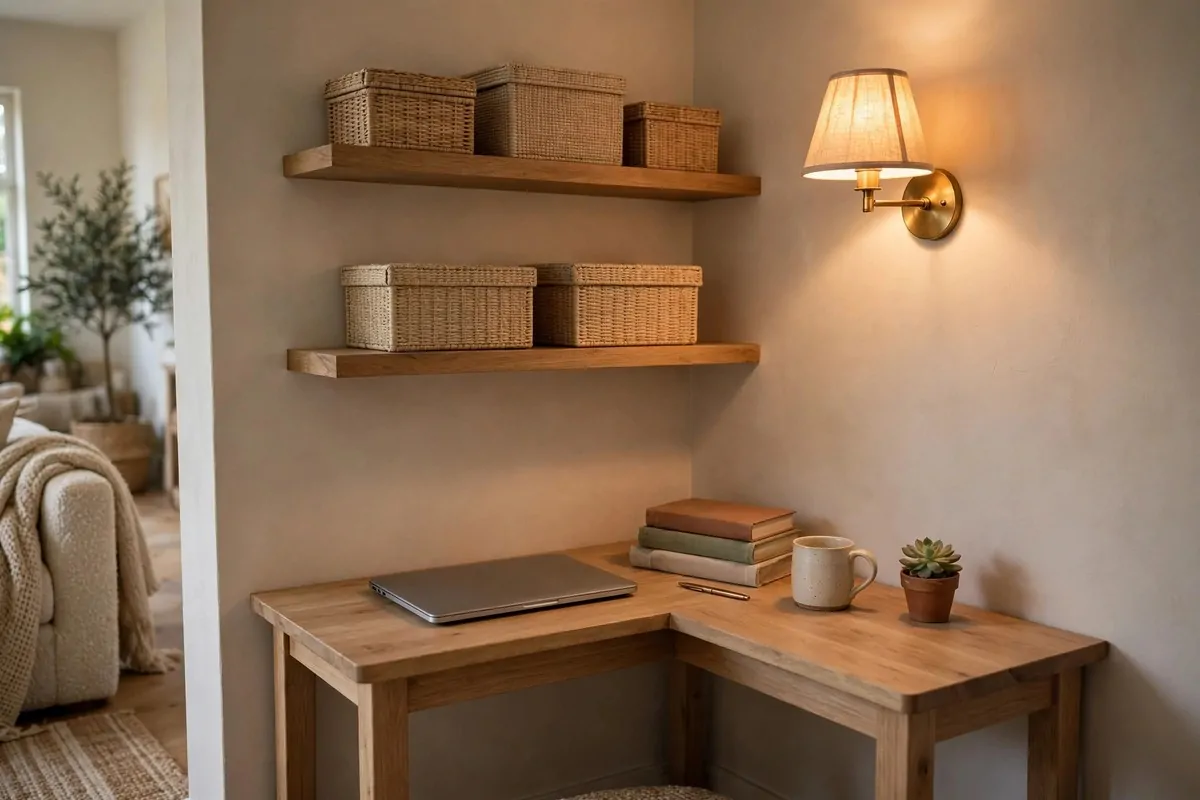
A floating desk is just a deep shelf screwed to the wall. No legs. The floor under it stays open, so the room looks bigger right away.
I like a depth of about 20 inches. Deep enough for a laptop and a mug. Not so deep that you lean over it like a shelf in a shop.
Install it at 28 to 30 inches high. That is normal desk height. Measure your chair first, because a short chair and a tall desk is a recipe for sore shoulders.
Add two strong brackets or a hidden cleat. Books and laptops are heavy. You do not want the desk to droop after one month.
Paint it the same color as the wall. It almost disappears. Or pick a wood tone that matches your shelves.
| Corner width you have | Desk depth to pick | Best for |
|---|---|---|
| Under 3 feet | 16 to 18 inches | Laptop only |
| 3 to 4 feet | 20 inches | Laptop plus notebook |
| Over 4 feet | 22 to 24 inches | Monitor and keyboard |
The best part is cleaning. You can mop right under it. Try doing that with a big desk.
Cost? A wooden board and two brackets cost less than lunch. Some weekends I like that math a lot.
2. A Fold-Down Desk That Vanishes at 5 PM
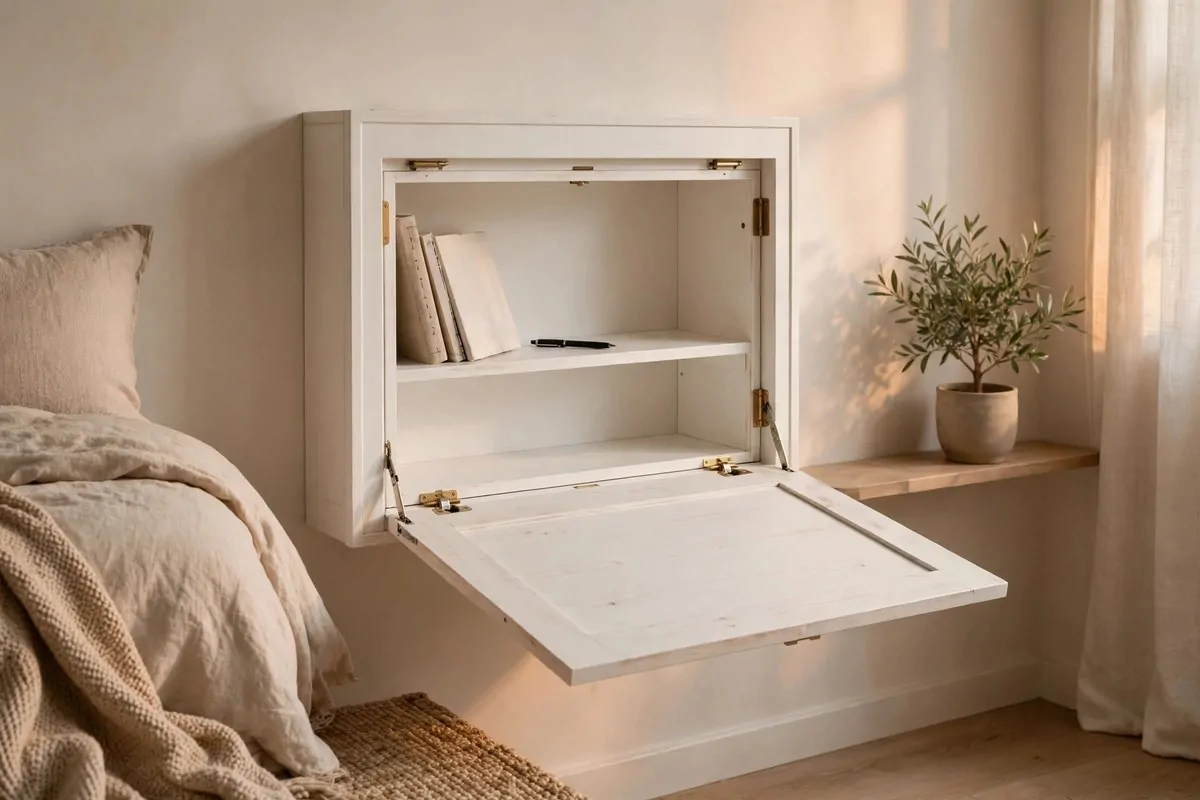
A fold-down desk hangs flat on the wall like a picture frame. When you need it, it drops down into a desk. When you finish work, it folds back up and the room is yours again.
This is the dream for a room that has to be two things. A bedroom by night. A dining nook by day. You know the kind.
Look for one with a lip on the inside edge. When it is folded down, that lip stops your laptop from sliding off. Tiny detail, big difference.
Mount it into a wall stud. Seriously. Anchors in plain drywall will hold a laptop fine for a while, but a stud holds it for years.
Some models hide a little shelf inside. Pens. A notebook. Your charger. Everything stays with the desk, so setup takes ten seconds.
I timed myself once. Fold down, open laptop, start work. Eleven seconds. You cannot beat that.
Guests come over and they just see a nice cabinet. Nobody knows it is an office. I love secrets like that.
This one idea changes how the whole room feels. The office stops taking up space in your head too.
3. A Ladder Desk With Storage Built In
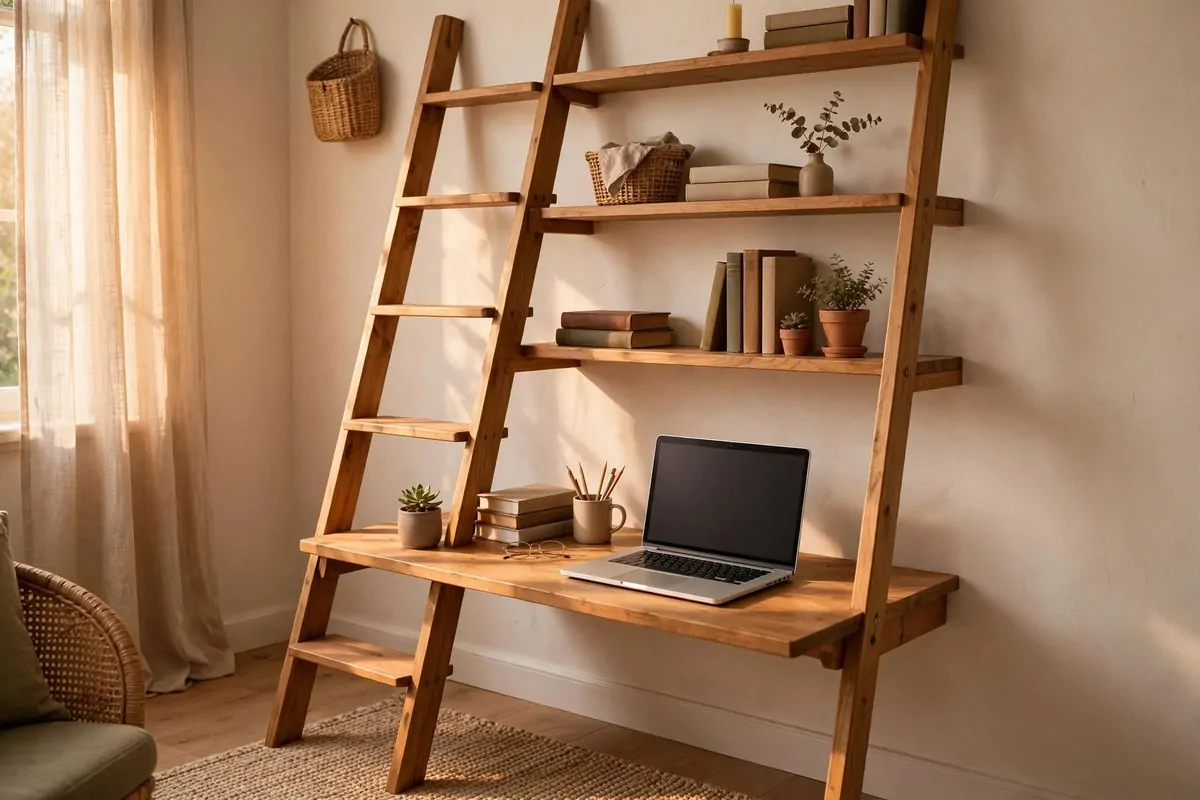
A ladder desk leans against the wall like a ladder. The desk part is the bottom shelf. Above it, more shelves climb up, getting narrower as they go.
The clever bit is the footprint. It only needs about two feet of floor space. The storage goes up, not out.
Top shelves hold the pretty stuff. Books, a small plant, a framed photo. Bottom shelves hold the boring stuff. Bills, chargers, a box of pens.
You can buy one ready-made or build it from leaning boards and brackets. Mine is made from an old bookshelf I cut down. Nobody can tell.
Keep the weight low on the bottom. Heavy books go on the desk level or below. The top is for light things only, or the whole thing gets wobbly.
It looks good in a room where a normal desk would feel like a wall. The open sides let light pass through.
Here is what fits on each level of mine:
- Desk level: laptop, lamp, and one notebook
- Middle shelf: notebooks, a jar of pens, and my headphones
- Top shelf: a small plant and two favorite books
If your room is narrow, this is the desk for you. It takes a sliver of floor and gives you a tower of storage.
4. Shelves That Climb the Whole Wall
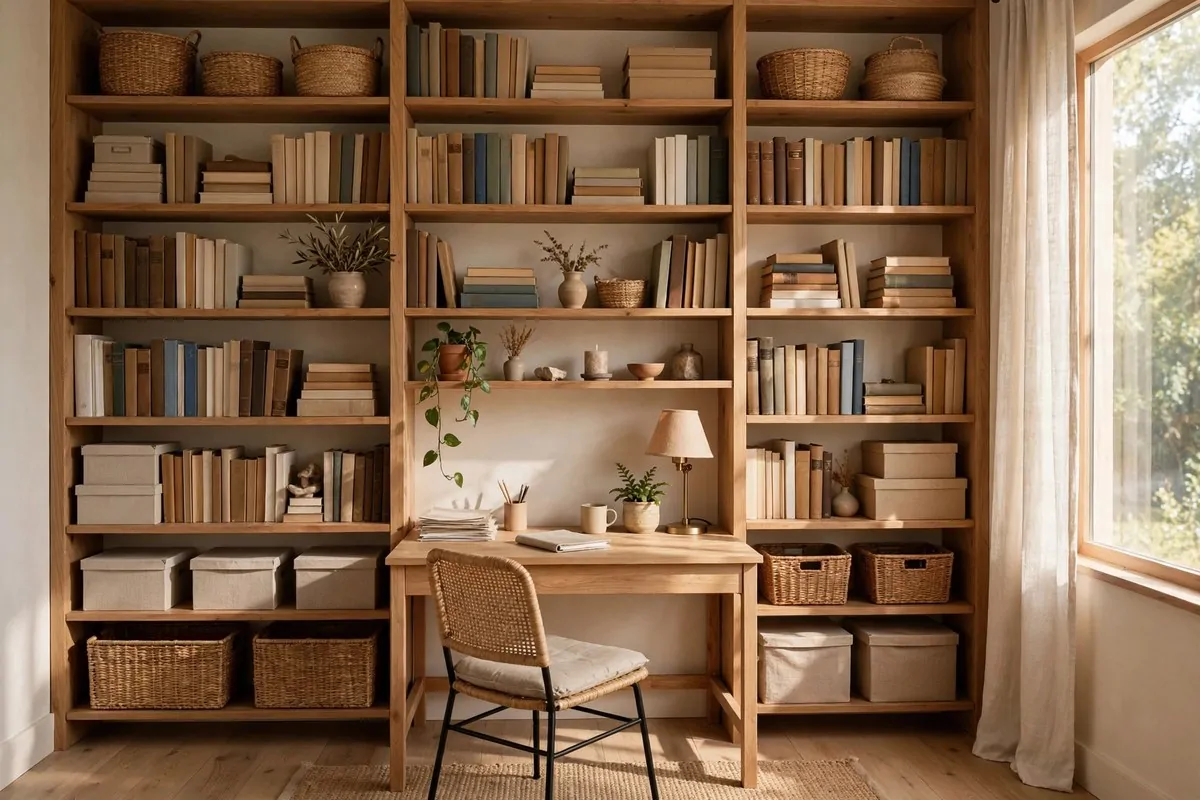
Look at the wall above your desk. All that empty air is free storage. Most people use none of it.
Floor-to-ceiling shelves hold more than any bookcase. And they make the ceiling feel taller, which makes the whole room feel bigger.
Put the things you use every week at arm height. Reference books. Your printer paper. The box with the good pens.
Things you use once a month go up high. Old files. The camera you never use. Label the boxes so you can find them fast.
Things you almost never use go at the very top. Or on the lowest shelf. Both are a pain to reach, so choose what belongs there wisely.
Leave some shelves half empty. A shelf packed wall to wall looks heavy and messy. A little breathing room looks calm.
| Shelf level | What to store there |
|---|---|
| Eye level | Daily supplies, current projects |
| Above reach | Labeled boxes, spare paper, files |
| Very top and bottom | Rarely used items, archives |
Sturdy brackets every 24 inches. Books are heavier than you think. A sagging shelf looks sad and feels risky.
I painted my shelf brackets the same color as the wall. They vanish. The shelves look like they float.
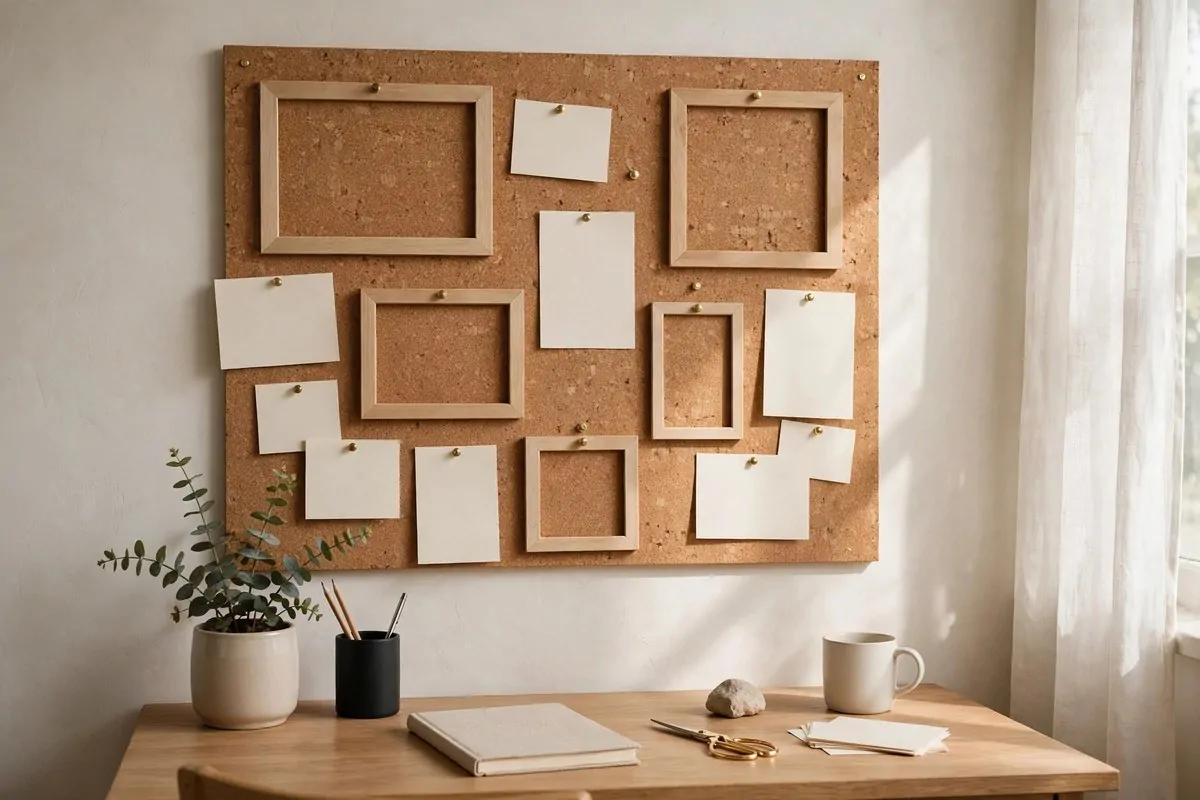
5. A Pegboard for Everything You Touch
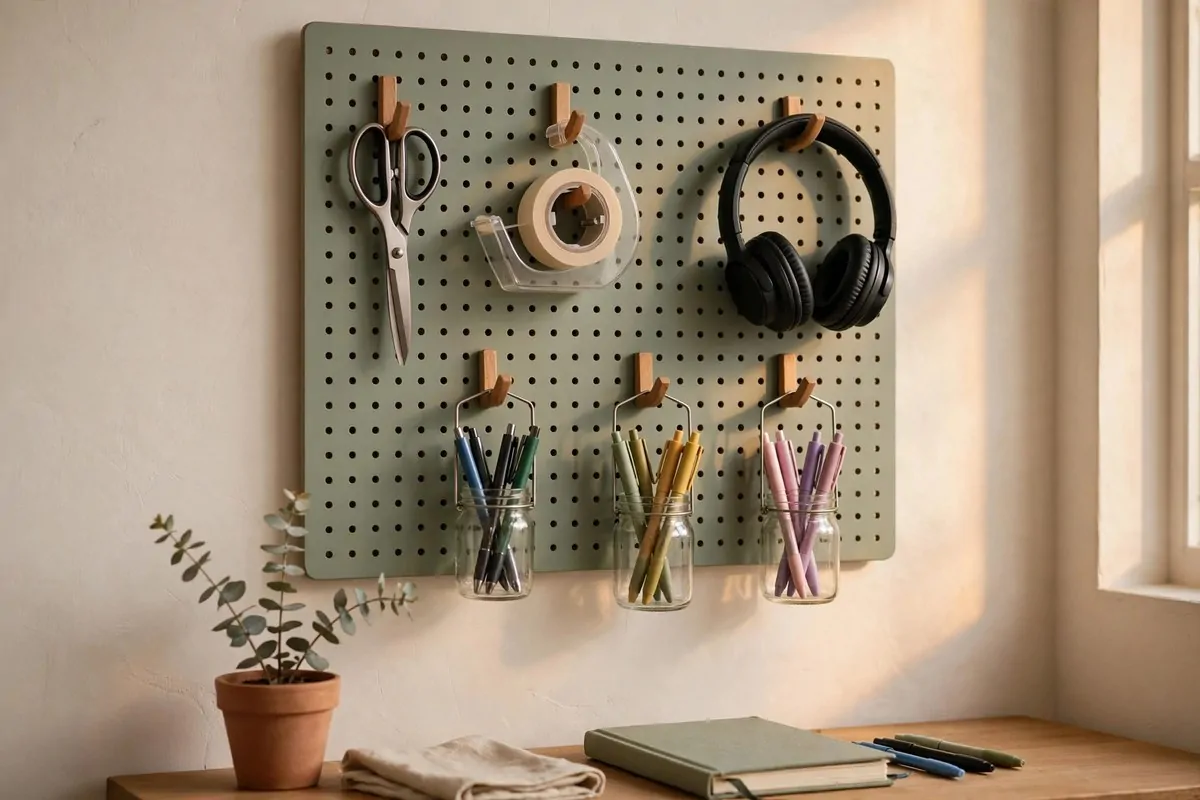
A pegboard is a board full of little holes. You push hooks into the holes. You hang things on the hooks. Simple.
It takes zero floor space and zero desk space. Your scissors, your tape, your headphones all hang on the wall, right where you can grab them.
Paint it before you hang it. A soft color looks so much better than plain brown. White, sage green, and pale blue all work.
Arrange the tools you use every day in the middle. The rest goes to the edges. Your hand should land on the scissors without you even looking.
Small jars hang from hooks too. They hold pens, clips, and little odds and ends. Everything visible. Nothing lost.
The fun part is rearranging. When your work changes, you just move the hooks. No new furniture needed.
Things I keep on my pegboard:
- Headphones on a wide hook, easy to grab
- Scissors, tape, and a ruler in a row
- Two small jars for pens and paper clips
- A hanging notebook for quick lists
Start small. One board, one wall, one afternoon. You will wonder why you did not do this sooner.
6. Floating Shelves Above the Desk
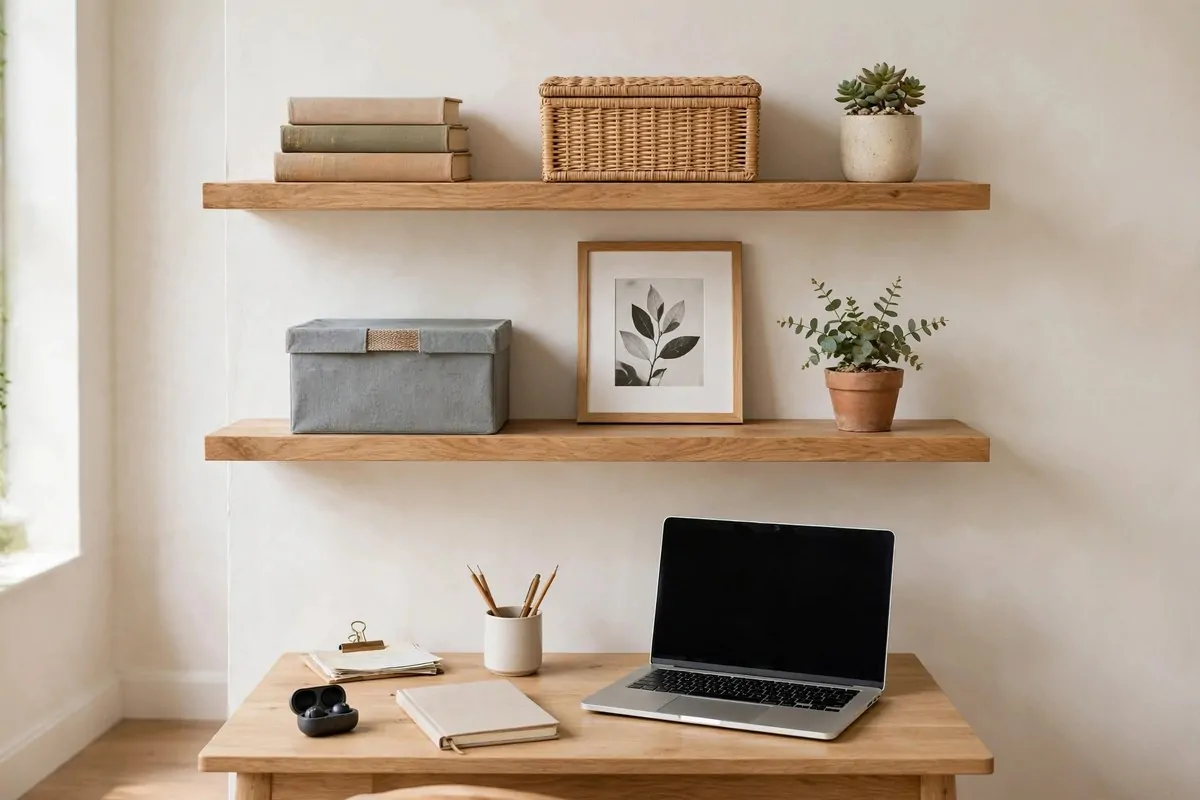
Two floating shelves above your desk change everything. It is like giving your desk a second floor.
Keep the daily stuff on the desk. Keep the weekly stuff on the shelf. That is the rule that keeps both clear.
Hang the first shelf about 18 inches above the desk top. High enough to clear your monitor. Low enough to reach without standing.
The second shelf goes about 12 inches above that. Books stand fine in 12 inches. So do most storage boxes.
Use one shelf for work and one for nice things. A little plant. A framed photo. Your eyes need something pretty to land on during a long day.
Anchor into studs. Shelves above a desk full of stuff are heavy. Drywall anchors alone are asking for trouble.
Match the shelves to your desk. Same wood, same color. It looks like one piece of furniture. Built-in, almost.
Dust them once a month. They collect dust fast. A quick wipe keeps them looking sharp.
7. Work Under the Window
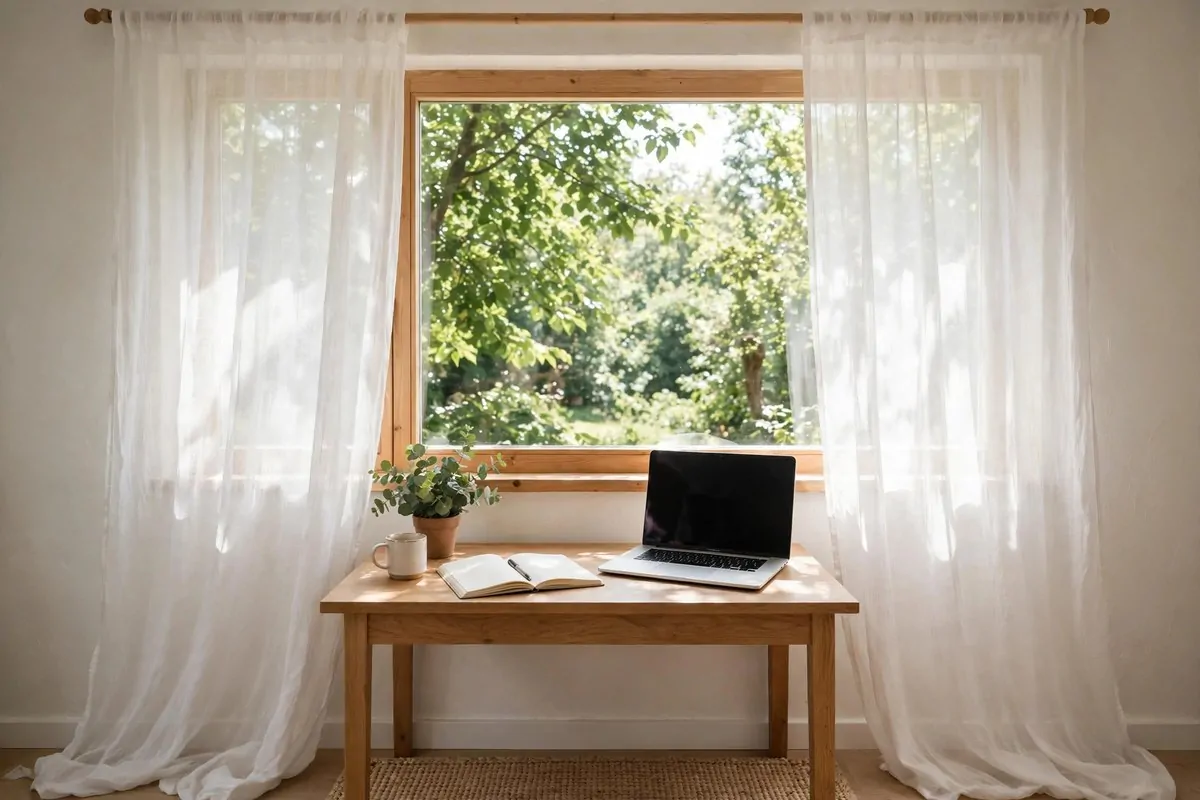
If you have a window, put your desk in front of it. Natural light is the best lamp ever made. And it is free.
Your eyes get less tired in daylight. You will feel the difference by the end of the first day. I promise.
Face the desk so you look at the window, not away from it. A view of the sky beats a view of a blank wall every time.
Watch out for screen glare. If the sun hits your screen at noon, add a sheer curtain. It softens the light without making the room dark.
A low desk works best here. You want to see out the window over your monitor. A tall monitor in front of a short window is a crime.
The radiator under the window is a problem in old houses. Leave a gap so warm air can rise. Your legs will thank you.
On sunny days this is the best seat in the house. On rainy days it is still the best seat. Rain on the glass while you work is a whole mood.
And when you look up from a hard task, there is the world outside. That small break keeps your brain fresh.
8. An L-Shaped Desk in the Corner
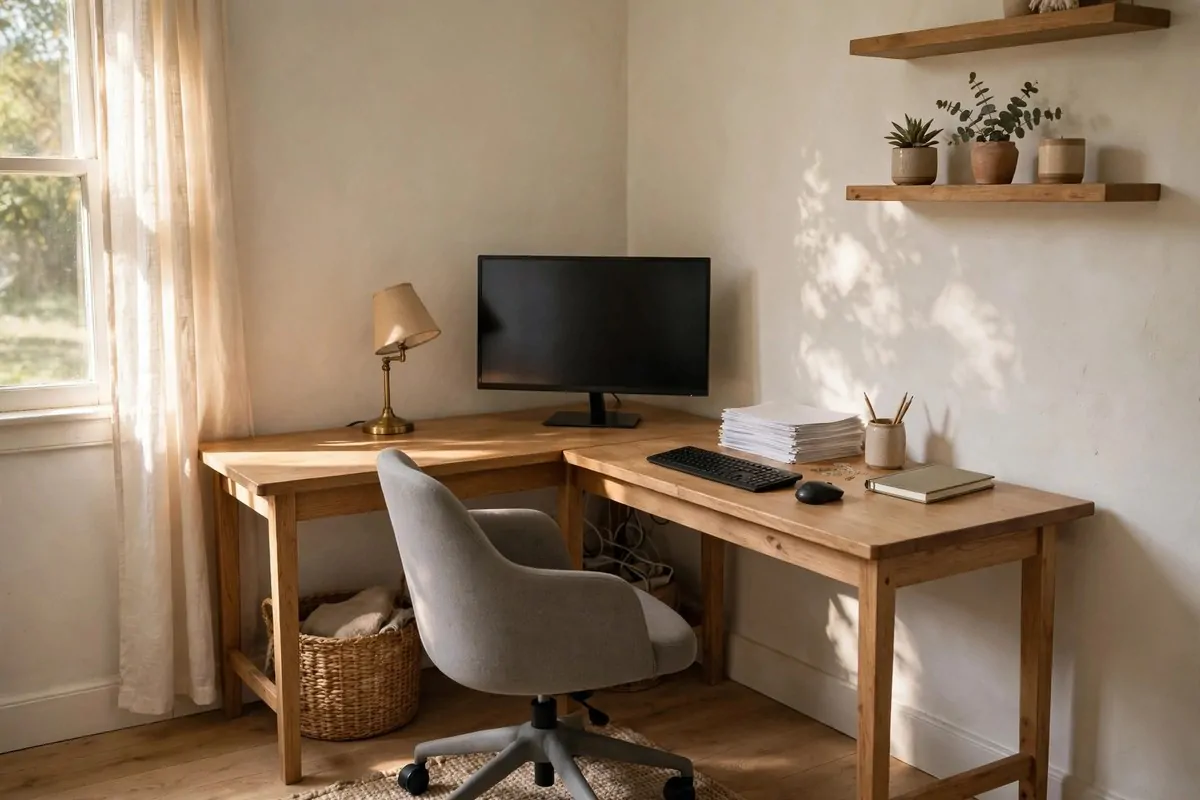
A corner is the most wasted shape in a small office. An L-shaped desk takes it back.
The long side holds your main work. Laptop, notes, lamp. The short side holds the overflow. Printer, papers, a tray for the mail.
You swivel instead of walk. Everything is within arm’s reach. It feels bigger than a desk twice its size.
Measure your corner before you buy. Corners are never as square as you think. Take two measurements, not one.
The inside corner is dead space unless you plan it. Put your monitor there. It fills the angle perfectly.
Or put a small lazy susan there. Spinning trays look silly and work great.
Keep the top clear. An L desk collects clutter on two sides instead of one. Clear it at the end of every day.
A short list of what earns a spot on the L:
- Your laptop or monitor, in the inner corner
- One lamp on the long side
- One tray for papers on the short side
- A small plant, because you deserve it
Everything else goes up on the wall. That is the deal you make with an L desk.
9. A Slim Console Table as a Desk
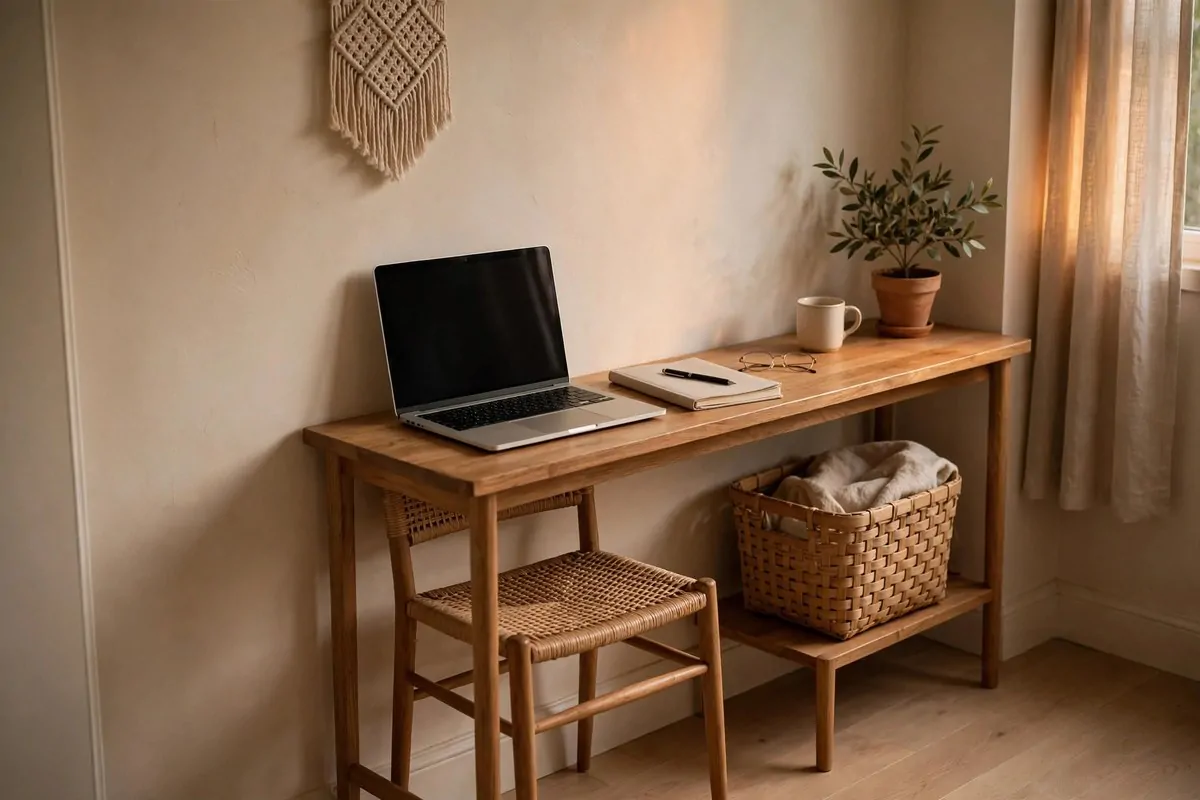
A console table is a long, narrow table made for hallways. It makes a great desk when your room is long and thin.
The trick is the depth. Most console tables are only 12 to 16 inches deep. That is plenty for a laptop and a notebook.
Push it against a long wall. Add a chair that slides all the way under. The walkway stays clear.
When it is not work time, it goes back to being a console table. A lamp, a bowl for keys, a stack of books. Nobody would guess.
Look for one with a lower shelf. That shelf holds a basket for your work stuff. Close the laptop, drop it in the basket, done.
Pair it with a slim chair. Big office chairs fight with narrow tables. A simple wooden chair or a stool fits the look.
This setup costs very little. Console tables show up at thrift stores all the time.
It works in a hallway too. If your office is really just a wall, a console desk is the answer.
10. A Rolling Cart as Your Second Desk
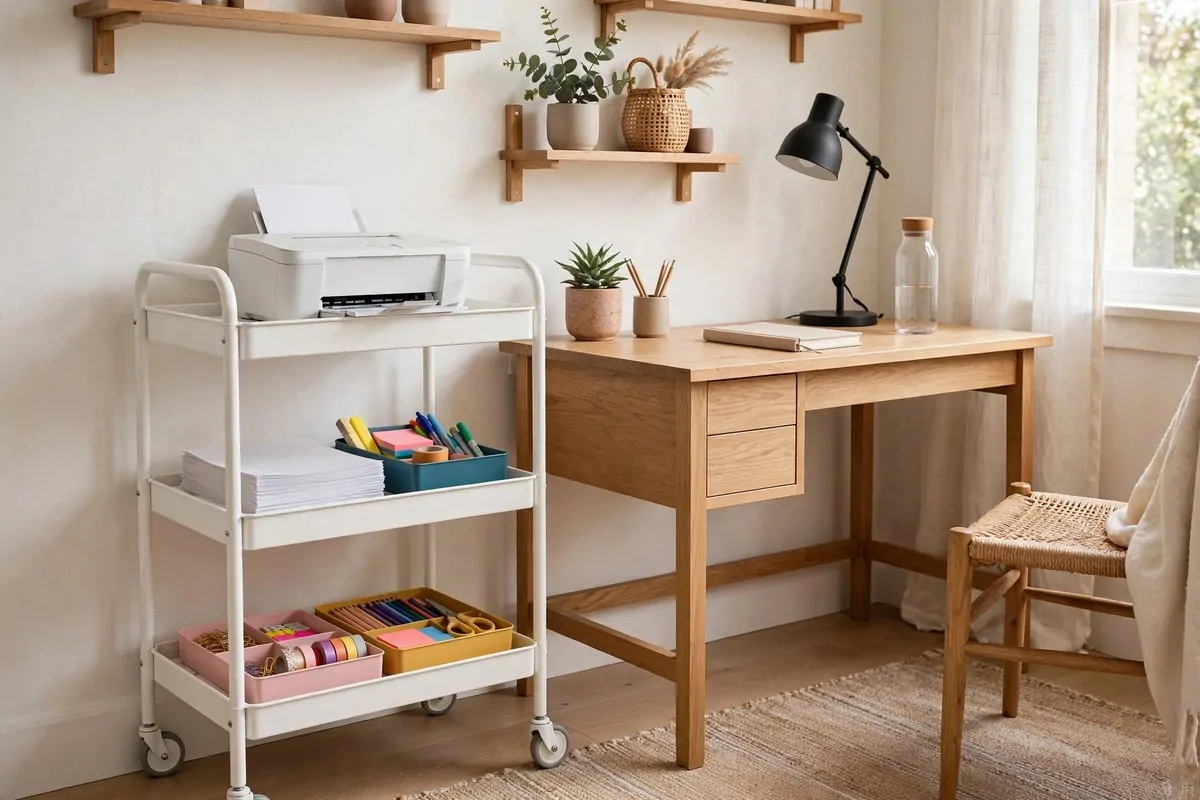
A rolling cart is a small tower of trays on wheels. It is the office sidekick your desk deserves.
Park it next to your desk while you work. Printer on top. Paper and supplies in the middle. Snacks on the bottom. I am not judging.
When guests come, roll it into a closet. The desk goes back to being a pretty table.
Three tiers are the sweet spot. More than that gets wobbly. Less than that barely holds anything.
Label the trays if you share the room. Your stuff, their stuff, shared stuff. No fights over the scissors.
It works as a standing desk extender too. Roll it close, raise your laptop on a box, stand and type.
Wheels lock. Use the locks when you park it. A cart that drifts across the floor while you print is not fun.
For very little money you get storage that moves. That is hard to beat.
11. An Ottoman That Hides Your Supplies
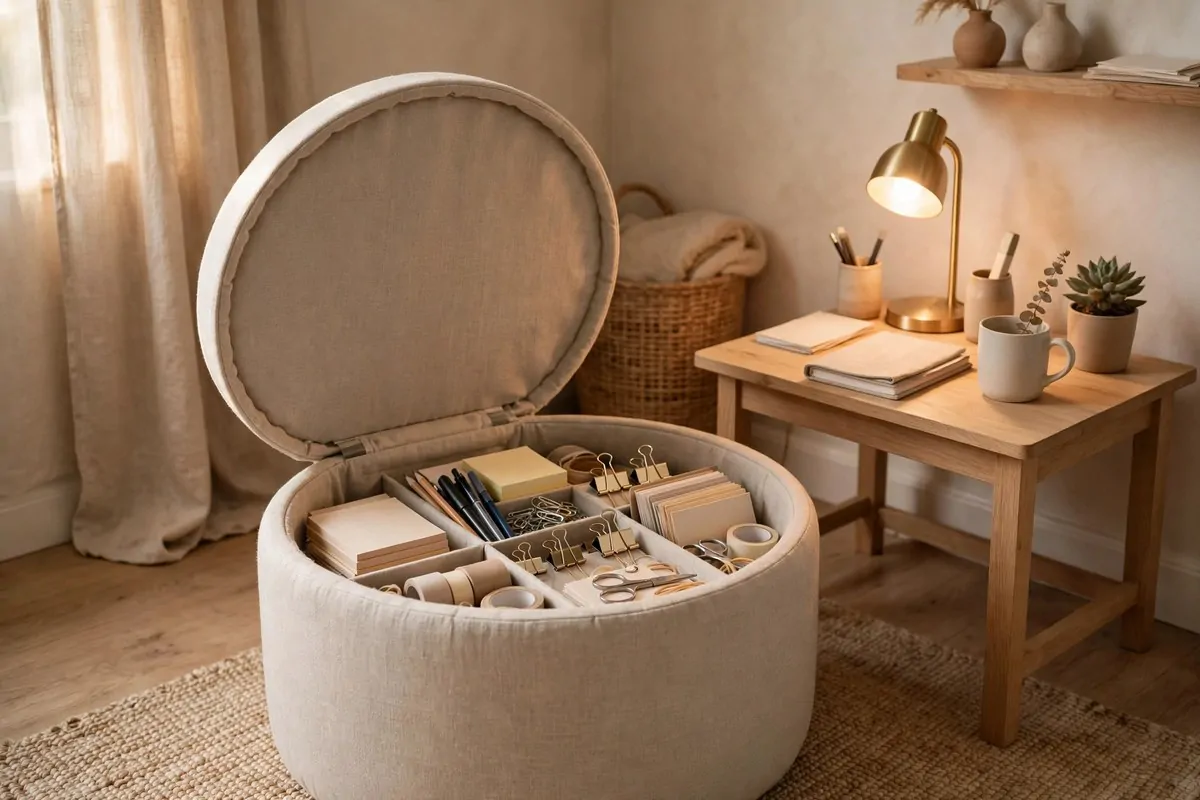
An ottoman is a low, soft seat with no back. A storage ottoman has a lid that opens. Inside is space for all your work clutter.
It is a seat, a footrest, and a filing cabinet in one. Three jobs, one square foot of floor.
Close the lid and your office supplies vanish. The room looks tidy in two seconds. Guests are impressed every time.
Pick one with a flat top. You can set a tray on it and use it as a side table when the lid is closed.
Keep the things you grab daily on top of the pile inside. Charger, notebook, headphones. The rest goes below.
A round ottoman fits better in tight corners than a square one. Corners are round-friendly, oddly enough.
It is also the best thinking seat. Sit on it, put your feet up on the desk chair, stare at the ceiling. Ideas come faster.
No lid-slamming. Check the hinges before you buy. Cheap ones snap shut on fingers.
12. A Mirror That Doubles the Room
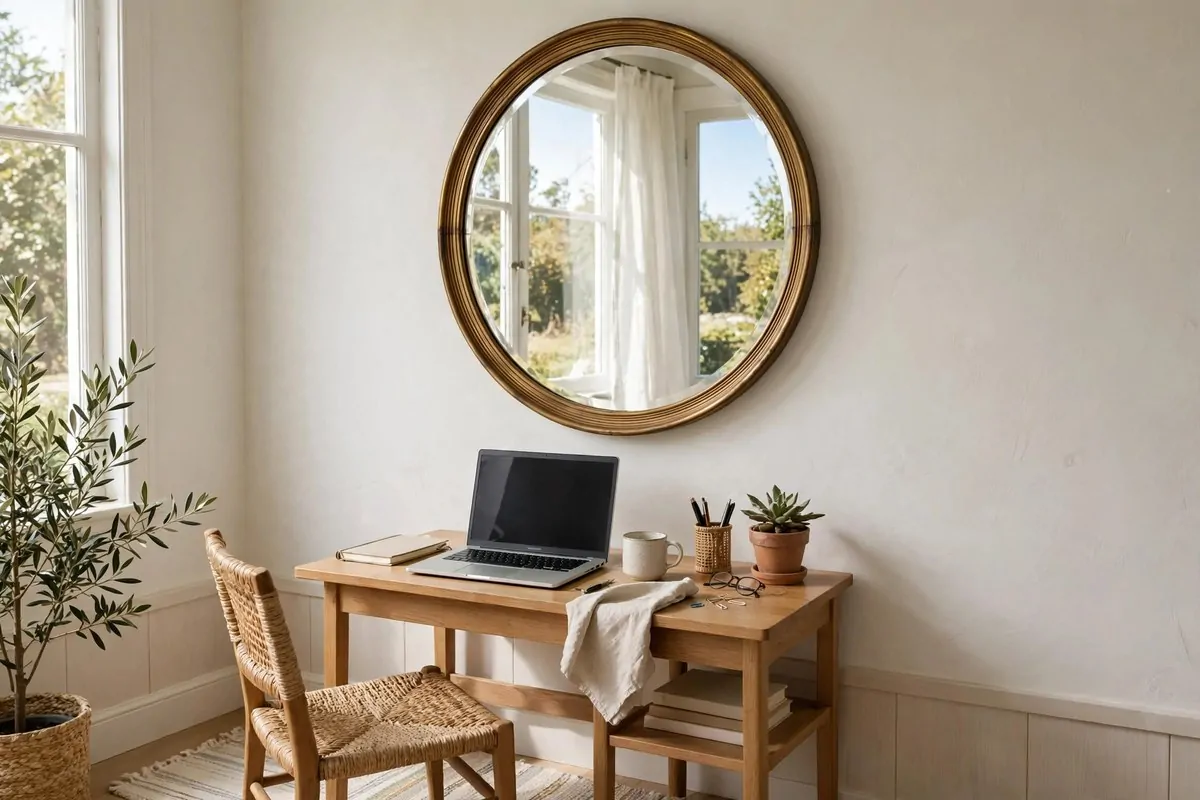
A mirror on the wall across from your window bounces daylight around the room. The whole space feels twice as bright.
It also fakes space. Your eye sees the reflection and reads the room as deeper than it is. It is a trick, but it works.
Round mirrors look softer in small rooms. Square mirrors look sharp and modern. Pick the one that matches your style.
Hang it so it reflects something nice. The window. A plant. Not the messy corner with the cables.
Keep it at eye level when you sit. You do not need to see your whole face. You need the light to bounce right.
Big mirrors beat small ones here. One large mirror does more than four tiny ones. Go bold if you can.
Lean it on the desk against the wall if you rent. No holes needed. It looks relaxed and stylish.
Clean it once in a while. A dusty mirror just makes the room look gray. A quick spray and it is sunshine again.
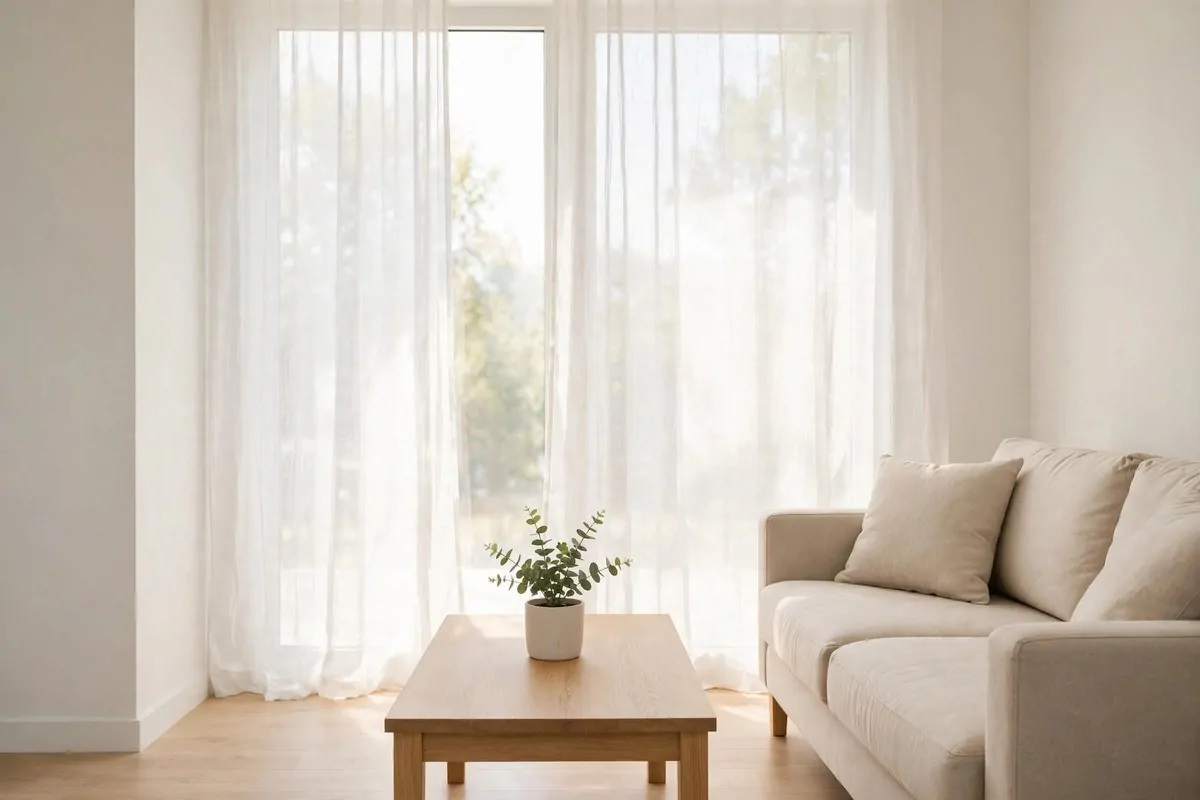
13. Pale Paint and Sheer Curtains
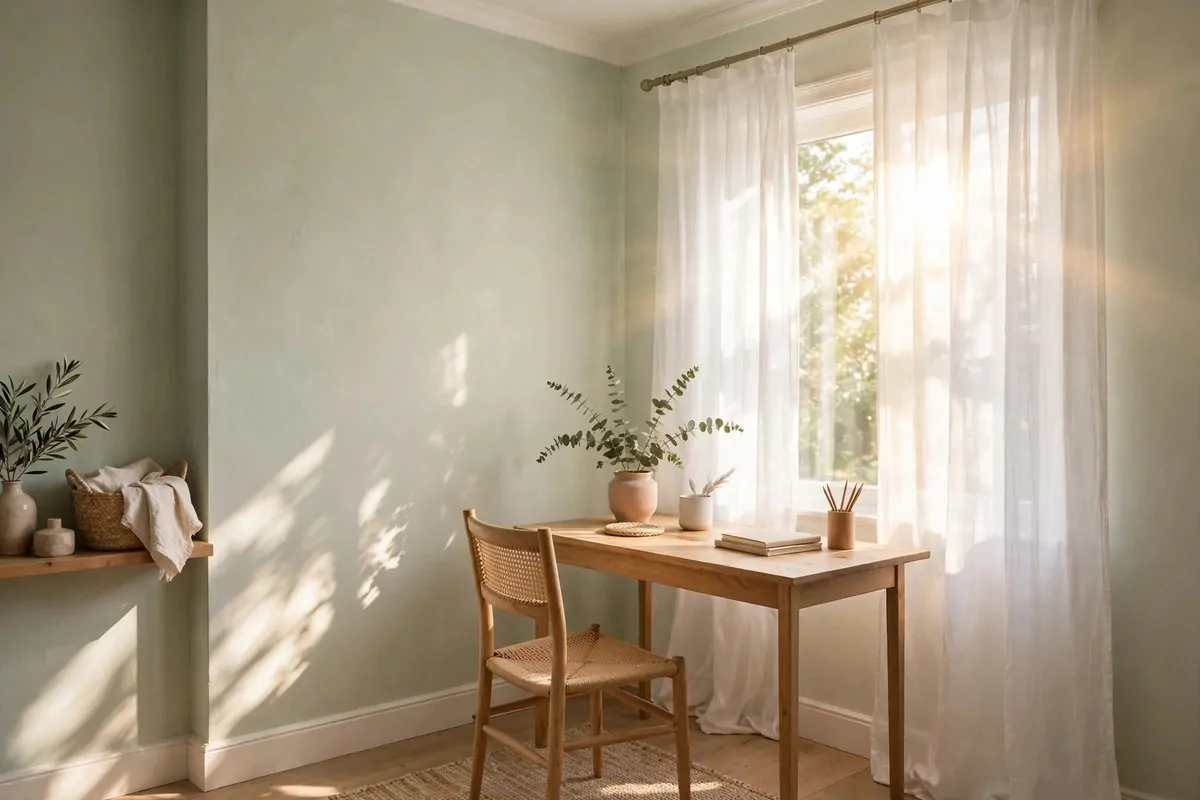
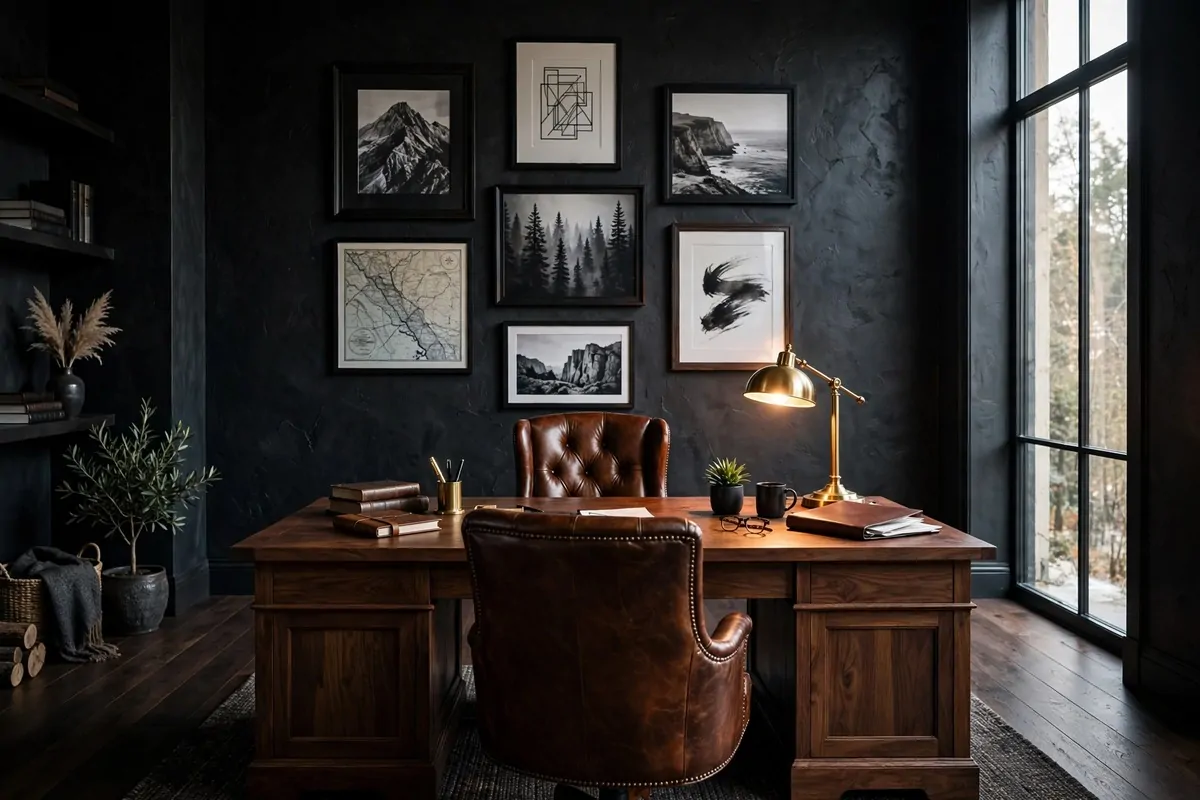
Dark walls eat light. Pale walls bounce it back. In a small office, that one change matters more than any furniture.
Soft white is the safe pick. Warm white feels cozy. Cool white feels crisp. Try a sample on the wall before you commit.
Pale blue or pale green add a little color without darkening the room. They also feel calm, which is what you want at work.
Sheer curtains let light in and keep eyes out. You get privacy without a dark room. Both wins.
Hang the curtain rod high and wide. Near the ceiling, past the window frame. The window looks bigger and the ceiling looks taller.
One wall can be a tiny bit bolder. A soft sage or a dusty blue accent wall adds personality without closing the room in.
Paint the ceiling bright white. Nobody thinks about the ceiling, but it is the biggest light reflector in the room.
Colors that love small offices:
- Warm white for a cozy feel
- Soft gray for a calm, modern look
- Pale sage green for a fresh touch
- Light blue for a bright, airy room
- Creamy beige for warmth without darkness
14. A Curtain That Hides the Office
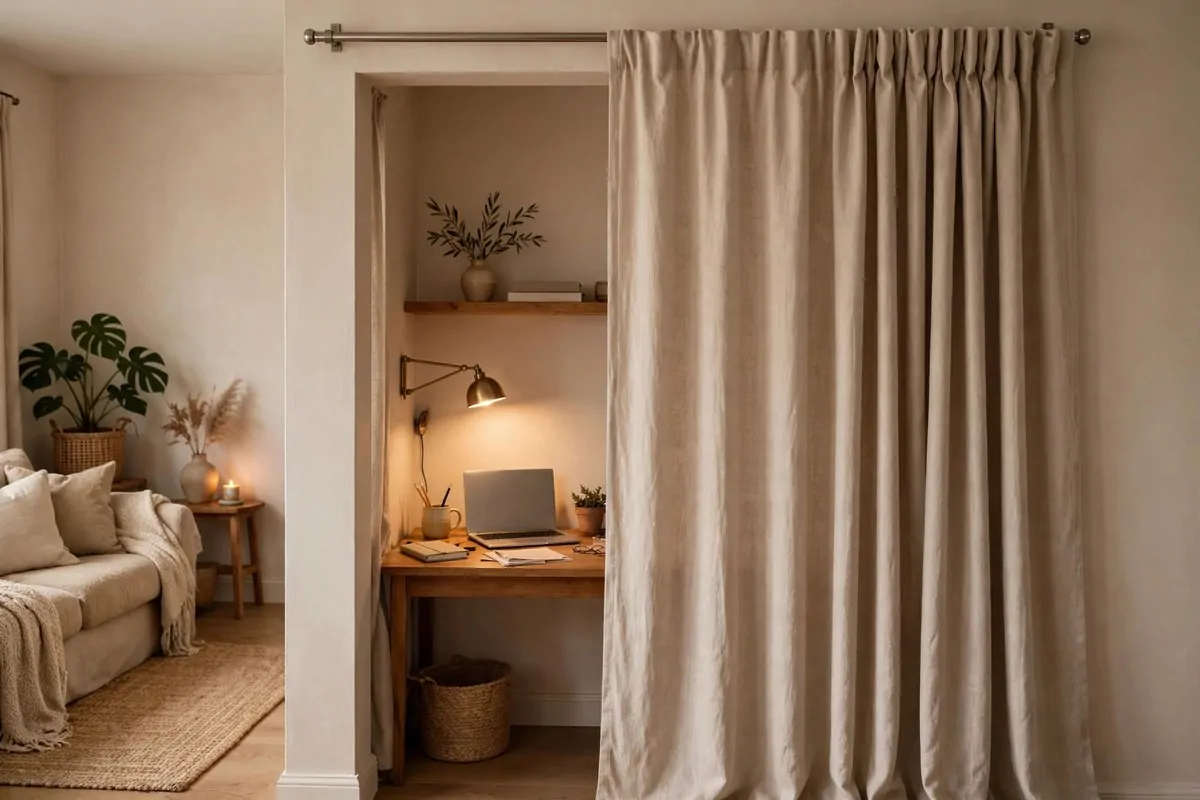
Sometimes the best office idea is a hiding spot. A curtain on a ceiling track can close off your whole work zone.
Open, it is an office. Closed, it is a guest room, a bedroom, a living room again. One room, two lives.
Ceiling tracks cost little and hold a lot. Get a track that bends around corners if your office is L-shaped.
Pick a fabric that matches your room. When the curtain is open, it just looks like a wall panel or an accent.
Heavy fabric blocks the sight of a messy desk. Light fabric just softens it. Choose based on how tidy you are. Be honest with yourself.
It also muffles a little sound. Not a lot, but enough to feel separate when you are on a call.
Iron it once after hanging. A wrinkled curtain looks cheap. A smooth one looks like it belongs.
This is the cheapest room divider you can buy. And it takes zero floor space. Zero.
15. The Nook Under the Stairs
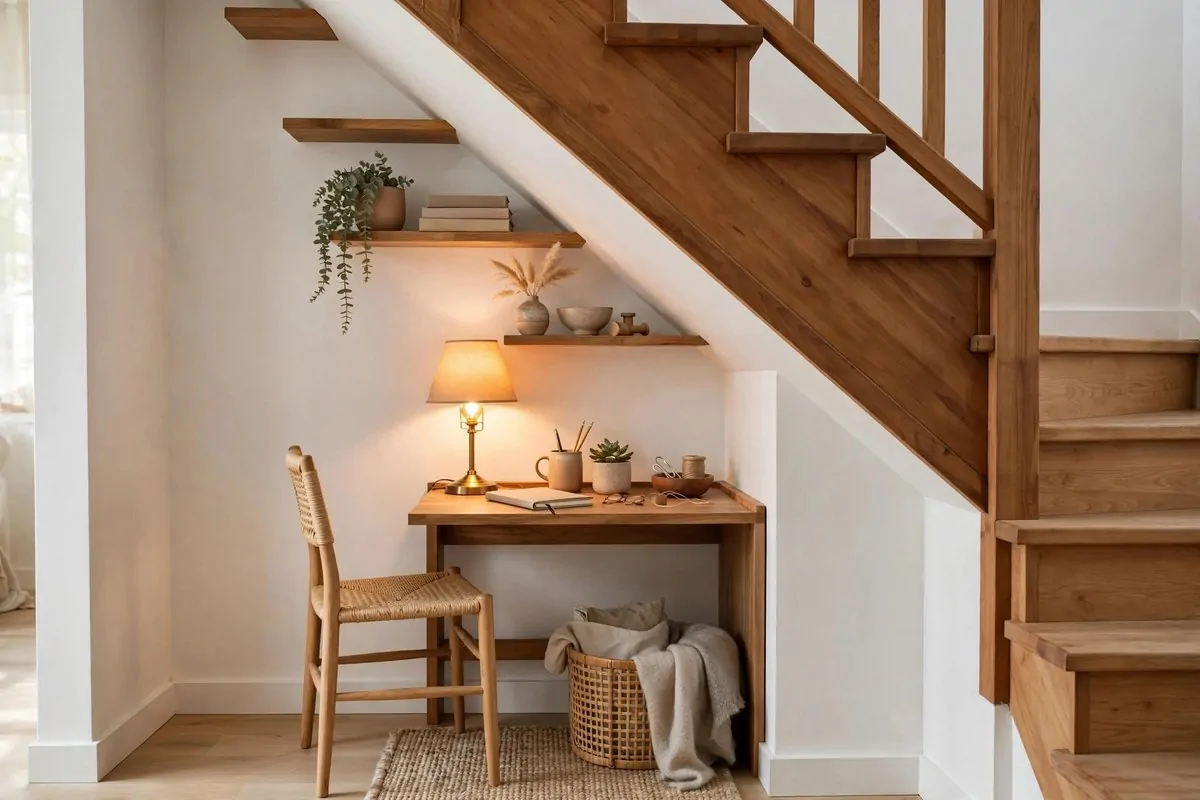
The space under the stairs is the most ignored square footage in a house. It is low, it is angled, and it is perfect for a desk.
The slope of the stairs is actually a gift. Your monitor goes where the ceiling is highest. Your legs go where it is lower. It fits like a puzzle piece.
A desk that fits the exact width works best. Measure three times. Angled walls forgive nothing.
Paint the under-stair walls a bright color. White or pale yellow. Dark corners under stairs feel like caves unless you fight it.
Add a small lamp. Under-stair nooks get almost no natural light. A warm lamp makes it feel cozy instead of gloomy.
Shelves follow the slope. Short shelves low, taller ones high. It looks custom because it kind of is.
Keep the walking path clear. The desk should not stick out past the stair line. Measure from the tallest step edge.
Tell people your office is under the stairs and watch their faces. Then show them how great it looks. That part is fun.
16. A Closet Office (Cloffice)
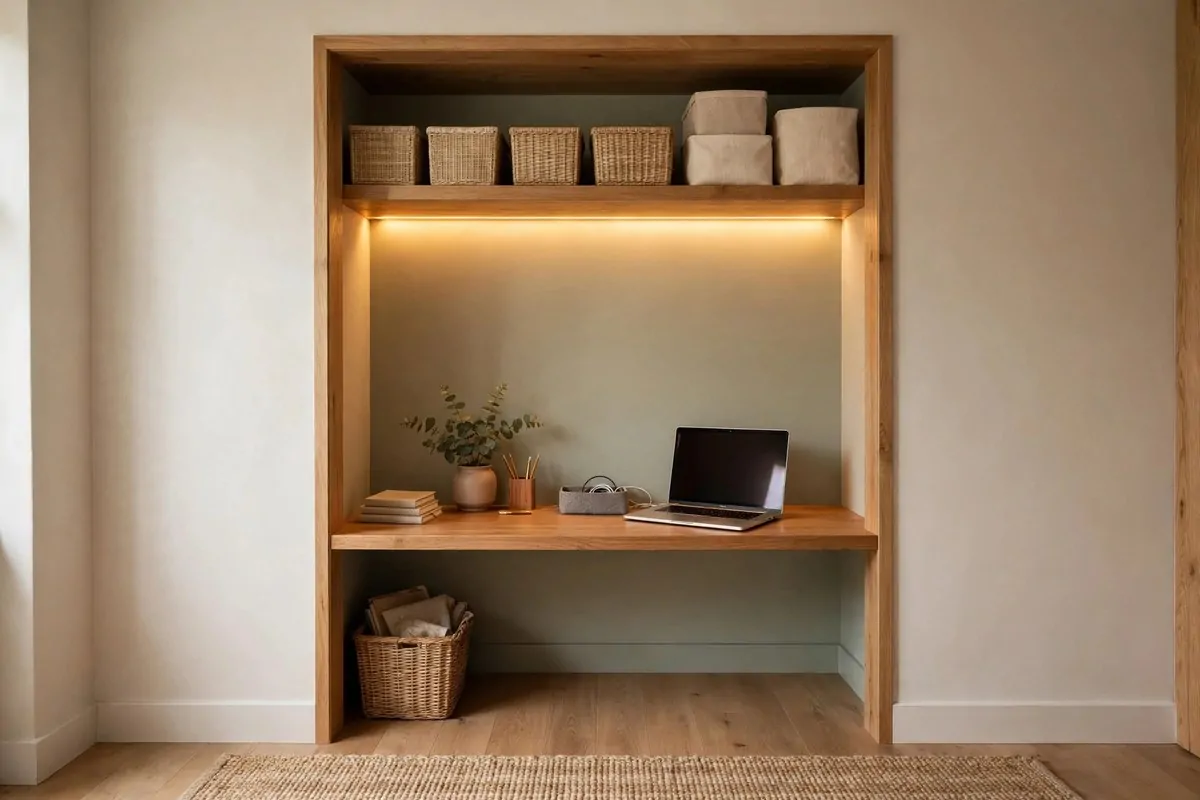
Take the doors off a closet. Put a desk inside. You now have an office with a door you can close. This is the famous cloffice.
A standard reach-in closet is about two feet deep. That is exactly enough for a desk and a laptop. The universe planned this.
Remove the doors or replace them with curtains. Sliding doors work too. Anything that does not swing out and eat floor space.
Add a light inside. Closets are dark. A stick-on LED strip or a small plug-in lamp turns it from cave to office.
The shelf above the rod is gold. It holds boxes, books, backup supplies. All your storage is built in already.
Close it up at night and work stays in the closet. Your brain learns that closed doors mean the workday is over.
Ventilation matters. Leave the door open a crack on long days. A stuffy closet makes a sleepy worker.
A quick cloffice checklist:
- Remove the doors or swap them for curtains
- Add a desk at 28 to 30 inches high
- Stick a light inside so it never feels dark
- Run a power strip in for your chargers
- Use the shelf above for boxes and books
17. A Bookshelf as a Room Divider
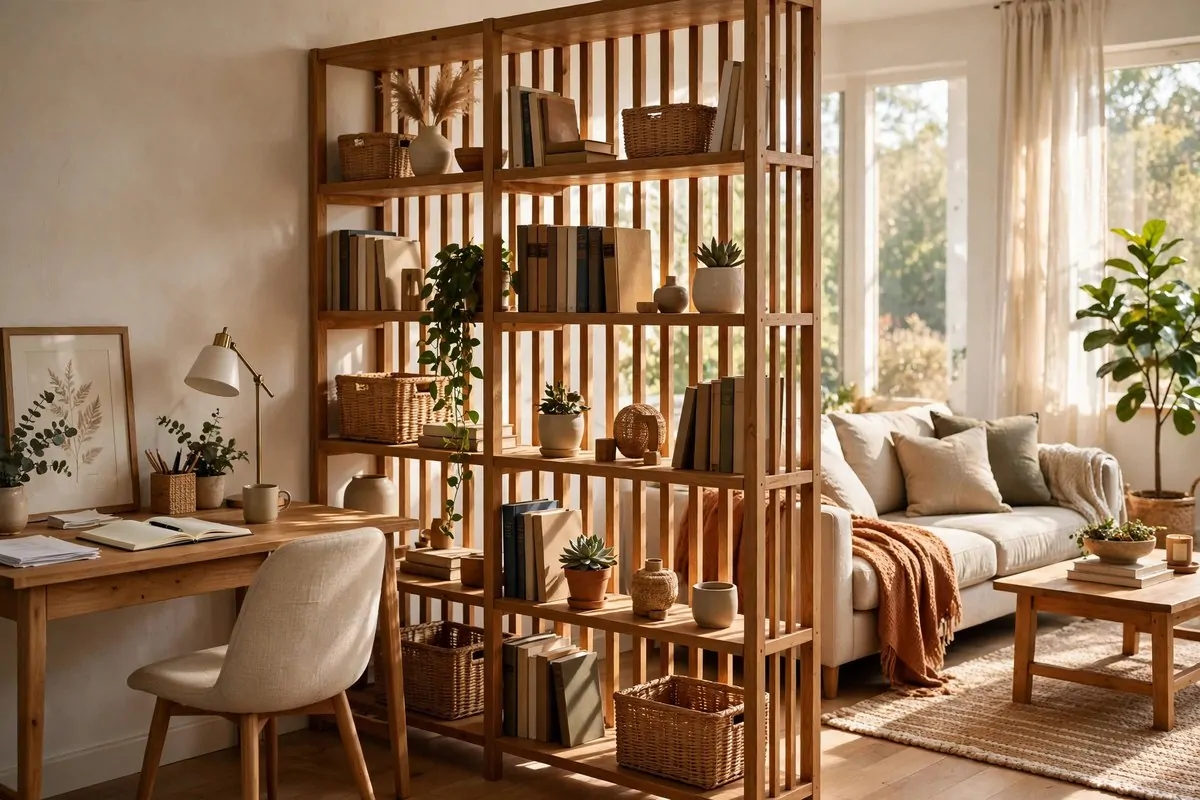
No spare room? Make a zone. A tall bookshelf standing across the room draws a line between office and everything else.
Your brain loves boundaries. When you sit behind the shelf, you are at work. When you step around it, you are home.
An open-back bookshelf works best. Light passes through. Both sides can use it. It never feels like a wall.
Fill the middle shelves with books and boxes. Keep the top shelf light. Heavy tops make dividers tippy.
Anchor it to the wall or the floor. A tall shelf in the middle of a room must not wobble. This is a safety thing, not a style thing.
Face the pretty side toward the living area. Decorative stuff out. Office chaos faces your desk side only.
It holds a shocking amount. Books, files, a printer, baskets of supplies. The divider earns its floor space.
When you move, the zone moves with you. No paint, no holes, no landlord problems.
18. Baskets and Hooks on the Wall
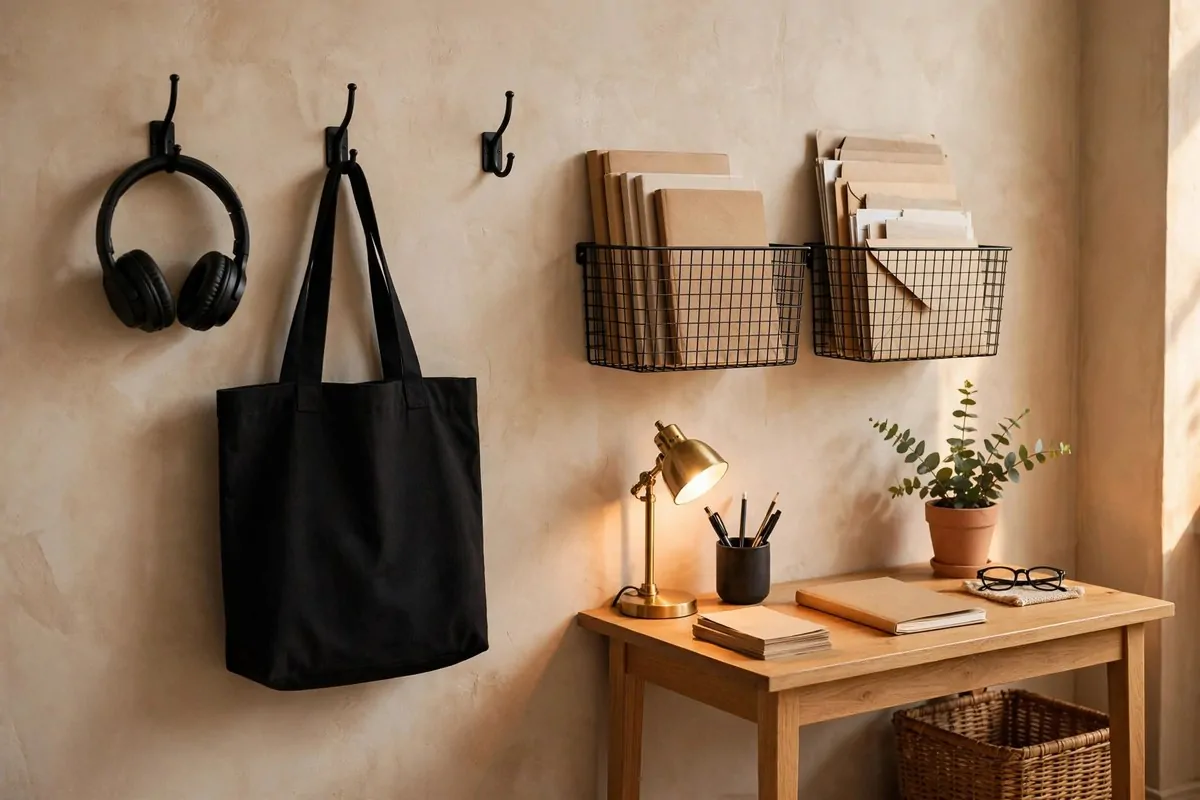
The wall next to your desk is prime real estate. Baskets and hooks turn it into storage that takes zero floor.
Hang a row of hooks at arm height. Headphones, your bag, the sweater you wear at your desk. All off the chair, all off the floor.
Wire baskets hold mail, notebooks, and the papers you need this week. You see everything at a glance. Nothing gets buried.
Keep the system simple. One basket for in, one for out, one for later. When later gets full, it is time to file or toss.
Hooks come in every style. Brass for fancy, black metal for modern, wood pegs for cozy. Match your room.
Stick-on hooks work if you rent. The good ones hold real weight. Read the weight limit on the package, not just the pretty picture.
A small rail with S-hooks is the flexible option. Move the hooks whenever your needs change. Nothing is permanent.
This whole setup costs less than a pizza. And it clears more clutter than a big filing cabinet.
19. A Wall Lamp Instead of a Desk Lamp
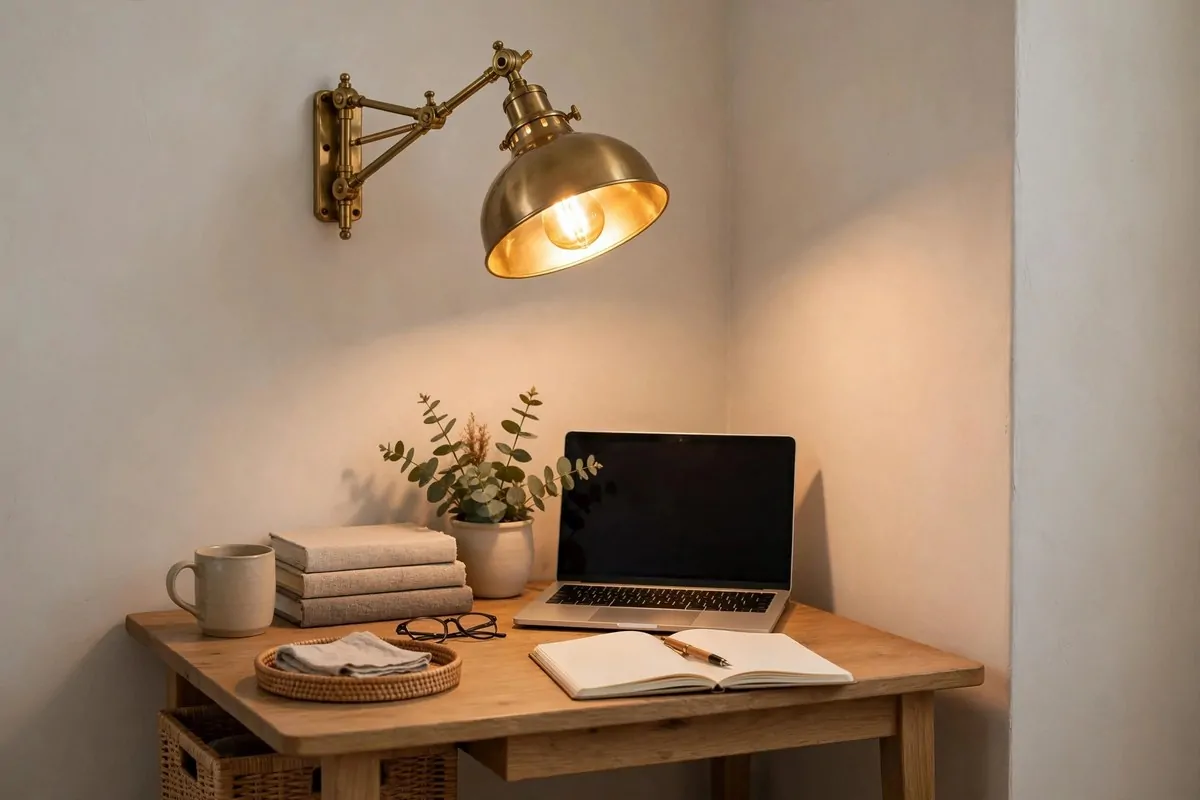
Your desk lamp eats about a square foot of desk. A wall-mounted lamp eats zero. The math is easy.
Swing-arm lamps are the classic pick. Pull it over your work when you need it. Push it flat to the wall when you do not.
Mount it on your writing side. Right side if you are right-handed. The light should fall on your work, not on your hand’s shadow.
Pick a warm bulb. Cool white light feels like an office cubicle. Warm light feels like home.
Plug-in versions exist if you cannot wire anything. The cord runs down the wall in a little cover. Looks neat, costs little.
It doubles as decor. A pretty brass arm or a colorful shade adds style while it works.
Pair it with the window light from idea number 7. Two light sources beat one. Your eyes will thank you at 4 PM.
Turn it on an hour before sunset. The room eases into evening instead of going dark all at once. Cozy beats harsh.
20. Cords You Never Have to See
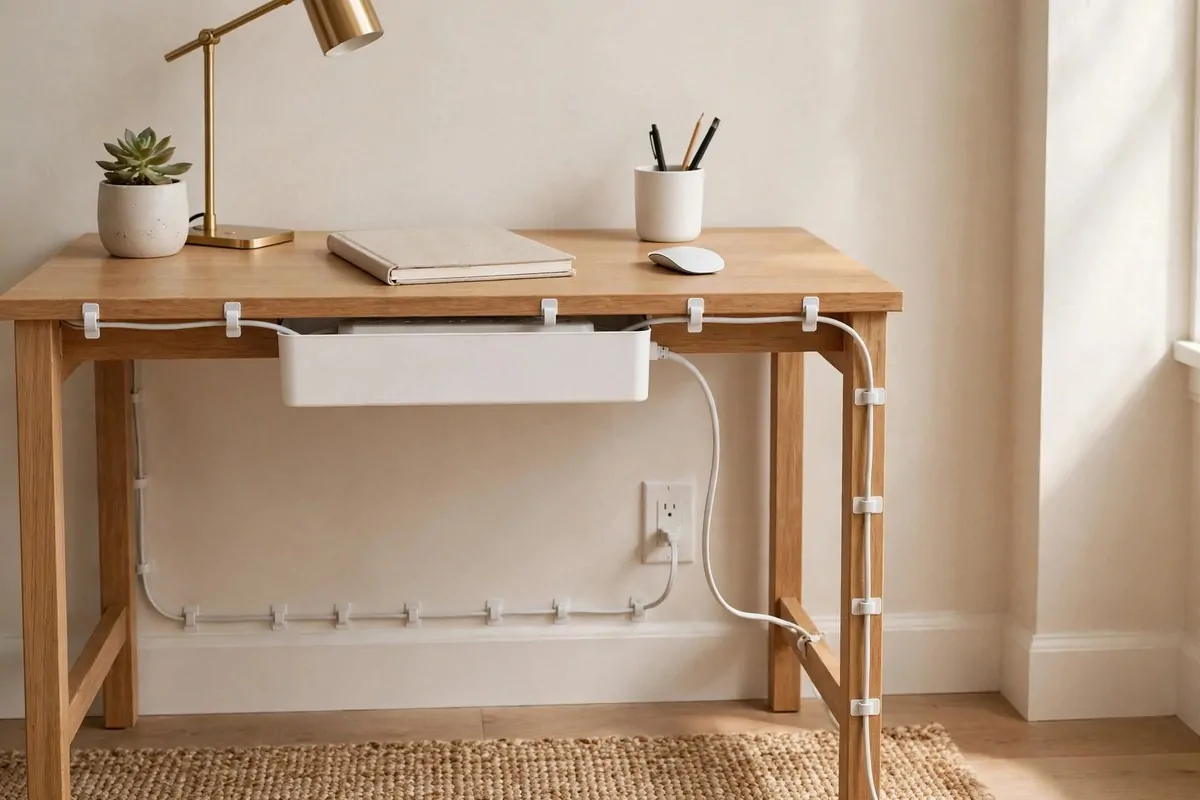
Nothing ruins a small office faster than a tangle of cords. They take up space and they look messy. Hide them.
A cable box under the desk holds the power strip and all the plugs. One cord goes to the wall. That is all you see.
Stick-on cable clips run cords along the desk edge. They cost almost nothing. They make the back of your desk look clean.
Charge inside a drawer. Drill a small hole in the back of a desk drawer, drop a power strip in. Phones and earbuds charge out of sight.
Label both ends of important cords. It sounds fussy. It saves you ten minutes every time something unplugs.
Go wireless where you can. A wireless mouse and keyboard remove two cords forever. Worth every penny.
Cord-hiding tools I actually use:
- A cable box under the desk for the power strip
- Stick-on clips along the desk edge
- Spiral wrap for the cords that hang down
- Velcro ties instead of zip ties, so you can redo them
Do this on a Sunday afternoon. It takes an hour. You will smile every time you sit down after.
21. A Desk With Deep Drawers
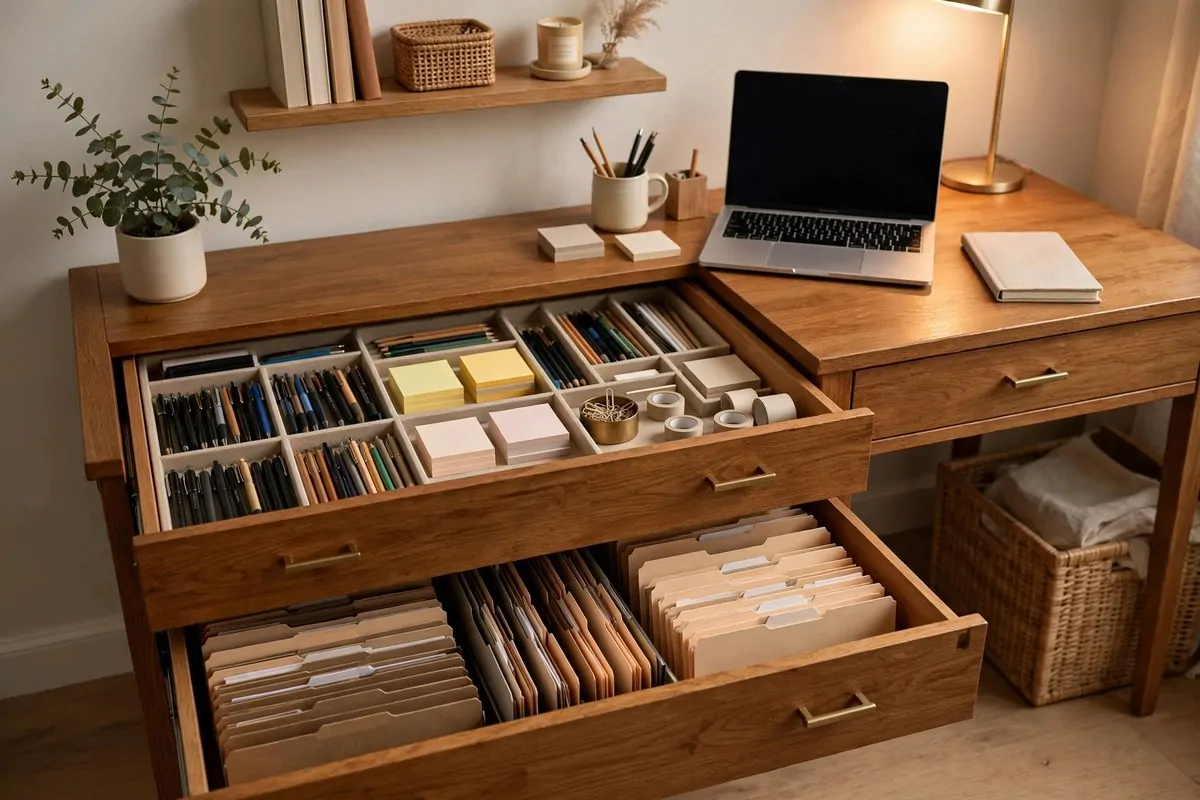
A desk with drawers is two pieces of furniture in one. Workspace on top. Filing cabinet underneath. No extra floor needed.
Deep drawers hold files standing up. Shallow drawers hold pens and little things. You want at least one of each.
Drawer dividers are the secret. Without them, a deep drawer becomes a junk pit. With them, everything has a home.
Keep the top drawer for daily things. Pens, sticky notes, your charger. Open, grab, close. Ten seconds.
The bottom drawer is for files. Hang folders on a rail if the drawer allows it. Papers stay upright and findable.
Lock the drawer if you share the room. Kids and roommates are curious. A small lock buys peace of mind.
If your desk has no drawers, add a rolling drawer unit under it. Same idea, and you can pull it out when you need the legroom.
A tidy drawer is a calm brain. Open a messy drawer and you feel it in your shoulders. True story.
22. One Green Corner
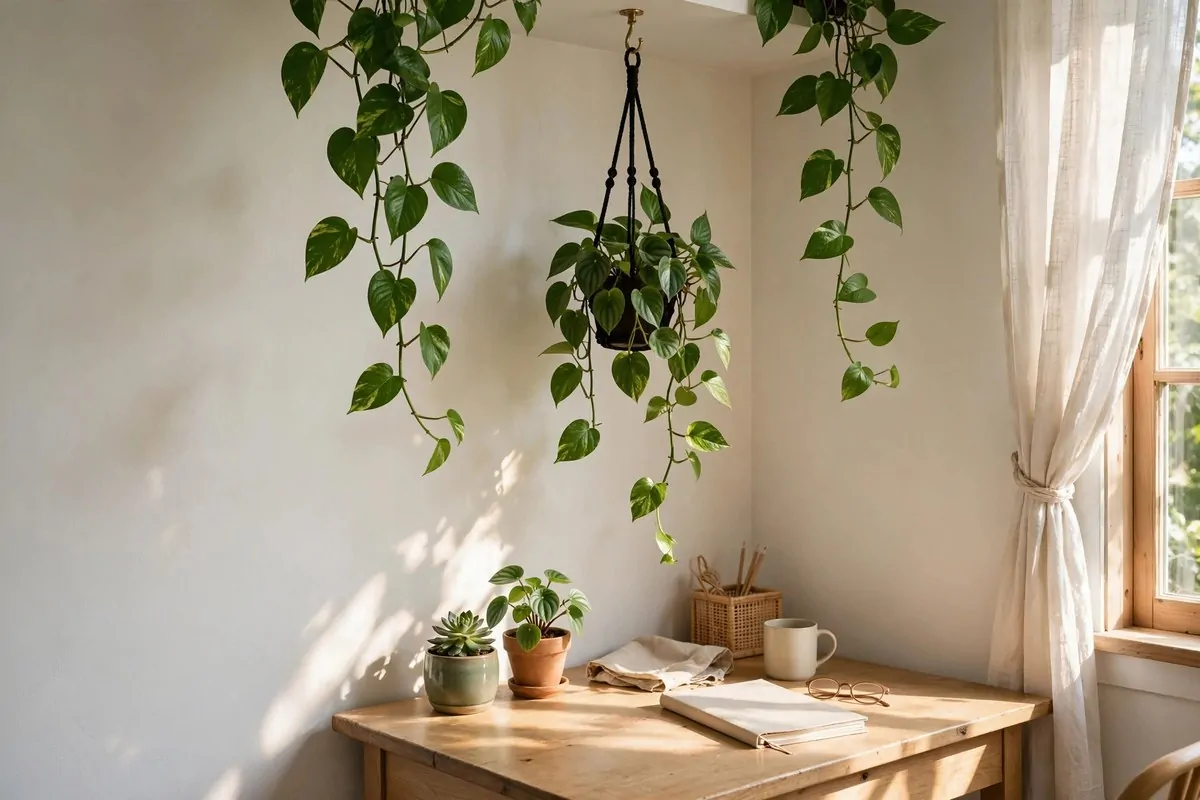
One plant changes a room. It really does. A little green life on your desk makes the whole office feel less like work.
Pick plants that forgive you. Pothos, snake plants, ZZ plants. They survive low light and forgotten waterings. Ask me how I know.
Hang one from the ceiling or a high shelf. It takes zero desk space and zero floor space. The leaves trail down like a green curtain.
A small pot on the desk is enough. You do not need a jungle. One healthy plant beats five sad ones.
Plants clean the air a little and your mood a lot. Looking at green for a minute resets tired eyes.
Water on the same day each week. Pick a day you will remember. I do Sundays, right after coffee.
If real plants die on you, good fake ones exist now. No shame. A pretty fake plant beats a dead real one.
Put the plant where you see it when you look up from work. That is the whole point. Green breaks for your eyes.
23. A Glass Desk That Keeps Air Moving
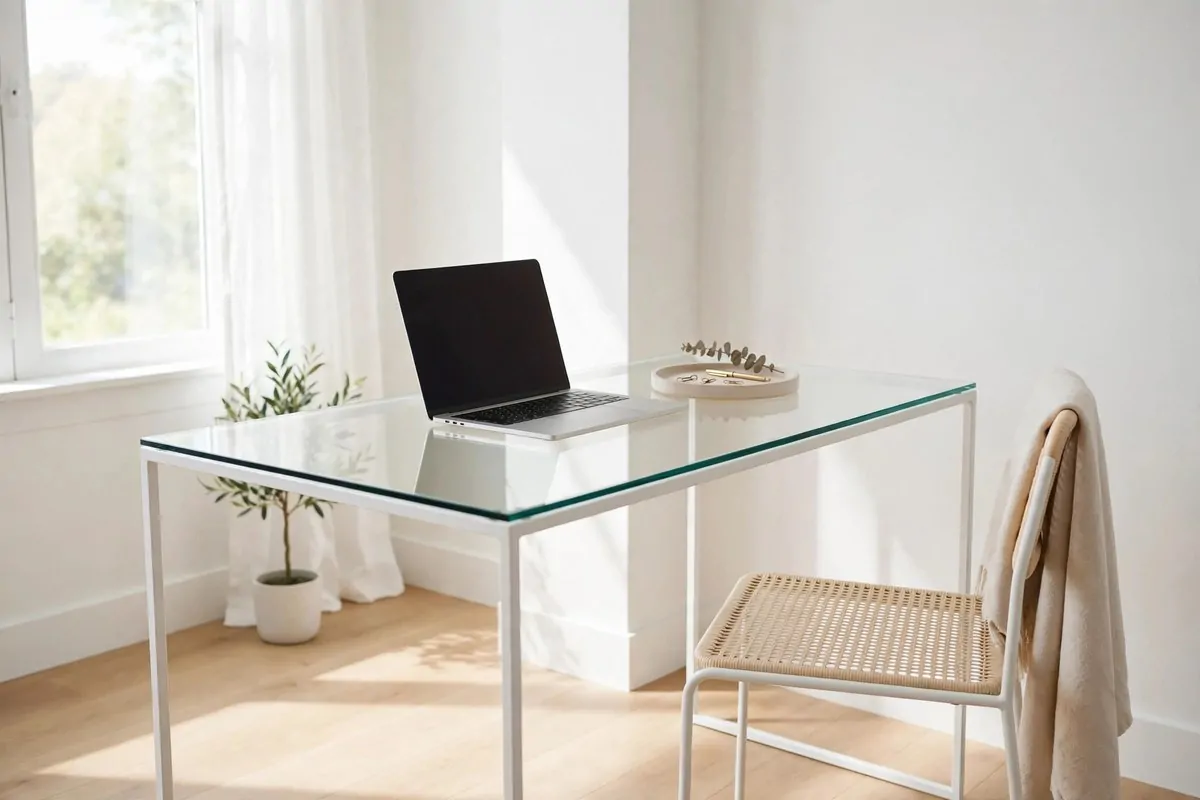
A glass desk top lets your eye see straight through to the floor. The room reads as bigger because nothing blocks the view.
It works best in a room that already has light colors. Glass plus white walls plus daylight is a triple win for small spaces.
Keep the surface clear. Glass shows everything, including the dust. A clear glass desk with clutter looks worse than a wooden one.
A small tray or a desk pad defines your work zone. It keeps the papers from sliding and gives your eyes a rest spot.
Pair it with a simple chair. Bulky chairs fight the airy look. A slim chair or a clear acrylic chair keeps the flow.
Watch the edges. Rounded corners are kinder to hips and thighs in a tight room. Sharp glass corners and small rooms do not mix.
It is easy to clean. One spray, one wipe, done. No wood grain holding onto coffee rings.
If glass feels too cold, try a light wood top with slim white legs. Same airy idea, warmer feel. Your room, your rules.