20 Attic Office Ideas That Turn Dusty Corners Into Dream Workspaces

Every attic I have ever walked into smells the same. Dust, old wood, and quiet.
That is the first thing that hits you when you climb the little ladder up there. The air is still. Nobody is talking. The only sound is the faint creak of the roof. I used to think of attics as storage graves, just boxes and old suitcases. Then one summer I actually stood in ours for a while and noticed something.
It has the best light in the whole house. The sun comes through the roof in the morning and rolls across the sloped ceiling, and no one is stomping past the door. Downstairs the kettle is always boiling and the telly is always on. Up there it is just you.
That is exactly why an attic makes such a good office. Most of us pick our work spot by size or by what furniture we already own. I think the better question is how far the spot sits from household noise. An attic wins that test every time. You are above it all, literally.
You do not need a big budget or a builder to make it work, either. A few clever ideas turn that dusty corner into a workspace you actually want to sit in all day. I have gathered my twenty favourite attic office ideas for you. Let us climb up and have a look.
1. Tuck Your Desk Under the Slant
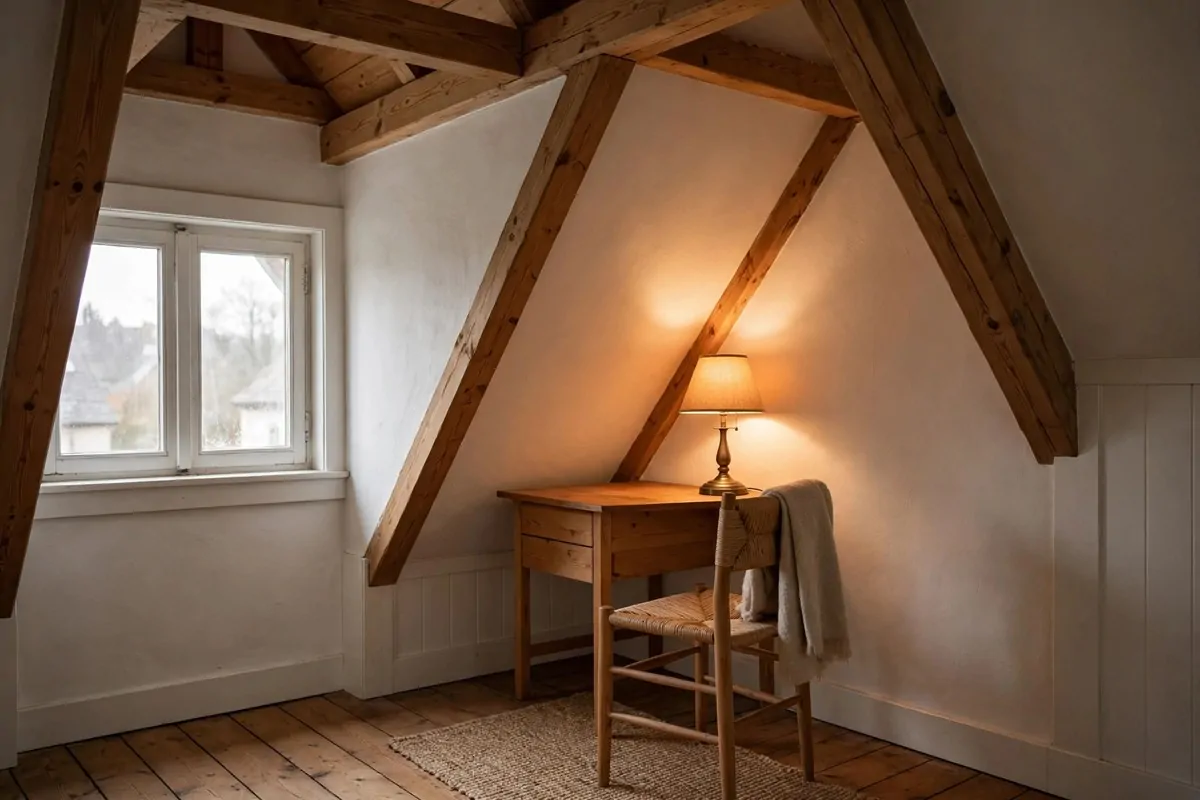
The sloped part of the ceiling is usually the bit people waste. They stand in the middle of the room and stare at the low corners like they are a problem. I see them as ready-made desk nooks.
A desk fits beautifully under the slant. The ceiling comes down close over you, which sounds cramped, but it actually feels like a hug. I find I focus better when the world closes in a little around my screen. It cuts out visual noise.
Measure the lowest point before you buy anything. I learned that the hard way with a desk that was two inches too tall. Sit in your chair, mock up the desk height with boxes, and check you can sit upright without brushing your head.
Put your monitor against the lowest wall and face out into the room. This sounds backwards. But then your back is to the dark corner and your eyes look toward the light.
A small lamp on the desk helps in the evening. The slant blocks overhead light, so a warm lamp stops the nook from going gloomy. I like a simple shade that throws light down on the keyboard.
Storage under a sloped desk is easy. Low baskets slide right in. A couple of fabric boxes hold chargers and notebooks without wasting the triangle of space. Nothing fancy needed.
- Sit-test the height with boxes first
- Face outward toward the room and the light
- Add a warm desk lamp for dark evenings
- Slide low baskets under the desk for storage
A cork board on the sloped wall above the desk is handy. It sits at a natural tilt and pins stay put.
Honestly this is my favourite trick in the whole list. It takes the awkward bit of the attic and makes it the best seat in the house. Once you sit there with your coffee, you will not want to leave.
2. Turn the Triangular Wall Into Shelves
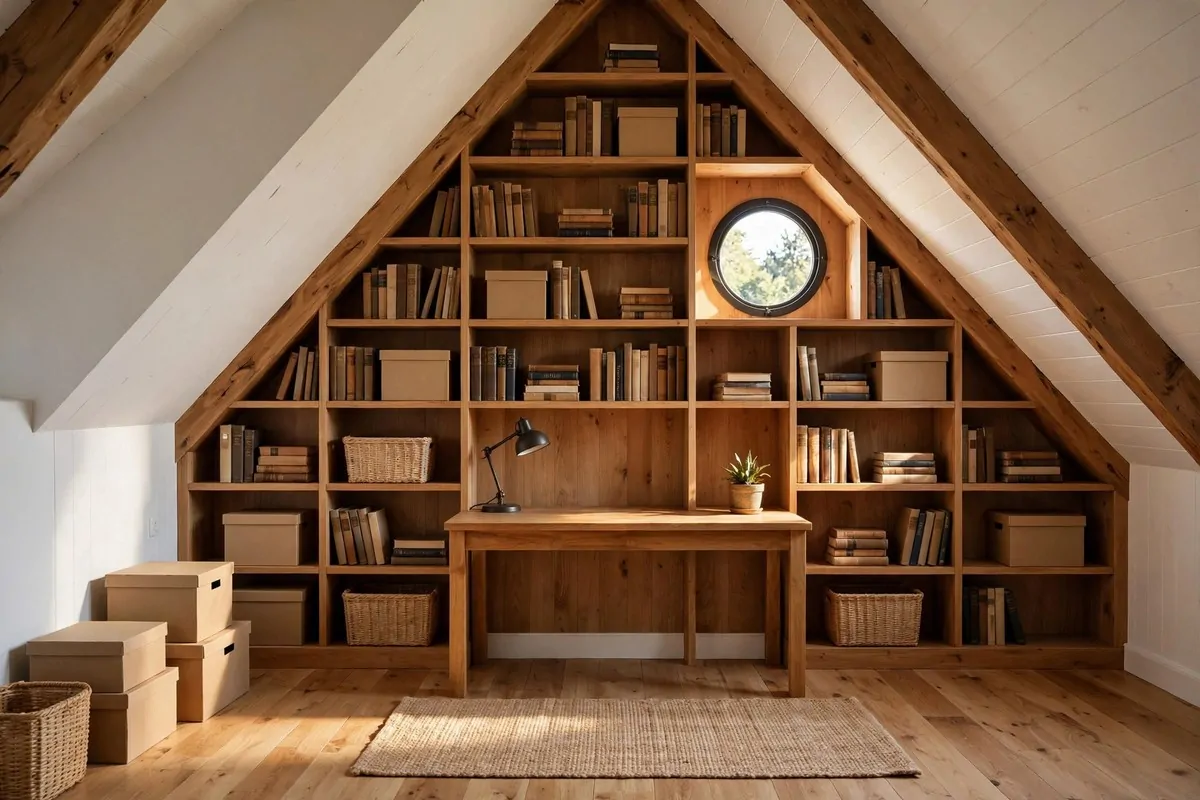
Every attic has that big triangle wall at the end. The gable end. Most people paint it and ignore it, which is a shame. It is the tallest wall you have got up there.
Shelves on a triangle wall look amazing because they follow the roof line. You can buy ready-made bookcases, but honestly custom shelves that step down with the slope look twice as good. A local joiner can knock them up in a day.
I keep my reference books, plant pots, and a few framed photos on mine. The tall middle shelves hold the big stuff. The short side shelves are perfect for small boxes and candles. Everything finds its level.
Paint the shelves the same colour as the wall and they blend in. Or paint them a contrast colour and make them the star of the room. I went white on white because my attic is small and I wanted it to feel open.
Leave the middle clear if the wall has a window. Light matters more than storage, in my opinion. Shelves can go on either side of the glass.
Deep shelves at the bottom work as a mini bookcase. Shallower shelves at the top hold decor. The triangle shape does the organising for you, which is half the fun of it.
- Use the tallest centre for big books
- Paint shelves to match the wall for a calm look
- Keep window areas clear for light
- Let the short sides hold small decor
Dust the top shelves once a month. High shelves in attics collect dust faster than you would think.
That wall used to hold nothing but cobwebs in my house. Now people ask me about it before they even notice the desk. It became the feature wall without any real effort.
3. Add Shiplap to the Angled Walls
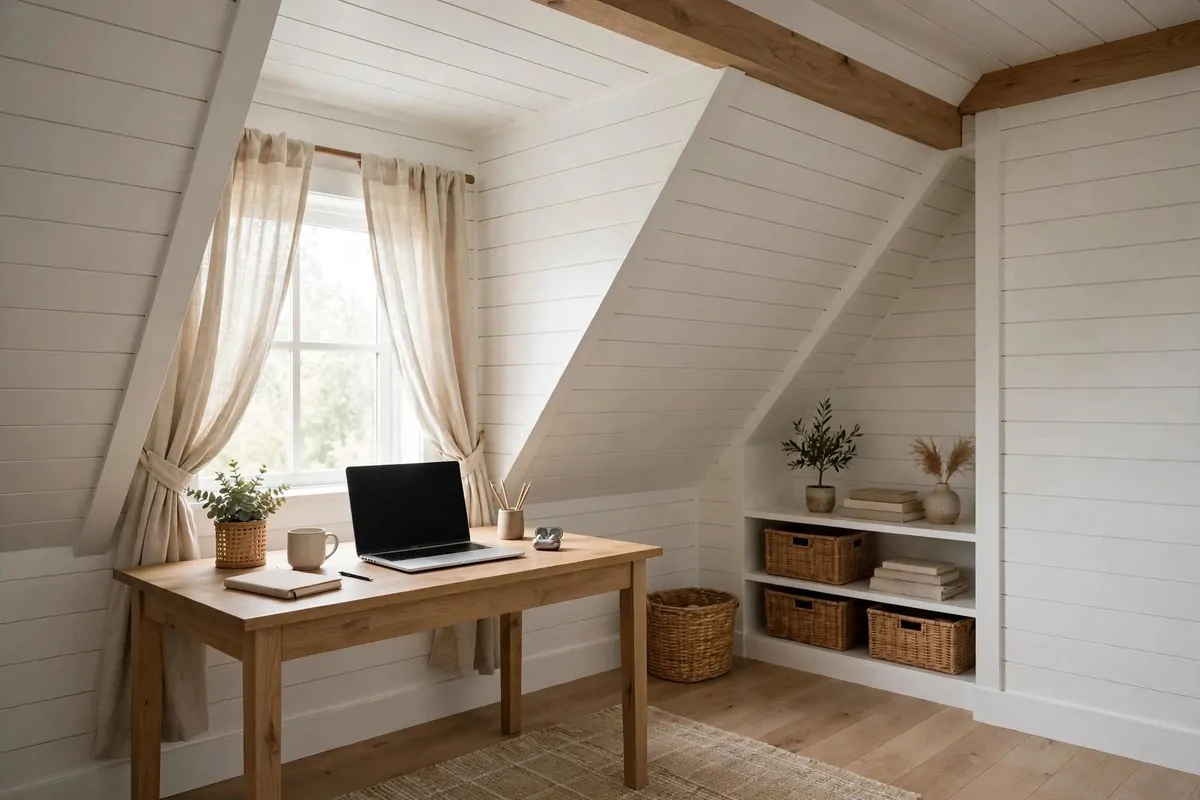
Plain plaster on a slope can feel a bit cold. Shiplap fixes that in an afternoon. Those thin horizontal boards add texture and shadow lines that make the ceiling feel cosy instead of bare.
I painted mine bright white. The boards catch the light from the skylight and the whole room glows. In the evening the lines throw soft shadows and it feels like a cabin. It is the same room but the mood changes completely.
You do not have to cover every slope. I did one long wall and left the other plain, and honestly that is enough. Too much texture in a small attic can feel busy. Pick the wall your desk faces so you see the benefit all day.
Vertical boards work too if you want height. Horizontal boards make a long narrow attic feel wider. That is the old decorator rule and it holds true up here as well.
- Do one feature slope first, live with it a week
- Paint it white to bounce the light around
- Horizontal boards widen, vertical boards add height
- Seal the boards so they do not warp in the heat
Fill the nail holes before you paint. A dab of filler and a quick sand makes the boards look seamless.
I chose a satin finish, not matt. It wipes clean when the attic gets dusty in summer.
Run the boards all the way into the corners. Stopping short leaves an awkward gap that catches the eye.
The best part is the cost. Shiplap boards are cheap and you can paint them with a roller. It is a weekend job that looks like a full renovation. My husband still thinks we hired someone.
4. Install Skylights for Natural Light
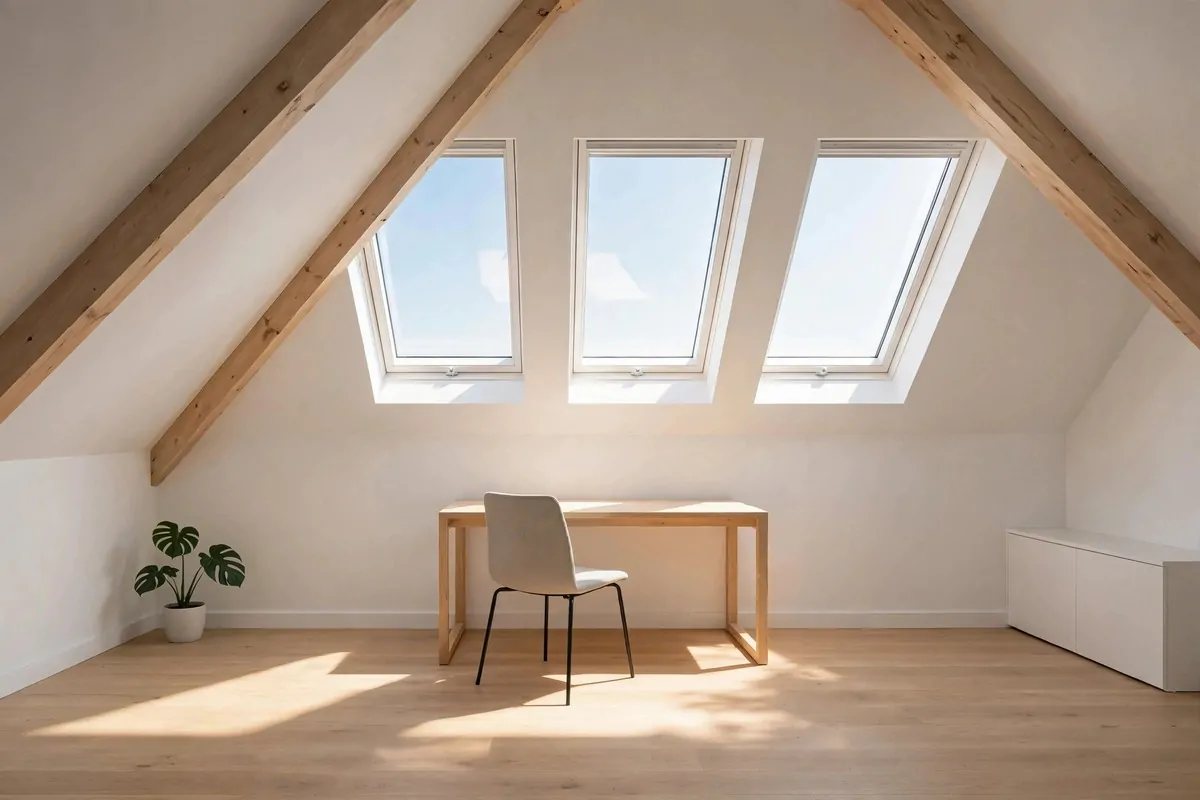
If your attic has no windows, this is the single best change you can make. Electric light is fine, but it does not do what real daylight does to your mood. I notice I work longer and happier on sunny days, and that is no accident.
A skylight over the desk is the dream set-up. You look up from your screen and see sky. On rainy days it is even better, the sound of rain on the glass while you type. I could write about that feeling forever.
There are a few main types and they do different jobs. Here is a quick look at the common options.
| Skylight type | Best for | Good to know |
|---|---|---|
| Fixed skylight | Light only, above the desk | Cheapest option, no moving parts |
| Opening skylight | Fresh air in summer | Lets hot air escape from the top of the house |
| Sun tunnel | Small dark corners | A tube that pipes daylight down from the roof |
An opening skylight is worth the extra money. Attics get hot in summer, and hot air rises straight to your office. Being able to vent it out changes everything. I open mine first thing on warm mornings.
Add a blind for glare. Midday sun straight onto a laptop screen is no joke. A simple pull-down blind takes five minutes to fit and saves your eyes.
If a full skylight is too much, a sun tunnel works in tiny attics. It is just a reflective tube from the roof to the ceiling. Less drama, but it still kills the cave feeling.
- Place the main skylight over the desk
- Choose an opening type for summer heat
- Fit a blind for midday glare
- Consider a sun tunnel for small budgets
Clean the glass twice a year. A dirty skylight can block a surprising amount of light.
Check your roof structure before you dream too big. A roofer will tell you in ten minutes whether your rafters allow it. Ours needed one small change and the whole job took a day.
5. Add Exposed Ceiling Beams
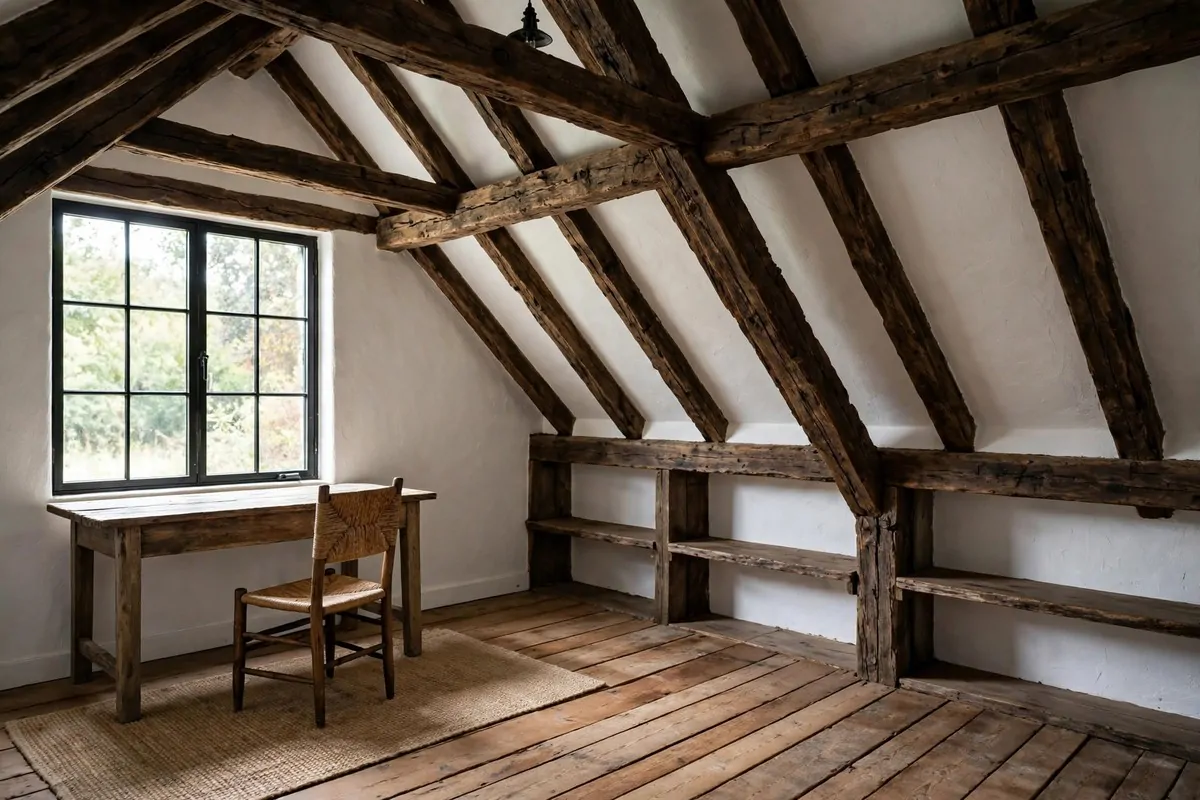
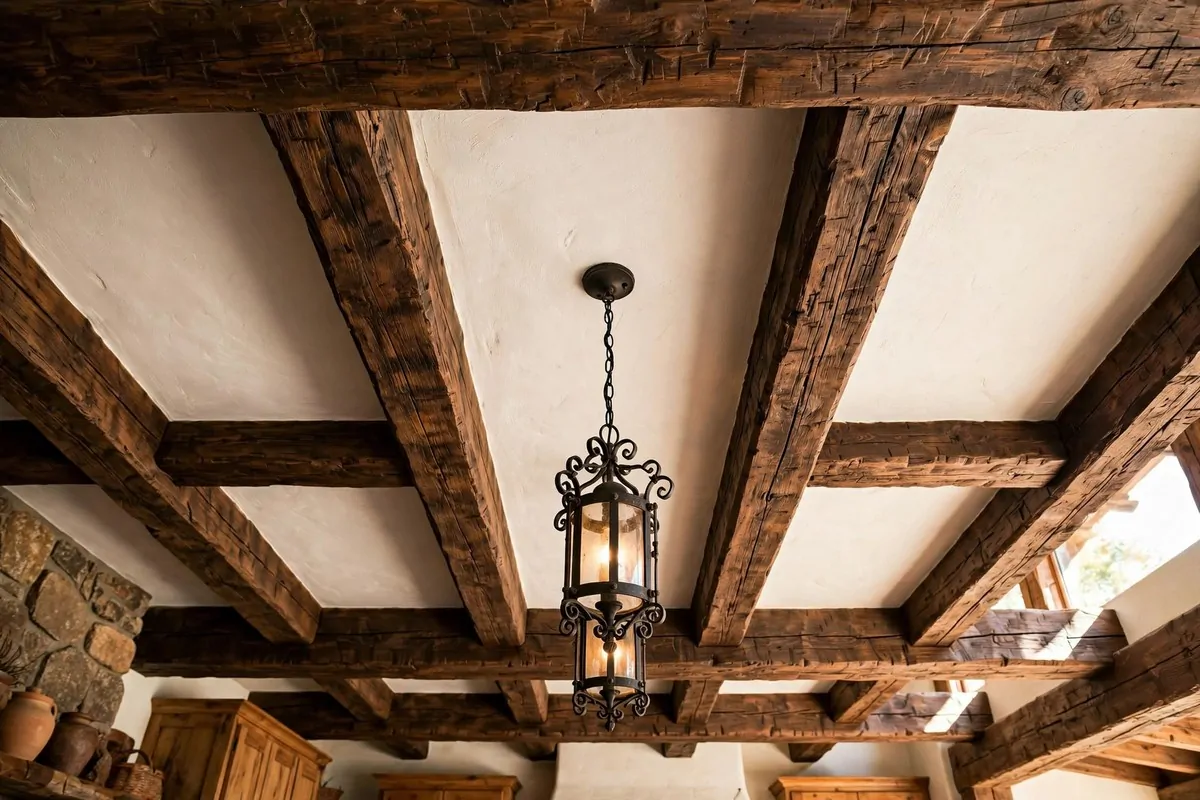
Some attics already have beams hiding behind plasterboard. If yours does, uncovering them is like finding treasure. Dark wood against white plaster is a look that never gets old.
I love how beams break up a big blank slope. They give the eye somewhere to rest. They also make the room feel solid and old in a good way, like the house has a story to tell.
If you have no real beams, fake ones are fine. Lightweight wood-look beams glue or screw straight to the ceiling. Nobody can tell from the ground, and honestly nobody is up there with a magnifying glass.
Stain them dark for a rustic farmhouse feel. Paint them white for a coastal calm. I went with a mid oak stain because my desk is oak and it all ties together. Match your beam colour to your desk for an easy win.
Beams are also practical. You can hang a pendant light from one, or clip up string lights in December. I have a small plant hanging from mine and it makes me smile every morning.
- Check for real beams before buying fake ones
- Stain dark for rustic, paint white for calm
- Match beam colour to your desk wood
- Use them to hang lights or plants
Seal the beams against woodworm if they are old. A quick treatment now saves heartbreak later.
I wrapped fairy lights around mine in December. It took ten minutes and the whole attic glowed.
The ceiling went from boring to beautiful in one weekend. It is the sort of detail that makes guests go quiet for a second when they come up. Worth every penny of stain.
6. Paint a Two-Tone Accent Wall
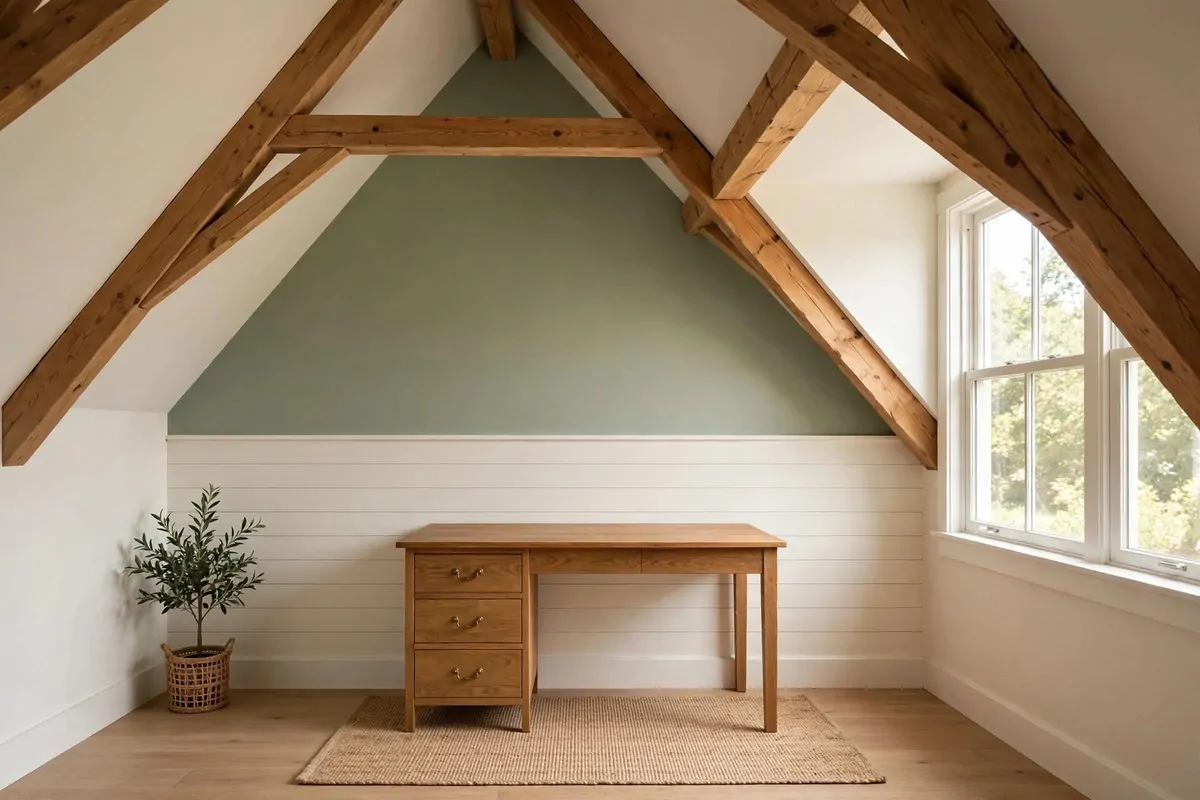
Painting a whole attic one colour is safe, but safe can be a bit flat. A two-tone wall adds depth without any building work. You just need a roll of masking tape and a steady hand.
The trick is the dividing line. A crisp horizontal line halfway up the wall looks modern. Following the angle of the roof with the line looks dramatic. I did a simple horizontal split and it took me an hour.
Pick the darker colour for the bottom half. It grounds the room and hides scuffs from chair legs and feet. The lighter top half keeps the ceiling feeling high. This order matters more than people think.
My colours are sage green below and warm white above. Green is calm for work, and it goes with wood furniture. If green is not your thing, navy below and white above looks sharp too.
- Darker colour on the bottom, lighter on top
- Use masking tape for a crisp line
- Sage, navy, and clay all work well below
- Paint the wall your desk faces
Touch up the tape line once a year. Chair backs scuff it faster than you would expect.
I painted a matching stripe on the door frame. It ties the room together and cost nothing extra.
Use the leftover paint on a plant pot. It is a small touch but it makes the room feel planned.
It is the cheapest idea on this list and maybe the most satisfying. One tin of paint, one afternoon, and the room has a whole new personality. I keep catching myself just looking at the wall.
7. Go Bold With Floral Wallpaper
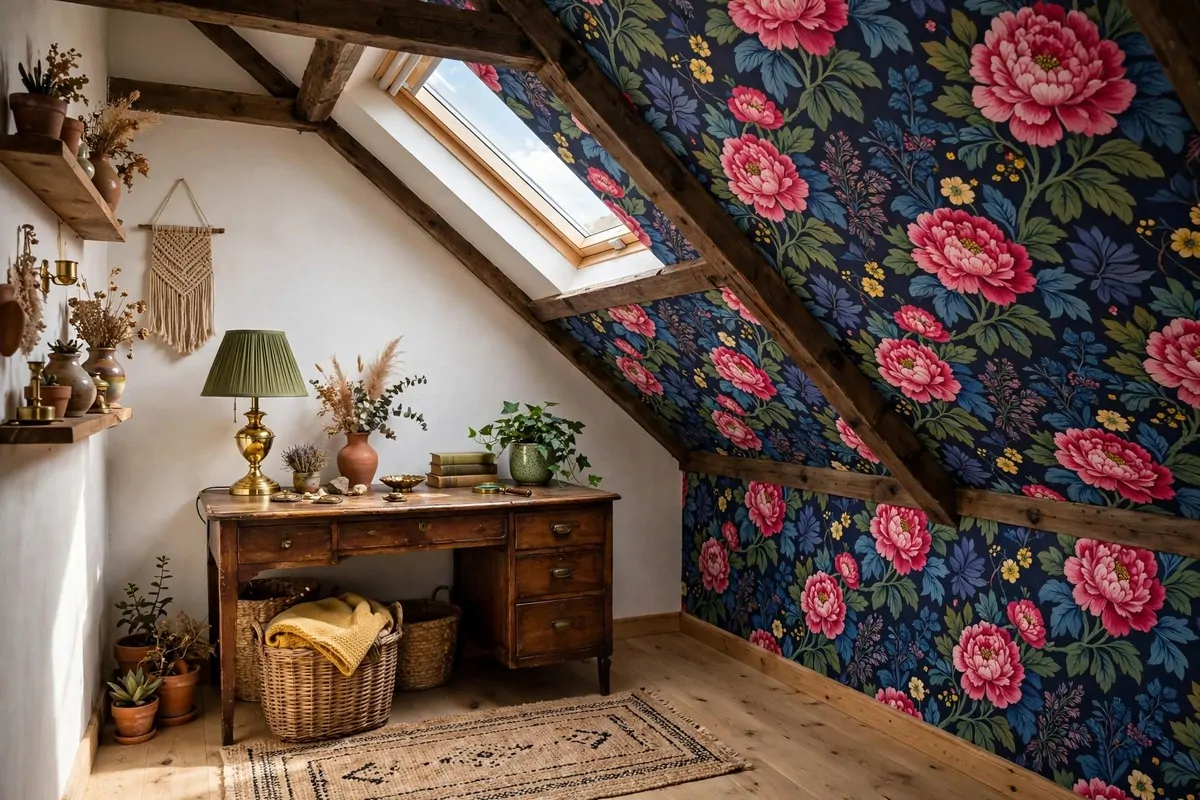
An office should make you happy to sit down, and nothing cheers a room like a big bold print. Floral wallpaper on one slope is brave, and I am here for brave. It turns a work corner into a little garden.
Pick one wall only. A small attic wrapped in big flowers can feel like being inside a gift box. One statement slope behind the desk is plenty. Let the other walls stay quiet so the pattern can shine.
Scale matters. Big blooms suit big walls, small ditsy prints suit small nooks. Hold a sample up in daylight before you commit. Wallpaper looks different under a skylight than it does in the shop, I promise you.
Peel and stick paper is your friend if you rent. It comes off clean and it forgives mistakes. I helped a friend do her attic with it and we rehung three pieces without any tears or swearing. Well, minimal swearing.
Keep furniture simple against a loud wall. A plain desk and a plain chair let the flowers do the talking. Too many patterns and the room starts to argue with itself.
- One feature wall is enough
- Match print scale to wall size
- Try peel and stick if you rent
- Keep furniture plain against loud paper
Order one extra roll. Slopes eat more paper than flat walls because of all the trimming.
Paste the wall, not the paper, if you can. It is much easier to slide the sheet into place on a slope.
My wallpaper wall is the first thing on every video call background now. People ask about it constantly. An attic office should have a little personality, and this is personality in a roll.
8. Frame the Triangle Wall With Wood Trim
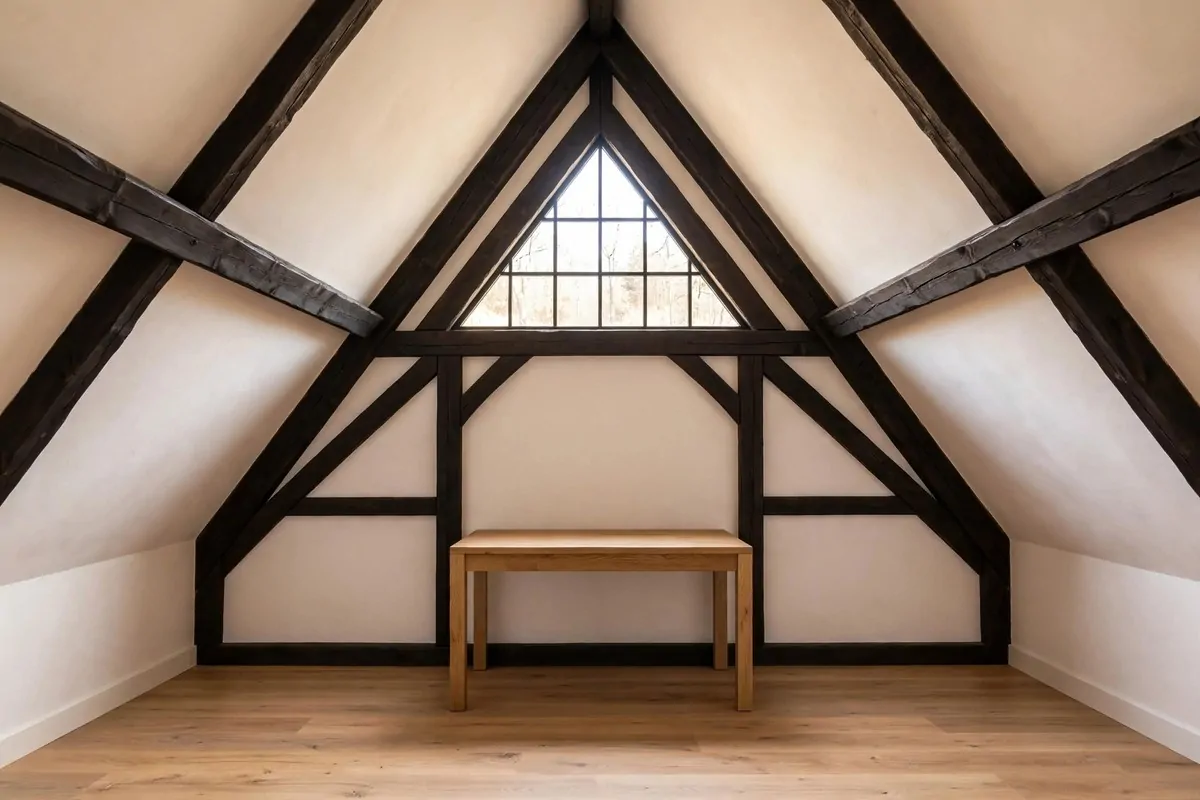
Remember that triangle wall from idea two. If shelves feel like too much, wood trim does a similar job for less money. Thin beams that follow the triangle shape make the wall look designed instead of leftover.
It is basically an outline. You trace the triangle with wood, paint it all one colour, and suddenly the wall has architecture. I did this in my hallway too and it works everywhere, but it is made for gables.
Dark trim on a light wall is the classic look. It pops. Light trim on a light wall is softer and more modern. Either way, keep the trim slim. Chunky wood on a small triangle can look heavy.
You can add a crossbar or two inside the triangle for extra detail. One horizontal beam across the middle gives you a shelf ledge for small plants. Form and function, as my dad would say.
- Trace the triangle shape with slim trim
- Dark trim pops, light trim stays calm
- Add one crossbar for a mini shelf ledge
- Paint trim and wall as one unit
Caulk the edges before painting. The caulk line is what makes trim look professional instead of DIY.
I added the same trim around the skylight. It echoes the triangle and the room feels designed.
Sand the cut ends smooth. Rough ends show through paint more than you would think.
This took me a Saturday and about forty pounds of wood. The wall went from blank to beautiful, and it photographs so well. Sometimes the simplest frame is the best one.
9. Drench the Room in Soft Pink
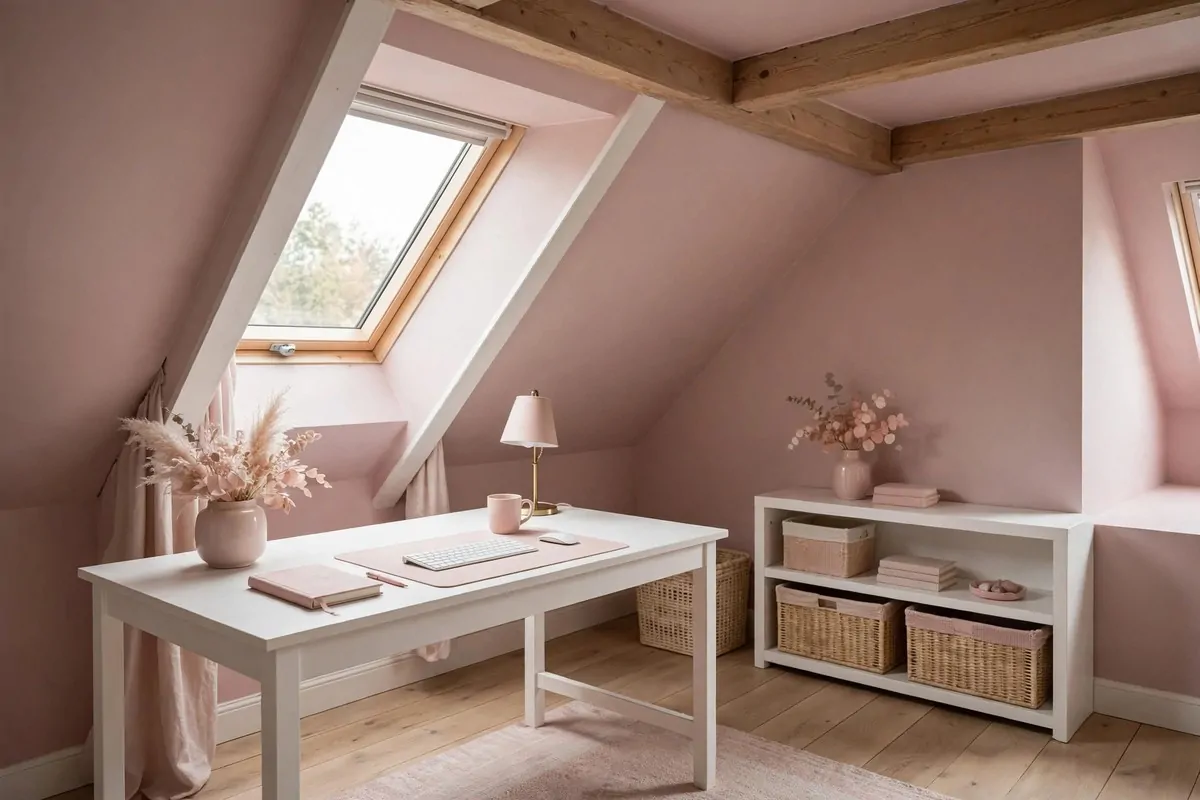
Colour drenching means painting the walls, ceiling, and trim all one shade. In soft pink it is like working inside a warm hug. I know pink sounds like a lot, but muted pink is barely pink at all. It reads as warm neutral.
The magic is that drenching erases the room’s awkward angles. When the slope and the wall are the same colour, your eye stops noticing where one ends and the other begins. The attic feels bigger and calmer at once.
Pick a pink with a grey or beige base, not a bubblegum one. Test it on the slope in daylight and lamplight. Pinks shift a lot between the two, and you live with both. I tested four before I found mine.
Pair it with white furniture and light wood. Pink plus dark heavy furniture can feel gloomy. Keep it airy. A white desk, a pale rug, and one green plant is the whole recipe.
- Use a muted pink with a grey base
- Test the shade in daylight and lamplight
- Keep furniture white or light wood
- Add one green plant for contrast
Keep the ceiling the same pink, not white. A white ceiling would chop the room in half visually.
Brass handles and a brass lamp suit pink perfectly. The warm metal picks up the warmth in the paint.
I painted the inside of the door pink too. It is a small surprise that makes me smile.
I was nervous about this one, I will admit. But now my pink attic is my favourite room to work in. It feels gentle at 8am and cosy at 8pm. Colour really does change how a day feels.
10. Set Up Two Desks for a Shared Office
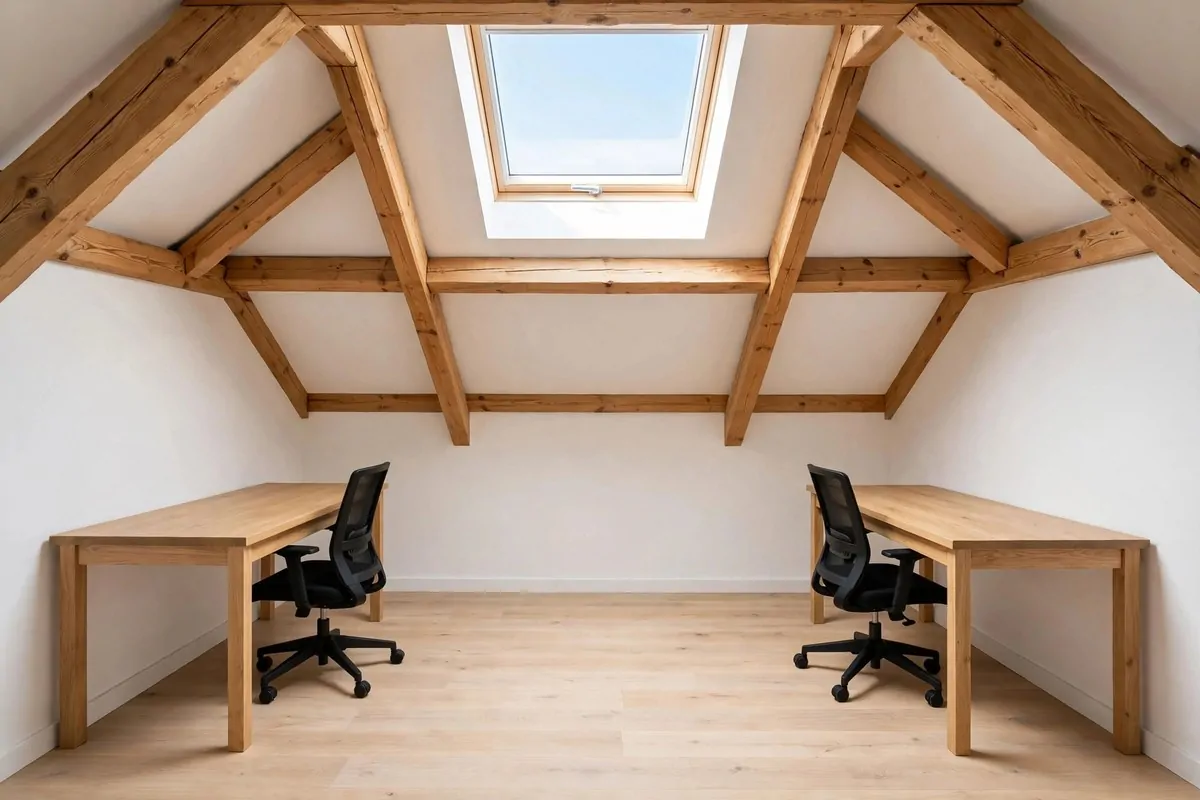
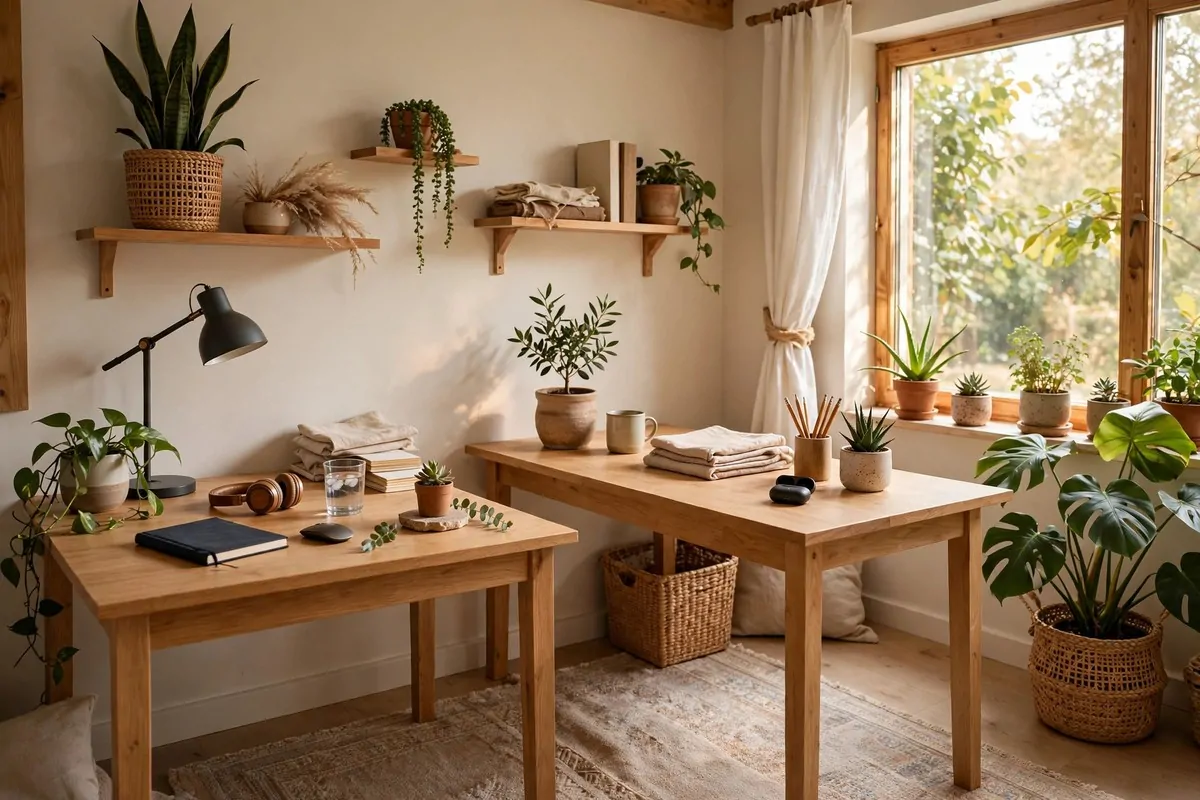
Not every home office is for one person. Couples, siblings, and flatmates share attics all the time. Two desks along the two parallel walls is the classic answer, and it works because the slope gives each person their own cave.
Face the desks away from each other. This is the golden rule. Back to back or facing opposite walls means no one stares at anyone’s screen. You share the room but keep your own headspace.
Give each desk its own lamp and its own storage. Sharing sounds nice until someone borrows your charger for the third time. A small set of drawers each keeps the peace better than any house rule.
Sound matters with two people on calls. A rug between the desks softens echo. Headphones are non-negotiable. I would also add a curtain or screen you can pull across for important meetings.
- Face desks away from each other
- Give each person their own lamp and drawers
- Add a rug to soften echo
- Keep a folding screen for private calls
Agree on call hours if you can. Two video calls at once in one attic is nobody’s idea of fun.
A shared whiteboard on the gable wall helps. Deadlines and doodles all live there together.
Keep a spare chair folded in the corner. Guests and collaborators need somewhere to sit too.
The middle of the room becomes shared space. A printer, a plant, a kettle on a tray. It feels like a tiny studio office. Honestly some couples work better up here than they ever did at the kitchen table.
11. Build a Reading Nook Under the Eaves
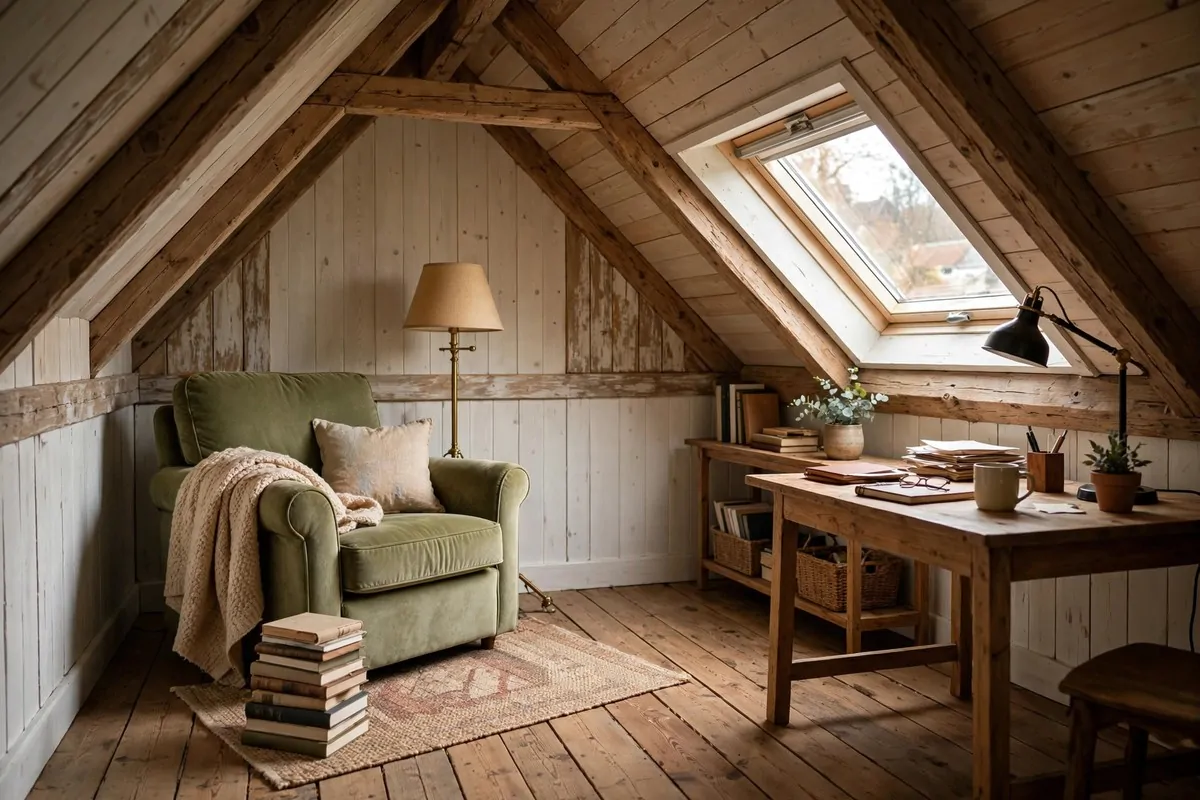
You will not work every minute you are up there. A reading nook under the eaves gives you somewhere to think, and thinking is work too. I do my best planning in my nook with a cup of tea.
All you need is a chair that fits the low height. Measure the slope first. A low armchair or even a big floor cushion works. Add a small side table for your mug and a floor lamp that arcs over your shoulder.
A rug defines the nook as its own zone. Without it, the chair just floats in the room. With it, you have a destination. I found a round rug that fits the corner perfectly and it changed the whole feel.
Keep a basket of books or magazines nearby. The nook only works if it is ready to use. If you have to fetch everything from downstairs, you will never sit there. Make it grab-and-go.
- Measure the slope before buying the chair
- Add an arc floor lamp for reading light
- Use a rug to mark the zone
- Keep books in a basket within reach
A soft throw lives on my chair arm. Attics get chilly in the evening even in summer.
I charge my phone in the nook, not at the desk. It stops me checking it during reading time.
A small footstool makes the chair twice as comfy. Your feet need a home too.
I take my lunch break in my nook every day. Ten minutes with a book resets my brain better than scrolling my phone. It is the smallest luxury and I would not give it up now.
12. Add Built-In Storage Along the Low Walls
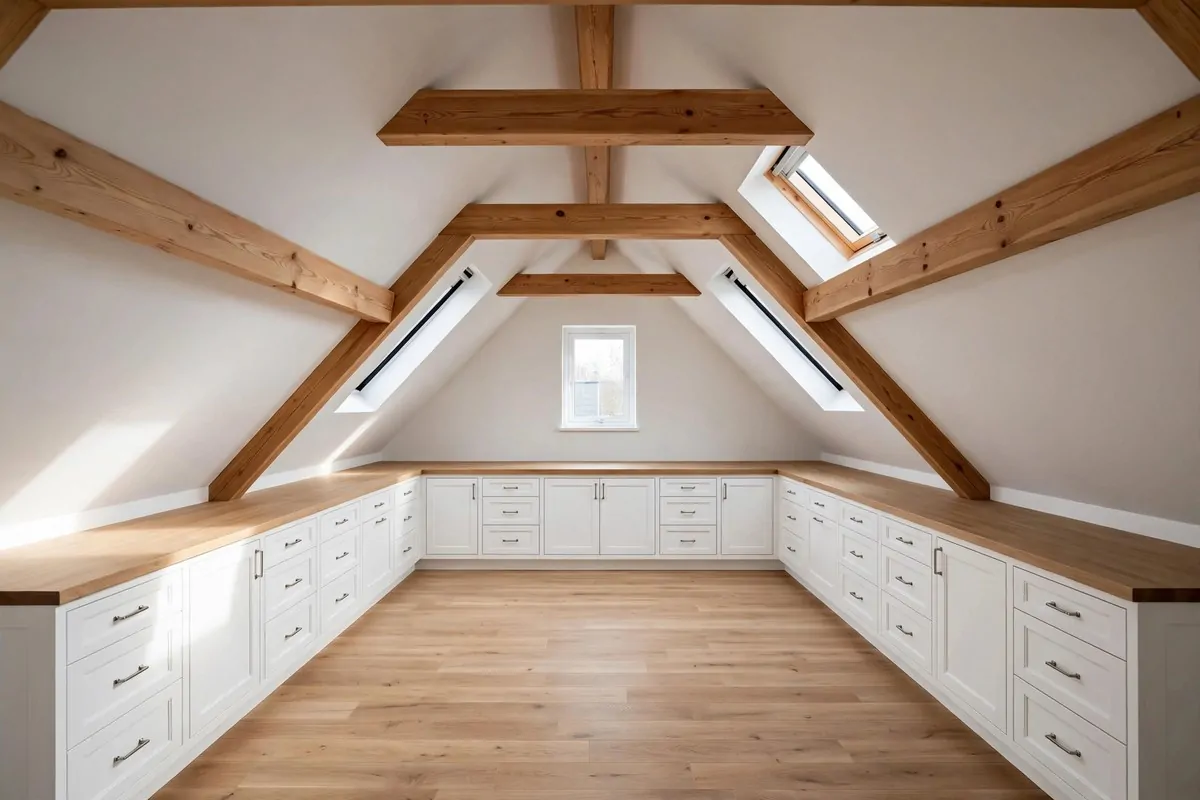
The knee walls are the short walls where the slope meets the floor. They look useless. They are actually the best storage in the house because they run the whole length of the room.
Built-in drawers along the knee wall swallow everything. Files, stationery, craft supplies, the printer paper you always forget to buy. I fitted simple drawer units and painted them wall-white so they disappear.
Depth is the thing to get right. Too deep and you lose things at the back. Too shallow and it is pointless. Here is what works for common office items.
| Storage type | Ideal depth | Good for | |||
|---|---|---|---|---|---|
| Shallow drawers | 25 to 30 cm | Pens, chargers, small supplies | File drawers | 40 to 45 cm | A4 folders and paperwork |
| Cupboards | 50 to 60 cm | Printer, boxes, bulky items |
Doors beat open shelves here. Open shelves at knee height collect dust and look messy fast. Doors keep it clean and calm, which is what you want when you are trying to think.
Label the insides if you share the office. It sounds fussy, but it stops the slow drift where everything ends up in the wrong drawer. A little label maker is ten pounds and very satisfying.
Leave one section open for the printer. Printers need air and easy access. A pull-out shelf for it is the dream. Mine slides out, prints, and slides back like it was never there.
- Build along the full length of the knee wall
- Match drawer depth to what you store
- Use doors to hide the clutter
- Leave a pull-out bay for the printer
Add dividers inside the deep drawers. Without them, everything slides into one messy pile.
This is the least glamorous idea on the list and the most useful. An attic office lives or dies by its storage. Get this right and the room stays calm for years.
13. Hang Fun Statement Lights
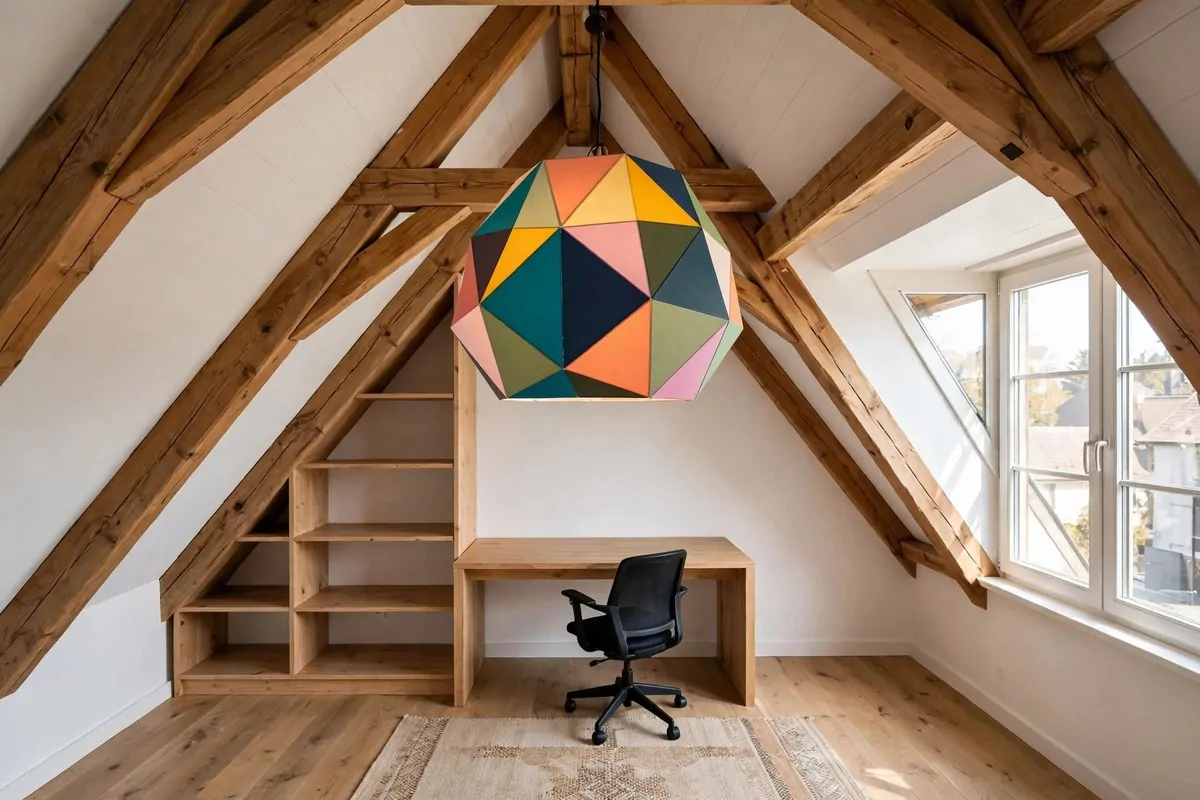
Attic ceilings are low in places, which makes lighting tricky. A fun statement pendant solves it and becomes the jewellery of the room. One bold light does more than three boring ones.
Hang it where the ceiling is highest, usually the centre ridge. That is where you need the most light anyway. A big shade up there fills the room without anyone bumping their head.
Pick something with personality. A rattan shade, a coloured metal dome, a cluster of glass globes. Offices are allowed to be fun. Mine is a mustard yellow dome and it makes me happy every single time I switch it on.
Layer it with task lighting. The pendant is for mood and general glow. Your desk still needs its own lamp for actual work. Two layers of light is the rule designers use, and it works up here too.
Check the drop length before you buy. In an attic, a pendant that hangs too low becomes a head injury. Measure from the ridge to your head height and leave plenty of room.
- Hang the pendant at the highest ridge point
- Choose a shade with real personality
- Add a desk lamp as well for task light
- Check the drop so no one bumps their head
Put the pendant on a dimmer switch. Bright for work, low for evening wind-down.
I swapped the bulb for a warm 2700K one. Cool white light in an attic feels like a hospital.
Good lighting changed my attic more than paint did. In the evening the whole room glows and I actually want to finish my work up there. Never underestimate a pretty light.
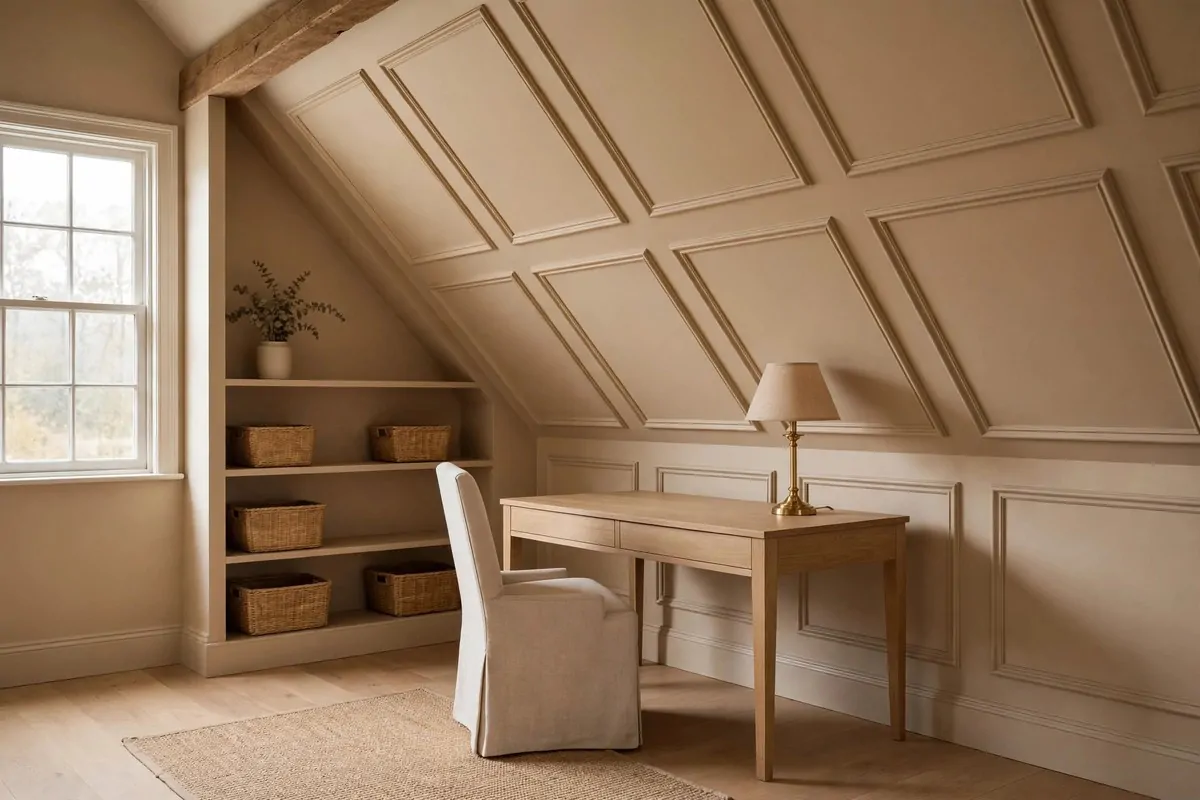
14. Add Picture-Frame Molding to the Walls
Attic ceilings are low in places, which makes lighting tricky. A fun statement pendant solves it and becomes the jewellery of the room. One bold light does more than three boring ones.
Hang it where the ceiling is highest, usually the centre ridge. That is where you need the most light anyway. A big shade up there fills the room without anyone bumping their head.
Pick something with personality. A rattan shade, a coloured metal dome, a cluster of glass globes. Offices are allowed to be fun. Mine is a mustard yellow dome and it makes me happy every single time I switch it on.
Layer it with task lighting. The pendant is for mood and general glow. Your desk still needs its own lamp for actual work. Two layers of light is the rule designers use, and it works up here too.
Check the drop length before you buy. In an attic, a pendant that hangs too low becomes a head injury. Measure from the ridge to your head height and leave plenty of room.
- Hang the pendant at the highest ridge point
- Choose a shade with real personality
- Add a desk lamp as well for task light
- Check the drop so no one bumps their head
Put the pendant on a dimmer switch. Bright for work, low for evening wind-down.
I swapped the bulb for a warm 2700K one. Cool white light in an attic feels like a hospital.
Good lighting changed my attic more than paint did. In the evening the whole room glows and I actually want to finish my work up there. Never underestimate a pretty light.
15. Keep the Palette Light and Airy
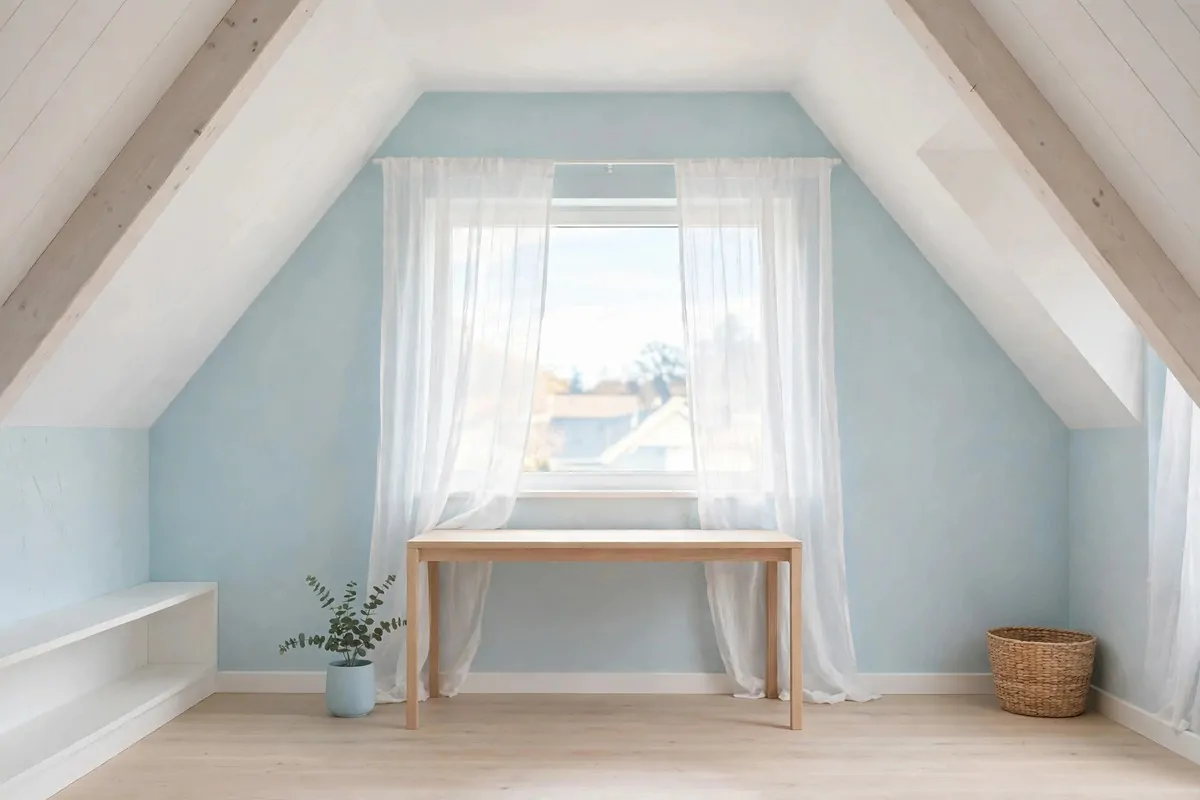
Small attics can feel like a box. A light palette fixes that faster than anything. Whites, creams, and soft pastels bounce light into every corner and the ceiling feels higher than it is.
I am not saying everything must be white. That can feel cold. The trick is layering lights: warm white walls, a cream rug, pale wood, a pastel blue chair. Different lights, same family. It feels rich, not flat.
Keep the floor light too if you can. A pale rug over dark floorboards does the job without sanding. It is the biggest single surface after the ceiling, so it matters more than people expect.
Limit yourself to three colours max. White plus two pastels is my rule. More than that and a small attic starts to feel busy. Restraint is doing the heavy lifting here.
- Layer different light tones, not just white
- Cover dark floors with a pale rug
- Stick to three colours maximum
- Use pastels for softness, not starkness
Warm white beats brilliant white. Brilliant white can look blue and cold under a skylight.
I painted the floorboards a pale grey. It was one weekend of work and the room felt twice as bright.
Cream curtains soften the window light. They glow in the morning sun like a lampshade.
My attic is not big, but visitors always say it feels spacious. That is the palette talking. Light colours are the cheapest square footage you will ever buy.
16. Layer a Soft Area Rug
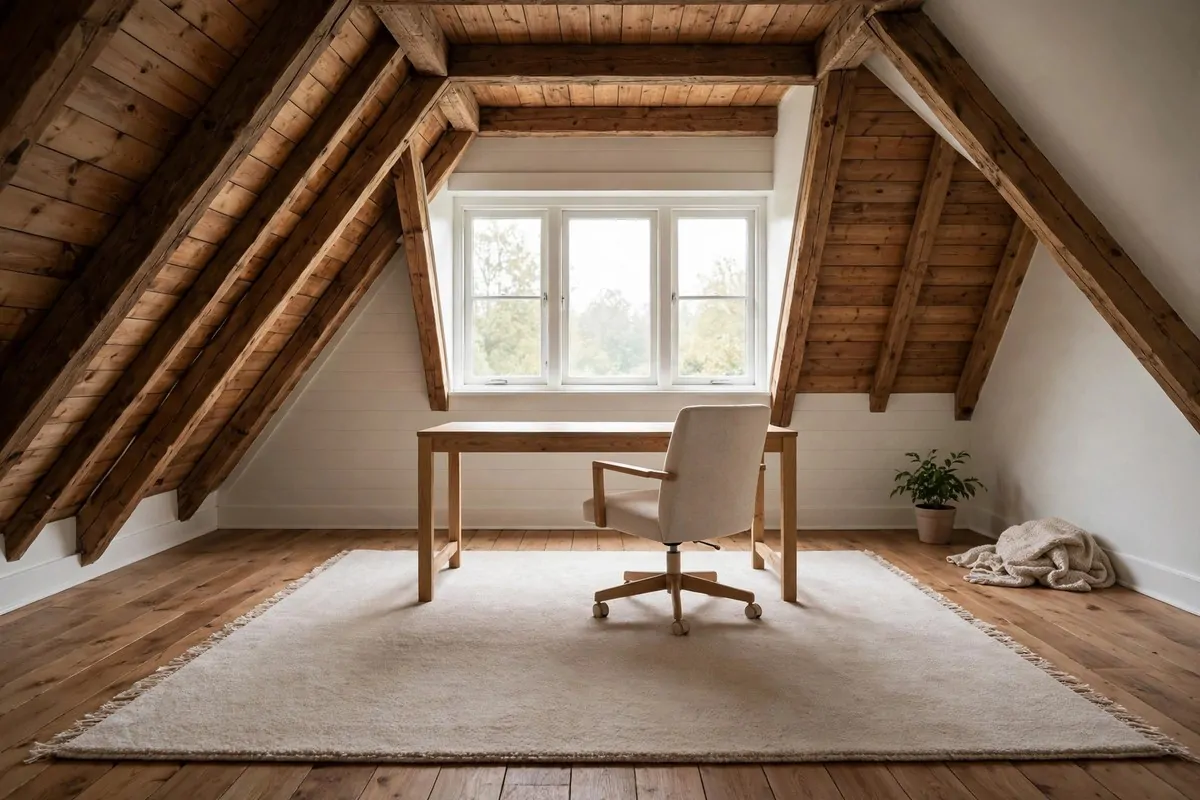
Attic floors are usually bare boards, and bare boards are cold and loud. A soft rug under the desk changes the acoustics and the comfort in one go. Your feet will thank you by October.
Size it generously. The rug should sit under the desk and extend past your chair, so the chair legs stay on it when you roll back. A rug that is too small looks like a postage stamp and trips the chair.
Low pile is best for office chairs. Thick shaggy rugs eat chair wheels for breakfast. A flat weave or a low loop pile rolls smoothly and still feels soft underfoot. I learned this one the annoying way.
Layering two rugs is a designer trick that works up here. A big flat jute rug as the base, then a smaller soft rug on top under the desk. Texture plus comfort, and it looks styled without trying hard.
- Extend the rug past the chair’s roll-back
- Choose low pile so the chair rolls easily
- Try layering jute plus a soft top rug
- Pick washable if you drink coffee at the desk
Use a rug pad underneath. It stops the rug sliding on smooth boards and adds extra softness.
I vacuum mine weekly. Attic rugs catch more dust than you expect from the roof space above.
Pick a pattern that hides crumbs. A busy weave forgives a working lunch better than plain cream.
I put my rug down on a Saturday morning and worked the whole day in socks. It sounds small, but comfort is what keeps you at your desk. Cold feet end work days early.
17. Install a Custom Glass Door
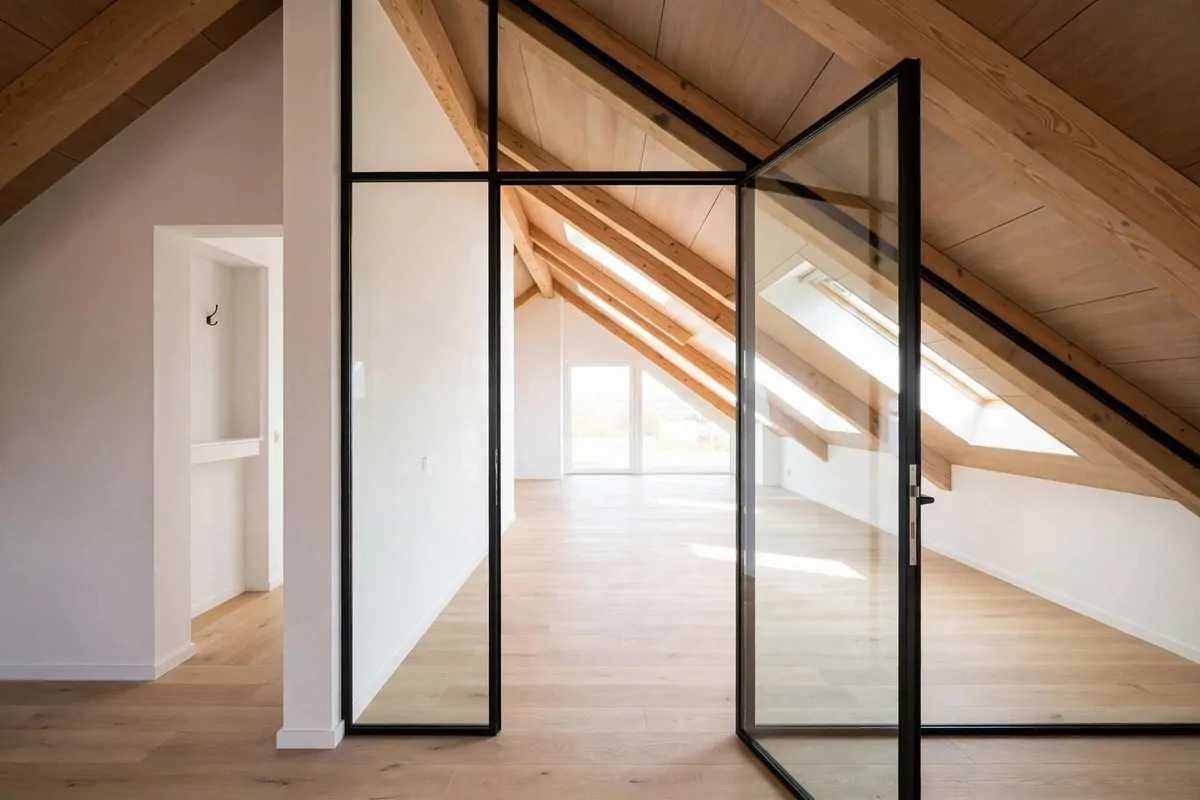
Attic doors are often tiny and dark, which makes the office feel cut off from the house. A glass door keeps the separation you need for quiet, but lets light flow through. Best of both worlds.
Frosted glass is the smart choice. You get the light without anyone seeing your messy desk from the landing. Full clear glass is braver and brighter. I went frosted because my desk is never as tidy as I pretend.
A black metal frame looks modern and sharp against white walls. A wood frame feels warmer and suits older houses. Either way, the glass is doing the work. The frame is just the outfit.
This is a job for a pro, not a DIY. Attic openings are rarely square, and the slope makes fitting tricky. Get a joiner to measure. It costs more, but a door that sticks every time you open it will drive you mad.
- Choose frosted glass for light plus privacy
- Black frame for modern, wood for warm
- Get a joiner to measure the odd opening
- Keep the door closed for quiet, open for air
Add a soft-close hinge if you can. A slamming glass door echoes through the whole house.
I stuck a small decal at eye level. It stops guests walking into the clean glass, which has happened.
Keep the hinges oiled. A smooth quiet door makes the office feel calm every time you enter.
Walking up to a glass door instead of a dark little hatch changes how the whole attic feels. It says office, not smooth cream rug. I found a round rug that fits the corner perfectly and it changed the whole feel.
18. Go Boho With Plants and Wicker
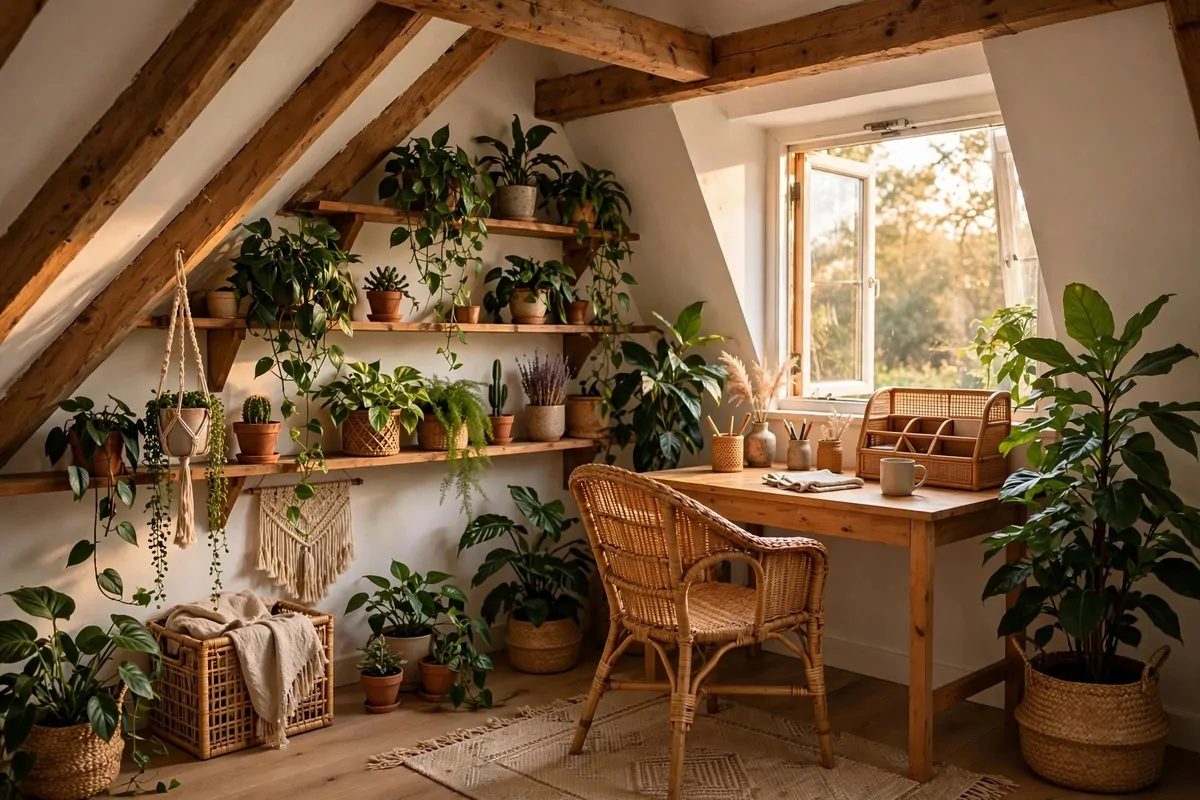
If minimal white is not your thing, go the other way. Boho style loves an attic. The slopes, the wood, the light, it all suits wicker and plants and warm texture. It feels like a treehouse office.
Plants are the heart of it. Attics get great light, so most houseplants thrive up here. Hang them from the ridge, line them on the knee wall, put a big one in the corner. I have nine and I am not stopping.
Wicker adds the warmth. A wicker chair, a rattan basket for blankets, a woven pendant shade. Natural materials soften all the hard angles of the roof. It stops the room feeling like a box and starts feeling like a nest.
Mix your woods and do not worry about matching. Boho is the one style where mismatched is the point. My desk is oak, my shelves are pine, my chair is wicker, and it all gets along fine.
- Use the good light for plants
- Add wicker in the chair, baskets, and shade
- Mix wood tones freely
- Layer throws and cushions for softness
Group plants in odd numbers. Threes and fives look natural, pairs look staged.
I mist my plants every morning. The attic air gets dry, especially with the heating on.
A macrame hanger frees up floor space. Hang one from the ridge and the plant gets the best light.
My boho corner is where I go when work feels heavy. Something about green leaves and warm wicker unties the knots in my shoulders. An office should look after you, not just hold your laptop.
19. Create an Artsy Neutral Look
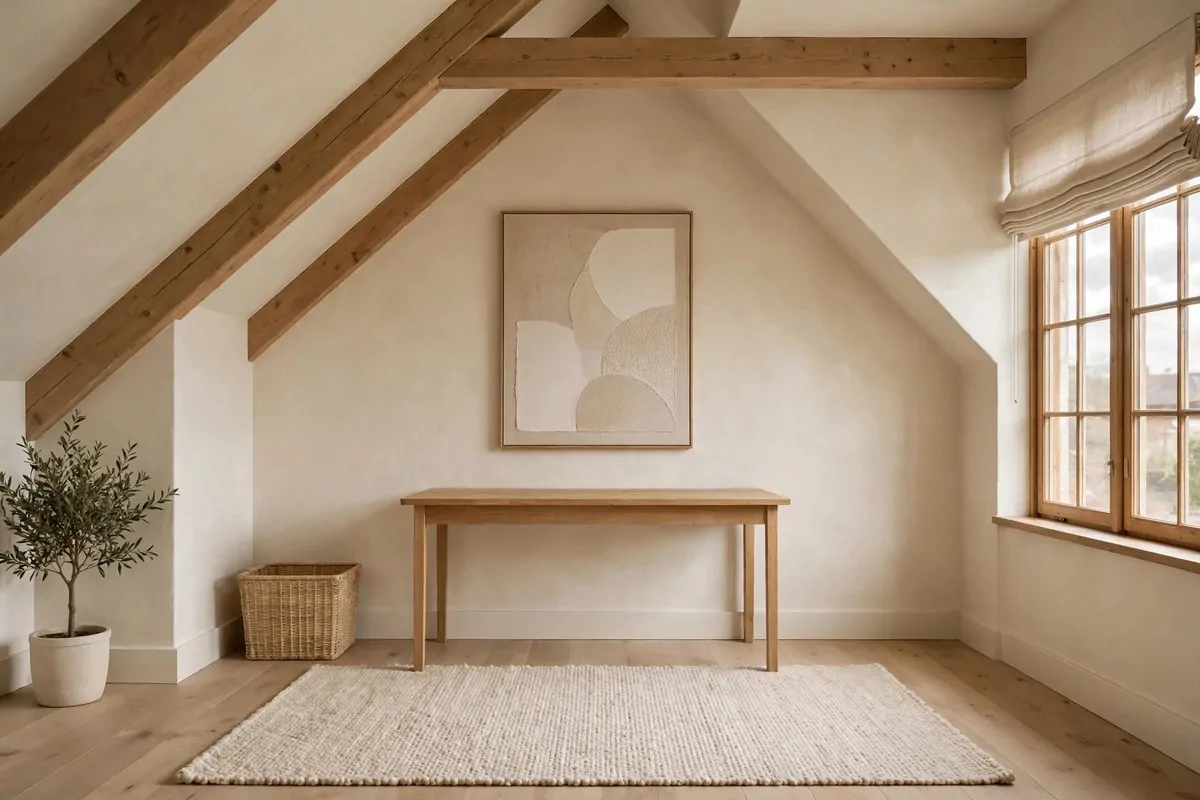
Not everyone wants colour and pattern. An artsy neutral look is calm without being boring. Think warm beiges, soft creams, one great piece of art, and texture doing the talking.
The art is the star, so give it the best wall. Above the desk is perfect because you see it all day. Go bigger than you think. Small art on a big slope looks lost. One large canvas beats five small frames up here.
Texture keeps neutrals interesting. A nubby rug, a linen curtain, a ceramic vase, a wool throw. When the colours are quiet, your fingers notice the surfaces. It feels expensive without costing much.
Keep the desk styling simple. A neutral office with a neutral desk just looks messy. I keep mine to a lamp, a plant, and a tray for the bits I use daily. Everything else lives in the drawers.
- Hang one large artwork above the desk
- Layer textures: linen, wool, ceramic, wood
- Keep desk styling to three items max
- Stay in warm beiges and creams
Rotate the art twice a year. A fresh piece makes the whole room feel new again.
I framed a page from an old book. It cost two pounds and looks like gallery art.
Lean a second frame on the shelf. Layered art feels relaxed and you can swap it in seconds.
This is the look I recommend to friends who say they have no style. Neutrals are forgiving, art makes it personal, and texture makes it rich. You cannot really get it wrong.
20. Face Your Desk Toward the Gable Window
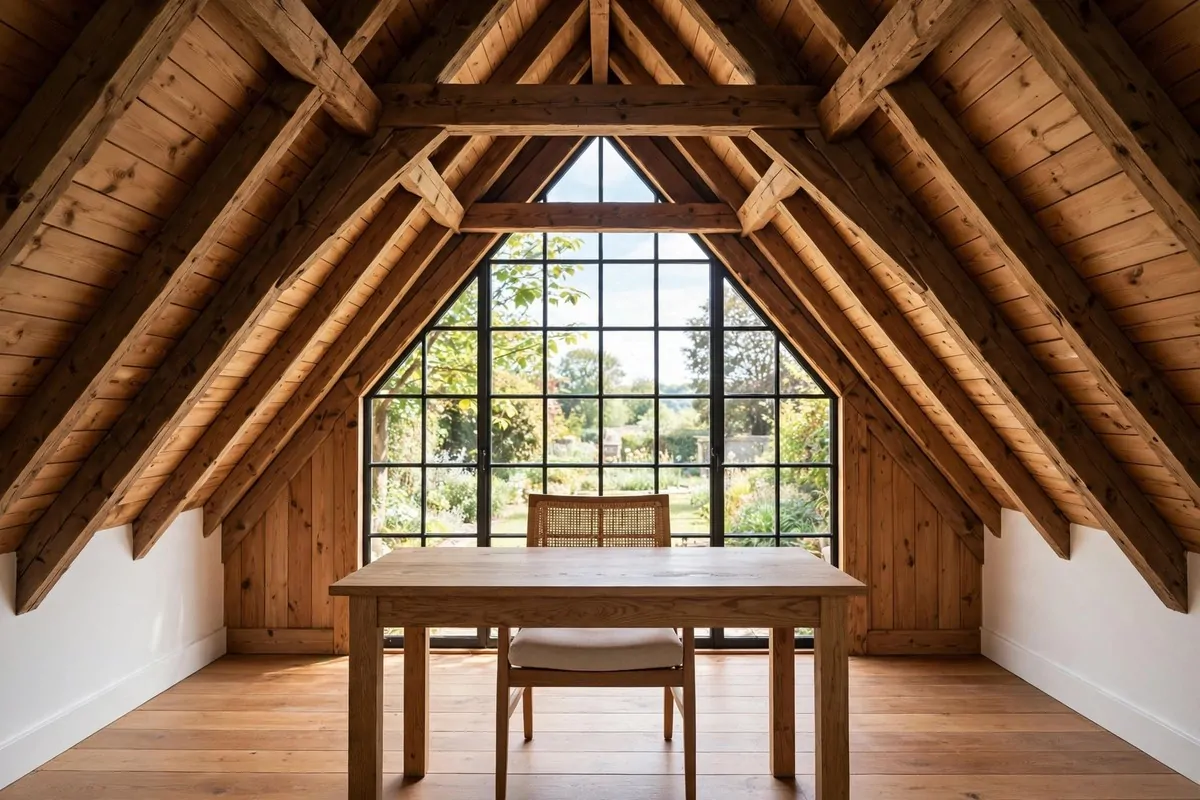
We have saved the best for last. If your attic has a gable window, put your desk right in front of it and face the view. Working with the sky in front of you beats staring at a wall every single time.
The light on your face is flattering and the view gives your eyes somewhere to rest. I look up every twenty minutes and just breathe. It is the cheapest stress relief I know, and it is built into the house.
Glare is the only real issue. A sheer curtain softens direct sun without killing the view. Position the screen at a slight angle so the window is beside it rather than behind it. Your eyes will thank you.
Make the window pretty. A clean sill, one plant, maybe a candle. You look at this spot more than any other in the room. It deserves a little styling. I keep a tiny succulent on mine and it makes me unreasonably happy.
- Place the desk to face the gable window
- Add a sheer curtain for glare control
- Angle the screen slightly off the window line
- Style the sill with one plant
Open the window for ten minutes each morning. Fresh air clears the attic stuffiness fast.
I keep binoculars on the sill. Birds and clouds keep me company between tasks.
A window seat cushion turns the sill into a perch. Some days I take calls sitting right there.
Every workday should start with a view. Mine starts with rooftops and clouds, and I would not trade it for any corner office in the city. The attic was the best room all along. We just had to look up.