27 Small Home Ideas That Make Every Inch Count

Your home is not too small. I know that sounds silly when you can touch both kitchen walls at the same time. But stay with me for a minute.
Most of the time the problem is not square footage at all. The problem is wasted space. It is the dead corner that holds nothing but dust. It is the empty wall above your doors that just sits there doing zero work. It is the couch that is only a couch and the table that is only a table.
Small homes win when every inch has a job. And honestly, once you start looking, you will find space hiding everywhere. I put together 27 small home ideas that make every inch count. Real ideas that real people use in real small homes. Let's find your hidden space together.
1. Go Vertical: Build Your Storage to the Ceiling
Most small homes have almost no wall space in use. Look at your walls right now. How much of them is empty? Probably a lot.
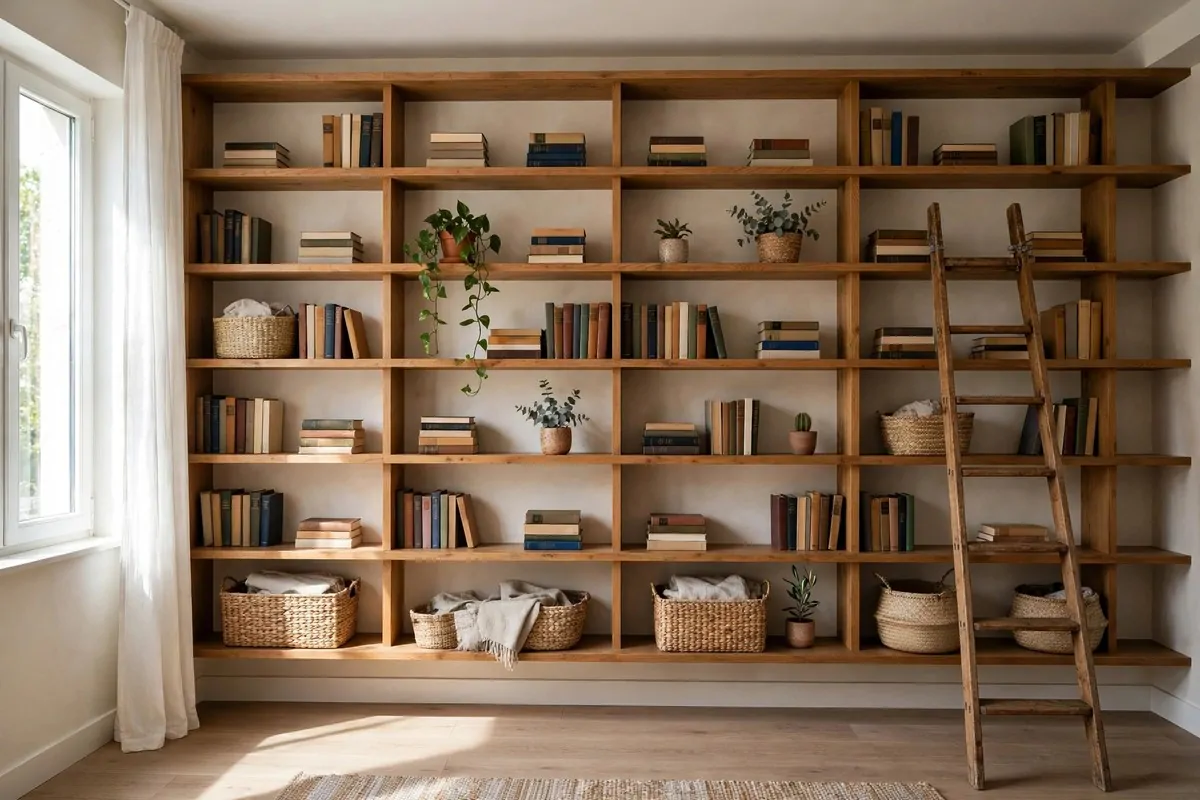
When the floor is full, the only way left to go is up. Tall shelves give you storage without taking one more step of floor room. They also pull the eye upward. That makes the whole room feel taller.
Start with one wall. A floor-to-ceiling shelf unit can hold books, baskets, plants and boxes. It looks like furniture, but it works like a closet.
Mix open and closed storage on it. Open shelves for the pretty things. Baskets and boxes for the messy things. Your guests will only notice the pretty things.
What I love most is how cheap this can be. Simple shelf boards and brackets cost very little. You do not need a fancy built-in look to get the same effect.
One tip: keep the heavy things low and the light things high. Nobody wants a heavy box falling from the top shelf. Safety first, always.
If drilling is not allowed in your rental, use a tall freestanding bookcase. It gives you the same vertical storage with zero holes in the wall. Lean it safely so it cannot tip.
Go up, not out. That is the whole trick. Your walls have been waiting for a job this whole time.
2. Buy Furniture That Works Two Jobs
In a small home, every piece of furniture needs to earn its spot. If it only does one job, it might be a waste of space. Harsh but true.
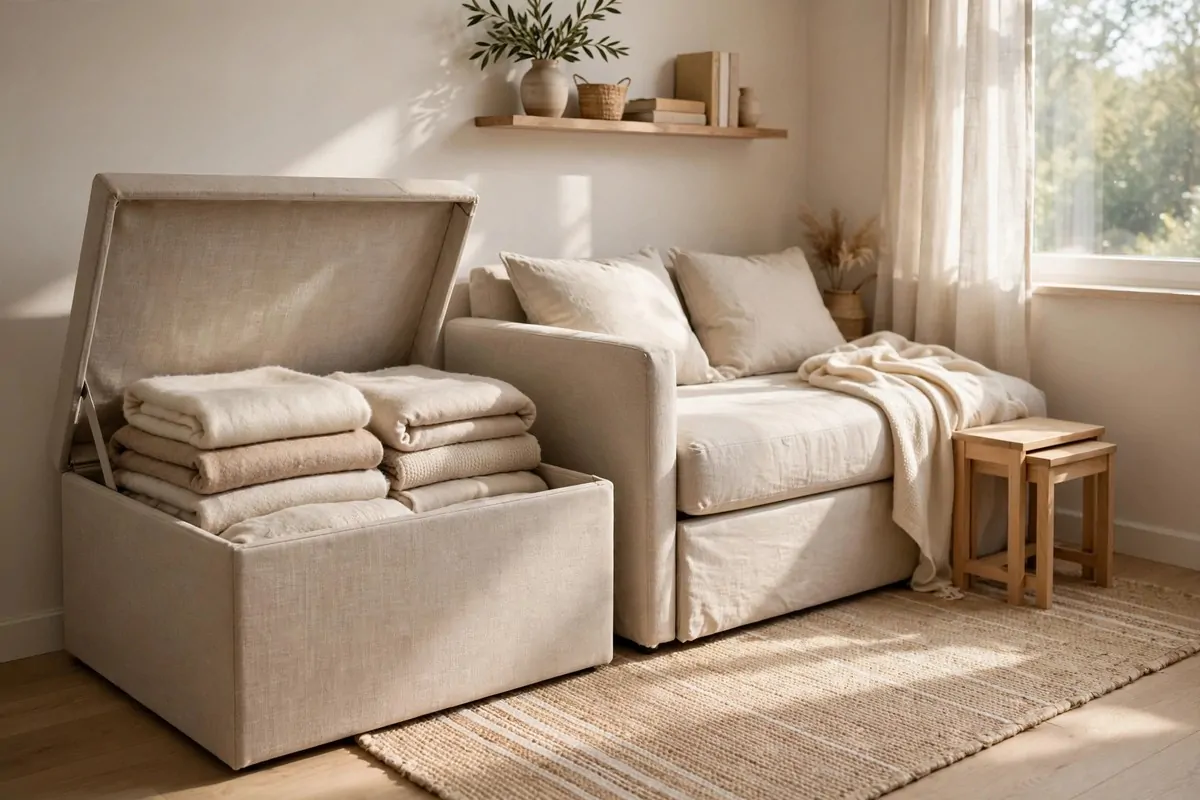
A storage ottoman is my favorite example. It is a footrest, a seat, a coffee table and a blanket box. Four jobs in one small square. Try getting that from a regular chair.
Beds with drawers underneath are another big win. You get a full dresser hiding right under where you sleep. No extra furniture needed.
A lift-top coffee table turns into a desk for your laptop. A bench by the door holds your shoes inside. Even your dining table can double as your office desk. It just takes a little planning.
| Single-use furniture | Double-duty swap |
|---|---|
| Regular coffee table | Lift-top storage coffee table |
| Basic bed frame | Bed with drawers or lift-up storage |
| Plain ottoman | Storage ottoman with lid |
| Dining table | Drop-leaf table that also works as a desk |
Before you buy anything new, ask one question. What else can this do for me? If the answer is nothing, keep looking.
The best small homes are full of quiet helpers. Things that look normal but secretly store your life inside. Your home gets bigger the moment your furniture starts working harder.
Measure twice before you buy. A double-duty piece only works if it actually fits your space. Bring a tape measure and your room dimensions to the store.
Start with the piece you touch most. Your bed, your sofa, your desk. Upgrading the biggest one first gives you the biggest win for your money.
3. Put a Big Mirror Across From Your Window
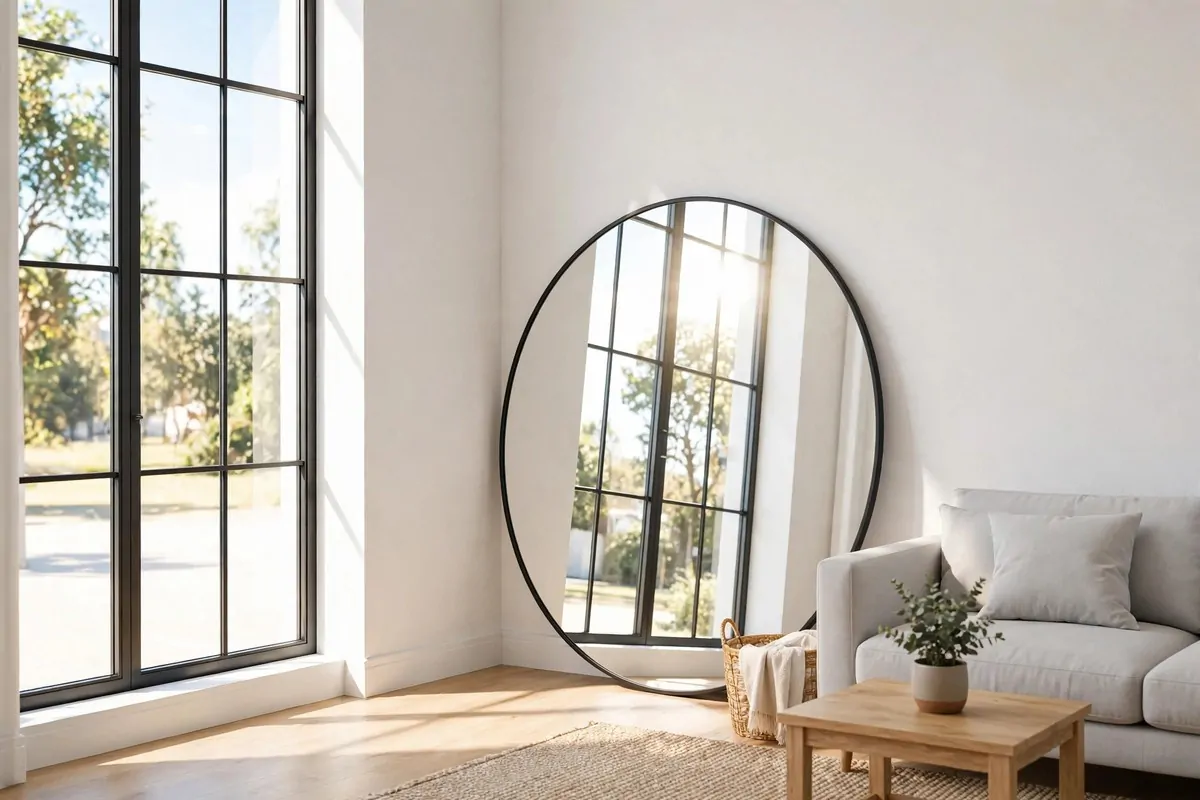
This is the oldest trick in the book and it still works like magic. A big mirror across from a window doubles the light in your room. It is almost like getting a second window for free.
Light makes rooms feel bigger. Dark rooms feel small and tight. So when the mirror bounces daylight around, your brain reads the room as larger. You did not add space. You added the feeling of space.
Size matters here. One big mirror beats five tiny ones. A tall full-length mirror leaning on the wall is perfect. It also gives you a place to check your outfit, so it earns its spot twice.
Be careful with what the mirror reflects. Point it at the window, at your plants, at the nice part of the room. Never point it at a cluttered corner. It will just double your mess too.
Mirrored furniture works the same way on a smaller scale. A mirrored side table or tray reflects light without taking up wall space. Just a little sparkle goes a long way.
I once hung a mirror in a hallway that had no windows at all. It bounced light from the far room down the hall. The hallway went from cave to bright in one afternoon. It cost me almost nothing.
Try it this weekend. Lean a big mirror across from your brightest window and watch your room change. You will wonder why you waited so long.
Renters can use this trick too. A leaning mirror needs no holes and no screws. Just lean it safely against the wall where it cannot slide.
Clean the mirror often. Dust dulls the reflection and steals the brightness you wanted. A quick wipe once a week keeps it working hard.
4. Paint the Walls and Ceiling the Same Light Color
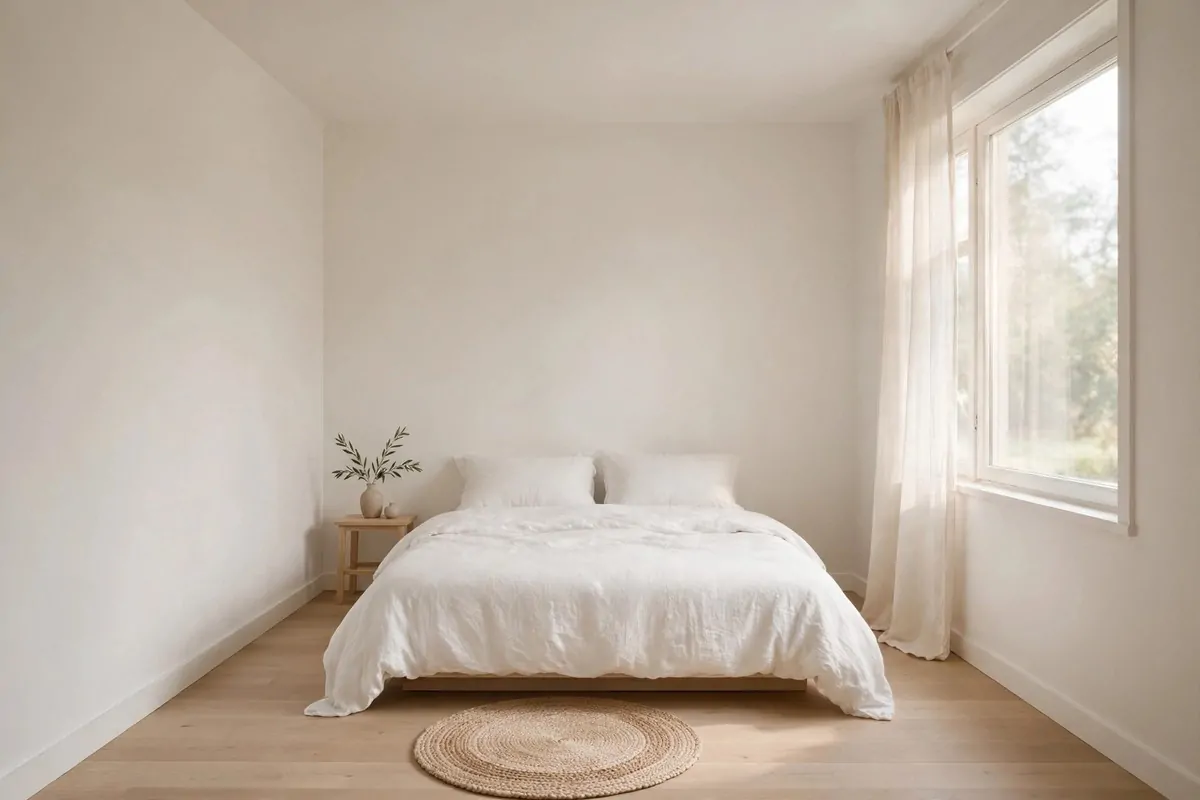
Here is a trick designers use all the time. Paint the walls and the ceiling the same light color. It blurs the line where the wall ends and the ceiling begins.
When your eye cannot find that line, the room feels taller. The edges disappear. The whole space reads as one soft, open cloud instead of a small box.
White is the classic pick, but warm whites and pale creams feel cozier. Soft beige works too. Just keep it light so it reflects as much daylight as possible.
Do not stop at the ceiling. Painting the trim the same color helps even more. The less contrast in the room, the bigger it feels. Everything flows together quietly.
If you rent and cannot paint, this still works in reverse. Keep your big furniture pieces close to your wall color. A white bed against white walls melts away. A dark bed in the same spot looks like a wall.
One bold accent is still fine. A colorful pillow or a piece of art pops even more against a calm background. The key is that the background stays calm.
Paint is cheap and the change is huge. One weekend, one light color, and your small room will feel like it grew a few inches.
Test the color on a small patch first. Paint looks different on the wall than on the card. Live with the swatch for a day before you commit.
If one color feels boring, add texture instead. A woven throw, a wood frame, a plant. Texture adds interest without breaking the calm.
5. Steal the Space Above Your Doors
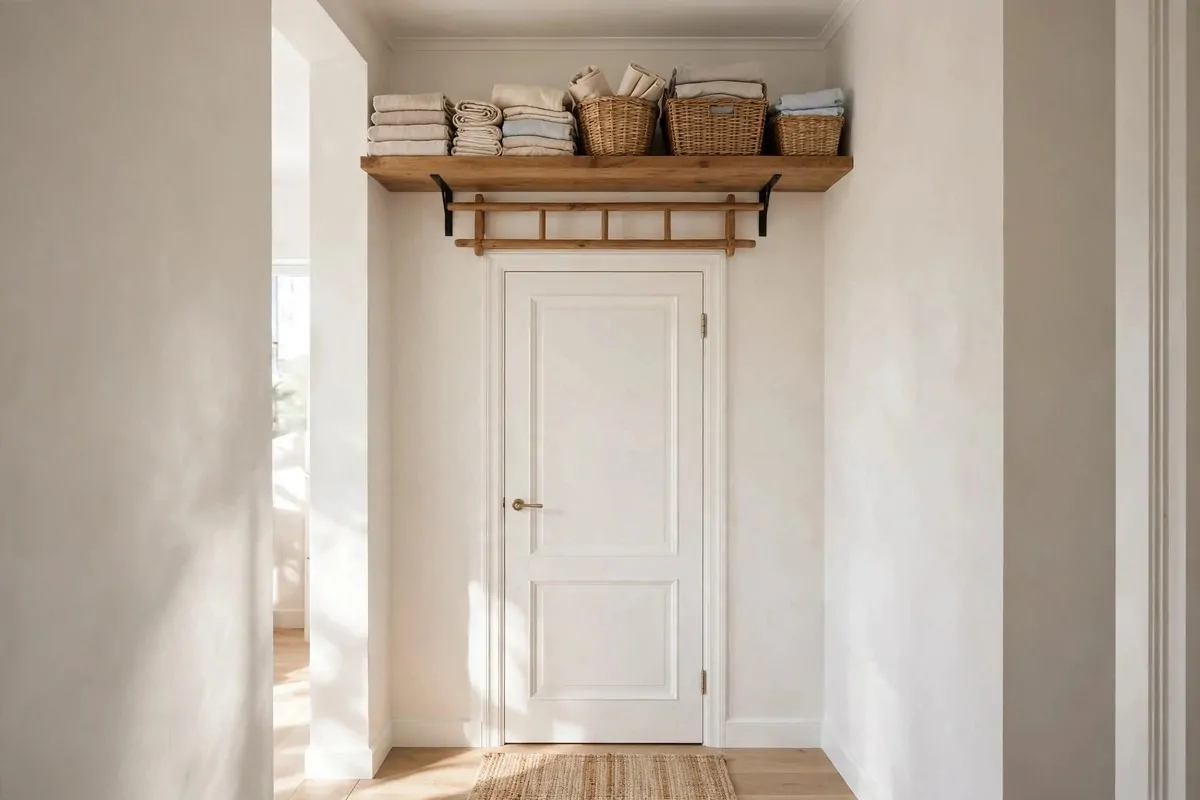
Here is a spot almost everyone ignores. The space above your doors. It just sits there, empty, holding up nothing but air.
That strip of wall is perfect for a shelf. It can hold folded blankets, spare towels, books you rarely open, or pretty boxes. Things you need, but not every day.
The kitchen doorway is a great spot for cookbooks. The bedroom doorway can hold extra bedding. A hallway door can carry baskets of seasonal stuff.
Keep the shelf shallow, about as deep as a book. It should not stick out where you can hit your head. Mount it strong with proper anchors. You do not want it coming down.
What goes up there should be light. Heavy pots and thick photo albums belong lower. Think blankets, linens, paper goods, light boxes.
I have one above my bedroom door for spare pillows. They used to eat half my closet. Now they live up there and I never think about them until a guest comes.
Once you notice this space, you will see it everywhere. Every door is a free shelf waiting to happen.
Use pretty boxes up there. Since guests can see the shelf, matching boxes look tidy. Mismatched clutter up high just looks like a mess.
Check the shelf twice a year. High storage is easy to forget. A quick look keeps it useful instead of turning into a dusty museum.
6. Turn a Dead Corner Into a Reading Nook
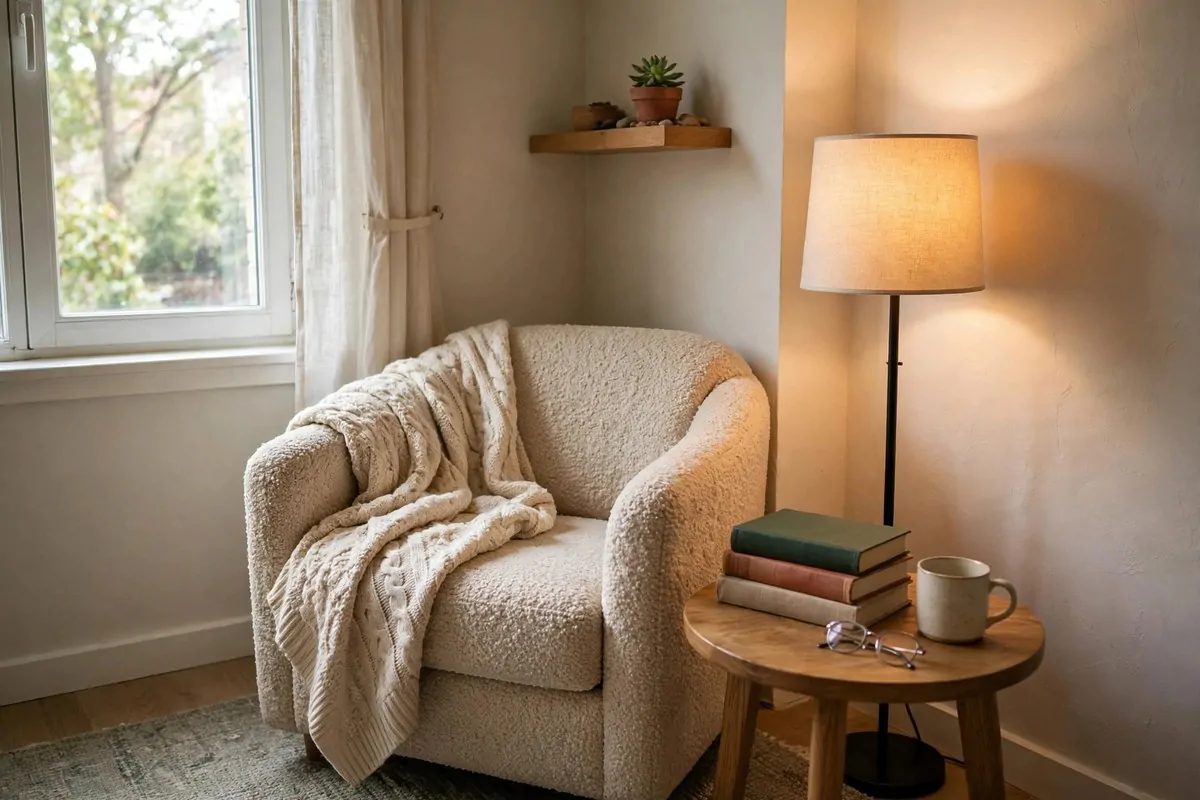
Every home has one. A corner that does nothing. Maybe it holds a plant you keep forgetting to water. Maybe it holds nothing at all.
That corner can become your favorite spot in the house. All it needs is a chair, a small table and a light. That is the whole recipe for a reading nook.
Pick a comfy chair that fits the corner without blocking the walkway. Add a little side table for your tea and your book. A floor lamp or a wall light makes it cozy after dark.
A small rug under the chair marks the nook as its own little zone. It tells your brain this corner is a place, not leftover space. Rugs are quiet magicians like that.
Add one soft thing. A throw blanket, a cushion, something you want to touch. Comfort is what turns a corner into a nook instead of just a chair in a corner.
I read there every evening now. It is my ten-minute reset at the end of the day. The rest of the house can be messy, but that corner is always calm.
You do not need a big window seat or a fancy setup. A dead corner plus three small things equals a brand new room.
Good light is everything in a nook. If there is no window nearby, a warm lamp makes it cozy. Cold light kills the mood, so keep it warm.
Keep a small basket for your current book and a charger. A nook works best when everything you need is within arm's reach.
7. Fold Down a Desk When You Need It, Hide It When You Don't
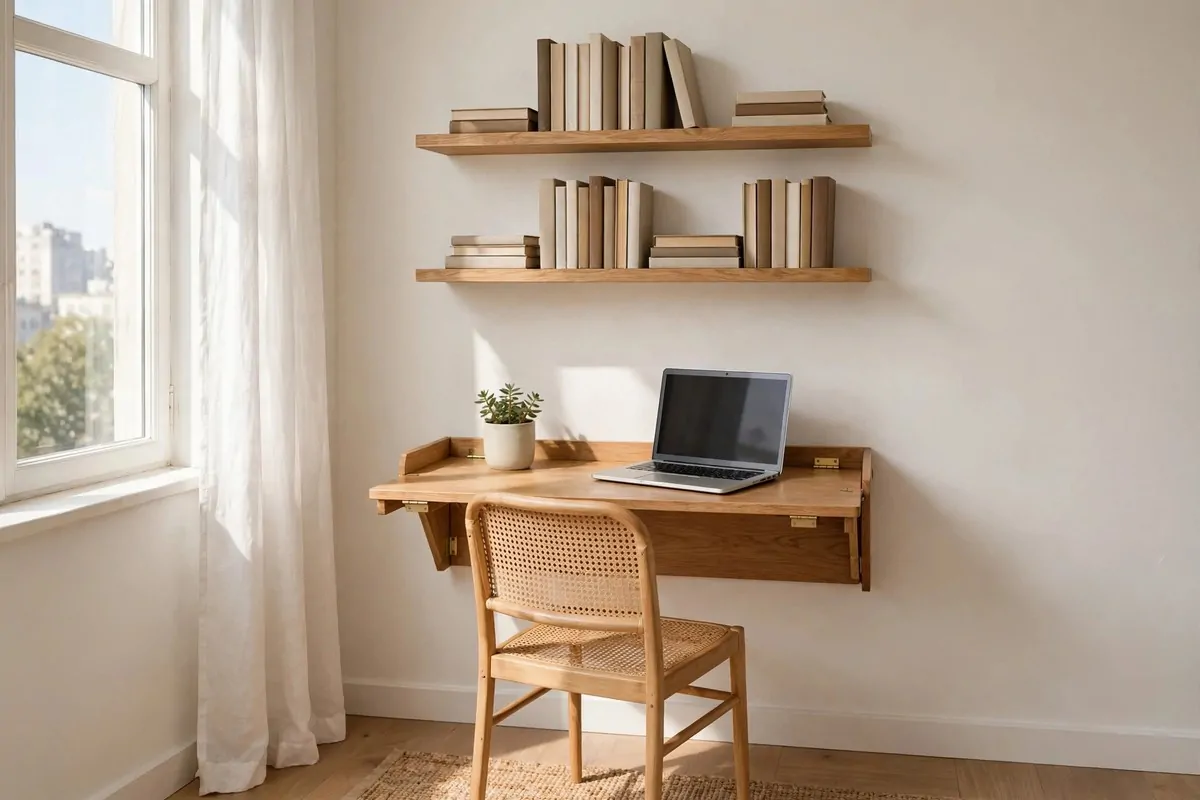
Working from home in a small space is hard. A full desk eats the whole room. No desk means working from the couch, which is not great either.
A wall-mounted fold-down desk solves this perfectly. You pull it down when you work. You fold it flat when you are done. The room goes back to normal in seconds.
Mount it at a height that works for you sitting or standing. Add two small shelves above it for your notebooks and pens. Everything lives on the wall, not on the floor.
The best part is the clean look. When the desk is folded up, it just looks like a slim cabinet on the wall. Guests would never guess it is an office.
Make sure it is mounted into a stud or with strong wall anchors. A desk full of laptop and books is heavy. Do this part right and it will last for years.
I folded mine up during a dinner party once and nobody believed me when I told them it was a desk. That is how clean it looks. Out of sight, out of mind, out of the way.
If your home is also your office, this one idea might change everything for you.
Choose a spot near an outlet. Laptops need power, and a cord stretching across the room ruins the clean look. Plan the outlet first.
Add a chair that tucks in fully. When the desk folds up, the chair should disappear too. A folding chair on a wall hook completes the trick.
8. Hang Your Pots and Pans on a Ceiling Rack
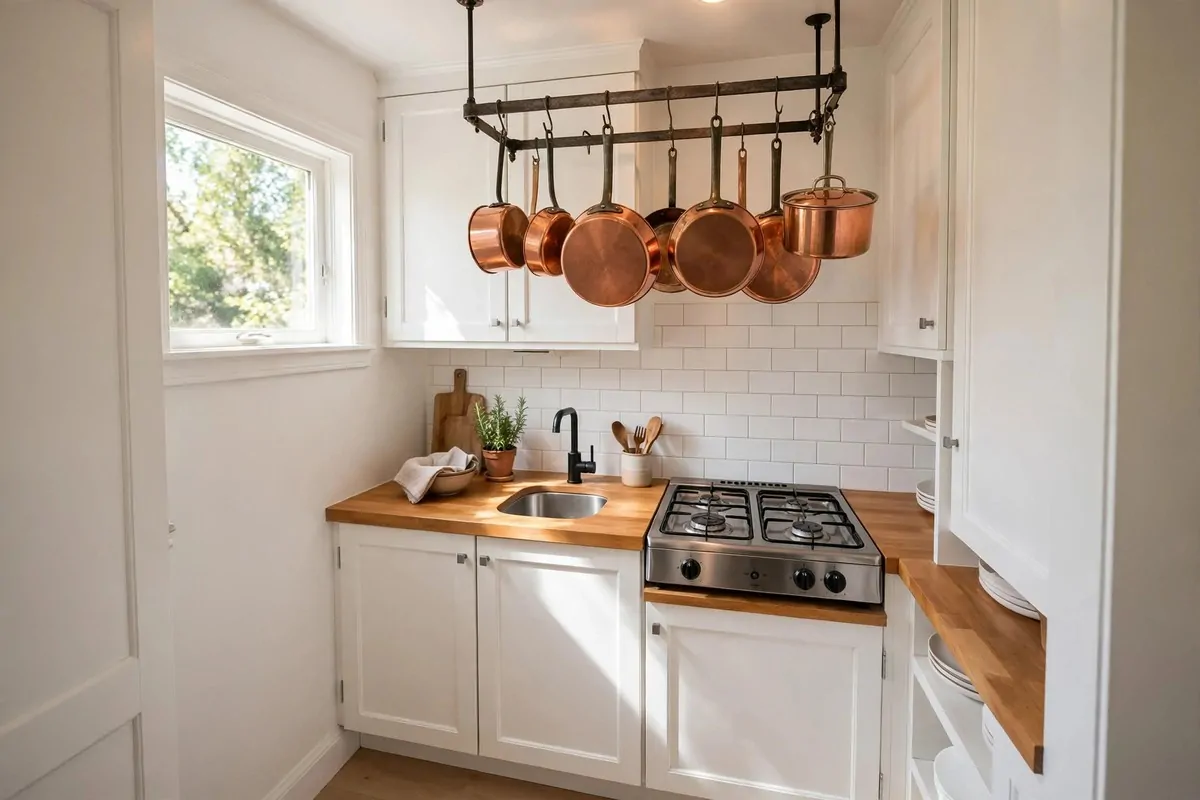
Small kitchens always run out of cabinet space first. Pots and pans are the worst offenders. They are big, round and they never stack nicely.
A hanging pot rack frees up an entire cabinet or two. Your pans move up to the ceiling where they are easy to grab. Your cabinets get room for everything else.
It looks good too. Copper and steel pans catch the light and add warmth to the kitchen. It feels like a real chef's kitchen, even a tiny one.
Mount the rack over the stove or an island if you have one. Keep it high enough that you will not bump your head. Tall friends will thank you.
Only hang the pans you use every week. The special ones can stay in a cabinet. If you have to stretch and climb for a pan you use daily, you picked the wrong pans.
A simple bar with S-hooks works if a full rack feels like too much. Start small and add more hooks as you go. Your kitchen will thank you either way.
Free the cabinets, hang the pans. It is one of the simplest small home ideas that makes a real daily difference.
Group pans by size on the rack. Big ones in the middle, small ones on the ends. It looks better and keeps the weight balanced.
Wipe the pans before hanging. Greasy pans collect dust fast up there. A quick wipe keeps them shiny and ready to use.
9. Put Every Inch Under the Bed to Work
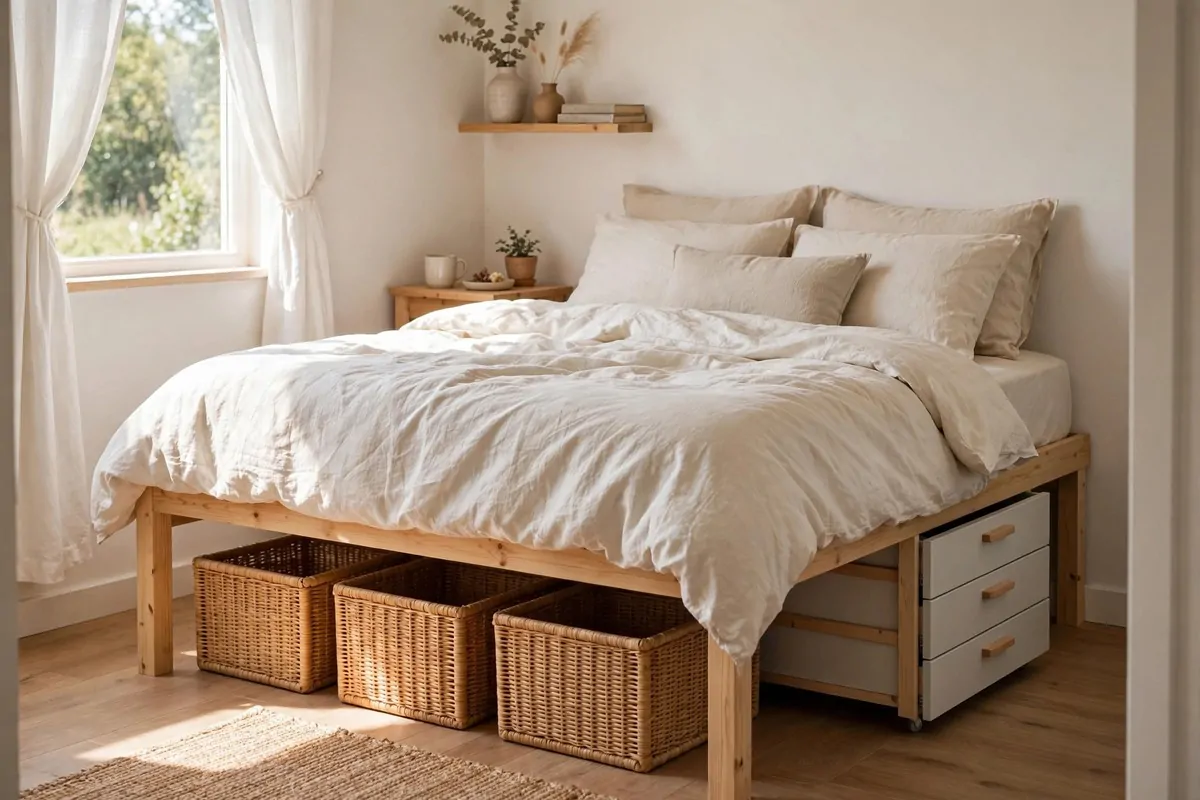
The space under your bed is huge. Most people fill it with dust and one lost sock. What a waste of a perfectly good closet.
Under-bed drawers turn that dead zone into real storage. Out-of-season clothes, spare sheets, gift wrap, all of it fits under there. You just need the right boxes.
Wheeled boxes are the easiest to use. You pull them out like drawers and push them back. No lifting, no crawling on the floor.
Good things to store under the bed:
- Off-season clothes in sealed bags
- Extra bedding and guest pillows
- Gift bags, wrapping paper and tape
- Shoes you only wear sometimes
- Photo albums and keepsakes
Keep the boxes flat and low so they slide easily. Measure your bed height before you buy anything. There is nothing sadder than a box that almost fits.
Vacuum bags make soft things even smaller. Winter coats shrink down flat and slide right under. It feels like cheating, but it works.
Lift the bed a little if you can. A few extra inches of height doubles what fits underneath. Bed risers cost almost nothing and change everything.
Your bed is the biggest piece of furniture you own. Make it work as hard as it is big.
10. Turn the Staircase Into Secret Storage
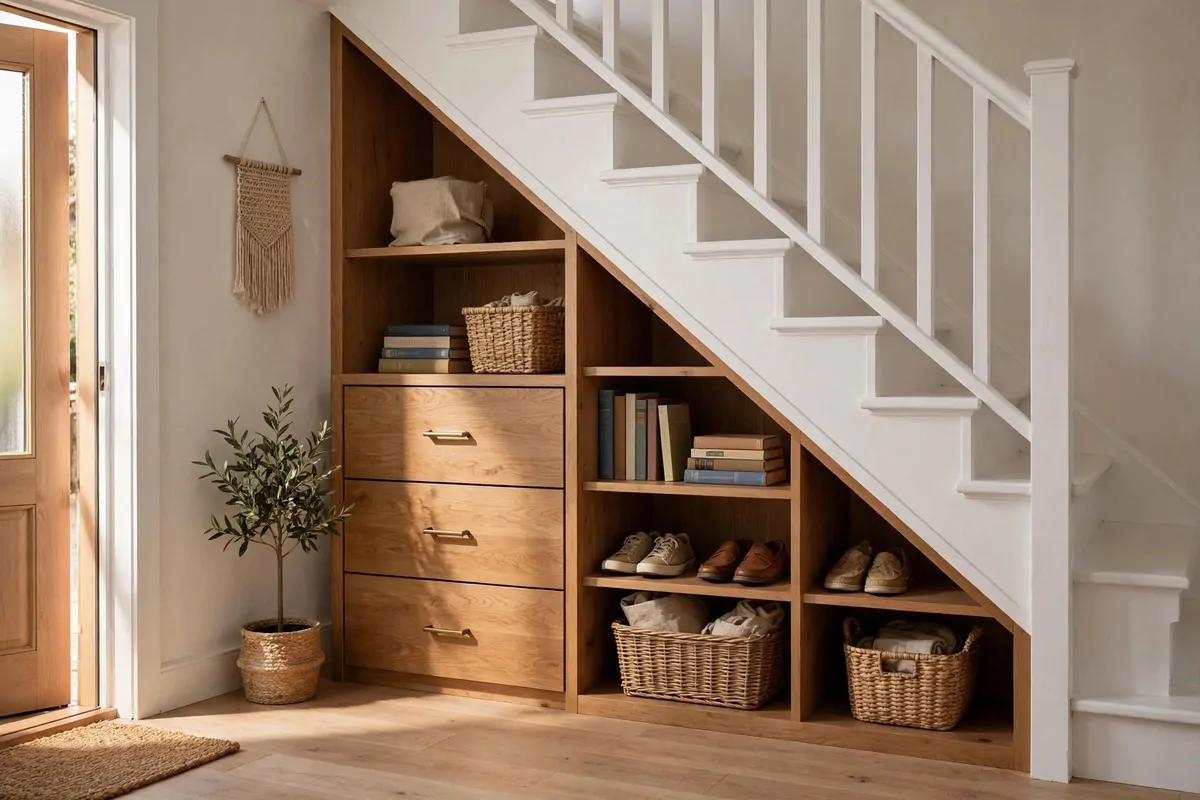
If your home has stairs, you are sitting on a gold mine. The space under a staircase is often just closed off and forgotten. That is a whole closet going to waste.
Pull-out drawers under the stairs are the dream version. Each step hides a deep drawer. Shoes, tools, cleaning supplies, all of it disappears inside.
A simpler version works too. Open the space and add shelves. Books, baskets and bins fit perfectly under the slope. It looks built-in and beautiful.
Some people put a small desk under the stairs. Others make a pet nook or a reading spot for kids. The shape is odd, which makes it fun to get creative with.
The key is lighting. Under-stair spaces are dark. Add a small light or leave the shelves open so daylight reaches in. Dark storage gets forgotten.
Start by just opening it up and seeing what fits. You might be surprised how much of your clutter has been waiting for this exact spot.
Stairs do not have to be just stairs. In a small home, they can be a dresser, a pantry and a bookshelf too.
Measure the slope before you build. Under-stair space is angled, so standard shelves may not fit. Adjustable shelves handle the odd shape best.
Put the everyday things at the tall end. The deep low end is for the rarely used stuff. You will thank yourself every time you reach in.
11. Divide Open Space With Rugs, Not Walls
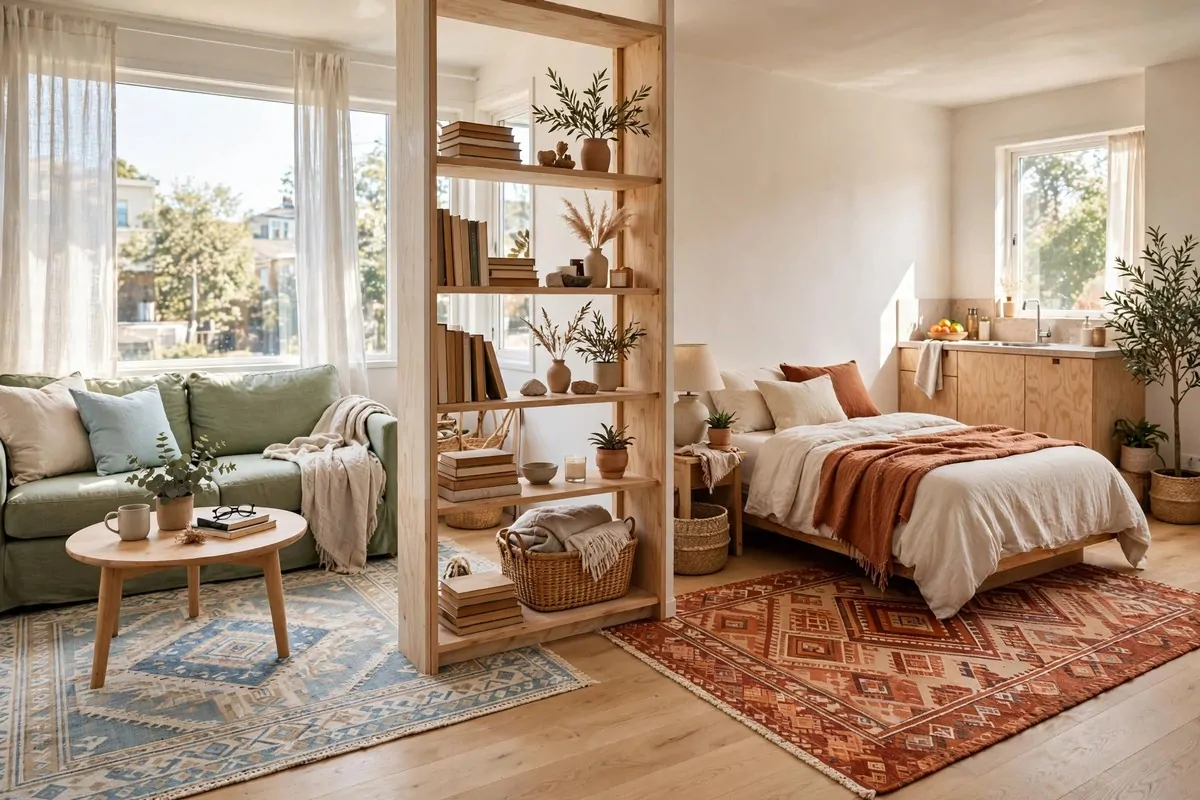
Open-plan small homes can feel messy fast. Everything blends into one big room with no clear purpose. It is hard to relax when your bed is also your office view.
Rugs fix this without a single wall. One rug under the sofa says this is the living room. Another rug under the bed says this is the bedroom. Your brain gets the message.
This is one of my favorite small home ideas because it costs so little. A rug changes the whole feeling of a zone. It anchors the furniture and quiets the floor.
Pick rugs that are different but friendly together. They should look like they belong in the same home. Same color family, different patterns, that kind of thing.
Size matters more than you think. The rug should be big enough for the front legs of your furniture to sit on it. A tiny rug floating alone looks lost and makes the room feel smaller.
A low open bookshelf can back up the rug trick. It divides the space a little while still letting light through. You get zones without losing the open feeling.
Walls are not the only way to make rooms. Sometimes a rug does the job better, and you can roll it up and change your mind anytime.
Washable rugs are a small-home hero. Spills happen, and a rug you can throw in the wash stays fresh for years. Check the label before you buy.
Use rug tape on hard floors. A sliding rug is annoying and unsafe. A few strips of tape keep your zones exactly where you put them.
12. Choose Furniture You Can Almost See Through
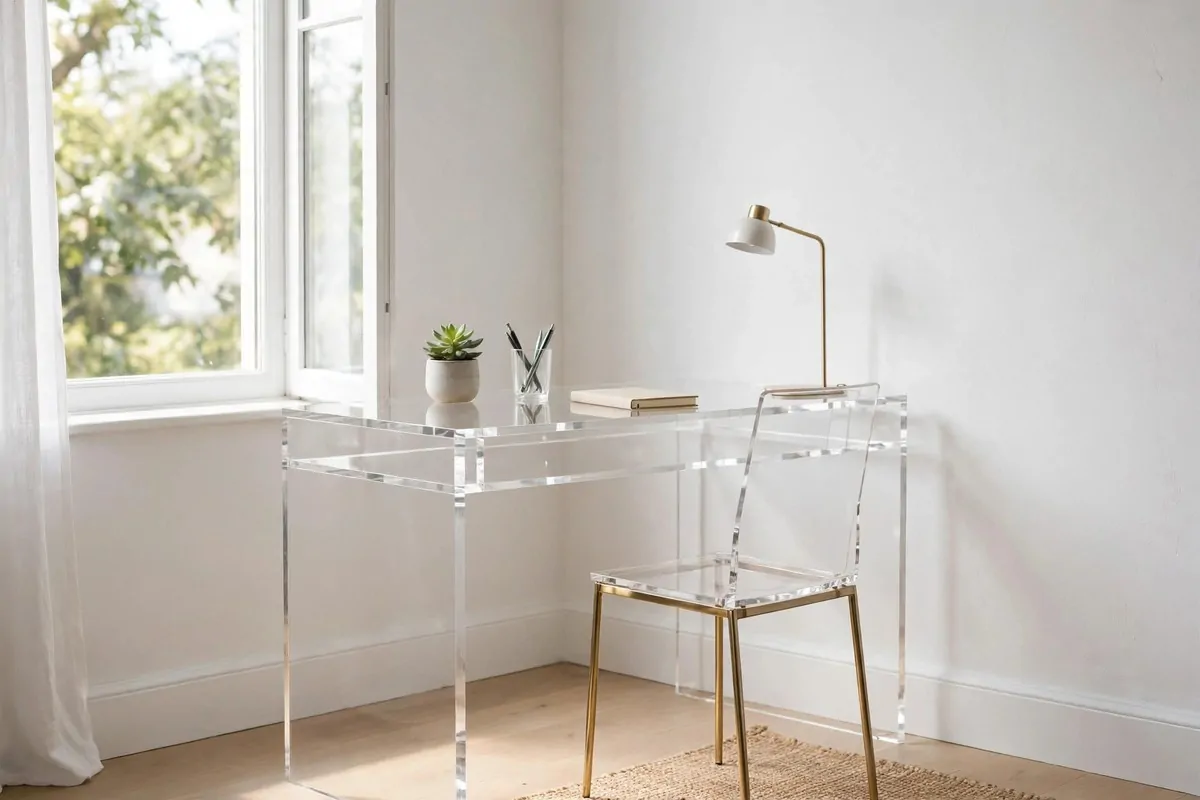
Heavy dark furniture eats a small room alive. A big chunky desk can make a tiny room feel like a closet. The eye stops at every solid surface.
Clear and leggy furniture fixes this. An acrylic desk is almost invisible. Your eye travels right through it to the wall behind. The room feels bigger because it looks bigger.
Glass coffee tables work the same way. So do chairs with thin legs and open backs. Anything that lets light and sight pass through keeps the room feeling airy.
Exposed legs are a small detail with a big effect. A sofa on legs shows floor underneath. A dresser on legs shows floor underneath. All that visible floor adds up to a bigger feeling room.
This does not mean everything must be glass. Mix one or two see-through pieces with your normal furniture. Too much clear stuff looks like an office.
The rule is simple. The more of the room you can see, the bigger the room feels. Let your eyes travel and your home will feel twice its size.
Small rooms love light furniture. Give your eyes room to roam.
Acrylic scratches, so treat it gently. Use a soft cloth for cleaning and skip harsh sprays. A little care keeps it crystal clear for years.
Balance clear pieces with soft ones. A glass table plus a soft rug plus a cozy throw looks warm, not cold. Clear and cozy can mix.
13. Float Your TV Cabinet and Keep the Floor Clear
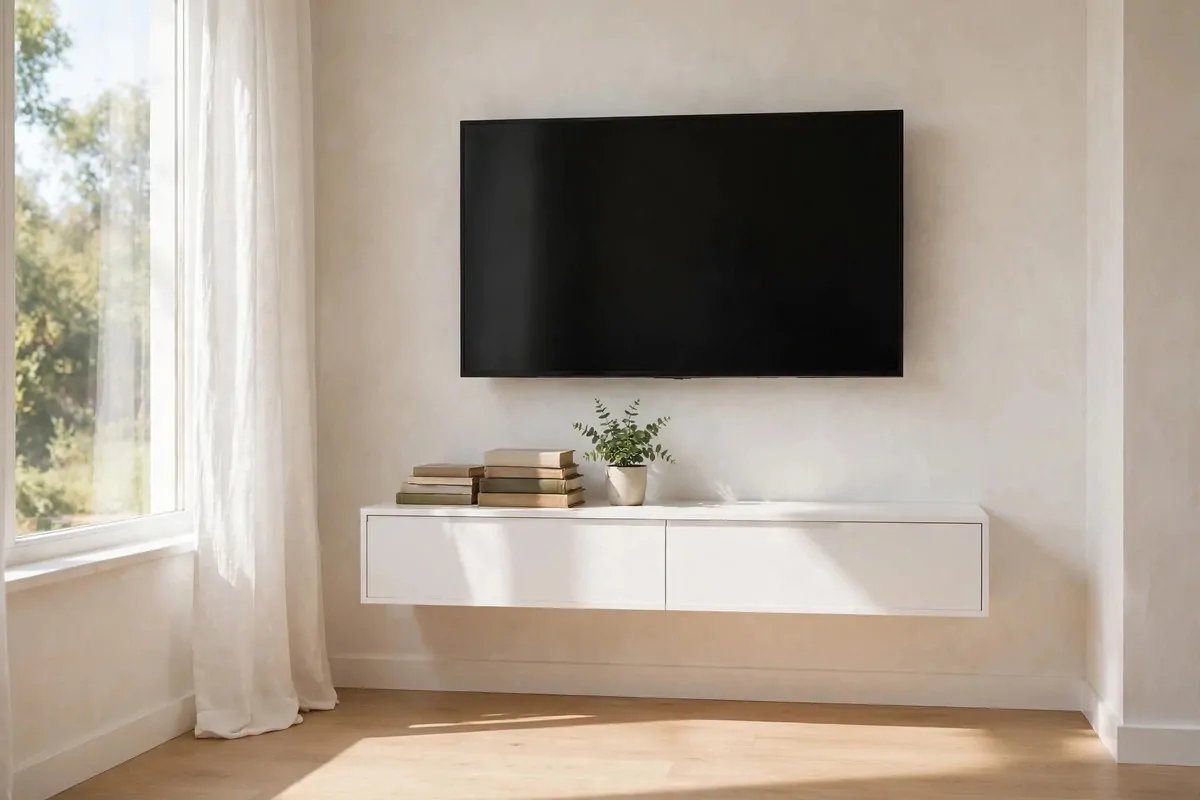
A regular media cabinet sits on the floor and blocks the view of the floor. A floating cabinet hangs on the wall and lets the floor show underneath. That one change makes the whole wall feel lighter.
The space below the cabinet is not wasted. It makes cleaning easy. It makes the room feel airy. Your feet and your vacuum will both be happy.
The top of the cabinet still works hard. It holds your TV boxes, your remotes, a few books. Add doors and the clutter disappears completely.
Wall-mount the TV above it if you can. Then the cabinet top is free for decor or a small bar setup. The whole wall becomes one clean line instead of a pile of furniture.
This works in bedrooms too. A floating shelf under a wall-mounted TV gives you storage without a single piece of floor furniture. Tiny bedrooms love this trick.
Make sure it is mounted strong. Use a stud or the right anchors for your wall type. A cabinet full of electronics is no joke.
Float it and forget it. The floor you get back is worth the small effort.
Hide the cables for a clean look. A small cable channel painted to match the wall makes wires vanish. Loose cables ruin the floating effect.
Leave a little gap behind the cabinet. Airflow keeps your electronics cool and happy. Give them room to breathe and they will last longer.
14. Mount Your Lights on the Wall and Free Your Tables
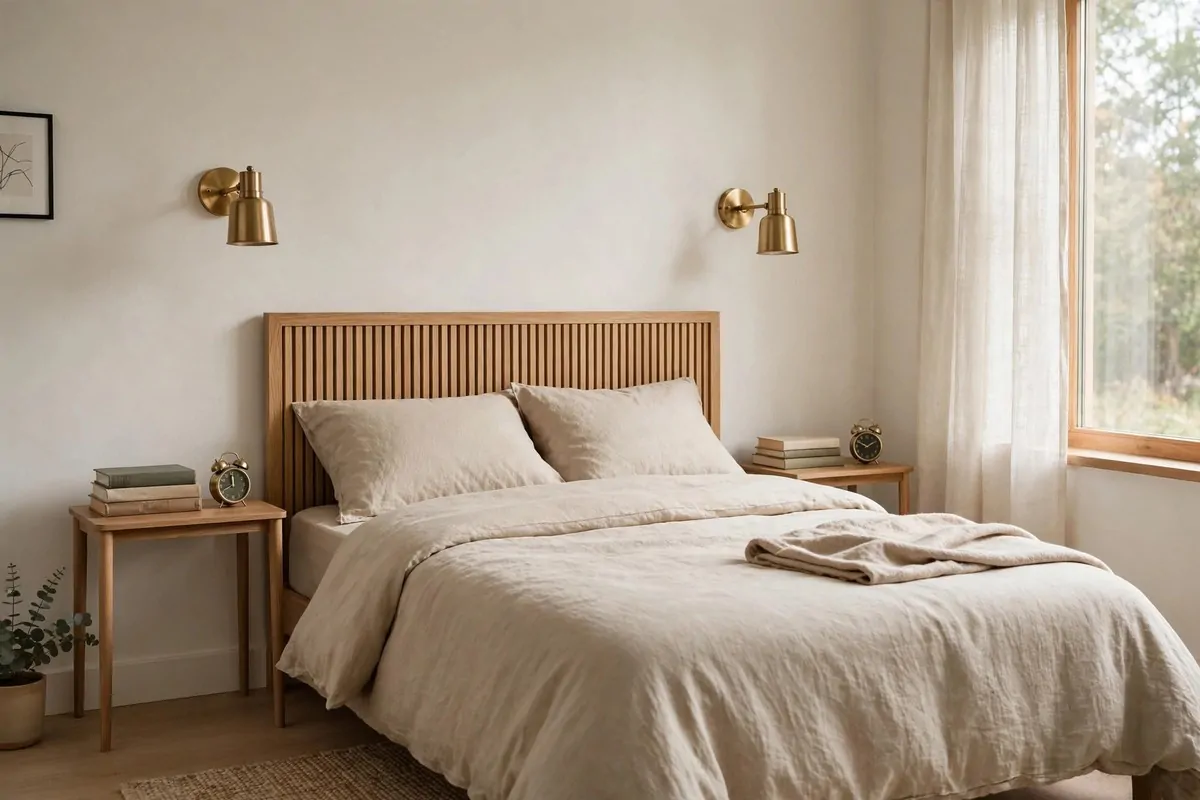
Table lamps are space thieves. They eat a big chunk of your nightstand, your desk and your side table. In a small home, that surface space is precious.
Wall sconces give you the same light with zero table space used. Your nightstand stays free for your book, your phone and your water. Everything has room again.
This works everywhere, not just the bedroom. A swing-arm lamp over your reading chair. A wall light over your desk. Sconces in the hallway instead of a console lamp.
Plug-in sconces are perfect for renters. No electrician needed. You just hang them and plug them in. The cord can run down behind furniture where nobody sees it.
Pick warm bulbs for cozy spots and brighter ones for work areas. Light color changes the mood more than most people realize. Warm light says relax. Cool light says focus.
I swapped two table lamps for wall sconces last year. My nightstands went from crowded to calm overnight. It felt like I had bought new furniture, but I had only moved the light.
Your tables have better things to do than hold lamps. Let the walls do that job.
Put sconces on both sides of the bed for balance. One lonely sconce looks like a mistake. A matching pair looks planned and calm.
Check the bulb brightness before you mount. Too dim and you cannot read. Too bright and it glares. A dimmable bulb gives you both options.
15. Tuck a Tiny Dining Table for Two Into the Corner
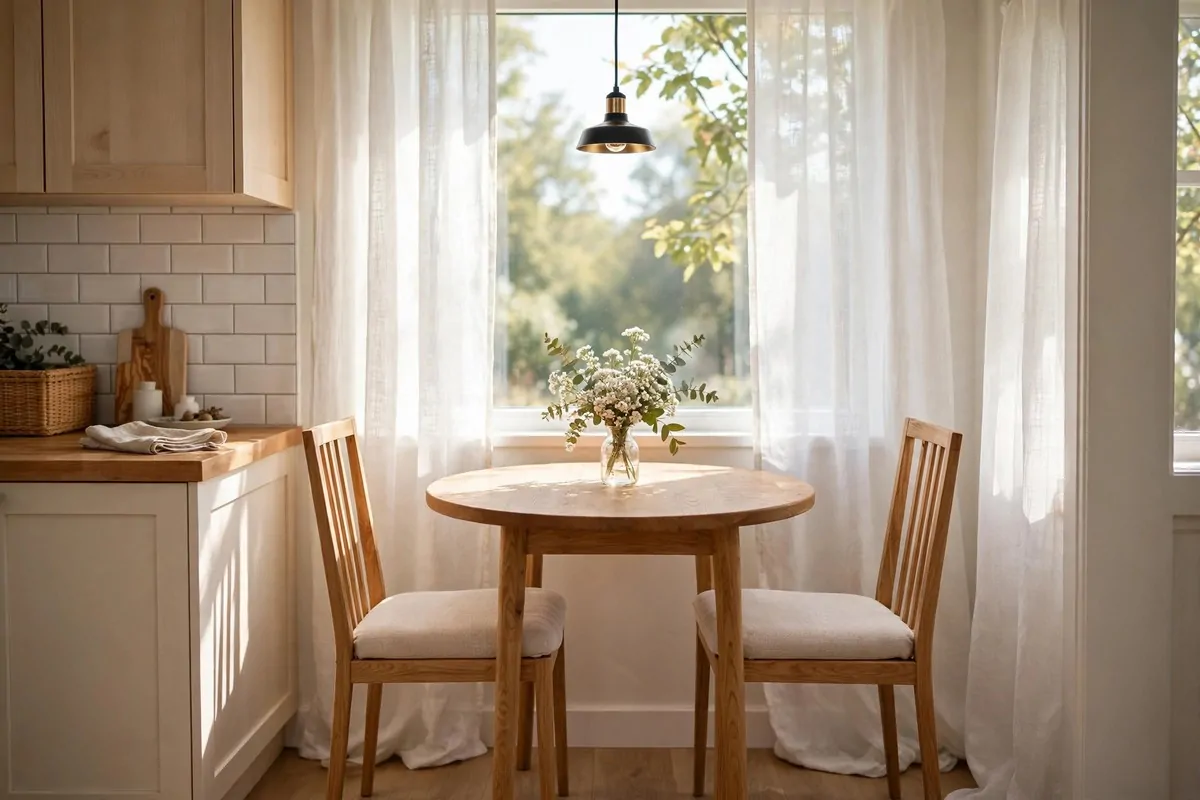
A big dining table for six makes no sense when it is usually just you, or you and one other person. It eats the room and sits empty most days.
A small table for two fits almost anywhere. Tuck it by a window, in a kitchen corner, or at the end of a counter. It takes up barely any room and changes how you live.
Eating at a real table feels different from eating on the couch. It slows you down. It makes a normal Tuesday dinner feel a little special. Your home feels grander for it.
A round table is best for tight spots. No sharp corners to bump into. It also seats two people comfortably without feeling cramped.
This little table can do more than meals. It becomes your work spot, your coffee spot, your puzzle spot. Small tables are the hardest workers in the house.
Add two chairs you actually like sitting in. Comfort matters more than looks here. You will use this table every single day.
You do not need a dining room to have dinner properly. You just need a small table and a good window.
A pendant light above the table makes it official. Even a cheap plug-in pendant says this is the dining spot. Light marks the zone.
Keep the table clear between meals. A table that collects clutter stops being inviting. Clear it daily and it stays your favorite spot.
16. Build an Entryway Out of Almost Nothing
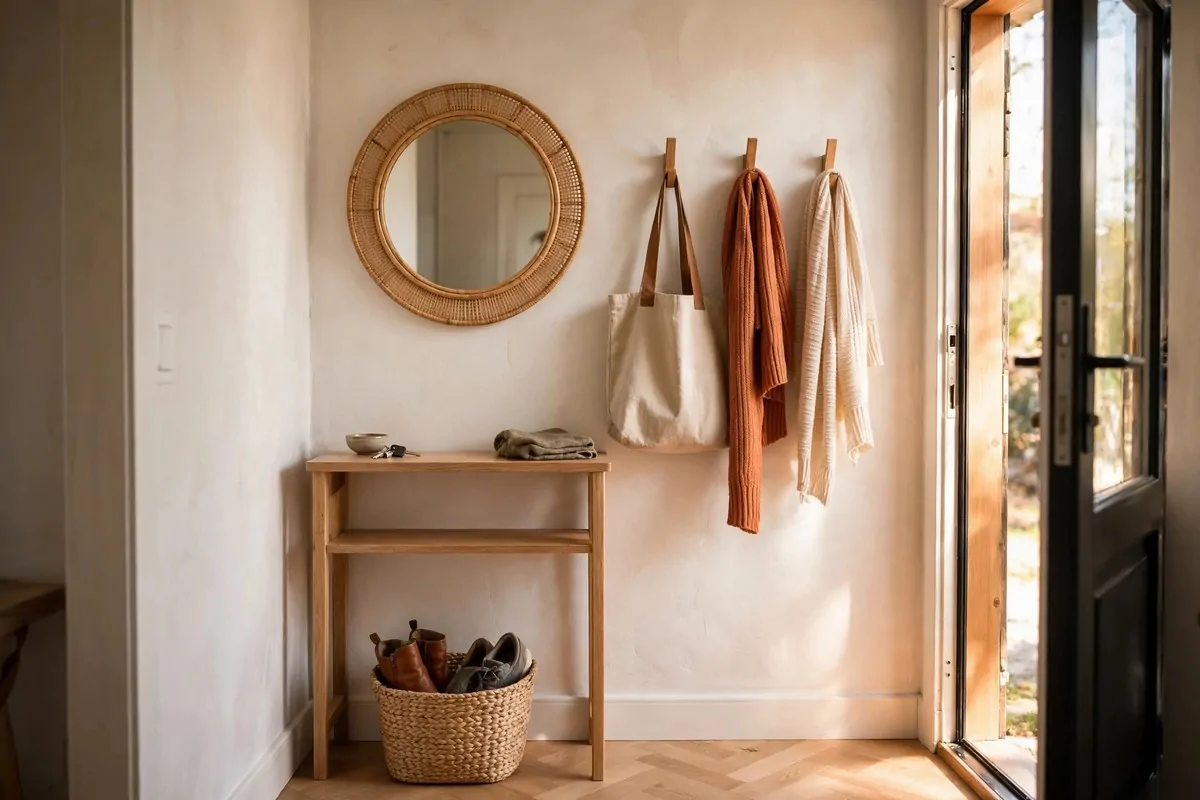
Small homes often have no real entryway. You walk in the front door and you are already in the living room. Keys, shoes and bags pile up with nowhere to go.
You can build an entryway from almost nothing. A slim console table against the wall. A mirror above it. A few hooks for bags and coats. That is a whole entryway in about two feet of space.
The mirror is the secret weapon here. It bounces light and makes the entrance feel bigger. It also lets you check yourself before you walk out the door.
Hooks are better than a coat rack in small spaces. They sit flat on the wall and hold just as much. A row of three hooks handles bags, a coat and keys easily.
A basket under the console catches shoes. A small tray on top catches keys and mail. Everything that used to land on the floor now has a home.
Even renters can do this with no damage. Lean the mirror, use adhesive hooks, pick a freestanding slim table. No holes needed.
An entryway, even a tiny one, changes how your home feels. It says welcome, and it says everything has its place.
Add a small tray for mail on the console. Mail is the number one entryway clutter. A tray catches it before it spreads through the house.
A washable runner rug by the door saves your floors. Shoes bring in dirt, and a rug takes the hit. Shake it out weekly and it lasts for years.
17. Give the Kitchen a Pegboard Wall
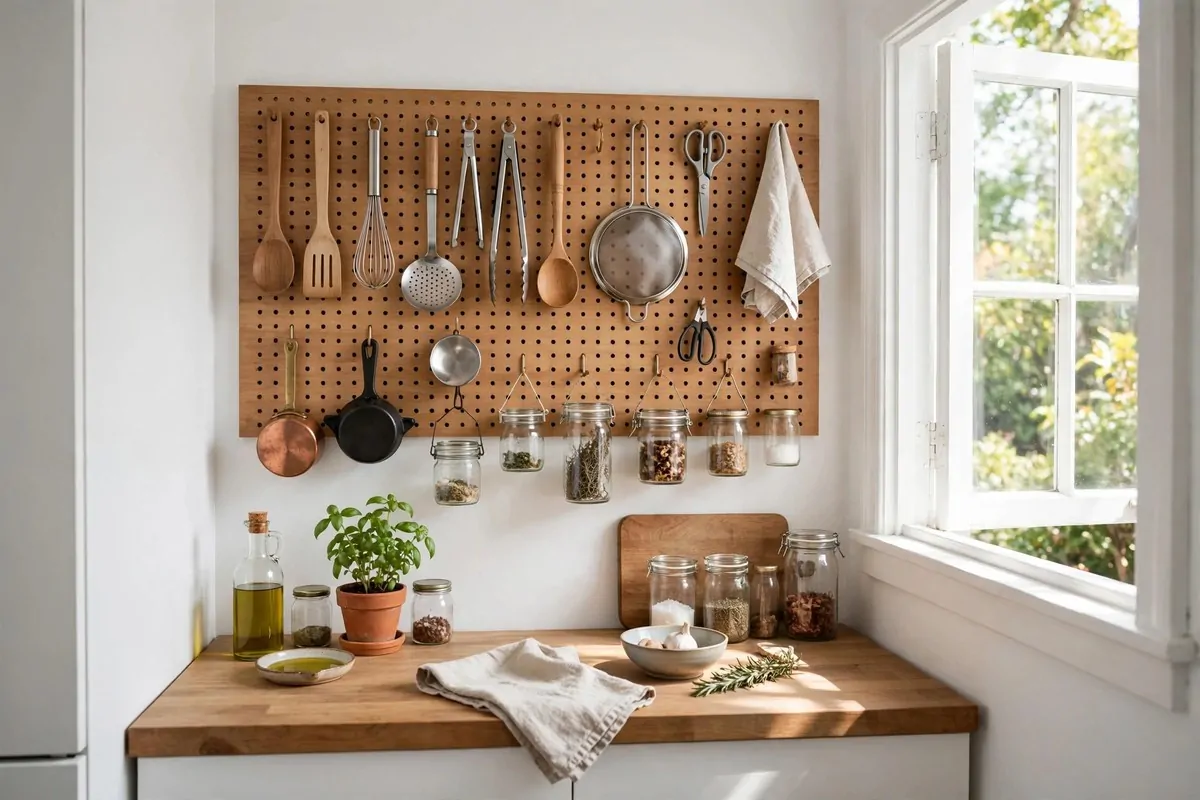
Kitchen drawers in small homes fill up fast. Utensils, tools, gadgets, they all fight for the same small space. And the stuff you need daily ends up buried.
A pegboard wall moves it all up where you can see it. Spoons, whisks, measuring cups, small pots, they hang on hooks in plain sight. You grab what you need and put it back in one move.
The best part is how flexible it is. Move the hooks anytime. Add a small shelf for spices. Hang a basket for onions. The board grows with your cooking.
It looks charming too, if you keep it tidy. Matching hooks and a simple layout make it look like decor, not clutter. Group similar things together and leave some breathing room.
Paint the pegboard to match your kitchen. White on white looks clean and calm. A soft color can turn it into a feature wall. It takes one afternoon and a little paint.
This trick is not just for kitchens. A pegboard works in a craft corner, a home office, or a kids' room. Anywhere small things need a visible home.
Get your tools out of the drawer and onto the wall. Your drawers will breathe again, and so will you.
Keep a step stool nearby for the top hooks. High hooks are useless if you cannot reach them. Put daily tools low and rare ones up high.
Outline your layout with paper first. Tape paper shapes on the wall before you drill. It saves you from a wall full of wrong holes.
18. Stack Your Kitchen Storage All the Way Up
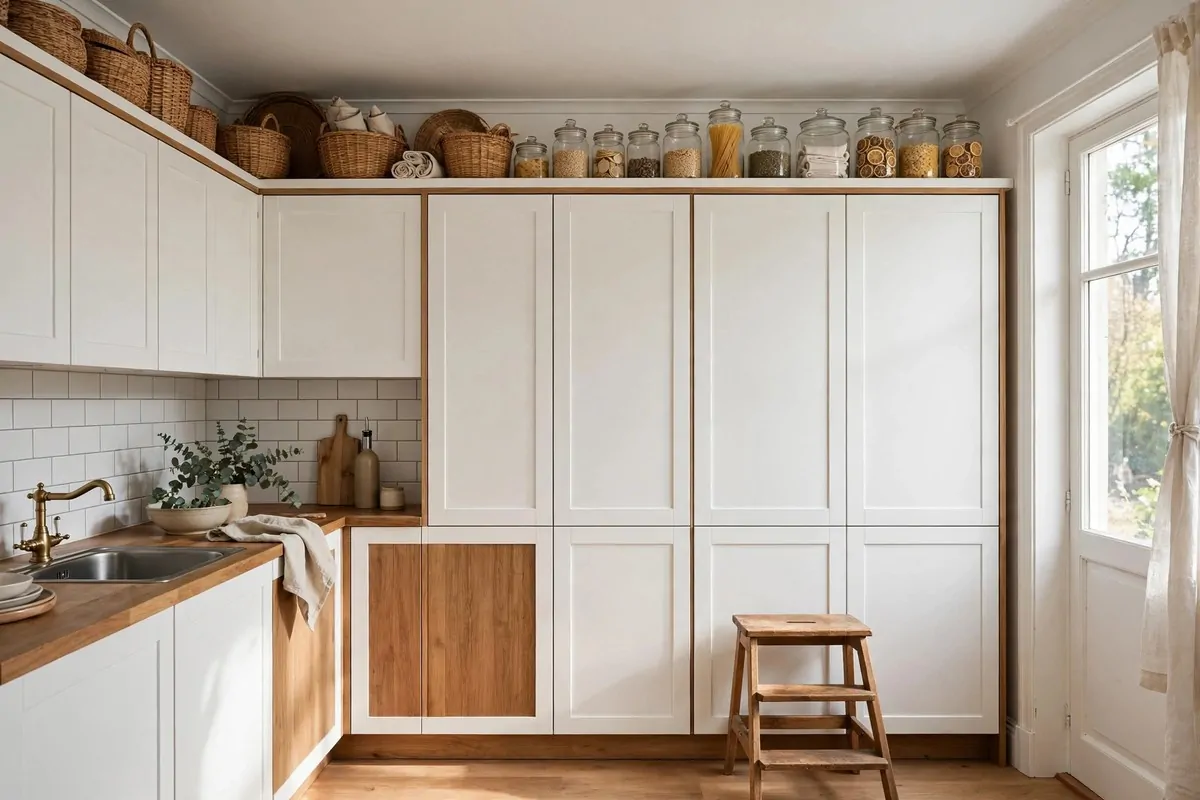
Look at the top of your kitchen cabinets. If there is a dusty gap between the cabinets and the ceiling, that is storage you are not using. And it is collecting dust for free.
Tall cabinets that reach the ceiling fix this. The top shelves hold the things you rarely touch. Holiday dishes, the big stockpot, the blender you use twice a year. They live up high and stay out of your way.
If new cabinets are not in the budget, use the gap you have. Pretty baskets and sealed jars on top of the cabinets look intentional, not messy. Just keep them clean and matching.
A small step stool is the key to all of this. If you cannot reach it easily, you will never use it. Keep a slim folding step stool in the kitchen and high storage becomes real storage.
Label the high boxes so you remember what is up there. A little tag saves you from pulling down five boxes to find the one you want. Future you will be grateful.
Think of your kitchen in layers. Daily things at arm level. Weekly things a little higher. Yearly things at the very top. Everything has a layer, and nothing fights for the same spot.
The ceiling is the most underused shelf in your kitchen. Claim it.
Store the heaviest things at waist height. Lifting heavy pots from high shelves is tiring and risky. Heavy low, light high, always.
Decant dry goods into clear jars. You see what you have, you waste less, and the shelves look beautiful. One look tells you what to buy.
19. Fold It, Stack It, Tuck It Away
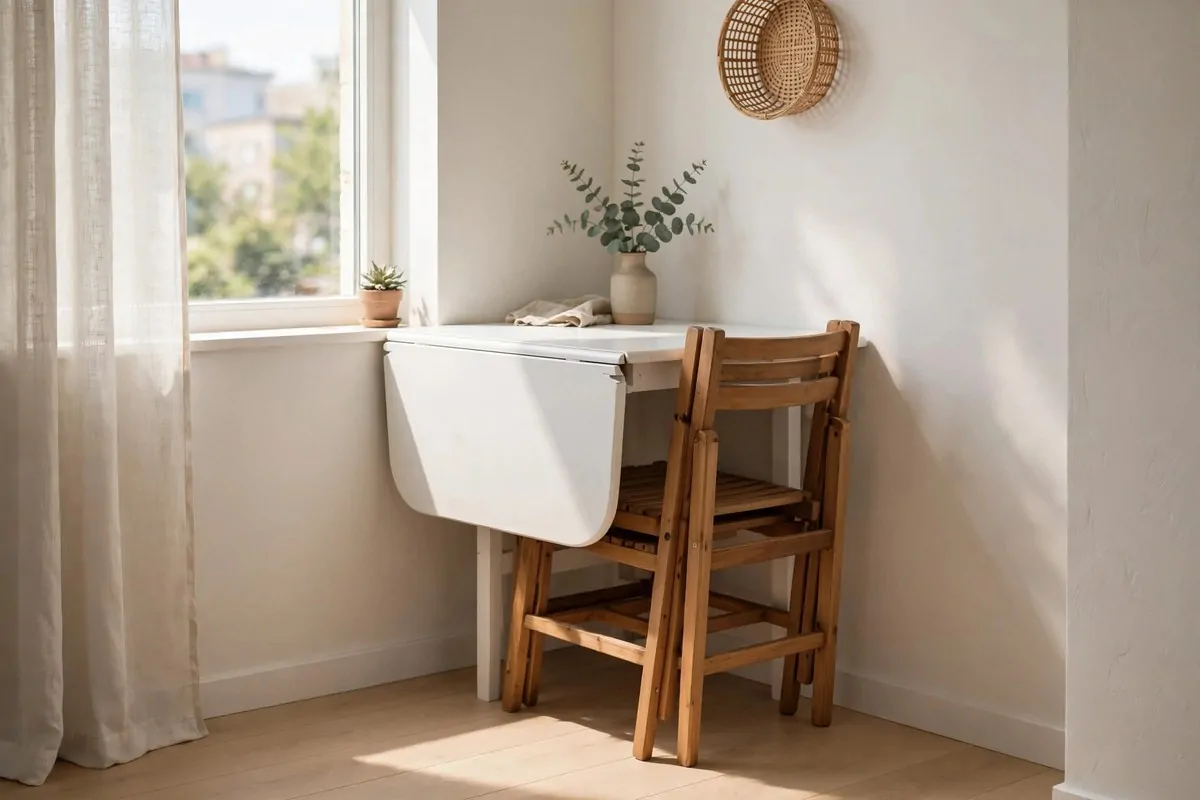
Some furniture only gets used sometimes. Guest chairs, extra tables, the ironing board. They take up room every day for a job they do once a month.
Folding and stackable versions solve this. A drop-leaf table folds flat against the wall when you eat alone. Open it up when friends come over. Same table, two sizes.
Stackable chairs are just as clever. Four chairs stack into the space of one. Pull them out for dinner parties, stack them back after. Your floor stays clear all week.
Good candidates for the fold-away treatment:
- Drop-leaf or gateleg dining tables
- Folding chairs that hang on a wall hook
- Stackable stools that double as side tables
- A folding drying rack instead of a bulky one
- Tray tables that nest together
The rule is simple. If you use it less than weekly, it should fold, stack or hang. Daily-use things earn floor space. Sometimes-things do not.
I keep two folding chairs in my closet. They come out for game nights and holidays. The rest of the time, you would never know they exist.
Empty floor is a luxury in a small home. Foldable furniture gives it back to you.
Store folding chairs where you will actually grab them. A closet near the dining spot beats the garage. If it is hard to reach, you will never use it.
Test the fold before you buy. Some folding furniture is fiddly and annoying. If it does not open and close smoothly in the store, skip it.
20. Keep Open Shelves in One Calm Color
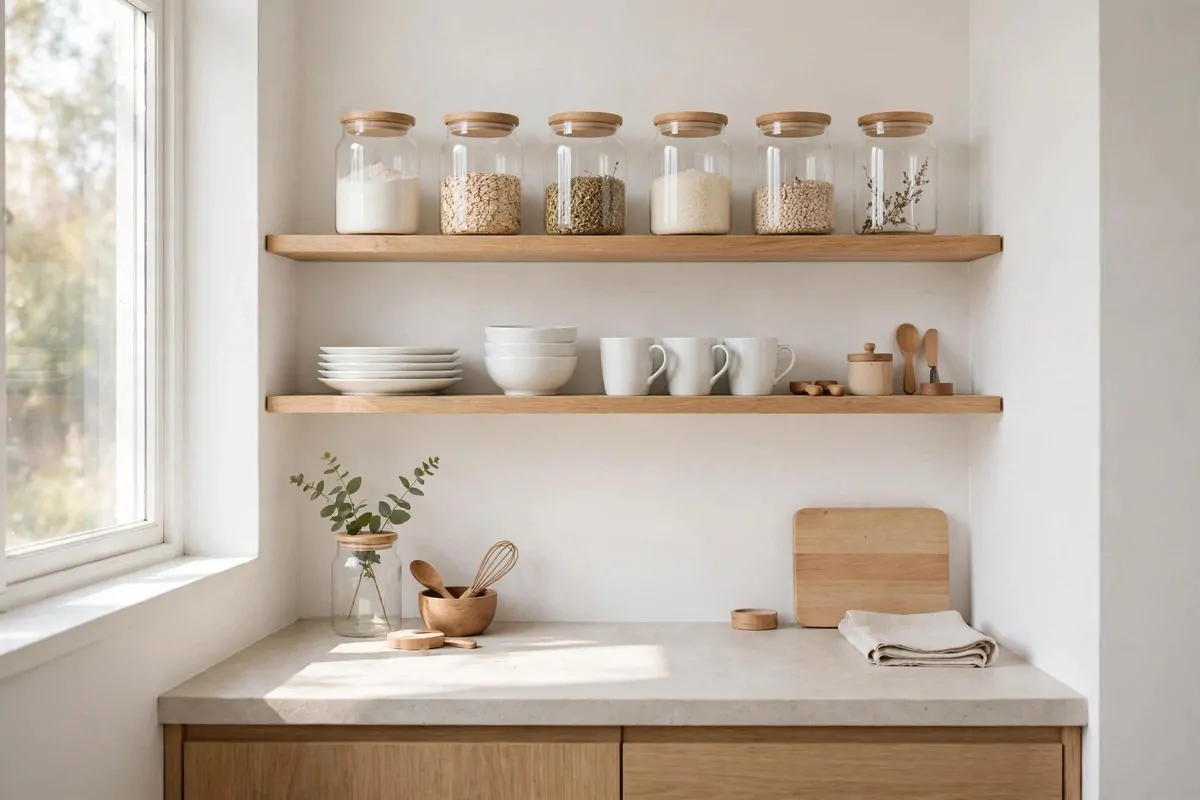
Open shelves are everywhere in small homes. They are cheap, they are easy, and they show everything. That last part is the problem.
When open shelves hold ten different colors and patterns, they look chaotic. Your eye jumps everywhere. The whole room feels busier and smaller.
One calm color scheme fixes it. Stick to white dishes, clear glass and a little wood. Suddenly the same shelves look like a magazine photo. Nothing changed except the color story.
This works for bookshelves too. Group books by color or turn them around. Add a few matching baskets. The shelf goes from messy to styled in minutes.
You do not need to buy all new things. Start with what you have and hide the loud pieces. Put the bright red pot in a cabinet. Keep the calm things on display.
Leave some empty space on each shelf. Crowded shelves feel heavy. A little air between things makes everything look intentional and light.
Open storage is only as calm as what you put on it. Give it one color, some space, and it becomes decor instead of clutter.
Rotate what is on display sometimes. Swapping a few pieces keeps the shelves feeling fresh. It costs nothing and feels like a mini makeover.
Dust open shelves weekly. Open storage collects dust fast, and dusty shelves look messy even when they are tidy. A quick swipe keeps them pretty.
21. Layer Your Lighting Instead of One Harsh Bulb
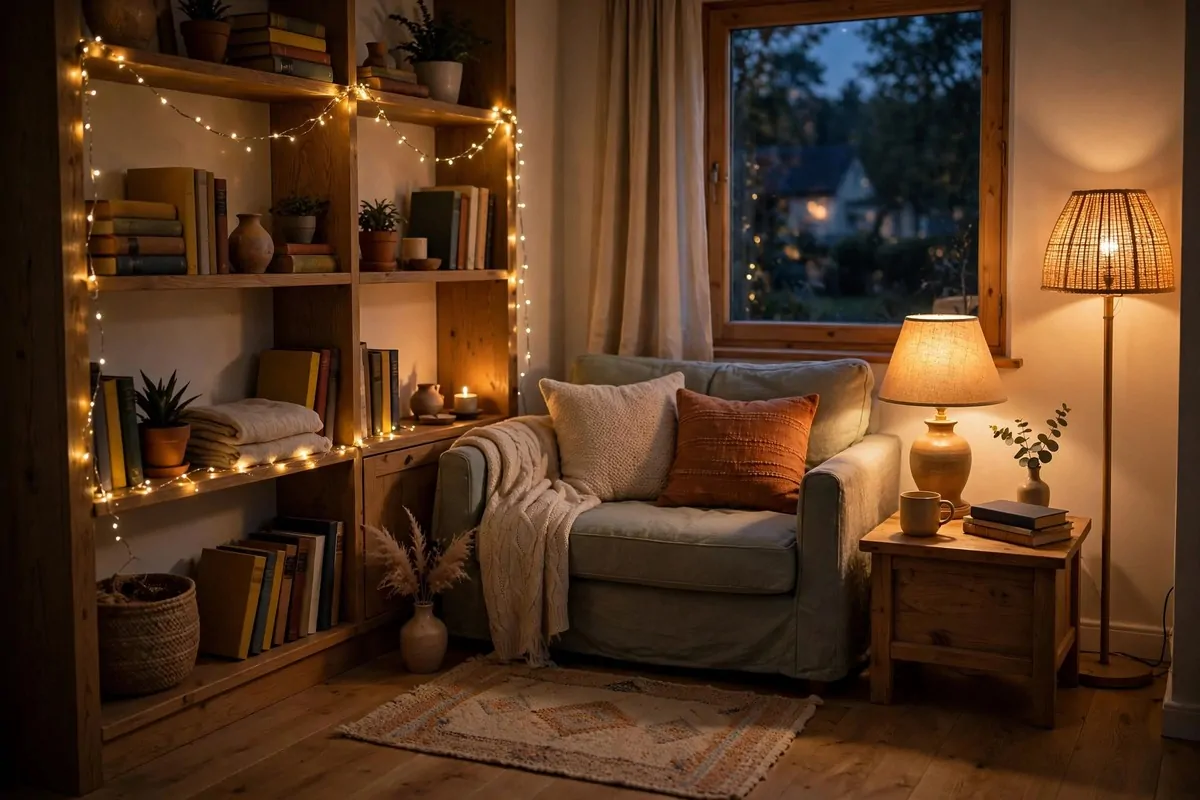
One bright ceiling light makes a small room feel like an interrogation. It flattens everything. It shows every flaw. Nobody looks good under it.
Layered lighting changes everything. A few small warm lights at different heights make the same room feel deep and cozy. The corners glow instead of going dark.
You need three kinds of light working together:
- Ambient light for general glow, like a floor lamp or ceiling light on dim
- Task light for reading and work, like a desk lamp or sconce
- Accent light for mood, like string lights or a small candle-style lamp
String lights are the cheapest way to add a layer. Drape them on a shelf or around a window. They cost almost nothing and make any evening feel special.
Dimmer switches are worth their weight in gold. Even a plug-in dimmer on one lamp lets you set the mood. Bright for cleaning, soft for movie night.
Light also shapes how big a room feels. Dark corners shrink a room. Lit corners expand it. A small lamp in a dark corner is one of the fastest room enlargers I know.
Stop living under one harsh bulb. Add layers and watch your small home turn warm and deep.
| Light layer | What it does | Easy example |
|---|---|---|
| Ambient | General brightness | Floor lamp with warm bulb |
| Task | Focused light for activities | Desk lamp or wall sconce |
| Accent | Mood and depth | String lights on a shelf |
Use timers for your accent lights. String lights on a timer turn on by themselves at dusk. You get the cozy glow with zero effort.
Match your bulb colors across layers. All warm or all cool, not mixed. Mixed colors look messy and fight each other instead of blending.
22. Make Your Hallway Do a Second Job
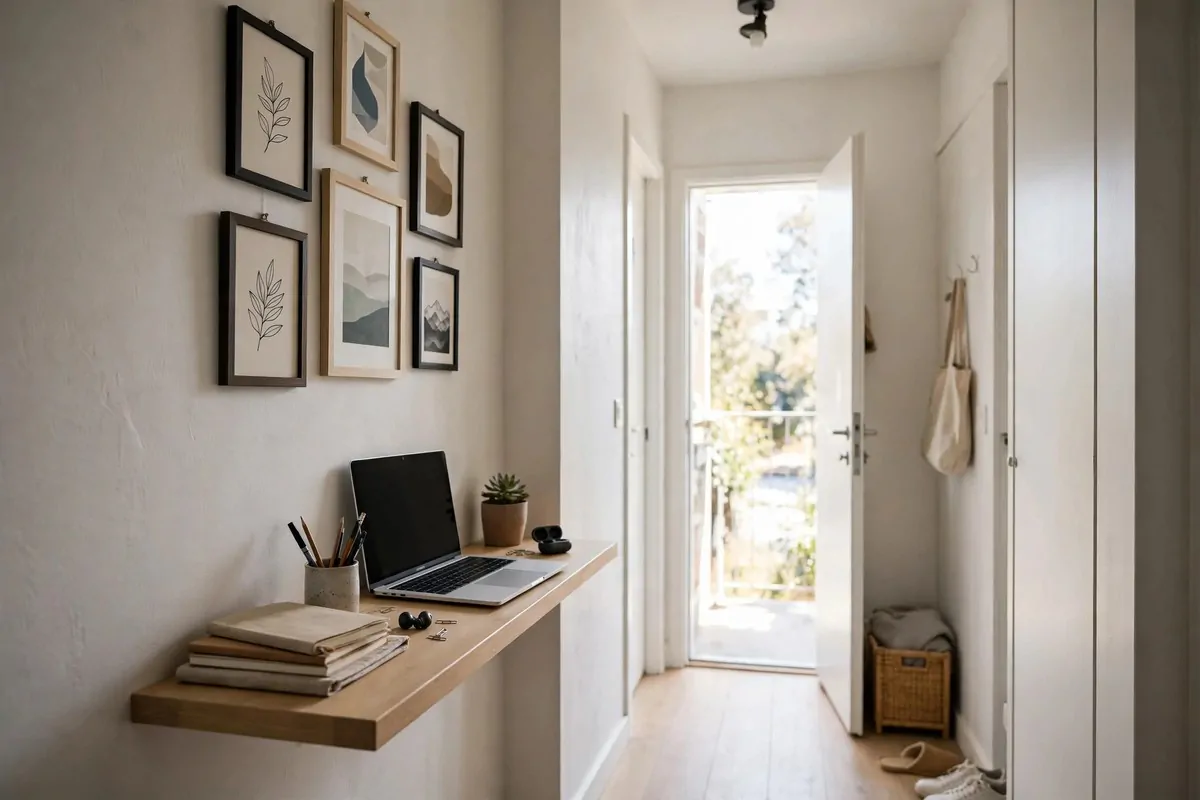
Hallways are the most wasted rooms in the house. We walk through them a dozen times a day and use them for nothing else. That is a lot of square footage doing one job.
A hallway can be so much more. A slim desk shelf turns it into a mini office. A row of hooks and a bench turns it into a mudroom. A gallery wall turns it into art space.
The trick is keeping it slim. Hallway furniture must be narrow enough to walk past easily. Think shelves, not cabinets. Hooks, not wardrobes. Flat, not deep.
A slim console table with baskets underneath gives you storage without blocking the path. A mirror on the wall bounces light down the hall. Both take almost no space.
If your hallway is wide enough for a desk, lucky you. A wall-mounted shelf desk with a stool gives you a full workspace in a spot that was doing nothing. Fold the stool away and the hall is a hall again.
Do not forget the walls above. Hallway walls are perfect for art, photos and shallow shelves. They are long and empty and begging for a job.
Walk through your hallway slowly today. See it as a room, not a tunnel. Then give it a second job.
Keep the walkway clear and wide. A hallway job should never block the path. If you have to squeeze past, the furniture is too deep.
Add a runner rug to make it feel like a room. A long rug softens the tunnel feeling. It says this hallway is a real space, not just a passage.
23. Use the Back of Every Door
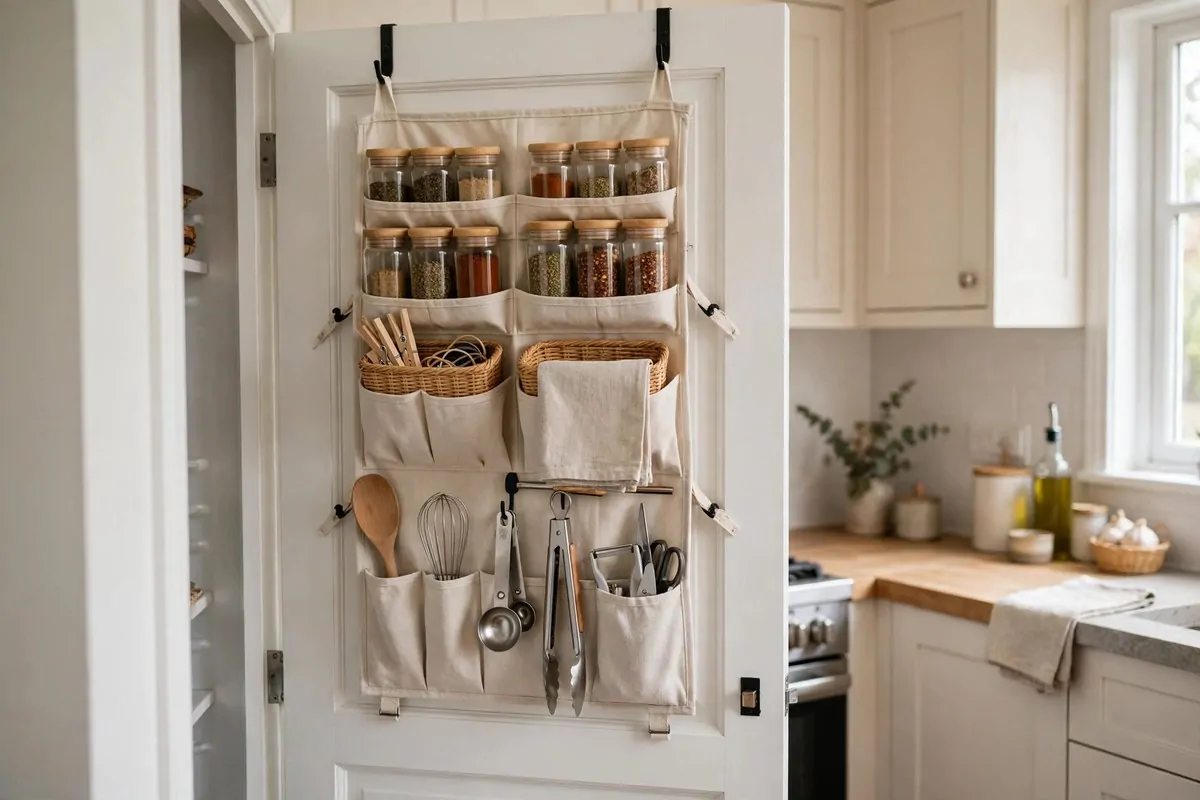
The back of a door is free real estate. It is flat, it is empty, and it is in every single room. Yet most doors hold nothing but a lock.
Over-the-door organizers turn that blank space into storage. Spices on the pantry door. Shoes on the closet door. Cleaning supplies on the laundry door. Each door becomes a slim cabinet.
Hooks are the simplest version. A few strong hooks on the back of the bedroom door hold tomorrow's outfit. Hooks on the bathroom door hold towels and robes. No drilling, no damage.
The key is keeping it flat. Bulky organizers stop the door from closing. Pick slim racks and shallow baskets. If the door still closes easily, you picked right.
Bathroom doors are especially useful. Towels, robes, hair tools, all of it can hang there instead of crowding the counter. Small bathrooms need this trick the most.
Check every door in your home tonight. Bedroom, bathroom, closet, pantry. Each one is a storage wall you already own.
Doors do more than open and close. Put them to work and gain a closet without building one.
Use felt pads where organizers touch the door. They stop scratches and rattling. Your doors will stay pretty even with daily use.
Do not overload one door. A sagging door is worse than no storage. Spread the weight across a few doors instead of piling it on one.
24. Spend on One Statement Piece, Skip the Rest
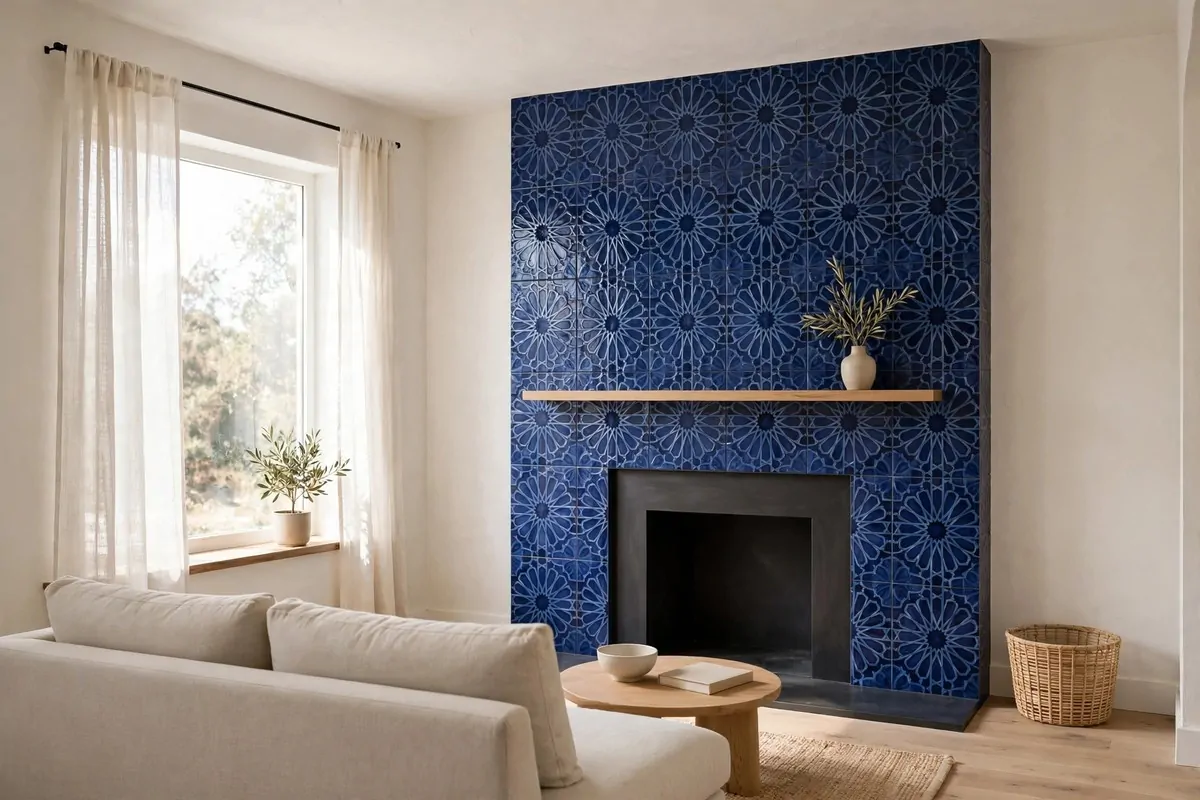
Small decorating budgets get spread too thin. A little money here, a little there, and nothing looks special. The room ends up plain and forgettable.
One statement piece changes that. A bold tile fireplace wall. A beautiful rug. One piece of art you truly love. It gives the room a star and everything else can be simple.
This works because small rooms are seen all at once. You take in the whole space in one glance. One strong focal point gives your eye somewhere to land.
Keep everything else quiet when you do this. Simple furniture, calm colors, clean lines. The statement piece shines because nothing competes with it.
It does not have to cost a fortune. A painted accent wall, a thrifted vintage mirror, a handmade quilt. Statement means character, not price.
I have a friend with a tiny living room and one incredible emerald sofa. The rest of her furniture is plain and simple. Everyone remembers her room. Nobody remembers the plain stuff.
Pick your one star. Let it shine. Skip the rest and your small room will feel designed instead of just filled.
Live with the statement for a week before adding more. Let it settle in and see how it feels. You might need less around it than you thought.
Photograph the room to see it fresh. A photo shows you what visitors see. It helps you spot what works and what is just noise.
25. Edit Your Stuff Like You Mean It
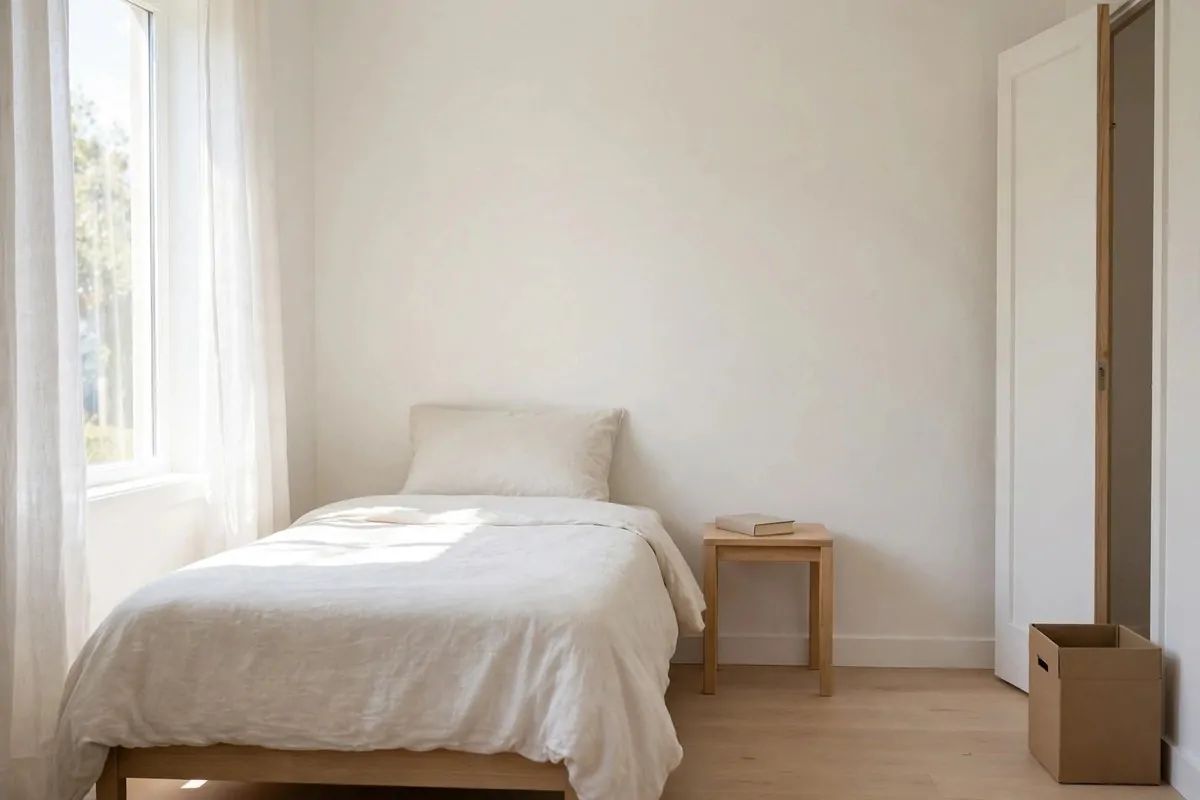
Here is the truth nobody wants to hear. The fastest way to make a small home feel bigger is to own less stuff. No product beats this one.
Clutter shrinks rooms more than anything else. Every extra thing fights for space and attention. A room with twenty things feels smaller than the same room with ten.
Be honest with yourself. When did you last use that bread maker? That stack of magazines? Those jeans that almost fit? If the answer is months ago, it is time.
Try the box test. Put questionable things in a box and date it. If you do not open the box in three months, donate it unopened. You will not miss a single thing.
Small homes force good decisions. Every new thing that comes in should earn its place. Ask where it will live before you buy it. No home, no purchase.
This is not about being perfect. It is about being real. Keep the things you use, display the things you love, and let the rest go find a better home.
Editing is free and it works instantly. Fewer things, more room, calmer mind. That is the best deal in all of home decorating.
Good things to let go of first:
- Duplicates, like three spatulas or five water bottles
- Clothes that do not fit or you never wear
- Old cables, chargers and mystery remotes
- Books you will never read again
- Gifts you kept out of guilt
26. Let Daylight Be Your Best Decoration
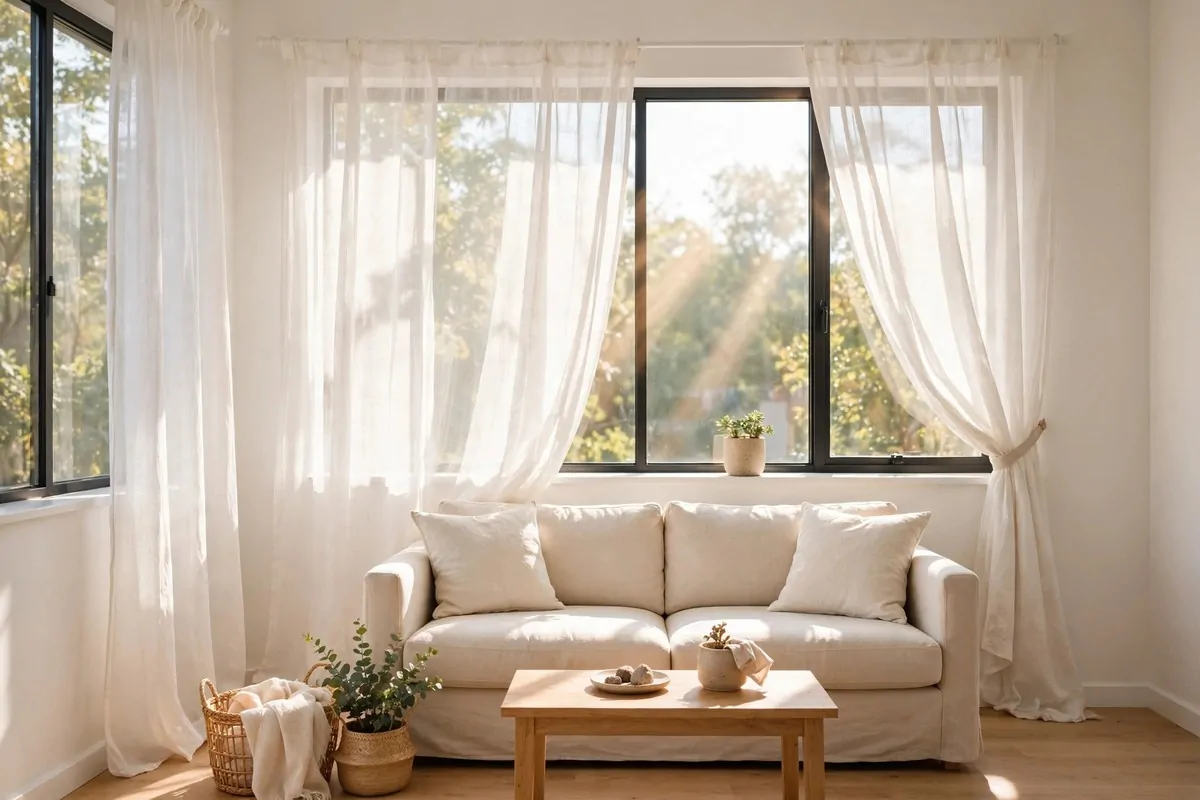
Daylight is free, and it is the best decorator you will ever hire. A bright room feels bigger, happier and more alive. A dark room feels small no matter what is in it.
Heavy curtains block all of that. If your windows wear thick dark drapes, your room is wearing sunglasses indoors. Swap them for sheer white curtains and watch the change.
Sheers let light pour in while still giving you privacy. During the day they glow softly. At night you can add a blind or a second curtain for darkness.
Keep your windowsills clear. A crowded sill blocks light and looks messy from outside. One small plant is plenty. Let the glass do its job.
Clean your windows too. It sounds silly, but dirty glass blocks a shocking amount of light. Ten minutes with a cloth can brighten a whole room.
Arrange your furniture to face the light when you can. A reading chair by the window. A desk near the glass. You will use those spots more because light draws people in.
Do not fight your windows. Open them up, keep them clean, and let the sun do the decorating for you.
Mirrors near windows multiply the daylight. One mirror across from the glass doubles what comes in. Light plus reflection is a powerful pair.
Trim plants that block the glass. A bushy plant in front of the window steals your sun. Move it to the side and let the light pour past it.
27. Keep One Small Surface Pretty on Purpose
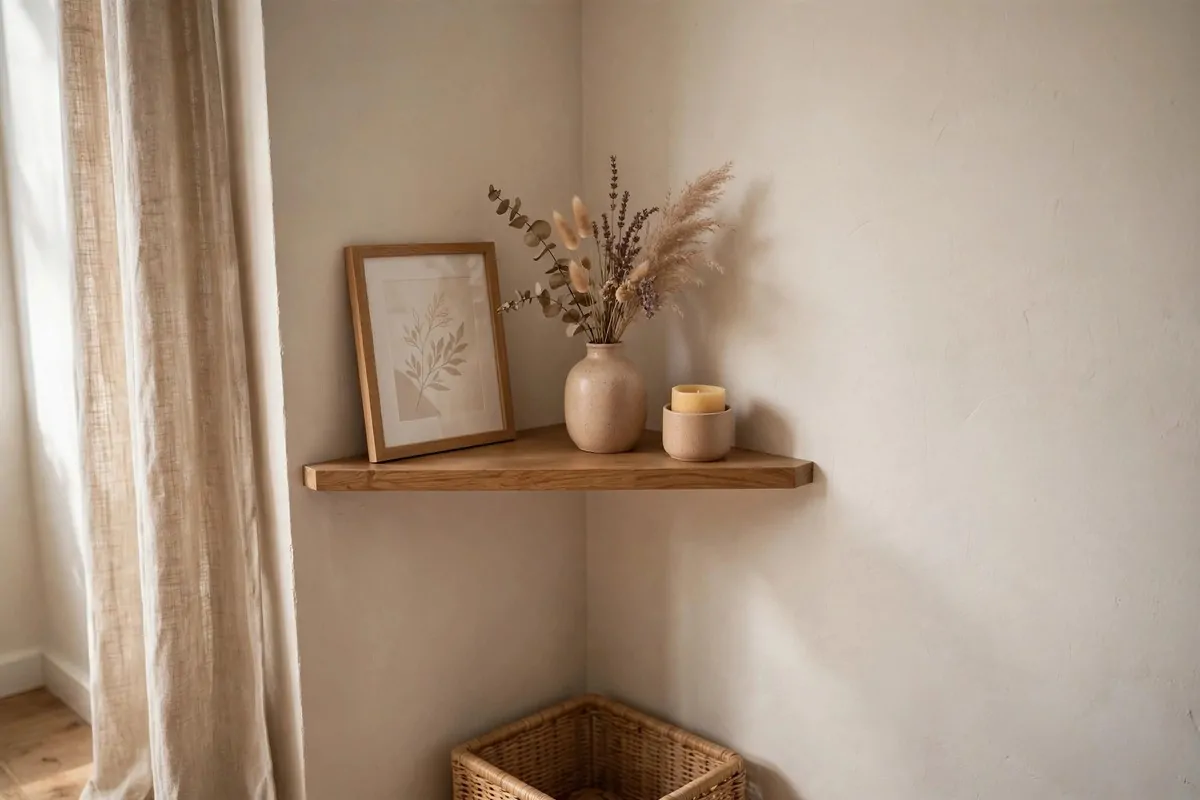
When everything in a small home is about function, the home can start to feel like a storage unit. Storage is great, but you also need a little beauty.
Pick one small surface and style it on purpose. A shelf with a framed print, a small vase and a candle. A tray on the ottoman with a plant and a book. One pretty corner.
This little spot does big emotional work. It tells you this is a home, not just a place to store things. Your eyes land there and relax.
Keep it small and simple. Three to five things is plenty. Odd numbers look best, for some reason. A tall thing, a short thing, and something green is a classic mix.
Change it with the seasons if you like. Dried flowers in fall, fresh greens in spring, a pinecone in winter. Tiny changes keep it feeling fresh without any real effort.
The rule is that this one surface is not for storage. No keys, no mail, no random clutter. It is the one spot that is only allowed to be pretty.
Every home needs one place that exists just to make you smile. Even the smallest home has room for that.
Keep the pretty surface dusted. A dusty pretty corner stops being pretty fast. Thirty seconds with a cloth keeps it shining.
Do not add a second pretty spot until the first one stays clean. One perfect corner beats three messy ones. Master one, then maybe add another.