How to Use Brain Dumping to Organize My Thoughts

Some nights my head feels like a browser with 40 tabs open. Bills, a text I forgot to send, a work task, a call I keep putting off, a gift I still need to buy. None of it is big. But all of it is loud.
For a long time, I tried to just hold it all in my head. I thought a good, busy person should be able to do that. I was wrong. The mind is not built to be a storage box.
Here is a fact that helped me. Nelson Cowan, a memory researcher at the University of Missouri, looked at many studies and found that we can only hold about four chunks of info in our working memory at once. Four. Not forty.
So when you try to keep 40 things in your head, they push and shove. You lose some. You worry about the ones you lost. And that worry takes up even more space.
A brain dump fixes this in a very plain way. You take every thought out of your head and put it on paper. Then you sort it. Then you pick what to do next.
That is the whole idea. But the sorting part is where most people get stuck, so that is where I will spend the most time. In this post, I will show you the problem first, then my simple sorting framework, then a real example from one of my own busy weeks, and last, a page you can reuse.
When Your Head Feels Full but You Can’t Explain Why
You sit down to work, and you can’t focus. You feel tired, but you did not do much. Someone asks what is wrong, and you say, “I just have a lot going on.”
That is the clue. It is not one big problem. It is many small, open loops.
An open loop is any task or thought you have not closed. Call the vet. Fix the door. Each one sits in the back of your mind and pokes you.
Two Harvard researchers, Matthew Killingsworth and Daniel Gilbert, used a phone app to check in on 2,250 adults at random times. They found that people’s minds were wandering 46.9 percent of the time. And people were less happy when their minds wandered.
Not every wandering thought is an open loop. But mine often wander to the stuff I have not dealt with yet.
Here are a few signs your head is full of open loops:
- You keep thinking of the same small task, but you never do it.
- You wake up at night and start listing things.
- You forget things you were sure you would remember.
- You jump from task to task and finish none.
If two or more sound like you, try a brain dump. All you need is a pen.
The Difference Between a Brain Dump and a Regular Journal
People mix these up a lot. They are both writing. But they have a very different job.
A journal is for feeling and thinking. You write about your day and how you feel. It is slow, and that is the point.
A brain dump is for clearing. You write short bits, fast, with no order. It looks like a messy list, not a story. Then you come back and sort it.
| Journal | Brain Dump |
|---|---|
| Full sentences and long thoughts | Short bits, two to six words each |
| Looks back at what happened | Looks at what is still open |
| Helps you feel and reflect | Helps you sort and act |
| You keep it | You process it, then you can toss it |
Both are good. But if you sit down to brain dump and write three pages about your feelings, you did a journal. That will not clear your task list.
There is some nice research on the journal side too. Kitty Klein and Adriel Boals, in a 2001 study in the Journal of Experimental Psychology, found that students who wrote about stress showed bigger gains in working memory seven weeks later than students who wrote about plain topics. The writers also had fewer intrusive thoughts. So putting hard stuff on paper can free up space in your head.
Start With Everything, Even the Thoughts That Seem Unimportant
This is step one of my framework. I call it the Dump. You write it all.
Get a sheet of paper. Set a timer for 10 or 15 minutes. Then write every single thing that is on your mind. Don’t judge. Don’t sort. Don’t fix. Just write.
Yes, even the silly stuff. “Buy dish soap” goes on the list. So does “Am I in the wrong job?”
Why add the tiny stuff? Because a small thought still takes one of your four slots.
If you get stuck, use these prompts. I go through them one by one:
- Home: things to fix, clean, buy, or sort.
- Work or school: tasks, emails, calls, and due dates.
- Money: bills, refunds, plans, and fears.
- People: who you need to call, text, thank, or say sorry to.
- Health: visits, meds, sleep, and aches you keep ignoring.
- Worries: the “what if” stuff that loops at night.
- Ideas: things you want to try or make someday.
When the timer ends, wait one more minute. The last few thoughts are often the ones you have been hiding from.
Sort the Mess Into Things You Can Do, Decide, Keep, or Let Go
Now comes step two. You have a messy page. Go down the list and give each line one of four labels. I use letters: D, C, K, and L.
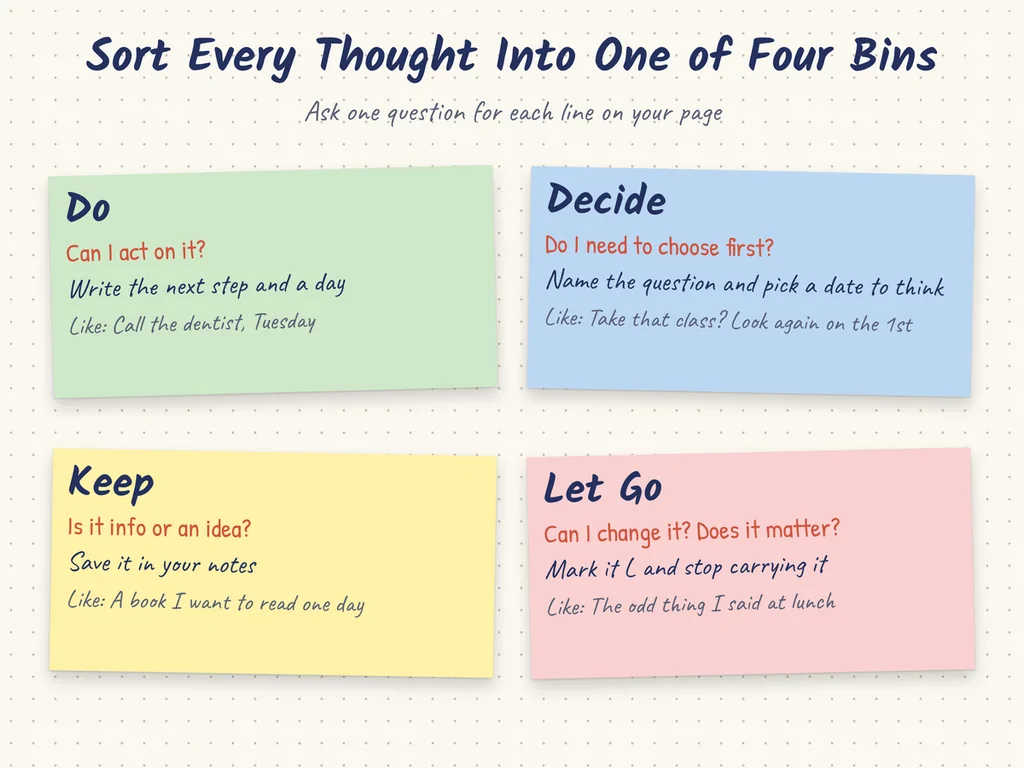
- Do (D): it is a real task. You can act on it. “Pay the water bill.”
- Decide (C, for choose): you can’t act yet, because you have to make a choice first. “Should I take that class?”
- Keep (K): it is not a task. It is info or an idea you want to save. “A book I want to read one day.”
- Let Go (L): you can’t change it, or it does not matter. “I said a dumb thing at lunch.”
Four bins. Every thought fits in one.
The Let Go bin is the one people skip. Please don’t. Writing “L” next to a worry is a small act of permission. You are telling your brain, “I saw this. I am choosing not to carry it.”
Some lines will be hard to label. That is a sign the line is really two or three thoughts mashed into one. Split it up. “Car stuff” might become “book oil change” (Do) and “sell the car or keep it?” (Decide).
Don’t take too long here. Five to ten minutes is plenty.
Turn a Random Thought Into One Clear Next Step
Step three is where the magic is. Every “Do” line needs a next step. A next step is the very first thing you would do with your hands.
“Sort out my taxes” is not a next step. It is a big, foggy cloud. You can’t do a cloud.
“Find last year’s tax form in the blue folder” is a next step. You know what it looks like. You know when it is done.
Here is a quick test I use. Ask, “Could I do this in one sitting, with no more thinking?” If yes, it is a next step. If no, break it down more.
This is not just my habit. It is backed by good research. In a 2011 paper, E.J. Masicampo and Roy Baumeister found that unfinished goals cause intrusive thoughts and hurt focus on other tasks. But when people made a specific plan for those goals, the intrusive thoughts went away. The goal was still not done. Just having a plan was enough to quiet it.
I find that so freeing. You don’t have to finish everything to feel calm. You just need a next step and a time.
So for each “Do,” write the next step and, if you can, a day. “Call the dentist, Tuesday at lunch.” Now your brain can let it go until Tuesday.
What to Do With Problems You Can’t Solve Today
Some thoughts are not tasks. They are big, slow problems. “My health needs more care.” “I don’t like my job.” “We may need to move.”
These live in the Decide bin. And they can be the heaviest things on your page.
You can’t fix them today. But you can still do three things:
- Name the real question. “I don’t like my job” turns into “Do I want to look for a new job this year?”
- Write what you need to know. “How much do jobs like mine pay? What would I need to learn?”
- Pick a date to think again. “I will look at this on the first Sunday of next month.”
That date matters. Without it, the problem floats in your head every day.
I keep a small page called “Thinking About.” These problems go there with their review date. When the date comes, I see if I am ready to decide. Sometimes I push it again, and that is fine.
How to Find the Tasks Hiding Inside Your Thoughts
A lot of worries have a task hiding inside them. You just have to look.
Take “I am scared I will forget a birthday.” That sounds like a feeling. But inside it is a task: “Add the birthday to my phone with a reminder one week before.”
Or “I feel bad about money.” Inside that might be “Check my bank account” or “List my bills for the month.”
I ask one question to find the hidden task: “What is one small thing that would make this worry a bit smaller?”
Here are a few more examples of how it works:
- “The house is a mess” became “Clear the kitchen table for 10 minutes after dinner.”
- “I never have time to rest” became “Block one free evening this week.”
- “My back hurts all the time” became “Book a doctor visit.”
Not every worry has a task inside. Those go to Let Go, or to your “Thinking About” page.
A 10 Minute Version for Extremely Busy Days
Some days, you do not have 30 minutes. Some days you barely have 10. On those days, I use a fast version. Here is how I did it on a crazy Monday last month.
Minutes 1 to 5: Dump. I wrote fast. Here is a bit of what came out:
- Report due Wed
- Renew bus pass
- Out of milk
- Dentist visit?
- Why did that email get no reply
- Car making noise
- Learn to bake bread
Minutes 6 to 8: Label. I put D, C, K, or L next to each line. Report: D. Bus pass: D. Milk: D. Dentist: C, since I had to check my week first. Email: L. Car: D. Bread: K.
Minutes 9 to 10: Pick three. I circled the three “Do” items that mattered most today. Bus pass, report, milk. That was my day.
The rest were on paper, so I could stop thinking about them.
The fast version is not as deep. But it is far better than nothing.
What to Do When Brain Dumping Makes You Feel More Overwhelmed
This happens. I want to be honest about it. The first time you see 60 things on one page, it can feel scary. “Is this really my life?”
If that is you right now, take a breath. Here is the thing. Those 60 things were already there. The page did not add them. It just showed you what you were already carrying.
Still, here are a few ways to make it feel less heavy:
- Stop at the dump for today. You don’t have to sort right away. Come back tomorrow with fresh eyes.
- Cross out the easy ones first. Things you can do in two minutes? Do them now. Seeing lines crossed out feels good.
- Count your Let Go items. On my own pages, a good chunk is often stuff I can just drop. That is a quick win.
- Only pick three. You do not need to fix all 60. You need to pick three for this week.
- Talk to someone. If the page is full of heavy worry, not tasks, share it with a friend, or a doctor or counselor if it feels like too much.
A brain dump is a tool, not a test. If it makes you feel worse every time, just dump one area, like work or home, and build up from there.
The Weekly Reset That Keeps Your Head From Filling Up Again
One brain dump helps. But your head fills up again. New tasks come in every day. That is just life.
So I do a short reset once a week. Mine is on Sunday evening with a cup of tea. It takes about 20 minutes.
- Dump again (5 minutes). Write everything new on a fresh page.
- Look at last week’s page (5 minutes). Cross out what is done. Move what is still open to the new page.
- Sort (5 minutes). Do, Decide, Keep, or Let Go.
- Plan (5 minutes). Pick the top three to five tasks for the week. Put any with dates on your calendar.
This has a nice side effect for sleep. In a 2018 Baylor University study, Michael Scullin and his team had 57 young adults write for five minutes before bed. Half wrote a to do list for the next few days. The other half wrote about what they had already done. The to do list group fell asleep about nine minutes faster. And the more specific the list, the faster they fell asleep.
A Simple Brain Dump Page You Can Reuse
Here is the page I use. You can draw it on any sheet of paper in two minutes, or print the page in this post.
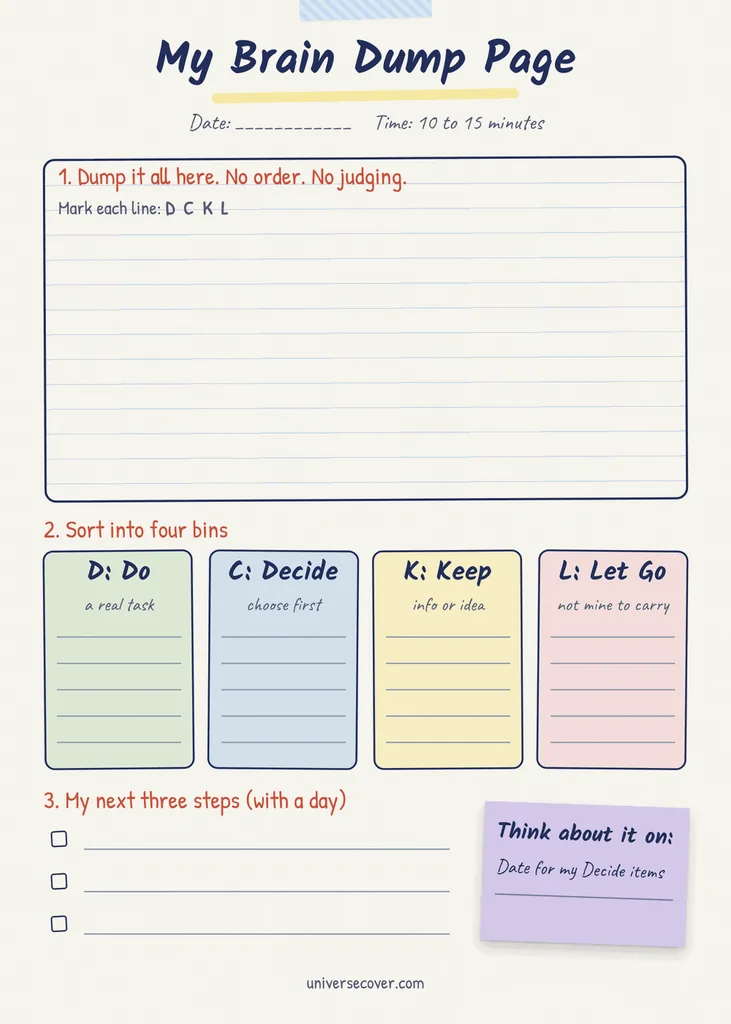
It has four parts:
- The big dump box. The top half of the page. Write anything and everything here.
- The four bins. Do, Decide, Keep, Let Go. After you dump, copy each line into its bin, or just mark the letter.
- My next three steps. The three most important next steps, with a day for each.
- Think about it on. A spot for the date you will come back to your Decide items.
I keep a small stack of these pages on my desk. When my head feels full, I grab one. The page tells me where to start. You can use a notes app too, but I like crossing out lines with a real pen.
When You Should Stop Writing and Start Acting
Here is a trap I fell into. I got so into brain dumps that I did one every day. Long ones. I had pages and pages. But I was not doing much of what was on them.
A brain dump’s job is to clear your head so you can act. If you are dumping but not acting, stop writing.
Here are signs you are in the trap:
- You write the same tasks over and over, week after week.
- You spend more time on the page than on the tasks.
- You redo your list when you feel stuck, instead of doing one thing on it.
If that sounds like you, try this. Close the notebook. Pick the smallest “Do” item. Do it now, before you can think too much. Then do the next one.
Once your head feels clear, move. The page has done its job.
FAQs
How long should a brain dump take?
A full brain dump takes about 20 to 30 minutes. That is 10 to 15 minutes to write and 10 to 15 minutes to sort and plan. On busy days, a 10 minute version works fine.
Should I brain dump on paper or on my phone?
Both work. Paper is great for focus, since there are no pop ups. A phone is great if you want to search your list later. I dump on paper and then move my next steps to my calendar.
How often should I do a brain dump?
Once a week is a good habit. Then do an extra one any time your head feels full, like before a big trip, after a hard week, or when you can’t sleep.
What do I do with the page after?
Move your next steps to your calendar or task list. Move your “Keep” items to wherever you save notes. Then you can toss the page or keep it in a folder to look back at.
Can a brain dump help with anxiety?
It can help with the busy, “too much to do” kind of stress, and studies on writing to do lists and plans back that up. But it is not a cure for anxiety. If worry is getting in the way of your life, please talk to a doctor or counselor.