Planner vs Notebook: Which Is Better for Organizing Life?

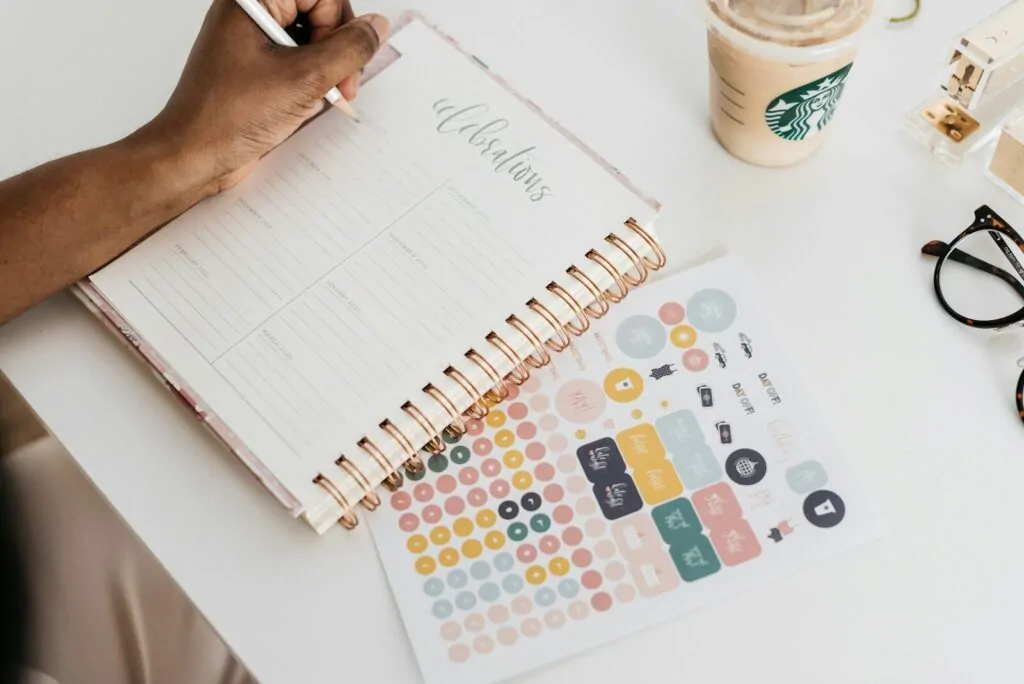
I have a drawer at home that I call the planner graveyard. It has three nice planners in it. Each one is used for about six weeks, then left blank. Next to them sit five notebooks, full of half lists and doodles.
For years I thought I just had to find the right one. The perfect planner. The perfect notebook. So I kept buying.
Then I saw what was really going on. A planner and a notebook are not two versions of the same thing. They do two different jobs. A planner is built for time. A notebook is built for thinking.
When you pick one and ask it to do both jobs, it lets you down. That is not your fault. It is a bad match.
Paper still matters here, by the way. In a 2021 study from the University of Tokyo, people who wrote a schedule in a paper notebook finished the task about 25 percent faster than people using a tablet or phone. An hour later, the paper group also showed more brain activity when they tried to recall the plans.
So in this post, I will compare the two tools side by side. Then I will walk through real life situations to show which one wins where. And last, I will show you the simple two tool system I use now, the one that finally kept my drawer from growing.
Why Choosing Between the Two Is Harder Than It Looks
On the store shelf, it seems easy. You want to be organized, so you buy a planner. Done.
But a few weeks later, you have a thought that does not fit in the little date box. A new idea. A long list. Notes from a call. So you start writing in the margins. Then on sticky notes. Then in a notebook.
Now you have two places, and you are not sure what goes where.
The choice is hard for three reasons:
- Our lives have two kinds of stuff. Some things are tied to a date, like a dentist visit. Some are not, like an idea for a trip.
- Stores sell a dream. Pretty planners promise a calm, perfect life. But a book can’t change how your week really works.
- We change week to week. A slow week needs less structure. A crazy week needs a lot more.
So the better question is not “which one is better?” It is “which kind of thinking do I need help with most?”
What a Planner Is Actually Designed to Handle
A planner is a tool for time. Every page is tied to a day, a week, or a month. That is its power.
A good planner is great at:
- Appointments and meetings
- Due dates and bills
- Seeing your week at a glance
- Planning how much you can fit in a day
- Habits you want to check off daily
The structure helps you answer one key question: “When will I do this?”
That question matters more than people think. Peter Gollwitzer and Paschal Sheeran looked at 94 tests from 63 studies on what they call “implementation intentions.” That is a fancy name for plans like “When X happens, I will do Y.” Their 2006 review found these plans had a medium to large effect on reaching goals.
A planner nudges you to make these plans. You see Tuesday. You write “gym at 6.” You have made a when and where plan without even trying.
What a planner is not great at is long thinking. The boxes are small. They are made for a few words, not a full page of ideas.
Where a Blank Notebook Gives You More Freedom
A blank notebook has no dates and no rules. You open it, and the page says, “Do what you want.”
That freedom is a gift for some kinds of work:
- Brain dumps and messy thinking
- Meeting notes and call notes
- Long lists, like packing or gift ideas
- Project plans with steps and sketches
- Ideas you want to grow over time
- Journal pages
A notebook can be anything you need it to be on any day. One page is a grocery list. The next is a plan for a garden. The next is notes from a doctor visit.
There is also good research on the value of the pen itself. In a 2024 study, Audrey van der Meer and Ruud van der Weel at the Norwegian University of Science and Technology (NTNU) tracked brain activity in 36 students. Writing by hand led to wide brain connectivity linked to memory and learning. Typing did not.
So when you think on paper, you may remember more of what you wrote. That is a big plus for notes and ideas.
When a Planner Starts Feeling Like Another Obligation
Here is the dark side of planners. They have a page for every day. And a blank day page looks like a failure.
Miss three days, and you see three empty pages. It feels like the planner is judging you. So you avoid it. Then you miss a week. Then it goes in the drawer.
I have been there more times than I can count.
Signs your planner has turned into a chore:
- You spend more time decorating it than using it.
- You feel guilt when you open it.
- You copy the same tasks from day to day because none get done.
- You fill in pages after the fact, just so they are not blank.
The fix is often not a new planner. It is a lighter way of using the one you have. Use only the weekly view. Skip the daily pages. Or only write the three things that must happen each day.
A planner should serve you. You should not serve it.
When a Notebook Gives You Too Much Freedom
Notebooks have their own problem. With no rules, things get lost.
You write a great idea on page 12. Three weeks later, you can’t find it. You write a task in the middle of meeting notes, and you never see it again.
A notebook with no system turns into a pile. A neat pile, maybe. But still a pile.
Here are a few simple rules that fix most of this:
- Date every page. Just a small date in the top corner. It helps so much later.
- Mark tasks with a box. Draw a small square before any task. Later, flip through and look for boxes with no check.
- Keep an index. Save the first two pages. When you write something you will want again, add the page number and a few words.
- One topic per page. Start a new page for each new subject, even if the last one is half empty.
These rules take a minute a day. But they turn a blank notebook from a mess into a tool you can trust.
Which One Works Better for Appointments and Deadlines?
Now let’s go through real situations. First up, the stuff with dates.
For appointments and deadlines, a planner wins. And it is not close.
Here is why. A date thing needs to show up at the right time. In a planner, you flip to the week, and there it is. In a notebook, it is on some page you wrote two weeks ago. You have to remember to look.
Some quick examples:
| Situation | Better Tool | Why |
|---|---|---|
| Doctor visit on the 14th | Planner | It needs to show up on that day |
| Rent due on the 1st | Planner | Repeats each month on a set date |
| Work report due Friday | Planner | You need to see it coming all week |
| Notes from the doctor visit | Notebook | Long text with no date to act on |
| Steps for the work report | Notebook | Needs space to think and plan |
See the pattern? The date goes in the planner. The thinking about it goes in the notebook.
A phone calendar can also do this job well, and it can beep at you. Many people I know use a phone calendar as their “planner” and a paper notebook for the rest. That is a great combo too.
Where Should Goals, Ideas, Lists, and Notes Live?
This is where most people get mixed up. So here is my simple answer for each.
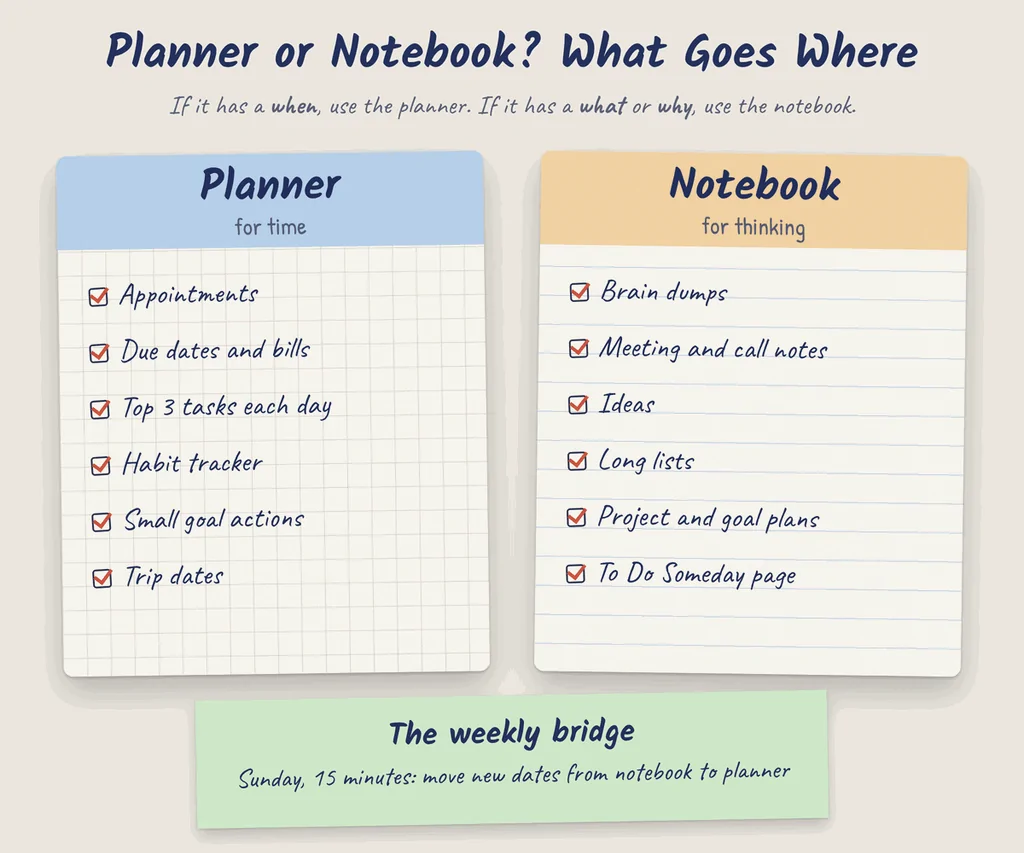
Goals: The big goal lives in the notebook. That is where you write why it matters, what done looks like, and the steps. The small actions that come out of it, like “run on Tuesday,” go into the planner.
Ideas: Notebook. Always. Ideas need room to grow, and most have no date.
Lists: Notebook, with one exception. If a list is tied to a date, like “pack for the trip on the 20th,” put a note in the planner that says “pack, see list on notebook page 34.”
Notes: Notebook. Meeting notes, call notes, class notes. All of them.
Habits: Planner. A habit happens on days, so a planner with a small tracker works well.
Tasks with no date: These are tricky. I keep a running “To Do Someday” page in the notebook. Each week, I pick a few and move them to the planner.
The simple rule: if it has a “when,” it goes in the planner. If it has a “what” or “why,” it goes in the notebook.
The Two Tool System That Combines Both
This is the system that finally worked for me. It is not fancy. It just gives each tool the job it is good at.
Tool 1: The planner (or phone calendar). This is my “when” tool. It holds:
- Fixed appointments
- Due dates
- My top three tasks for each day
- A small habit tracker
Tool 2: The notebook. This is my “think” tool. It holds:
- Brain dumps
- Notes of all kinds
- Project plans
- Lists and ideas
- The “To Do Someday” page
The bridge: Once a week, on Sunday, I spend 15 minutes with both open. I look through the notebook for open tasks and new dates. Then I move them to the planner. That one weekly link is what keeps the two from drifting apart.
Here is a real example. Last month, I wrote notes from a call about a heater repair in the notebook. In the notes, I wrote that a man would come to fix it “next Thursday.” On Sunday, I saw that and put “heater fix, stay home 9 to 12” in the planner. Without the bridge, I would have missed it.
How to Know Which System Matches Your Personality
All people are not the same. Your best setup may lean more to one tool than the other. Here is a quick guide.
You may lean planner if:
- Your days are full of fixed times, like meetings, school runs, or shifts.
- You like to see the whole week at once.
- You feel calm when things are in boxes.
- You often forget dates.
You may lean notebook if:
- Your days are flexible, and you set your own hours.
- You think best by writing it out.
- You get bored with fixed layouts.
- You have lots of projects and ideas.
Most people are a mix. I lean notebook, but my weeks have lots of fixed dates, so they matter a lot. That is why I use both.
Don’t pick a tool based on how you wish you were. Pick it based on how your weeks really look right now.
What to Do If You Keep Abandoning Your Planner
If you have your own planner graveyard, you are not alone. And you are not lazy. Most of the time, the planner just asked for too much.
Try these fixes before you give up again:
- Use less of it. Ignore the daily pages. Use just the weekly or monthly view.
- Tie it to a habit you already have. Open it every morning with your tea or coffee. Same time, same place.
- Keep it open on your desk. Out of sight, out of mind. A shut planner is a forgotten planner.
- Allow blank days. A blank page is not a fail. It just means nothing was planned.
- Start on any day. You don’t have to wait for January or the first of the month. Start on a Wednesday.
There is a helpful fact about habits too. In a study from University College London, led by Phillippa Lally and published in 2010, it took people an average of 66 days to make a new habit feel automatic. But the range was huge, from 18 to 254 days. And missing one day did not ruin the habit.
So give your planner two months, not two weeks. And don’t quit after one missed day.
A Simple Test Before Buying Another Organization Tool
Before you buy one more planner or notebook, try this free test. It takes one week.
Step 1: Take any plain notebook or even a few sheets of paper.
Step 2: For seven days, write down every time you need to “organize” something. A date to remember. A note to keep. A list to make. An idea.
Step 3: At the end of the week, count them up. How many had a date? How many were notes or ideas?
If most had a date, you need a planner or calendar first. If most were notes and ideas, you need a notebook first. If it is a mix, use the two tool system.
This test also shows you what your real needs are. You may find you only need a simple weekly page, not a big, fancy planner.
I wish I had done this before I spent so much on books I never used.
Build a System You Will Actually Continue Using
The best system is not the prettiest one. It is the one you still use in six months.
Here are the rules I live by now:
- Keep it simple. Two tools, max. More tools means more places to check.
- Give each tool one job. Planner for when. Notebook for what and why.
- Have one weekly link. 15 minutes on the same day each week.
- Make it easy to grab. Keep both tools where you will see them every day.
- Change what does not work. If a section never gets used, stop using it.
Your system should be able to bend. On a busy week, you might only use the planner. On a slow, creative week, the notebook might do most of the work. Both are fine.
So go open that drawer. Pick one planner and one notebook from the pile. Give each one its job. And start today, on whatever day it is.
FAQs
Is a planner or a notebook better for students?
Most students do best with both. A planner, or a phone calendar, keeps track of due dates and exams. A notebook holds class notes and study plans. If you can only pick one, pick the planner, since missed due dates hurt the most.
Can I use a notebook as a planner?
Yes. Many people draw their own weekly pages in a notebook. Just make a week layout at the start of each week and keep notes on the pages after it. Date every page so you can find things later.
Is a digital planner better than paper?
It depends on you. A phone calendar is great for reminders and shared plans. Paper can help with focus and memory, as the University of Tokyo study found. Many people use a phone calendar for dates and a paper notebook for thinking.
How do I stop buying new planners?
Try the one week test in this post first. It shows you what you really need. Then use one planner for at least two months before you judge it. Most planners fail because of how we use them, not how they are made.
What should I write in a notebook every day?
You don’t have to write every day. But a short daily page with the date, a quick brain dump, and any notes from the day works well. Mark tasks with a box so you can find them later.