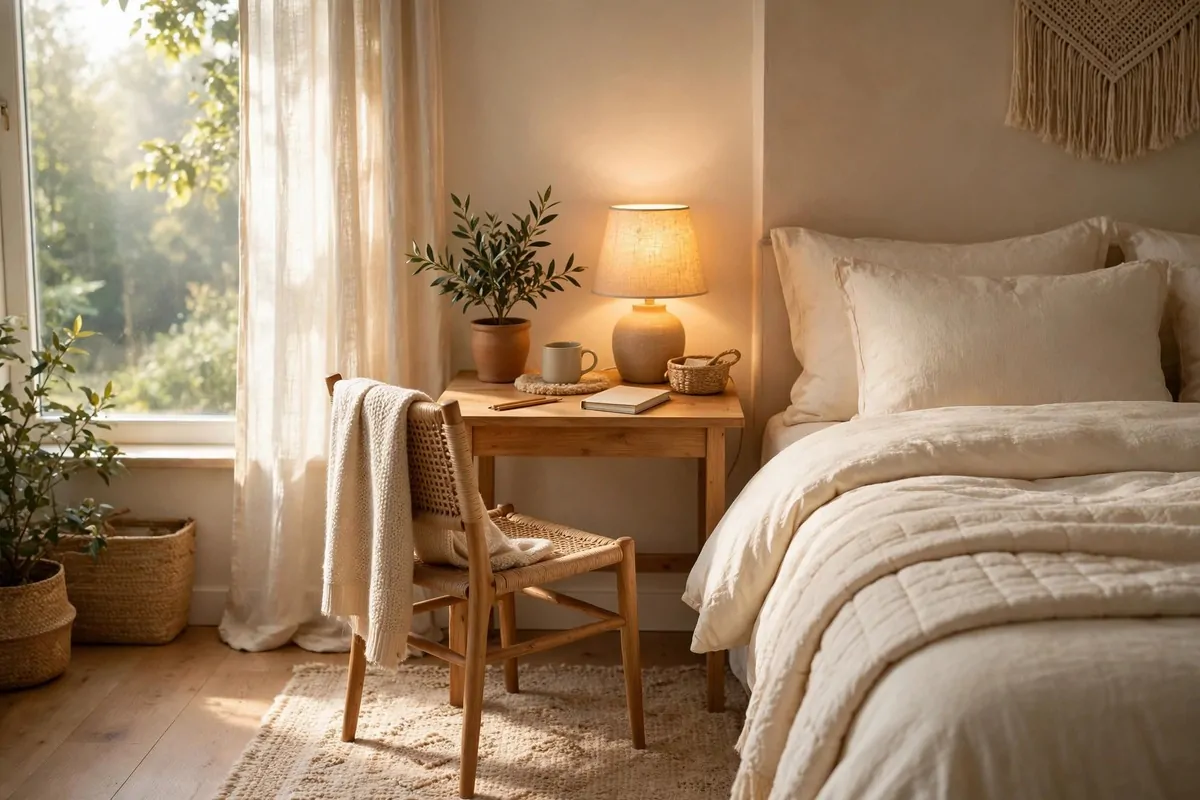
15 Office in Bedroom Master Layouts That Feel Luxe

A master bedroom office feels luxe when it stops looking like an office.
That sounds odd, but it is the whole trick. A luxe room does not shout about work. It looks calm. It looks finished. The desk sits where it belongs, the light falls the right way, and nothing in the room looks like it was pushed there in a hurry.
My master bedroom used to have two moods, and neither one was luxe. By day it was a desk with a bed behind it. By night it was a bed with a desk in the way. I moved the furniture around for a whole year before I learned the real lesson. Luxe is not about money. It is about layout.
That is what these 15 office in bedroom master layouts are about. Each one is a way to lay out your master bedroom so the office part feels rich, calm, and grown up. Pick the ones that fit your room, and start with the desk, because the desk sets the whole room.
The Desk Against the Best Wall
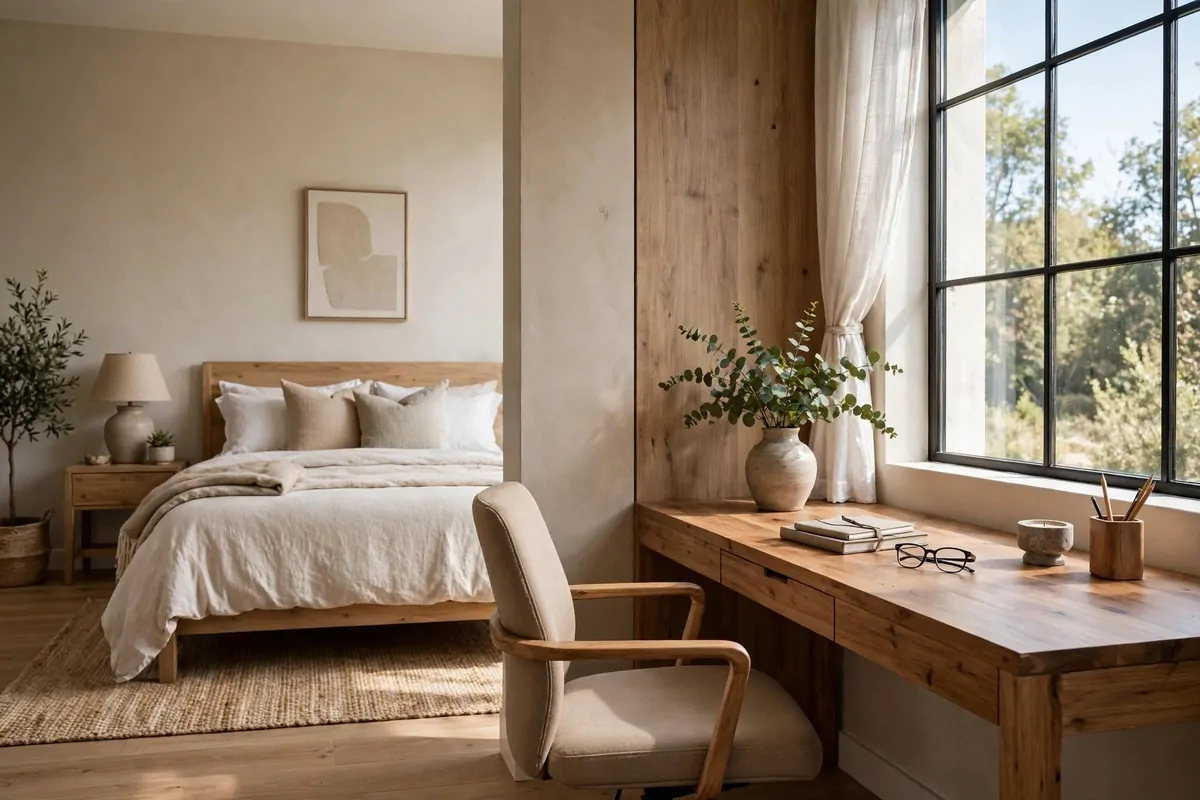
A desk against the best wall changes the whole room. The best wall is the one with the nicest light and the most space around it, not the wall that is left over.
My desk used to sit in the dark corner by the door. It was the only spot left after the bed and the wardrobe took the good walls. I worked there for months, and every day felt a little bit grey. Then I moved the bed to the short wall and gave the desk the long wall by the window. The room felt new the same afternoon.
Pick the wall with the window first. A desk by the window gets morning light on your work, and your eyes stay fresh longer. A desk in a dark corner needs a lamp all day, and a lamp all day makes the room feel small.
Leave space on both sides of the desk. A desk jammed between the bed and the wall looks like an afterthought. A desk with air on both sides looks like it was planned. Two feet on each side is plenty.
Put the chair so you face into the room, not into the wall. When you look up from your work, you should see the bed and the window, not a blank wall. That small turn makes the desk feel like part of the room, not a corner you hide in.
Keep the wall behind the desk clear for one good thing. A framed picture. A small shelf. One thing that says this desk belongs here. A bare wall behind a desk looks unfinished, and an unfinished wall is the opposite of luxe.
Wipe the desk top once a week so dust never builds up. A dusty desk looks forgotten, even when it is tidy. A clean desk in good light looks like a place where good work happens.
Try this layout first if your desk is still in the leftover corner. Move the bed, give the desk the best wall, and watch the room change before lunch.
One Rich Colour, Three Times
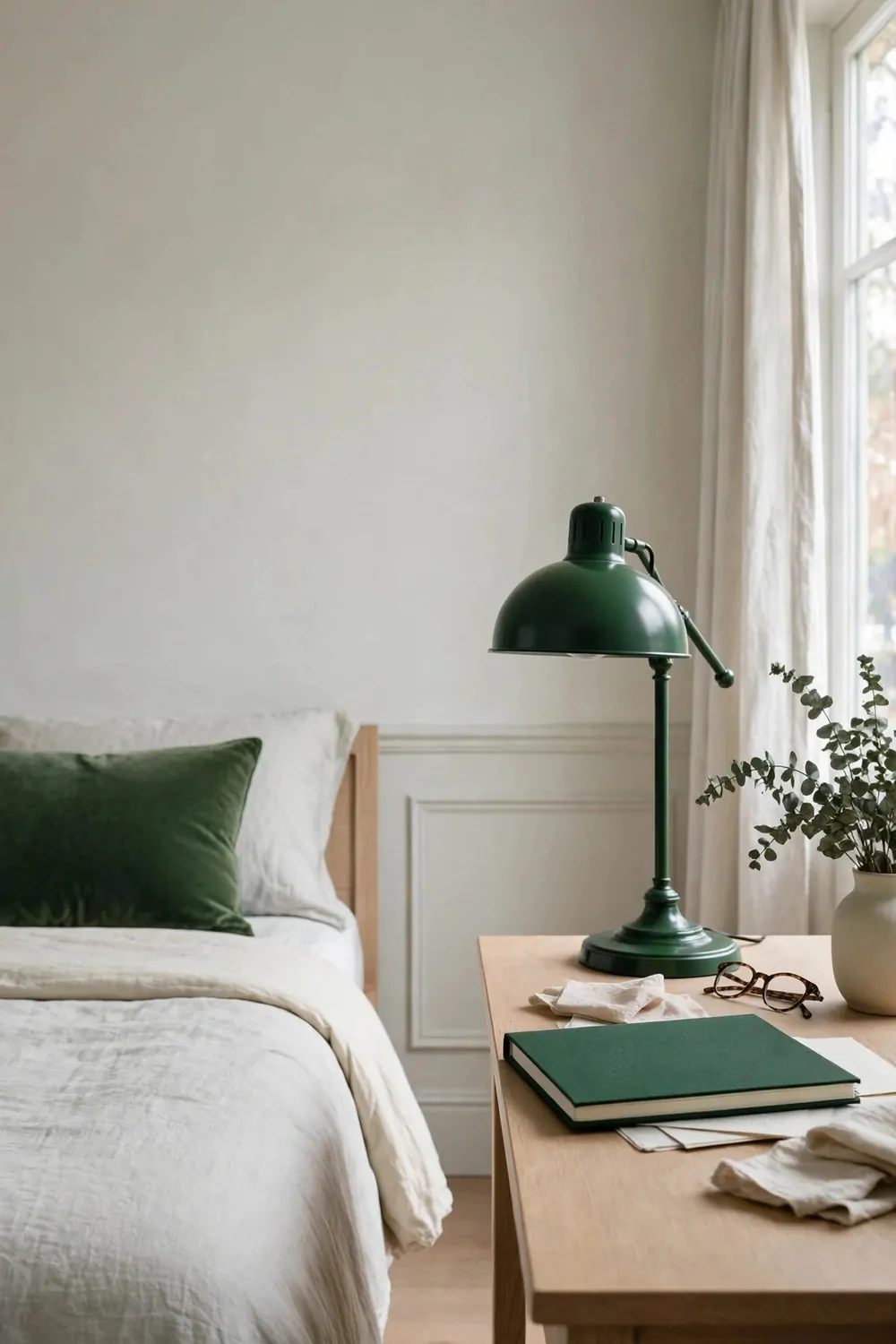
One rich colour, used three times, makes a room feel luxe. Not ten colours. Not a rainbow. One deep colour, repeated in three places, and the whole room reads as rich.
My colour is a deep soft green. It shows up on my desk lamp, on one cushion on the bed, and on the cover of the notebook I keep on the desk. Three small repeats. Nothing big. Nothing loud. But the room feels pulled together in a way it never did before.
Pick a colour you love living with. A deep green, a warm navy, a soft plum, or a rich rust all work. The colour has to be one you like seeing every morning, because you will see it every morning.
Use it once on the desk side of the room. A lamp, a tray, a pen pot, or a notebook cover. Small things count. The desk is where your eyes rest most of the day, so the colour has to live there.
Use it once on the bed side of the room. A cushion, a throw folded at the foot of the bed, or a small vase on the bedside table. The bed is the biggest thing in the room, so one repeat there ties the two sides together.
Use it a third time somewhere small and easy to change. A book spine on the shelf. A candle on the desk. A plant pot. The third repeat is the one that makes people think you planned it all, even when you did not.
Keep the rest of the room pale and plain. Cream walls, pale wood, and white bedding. A rich colour only looks rich when the room around it stays quiet. If everything is loud, nothing is luxe.
Here is where my one rich colour shows up, three times.
| Where it shows up | What it is | Why it works |
|---|---|---|
| On the desk | A deep green lamp and notebook cover | Your eyes rest on it all day |
| On the bed | One deep green cushion | It ties the bed to the desk |
| Somewhere small | A green plant pot on the shelf | The third repeat makes it look planned |
Try this one if your room feels plain but you do not know why. One rich colour, three times, and the room will feel finished.
Matching Wood Tones
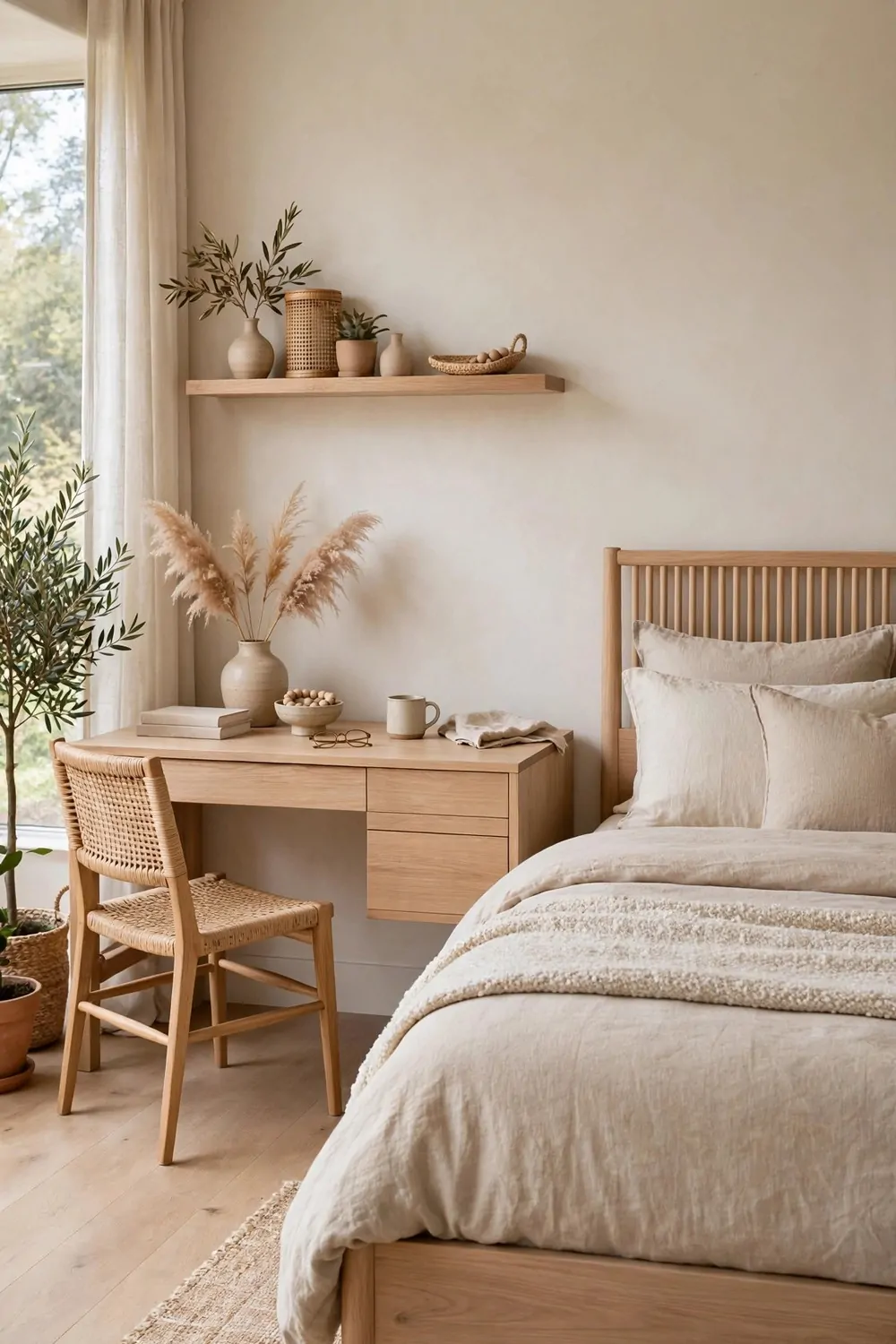
Matching wood tones make a bedroom office feel luxe. When the desk, the bed frame, and the shelves all wear the same wood family, the room reads as one calm place.
My desk is pale oak. My bed frame is pale oak. My one wall shelf is pale oak. None of them match exactly, and that is fine. They are all in the same family, light and warm, and your eye glides from one to the next without stopping.
Look at the wood in your room right now. Is the desk dark and the bed light? Is the shelf orange and the chair grey? Mixed wood tones are the fastest way to make a room feel thrown together, even when every piece is nice on its own.
Pick one wood family and stick to it. Pale oak, warm walnut, or honey pine all work. The family matters more than the exact shade. Two pale oaks from different shops still look like they belong together.
Start with the two biggest pieces. The bed and the desk. If they are in the same family, the room already feels planned. If they are not, a coat of the right stain or a new desk top can fix it in one weekend.
Add the small pieces next. A shelf, a tray, a picture frame, a plant pot stand. Small pieces in the same wood family tie the room together without costing much at all.
Leave the metal and the fabric out of the wood rule. A black lamp, a brass handle, a linen cushion, all of those can be different. The wood is the base note. Everything else can play around it.
Try this one if your room has good pieces that never quite look right together. Match the wood, and the pieces will finally look like a set.
Layered Light: Three Lamps, One Room
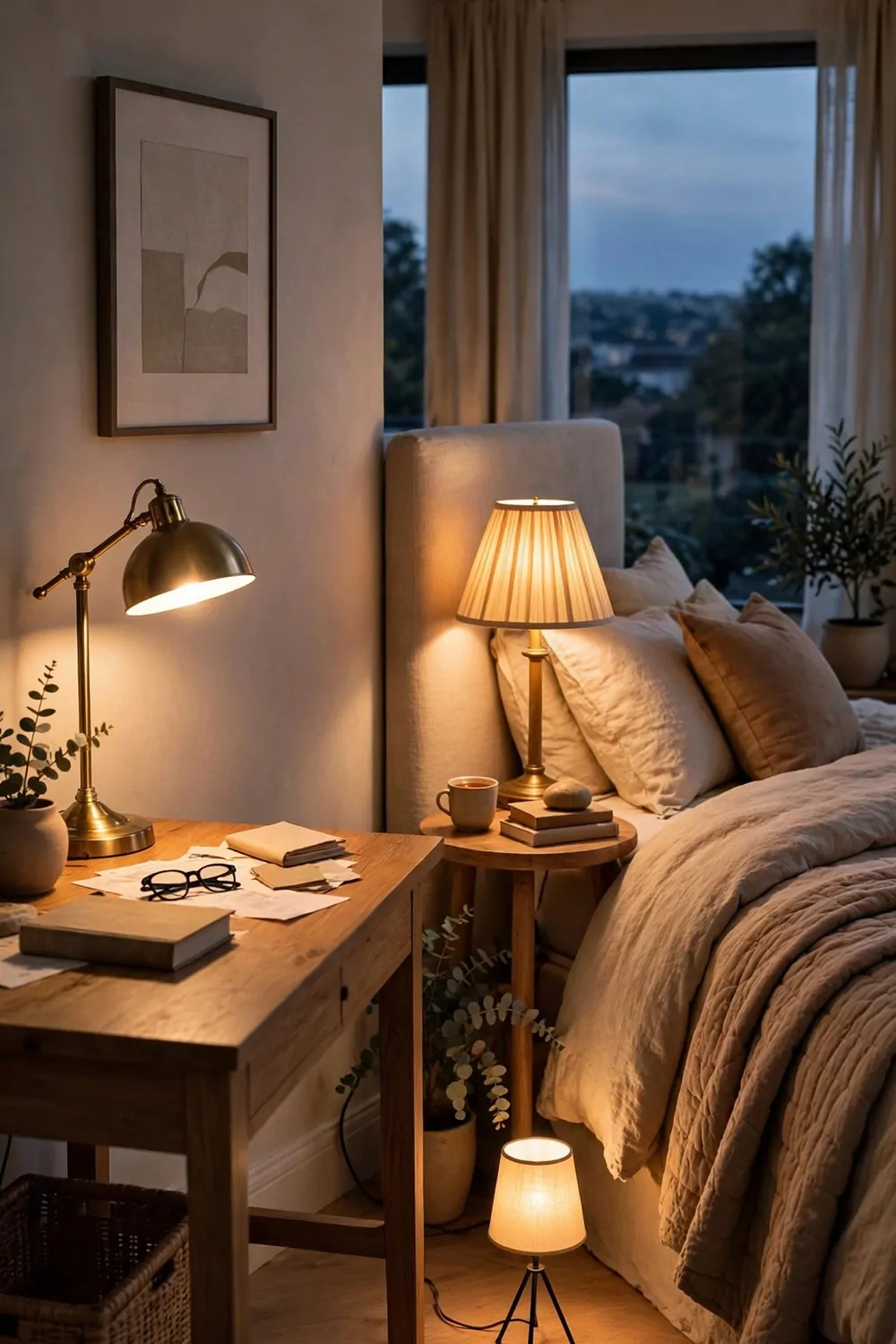
Layered light is what makes a master bedroom feel luxe after dark. One ceiling light cannot do it. Three lamps, at three heights, can.
My room has a desk lamp, a bedside lamp, and a small floor lamp in the corner. I never switch all three on at once. In the morning I use the desk lamp. In the evening I use the bedside lamp. At night, just the floor lamp, low and warm. The room changes its mood with one switch.
Put the desk lamp on the desk, on the side away from your writing hand. It should throw light down on your work, not across your eyes. A lamp that glares is worse than no lamp at all.
Put the bedside lamp where you can reach it from the bed. It is the lamp you switch on to read and switch off to sleep. If you have to get up to reach it, it is in the wrong place.
Put the third lamp in the darkest corner of the room. A small floor lamp, or a lamp on a low shelf. It fills the corner that the other two lamps never reach, and the room stops having a dark side.
Use warm bulbs in all three lamps. Warm light makes pale walls glow and wood look richer. Bright white light makes the same room look like a shop, and a shop is not luxe.
Here is how my three lamps work through the day.
| Lamp | Where it sits | When it is on |
|---|---|---|
| Desk lamp | On the desk, away from your writing hand | Morning, while you work |
| Bedside lamp | On the bedside table, in reach of the bed | Evening, while you read |
| Floor lamp | In the darkest corner of the room | Night, low and warm |
Keep the big ceiling light off most of the time. It flattens the room and kills the mood. Small warm lights do a better job than one harsh one, every single time.
Try this one tonight. Switch off the ceiling light, switch on two small lamps, and sit in your room for ten minutes. Notice how different the room feels.
A Rug That Anchors Bed and Desk
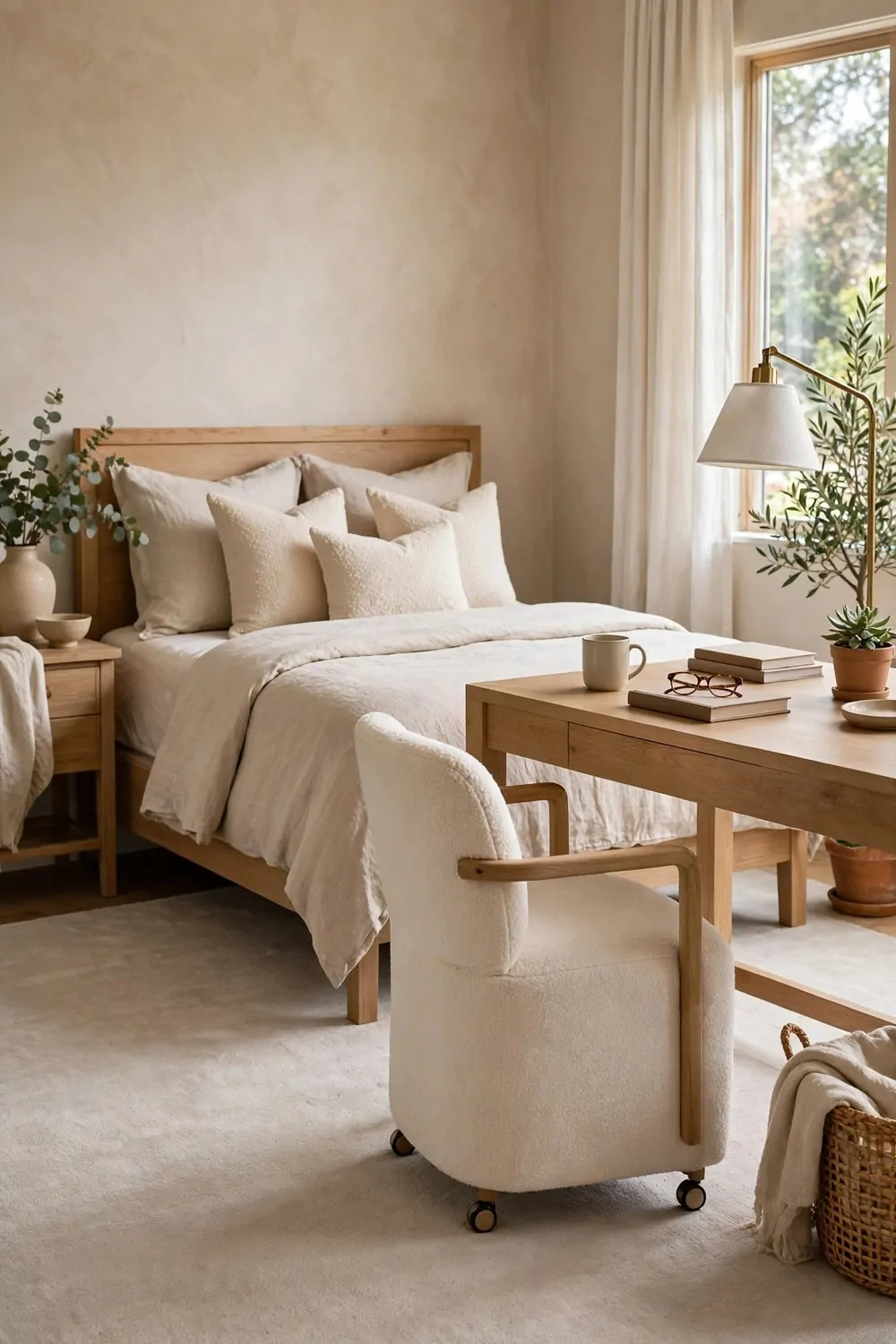
A rug that sits under both the bed and the desk anchors the whole room. It ties the two jobs together, and the room stops feeling split in half.
My rug is big and pale, with a soft low pile. One end slides under the bed. The other end runs out past the desk chair. When I sit at my desk, my feet are on the rug. When I get out of bed, my feet are on the rug. The whole room shares one soft floor.
Pick a rug big enough to touch both pieces. A small rug by the bed only helps the bed. A small rug under the desk only helps the desk. A big rug that reaches both makes the room read as one place.
Keep the colour pale and plain. A cream rug, a soft grey rug, or a pale sage rug all work. A loud pattern on the floor fights with everything else in the room, and a luxe room does not fight with itself.
Choose a low pile. A deep shaggy rug swallows chair legs and makes the chair hard to move. A low rug lets the chair glide, and it never fights you when you pull it out.
Let the rug run past the chair legs by a foot or so. A rug that stops short of the chair leaves your feet on bare boards, and bare boards first thing in the morning are no fun at all. A rug that reaches past the chair feels generous, and generous is luxe.
Take the rug outside for a shake on a dry day each month, and run a brush over it once a week. Fresh air keeps it soft and sweet smelling. A rug that never gets outside slowly goes grey and tired.
Try this one if your bed and your desk feel like two rooms sharing one floor. One big rug, and they become one room.
Framed Art Above the Desk
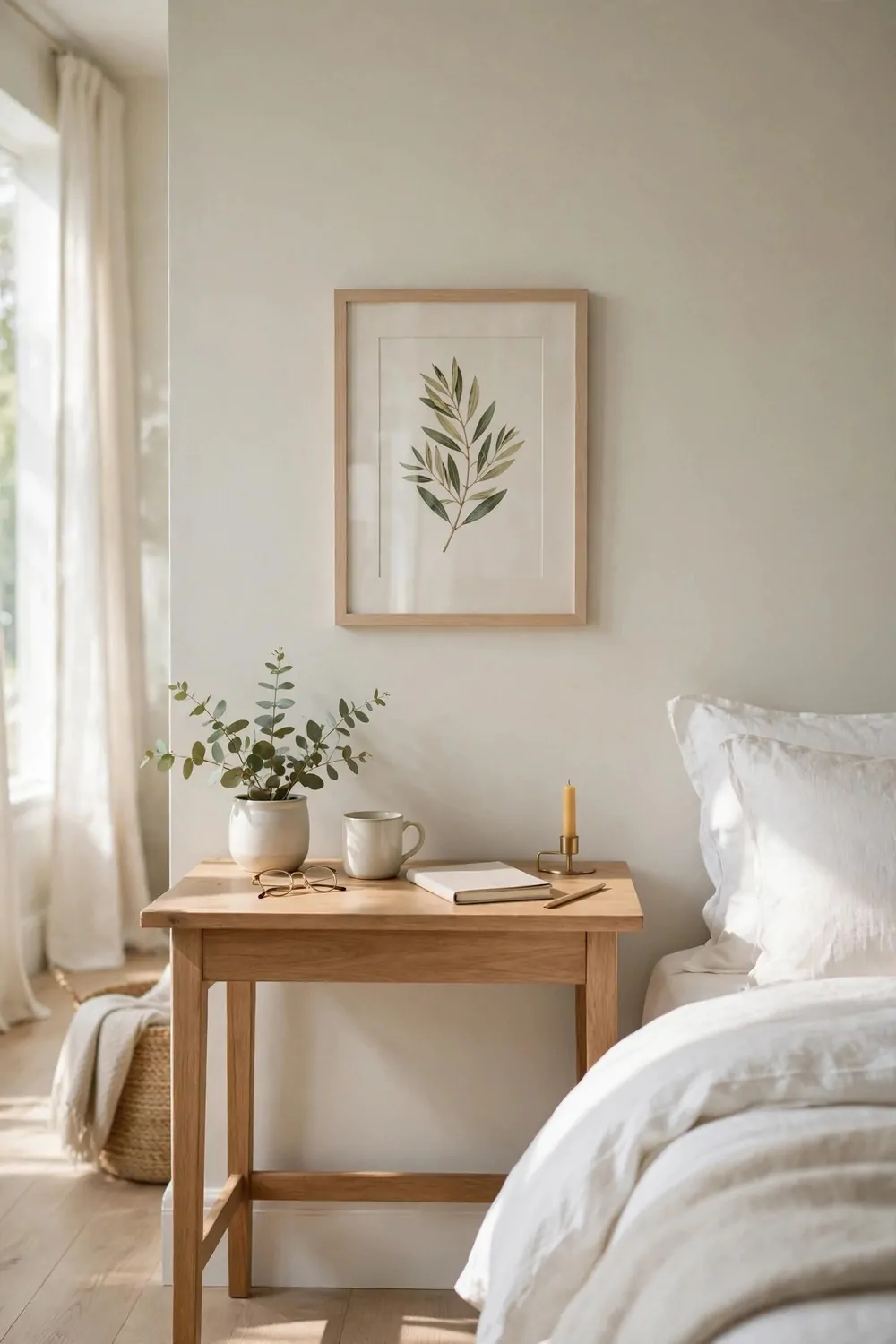
Framed art above the desk makes the desk look finished. A bare wall above a desk looks like you ran out of ideas. One framed picture says the desk is a real place, not a table you pushed against a wall.
My picture is a simple print of a tree in a pale frame. It hangs right above my desk, at eye level when I sit down. I look up from my work and see green leaves instead of a blank wall. It cost almost nothing, and it changed the whole corner.
Pick one picture, not three. One good frame, hung straight, beats a wall of small frames that never quite line up. A luxe wall is a calm wall, and a calm wall has room to breathe.
Hang it at the height of your eyes when you sit at the desk. Art hung too high looks like it belongs to the ceiling. Art hung too low hides behind your laptop. Eye level when seated is the right height.
Match the frame to the wood in your room. A pale oak frame with a pale oak desk. A dark walnut frame with a dark walnut desk. The frame is a small thing, but it ties the wall to the furniture.
Keep the picture simple. A landscape, a leaf print, a plain shape in one soft colour. A busy picture pulls your eyes away from your work all day. A quiet picture lets your eyes rest on it for a second, then come back to the page.
Dust the frame once a week when you dust the desk. A dusty frame makes the whole wall look tired. A clean frame in good light looks like it was hung yesterday.
Try this one if the wall above your desk is still bare. One frame, hung straight, and the desk stops looking like a spare table.
A Proper Chair, Not a Spare One
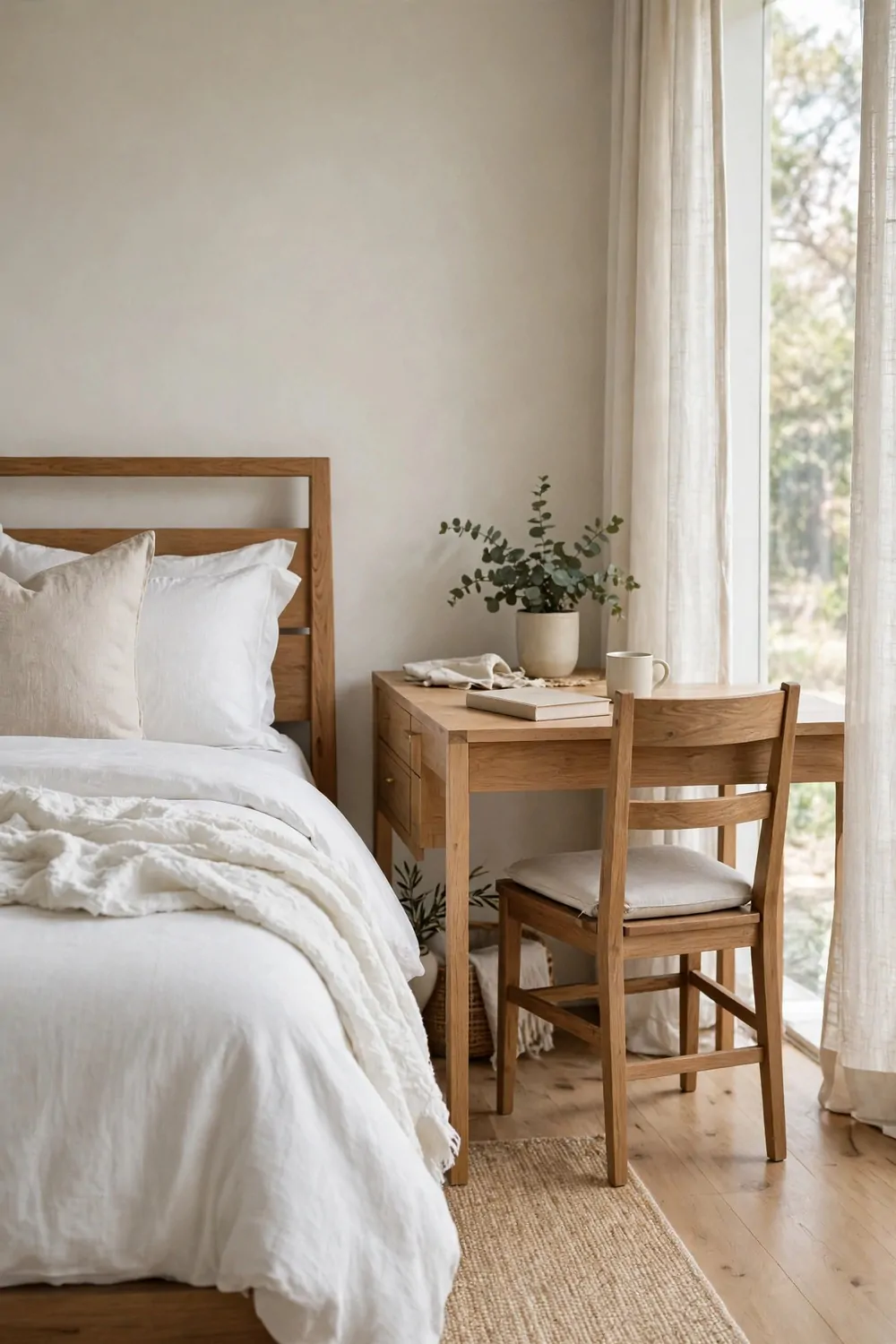
A proper chair makes a master bedroom office feel luxe. Not a spare dining chair. Not a folding chair. A chair that fits you, and fits the room, and looks like it belongs there.
My chair is a simple wooden chair with a straight back and a thin pale cushion. It is not fancy. But it fits under my desk, it fits my back, and it looks like it grew up with the desk. I sit in it for hours, and I never think about it. That is what a proper chair does. It disappears under you.
Sit in the chair before you keep it. Your feet should sit flat on the floorboards. Your knees should bend at a soft angle. Your back should touch the backrest without leaning. A chair that fails any of those three tests will ache by lunch.
Pick a chair in the same wood family as your desk. The chair and the desk are a pair, and pairs should look like they belong together. A chair in a different wood family sticks out every time you look at it.
Put a thin cushion on the seat in a pale colour. A plain cushion softens the seat without shouting about it. A thick puffy cushion would swallow you up, and that is not how you get work done.
Tuck the chair right under the desk when the day ends. A chair slid away tells the room the workday is over. A chair left out in the middle of the floor says the work is still waiting for you.
Put a drop of oil on the joints once a year if the chair starts to creak. A creaky chair ruins the quiet each time you shift. One drop of oil on each joint keeps it silent.
Try this one if your chair is the spare one from the kitchen. One proper chair, and the whole desk feels like a real office.
Closed Storage That Hides the Work
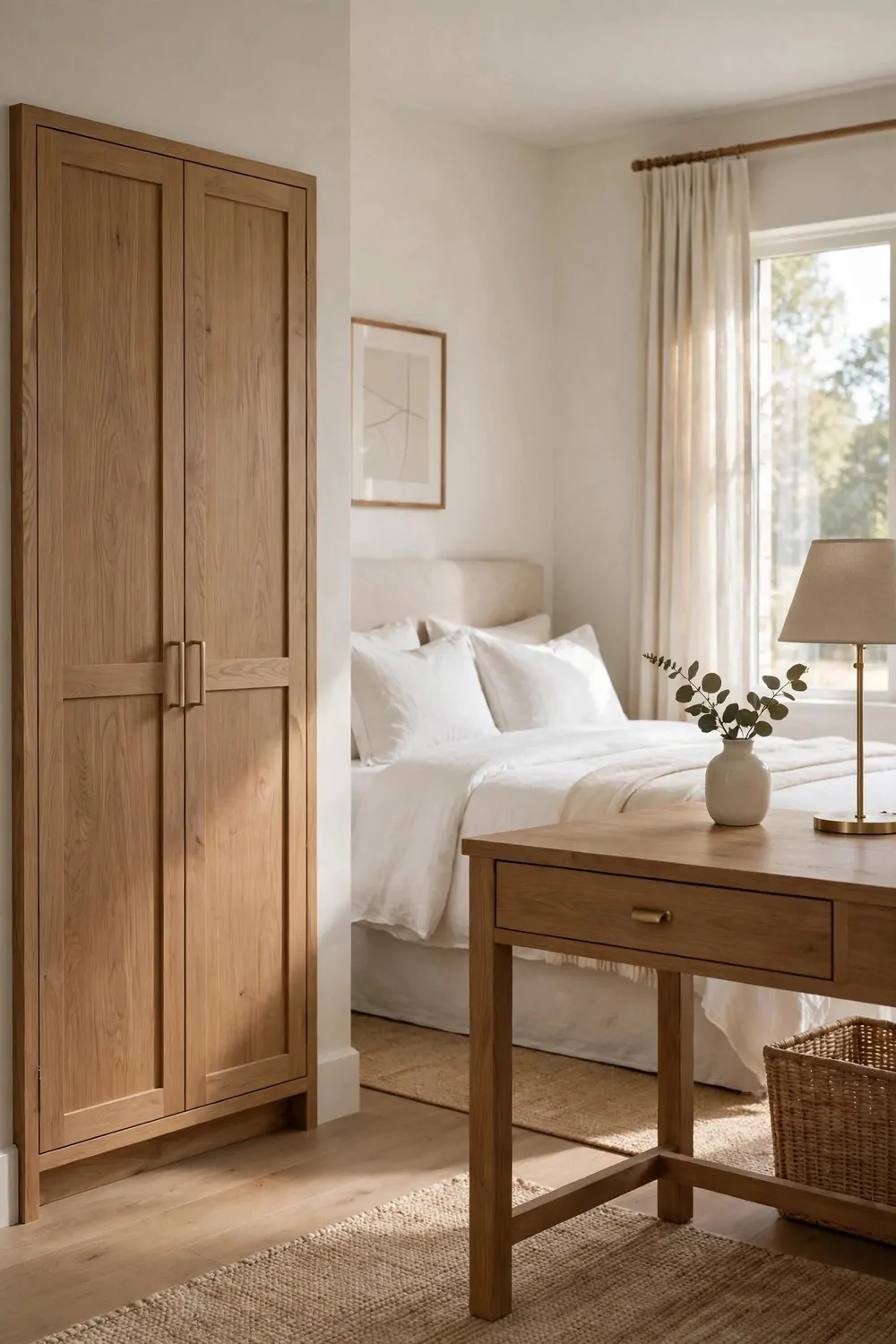
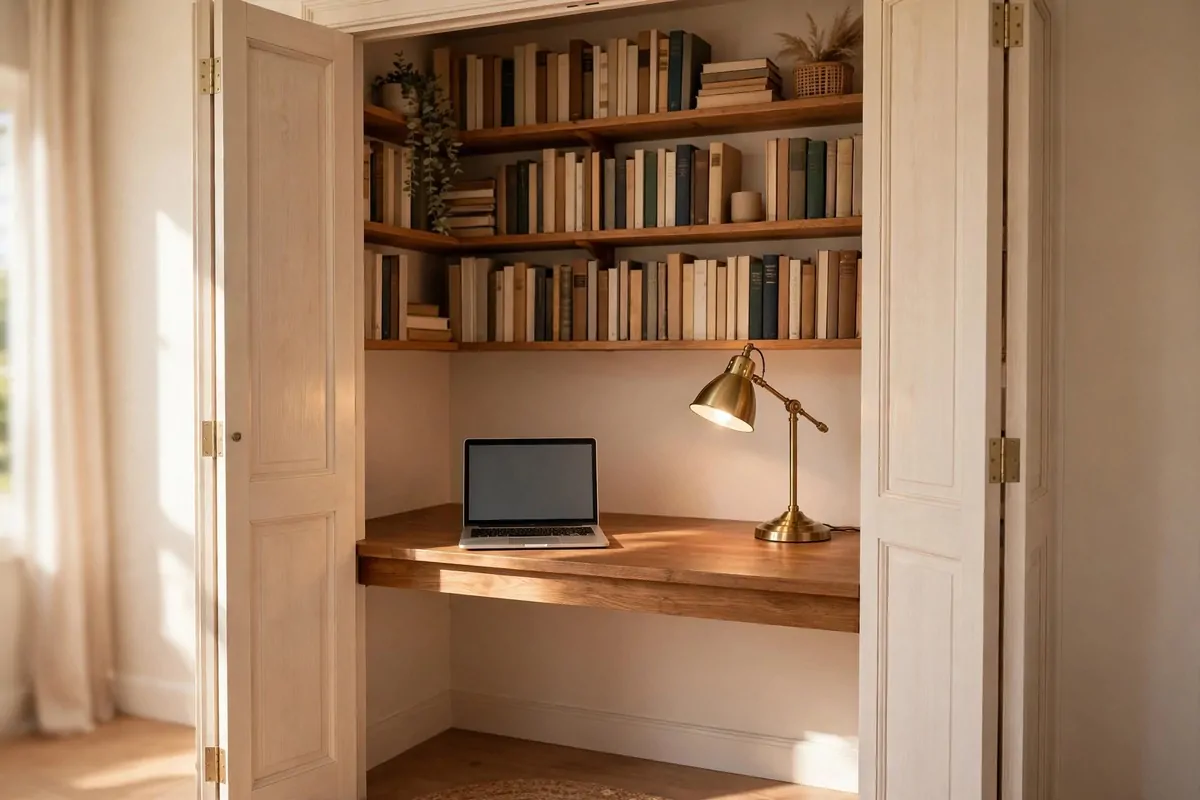
Closed storage hides the work, and hiding the work is what makes a master bedroom feel luxe. An office you can see from the bed is an office that never lets you rest.
My desk has one drawer, and my papers live in a cupboard with a door. At five in the evening, I slide the papers into the drawer, shut the cupboard door, and the room is a bedroom again. Nothing on show. Nothing staring at me while I try to sleep.
Give every work thing a closed home. Papers in a drawer. Cables in a box with a lid. The printer on a shelf behind a cupboard door. If it has no closed home, it will end up on the desk, and the desk will look like a mess by Friday.
Pick storage with doors, not open shelves, for the work side of the room. Open shelves are fine for books and a plant. Open shelves full of folders and chargers look like a stock room, and a stock room is not luxe.
Keep one drawer for the day’s work only. When the day ends, that drawer holds the notebook and the pen, and nothing else. A drawer with one job is a drawer you can trust. A drawer with everything in it is a drawer you fear.
Shut the doors every evening. It takes ten seconds. An open cupboard in a small room looks messy, and it pulls your eyes away from the bed. Close the door, and the room feels calm again.
Keep the cupboard tidy inside too. A cupboard with a clear split and plain boxes stays tidy on its own. A cupboard where everything is tossed in will spill out onto the desk by Thursday.
Try this one if your desk is covered in things you meant to file. One drawer, one cupboard door, and the work disappears at five.
The Dressing-Table Desk
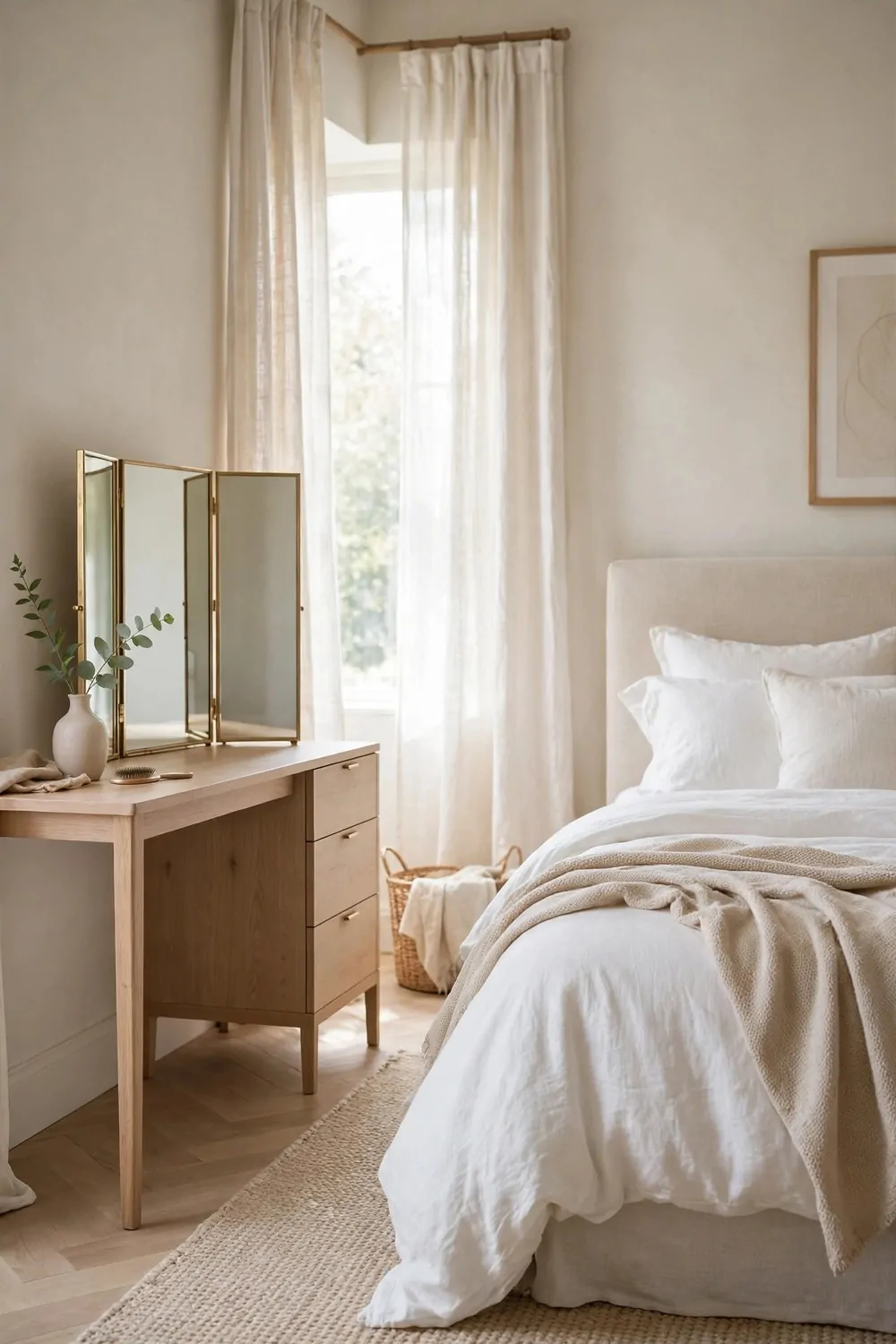
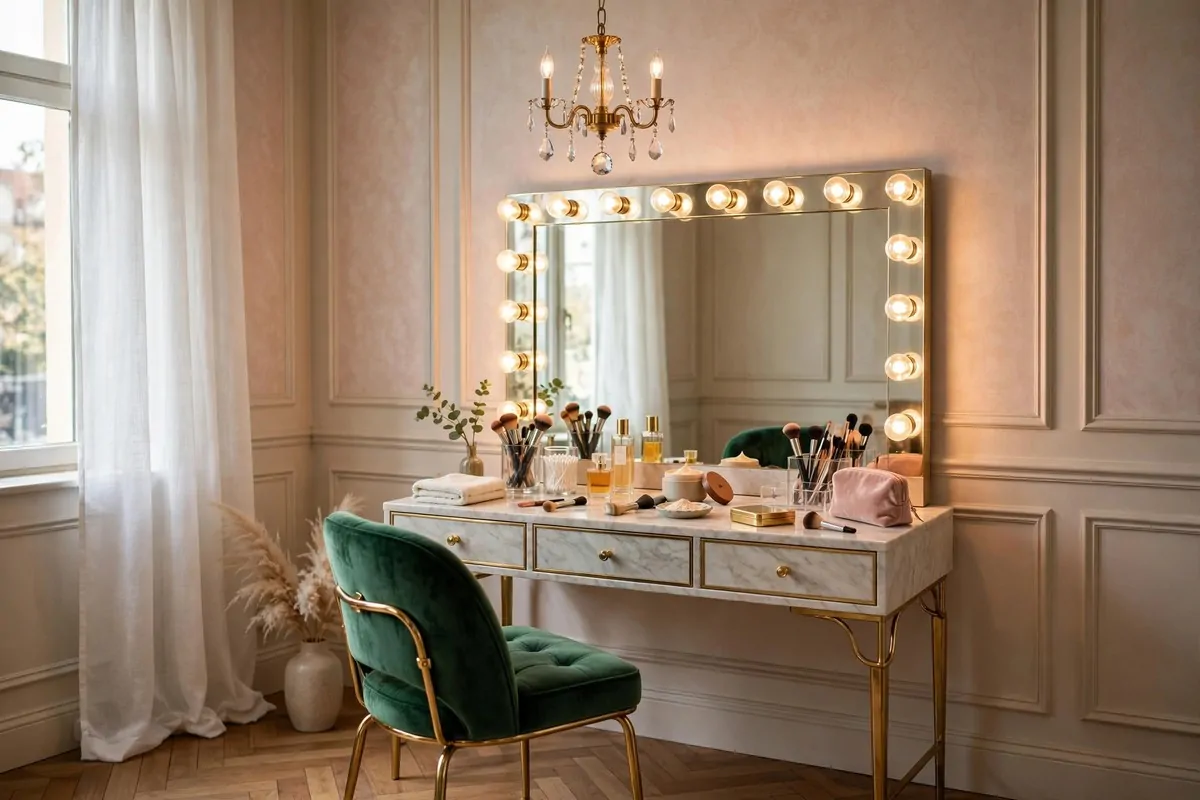
A dressing-table desk does two jobs in a master bedroom, and it does them both beautifully. By day it is your desk. By morning it is the place you sit to get ready. One piece, two jobs, and the room stays luxe.
My dressing-table desk is a slim wooden table with a mirror above it and one shallow drawer. In the morning I sit there with a brush and a cup of tea. In the day I slide the laptop onto it and work. The mirror folds flat when I work, so I never catch my own face in the middle of a video call.
Pick a table that is slim and plain. A dressing table should look light, not heavy. A big chunky desk in a bedroom feels like an office that moved in by mistake. A slim table feels like it always lived there.
Put the mirror on the wall above it, or use a small standing mirror you can fold flat. A mirror that stays up while you work will show your screen and your face, and that is no good. A mirror that folds away lets the table change jobs in two seconds.
Keep one drawer for both jobs. Hair things on one side, pens and a notebook on the other. A small tray inside the drawer keeps them apart. Two jobs, one drawer, no mess.
Put a small vase with one stem on the table. A vase makes a dressing table feel finished, and it makes a desk feel soft. One stem, not a bunch. A bunch crowds a slim table.
Keep the mirror clean. A mirror with fingerprints makes the whole table look tired. One quick wipe in the morning, and the table looks new again.
Try this one if your bedroom has no room for a desk and a dressing table. One slim table, two jobs, and the room feels like it was planned that way.
Symmetry: Two of Everything
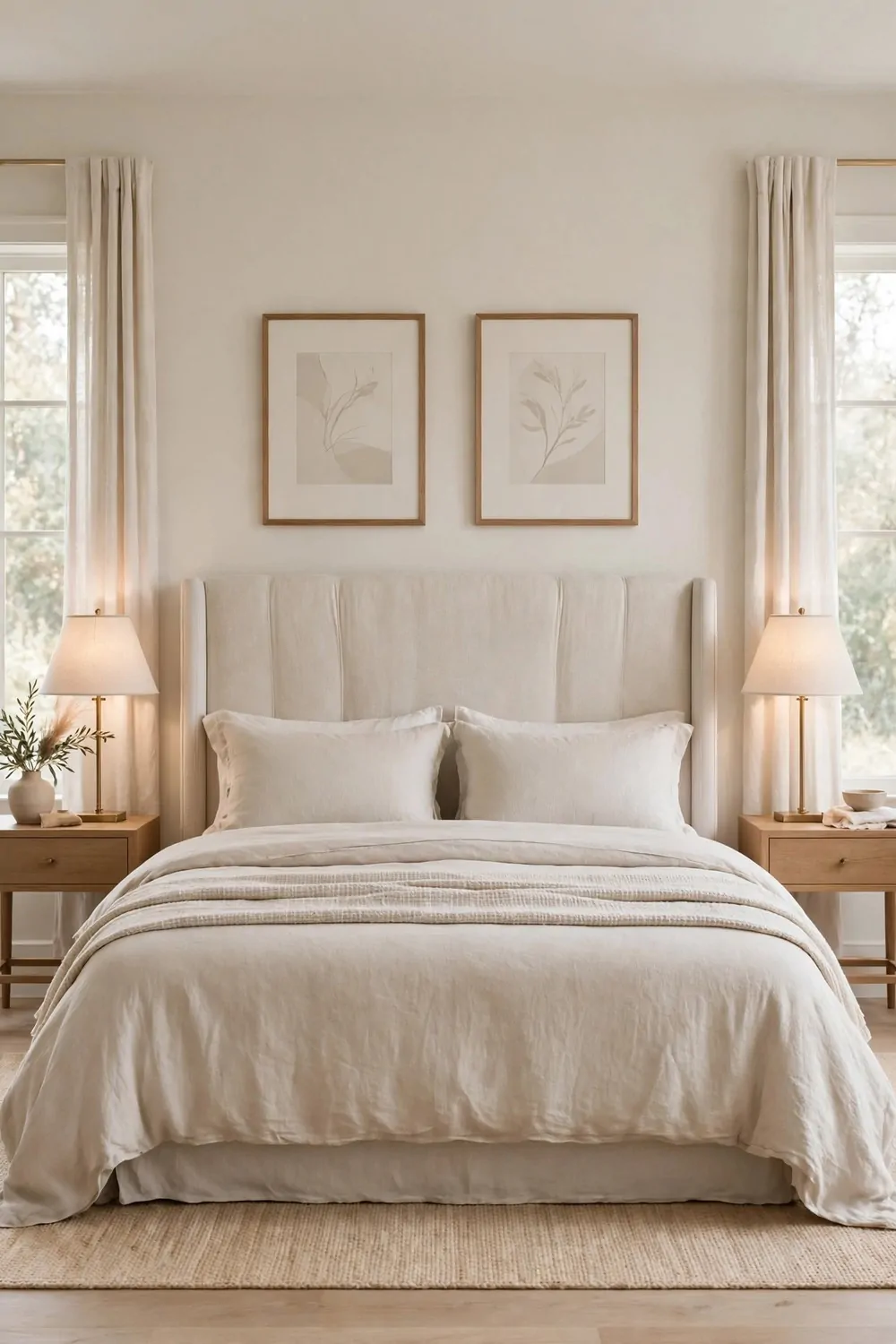
Symmetry makes a master bedroom feel luxe. Two lamps, two pictures, two cushions, one on each side. The human eye loves balance, and a balanced room feels calm the second you walk in.
My bed has two bedside tables, one on each side. Each one holds a small lamp, and the two lamps match. Each one holds a small book. Nothing fancy. But the room looks settled, like it knows what it is doing.
Put two matching lamps on the two bedside tables. They do not have to be expensive. They just have to match. Two different lamps on two tables make the room feel like a jumble sale.
Hang two matching pictures, one on each side of the bed, or one on each side of the desk. Two frames the same size, the same wood, hung at the same height. The wall stops wobbling and starts looking finished.
Use two cushions on the bed, not one and not five. Two cushions in the same pale colour, one on each side. Five cushions turn the bed into a shop display. One cushion looks lonely. Two is the luxe number.
Keep the desk in the middle of its wall, not pushed into a corner. A desk centred on the wall, with a picture above it and a lamp on one side, looks like the wall was built for it. A desk shoved into a corner looks like it is hiding.
Step back to the door and look at the room once the pairs are in place. If both sides of the bed match and both sides of the desk match, the room will feel settled from the doorway. If one side is still off, fix that side first.
Try this one if your room feels a little bit off and you cannot say why. Match things in pairs, and the room will settle.
A Tray and a Vase on the Desk
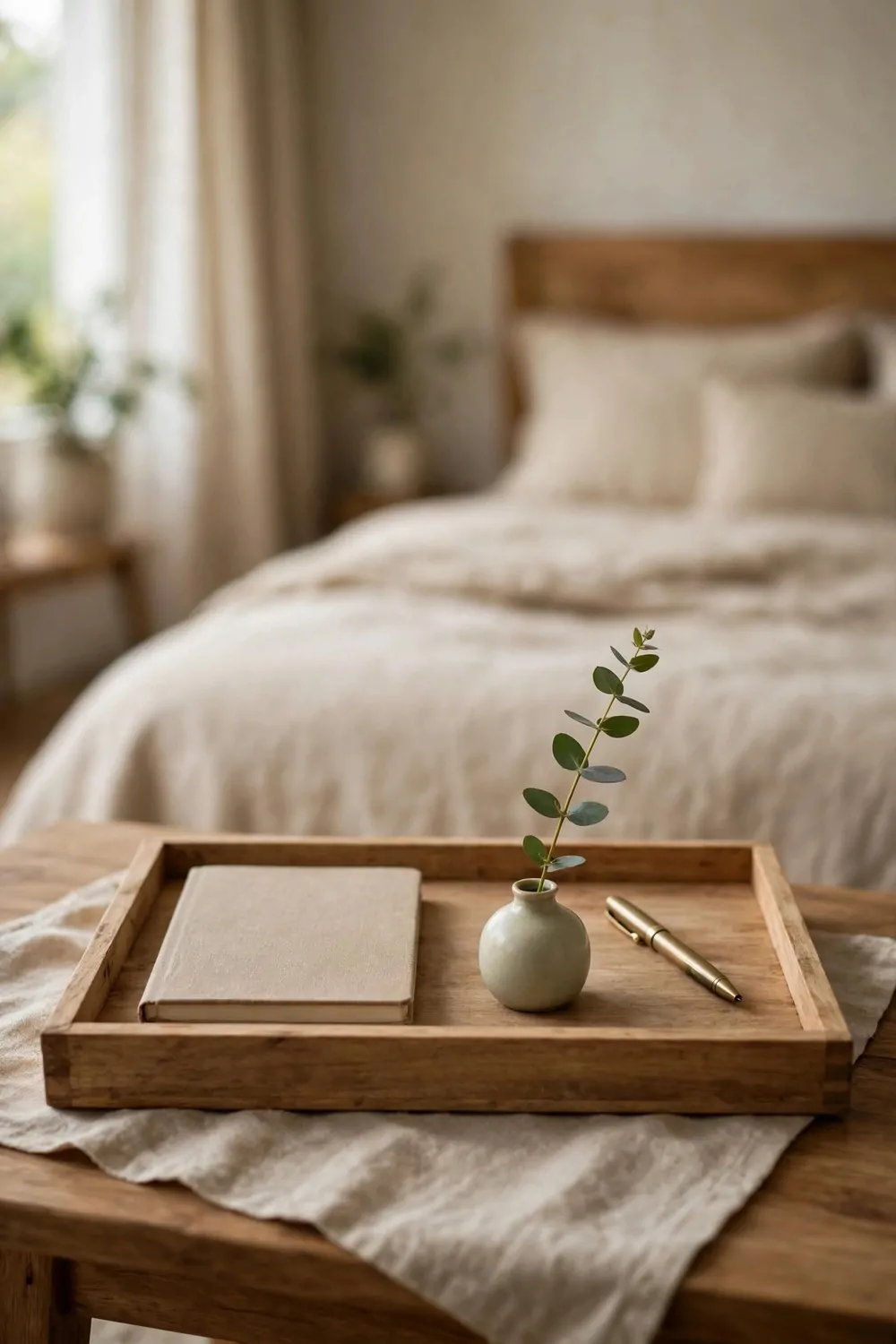
A tray and a vase on the desk make the desk feel luxe. Two small things, and the desk stops looking like a work surface and starts looking like a place someone cares about.
My tray is a plain wooden one, just about the width of my notebook. It holds my pen, my phone, and one small notebook. The vase sits beside it with one green stem. That is all. A tray and a vase. The desk looks finished, and I can still work on it.
Pick a tray in the same wood family as your desk. A pale tray on a pale desk looks like it grew there. A bright coloured tray would steal your eyes away from your work all day long.
Give the tray one job. It holds the small things that would otherwise scatter across the desk. A pen. A phone. A pair of glasses. When the small things have a home, the desk top stays clear.
Here is what lives on my tray, and nothing else.
- One pen that writes well.
- My phone, face down while I work.
- One small notebook, open at today’s page.
- Nothing else. The tray stays shallow on purpose.
Put one stem in the vase, not a bunch. A single green stem is calm. A big bunch is loud, and it blocks your view. Change the stem once a week, and the desk always feels fresh.
Keep the tray on the same side of the desk every day. A tray with a fixed home becomes part of the desk, like the lamp. A tray with no fixed spot never really earns its keep.
Try this one if your desk looks like a pile of things with no home. One tray, one vase, and the desk goes quiet.
The Quiet Corner for Reading
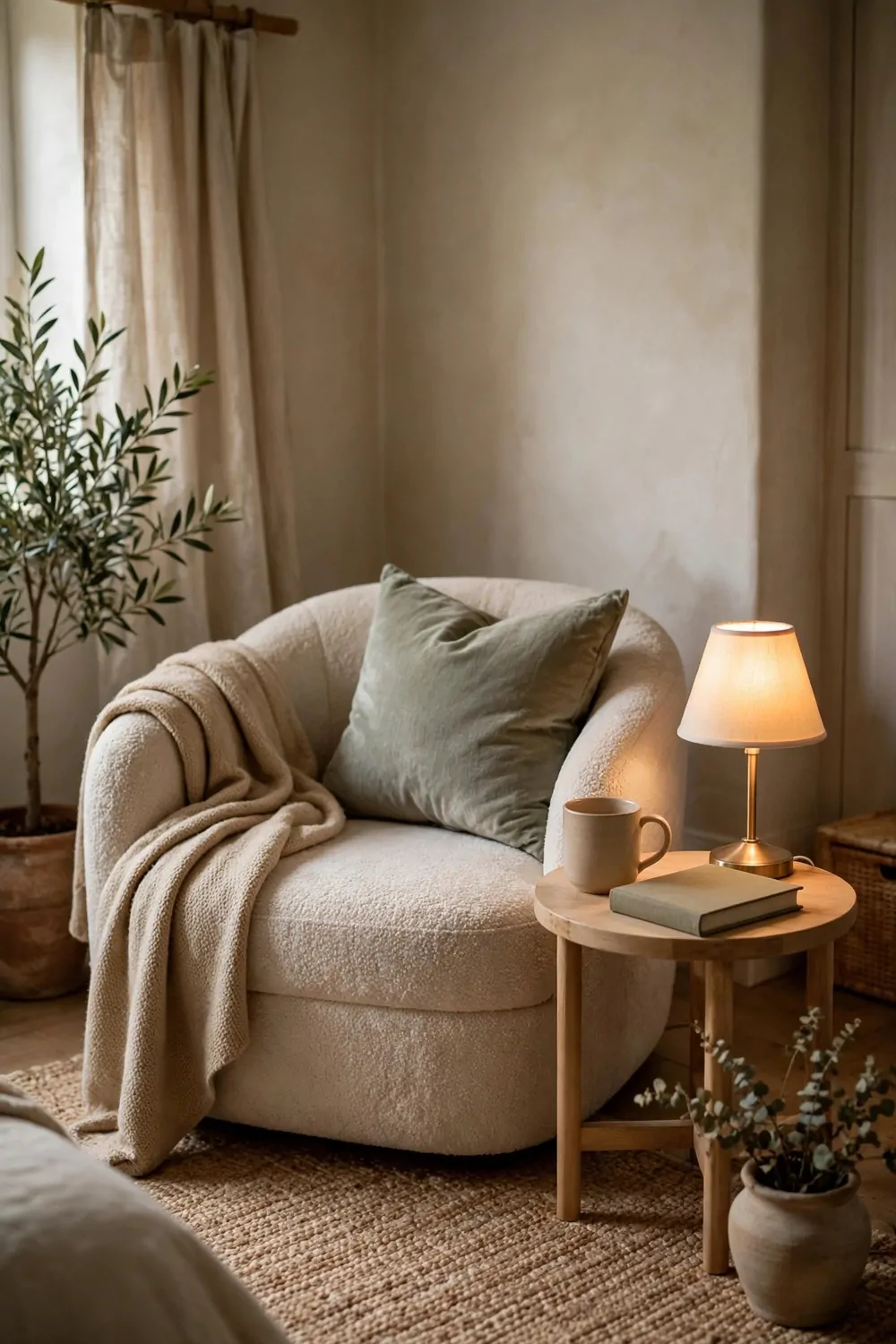
A quiet corner for reading makes a master bedroom feel luxe. Every grown-up bedroom needs one chair that does nothing but wait for you to sit down with a book.
My quiet corner is the far end of my bedroom, away from the desk. It holds one soft chair, one small lamp, and a tiny table for a mug. No desk. No screen. Just a place to sit for twenty minutes before bed.
Pick the corner farthest from the door. The far corner is where nobody walks past. It is where the room is quietest, and quiet is what a reading corner needs most.
Put one chair there and one lamp beside it. A chair with a soft cushion, and a lamp with a warm bulb. The chair is for sitting. The lamp is for reading. Nothing else needs to live in that corner.
Keep a small stack of books on the tiny table. Two or three books, not ten. A tall stack looks like a chore. A small stack looks like a choice.
Use the corner at the same time every evening if you can. Twenty minutes before bed, no phone, just a book. The corner becomes a habit, and the habit becomes the best part of the day.
Keep the mug on the tiny table, not on the chair arm. A mug on the chair arm will fall, and a fall in a quiet corner is the loudest sound in the house.
Try this one if your bedroom has a corner that does nothing but hold dust. One chair, one lamp, and the corner starts working.
Morning Light for Work, Evening Light for Rest
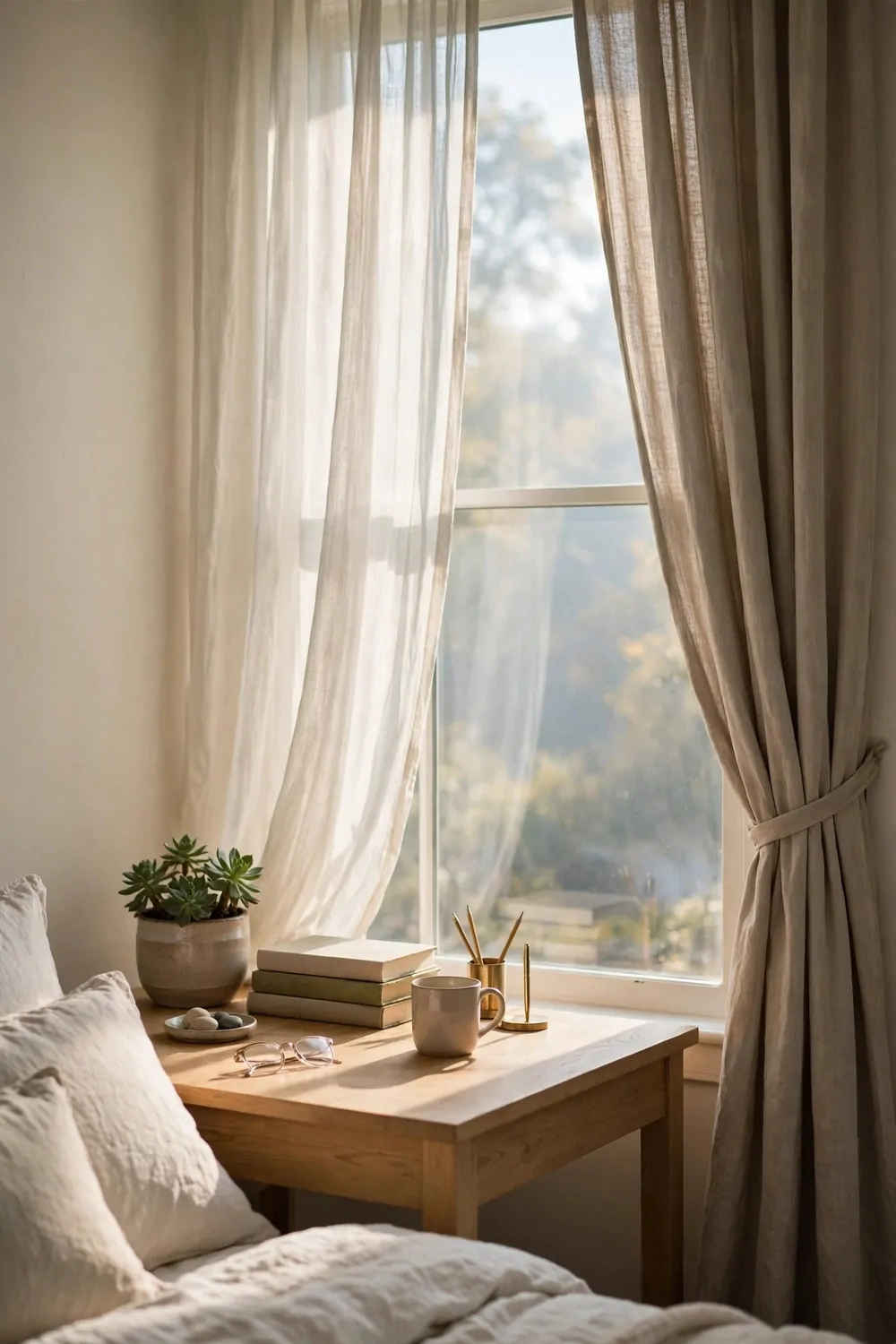
Morning light for work and evening light for rest is the luxe way to use one window. Work loves bright morning light. Sleep wants soft evening light. One window can give you both if you dress it right.
My window wears two layers. A thin pale curtain lets the morning in for work. A thicker curtain pulls across at night and softens the room for sleep. Two layers on one window, each with its own job. It is the same trick as the rest of the room. One thing, two jobs.
Hang the thin curtain close to the glass. It hangs there the whole day. It gentles the light without shutting it out, so your work corner stays bright but never harsh.
Hang the thicker curtain on a second rail, a little further into the room. Pull it across in the evening, and the room goes soft and warm. Your brain gets the message that work is over, even before you close the laptop.
Set the desk close to the window so the morning light lands on your work. A desk in a dark corner leans on a lamp all day, and that tires your eyes out fast. Morning light costs nothing, and no lamp beats it.
Keep the bed off the window wall when you can. A bed right under the window gets the morning sun in the face, and you wake up too early. A bed across the room wakes up soft and slow.
Wash both curtain layers when the season turns. Clean curtains smell lovely, and the cloth drops softer once it has been washed. A room with clean curtains feels cared for, like someone loves living there.
Try this one if your room feels too bright in the morning and too flat at night. Two curtain layers, and the window does both jobs without arguing.
Fresh Bedding, Tidy Desk: The Daily Reset
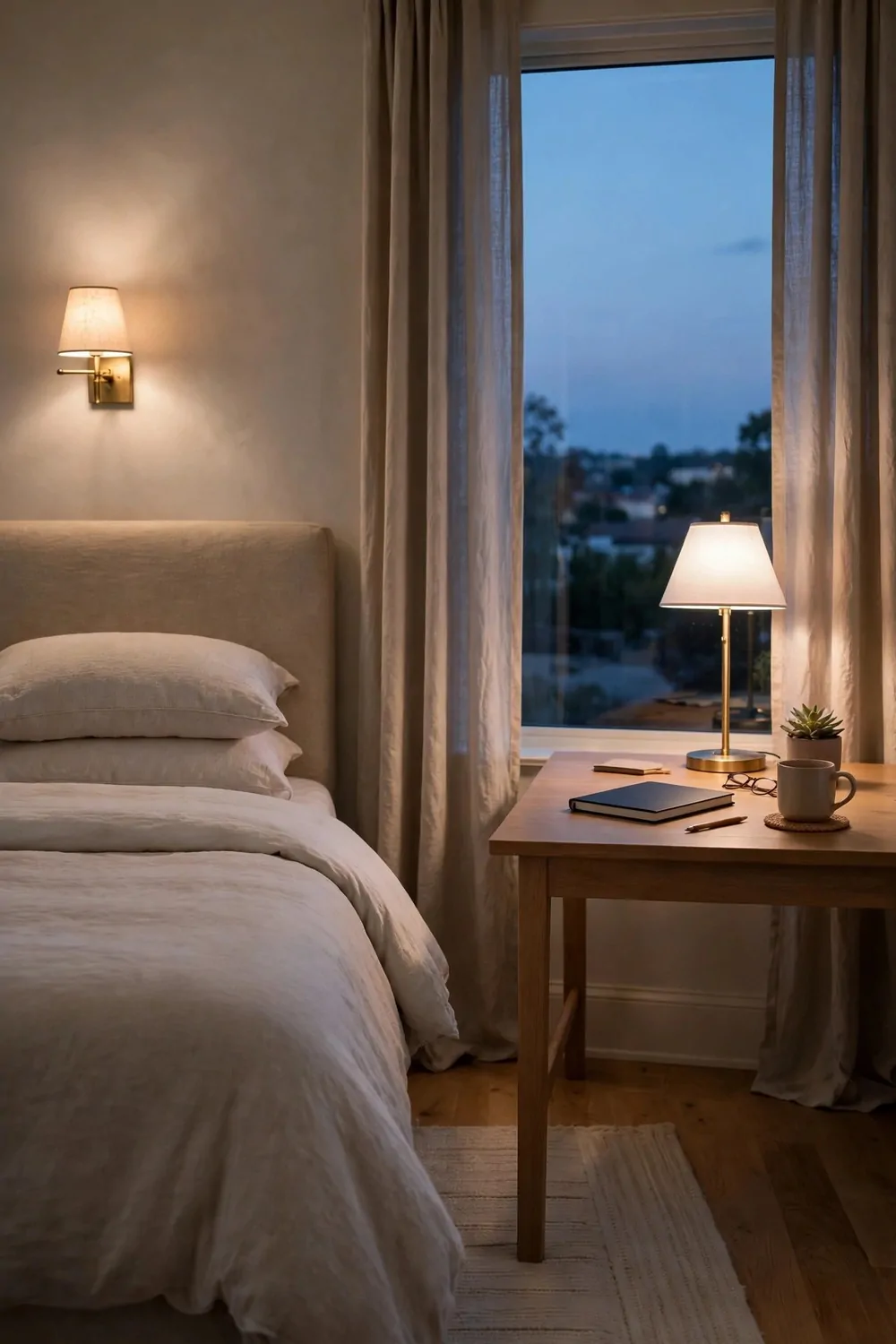
A daily reset keeps a master bedroom office feeling luxe. Five minutes in the evening, and the room stays gentle. Skip it for a week, and the room stops feeling luxe at all.
My reset takes five minutes from start to finish. I make the bed. I clear the desk. I put the pen back in the tray. I shut the laptop and slide the chair under the desk. Five minutes on, the room looks just like it did when I first set it up that morning.
Make the bed first, before you touch the desk. A made bed makes the whole room feel calm. Two minutes is all it takes, and the room looks done before the work even begins. An unmade bed makes even a tidy desk look messy.
Clear the desk next. Notebook on the shelf. Pen in the tray. Rinse the mug and put it back in its spot. A clear desk in the evening is a calm desk in the morning, and a calm desk is where good work starts.
Here is the evening reset I follow, step by step.
| Minute | What to do | What it leaves behind |
|---|---|---|
| Minute one | Make the bed, smooth the throw | A bed that looks slept in by no one yet |
| Minute two | Clear the desk, papers into the drawer | A clear desk top |
| Minute three | Chair under the desk, mug rinsed | A tidy work corner |
| Minute four | Curtains half closed, lamps on low | Soft evening light |
| Minute five | Notebook on the bedside table, ready for tomorrow | A calm morning waiting for you |
Do it at the same time each evening. After a week or two, your hands will do it on their own. Done daily, it just becomes part of how the day ends. Done only now and then, it slips away and never sticks.
Keep the reset short. Five minutes is enough. A long reset is one you will give up on by Friday, and a reset you give up on is worse than no reset at all.
Try this one tonight. Five minutes, every evening, and tomorrow morning your room will still feel luxe.
Keep the Middle Open
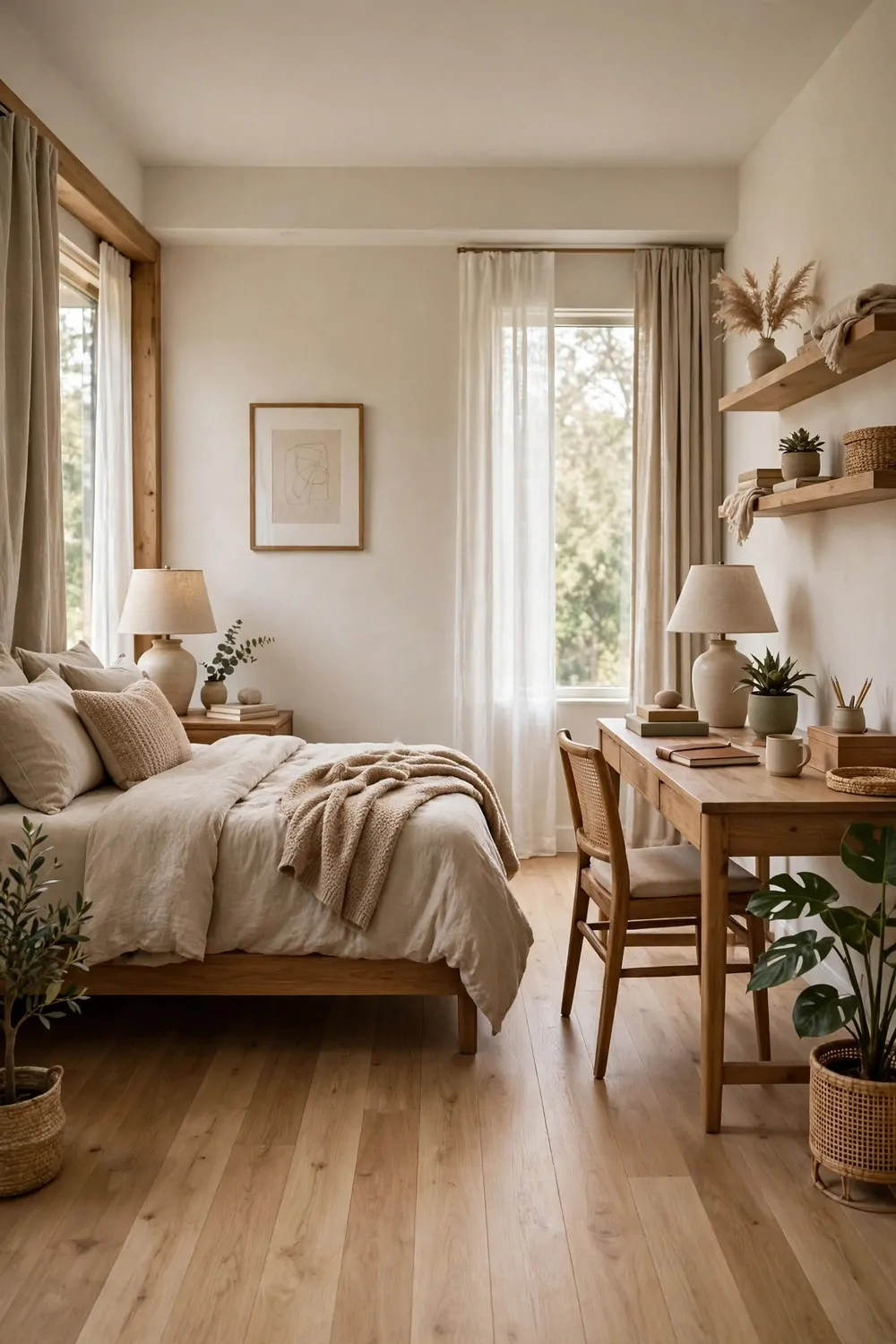
Keeping the middle of the floor open is the last luxe layout rule, and it is the simplest one. A master bedroom with an open middle feels twice as big as the same room with furniture in the middle.
My rule is short. Nothing gets to live in the middle. No bags, no boxes, no shoes, no heaps. Every thing gets a shelf, a hook, or a drawer, and the middle stays free for walking.
Push the big pieces out to the edges. Bed against one wall, desk against the next, cupboard against the third. The open middle is for walking through, not for piling things in. A room with an open middle feels like a room that breathes.
Shoes belong on a tray by the door. Two pairs fit, and that is enough for a master bedroom. The rest live somewhere else in the house, not on the bedroom floor.
Here is the rule for the middle of the floor.
- Bags on hooks.
- Shoes on the tray.
- Papers in the drawer.
- Nothing else on the floor.
Bags hang from hooks by the door. A bag draped over a chair steals that chair. A bag on a hook leaves the chair free for sitting, and the middle stays open.
Tidy things away every night before bed. Five minutes is all it takes, and the room is set for the morning. A tidy floor in the morning makes the whole day feel easier, and an open floor makes the whole room feel luxe.
Try this one first if your room still feels tight even though the furniture fits. Shift one thing off the floor tonight, and watch how the room changes.
A luxe master bedroom office is not a perfect room. It is a room that feels grown up. The desk has a proper spot. The light is layered. The wood matches. The middle is open. Nothing shouts, and nothing hides.
My room says welcome to me in two ways now. In the morning it says, sit down, the light is good, the desk is clear. In the evening it says, the work is away, the bed is made, rest now. One room, two welcomes, and both of them feel calm.
Keep one thing in the room that belongs only to work. A notebook waiting on the desk. A pen in a tray. One thing that tells you this is a real office, not a spare room with a laptop in it.
Keep one thing in the room that is only for rest. A soft throw on the bed. A book on the bedside table. One thing that says, this room is a bedroom first, and the work is a guest here.
Change the bedding once a week, and keep the desk clear every night. Fresh sheets and a clear desk are the two cheapest luxe moves there are. They cost almost nothing, and they change how the room feels every single day.
Try one layout from this list in the next few days. Move the desk, or match the wood, or hang one picture. One change is all it takes, and the room will show you if it suits you.
Keep Reading
If you liked these office in bedroom master layouts, these bedroom office ideas will give you even more ways to make one big room feel rich, calm and easy to work in.
- 17 Small Home Office Guest Room Layouts That Work for Both
- 19 Work Space in Bedroom Ideas That Actually Feel Calm
- 21 Office Area in Bedroom Setups That Keep Work Separate
A master bedroom can hold a real office and still feel luxe. Pick one layout from this list, try it this week, and let your biggest room earn its keep every single day.