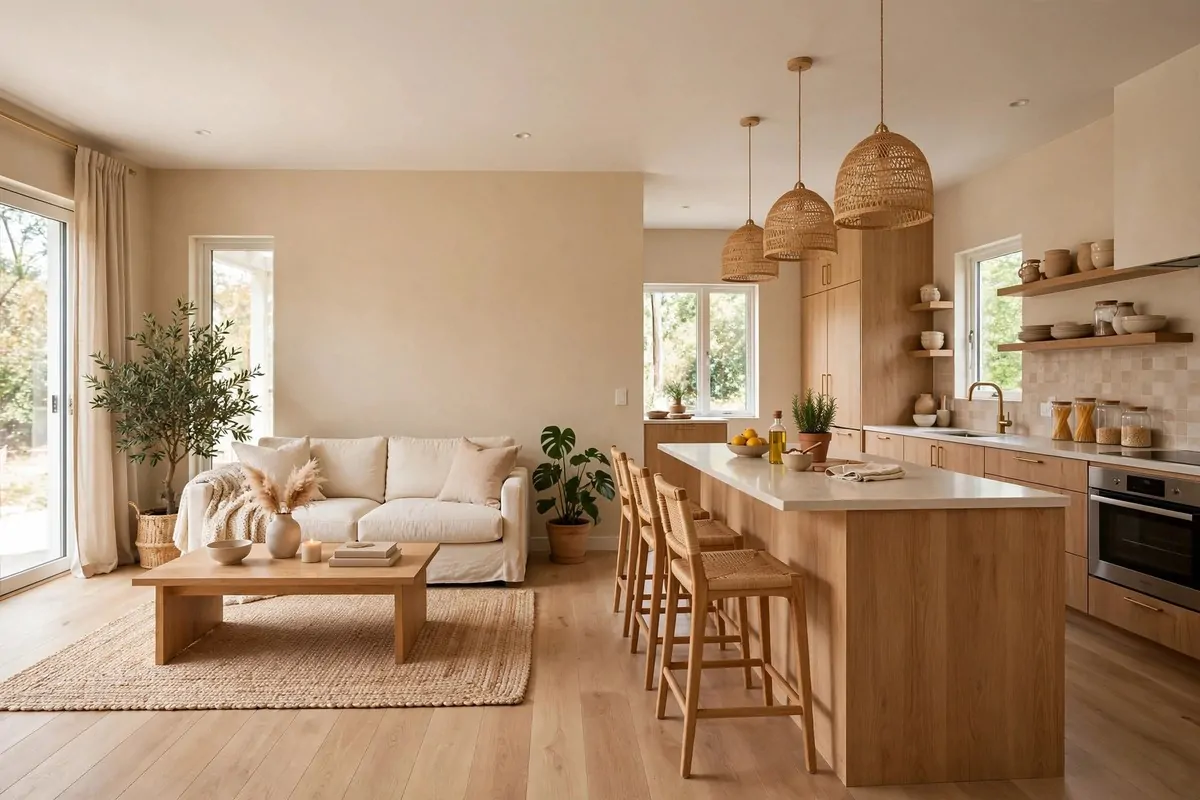
19 Work Space in Bedroom Ideas That Actually Feel Calm

The quietest work I ever did happened on a morning when nothing in my room was asking for my attention. No bright light in my eyes. No pile of papers leaning over. No chair that squeaked. Just a pale room, a clear desk, and a slow hour ahead of me.
My bedroom used to fight me. The desk was jammed in a dark corner. The lamp was too bright. The walls were three different colours, and my eyes never knew where to rest. I worked in that room for months and I always felt a little bit tired before I even started.
Then I changed one thing at a time. Not big things. Quiet things. A pale wall. A softer lamp. A desk with nothing on it except the work in front of me. The room got slower, and my work got better. Calm is not a style. It is a way of letting your brain rest while you work.
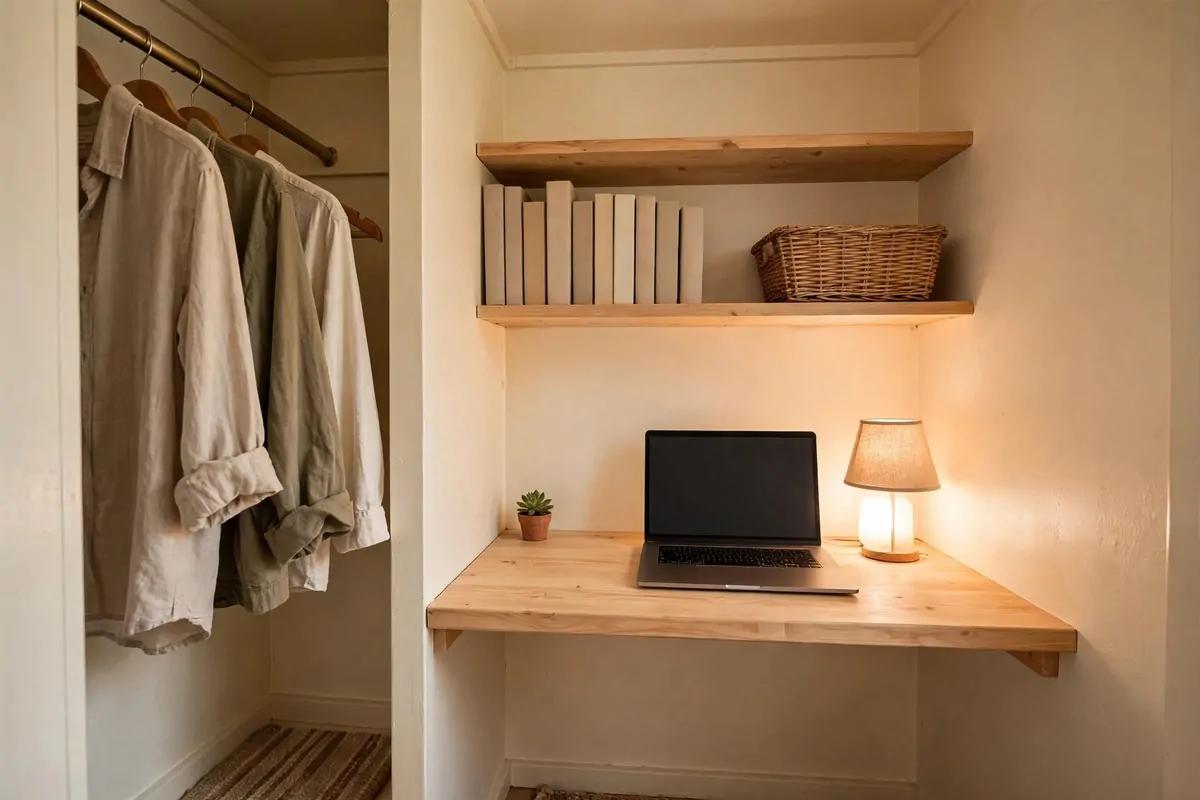
That is what these 19 Work Space in Bedroom ideas are about. They make a small bedroom feel calm, quiet, and gentle, so work feels easier and evenings feel softer. Pick three ideas. Start with the wall colour, because that is where calm begins.
One Pale Colour on Every Wall
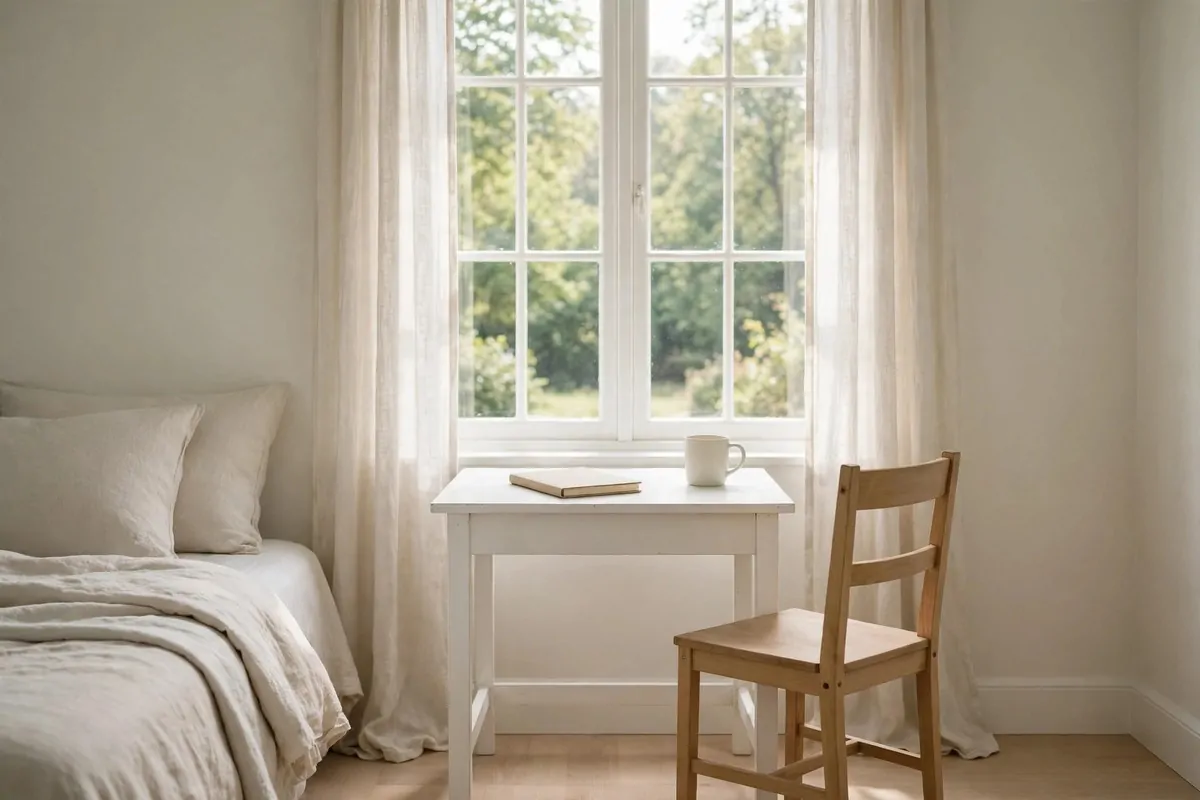
A room with many colours asks your eyes to work hard all day. A room with one pale colour lets them rest.
My walls used to be three colours. Cream on one wall, pale blue on another, and a strip of green I had painted one bored weekend. My eyes jumped from wall to wall and never settled. I painted them all one soft cream, and the whole room went quiet in a good way.
Pick one pale colour you like living with. Pale cream, soft white, or a light grey with a warm hint all work. Paint every wall the same shade. The corners soften, the room feels wider, and your brain stops noticing the walls at all.
Paint the ceiling the same pale colour too, or leave it white. A white ceiling over pale walls keeps the light bouncing around. The room feels bright without feeling sharp.
Keep the door the same colour as the walls if you can. A door in a third colour breaks the calm. A door that matches disappears, and the room reads as one soft space.
Use one tin of paint and do it in a day. One coat in the morning, one coat after lunch, and the room is done. Pale paint dries fast, and the smell is gone by evening.
Stand in the doorway when the paint dries. If the room feels like a deep breath, you got it right. If one wall still shouts, give it one more coat.
This move suits a room that feels noisy even when it is silent. One pale colour everywhere, and the noise goes away.
Try this one first if your bedroom office feels busy before you even sit down. One colour, and the room calms down with you.
A Desk That Faces the Window, Not the Room
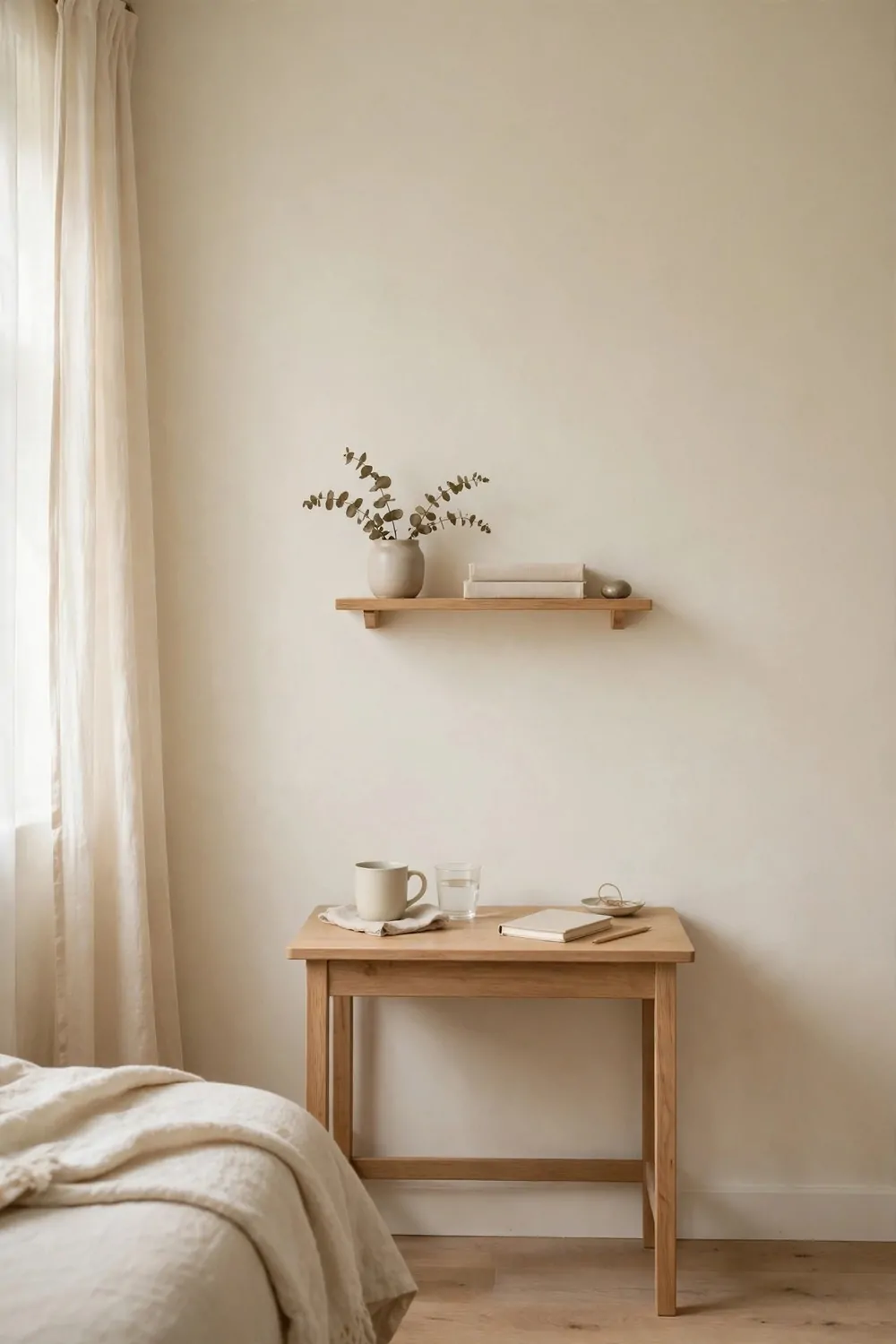
A desk that faces the room shows you everything you have not done yet. A desk that faces the window shows you the sky.
My desk used to face the bed, the wardrobe, and the pile of laundry on the chair. Every time I looked up, I saw jobs waiting for me. I turned the desk around to face the window, and my whole workday slowed down.
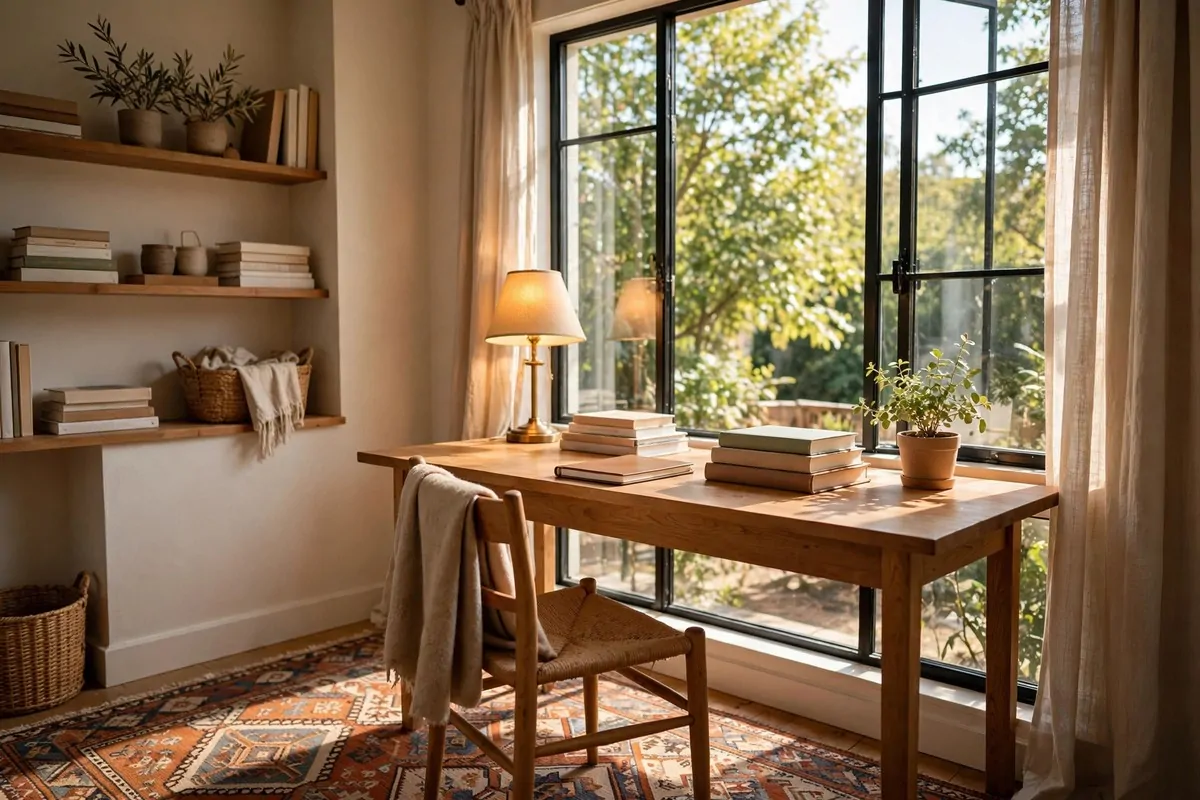
Put your desk so you look out of the window when you sit down. Morning light lands on your notebook. Clouds drift past. Your eyes get a soft view to rest on when they get tired of the screen.
Keep the window clean so the view stays soft. A dusty window makes the light grey and dull. A clean window lets the morning in properly, and the room feels fresh.
Put a small plant on the windowsill if you like. One plant, nothing more. It gives your eyes something green to look at, and green is the colour eyes rest on best.
If the window faces a brick wall, face the desk toward the brightest part of the room instead. Bright does not have to mean a view. It just has to mean soft light on your work.
Move the chair with the desk, so you face the same way. A chair turned sideways lets your eyes wander back to the room. A chair facing the window keeps your eyes where the calm is.
Sit down and test it for one morning. Work for an hour facing the window. Notice how your shoulders feel. Then turn the desk back for an hour and feel the difference.
Try this one if your eyes feel tired by ten in the morning. One turn of the desk, and the whole room feels slower.
Soft Light, Never Bright Light
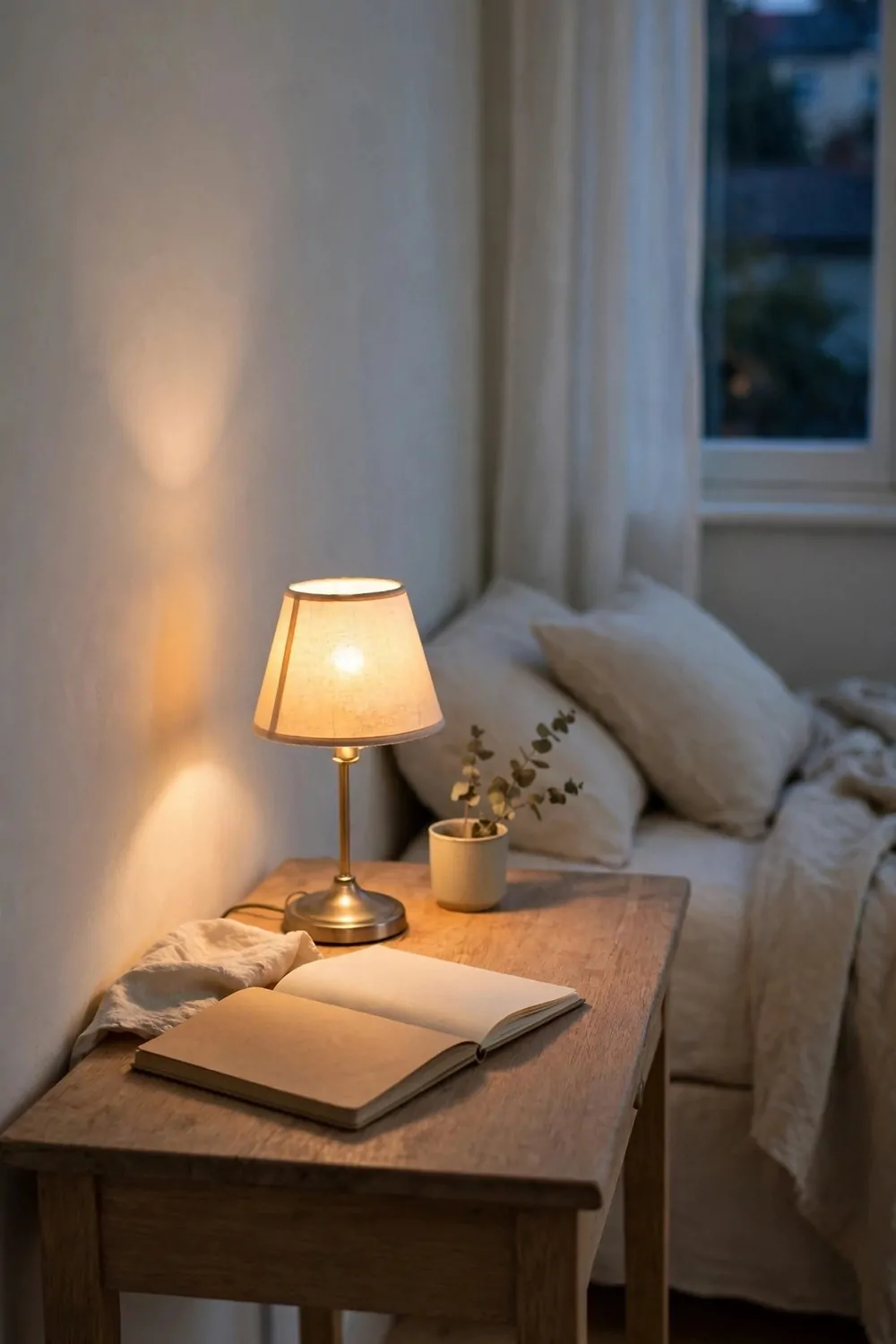
Bright light makes a room feel like a shop. Soft light makes it feel like a quiet morning.
My old desk lamp was bright and white. It threw hard light on my papers and made my eyes ache by lunch. I swapped it for a lamp with a warm bulb and a cloth shade, and the whole corner went soft.
Pick a lamp with a warm bulb, never a bright white one. Warm light feels like evening sun. It makes pale walls glow gently, and it never glares on your screen.
Set the lamp on the opposite side from the hand you write with, so the light falls on the page and your hand never shades it. Your shadow stays out of the way, and your eyes stay relaxed for longer.
Use a cloth shade if you can. A cloth shade spreads the light softly in all directions. A bare bulb throws hard light in one spot, and hard light is the opposite of calm.
Here is how the light in a calm room should change through the day.
| Time of day | Best light | How it feels |
|---|---|---|
| Morning | Soft daylight from the window | Fresh and gentle, easy on the eyes |
| Afternoon | Lamp on low, curtains half open | Steady and quiet, no glare |
| Evening | One warm lamp, rest of the room dim | Soft and slow, ready for rest |
Keep the big ceiling light off while you work. One bright ceiling light washes the whole room flat and spoils the soft mood. Small warm lights do a better job than one harsh one.
Open the curtains wide in the morning and close them halfway in the afternoon. The room follows the sun, and your eyes follow the room.
Try this one tonight. Switch off the ceiling light, switch on one warm lamp, and sit at your desk for ten minutes. Feel how the room changes.
The Clear Desk Rule
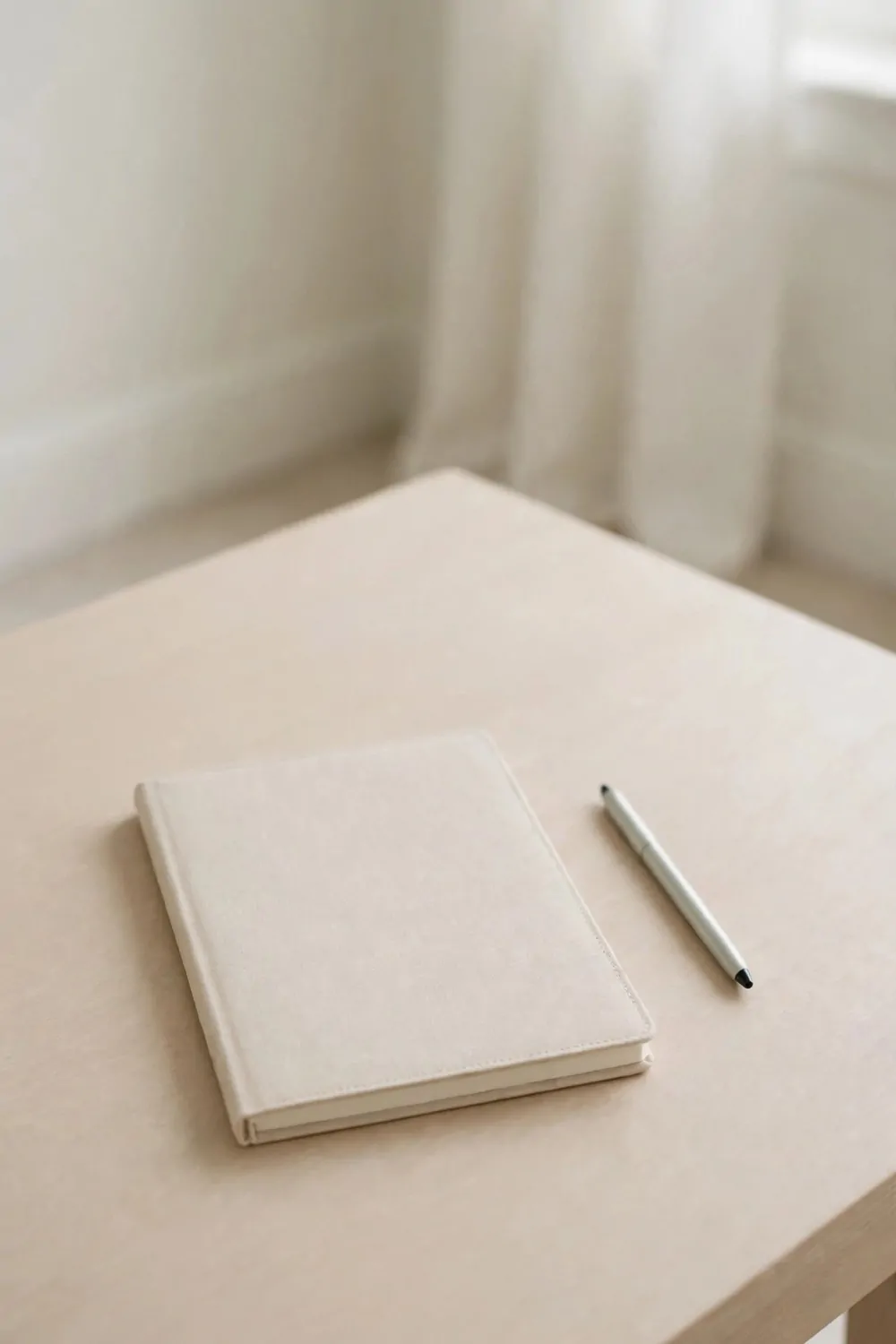
A desk covered in stuff is a brain covered in stuff. A tidy desk is a quiet mind.
My desk used to hold everything. Old mugs. Three pens that did not work. A stack of papers I kept meaning to read. A cable I did not own. I could not find my notebook under it all, and my work felt as messy as the desk looked.
Now my desk holds only the work in front of me. One notebook. One pen. One mug. That is the rule, and I keep it every day. A tidy desk makes for a tidy mind.
Clear the desk completely before you start work. Take everything off it and put it on the bed. Look at the pile. Most of it does not belong on a desk at all.
Put back only what today needs. The notebook for today. The pen that works. The mug for your tea. Everything else goes in a drawer, on a shelf, or in the bin.
Keep a small tray on the desk for the papers in progress. One tray, one neat pile, and the papers stay in one place. A tray is a home for paper. A desk top is not.
At the end of the day, clear the desk again. Notebook on the shelf. Pen in the jar. Mug rinsed and set back where it lives. A clear desk in the evening is a calm desk in the morning.
If papers keep landing on the desk, give them a home somewhere else. A drawer, a shelf, a folder in the cupboard. Paper with no home always lands on the desk.
Give this one a go tomorrow at breakfast. Clear the desk, put back only three things, and work for one hour. Notice how much lighter the hour feels.
One Plant, One Mug, Nothing Else
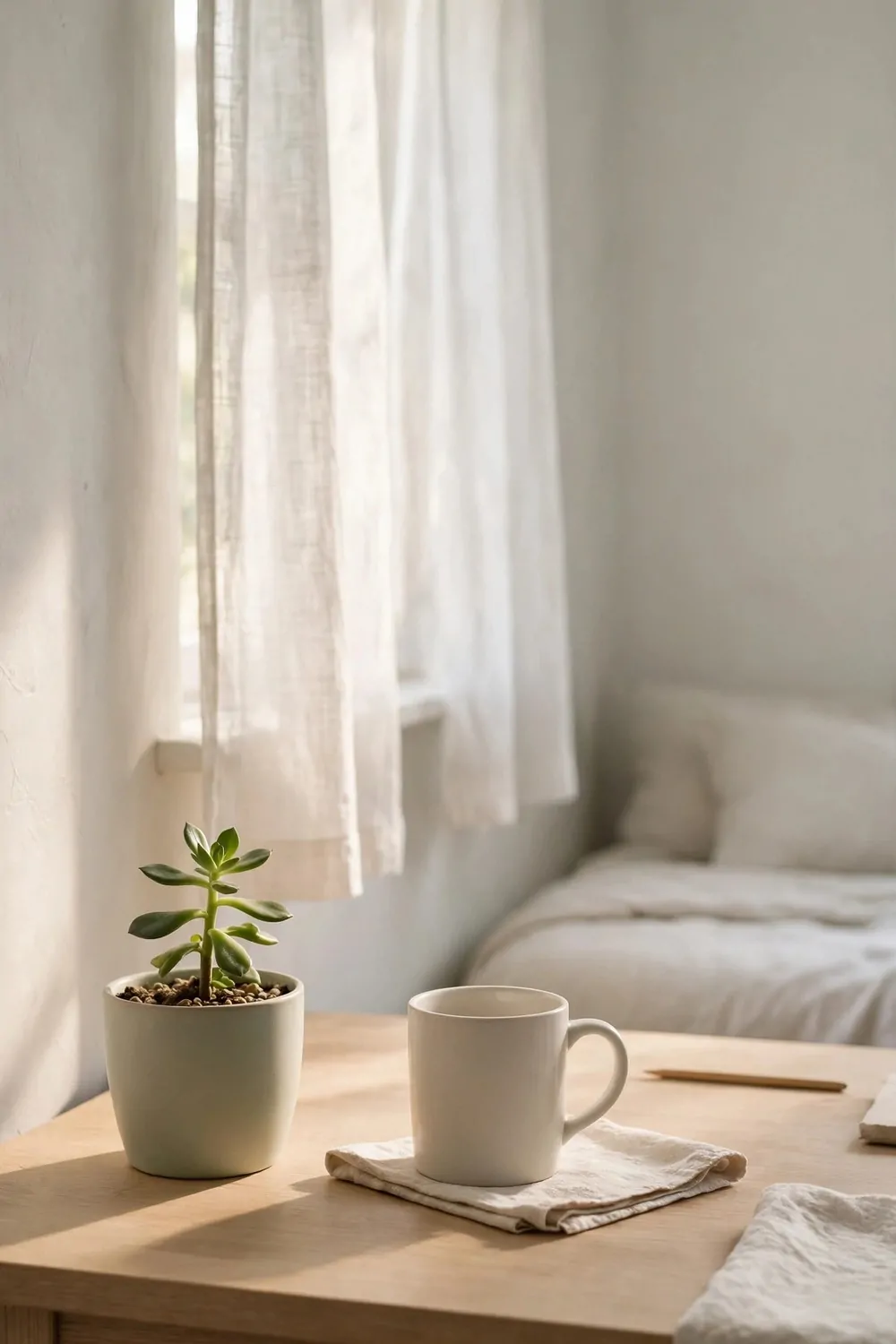
A desk with ten small things on it looks busy. A desk with two small things on it looks calm.
My desk used to hold a forest of little things. A plant, a candle, a photo frame, a tiny clock, a stone from a beach, a cup full of pens. Each one was nice on its own. Together they shouted.
Now my desk holds one plant and one mug. The plant is small and green. The mug is plain and cream. Two things, and the desk breathes.
Pick one plant for your desk. A small one in a plain pot. It should sit in the corner, out of the way of your notebook. One green thing is enough to make a desk feel alive.
Pick one mug for your desk. Plain, in the room’s main colour. It holds your tea while you work, and it goes back to the kitchen when the day ends. One mug, one job.
Take everything else off the desk and find it a new home. The photo frame goes on the shelf. The candle goes on the bedside table. The clock goes on the wall. Each thing gets one spot, and the desk gets its calm back.
Water the plant once a week, always on the same day. A little water is plenty. A plant that gets too much love drowns, and a plant that gets too little dries out. Once a week is just right.
Wash the mug every evening before you leave the desk. A clean mug in the morning says the day starts fresh. A dirty mug left overnight says yesterday never ended.
Try this one if your desk looks like a shop shelf. One plant, one mug, nothing else, and the desk goes quiet.
A Chair You Can Sit In for Hours
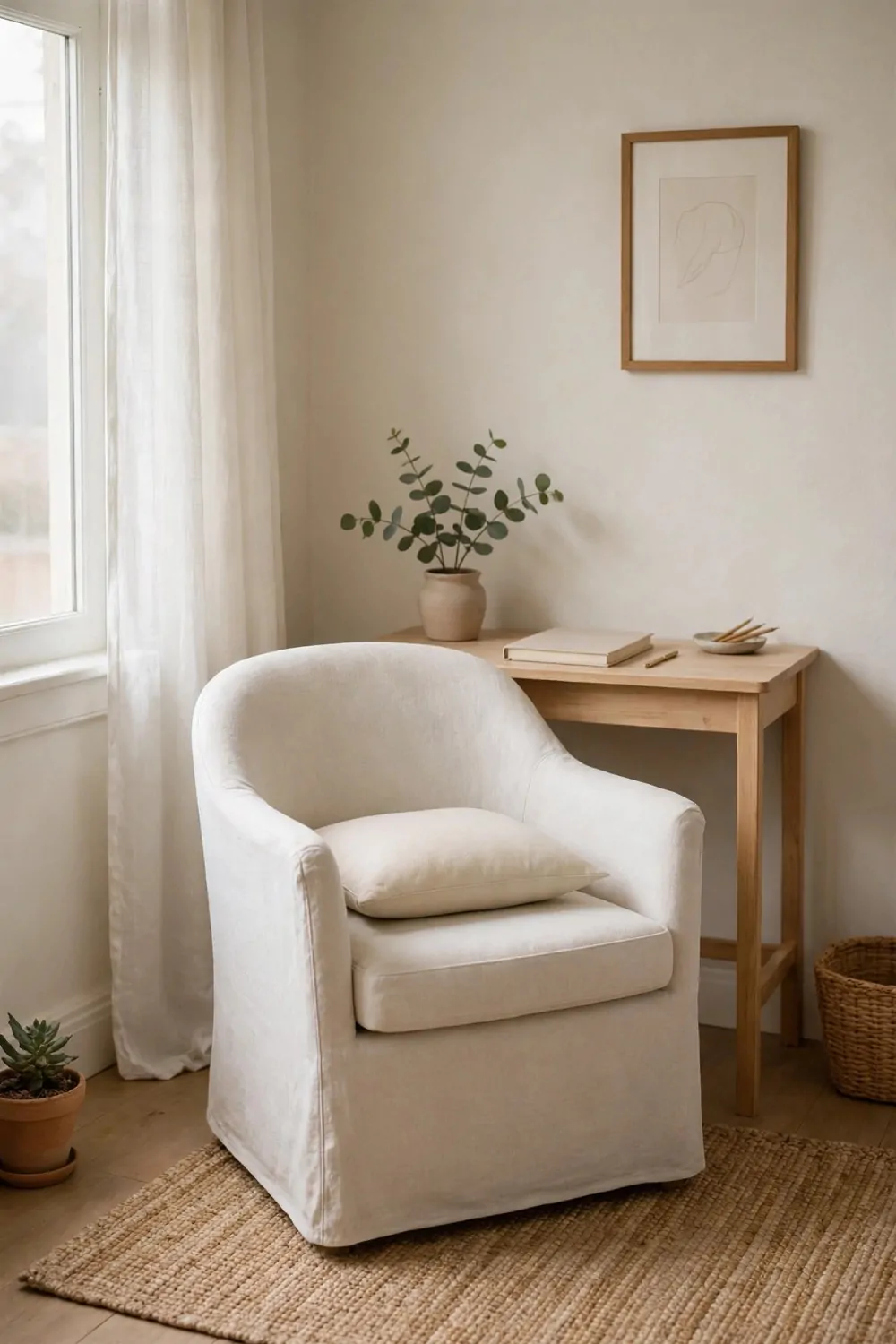
A chair that hurts your back makes every hour feel long. A chair that fits you makes the hours feel short.
My old chair was hard and low. My knees ached by eleven. My shoulders ached by two. I blamed my work for the tired feeling, but it was the chair all along.
Pick a chair with a straight back and a seat that fits you. Sit in it before you buy it, or before you keep it. Your feet should rest flat on the floor. Your knees should bend at a soft angle, not a sharp one.
If the seat is hard wood, lay a thin cushion on it in a pale colour. A plain cushion keeps the chair soft without making it shout. A thick puffy cushion would make you sink, and sinking is not working.
Put the chair right under the desk when the day ends. A chair tucked away says the workday is done. A chair left out in the middle of the floor says the work is still waiting.
Stand up and stretch once an hour. Roll your shoulders. Shake your hands out. A good chair helps a lot, and moving helps even more. Calm work is slow work, and slow work includes standing up.
Oil the chair joints once a year if it squeaks. A squeaky chair breaks the quiet every time you move. One drop of oil on each screw keeps it silent.
In cold months, drape a light throw over the chair back for warmth. It warms the room up, and it gives you something soft on cold mornings. A chair with a throw on it looks lived in, not showroom perfect.
Try this one if your back aches before lunch. One chair that fits, and the whole workday feels gentler.
Quiet Sounds Only
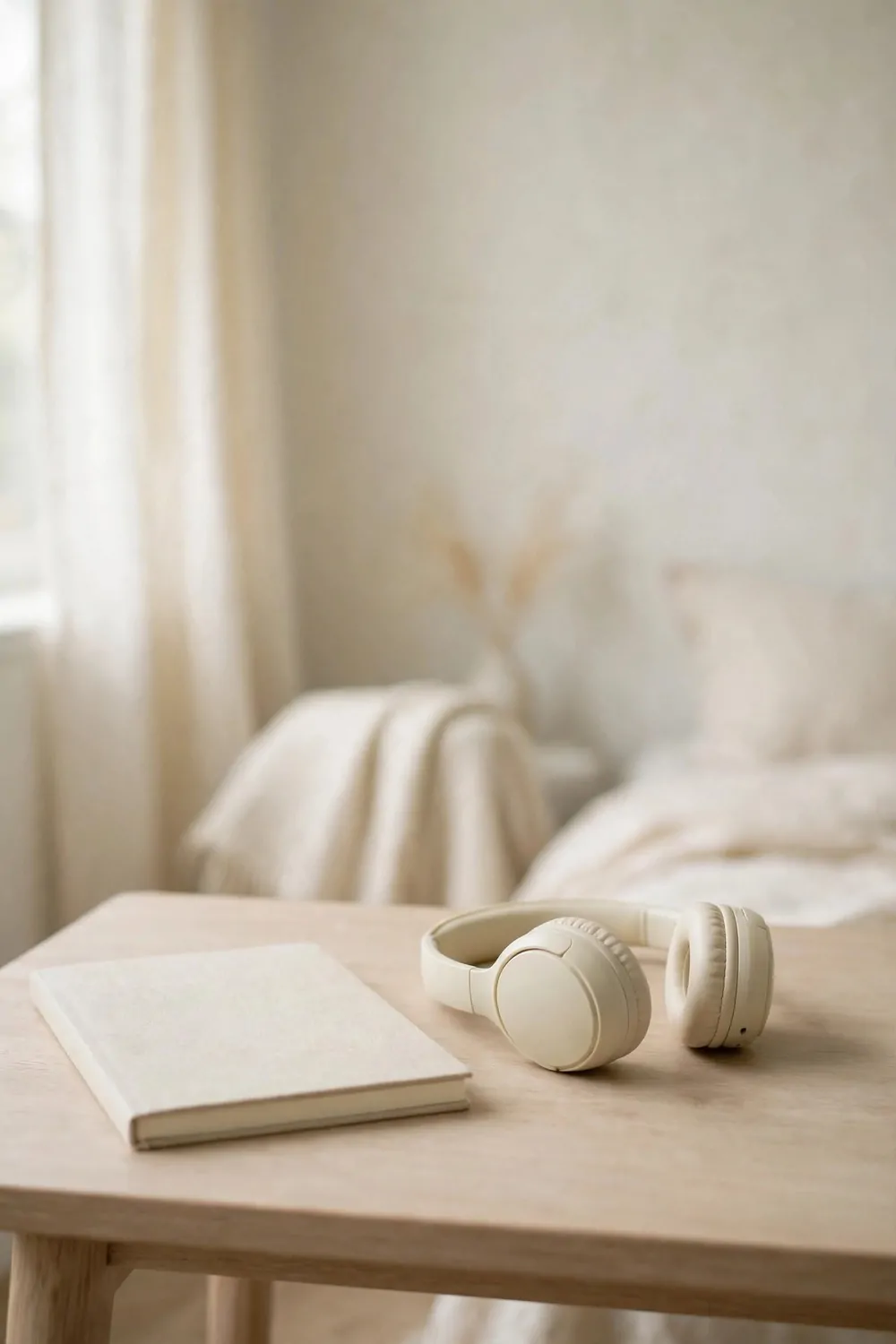
A calm room is a quiet room. Loud sounds break the calm faster than anything else.
My bedroom office used to hum. The laptop fan whirred. The phone buzzed every few minutes. A radio played in the next room. I thought I was used to it, but my shoulders were up around my ears all day.
Now my work hours are quiet. The phone stays on silent. The radio stays off. The only sounds are the soft click of my keyboard and the kettle in the kitchen.
Put your phone on silent when work starts. Not vibrate. Silent. A phone on vibrate still buzzes against the wood, and a buzz is still a sound that pulls your brain away.
Close the door while you work if you can. A closed door softens the sounds of the house. It tells the house you are working, and it tells your brain the room is yours.
Play soft sounds if silence feels strange. Rain sounds. Gentle piano. Nothing with words. The same soft sound every day becomes part of the calm, like the pale walls.
Keep the laptop fan clean so it stays quiet. Dust makes fans work harder and louder. A quick wipe of the vents once a month keeps the hum down.
Listen to the room for one minute before you start work. What do you hear? A ticking clock is fine. A humming light is not. Fix the hums, and the room goes quiet.
Try this one tomorrow. One quiet hour, phone on silent, door closed, and notice how much further your work gets.
The Slow Morning Start
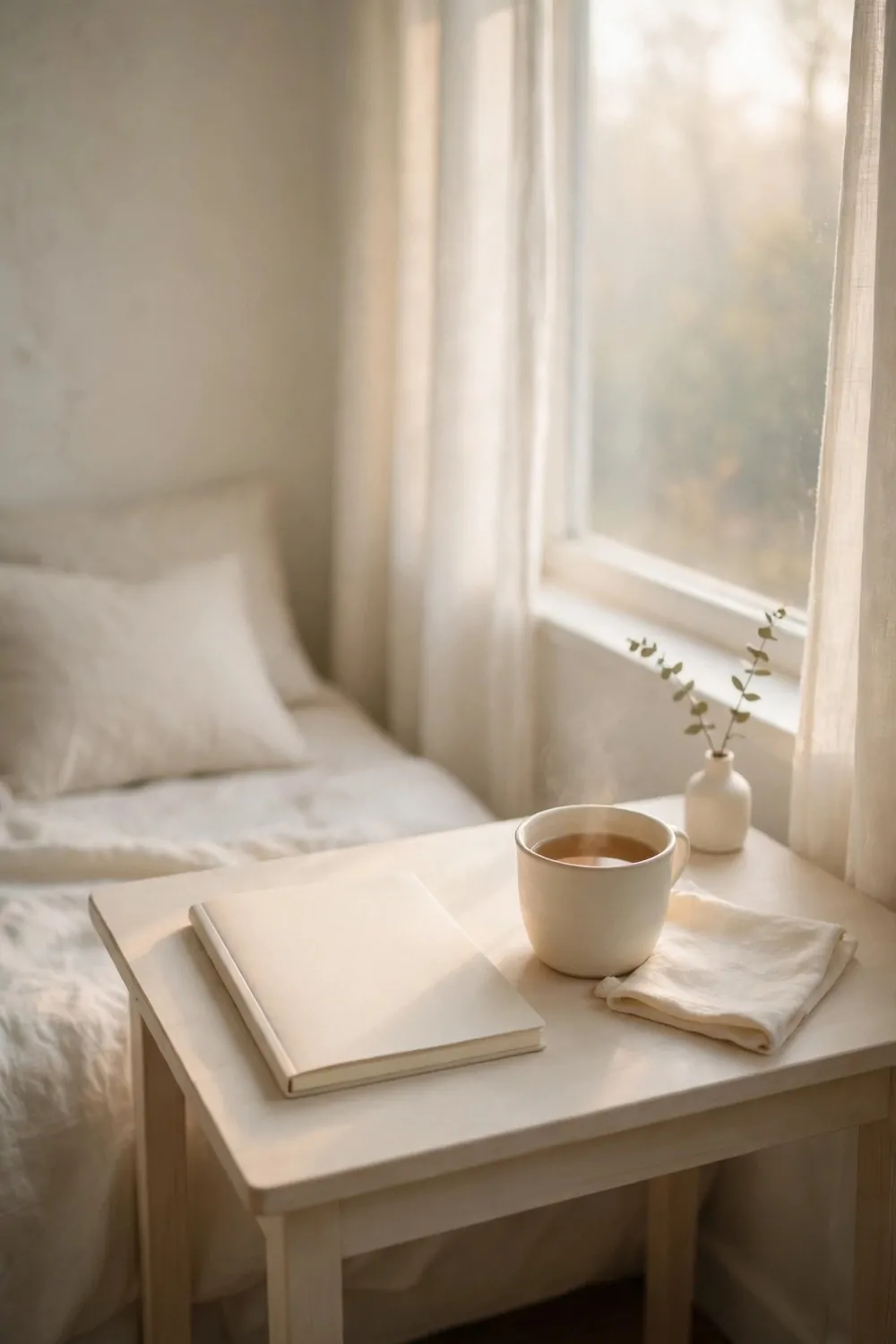
A calm workday does not start with a rush. It starts slow, like the sun coming up.
My mornings used to start with a sprint. Alarm, shower, laptop open, emails before I had even drunk my tea. By nine I felt behind, and the whole day ran at that same fast pace.
Now my mornings start slow. I open the curtains. I switch the kettle on. I sit at the desk with my tea and my notebook for ten quiet minutes before I open the laptop. The day starts soft, and it stays soft.
Open the curtains first, before anything else. Morning light wakes your brain up gently, better than any alarm. Let the light in, and let your eyes get used to the day.
Make your tea or coffee before you touch the laptop. The small wait while the kettle boils is a good pause. It gives your mind a moment to settle before the work begins.
Write one line in your notebook before you open any app. One short line about the one job that matters most today. A line written by hand feels like a promise you made to yourself. A line typed on a screen feels like just another message.
Here is the slow start I use every morning.
| When | What to do | Why it helps |
|---|---|---|
| First five minutes | Open the curtains, put the kettle on | Light and warmth wake the room up gently |
| Next five minutes | Sit with tea, write one line in the notebook | The day gets one clear job before the noise starts |
| Then | Open the laptop and start on that one job | Work starts calm, not rushed |
Keep the first hour free of messages if you can. No chats, no calls, no quick checks. The first hour belongs to the real work, and the messages can wait.
Do the slow start at the same time every morning. A slow start that runs daily becomes automatic. A slow start that runs only on good days never sticks.
Try this one tomorrow when you wake. Ten slow minutes before the laptop, and see how the whole morning feels different.
A Shelf With Breathing Room
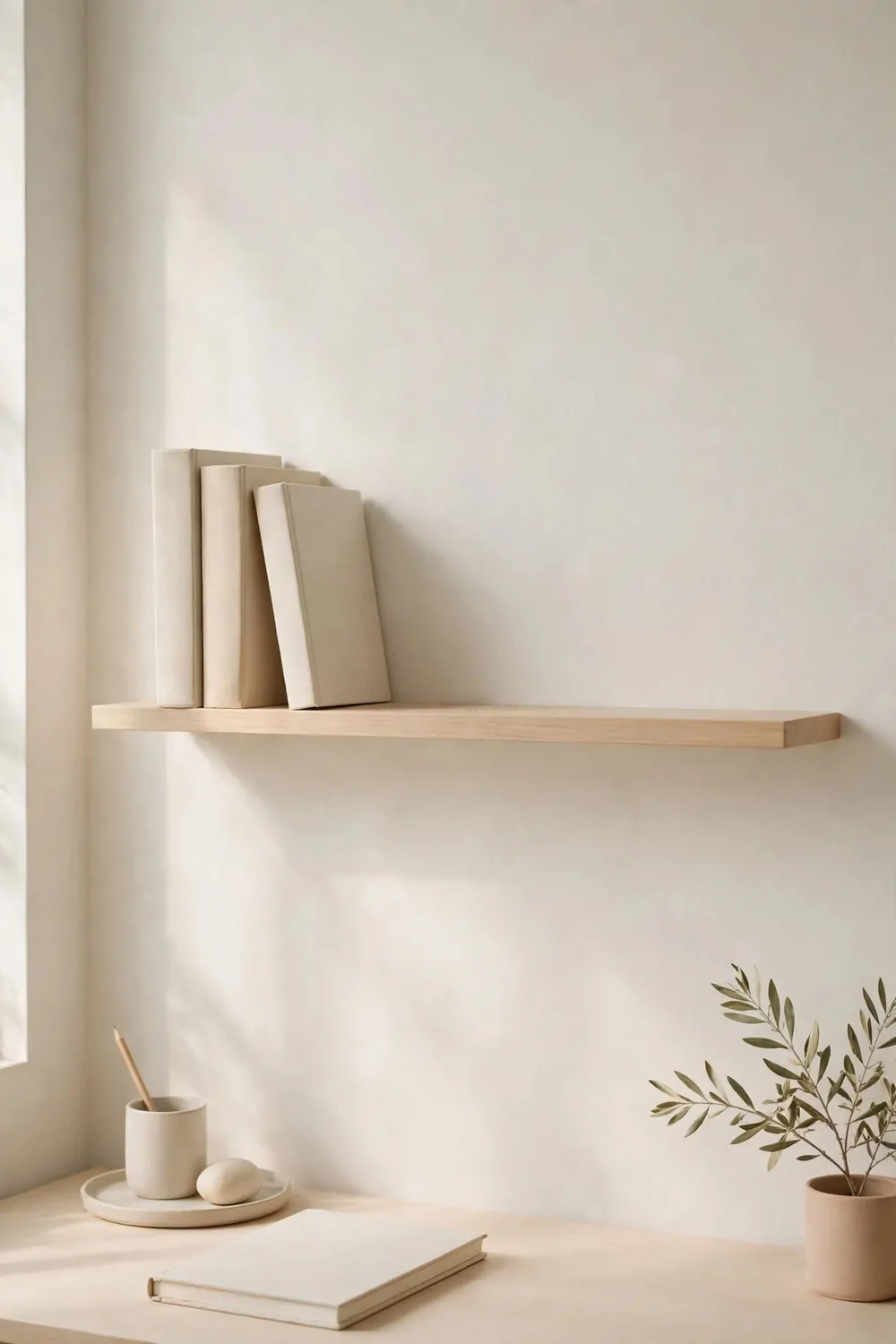
A shelf packed tight looks like storage. A shelf with space looks like a calm room.
My shelves used to be full to the edges. Books jammed in sideways. Boxes stacked on top of boxes. Every inch was used, and the wall felt heavy just to look at.
Now my shelves have gaps. A row of books, then a little empty space. A small plant, then nothing. The gaps are the best part. They let the shelf breathe, and they let my eyes rest.
Take a third of the things off your shelf. Put them in a cupboard, give them away, or move them to another room. A shelf with room to spare looks like a room where someone reads, not a room where someone stores.
Leave one shelf partly bare on purpose. That empty space is where the next book goes, and it keeps the shelf from ever feeling full again.
Put the books you love at eye level. The books your hand finds most often. The books you never open go higher up, where they do no harm.
Here is what belongs on a calm shelf, and what does not.
- Books you have read and love.
- One small plant or one plain box.
- A little empty space between the rows.
- Nothing else. The shelf is not a cupboard.
Stand back and look at the shelf from the door. If it reads as a few quiet rows with soft gaps, it is done. If it reads as a wall of stuff, take more off.
Wipe the shelf when you wipe the desk, so dust never builds up. A dusty shelf looks forgotten. A clean shelf looks cared for.
Try this one if your shelves make the room feel heavy. A little empty space, and the wall feels light again.
Paper Instead of Piles
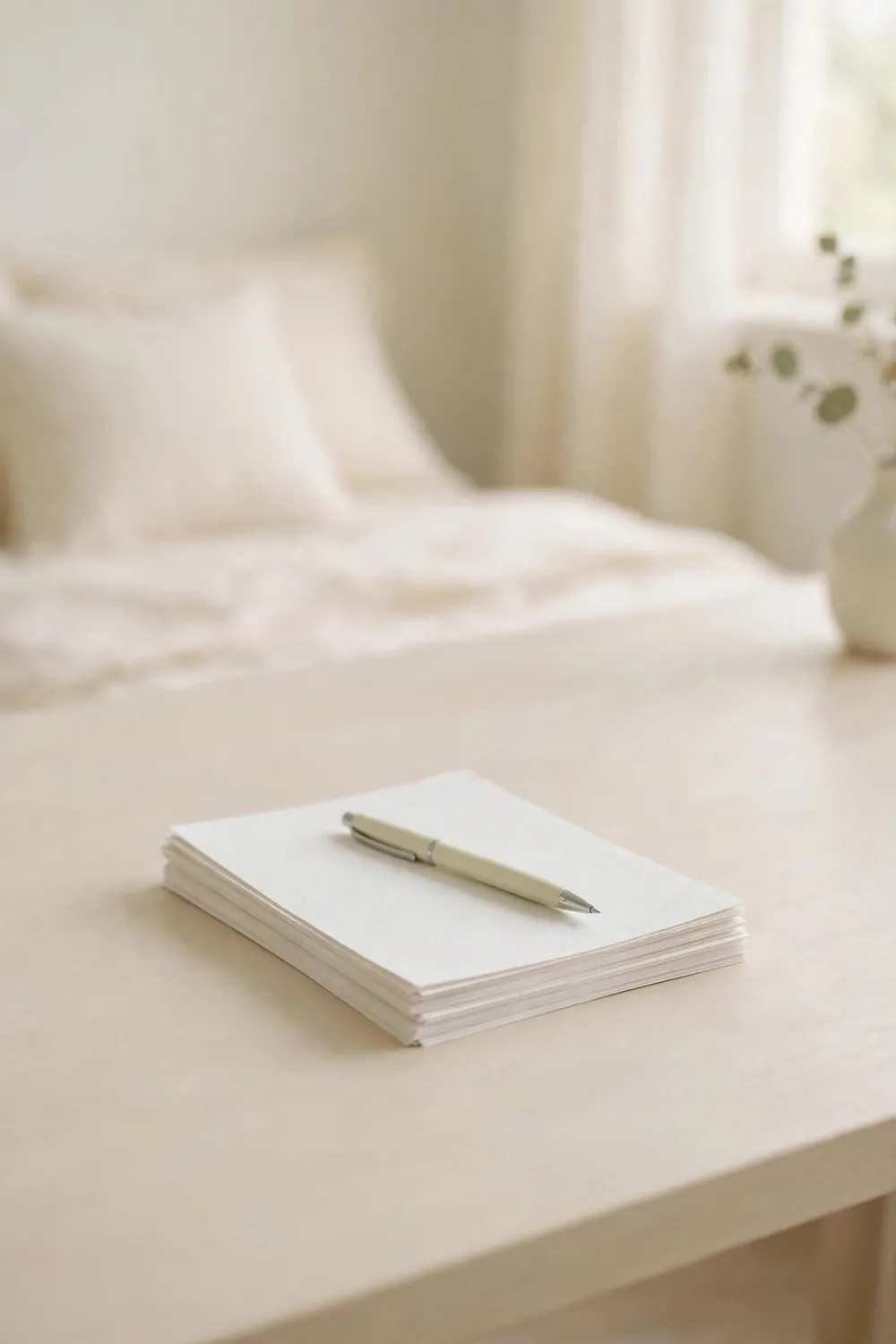
Piles of paper are the noisiest thing in a quiet room. They lean, they slide, and they whisper about work you have not done.
My desk used to have three piles. One by the lamp, one by the laptop, one sliding off the edge onto the floor. I never knew which pile held what, and every pile made me feel a little bit behind.
Now I have no piles. I have one folder, one notebook, and one tray. Paper lives in the folder or in the tray. Never in a pile on the desk.
Put all your loose paper in one folder today. Sort it in ten minutes. Keep what matters. Throw away what does not. A folder with five pages is a folder you can trust. A pile with fifty pages is a pile you fear.
Keep the folder in the drawer, not on the desk. A folder in a drawer is there when you need it and invisible when you do not. A folder on the desk is just another pile with a cover.
Use the tray for today’s papers only. When the day ends, the tray goes on the shelf and the papers go in the folder. The desk is clear again, and tomorrow starts clean.
Write new notes in the notebook, not on loose sheets. A notebook keeps your thoughts in one place, in order, where you can find them. Loose sheets scatter, and scattered thoughts feel noisy.
If a paper has been sitting untouched for a month, let it go. A paper you have not needed in a month is a paper you will not need next month either. Letting go is part of calm.
Try this one tonight. Gather every loose paper into one folder, and feel how much quieter the desk looks.
The Calm Colour on the Bedding
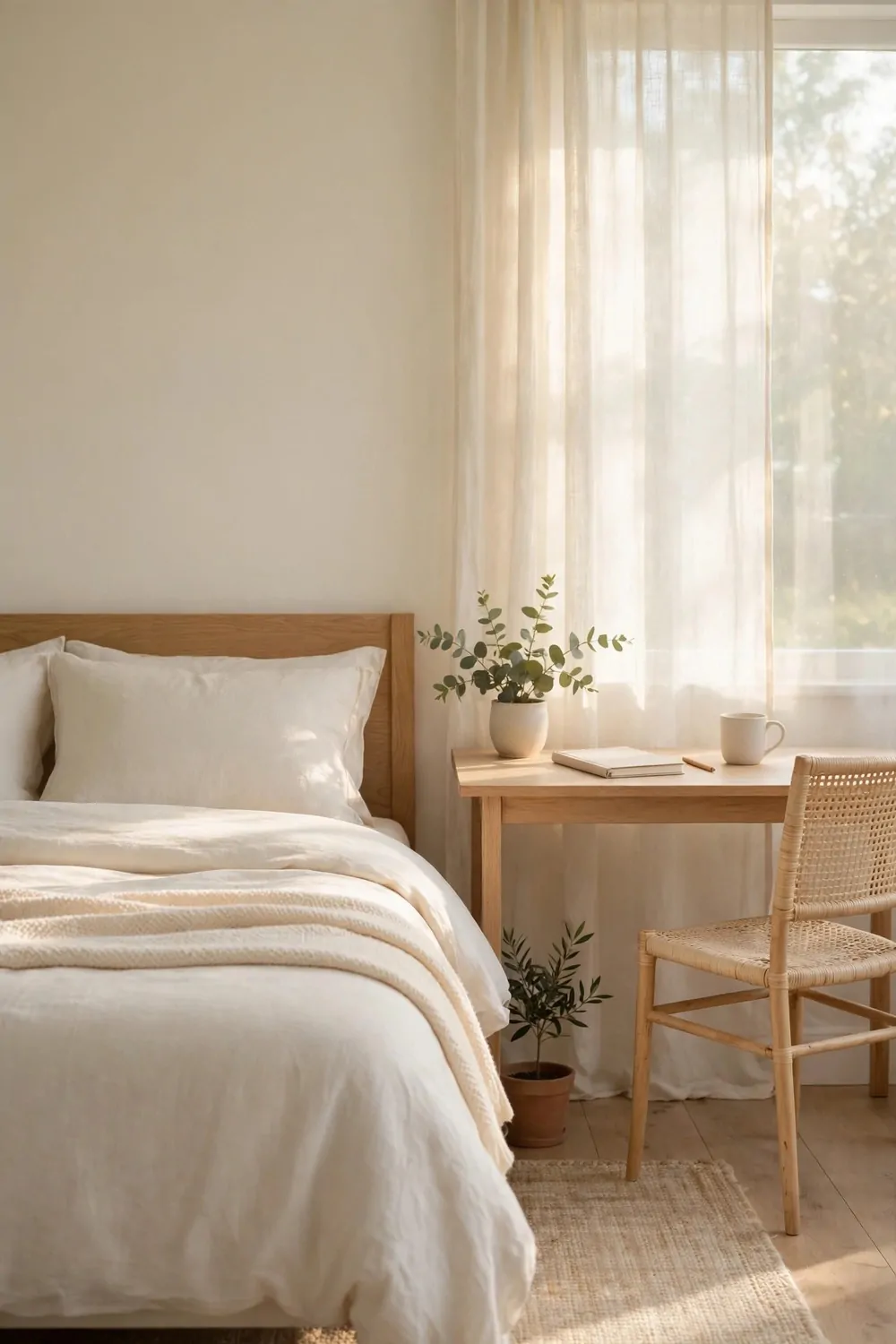
A bedroom office has two jobs, and the bed sets the mood for both of them. Pale bedding makes the whole room feel soft.
My bedding used to be dark and busy. Deep blue with a bold pattern. It was the first thing my eyes landed on every time I looked up from my desk, and it pulled the room toward the loud side.
Now my bedding is plain and pale. Soft cream, with one pale grey cushion. The bed blends into the walls, and the room feels like one gentle place instead of two rooms arguing.
Pick bedding in the same pale family as your walls. Cream bedding with cream walls. Pale sage bedding with pale sage walls. The bed and the walls agree, and your eyes stop jumping between them.
Keep the pattern plain or skip it altogether. A plain duvet in a soft colour lets the desk and the shelves shine. A loud pattern fights everything else in the room for attention.
Make the bed every morning before you sit at the desk. A made bed is a calm bed. It takes two minutes, and the room looks finished before the work even starts.
Change the bedding once a week so it stays fresh. Clean bedding smells soft, and a fresh smell makes the whole room feel cared for. A stale bed makes a calm room feel tired.
Put one soft cushion on the bed, not five. One cushion in a pale colour is enough. Five cushions turn the bed into a shop display, and a shop display is not calm.
Try this one if your bed is the loudest thing in the room. One pale set of bedding, and the room softens at once.
Curtains That Soften the Whole Room
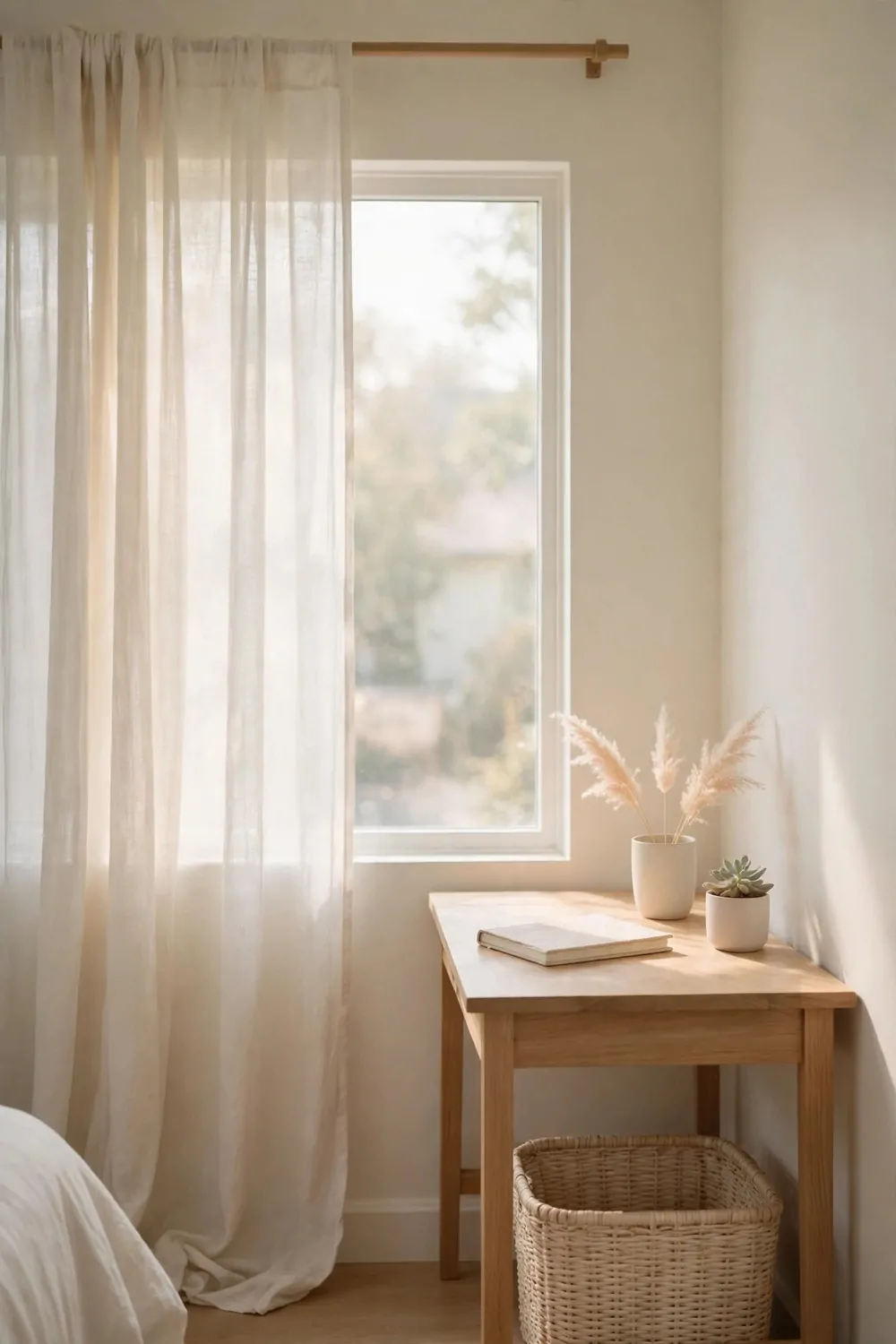
Curtains are the softest thing in a bedroom, and soft is what a calm work space needs.
My old curtains were stiff and dark. They hung like a wall, and they made the window feel small. I swapped them for pale linen curtains that fall gently to the floor, and the whole room changed its voice.
Pick curtains in a light, airy fabric that lets the morning through. Thin linen or soft cotton works best. Heavy fabric blocks the light and makes the room feel closed in, and a calm room needs light more than it needs shade.
Tie the curtains back with a simple loop of cord during the day. Tied-back curtains frame the window like a picture, and the daylight spreads right across the desk. Loose curtains that hang in the middle of the glass cut the light in half.
Match the curtain colour to the bedding so the two soft things in the room agree. When the window and the bed wear the same pale shade, the room reads as one gentle place.
Let the curtains brush the floor a little. A hem that just kisses the floorboards looks relaxed and lived in. A hem that stops above the sill looks cut short, and the window feels unfinished.
Take the curtains down and give them a good wash when the season turns. Fresh curtains smell clean, and the fabric hangs softer after a wash. A room with fresh curtains feels like a room that has been looked after.
Keep the curtains plain, with no bold print. A quiet fabric lets the desk and the bed be the stars of the room. A loud print pulls your eyes to the window every time you look up.
Try this one if your window feels hard and bare. One pair of soft pale curtains, and the room feels like a quiet morning.
No Screens After Six
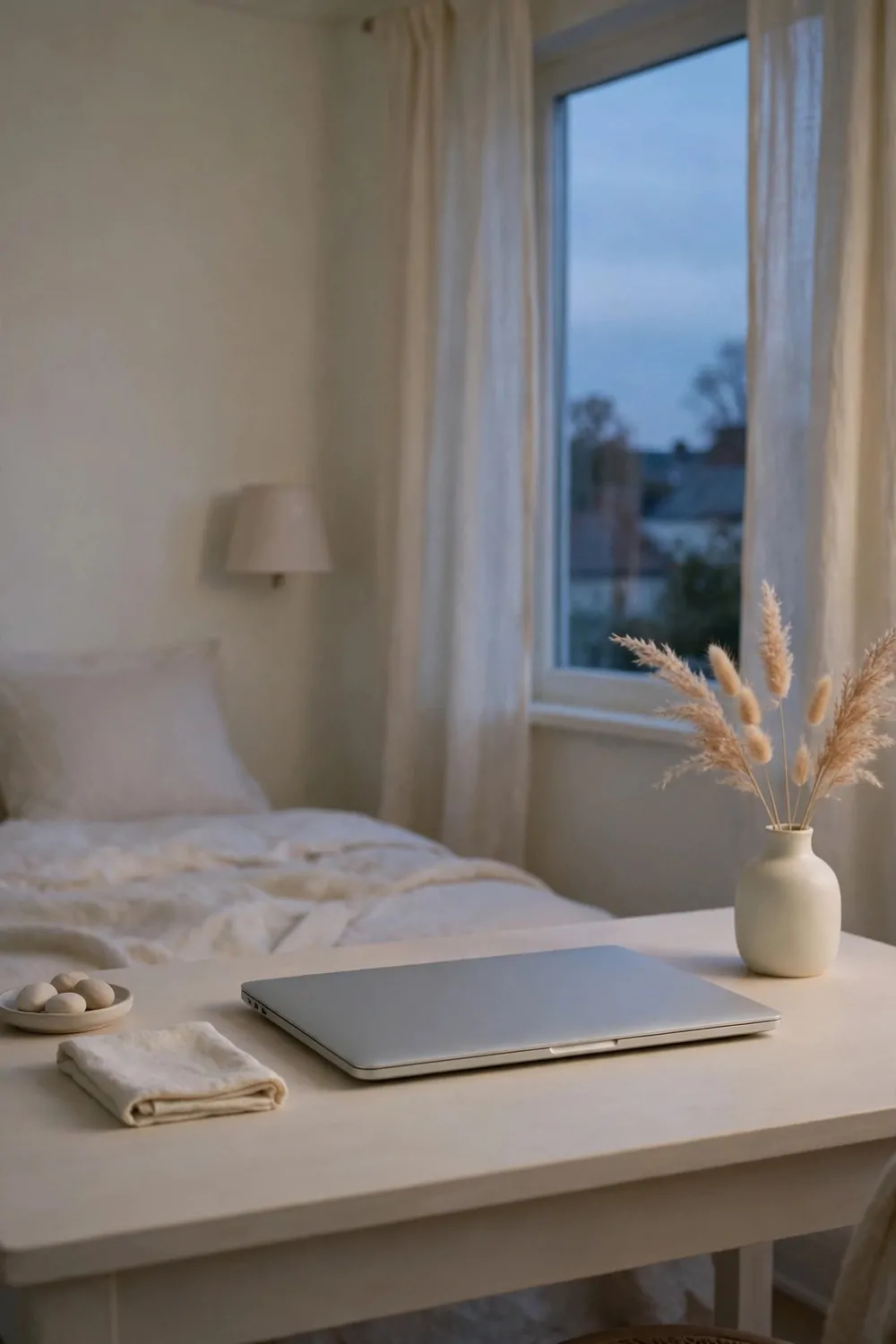
A calm evening starts when the screens go dark. My rule at home is short and plain. No screens after six.
My laptop used to glow on my desk until bedtime. My phone lit up beside my pillow. My brain never got the message that work was over, and my sleep was light and broken.
Now the laptop closes at six and stays closed. The phone goes face down on the bedside table, on silent. The evening belongs to the bedroom, not the office.
Close the laptop at six every evening, even on busy days. A laptop left open is a workday left open. The closing is the ending, and endings matter.
Put the phone on silent at six. Not vibrate. Silent. A phone on vibrate still buzzes against the wood, and a buzz at nine in the evening is still a work thought.
Keep the television out of the bedroom if you can. A bedroom with no television is a bedroom that knows how to rest. A screen on the wall is a screen that glows at you all evening.
Read a paper book in the evening instead. A paper book has no glow, no buzz, and no new messages. It lets your brain slow down the way a screen never does.
If a message truly cannot wait, write the reply on paper and send it in the morning. A reply written on paper is a reply that waits for work hours. A reply sent late at night means the workday never really stopped.
Try this one tonight. Screens off at six, and see how the evening feels by nine.
The Breathing Corner
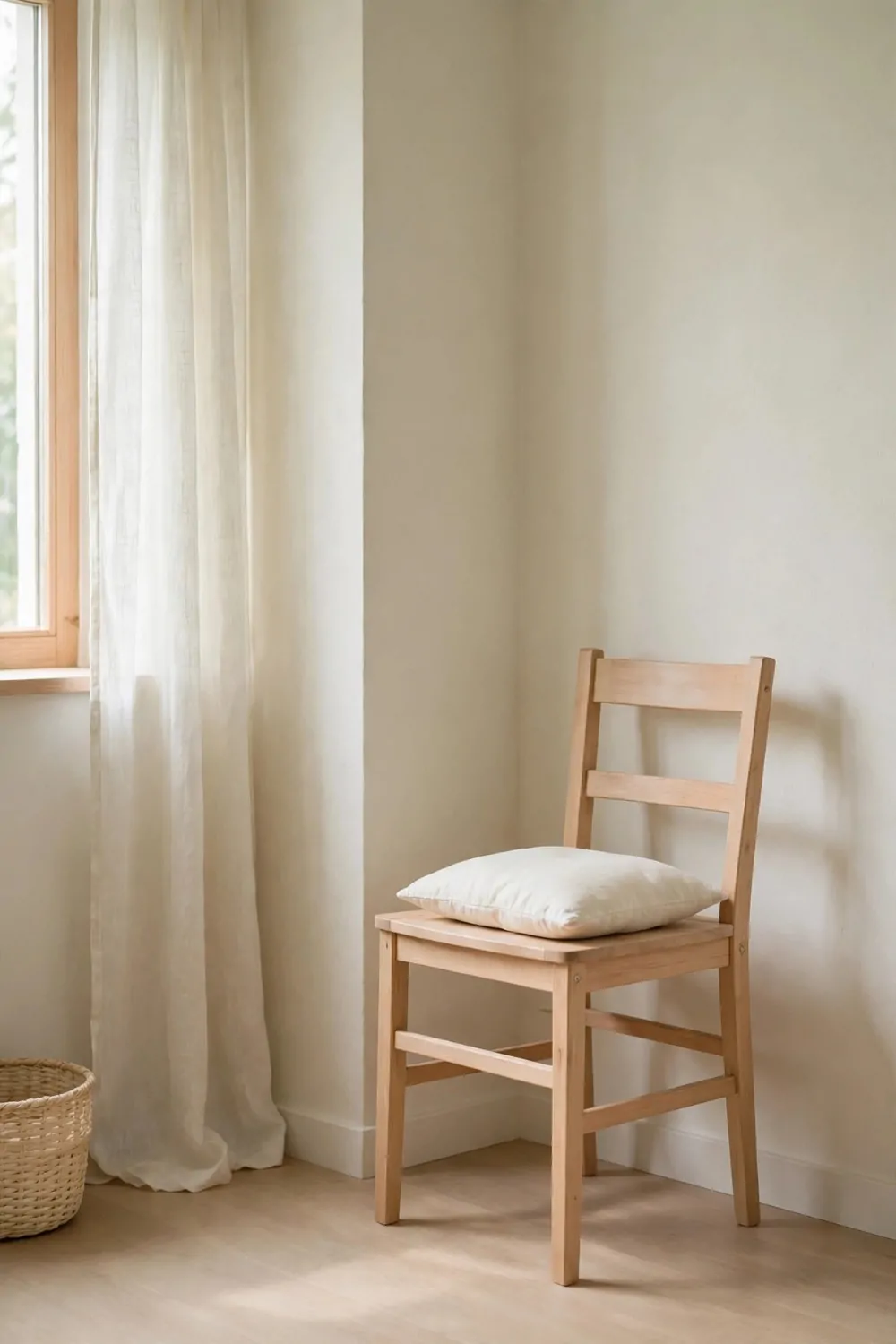
Every calm work space needs one corner that does nothing at all. That corner is for breathing.
My breathing corner is the far end of my bedroom, away from the desk. It holds one plain chair, one small cushion, and nothing else. No desk. No screen. Just a place to sit and breathe for five minutes.
Pick the quietest corner of your room for this spot. The corner farthest from the door, where nobody walks past. The far corner is where interruptions cannot reach you.
Put one chair there and nothing else. A small side table is fine if you want somewhere to put a mug. A big desk in the breathing corner would turn it into a second office, and that is not the point.
Sit in the breathing corner for five minutes in the middle of the day. Close your eyes. Breathe slowly. Let your shoulders drop. Five quiet minutes in the middle of a workday change the whole afternoon.
Leave the phone on the desk, far from this corner. A breathing corner with a phone in it is not a breathing corner at all. One buzz and your mind will chase it.
Put a soft rug under the chair if the floor is hard. A soft rug hushes your steps and marks the corner as its own little place.
Use the corner at the same time every day if you can. Mid-afternoon works best for most people. The morning is fresh, the evening is close, and five quiet minutes in between keep the day gentle.
Try this one today. Five minutes in a quiet corner, and feel how much slower the afternoon goes.
A Tray for the Day’s Work
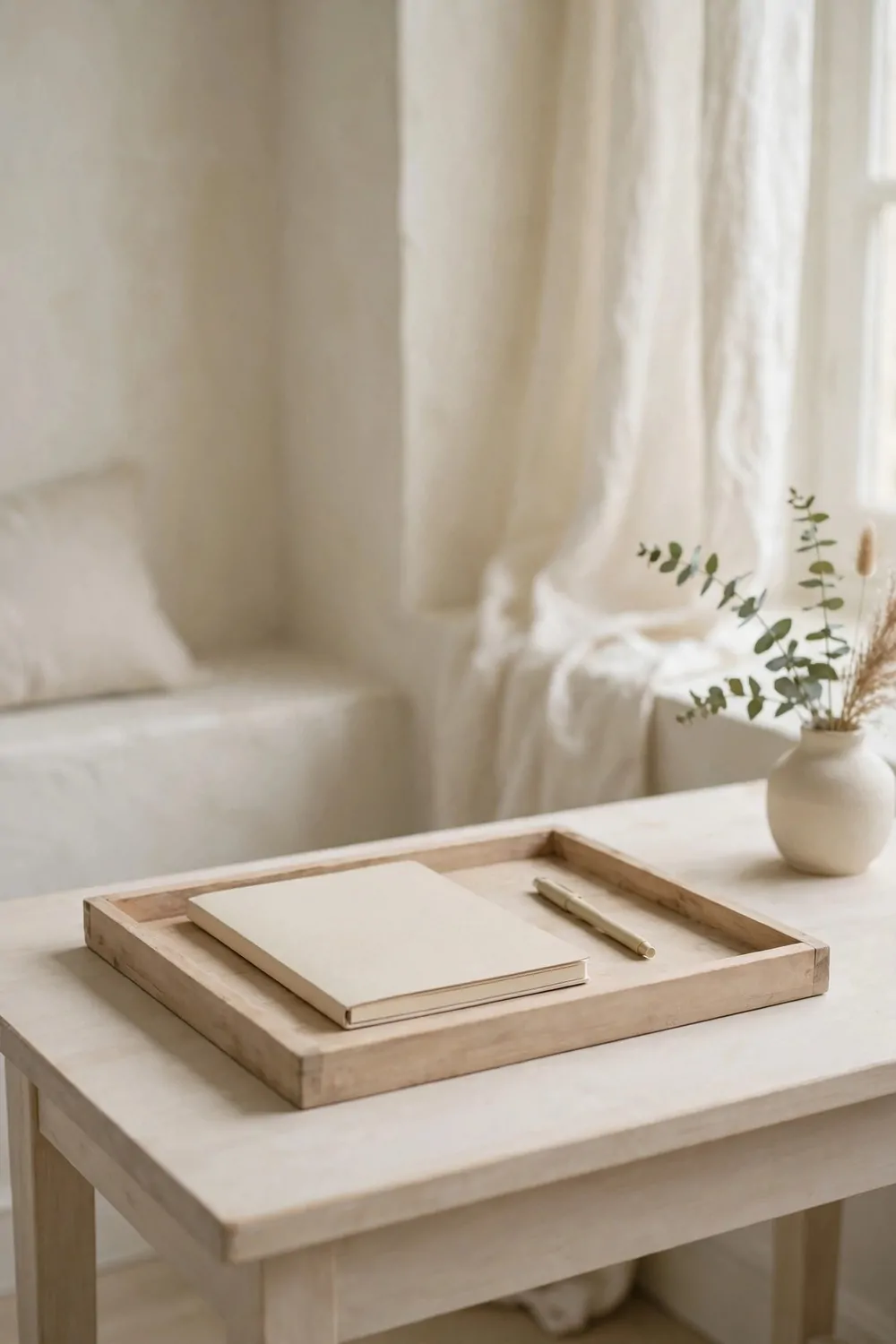
A tray is a small thing with a big job. It holds the day’s work in one neat place, and it keeps the desk calm.
My tray is a plain wooden one, about as wide as my notebook. It sits on the left side of my desk, and it holds the three things today needs. A notebook, a pen, and one folded page. Nothing more fits, and that is the point.
Pick a tray that suits the wood of your desk. A pale wooden tray on a pale desk looks like it grew there. A tray in a loud colour would pull your eyes away from your work all day.
Give the tray one job and one job only. It holds today’s work. Not yesterday’s papers. Not next week’s list. Just today, in one shallow space you can see at a glance.
Set the tray down in the same place each morning, and leave it there all day. A tray with a fixed home becomes part of the desk, like the lamp or the chair. A tray that wanders around never quite works.
Here is what my tray holds, and what it never holds.
- The notebook I am writing in today.
- One pen that writes well.
- The single page I am working from.
- Nothing else. The tray stays shallow on purpose.
Empty the tray when the day ends and put it back on the shelf. A tray left full overnight is just a neat pile with edges. An empty tray in the morning is a fresh start.
Wipe the tray when you wipe the desk. A dusty tray looks forgotten, even when it is tidy. A clean tray looks like part of a calm room.
Try this one if your desk looks messy even when it is clean. One shallow tray, three things, and the desk goes quiet.
The Five-Minute Evening Reset
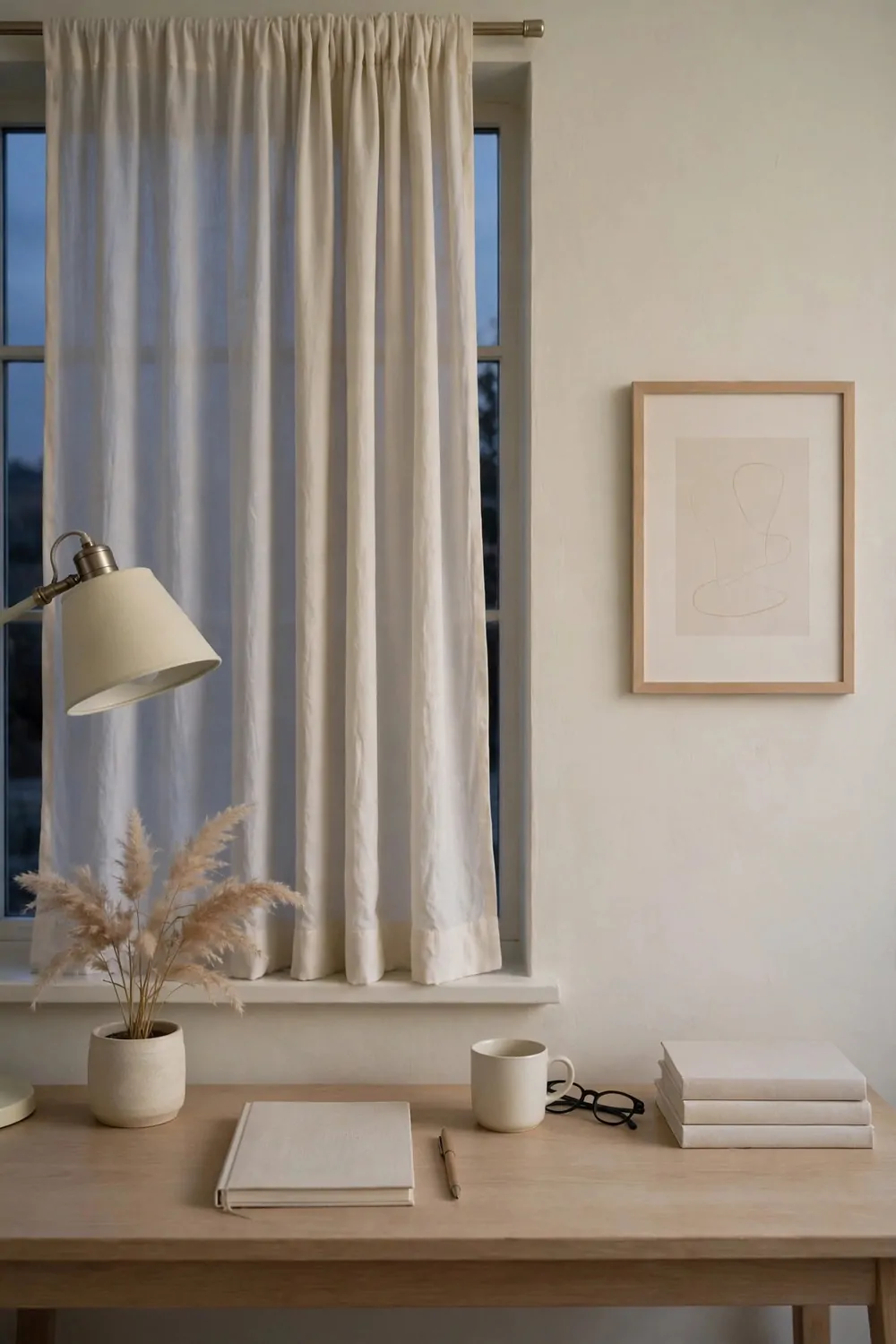
A calm room only stays calm if it gets five quiet minutes at the end of the day. Five minutes, every evening, and the room stays gentle.
My evening reset takes five minutes from start to finish. I straighten the books, drop the pen back in the jar, shut the laptop, and slide the chair under the desk. Five minutes later, the room looks the way it did the morning I set it up.
Do the reset at the same time every evening. After a week or two, you will do it without thinking at all. Do it every day and it becomes part of the day. Do it only now and then and it fades away.
Here is the reset I use every evening.
| Minute | What to do | What it leaves behind |
|---|---|---|
| Minute one | Clear the desk, papers into the tray | A clear desk top |
| Minute two | Shut the laptop, pen back in the jar | A desk that looks finished |
| Minute three | Chair under the desk, mug rinsed | A room that looks tidy |
| Minute four | Curtains half closed, lamp off | Soft evening light |
| Minute five | Notebook on the bedside table, ready for tomorrow | A calm morning waiting for you |
Keep the reset short. Five minutes is enough. A long reset is one you will give up on by Friday.
Pause in the doorway before bed and look at the room once more. That is the first thing anyone sees when they step in. If it looks soft and quiet from there, you are done for the day.
Put the notebook on the bedside table when the five minutes are done. A notebook left there overnight is one you will pick up first thing.
Try this one tonight. Five minutes, every evening, and tomorrow morning your room will still feel calm.
Soft Rugs Under Tired Feet
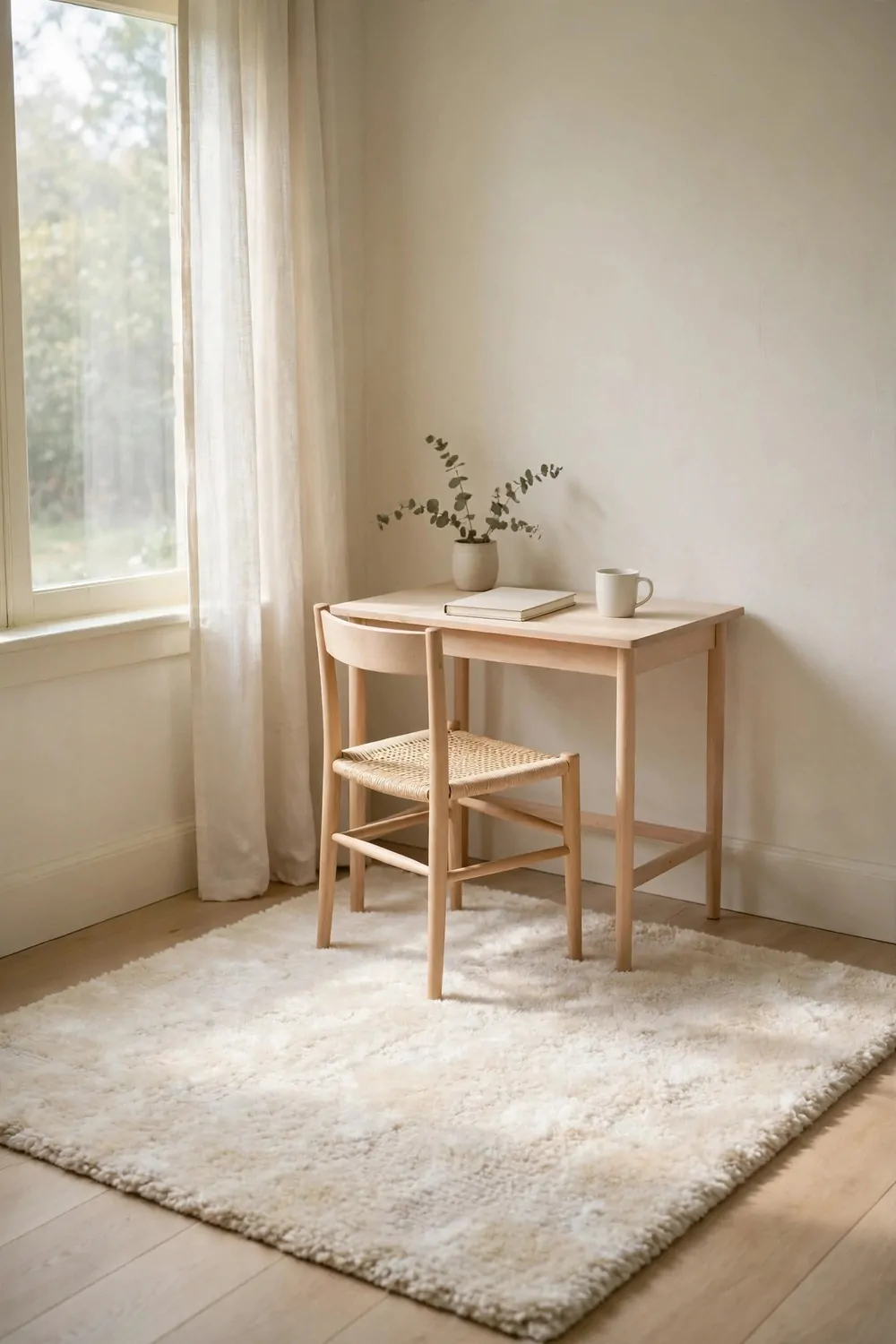
A soft rug is the first gentle thing your feet touch in the morning, and the last gentle thing they touch at night.
My bedroom floor used to be bare wood. Cold in the morning. Hard under my chair. I put a soft pale rug under my desk, and the whole corner felt warmer the same day.
Pick a rug in a pale shade that sits well with the bedding. When the floor and the bed wear soft colours from the same family, the room feels warm all over. A rug in a harsh colour would shout from the floor.
Let the rug run under the desk and out past the chair legs, so the whole work corner sits on soft ground. A rug that ends under the desk leaves your feet on cold wood, and cold feet make for a restless morning.
Choose a rug with a low, soft pile. A deep shaggy rug swallows the chair legs and makes the chair hard to move. A low rug lets the chair glide, and it never fights you.
Shake the rug outside on a dry day once a month, and give it a quick brush each week. A rug that gets fresh air stays soft and smells clean. A rug that never leaves the floor slowly turns grey and dull.
Slip a thin grip pad underneath if the rug creeps across the wood. A rug that wanders is a rug you trip over. A rug that stays where you put it is one less thing to think about.
Step onto the rug barefoot in the morning before you sit down. If it feels warm and soft under your feet, it will set a slow tone for the whole day. That gentle first step is worth more than any fancy chair.
Try this one if your floor feels cold and hard. One soft rug, and the room feels gentle from the ground up.
A Notebook That Holds the Noise
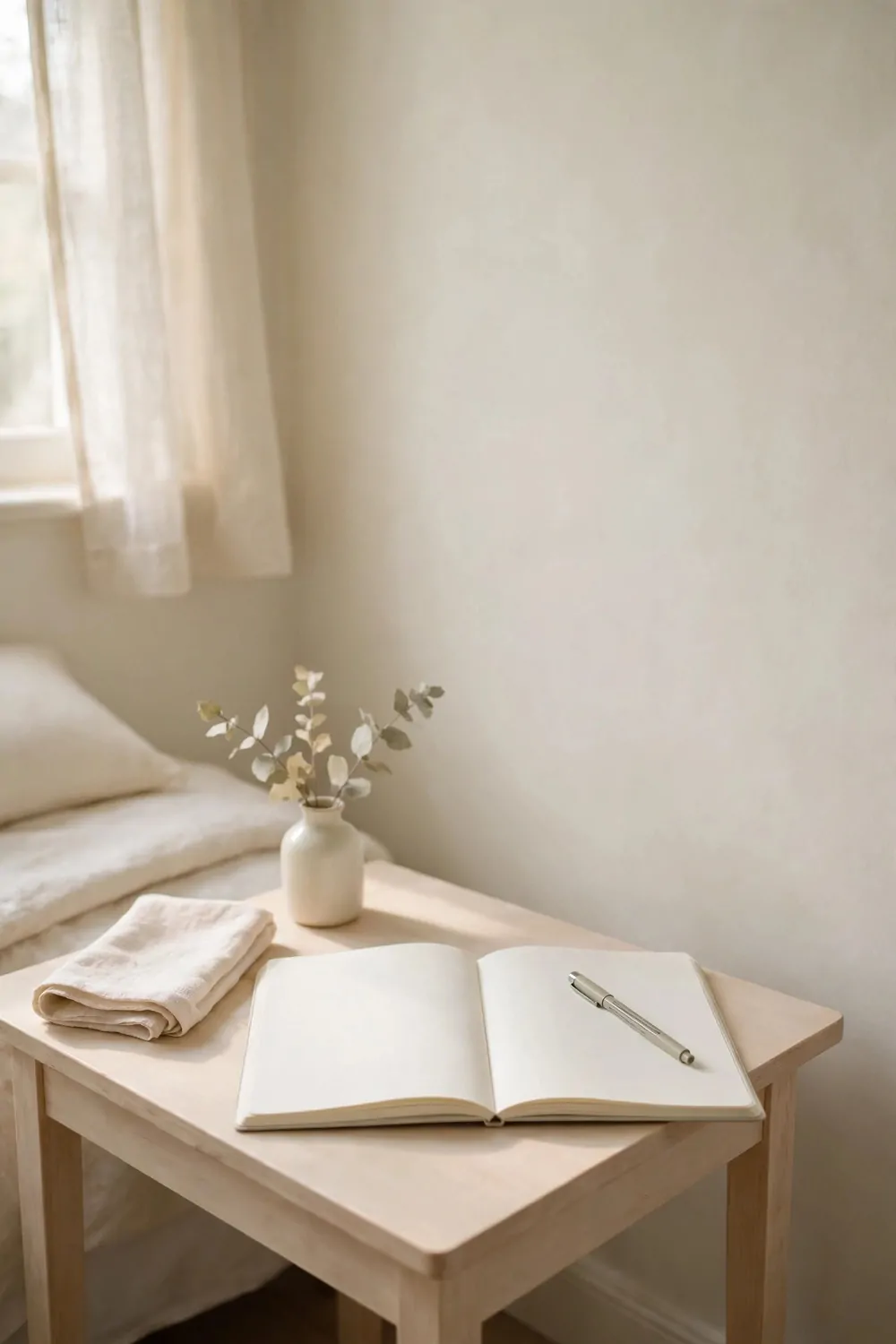
A busy brain is a noisy brain. A notebook gives the noise somewhere to go, so your head can stay quiet.
My notebook lives on my desk, open at a blank page. When a worry pops up, I write it down. When an idea pops up, I write it down too. The page holds it, and my brain lets it go.
Keep one notebook on the desk, always open at a blank page. A closed notebook is a notebook you will not open. An open one sits there waiting for you, like a quiet friend.
Write down every worry that pops up while you work. One line each. A worry written down is a worry that stops buzzing. A worry kept in your head buzzes all day.
Write down your ideas the same way. One line each, no fuss. Ideas written down do not get lost, and they do not keep tapping you on the shoulder while you work.
Read the notebook once at the end of the day. Cross off the worries that never happened. Circle the ideas worth keeping. Most worries never happen, and seeing that on paper is a calm feeling.
Keep the notebook plain, with no fancy cover. A plain notebook is a tool, not a showpiece. A notebook that looks too pretty to write in never gets written in.
Put the notebook on the bedside table at night, open at tomorrow’s first line. Your morning self will thank your night self for leaving a clear first step.
Try this one today. One notebook, one open page, and let the noise move from your head onto the paper.
The Room That Waits for You
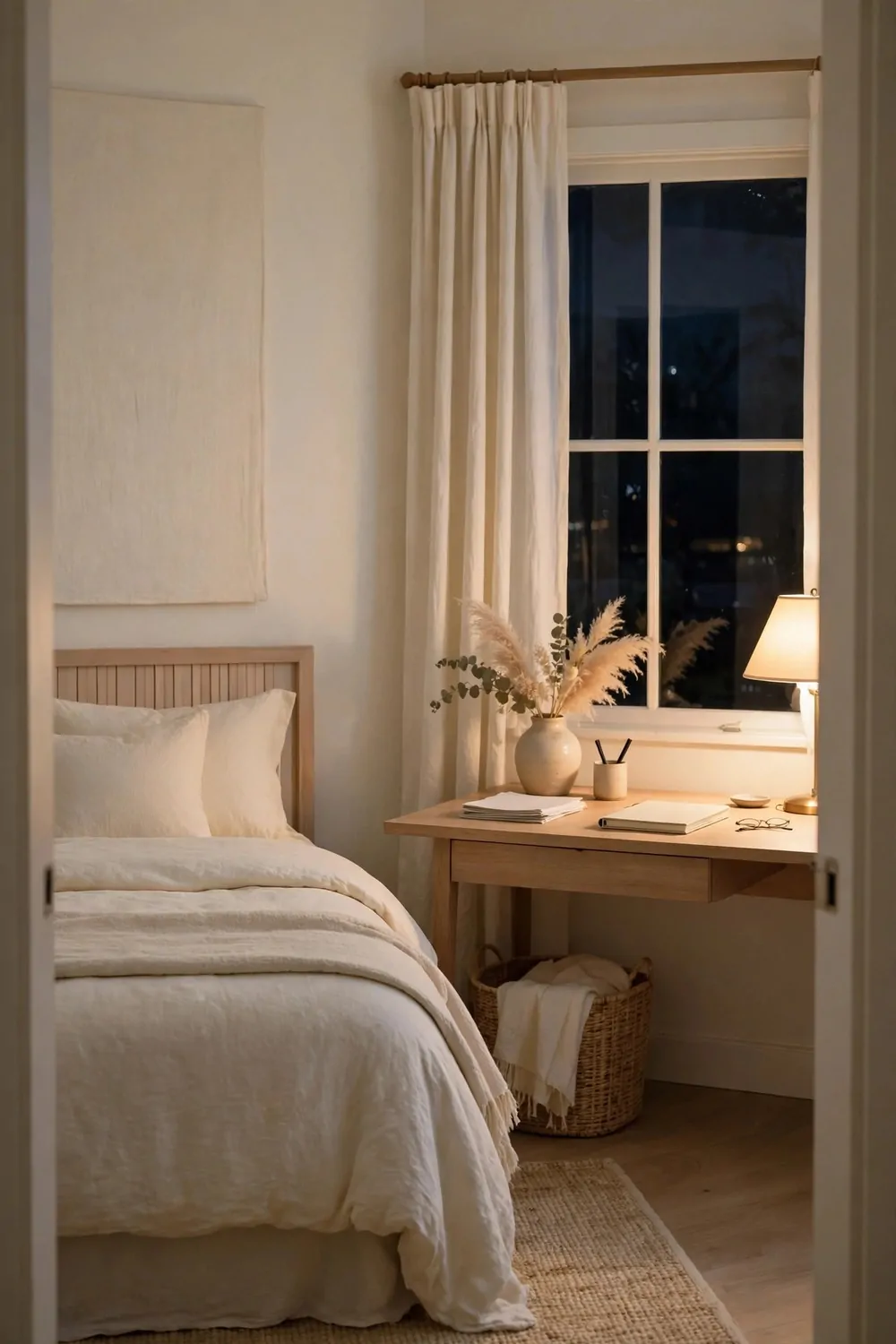
A calm work space is a room that waits for you kindly. It does not rush you. It does not judge you. It just sits there, pale and quiet, ready when you are.
My room used to feel like a boss. It pushed me to work faster, to do more, to never stop. The desk was always messy. The light was always harsh. The room felt like a place that wanted more from me than I could give.
Now my room feels like a friend. The desk is clear. The light is soft. The chair is waiting, and the notebook is open. I walk in, and the room says, take your time.
Make your room wait kindly. Clear the desk the night before, so the morning finds it ready. Open the curtains in the morning, so the light finds you first. Keep the room pale and soft, so your eyes find rest.
Do not fill the room with things that demand attention. A calm room asks for nothing. It holds your work gently, and it lets it go gently at six.
Sit in your room for five minutes with no work at all, just to feel it. Is it pale? Is it quiet? Is it soft? If it is, you have built a calm work space. If it is not, pick one idea from this list and try it this week.
A bedroom does not need to be big to hold a calm office. It needs pale walls, soft light, a clear desk, and a slow start. That is all calm ever was. A room that lets you breathe while you work.
Start with one idea tonight. Clear the desk, or open the curtains, or write one line in a notebook. Small steps, slow days, and a room that waits for you kindly.
Keep Reading
If you liked these Work Space in Bedroom ideas, these budget, real-study and designer-made bedroom office ideas will give you even more ways to make one small room feel calm and easy to work in.
- 18 Ikea Bedroom Office Ideas on a Budget
- 16 2nd Bedroom Office Ideas That Feel Like a Real Study
- 17 Small Second Bedroom Office Ideas That Look Designer-Made
A bedroom does not need to be big to hold a calm office. It needs pale walls, soft light, a clear desk, and a slow start. Pick one idea from this list, try it tonight, and let your smallest room feel calmer tomorrow.