21 Classroom Setup Ideas That Save Teachers Hours

I once watched a teacher friend spend her whole lunch break hunting for a lost stack of permission slips. She checked her desk. She checked the floor. She checked a bag she had not touched in weeks. By the time she found them under a pile of ungraded quizzes, lunch was over and her break was gone. I think about that day a lot, because most teacher exhaustion is not about teaching. It is about the small lost minutes that pile up and up.
These 21 classroom setup ideas are built for real classrooms, the kind with 25 kids and one tired adult. Each idea saves you minutes here and there, and minutes turn into hours by Friday. You do not need a big budget. You do not need a weekend overhaul. You just need systems that work when you are busy.
I pulled these ideas from teachers who actually use them every day. They are simple, they are cheap, and they keep working long after the novelty wears off. Pick three or four to start with. You will feel the difference by next week, I promise.
1. The Visual Schedule Wall
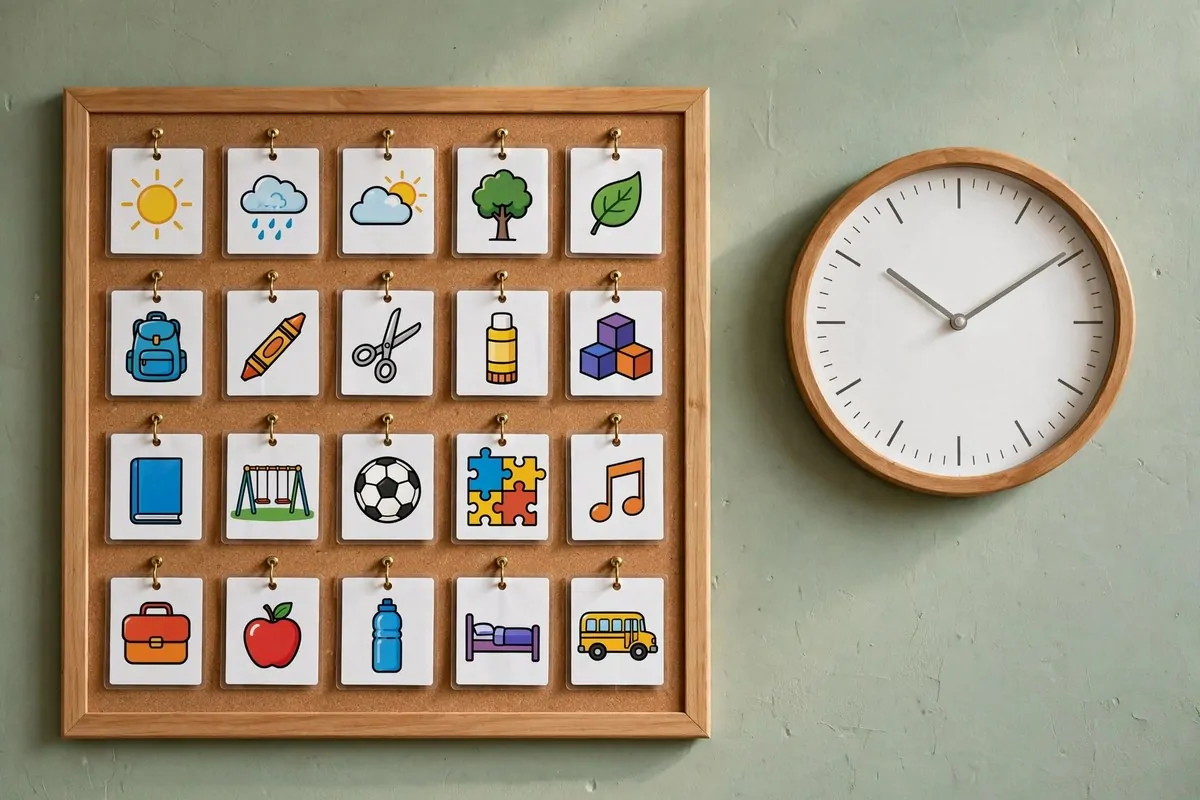
The question I hear most from teachers is how to stop repeating the daily plan. A visual schedule wall answers it once, then keeps answering it all day. You hang cards for each part of the day in order. Kids check it instead of asking you.
I like the ones with picture cards best. A little picture of a book for reading time. A pencil for writing. A sun for lunch. Young kids can read the pictures even when they cannot read the words yet. And older kids still glance at it, even if they pretend they do not.
Put a small clock next to the board if you can. It helps kids see what time each block starts. They learn to watch the clock instead of watching you.
Move the cards down as the day goes. I used to have a little arrow that pointed to the current activity. When a kid asked what was next, I just pointed at the wall. No words needed. My voice got a real rest.
You can make the cards yourself with index cards and a marker. Laminate them if you want them to last. Mine survived three whole school years, which felt like a miracle.
The best part is the morning calm. Kids walk in, look at the board, and know the plan. You do not start the day answering the same five questions. That alone saves you twenty minutes a week, easy.
Start with just the main blocks of your day. Reading, math, lunch, recess, science, pack up. You can add details later. Simple beats perfect here.
One teacher I know color codes her cards by subject. Blue for math, green for science, red for reading. The kids learn the colors fast. It makes the board even easier to read from across the room.
If you share a room with another teacher, make the cards magnetic. Then each teacher can build their own day in seconds. No redoing the whole board. Just swap the cards and go.
2. Turn-In Trays by Period
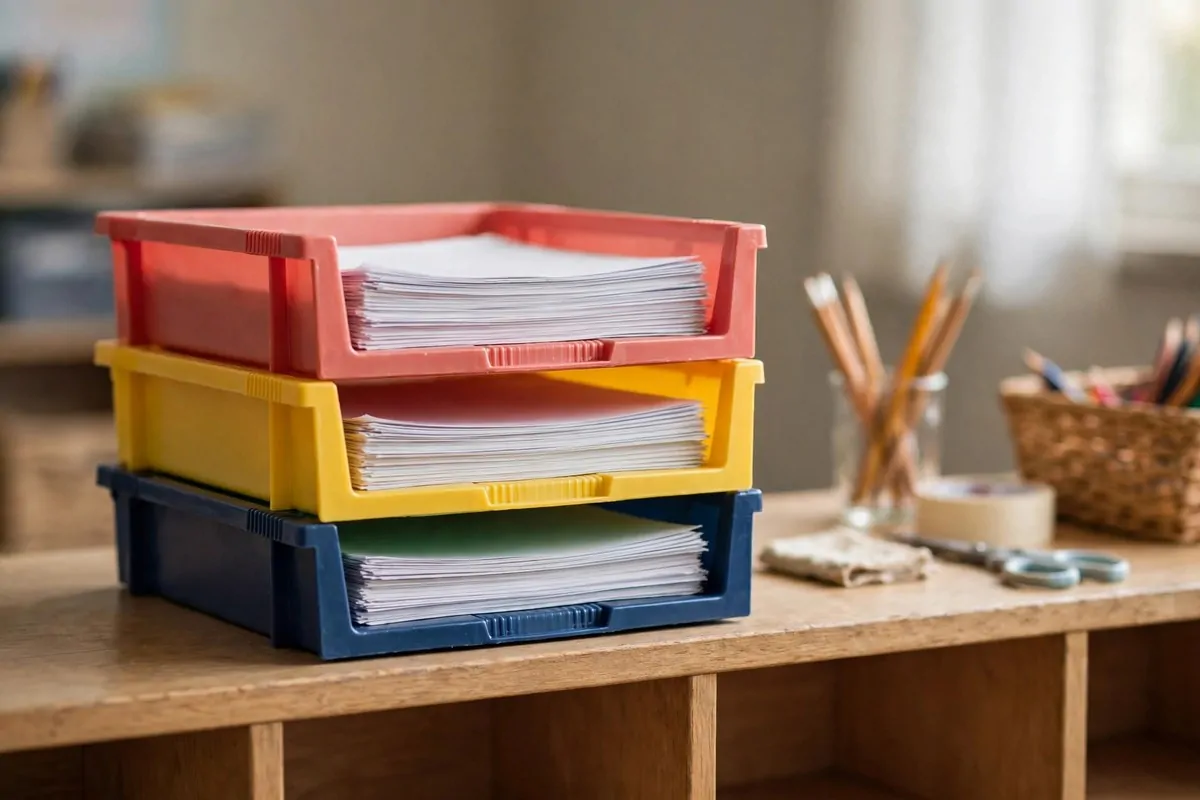
Loose papers are the enemy of a calm teacher. They pile up, they slide off desks, and they mix together into one big confusing stack. Turn-in trays fix this in one move. Each tray gets a label. Each tray holds one kind of work.
I stack mine in a little tower on a shelf near the door. Kids drop their papers in on the way in or on the way out. No lines. No waiting. No handing papers to me one by one while I am trying to start the lesson.
Label each tray clearly. Math homework. Reading logs. Science lab sheets. If you teach middle school, use one tray per period. Period 2 goes in tray 2. It sounds too simple, but simple is what works at 8 in the morning.
The real magic happens at grading time. Instead of sorting a mixed pile, you just grab the tray you need. You grade math, you are done, you move on. I used to lose ten minutes per subject just sorting. Now that time is gone.
Use different colored trays if you can find them. The color becomes a shortcut. Kids stop reading labels after a week. They just know that green means math.
Put a "no name" tray at the bottom of the tower too. Every class has nameless papers. This keeps them from vanishing into the trash. Check it on Fridays. Half the mystery papers get claimed.
Stackable trays are cheap. You can find them at any office supply store. Get sturdy ones if you can, because kids are not gentle. Mine have been knocked over twice and they still work fine.
One more tip. Put the trays at kid height, not teacher height. If kids have to reach or climb, they will just hand papers to you instead. The whole point is that they do it themselves.
This single setup can save you an hour a week in sorting time. It might be the best return on investment in this whole list.
3. Color-Coded Subject Bins
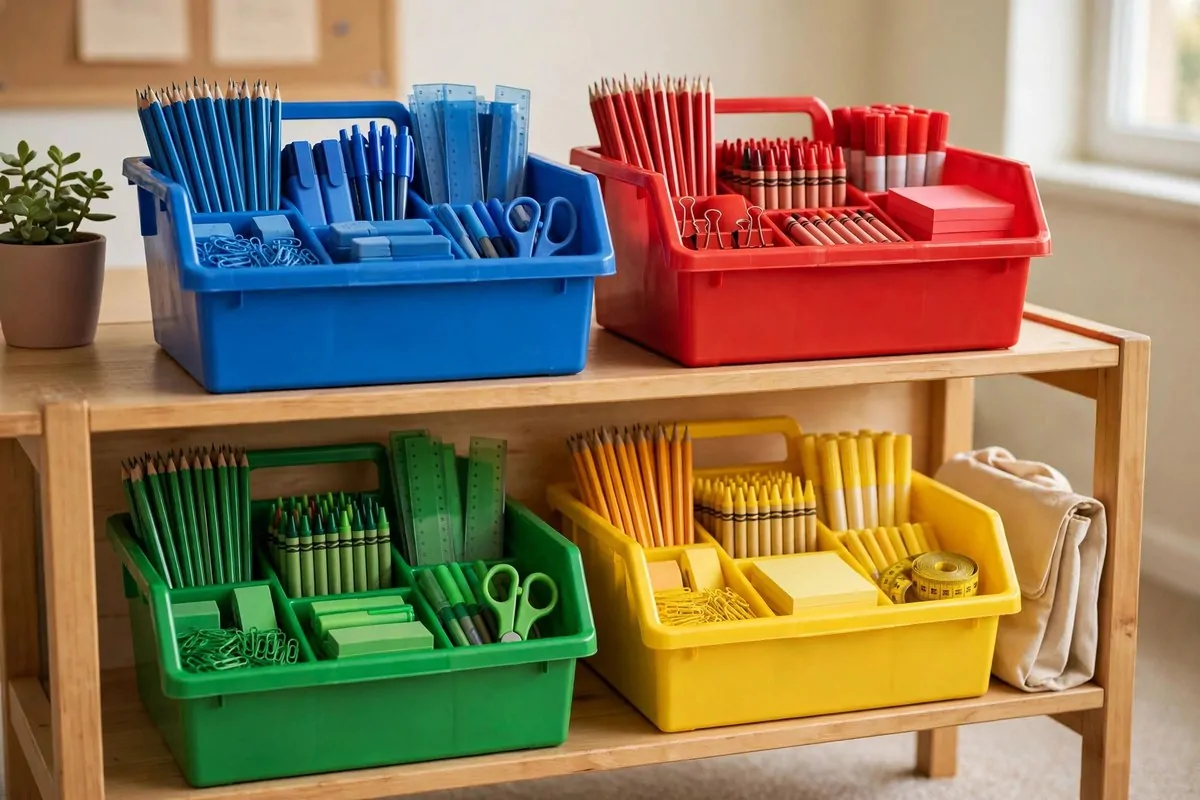
Color coding sounds fancy, but it is really just giving every subject its own color. Math is blue. Reading is red. Science is green. Then you buy bins, folders, and trays in those colors. That is the whole trick.
The reason it works is speed. A kid looking for the math bin does not read labels. They scan for blue. Their brain finds blue in half a second. Reading a label takes longer and gets skipped anyway.
I set this up in my friend's classroom last year. We went to the dollar store and bought every blue, red, and green container they had. Total cost was under twenty dollars. The room looked calmer the same afternoon.
Keep the system consistent everywhere. Blue math folders. Blue math bin. Blue math bookshelf label. When the color follows the subject through the whole room, kids never get lost.
Let the kids vote on the colors. It takes five minutes and they will remember the system forever. Kids who pick the color feel like they own it. And kids who own a system actually follow it.
This also helps substitutes a lot. A sub can look around and guess the system in a minute. Blue stuff is math. That is all they need to know to hand out the right materials.
The bins do not need to match perfectly. Different shades of blue still read as blue. Do not let perfect stop you from starting. A messy color system still beats no system at all.
Washable bins are worth it if you teach little ones. Glue sticks leak. Paint spills. Markers explode. I learned this the hard way with a fabric bin that is now a permanent shade of purple.
Restock the bins on Friday afternoons. Five minutes keeps them full for Monday. An empty bin is useless, and a half empty bin makes kids ask you where the supplies are. Which defeats the whole point.
4. The Supply Caddy System
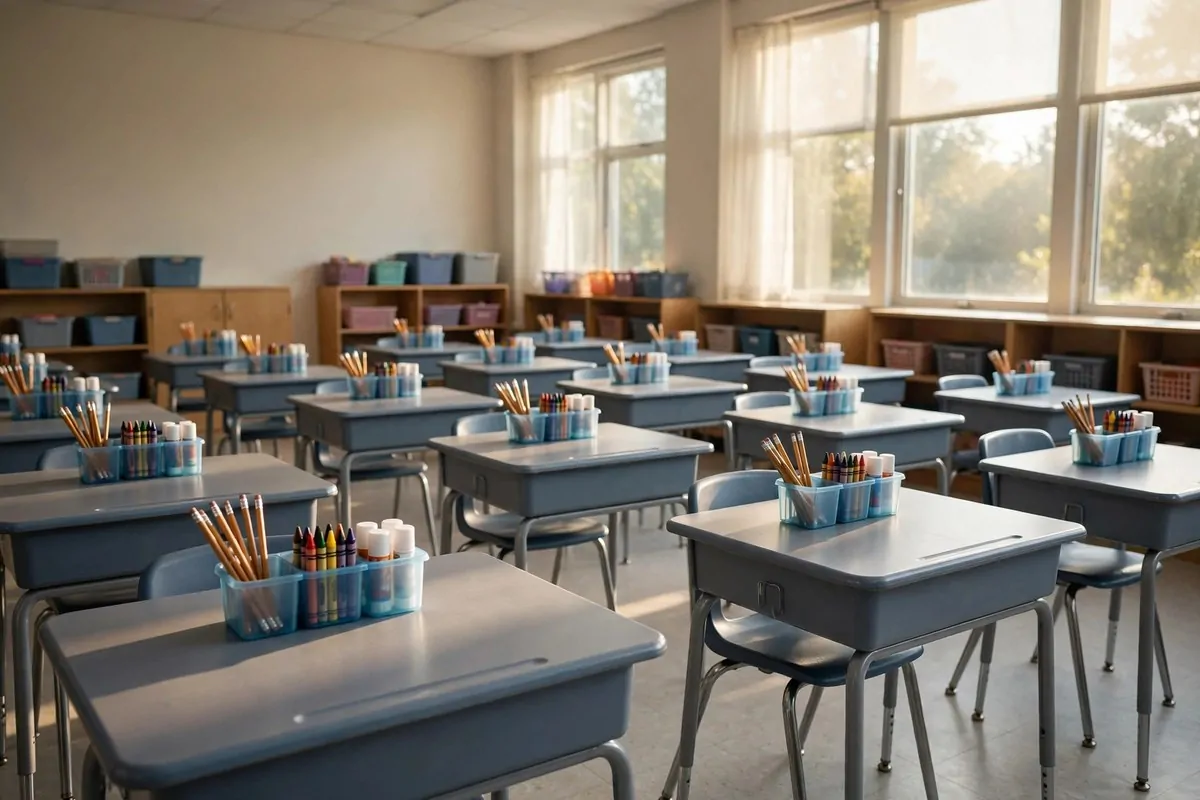
Communal supply stations sound nice, but they create traffic jams. Twenty kids walking to one table for pencils is a recipe for chaos. Supply caddies flip the idea around. Every desk gets its own little box of basics.
Each caddy holds the everyday stuff. Pencils, crayons, glue sticks, scissors, an eraser. That is it. Nothing fancy. The kids carry their caddy to any workspace in the room. When the lesson ends, the caddy goes back on the desk.
Transitions get so much faster. I timed this once with a teacher friend. Before caddies, it took six minutes to get everyone settled with supplies. After caddies, it took two. That is four minutes saved per transition, three transitions a day. The math adds up fast.
Kids take better care of their own stuff too. When the pencils belong to "the table group," nobody cares if they break. When they belong to one kid, that kid guards them like treasure.
You do not need matching caddies. Old plastic containers work. Cut down cereal boxes work. I have seen teachers use shower caddies from the dollar store, and they were perfect. They have a handle and everything.
Have a restock day once a week. Wednesday works well. Kids check their caddy, tell you what is missing, and you refill from your big supply. Five minutes and you are done for the week.
Label each caddy with the kid's name. It stops the borrowing fights. "That is my pencil" becomes a lot clearer when the caddy has a name on it.
The best part might be the quiet. No more kids wandering the room looking for scissors. No more "who took my glue." Everyone has what they need, right there. You can actually hear yourself think.
5. A Wall Pegboard for Tools
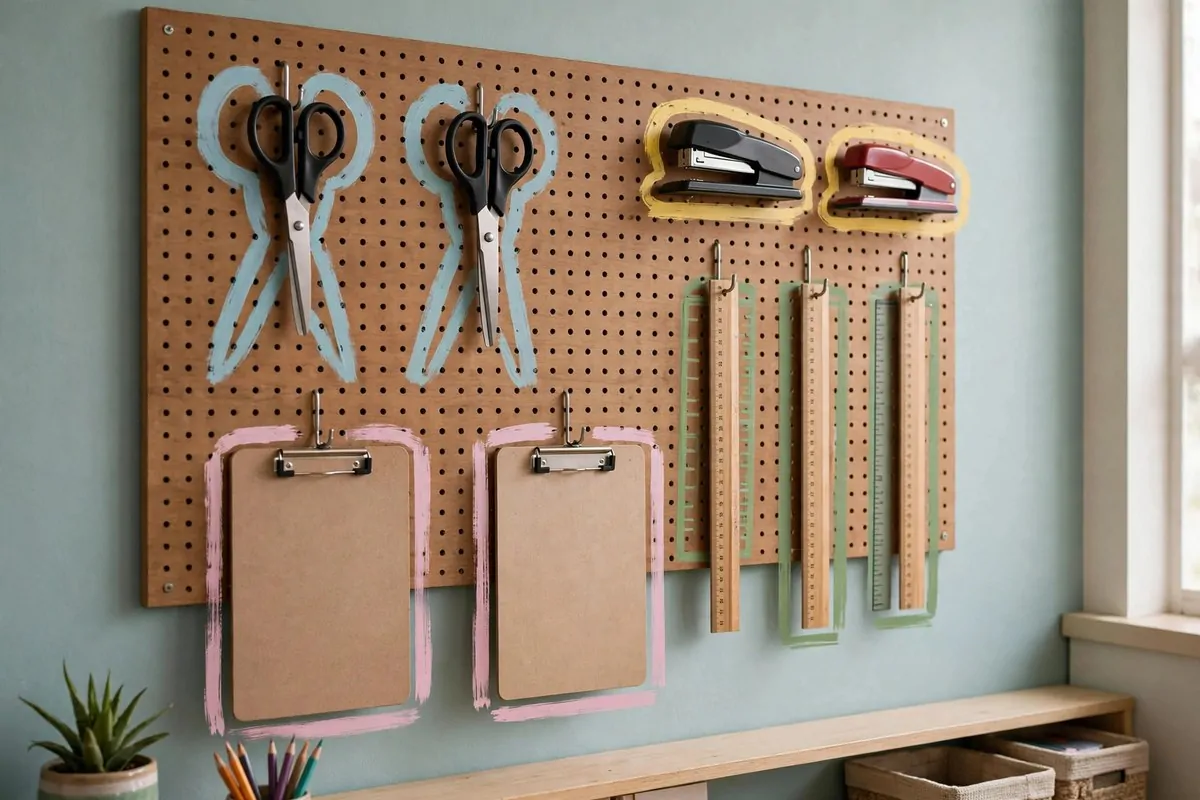
Scissors, staplers, tape dispensers, and hole punches. Every classroom has them, and every classroom loses them. A pegboard puts them on the wall where everyone can see them. No more digging through drawers.
Hang the pegboard near your desk or the art area. Put each tool on a hook. Then trace the outline of each tool on the board with a marker. The outline is the clever part. When something is missing, you can see exactly what is gone.
Kids learn to put things back fast. The outline makes it a little game. Match the scissors to the scissors shape. Even kindergarten kids can do it. And they like doing it, which is the surprising part.
I painted mine a cheerful color before hanging it. It took one afternoon and it made the board feel like decor instead of hardware. Yellow works well. So does a soft blue. Pick whatever matches your room.
Pegboards also free up desk space. Drawers stay empty, which means they stay usable for things that actually need drawers. My teacher desk used to swallow supplies. Now it has actual empty space. It feels wrong and wonderful.
Keep the everyday tools on the pegboard and the rare tools in a drawer. The stapler gets a hook. The three hole punch you use twice a year stays hidden. Only the busy tools earn wall space.
If you cannot mount things on the wall, get a freestanding pegboard panel. They lean against the wall or sit on a counter. Same idea, no holes. Your custodian will thank you.
Check the board at the end of each day. Thirty seconds. If a hook is empty, ask the class before they pack up. Finding the stapler at 3 pm beats finding out it is gone at 8 am tomorrow.
6. Hanging Pocket Charts
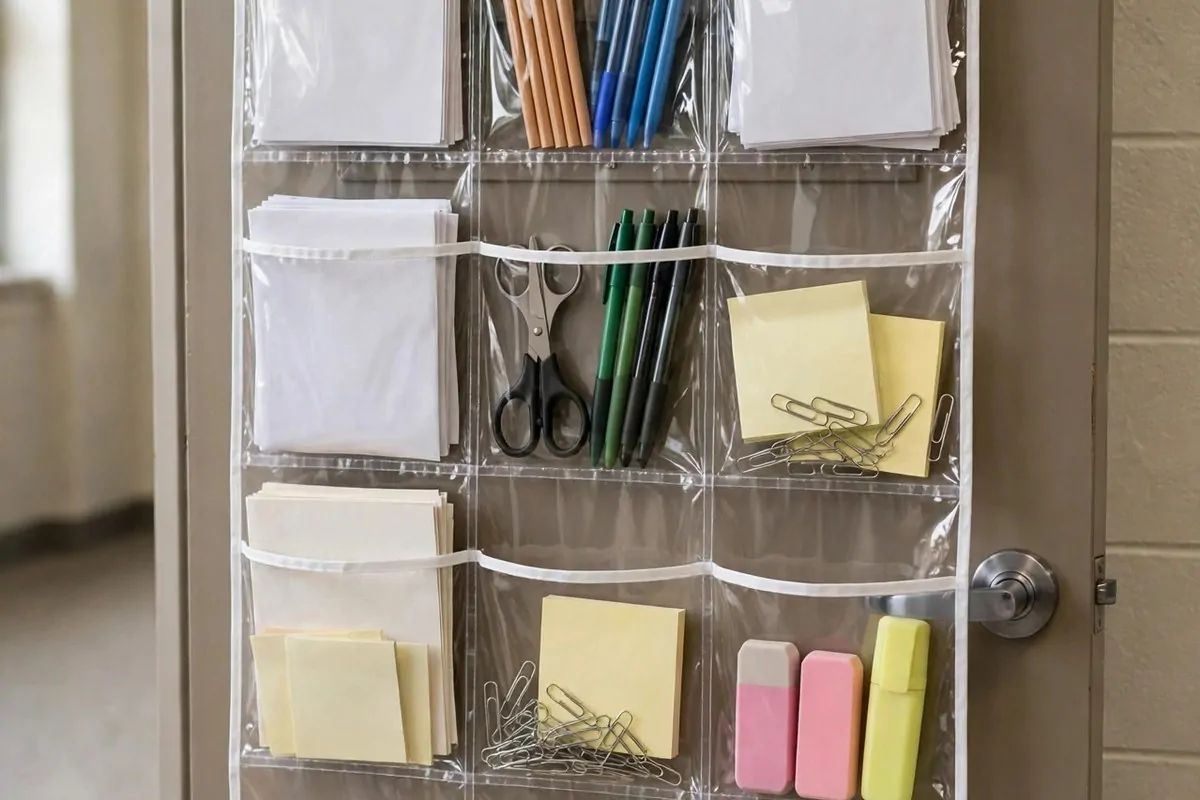
Doors and walls are free storage space. A clear over-the-door pocket organizer turns them into a filing system you can see at a glance. Each pocket holds worksheets, forms, or supplies. Nothing hides. Nothing stacks up.
I use one for worksheets by day of the week. Monday's sheets go in pocket one. Tuesday's in pocket two. When it is time for math, I pull the right pocket's papers and hand them out. No flipping through a pile wondering which sheet is which.
Number the pockets with a marker. Then your lesson plans can say "grab pocket 4." Anyone can do it, including a student helper or a substitute. The number removes all the guessing.
These organizers also work for supplies. Glue sticks in one pocket. Dry erase markers in another. Kids can see everything through the clear plastic. They grab what they need without asking you.
Hang one on the inside of a closet door for your own stuff. Hall passes, first aid kit, the phone list, spare masks. Your personal things stay private but reachable. You stop opening five drawers to find one thing.
The pockets are small, which is actually good. They force you to keep only the current week's papers. Old stuff has to leave. It is a built-in declutter rule.
They are cheap and they last. Mine cost less than ten dollars and survived two years of daily use. When a pocket tears, a little tape fixes it. You do not need to replace the whole thing.
Wipe the plastic down once a month. Dust makes clear pockets look cloudy and gross. A damp cloth takes one minute. It keeps the whole thing looking fresh and professional.
7. Rolling Carts for Centers
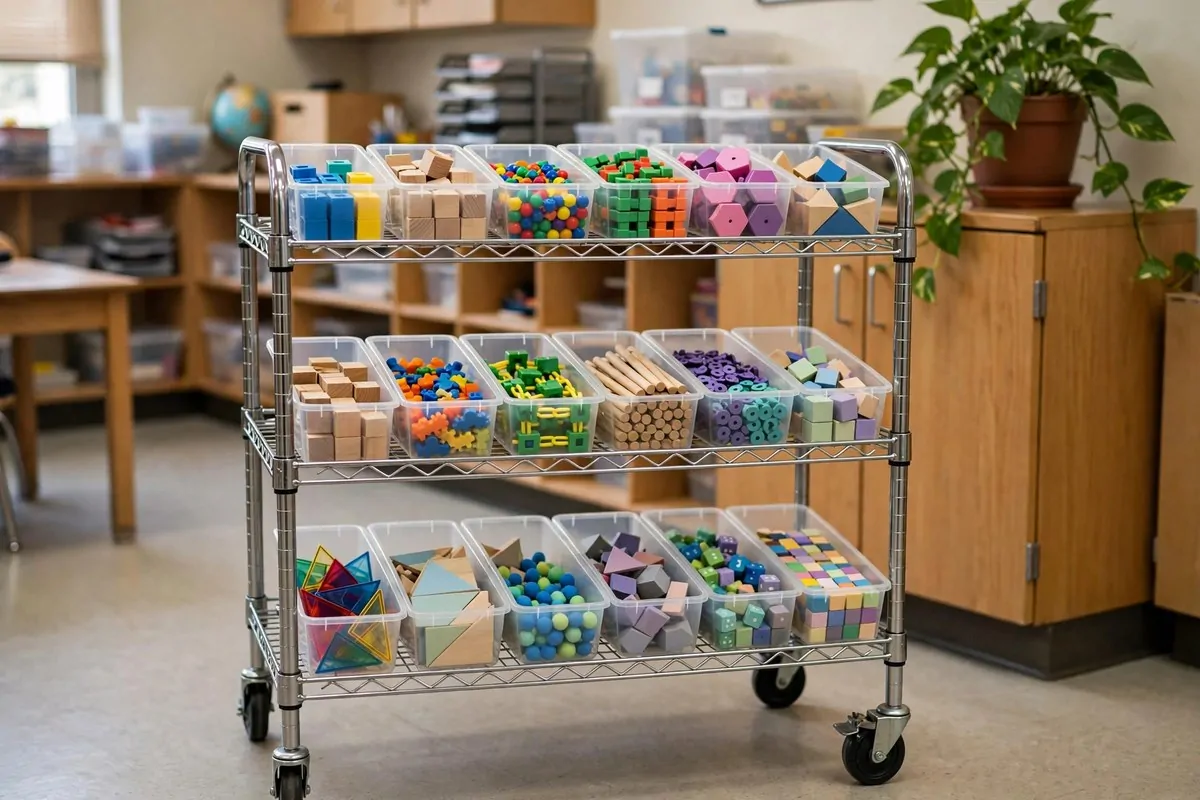
Learning centers need a lot of stuff. Art supplies for the art center. Games for the math center. Books for the reading center. A rolling cart keeps each center's materials together in one mobile home.
The idea is simple. One cart per center. Everything that center needs lives on that cart. When center time starts, kids roll the cart to their area. When it ends, they roll it back. Setup takes seconds.
I love the three tier carts for this. Top tier for the instructions. Middle tier for the main materials. Bottom tier for extras and backup supplies. Kids can see everything without digging.
Tape the center instructions to the cart itself. Then kids do not need to ask you what to do. They read the card, grab the materials, and start. You get to actually teach small groups instead of repeating directions.
These carts are lifesavers for teachers who share rooms. Load your cart, roll it in, teach, roll it out. Your materials stay organized and portable. No claiming shelf space that is not yours.
Label each cart with a big clear sign. "Art Center." "Math Games." Big letters. Little kids can find their center from across the room. It cuts down the wandering and the "where do I go" questions.
Stock the carts on Friday. Check for missing pieces, broken crayons, dried out markers. Ten minutes keeps them running all week. A center with missing materials falls apart fast, and then the kids come to you.
The carts also make cleanup faster. Everything has a spot on the cart. Kids just put things back where they found them. You are not the only one tidying up anymore.
8. Magnetic Strips on the Whiteboard
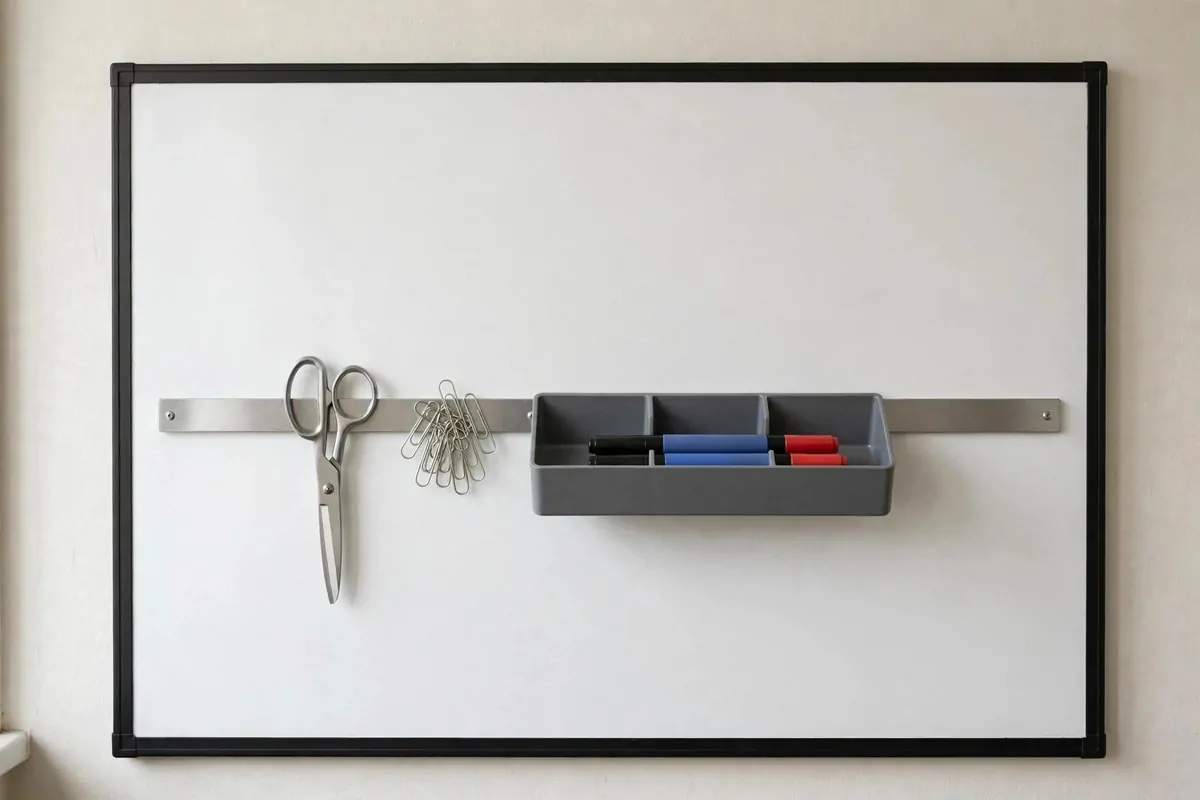
Small metal things vanish in classrooms. Scissors walk away. Paper clips sink to the bottom of drawers. A magnetic strip on the whiteboard keeps them visible and stuck in place.
You can buy magnetic knife strips made for kitchens. They work perfectly in classrooms. Stick one on the side of your whiteboard or on a file cabinet. Hang your scissors, your paper clips, your magnetic markers. They click on and stay put.
The beauty is that everything is visible. You see the scissors every time you look at the board. Kids see them too. Things that are visible get returned. Things that hide in drawers get forgotten.
I keep my whiteboard markers on one, right at the tray. I used to lose markers daily. Now they live on the strip and I have not lost one in months. It feels like a small miracle every time.
These strips also work on the side of a metal desk or a filing cabinet. Any metal surface becomes storage. You are using space that was just sitting there doing nothing.
They are strong enough for real tools. Scissors, hole punches, even a small stapler. Test the weight first, but most classroom tools hold fine.
Keep one strip for kid tools and one for teacher tools. Kids can grab the kid scissors without touching your good ones. Boundaries, but make them magnetic.
Installation takes five minutes. Most strips come with screws or strong adhesive. If your walls are off limits, stick it to a metal cabinet instead. No holes, no problems.
9. The Grab-and-Go Sub Tub
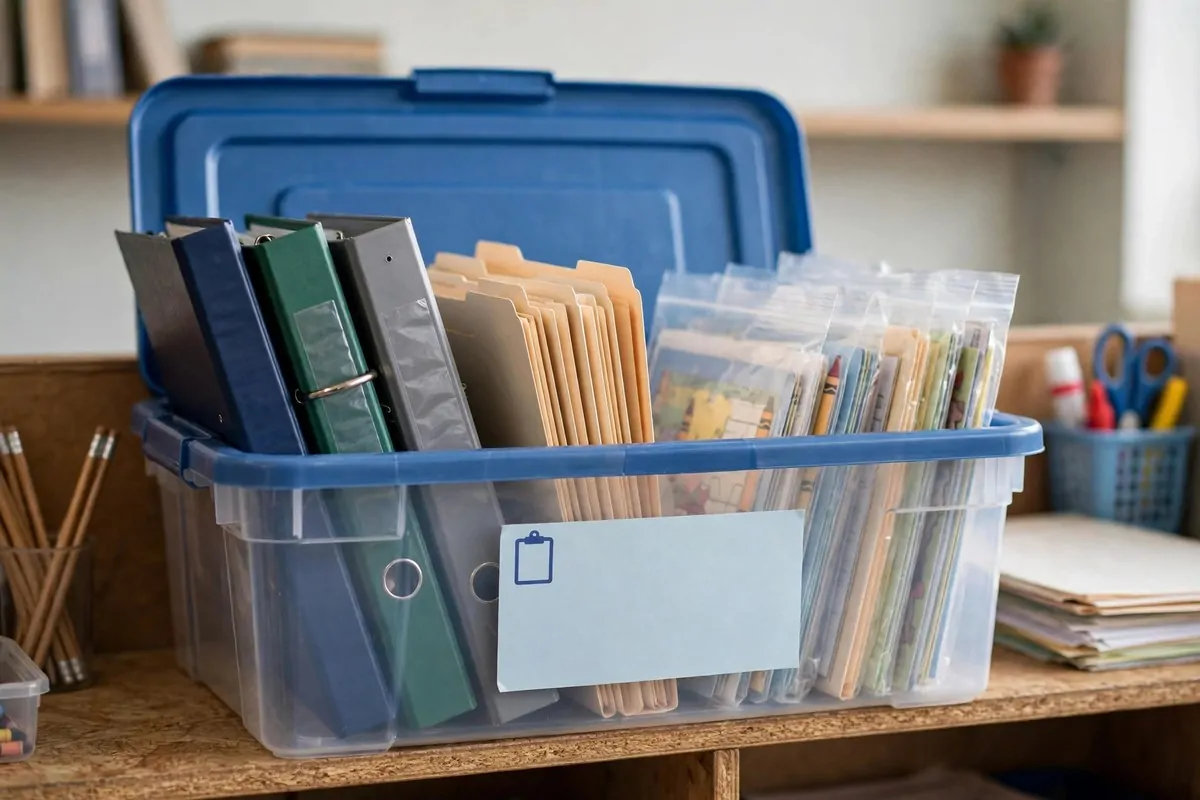
Being sick is stressful enough without writing sub plans at 5 am. A grab-and-go sub tub sits ready all year. Inside is everything a substitute needs to run your class for a day.
Pack it with your class list, the daily schedule, seating chart, and emergency lesson plans. Add a few quiet activities too. Word searches, coloring pages, a read aloud book. Things that work with zero prep.
Update the tub once a month. Swap in fresh worksheets. Check that the class list is current. It takes fifteen minutes. Compare that to the two hours of panicked plan writing when you wake up with the flu.
Label the tub clearly and tell your class where it lives. "If I am ever out, the sub tub is on the shelf by my desk." Kids can point a substitute right to it. You do not even need to be conscious to have a plan.
Include a note about your tricky kids. Not mean, just honest. "Jamal finishes fast and gets bored, give him the puzzle box." A sub who knows the landmines has a much better day. And your kids have a much better day too.
Put your classroom routines in the tub. How you do lunch. Where the kids line up. What the bathroom signal is. Subs do not know your systems. Write them down once and stop re-explaining them every absence.
The peace of mind is worth it alone. You can actually rest when you are sick. No guilt, no 5 am laptop session. The tub has it covered.
Make it a bright color so it is easy to spot. Mine is red. You can see it from the door. A sub walks in, sees the red tub, and knows exactly where to start.
10. Inbox and Outbox Trays
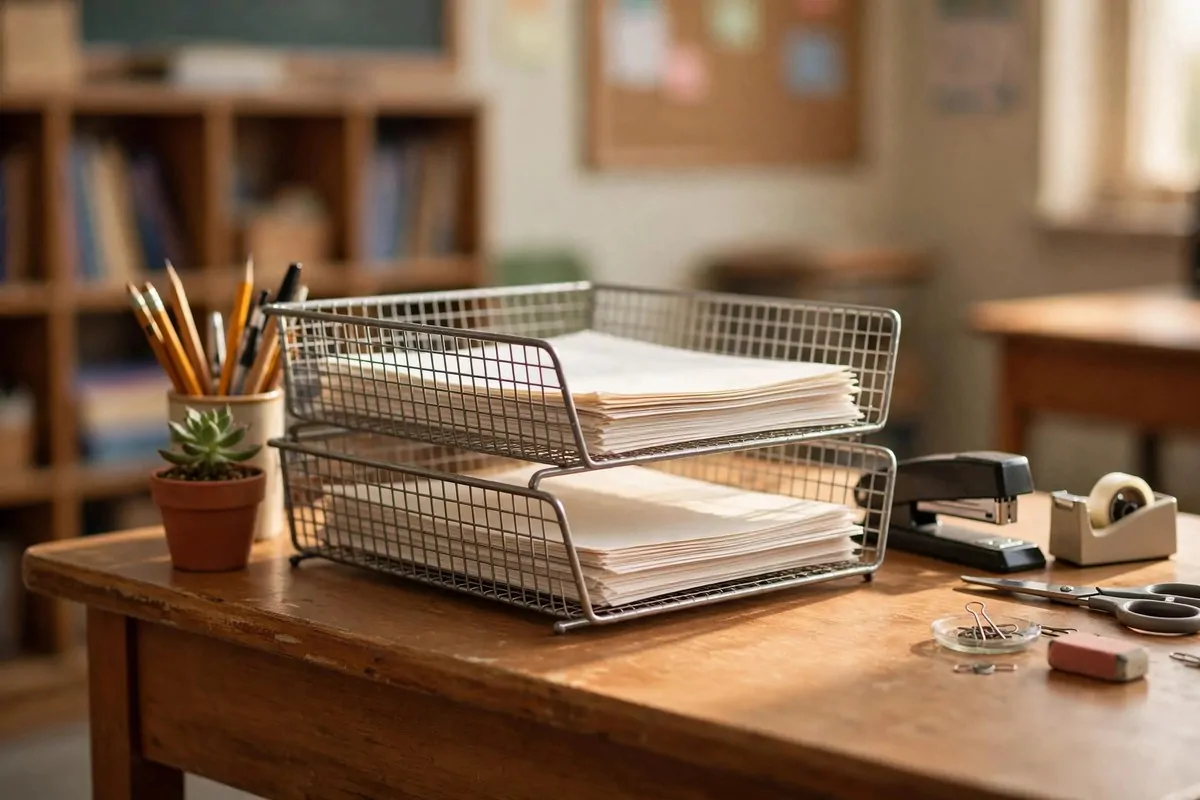
Your desk is the Bermuda Triangle of the classroom. Notes from home, permission slips, graded papers, forms to sign. They all land there and most of them sink. An inbox and outbox system gives every paper a next step.
The inbox is for things coming in. Notes from parents. Homework turned in late. Forms you need to look at. The outbox is for things going back out. Graded work. Notes to send home. Papers to file.
The rule is simple. When a paper arrives, it goes in the inbox. Not on the desk. Not in a pile. In the inbox. When you process it, it moves to the outbox or the trash. Nothing sits in limbo.
I process my inbox once a day, usually right after the kids leave. It takes ten minutes. Sign what needs signing. Grade what is quick. File what is done. The desk stays clear, and my brain feels clear too.
Teach the kids to use the inbox. "Put your note in the inbox, not on my keyboard." It takes a week of reminders. Then it sticks. Kids are great at systems once they learn them.
Get trays that stack. They take up almost no desk space. Two trays, one footprint. Your desk thanks you.
The outbox has a hidden benefit. When a parent asks if you got their note, you check the inbox. When a kid asks where their graded quiz is, you check the outbox. Every paper has a known location. No more searching.
Empty both trays on Friday. Inbox to zero. Outbox to zero. Start Monday clean. It is the best five minutes of your week, I swear.
11. A Teacher Filing Corner
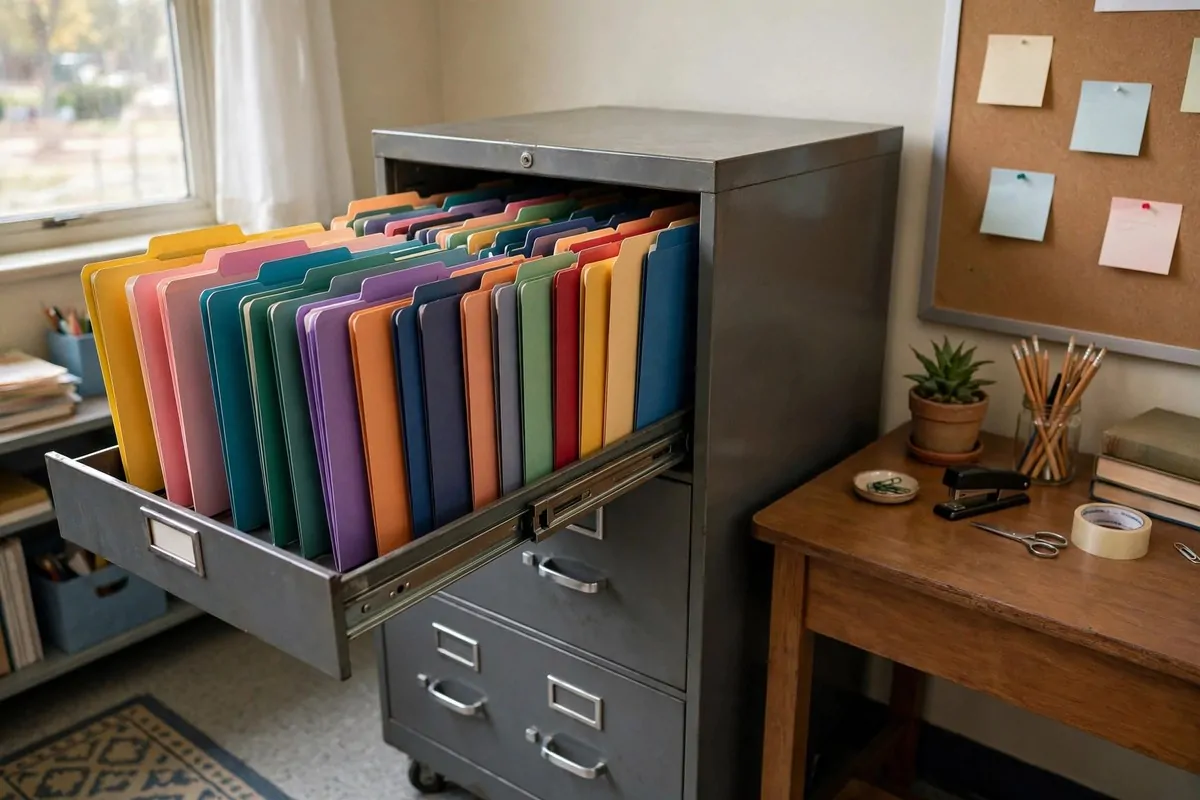
Every teacher needs one place where the important papers live. Not three places. One. A filing cabinet with labeled hanging folders is the classic answer because it works.
Set up folders for the things you touch most. Attendance records. Lesson plans by week. Student data. Parent contacts. Field trip forms. If you reach for it often, it gets a folder.
Label everything with big clear words. Not codes, not abbreviations. "Reading Assessments" not "RA." Future tired you will not remember what RA meant. Future tired you needs it spelled out.
Match your physical folders to your computer folders. Same names, same order. When you need something, you check the same spot whether it is paper or digital. Your brain only learns one system.
I keep a "this week" folder at the very front. Everything I need for the current week goes in it. On Monday I load it up. By Friday it is empty. It is like a to do list made of paper.
File things the day they arrive. I know, I know. Nobody wants to. But a paper filed today takes thirty seconds. A paper filed next month takes ten minutes of searching first. The math is not close.
Get a cabinet with a lock if you can. Student records are private. A locked drawer keeps you compliant and keeps curious kids out. It is worth asking your school for one.
Once a year, purge the old stuff. Last year's attendance sheets can go. Keep what the school requires, toss the rest. A filing cabinet full of old paper is just an expensive trash can.
12. The Fast-Finisher Station
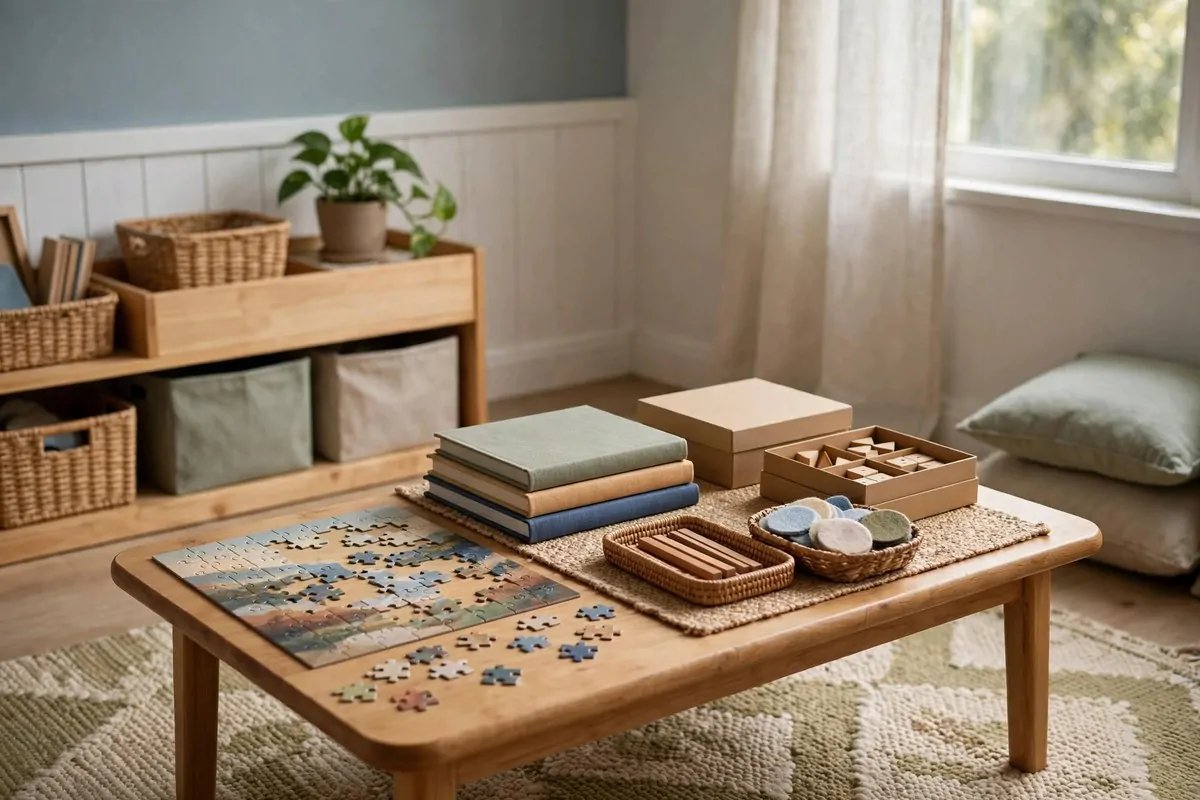
Every class has kids who finish in ten minutes and kids who need forty. The fast finishers used to be your problem. They would wander, chat, and distract everyone. A fast finisher station solves it.
Set up a small table or shelf with quiet activities. Puzzles. Logic games. Extra reading books. Drawing paper. Challenge worksheets. Things kids can do alone without bothering anyone.
The rule is simple. When you finish your work, you go to the station. No asking. No waiting. Kids learn the routine in a week and your fast kids stop being a disruption.
Rotate the activities every few weeks. New puzzles, new books, new challenges. It takes five minutes to swap things out. Fresh activities keep the station exciting instead of boring.
I put a little sign with the rules. "Pick one activity. Work quietly. Clean up when done." Three rules. Kids follow them because the station is a privilege, not a punishment.
This station is also great for early morning arrivals. Kids who get to school early can start there. No more kids sitting at desks with nothing to do while you take attendance.
Keep the activities self checking when possible. Puzzle boxes with the answer inside. Books with discussion questions. You do not want the station creating more work for you.
The quiet it buys you is gold. While fast kids are busy at the station, you can help the kids who need more time. Nobody is waiting on you. Nobody is bored. Everyone is working.
13. A Lost-and-Found Basket
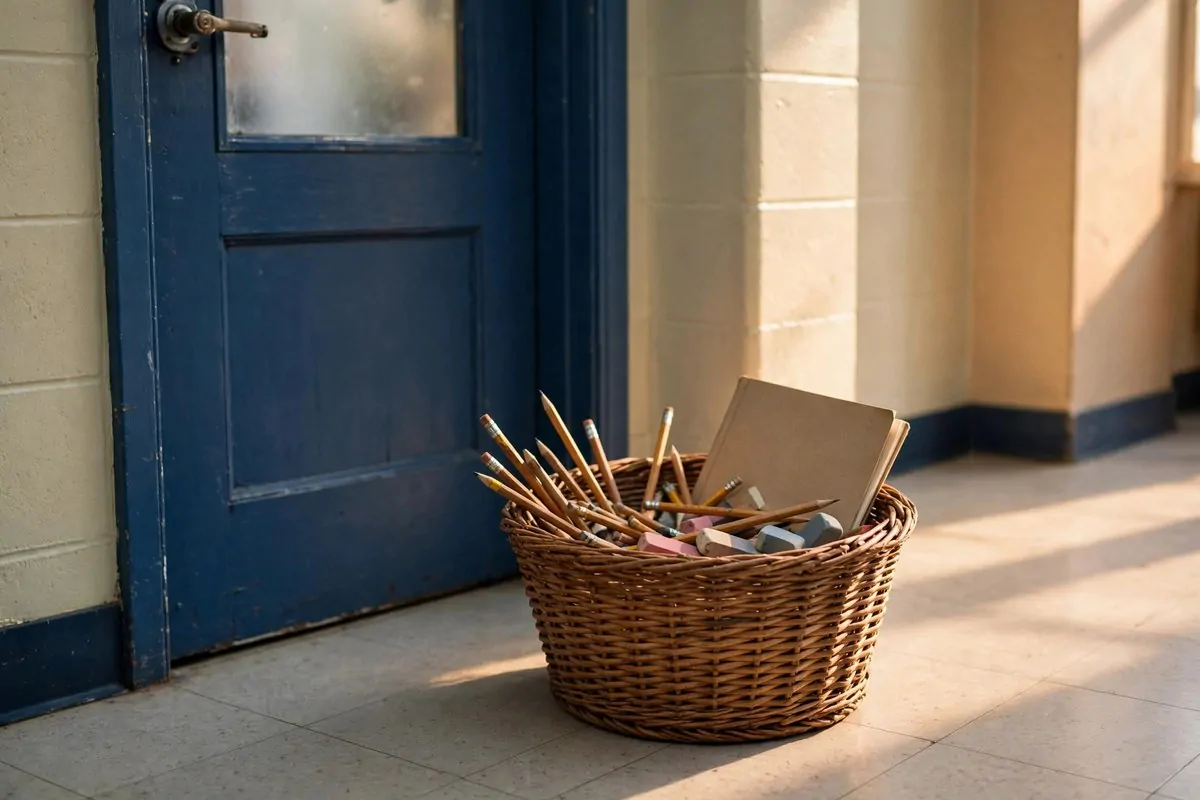
Kids lose things constantly. Pencils, erasers, jackets, lunch boxes, one shoe. Yes, one shoe. A lost and found basket by the door catches it all before it vanishes forever.
The system is simple. Found something on the floor? Put it in the basket. Lost something? Check the basket. No teacher involvement needed. It runs itself.
Put the basket right by the door. Kids pass it on the way in and out. That is when they notice things. A basket in the back corner gets ignored. A basket by the door gets used.
Empty the big stuff monthly. Jackets and lunch boxes go to the school lost and found. Small stuff like pencils can be recycled back into the supply caddies after a week. Nothing goes to waste.
I labeled mine with a little sign. "Lost something? Look here." The sign matters. New kids do not know the system yet. The sign teaches them without you saying a word.
This saves you from being the lost item detective. Before the basket, kids would interrupt lessons to ask about missing pencils. Now they check the basket during transitions. The interruptions stopped.
It also teaches responsibility. Kids learn that their stuff has a home base. They start checking the basket on their own. They start losing less. It is a small life lesson disguised as a basket.
Get a basket with handles. You will need to carry it to the office lost and found sometimes. Handles make that trip easier. Trust me on this one.
14. Washi Tape Desk Zones
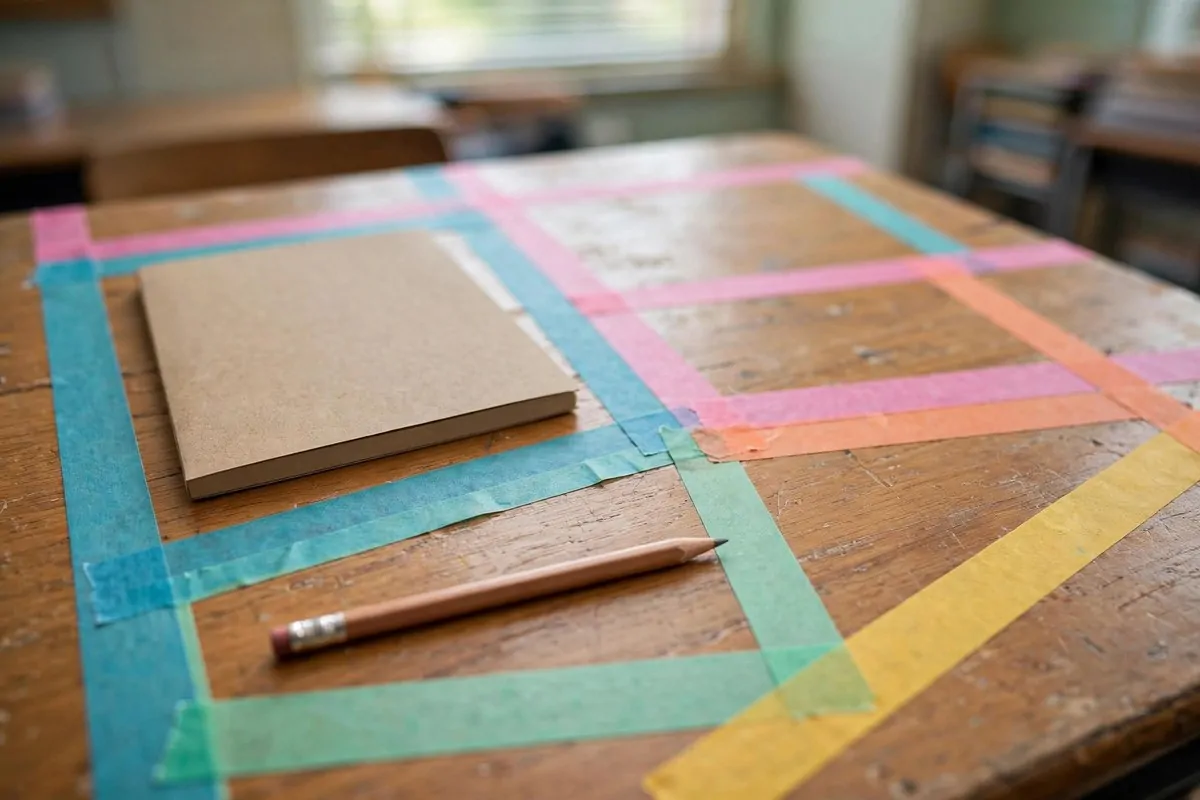
Student desks get messy in about four minutes. Papers slide everywhere. Pencils roll off. Books stack up sideways. Washi tape zones give every item a parking spot.
Take colorful tape and mark out zones on each desk. A rectangle for the notebook. A small square for the pencil. A spot for the book. Kids put things in their zones and the desk stays organized.
It looks like a game, and kids treat it like one. "My pencil is in its home." They actually say this. It is adorable and it works. The tape turns tidying into matching.
Use different colors for different zones. Blue tape for books. Green tape for writing tools. The colors help kids remember what goes where. It is color coding, but tiny.
The tape lasts a few weeks before it peels. Replacing it takes ten minutes for the whole class. I do it on Friday afternoons while the kids do silent reading. They do not even notice.
This is great for kids who struggle with organization. The visual boundary does the thinking for them. They do not have to decide where the pencil goes. The tape already decided.
It also helps with devices. If your kids use tablets, tape out a tablet zone. The tablet has a home. It stops sliding off desks. Screens break less. Your tech budget thanks you.
Let kids pick their tape colors. It takes two minutes and they will care about their zones more. A kid who chose pink tape will defend that pink zone with her life.
15. The Over-the-Door Supply Wall
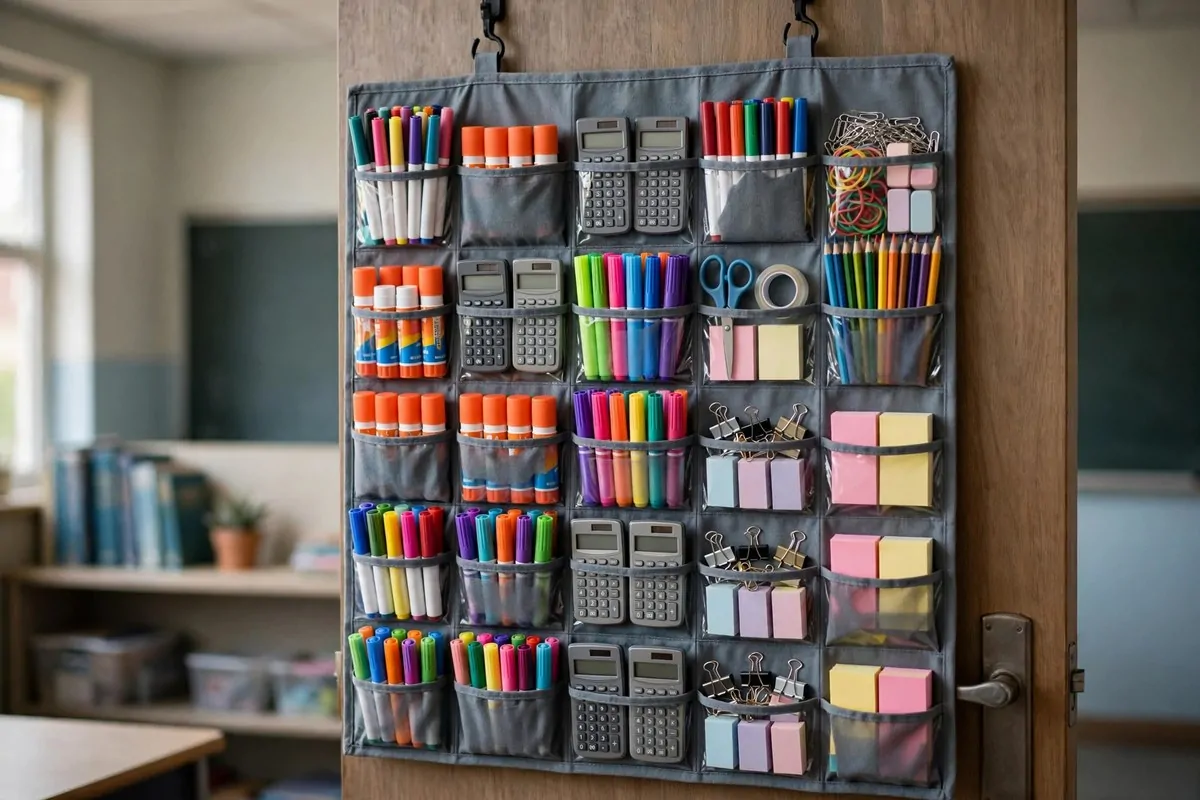
Small supplies need small homes. Markers, glue sticks, calculators, rulers. They are too small for shelves and too many for drawers. An over the door shoe organizer gives each one a pocket.
Hang it on the back of your door or on a closet door. Fill each pocket with one type of supply. Markers in the top row. Glue sticks in the middle. Scissors at the bottom. Kids can see everything.
The clear pockets are the key. Kids do not have to open anything or dig through anything. They look, they grab, they go. It is faster than any drawer system I have ever seen.
I keep mine stocked with the stuff kids ask for most. That is the whole trick. If kids ask for it daily, it goes in the door organizer. If they ask for it monthly, it stays in the closet.
Number the pockets or label them with pictures for little kids. A marker picture on the marker pocket. A glue stick picture on the glue stick pocket. Pre readers can use it independently.
Restock it on Mondays. Check which pockets are empty, refill from your big supply. Three minutes. An empty pocket is a kid asking you for markers during math. You do not want that.
This also works great for art supplies. Paint brushes, oil pastels, watercolor sets. Art rooms love these organizers. Everything visible, everything reachable, nothing spilled in a drawer.
One organizer holds a shocking amount of stuff. Twenty four pockets times a handful of markers each. That is a lot of supplies in the space of one door. Small rooms especially benefit.
16. Interactive Bulletin Boards
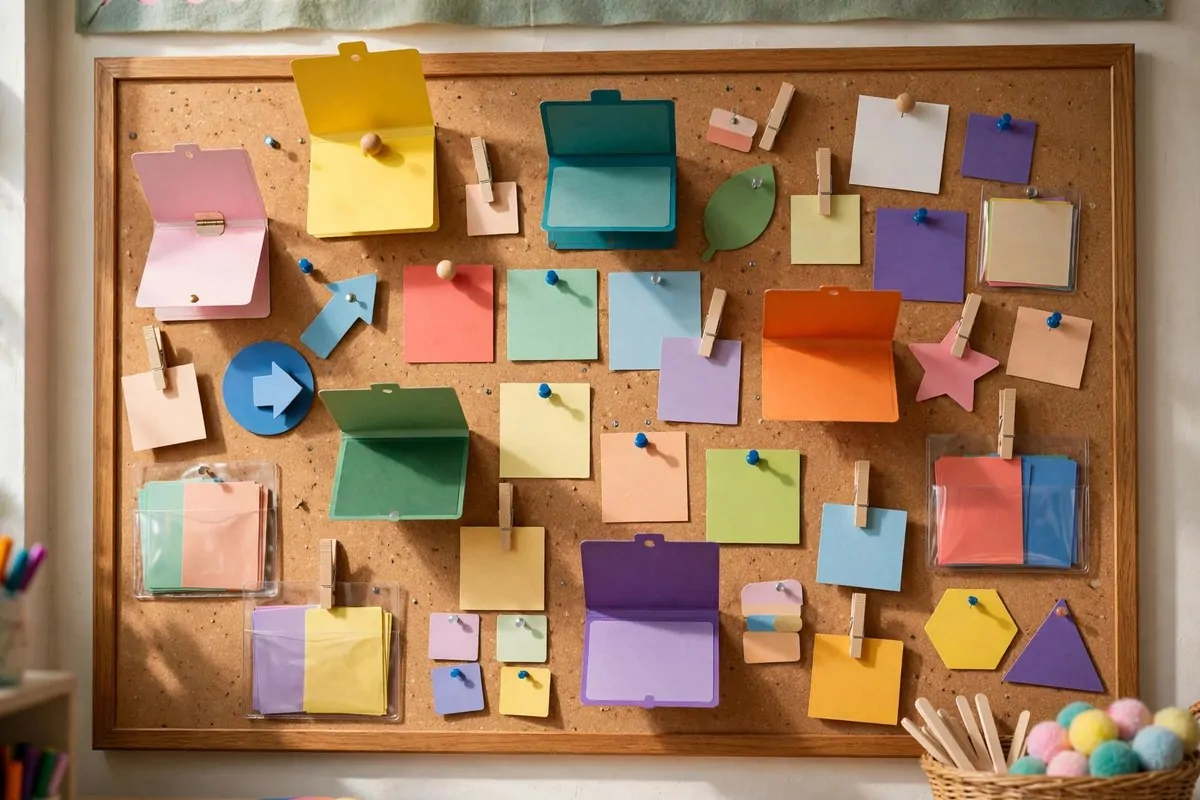
Most bulletin boards are just wallpaper. They look nice for a week, then everyone stops seeing them. Interactive boards are different. Kids touch them, move pieces, and use them to learn.
Make a word wall with magnetic letters. Kids build words during free time. Make a math board with flippable fact cards. Kids quiz each other. The board becomes a learning station, not a decoration.
Use velcro dots for the movable pieces. They stick well and peel off easy. Kids can rearrange things without tearing the board. It survives daily use, which is more than I can say for most classroom decor.
Assign a board helper each week. That student updates the board on Mondays. New words, new facts, new questions. You do not touch it. The kids run it. It is one less thing on your plate.
Interactive boards also fill awkward time gaps. Kids waiting for the bus can flip through the fact cards. Early finishers can build words. Dead time becomes learning time without any planning from you.
Keep the pieces big and chunky for little hands. Small pieces get lost. Big pieces stay on the board. I learned this after losing half a set of tiny word cards in one week.
Change the content monthly to match what you are teaching. Fractions in March. Plant parts in April. The board grows with your curriculum. It never goes stale.
Take a photo of each board setup before you change it. Next year, you can rebuild it in minutes instead of redesigning from scratch. Future you will be so grateful.
17. A Classroom Job Chart
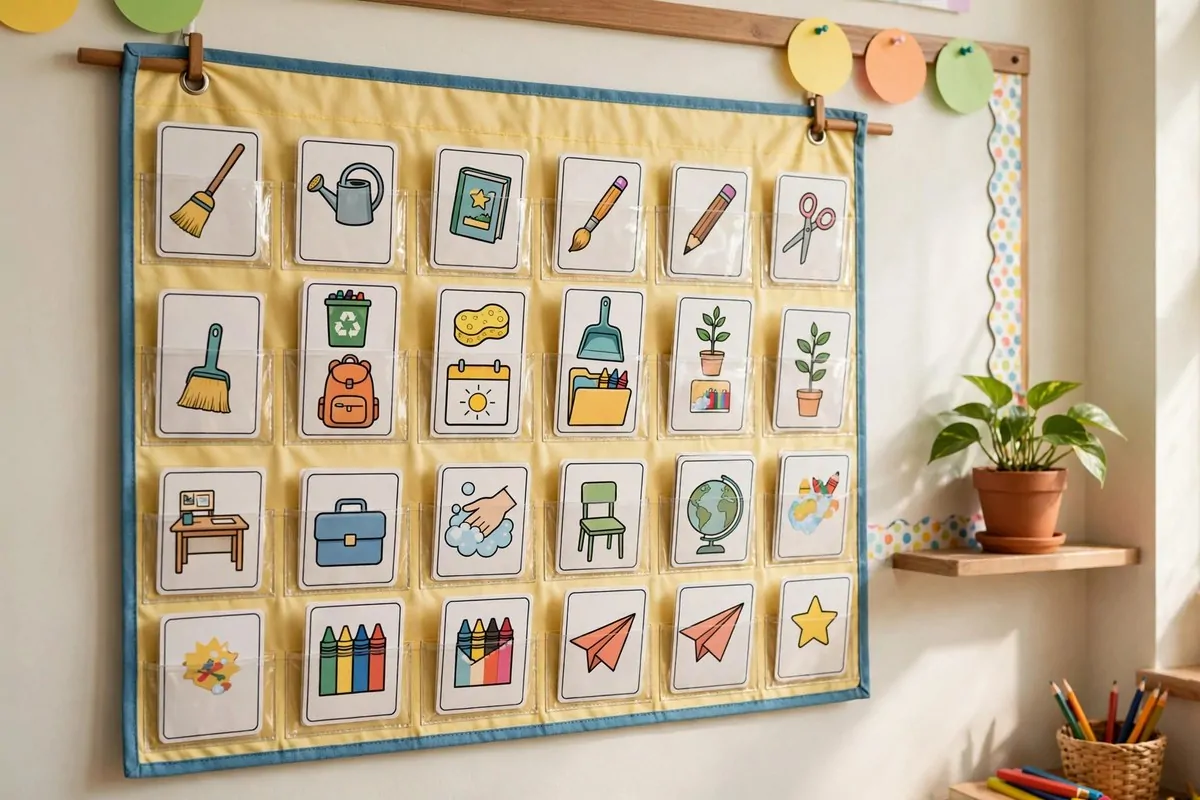
Classrooms have a hundred tiny jobs. Passing out papers. Collecting books. Watering the plant. Feeding the class pet. Doing them all yourself eats your day. A job chart hands them to the kids.
Make a chart with pockets, one pocket per job. Put a card with each kid's name in a pocket. Rotate the cards every Monday. Every kid gets a turn at every job over the year.
The jobs should be real. Not fake busywork. Kids know the difference. Paper passer is real. Line leader is real. Board cleaner is real. Real jobs make kids feel important.
Train each job once. Show the paper passer how you want papers stacked. Show the librarian how to shelve books. Ten minutes of training saves you hours of fixing mistakes later.
I include a "substitute" job in my chart. That kid covers for anyone who is absent. No scrambling when someone is out. The sub kid just does both jobs. It is a coveted role, oddly enough.
The chart also builds community. Kids take pride in their jobs. They remind each other. "It is my week for plants, I will water them." You stop being the only adult in the room, in the best way.
Keep the chart at kid eye level. If they cannot reach it, they cannot use it. Mount it low on the wall or on the side of a bookshelf. Accessibility matters.
Laminate the name cards. They get handled every week. Paper cards turn to mush by October. Laminated cards last all year. It is a one time effort for a year of use.
18. Under-Desk Storage Baskets
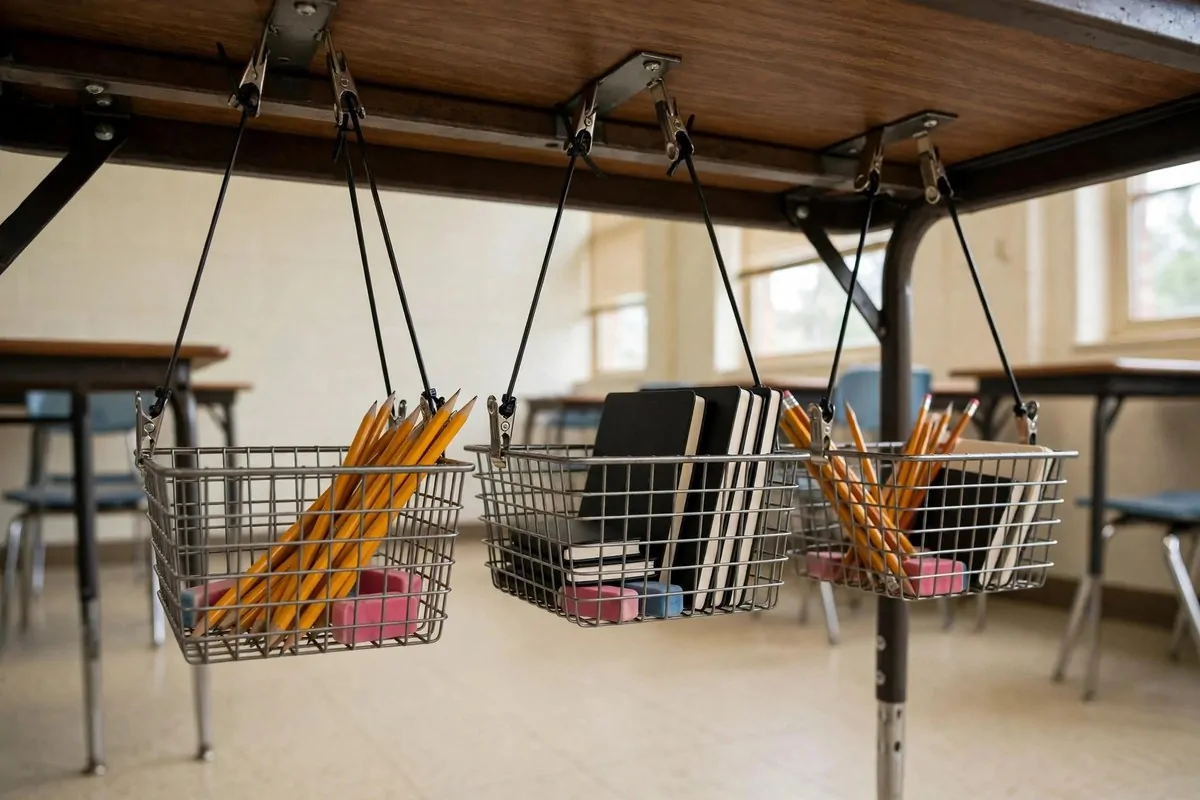
Desk surfaces are small. The space under the desk is wasted. Hanging baskets underneath gives each kid a private storage spot that does not eat desk space.
Use wire baskets with hooks that fit over the desk edge. Or screw small baskets under the desk if your school allows it. Each basket holds the kid's personal extras. Spare pencils. A book they are reading. Their headphones.
This cuts down trips to the supply area. Kids keep their extras within reach. They do not stand up, walk across the room, dig through a bin, and distract six people on the way. They just reach under.
Desktops stay clearer too. When every kid has an under desk spot, fewer things pile up on top. Clear desks mean faster starts. You stop waiting for kids to clear space before a lesson.
Let kids personalize their basket. A name tag. A sticker. It becomes their space. Kids take care of spaces that feel like theirs.
These baskets are also great for unfinished work. A kid puts their half done project in the basket instead of cramming it in a desk. It stays flat. It stays safe. It is there tomorrow.
Check the baskets monthly for trash. Kids will store ancient snacks in there. I speak from experience. A quick monthly check keeps things from getting gross.
The baskets cost very little. Wire ones from the dollar store work fine. You do not need anything fancy. You just need a hook and a basket.
19. Visual Direction Cards
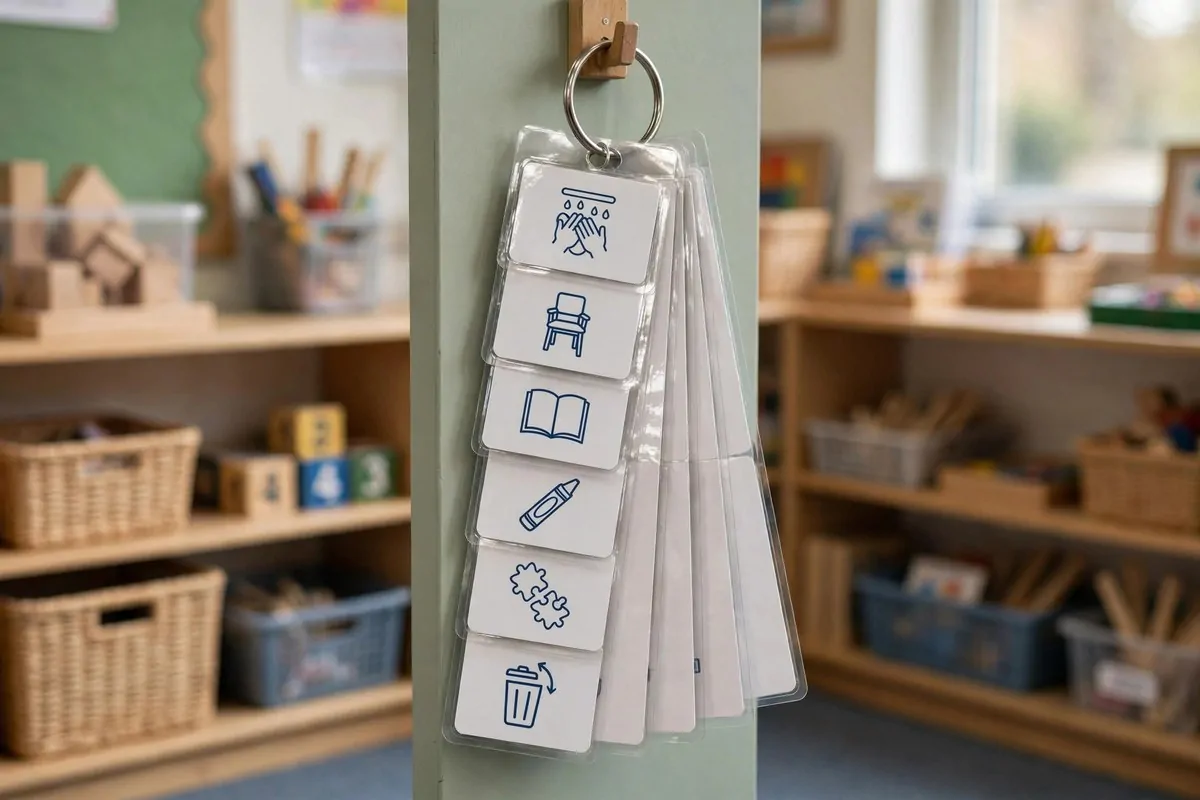
Repeating directions is the biggest time drain in teaching. You say it. Half the class misses it. You say it again. Visual direction cards say it once, permanently, at the spot where kids need it.
Make a set of cards for each center or routine. Each card shows one step with a simple picture. "1. Get your folder. 2. Read the task card. 3. Start writing." Hang the set on a ring at the center.
Kids check the cards instead of asking you. It takes training, but it sticks. Point to the cards every time a kid asks. "What do the cards say?" After two weeks, they check before they ask.
Pictures matter more than words for young kids. A drawing of a hand picking up a folder beats the word "folder." Keep the pictures big and simple. Stick figures are fine. Nobody is judging your art.
Laminate the cards. They get touched a hundred times a day. Unlaminated cards die fast. Laminated ones last years. It is worth the ten minutes with the laminator.
Keep each set to five steps or fewer. More than five and kids stop reading. Break big routines into smaller card sets if you need to. Short beats complete.
These cards are gold for substitutes too. A sub can run your centers by following the cards. Your routines keep working even when you are not there. That is the dream.
Update the cards when routines change. Old cards teach old routines. It takes two minutes to swap a card. Do it the day the routine changes, not next month.
20. The Quiet Corner
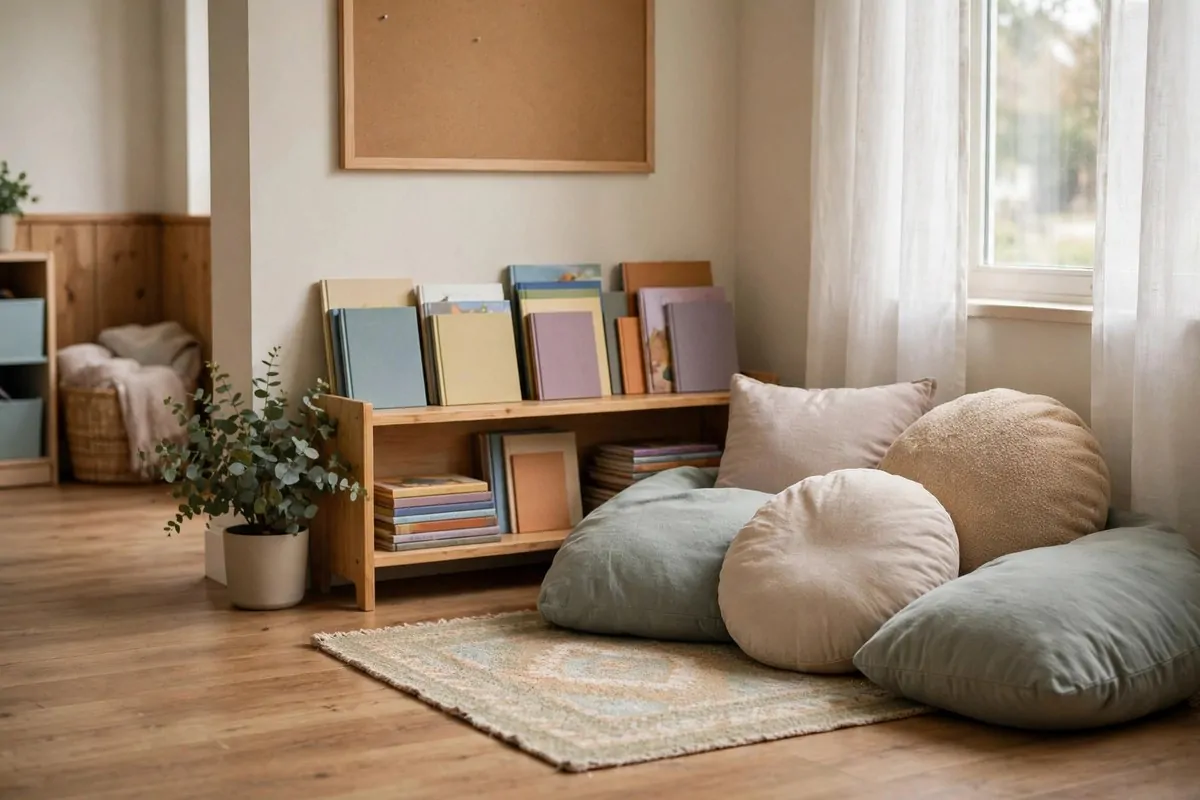
Kids have big feelings. Sometimes they need a minute to reset before they can learn. A quiet corner gives them a soft place to do that, instead of a meltdown at their desk.
Set it up in a corner with pillows, a small rug, and some calming books. Add a stuffed animal or two. Keep it simple. The goal is calm, not a playground. Soft textures and low stimulation.
Teach the routine explicitly. "When you feel upset, you may go to the quiet corner. Stay for five minutes. Come back when you are ready." Practice it when everyone is calm. Then it works when someone is not.
This saves you so much time. Before the quiet corner, an upset kid meant fifteen minutes of your attention while twenty four other kids waited. Now the kid resets independently and rejoins the class. You keep teaching.
Put a sand timer in the corner. Five minutes. Kids flip it and watch the sand fall. It gives them something to focus on besides their feelings. It also stops the corner from becoming a hangout spot.
Keep a feelings chart nearby. Kids can point to how they feel. Mad, sad, frustrated, tired. Naming the feeling helps them move through it. It is a small tool with a big effect.
The corner is not a punishment. Never send a kid there as discipline. It is a tool they choose. If it feels like punishment, kids will avoid it and you lose the benefit.
Restock the books monthly. A fresh book keeps the corner interesting. Rotate in seasonal titles or books about feelings. Small effort, big payoff.
21. Tension Rods and Folder Sorters
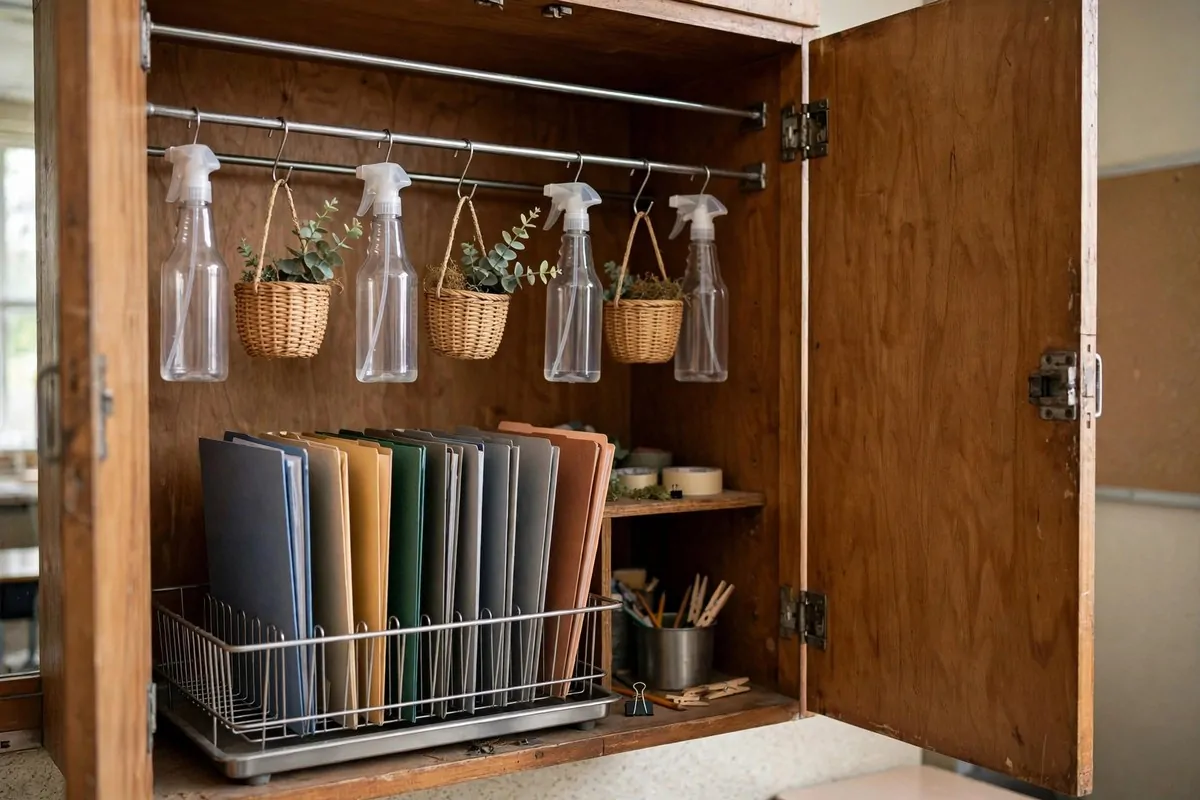
Cabinets are deep black holes. Things go in, things disappear. Tension rods and simple sorters turn cabinet chaos into organized storage without buying new furniture.
Put a tension rod inside a cabinet and hang spray bottles from it. They dangle neatly instead of falling over. Put another rod lower and hang small baskets. Suddenly the cabinet has shelves it never had.
Use old dish racks as folder sorters. The slots hold student folders upright. You can flip through them like files. Finding one kid's folder takes seconds instead of minutes of digging.
Sort folders by table group or by last name. Pick one system and stick to it. Label the slots. When a new kid joins, add a slot. The system grows with your class.
This trick also works for art supplies. Stand paper upright in a dish rack instead of stacking it flat. Stacked paper gets wrinkled and torn. Upright paper stays crisp. Your art projects look better.
Tension rods cost almost nothing. Dish racks can come from the thrift store. This is one of the cheapest ideas on the list, and it fixes one of the most annoying problems.
Label the inside of the cabinet door with what lives where. "Top shelf: math games. Bottom: art paper." Anyone opening the cabinet knows the system instantly. Including you on a tired Friday.
Do one cabinet at a time. Do not try to fix all your storage in one day. One cabinet takes twenty minutes. Next week, do another. Slow and steady beats a weekend marathon you will never start.
Here is a quick look at how these ideas stack up for time saved and cost:
| Idea | Time Saved Weekly | Cost |
|---|---|---|
| Turn-in trays | About 1 hour | Low |
| Supply caddies | About 45 minutes | Low |
| Visual schedule wall | About 30 minutes | Very low |
| Sub tub | Hours per absence | Very low |
| Color-coded bins | About 30 minutes | Low |
You do not need all 21 ideas to change your week. Start with the trays, the schedule wall, and the caddies. Those three alone can hand you back two hours every single week. Add more systems when you are ready. Your future self, the one eating lunch in peace, will thank you.