26 Closet Organization Ideas That Make Mornings So Much Easier

There is a chair in my bedroom that does exactly one job. It holds the clothes I tried on but did not wear. The maybe clothes.
Every night that chair fills up a little more. Every morning I stand in front of it, half awake, and dig. That chair was my morning routine, and it was costing me twenty minutes I did not have.
Then I fixed my closet. Not all at once. One small change at a time. The chair is empty now. Most mornings I get dressed in about four minutes, and I never have to think very hard.
That is what these 26 Closet Organization Ideas do for you. They turn your closet from a pile of choices into a place where the choice is already made. Mornings get quiet. You get dressed. You leave. Here is the whole list.
1. Start With the Big Declutter
You cannot organize clothes you do not wear. That is the first thing I learned, and it changed everything about my closet.
Pull every single item out. Yes, all of it. Lay it on your bed and look at the mountain.
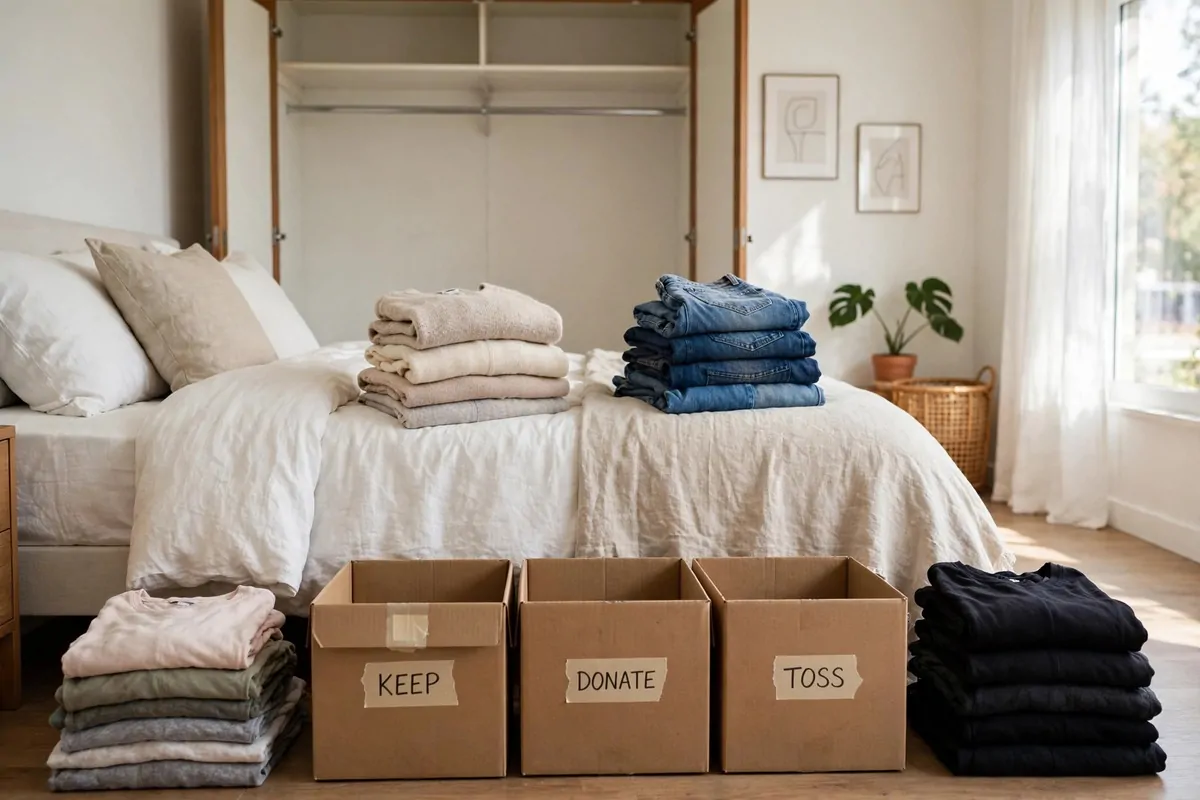
Now make four piles. Keep. Toss. Donate. Store for another season. Touch each item once and decide fast.
If you have not worn it in a year, be honest with yourself. It is taking up space your good clothes could use.
The toss pile is for clothes with holes or stains. The donate pile is for things that still have life left in them.
This part is not fun. I will not lie to you. It took me one whole afternoon and two cups of tea.
But when I finished, my closet had breathing room. For the first time in years, I could see every single thing I owned.
Mornings get easier the second you stop choosing between ten shirts you never wear. Less stuff means faster choices. That is the whole secret.
| Pile | What goes in it |
|---|---|
| Keep | Clothes you wore in the last year and love |
| Donate | Good condition, just not your style anymore |
| Toss | Stained, torn, worn out beyond repair |
| Store | Off-season clothes that will come back later |
2. Switch to Slim Matching Hangers
This was the cheapest change I ever made to my closet. It cost less than a pizza, and it changed the whole look of the rod.
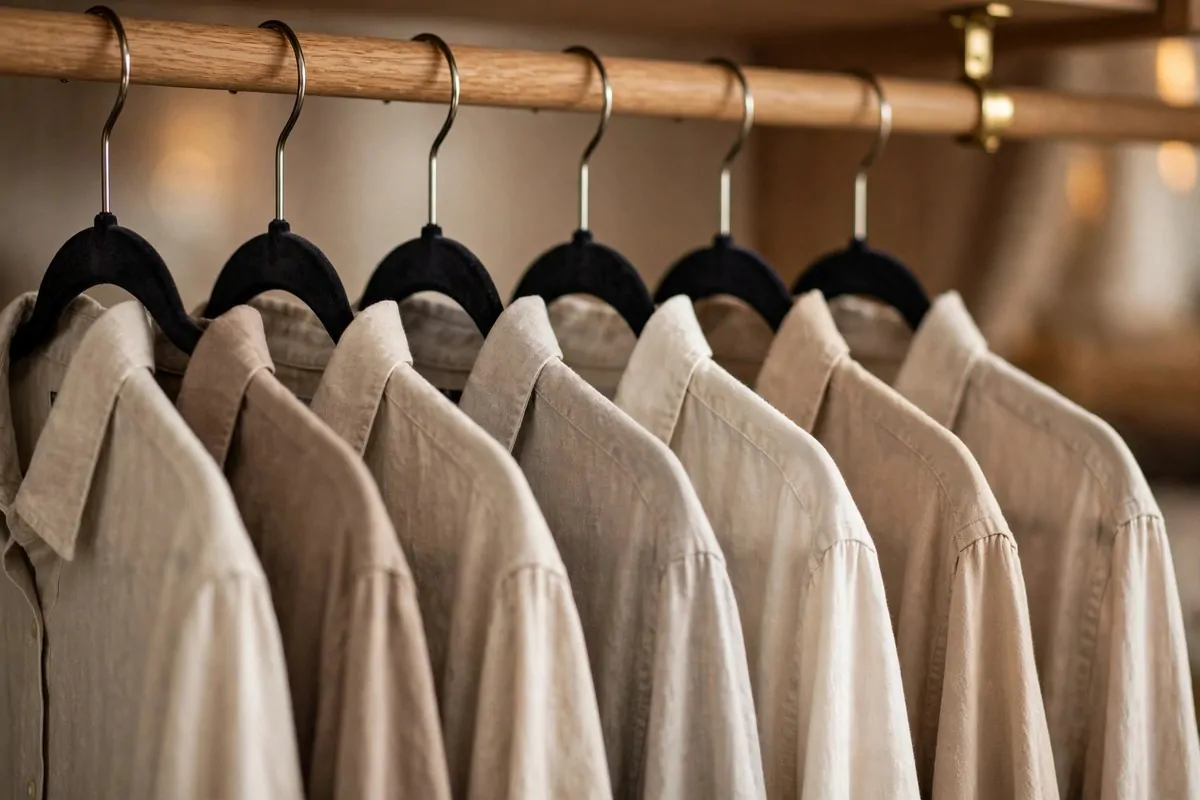
Slim velvet hangers take up about half the space of thick plastic ones. Half. That alone gave me room for ten more shirts.
The velvet surface is grippy. Shirts do not slide off and land in a sad pile on the closet floor. You know exactly the pile I mean.
Matching hangers also make the closet look calm. When every hanger is the same, your eyes see the clothes, not the mess.
I bought mine in one big pack and did the swap in a single evening. It felt like a weirdly fun little project.
My old hangers went to the donation bin. Somebody else can use them. My closet never wants to see them again.
The result surprised me most on hang day. Pulling a shirt out was smooth. No fighting with tangled plastic hooks.
Little things like this stack up. Ten seconds saved per shirt, five shirts a morning, and suddenly you are out the door earlier.
3. Add a Second Hanging Rod
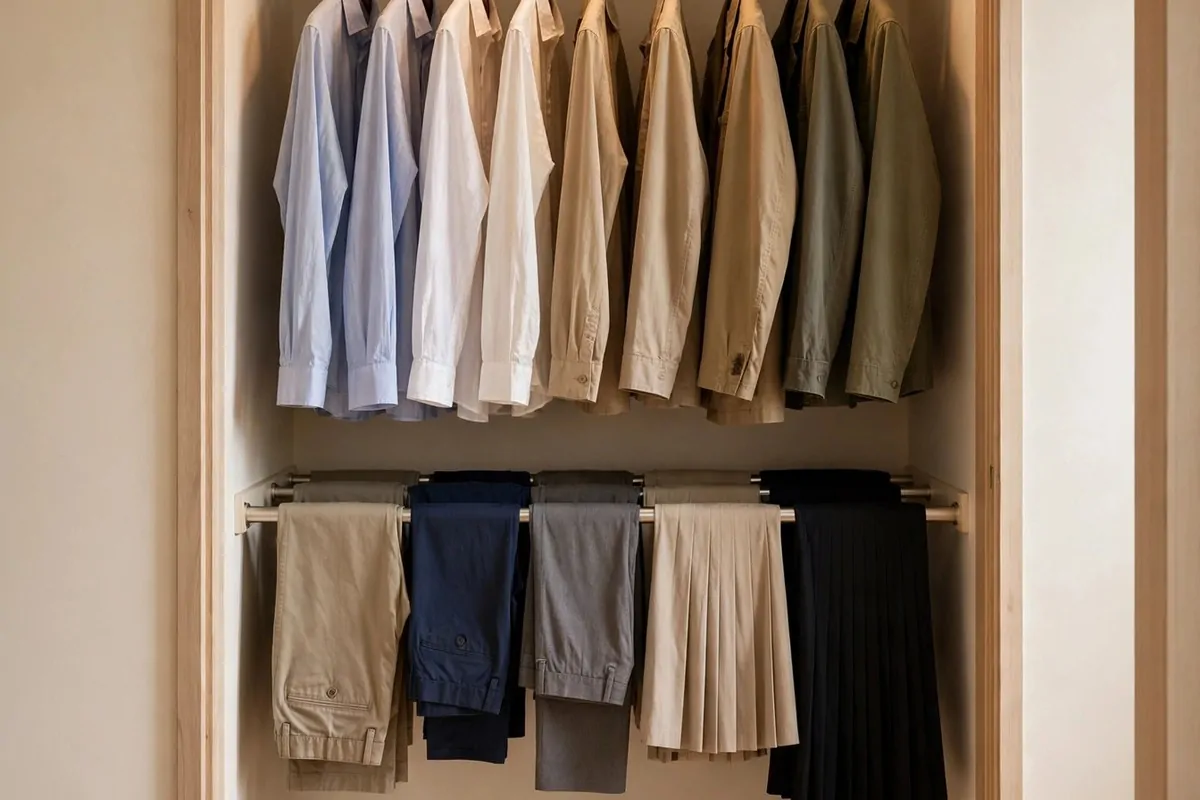
Look at your closet rod right now. See all that empty air below your shirts? That is wasted space, and it is about to disappear.
A second rod doubles your hanging space in one move. Shirts go on top, pants and skirts go below. Simple as that.
You do not need to build anything fancy. Tension rods and chain extenders both work, and they cost very little money.
Measure first so the lower rod sits at a good height. You want your longest top to hang freely without bunching on the floor.
I installed mine on a Saturday afternoon. No drilling. No power tools. Just hooked it on and started hanging.
The morning difference is real. Before, my shirts were crammed tight like sardines. Now each one has space to breathe.
You can see everything at a glance. No more pushing five shirts aside to check if that is the blue one you wanted.
If you own mostly dresses or long coats, this trick needs adjusting. But for everyday clothes, the double rod is the single biggest space win I know.
4. Arrange Clothes by Color
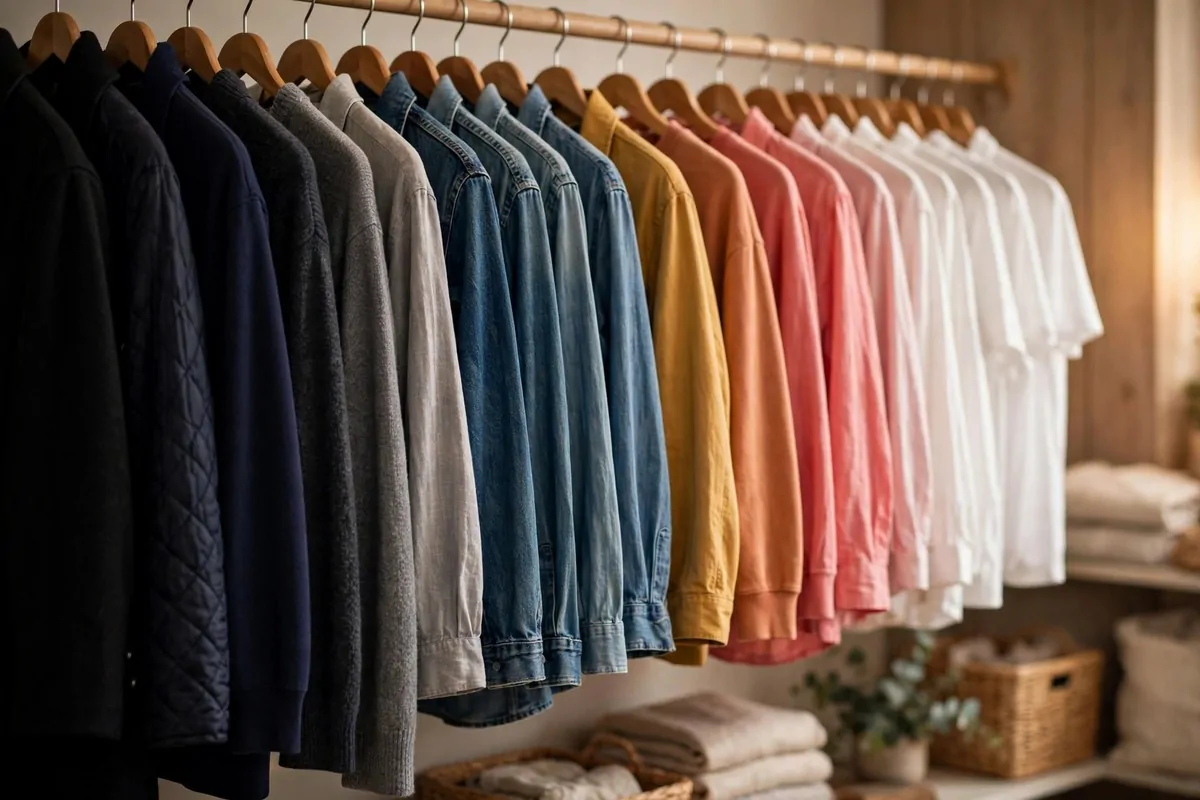
This idea sounds silly until you try it. Then you wonder why you never did it before.
Sort your hanging clothes from dark to light. Black and navy first, then gray and denim, then colors, then whites at the end.
Your eye finds things fast when colors flow like a rainbow. You stop hunting. You just look.
It also shows you patterns you never noticed. I had eleven gray shirts. Eleven. No wonder getting dressed felt boring.
Seeing duplicates helps you shop smarter too. Next time you reach for another black tee, the closet tells you no.
Guests always comment on this. A color-sorted closet looks like a little boutique, even if the clothes are old.
I do a quick re-sort once a month. It takes ten minutes while a podcast plays in the background.
Mornings love this trick. Need a white shirt? Look at the white end. Done. Your brain makes the choice before your coffee is ready.
5. Group Everything by Category
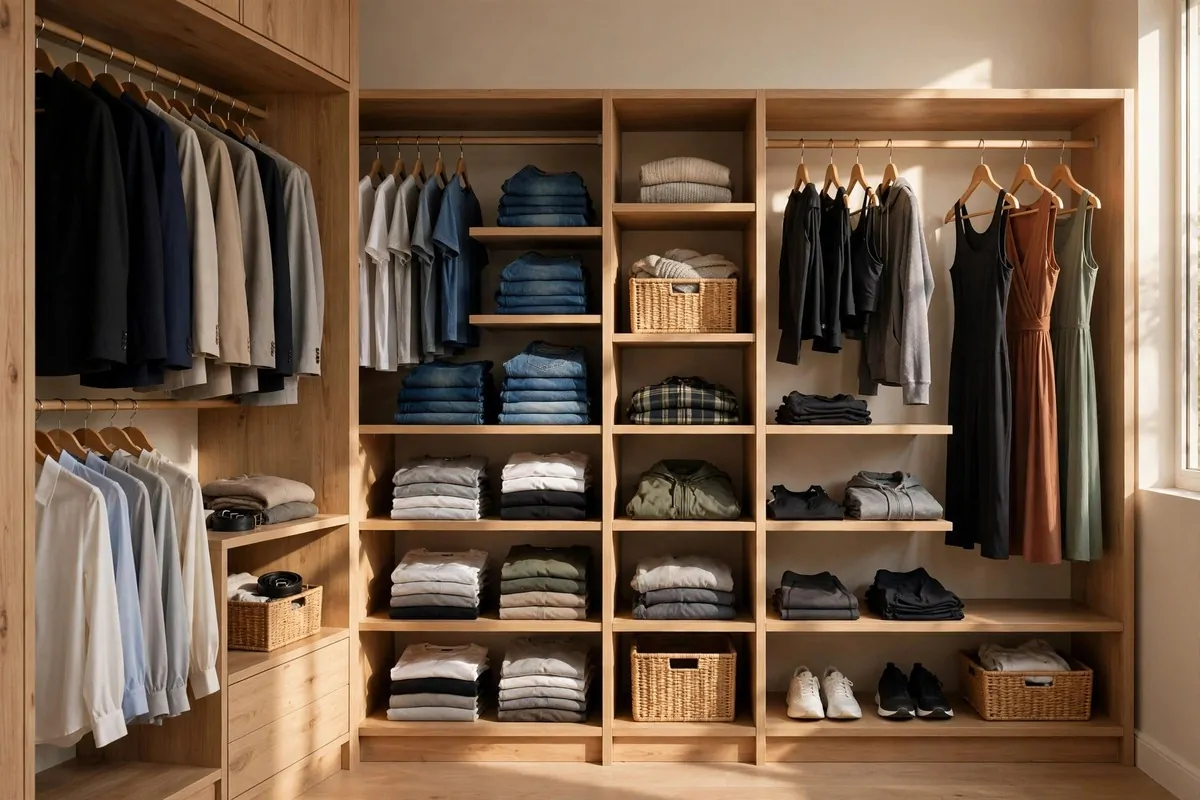
Categories are how your brain shops. So let your closet speak the same language.
Put work clothes together. Casual weekend clothes in their own zone. Dressy outfits get a small section at one end.
I did this last spring and it cut my morning thinking in half. First question answered automatically: what kind of day is this?
Then I just pick from one zone. Three options, not thirty. Decisions get fast when the field is small.
This also helps on laundry day. You can see which zone is running low and wash to refill it.
Here is a simple way to plan your zones:
- Work zone: blouses, trousers, blazers, smart dresses
- Casual zone: tees, jeans, hoodies, weekend tops
- Active zone: workout clothes, yoga pants, sports tops
- Special zone: party dresses, occasion outfits
The zones do not need to be equal in size. My work zone is twice my casual zone, and that matches my real life.
Kids can use this too. School clothes in one spot, play clothes in another. Even small kids get the system fast.
This is one of those Closet Organization Ideas that sounds obvious and still most closets do not have it. Now yours will.
6. Use Shelf Dividers for Neat Stacks
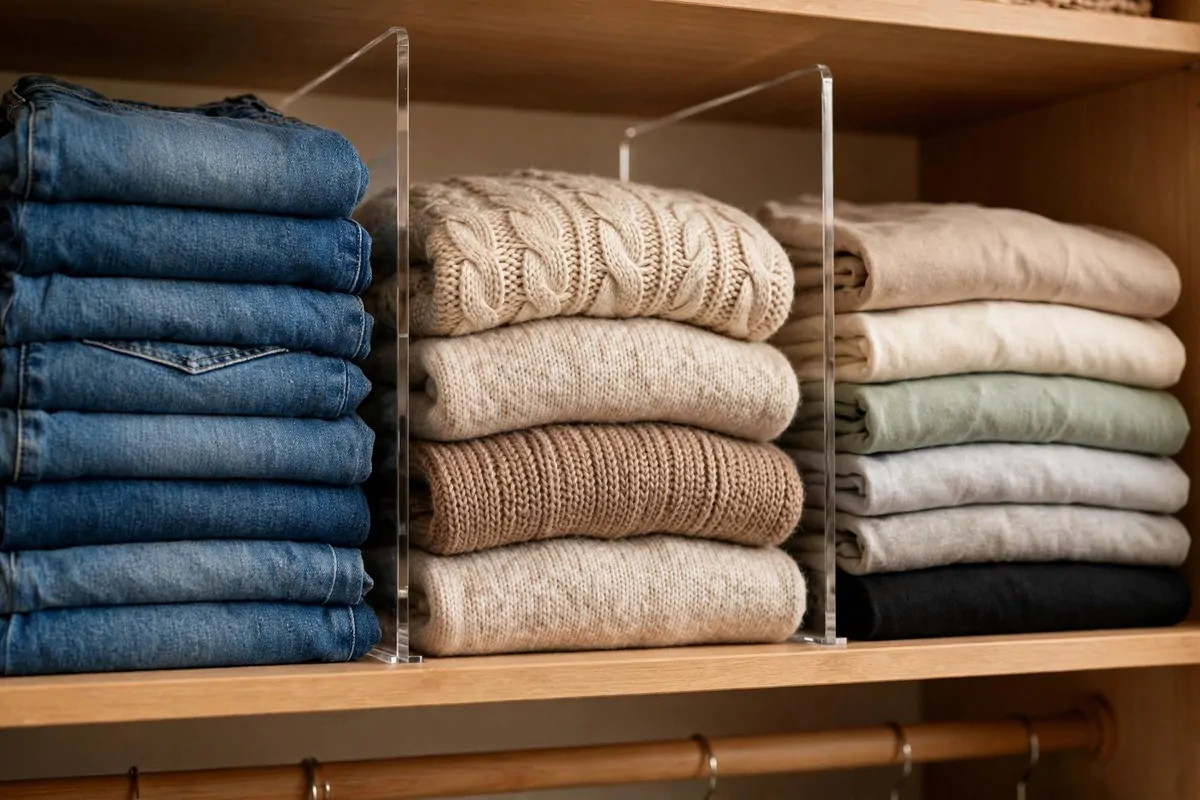
Folded piles have one big enemy. Gravity plus the one shirt you pull from the middle.
Shelf dividers fix this. They are little walls that keep each stack standing tall, even after you grab from it.
You can buy acrylic ones that slide right onto the shelf. No tools. No screws. They just sit there and work.
I keep my jeans in one stack, sweaters in another, t-shirts in a third. Each has its own little divider wall.
Pulling from the middle used to collapse the whole pile. Now the dividers hold everything in place like bookends.
They work for bags too. Stand your clutches upright between dividers and they stop flopping over.
The clear ones are best because they disappear. The shelf looks tidy without adding visual noise.
One pack covered all my shelves. It was the kind of boring little purchase that made me way too happy.
Morning bonus: you can grab from any stack without ruining the next three. That alone makes this worth it.
7. Roll Clothes Instead of Folding
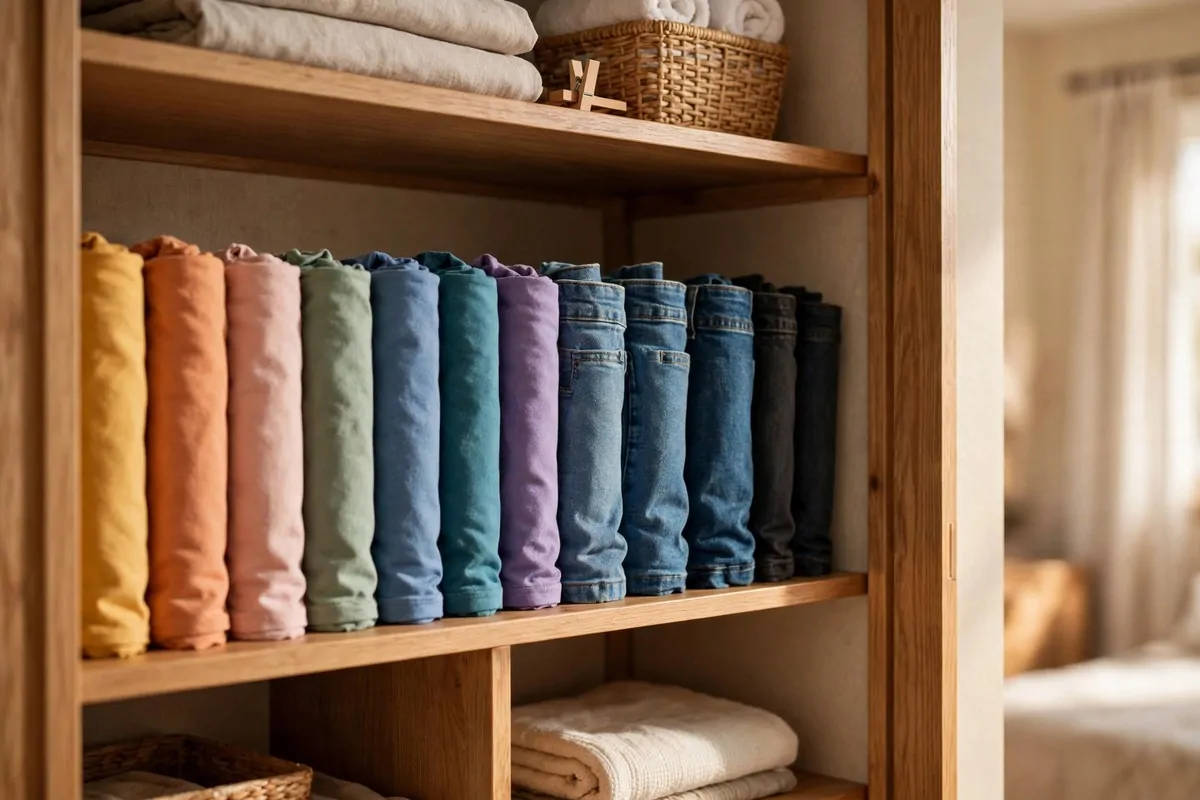
Rolling sounds like a travel trick. But it works just as well on a closet shelf.
Roll each item into a tight little log. Then stand the rolls side by side, like files in a drawer.
Now you can see every shirt at once. No more lifting a pile of six to find the one you want.
Rolled clothes also wrinkle less than folded ones. The folds are soft curves instead of hard creases.
I roll my t-shirts, workout tops, and casual pants. Things that hang keep hanging. Things that fold get rolled.
This also fits more into the same space. I gained almost a full shelf just by switching from fold to roll.
It takes a tiny bit of practice. The first ten rolls look lumpy. By number twenty, you are fast and neat.
Watch one short video if you want the technique. Or just start. Your hands figure it out quickly.
Guests open my closet and always ask about it. Rolled clothes look oddly pretty, like a little clothing library.
8. Install Hooks on Every Spare Wall Inch
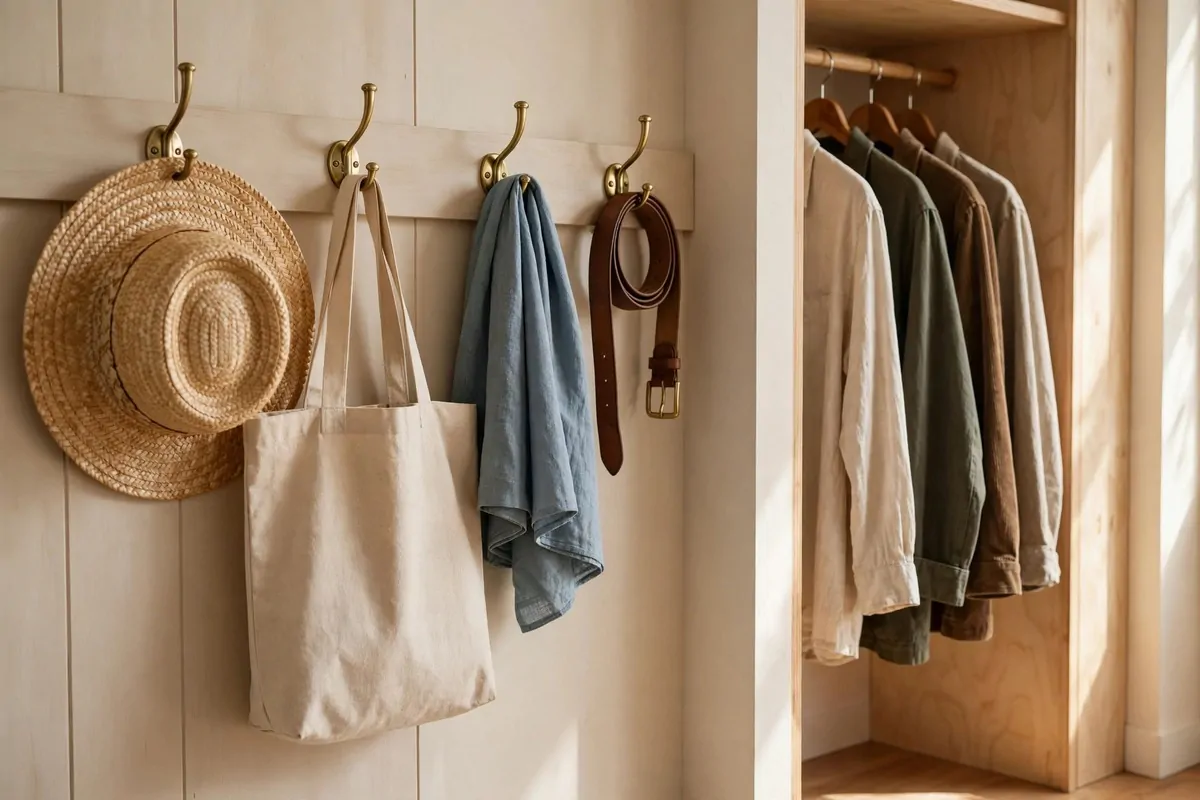
Hooks are the laziest storage ever invented. Grab. Hang. Done. Nothing to fold, nothing to stack.
I put a row of hooks on the inside wall of my closet, right next to the rod. It took fifteen minutes.
Now my most-worn jacket lives on a hook. So does tomorrow’s scarf. My tote bag hangs there too.
Hooks are perfect for the things you grab daily. Rods are for storage. Hooks are for living.
Self-adhesive hooks work great if you rent. They hold real weight and come off clean when you move.
I also use hooks for my work bag and my favorite cap. Both used to live on my bedroom floor. Not anymore.
The trick is to place hooks where your hands already go. By the door of the closet is the sweet spot.
Do not hang everything on hooks. That is how you get a mess again. Keep it to your daily stars.
- One hook: the jacket you wear this week
- One hook: tomorrow’s scarf or bag
- One hook: the cap or belt you grab often
Three hooks. That is all most people need. Fast, easy, and your morning hands thank you.
9. Use the Back of the Door
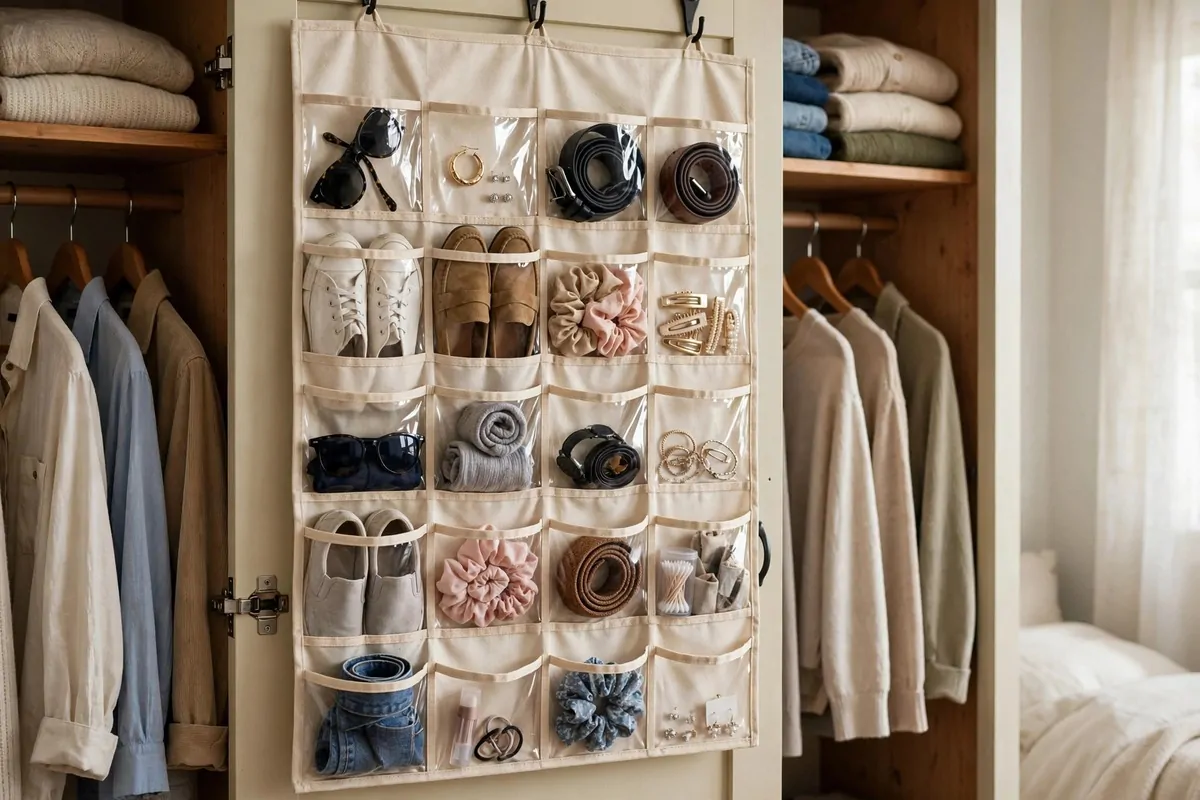
The back of your closet door is free real estate. Right now it is doing nothing. Let us change that.
Over-the-door organizers hang over the top with no screws. Instant storage in about thirty seconds.
Shoes love these. Each pocket holds a pair, and you can see all of them at once. No more digging in a dark pile.
Small things love them too. Sunglasses, rolled belts, scarves, little bags. All the stuff that vanishes on shelves.
I keep my most-worn shoes on the door. Morning feet just pick a pair and go. It is the fastest shoe choice I have.
If your door is too thick or fancy, use adhesive hooks instead. They work the same way for lighter items.
One warning: check the door still closes. Leave a little gap or the rack pushes against the frame. I learned this the hard way.
Measure the door thickness before you buy. Most racks fit standard doors, but thick solid doors need a different style.
This is the kind of trick that costs almost nothing and gives you a whole new wall of storage. Renters especially love it.
10. Stack Clear Bins on Top Shelves
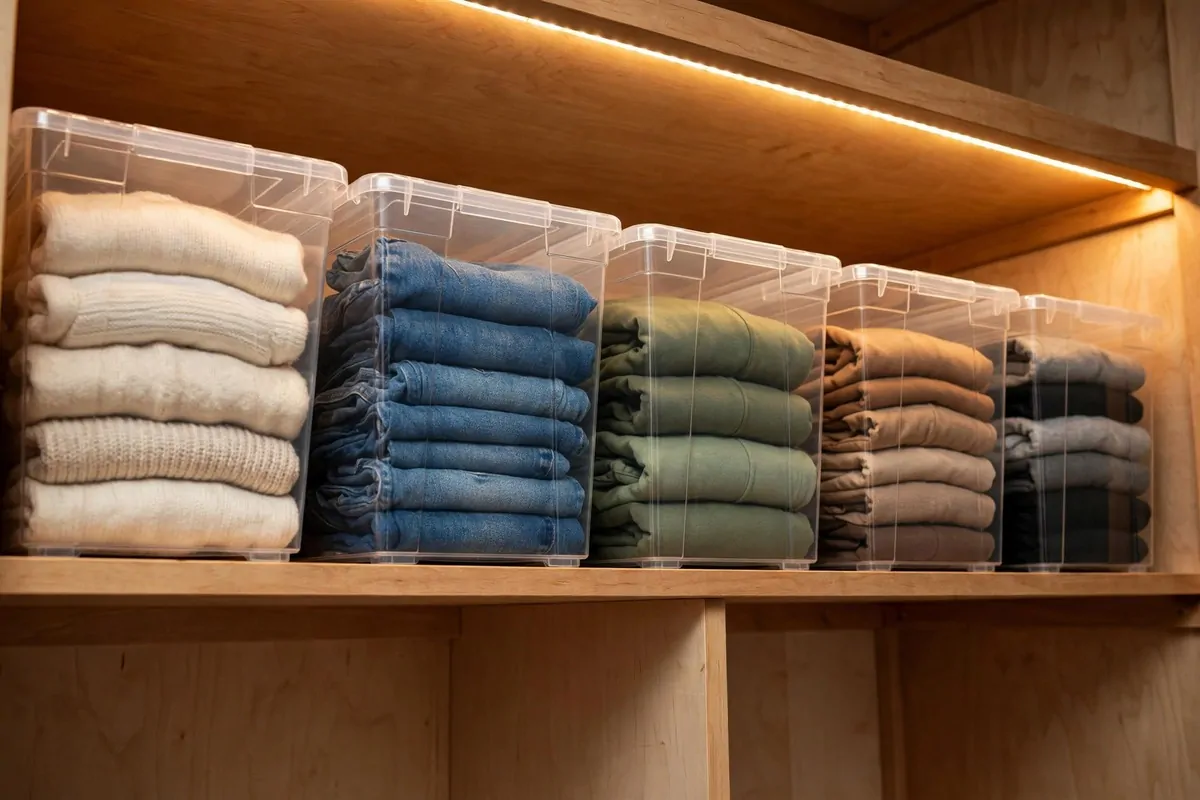
The top shelf of your closet is the place things go to be forgotten. Clear bins bring them back into the light.
You can see through them. That one fact saves you from pulling down three boxes to find one thing.
I keep off-season clothes up there. Winter sweaters in summer. Summer tops in winter. All visible through the plastic.
Stackable bins use vertical space well. Two or three high, no tipping, everything contained.
Pick bins with lids. Dust loves high shelves, and lids keep everything clean without you trying.
Add a little label on each bin anyway. Clear is great, but a label at eye level is faster than squinting upward.
Choose bins that match your closet width. Measure once and buy the whole set at the same time.
I use the same size everywhere. When everything matches, even a messy shelf looks calm.
Morning use case: reach up, grab the bin you labeled, and the sweater you wanted is right there. No chair-climbing archaeology.
| Bin spot | What to store |
|---|---|
| Top shelf bins | Off-season clothes, spare bedding, travel bags |
| Middle shelf bins | Accessories, scarves, swimwear |
| Floor bins | Shoes, heavy bags, gift wrapping |
11. Label Every Bin and Box
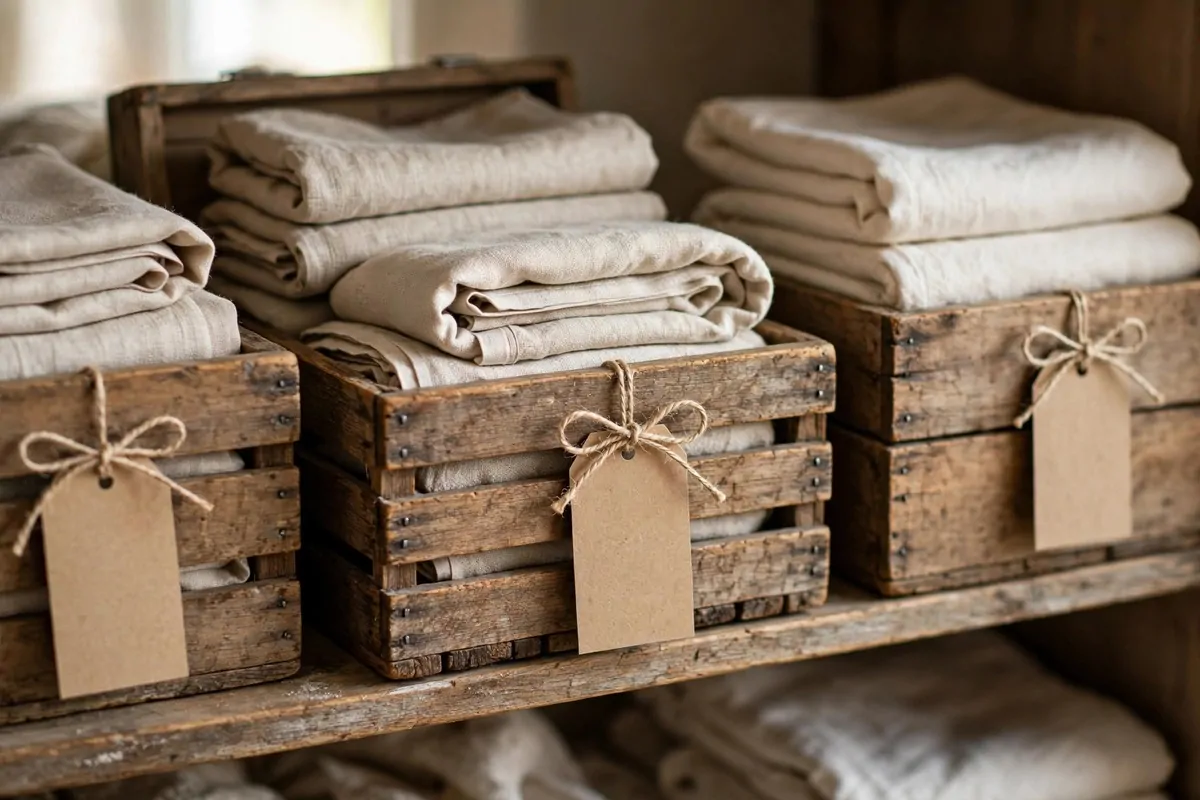
Labels feel like overkill until you live with them. Then they feel like magic.
Your brain trusts a label. “Winter scarves” means your hand goes straight there. No guessing. No opening six boxes.
I use simple kraft paper tags and a thick marker. Nothing fancy. They look warm and homemade, and they cost pennies.
You can also buy a little label maker. The tiny printed labels look neat and they never smudge.
Label the shelf edge too, not just the bin. When the bin is in the wash or upstairs, the shelf still tells you where it goes back.
I labeled everything in one sitting with my favorite playlist on. It took less time than I feared.
Here is my rule: if a bin needs opening to identify it, it needs a label. Simple.
Kids’ closets need labels most. Little ones cannot read sentences, so use picture labels. A sock drawing on the sock bin.
Mornings run on autopilot with labels. Your eyes do the finding before your brain even wakes up.
12. Give Shoes a Real Home
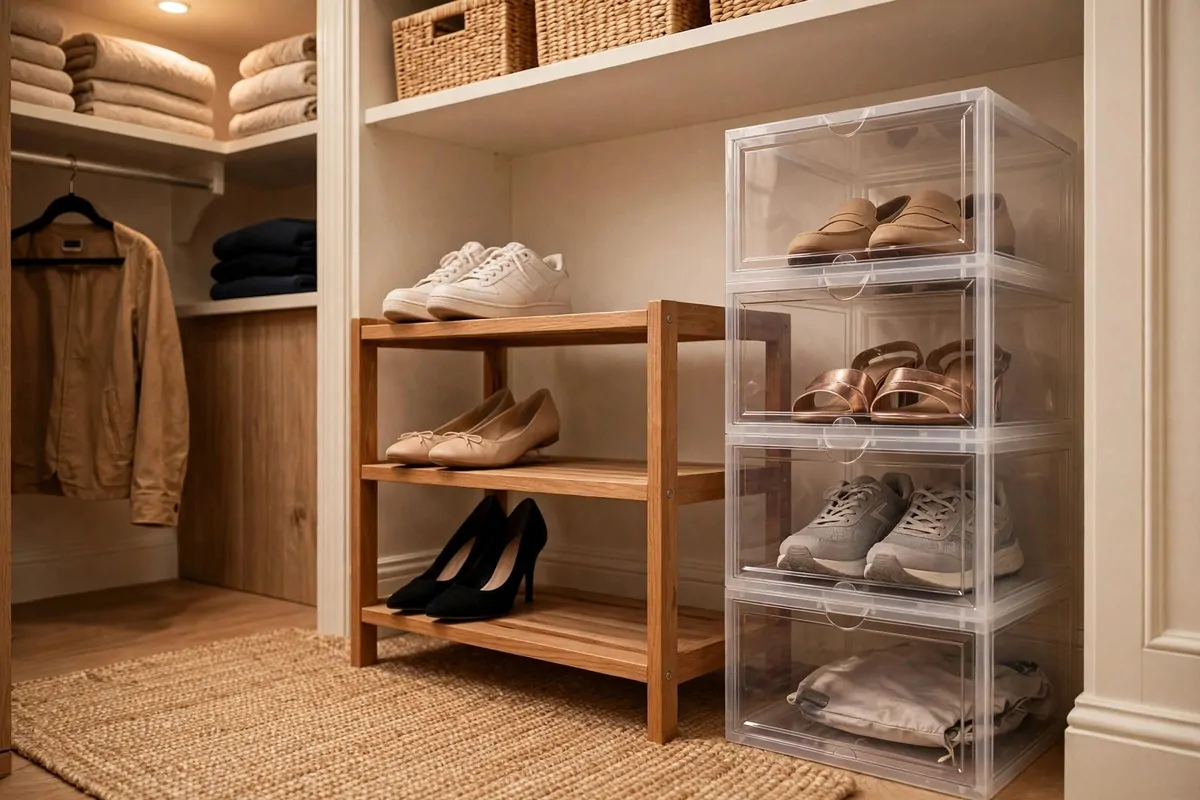
Shoes multiply in the dark. That is my theory, and my closet floor used to prove it.
Every pair needs one clear home. No home means floor pile, and floor piles slow your mornings down.
A simple tiered rack on the closet floor works for most people. Ten pairs, visible, grab and go.
Heels and flats fit well on stacked racks. Boots need taller space, so give them their own corner with boot shapers inside.
Clear drop-front boxes are great for special shoes. You can see the pair without opening, and the box keeps dust off.
I stopped buying shoe organizers that hide things. If I cannot see the shoe, I forget I own it.
Arrange by how often you wear them. Daily shoes at the front and low. Party shoes up higher.
Count your pairs once a year. I found shoes I had not worn in three years just sitting there.
The morning win here is huge. You pick the outfit, glance at the rack, and the right shoe is already looking at you.
13. Hang a Sweater Organizer
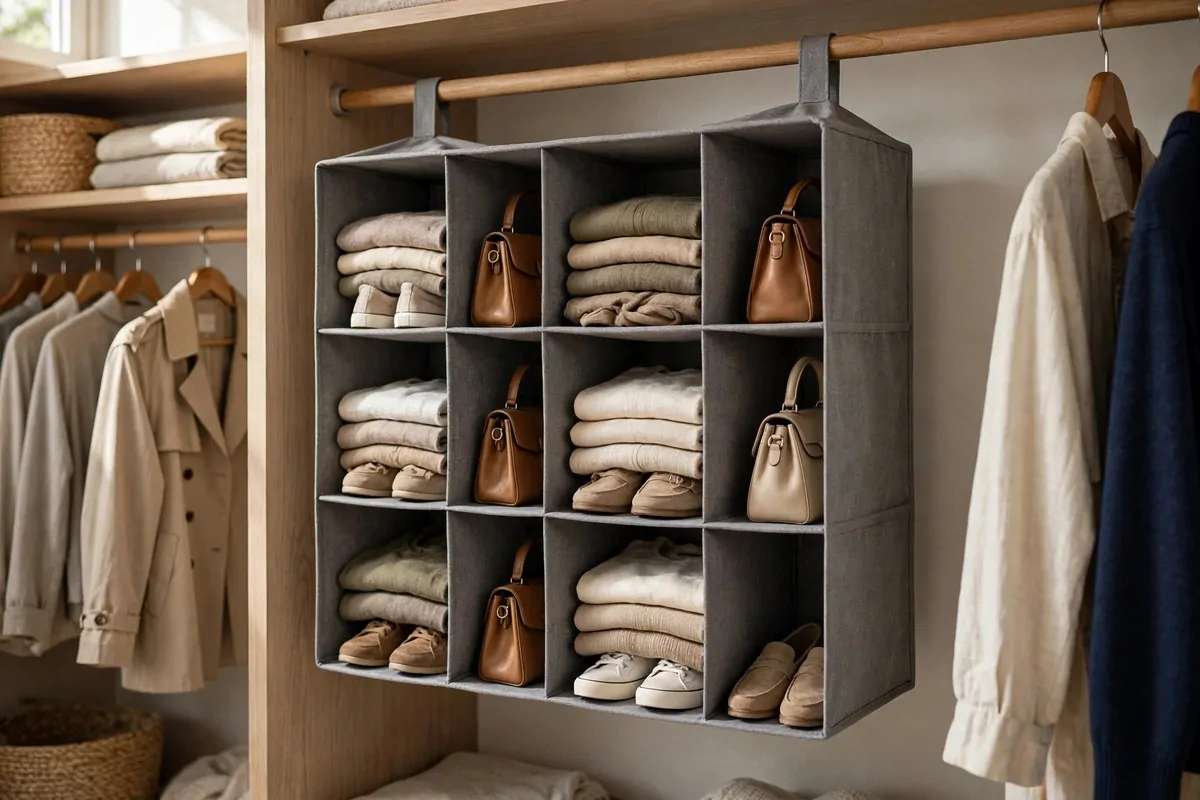
That long empty space under your short clothes is perfect for one of these. A hanging sweater organizer just loops over the rod.
Six cubbies appear out of thin air. No shelf building. No drilling. Just instant storage.
I use mine for folded tees, workout tops, and two handbags that flopped over everywhere before.
The fabric ones fold flat when not needed. The sturdy canvas ones keep their shape better.
You can also use the cubbies for shoes. One pair per cube, easy to see, easy to grab.
I like to keep my most-worn casual tops in here. They are at arm height, right where mornings happen.
This is also a great kid-closet trick. Low cubbies hold folded clothes where small hands can reach them.
One per closet is usually enough. Two and you start stealing too much rod space. Find the balance.
It is not pretty in a magazine way. But it is the workhorse of my closet, and my mornings are faster for it.
14. Store Bags Upright on a Shelf
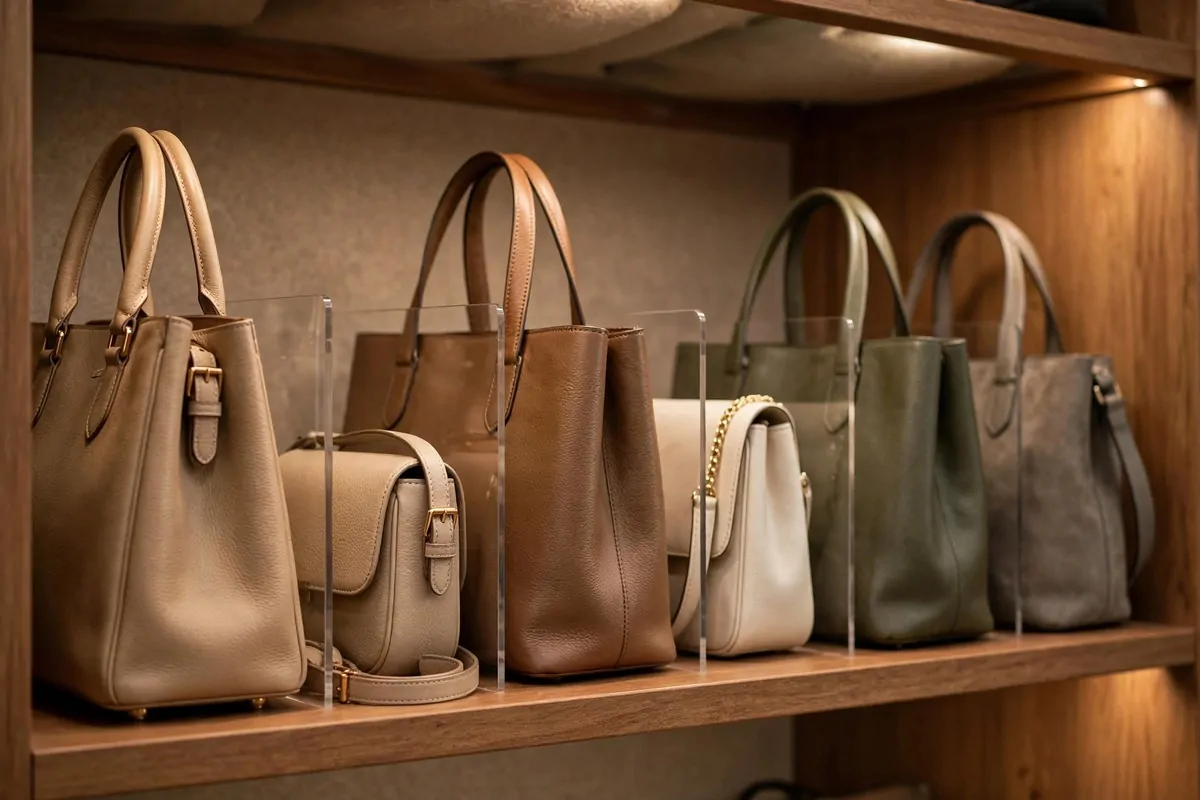
Bags flopping into a pile is sad for the bags and bad for your mornings. Store them standing up instead.
Give each bag its own little slot on a shelf. Shelf dividers or even bookends keep them upright.
Stuff soft bags with tissue or a small pouch so they keep their shape. They last years longer this way.
I group mine by size. Big totes together, small crossbodies together. My hand reaches the right one fast.
Expensive bags get the top shelf, away from daily bumps. Everyday bags live at arm level.
Hooks work for bags too, if the shelf is full. One sturdy hook holds a bag without creasing the handles.
I used to stack bags inside each other. Terrible idea. You never use the inner ones, and they come out wrinkled.
Upright storage means you see them all. I started using bags I had forgotten I owned. It felt like free shopping.
Morning pick takes five seconds now. Open the closet, see the bags, grab one. Done.
15. Put Belts and Scarves on Hooks or Hangers
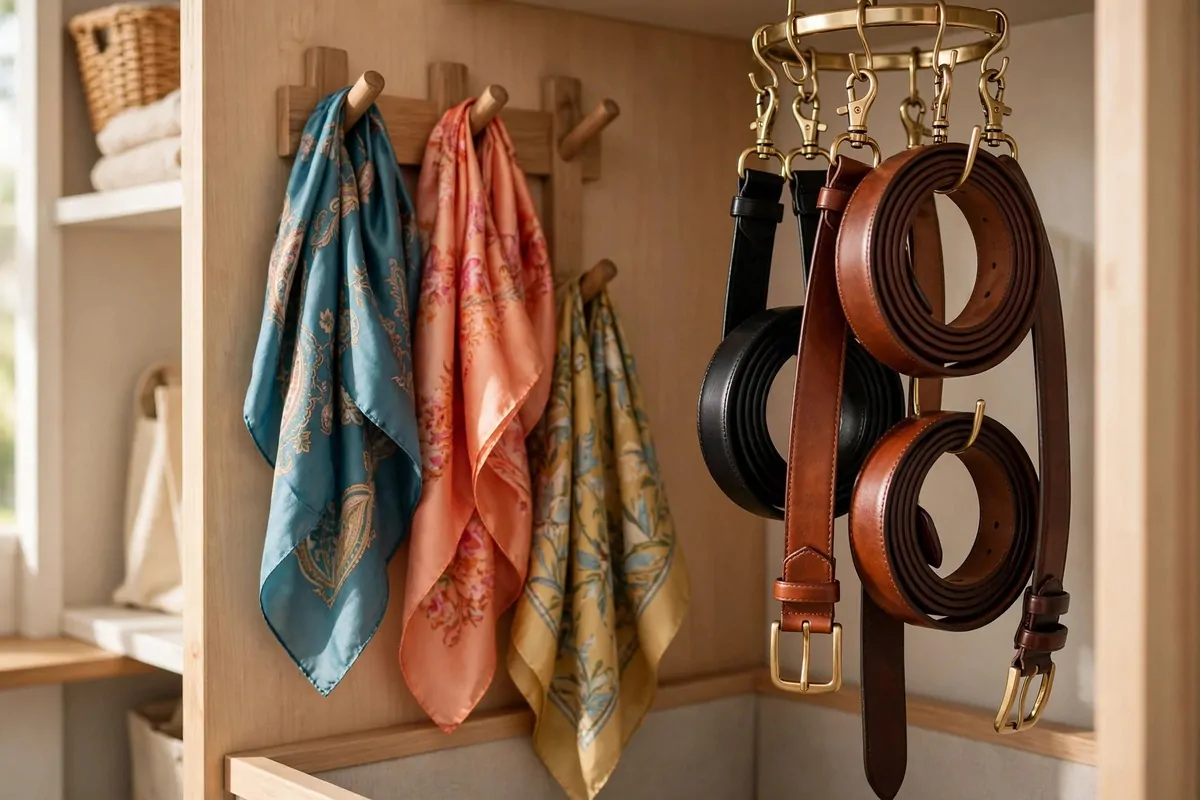
Belts and scarves are small, slippery, and experts at hiding. Give them a spot they cannot escape from.
A belt hanger holds eight belts in the space of one shirt. They hang coiled and neat, no tangles.
Scarves love a row of hooks or a multi-loop scarf hanger. Both keep them visible and wrinkle-free.
I keep mine right next to my tops. When I pick a shirt, the scarf options are right there beside it.
You can also roll scarves into a drawer divider. Rolled scarves show their colors and patterns all at once.
Cheap plastic rings on one hanger work too. Loop each scarf through a ring and they all hang together.
I lost a favorite belt for six months once. It was behind the dresser. Since the belt hanger arrived, nothing hides.
Match these to your outfit zones if you can. Work belts near work clothes. Casual ones near the jeans.
Five seconds to accessorize. That is the morning math. A visible belt and scarf turn a plain outfit into a good one.
16. Make a Jewelry Corner
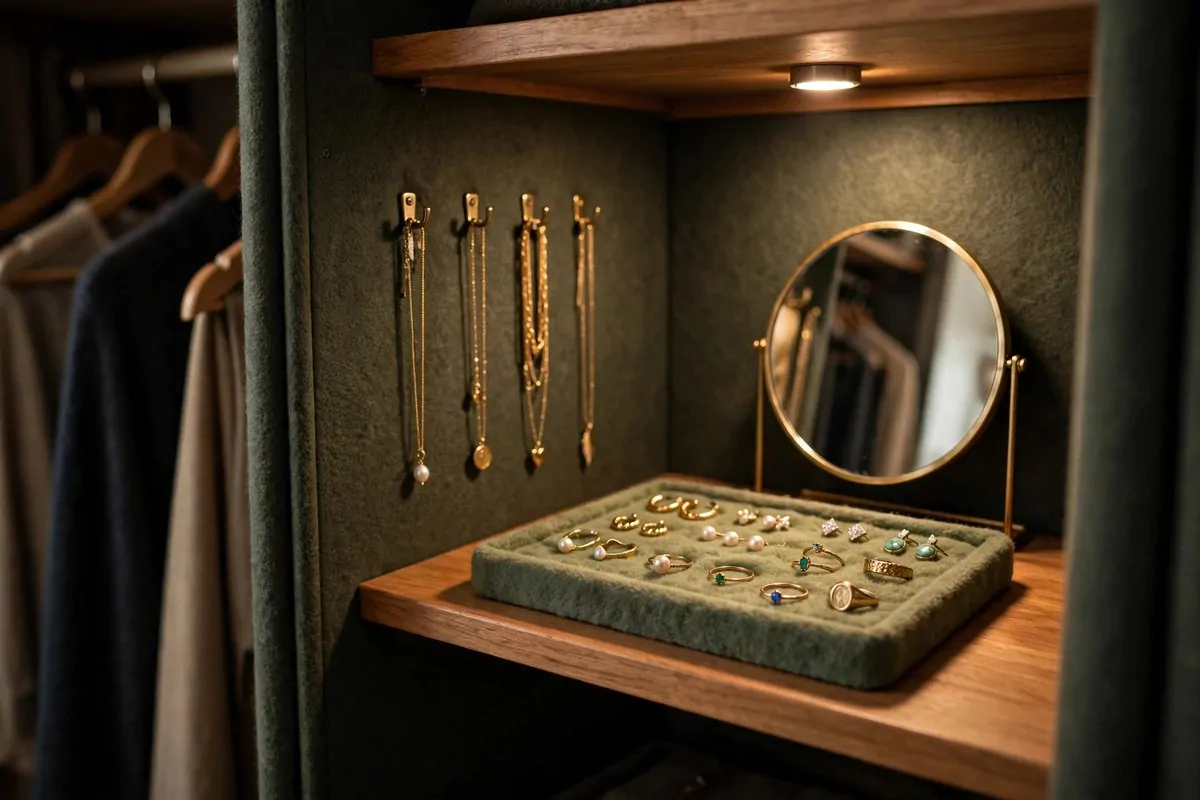
Jewelry in a tangled heap is jewelry you never wear. A tiny corner fixes that forever.
A felt-lined tray on a shelf holds rings and earrings. The soft surface stops things sliding around.
Wall hooks inside the closet hold necklaces. No tangles, no knots, each one ready to grab.
I mounted a small strip of hooks on the side wall. It took five minutes and cost almost nothing.
A little mirror nearby helps. Try the necklace on, check the look, and you are dressed.
Keep everyday pieces here. Special occasion jewelry can live in its box elsewhere.
I started wearing earrings again the week I made this corner. They had been in a drawer for two years.
This corner also keeps delicate things safe from getting crushed under clothes.
Mornings feel a little bit fancy now. One necklace, one minute, and the whole outfit feels finished.
17. Plan Five Outfits on Sunday Night
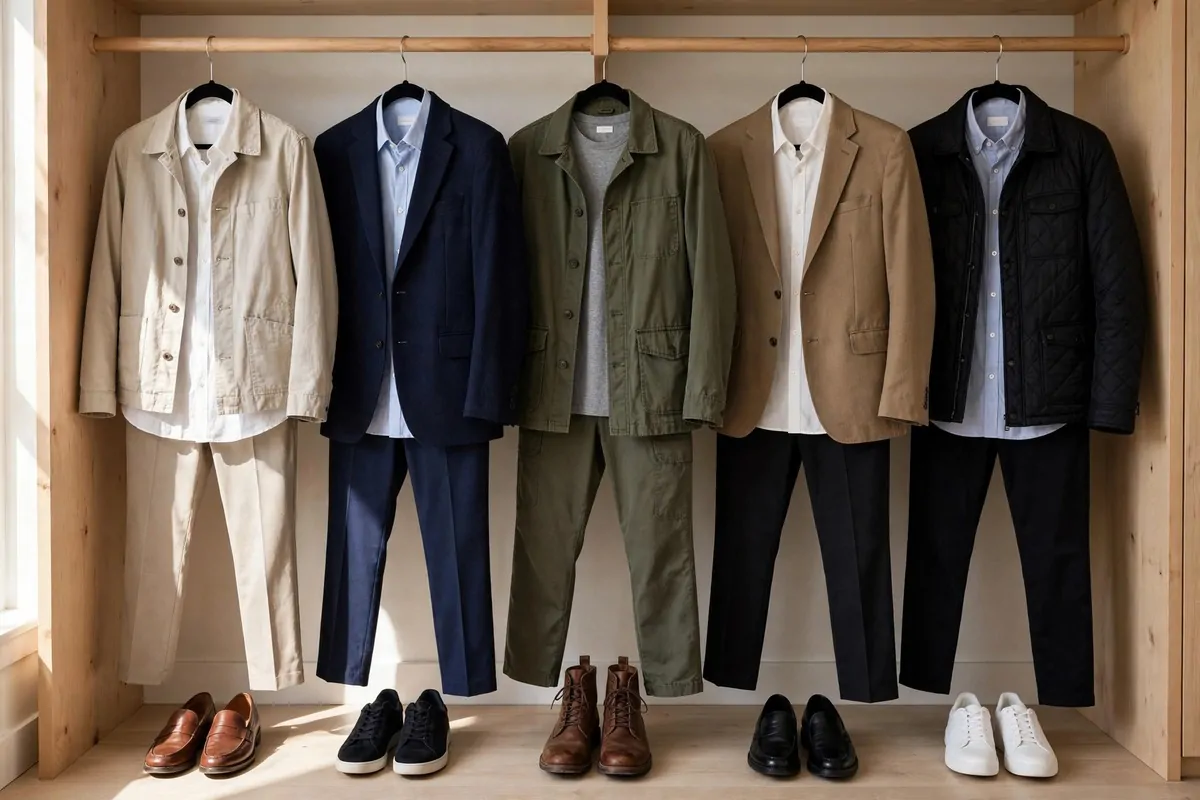
This is the idea that changed my mornings most. One hour on Sunday. Zero thinking all week.
Hang five full outfits together on the rod. Shirt, pants, and the jacket or cardigan. All on one hanger set, side by side.
Monday morning, you do not choose. You just take the first outfit. Tuesday, the second. It is that simple.
I check the weather forecast first. Rain day gets the waterproof jacket. Warm day gets the light top.
This trick removes the hardest part of mornings: decisions. Decision fatigue is real, and it eats your energy early.
Some people hang outfits in weekday order. Others mix and match from a small capsule. Both work.
Include shoes in the plan. Put the matching pair under each outfit spot. Future you says thank you.
I do this while a show plays on Sunday evening. It feels like a little gift I give myself for the week.
Try it for one week only. If your mornings are not easier, I will eat my favorite scarf. They will be easier.
18. Keep a Step Stool in the Closet
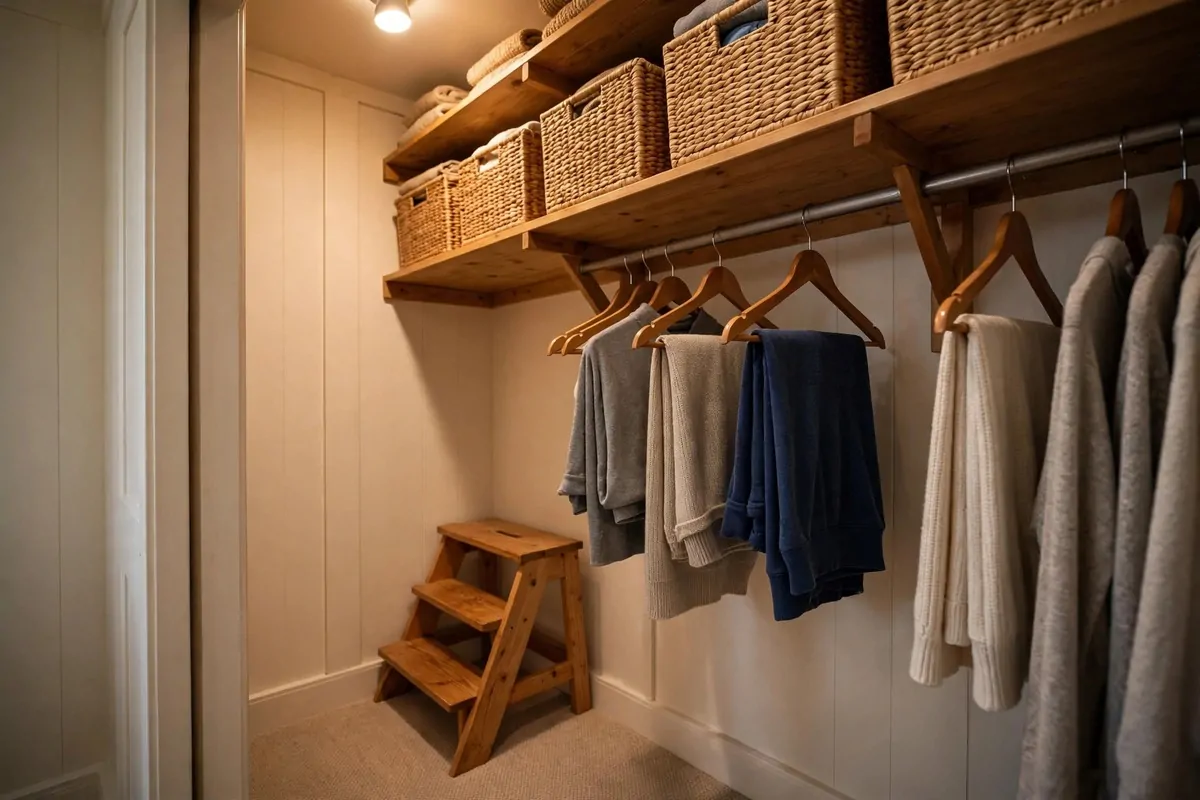
High shelves are only useful if you can reach them. A step stool turns the whole closet into usable space.
I bought a small wooden one that folds flat. It lives inside the closet, right where I need it.
No more dragging a dining chair across the room. No more standing on tiptoes and knocking things down.
When the top shelf is easy to reach, you actually use it. Seasonal bins get swapped on time. Everything stays fresh.
Pick a stool with a wide, steady base. Wobbly stools and high reaches are a bad mix.
If space is tight, a slim folding stool slides into the gap beside the closet. It disappears when you are done.
I also use mine for the high hooks and the top of the double rod. Full access, everywhere.
Kids love this too. A sturdy low stool lets them reach their own clothes and dress themselves.
One small stool, and suddenly no shelf in your closet is dead space. That is a big win for a tiny purchase.
19. Add a Mirror Inside the Door
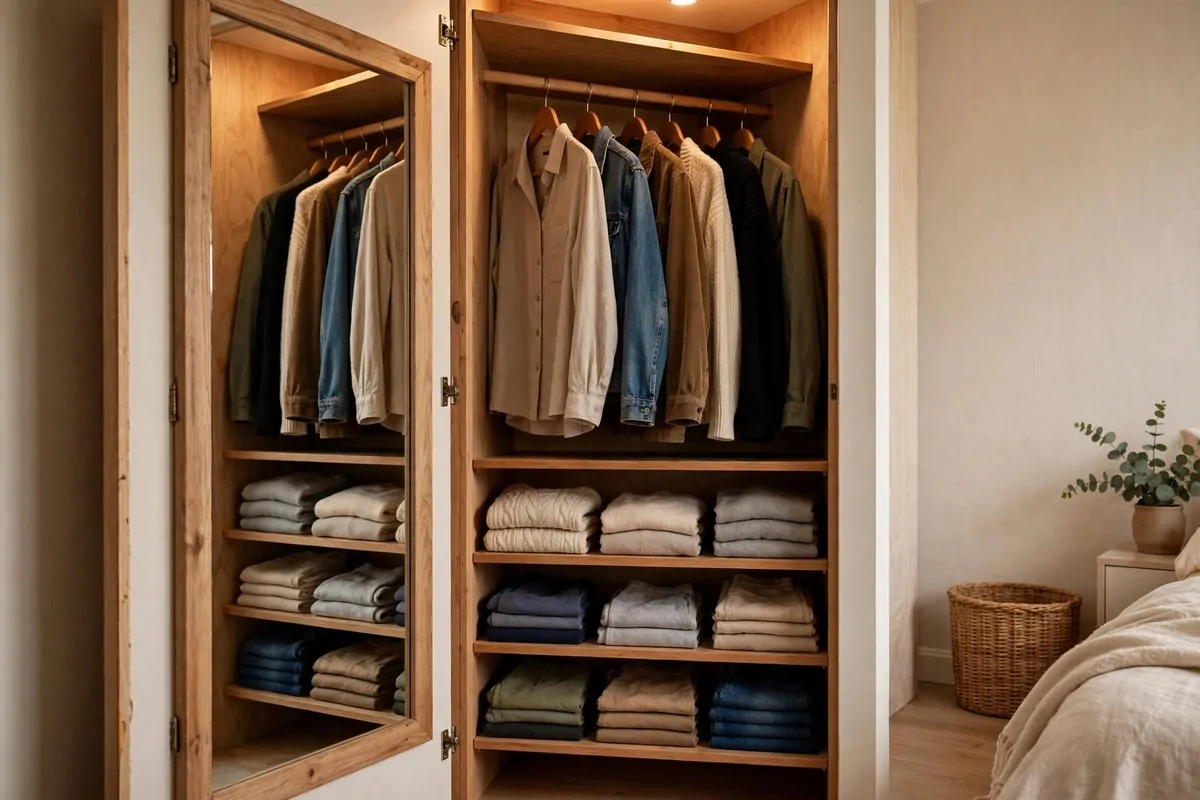
A mirror inside the closet door saves you a trip. Get dressed, check the look, done. All in one spot.
Full-length mirrors that hang over the door need no screws. They hook on top in seconds.
I check my outfit right where I built it. If the scarf is wrong, the scarf rack is two steps away. Easy fix.
Mirrors also bounce light around inside the closet. Dark corners feel brighter and less cave-like.
This cuts the morning walk to the bathroom mirror. Sounds small. Adds up every single day.
If your closet is a walk-in, lean a big mirror against the end wall. It feels like a little dressing room.
Renters can use adhesive mirror tiles on the door. Four tiles make a decent full-length view.
I never realized how many trips I made until I stopped making them. One mirror, one less walk, every morning.
20. Add Light With a Motion Sensor Lamp
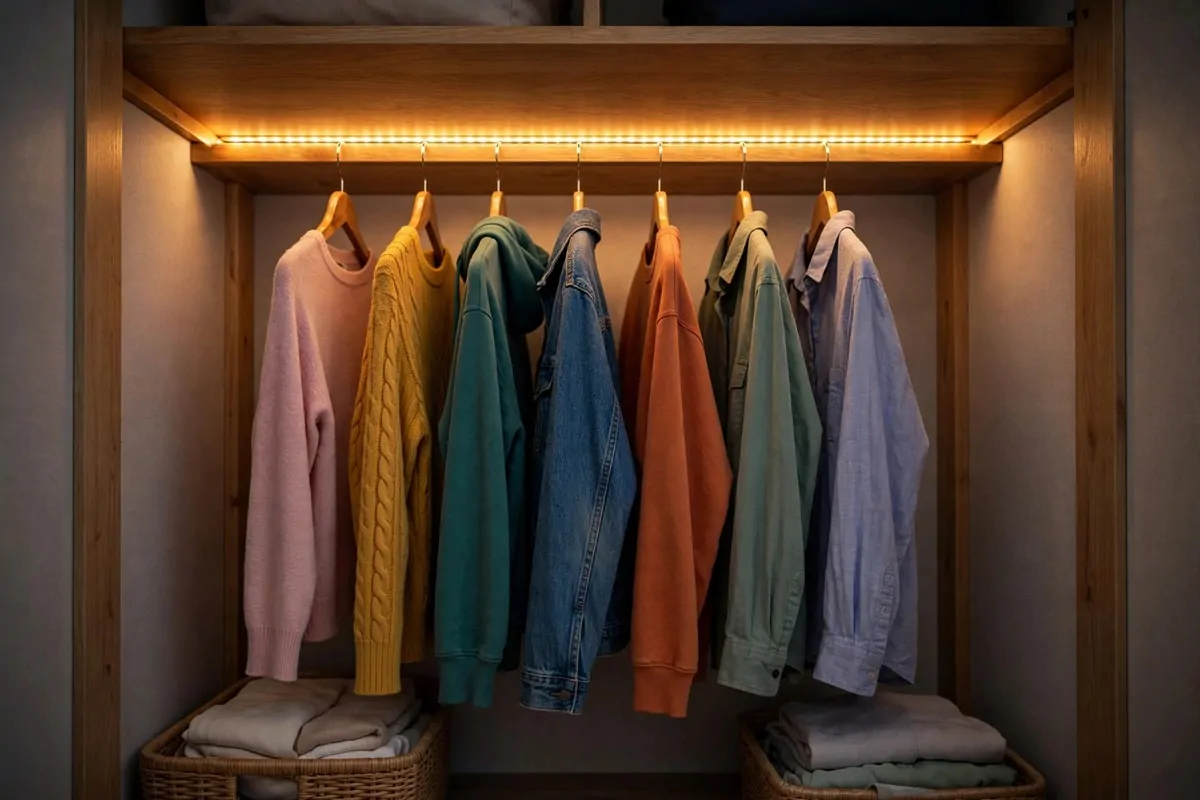
Dark closets hide everything. You cannot pick clothes you cannot see. Light fixes it in minutes.
Stick-on LED strips cost very little and need no wiring. Peel the backing, press under a shelf, done.
Motion sensor puck lights are even easier. Open the door, the light turns on. Close it, the light turns off.
I put one strip under my top shelf. It washes warm light down over all my hanging clothes.
Suddenly my dark blue shirts and my black shirts are different things again. Color confusion gone.
Rechargeable ones last weeks between charges. I charge mine while I do the Sunday outfit planning.
Place lights where you actually look. Under shelves and along the rod, not up in the dark ceiling corner.
A bright closet also looks bigger and cleaner. It feels like a little shop instead of a storage cave.
Morning eyes are tired eyes. Give them light, and choosing clothes stops feeling like guesswork.
21. Rotate Clothes With the Seasons
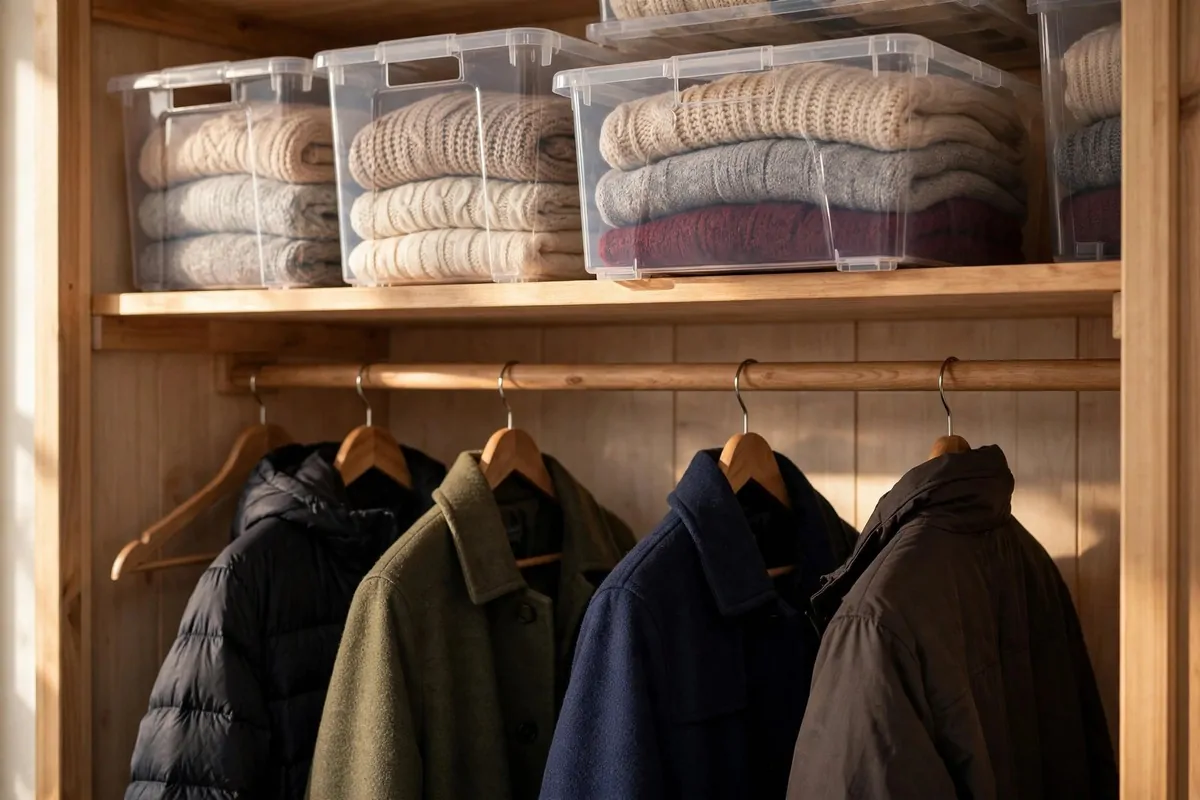
Your closet only needs the current season. Everything else is just taking up morning space.
Twice a year, do a swap. Pack off-season clothes into bins and move them to the top shelf or under the bed.
Pull the new season’s clothes down front and center. Your closet instantly feels fresh and smaller in the best way.
I do my swap on the first cool weekend of autumn and the first warm weekend of spring. It feels like a ritual now.
While you swap, do a mini declutter. If you did not wear it last season, it is probably ready to donate.
Use the clear bins from idea 10. Label them by season so next swap day you know exactly what is where.
Your rod should never hold a winter coat in July. That space belongs to clothes you wear right now.
This also protects your clothes. Heavy winter fabrics rest properly in bins instead of stretching on hangers all year.
Mornings get faster because every option is a real option. No more skipping past the parka to find a t-shirt.
| Season | Keep in closet | Store in bins |
|---|---|---|
| Spring | Light layers, rain jacket | Heavy coats, thick scarves |
| Summer | Shorts, tees, sandals | Sweaters, boots, warm layers |
| Autumn | Jeans, light knits, boots | Shorts, swimwear, sandals |
| Winter | Coats, sweaters, warm boots | Linen, light dresses, sandals |
22. Slide a Dresser or Cube Unit Inside
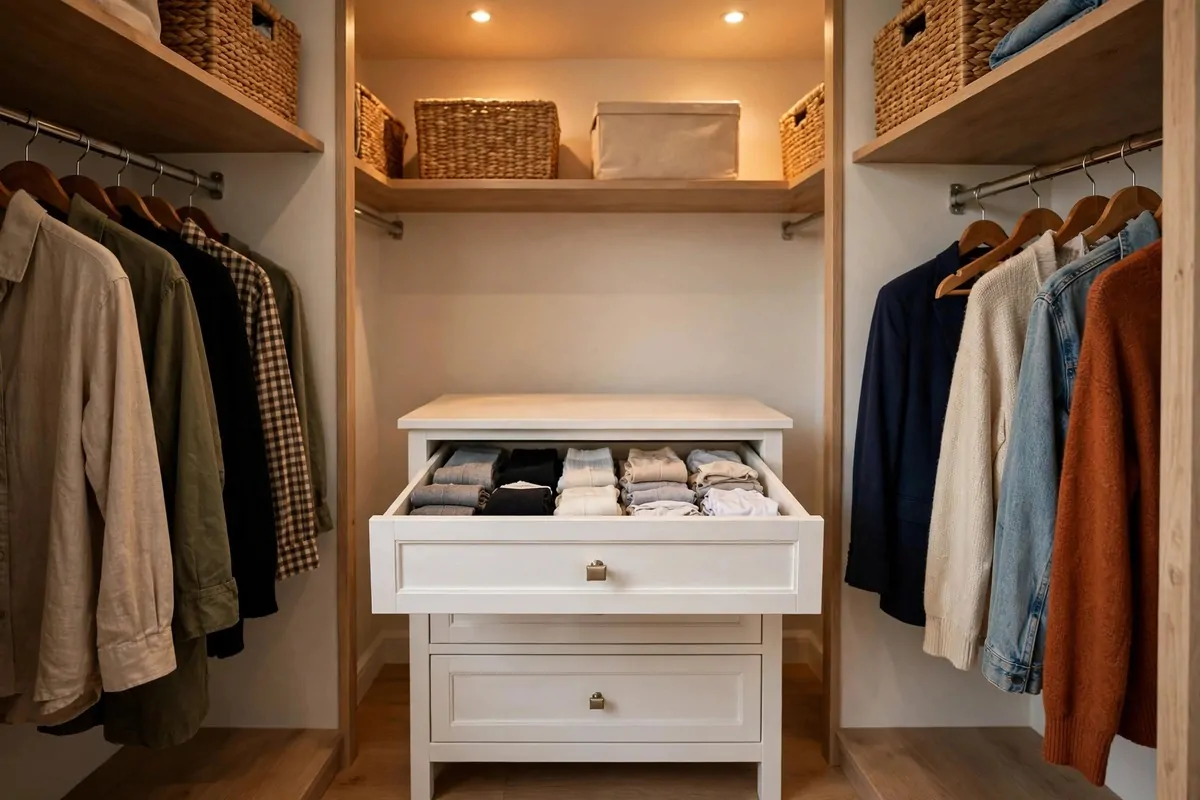
If your closet has floor space, use it. A small dresser inside the closet is a game changer.
Socks, underwear, pajamas, swimwear. All the small stuff that clutters shelves gets real drawers.
Everything you wear lives in one room now. No more trips between the closet and the bedroom dresser.
Cube storage units work the same way. Each cube holds a bin or a folded stack.
Measure the closet depth first. You need the doors to close with the unit inside. Ask me how I know this.
I moved a small three-drawer dresser in last year. It was the last piece of my one-room dressing puzzle.
Drawers also hide the messy stuff. Folded is nice, but drawer-hidden is nicer on a busy morning.
Use drawer dividers inside for socks and small items. Tiny things vanish in big drawers without them.
This turns a closet into a real dressing station. Walk in, open drawers, get dressed, walk out.
23. Use Under-Shelf Baskets
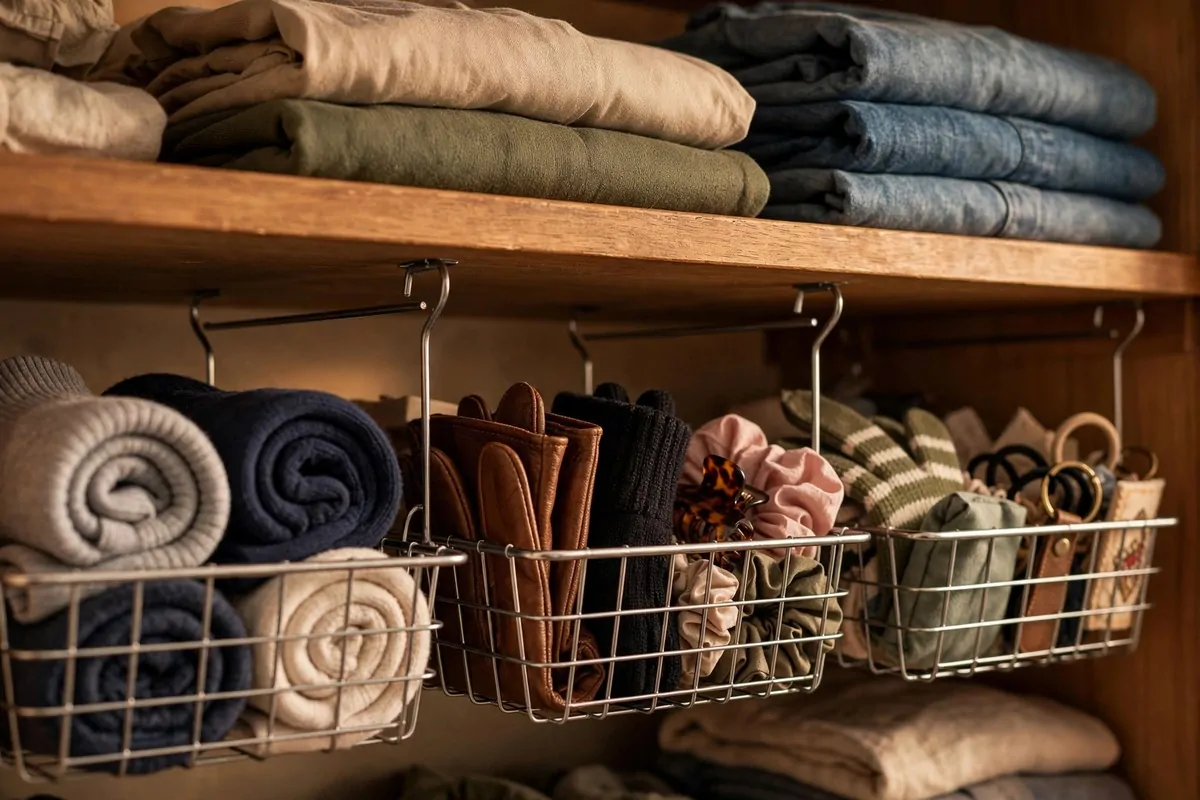
The space under a shelf is invisible storage. Under-shelf baskets slide on and make it real.
These wire baskets hook onto the shelf above. No screws, no tools. They just grip and hang there.
I keep socks in one, gloves and small accessories in another. All the fiddly stuff that never had a home.
They are perfect for the dead space above folded stacks. That little gap between the pile top and the next shelf.
Slide them on, slide them off. You can pull the whole basket out, grab what you need, and push it back.
I use two in my closet. One for daily small things, one for seasonal bits like sunglasses in summer.
They cost very little and take ten seconds to install. Truly the easiest upgrade on this whole list.
Check the shelf thickness before buying. Most baskets fit standard closet shelves, but thick wood shelves need bigger hooks.
Mornings love these because small items stop hiding. Socks are socks. They should not take a treasure hunt to find.
24. Follow the One-In-One-Out Rule
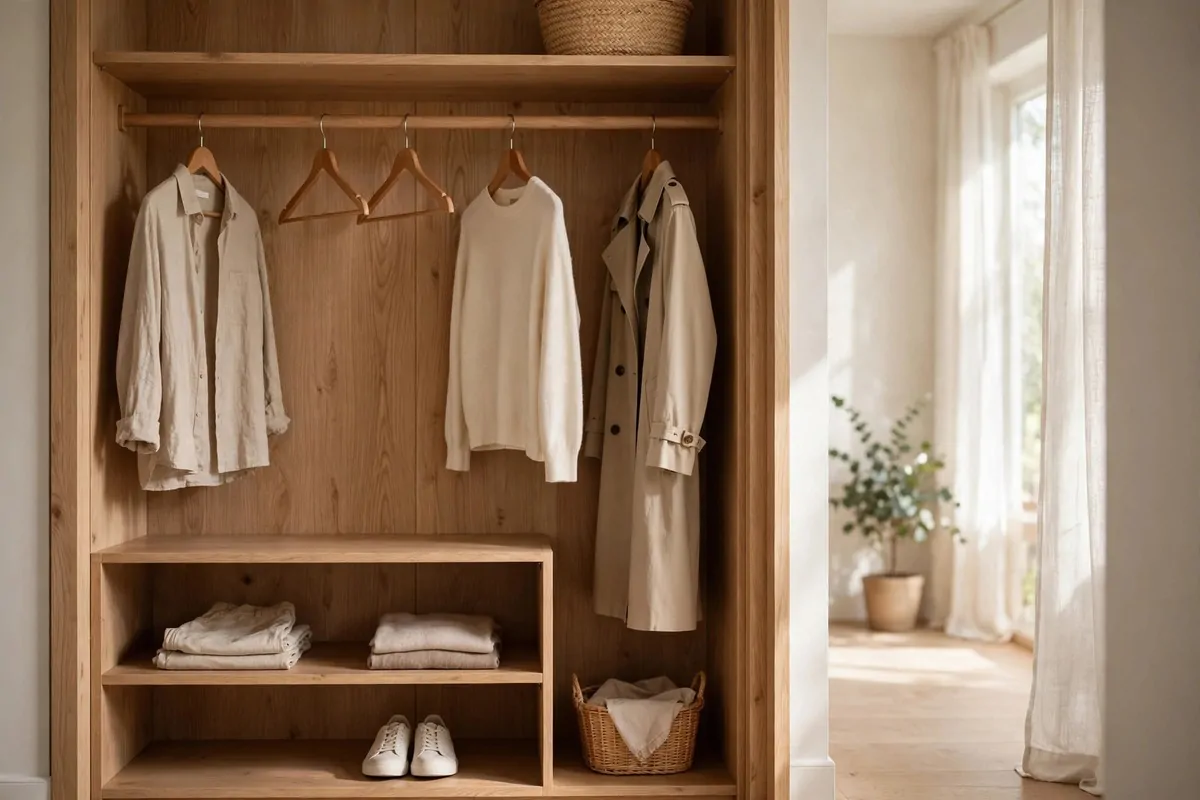
Organized closets stay organized with one rule. When something new comes in, something old goes out.
Buy a new shirt? Pick an old one for the donation bag. It keeps the closet at a steady size forever.
This rule stops the slow creep. You know the creep. One new top a month, and suddenly the rod is jammed again.
I keep a small donation bag hanging in my closet. When it fills up, it goes to the charity shop. Easy loop.
Shopping gets smarter too. You ask yourself, is this worth giving something up for? Sometimes the answer is no, and you save money.
This is not about being strict or minimal. It is about keeping the calm you worked hard to build.
Tell the family the rule. When everyone follows it, the whole house stays easier to manage.
I have followed this for two years now. My closet has stayed the same comfortable size the whole time.
Mornings stay fast because the closet never refills with noise. The rule guards your calm while you sleep.
25. Keep a Donation Bag Hanging Inside
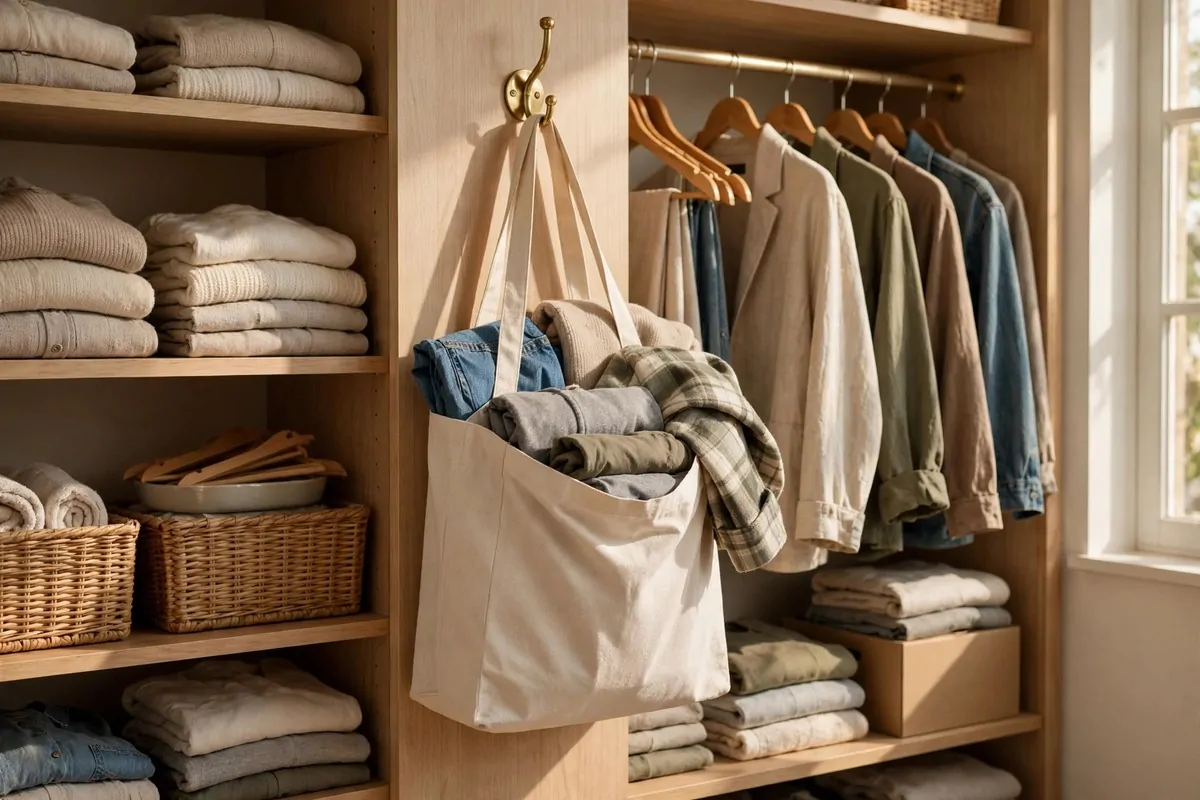
The best time to let go of a shirt is the moment you notice you never wear it. Not someday. Now.
A donation bag hanging in the closet catches those moments. See it, drop it in, move on.
I hang a simple fabric tote on a hook by the closet door. It is always there, always open, always ready.
When you try something on and it does not work, the bag is right there. No pile on the chair. No “later.”
Later is how closets fill up. The bag kills later. It turns a maybe into a decision in three seconds.
When the bag is full, tie it and take it out that week. Do not let it become furniture.
I do a drop-off run once a month. The bag empties, and the closet feels light again.
Kids can have their own little bag too. Outgrown clothes go straight in the day you notice.
This tiny habit keeps ideas 1 and 24 working all year. Decluttering becomes a daily ten-second thing, not a yearly nightmare.
26. Do a Two-Minute Reset Every Night
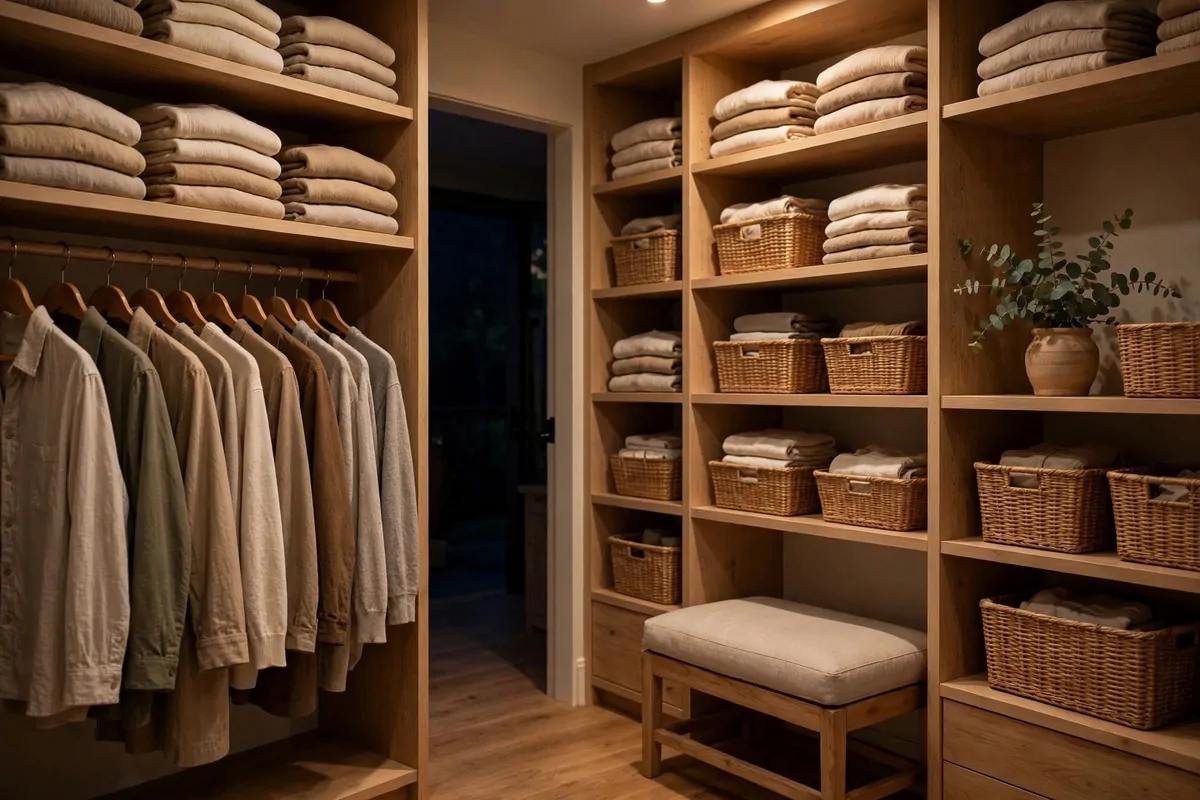
Every system on this list breaks without one habit. The two-minute nightly reset.
Before bed, walk to your closet and put things back. Hang the jacket. Straighten the stacks. Toss the maybe clothes in the wash or the donation bag.
Two minutes. That is all it takes when everything already has a home. You are just parking things in their spots.
I do this while I brush my teeth. By the time the toothbrush is done, the closet is done too.
This habit is why my mornings work. I never wake up to yesterday’s mess anymore.
Think of it like making the bed. Small effort, big payoff, and it signals your brain that the day is done.
If you skip a night, no guilt. Just do it the next night. The system forgives you.
Set a phone reminder for the first two weeks. After that, your hands just do it on their own.
Twenty-six ideas, and this last one is the glue. It keeps all the others alive. Two minutes tonight buys you twenty easy mornings.