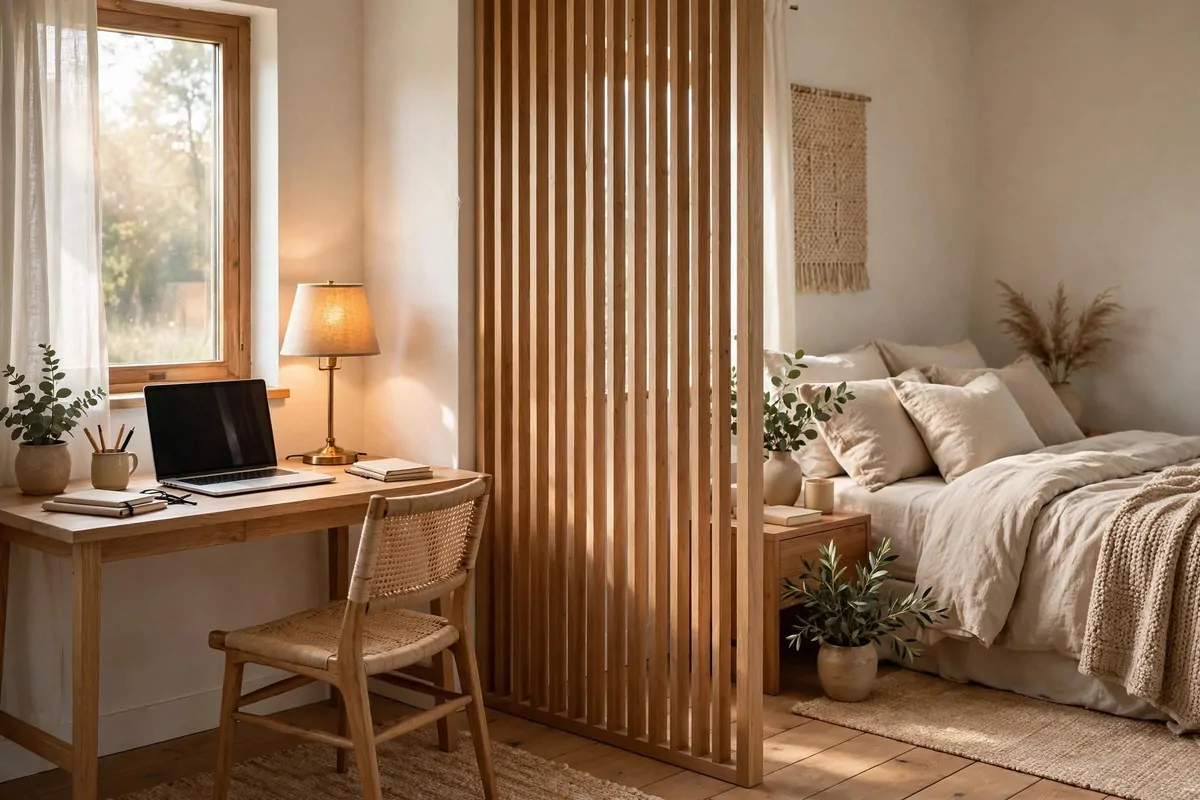
21 Office Area in Bedroom Setups That Keep Work Separate

My laptop used to sleep in my bed. Not on the desk. In my bed, right next to my pillow, still warm from the day.
My notebook lived on the bedside table. My charger hung off the headboard. My work papers slid under my pillow when I got tired. The room had two jobs, and they were all mixed up together.
Then one night I woke up at three in the morning and my first thought was an email I had not answered. That was the night I knew the room needed a line down the middle. Not a wall. Just a clear line between work and sleep.
That is what these 21 Office Area in Bedroom ideas are about. They keep work separate from sleep in one small room. Dividers, lights, rules, and small habits that tell your brain which half of the room you are in.
You do not need a second room. You need a clear divide. Pick three ideas. Start with the line on the floor, because that is where the divide begins.
Draw a Line on the Floor
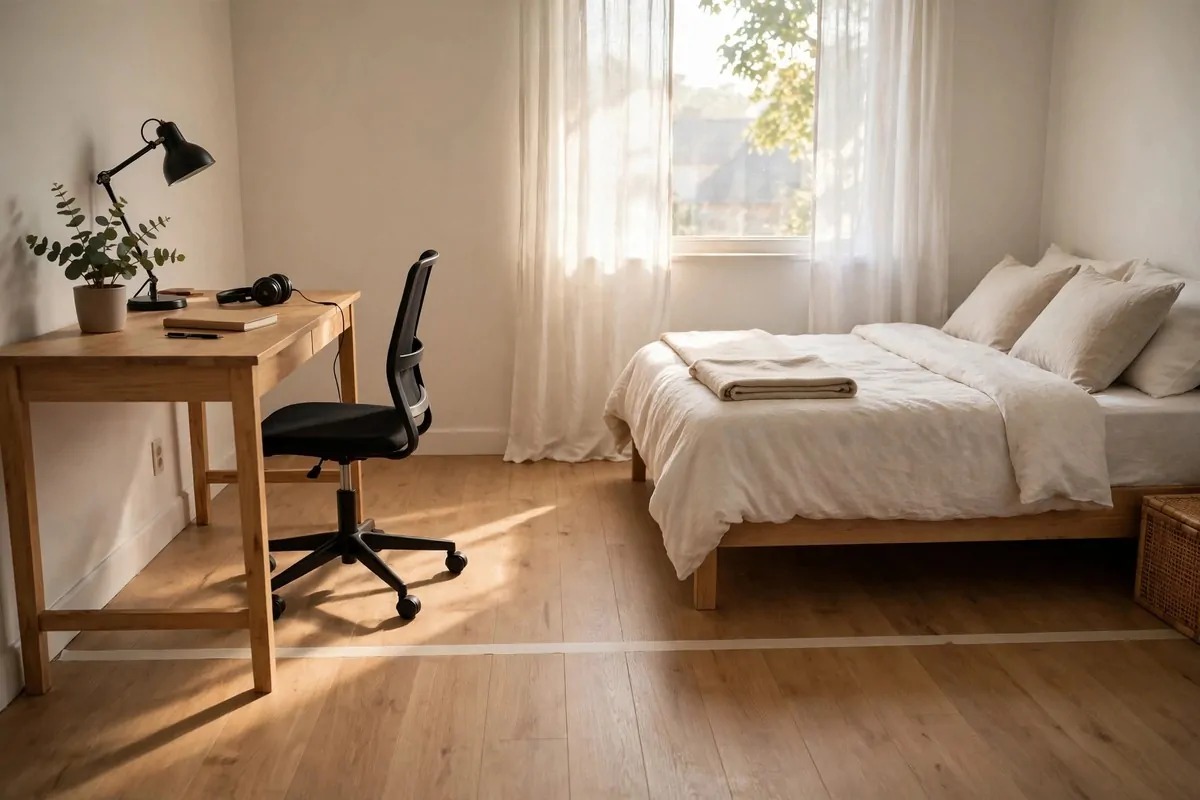
A line on the floor sounds silly until you try it. It is the cheapest divide in this whole list.
I stuck a strip of plain tape across my bedroom floor, from the wall to the bed. On one side sat my desk. On the other side sat my bed. The tape cost nothing. It came from a drawer I already had.
The line works because your feet can feel it. You step over it in the morning when work starts. You step back over it in the evening when work ends. Your brain learns the line faster than your eyes do.
Use tape that peels off clean. Painter tape is best. It stays down for months and comes up without a mark. Do not use packing tape. It leaves sticky patches on the floor, and nobody wants that.
Keep the line straight. A straight line reads as a rule. A wobbly line reads as a mistake. Measure it with a book if you have no ruler. Two books laid end to end make a fine straight edge.
Put the line where the two jobs actually split. Mine runs between the desk leg and the bed leg. The desk side holds the chair, the lamp, and the papers. The bed side holds the pillow, the blanket, and nothing else.
Step over the line on purpose the first week. Say it out loud if it helps. Work side. Sleep side. It sounds daft, and it works anyway. Habits start with small silly moves like that.
When guests come, the line still looks fine. It is just a thin strip on the floor. Most people never even ask about it. The ones who do ask usually want one for their own room.
The Folding Screen That Splits the Room
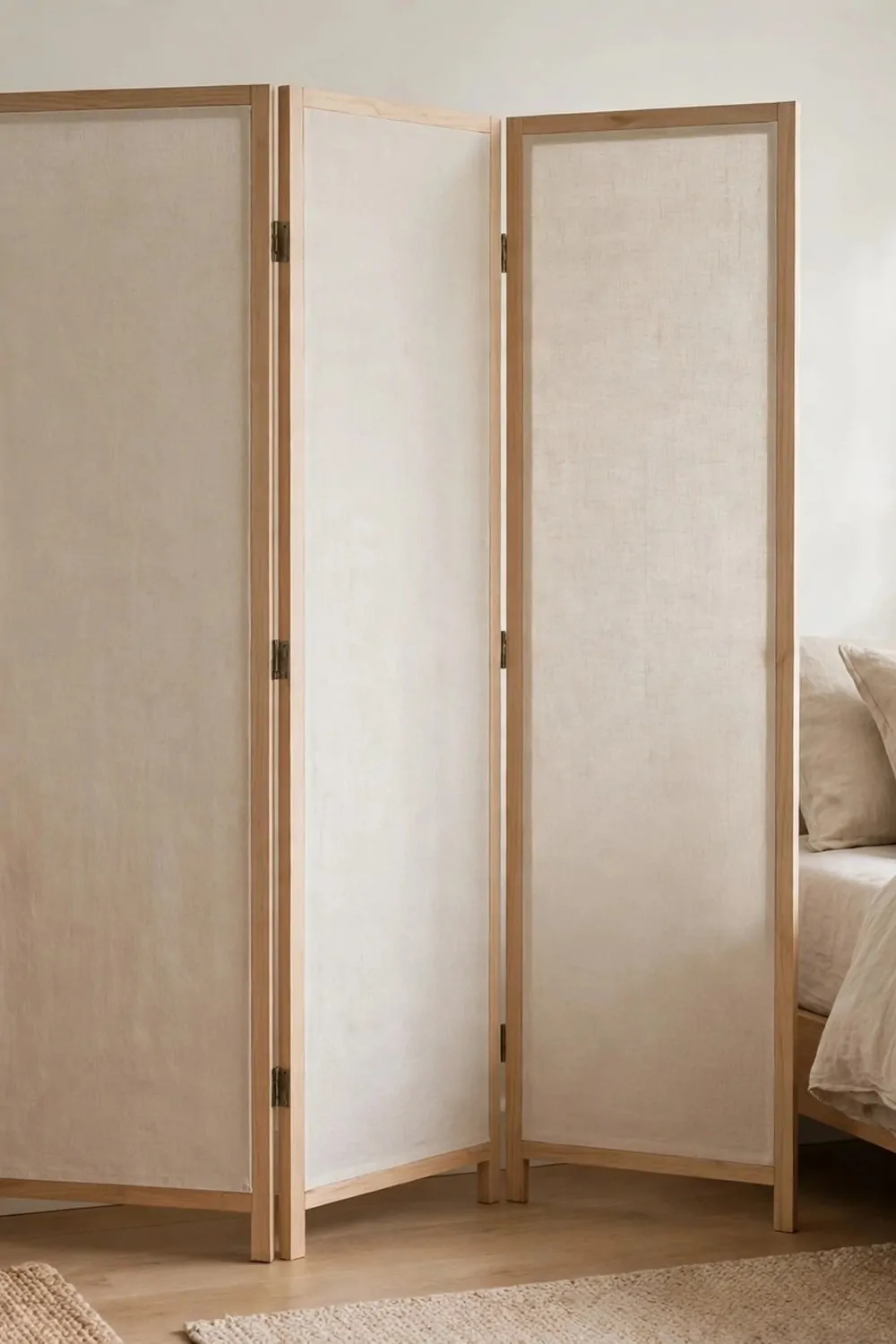
A folding screen is a wall you can put up and take down. That is exactly what a bedroom office needs.
Mine has three panels and stands in the corner between my desk and my bed. In the morning I open it up. In the evening I fold it flat against the wall. Two minutes, twice a day, and the room changes shape.
Pick a screen made of plain cloth or plain wood. A busy pattern fights the room. A plain screen in the room’s main colour disappears into the background. It divides without shouting.
Stand the screen so it blocks the view of the bed from the desk. That is the whole trick. If you can see the bed while you work, your brain keeps thinking about sleep. If the screen hides the bed, your brain thinks about work.
Keep the screen light enough to move with one hand. A heavy screen stays in one place and becomes furniture. A light screen gets used every day. Mine weighs less than a bag of shopping.
Use the screen as a pinboard too. Pin your weekly list to the work side. Pin a photo to the sleep side. The screen does two jobs at once, and it earns its corner that way.
Fold the screen away on weekends if you like. A folded screen leans flat against the wall and takes up almost no space. Unfold it on Monday morning and the office is back.
Try this one if your eyes keep drifting to the bed while you work. One screen between the two jobs, and the drifting stops.
Two Lamps for Two Jobs
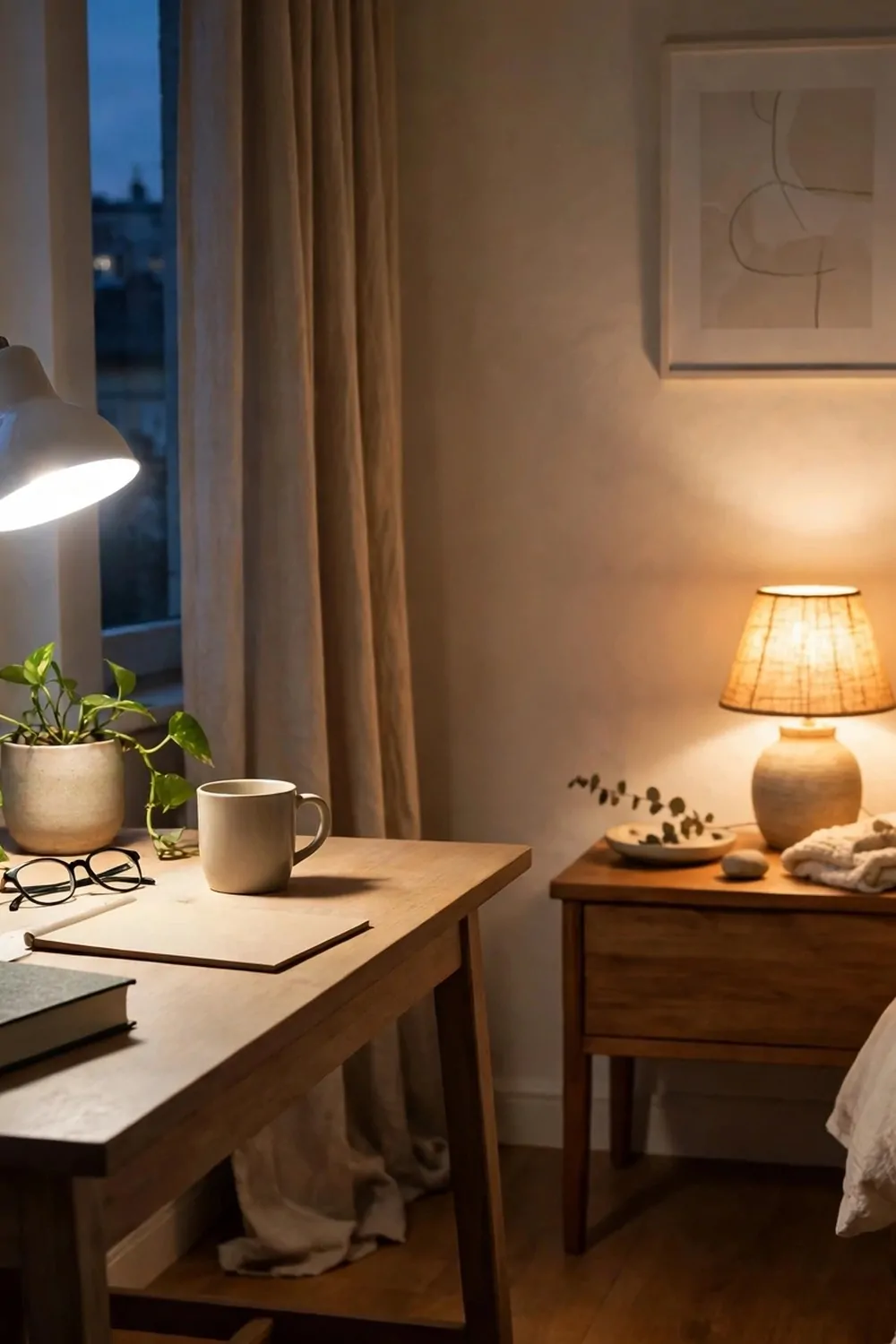
One lamp cannot do two jobs. A bedroom office needs two lamps, one for work and one for sleep.
My work lamp sits on the desk. It is bright and white, and it points straight down at my notebook. My sleep lamp sits on the bedside table. It is warm and low, and it glows soft against the wall.
Switch on only one lamp at a time. That is the rule that makes this work. Work lamp on means work time. Sleep lamp on means the day is done. Two lamps, two moods, and your brain learns the switch fast.
Pick a work lamp that throws light down, not out. A lamp with a shade that points down keeps the light on your page. A lamp that throws light everywhere lights up the bed too, and that ruins the divide.
Pick a sleep lamp that glows low and warm. A small lamp with a cloth shade works well. It should feel like evening, not like an office. When that lamp is on, the desk should sit in shadow.
Put the two lamps on opposite sides of the room. Mine are as far apart as the room allows. The distance matters. Two lamps close together blur into one light, and the divide goes soft.
Keep a spare bulb for each lamp in the drawer. A work lamp with a dead bulb is a dark desk. A sleep lamp with a dead bulb is a dark bedroom. Two spare bulbs cost very little and save two bad days.
This move costs almost nothing if you already own two lamps. Most homes do. One lamp was probably sitting in another room, waiting for a job. Give it one.
Face the Desk Away From the Bed
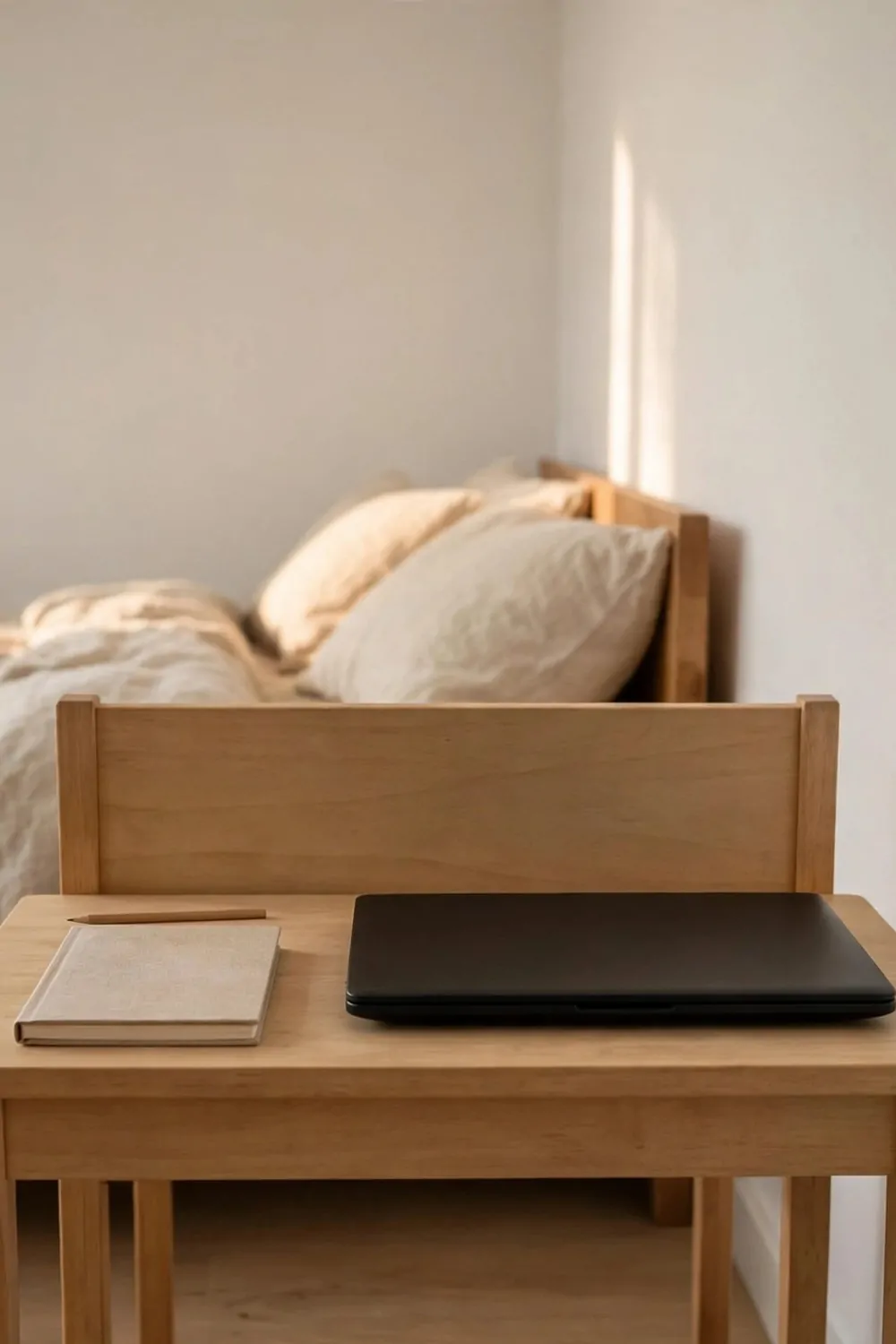
The direction your desk faces decides how separate the two jobs feel. Face it away from the bed.
My desk used to face the bed. I sat down to work and the first thing I saw was my pillow. My brain read that pillow as a nap. I spent half the morning fighting sleep I was not even tired enough to need.
Now my desk faces the wall, with my back to the bed. I see a plain wall, a shelf, and my notebook. The bed is behind me, out of sight, out of mind. Work got easier the same week.
Turn the desk so the bed sits behind your chair. That is the simplest version of this idea. You never have to look at the bed while you work. Out of sight is a real thing, not just a saying.
Put something worth looking at on the wall in front of you. A pinboard. A framed picture. A small shelf with a plant. The wall in front of you is your work view. Make it a good one.
Keep the chair facing the same way as the desk. A chair turned sideways lets your eyes wander back to the bed. A chair facing the wall keeps your eyes where the work is.
If the room is too small to turn the desk fully, turn it sideways. Even a half turn helps. A desk facing the window with the bed off to one side is better than a desk facing the bed head on.
Sit down and test it before you decide. Work for one hour facing away from the bed. Notice how your eyes feel. Then turn around and work facing the bed for an hour. The difference will tell you everything.
The Work Shirt Comes Off at Six
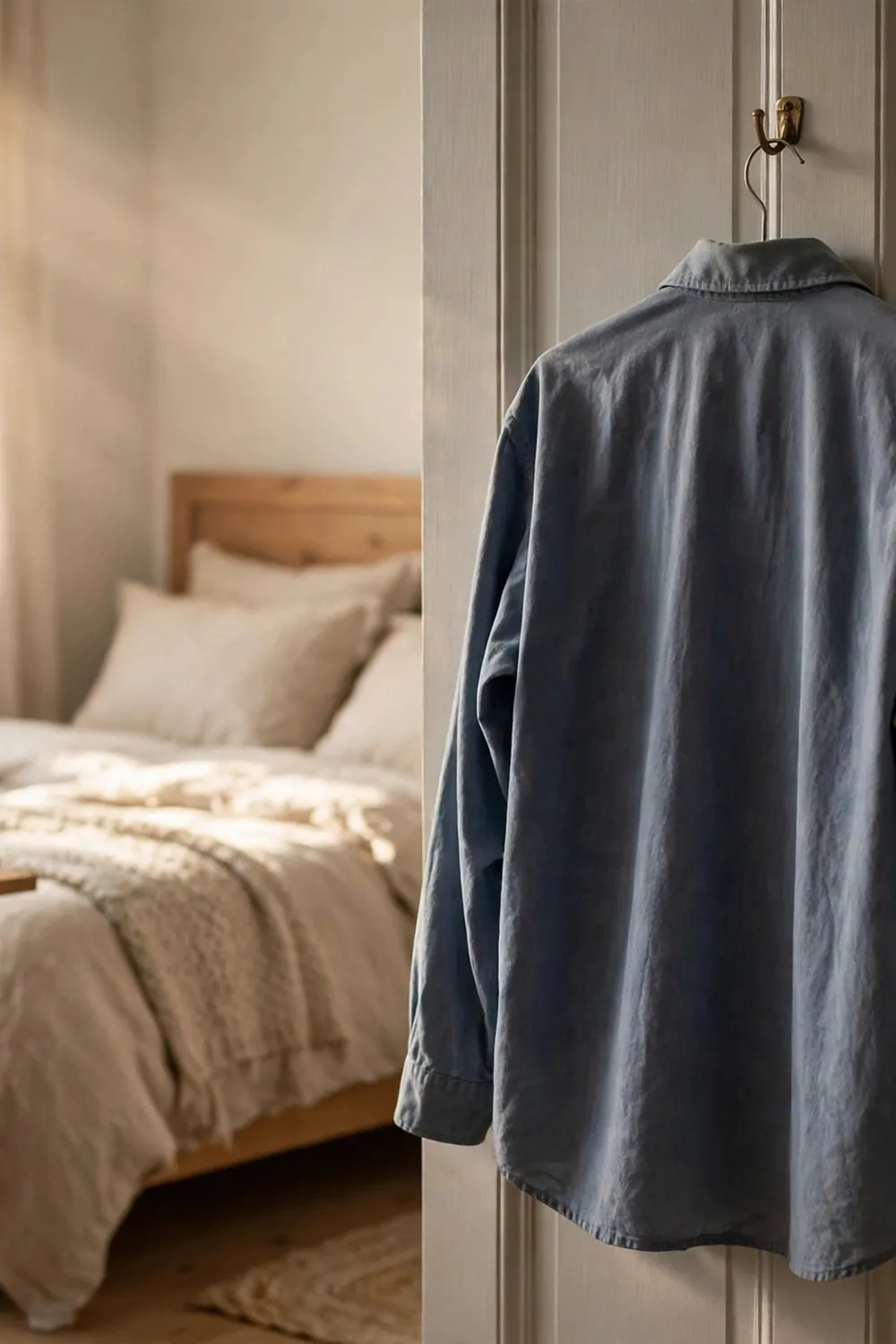
A bedroom office needs a uniform, even a small one. Mine is a work shirt. It goes on at nine and comes off at six.
I put the shirt on in the morning before I sit at the desk. It is a plain shirt, nothing fancy. At six I take it off and hang it on the back of the door. That shirt on the hook means work is over. The day is done.
Pick one thing to be your work uniform. A shirt. A cardigan. A pair of shoes you only wear at the desk. It does not matter what it is. It matters that it only ever means work.
Put the work thing on before you open the laptop. That order matters. Clothes first, laptop second. The shirt tells your brain that work is starting, before the screen even lights up.
Take the work thing off the moment work ends. Do not wear it to make dinner. Do not wear it to watch television. The moment it comes off, your brain knows the workday is finished.
Hang the work thing where you can see it from the bed. Mine hangs on the door hook, right in my line of sight. In the evening it hangs there like a closed sign on a shop. Work is shut. Come back tomorrow.
Wash the work thing on Friday evening. A fresh shirt on Monday morning feels like a fresh week. A shirt worn all week without a wash feels like a week that never ended.
This idea costs nothing and it works from day one. One shirt, two states, and the room finally has a start time and a finish time.
A Cupboard Door That Closes on Work
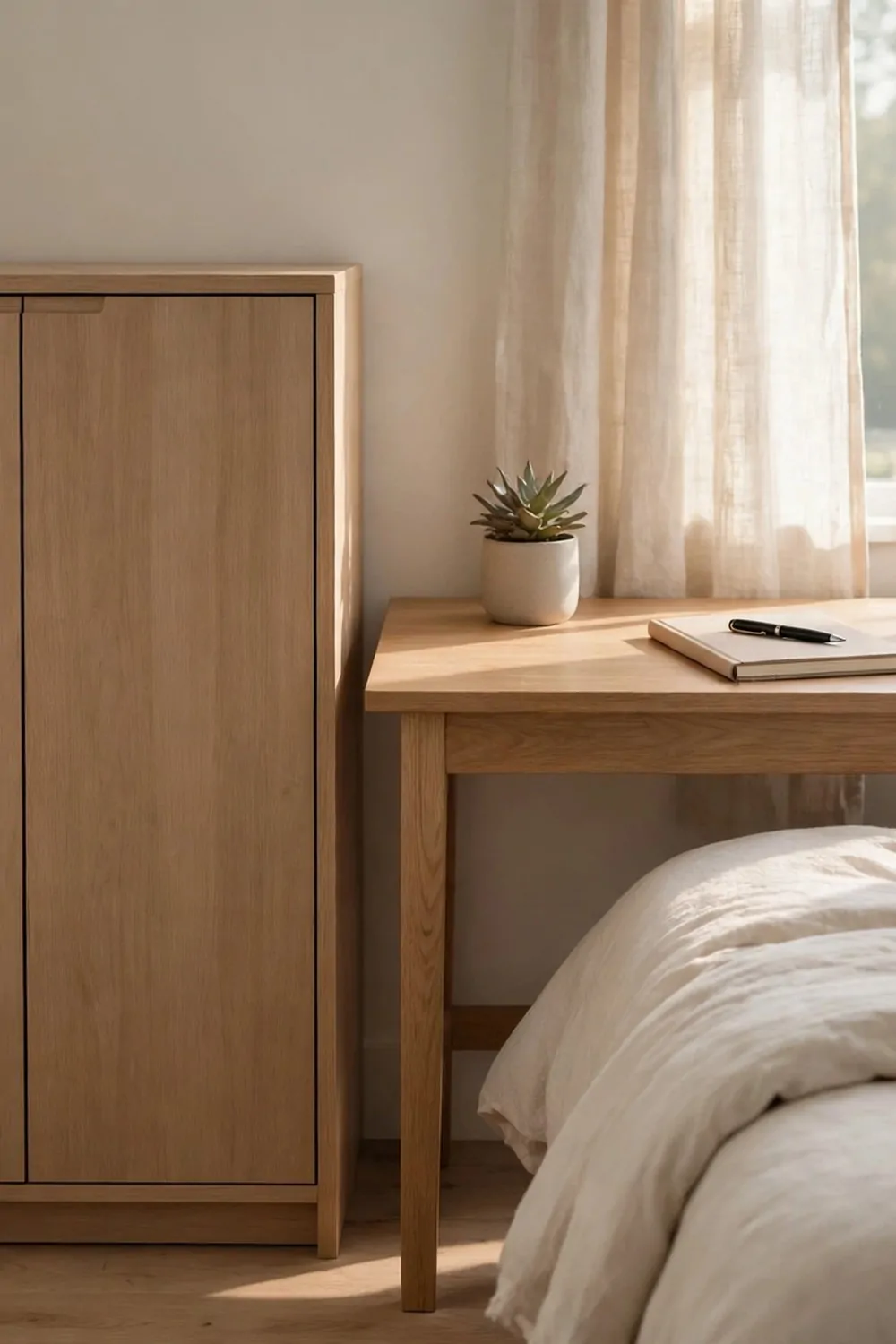
Work that you can see is work that never ends. A cupboard door that closes on it fixes that.
My desk papers, my laptop, and my charger all live inside a small cupboard with doors. At six I slide everything in and shut the doors. The desk is gone. The room is a bedroom again.
Pick a cupboard with doors that close flat. Sliding doors work well in a small room. Doors that swing open need floor space you may not have. Flat doors close the work away with one push.
Keep everything work owns inside that one cupboard. Laptop, papers, pens, charger, notebook. If it belongs to work, it lives behind those doors. If it belongs to sleep, it never goes in there.
Label the inside of the doors if you share the room. One side for your things, one side for theirs. Labels inside the doors stay hidden when the doors are shut, and they stop arguments when the doors are open.
Put the cupboard close to the desk so the shut-down takes seconds. Mine stands right beside the desk. One arm’s reach and the laptop is inside. If the cupboard is across the room, the shut-down takes too long and you will skip it.
Close the doors every single evening, even on busy days. A cupboard left open is a desk left out. The doors are the divide. Shut doors mean shut work.
Wipe the cupboard doors once a week. Fingerprints build up fast on doors you open twice a day. A quick wipe keeps them looking like bedroom furniture, not office storage.
The Headphone Rule

Headphones on means do not disturb. That is the rule in my bedroom office, and it works even when I live alone.
I put my headphones on when work starts. They do not even have to play music. The headphones themselves are the signal. They tell my brain that the room is an office now, and they tell everyone else in the house to leave me alone.
Pick one pair of headphones to be the work pair. Big ones that cover your ears work best. They block the sound of the house and they look like a do-not-disturb sign. Small earbuds do not send the same message.
Put the headphones on at the same time every morning. Same time, same move, and the habit builds fast. After two weeks your brain will switch into work mode the second the headphones go on.
Keep the headphones on the desk, never on the bed. The desk is their home. If the headphones drift onto the bed, the rule drifts with them. A pair of headphones on the pillow means nothing at all.
Play the same kind of sound every workday if you like music. Rain sounds. Soft piano. Nothing with words. The same sound every day becomes part of the work uniform, like the work shirt.
Here is what the headphones mean in my house.
- Headphones on, do not knock unless it is urgent.
- Headphones off, come in and talk.
- Headphones on the hook, work is done for the day.
- Nothing else. The headphones are not for music at night.
Take the headphones off the moment work ends and hang them on the desk hook. Off means off. Do not wear them to bed. Do not wear them while you cook. The rule only works if the headphones mean one thing.
Tell the people you live with what the rule means. Headphones on, do not knock unless it is urgent. It takes one short talk, and it saves a hundred small interruptions a week.
The Pinboard Wall Between the Two Worlds
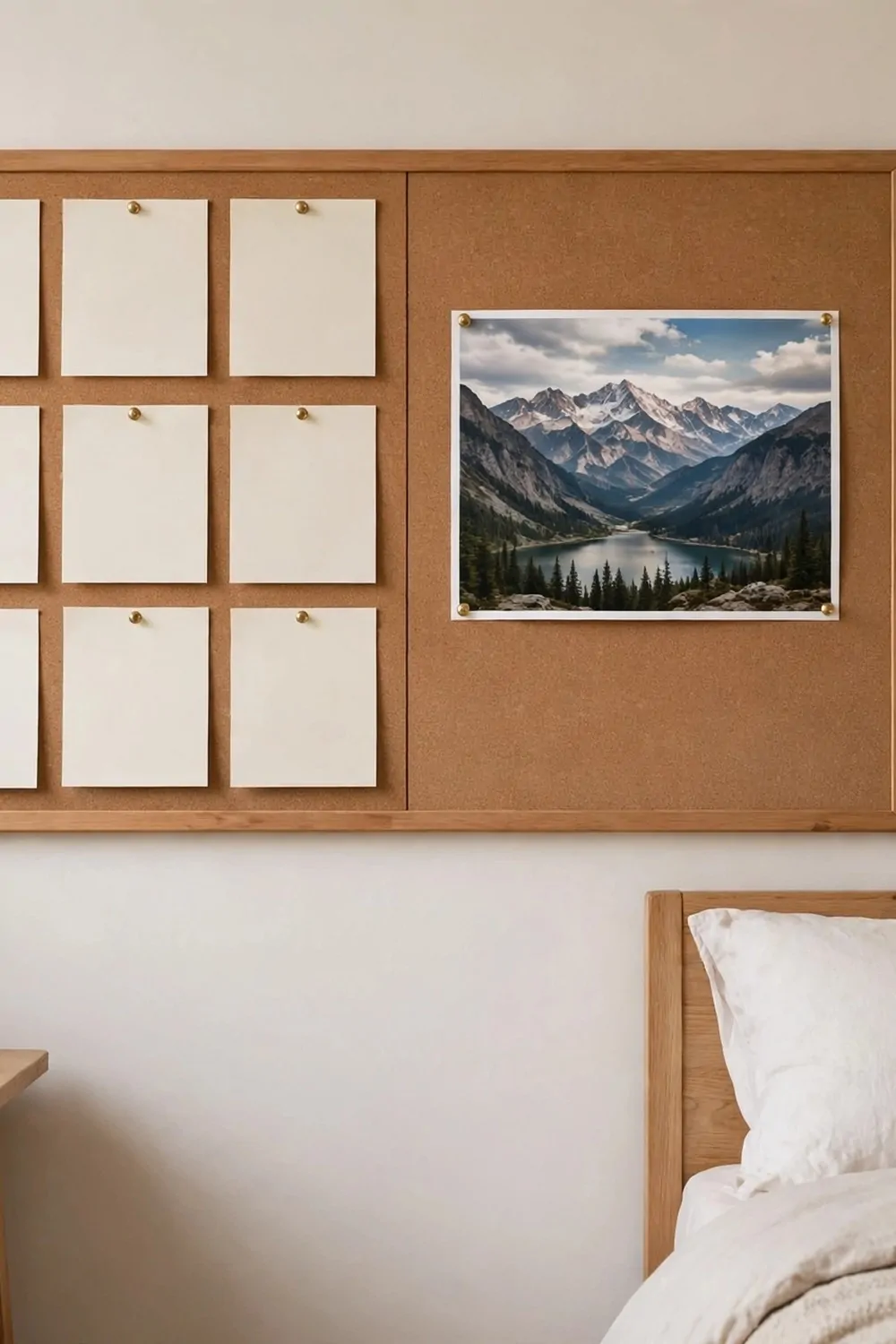
A pinboard on the wall can do the job of a divider. It marks where work ends and sleep begins.
Mine hangs on the wall between my desk and my bed. The work side of the board holds my list, my deadlines, and a calendar. The sleep side holds one photo and nothing else. The board is the border.
Hang the board so it sits exactly on the line between the two zones. Mine is centred on the tape line on the floor. Wall and floor agree on where the divide is, and the room reads clearly.
Pin work things only on the work half of the board. Lists, dates, reminders. Pin sleep things only on the sleep half. A photo. A postcard. A note from a friend. The two halves never mix.
Keep the work half tidy. Take down last week’s list every Monday, even if some jobs are still undone. A board full of old lists looks like a museum of things you never did. A fresh list looks like a fresh week.
Change the sleep half once a season. A new photo, a new postcard, and the sleep side feels alive again. A sleep side that never changes becomes invisible, and the divide goes soft with it.
Use pins in two colours, one for each half. Red pins for work. Plain pins for sleep. The colour split makes the divide visible from across the room, even before you read a single note.
Stand back and look at the board from the door once a week. If the work half is creeping onto the sleep half, pull it back. Divides need looking after. A divide that drifts is a divide that disappears.
Morning Light for Work, Evening Light for Sleep
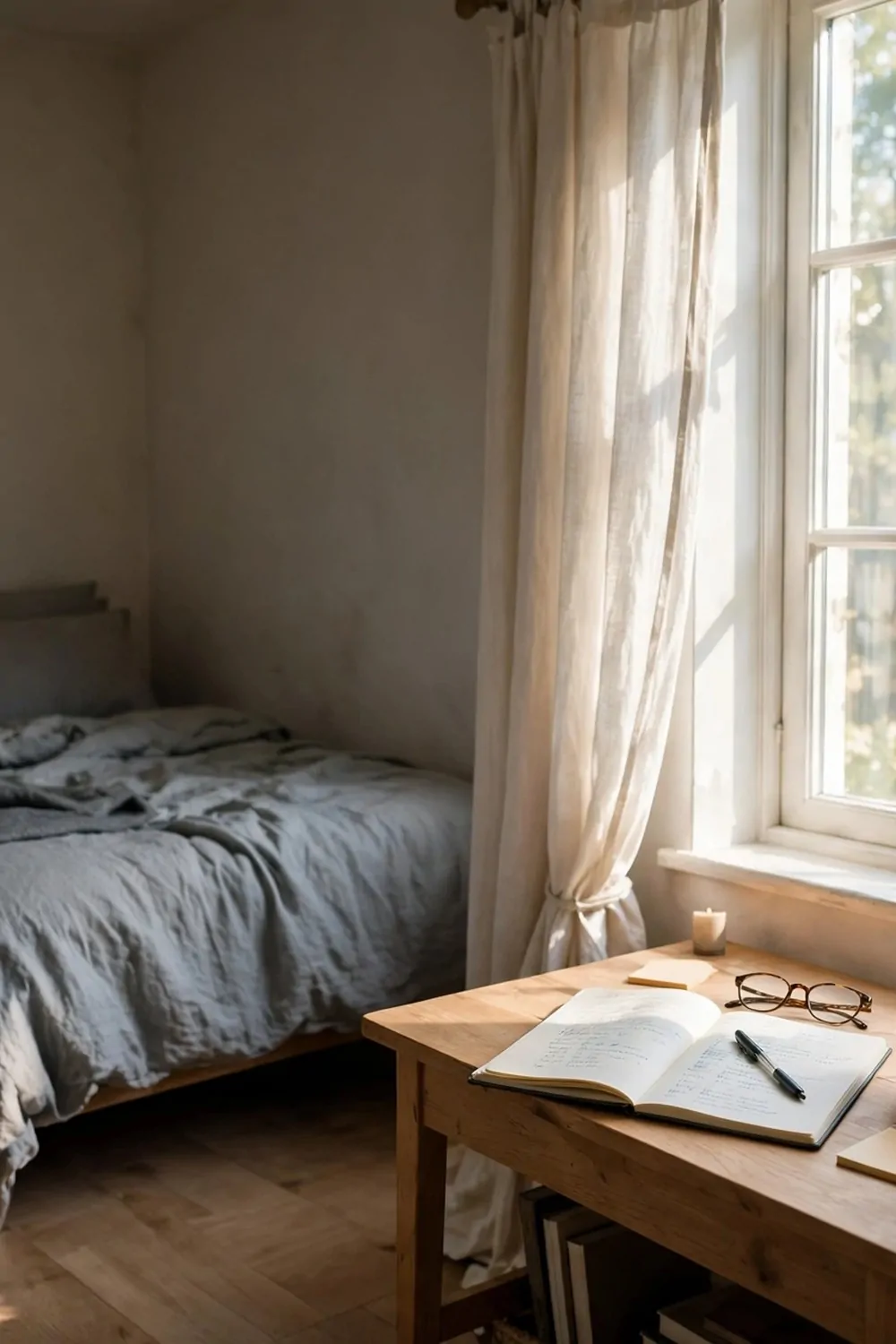
Light can split a room in two. Morning light belongs to work. Evening light belongs to sleep.
My desk sits by the window, where the morning sun lands first. My bed sits in the far corner, where the evening light never reaches. The room has two light zones, and each one has its own job.
Put the desk where the morning light falls. Open the curtains wide when work starts. Bright morning light wakes your brain up better than coffee does. It is free, and it works every single day.
Keep the bed out of the morning light if you can. A bed in full morning sun is a bed that calls you back at noon. A bed in a shady corner stays a bed, quiet and out of the way until night.
Close the curtains halfway at six in the evening. The room goes dim and soft. The desk fades into shadow and the bed takes over. One pull of the curtain, and the room changes jobs.
Use a thin curtain that lets the morning in and a thick one that keeps the evening out. Two layers on one rod do both jobs. Thin by day, thick by night, and the room shifts with the light.
Here is how the light should change through the day.
| Time of day | What the light does | What it means |
|---|---|---|
| Morning | Bright sun on the desk | Work time, eyes open |
| Afternoon | Soft light across the room | Work slows down |
| Evening | Warm lamp by the bed | Work is done, rest starts |
Never work in the dark with only a screen glowing. A screen in a dark room makes your eyes ache, and it makes the whole bedroom feel like an office at midnight. The desk lamp goes on when the sun goes down, and off when work ends.
Watch the light for one week and notice the pattern. Where does the sun land at nine? Where does it land at six? Move the desk to the morning spot and the bed to the evening spot. The sun will do the dividing for you.
The Phone Lives on the Desk, Not the Bed
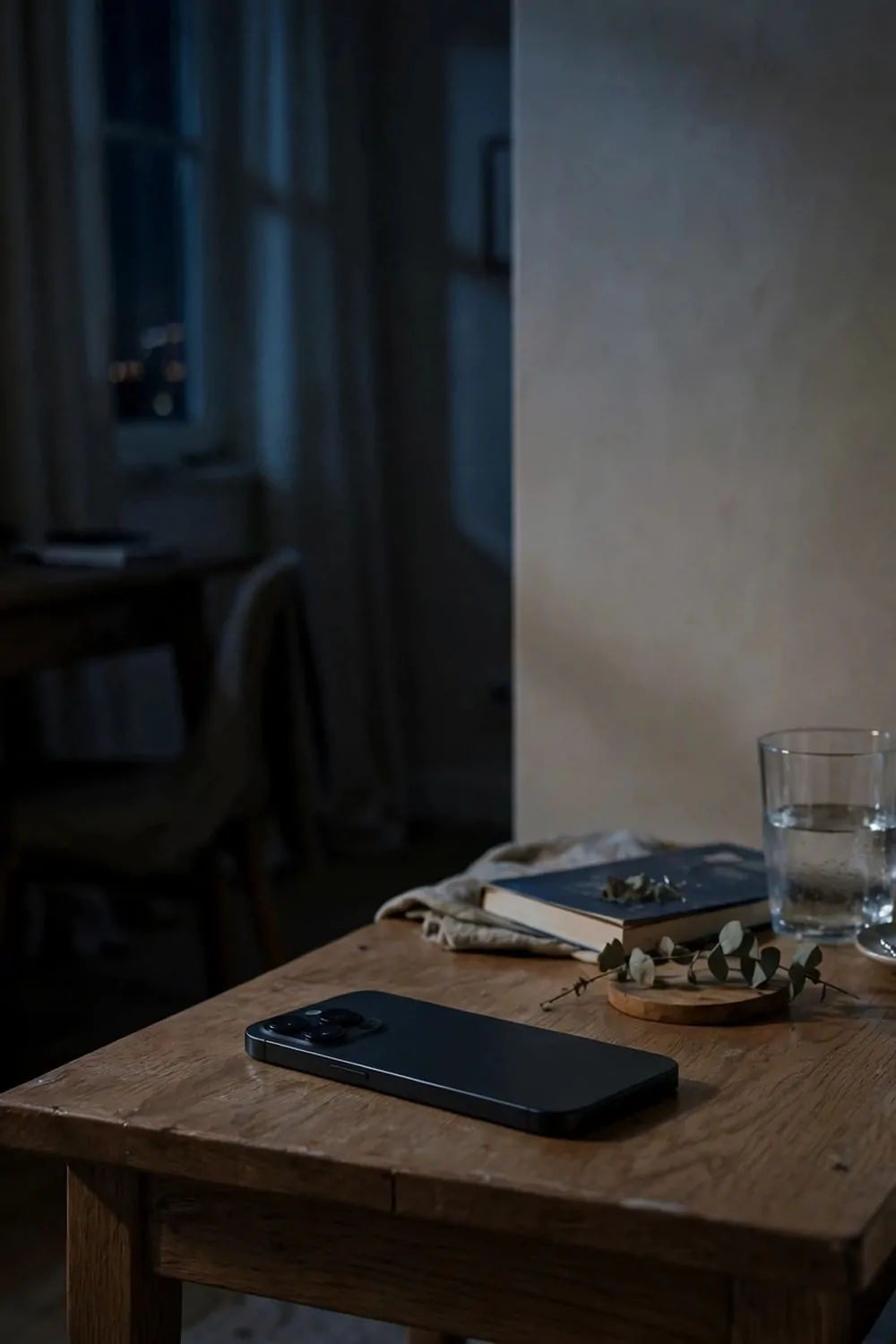
A phone on the bed is a work email at midnight. A phone on the desk is a tool that stays in its place.
My phone lives on the desk from nine to six, and it lives on the bedside table after that, face down, on silent. The phone has two homes, and the time of day decides which one it uses.
Charge the phone on the desk during the day. The charger sits in the drawer unit, and the phone rests on the desk while it charges. When work ends, the charger stays and the phone moves to the bedside table.
Turn the phone face down after six. Face down means no lights, no buzzing screen, no midnight email peeking at you from the pillow. It is a small move and it changes how you sleep.
Set the phone to silent at six every evening. Not vibrate. Silent. A phone on vibrate still buzzes against the wood, and a buzz at midnight is still a work thought. Silent is silent.
Keep the work apps closed after six. No email app open. No chat app open. Close them like you close the cupboard doors. An open app is an open door, and work walks right through it.
Put the phone on the desk the moment you sit down in the morning. That is the start of the workday. The phone comes out of the bedroom at nine, and it goes back at six. Two homes, two jobs, and the divide holds.
If you wake up at night and reach for the phone, it should not be there. Reach for the bedside table and find nothing but the dark. That empty reach is the divide doing its job.
The Work Mug That Stays on the Desk
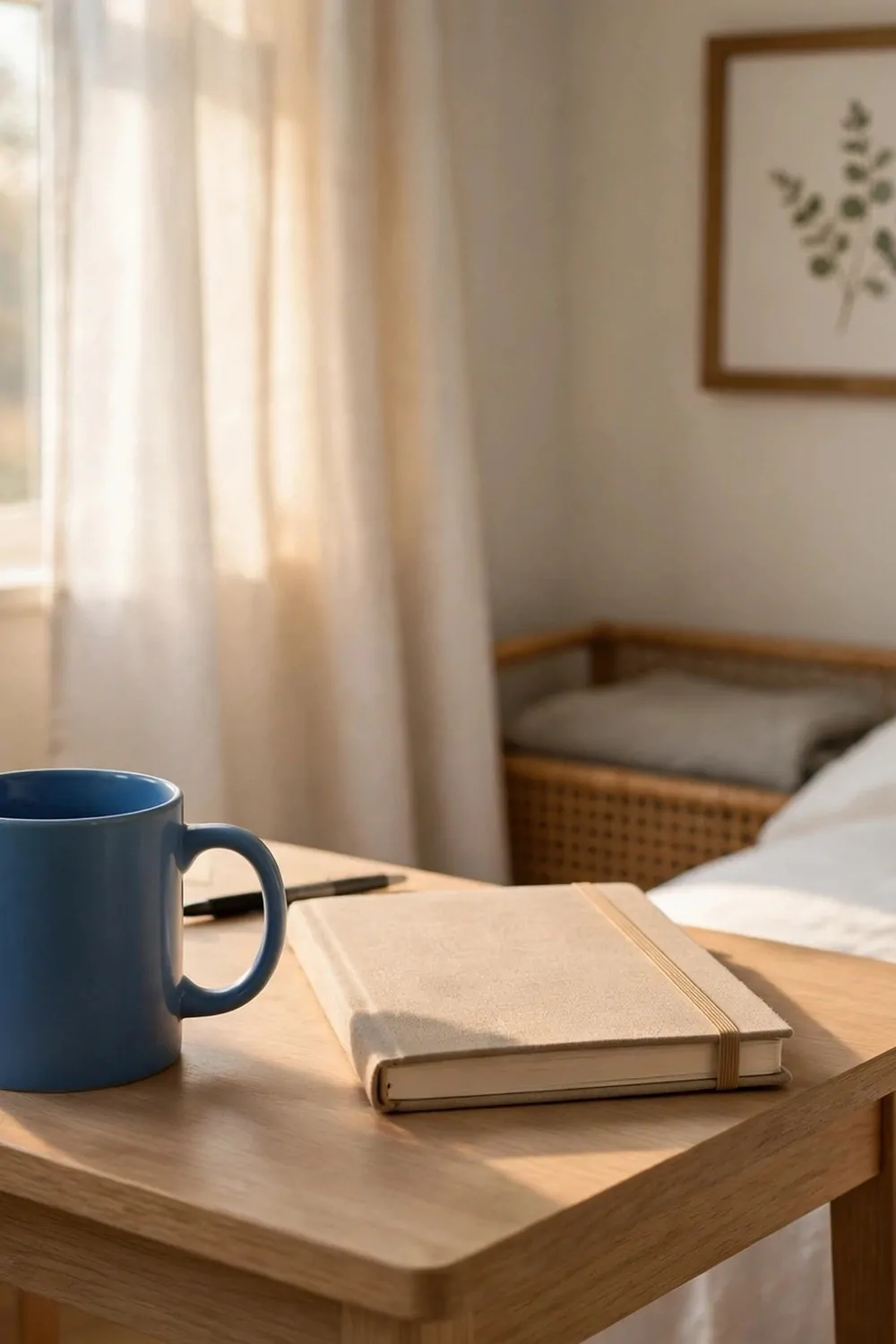
A mug can mark a boundary. My work mug never leaves the desk. My sleep mug never leaves the kitchen.
The work mug is plain and blue. It sits on the desk from nine to six, and it holds my tea while I work. At six I wash it and put it back on the desk, empty, ready for tomorrow. It never goes to the bed.
Pick one mug to be the work mug. One colour, one mug, and it only ever sits on the desk. A mug that travels all over the house marks nothing. A mug that stays put marks the work zone.
Wash the work mug at six, every evening, before you leave the desk. A dirty mug left overnight is the first thing you see in the morning, and it says yesterday never ended. A clean empty mug says tomorrow starts fresh.
Keep the sleep drink out of the work mug. No bedtime tea in the blue mug. No morning coffee in it either. The work mug holds work tea, and nothing else. That sounds fussy, and it works anyway.
Put the work mug on the same spot every day. Mine sits on the left side of the desk, next to the notebook. Same spot, same mug, and the desk looks the same every morning. That sameness is the divide.
Buy a second mug for the bedroom if you like a drink at night. A different colour, a different shape, and it lives on the bedside table. Two mugs, two jobs, and the room reads clearly.
Give the work mug a name if it helps you remember the rule. Mine is just the blue one, and that is enough. The name is not the point. The place is the point.
The Drawer That Locks Work Away
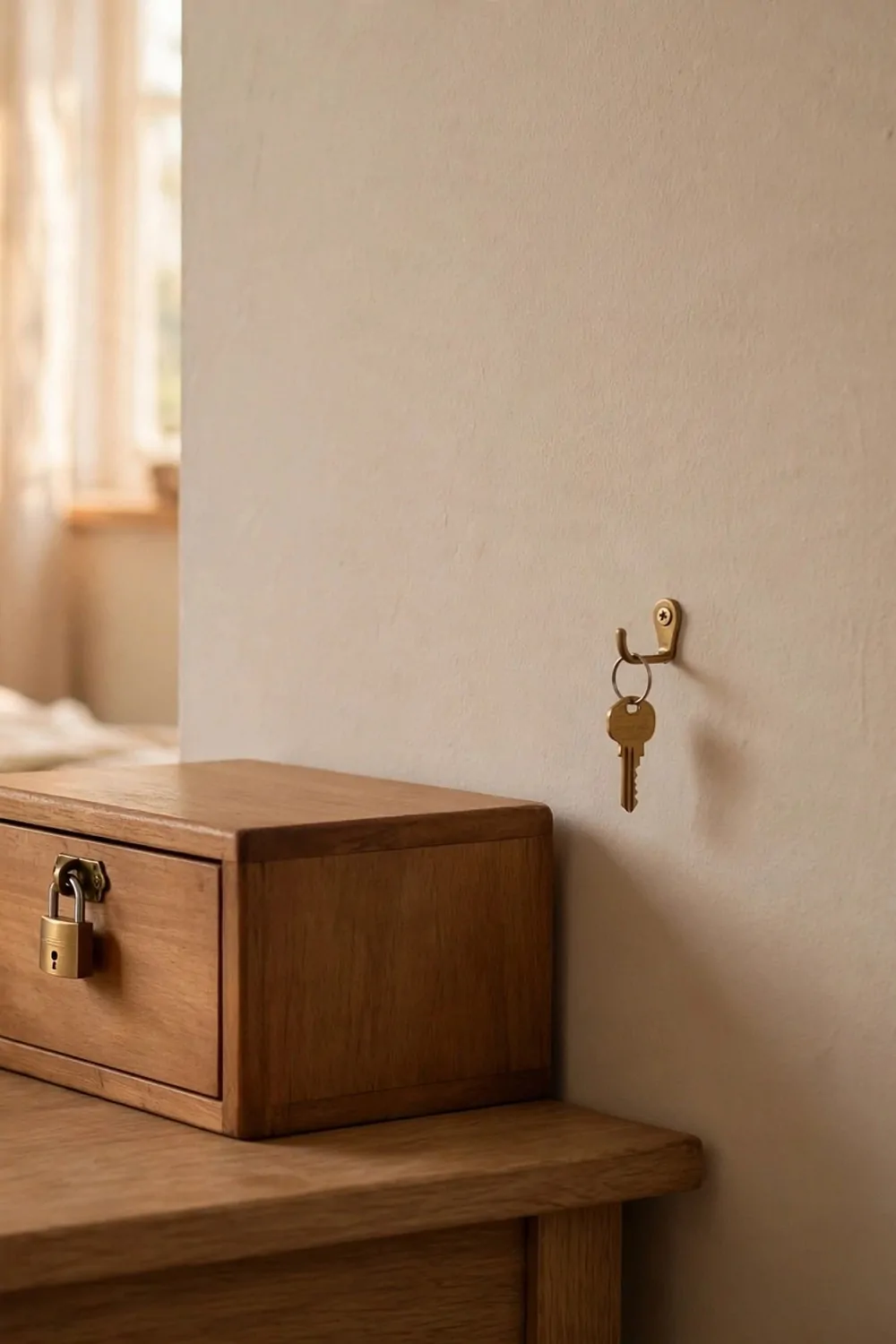
A drawer with a lock is a door that work cannot walk through at night. Mine has a small key, and I use it every evening.
My work papers, my notebook, and my laptop cable all go into the top drawer at six. I turn the key. The drawer locks. The work is inside, and I am outside. That click is the sound of the day ending.
Pick a drawer that locks, or add a small lock to one you already own. A tiny padlock on a hasp does the job. It does not need to be strong. It needs to be a ritual, not a safe.
Put the things you reach for at night into that drawer. The notebook with tomorrow’s list. The papers you were reading. The charger. If it belongs to work, it goes behind the lock at six.
Keep the key in one place and one place only. Mine hangs on a hook inside the cupboard. A key that lives in three places is a key you will lose. A key that lives in one place is a habit.
Lock the drawer at the same time every evening. Same time, same click, and your brain learns that locked means done. After a week the click feels like a full stop at the end of a sentence.
Never open the locked drawer after six. That is the rule that makes the lock work. A locked drawer you open at midnight is just a drawer. A locked drawer you leave alone until morning is a boundary.
Unlock it in the morning before you open the laptop. Key, drawer, laptop, in that order. The morning unlock is the start of the workday, just like the evening lock is the end of it.
The Tomorrow List Lives on the Desk

A list for tomorrow keeps tonight free. Mine lives on the desk, and it never travels to the bed.
Every evening at six I write three lines on a small notepad. Three jobs for tomorrow, no more. The notepad stays on the desk. The jobs stay on the desk. My head stays empty when I go to bed.
Write the list by hand, on paper, before you leave the desk. Handwriting slows you down just enough to think. A list typed on the phone follows you to bed. A list on paper stays where you wrote it.
Keep the list to three lines. Three jobs are enough for one day. A list with ten jobs is a list that follows you into the night, whispering about the ones you will never finish.
Read the list once in the morning before you open the laptop. It tells you where to start, and it stops the morning drift. A day that starts with a list starts with a plan.
Never rewrite the list at night in bed. If a fourth job pops into your head at midnight, let it go. It will still be there in the morning, and the desk will still be there to hold it.
Put the notepad in the same spot every day. Mine sits on the right side of the desk, next to the lamp. Same spot, same notepad, and the routine builds itself.
Cross each job off as you finish it. A crossed-off line feels good, and it shows the day moving. By six the list should be mostly crossed off, and the next list can be a fresh page.
A Bookshelf Back That Acts Like a Wall
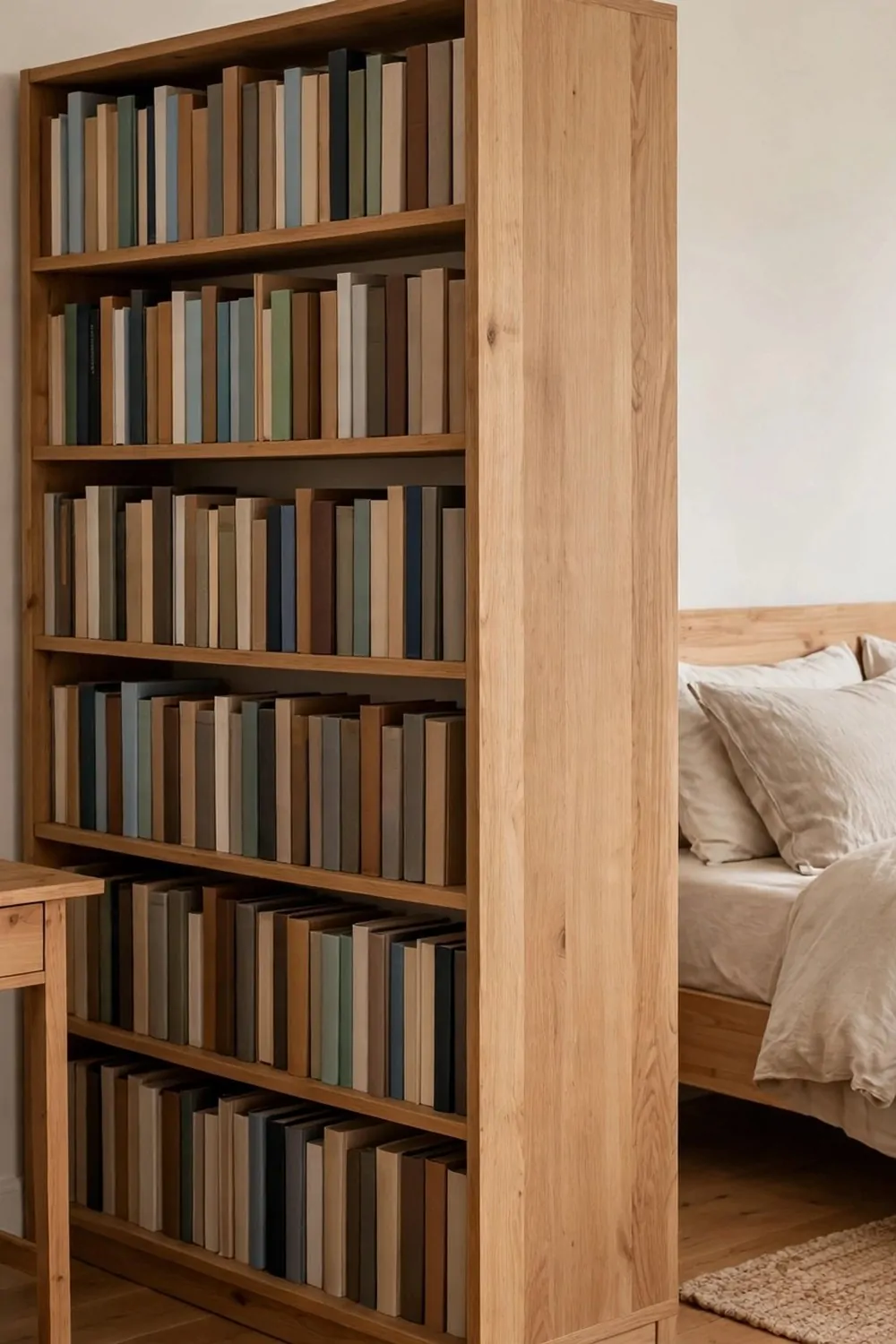
A bookshelf turned sideways is a wall that holds books. That is the best divider in a small bedroom.
My bookshelf stands with its back to the bed and its front to the desk. From the desk I see rows of books. From the bed I see a plain wooden back. One piece of furniture, two faces, and the room is split in half.
Turn a shelf you already own so its back faces the bed. The books face the work side. The plain back faces the sleep side. The shelf does the job of a wall without a single nail in the plaster.
Fill the shelf with books and boxes, not with gaps. A shelf full of things blocks the view properly. A shelf with empty gaps lets your eyes through, and the divide goes soft. Pack it tight.
Keep the work things on the desk side of the shelf. Notebooks, pens, the book you are reading now. Keep the sleep side plain. Nothing on the back of the shelf at all. A plain back reads as a wall. A cluttered back reads as a mess.
Fix the shelf to the wall with a bracket so it cannot tip. A tall shelf full of books is heavy, and a shelf that tips is dangerous. One bracket at the top keeps it safe for years.
Put the shelf where the two zones meet. Mine stands on the tape line on the floor. Shelf and tape agree on the border, and the room reads as two rooms in one.
Dust the shelf once a week when you clean the desk. A dusty shelf looks like storage. A clean shelf looks like a wall that happens to hold books. Ten seconds with a cloth is all it takes.
Two Alarms, Two Modes
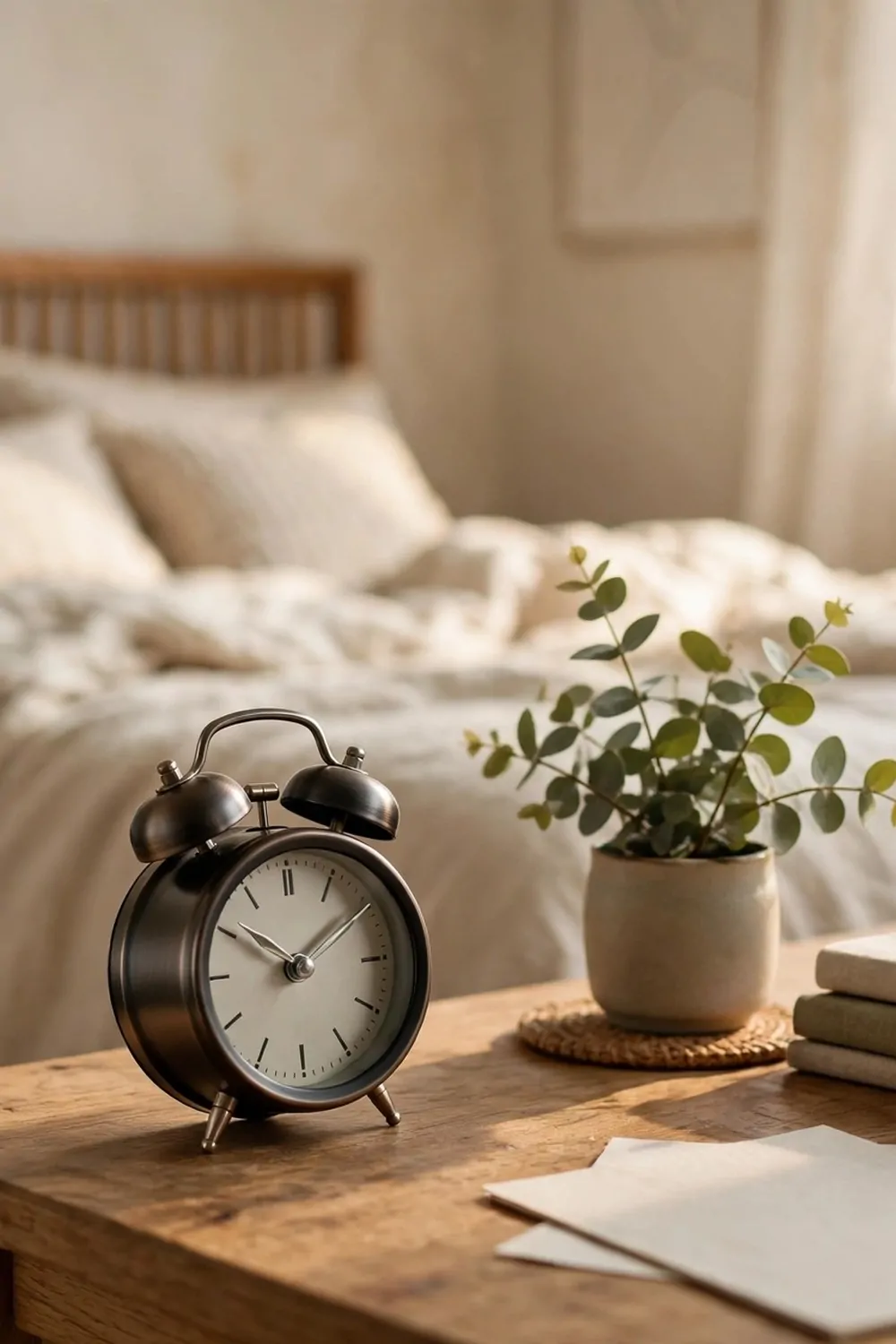
Two alarms split the day better than one alarm ever could. One starts work. One ends it.
My first alarm goes off at eight in the morning. It means get up, get dressed, put the work shirt on. My second alarm goes off at six in the evening. It means shut the laptop, lock the drawer, pull the curtain. Two alarms, two modes.
Set the work alarm for the same time every weekday. Same time, same sound, and your body learns it fast. After two weeks you will wake up a minute before it rings, ready for the day.
Set the end-of-work alarm for the same time every evening. Use a different sound from the morning one. A soft chime for the evening works well. A harsh buzz at six feels like a fire drill, and you will start to ignore it.
Label the two alarms on your phone. Work starts. Work ends. Labels matter, because an alarm with no label is just a noise. An alarm with a label is an instruction.
| Alarm | Time | What it means |
|---|---|---|
| Work starts | Eight in the morning | Shirt on, headphones on, laptop open |
| Work ends | Six in the evening | Laptop shut, drawer locked, shirt off |
| Weekend | No alarm at all | The room belongs to sleep |
Keep the morning alarm in the bedroom and the evening alarm on the desk. The morning alarm lives where you sleep. The evening alarm lives where you work. Each alarm belongs to its own zone.
Never snooze the evening alarm. A snoozed end-of-work alarm is a workday that never ends. When it rings, shut the laptop. The work will still be there in the morning, and it will be easier to face after a proper evening.
Turn both alarms off on the weekend. A weekend with work alarms is a weekend that never starts. Saturday and Sunday belong to the bedroom, not the office.
The Window Side for Work, the Dark Side for Sleep
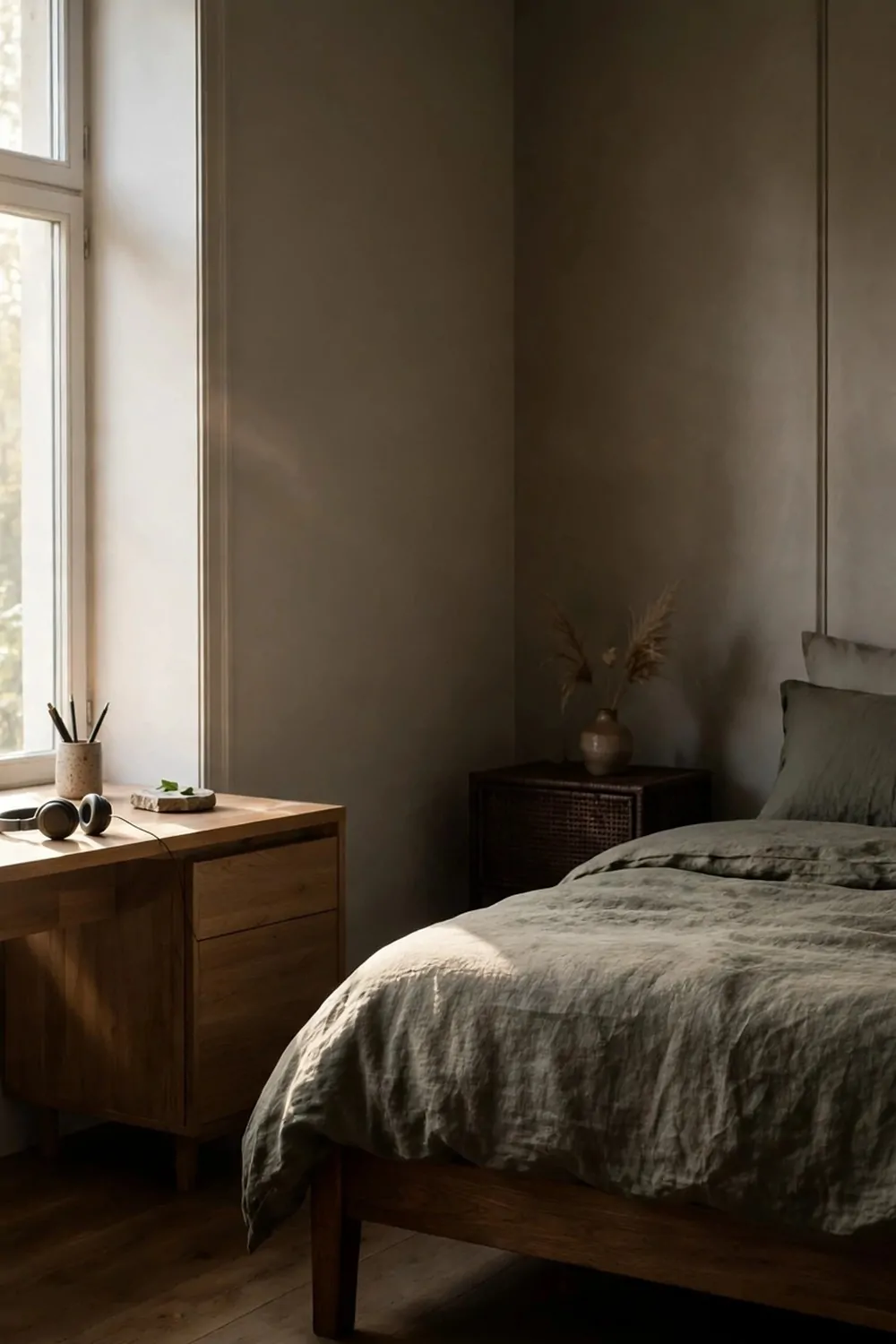
Every bedroom has a bright side and a dark side. Give the bright side to work and the dark side to sleep.
My desk sits on the window side of the room, where the daylight lands all morning. My bed sits on the far side, where the wall blocks the sun. Work gets the light. Sleep gets the shade.
Move the desk to the window side first. That is the biggest win in this idea. A desk by the window gets free light, free air, and a view to rest your eyes on. A desk in the dark corner gets none of those things.
Move the bed to the dark side, even if it feels odd at first. A bed in the shade is a bed that stays cool in summer and quiet in the morning. A bed in the sun is a bed that wakes you up too early and keeps you too warm.
Open the window near the desk in the morning. Fresh air at the desk keeps your brain sharp. A stuffy corner makes you sleepy by ten, and sleepy is not a work mode.
Keep the bedside window shut at night if the street is noisy. A quiet dark corner helps you sleep. A noisy bright corner does the opposite. The dark side should feel like a cave at night, soft and still.
Put a plant on the window side if you like. Plants love the bright side, and a green thing near the desk makes work feel less grey. Keep the plant on the desk side of the line, never on the bed side.
Try this one for a week before you judge it. Move the furniture on a Sunday, live with it for five workdays, and notice how you feel. The sun does the dividing better than any screen can.
The Door Sign That Says Working
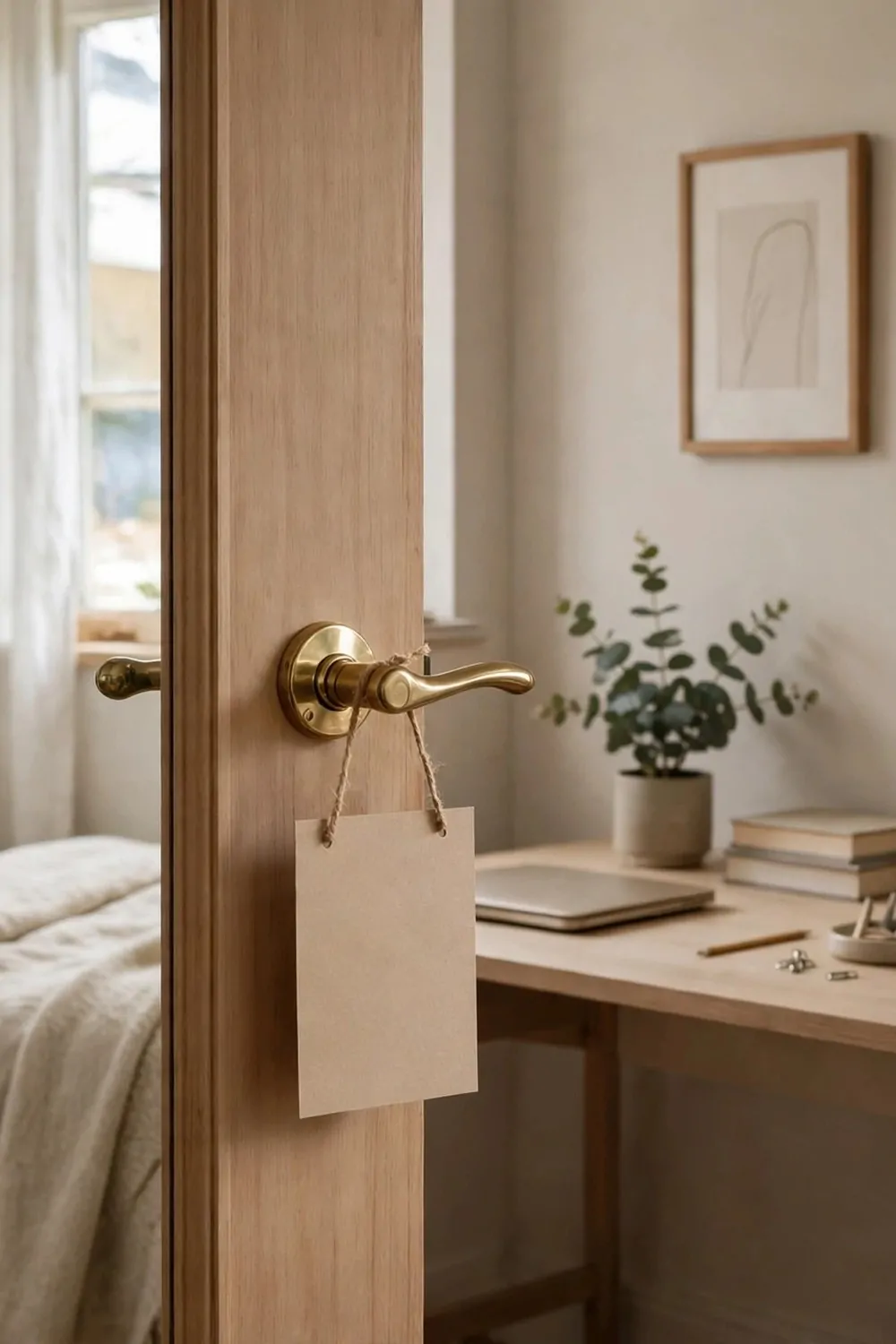
A sign on the door is a boundary that everyone can read. Mine says working, and it hangs on the inside of the bedroom door.
I made the sign from a piece of card and a string. One side says working. The other side says free. I flip it when work starts and flip it back when work ends. It takes two seconds and it stops a hundred interruptions.
Hang the sign where people see it before they knock. The door handle is the best spot. A sign on the handle is the first thing a hand touches. A sign on the wall is the last thing anyone notices.
Flip the sign at the same time as the work shirt goes on. Two moves, one moment, and the workday has a clear start. Flip it back when the shirt comes off, and the workday has a clear end.
Use plain words on the sign. Working. Free. Two words, big letters, and nobody has to guess. A sign with a joke on it is a sign people ignore. A plain sign is a sign people respect.
Tell the people you live with what the sign means. Working means knock only if it is urgent. Free means come in. One short talk, and the sign does the rest.
Make a second sign for the desk if you share the room. A small card on the desk that says working when you are in a call, and free when you are not. Two signs, two zones, and nobody has to ask.
Keep the sign simple and replace it when it gets tatty. A torn sign looks like a joke. A fresh sign looks like a rule. Card is cheap, and a new sign takes five minutes.
The Cloth That Covers the Desk at Night
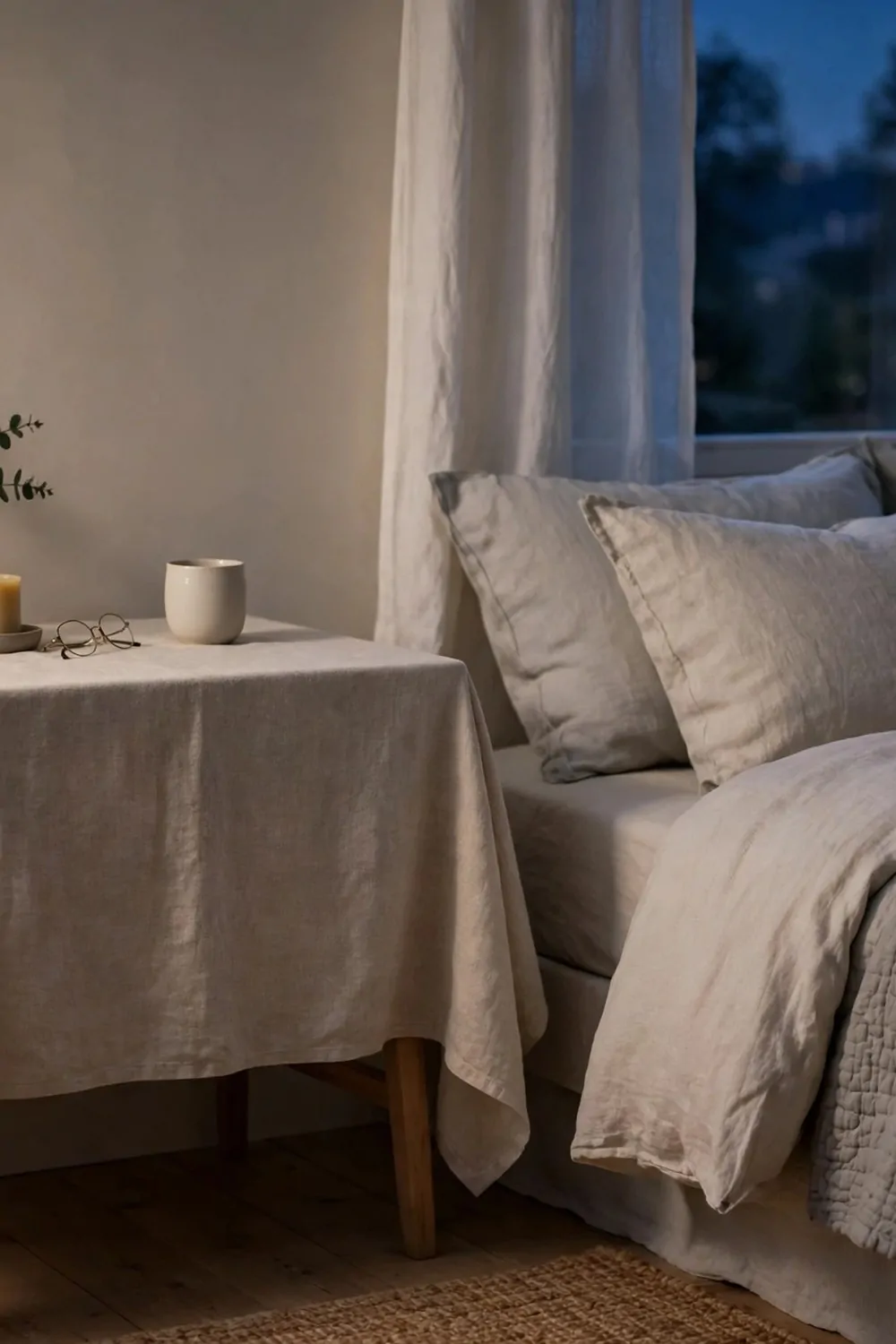
A desk you cannot see is a desk that cannot call you. A cloth over it at night does that job.
My desk gets covered at six every evening. I drape a plain cloth over the whole desk, laptop and all, and tuck the edges under. The desk becomes a shape under cloth. The work disappears. The bedroom takes over.
Pick a cloth big enough to cover the whole desk. An old sheet works well. A plain curtain offcut works too. The cloth should reach the floor on the front side so nothing peeks out from under it.
Choose a plain colour that matches the bedding. A cloth that matches the bed makes the covered desk look like part of the bedroom. A cloth in a clashing colour looks like a tent in the corner, and your eyes keep going back to it.
Uncover the desk in the morning before you open the laptop. Cloth off, laptop open, in that order. The uncovering is the start of the workday, just like the covering is the end of it.
Wash the cloth once a month so it stays fresh. A cloth that lives on a desk collects dust fast. A clean cloth looks like bedroom linen. A dusty cloth looks like a dust sheet in a building site.
Keep the cloth folded on the shelf during the day. A folded cloth on the shelf is a promise that the desk will be covered again at six. A cloth left in a heap on the floor is a promise nobody keeps.
Try this one if the laptop glows at you from the desk all evening. One cloth, two minutes, and the glow is gone.
The Sunday Divide
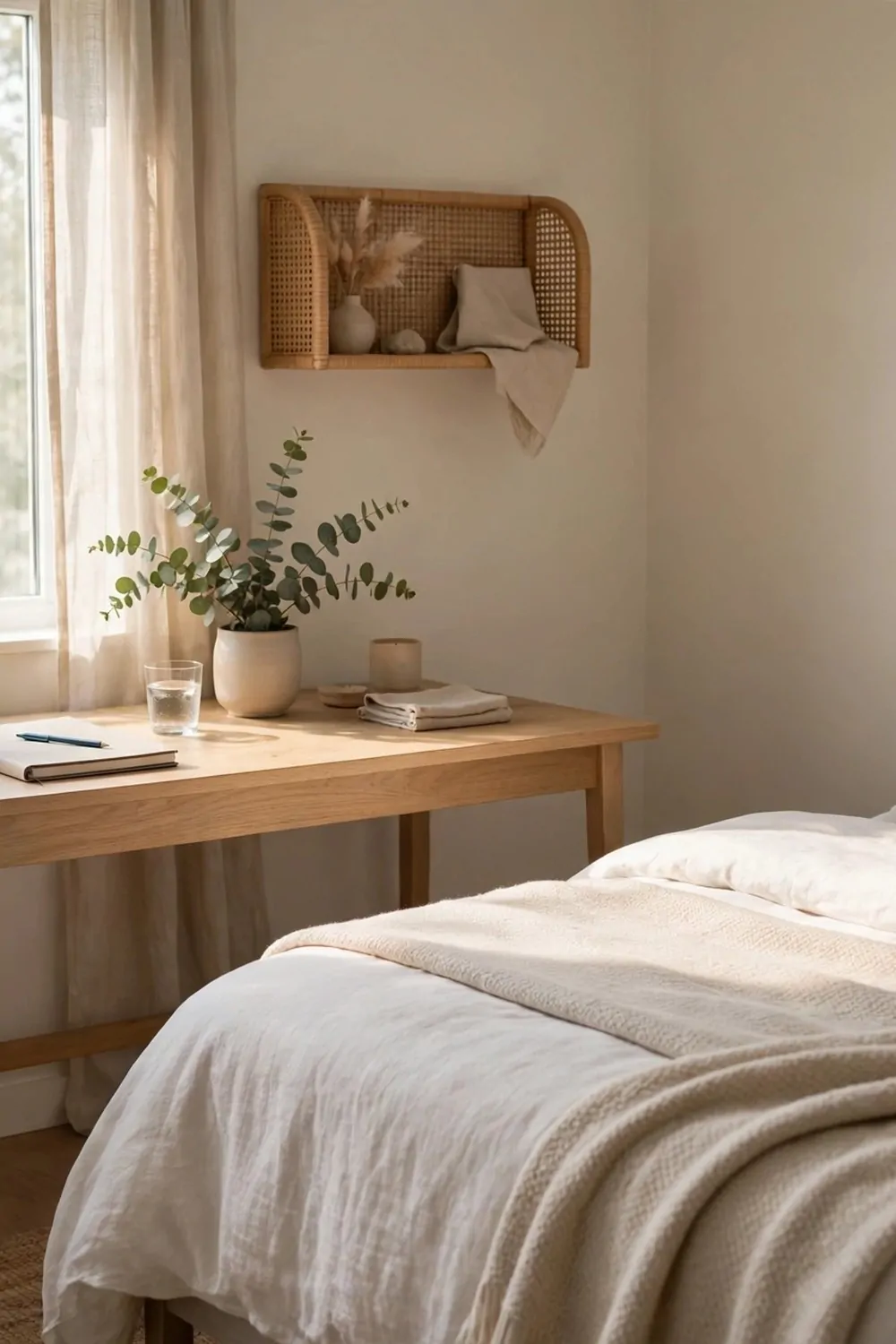
Sunday is the day the divide gets fixed. One hour, once a week, and the two zones stay separate.
My Sunday hour starts with a walk around the room. I look at the tape line on the floor. I look at the screen, the shelf, and the cupboard doors. Has work crept onto the sleep side? Has sleep crept onto the work side? I put everything back where it belongs.
Clear the desk top first. Papers back in the cupboard. Pens back in the jar. Mug washed and back on its spot. A clear desk on Sunday night is a clear desk on Monday morning.
Clear the bedside table next. Work things off it, sleep things back on it. A book, a glass of water, and nothing else. A bedside table with work papers on it is a bedside table that never lets you rest.
Check the pinboard. Take down last week’s list. Pin up the new one. The board should show this week, not last week. A board that shows last week is a board that lies to you.
Wipe the two lamps and check the bulbs. A dusty work lamp throws half the light of a clean one. A sleep lamp with a dead bulb is a dark bedroom. Two minutes, and both lamps are ready for the week.
End the hour by flipping the door sign to free and hanging the work shirt on its hook. The room is a bedroom again for Sunday evening. Work starts on Monday, not before.
Write next week’s three jobs on the notepad while the room is still tidy. Three lines, no more, and the week starts with a plan instead of a scramble.
The No-Email-After-Dinner Rule
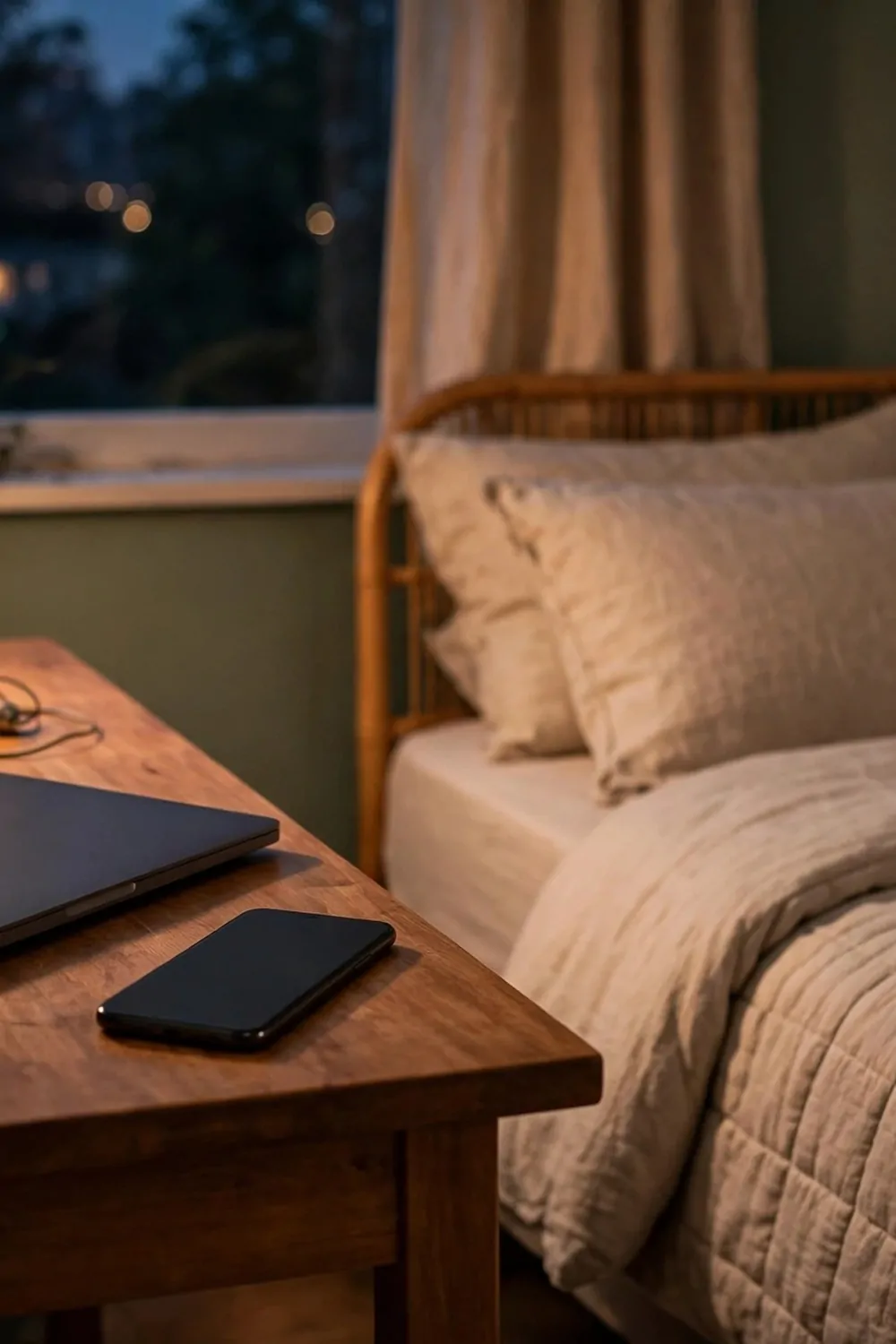
Email after dinner is work after dinner. The rule in my house is simple. No email after dinner, ever.
My laptop closes at six and it does not open again until morning. My phone stays face down after dinner. The email app stays shut. Dinner is dinner, and the evening belongs to the bedroom, not the office.
Set the rule as a time, not a feeling. Six o’clock is a time. When I feel like checking is a feeling, and feelings change every night. A time never changes, and that is why it works.
Tell the people who email you about the rule. Most people never notice. The ones who do notice respect it. A short line in your email signature works well. I answer emails between nine and six.
Keep the laptop in the cupboard after dinner, not on the desk. A laptop on the desk at eight in the evening is a laptop that gets opened. A laptop behind closed doors stays closed.
If an urgent email truly cannot wait, write the reply on paper and send it in the morning. A reply written on paper is a reply that waits for office hours. A reply typed at ten at night is a workday that never ended.
Put the phone on charge in the kitchen after dinner, not in the bedroom. A phone charging in the kitchen cannot buzz you awake at midnight. A phone charging beside the bed can, and it will.
Break the rule once and the rule breaks. That sounds harsh, and it is true anyway. One email after dinner turns into two, and two turn into a habit. Keep the line firm and the evenings stay yours.
The Goodnight Walk Around the Room
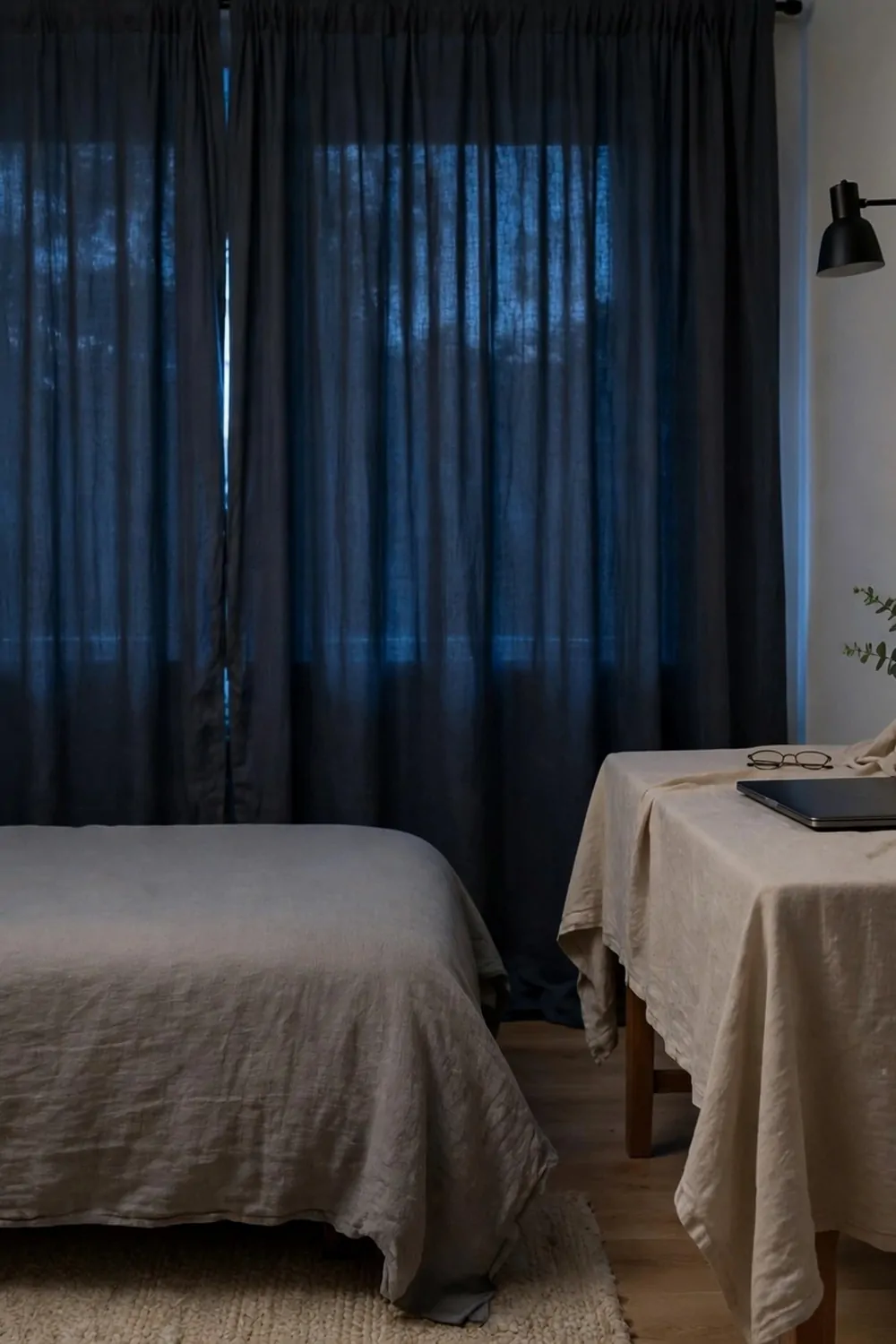
Every night I take a walk around my room before bed. It takes two minutes, and it closes the day properly.
The walk starts at the desk. Laptop shut. Lamp off. Cloth over the desk if it is a cloth night. Notebook on the shelf. Mug washed and back on its spot. The desk is done.
The walk moves to the cupboard. Doors shut. Drawer locked. Key on its hook. The work is inside, and I am outside. The click of the lock is the sound of the day ending.
The walk ends at the bed. Curtains drawn. Sleep lamp on. Phone face down on the bedside table. Work shirt on its hook by the door. The room is a bedroom again, and it feels like one.
Do the walk in the same order every night. Desk, cupboard, bed. Same order, same moves, and the walk becomes automatic. After two weeks you will do it without thinking, and your brain will start to relax halfway through.
Keep the walk short. Two minutes is enough. A long walk is a walk you will skip, and a skipped walk is a day that never quite ends. Short and daily beats long and rare, every single time.
Say goodnight to the room in your head if it helps. It sounds silly, and it works anyway. A quiet goodnight tells your brain the work is finished. Without it, the work follows you into your sleep.
Start tonight. Two minutes, every evening, and tomorrow morning your room will feel like two rooms in one again.
Keep Reading
If you liked these Office Area in Bedroom ideas, these real-study, designer-made and spare-inch bedroom office ideas will give you even more ways to make one small room do two jobs well.
- 16 2nd Bedroom Office Ideas That Feel Like a Real Study
- 17 Small Second Bedroom Office Ideas That Look Designer-Made
- 20 Extra Bedroom Office Ideas to Use Every Spare Inch
A bedroom does not need a second room to hold an office. It needs a clear line between work and sleep. A tape line on the floor. A screen that folds away. Two lamps, two alarms, and a walk around the room at night. Pick your favourite three ideas from this list, try them this week, and let your smallest room surprise you.