18 Closet Turned Office Makeovers That Look Unbelievable

The best sound in my workday is the soft click of my closet door sliding shut at five o’clock.
That little click means work is done. The laptop is closed. The papers are put away. And the room goes back to being a bedroom, like the office was never there at all.
A closet office is the smallest office that still feels like a real office. It has walls that hold you in a good way. It has a door that shuts. And it takes up no floor space your house was actually using, because the closet was already there, holding stuff you forgot you owned.
These 18 Closet Turned Office makeovers all start the same way. A closet that looks like nothing much. And they all end the same way too. A tidy little workspace that makes people say, wait, that used to be a closet?
Pick the one that fits your closet and start there. Most of them need one weekend, a few simple tools, and a brave afternoon of clearing things out.
The Empty-It-First Makeover
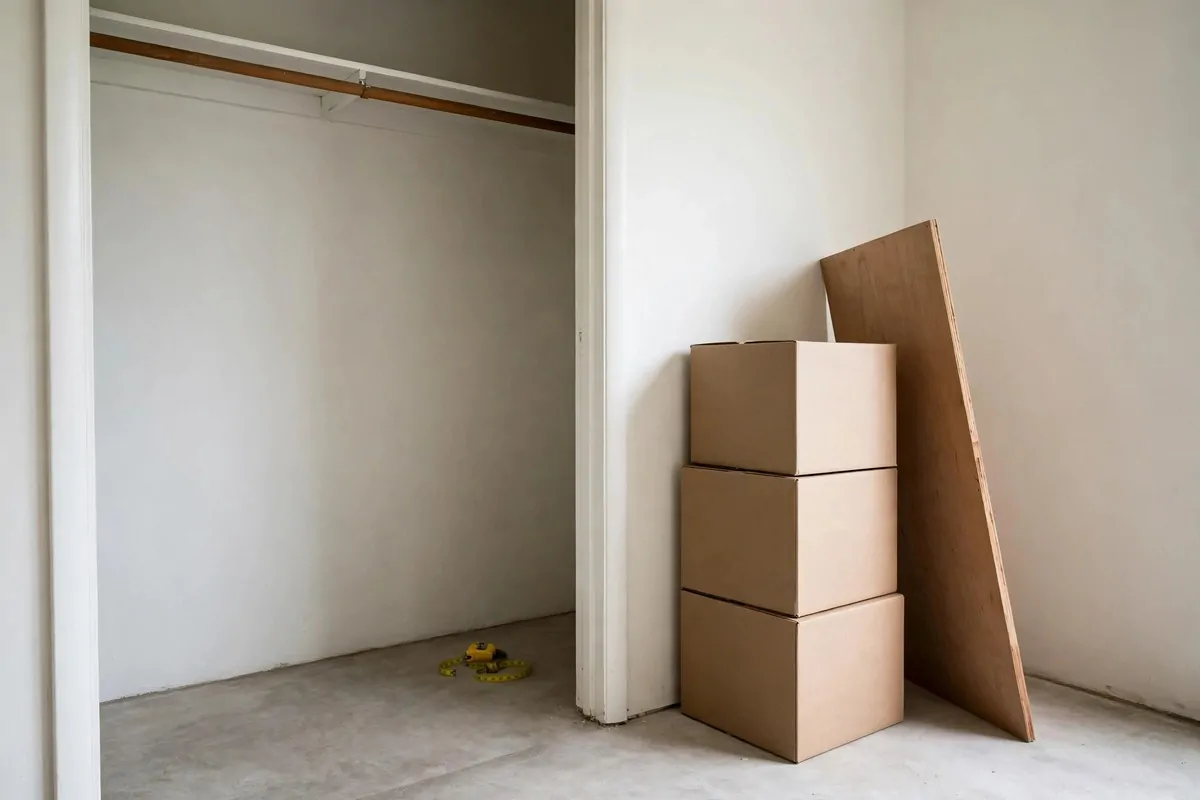
Every good closet makeover starts with an empty closet. Not a half empty closet. A fully empty one, with nothing left inside but walls and a light.
Take everything out. Every shirt, every box, every bag you forgot about. Pile it on the bed. Yes, the bed will look like a small mountain for a while. That is fine. You need to see the space with nothing in it before you can plan it right.
Now look at what you took out. Sort it into three piles. Keep, give away, and throw away. Be honest with yourself here. If you have not worn it in a year, you do not need it living in your new office.
Measure the empty closet next. Width, depth, and height. Write the numbers on a piece of paper and tape it to the wall. A reach-in closet is often about four feet wide and two feet deep, but yours might be different, and guessing is how desks end up too wide.
Here is a table for the numbers that matter most.
| What to measure | Why it matters | Good size to aim for |
|---|---|---|
| Width | Sets your desk length | At least 3 feet |
| Depth | Sets your knee room | At least 20 inches |
| Height to first shelf | Sets your leg and screen space | About 29 inches for the desk |
| Door opening | Sets what fits through | Measure before you buy a chair |
Clean the empty closet while it is bare. Wipe the shelves. Sweep the floor. Dust is sneaky in closets, and it sticks to everything once the desk goes in.
Check the light too. Most closets have one sad little bulb or no light at all. If the bulb is dead, change it now, before the desk blocks your reach.
This step feels slow, and it is tempting to skip it. Do not skip it. Every closet office that looks unbelievable started with this boring, empty, clean box. The makeover is easy after this. The emptying is the hard part, and you just did it.
The Paint-It-Bright Makeover
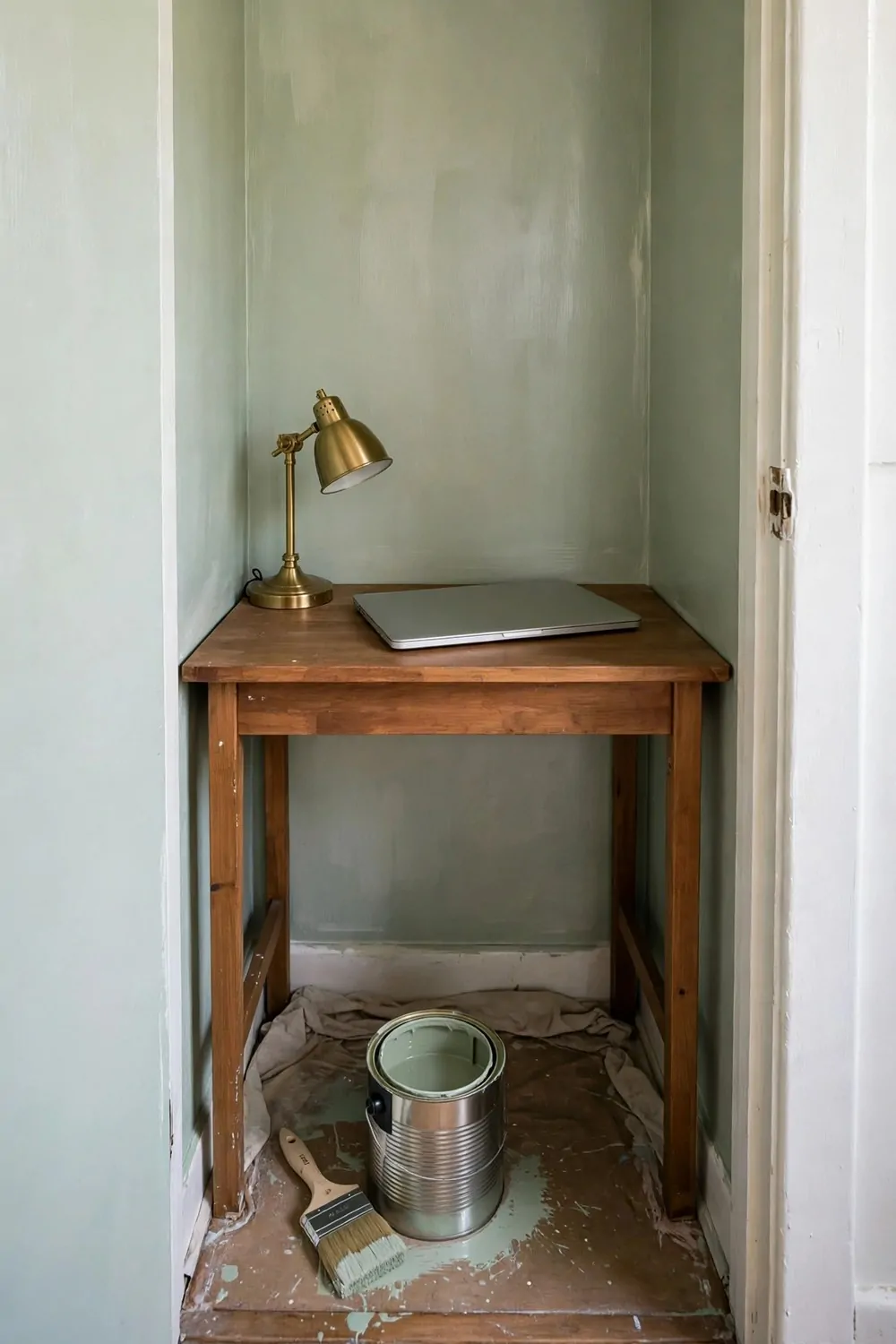
Paint is the cheapest makeover on this whole list. One tin, one brush, one afternoon, and your closet looks like a different room.
Closets are dark by nature. They sit in a corner with no window, and the walls are often a dull white that has gone a little grey over the years. Fresh paint fixes that in one coat or two.
Pick a light colour. Pale sage, soft cream, light blue, or a warm white. Light colours bounce what little light you have around the small space, and the closet feels bigger the second the paint dries.
Paint the back wall first, then the side walls, then the shelves. Use a small roller for the flat parts and a brush for the corners. A closet is small, so you can be neat about it without it taking all day.
Let the first coat dry fully before you judge it. Wet paint always looks darker than dry paint. If it still looks patchy after it dries, do a second coat. Two thin coats beat one thick coat every time.
The ceiling of the closet matters too. A white ceiling lifts the whole nook. If the ceiling looks yellow or stained, paint it white while you are at it. It takes ten extra minutes.
Wait a full day before you put the desk in. Paint needs time to harden, and a desk leg dragged across soft paint leaves a mark you will stare at forever.
This is the makeover for people who want a big change with a small budget. The room is the same size. The closet is the same closet. But the light feels different, and you will smile every time you slide the door open.
The Desk-Board Makeover
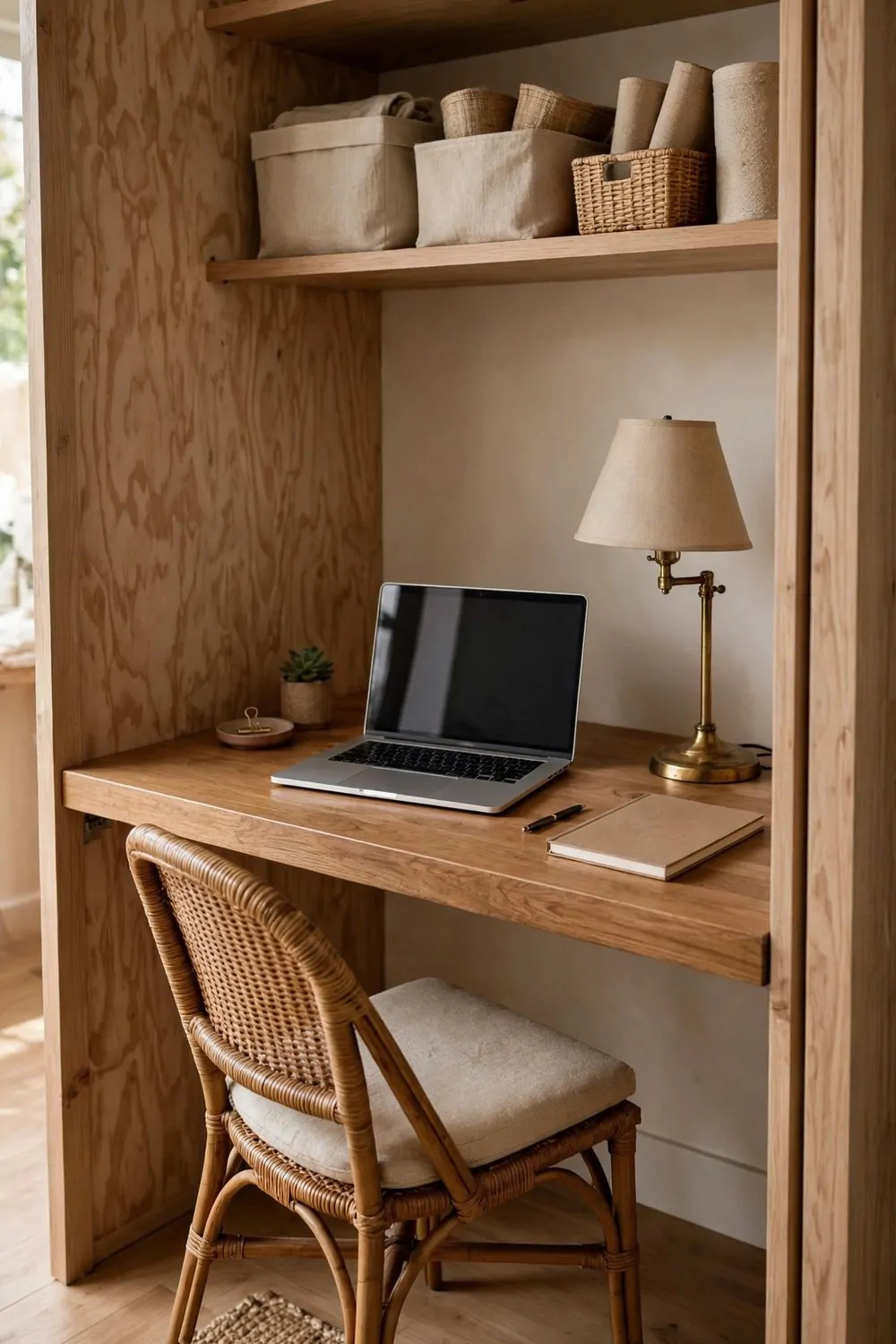
A desk board is just a flat board cut to fit your closet wall to wall. It sounds too simple to count as a makeover. Then you see it, and you get it.
Measure the width of your closet, then take that number to the hardware shop. Ask them to cut a board to fit, with a little gap on each side for the brackets. Pine is cheap and light. A thicker board feels more solid under your arms.
Mount the board at sitting height, about 29 inches from the floor. That is normal desk height, and it works for most chairs. Fix it to the side walls with strong brackets so it does not wobble when you type.
The board should be about 20 inches deep. That holds a laptop and a notebook without crowding you. Deeper boards bump your knees in a shallow closet, and you will feel it all day.
Sand the edges smooth before you mount it. A rough edge catches your sleeves and scratches your arms, and you will notice it every single day. Ten minutes with sandpaper fixes it for good.
Paint or stain the board to match the closet walls. One colour across the whole nook makes the desk look built in, like the room was made that way from the start.
Add a small shelf above the board for books and a pen pot. Keep the shelf shallow so nothing falls on your head when you reach for a shirt. Or a notebook, since there are no shirts in here anymore.
This is the heart of almost every closet office. A board, two brackets, and a chair. Everything else on this list is decoration on top of this one good idea.
The Doors-Off Makeover
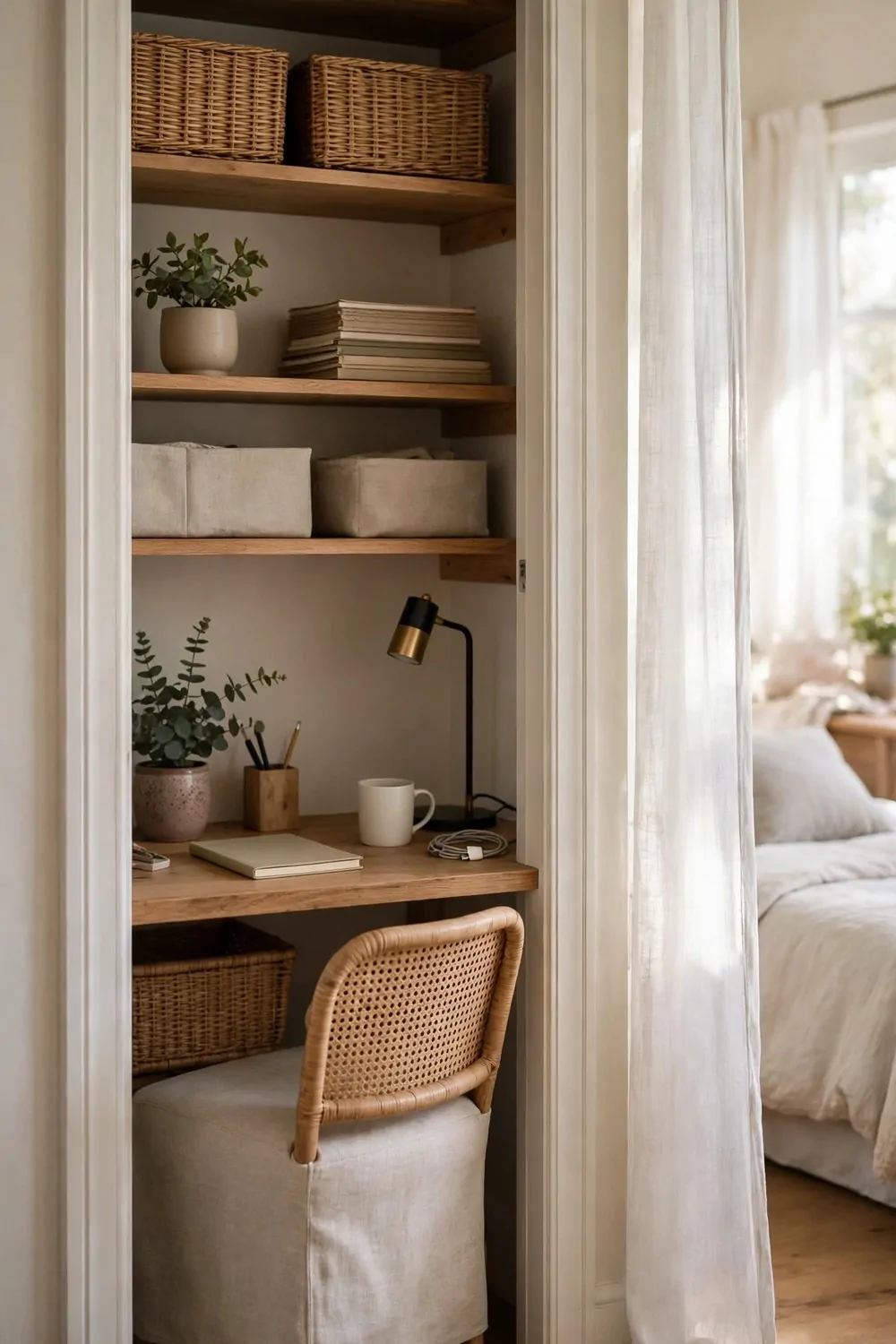
Closet doors make a small office feel like a cupboard. Take them off, and the same space feels like a room.
Most closet doors lift off their track with a little wiggle. Sliding doors lift up and out. Bifold doors fold up and pop off their pivots. Try it gently first. If a door sticks, check for a small screw at the top pivot before you force anything.
Take the track off too. The overhead track leaves a dark line across the top of the opening, and it catches the eye. A few screws, a little filler, and the opening looks clean.
Store the doors somewhere safe, like the garage or under a bed. You might want them back one day, and doors are a pain to replace. Wrap them in an old sheet so they do not get scratched.
Patch the little holes the track screws leave behind. A dab of filler, a quick sand when it dries, and a touch of paint. The top of the opening looks clean, and nobody can tell a track was ever there.
If your doors are heavy, ask someone to help you lift them off. A sliding door is awkward to hold on your own, and a dropped door chips the floor and hurts your toes. Two people, two minutes, no drama.
Now the closet is open to the room. Light from the bedroom window reaches the desk. Air moves through. You can sit at your desk without feeling boxed in, and the whole room feels bigger.
The open front also means you have to keep it tidy. An open closet office with papers everywhere looks messy from the bed. A closed door hides mess. An open front shows it. That is the trade, and most people find the open feel is worth the extra tidying.
If you miss the doors later, hang a curtain instead. That is the next makeover on this list, and it gives you the best of both.
The Curtain-Swap Makeover
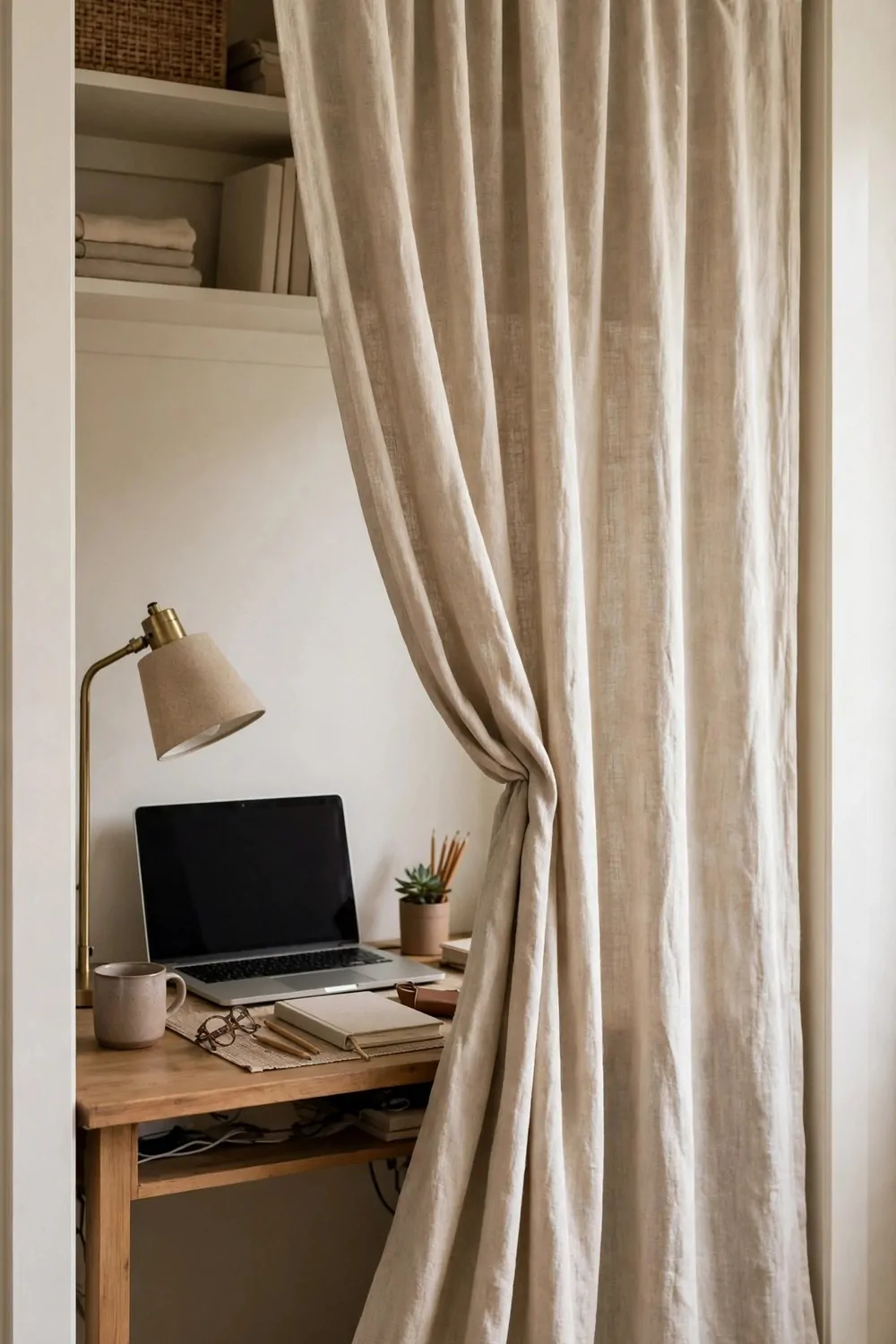
A curtain is the cheapest wall you will ever buy. Hang one where the doors used to be, and your closet office gets a soft front that opens and closes in one pull.
Pick a curtain that matches your room. Linen looks calm and soft. Plain cotton in a pale colour lets a little light through. Heavy dark curtains make a small room feel smaller, so save those for big rooms.
Hang the rail from the ceiling if you can, not the wall. A ceiling rail lets the curtain fall straight to the floor, and the split looks clean. A wall rail leaves a gap at the top, and the trick falls apart a little.
Make the curtain a little wider than the opening. A curtain that just fits pulls tight and looks stressed. A curtain with a little extra fabric falls in soft folds and looks like it belongs there.
Pull the curtain closed when you work, and the room feels like a small office. Pull it open when you are done, and the room feels big again. You control the size of the room with one pull.
The curtain also hides mess in a kind way. A desk with papers on it never looks messy behind linen. It looks like a soft wall. Your eyes rest, and your brain stops counting the notebooks.
Wash the curtain now and then. Curtains near a desk collect dust. A quick wash every month or two keeps it fresh, and it takes less time than you think.
This is the makeover for renters too. A ceiling rail comes down when you move out, and the holes are tiny. Your deposit stays safe, and your office still looks finished.
The Wallpaper-Accent Makeover
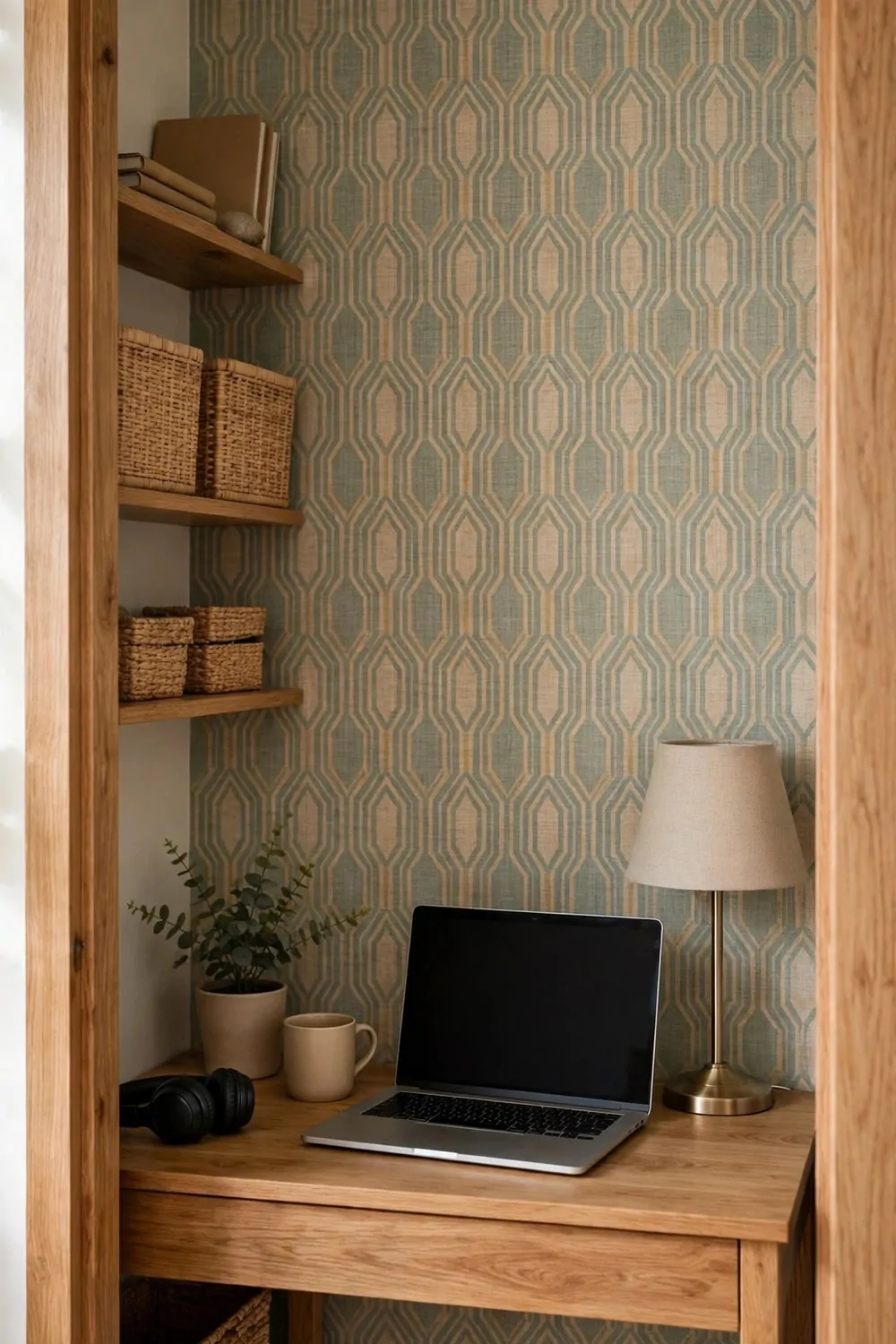
One wall of wallpaper can make a plain closet office look like a designer did it. Just one wall. That is the whole trick.
Pick the back wall of the closet, the one right behind your desk. That is the wall you stare at all day, and it is the wall people see when they look into your office. A little pattern there goes a long way.
Choose a pattern you love but would never put on a whole room. Bold stripes. Small flowers. A soft geometric print. In a tiny closet, a big pattern feels brave. A small pattern feels calm. Either one works if you love looking at it.
Peel and stick wallpaper is your friend here. It goes up without paste, and it comes down without ruining the wall. That matters in a closet you might change again next year.
Measure the wall and cut the paper a little long. Trim the extra at the top and bottom with a sharp knife after it is stuck. A straight edge and a slow hand give you a clean line.
Smooth out bubbles as you go. A flat cloth or a plastic card pushed from the middle outwards works well. Bubbles left under the paper show up in the light, and you will see them every time you sit down.
Keep the other walls plain. One patterned wall is a feature. Four patterned walls in a closet is a headache. The plain walls let the pattern shine.
This makeover costs a little more than paint, but it gives you the biggest wow for the money. People open the closet, see the pattern, and say the same thing every time. I cannot believe this used to be a closet.
The Shelf-Wall Makeover
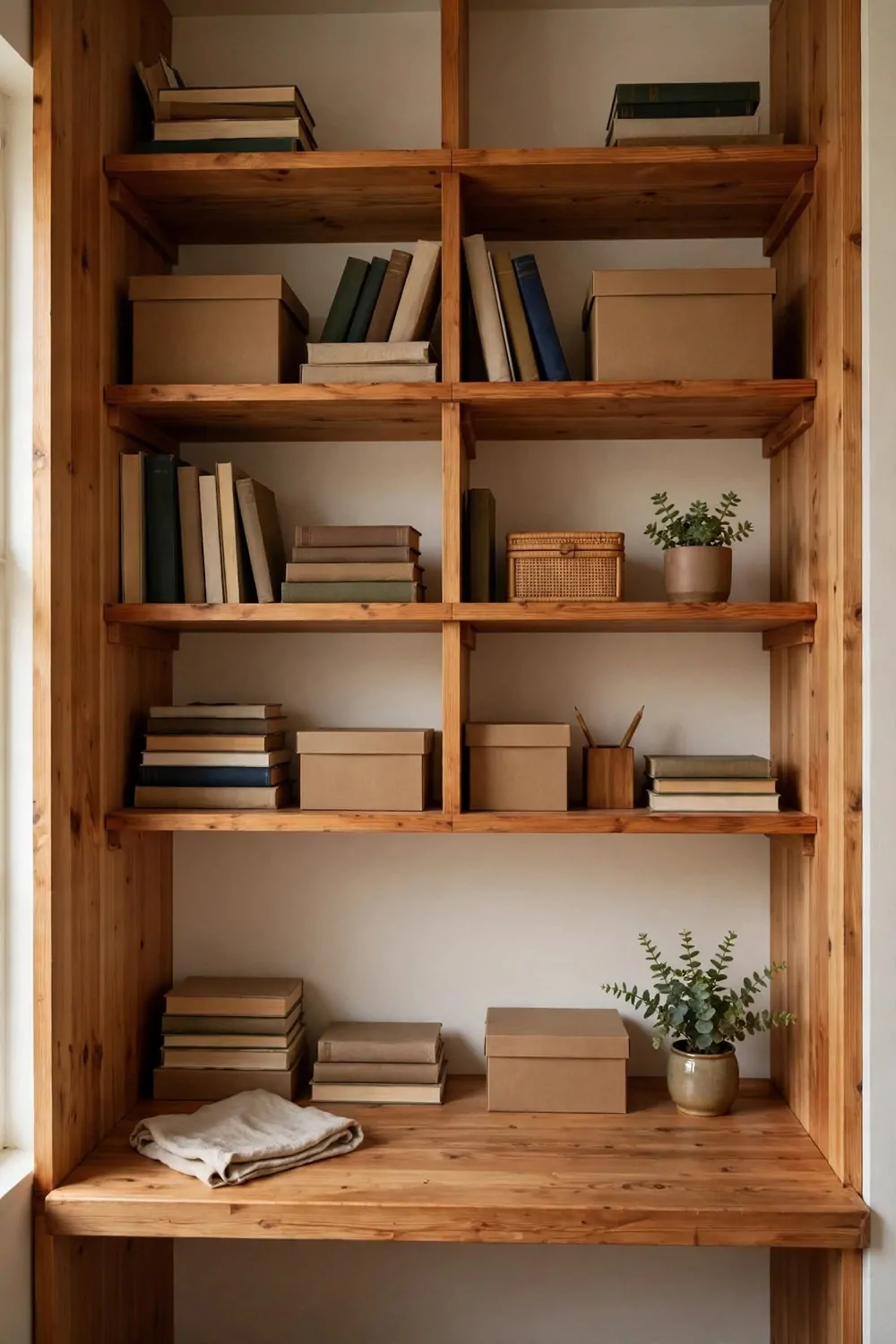
A closet office has almost no floor space. So the walls have to do the work. Shelves turn dead wall space into storage, and storage is what keeps a tiny office tidy.
Start with two shelves above the desk. The lower shelf holds notebooks and a pen pot, right where your hand can reach them. The upper shelf holds boxes for cables and chargers, the stuff you need but do not want to see.
Keep the shelves shallow, about 10 inches deep. Deep shelves in a closet eat your headroom and drop things on your keyboard. Shallow shelves hold plenty and stay out of your way.
Add shelves on the side walls too. The side walls of a closet are wasted space in most homes. A short shelf on each side wall holds books, a small plant, or a basket for supplies.
Use matching boxes across all the shelves. Same colour, same size, different labels. Matching storage makes a mixed shelf wall look planned. Mixed boxes make it look like a jumble sale, even when everything is tidy.
Label the boxes in plain words. “Tax papers” beats “Misc” every single time. You will thank yourself on the day you need something fast.
Leave one shelf a little bit empty if you can. An empty shelf is breathing room. It is also the spot where new things land without wrecking the system. A shelf wall with no spare space falls apart the first time you buy something new.
Dust the shelves once a week. Open shelves collect dust faster than closed cupboards. Keep a small duster in the bottom basket so the job takes two minutes, not twenty.
This makeover is quiet. Nobody gasps at shelves. But a week after you add them, you will wonder how you ever worked without them. Everything has a home, and your desk stays clear.
The Pegboard Makeover
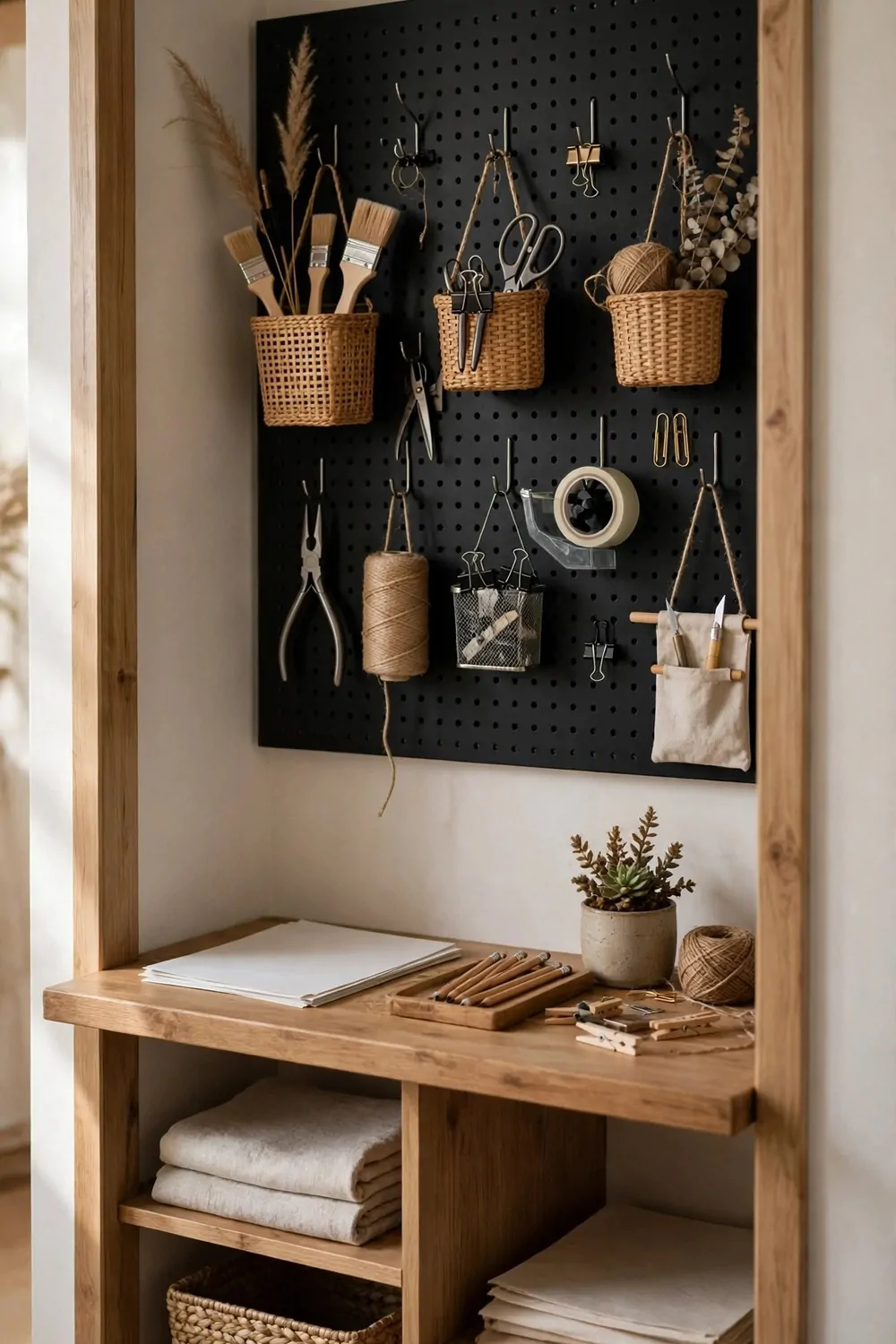
A pegboard is a flat board full of little holes, and it might be the smartest thing you can put on a closet office wall.
Hang it on the wall right above your desk, where your eyes go when you look up from your laptop. Hooks go into the holes. Baskets hang from the hooks. Small shelves clip on. Everything you use every day hangs right there, in plain sight.
Your scissors, your pens, your headphones, your charger cable. They all hang on the board instead of piling up on the desk. The desk stays clear for the laptop and the notebook, which is all a desk really needs.
The best part is that a pegboard changes whenever you do. Move a hook. Shift a basket. Add a shelf for a new project, then take it down when the project is done. Nothing is fixed forever, and you never have to drill a new hole.
Paint the pegboard the same colour as the wall, and it blends in like part of the room. Paint it a bold colour, and it becomes the feature of the whole office. Both look good. Pick the one that makes you smile.
Add small baskets for the fiddly things. Paper clips, sticky notes, spare pens. Little things get lost on a desk. In a basket on a pegboard, they stay put and you can see them.
Keep the bottom of the pegboard clear of heavy things. Heavy baskets pull hooks out over time. Light things up high, heavy things down low on the desk or the floor.
This is the makeover for people who like to see everything they own. If you forget what you own when it hides in a drawer, a pegboard will make you happier. You see it, you use it, and nothing gets lost.
The Light-It-Up Makeover
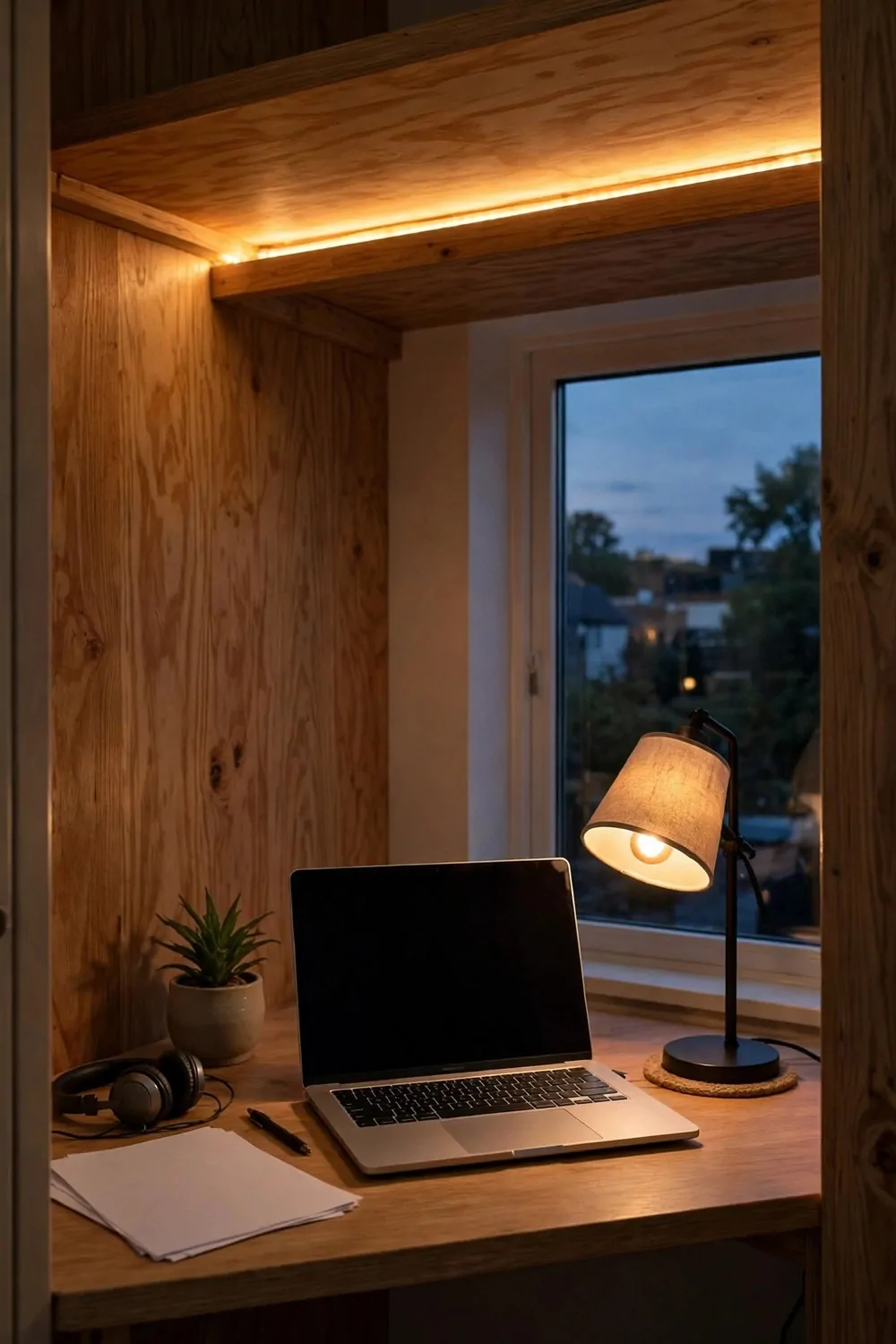
Closets are dark. That is the one real problem with a closet office, and light is the fix. Get the light right and the whole room changes.
Start with a desk lamp. A small lamp with a warm bulb gives you clear light right where your hands are. Angle it so it lights the laptop and the notebook, not your eyes. Warm light feels calm. Cold white light in a small closet feels like a fridge.
Then add an LED strip under the top shelf. A slim strip lights the whole desk evenly, with no shadows. It sticks on with tape, it plugs into a small socket, and it costs less than a takeaway dinner.
Here is a table for the three lights that make a closet office work.
| Light | Where it goes | Job |
|---|---|---|
| Desk lamp | On the desk | Warm light for your work |
| LED strip | Under the top shelf | Even light, no shadows |
| Ceiling bulb | Top of the closet | General light for the whole nook |
If your closet has a ceiling bulb, change it to a bright warm bulb. Old bulbs go yellow and dim over time, and you stop noticing. A new bulb is the cheapest upgrade in the whole room.
Do not light the room from the ceiling alone. A single ceiling light throws shadows over the desk and into the corners. It is the worst light for a small office, and it is the one most closets start with.
If you can, pick bulbs you can dim. Dim light in the evening feels calm. Full light in the morning feels sharp. One dimmer gives you both, and it costs less than a new lamp.
Test the light at the time you actually work. Morning light needs are different from evening light needs. Sit at the desk at nine in the morning, then again at six in the evening, and adjust until both feel good.
Bad light makes your eyes tired and your head ache. Good light makes a closet feel like a real office. Fix the light first, and everything else in the room starts working better.
The Mirror Makeover
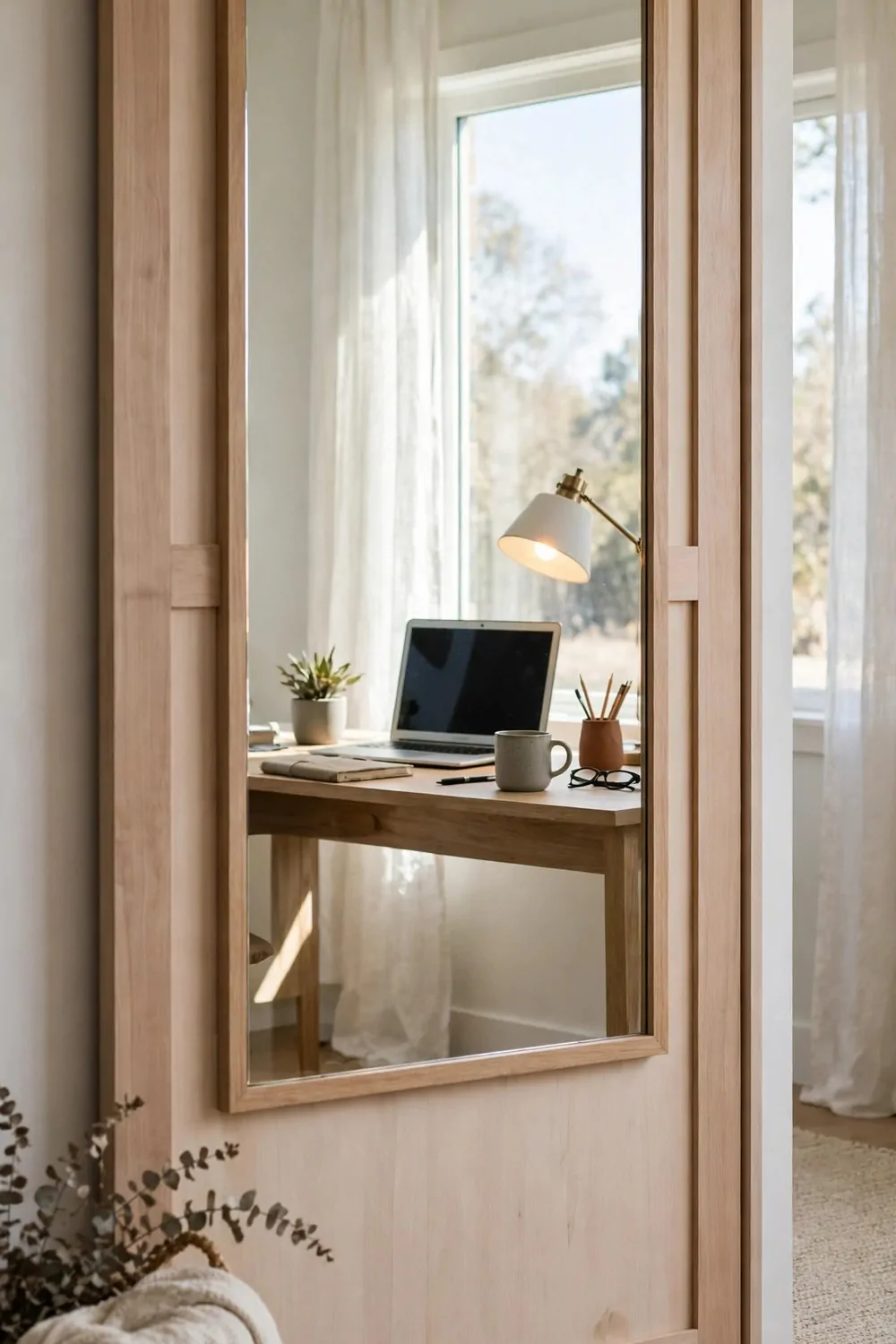
A mirror on a closet door is a small trick with a big payoff. It bounces light around the room, and the whole office feels wider without moving a single wall.
Hang a full-length mirror on the inside of the closet door, or on the wall beside the desk. Your desk lamp looks like two lamps. Your window looks like two windows. The space feels deep instead of boxed in.
Getting dressed gets easier too, if your closet still holds some clothes. A full-length mirror shows your whole outfit before a video call. You check your look, grab your bag, and go. No separate mirror leaning in a corner, taking up floor space.
Place your desk facing the mirror wall or beside it, not with your back to it. When you look up from your laptop, you see the room behind you in the mirror, and the space feels open instead of shut in.
Keep the mirror clean. A smudged mirror makes a room look tired, and it shows every fingerprint. A quick wipe with a cloth once a week keeps it bright. Keep the cloth in the desk drawer so the job takes a minute.
Be careful with what the mirror faces. A mirror facing a messy desk doubles the mess. A mirror facing a tidy desk doubles the calm. Keep the desk clear and the mirror becomes your best friend.
If a full mirror feels like too much, try one tall narrow panel. One slim mirror on the centre of the door gives you the light and the outfit check without turning the whole wall into glass.
Framed mirrors look softer than plain mirror sheets. A slim wood frame around the mirror makes it look like furniture, not like a dance studio. Pick a frame that matches your desk wood.
This is the cheapest way to make a small closet office feel big. Mirrors cost less than a remodel and they work the same day you hang them. Try it if your room feels tight, even when it is tidy.
The Fold-Down Desk Makeover
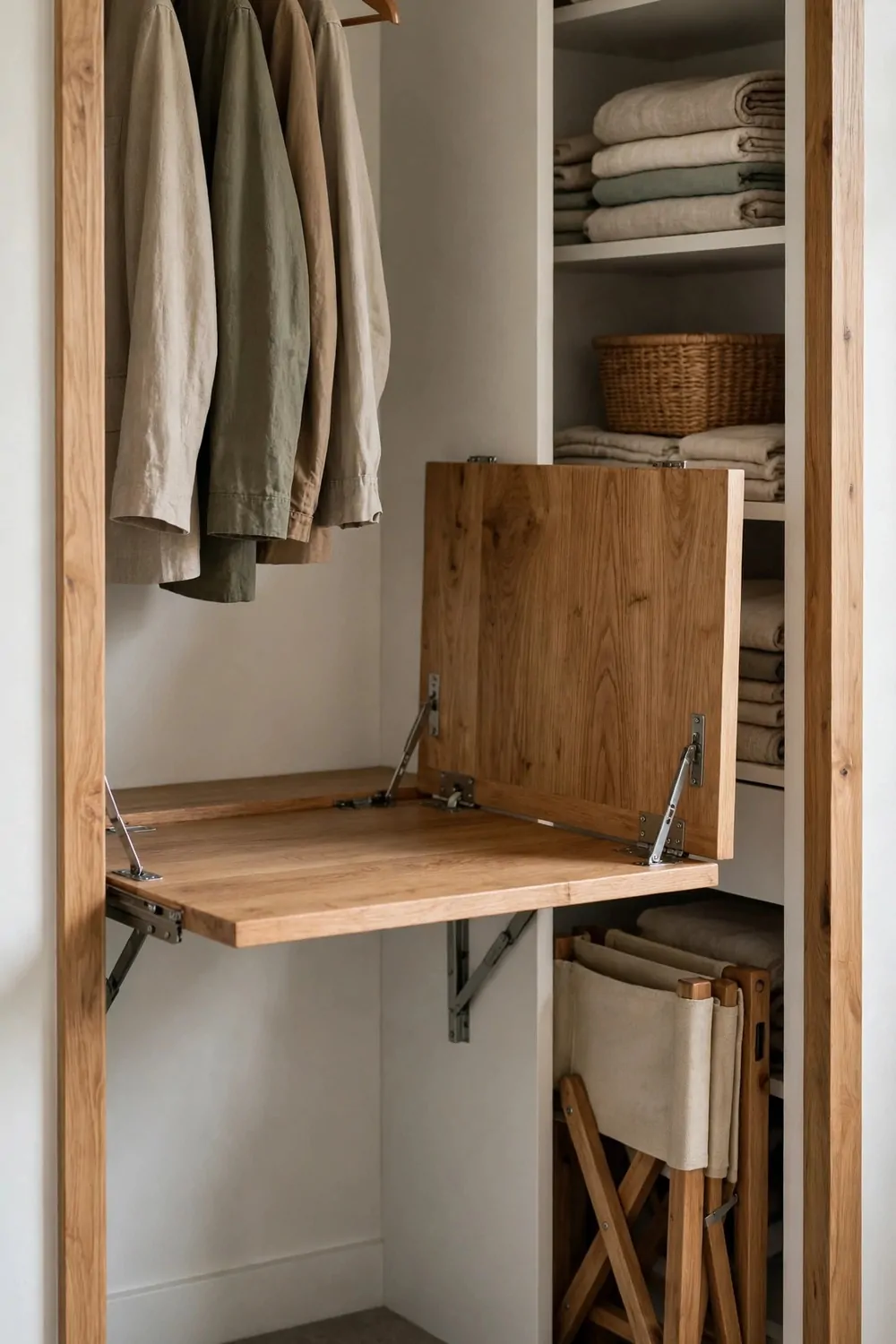
A fold-down desk is a desk that knows how to disappear. Open it and you have a full work surface. Fold it up and the closet looks like a closet again.
This is the setup for people who work from home some days and not others. You do not need a desk sitting empty all week. You need a desk that shows up when you need it and hides when you do not.
Mount the desk board on the back wall of the closet at sitting height. Hinges hold it flat against the wall when it is up. Little folding brackets underneath hold it steady when it is down.
Check the depth before you buy anything. A board about 20 inches deep holds a laptop and a notebook without crowding you. Deeper boards bump your knees in a shallow closet, and you will feel it every time you sit down.
Shelves above the desk hold the rest of your office. One shelf for books, one shelf for a basket of cables and chargers. When the desk folds up, the shelves stay put and the closet still looks neat.
A stool that folds flat is the right chair here. It tucks into the closet beside the desk when you are done. A big office chair will not fit, and it will fight you every time you fold the desk away.
One tip from my own mistake. Do not screw the hinges into drywall with no support. Find the studs in the wall or use proper wall plugs. A desk full of laptop that pulls out of the wall is a bad day.
The best moment with this desk is the fold-up. You finish your work, fold the board, and the closet goes back to being a closet. It takes ten seconds and it feels like tidying your whole brain.
This setup is perfect for renters too. Two small hinge plates leave tiny holes, and a dab of filler fixes them when you move out. No big build, no big mess.
The Walk-In Wonder Makeover
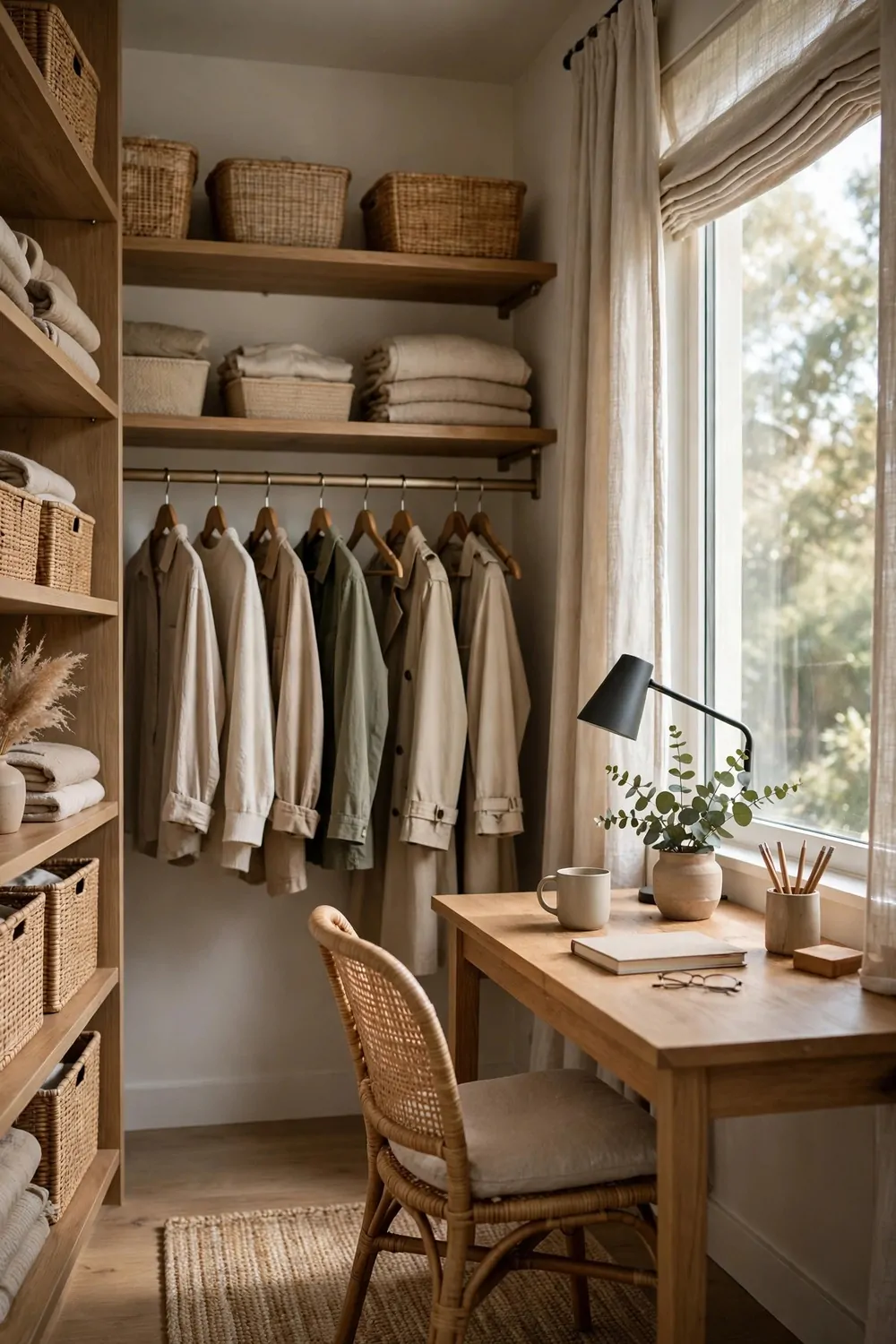
A walk-in closet is a gift. It is already a small room. Turning it into an office takes less work than you think, and the result looks like a real room, not a nook.
Start by clearing one wall for the desk. A walk-in has room for a proper desk, not just a board. Put it against the wall with the best light. If there is a window, the desk goes under it. Morning light on a desk is worth more than any lamp.
Use the other walls for clothes and storage. Hanging space on one side, shelves and drawers on the other. Everything you wear lives within arm’s reach, but behind you, so you never see it while you work.
Keep the middle of the room clear. A walk-in office needs floor space to breathe. A chair that rolls, a small rug, and nothing else on the floor. The moment the floor fills up, the room stops feeling like an office.
Add a small reading chair in the corner if the room is big enough. It gives you a spot to think, take a call, or read a paper copy without sitting at the desk. Two seats make the room feel like a real office, not a cupboard with a laptop.
Light matters more here than in a reach-in closet, because the room is deeper. Add a floor lamp in the corner and a desk lamp on the desk. Two warm lights beat one bright ceiling light every time.
Paint the whole room one calm colour. A walk-in has more wall to see, so the colour shows more. Pale sage or warm white keeps it calm. A dark colour in a walk-in can feel like a cave, so save the dark paint for the accent wall.
This is the makeover that makes guests say the most unbelievable thing of all. They walk in, look around, and ask where the closet went. Then you point at the rail behind the desk, and they laugh.
The Under-Stairs Makeover
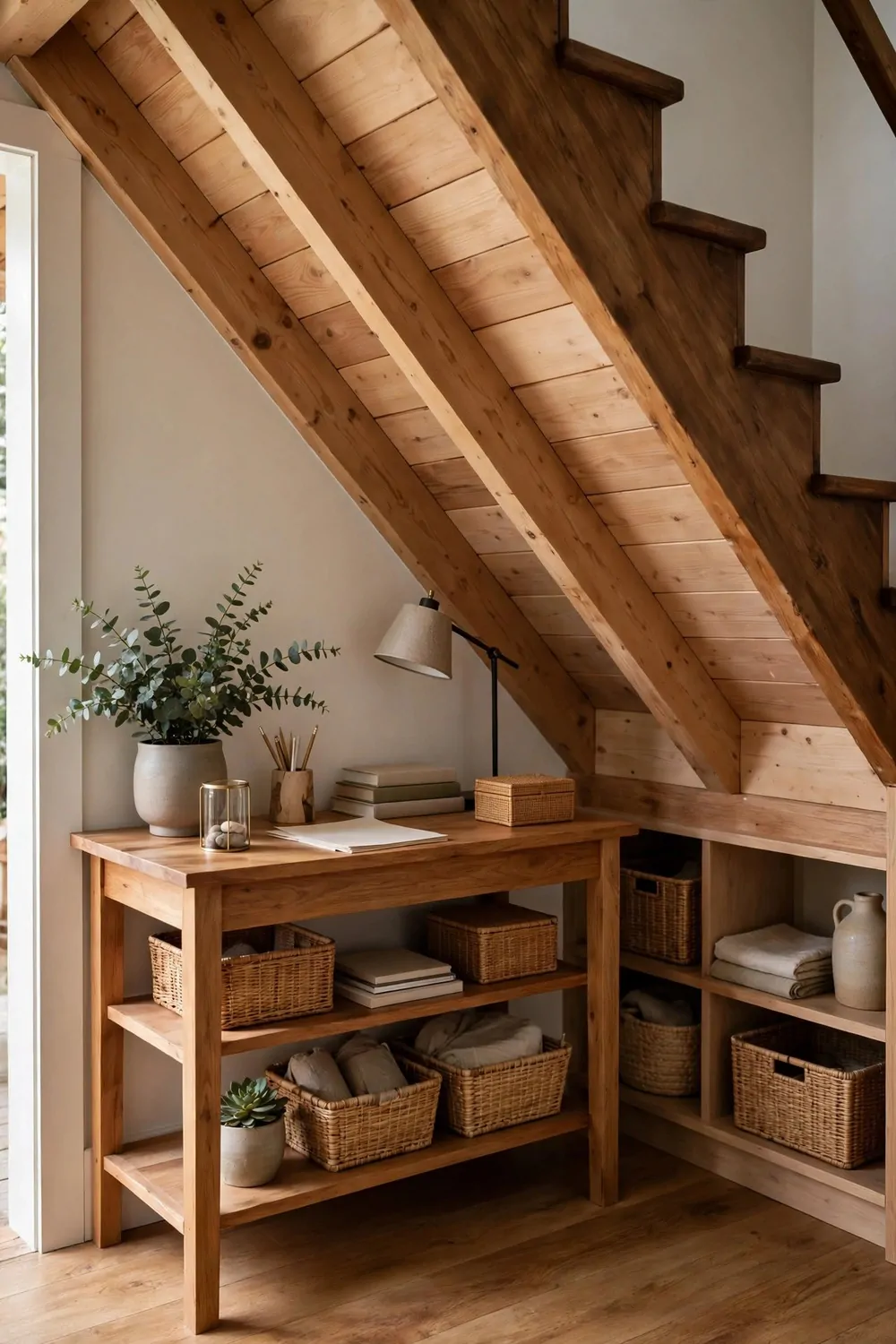
The closet under the stairs is the weirdest space in most houses. Sloped ceiling, odd corners, a door that never quite fits. It is also one of the best office spots you will ever find.
Nobody walks past an under-stairs closet all day. It is quiet. It is out of the way. And the sloped ceiling makes it feel cozy, like a little cabin, instead of cramped.
Measure the tallest part first. You need enough height to sit up straight at a desk. The tall side goes against the desk wall. The short side holds low shelves and baskets, the things you reach for while sitting down.
Fit a desk board along the tall wall. It follows the slope of the stairs, so the board can be longer than a normal closet desk. More desk means more room for a second screen, or a notebook open next to the laptop.
Use the slope. Low shelves under the lowest part of the slope hold books and boxes. A basket on the floor holds cables. Nothing is wasted, and the odd shape becomes the charm of the room.
Light is the one thing you must plan. Under-stairs spaces are dark even in the daytime. A strip of LED lights along the slope lights the whole nook warm and even, and it costs very little.
Add a small rug on the floor. The floor under stairs is often cold bare wood or concrete. A rug warms it up and marks the office as a room, not a storage hole.
The chair matters here more than anywhere else. A chair with no arms slides fully under the desk. When you stand up, the chair disappears and the nook looks tidy from the hallway.
Guests will never guess there is an office under your stairs. I have had friends stand right next to mine and ask where I work. Then I open the little door and they laugh, because the cosiest office in the house was hiding under their feet the whole time.
The Two-Person Makeover
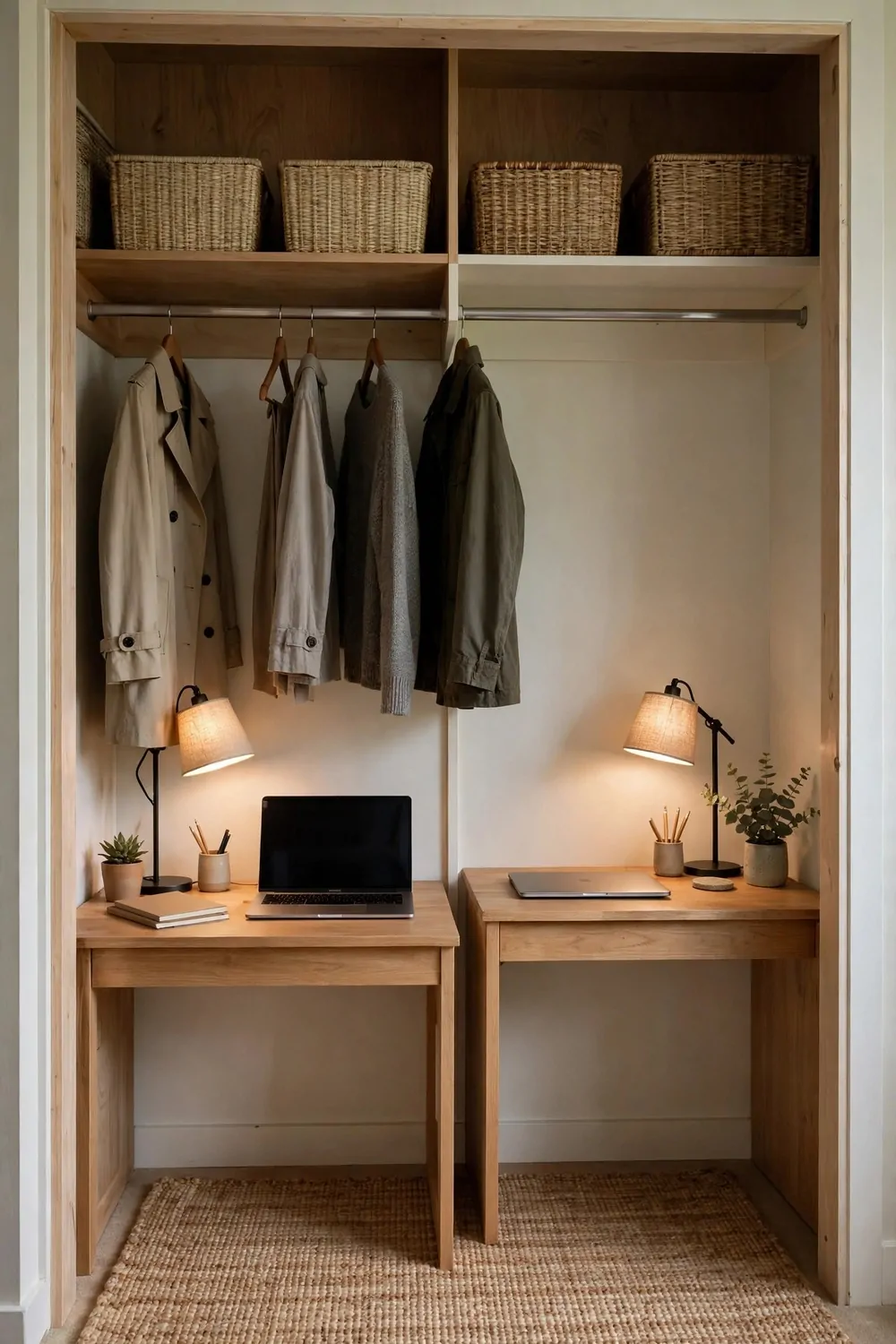
One closet, two desks, two people. It sounds impossible until you see it done well, and then it looks obvious.
This works best in a wide closet or a walk-in. Run one desk along the left wall and one along the right wall, or put one long desk across the whole back wall with a line down the middle. Each person gets a side, and the middle stays shared.
Give each person their own light. One desk lamp each, not one lamp to share. Shared light always ends in a small argument about brightness, and it is easier to just have two lamps.
Give each person their own storage too. A small shelf each, a basket each, a hook each. Shared storage in a shared office turns into a mess fast, because nobody owns the mess.
The rule that makes this work is simple. Your side, your mess, your rules. My side, my mess, my rules. The shared middle stays clear, always. No papers in the middle. No mugs in the middle. The middle is the peace treaty.
Headphones help a lot. One person on a call while the other one types is fine with headphones. Without them, every call interrupts the other person, and the room gets tense by lunch.
A small rug in the middle ties the two sides together. It also stops the chairs from sliding around on a hard floor. Pick a flat rug so the chair wheels roll easily.
This setup is kind to couples and to kids doing homework next to a parent. Two people working side by side, each with their own space, and nobody in anybody’s way. The closet gives you both a little room to breathe.
Try this one if your closet is wider than four feet. That is the magic number. Four feet gives each person about two feet of desk, and two feet is enough for a laptop and a notebook. Any wider, and it only gets better.
The Renter-Friendly Makeover
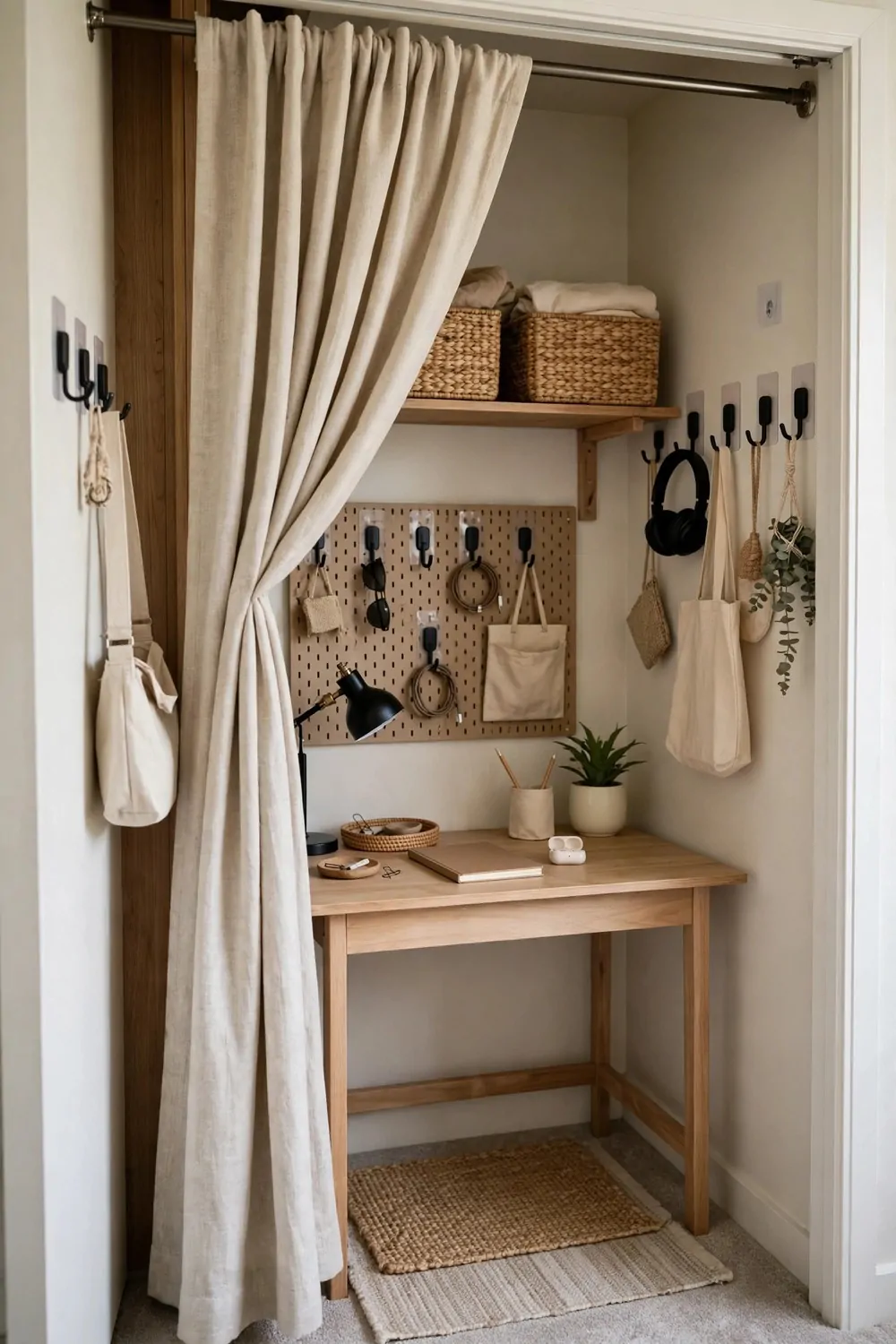
Renters can have a closet office too. You just need a makeover that leaves no trace when you move out. No holes, no paint, no angry letters from the landlord.
Start with a tension rod. It wedges between the closet walls and holds a curtain, with no screws at all. When you move out, the rod comes down and the wall looks like you were never there.
Use removable hooks for everything on the walls. The sticky kind that peel off clean. They hold a surprising amount of weight, and they leave no marks. Hang your calendar, your headphones, and a small basket from them.
Pick a desk that stands on its own. A small folding table or a narrow desk that leans on nothing. No brackets, no screws into the wall. It slides into the closet, and it slides right back out on moving day.
Use a freestanding shelf unit for storage. A small set of shelves that stands on the floor holds books and boxes without touching the walls. It also moves with you to the next home, which is a nice bonus.
Here is a short list of renter-safe swaps that keep your deposit safe.
- Tension rod and curtain instead of removing the doors.
- Removable hooks instead of nails and screws.
- Freestanding desk instead of a wall-mounted board.
- Floor shelf unit instead of wall-mounted shelves.
- Plug-in lamp and LED strip instead of wired lights.
- Peel and stick wallpaper instead of paint.
Keep the original closet fittings safe. If you take a shelf down, store it flat under the bed. Put it back before you hand back the keys, and nobody will ever know it moved.
Take photos of the closet before you start. One photo of each wall. If there is ever a question about a mark on the wall, the photos show how it looked on the day you moved in.
This is the lowest promise makeover on the list. If you hate it, you take it down in one afternoon and the closet is back to normal. But most renters who try it never take it down. They just pack it up and build it again in the next home.
The Power-and-Cable Makeover
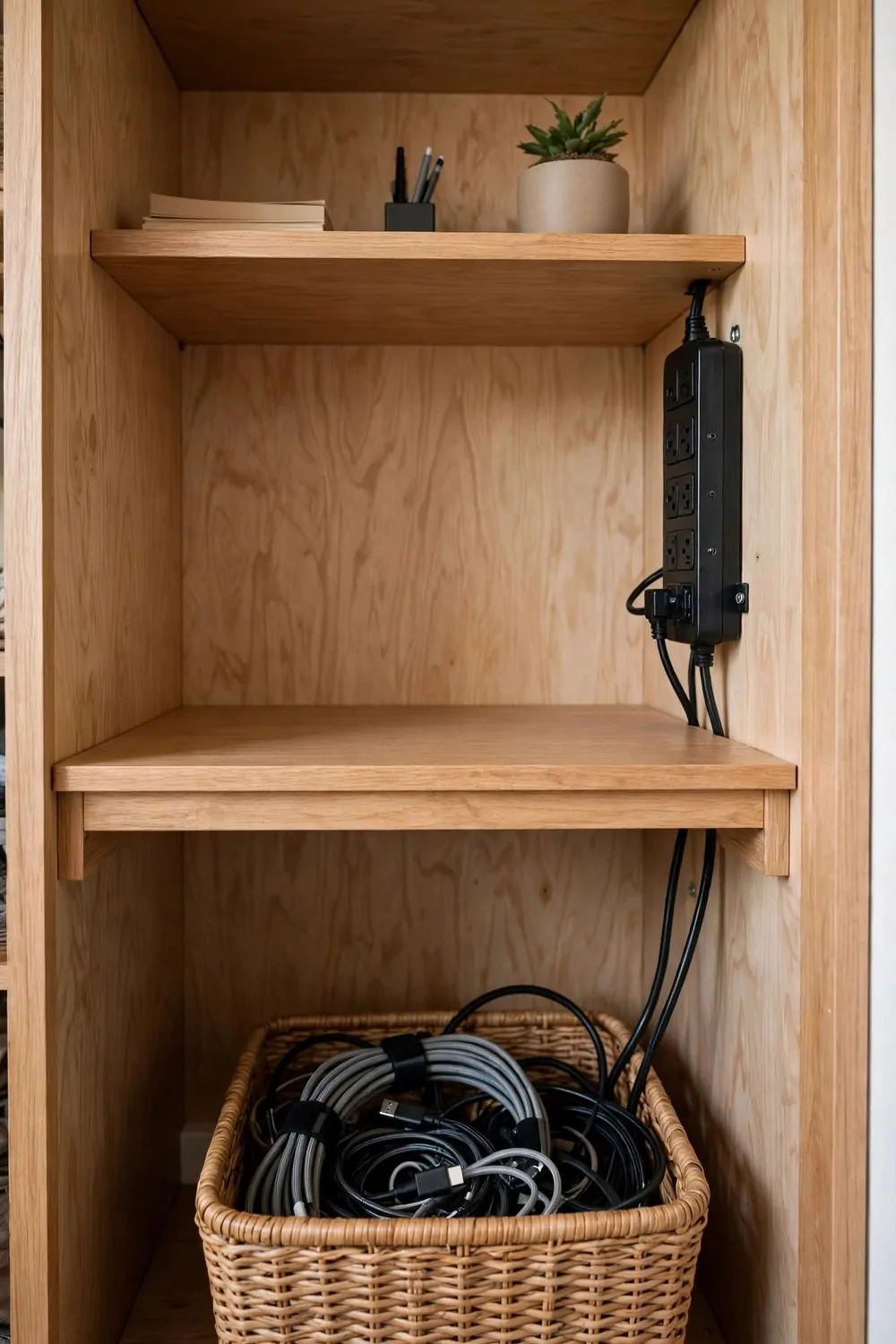
Every closet office has the same secret problem. Power. Closets almost never have enough sockets, and cables end up everywhere.
Start by counting what needs power. Laptop, lamp, phone charger, maybe a small printer. That is three or four plugs, and most closets have one socket if you are lucky.
Run a power strip from the nearest socket outside the closet. Use a flat cable that runs neatly along the floor or the wall, not across the middle where feet catch it. A cable cover strip hides it and stops trips.
Mount the power strip on the wall under the desk, or on the side of the desk leg. A strip on the floor collects dust and gets kicked. A strip on the wall stays clean and easy to reach.
Here is a table for a simple power plan that keeps cables tidy.
| Device | Plug it into | Cable goes |
|---|---|---|
| Laptop charger | Power strip, left side | Down the desk leg |
| Desk lamp | Power strip, middle | Behind the desk |
| Phone charger | Power strip, right side | Into a small basket |
| LED strip | Power strip, spare socket | Along the shelf edge |
Use a basket for spare cables. Every home has a drawer of cables nobody can name. Put the spares in one basket on a shelf, label it, and stop buying new ones every time you lose one.
Tie the cables you use every day into one neat bundle with a reusable tie. One bundle looks tidy. Five loose cables look like a nest, and they catch on everything.
If you want a permanent fix, ask an electrician to add one socket inside the closet. It costs more than a power strip, but it is the one upgrade that makes a closet office feel like a real room. One socket, just above desk height, and the cables all but disappear.
Never overload one socket with adapters stacked on adapters. It is not safe, and it is not worth it. One good power strip with a switch is safer and tidier than a tower of plugs.
This makeover is invisible when it works. Nobody compliments tidy cables. But everyone notices messy ones. Fix the power, hide the cables, and the whole office looks calmer.
The Plant-and-Warmth Makeover
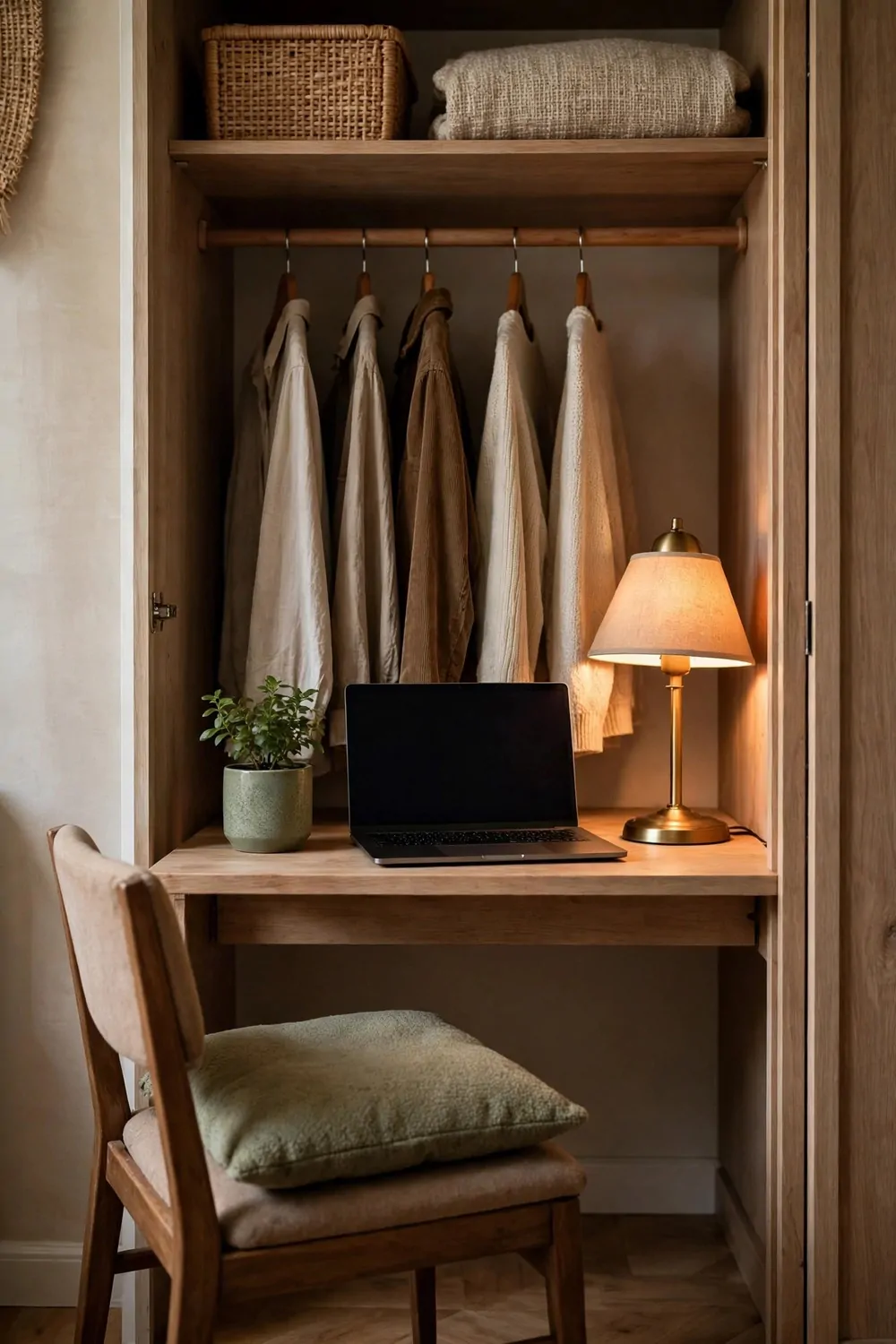
A closet office can feel cold. Small walls, hard desk, bright screen. A plant and a few warm touches fix that in an afternoon.
Pick a plant that likes low light. A pothos or a snake plant does well in a closet with no window. They need little water and they forgive you when you forget them for a week.
Put the plant where you see it when you look up from the laptop. On the corner of the desk, or on the shelf right above. Green in your eye line rests your eyes, and your shoulders drop a little without you noticing.
Add one warm thing you can touch. A soft cushion on the chair. A small rug under your feet. A wooden pen pot instead of a plastic one. Warm textures make a small room feel kind instead of plain.
Hang one picture you love. Not a big gallery wall. One framed print, or one small photo, right where you see it when you sit down. It makes the office yours, not just a desk in a cupboard.
A candle on the shelf helps too, as long as it sits far from papers. Light it at the end of the day while you tidy the desk. The smell tells your brain the day is done, even before you close the laptop.
Keep it simple. One plant, one cushion, one picture. Three warm touches are enough. Ten warm touches in a closet is clutter, and clutter in a small room feels twice as big.
Water the plant on the same day every week. Tie it to something you already do, like your Sunday reset. A dead plant in a closet office is sadder than no plant at all, so pick a tough one and stick to the routine.
This is the makeover that costs the least and changes the feeling the most. The desk is the same. The shelves are the same. But the room feels alive now, and you will want to sit in it longer.
The Shut-It-At-Five Makeover
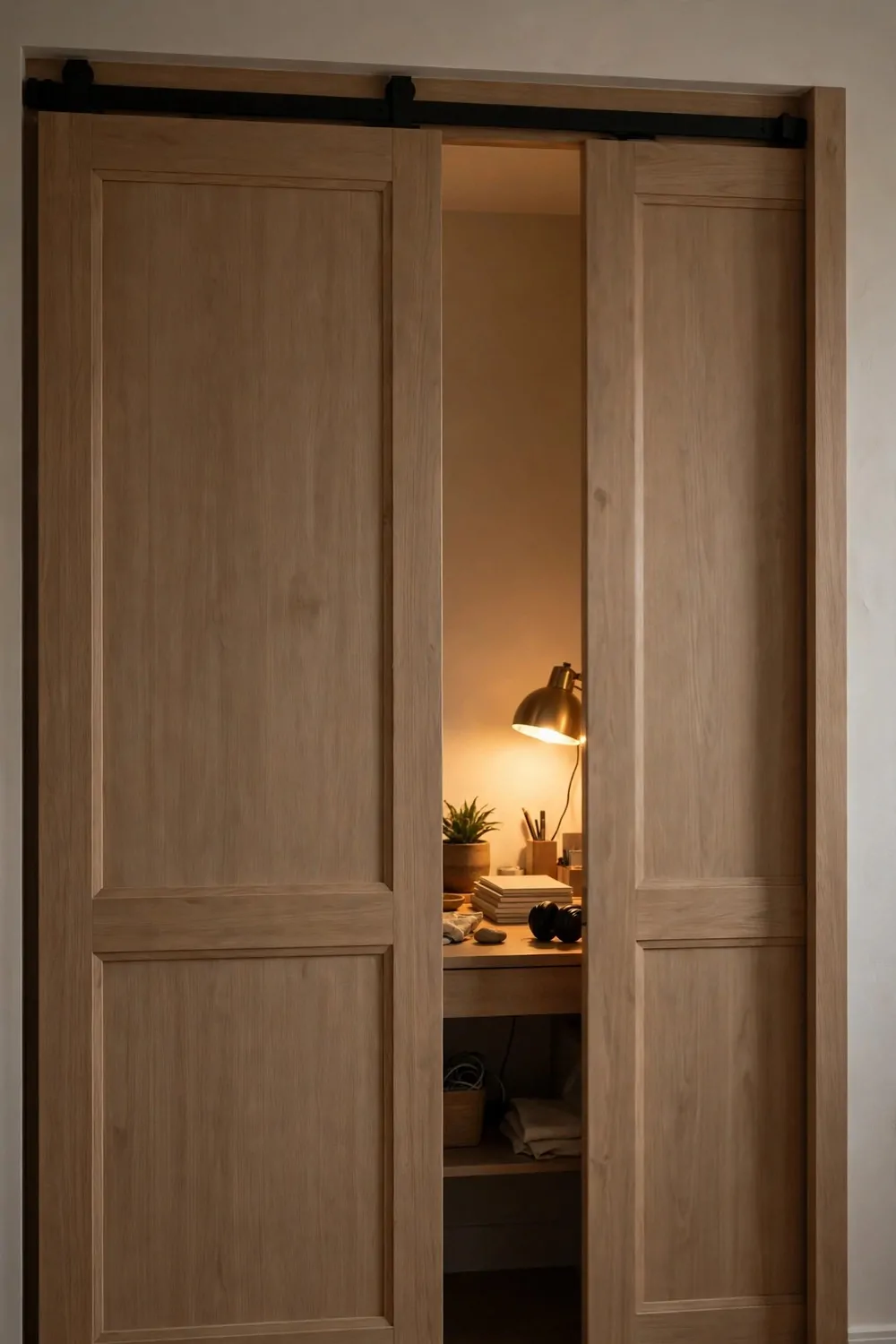
This last makeover is not a layout. It is a habit. And it is the one that keeps the other seventeen working.
A closet office has a superpower no other office has. A door. When you shut that door, work is gone. The room is a bedroom again. The trick is using the door every single day.
Set a finishing time and stick to it. Five o’clock, six o’clock, whatever fits your day. When the time comes, you run the same little routine, and the office closes for the night.
Clear the desk first. Papers into a folder, pens into the pot, mug to the kitchen. The desk ends up with only the laptop, the lamp, and the plant. It takes two minutes.
Close the laptop and slide it into its sleeve. Pull tomorrow’s outfit to the front of the rail if your closet still holds clothes. Straighten the chair and push it in.
Then shut the door. Slide it, fold it, or pull the curtain across. That soft click is the end of the day. Your brain hears it and lets go, the same way it lets go when you leave a real office building.
In the morning, open the door and the office is right there, tidy and ready. You did not have to clean it in the morning, because you cleaned it last night. Mornings start calm instead of messy.
Write the routine on a small card and stick it inside the door. Three lines. Clear the desk. Close the laptop. Shut the door. A habit you can read happens. A habit you hope for does not.
This is the most important makeover on the list, and it costs nothing. Seventeen layouts and one habit. The habit is the one that keeps the other seventeen alive. Start tonight, and see how different tomorrow feels.
Keep Reading
If you liked these closet makeovers, these closet office ideas will give you even more ways to make a small space work hard.
- 17 Tiny Closet Office Ideas for Even the Smallest Spaces
- 18 Closet Office Ideas Small Walk In Setups That Actually Fit
- 15 Kate Spade Office Inspiration Looks With Playful Glam
One closet can do a whole job well. It just needs a clear spot for the desk, a little light, and a small habit to keep it tidy. Pick your favourite makeover from this list, set it up this weekend, and let your closet surprise you.