17 Tiny Closet Office Ideas for Even the Smallest Spaces

Four feet wide. That is what my tape measure said, and I stood in the doorway thinking no office could ever fit in a space that narrow.
I was wrong, and you might be wrong too if you think your closet is too small. These Tiny Closet Office Ideas showed me that a tiny space can still hold a real desk, your laptop, and a calm place to think.
My closet had no window. It had a rod, a high shelf, and dust in the corners. I did not need a big room. I needed a plan that fit the space I already had.
You do not need to knock down walls. You do not need to spend a lot of money either. Most of the ideas below use what you already own, plus one or two small buys that make a big change.
I will walk you through all 17 ideas one by one, from desks to storage that goes up instead of out. All of them were made for closets under five feet wide, where your knees almost touch the wall.
Pick one idea to start with. Try it for a week. Then add the next one that solves your biggest headache, like cords, clutter, or dark corners.
The Shelf Desk That Spans Wall to Wall
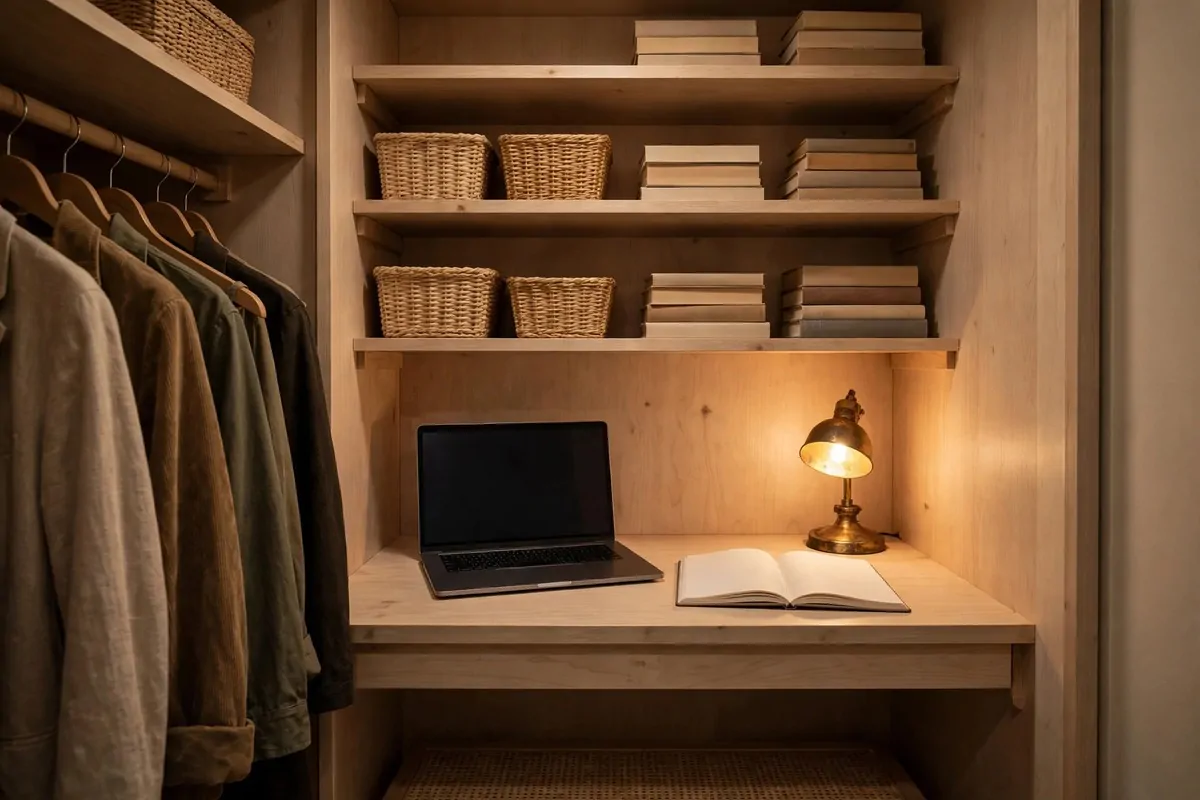
A shelf desk uses the full width of your closet, so no inch goes to waste. You sit in the middle, and your arms can reach both sides without standing up.
Measure from one side wall to the other wall before you buy anything.
My closet was just under four feet wide, so I cut a board to fit snug. I rested it on two small cleats screwed into the side walls. It felt solid the first time I leaned on it, and it did not wobble when I typed.
Pick a board that is 18 to 20 inches deep. That gives you room for a laptop and a notebook, but your knees still fit under it.
Leave at least 28 inches from the floor to the top of the desk for your legs.
If the board feels too plain, paint it the same color as your walls. It will look built in, and your eye will not stop at the edge. I painted mine white, and the whole closet looked a little bigger right away.
Add a small lip at the back if your pens roll off. A thin strip of wood works fine, and you can glue it on and forget about it.
Keep only your laptop, one notebook, and a cup for pens on top.
Everything else goes up on shelves or in a bin below. That one rule keeps a wall to wall desk from feeling crowded, even on a busy Monday morning.
The Fold-Down Desk That Vanishes at Night
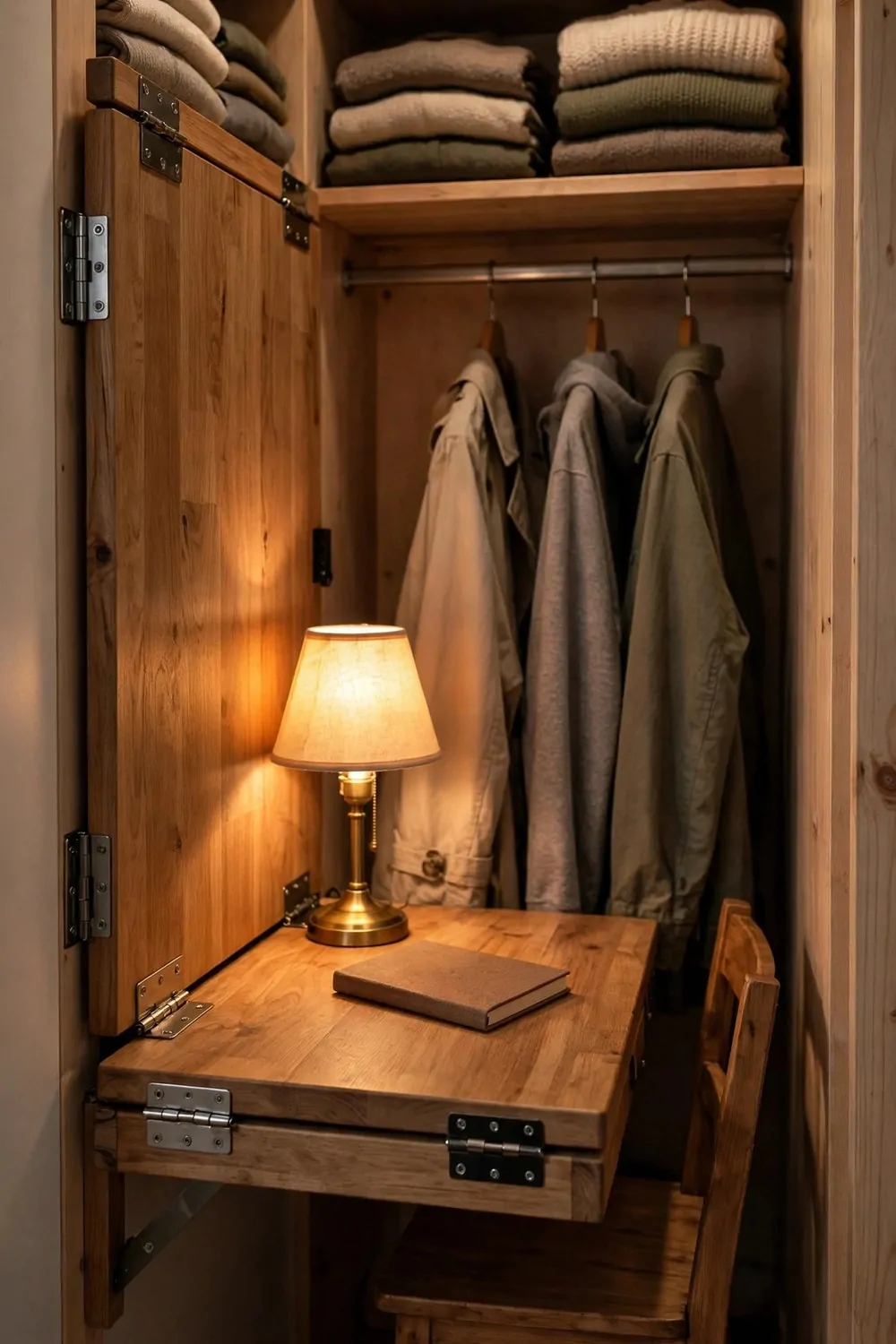
A fold-down desk is perfect when your closet also has to hold coats or boxes.
You pull it down in the morning, and you work. You fold it up at night, and your closet looks normal again. I loved that my tiny hall closet could be an office at nine and a closet again at six.
Look for a strong hinge and a latch that holds it flat. Cheap hinges sag, and a sagging desk makes typing feel awful.
Mount it at the same height as a normal desk. Test it with your chair before you screw in the last screws, because moving it later leaves holes you will see every day.
Add a small chain or folding bracket on each side for extra support.
Keep the top clear when you fold it up. I learned this the hard way when a mug slid off and hit the floor. Now I keep a small tray on the shelf above, and I move my mug there before I fold the desk away.
A fold-down desk works best for laptop only work. If you need two big monitors, this is not your best pick, and that is okay.
Put a soft pad under the front edge so it does not bang the wall when it closes.
At night, you get your floor back. You get your closet back too. And in the morning, your office is waiting for you, right where you left it, with no setup time at all.
The Corner Nook That Wastes Nothing
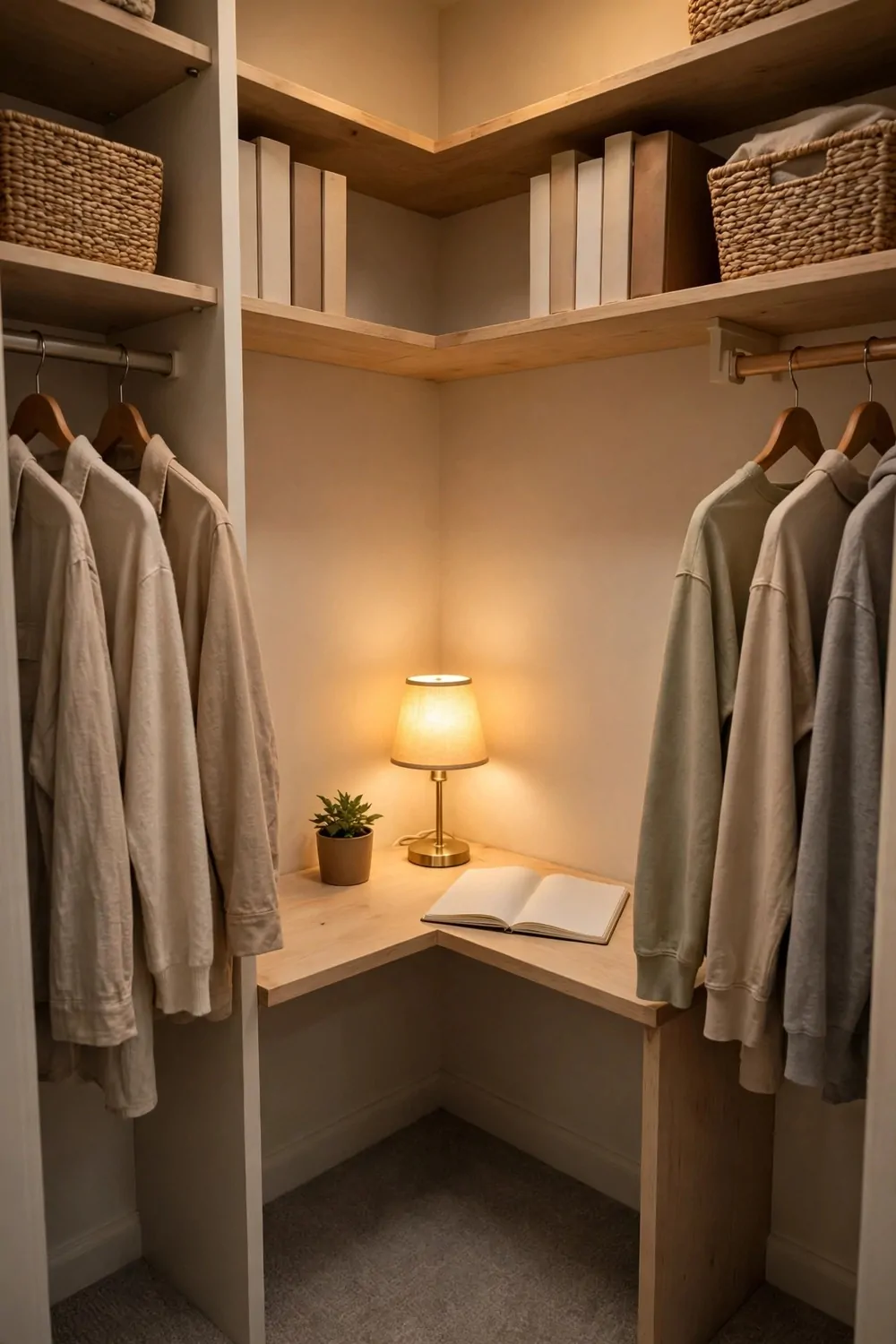
Most closets have one corner that gets ignored. That corner can hold a small triangle desk or an L shaped shelf that turns dead space into your work spot.
Sit at an angle and your screen will face the room, not the back wall.
I tried this in a closet that was wider at the door than at the back. The corner shelf gave me a place for my laptop, and the wall beside it gave me a place for notes. It felt cozy, not cramped, because I was not staring straight into a wall six inches from my face.
Use the corner for your hardest task of the day. You will feel tucked in, and the walls block the noise and mess from the rest of the house a little bit.
Keep the desk depth shallow here, about 16 inches is plenty.
Add a small shelf above one side only. If you add shelves on both sides, the corner can feel like a box. One side open keeps the air moving and lets you turn without bumping your elbow, which matters a lot in a space this small.
A corner nook is also good if two people share a home. One person can work in the corner while the other walks past, and nobody has to move a chair out of the way.
Put your charger in the corner, where the cord stays out of your lap.
Test the chair fit before you fix anything in place. Slide in, slide out, and turn a little. If you can do all three without a struggle, the corner is working.
The Shelves That Climb to the Ceiling
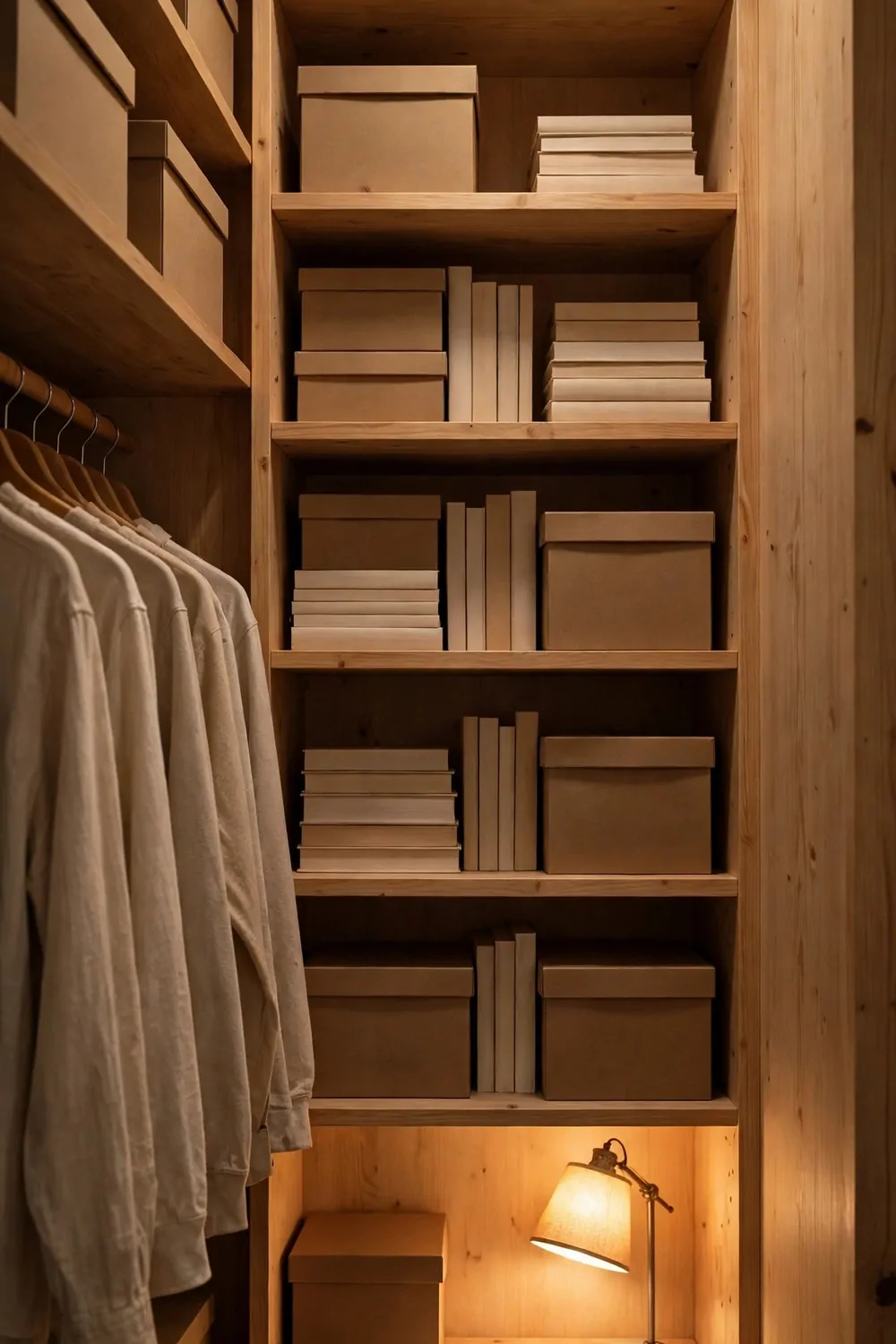
When you have no floor space, go up. Shelves that climb to the ceiling give you storage without stealing desk room or knee room.
Start your first shelf about 18 inches above your desk.
That gap leaves room for a monitor or a stack of books, and you can still reach the shelf without standing up. I keep my daily notebooks there, right where my hand can find them. The shelves above that hold things I only need once a week.
Use the very top shelf for boxes you rarely open. Label them in big letters. You will thank yourself later when you are standing on a stool looking for one small cable.
| Shelf Height | What Goes There | Why It Works |
|---|---|---|
| Just above desk | Daily notebooks and pen cup | Easy reach while seated |
| Eye level standing | Current project box and charger | Quick grab without bending |
| Above your head | Extra paper and spare cables | Out of the way but close |
| Near the ceiling | Rare boxes with big labels | Uses dead space at the top |
Keep heavy books low and light boxes high.
I once put a heavy box of old files on the top shelf, and it bowed in the middle. I moved it down the same day, and I learned to check the shelf brackets twice. Strong brackets matter more than pretty shelves in a tiny closet office.
Paint the shelves the same color as the walls if you want them to fade away. Or paint them a soft wood tone if you want a warm, homey feel.
Leave one shelf a little empty on purpose.
That empty spot is for the project you are working on right now. It stops the shelves from filling up with stuff you do not need, and it gives your eyes a place to rest.
The Slim Rolling Cart That Parks Anywhere
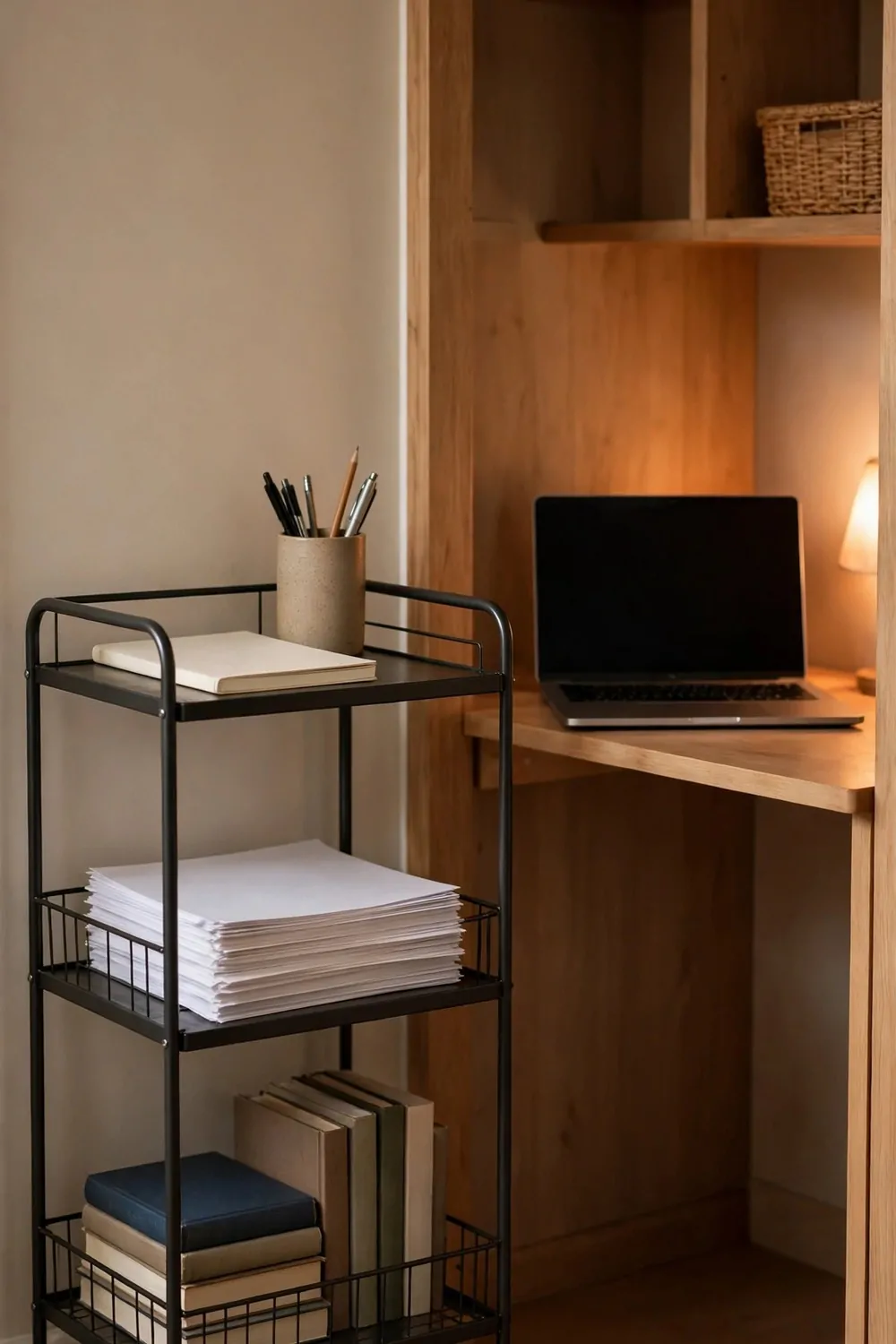
A slim rolling cart is like a drawer that can move.
Mine is only about 10 inches wide, so it slides in the gap beside my desk. I roll it out when I need printer paper or snacks, and I roll it back when I need leg room. It sounds small, but that little bit of movement makes a tiny closet feel flexible.
Pick a cart with wheels that lock. If the wheels do not lock, the cart will roll away every time you bump it with your knee.
- Top tier: charger, pens, and sticky notes
- Middle tier: notebook, headphones, and a small snack box
- Bottom tier: printer paper and spare cables in a zip bag
- Side hook: headphones and a small tote bag
Keep the cart light on top and heavier at the bottom. That stops it from tipping when you pull it out fast.
Use the cart for things you need every day, not for long term storage.
I keep my cart for tea, my notebook, and my headphones. When work ends, I roll it into the closet and shut the door, and my office is gone. That small ritual helps my brain switch off, even though my office is only a few steps from my bed.
If your closet floor is carpet, pick bigger wheels. Small wheels get stuck, and you will end up dragging the cart and scratching the floor.
Wipe the tiers once a week, because dust loves a tiny closet.
A cart also works if you share the closet with someone else. You roll your stuff out, they roll theirs in, and nobody fights over one small desk.
The Pegboard Wall for Every Little Thing
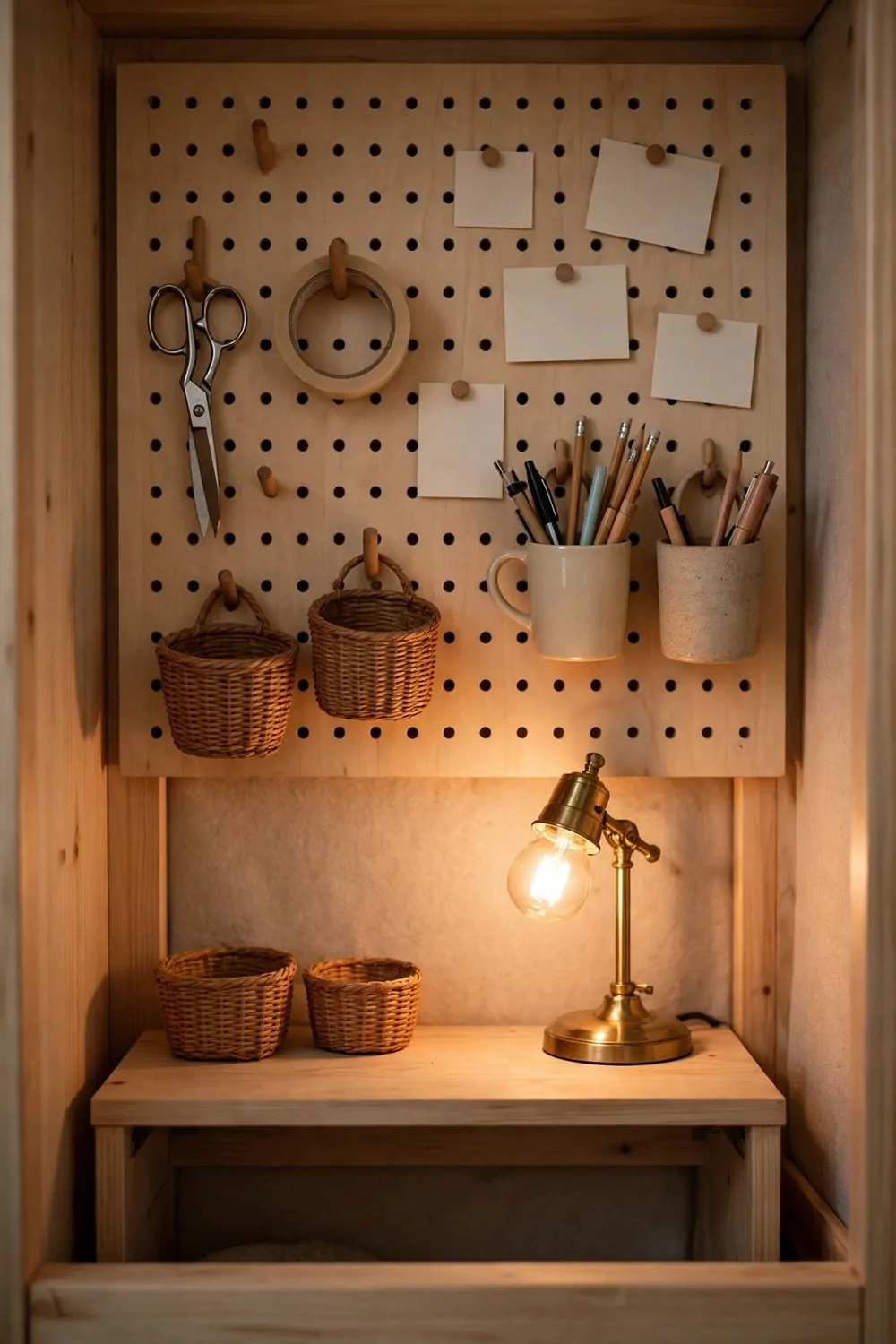
A pegboard turns a blank wall into storage you can see. You hang hooks and small baskets, and everything has a spot you can find in two seconds.
Mount the pegboard on the wall beside your desk, not right in front of your face.
I hung mine on the left wall of my closet, and I put scissors, tape, and cords on hooks. I could grab them without looking, which saved me alot of digging through a drawer every time. The board also made the wall look tidy, even when the hooks were full.
Leave a gap behind the board with small spacers. The hooks need room to go in and stay put, or they will fall out when you pull something off.
Paint the pegboard to match your closet, or leave it natural wood for a warm look.
Change the hooks when your work changes. One week I needed more space for cables, so I moved two baskets down and added hooks up top. It took five minutes, and I did not need any new tools, which felt like a small win in a small space.
Do not overload the board with heavy tools. Pegboard is strong for light stuff, but a heavy shelf on pegboard will pull away from the wall over time.
Put a small basket on the board for loose bits like clips and rubber bands.
At the end of each day, hang things back on their hooks. It takes one minute, and your tiny office will look calm the next morning when you open the door.
The Clip Light and Mirror That Double the Space
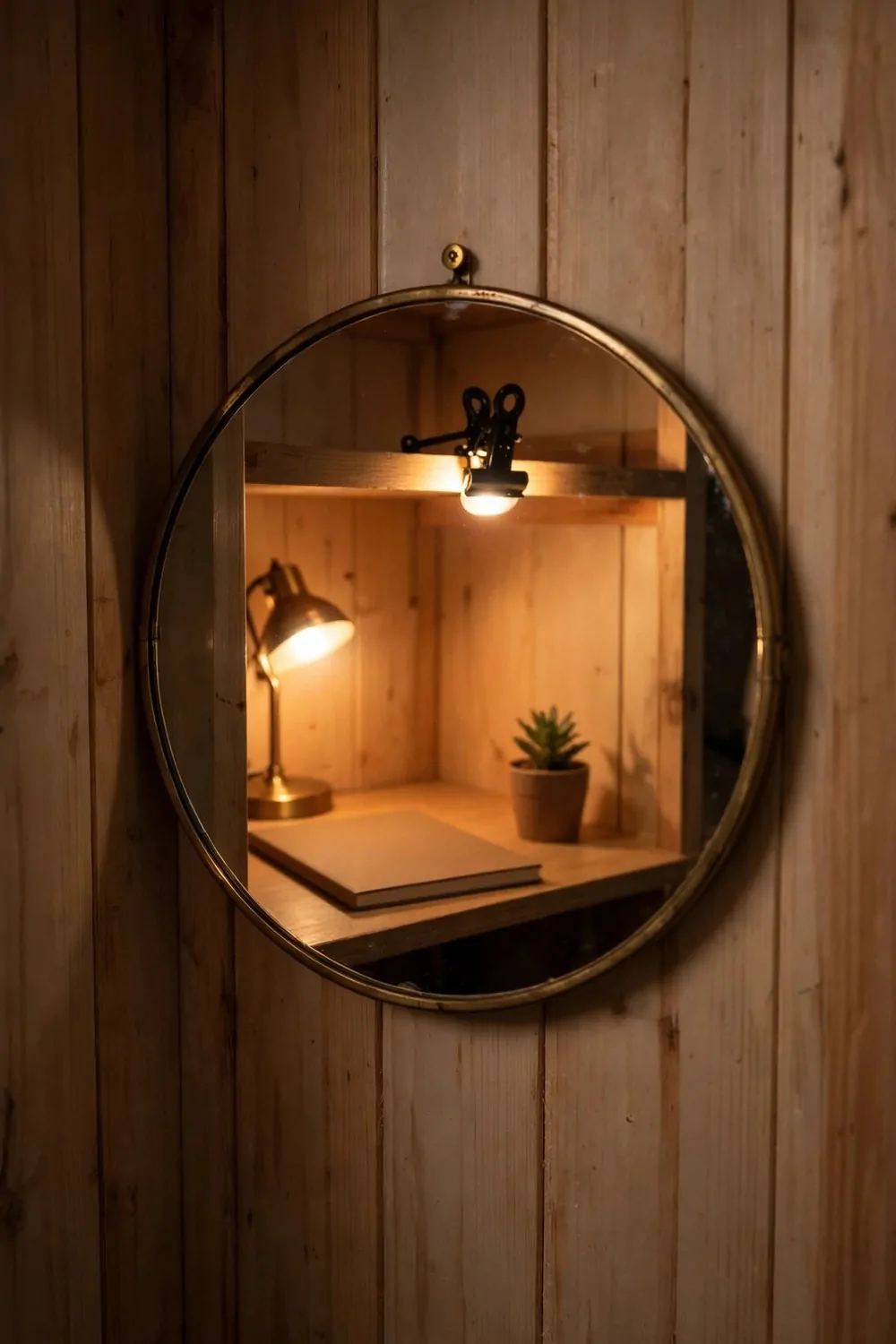
A closet with no window can feel kinda dark and a bit sad. A clip light and a small mirror fix both problems without taking up desk space, and they cost very little.
Clip the light to your shelf, right above your work.
Point it at your desk, not at your eyes. A warm bulb feels softer, and it makes late work feel less harsh on a tired brain.
I use a light I can dim, because full brightness at night hurts my eyes.
The mirror goes on the wall across from the door, or on the side wall where it catches the light. It bounces light around the closet, and it makes the space look twice as deep. I was surprised how much bigger four feet felt with one small mirror on the wall.
Pick a mirror that is flat and light. A heavy mirror in a tiny closet is a risk, and you do not need a big one to get the effect.
Keep the mirror clean, because dust shows up fast under a bright light.
If you take video calls, the mirror can help you check your face before you join. I glance at it, fix my hair, and I feel a little more ready. It is a tiny habit, but it helps me feel like I am in a real office, not a closet.
Do not put the mirror where it reflects your screen. The glare will annoy you all day, and you will end up turning the mirror around anyway.
The One Drawer That Holds the Whole Office
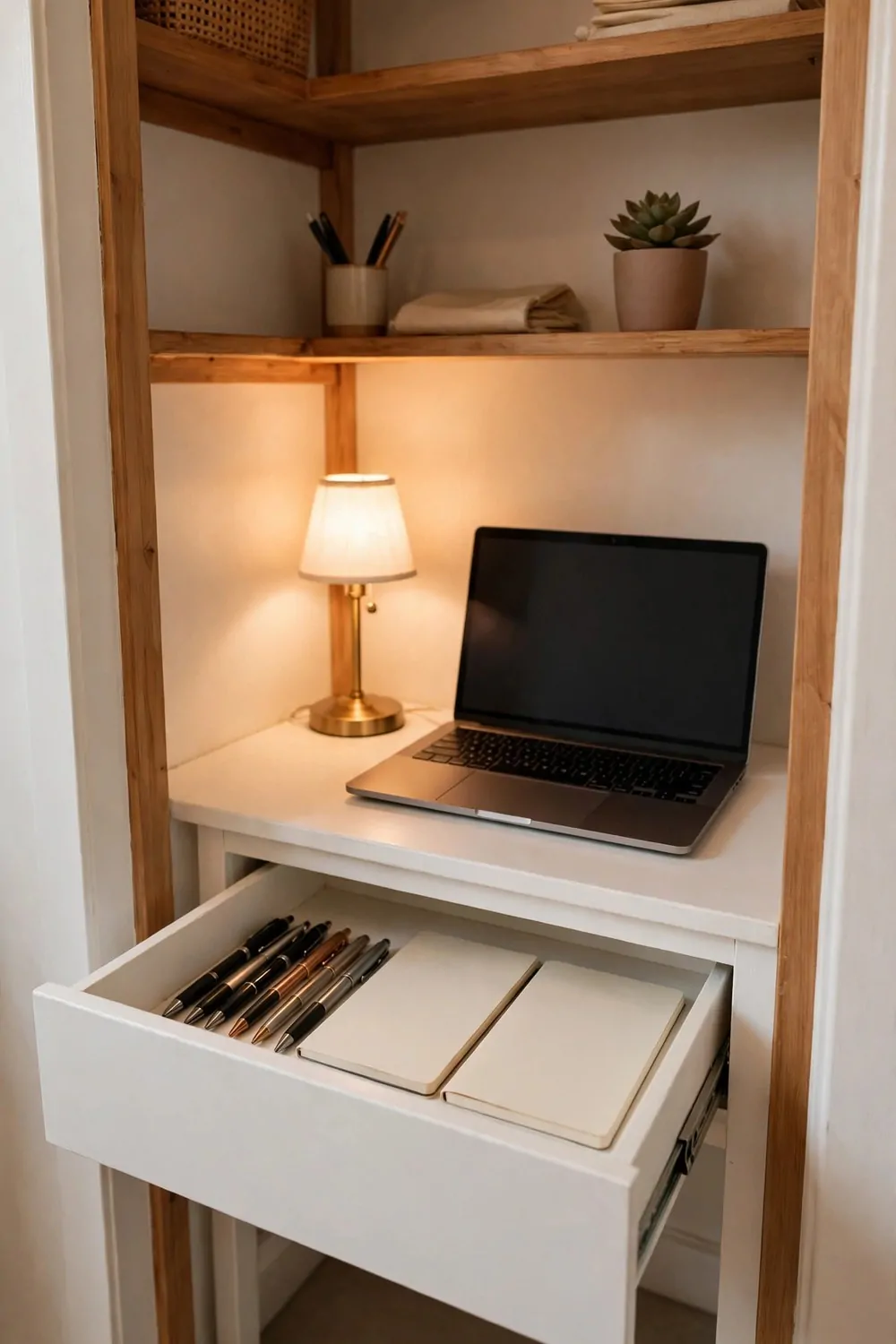
You do not need a big filing cabinet in a closet. One good drawer can hold your whole office if you give every zone a job.
A shallow drawer under your desk works best, because you can reach it without standing.
I use one drawer that is only about four inches deep, and it holds more than I thought it would. The trick is to stop tossing things in and start placing them in zones. When each zone has a name, you stop losing pens and chargers in a dark pile.
Use small trays or cut cardboard boxes as dividers. You do not need fancy organizers. A cereal box cut down to size works just fine, and it costs nothing.
| Zone | What Lives There | Rule to Keep |
|---|---|---|
| Front zone | Pens, sticky notes, and charger | Only daily tools stay here |
| Middle zone | Paper, envelopes, and small notebook | Refill once a week |
| Back zone | Spare batteries, clips, and cables | Check once a month |
| Drawer top | One to do list and a pen | Clear it every night |
Keep the front zone for things you touch every day.
The middle zone is for paper and envelopes, and the back zone is for spare stuff like batteries and extra clips. I check the back zone once a month, and I toss anything I have not used. That little check keeps the drawer from growing into a junk drawer, which happens fast in a small space.
Label the zones with tape if you share the drawer. It sounds fussy, but it stops the drawer from turning into a shared mess where nobody can find a pen.
Close the drawer at the end of the day, and your desk will look clear in seconds.
If the drawer starts to stick, it is too full. Take five things out, find them a home on a shelf, and the drawer will slide smooth again.
The Back of the Door Storage
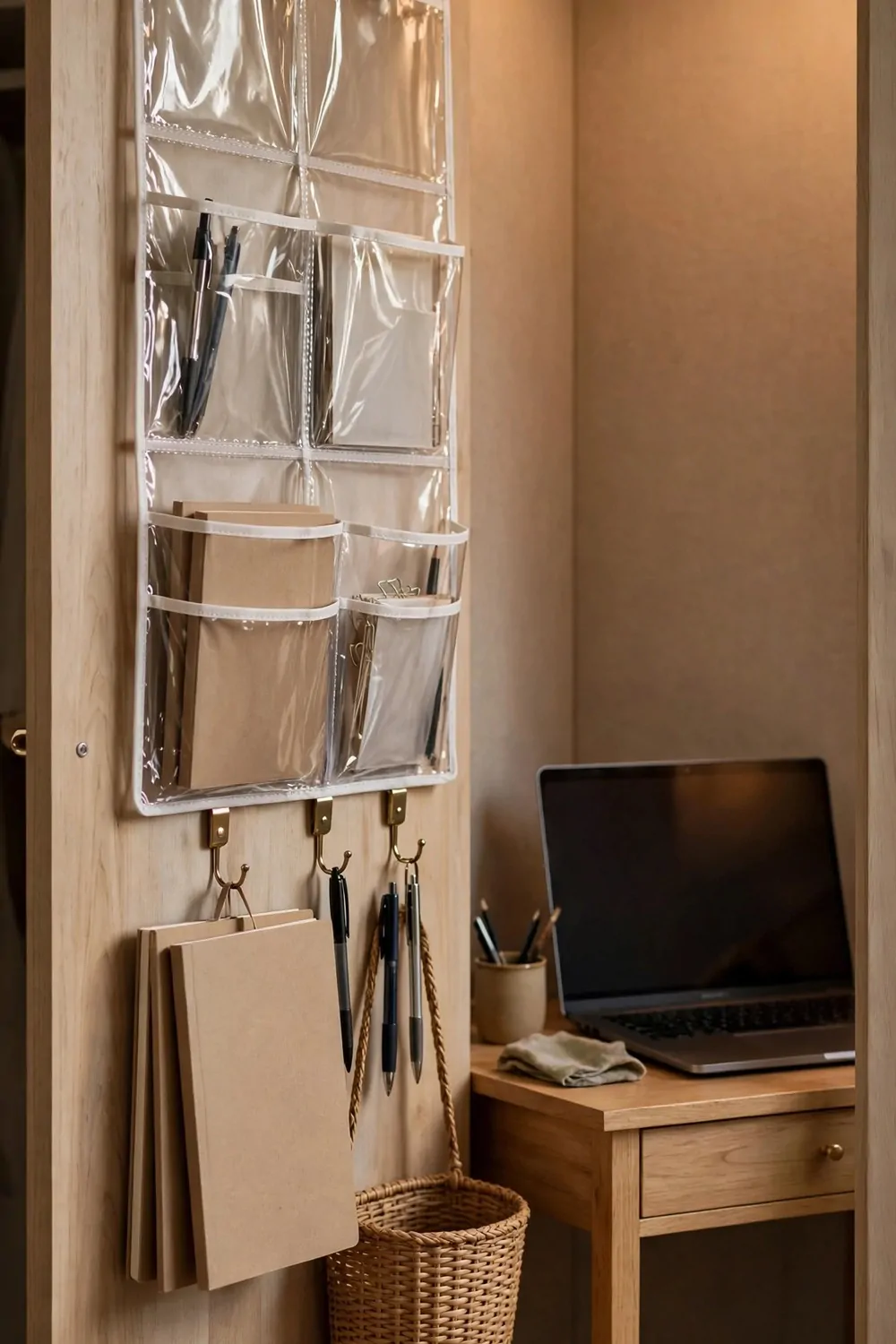
The back of the closet door is free storage. You open it, you see your supplies, and you close it and they disappear from view.
Use over the door hooks or a slim hanging organizer with clear pockets.
Clear pockets help a lot in a dark closet, because you can see what is inside without pulling everything out. I keep tape, stamps, and small cables in mine, and I can find them in seconds. The door still closes fine, as long as the organizer is slim and flat.
Do not hang anything too heavy on the door. A heavy organizer will pull the hinges and make the door hard to close, which gets annoying fast.
- Top pockets: stamps, tape, and sticky notes
- Middle pockets: cables, earbuds, and a small calculator
- Lower pockets: envelopes and spare paper clips
- Hook on top: headphones and a light tote bag
Keep the pockets for light, flat things only.
If your closet has sliding doors, this idea needs a change. Use a hanging strip on the inside wall instead, or a small rack that sticks to the wall with strong tape. You still get the same easy reach, and you do not fight with a sliding door every time.
I check my door pockets once a week and toss dried out pens. It is a two minute job, and it stops the pockets from filling with things I will never use again.
Put your most used item at eye level on the door.
That way you do not have to bend down in a tight space. Your knees will thank you, and your back will too, after a long day of sitting.
The Laptop Only Desk
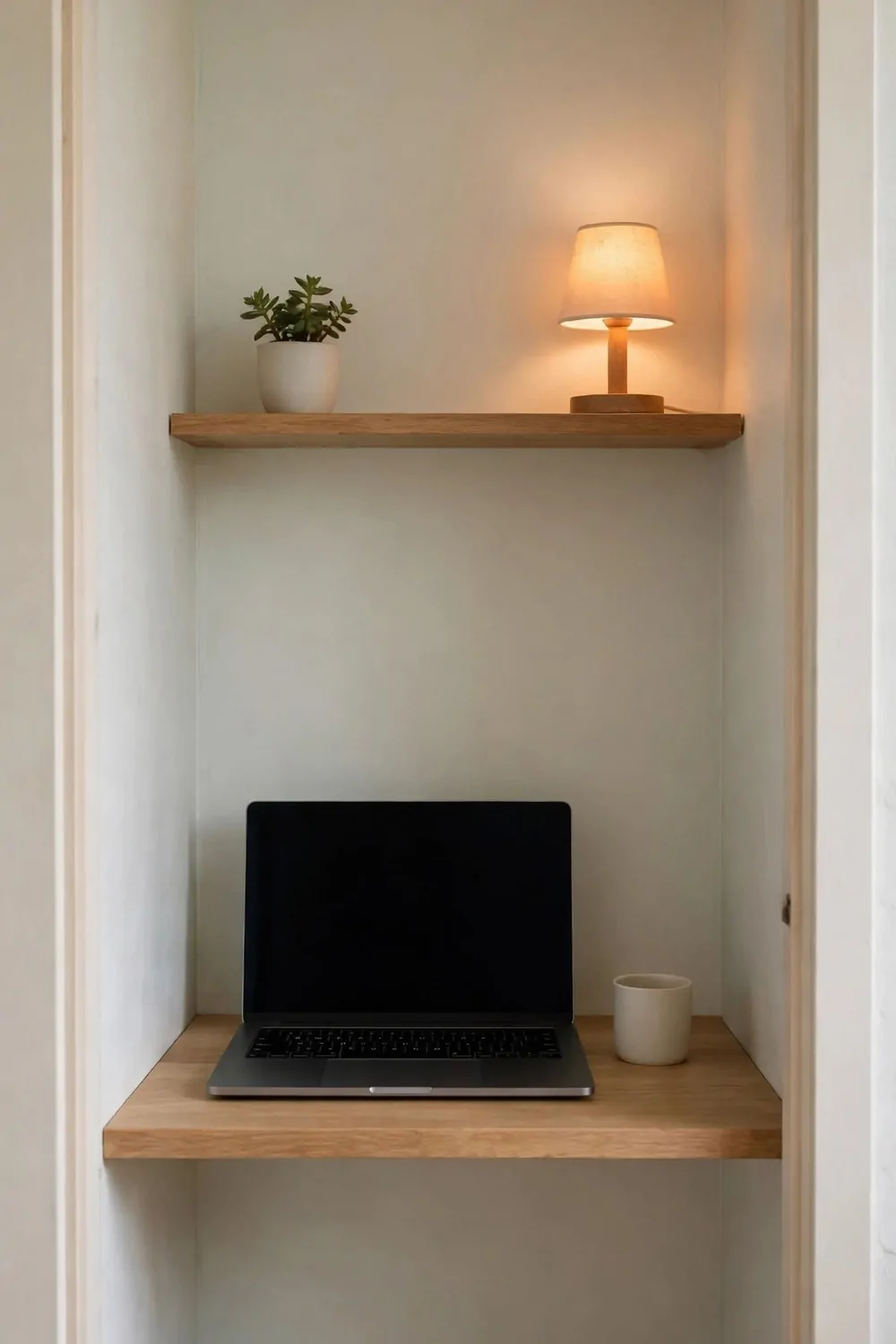
A laptop only desk is the simplest office you can build in a closet.
No printer, no big monitor, no piles of paper. Just a board, a laptop, and a chair that fits. I went laptop only for a whole month, and my tiny closet felt calm for the first time.
Pick a desk depth of 16 to 18 inches. That is enough for a laptop and your wrists, and it leaves room for your knees and a small stool.
Keep your charger plugged into a power strip under the desk.
Use cloud storage or one slim folder for paper, so you do not need a stack of files beside you. I keep one folder for bills and one for work notes, and that is it. If a paper does not fit in those folders, I scan it or I toss it, and I dont feel bad about it.
A laptop stand helps a lot here. It lifts the screen to eye level, and it frees space under the laptop for a notebook or a small keyboard.
Add a wireless mouse if you like one, but keep it small.
The best part of a laptop only desk is how fast you can pack up. You close the laptop, you slide the stool under, and you shut the door. Your office is gone in ten seconds, and your home feels like a home again, not a workspace that never sleeps.
If you miss a second screen, try a tablet stand for a week. It gives you a second view without taking over your tiny desk, and you can put it away just as fast.
The Curtain That Hides the Office
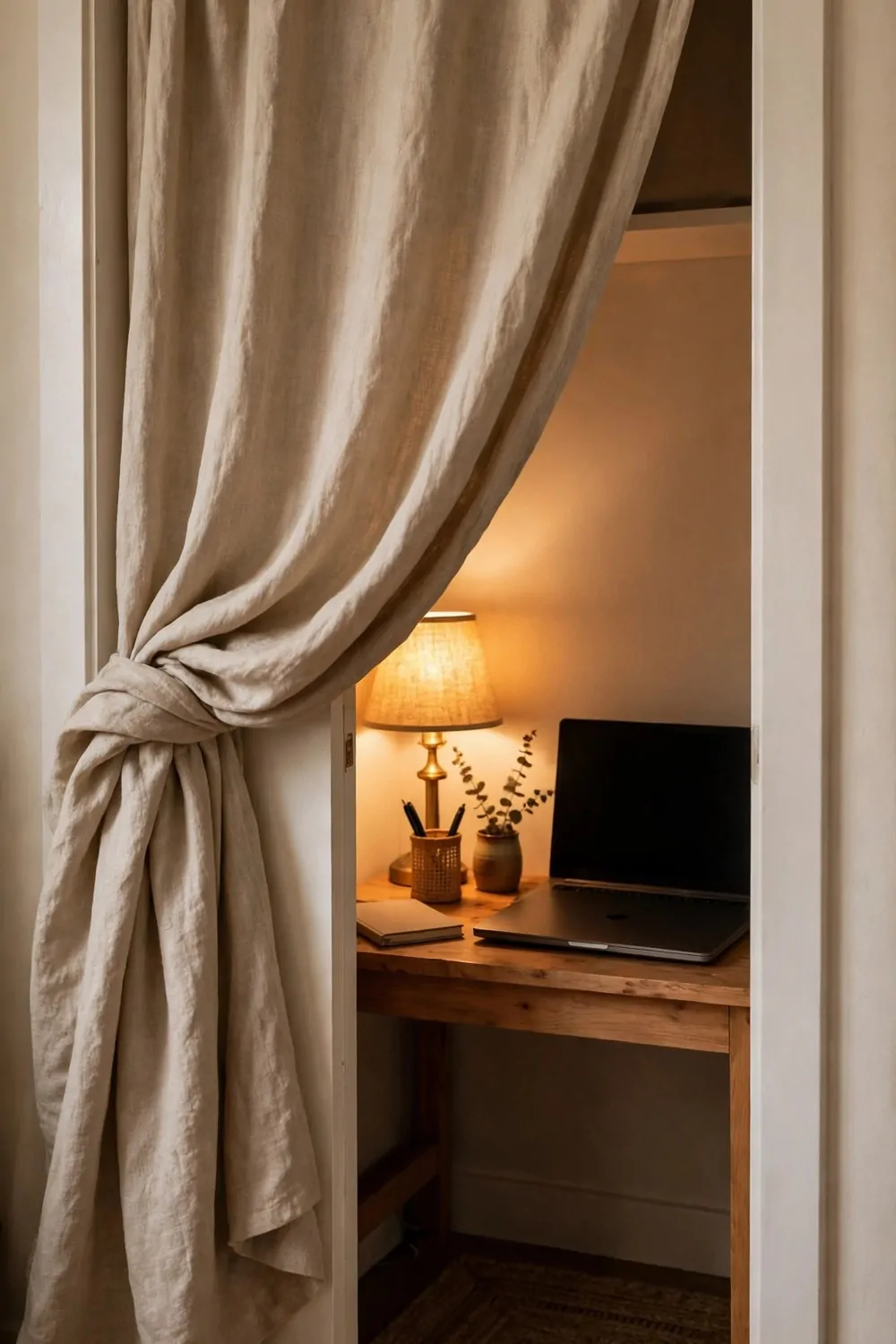
A curtain is cheaper than a door, and it hides your office in one pull. It also softens the look of a closet that opens right into a bedroom or living room.
Hang a tension rod inside the closet frame, no drilling needed.
Pick a curtain that reaches the floor and matches your room. A light fabric lets a little air through, and it will not make the closet feel stuffy. I picked a soft cream curtain, and my closet looked like part of the room, not like a storage hole with a desk shoved inside.
Pull the curtain closed at the end of work. That one move tells your brain that work is done, even if your office is only three steps from your sofa.
Keep the curtain out of your chair wheels, or it will get caught every day.
If you need light while you work, tie the curtain to one side with a simple tieback. You get light from the room, and you still have privacy when you need it. I tie mine back in the morning, and I let it fall at night, and that rhythm helps me start and stop work on time.
Wash the curtain once a month if your closet is dusty. A clean curtain smells fresh, and it stops dust from settling on your desk while you sleep.
A curtain also hides cords and boxes that you do not want guests to see.
Choose a curtain with no loud pattern if your space is tiny. A calm color keeps the room feeling open, and your closet office stays a quiet corner, not a loud focal point.
The Shoe Rack Turned Supply Shelf
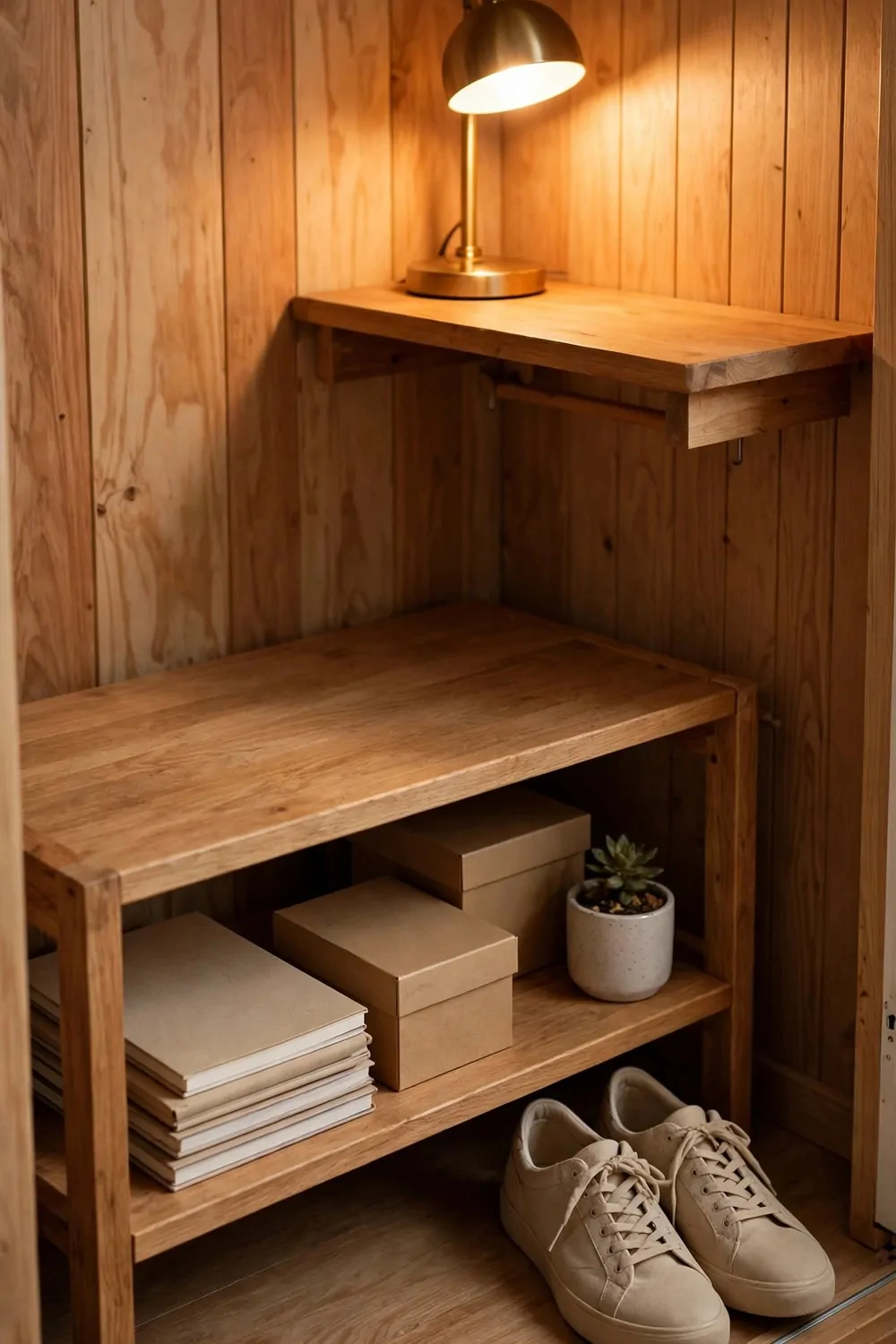
An old shoe rack can become a supply shelf with almost no work. The tiers are already the right size for notebooks, boxes, and small bins.
Stand it against one side wall, or lay it flat under your desk if it fits.
I found a slim shoe rack for a few dollars, and I put it beside my desk. The top tier holds my planner, the middle holds pens and tape, and the bottom holds a small printer paper stack. It wasnt pretty at first, but a coat of paint fixed that in an afternoon.
Use small bins on each tier to stop things from sliding off. Clear bins work best, because you can see what is inside without pulling the bin out.
Keep the rack narrow, so it does not eat into your knee space.
If the rack wobbles, fix it to the wall with one small bracket. A wobbly rack in a tight closet is a pain, and it will tip when you pull a heavy bin out fast. One screw makes it feel solid, and you will forget it was ever a shoe rack.
Label each tier with a small tag. It helps you put things back in the right spot, and it helps anyone else in the house leave your stuff alone.
Do not use the rack for shoes and office stuff at the same time.
Pick one job for it, and let it do that job well. A shoe rack that tries to do both ends up messy, and a tidy supply shelf makes your tiny office feel twice as useful.
The Magnetic Strip for Scissors and Clips
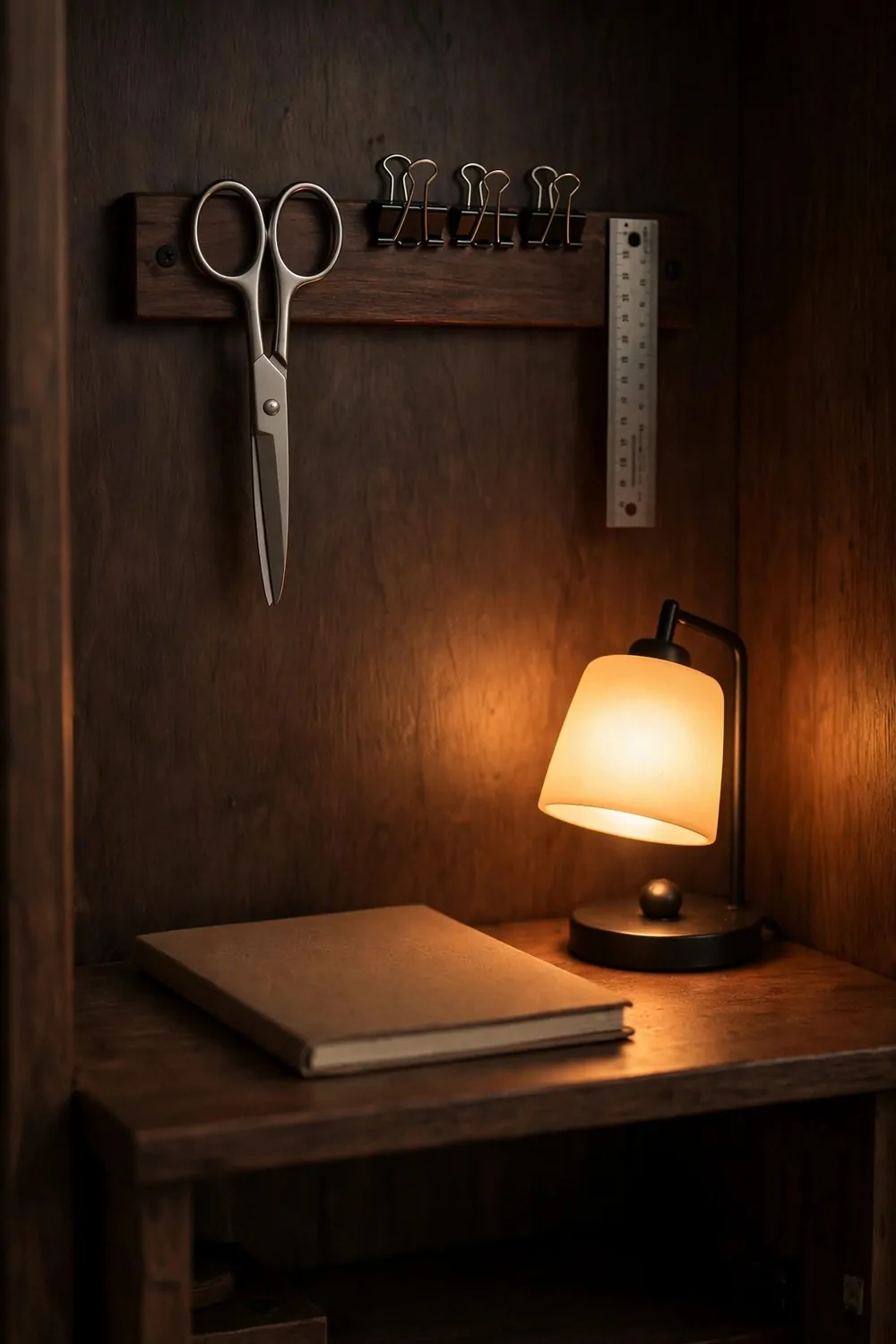
A magnetic strip on the wall holds scissors, clips, and other metal bits right where you can grab them. It frees up desk space, and it looks neat and tidy.
Mount the strip at arm height, beside your desk.
I put mine on the right wall, just above desk level, and I stuck my scissors there the first day. It felt a bit magic to just reach and grab them, and I stopped losing them in drawers. My clips and binder clips line up in a row, and I can see at a glance what I have left.
Pick a strip with strong magnets and screws, not just sticky tape. Tape can peel off in a warm closet, and a falling strip with scissors on it is not safe.
| Item | Where on the Strip | Safety Note |
|---|---|---|
| Scissors | Middle of strip, points down | Keep out of reach of kids |
| Binder clips | Left end in a row | Check grip once a week |
| Paper clips | Small metal cup on the strip | Keep the cup light and level |
| Metal ruler and clips | Right end, flat against the wall | Nothing sharp facing up |
Keep sharp items with the points facing down or sideways, never up.
Teach kids in the house not to pull things off the strip. If little hands can reach it, put the strip higher, or keep sharp items in a drawer instead. Safety comes first, even in a tiny office, and a high strip still works fine for adults.
Wipe the strip once a week. Dust and paper bits stick to magnets, and a quick wipe keeps the hold strong.
Do not hang anything too heavy, like a full stapler, on a light strip.
Use the strip for small metal tools only, and let shelves and drawers do the heavy work. That balance keeps your wall tidy, and your desk stays clear for the work that matters.
The Stool That Slides Under the Desk
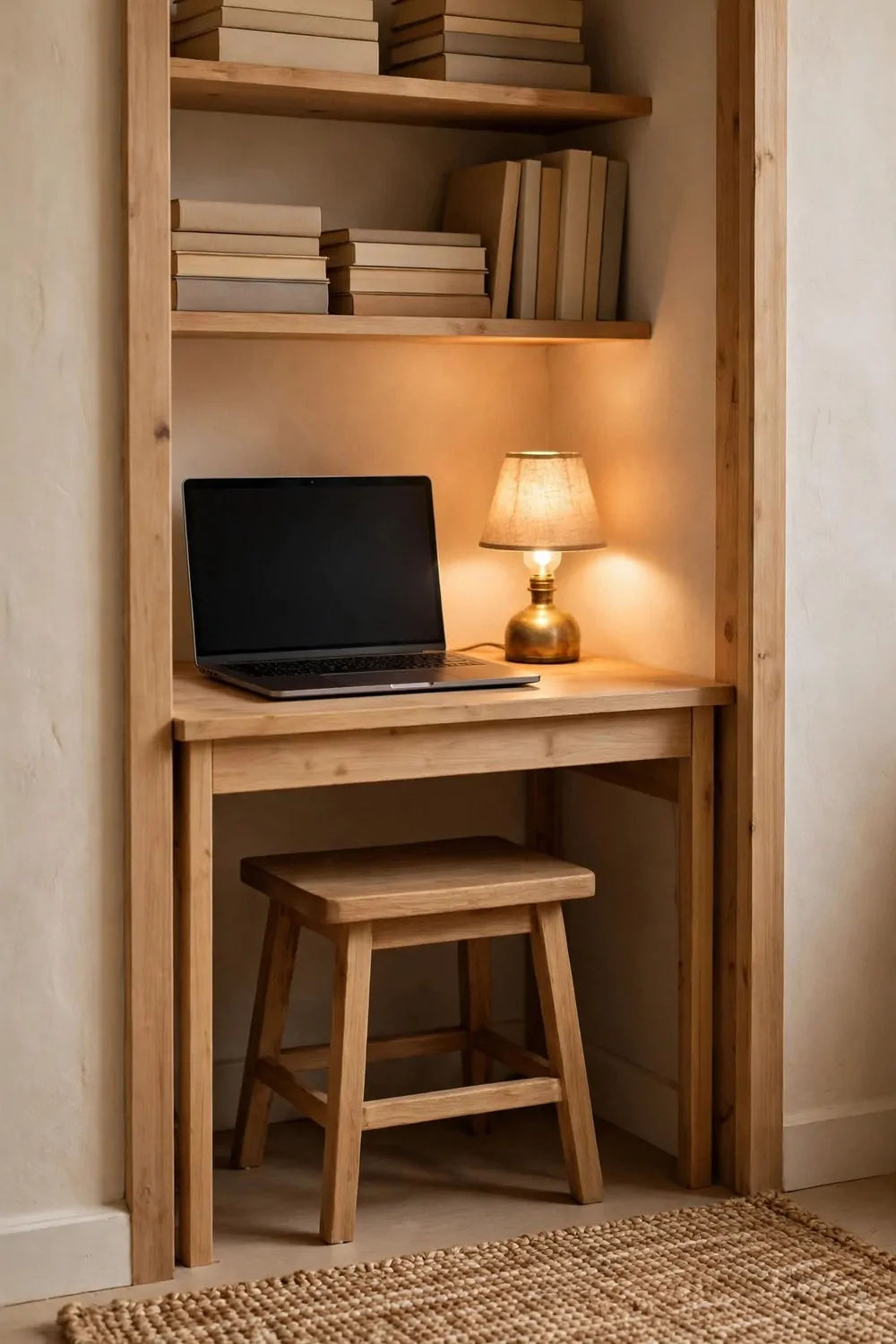
In a closet under five feet wide, a big office chair will not fit. A stool that slides right under the desk will, and it gives you back your floor when work ends.
Pick a stool with no arms and no wide base.
Arms catch on the closet walls, and a wide base trips you when you stand up. I use a simple round stool with a padded top, and it slides under my desk with one push. My knees fit, my feet rest flat, and I can turn a little without hitting the wall.
Look for a stool you can adjust in height. Your desk height and your leg length are different from mine, and a fixed stool can leave you too high or too low all day.
Add a small footrest if your feet dangle, because dangling feet get tired fast.
A stool also helps you keep good posture if you sit up straight. I set a timer for every 45 minutes, and I stand up and stretch in the doorway. That tiny break helps my back, and it reminds me that my office is small, but my day does not have to feel small too.
Keep a cushion on the stool if you sit for long hours. A thin cushion is enough, and it slides under the desk just as easily as the bare stool.
Do not leave bags or boxes under the desk, or the stool will have nowhere to go.
Clear the space under the desk every night. In the morning, your stool will slide in and out smooth, and your tiny closet will feel ready for work, not cluttered from yesterday.
The Cordless Desk With No Cables Showing
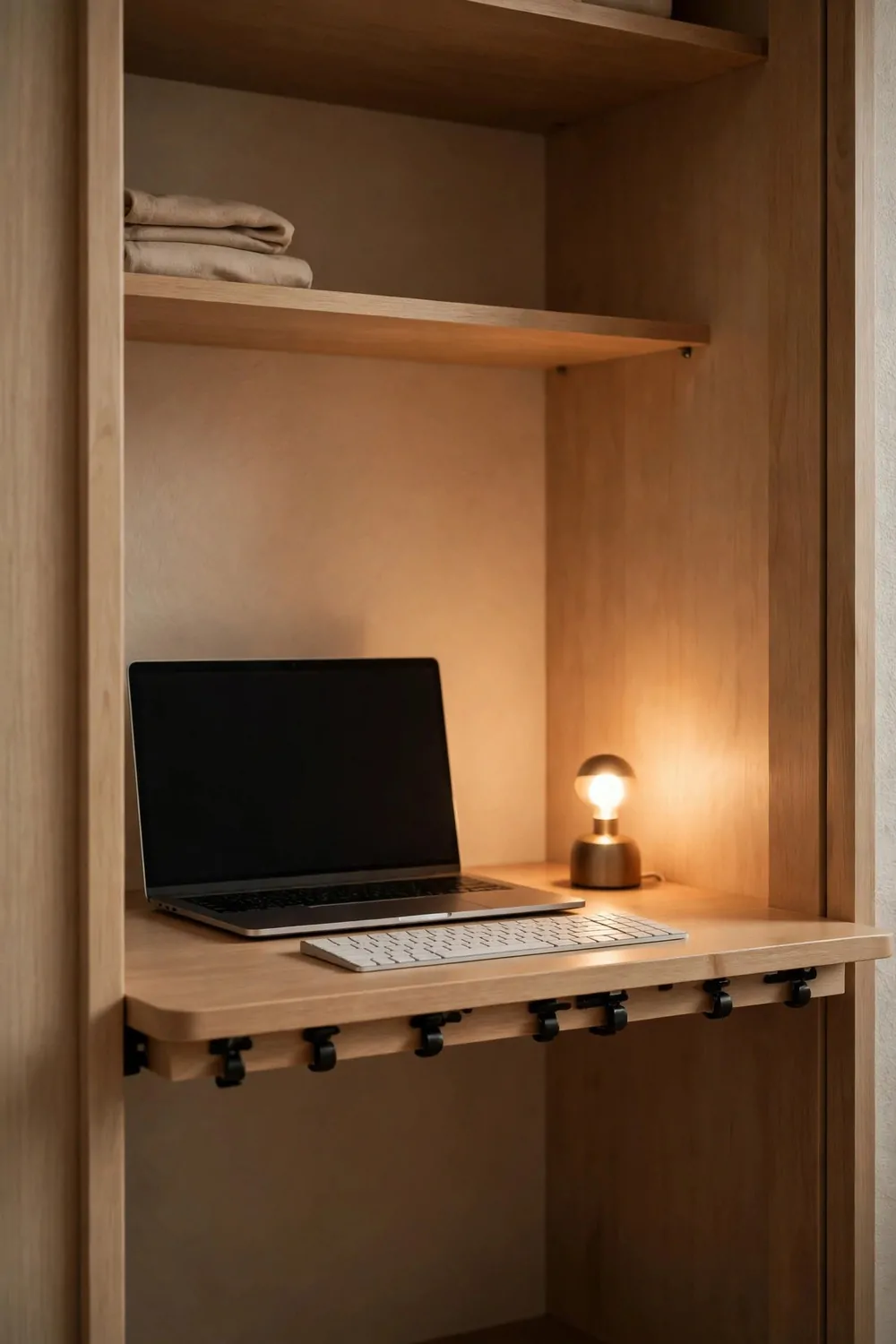
Cables make a tiny closet look messy fast. One cord across your knees feels like three, and a tangle under the desk is a trip risk in a space this tight.
Go cordless where you can, and hide the rest.
Use a wireless keyboard and mouse if your budget allows. Charge them at night, and you will not need a cord snaking across your desk during the day.
- Wireless mouse and keyboard, charged overnight
- One laptop charger, clipped to the back edge
- Power strip fixed to the side wall
- Small cable clips and twist ties for spare length
Run your one charger cable along the back edge of the desk. Fix it with small clips, so it stays flat and out of your lap.
Put your power strip on the wall, not on the floor.
A strip on the wall keeps plugs off the floor, and you can reach the switch without bending down in a tight space. I stuck mine to the side wall with strong tape, and I plug my lamp and laptop into it. It looks tidy, and I do not kick it when I slide my stool in.
Coil any spare cable length with a twist tie. A loose coil looks neat, and it stops cables from falling behind the desk where you cannot reach them.
Label your charger with tape, so you do not unplug the wrong thing in the dark.
At the end of the week, do a quick cable check. If a new cord has crept in, find it a clip or a home, and your desk will stay cordless and calm for the next week too.
The Plant Ledge That Softens the Walls
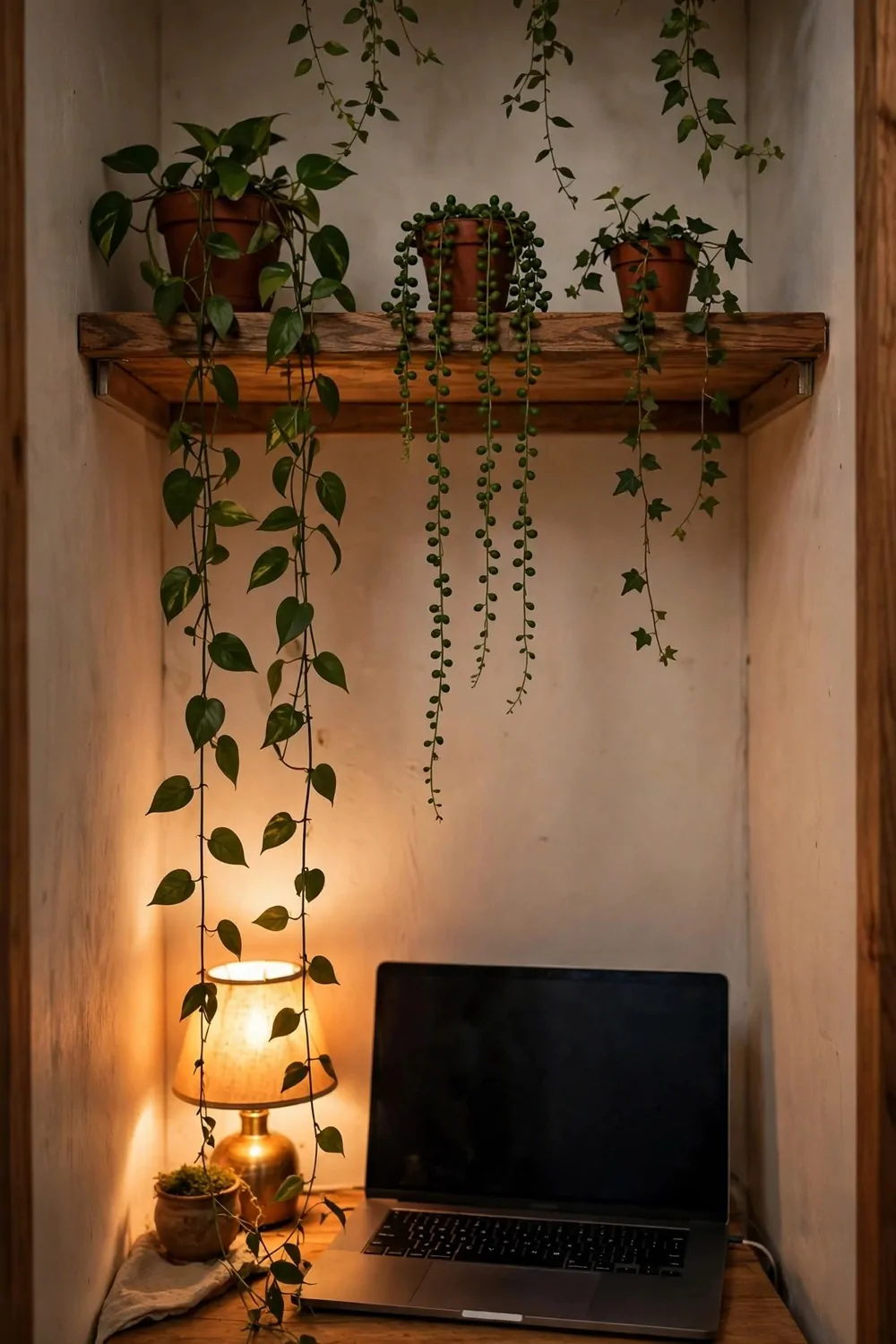
A tiny closet can feel hard and boxy. A small plant ledge softens the walls, and a bit of green makes work feel calmer and more human.
You do not need a big plant, or a lot of light, to get this effect.
I put a narrow ledge high on the side wall, above my shelves, and I set one small trailing plant there. It hangs down a little, and it makes the closet feel less like a box. I water it once a week, and I check that it does not drip on my papers below.
Pick plants that like low light and little water. A pothos or a small snake plant works well, and they forgive you if you forget to water them for a few days.
Keep the plant off your desk, so leaves do not fall on your keyboard.
Use a light pot that will not hurt you if it falls. A heavy ceramic pot on a high ledge is a risk in a small space, and a plastic pot looks just as good once the plant fills in. I learned to check the ledge screws twice, just to be safe, and I sleep better for it.
If you have no light at all, try a small fake plant. It still softens the walls, and you will not worry about watering it or watching it fade in the dark.
Add one plant only at first, and see how it feels.
Too many plants in a tiny closet will crowd your shelves and drop leaves on your work. One happy plant is enough to make the space feel alive, and it leaves room for everything else you need.
The One Bin Rule That Keeps It Tidy
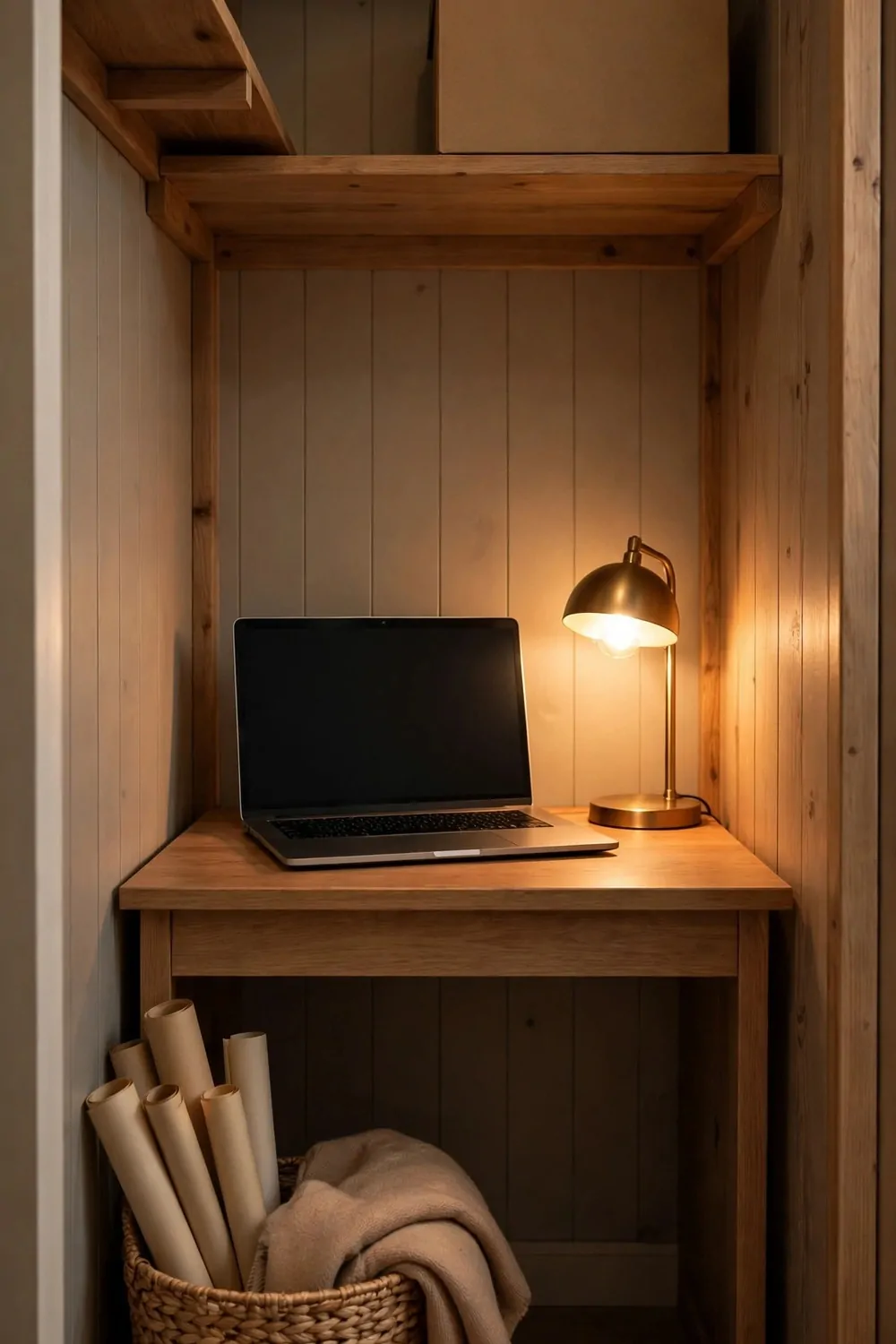
The one bin rule is simple. You get one bin for all the loose stuff that does not have a home, and when the bin is full, something has to go.
Pick a bin that fits under your desk or on one shelf, no bigger.
I use a small bin about the size of a shoe box, and it holds cables, spare pens, and odd bits I am not ready to toss. Once a week I open it, and I put each thing away or I throw it out. That weekly check is the whole secret, and it takes less than ten minutes.
Do not buy a second bin when the first one fills up. A second bin is how a tiny closet turns into a storage room, and your office space will shrink a little more each month.
Label the bin "in between" so you know it is not long term storage.
If something sits in the bin for a month and you never touch it, let it go. I know it feels hard to toss things you might need one day, but a tiny closet has no room for "maybe". Keeping only what you use makes room for the work you do now, not the work you might do later.
Keep the bin easy to reach, but out of sight if you can. Under the desk works well, or behind the curtain if you have one, and it stays tidy without a daily effort.
Empty the bin before a big project starts, so you start clean.
A tidy closet office is not about being perfect. It is about having one small rule you can keep, even on a busy week, and letting that rule do the hard work for you.