19 Office Ideas for Two People That Share Space Without Chaos

"Can you move your elbow? It is sitting on my mouse."
"Your mouse is on my notebook, so I think we are even."
When two people share one room for work, little funny moments like this happen all day long. You laugh, you move your stuff, and you keep working. But if the room has no plan, those little moments can slowly turn into real fights.
The good news is you do not need two rooms to stay happy and get work done. You just need a few smart Office Ideas for Two People that keep your space calm and your bond strong.
I have tried many of these ideas in my own home, and I watched friends try the rest. Some ideas are about where you put the desks. Others are about small rules that stop problems before they start. Pick the ones that fit your room and your life, and start with just one or two.
1. Try Back-to-Back Desks
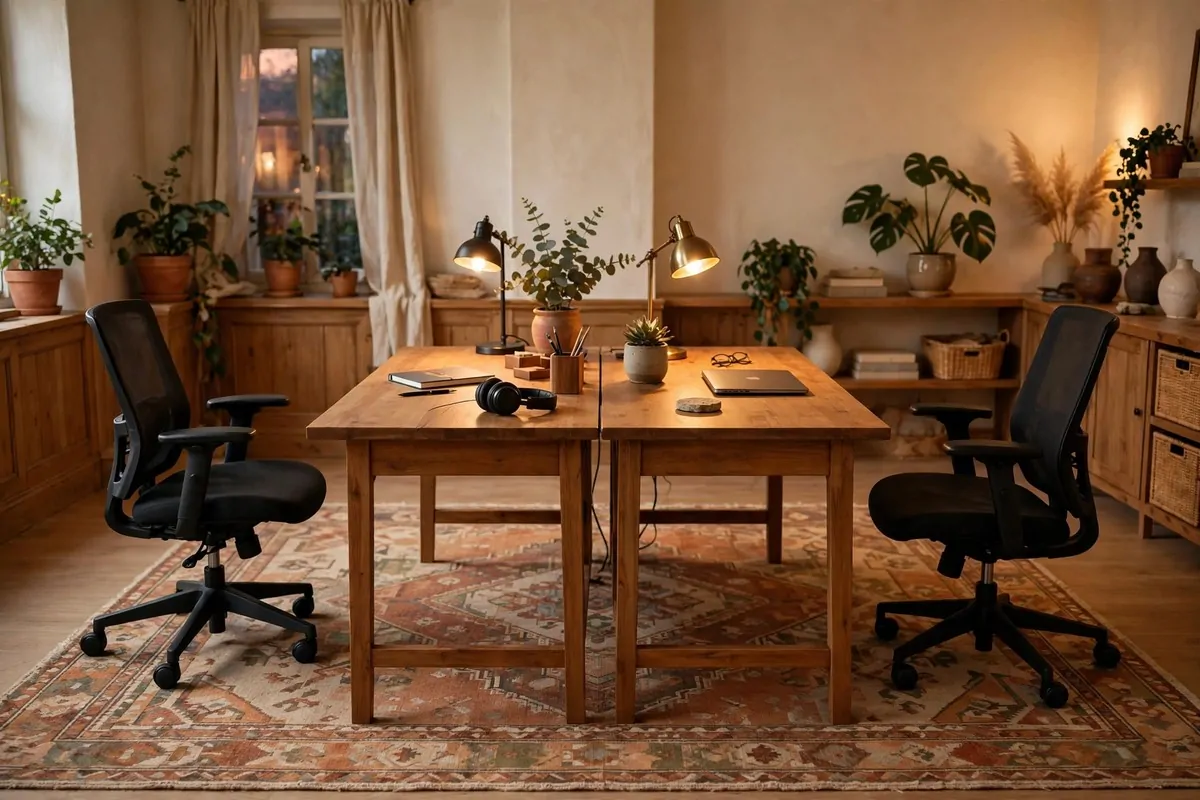
Back-to-back desks are my first pick when the room is big enough for it. You place two desks in the middle of the room with the backs touching. Then each person sits on their own side and faces away from the other.
This setup stops the worst habit of shared offices. You cannot stare at the other person's screen by accident. That means no awkward moments and no fights about privacy.
You also get a small bit of sound help. When you face away from each other, your voices do not hit the other person's ears as hard. Calls feel more private even in the same room.
A rug under both desks ties the whole thing together. It also marks the office zone in a room that does other jobs, like a guest room or a living room corner.
Here is a quick check to see if this layout fits your room:
- You need about 6 feet of clear space for two desks plus chair room.
- Each person needs space behind their chair to push back and stand up.
- A power strip in the middle lets both of you plug in without long cords.
Talking is still easy. You just turn your chair around and there is the other person. It feels like a little office of your own that happens to share a floor.
One thing to watch is cords. With two desks touching in the middle, cables can get messy fast. Tie them up with a few cheap cable ties and you will be fine.
I also like this layout because it feels fair. Nobody gets the "good wall" and nobody sits in the corner. You both get the same desk, the same space, and the same deal.
2. Line Two Desks Along One Wall
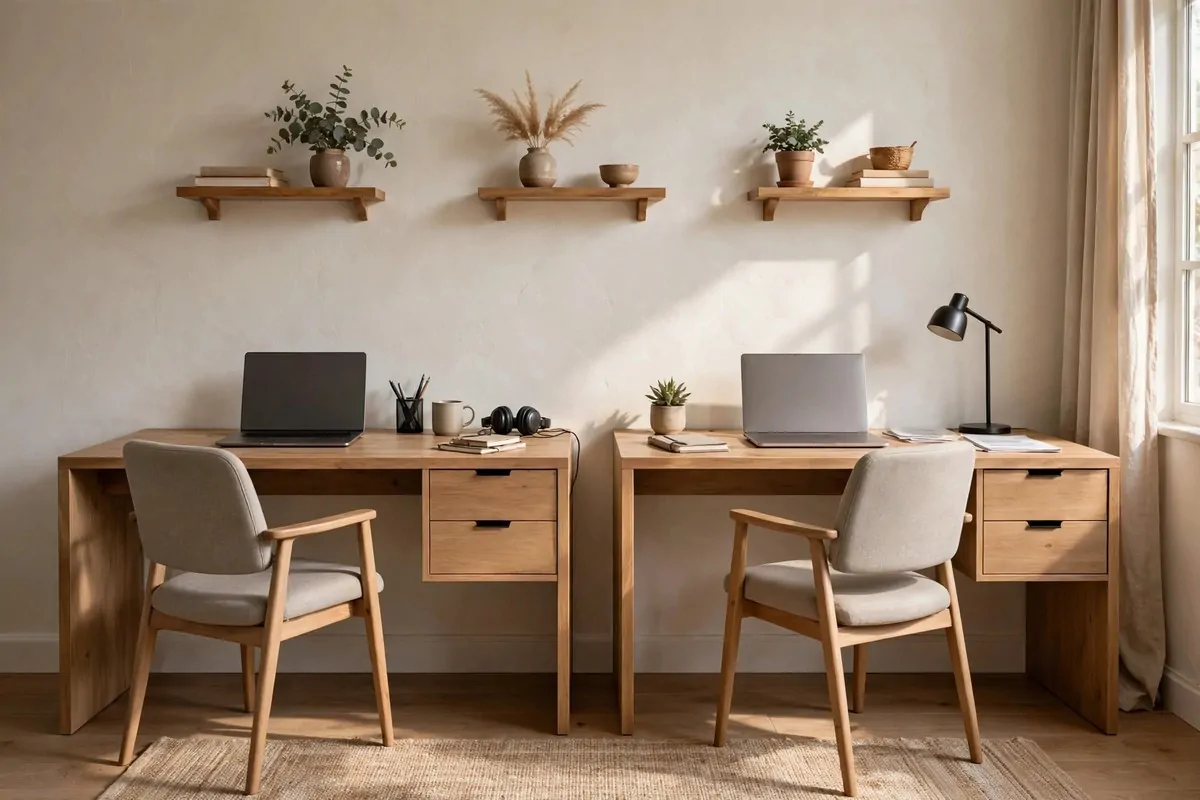
Two desks along one wall is the classic move for a reason. It is simple, it is cheap, and it works in almost any room. You just push both desks against the same wall and sit side by side.
The big win here is wall space. Everything you need can hang on that one wall. Shelves, a pegboard, a clock, a small whiteboard. Both of you reach it without walking anywhere.
It also keeps the rest of the room free. Your office takes up one wall and the rest stays open for play, guests, or a couch. Small homes love this layout for that reason.
The hard part is focus. You sit right next to each other, so every sigh and phone buzz is shared. You will need rules for noise, which I cover later in this post.
Desk depth matters here. Shallow desks, around 20 inches deep, leave more room behind your chairs. Deep desks give you more work space but eat the room fast.
If one of you is left-handed and the other is right-handed, give the lefty the left desk. It sounds small but it stops your elbows from crashing into each other all day.
Matching desks look calmer, but they do not have to be the same. Two desks at the same height feel better than one tall and one short. Your eyes and necks will thank you.
Try this on your first week. Sit side by side for a few days and see how it feels. If it is too close, you can always pull one desk out at an angle later.
3. Face Each Other for Easy Talking
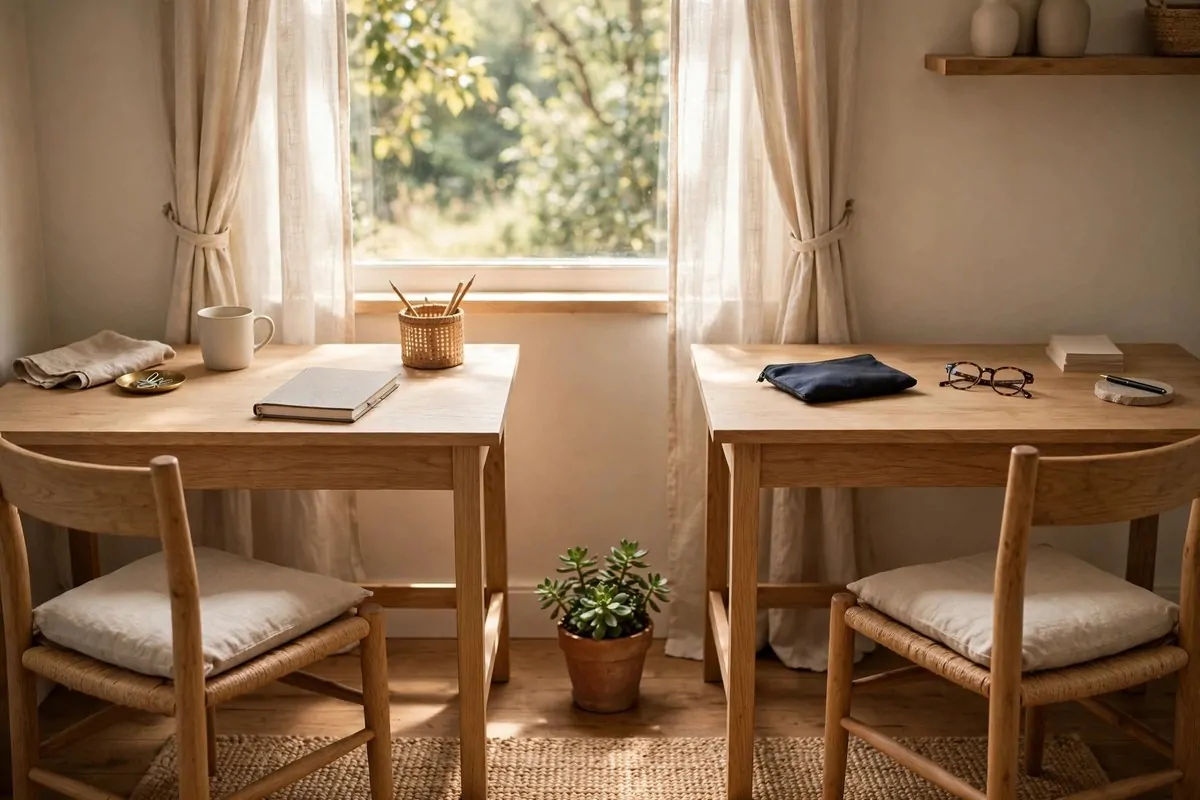
Some pairs talk all day. If that is you, face each other. Two desks facing each other make every question fast. No shouting across the room, no typing a message to someone three feet away.
This layout is great for couples who run a small business together. It is also good for study buddies and for a parent helping a teen with homework. Quick looks and quick answers keep the day moving.
But you need a buffer. Put something small between the two desks. A plant, a stack of books, or a low tray for pens. It softens the staring feeling and gives your eyes a place to rest.
Calls are the tricky part. When you face each other and both talk on calls, it gets loud fast. A simple fix is to take calls in different rooms when you can.
Desk size helps a lot. Smaller desks keep you close enough to talk but far enough to feel okay. Huge desks push you so far apart that you might as well email each other.
I like to keep a shared notebook in the middle. When a thought pops up and the other person is busy, you write it down instead of breaking their focus. They read it when they are free.
Eye contact all day can feel like a lot for some people. If one of you feels watched, this layout is not for you. Try back-to-back instead and save this one for teams that love to chat.
The best test is simple. Face each other for one full workday. By dinner you will know if it made your day better or if you are both tired of each other's faces.
4. Share an L-Shaped Corner Desk
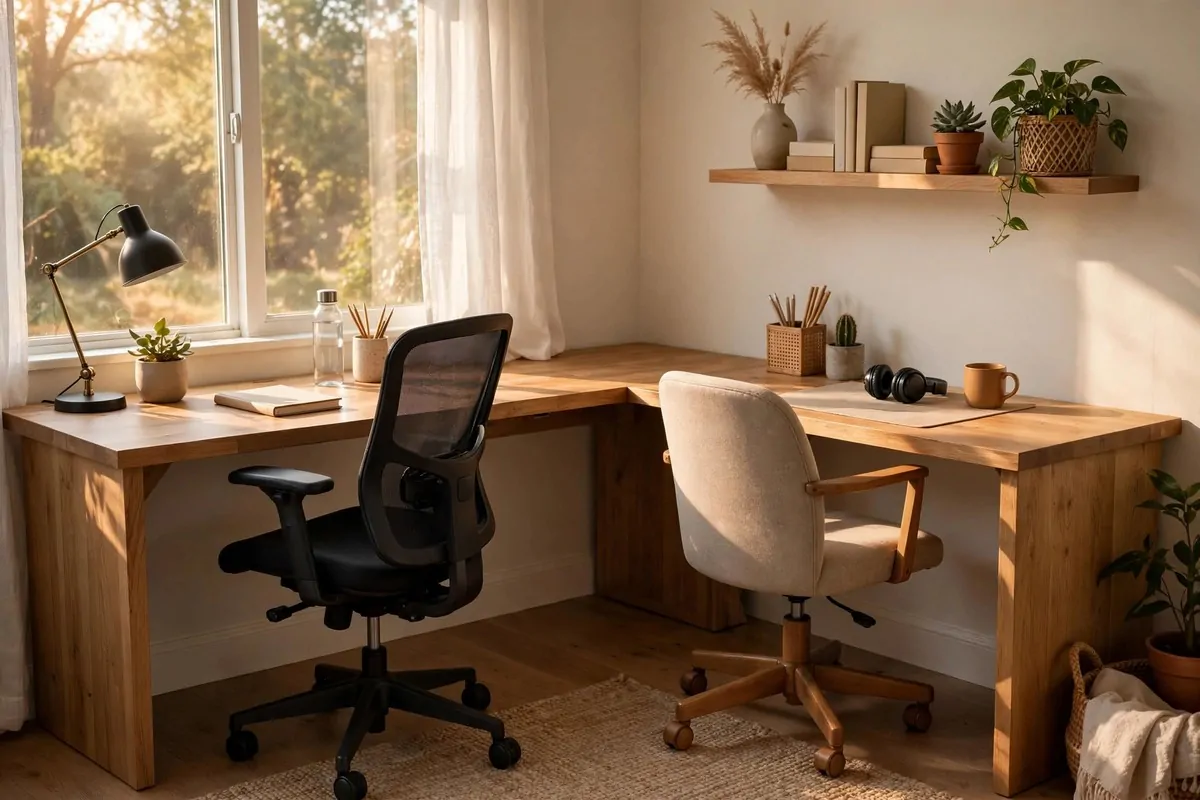
Corners are the most wasted spots in most rooms. An L-shaped desk fixes that. It wraps around the corner and gives two people a full work zone in a spot nobody was using.
One person takes one arm of the L and the other takes the other arm. You sit at a right angle to each other. Close enough to chat, angled enough to not stare.
This is a dream for small rooms. The desk hugs the walls, so the middle of the room stays wide open. Your office feels big even when the room is small.
The corner spot where the two arms meet is the shared zone. Keep a lamp there, or a plant, or the printer. It belongs to both of you and keeps the peace in the middle.
Watch the leg room. Cheap L desks sometimes have a chunky leg right where your knees want to be. Sit at it before you buy, or at least check the photos closely.
Two chairs need to fit without bumping. Measure your chair width and make sure each arm of the L is wider than that. Nothing kills calm like chairs that crash every time someone moves.
Cable chaos lives in corners. Get a small cable tray under the desk and run everything through it. One messy corner will make the whole room feel messy, so fix it early.
I have seen this work great for a parent and kid sharing a study corner. The adult gets one arm, the kid gets the other, and homework time stops being a fight about table space.
If your corner has a window, put the L there. Both people get some daylight, which makes long workdays feel much lighter.
5. Use One Long Desk With a Divider
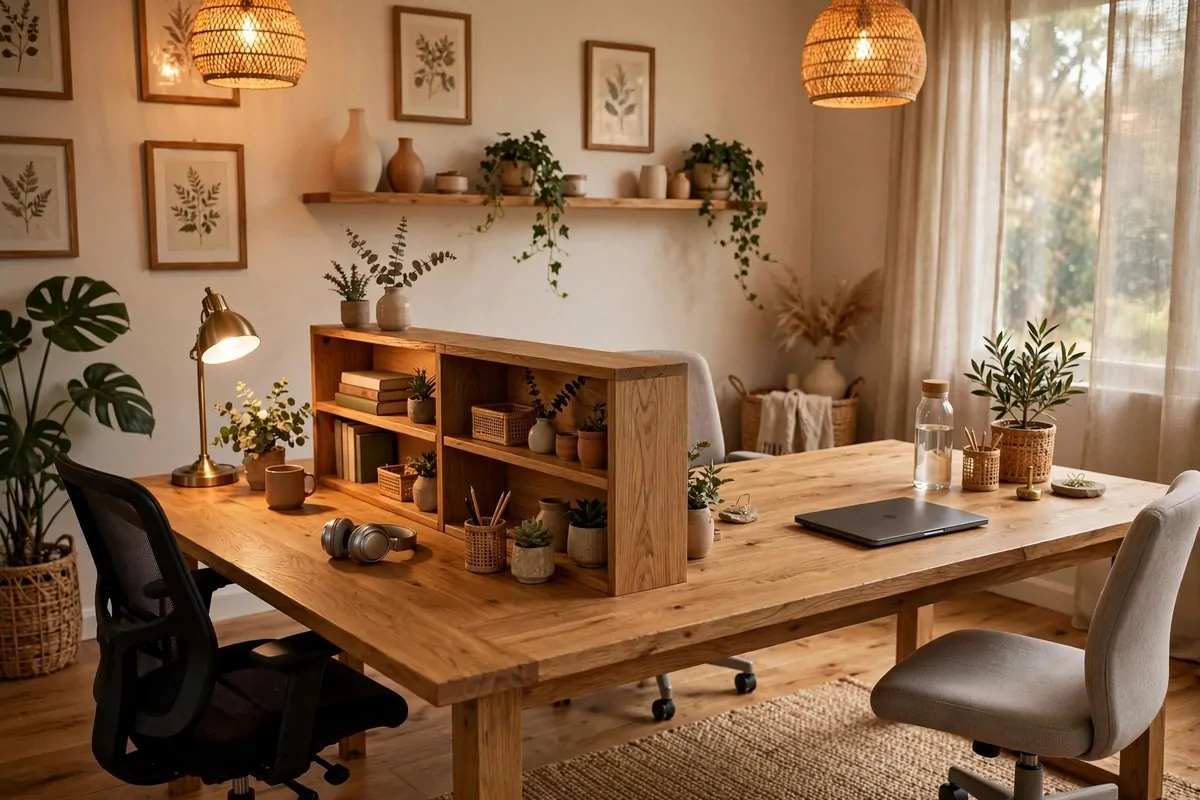
One long desk is cheaper than two desks. But without a divider it feels like one desk, and people start fighting over inches. A divider in the middle fixes that fast.
The divider marks where your side ends and mine begins. It is a small thing but it works like a fence. Your brain treats your half as your own space.
You have many choices for the divider. Here is a quick look at the common ones:
| Divider type | Best for | Watch out for |
|---|---|---|
| Low bookshelf | Storage plus a visual break | It is heavy, so place it once |
| Small desktop shelf | Light split without blocking light | It eats some desk depth |
| Row of plants | Soft, pretty, cheap | It needs watering and some sun |
| Fabric panel | Sound help plus privacy | It can look plain, so add color |
A long desk against a wall is the easiest version. Both of you face the wall, and the divider sits between you like a tiny border crossing.
Keep the divider low if you want to keep talking easy. A divider at eye height will block chat but also block daylight. Low is friendlier for most pairs.
The middle of a long desk is also perfect for shared stuff. Put the printer, the stapler, or the snack bowl right on the divider line. Shared tools live in the middle, personal tools stay on your side.
One rule saves this layout. Agree that your half is yours and their half is theirs. No "borrowing" space for your pile of papers. The divider only works if you both respect it.
Long desks are easy to find secondhand. Dining tables work great as shared desks, and they are built to be sturdy. Just check the height is right for typing.
If the desk is very long, add a leg in the middle. Two people leaning and typing can make a long desk wobble. A center leg or a divider with weight fixes the shake.
This is also the best layout when money is tight. One desk, one divider, two chairs. Done. You can upgrade to two desks later when the budget allows.
6. Split the Room With a Bookshelf
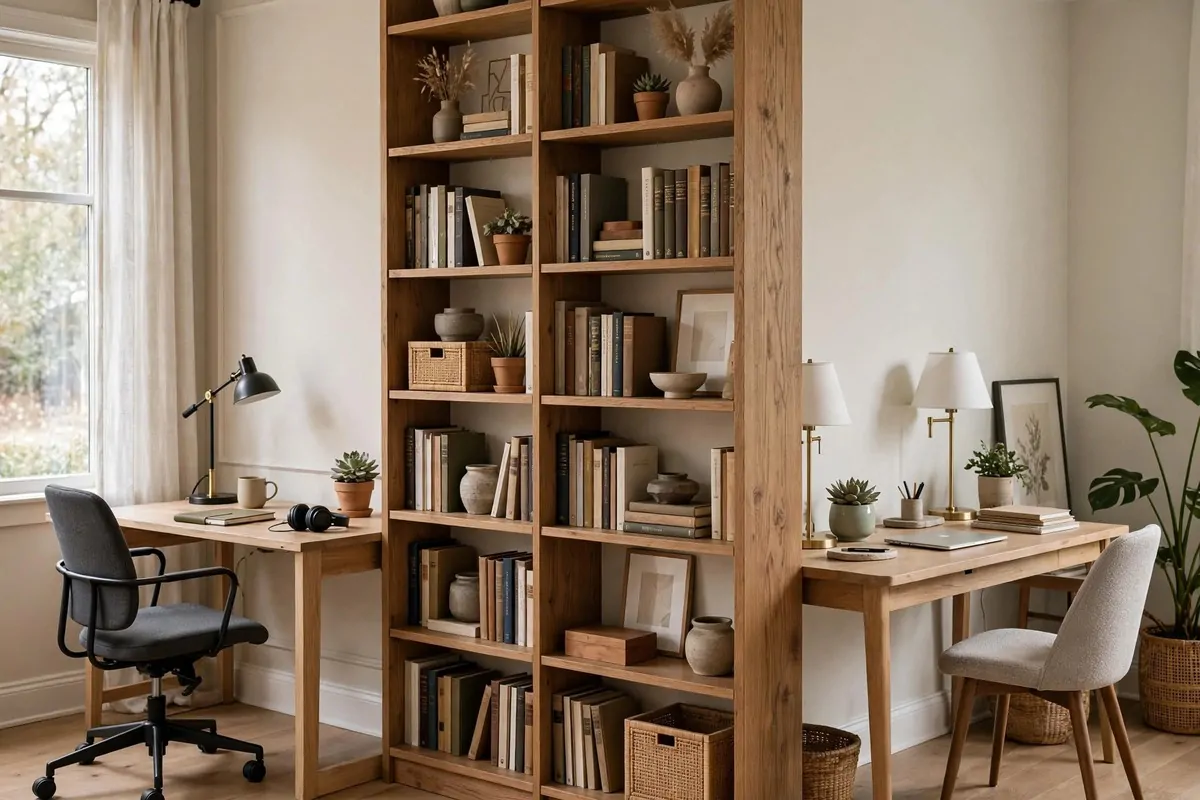
A tall bookshelf is the hardest working divider you can buy. It splits the room, holds your stuff, and looks good from both sides. Three jobs, one piece of furniture.
Place it standing tall between the two desk zones. Each person gets one side of the room and one face of the shelf. Fill your side with your books and boxes.
Use the shelf to hold office supplies for both of you. Paper, notebooks, chargers, the printer. When storage lives on the divider, neither desk gets buried in clutter.
Make sure it cannot tip. A tall shelf with two people bumping desks near it needs to be fixed to the wall. This is not optional if kids or pets run through the room.
The shelf will block some light. Put it so it does not steal the window from one person. Nobody should work in a dark corner while the other sits in sunshine.
Open-back shelves feel lighter than closed ones. Light passes through and you can peek at each other. Closed backs give more privacy but make the room feel split in half.
Style both faces of the shelf. When guests walk in, they see furniture, not a wall of boxes. A few plants and pretty boxes on top make it look planned.
This divider also helps with sound. Books are great at soaking up noise. A full shelf of books between you is like a soft wall for voices.
Measure before you buy. The shelf should be tall enough to feel like a divider but not so tall it makes the room dark. For most rooms, five to six feet is the sweet spot.
7. Grow a Plant Wall Between You
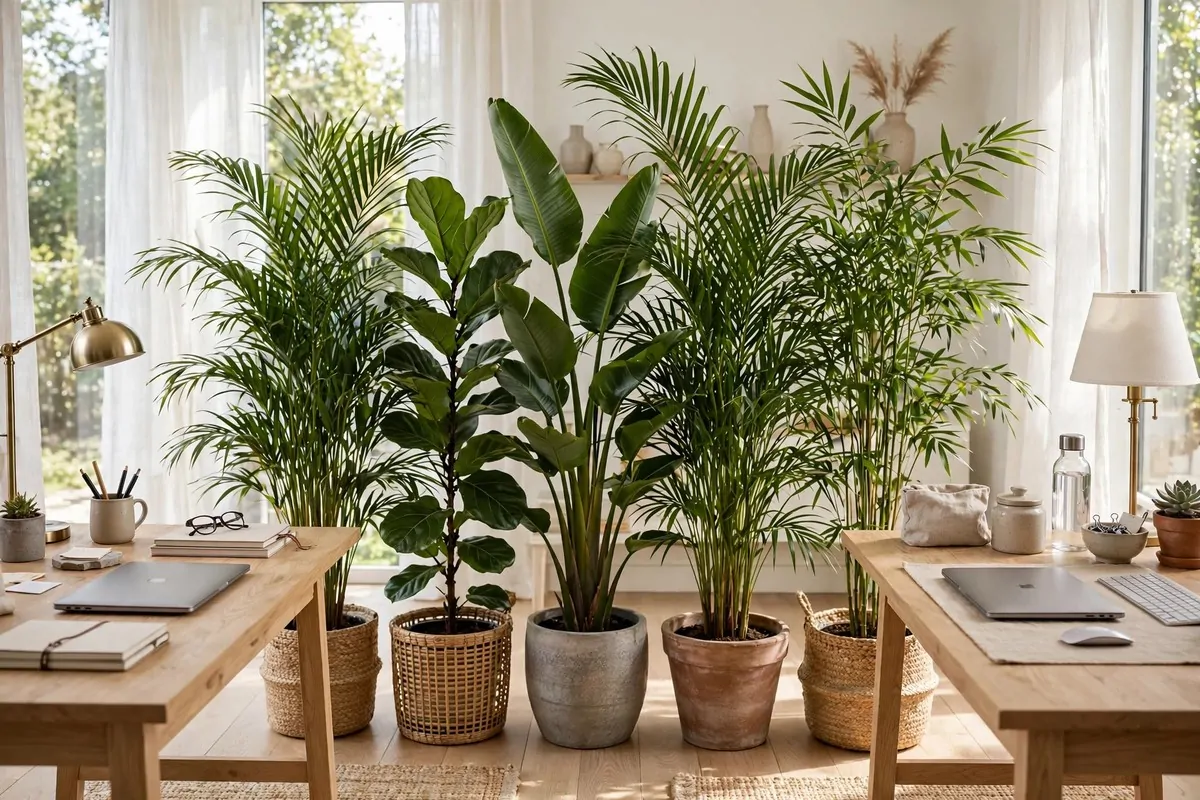
Not every divider has to be furniture. A row of tall plants makes a soft, living wall between two desks. It is pretty, it is calm, and it never feels like a fight about territory.
Pick plants that grow up, not out. Snake plants, tall ferns, or a row of the same plant in matching pots. Matching pots make it look planned instead of random.
Plants clean the air a little and lift your mood a lot. Studies say green near your desk helps you feel less tired. I do not need a study to tell me it feels nice to look at leaves instead of a blank wall.
This divider is cheap to start. Three or four medium plants in simple pots can split a desk for less than a bookshelf. You can add more plants over time as they grow.
The catch is care. Dead plants are sad and ugly. Pick plants that match your light and your habits. If you forget to water, get snake plants or pothos. They forgive a lot.
Put a tray under each pot. Water will spill one day, and a tray saves your desk and your friendship. This is a small thing that stops a big fight.
A plant divider keeps the room feeling open. Light and air pass through the leaves. You get the feeling of your own zone without a big solid wall.
You can also mix in herbs if your office gets good sun. Basil and mint smell great and you can toss them in your lunch. Your desk divider becomes a tiny garden.
Talk to your plant buddy before you buy. One of you might be allergic to pollen or hate the smell of soil. Pick plants you both like and the divider stays a happy thing.
8. Face Opposite Walls
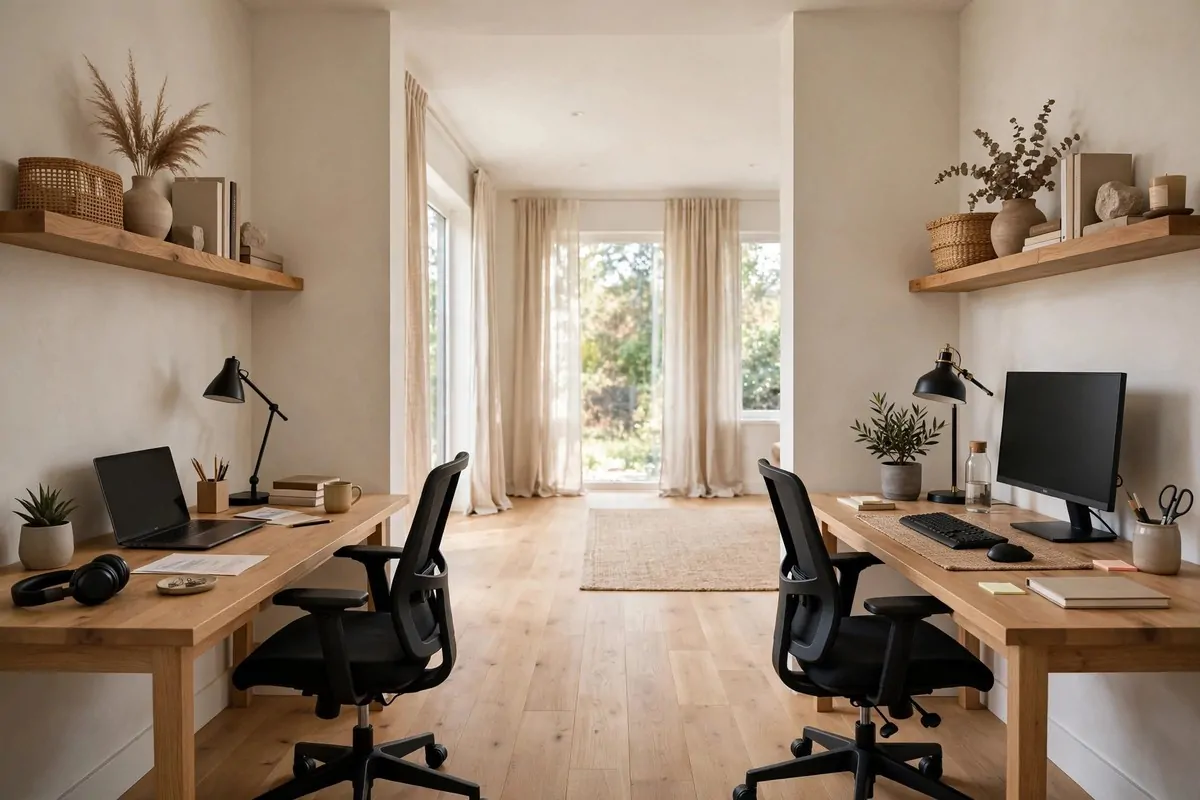
Facing opposite walls is the layout for people who need real focus. You each face your own wall with your backs to each other. It is almost like having two tiny private offices in one room.
This is the best pick when your work needs deep thought. Writers, coders, students, anyone who loses their train of thought when someone moves. Facing away removes most visual noise.
The room needs to be wide enough. Each desk needs about three feet of depth plus chair space. Measure your room before you fall in love with this idea.
The space in the middle becomes shared ground. Put a rug there, a small shelf, or the printer. It feels like a little hallway between your two offices.
Sound still travels, so this layout does not fix noise. It fixes the looking problem. For sound, add the headphone rule from later in this post.
One risk is feeling cut off. Some people feel lonely facing a wall all day. If that is you, turn your chair around for breaks and chat face to face for a bit.
Wall space is your friend here. Each person gets a full wall for shelves, boards, and art. Pin up what you need for your own work and leave the other wall alone.
Light both walls well. A wall-facing desk can feel like a cave if the room light is behind you. A small lamp on each desk fixes it fast.
This layout also ends screen fights. Nobody can peek at your screen by accident. That privacy helps when one of you handles bills, health stuff, or work you cannot share.
Try it for a week before you judge it. The first day feels strange. By day three most people love how calm their corner feels.
9. Mix One Fixed Desk and One Roaming Spot
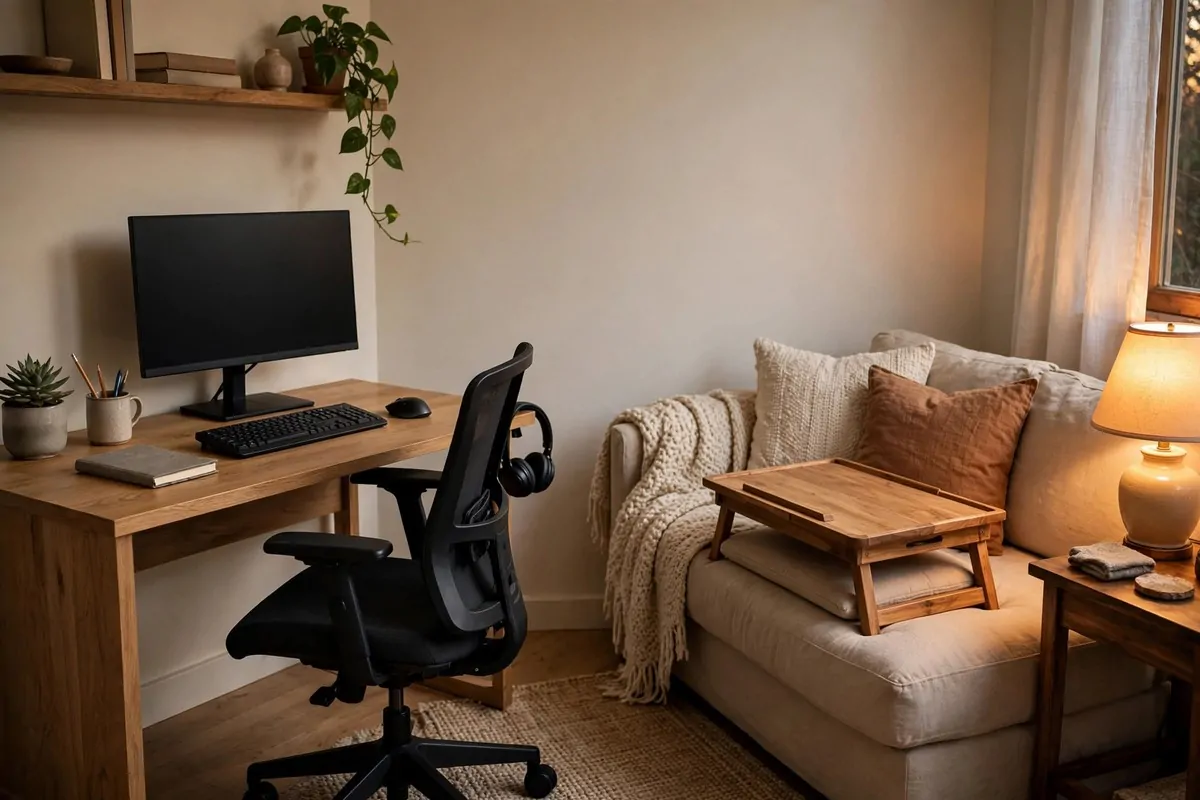
Not every worker needs a full desk. Sometimes one person needs the big setup and the other just needs a laptop spot. A fixed desk plus a roaming spot can be the perfect mix.
The fixed desk belongs to the person with more gear. Monitors, a keyboard, papers, all the stuff that cannot move. That person gets the desk full time.
The roaming spot is a lap desk, a tray table, or a comfy chair with a cushion. The second person can work from the sofa, the armchair, or even the bed on slow days.
This works great when schedules differ. If one of you works mornings and the other works nights, the roamer can even use the main desk when it is free.
The key is a good lap desk. Cheap ones wobble and slide. Spend a little more on one with a firm top and a soft bottom. Your neck and your laptop will thank you.
Keep a shared charging spot near the roaming area. Nothing is worse than settling into the sofa and seeing your battery at five percent. A plug within reach fixes it.
You also need a home for the roaming gear. A basket or a small shelf where the lap desk and laptop live when the day is done. If it has no home, it will live on the floor.
This setup is kind to small homes. You get two work spots but only one desk takes up floor space. The room still feels like a living room, not an office.
Talk about desk time honestly. The roamer should get the big desk sometimes too, like for video calls or long writing days. Share the good seat and nobody feels second place.
10. Hang a Curtain Divider
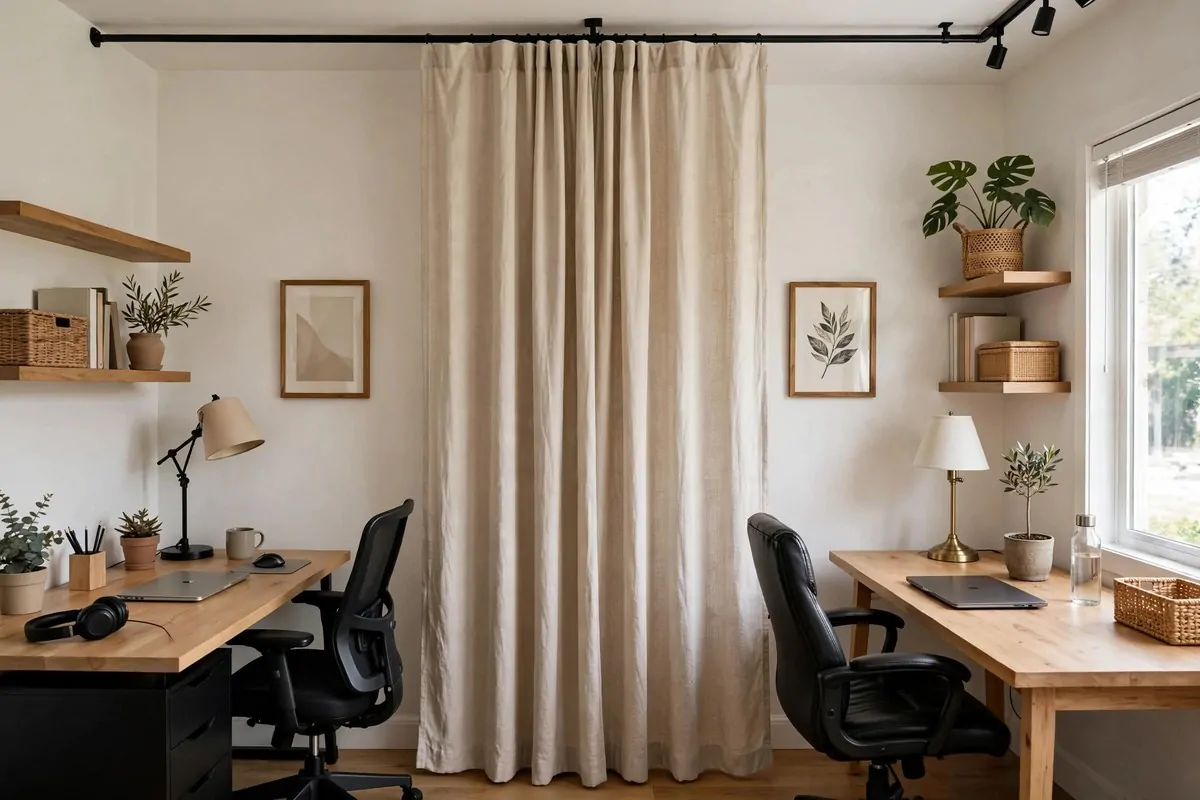
A curtain divider is the fastest way to split a room. You hang a curtain from the ceiling and pull it closed when you need your own zone. Open it when you want to feel together.
This is perfect for renters. A tension rod or a ceiling track needs no big holes. When you move out, it comes down in minutes and the room looks like it did before.
Curtains also soften sound a little. They will not block a loud call, but they take the edge off typing and small noises. Thick fabric works better than thin.
Pick a curtain you both like. You will see it every day. A color that fits the room keeps it from looking like a hospital screen. Light colors keep the room feeling bright.
Here is how most people hang one:
- Measure the spot where the curtain will hang, wall to wall or partway.
- Use a ceiling track kit or a strong tension rod made for wide spans.
- Hang the curtain so it just kisses the floor, not pools on it.
- Add tie-backs so you can open it fully on days you want togetherness.
A curtain also hides mess. When guests come over, pull the curtain and your office half disappears. It is like a magic trick for small homes.
The closed curtain can feel dark on one side. Add a small lamp behind it so the closed-off zone still has light. Working in the dark is no fun.
Agree on curtain rules. When is it closed and when is it open? A simple rule like "closed during calls, open the rest of the day" stops most fights.
Curtains need a wash now and then. Dust builds up on fabric that hangs still. Toss it in the wash every few months and it stays fresh.
11. Share One Big Storage Wall
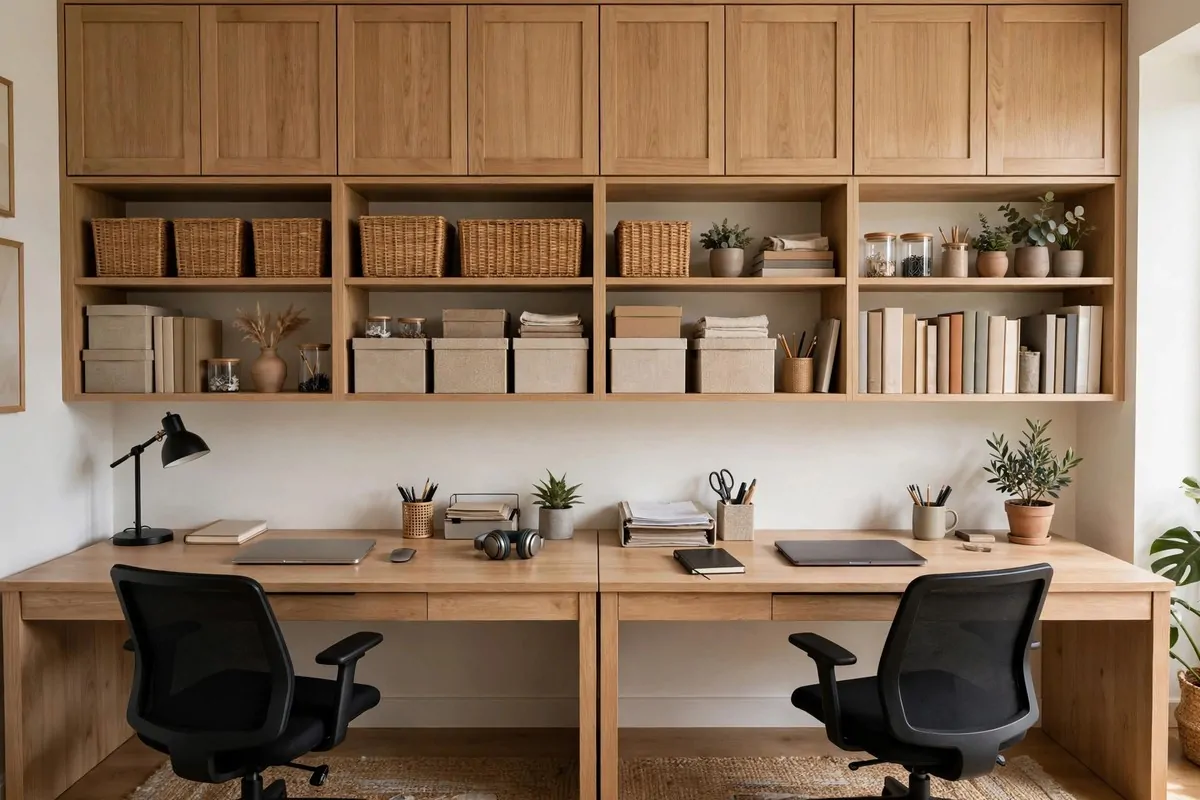
Clutter is the number one killer of shared offices. Two people means twice the stuff. One big storage wall gives every item a home and keeps both desks clear.
Pick one wall and make it the storage zone. Shelves up high, cabinets down low, and both desks sitting under it or beside it. Everything has a place.
Split the storage down the middle. Left half is yours, right half is mine. Label the shelves if you need to. Labels feel silly until they stop your third fight about the missing stapler.
Go vertical. Tall shelves use wall space, not floor space. In a small room, up is the only direction you have left. Use it.
Closed cabinets hide the ugly stuff. Cords, old files, the box of cables nobody wants to sort. Doors make it all vanish. Open shelves are for the pretty stuff and the things you grab daily.
Shared supplies live in the middle. Paper, pens, tape, the printer. Put them where both of you can reach. Personal supplies live on your own side.
Do a quick clean every Friday. Ten minutes, both of you, put stuff back on the storage wall. Shared spaces stay clean only when both people keep them clean.
A storage wall also makes the room look planned. Guests see one neat wall instead of two messy desks. It is the fastest way to make a shared office look grown up.
If you cannot build shelves, use two tall bookcases pushed together. It looks like one wall and costs much less. Add matching baskets and it looks like you hired someone to plan it.
12. Match Your Desks for Calm
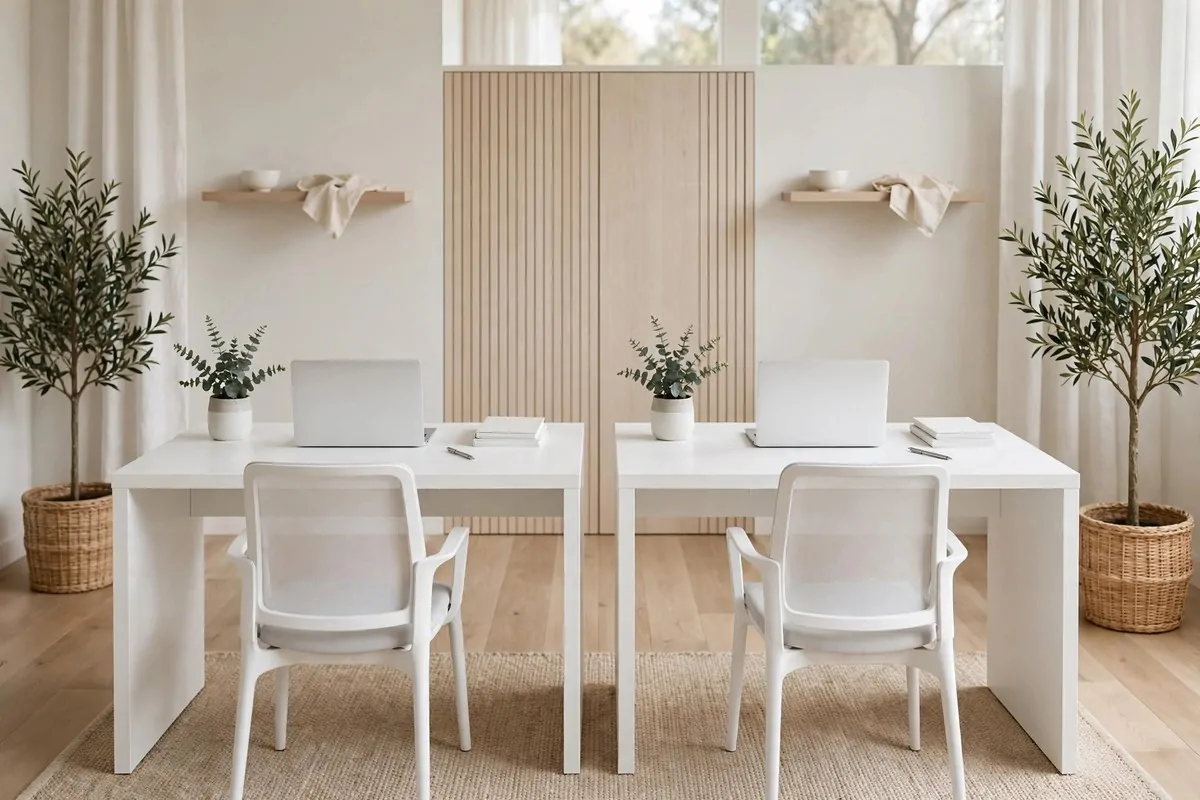
Matching desks make a room feel calm. Two of the same desk, two of the same chair, and the whole space looks like one plan instead of two accidents. Your eyes relax and so do you.
This trick is used in real offices for a reason. When everything matches, the room feels bigger and tidier. Mismatched stuff can look fun, but it can also look busy.
You do not need to spend a lot. Many simple desks come in the same line at low prices. Buying two of the same cheap desk often costs less than two different "nice" ones.
Match the chairs too if you can. Different chairs are fine, but matching chairs keep the look clean. At the very least, keep them the same color family.
Fairness is a hidden win here. When both setups are the same, nobody feels like they got the worse deal. No one can say your desk is bigger or your chair is nicer.
You can still show personality on matching desks. The desks match, but your mugs, your plants, and your notebooks can be all you. Same bones, different soul.
Keep cords the same too. If one desk has tidy cables and the other looks like spaghetti, the room still feels messy. Spend one hour and fix both desks on the same day.
Matching works best in small rooms. When space is tight, visual calm matters more. Two matching desks in a small room feel like a plan. Two random desks feel like a storage unit.
Take a photo when you are done. It helps you see the room like a guest sees it. If the photo looks calm, you did it right.
13. Let Each Desk Show Personality
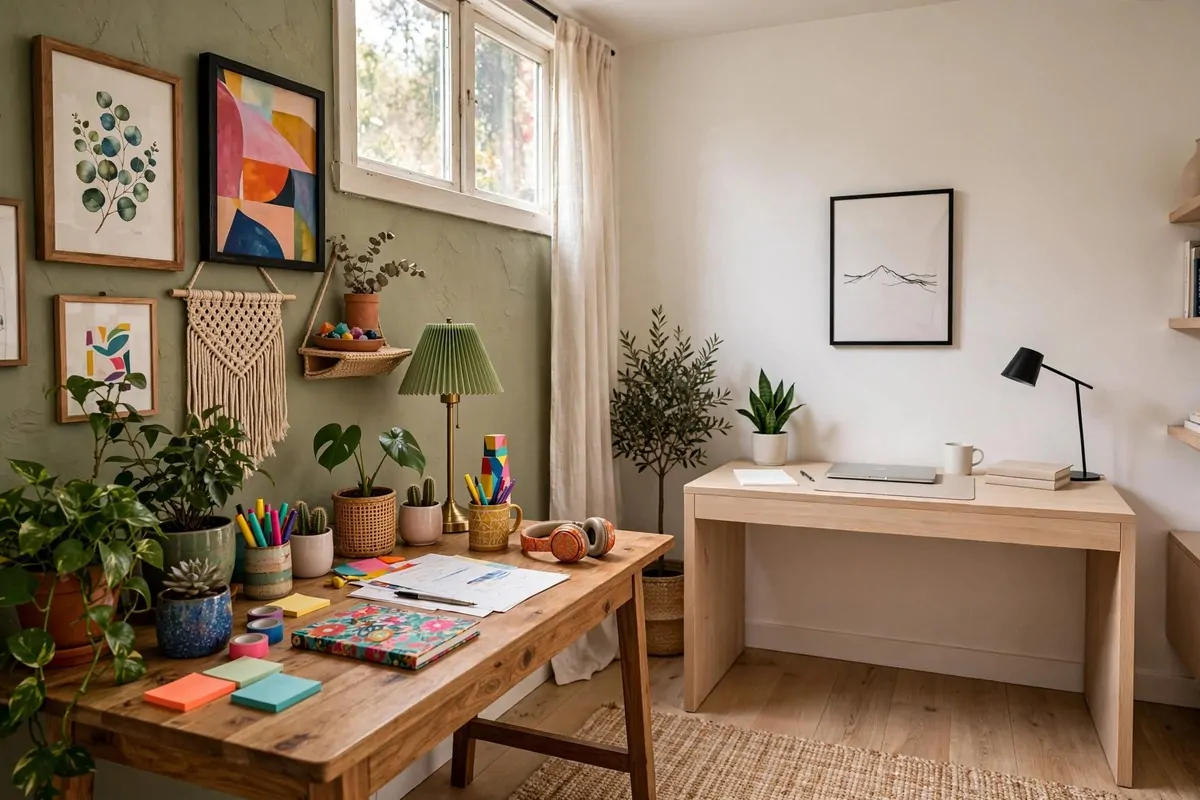
Some pairs are opposites, and that is fine. Letting each desk show personality can make a shared office feel more like home. One side colorful and full of art, the other side plain and quiet.
This works when both people truly do not mind the difference. One person's cozy clutter is another person's nightmare. Talk about it first and be honest.
Set one shared rule: your side, your style, but no spillover. Your posters stay on your wall. Your pile of books stays on your desk. The middle stays neutral.
Different desks can still work at the same height. A tall desk next to a short desk looks odd and feels odd when you sit down. Keep the heights close even if the styles differ.
This layout is great for showing kids that grown-up sharing is real. A parent with a plain desk and a teen with a wild desk can share one room and both feel like themselves.
Color can mark the sides without a fight. Your chair is blue, mine is green. Your lamp is round, mine is square. Small choices like this make each spot feel owned.
The risk is visual noise. If both sides go wild, the room feels loud. A good deal is this: one person goes bold, the other stays calm. Or both go medium. Balance keeps it livable.
Take turns picking shared items. The rug, the curtains, the big shelf. If one person picks everything, the other feels like a guest. Shared picks make it feel like ours.
Photos of your people go on your own side. It sounds small, but seeing your own photos at your own desk makes the space feel like yours even when the room is shared.
14. Give Each Side Its Own Color
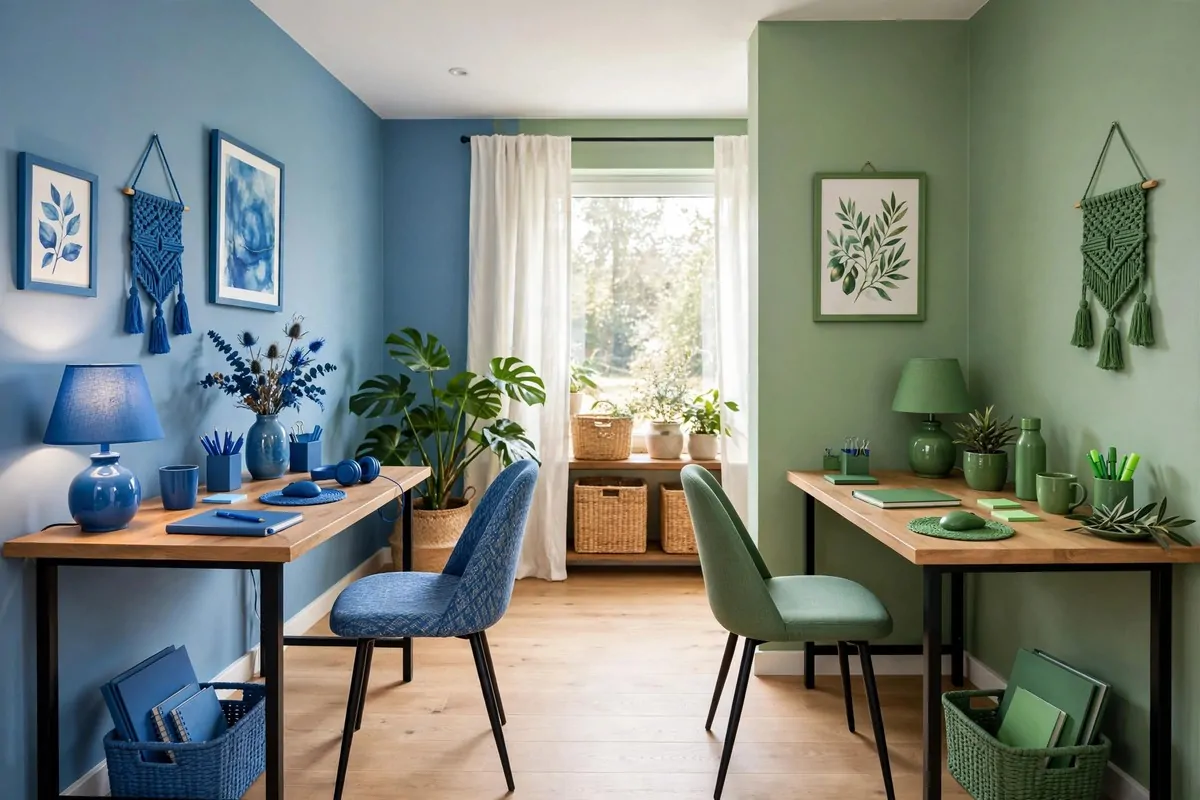
Color is a quiet way to split a room. Give each side its own color and the room feels divided without any wall or shelf. Your brain reads the color change as a border.
Pick two colors that get along. Blue and green, warm gray and soft yellow, blush and cream. Colors that fight will make the room feel tense, which is the opposite of what you want.
You do not need to paint walls. Renters can do this with art, cushions, desk mats, and storage boxes. A blue poster on your side and a green plant pot on mine does the job.
Start with one anchor item per side. A rug in your color under your desk is the strongest move. It marks your ground in a way everyone understands.
Add small touches from there. A desk organizer, a notebook, a mug, a small frame. Three or four items in your color are enough. More than that starts to look like a theme park.
Keep shared items neutral. The rug between you, the curtains, the big shelf. Neutral shared stuff lets both colors shine without clashing.
This trick also helps kids share a study room. Each child gets their color and suddenly the room feels fair. Fights about "your side" drop fast when the sides are clear.
Light matters for color. A color that looks soft in the shop can look loud in bright sun. Test with one small item first and live with it for a few days.
If you ever get bored, colors are easy to swap. New cushion covers and a new desk mat cost little and change the whole feel. It is the cheapest room makeover there is.
15. Quiet the Room With Rugs and Panels
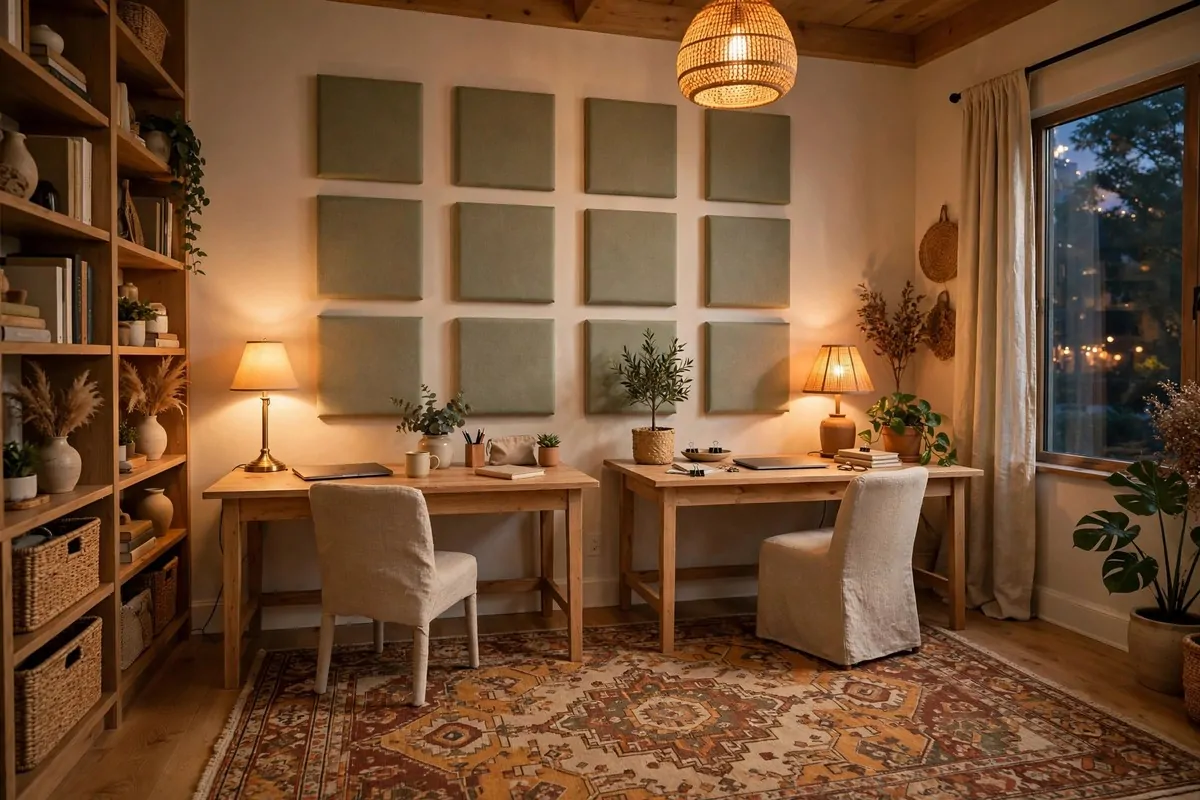
Two people in one room means twice the noise. Typing, calls, music, chair wheels. Rugs and fabric panels soak up that noise and make the room feel calmer right away.
Hard floors bounce sound everywhere. A big rug under the desks is the single best noise fix for the money. It also feels great under your feet, which is a nice bonus.
Fabric wall panels are the next step. They are soft boards that hang on the wall and eat echo. You can buy them or make them with fabric over simple frames.
Place panels where sound bounces most. The wall behind each desk and the wall between you are the best spots. You do not need to cover every wall to feel the difference.
Panels can also be pretty. Pick fabric in colors you both like and they look like art. Some people pin photos or kids' drawings on them, which makes them personal.
Curtains help too. Heavy curtains on the window cut street noise and soften the room. If your office has a thin door, a curtain over the door helps more than you would think.
Soft chairs beat hard chairs for noise. A chair with fabric or cushion makes less sound when you move. Small thing, big difference over a full day.
Do not forget the ceiling in a tall room. Sound bounces up there too. A hanging fabric panel or even a big paper lantern softens it. It looks cozy as well.
Test the change with a call. Have one person talk on the phone while the other listens. Add the rug first, then panels, and you will hear the room get quieter step by step.
16. Agree on a Headphone Rule
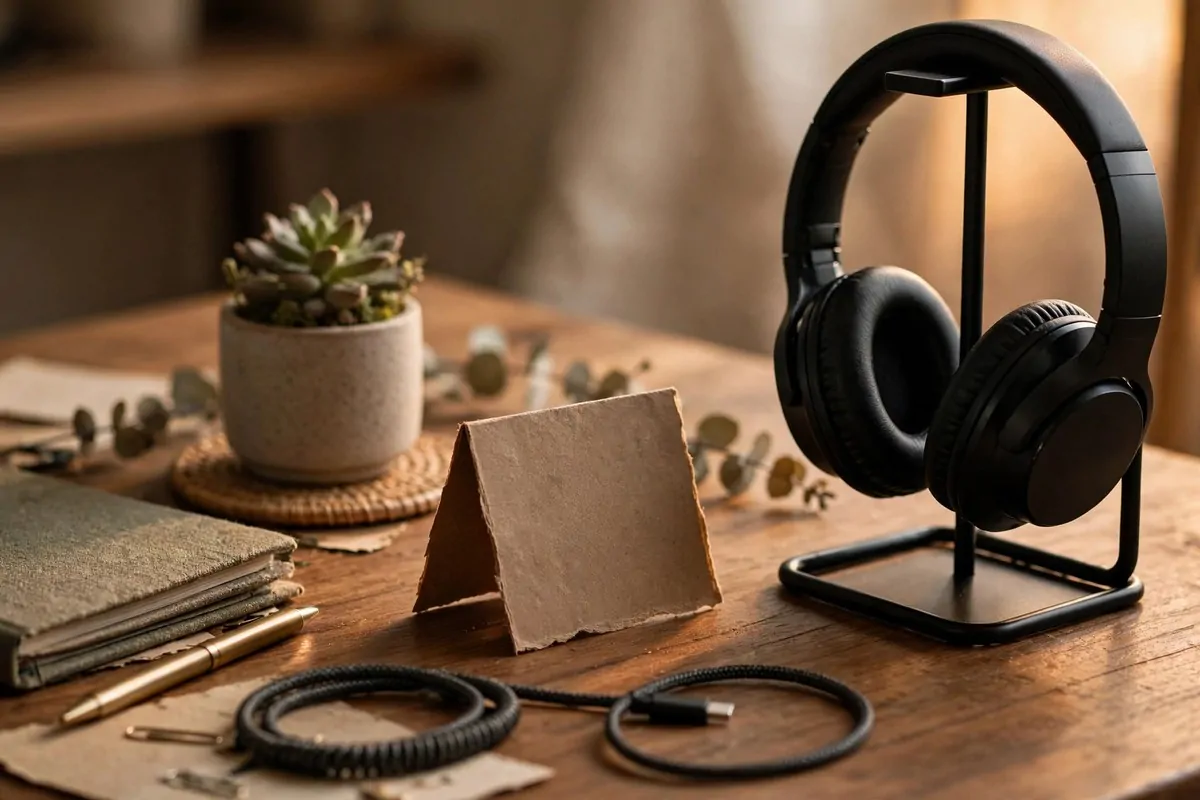
Headphones are the shared office's best friend. But they only work if both people agree on what they mean. A headphone rule turns a simple habit into a peace treaty.
The basic rule is this: headphones on means do not talk to me. Headphones off means I am free. It sounds simple, but writing it down stops a hundred small interruptions.
Add a visual signal for extra clear days. A small "busy" sign, a red card on the desk, or a funny flag. When the sign is up, the other person waits. No exceptions.
Here is a simple signal chart you can copy for your own room:
| Signal | What it means | What the other person does |
|---|---|---|
| Headphones on | I am in deep focus | Wait or send a text |
| One earbud in | I am working but free | Quick questions are fine |
| Busy sign up | Call or deadline, do not knock | Leave the room if you can |
| Headphones off | I am free to chat | Talk away |
Both people need decent headphones. Cheap earbuds leak sound and hurt after an hour. A comfy pair each is one of the best buys for a shared office.
Noise-cancelling is worth it if calls overlap a lot. It will not erase everything, but it turns a loud room into a soft hum. Your focus will thank you.
Set quiet hours too. Maybe the first hour of the day is silent work for both. No calls, no chatting, just heads down. Shared quiet time feels like a gift.
The rule must go both ways. If you want people to respect your headphones, you must respect theirs. One-sided rules breed quiet anger, and quiet anger is the worst kind.
Review the rule after two weeks. What worked? What felt silly? Change it together. A rule you both shaped is a rule you both keep.
17. Give Everyone Their Own Lamp
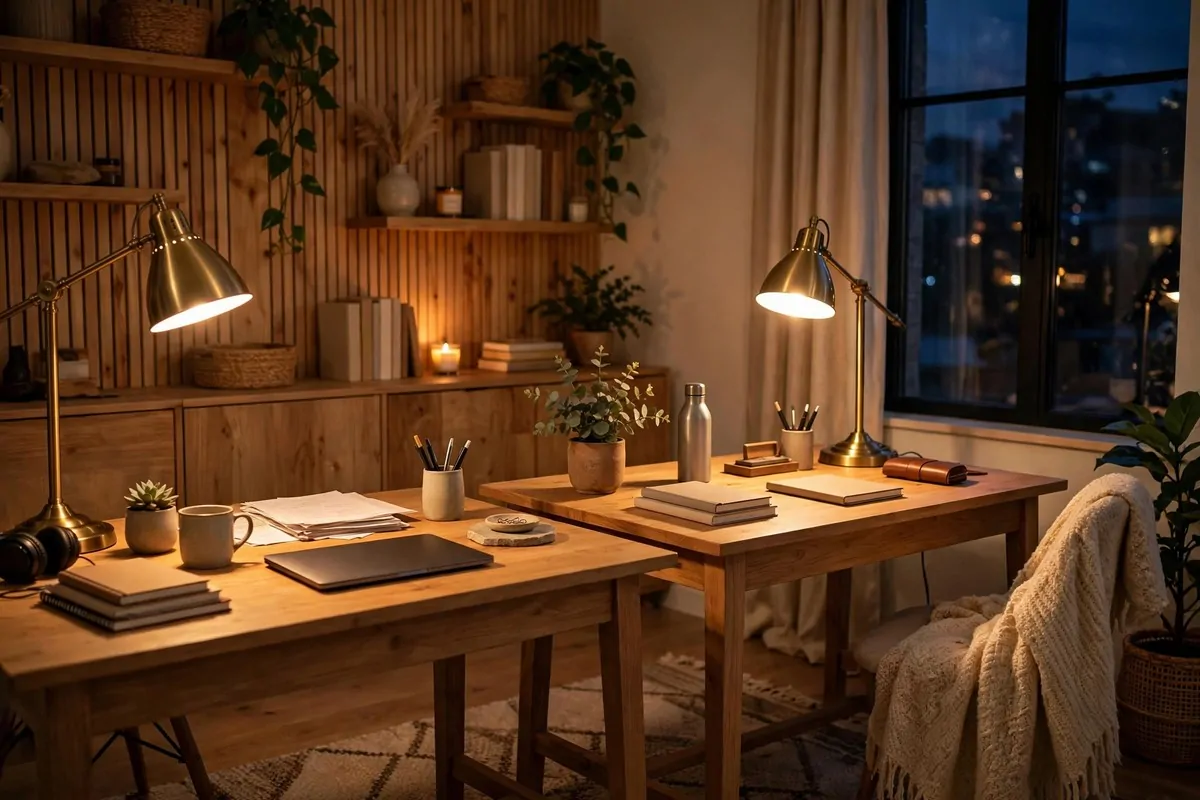
Your own lamp means you choose your brightness. One of you likes bright white light, the other likes warm and soft. Two lamps let you both win. One shared light makes one of you lose.
One ceiling light for two workers is never enough. Each person needs their own lamp. It is about good light for your eyes, and it is also about control over your own space.
Task lamps with bendy arms are the best pick. You point the light at your work, not at your partner's face. Aim it down and keep the peace.
Warm light feels calmer for most people. Cool white light can feel like a hospital. Try warm white bulbs first and see how the room feels in the evening.
Here are lamp styles that work well on shared desks:
- Clip-on lamps that grab the desk edge and save surface space.
- Small desk lamps with a heavy base that will not tip over.
- Lamps with dimmers so each person can set their own level.
- Lamps with warm bulbs for evening work that feels less harsh.
Lamp placement matters. Put the lamp on the opposite side of your writing hand. Right-handed? Lamp on the left. This stops your hand from making shadows on your work.
Matching lamps look tidy, like the matching desks idea. But different lamps are fine too. The light matters more than the look. Function first, pretty second.
Turn lamps off when you leave. It saves power and it signals that your workday is done. A dark desk is a clear sign: this person is off duty.
If one of you works nights, a lamp with a low warm setting is kind. It lights your desk without lighting the whole room. Your partner can sleep or relax nearby in peace.
18. Build One Shared Charging Station
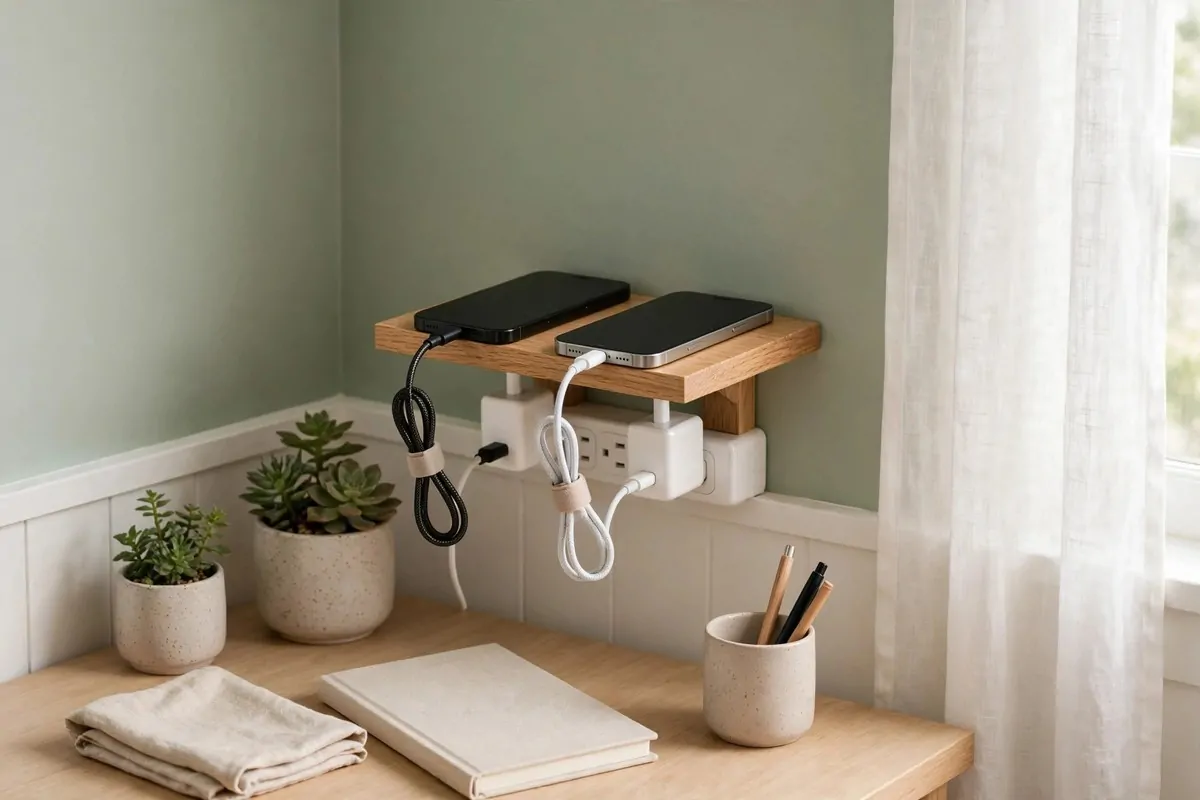
Two people means double the chargers. Phones, laptops, tablets, earbuds, watches. Without a plan, chargers spread across every plug in the room like weeds.
One shared charging station fixes it. Pick one spot, like a small shelf or a tray on the storage wall. Every charger lives there. Every device charges there.
Use a power strip with enough plugs for both of you. Count your daily devices and add two extra plugs. You will need them sooner than you think.
Label the chargers. A tiny tag or a bit of colored tape on each cord. When both phones use the same plug type, labels stop the "is this mine?" dance.
Tidy the cables with ties or a cord box. A charging station with messy cables is just a messy corner with a fancy name. Ten minutes of tying makes it look clean.
Set a simple rule: devices charge at the station, not at the desks. This keeps desk plugs free for laptops and lamps. It also stops cords from crawling across your work space.
Your phone is across the room, so you check it less. Both of you get more focus without even trying. A charging station is also a natural break spot.
Keep one long cable for sofa charging. The roamer from idea nine needs power too. One long cable on a hook near the sofa covers it.
Clean the station once a month. Old cords pile up fast. If a charger has not been used in weeks, it can go in a drawer. Less clutter, less confusion.
19. Make a Shared Break Corner
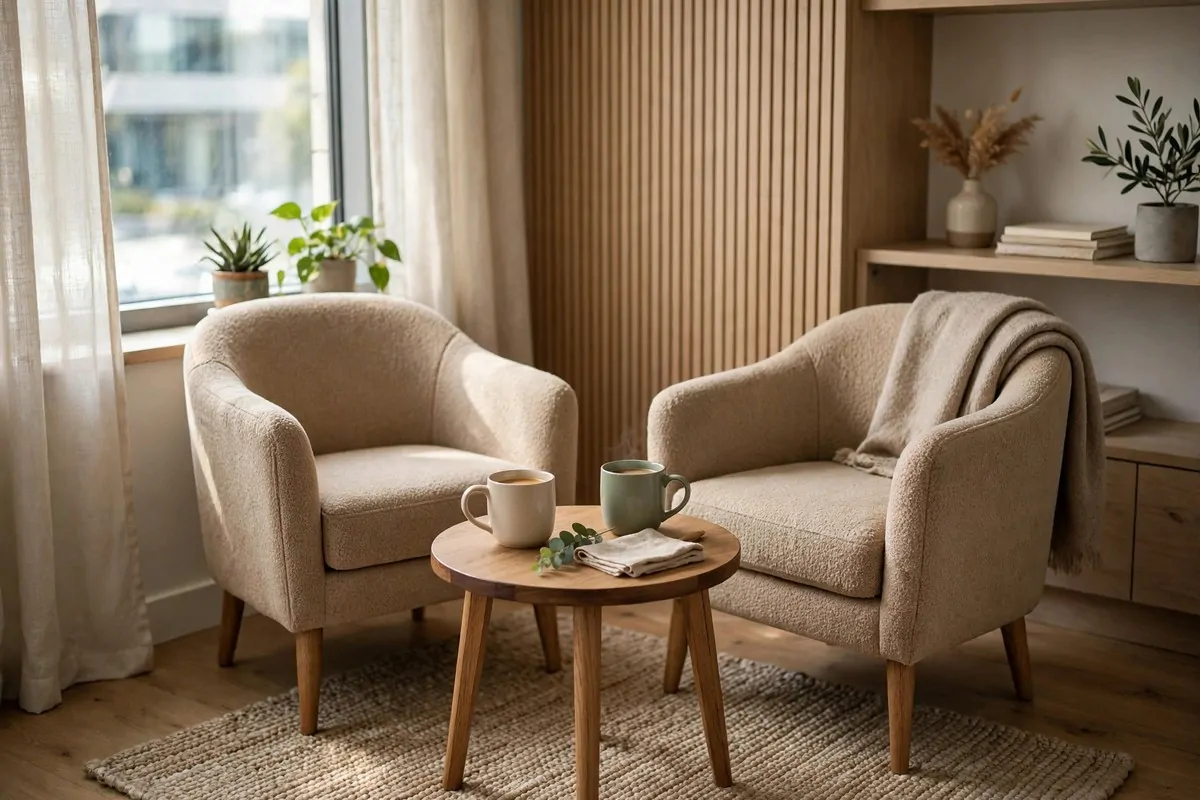
Every shared office needs a spot that is not for work. A small break corner with two chairs and a side table gives both of you a place to rest, chat, and drink coffee away from the screens.
Breaks together build the relationship. When you share a room all day, you need good moments too, not just work moments. A five-minute tea break side by side does more for peace than any rule.
You do not need much space. A corner with two small chairs and a tiny table is enough. Even a window sill with two cushions can work in a tight room.
Keep it screen-free. No laptops, no phones on the table if you can help it. The break corner is for eyes-off-screen time. Your brain needs that rest to work well later.
Stock it simply. A small tray with mugs, tea bags, and a water bottle. When the break spot is ready, you actually take breaks. When it is not, you just keep working until you burn out.
This corner also saves your work chairs. Sitting in the same chair for work and rest blurs the day together. Moving to a new seat tells your body that break time is real.
Use the corner for hard talks too. When you need to discuss a problem, like noise or mess, talk there instead of at the desks. Neutral ground makes hard talks feel kinder.
Add one cozy thing. A soft throw, a small plant, a funny photo. Cozy corners get used. Cold corners get ignored.
End your day there sometimes. Five minutes together, no screens, talk about the day. It turns a shared office from a place you survive into a place you like.