21 Office Space in Bedroom Setups That Don’t Feel Cramped

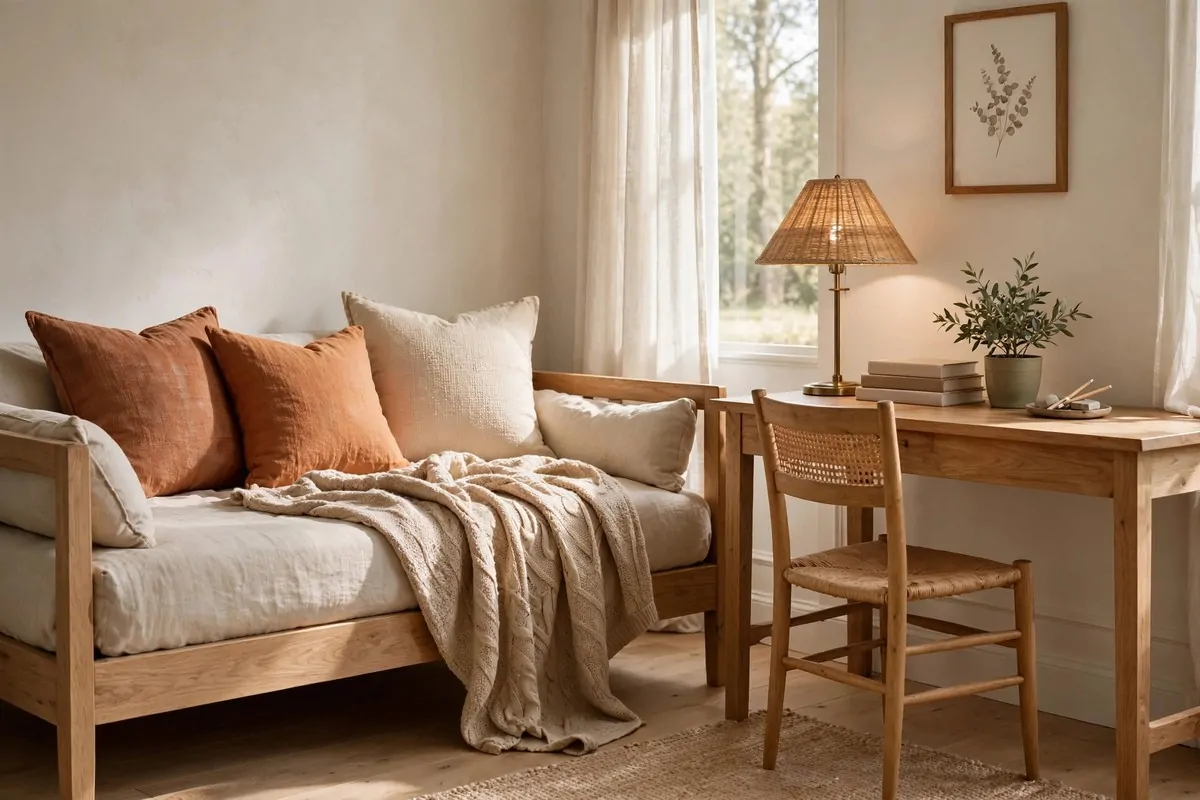
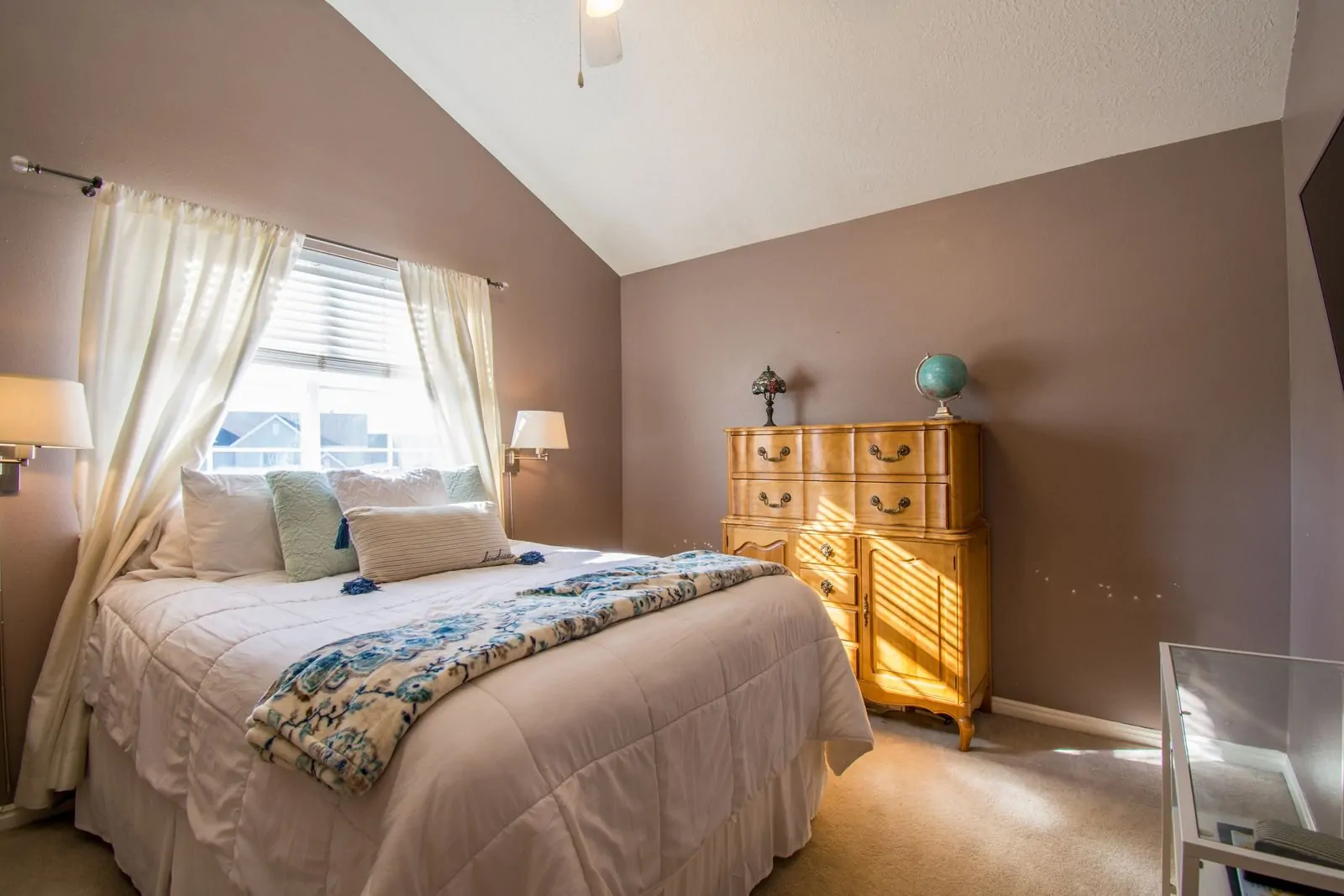
My bedroom has two jobs and one small floor. In the morning it is my office. At night it is where I sleep. And the desk had to learn to share, because the bed was here first.
The bed is the boss of this room. It takes up the most floor, it holds the softest things, and it never moves. My desk is the guest. It sits in the corner the bed does not want, and it works around the bed’s schedule, not the other way round.
When my desk tried to act like the boss, my sleep got worse. I would lie in bed and stare at the laptop. I would see the papers and think about tomorrow. So I moved the desk, I shrank the desk, and I gave the bed its room back. My sleep got better the same week.
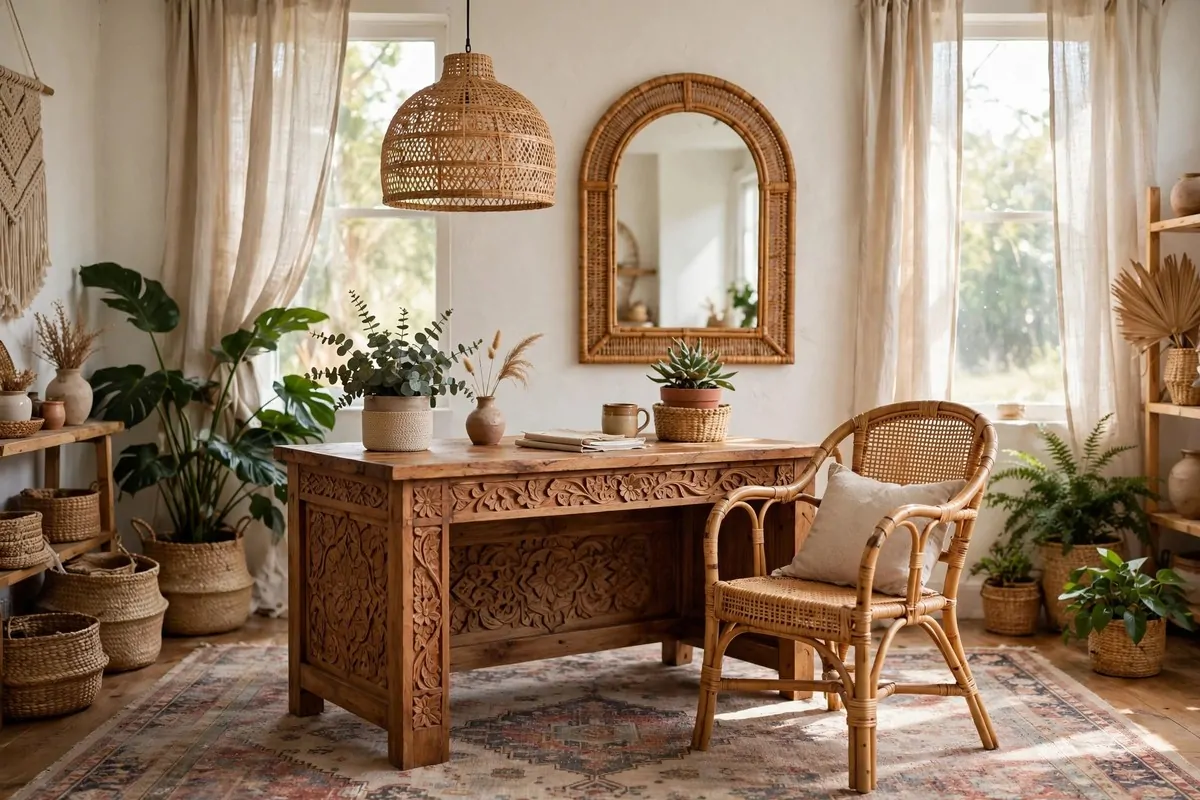
These 21 Office Space in Bedroom setups are all about that deal. A desk that fits next to a bed without crowding it. A workspace that lets you sleep well at night and work well in the day.
That is what this list is for. Not a bigger bedroom. A smarter one. A room where the bed and the desk share the floor and neither one wins. Pick the setup that matches your bedroom, and start with the spot your bed is not using.
The Bed Was Here First
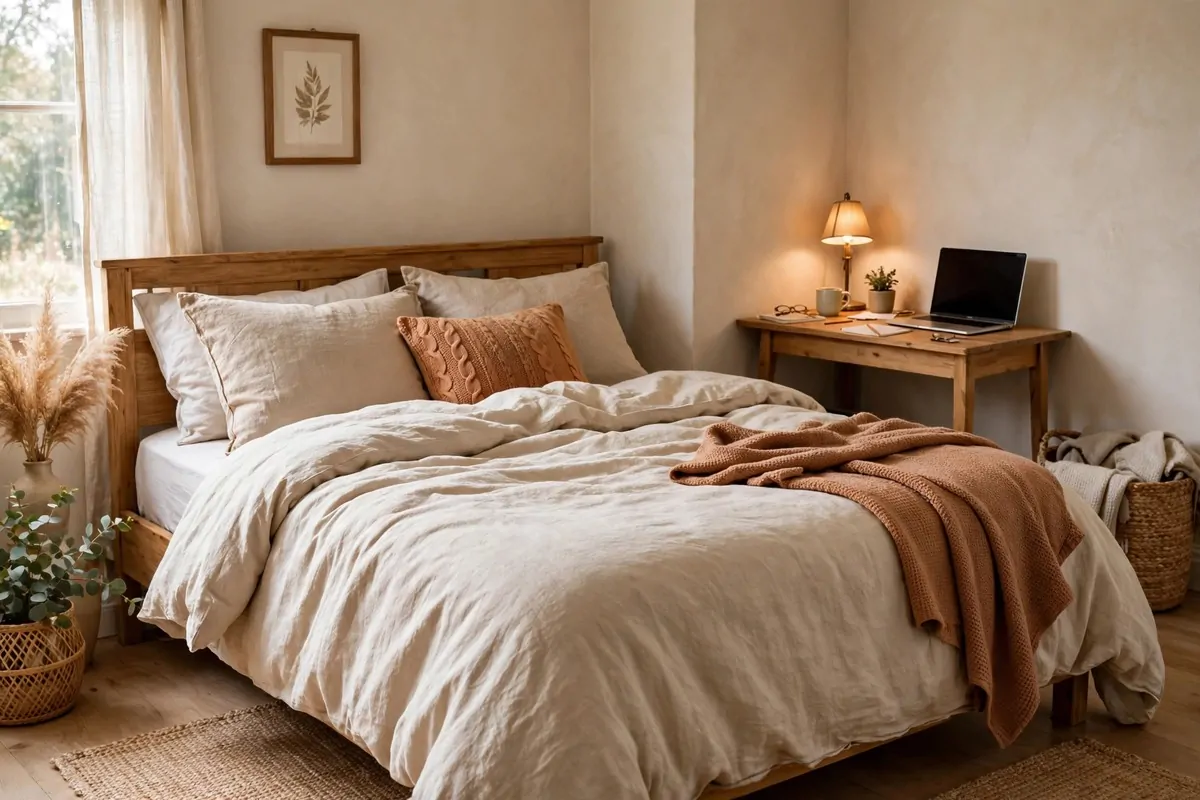
Before you buy a desk, look at your bed. Really look at it. It is the biggest thing in the room, and it decides where everything else can go.
My bed sits against the long wall, and it leaves one short wall free. That short wall is where my desk lives. It is not the spot I would have picked for an office. It is the spot the bed left behind, and it works fine.
Measure the floor the bed does not use. Walk around the bed with a tape measure and mark the empty patches. The patch by the window. The patch by the door. The patch at the foot of the bed. Those patches are your office. The rest belongs to sleep.
Do not push the bed into a corner just to make room for a desk. A bed squeezed into a corner is hard to make, hard to get out of, and hard to sleep in. Let the bed keep its good spot. The desk can take the leftover spot and still do its job.
Think of the desk as a guest in the bedroom. A good guest does not move the furniture around. A good guest finds the free chair and sits there quietly. Your desk should do the same.
Start small on purpose. A narrow board, a small stool, one lamp. You can always add a shelf later, once you know the desk works. A big desk bought first is a big desk you have to live with, even when it crowds the bed.
Try the spot for a week before you drill anything. Put a folding table where you think the desk should go and work there for five days. If your knees bump the bed, move it. If the light is wrong, move it. A week of testing beats a year of living with the wrong spot.
This is the setup for people who tried to fit an office into a bedroom and ended up with a room that does neither job well. Let the bed lead. The desk follows. And the room starts to feel right again.
The Desk at the Foot of the Bed
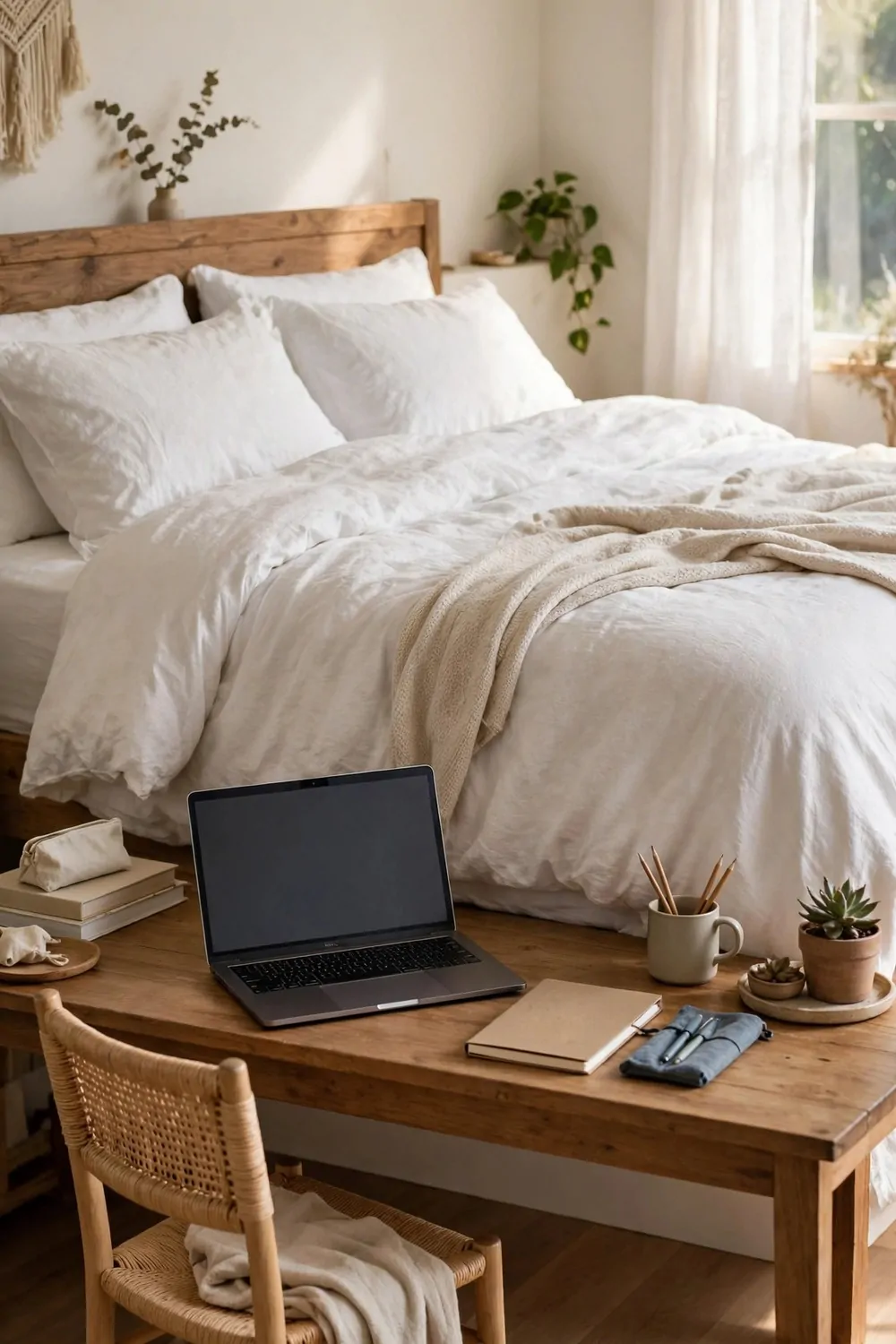
The foot of the bed is the most wasted space in most bedrooms. Nobody walks there. Nothing lives there. And it is exactly the right size for a desk.
Put a narrow desk board across the foot of the bed, with a small gap between the board and the mattress. That gap matters. Your knees need it when you sit down, and the bed needs it when you pull the covers back at night.
Here is a table for the best desk spots in a bedroom, so you can see which one fits your room.
| Desk spot | What is good | What to watch |
|---|---|---|
| Foot of the bed | Uses dead floor space | Leave a gap for your knees |
| Headboard wall | Close to a plug and a lamp | Keep the lamp out of the sleeper’s eyes |
| Window side | Best daylight in the room | Sun glare on the screen by midday |
| Corner by the door | Easy to leave and come back | The door swing must clear the chair |
Sit on the stool and stretch your legs out. If your feet touch the bed frame, the desk is too close. Slide it six inches toward the wall and try again. Six inches is the difference between a desk you use and a desk you avoid.
Keep the top of the desk low and clear. A laptop, a notebook, a small lamp. That is all a foot-of-the-bed desk can hold, and that is enough. A tall stack of books at the foot of the bed makes the room feel like a storage unit.
The best part of this spot is the view. When you sit at the desk, you face the bed, and a made bed is a calm thing to look at. Make the bed every morning before you sit down, and the whole room feels like it is on your side.
At night, the desk is right there when you climb into bed, so the shut-down matters. Close the laptop, slide the chair under the desk, and let the bed take the room back. A desk that stays open all night stares at you while you try to sleep.
Try this setup if your bedroom is long and narrow. The bed takes the top half, the desk takes the bottom half, and the middle stays clear for walking. It is the simplest split in this whole list.
The Headboard Wall Desk
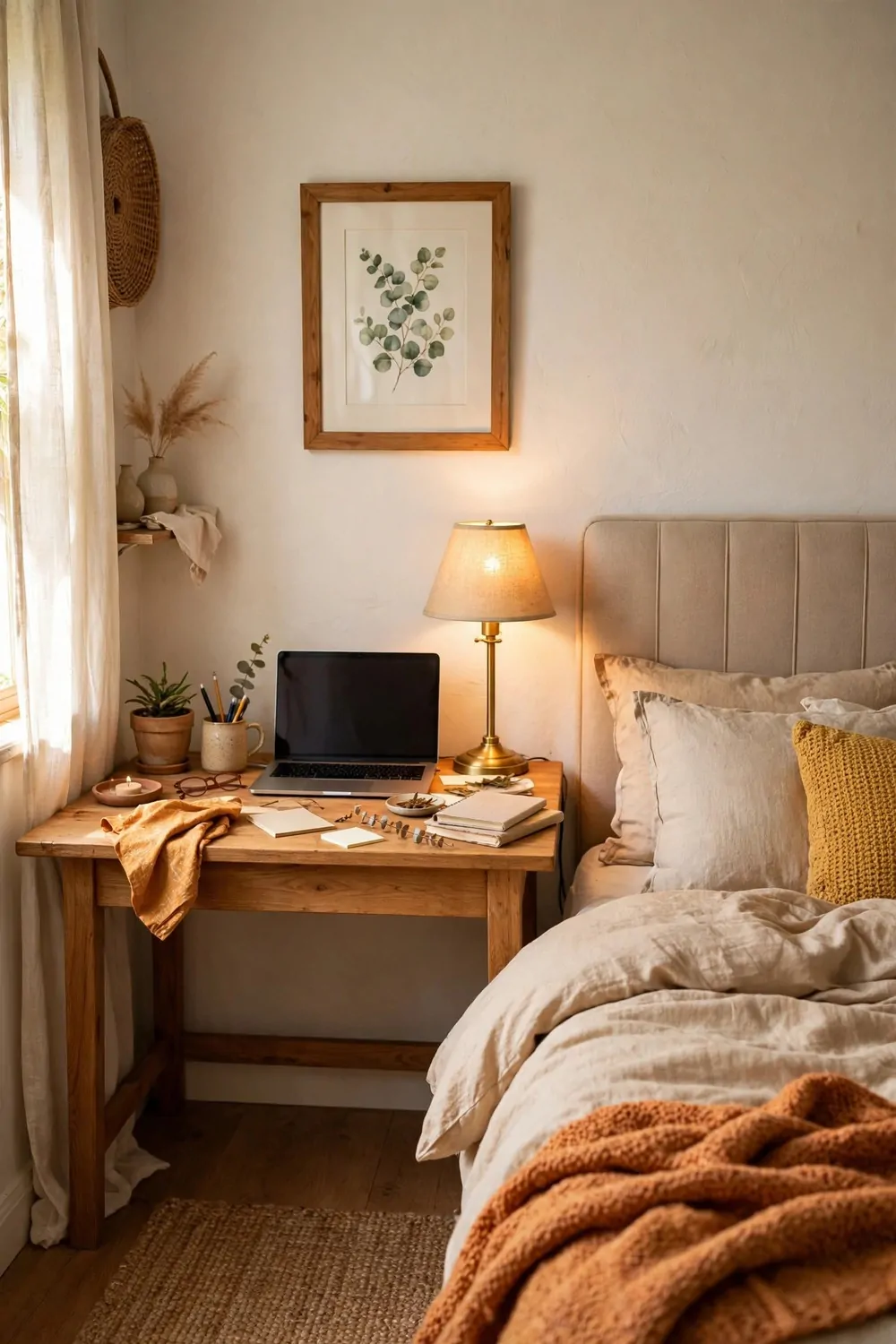
The wall behind your headboard is usually bare above the bed. That bare wall is a desk waiting to happen, if you use it the right way.
Put a slim desk on the wall beside the headboard, not behind it. The desk sits next to the bed, at the same height as the mattress, and it feels like a long bedside table that grew up and got a job.
The plug is the reason this spot works. Most bedrooms have a plug right by the headboard, for the bedside lamp and the phone charger. Your desk can share that plug, and the cable run is short and tidy.
Keep the desk lamp small and warm. A big bright lamp beside the bed lights up the whole room, and that is no good when someone is trying to sleep. A small warm lamp lights your notebook and nothing else.
Put a little shelf above the desk for the things you need in the morning. A notebook, a pen, a glass of water for the night. The shelf is close to the bed, so it does two jobs. Office shelf by day, bedside shelf by night.
Do not let the desk creep onto the bed. Papers on the pillow, a laptop on the blanket, a charger tangled in the sheets. The desk stays on its wall, and the bed stays clean. That line is what keeps the room feeling like a bedroom.
This spot is best for early risers. You wake up, you swing your legs out of bed, and the desk is right there. No walk across a cold floor. No hunting for the chair. Work starts in ten seconds, and the bed is still warm behind you.
Try this one if your bedroom has one good wall and the rest is taken up by the bed and the wardrobe. The headboard wall does the work, and the room never feels like it has a desk in it at all.
The Window Side Desk

The best light in a bedroom comes through the window, and the desk should sit in it. Not in front of it. Beside it.
Put the desk on the wall next to the window, so the daylight falls across the desk from the side. Your screen never glares, your notebook is easy to read, and your face looks bright on video calls. Light from the side is kind. Light from behind you is a problem.
Keep the window clear of shelves and tall plants. A shelf across the window blocks the one thing the desk needs most. Let the light in first, and put the storage on the wall across the room.
Work with the sun, not against it. Mornings are bright and sharp by the window. That is the time for the hard work, the writing, the thinking. Afternoons get softer, and that is when the desk lamp takes over and the room turns warm.
Hang a light curtain on the window for the bright hours. A pale curtain softens the glare without blocking the daylight, and you can pull it aside in one second when the sun moves off. A heavy curtain turns the desk into a cave, and caves are no good for work.
Put a small plant on the windowsill beside the desk. It gets the light, it softens the hard edge of the desk, and it reminds you to look up from the screen once in a while. One plant is enough. A windowsill full of pots crowds the light out.
This is the setup for people who work best in daylight. The window makes the bedroom feel like a real room for work, not a dark corner you got stuck in. You will notice the difference on the very first morning.
Try this one if your bedroom window faces the morning sun. The desk gets the best hours of the day, and the bed gets the soft evening light. Both sides of the room win.
The Corner by the Door
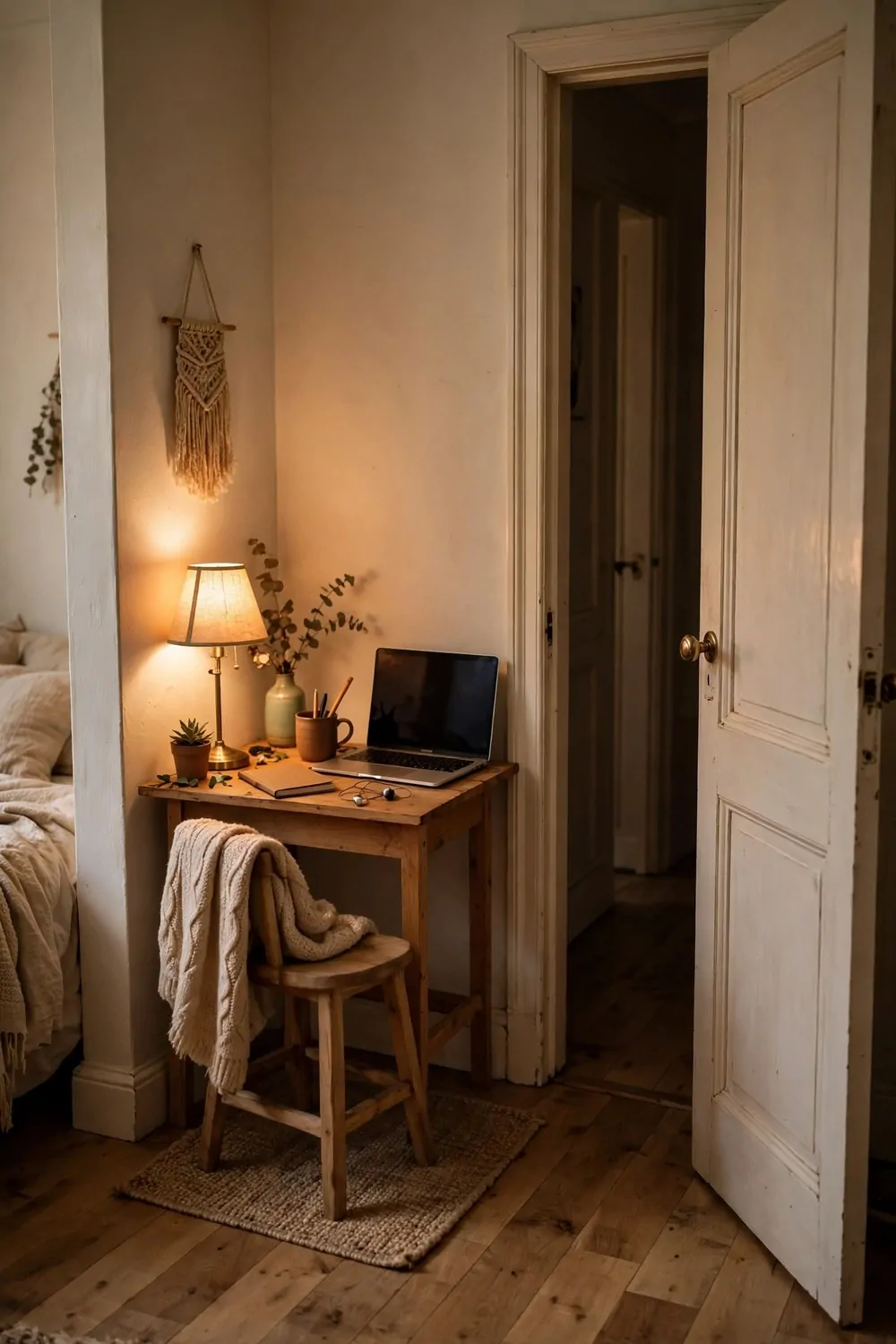
The corner by the bedroom door is the easiest desk spot to walk away from, and that is a good thing. When work ends, you stand up, you walk out, and the office is behind you.
Put a small desk in the corner nearest the door, with the chair facing into the room. You sit down and you can see the whole bedroom. The bed, the window, the wardrobe. Nothing is behind you, and that feels safe in a small room.
Check the door swing before you place anything. Open the door all the way and watch where it stops. The chair must sit clear of that arc, or the door will bump it every single time someone walks in. A door that hits a chair is a room that fights you daily.
Keep a small rug under the desk and the chair. The rug marks the office corner, and it stops the chair from scraping the floor when you push back. A rug the size of a doormat is enough. It is a border, not a carpet.
Keep the corner lamp on a small shelf, not on the desk. A lamp on the shelf lights the whole corner without taking up desk space, and the desk stays clear for the laptop and the notebook.
This corner is the best spot for a desk you only use for an hour or two a day. You walk in, you sit down, you do the emails, and you walk out. The desk never takes over the room, because the door is right there reminding you to leave.
Put a hook on the wall beside the door for your work bag. The bag hangs there when you come home, and you grab it on the way out. A bag on the desk takes up half the work space, and a bag on the floor trips you in the dark.
Try this setup if your bedroom door opens into a hallway you use a lot. The desk lives by the door, the bed lives deep in the room, and the two never bother each other. Work stays near the exit, and sleep stays far from it.
The Dresser That Does Two Jobs
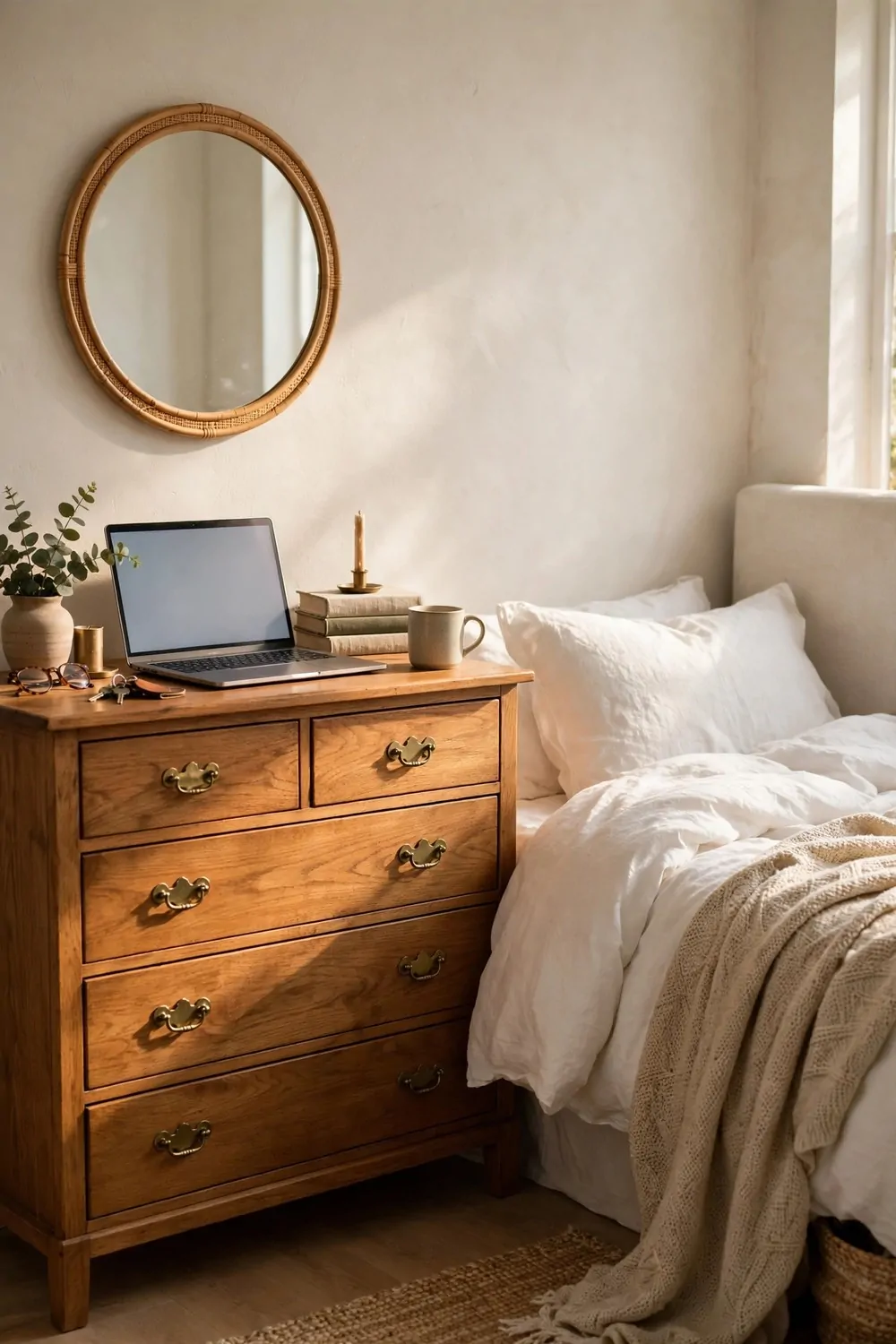
Your dresser is already a desk. It is the right height, it is the right depth, and it is already in your bedroom. It just needs a chair and a lamp.
Clear the top of the dresser down to one clear patch, about as wide as your laptop. The rest of the dresser keeps its job. Perfume on one side, a jewellery box on the other, and the laptop in the middle. Nobody walking in would call it an office. They would call it a tidy dresser.
Pull a chair up to the dresser in the morning and push it away at night. The chair is the only thing that says office, and a chair can live anywhere. Tuck it under the dresser when you are done, and the room looks like a bedroom again.
The drawers are the secret weapon here. The top drawer holds pens, chargers, and sticky notes. The middle drawer holds notebooks and papers. The bottom drawer holds the cables and the spare bits. A dresser with drawers beats a desk with none, every single time.
Keep a small mirror on the dresser wall above the laptop. In the morning the mirror is for your hair. By nine o’clock it is just a bright spot on the wall behind your screen, bouncing a little light back onto the desk.
Do not let the dresser become a dumping ground. A dresser desk only works when the top stays mostly clear. One pile of clothes on the laptop and the whole trick falls apart. The rule is simple. Clothes go in the drawers, not on the desk.
This is the setup for people who cannot fit one more piece of furniture into their bedroom. You do not need a new desk. You need to look at the dresser you already own and give it a second job.
Try this one first if money is tight. A chair and a lamp is the whole shopping list. The dresser was already there, waiting for someone to notice it could work twice as hard.
The Nightstand Office
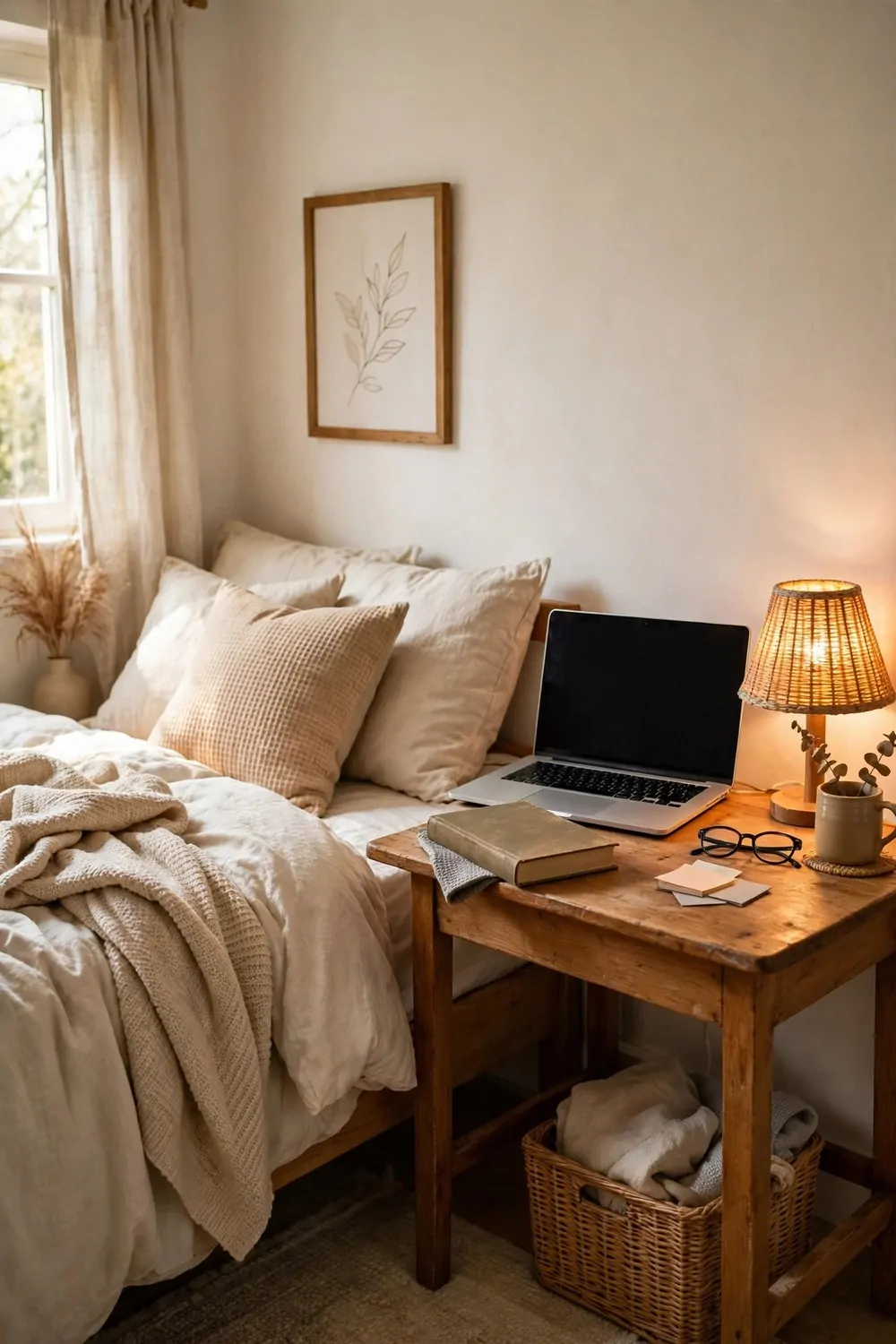
A nightstand is the smallest desk in the world, and sometimes it is enough. If your work is mostly a laptop and a phone, a nightstand can hold your whole office.
Pick the nightstand on the side of the bed you get out of. That is the side you will sit on, and the side where the lamp already lives. The lamp is already there, the plug is already there, and the nightstand is already at the right height.
Keep the nightstand top to three things only. Laptop, lamp, and one notebook. A fourth thing tips the whole setup over the edge, and the nightstand stops being a desk and starts being a pile.
Sit on the edge of the bed to work. It sounds odd, but the edge of the bed is a fine chair for short stretches. Twenty minutes of emails, half an hour of planning, and then you stand up and stretch. A nightstand office is for short work, not for eight-hour days.
Put a small basket under the nightstand for the charger and the spare cables. The basket keeps the floor clear, and the cables never tangle with the bed sheets. A basket under the bedside table is out of sight and easy to reach.
Charge your phone on the dresser across the room, not on the nightstand. A phone charging beside the bed buzzes at night, and a nightstand office should go quiet when the work ends.
This setup is best for people who work in short bursts. A quick reply here, a short call there, and then the laptop closes and the nightstand goes back to holding a glass of water and a book.
Try this one if your bedroom is truly tiny, the kind where a real desk would block the door. A nightstand office asks for nothing new. It just asks the little table beside your bed to work a little harder.
The Under-the-Bed Boxes
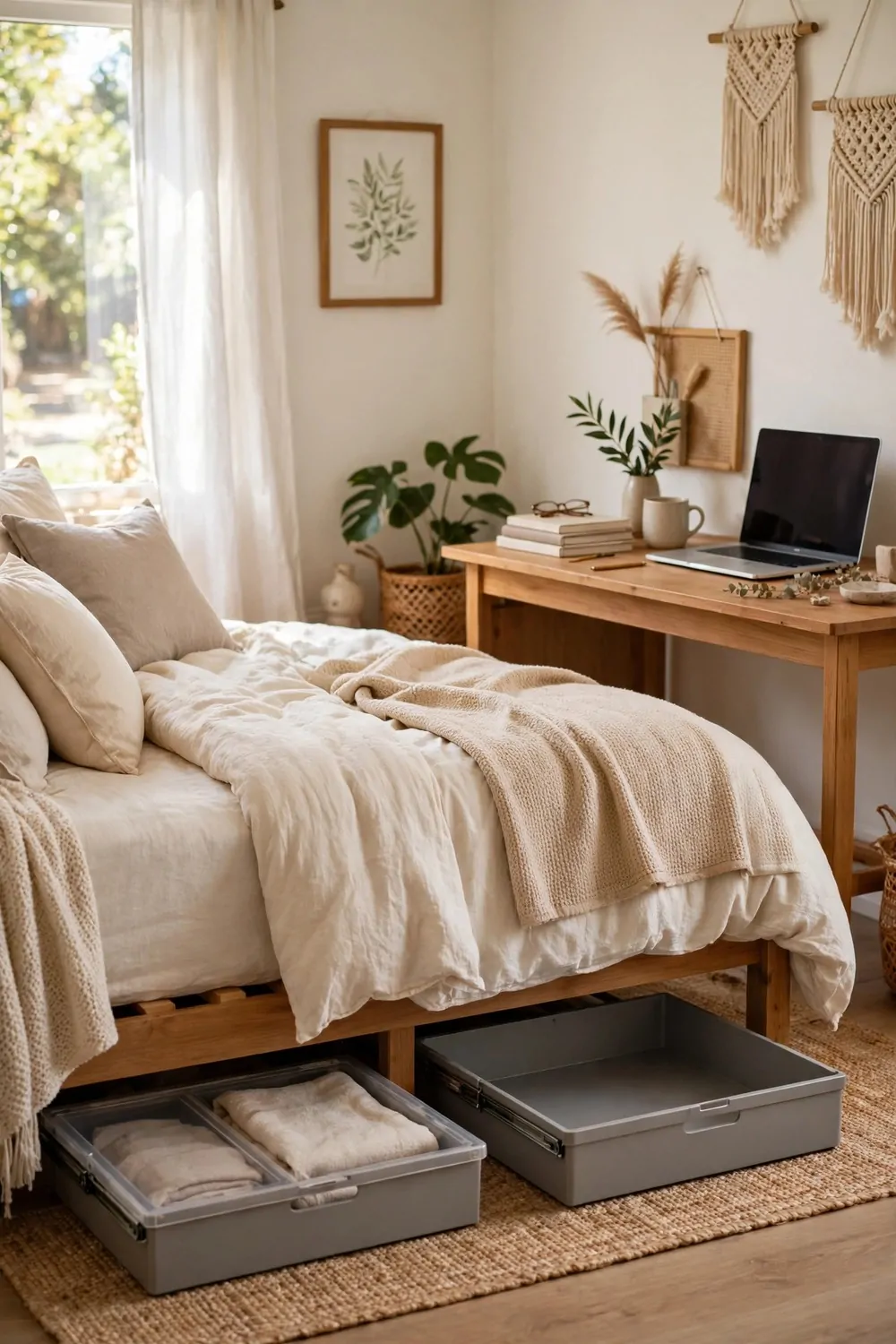
The space under your bed is a whole storage room that most people waste. It holds dust and one lost sock. It should hold your office supplies instead.
Slide two low boxes under the bed, one for papers and one for cables and chargers. The boxes roll out on little wheels or on a smooth floor, and they roll back in when you are done. The desk stays clear, and the supplies are always one pull away.
Here is what goes in the under-bed boxes.
- Spare notebooks, printer paper, and the files you need once a week.
- Chargers, spare cables, and the headphones you only use on calls.
- The folder of tax papers and the envelopes you keep meaning to file.
- Seasonal stuff, like the thick blanket you swap out in spring.
Label the boxes on the side you can see from the doorway. One word each, in big plain letters. “Papers.” “Cables.” A label you can read from the floor saves you from pulling out both boxes to find one notebook.
Keep the boxes low and flat. A box that is too tall will not slide under the bed, and a box that sticks out looks like clutter. Measure the gap under your bed first, then buy the boxes to fit it.
Wipe the boxes once a month when you change the sheets. Under-bed boxes collect dust faster than anything else in the room, and a dusty box makes the whole bedroom feel tired.
This is the setup for people whose desk is always covered in stuff they use once a week. The stuff moves under the bed, the desk gets its surface back, and the bedroom looks bigger the same day.
Try this one if your desk is small and your supplies are many. The bed holds the storage, the desk holds the work, and neither one has to do the other’s job.
The Morning Light Desk
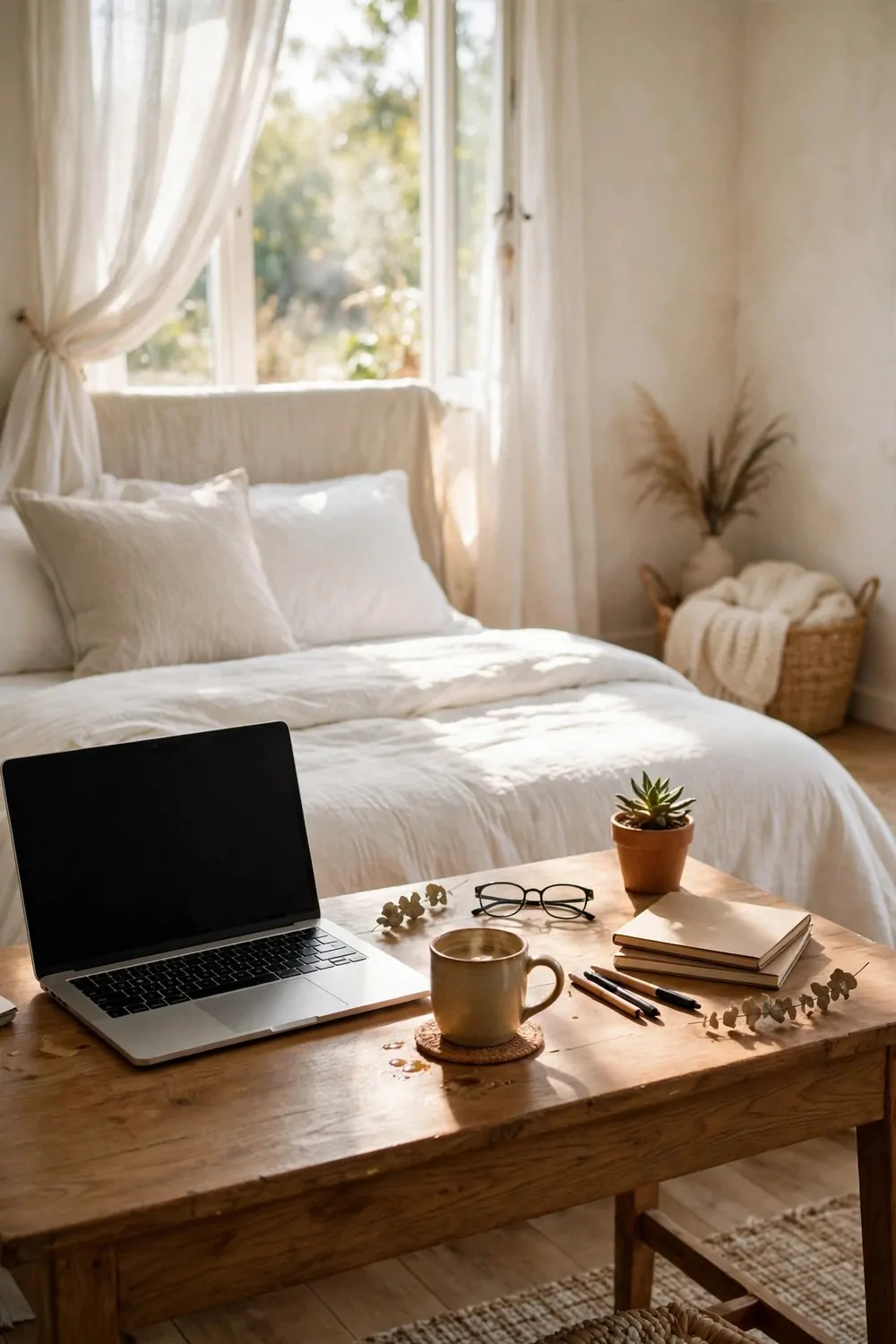
The first hour of the day is the best hour for work, and the morning light desk is built around it. The desk faces the morning sun, the bed is made, and the room feels like it is helping you.
Make the bed first, before you sit down. A made bed changes the whole room in two minutes. The desk feels like it belongs in a tidy room, and your brain takes the hint. Work starts clean when the bed is clean.
Open the curtains wide when you sit down. Let the morning light fall right across the desk. It wakes you up better than coffee, and it makes the screen easier to read. A dark desk in the morning feels like a night shift, and nobody wants that.
Do the hardest job first, while the light is bright and your head is clear. The email that needs thinking. The page that needs writing. Save the easy jobs for the afternoon, when the light softens and your energy dips a little.
Keep a glass of water on the desk, not coffee. Coffee is fine, but water in the morning keeps you awake longer and it never stains the desk when you knock it over. A glass of water is the cheapest morning habit there is.
Close the curtains a little by late morning, when the sun climbs high and starts to glare on the screen. A half-closed curtain is the whole trick. Too much sun is just as bad as too little, and the curtain is the dial that fixes it.
This is the setup for early risers who love the quiet of the house before everyone else wakes up. The bedroom is still, the light is gold, and the desk feels like the best seat in the house.
Try this one if you work best before lunch. The morning light does half the work for you, and the made bed does the other half.
The Sleep-Safe Screen Rule

A screen in a bedroom is a problem at night, and the sleep-safe screen rule fixes it. The rule is simple. No glowing screen after ten o’clock, unless the work is truly urgent.
Screens tell your brain it is daytime. The bright light, the moving pictures, the little red dots that say someone needs you. Your brain believes all of it, and it stays awake long after you put the laptop down.
Set a screen curfew and write it on a card inside the wardrobe door. Mine says ten o’clock. When the time comes, the laptop closes, the phone goes face down on the dresser, and the bedroom goes back to being a bedroom.
Use a warm lamp for the last hour of work, not the bright overhead light. A warm lamp tells your brain the day is winding down, and your eyes stop straining. A bright white light at nine at night feels like an office at noon, and your sleep pays for it.
Keep the phone out of the bed. Charge it on the desk, across the room, not on the pillow beside you. A phone on the pillow buzzes at midnight, and a phone across the room sleeps through the night like you should.
If you must work late, sit at the desk with your back to the bed. Facing the bed while you work makes the bed feel like part of the office, and the office never leaves your head. Facing away keeps the two jobs apart, even in the same small room.
This is the setup for people who lie awake thinking about work. The screen rule is not about willpower. It is about giving your brain a clear signal. Desk time ends, sleep time starts, and the room changes jobs with you.
Try this one if your sleep has got worse since the desk moved into the bedroom. One rule, one card on the wardrobe door, and your nights start to feel like nights again.
The Quiet Hours Agreement
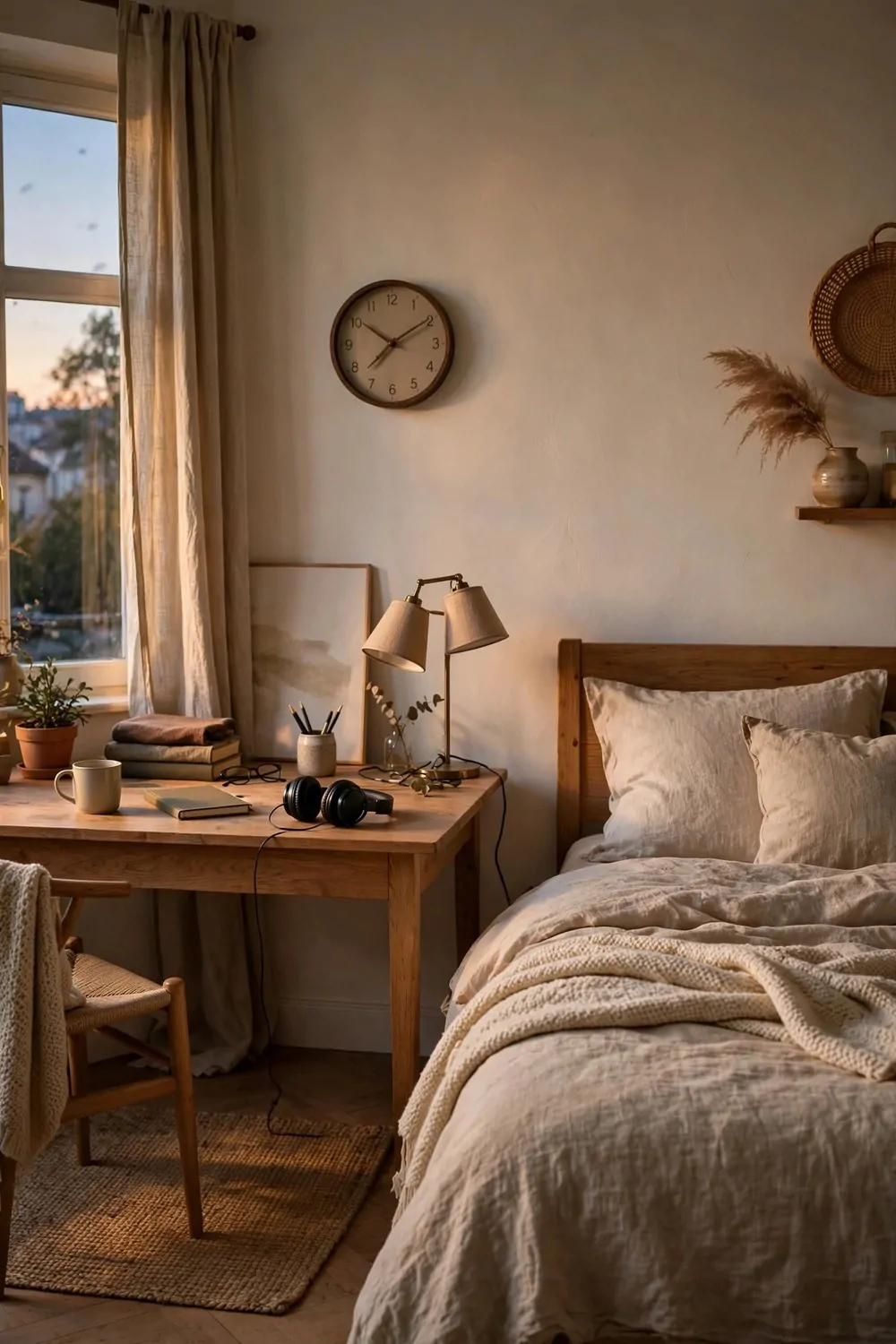
When two people share a bedroom and one of them works there, the room needs rules. Not big rules. Small, kind ones that both people agree on.
Sit down together and pick the quiet hours. Maybe nine to five, maybe just the mornings. Write them on a small card and stick it inside the wardrobe door. A rule you both agreed on is easy to keep. A rule one person made up is easy to resent.
Headphones are the best tool in a shared bedroom office. Headphones on means do not talk. Headphones off means you can ask a question. One clear signal beats ten little interruptions, and it keeps the peace better than any door ever could.
Keep your calls short when someone is sleeping. Step into the hallway for the long ones, or book them for the hours when the room is yours alone. A video call at seven in the morning wakes the whole house, and a hallway call wakes nobody.
The sleeper gets the dark side of the room. If your partner sleeps while you work, put the desk lamp on the far side of the desk, pointed down at your notebook. A lamp that points at the bed is a lamp that ends the agreement fast.
Here is a table for how the room splits its day, so both people know when it is theirs.
| Time of day | The desk | The bed |
|---|---|---|
| Morning | Yours for the first hour | Still sleeping, keep it quiet |
| Midday | Full work mode | Made and tidy, out of the way |
| Evening | Last hour, then shut down | Getting ready for sleep |
| Night | Closed and dark | Yours, and only yours |
Agree on one tidy rule too. The desk gets cleared at the end of the workday, every day, no exceptions. A cleared desk is a room that belongs to both of you again. A messy desk is a room that belongs to work, and work already had its hours.
This is the setup for couples, roommates, and anyone who shares a bedroom with a worker. The room is small, the rules are simple, and the quiet hours are what make sharing it possible.
Try this one if your bedroom office has ever started a small argument. One card, one pair of headphones, and one tidy desk at five o’clock. That is the whole agreement.
The Rug That Draws the Line
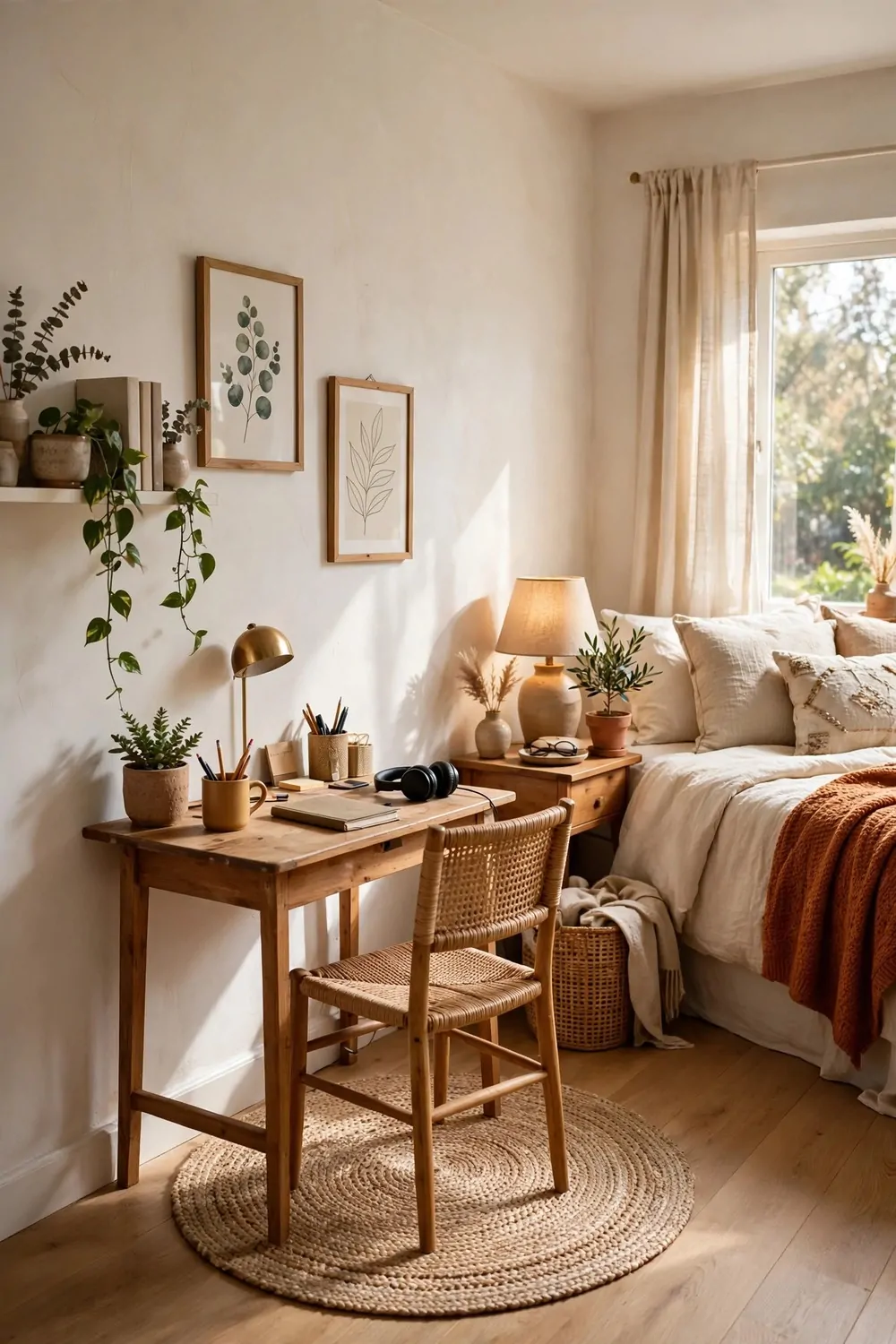
A rug is the cheapest wall you will ever buy. It does not block light, it does not need drilling, and it still tells your brain where the office ends and the bedroom begins.
Lay a rug under the desk and the chair, big enough for both and no bigger. The rug is the office floor. Step off the rug and you are in the bedroom. Step onto it and you are at work. Your feet learn the line before your brain does.
Pick a rug in a different colour from the bedroom carpet or the floor. A rug that blends in does nothing. A rug that stands out draws the line clearly, and the line is the whole point.
Keep the rug flat and low. A thick rug under a chair makes the chair wobble, and a wobbling chair is a chair you stop using. A flat rug stays put, the chair rolls smooth, and the line stays where you drew it.
The rug also catches the mess. Crumbs, pencil shavings, the little bits of paper that fall off the desk. They land on the rug, not on the bedroom floor, and you shake the rug out once a week. The bedroom stays clean because the rug does the catching.
Put the rug down before you place the desk. A rug placed after the desk never sits quite right, and you end up dragging the desk to fix it. Rug first, desk second, chair last. That order never fails.
This is the setup for people who feel like their bedroom office has no edges. The rug gives the office a border, and a border makes a small room feel organised instead of mixed up.
Try this one if your desk and your bed feel like they are in the same room with no line between them. One rug, one line, and the room has two halves again.
The Curtain Between Sleep and Work
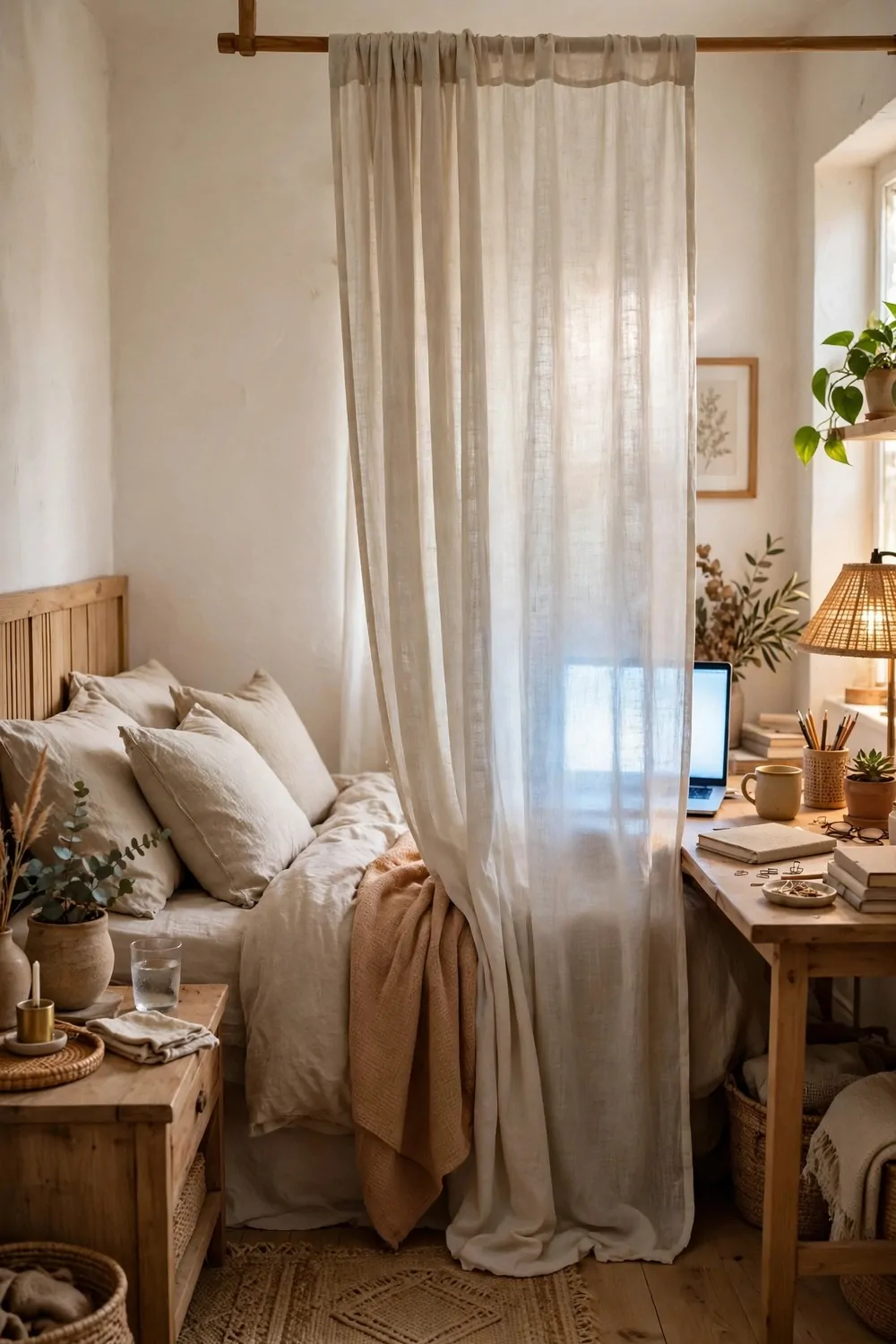
A curtain is a wall you can pull aside. Hang one between the bed and the desk, and your bedroom becomes two rooms in five minutes.
Fix a ceiling track or a simple rod across the room, from one wall to the other, right between the bed and the desk. Drop a curtain from it, in a pale colour that matches your bedding. The curtain hangs straight down, and the room splits in half.
Pull the curtain shut when you work, and the bed disappears behind it. Your brain stops seeing the pillows, and the work gets easier. Pull it open at night, and the room is a bedroom again, wide and calm.
Pick a fabric that lets a little light through. A heavy dark curtain makes the desk side feel like a cupboard. A pale linen curtain glows a little when the lamp is on, and the desk side feels bright even with the curtain shut.
Let the curtain end a little above the floorboards. A curtain that brushes the floor gathers dust and catches on the chair legs. One that hangs just short of the floor moves freely, and the floor underneath stays easy to clean.
Take the curtain down for a wash when the seasons change. Bedroom curtains hold dust you cannot see, and a fresh one brightens the whole wall in a way new paint never could. A short wash and a quick press is all it needs.
This is the setup for people who share a bedroom with a worker and a sleeper at the same time. The curtain is the wall between them, and it costs less than a takeaway dinner.
Try this one if your bedroom feels like one big mixed-up room. A curtain, a rod, and five minutes. The bed gets its half, the desk gets its half, and nobody has to build anything.
The Plant That Splits the Room
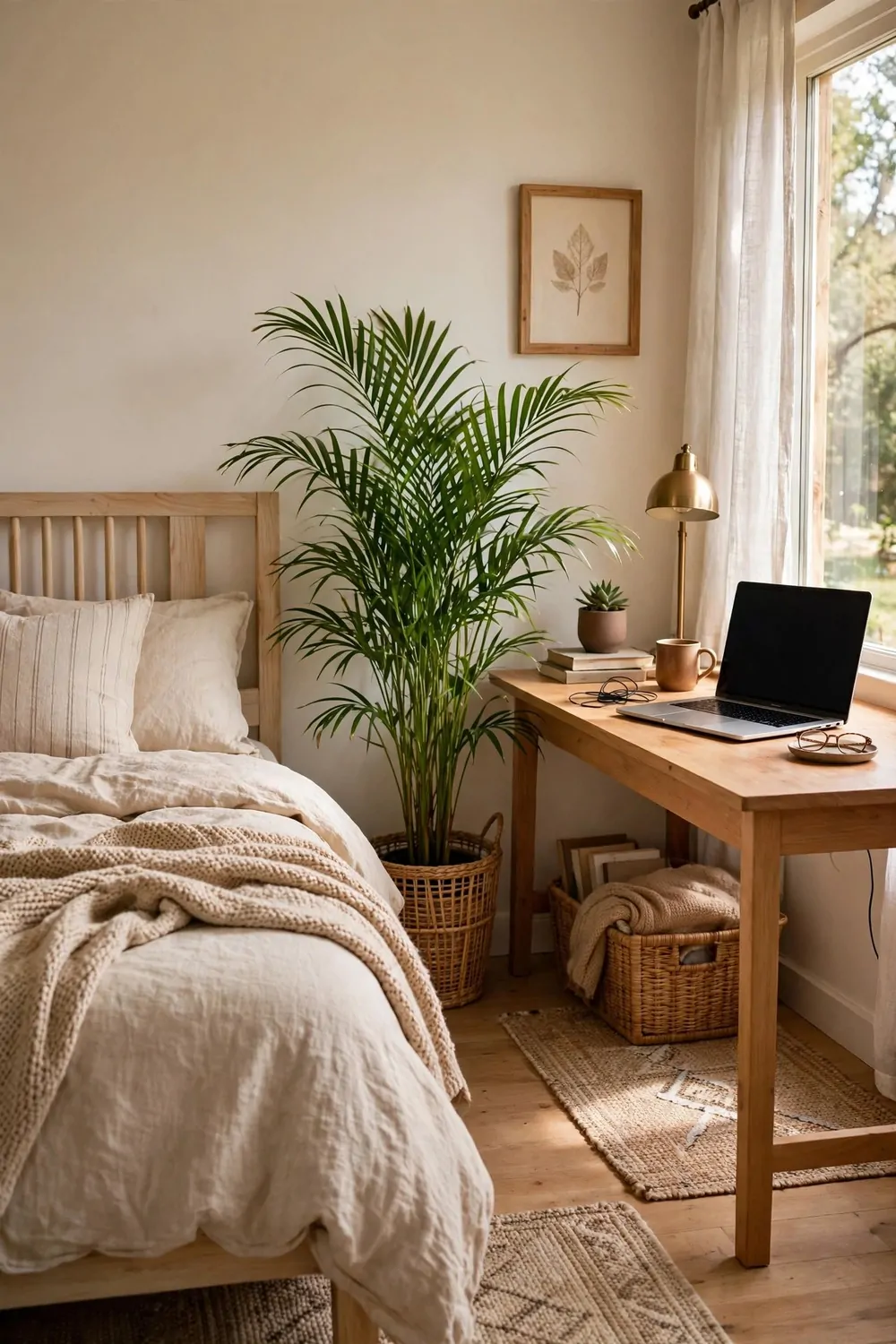
A tall plant is the friendliest divider in the world. It does not block the light, it does not need a drill, and it makes both sides of the room look better.
Stand a tall plant in a big pot right between the bed and the desk. A plant about as tall as your waist is the right size. It breaks the line of sight without blocking it, and the room feels split without feeling small.
Pick a plant that likes bedroom light. A snake plant or a tall leafy one that copes with a shady corner. A plant that needs full sun will droop in a bedroom, and a drooping plant is worse than no plant at all.
Water it once a week, on the same day you change the sheets. One jug, one plant, two minutes. A plant with a routine stays alive, and a dead plant between the bed and the desk is sadder than an empty corner.
The plant also cleans the air a little and softens the hard edges of the desk. A desk next to a plant feels calmer than a desk next to a bare wall. Your eyes land on green when they get tired of the screen, and that short rest makes the next hour easier.
Keep the leaves off the desk. A vine that creeps across the keyboard is charming for one day and annoying by Friday. Trim the ends when they reach the desk edge, and tuck the cuttings into a jar of water on the shelf. They grow roots, and soon you have a second plant for free.
This is the setup for people who want a divider but hate the idea of a wall or a screen. A plant divides the room gently, and it grows a little taller every year, which is more than you can say for a folding screen.
Try this one if your bedroom office feels bare and hard. One tall plant, one big pot, and the room softens up the same day.
The Bedding-Match Desk
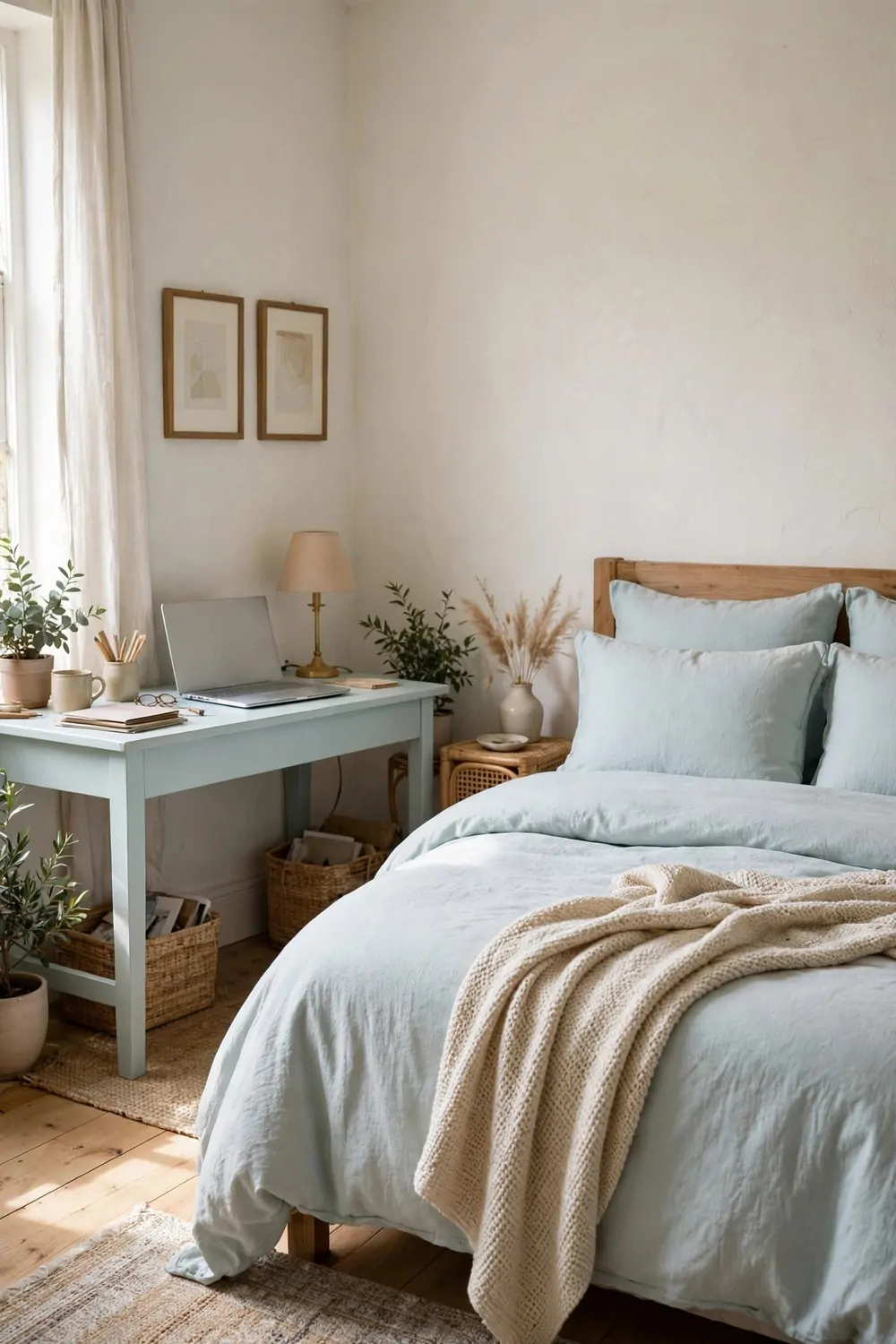
A desk that matches your bedding looks like it belongs in the bedroom. A desk that clashes looks like it wandered in from another house and got lost.
Paint the desk the same colour as your bed frame, or the same soft shade as your duvet cover. A white desk with white bedding. A pale wood desk with cream sheets. The match makes the two pieces feel like a set, even if you bought them years apart.
Keep the desk accessories in the same family of colours too. A lamp with a cream shade. A pen pot in a soft grey. A notebook in the same blue as the pillowcases. Small repeats like that tie the room together without any big spending.
Do not match everything exactly. A desk painted the exact same white as the walls disappears, and a desk that disappears is a desk you bump into. One shade darker or warmer than the walls is the sweet spot. It stands out just enough to find, and blends in just enough to calm the room.
Change the bedding with the seasons and let the desk follow with small touches. A warm throw on the chair in winter. A pale cushion in summer. The desk changes with the room, and the room never feels stuck in one season.
Wipe the desk down on laundry day, when you change the sheets. A quick wipe keeps the paint fresh, and a fresh desk matches fresh sheets better than a dusty one ever will.
This is the setup for people whose bedroom office looks like an office that crashed into a bedroom. The colour match is the fix. It costs one tin of paint and one afternoon, and the room looks planned instead of accidental.
Try this one if your desk feels like it does not belong in your bedroom. Paint it to match the bed, and watch the whole room relax.
The Wardrobe-Side Desk
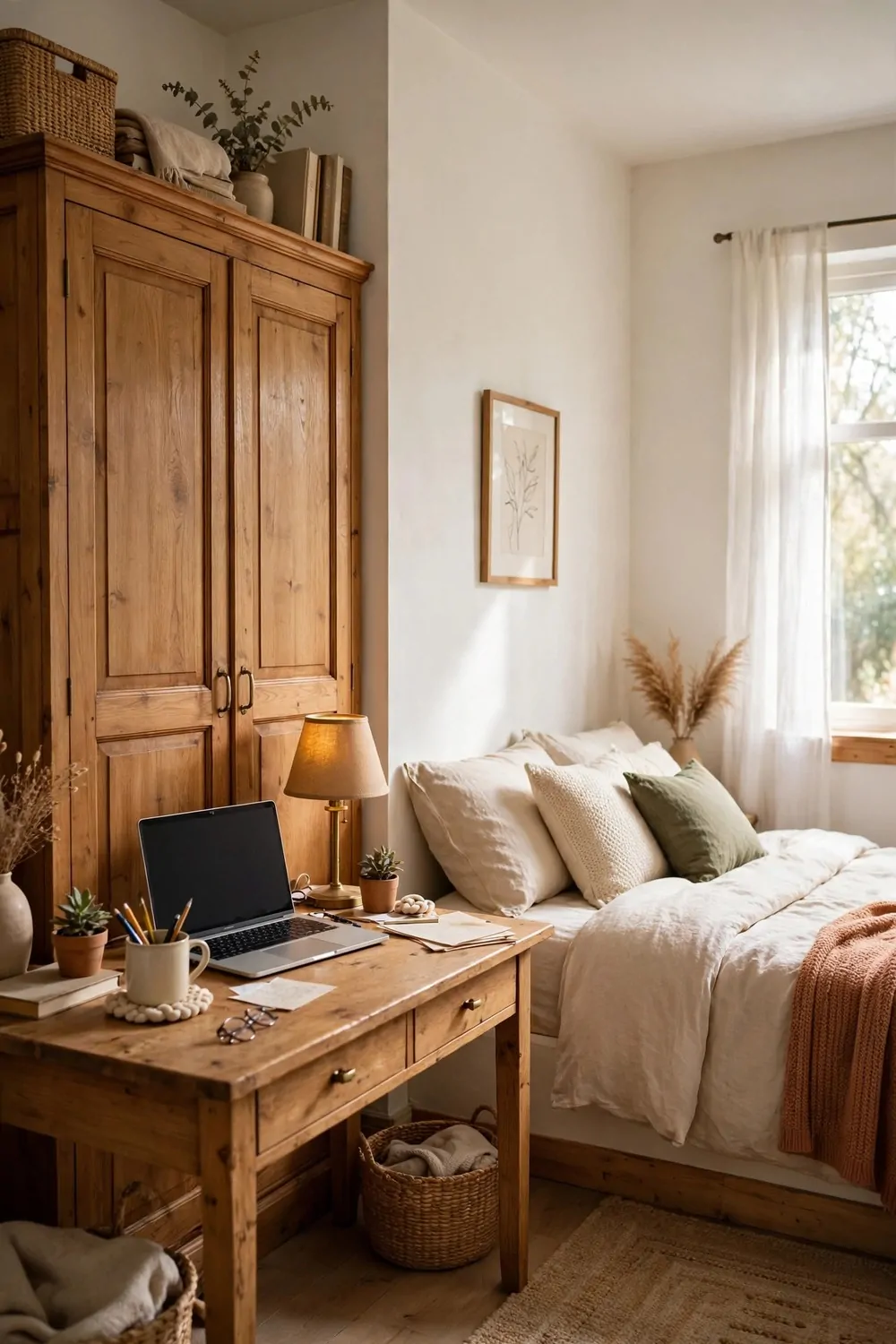
The wardrobe is the tallest piece of furniture in most bedrooms, and the wall beside it is usually empty. That empty wall is a desk spot hiding in plain sight.
Put a slim desk on the wall right next to the wardrobe, at the same height as the wardrobe shelves. The desk and the wardrobe share the wall, and the room looks like it was planned that way from the start.
Use the wardrobe for office storage too. The top shelf holds the spare paper and the files you need once a week. The bottom shelf holds the bag and the spare cables. The wardrobe already stores your clothes. Let it store your office bits as well.
Keep the desk chair clear of the wardrobe doors. Open the doors all the way and watch where they stop. The chair must sit outside that swing, or you will be moving the chair every time you need a shirt.
Hang a small mirror on the wardrobe door beside the desk. In the morning the mirror is for checking your shirt. By nine o’clock it bounces a little light onto the desk, and the corner feels brighter.
Keep the wardrobe doors shut while you work. Open doors swing into the chair, and a shut door keeps the clothes out of sight so your eyes stay on the screen.
This spot is best for bedrooms where the wardrobe takes up a whole wall and the bed takes up the rest. The desk squeezes into the gap between them, and the room gains an office without losing anything.
Try this one if your wardrobe wall feels wasted. A slim desk, a chair that tucks under it, and the wall beside the wardrobe finally earns its keep.
The Fold-Up Evening Desk
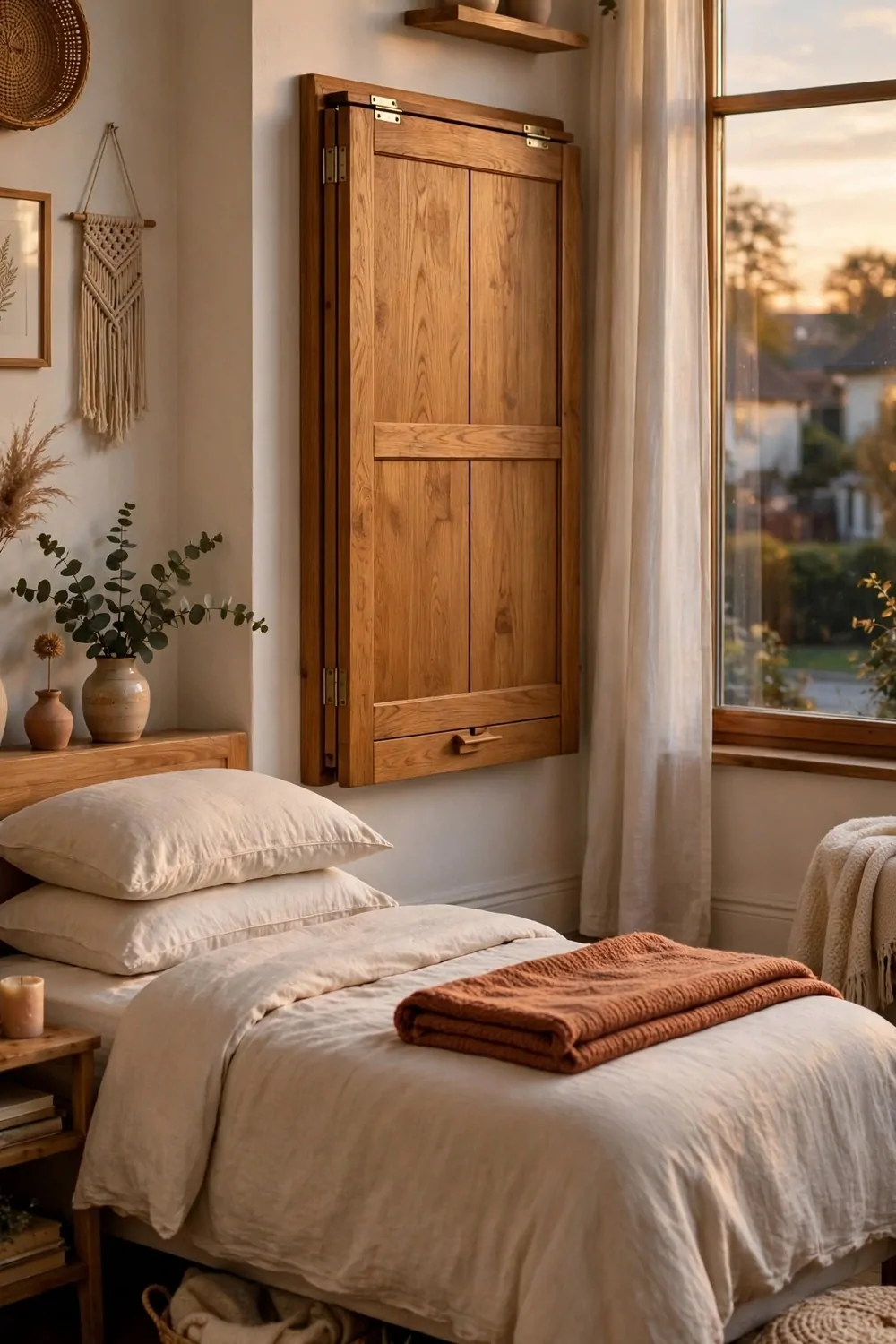
A desk that folds up at night is a bedroom that goes back to being a bedroom. The fold takes ten seconds, and the room changes jobs with it.
Mount a fold-down board on the wall beside the bed, on two strong hinges. In the morning you pull it down and it rests on two small brackets. At night you lift the brackets, fold the board up, and the wall is blank again.
Clear the board right down before you fold it away. Empty boards fold in a blink. A board with a laptop and a mug on it does not fold at all, it just sits there half shut and in the way. Give the laptop a home on the shelf above, and send the mug back to the kitchen where it belongs.
Give the back of the board a coat of paint in the wall colour. Folded up, that back is all the room sees, so a matching shade lets it blend in. A clashing shade turns the folded desk into a notice board that shouts about the office hidden behind it.
Give the hinges a look every year or so. Use wears them a little loose, and a loose hinge lets one side of the board sag lower than the other. A single twist of the screwdriver puts them right, and the board swings smooth again.
Keep a little basket on the shelf above the board for the charger and a spare notebook. Morning comes, you reach up, you grab what you need, and the desk is ready before the kettle boils.
This is the setup for a bedroom that has to earn its keep twice over. Night time it is a place to sleep. Day time it is a place to work. Fold the board up and the wall goes blank, and anyone walking in would never guess a desk was hiding there. That is the magic of it.
Try this one if your bedroom is so small that a fixed desk would block the door. A fold-up desk gives you the office and gives the room back, every single night.
The No-Work-in-Bed Rule

Working in bed feels cozy for about ten minutes. Then your back aches, your neck aches, and your brain starts to think the bed is an office. That is the beginning of bad sleep.
The rule is simple. The bed is for sleeping. The desk is for working. Never the other way round. Write it on a card and stick it on the bedside table, where you can see it when you are tempted.
Here is what the rule means in real life.
- No laptop on the blanket, not even for five minutes of emails.
- No papers on the pillow, not even the ones you only need to glance at.
- No phone scrolling in bed after the screen curfew, not even for one quick check.
- No breakfast in bed with the laptop open, because the bed starts to smell like work.
Your brain learns fast. If you work in bed for a week, your brain starts to wake up the second your head hits the pillow. It thinks the bed is a desk, and it stays alert. If you keep the bed for sleep only, your brain learns the opposite. Pillow means sleep, and sleep comes faster.
Keep a book on the bedside table instead of the laptop. A book tells your brain the day is over. A laptop tells your brain the day is still going. The book is the better bedtime friend.
If the rule feels hard, move the laptop charger to the desk side of the room. A laptop with a dead battery cannot tempt you into bed. It stays on the desk, where it belongs, and the bed stays a bed.
This is the setup for people who wake up tired even after eight hours in bed. The bed was doing two jobs, and it was doing both of them badly. Give it one job back, and your sleep gets better in a week.
Try this one if you have ever answered an email from under the covers. One rule, one card on the bedside table, and the bed goes back to being the best place in the house.
The Sunday Night Reset
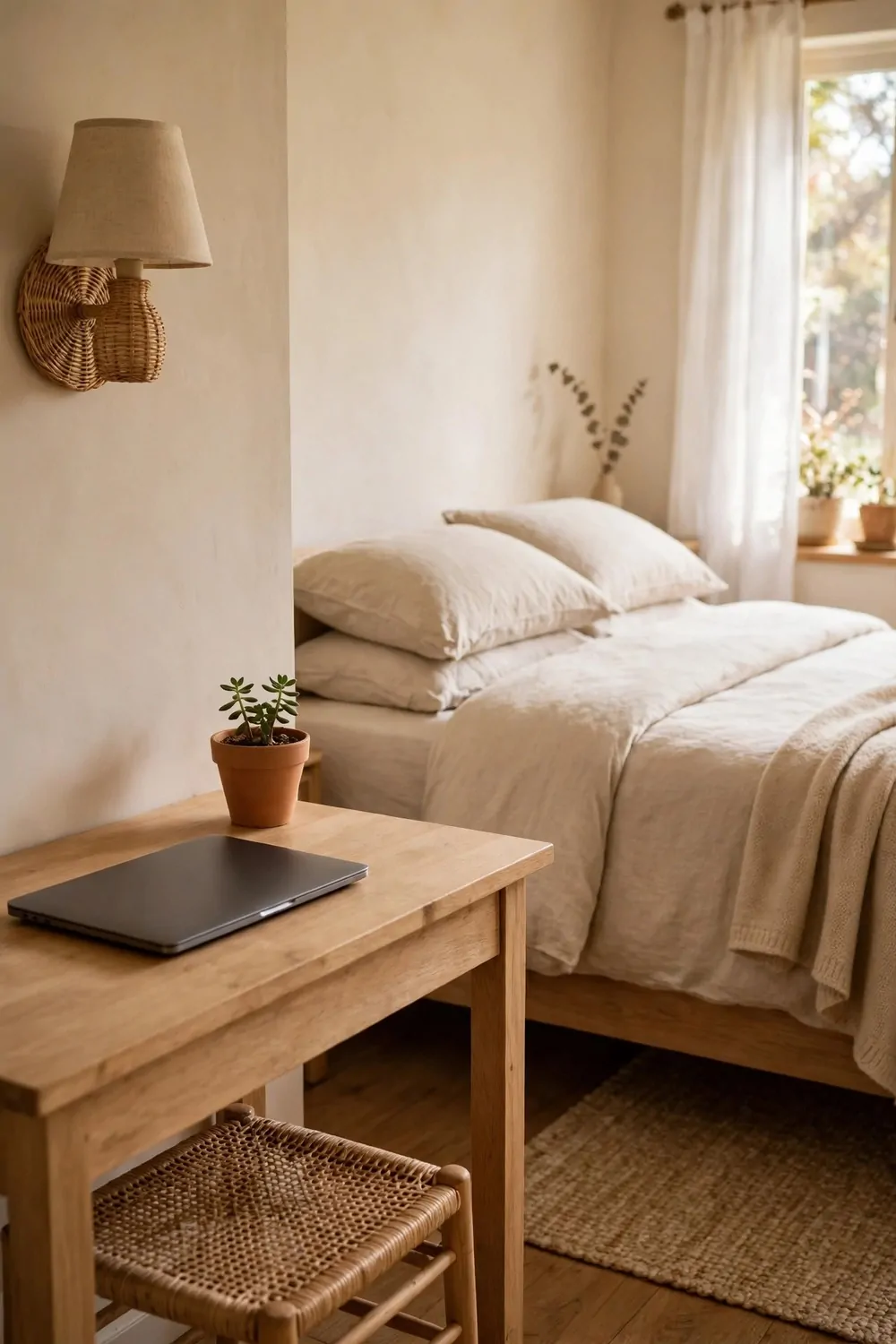
A bedroom office falls apart slowly, one small mess at a time. A paper here, a cable there, a mug that never made it back to the kitchen. The Sunday night reset fixes it in twenty minutes.
Pick the same night every week. Sunday works best, because Monday starts clean. Put it on the calendar like a real appointment, because a reset without a date never happens.
Here is the reset in one place.
| Reset step | Time it takes | What it fixes |
|---|---|---|
| Clear the desk | About 5 minutes | Papers, mugs, and loose pens |
| Tidy the cables | About 3 minutes | Tangled chargers under the desk |
| Change the sheets | About 5 minutes | A fresh bed for a fresh week |
| Wipe the desk and lamp | About 2 minutes | Dust that makes the room feel tired |
| Plan the week | About 5 minutes | Monday starts with a clear list |
Start with the desk, because the desk is the messiest part of the room. Clear it down to the laptop, the lamp, and the notebook. Everything else goes in a drawer, in a box, or in the bin. A clear desk on Sunday night is a calm Monday morning.
Change the sheets while you are at it. Fresh sheets and a clear desk together make the whole bedroom feel new, and the feeling lasts all week. It is the cheapest fresh start there is.
Write the week’s three big jobs on a small card and leave it on the desk. Three jobs, no more. Monday starts with a plan you can see, and the week feels smaller already.
Keep the reset short on purpose. Twenty minutes, same steps, same night. A reset that takes an hour gets skipped. A reset that takes twenty minutes becomes a habit, and a habit is what keeps a bedroom office working.
This is the setup for people whose bedroom office slowly turns into a mess by Friday. The reset is the fix. One night a week, twenty minutes, and the room goes back to the way it looked on the day you built it.
Try this one if your desk is covered in things you cannot name. Sunday night, twenty minutes, and Monday starts with a desk you actually want to sit at.
The Two-Chair Trick
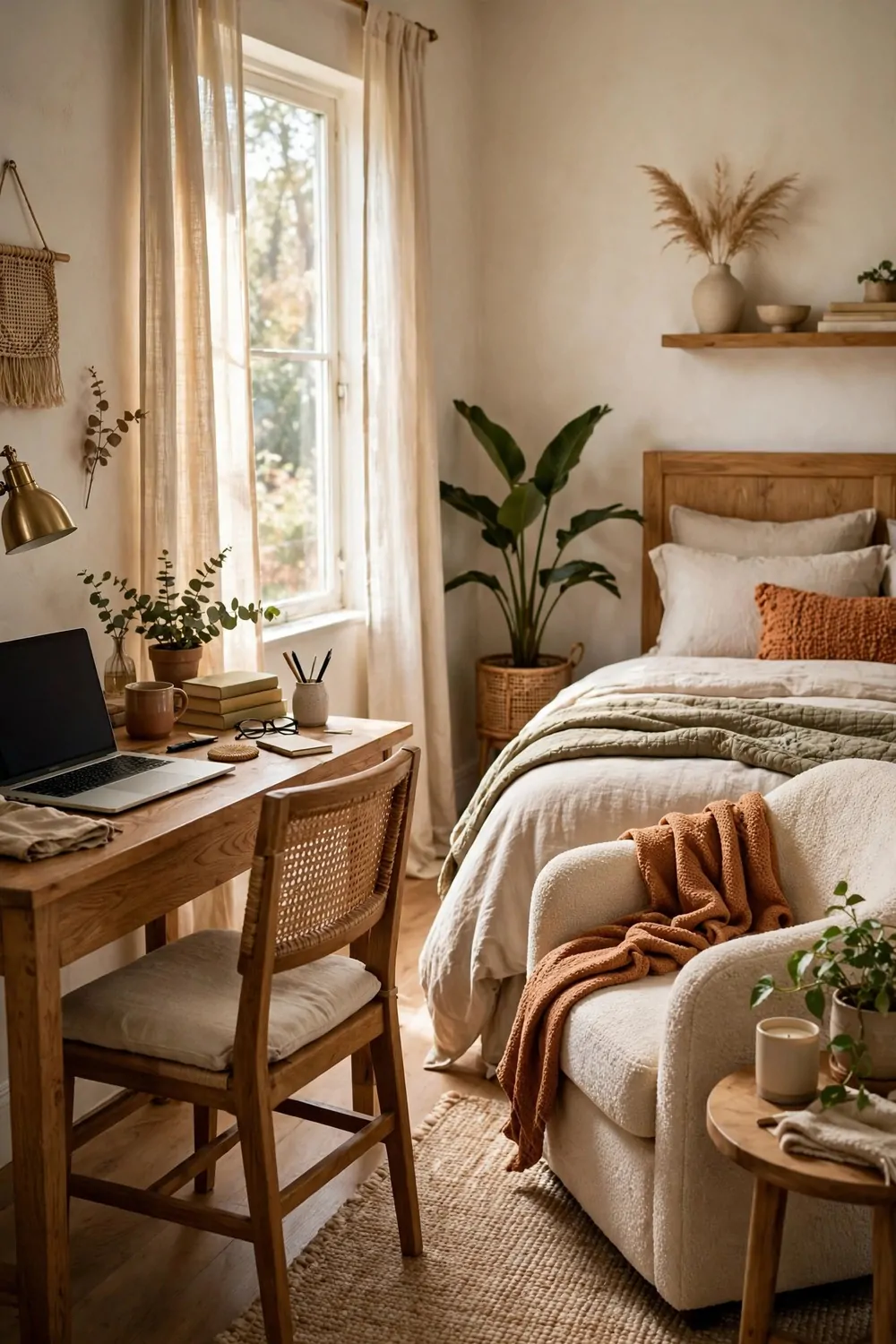
One chair is for work. The other chair is for thinking. That is the two-chair trick, and it works because your brain likes to move when it thinks.
Put your work chair at the desk, the one with the straight back that keeps you upright. Put a second chair somewhere else in the bedroom, by the window or in the corner by the bed. A soft chair, the kind you sink into a little.
When you get stuck on a hard job, stand up and move to the second chair. Sit there for ten minutes with a notebook and no screen. The change of seat changes your brain, and the idea that would not come at the desk often shows up in the soft chair.
The second chair is also the guest chair. When a friend visits and you are working, they have somewhere to sit that is not your bed. A guest on the bed feels awkward. A guest in the soft chair feels welcome.
Keep a small side table next to the second chair for a mug and a book. A chair with no table beside it is a chair you never use, because your hands have nowhere to go.
Do not buy a second chair that matches the work chair. A soft chair should look soft, with a cushion and a throw over the arm. The difference between the two chairs is the whole point. One says work. The other says rest.
This is the setup for people who think best when they move around. Writers, planners, students. The desk chair holds the work, the soft chair holds the thinking, and your brain gets to switch between them all day.
Try this one if you sit at your desk for hours and get nowhere. Stand up, walk three steps, sit in the soft chair, and let your brain do its work somewhere new.
The Clothes Chair Fix
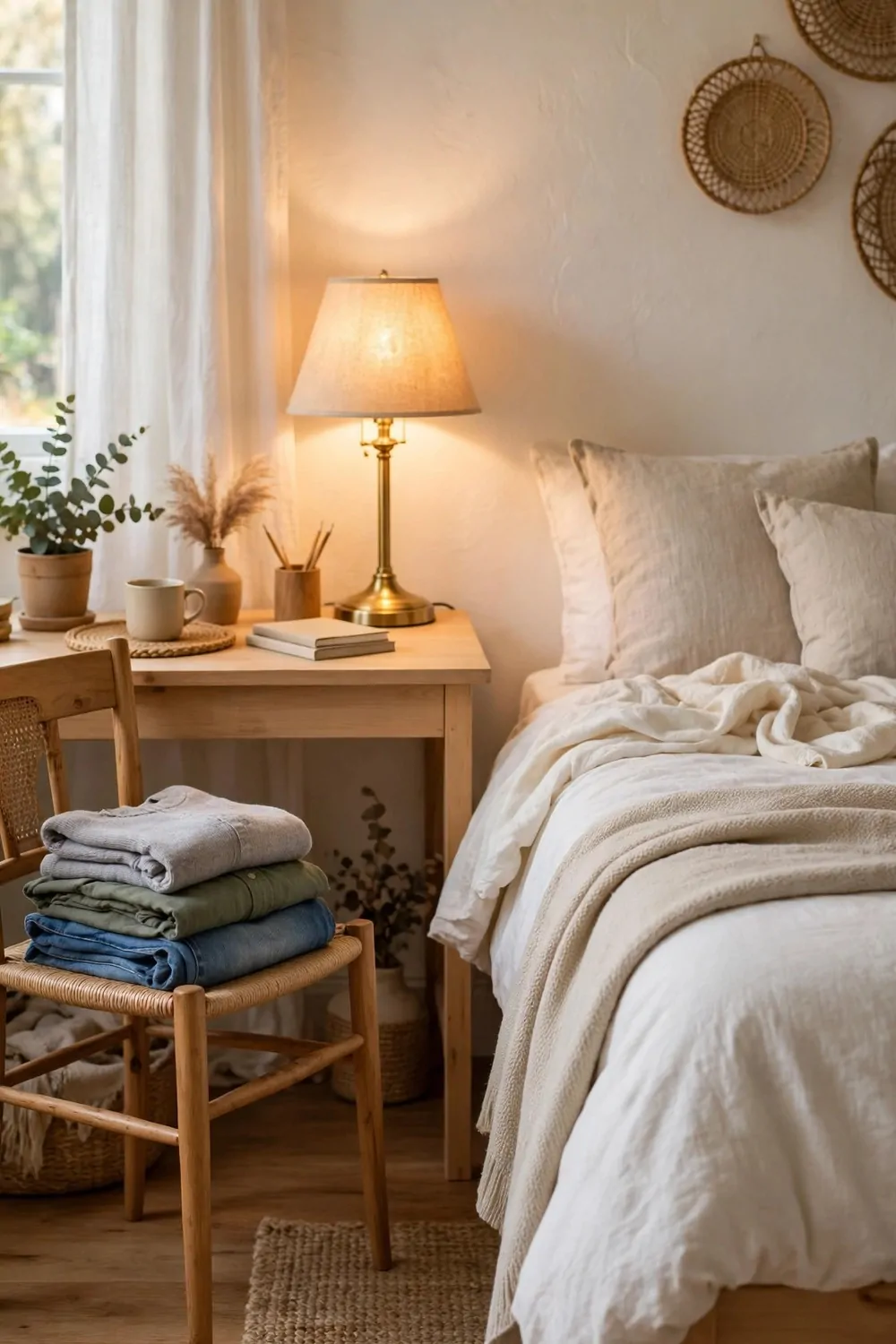
Every bedroom has a clothes chair. It holds the jeans you wore once, the shirt you tried on and took off, and the sweater that is not quite dirty enough to wash. That chair is the messiest thing in the room, and it sits right next to your desk.
The fix is not to get rid of the chair. The fix is to give it a real job. The chair becomes the tidy chair, with rules, and the desk stops living next to a pile.
Hang two hooks on the wall beside the chair. One hook holds today’s clothes. The other holds tomorrow’s. The chair holds nothing at all, except maybe one folded sweater on the seat. The hooks do the holding, and the chair stays clear.
Put a small basket beside the chair for the clothes that need washing. A basket on the floor beats a pile on the chair, because a basket has sides and a pile does not. When the basket is full, it goes to the laundry. When the chair is full, it just sits there judging you.
Fold the maybe clothes and put them in a drawer, not on the chair. The maybe clothes are the ones you tried on and took off. They are clean enough to wear again, so they belong in a drawer, not on a chair that everyone can see.
Keep the chair clear for one week and see how the room feels. The desk looks tidier when the chair beside it is tidy. The bed looks tidier too. One clear chair changes the whole room, because the chair was the messiest thing in it.
This is the setup for people whose bedroom office is fine, but the room still looks messy. The desk is not the problem. The chair is. Fix the chair, and the desk finally gets to shine.
Try this one if your clothes chair is doing more damage than your desk ever did. Two hooks, one basket, one clear chair, and the bedroom office looks like it was planned all along.
Keep Reading
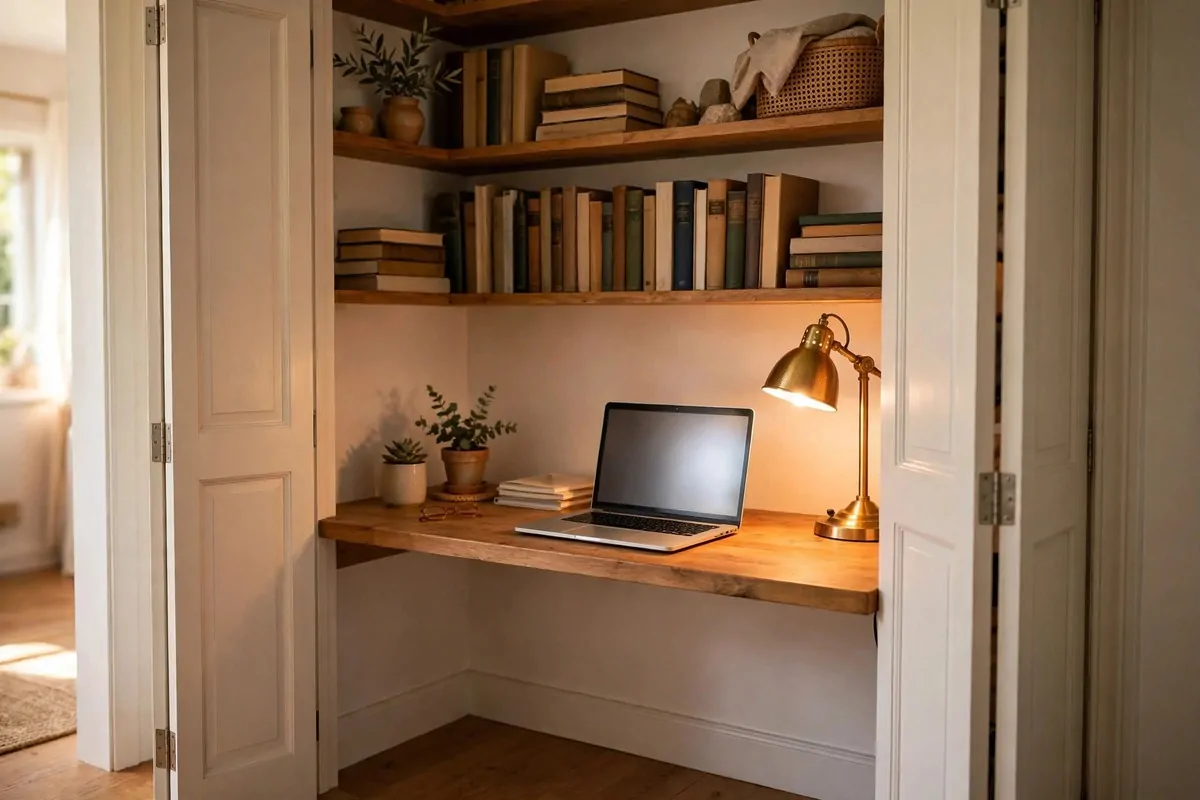
If you liked these bedroom office setups, these closet office ideas will give you even more ways to make a small space work hard.
- 20 Walk in Closet Office Setups With Serious Wow Factor
- 16 Cloffice Ideas Small Spaces Will Love
- 17 Closet Converted to Office Projects Worth Copying
A bedroom can hold a whole workday and still be the calmest room in the house at night. All it takes is a desk that knows its place, a bed that keeps its own, and a door you can shut at five. Pick your favourite setup from this list, build it this weekend, and let your bedroom surprise you.