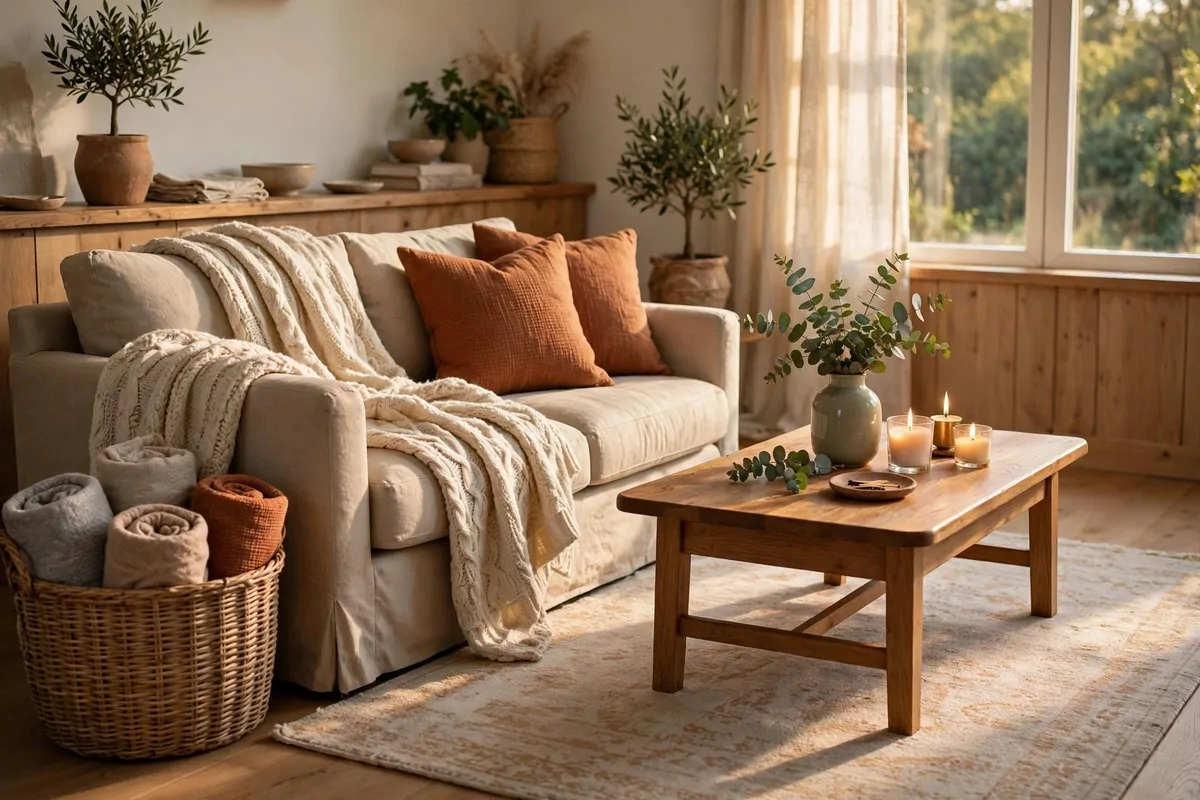
18 Desk in Closet Ideas for a Hidden Workspace

My guests have sat on my sofa for an hour and never once guessed there is a desk in my bedroom. Not one of them. They have used the bathroom, hung their coat in the hall, and looked right past the closet door without a single question.
That is the whole idea behind a hidden workspace. The desk is there when you need it. It is gone when you do not. Nobody has to know it exists, and that is the best part.
These 18 Desk in Closet Ideas are all about hiding the office in plain sight. Each one keeps the desk out of sight when the workday ends, so your bedroom looks like a bedroom again, your living room looks like a living room, and your brain gets to switch off too.
Pick the hiding trick that fits your closet and start there. You do not need a big room. You need a door that shuts, a board that folds, or a curtain that drops, and the office disappears.
The Sliding-Door Desk
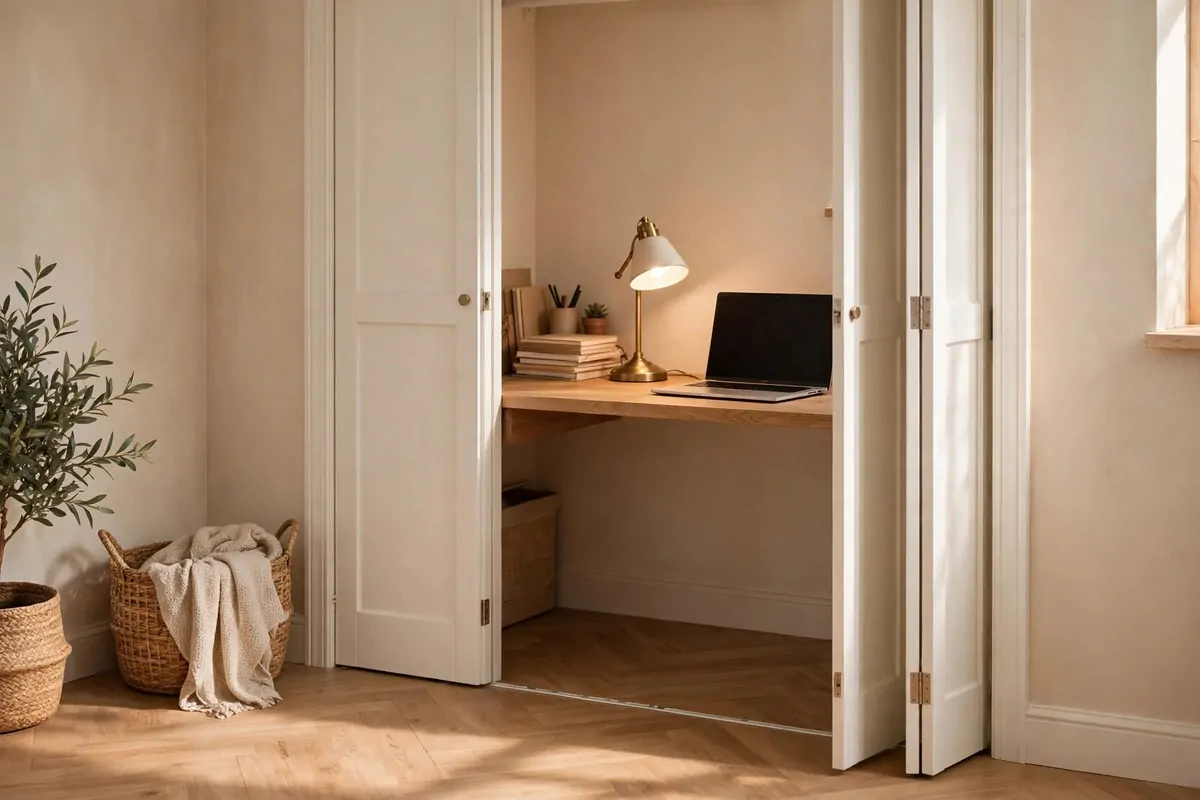
A sliding door is the fastest hiding trick in this whole list. One push and the office is gone. No folding, no packing, no tidying first.
Fit a desk board across the back wall of the closet, at the height that suits your elbows. Put your laptop on it, add a small lamp, and leave the chair tucked underneath. The desk stays put all day, every day, because the doors do the hiding for you.
Here is a table for picking the right door for your hidden desk.
| Door type | How it hides | Best for |
|---|---|---|
| Bi-fold doors | Fold flat against the wall | A narrow closet |
| Sliding doors | Glide across in one push | A wide closet |
| Louvered doors | Slats let a little light through | A dark closet |
| Mirror doors | Reflect the room, hide the desk | A small bedroom |
Keep the desk top tidy enough to hide in one move. A laptop, a lamp, and a notebook. That is all the sliding door needs to cover. If the desk is piled high, the door still shuts, but the pile pushes against it, and the door sticks.
Oil the door track once a year with a drop of plain oil on a cloth. A sticky track turns a one-second hide into a wrestling match, and a smooth track is what makes the trick feel like magic.
Hang a small hook on the inside of one door for your headphones. They hang out of sight, they never tangle, and they are right there when the door opens in the morning.
This is the hidden desk for people who want the simplest trick of all. No building. No folding. Just a door that slides, and an office that vanishes.
Paint the inside of the closet a pale colour before you mount the desk. A pale back wall makes the desk feel brighter, and the room feels bigger the moment the doors slide open.
The Curtain Desk
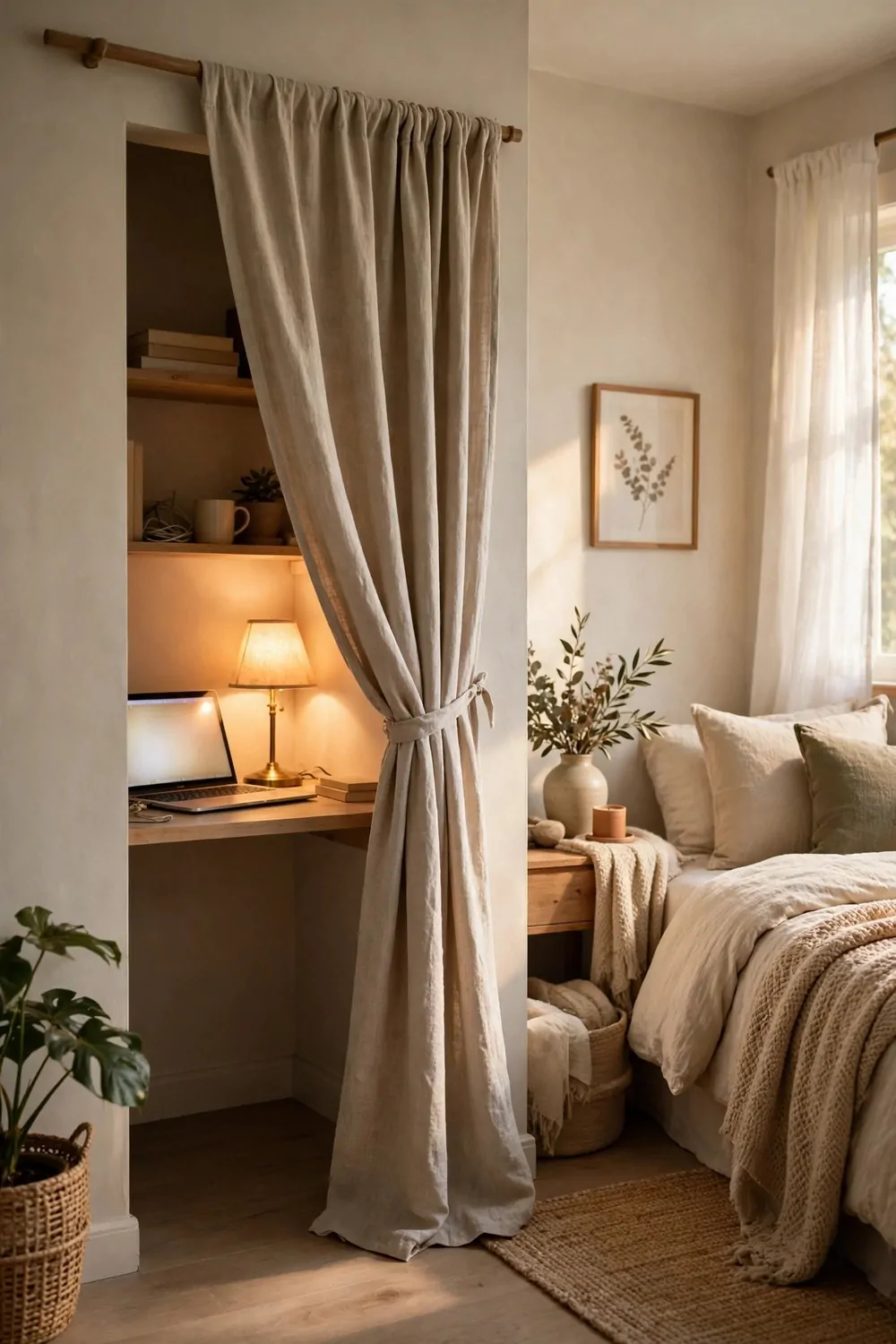
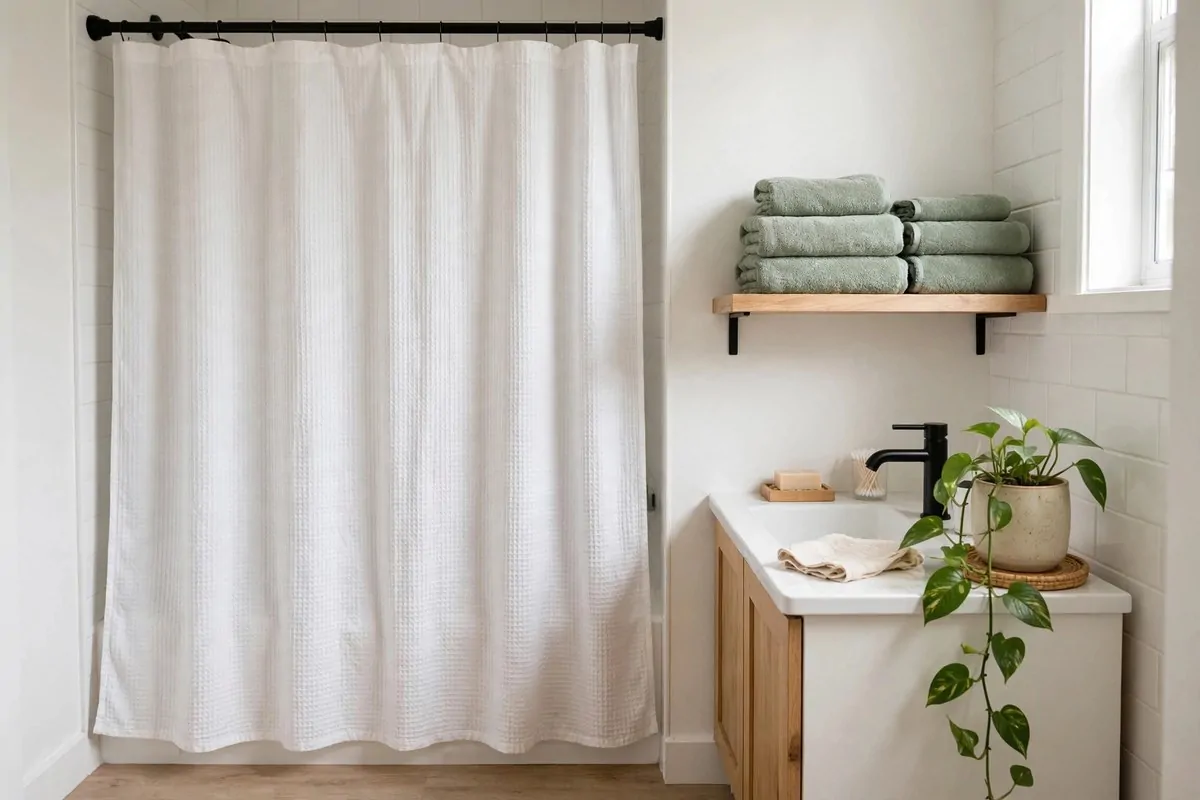
A curtain hides a desk softer than any door. It moves in the breeze a little, it comes in any colour you like, and it costs less than a takeaway dinner.
Hang a rod across the top of the closet opening and drop a curtain from it. Pick a fabric that matches your walls, and the closet stops looking like a closet. It looks like a window with the curtains drawn.
The desk behind the curtain can be as simple as a board on two brackets. Nobody sees it when the curtain is shut, so it does not need to look pretty. It just needs to hold a laptop and a lamp without wobbling.
Pull the curtain open in the morning and tie it to one side with a bit of ribbon. The desk is out, the light comes in, and the room feels like an office. Pull it shut at five, and the room is a bedroom again.
Wash the curtain twice a year, once in spring and once in autumn. A dusty curtain in a bedroom looks tired, and a clean one makes the whole wall look new. It takes ten minutes in the machine and a quick iron.
Keep the curtain hem just above the floor. A hem that drags on the floor collects dust and trips the chair. A hem that stops an inch short swings clean, and the room stays tidy underneath.
Try this one if your closet has no doors at all. A curtain is the cheapest door you will ever buy, and it hides the desk just as well as wood does.
Pick a thick fabric if the room gets cold at night. A heavy curtain keeps a little warmth inside the closet, and your laptop stays a touch warmer on a cold morning. A thin curtain looks light and pretty, but it does nothing for the chill.
The Fold-Flat Wall Desk
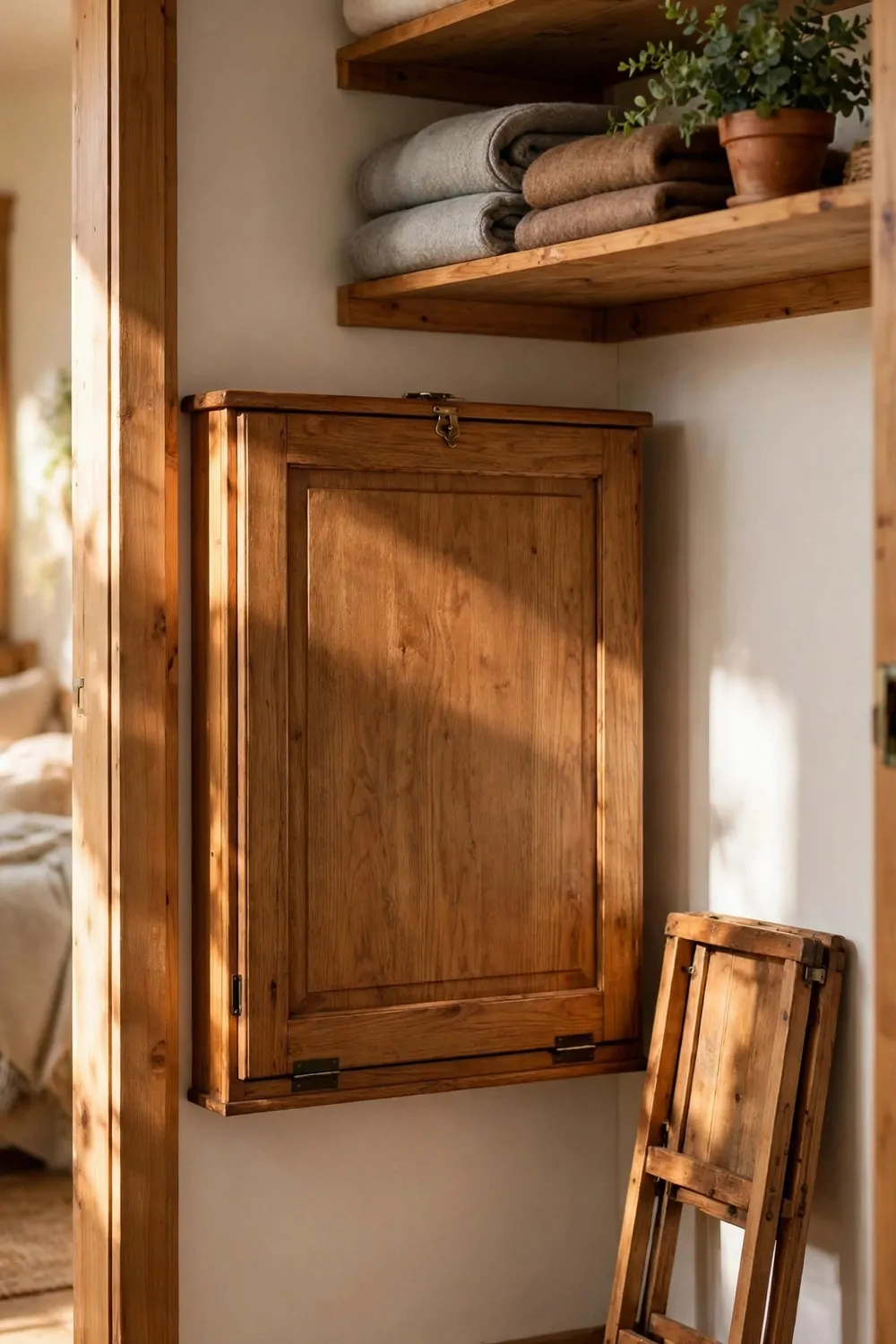
Some desks fold away. This one folds flat against the wall, so flat you could hang a picture over it and nobody would know a desk was ever there.
Mount the board on two strong hinges along the back wall of the closet. When you want to work, you pull it down and it rests on two small folding brackets. When you are done, you lift the brackets, fold the board up, and the wall is blank again.
Size is the whole trick here. The board should be just big enough for a laptop and a notebook, and no bigger. A board that is too deep will not fold flat, and a board that is too wide will hit the side walls. Measure twice, cut once, and the fold will be smooth.
Keep nothing on the board when it folds up. No laptop, no mug, no papers. A fold-flat desk only works if the fold takes five seconds, and it only takes five seconds if the board is empty. The laptop lives on a shelf above, and the mug lives in the kitchen.
Paint the underside of the board the same colour as the wall. When the desk is folded up, the underside faces the room, and a matching colour makes it disappear. A board painted a different colour stands out like a sign that says desk here.
Check the hinges once a year. Hinges loosen a little over time, and a loose hinge makes the board droop. One turn of a screwdriver tightens them up, and the desk swings like new again.
This is the hidden desk for a room that has to be two rooms at once. A bedroom by night, an office by day, and a blank wall in between. Nobody walks in and sees a desk. They see a wall, and that is the whole point.
Put a small basket on the shelf above for the laptop charger and a spare notebook. The basket lives on the shelf, the desk folds flat below it, and nothing has to travel far in the morning.
The Wardrobe Desk
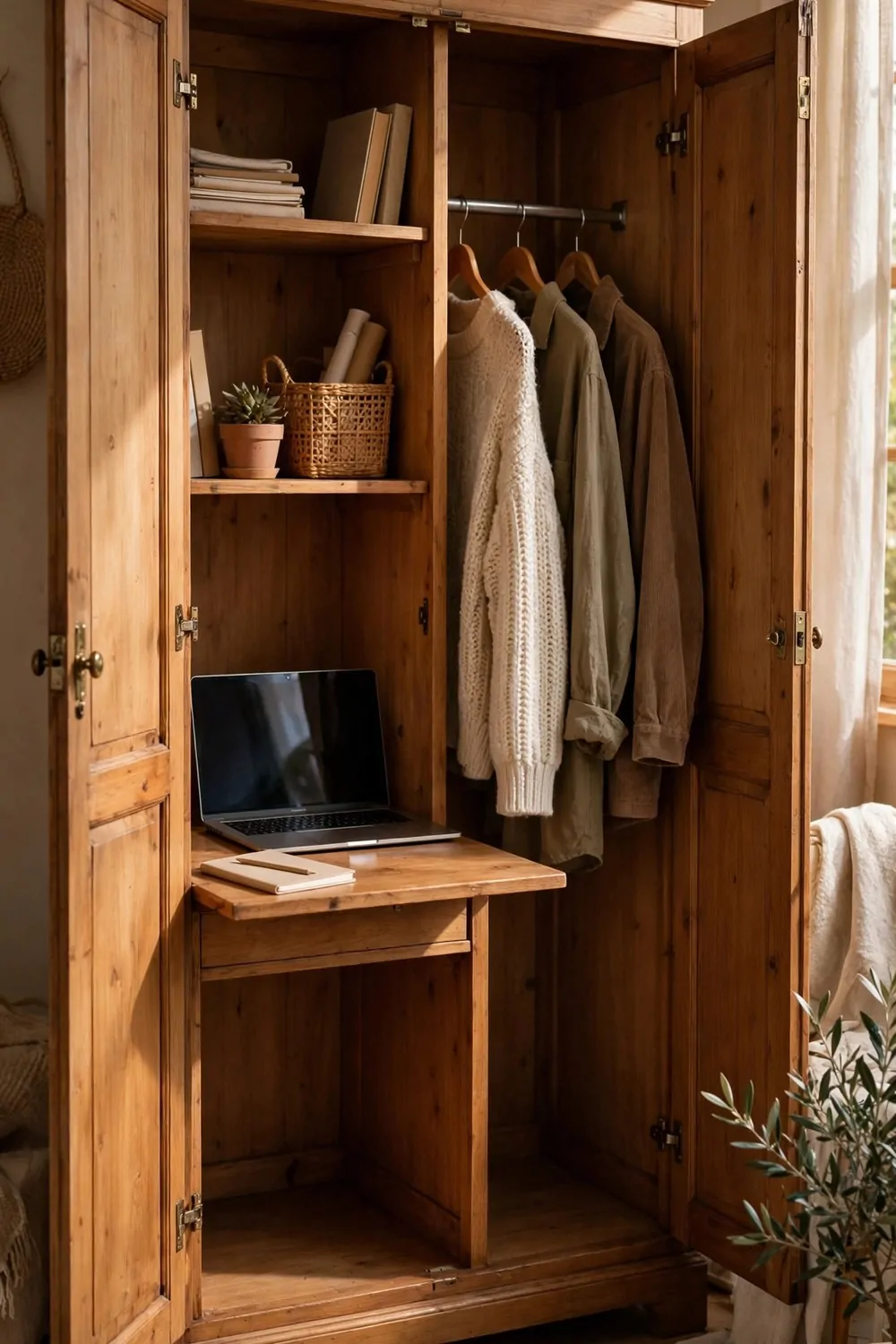
A wardrobe is a closet with doors that open wide, and wide doors are perfect for hiding a desk. Open them and you have an office. Shut them and you have a plain wardrobe.
Take the rail out of one side of the wardrobe and fit a desk board across it instead. The other side keeps the rail, so your clothes stay where they are. One wardrobe, two jobs, and nobody can tell from the outside.
Put shelves above the desk for notebooks and a small plant. The shelves live inside the wardrobe, so they never show when the doors are shut. A shelf that only you see does not need to look perfect. It just needs to hold things without falling down.
Keep the laptop on the desk and the charger in a small basket on the shelf. When the doors shut, the whole office is inside the wardrobe, and the room looks like a bedroom. When they open, the office is ready in seconds.
Line the inside of the doors with a little cork board or a few hooks. The doors are free wall space, and they hold your headphones, your keys, and the note you keep forgetting. The doors do the hiding and the holding at the same time.
Pick a wardrobe with solid doors if you can. Glass doors show everything inside, and a glass door hides nothing. Solid wood doors shut the office away completely, and the room stays calm.
This is the hidden desk for people who share a bedroom with their office. The wardrobe was already there. It just needed a desk inside it, and now the office appears and disappears with two doors.
Keep a small rug in front of the wardrobe doors. The rug marks the spot where the chair goes, and it stops the chair legs from marking the floor.
The Roll-Away Desk
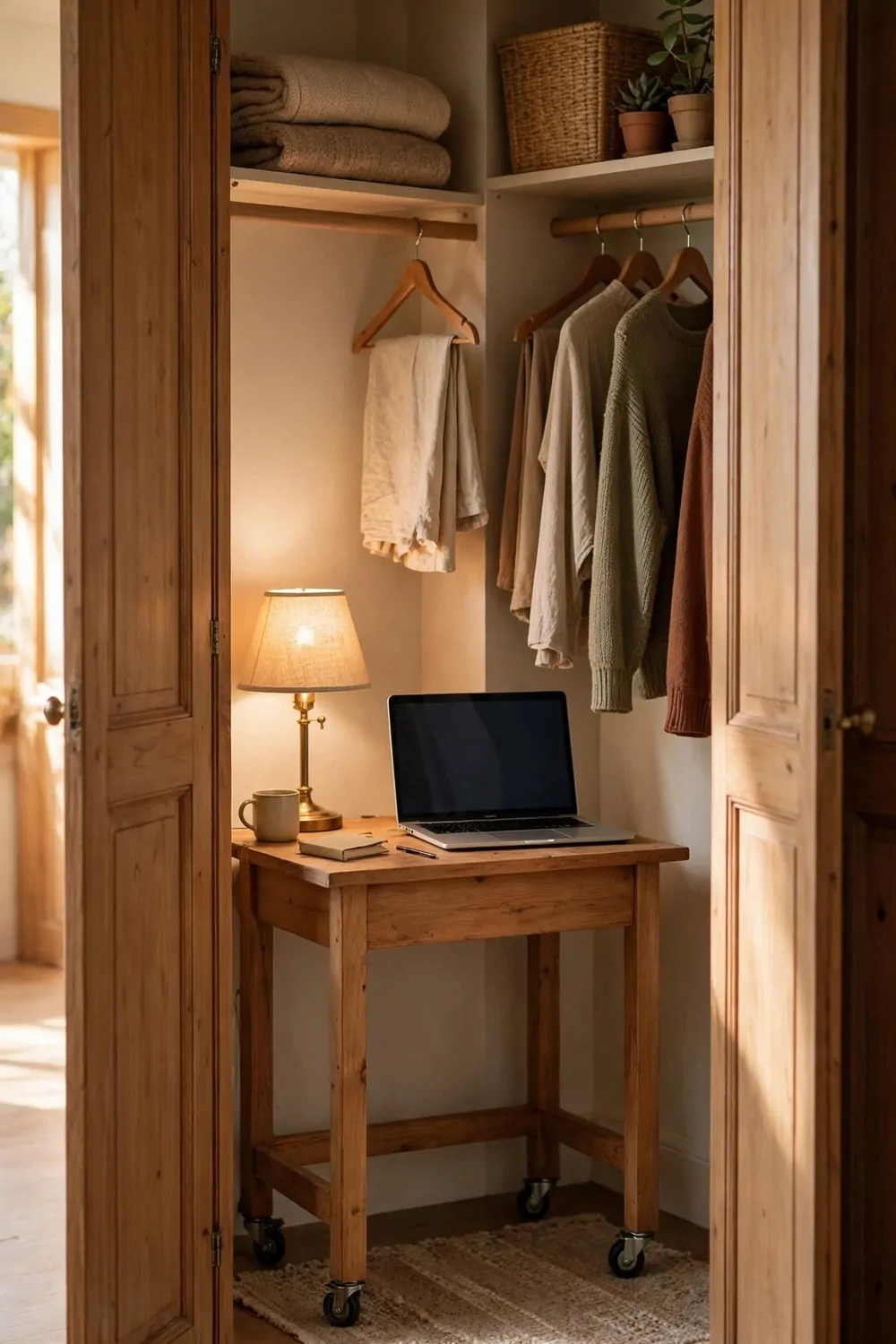
A desk on wheels is an office that can run away and hide. Roll it into the closet at five o’clock, roll it back out in the morning, and the room never has to look like an office at all.
Pick a small desk with four castor wheels, the kind that lock with a little foot pedal. The wheels let it move, and the lock keeps it still while you work. A desk that rolls away on its own in the middle of a video call is a problem you only need once to learn from.
Keep the desk small enough to fit through the closet door with room to spare. Measure the door first, then buy the desk. A desk that is one inch too wide lives in the living room forever, and the hiding trick never works.
Run the cables from the desk to the wall with one long lead, and coil it on a hook inside the closet when the desk rolls in. A cable that trails across the floor trips everyone, and a coiled cable on a hook is out of the way in seconds.
Put everything the desk needs on the desk itself. Laptop, lamp, notebook, pen pot. A roll-away desk that needs three trips to the shelf to set up is not a quick hide. It is a packing job, and packing jobs get skipped.
This is the hidden desk for renters and movers. No holes in the wall, no brackets, no paint. Just a desk with wheels, a closet to roll it into, and a room that looks like a bedroom by dinner.
Lock the wheels every time you sit down to work. A desk that rolls away mid-sentence is funny once and annoying forever.
Keep a spare set of castor wheels in a drawer, just in case one breaks. Wheels wear out, and a spare set costs less than a takeaway dinner.
The Bookshelf Front
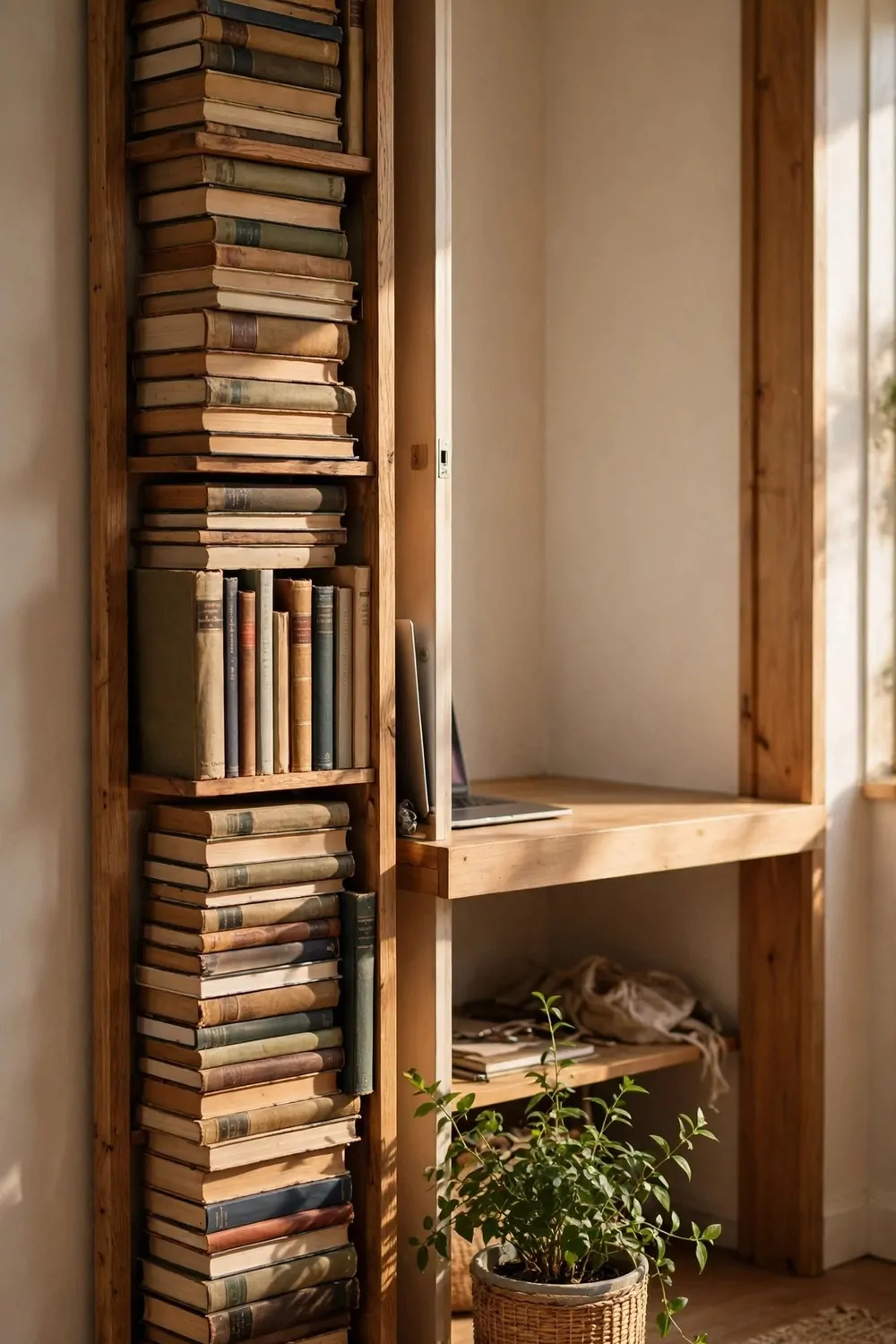
A bookshelf in front of a closet desk is the oldest hiding trick in the book. Guests see books. You see an office behind them.
Stand a tall, narrow bookshelf in the closet opening, just in front of the desk. Fill the shelves with books, a plant, and a few pretty boxes. The desk sits behind the shelf, and from the doorway all anyone sees is a wall of books.
The shelf needs to be shallow enough to leave room for your chair. A shelf twelve inches deep leaves you a working gap behind it. A shelf eighteen inches deep eats the whole closet, and your knees end up under the books.
Put the things you grab most on the front of the shelf, at eye level. The books you love, the plant, the framed photo. The back of the shelf holds the boring stuff, like the charger and the spare paper, where nobody looks.
Slide the shelf to one side when you want the full desk. A shelf on small felt pads slides across the floor without scratching it, and you can pull it aside in the morning and push it back at night. Two seconds, and the office is open or hidden.
Keep the desk lamp on the desk, not on the shelf. A lamp behind books looks strange, and the light gets blocked by the spines. A lamp on the desk lights your hands, and the books stay in the dark where they look their best.
This is the hidden desk for book lovers. The closet holds your books and your office at the same time, and the books do the hiding for free. Nobody suspects a desk behind a bookshelf, because a bookshelf is the last place anyone looks for one.
Dust the books once a month with a dry cloth. Dusty books in a bedroom look tired, and a quick wipe keeps the whole shelf looking loved.
The Drawer Desk
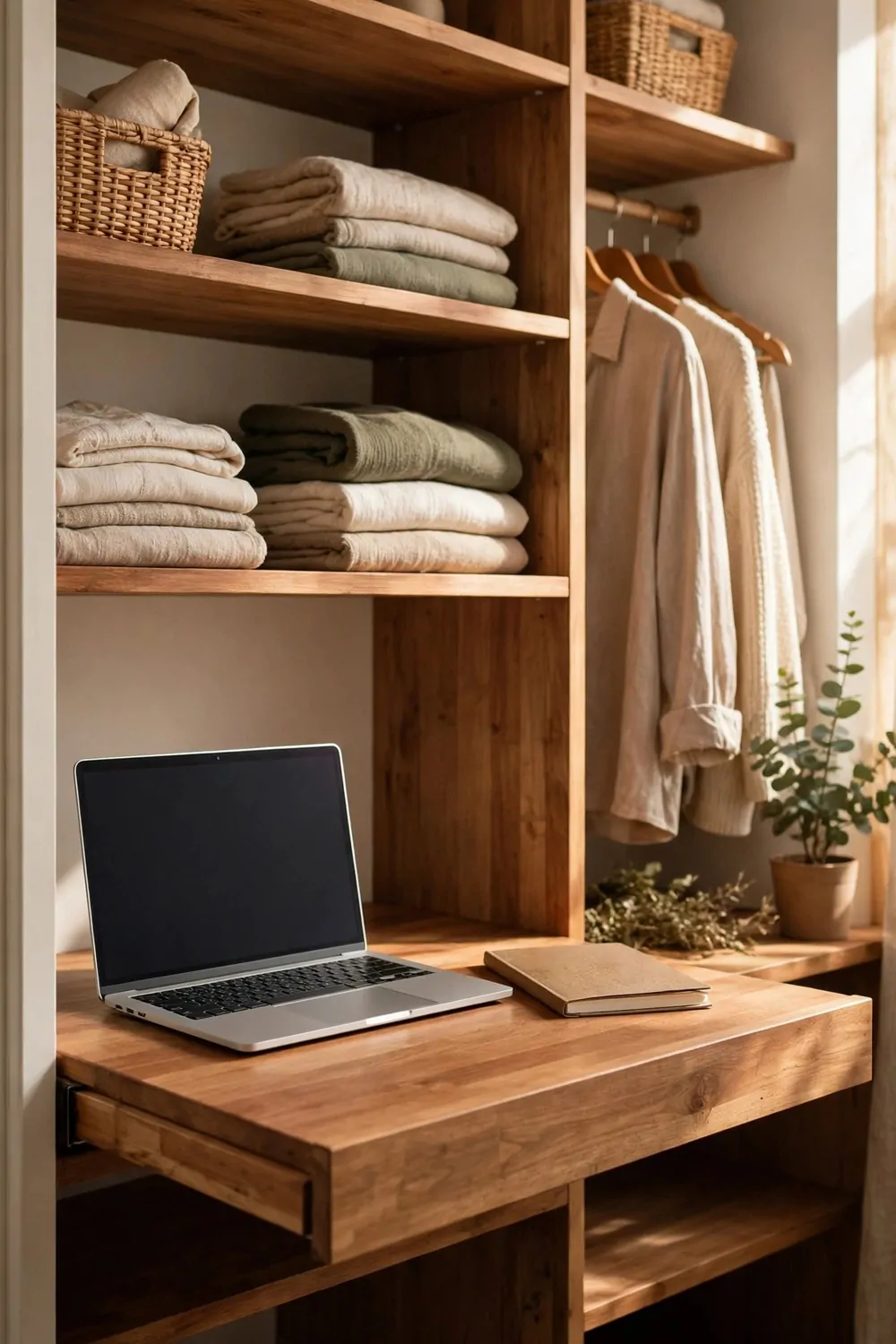
A drawer that holds a desk is the sneakiest hiding trick I know. Pull it out and you have a workspace. Push it in and you have a drawer.
Fit a deep drawer under the closet shelf, wide enough for a laptop and a notebook. The desk board lives inside the drawer, on two smooth runners. Pull the drawer out, lift the board up to sitting height, and you are working.
The trick is the runners. Cheap runners stick and squeak, and a sticky drawer ruins the whole trick. Spend a little more on smooth ball-bearing runners, and the drawer glides out like it is on ice.
Keep the laptop in the drawer when it is closed. The drawer is the laptop’s home, and the laptop never has to travel to the desk and back. Open the drawer, lift the lid of the laptop, and the office is running in ten seconds.
Label nothing on the outside of the drawer. A drawer with a label that says office is not a hidden office. A plain drawer front looks like every other drawer in the room, and nobody opens a drawer they have no reason to open.
Put a small felt mat in the bottom of the drawer. The mat stops the laptop from sliding around when you pull the drawer out, and it keeps the drawer quiet. A drawer that rattles gives the game away.
This is the hidden desk for small closets with no room for a board on the wall. The desk lives in a drawer, the drawer lives under a shelf, and the whole office hides in a space no bigger than a shoebox.
Keep a pencil and a notepad in the drawer beside the laptop. A drawer desk with no pen in it is a desk you have to leave every time you need to write something down.
The Mirror Door Desk
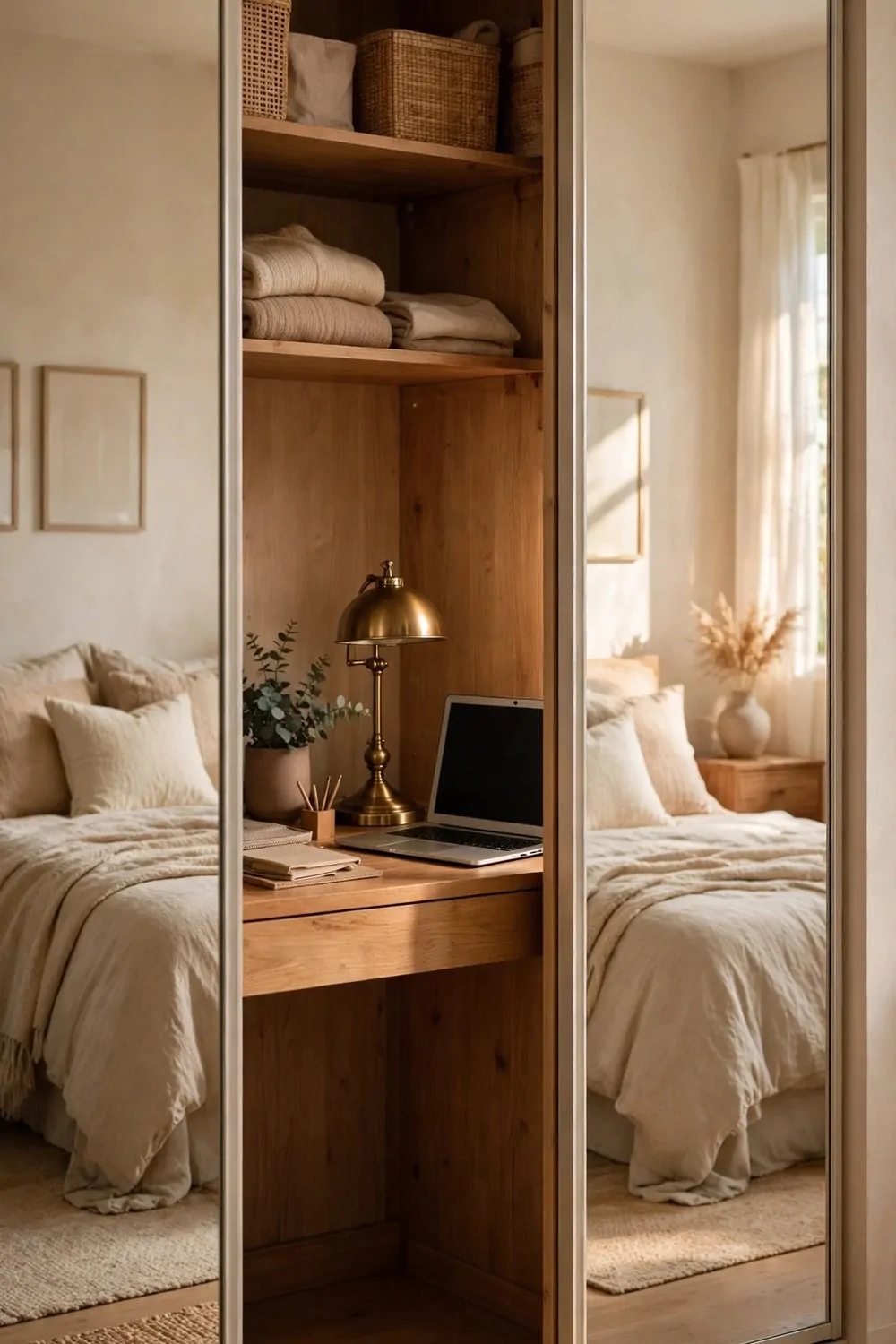
A mirror door hides a desk twice over. It covers the opening, and it reflects the room, so your eye slides right past it.
Fit mirrored sliding doors across the closet opening. From the bedroom, the doors look like a big mirror on the wall. Nobody thinks there is a desk behind a mirror. They think about their own reflection, and they walk on by.
Put the desk board across the back wall, with the laptop and a small lamp on it. The mirror doors shut over the whole setup at the end of the day. The room looks bigger because of the mirror, and the office is gone because of the doors.
Keep the mirror clean. A dusty mirror in a bedroom is worse than no mirror at all, because it just shows a grey smudge. Wipe it once a week when you wipe the desk, and the trick stays perfect.
Point the mirror at the tidiest part of the room. A mirror shows whatever sits across from it, so aim it at the made bed and the lamp, not at the laundry pile. It hides the desk and shows off the prettiest corner at once.
Use a plain frame in the same wood as your furniture. A matching frame makes the mirror doors look like they belong in the room, not like something you stuck on the closet as an afterthought.
This is the hidden desk for small bedrooms that need light more than they need furniture. One mirror, one wipe a week, and the office disappears behind your own reflection.
Hang a small hook on the side wall for your bag. The bag hangs out of the way, the mirror stays clear, and the room looks tidy from the bed.
The Pegboard Panel
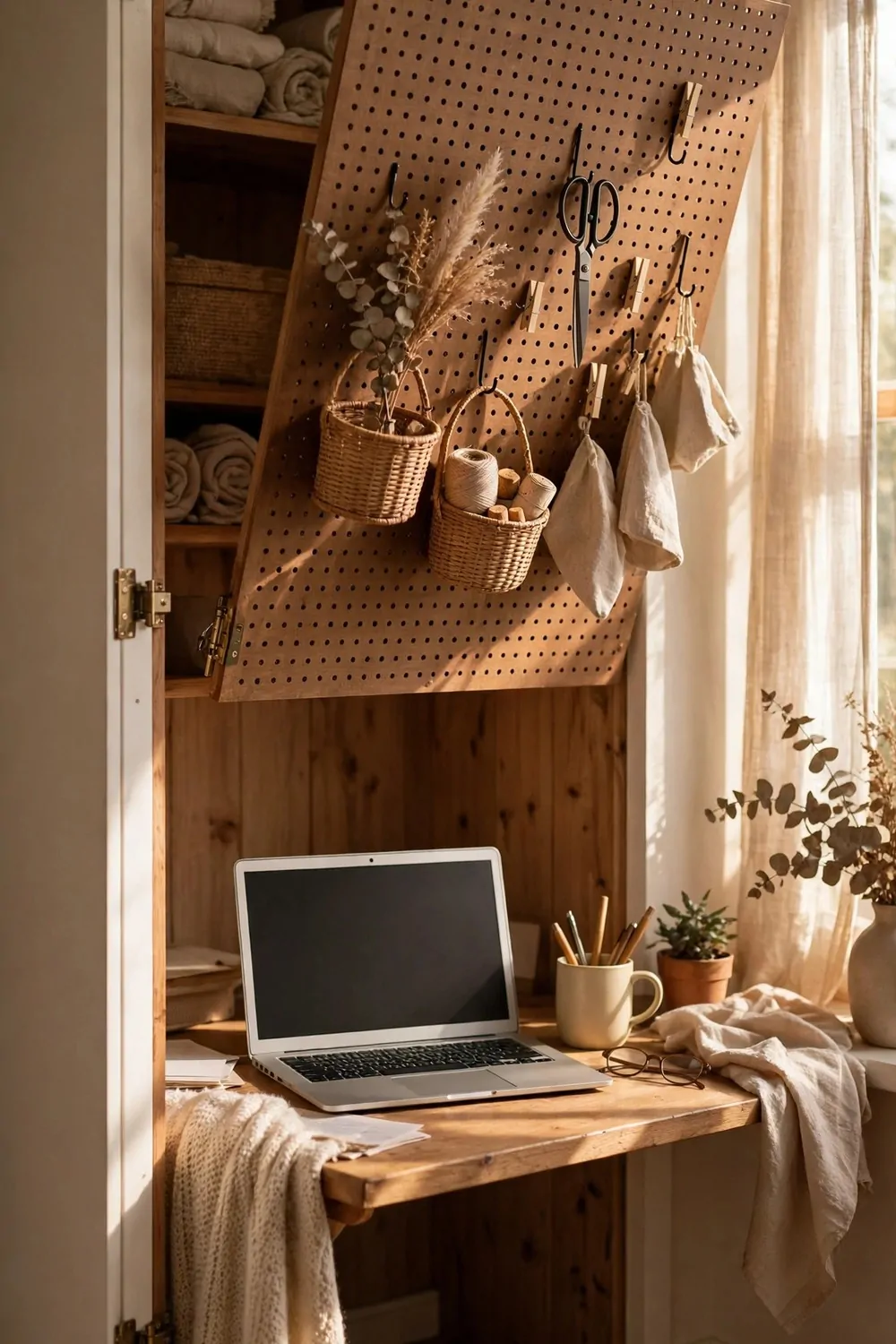
A pegboard panel that swings shut over a desk is a hiding trick and a storage trick in one move. Open it and you have tools and hooks. Shut it and you have a plain panel on the wall.
Hang the pegboard on two hinges on one side of the closet opening. When it is open, it leans flat against the side wall, and the desk is out. When it is shut, it covers the desk completely, and the room sees only a neat board with hooks on it.
Load the pegboard with the things you grab every day. Scissors, a ruler, a small basket for pens, a hook for your headphones. The board holds them all where you can see them, and when it swings shut, they swing shut with it.
Keep the board light. A pegboard full of heavy tools will pull on its hinges and start to sag. Hooks, baskets, and one small shelf are plenty. If the board feels heavy when you swing it, take something off.
Paint the back of the pegboard the same colour as the wall. When the board is shut, the back faces the room, and a matching colour makes it disappear. A board painted a different colour stands out like a sign.
Check the hinges once a year. Hinges loosen a little over time, and a loose hinge makes the board droop. One turn of a screwdriver fixes it, and the panel swings smooth again.
This is the hidden desk for people who like their tools close and their office closer to invisible. The pegboard holds everything, hides everything, and costs less than a new chair.
Leave one hook bare on purpose. That bare hook is where the next tool will go, and a board with no free hook has no room for your next idea.
The Two-Door Split
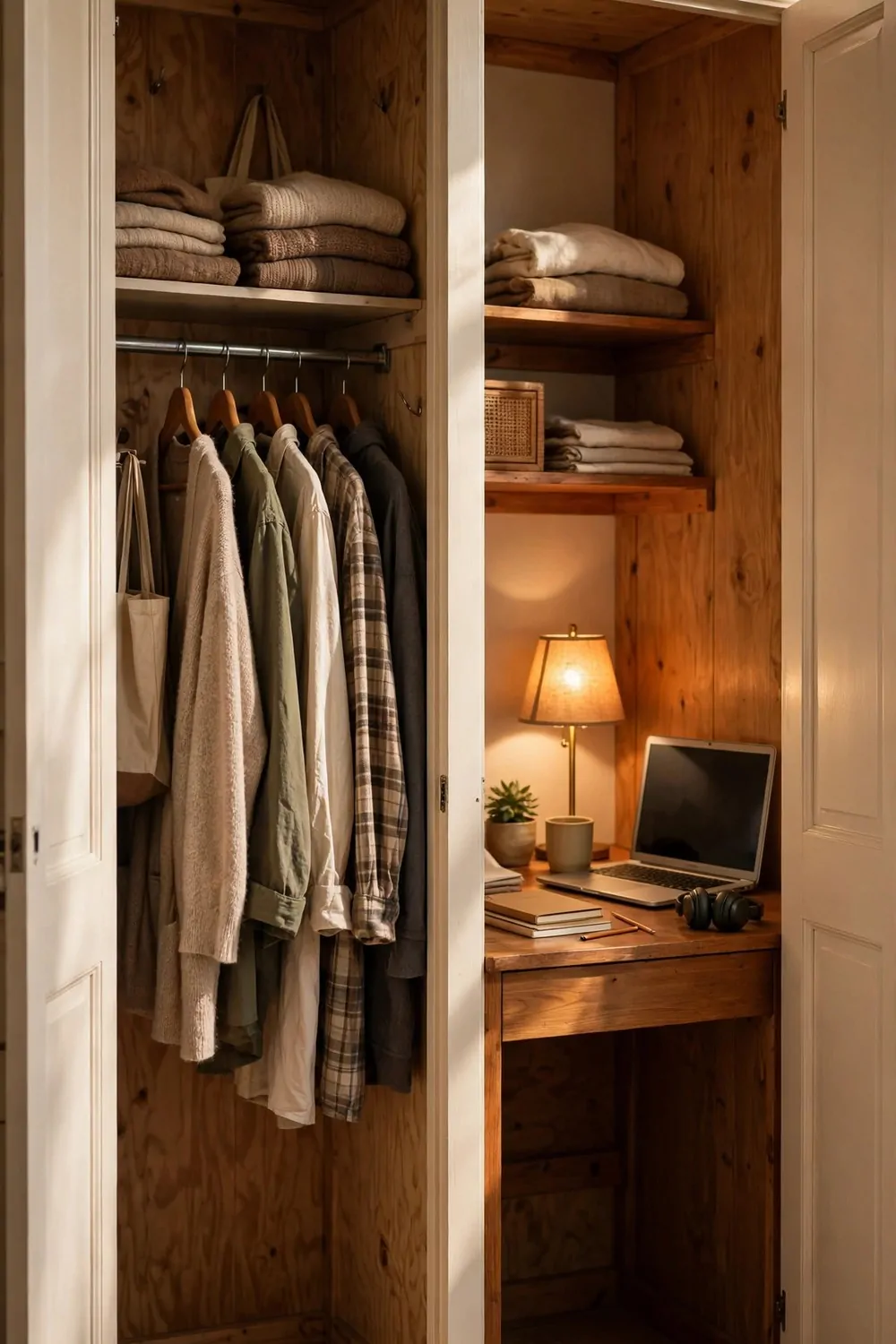
Some closets have two doors, and two doors are better than one for hiding a desk. One door hides the clothes. The other door hides the office. Both doors look the same from the outside.
Split the closet down the middle. Clothes live behind the left door, on the rail. The desk lives behind the right door, on a board across the back wall. When both doors are shut, the closet looks like any other closet in the house.
Keep the two sides separate in your head too. The clothes side is for getting dressed. The desk side is for work. When the work side is open, the clothes side stays shut, and the room never looks like a mess of coats and cables at the same time.
Put a small rug in front of the desk door, not the clothes door. The rug marks the office side of the closet, and your chair rolls onto it in the morning. A rug in front of both doors just gets in the way of getting dressed.
Hang a tiny hook on the inside of the desk door for your bag. The bag hangs out of sight while you work, and you grab it on the way out. A bag on the floor under the desk trips you every time you push the chair back.
This is the hidden desk for people who cannot give up the whole closet to work. You keep your clothes, you gain an office, and the two doors keep the two jobs apart. Nobody opens the wrong door, because both doors look the same, and that is the whole trick.
Put a small lamp on the desk side, not on the clothes side. A lamp over the clothes lights the rail, and a lamp over the desk lights your work.
Keep the desk door shut when you get dressed in the morning. A shut desk door means the office stays hidden while you pick your clothes, and the morning feels calmer.
The Hidden Printer Shelf
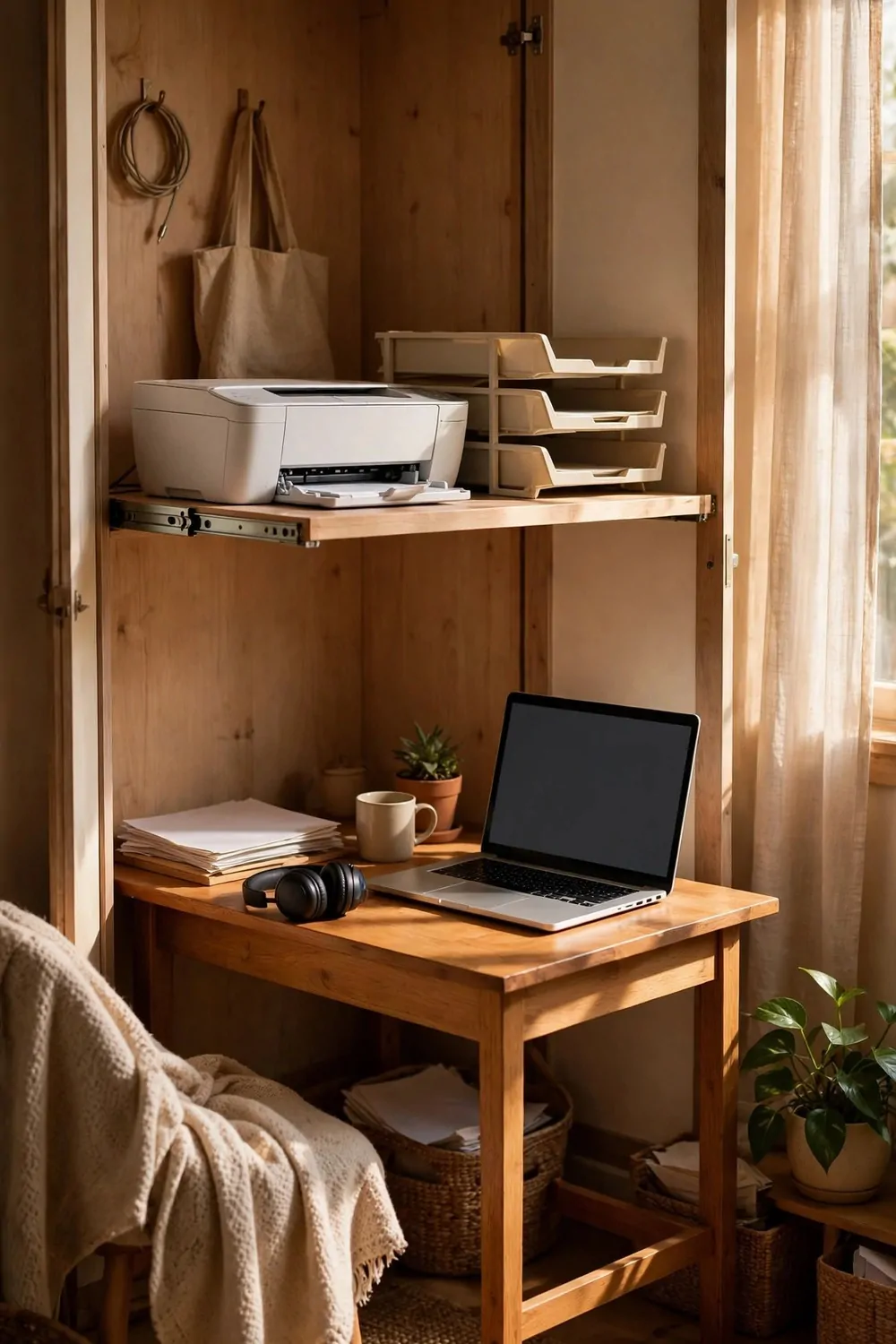
A printer is the loudest, clumsiest thing in any home office. A hidden printer shelf tucks it out of the way, on its own little ledge, so your desk never has to share space with it.
Fit a pull-out shelf low down in the closet, on smooth runners, and put the printer on it. Push the shelf in and the printer disappears behind the closet door. Pull it out when you need to print, and push it back when the pages are done.
Keep paper in two stacking trays on the shelf above the printer, one for everyday paper and one for the nice paper. Trays stay neat where piles slide around, and the shelf above keeps them out of sight.
Slide a basket under the printer shelf for pages that come out. Finished sheets and recycling both land in the basket, so the desk never becomes a paper pile. The desk is for working, and the basket does the holding.
Run one power lead behind the printer shelf for the printer and the charger. One lead, two plugs, and no cables crossing the floor to trip over. A cable that crosses the floor in a hidden office is a cable that gets yanked out at the worst moment.
If you own a shredder, park it on the floor under that same shelf. It is heavy and loud, and it belongs down low where you can reach it without lifting. Out of sight, out of mind, and out of the way.
This is the hidden desk for people who still print things. The machine gets its own shelf, the paper gets its own trays, and your desk stays clear for actual work.
Keep a small stack of envelopes on the printer shelf. An envelope you can grab in seconds beats a drawer you have to dig through.
The Chalkboard Panel Desk
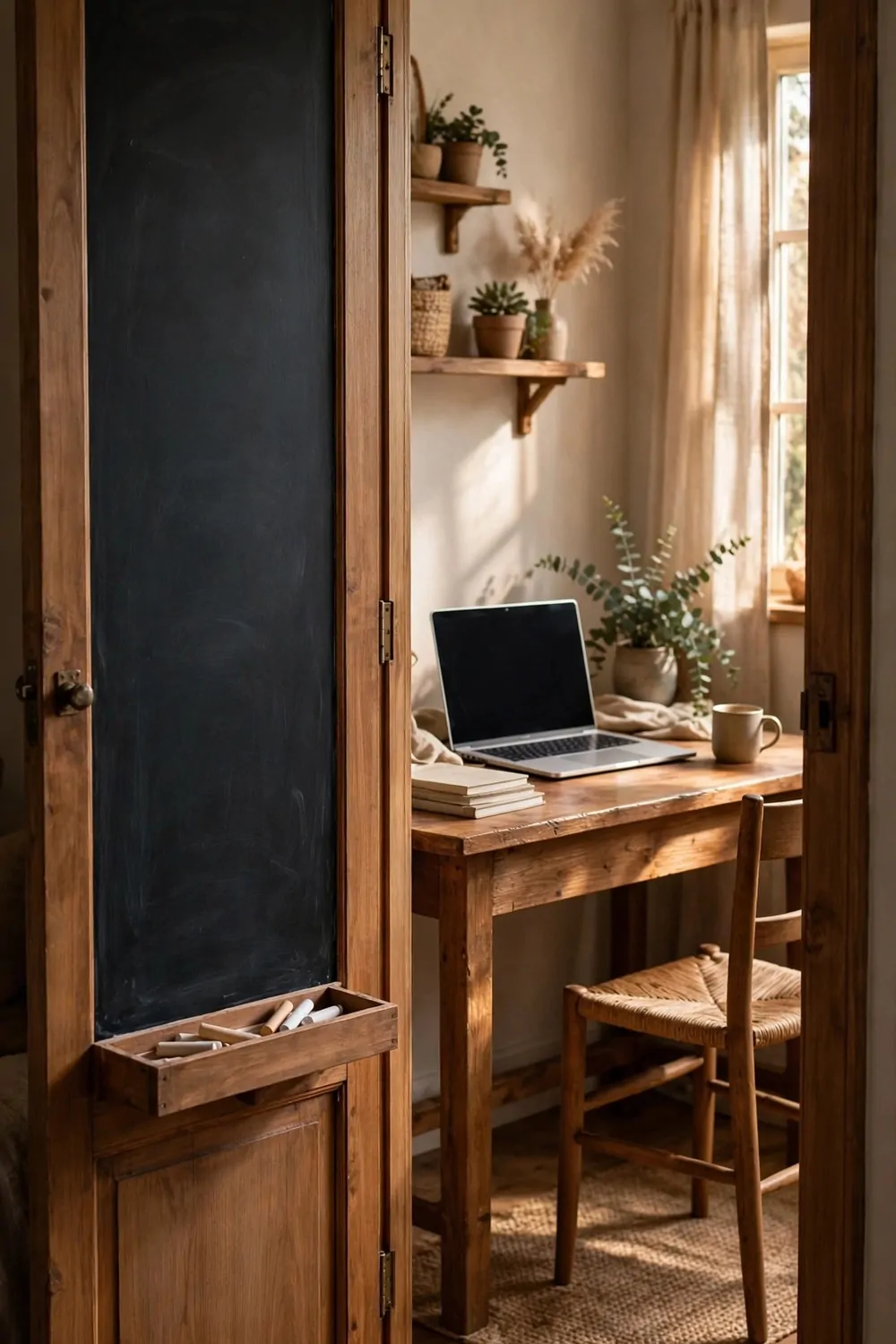
A chalkboard panel on the closet door hides the desk and gives you a planning board at the same time. Shut the door and the room sees a chalkboard. Open it and the office is right there.
Paint the inside of one closet door with chalkboard paint, two coats, and let it dry a full day. The door becomes a board for your to-do list, your shopping list, and the one note you keep forgetting. Chalk wipes off clean every Monday, and the list starts fresh.
Put the desk board on the back wall of the closet, with the laptop and a small lamp on it. When the door is shut, the chalkboard faces the room and the desk is hidden. When the door opens, the board swings away and the desk is out.
Keep a little chalk tray on the door, a small ledge that holds the chalk and the eraser. Chalk without a tray ends up on the floor, and chalk on the floor ends up on your socks. A tray the size of a pencil keeps it all in one place.
Write the day’s three jobs on the board every morning. Three jobs, no more. A board full of twenty jobs is just a wall of worry. A board with three jobs is a plan, and a plan you can see is a plan you finish.
This is the hidden desk for people who think on paper. The door holds the week, the desk holds the work, and your brain gets to do the thinking instead of the remembering. And when guests come over, they see a chalkboard, not an office.
Keep the chalk in a little tin on the door tray, not loose in your pocket. Chalk in a pocket ends up on your clothes, and chalk dust on a dark shirt shows up fast.
Wipe the board clean on Sunday night, ready for Monday. A clean board on Monday morning feels like a fresh start, and a board full of last week’s jobs feels like homework.
The Plant Screen Desk
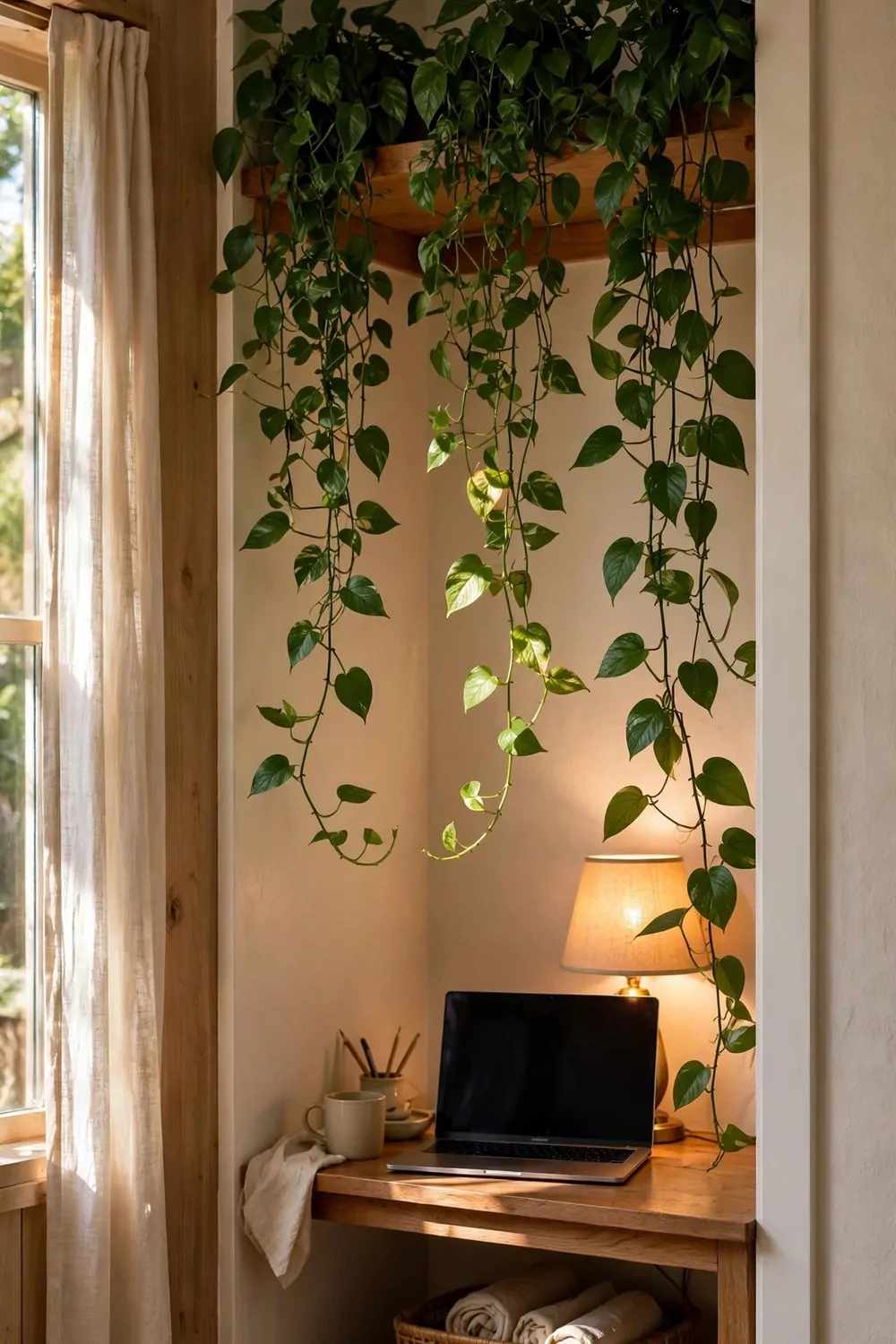
Plants make the best hiding screen in the house, because nobody looks behind a plant. They look at the plant, and they stop there.
Line the top shelf of the closet opening with trailing plants in a row. Pothos and philodendron work well, with vines that spill down over the edge like a living curtain. The vines fall across the opening, and the desk behind them turns into a green blur.
Put the desk board on the back wall, with the laptop and a small lamp on it. From the doorway, the plants frame the desk like a picture, and the desk looks like part of the garden, not part of the office.
Give them all a drink on the same evening each week. Mine get watered on Sunday nights, right after I clear the desk. A little jug, one shelf, done in two minutes. Plants on a routine stay green, and a brown plant in front of a desk is worse than no plant at all.
Cut the vines back before they creep onto the keyboard. Leaves across the laptop look sweet for a day, then they block every key you press. Snip the tips, pop them in a jar of water on the shelf, and they sprout roots. That is a new plant for free, and it only cost you one snip.
Choose plants that cope with dim corners. A closet gets almost no sun, so sun-hungry plants will droop within a month. Tough green ones that like shade keep growing even when you skip a week.
This is the hidden desk for people who feel tired in small rooms. The green softens the walls, the air feels fresher, and the desk hides behind leaves. Guests see a jungle. You see an office.
Rotate the plants once a month so they grow evenly. A plant that leans toward the light for months ends up lopsided, and a quick turn keeps it full on every side.
The Guest-Room Hideaway
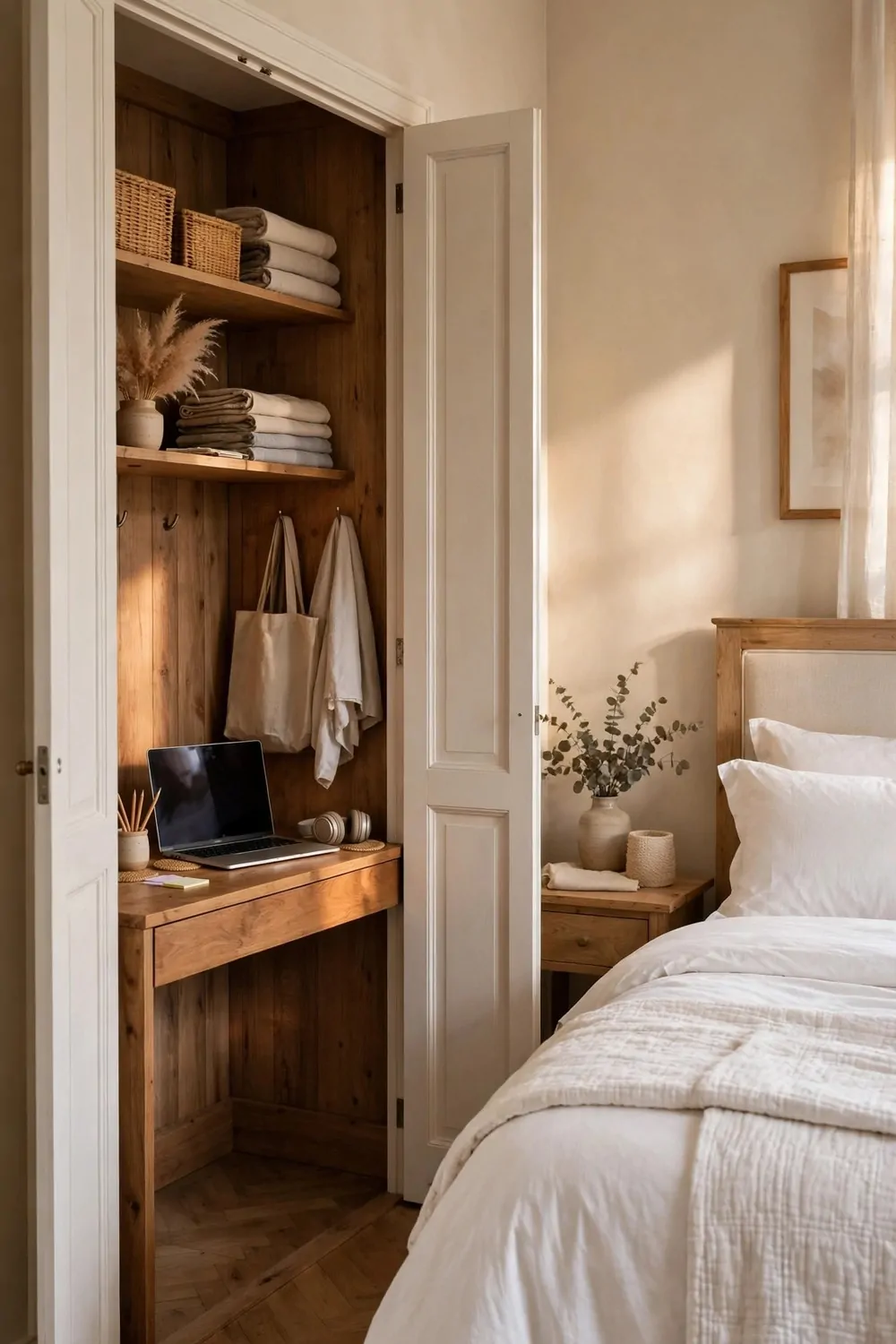
A guest room closet is the best hiding place in the whole house, because guests never open a closet they were not invited to open. Your desk can live in there for years, and nobody will ever know.
Fit a desk board across the back wall of the guest room closet, with the laptop and a small lamp on it. The guest bed sits in the room, the closet door stays shut, and the room looks like a guest room. Open the door and the office is ready.
Keep the desk clear when guests stay over. Laptop in a drawer, lamp unplugged, notebook on the shelf. A guest who opens the closet by mistake should see a tidy closet, not your workday. Five minutes of clearing before guests arrive saves you a whole awkward conversation.
Put the chair in the guest room itself, as a reading chair by the window. A chair by the window looks like part of the guest room, and it rolls over to the closet desk in the morning. A chair inside the closet all day looks like a clue, and clues give the game away.
Change the sheets and fluff the pillows before you work in there. A guest room that smells fresh and looks made up is a room nobody questions. A guest room that looks lived in makes people curious, and curious people open closets.
This is the hidden desk for people with a spare room that sits empty most of the year. The room stays a guest room. The closet stays a secret. And the office appears only when you need it, behind a door nobody opens.
Air the room out once a week, even when nobody visits. Open the window for ten minutes and the room smells fresh. A stuffy guest room makes guests curious, and a fresh room makes them comfortable.
Keep a small vase of flowers on the bedside table when guests come. Flowers make a guest room feel loved, and a loved room is a room nobody questions.
The Keyboard Tray Desk
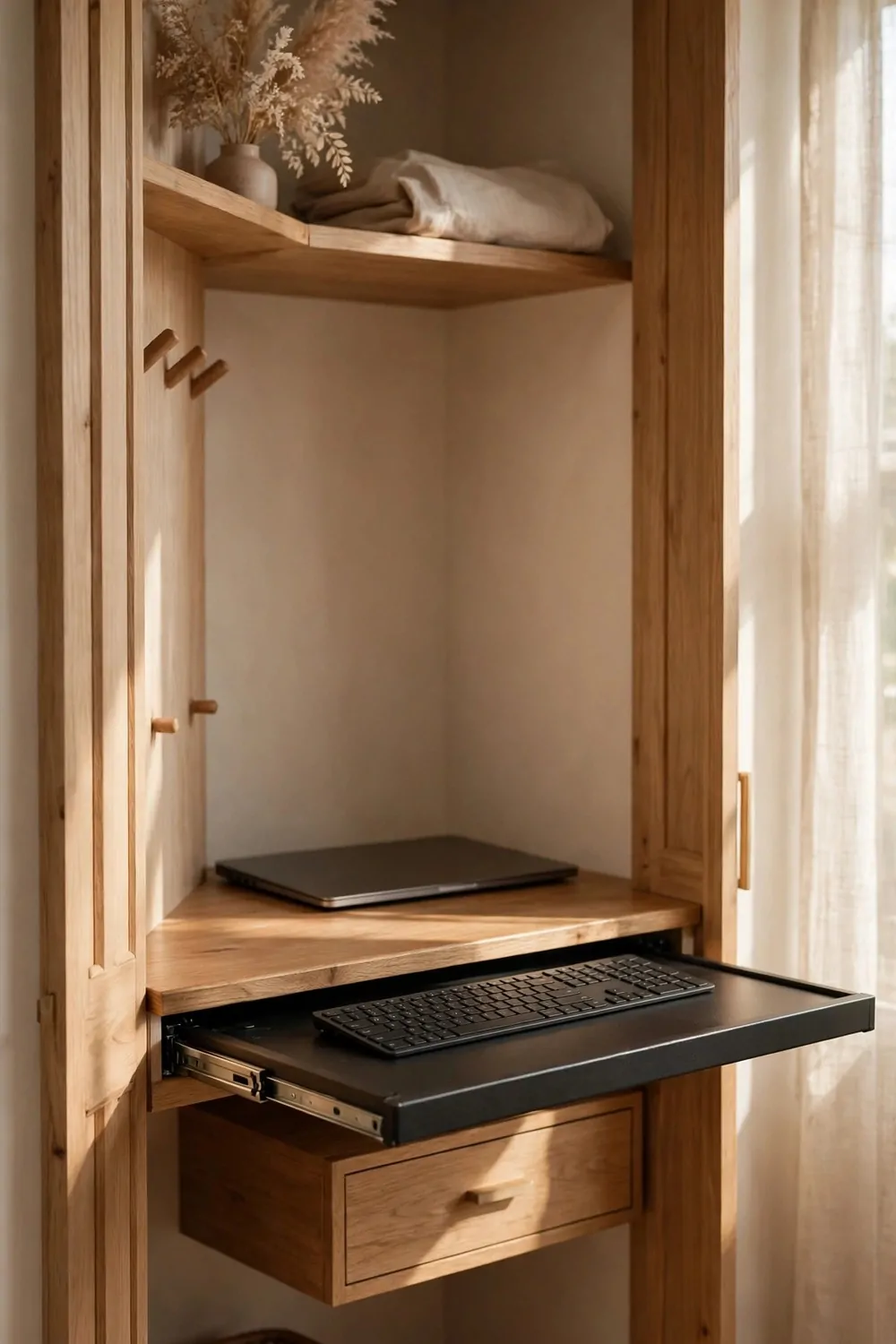
A keyboard that slides away is an office that hides itself one piece at a time. Slide the keyboard in, fold the screen down, shut the door, and the desk is just a board.
Mount a sliding tray under the desk board, on smooth runners, and put the keyboard on it. When you work, the tray slides out and the keyboard is under your hands. When you stop, the tray slides in, and the desk top is empty.
Fold the laptop shut and slide it to the back of the board. A closed laptop on an empty desk looks like a book on a shelf. An open laptop with a glowing screen looks like work, and work is what we are hiding.
Keep the mouse in a small drawer under the board, not on top of it. A mouse on an empty desk is a clue. A mouse in a drawer is invisible, and it takes two seconds to pull out in the morning.
Label nothing. A desk with a label that says office is not a hidden office. A plain board with nothing on it looks like a shelf, and a shelf is the most boring thing in the room. Boring is the best disguise there is.
Oil the runners once a year with a drop of plain oil on a cloth. A tray that sticks is a tray you stop using, and a tray you stop using is a desk that stops hiding.
This is the hidden desk for people who want the office to vanish piece by piece. Keyboard in, screen down, mouse away, door shut. Four moves, ten seconds, and the room is a bedroom again.
Keep a soft cloth in the drawer for the screen. A quick wipe on Monday morning clears the dust, and a clear screen is easier on your eyes all week.
The One-Box Office
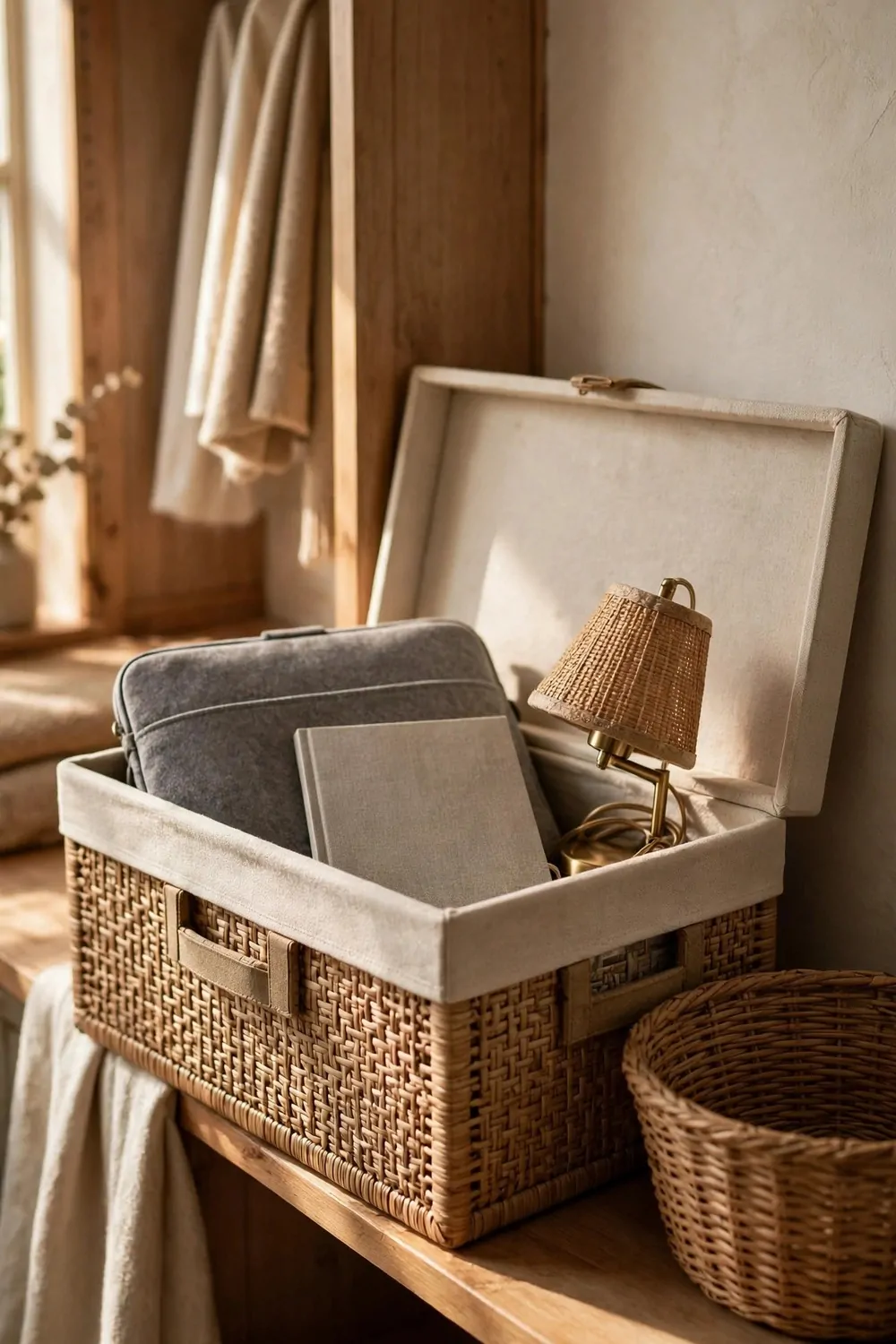
Some offices fit in one box. Not a room, not a desk, not a shelf. One box, on one shelf, and the whole workday lives inside it.
Pick a sturdy box that fits on the top shelf of your closet, about the size of a shoebox, with a lid. That box is your office. Everything you need for work lives inside it, and nothing lives outside it.
Here is what goes in the box each evening.
- Laptop tucked into its sleeve, standing upright.
- A little pouch with a notebook, two pens and the phone charger.
- The small lamp, lifted off the desk and laid on its side.
- Tomorrow’s papers, folded in half, resting on top of it all.
In the morning, you lift the box down, set the desk up, and work. The closet door stays open while you work, and the empty box sits on the floor, waiting. At five o’clock, you run the pack-down and the box goes back on the shelf.
Here is a table for the pack-down, so you can see how fast it really is.
| Step | What you pack | Time it takes |
|---|---|---|
| One | Laptop into its sleeve | About 30 seconds |
| Two | Papers into the pouch | About 30 seconds |
| Three | Lamp and charger into the box | About 1 minute |
| Four | Lid on, box on the shelf | About 30 seconds |
Keep the box lid on tight. A box with no lid spills when you lift it down, and a spill on the floor is a mess you have to clean before you can work. A lid that clicks shut keeps the office safe on the shelf all night.
Label the box with one plain word, like “office” in small pencil on the side. A box labelled in big letters is a sign. A box with a tiny pencil word is just a box, and nobody reads the side of a box on a top shelf.
This is the hidden desk for people who share their home with guests, kids, or a partner who wants the room back at night. The box goes up, the closet goes back to normal, and work is out of sight until morning.
The Pantry Desk
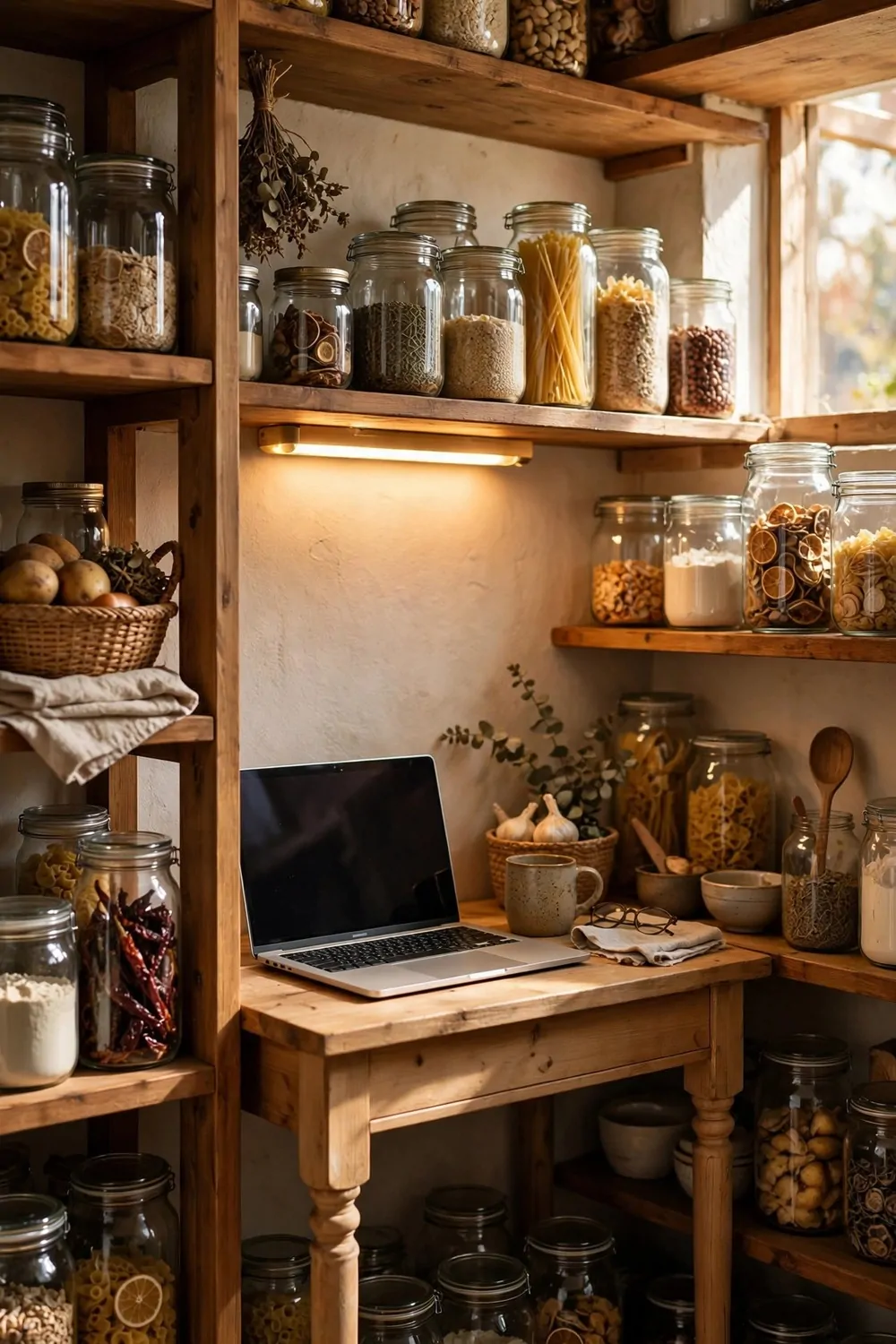
A pantry closet is the last place anyone looks for an office, and that is exactly why it works. Guests open the pantry for a snack, not for a desk, and they never look twice at the little board at the back.
Clear one shelf at the back of the pantry and fit a small desk board across it, at sitting height. The food stays on the shelves above and below. The desk sits in the middle, and from the doorway it looks like just another shelf.
Put the laptop on the board and pull the stool into the doorway. You sit close to the shelves, the screen sits right in front of you, and the little nook feels snug in a good way once the light is on.
Stick a small battery light under the shelf above the desk. A pantry has no window, so a little stick-on light does all the work. Swap the batteries when the glow fades and carry on.
Keep food smells away from the desk. A desk next to a bag of onions is a desk you will not want to sit at. Put the strong-smelling food on the far side of the pantry, and keep the desk side for jars, boxes, and the laptop.
Give the board a quick wipe every Saturday. A pantry gathers crumbs faster than any other closet, and crumbs in a keyboard are a pain to pick out. One damp cloth, one minute, and the nook is clean again.
This is the hidden desk for people who swear they have no space at all. You have a pantry. It holds food on the shelves and a desk in the middle, and the door shuts on both. That is an office, hiding in the last place anyone would look.
Keep a small stool in the pantry, tucked under the desk board. A stool that lives in the pantry is always there when you need it, and it never has to travel from another room.
The Five-Minute Vanish
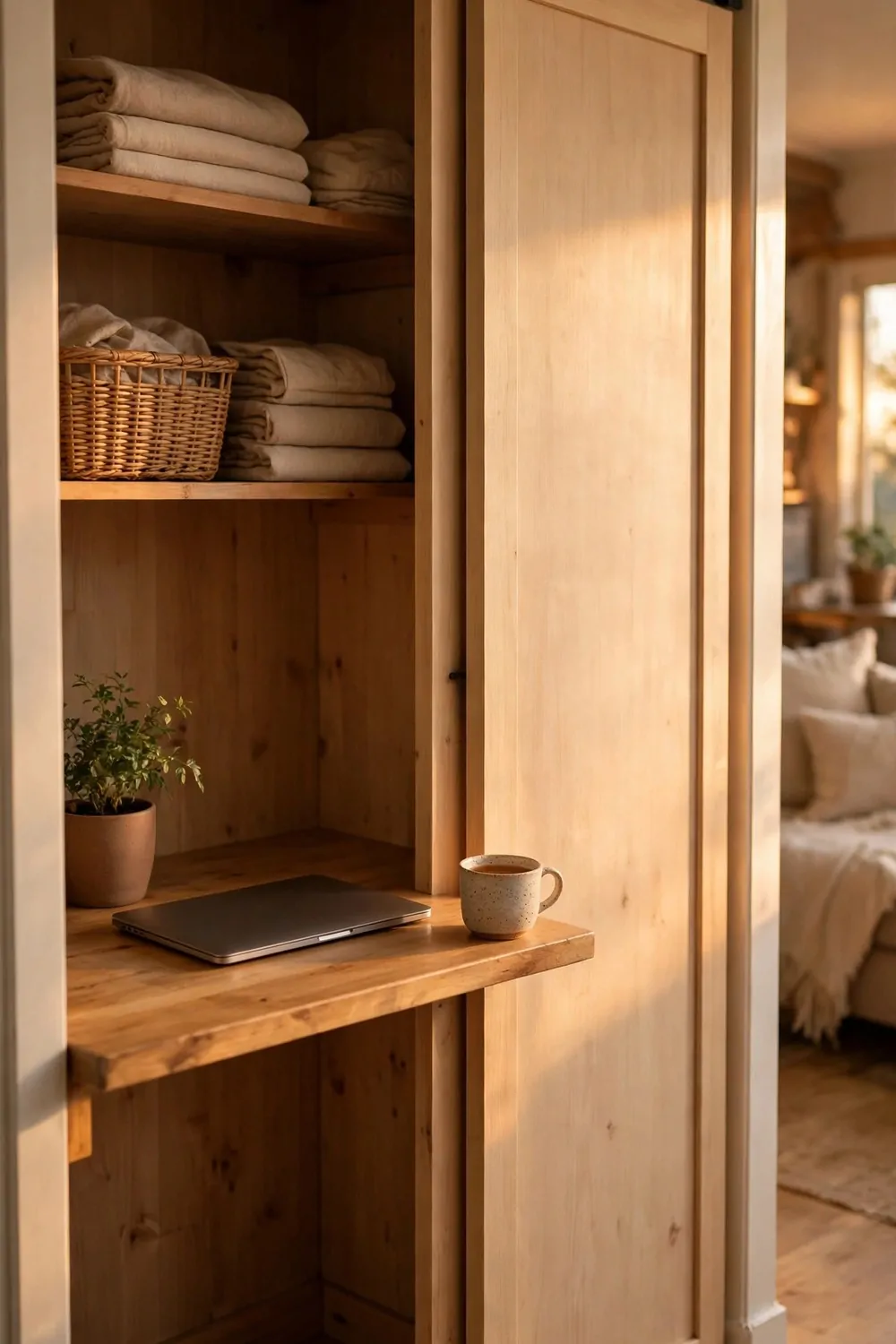
The best hiding trick is not a door or a curtain. It is a routine. Five minutes, same steps, every evening, and the office disappears like a magic trick.
Minute one is the clear. Laptop shut, papers into the basket, mug into the kitchen. A desk with three things on it hides in seconds. A desk with thirty things on it hides never.
Minute two is the fold. Fold the desk board up, slide the keyboard tray in, push the chair under the desk. The furniture folds away in one smooth move, and the room gets bigger with every fold.
Minute three is the cover. Pull the curtain across, slide the door shut, drop the pegboard panel down. One cover, whichever trick your closet uses, and the office is behind it.
Minute four is the check. Stand in the doorway and look at the room like a guest would. Desk gone. Cables gone. Papers gone. If you can spot one thing that says office, hide that thing now.
Minute five is the walk away. Shut the bedroom door, walk to the kitchen, and make a cup of tea. The office is gone, the evening is yours, and your brain gets to stop working because it cannot see the work anymore.
Here is the vanish in one place, so you can pin it inside the closet door.
| Minute | Job | What disappears |
|---|---|---|
| One | Clear the desk | Laptop, papers, mug |
| Two | Fold the furniture away | Desk board, keyboard, chair |
| Three | Cover the closet | The whole office |
| Four | Check like a guest | The last clue |
| Five | Walk away and make tea | The workday itself |
Do the vanish at the same time every day. Same time, same steps, same five minutes. A routine you do every day becomes automatic, and an automatic routine never gets skipped. A routine you do when you remember gets skipped most days.
This is the hidden desk for people who do not want to build anything new. The desk is already there. The door is already there. The vanish is just five minutes and five steps, and the office is gone until morning.
Keep Reading
If you liked these hidden workspace ideas, these closet office ideas will give you even more ways to make a small space work hard.
- 16 Cloffice Ideas Small Spaces Will Love
- 17 Closet Converted to Office Projects Worth Copying
- 18 Closet Turned Office Makeovers That Look Unbelievable
A hidden desk is the kindest thing you can give your evenings. It works all day, then it vanishes, and your home goes back to being your home. Pick your favourite hiding trick from this list, build it this weekend, and let your smallest room surprise you.