18 Bedroom Office Combo Layout Ideas That Maximize Space

My bedroom has four walls. That is the whole room, really. Four walls, one window, one door, and one bed. For years I thought that was all the room could hold, so my desk lived in the hallway and my papers lived in a pile on the floor.
Then one rainy weekend I stopped looking at the floor and started looking up. The walls were empty. The corners were empty. The space above the door was empty. The space under the bed was empty. My little room was not small at all. It was just half used.
That is what these 18 bedroom office combo layout ideas are about. Each one takes a spot in your bedroom that does nothing right now and puts it to work. No bigger room. No new walls. Just every inch doing a job.
Use the Wall Above the Door
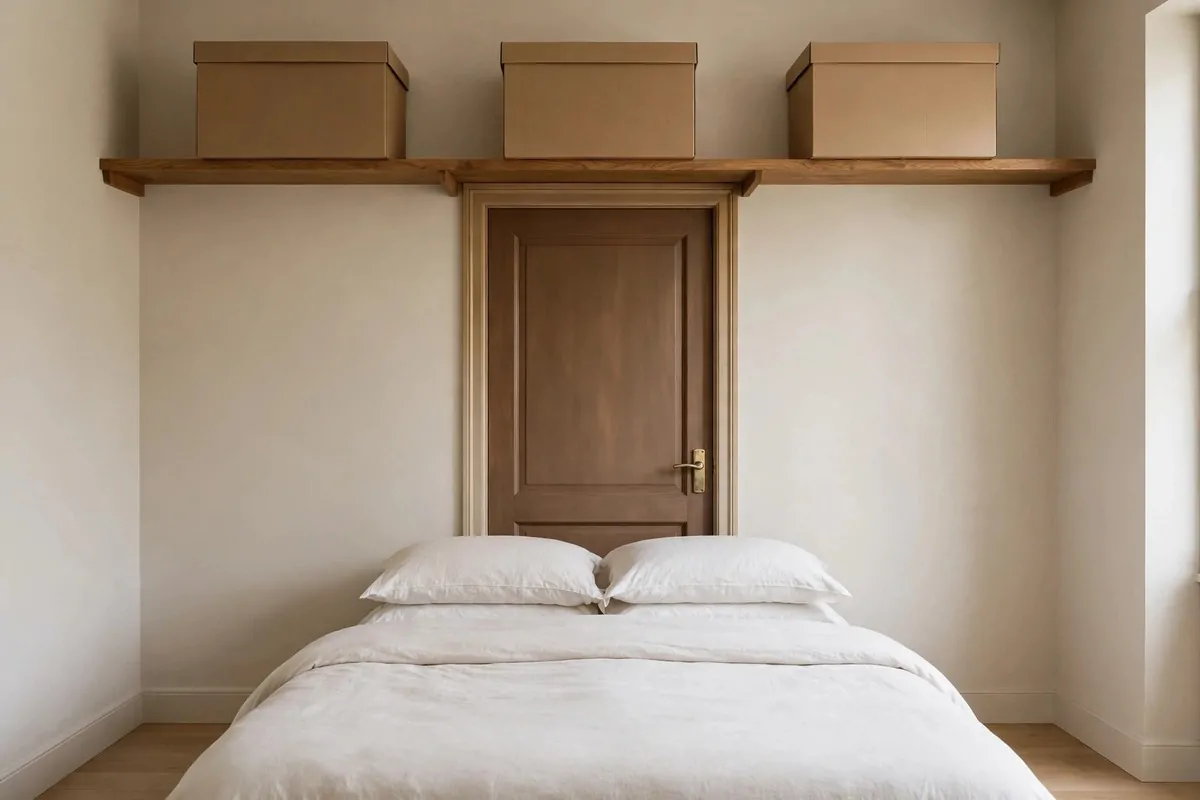
The wall above the door is the most ignored spot in any bedroom. It is high, it is out of the way, and nobody ever looks at it. That is exactly why it is perfect for storage.
I put one long shelf above my door last spring. It holds three plain boxes. One box holds spare cables. One box holds old notebooks. One box holds the papers I need once a year and never in between. Nothing on that shelf gets touched more than once a month, and that is the point.
High shelves are for things you rarely need. If you have to climb up every day, the shelf is in the wrong place. Put the once-a-month things up high and the every-day things down low.
You need a small step stool to reach it. Mine folds flat and leans behind the door when I am done. A stool that lives in the room is a stool you will actually use.
Fix the shelf into the solid wood above the door frame. That wood is strong, and it will hold a shelf full of boxes without a wobble. Screws in plain plaster will pull out over time, so find the stud first.
Keep the boxes light. Paper is heavier than it looks, and a shelf of heavy books above a door is a bad idea. Light boxes, spare cables, soft things. Heavy books belong low, where they cannot fall on anyone.
Label each box on the end you can see from the floor. One word is enough. Cables. Old papers. Spare. Labels save you from pulling down all three boxes every time you need one thing.
Try this one first if your shelves are full and your door wall is bare. One shelf above the door, and the whole room breathes a little easier.
A Desk That Hangs on the Wall
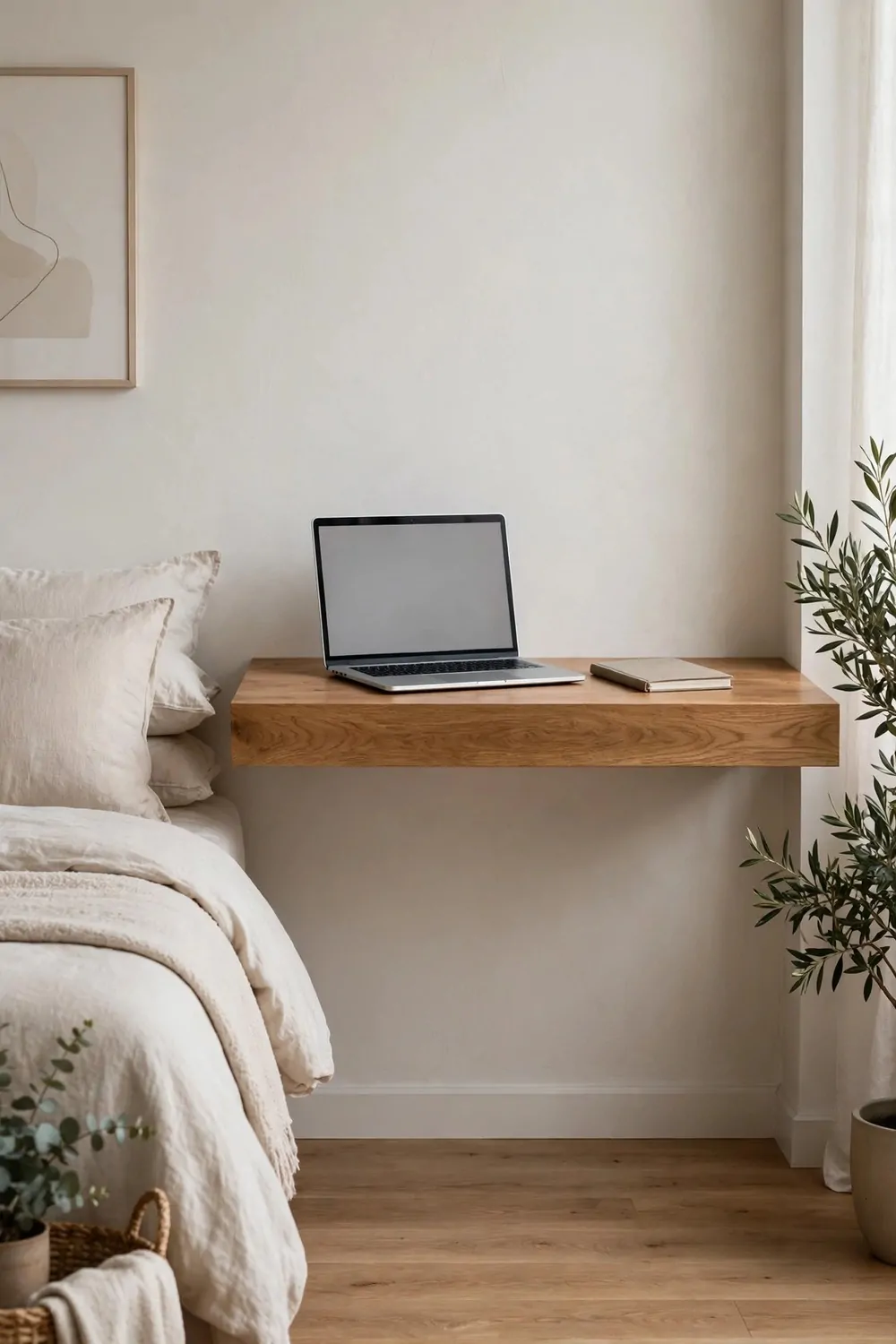
A desk with legs takes up floor. A desk that hangs on the wall takes up none. It floats above the floor, and the space underneath stays open for your feet, your bag, or nothing at all.
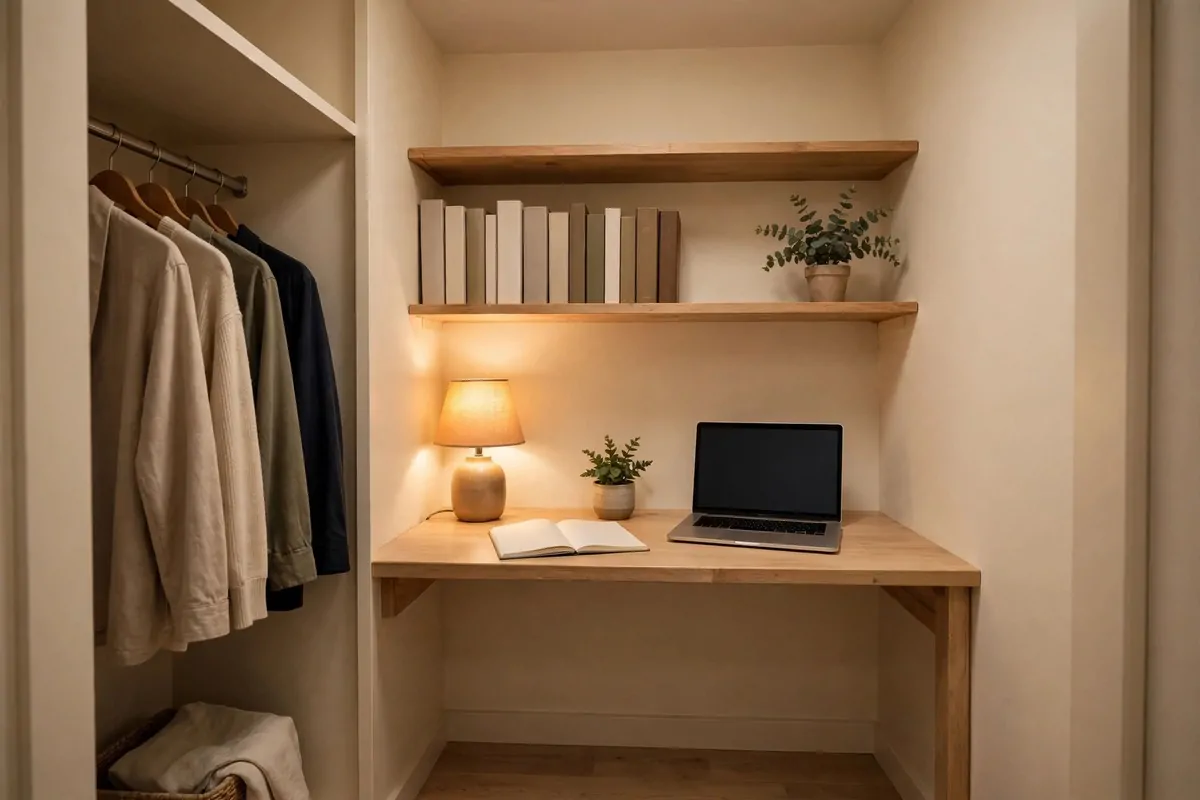
My floating desk is a plain wooden board, about as wide as my laptop and a notebook side by side. Two strong brackets hold it to the wall. That is the whole desk. No legs, no wobble, no floor space lost.
The brackets have to bite into solid wood inside the wall. Knock on the wall and listen for the solid thump that tells you the beam is behind the plaster, then drive the screws into that spot. A floating desk that pulls out of the wall is a mess you do not want.
Pick a board that is deep enough for your laptop and your wrists, and no deeper. About the depth of a hardback book, plus a hand. Any deeper and it eats floor for no reason. Any shallower and your laptop hangs off the edge.
Put a small shelf above the floating desk for a book and a plant. The shelf takes the clutter off the desk top, and the wall looks finished. One shelf is plenty. Two shelves make the wall feel heavy.
Keep the floor under the desk clear. That open patch of floor is the whole reason the desk floats. A box under a floating desk turns it back into a normal desk with a box under it.
A floating desk is best if you work on a laptop and keep your papers in a drawer. If you need two screens and a stack of files, this desk is too small for the job.
Try this one if your room feels crowded at floor level. One board on brackets, and the floor comes back to you.
The Corner That Faces the Room
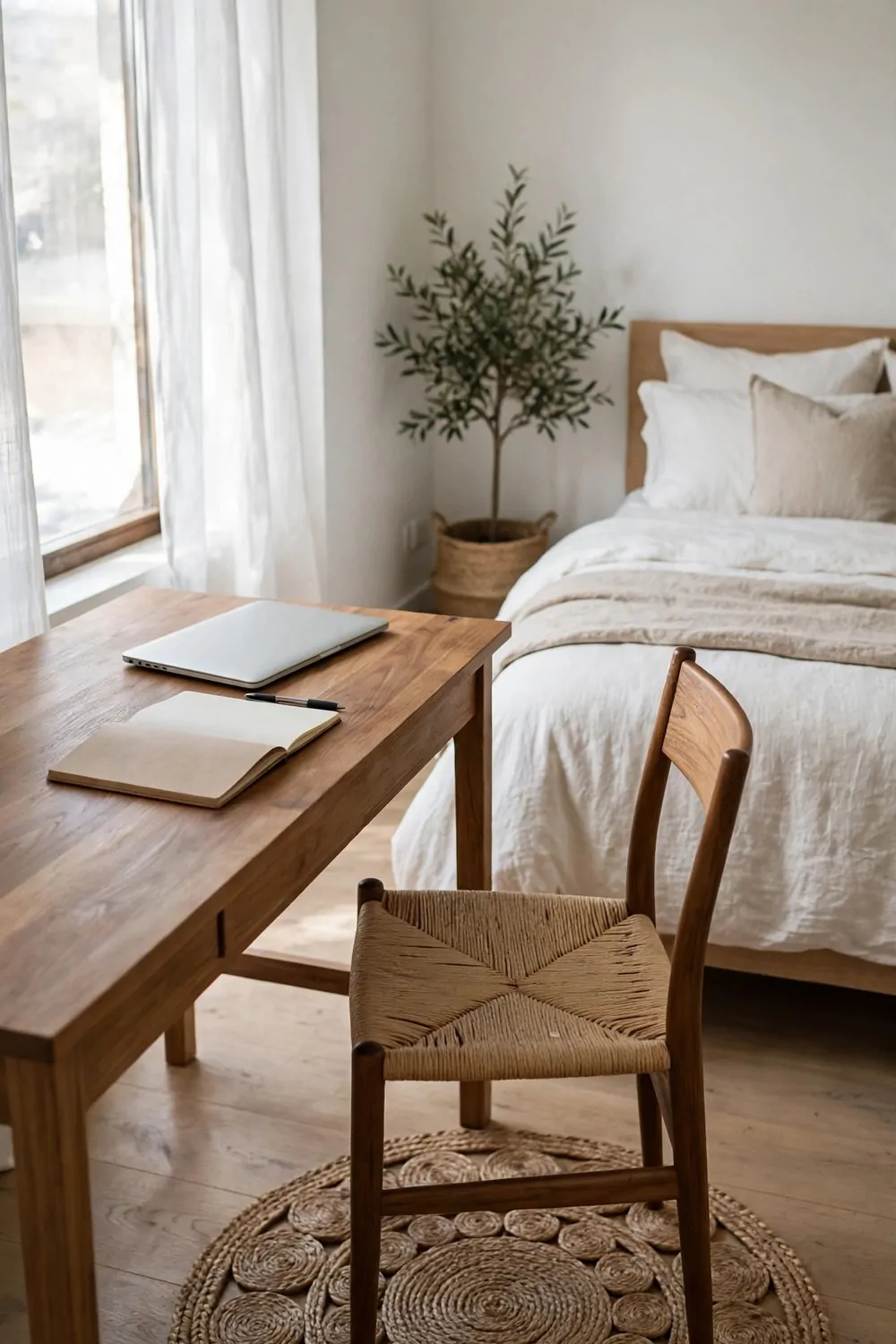
My corner desk does not hug the walls. It turns its back to them. The desk sits at an angle across the corner, the chair faces out into the room, and I can see the door, the window, and the bed all at once.
A desk turned this way wastes a little floor behind it, and that is fine. The triangle of floor behind the desk holds the cables and the power strip, out of sight. The front of the desk stays clean because the mess lives behind it.
Measure the diagonal before you buy anything. A corner desk needs room to sit at an angle, and the angle eats more floor than a desk flat against the wall. Tape the shape on the floor first and walk around it for a day.
Put a small round rug under the chair. The rug marks the work spot, and the chair wheels roll on it instead of on the bare boards. A round rug suits a diagonal desk better than a square one.
Hang a triangle shelf in the corner above the desk. A shelf cut to fit the corner holds a plant and two books, and it uses the dead air where the two walls meet. No other shelf fits there.
Keep the light coming from the side, not from behind you. A lamp on the left end of the desk throws light across your work without shining in your eyes. A lamp behind you throws your shadow over the whole desk.
Leave the wall behind the chair bare. A picture behind your head is one you never see while you work, and it crowds a corner that is already busy. Save the art for the wall you face.
A diagonal corner desk is best in a room where the corner has a window nearby. Light from the side and a view across the room make the corner feel open instead of boxed in.
Try this one if your corner desk faces a wall and the room feels like it is closing in on you. Turn the desk around, and the corner opens up.
Stack the Zones, Don’t Spread Them
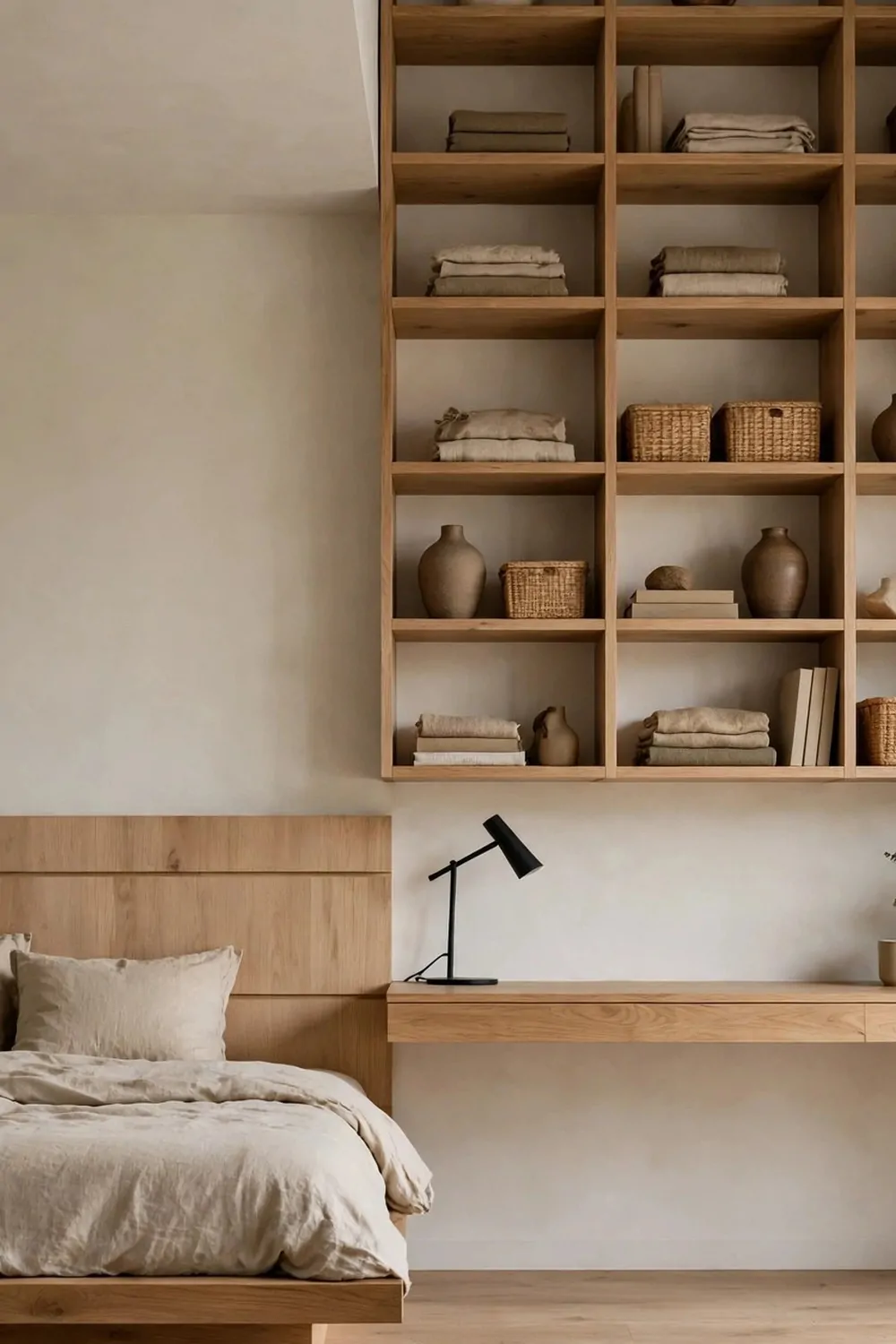
Small rooms run out of floor fast. The fix is to stack up, not spread out. Bed low, desk in the middle, shelves high. Three zones on one wall instead of three zones across the floor.
My wall works like a ladder now. The bed sits on the floor against the wall. The desk hangs above the foot of the bed. The shelves climb above the desk. One wall holds the whole office, and the rest of the room stays open.
Here is how my one working wall stacks up.
| Height | What lives there | Why it works |
|---|---|---|
| Floor level | Bed, pushed to the wall | Sleep stays low and calm |
| Waist height | Floating desk, chair tucked under | Work happens at the right height |
| Above the desk | Two shelves for books and boxes | Storage climbs instead of spreading |
Start with the bed. Push it to the wall and leave the rest of the wall free. A bed in the middle of the room eats the wall you need for stacking.
Hang the desk on the same wall, above the foot of the bed if the bed is low. Your knees slide under the desk while you work, and the bed is right behind you when you stop.
Keep the top shelf for things you use once a week. Books you finished. Spare chargers. A box of old papers. The every-day things live on the desk, not on the top shelf.
Leave one gap on the shelves on purpose. That empty space is where the next book goes, and it keeps the stack from ever looking stuffed. Empty space is part of the plan too.
Try this one if your floor is full but your walls are bare. Stack the room up, and the floor comes back.
Raise the Bed, Free the Floor
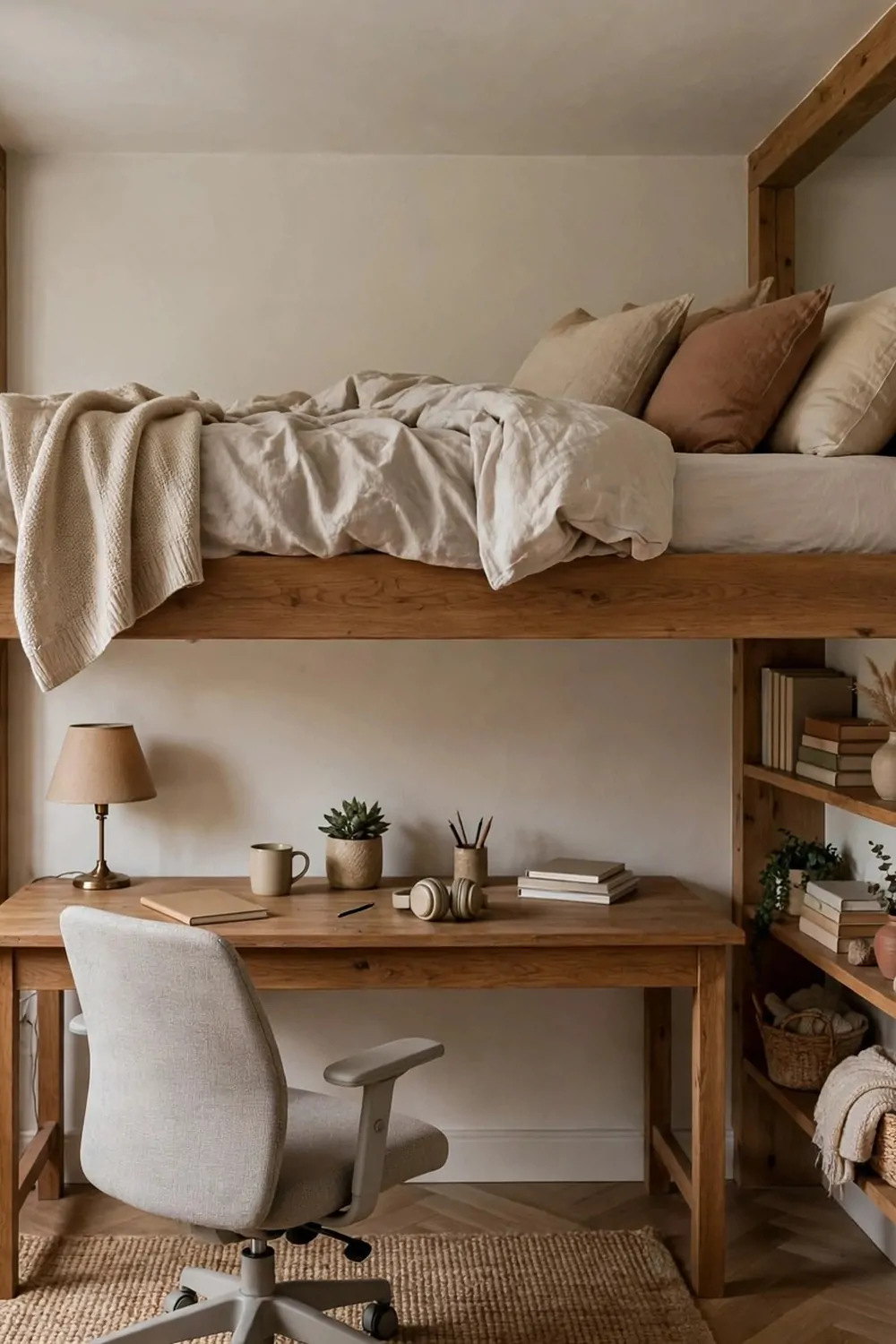
A bed sits on the floor and takes up the biggest patch of floor in the room. Raise it up, and the whole patch underneath becomes free. That is the biggest space win on this list.
My bed sits on a raised frame, about waist high. Underneath it is my desk, my chair, and one small shelf. The bed is up top. The office is down below. One footprint, two rooms stacked on each other.
You need a strong frame for this. A raised bed has to hold you, the mattress, and the bedding without a wobble. Buy a frame made for the job, or ask someone who builds them. A wobbly raised bed is no good for sleeping or for working under.
Check your ceiling height before you raise anything. Sit up in bed and reach your hand up. If your hand hits the ceiling, the bed is too high. You need room to sit up in the morning without bumping your head.
Put a small lamp under the bed for the desk. The space under a raised bed is darker than the rest of the room, and a dark desk is a desk nobody uses. One warm lamp fixes it.
Keep the space under the bed tidy. A desk, a chair, one shelf. That is all that fits, and that is all it should hold. Stuff a second shelf under there and the desk becomes a cupboard.
Climb up and down with a small step or a short ladder. A step that folds away is best. A big ladder eats the floor space you just freed up, and that defeats the whole point.
Try this one if your ceiling is high and your floor is full. One raised bed, and the room doubles without getting any bigger.
The Foot of the Bed Works Too
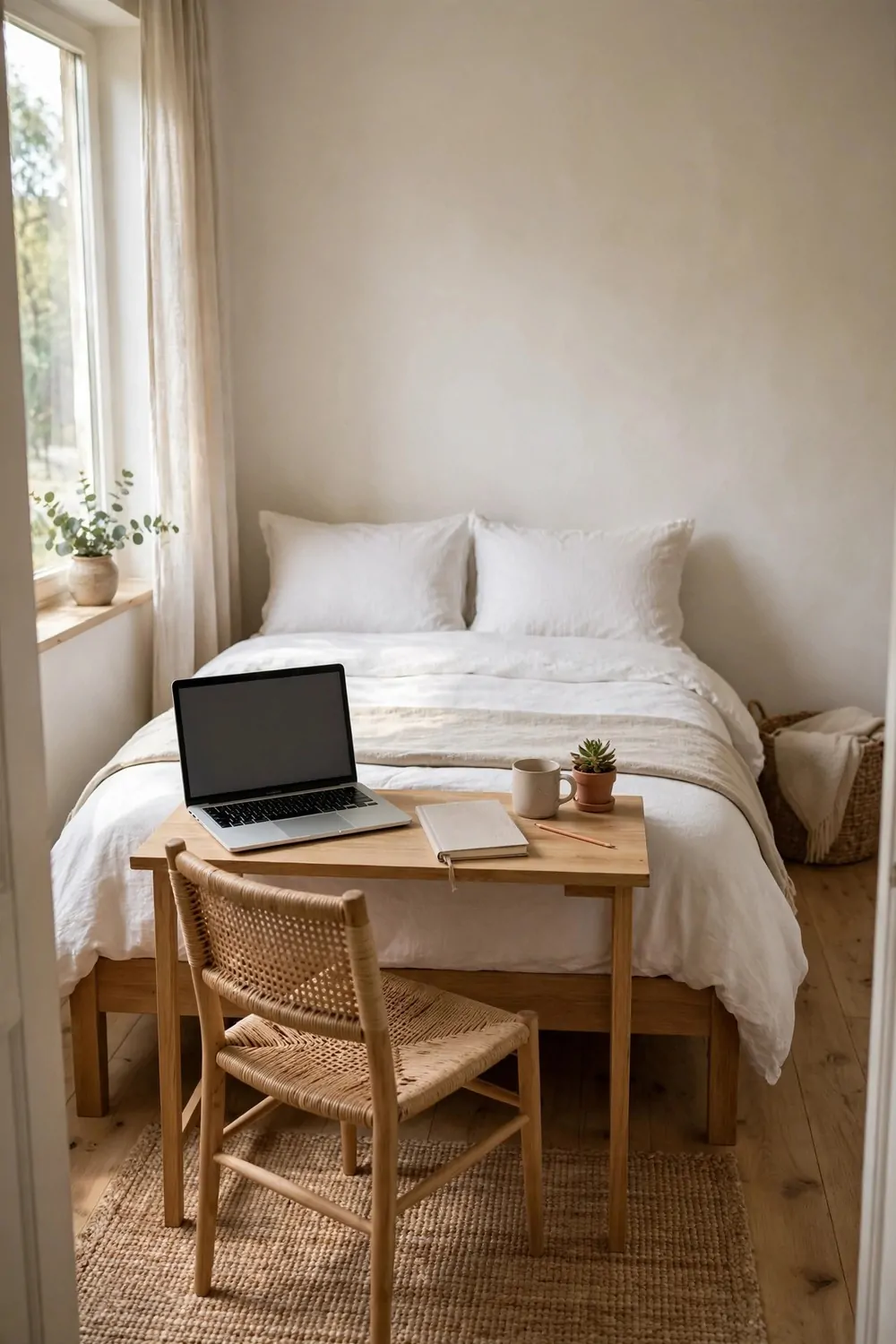
The foot of the bed is a patch of floor nobody uses. It is too small for a wardrobe and too narrow for a chair. It is just right for a slim desk.
My desk at the foot of the bed is a narrow console, about as deep as a book. My laptop fits on it with room for a notebook beside it. The chair slides under it when I am done, and the room looks like a bedroom again.
Measure the gap between the foot of the bed and the wall before you buy anything. You need room for the desk and room for the chair and your legs. Two feet of clear floor is the smallest gap that works.
Put the desk so you face away from the bed while you work. You look at the wall, not at the pillows. That small turn helps your brain switch into work mode, even though the bed is right behind you.
Keep the desk top clear when the day ends. The laptop goes on the wall shelf, and the notebook goes in the desk drawer. A desk with stuff on it at the foot of the bed looks messy from the doorway, and the doorway is where you see it every night.
Use a chair that slides fully under the desk. A chair that sticks out into the walkway blocks the path around the bed. A chair tucked away leaves the path open.
A foot-of-bed desk is best if you work on a laptop and keep your papers in one drawer. A big monitor and tall paper stacks will not fit here, so this desk suits a laptop and one drawer of papers.
Try this one if the foot of your bed faces a blank wall. One slim desk, and the dead patch of floor starts earning its keep.
One Piece, Three Jobs
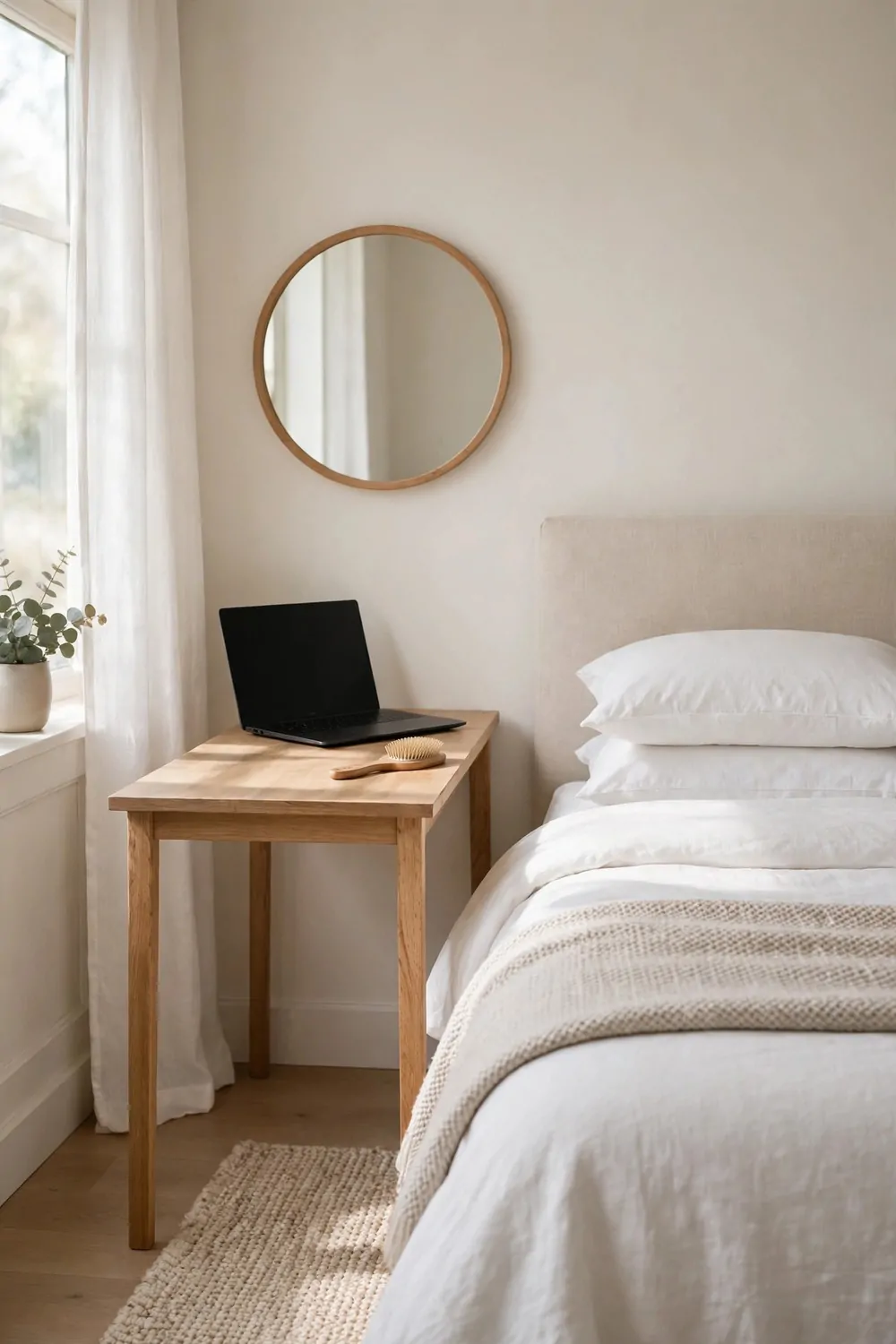
One piece of furniture that does three jobs saves more space than three pieces that do one job each. My desk is also my dressing table and my bedside table. One piece, three jobs, and two pieces of furniture never had to move in.
The desk sits beside my bed. Mornings start there with a hairbrush in one hand and a warm mug in the other. When work starts, the laptop takes the same spot and the brush moves aside. At night it holds my book and a glass of water. Same table, same spot, three jobs.
Here is how the one piece splits its day.
| Time of day | Job it does | What sits on it |
|---|---|---|
| Morning | Dressing table | Brush, small mirror, cup of tea |
| Daytime | Desk | Laptop, notebook, pen |
| Night | Bedside table | Book, glass of water, phone |
Look for a table that is narrow and simple. The table ought to look airy, never bulky. A big chunky desk beside a bed feels like an office that moved in by mistake. A narrow table looks like it grew up in that corner.
Keep one drawer for all three jobs. Brush and pens on one side, notebook on the other. A little tray in the drawer keeps the two sets of things from mixing. Three jobs, one drawer, no mess.
Put a small mirror on the wall above it. A mirror that hangs on the wall leaves the table top free for work. A mirror that stands on the table steals the space your laptop needs.
Clear the table between jobs. Two minutes, and the table changes from dressing table to desk. A table that never gets cleared ends up doing no job well.
Try this one if your bedroom has no room for a desk and a dressing table and a bedside table. One slim table, three jobs, and two pieces of furniture can leave the room.
Shelves That Step Up Like Stairs
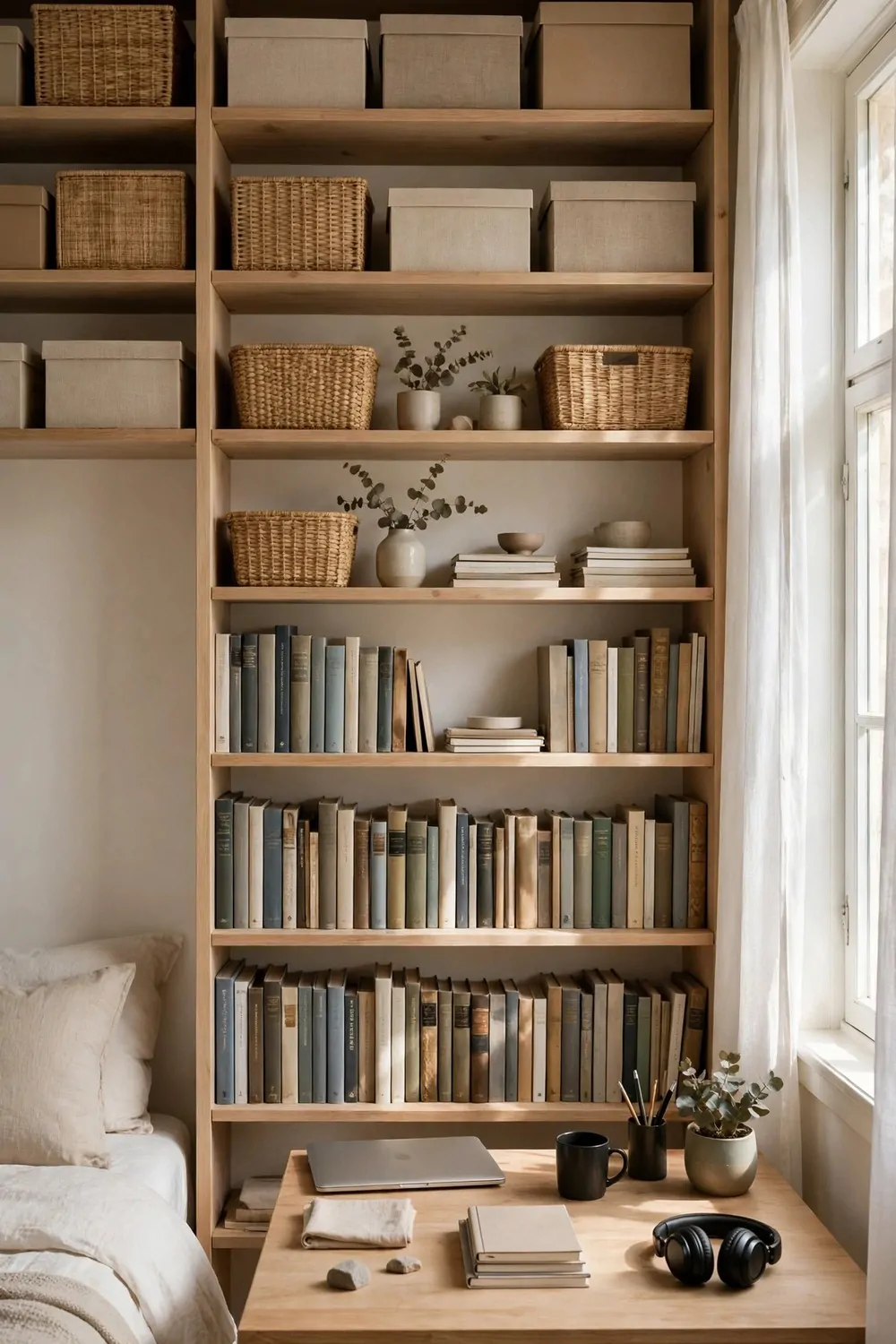
My shelves do not run in one straight line. They step up the wall like stairs, one box shelf higher than the last, and each step holds one kind of thing. The steps climb from the desk to the ceiling in five short jumps.
The lowest step sits just above the desk, at elbow height. It holds my pen pot and my phone charger. I reach for them without standing up, and they never sit on the desk top.
The next step up holds the printer paper and the spare notebooks. The step above that holds the box of cables. The step above that holds the old files. The top step, right by the ceiling, holds the empty boxes I keep just in case.
Here is what lives on each step in my room.
| Step | What sits there | How I reach it |
|---|---|---|
| First step, elbow height | Pen pot, phone charger | Sitting down, without standing up |
| Second step | Printer paper, spare notebooks | Standing up, one arm up |
| Third step | Box of cables | Standing on tiptoe |
| Top steps | Old files, empty boxes | With the folding stool |
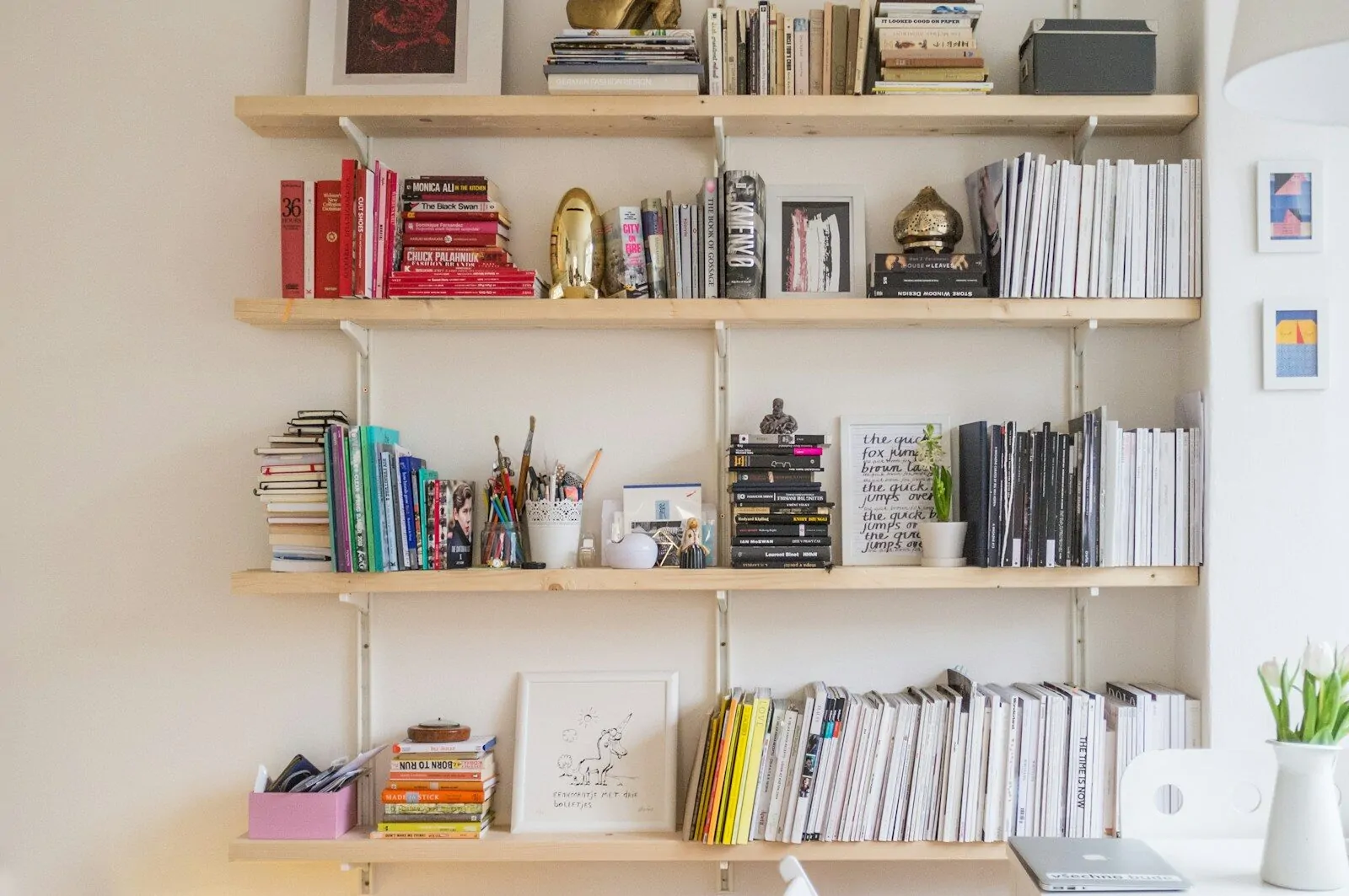
Box shelves are better than long boards for this. Each box is its own little cupboard on the wall, and you can hang them at different heights. A long board forces everything onto one level, and one level is never enough.
Screw each box into the beam behind the plaster. A box shelf full of paper is heavy, and plain wall plugs give up after a few months. One long screw into solid wood holds for years.
Leave one box empty on purpose. That empty box is where the next thing goes, and it keeps the wall from ever looking stuffed. An empty box is part of the plan, not a gap in it.
Try this one when books pile on the desk and boxes pile on the floor. Steps on the wall, and both piles climb up out of the way.
The Narrow Desk That Fits the Gap
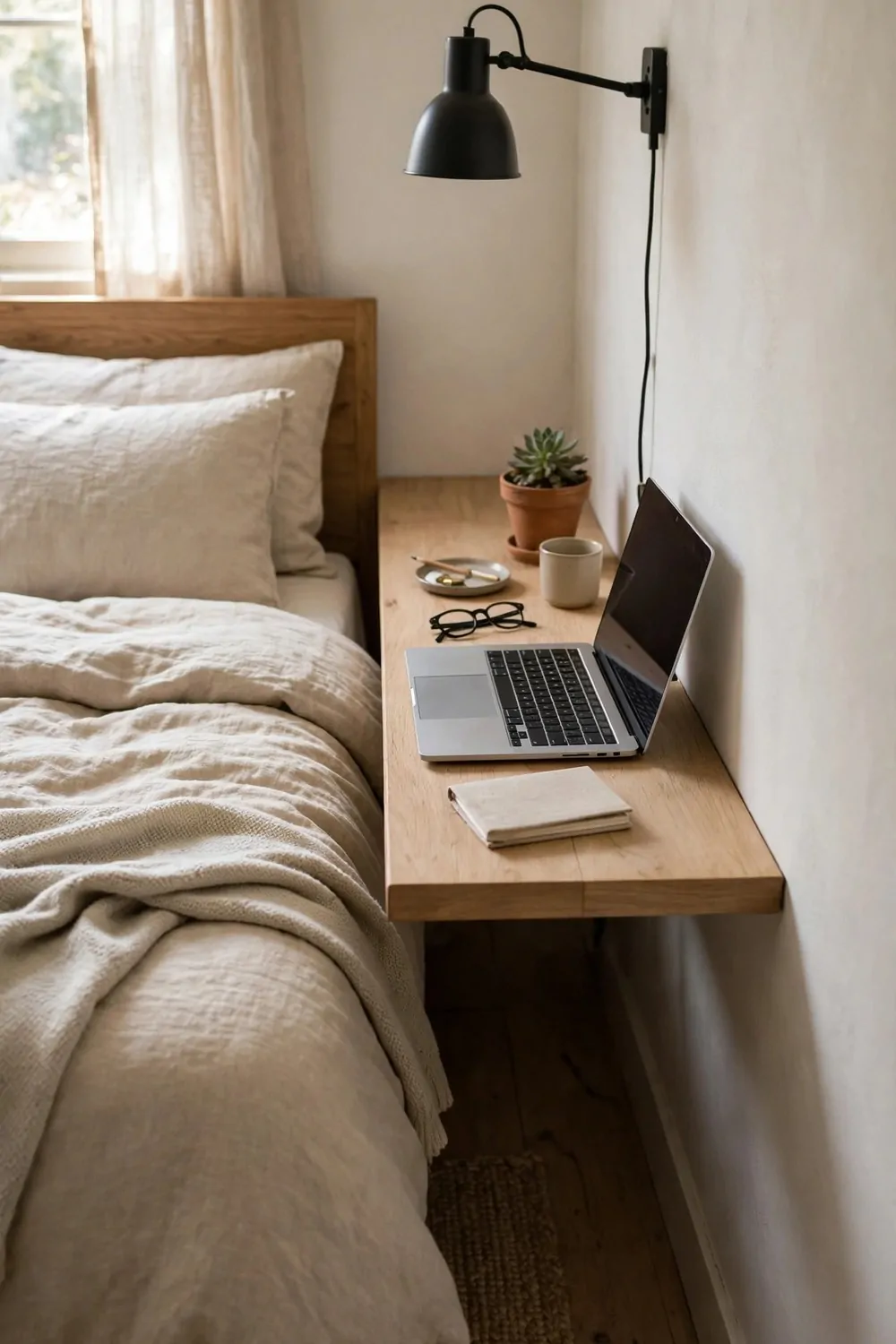
There is a gap in every bedroom. Between the bed and the wall. Between the wardrobe and the door. A gap too small for a chair and too wide to ignore. That gap can hold a desk.
My narrow desk slides into the gap beside my bed. It is barely wider than my laptop. I sit on the edge of the bed to work at it, and when I am done I slide the laptop off and the gap goes back to being a gap.
Measure the gap with a tape before you buy or build anything. A desk that is too wide will not fit, and a desk that is too narrow wobbles. Leave a finger of space on each side so it slides in without scraping.
Use a board with no legs. Legs need floor space, and a gap has none to spare. A board on two small brackets uses the wall, and the floor underneath stays free.
Keep the top clear when you are not working. A narrow desk with stuff on it blocks the gap, and the gap is a walkway too. Laptop on the shelf, notebook in the drawer, and the gap is clear again.
Put a small lamp on the wall above the gap desk. A lamp on the desk top would take up half the desk. A wall lamp leaves the whole board free for work.
A gap desk is best if you work on a laptop and keep your papers in one drawer. If you need a big screen and two piles of paper, the gap is too small for the job.
Try this one if your bedroom has a gap between two big pieces of furniture. One narrow board, and the gap starts working.
A Pegboard Wall That Holds Everything
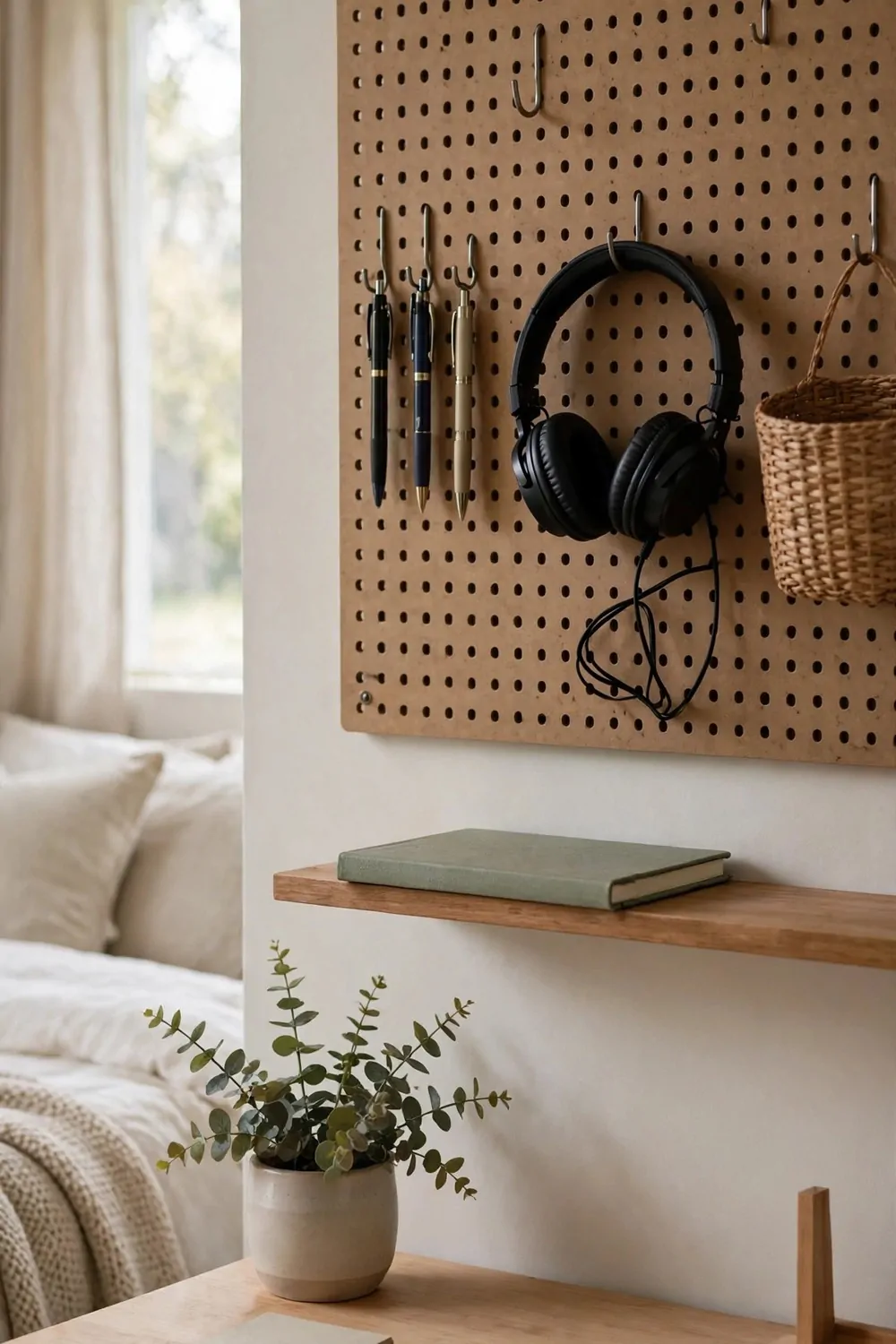
A pegboard wall holds a whole office without taking a single inch of floor. Hooks, small shelves, little baskets, all hanging on one board. Everything you need is on the wall, at arm’s reach, and the desk stays clear.
My pegboard hangs above my desk. It holds my pens in a small cup, my scissors on a hook, my notebook on a little shelf, and my headphones on a peg. I reach up, I grab what I need, and I put it back when I am done.
Hang the board at arm’s reach from your chair. If it is too high, you will never reach the top row. If it is too low, it crowds the desk. Eye level when you sit down is the right height.
Start with a few hooks and add more as you go. A pegboard full of hooks you never use is just a wall with holes in it. A pegboard with five hooks you use every day is an office.
Keep the heavy things low on the board. A basket of books hangs better on a low hook than a high one. A pair of scissors can go higher, because it weighs almost nothing.
Here is what hangs on my pegboard, and nothing else.
- One cup for pens and pencils.
- One hook for my headphones.
- One small shelf for my notebook.
- One basket for cables and chargers.
- One hook for my bag.
Move the hooks around when your work changes. That is the whole point of a pegboard. Nothing is fixed. When a new job needs a new tool, the hook moves in two seconds.
Try this one if your desk is covered in small things with no home. One board on the wall, and the desk is clear again.
A Mirror Makes the Room Bigger
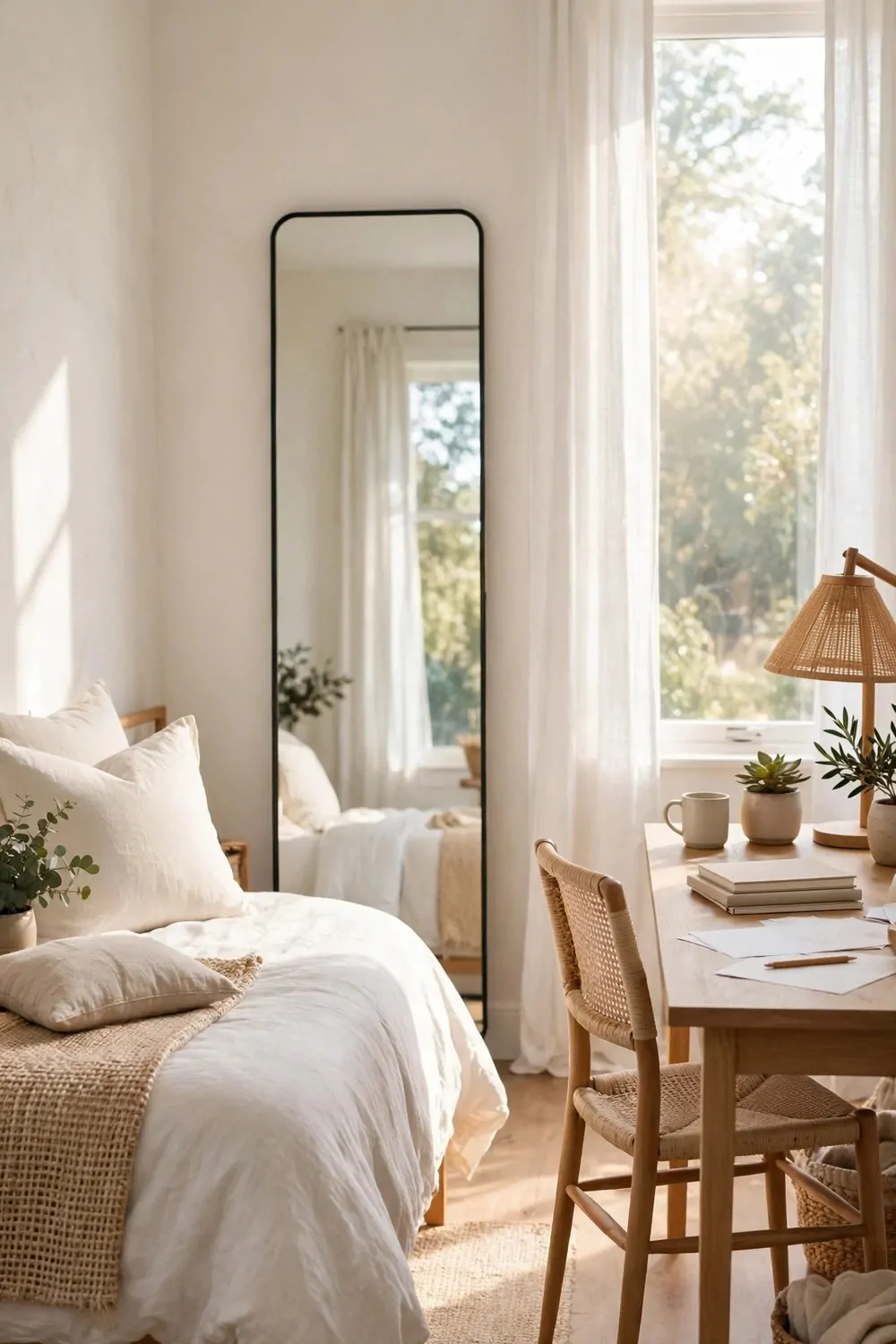
A mirror does not add a single inch of floor, and yet it makes a small room feel twice as big. It bounces the light around, and your eyes read the reflection as more room.
My mirror hangs on the wall opposite the window. It catches the morning light and throws it back across the room. The desk side gets brighter. The bed side gets brighter. One mirror, and the whole room feels lighter.
Hang the mirror where it can see the window. A mirror that faces a blank wall only shows you more blank wall. A mirror that faces the window shows you light and sky, and that is what makes the room feel bigger.
Pick a mirror as tall as your desk is wide. A small mirror does almost nothing. A tall mirror doubles the light and the view. Lean it against the wall if you cannot hang it, but fix it so it cannot fall.
Keep the mirror clean. A dusty mirror makes the room look grey. A clean mirror makes the same room look bright. One quick wipe a week is enough.
Do not hang a mirror where it shows your screen. A mirror behind your laptop will show your work to the whole room, and it will catch the glare on your screen all day. Put it on the side wall, not behind the desk.
A mirror is best in a room with one good window. If your room has no window at all, a mirror helps less, and a good lamp matters more.
Try this one if your room feels dark and small even though the furniture fits. One big mirror, and the room opens up.
The Closet Door Holds the Office
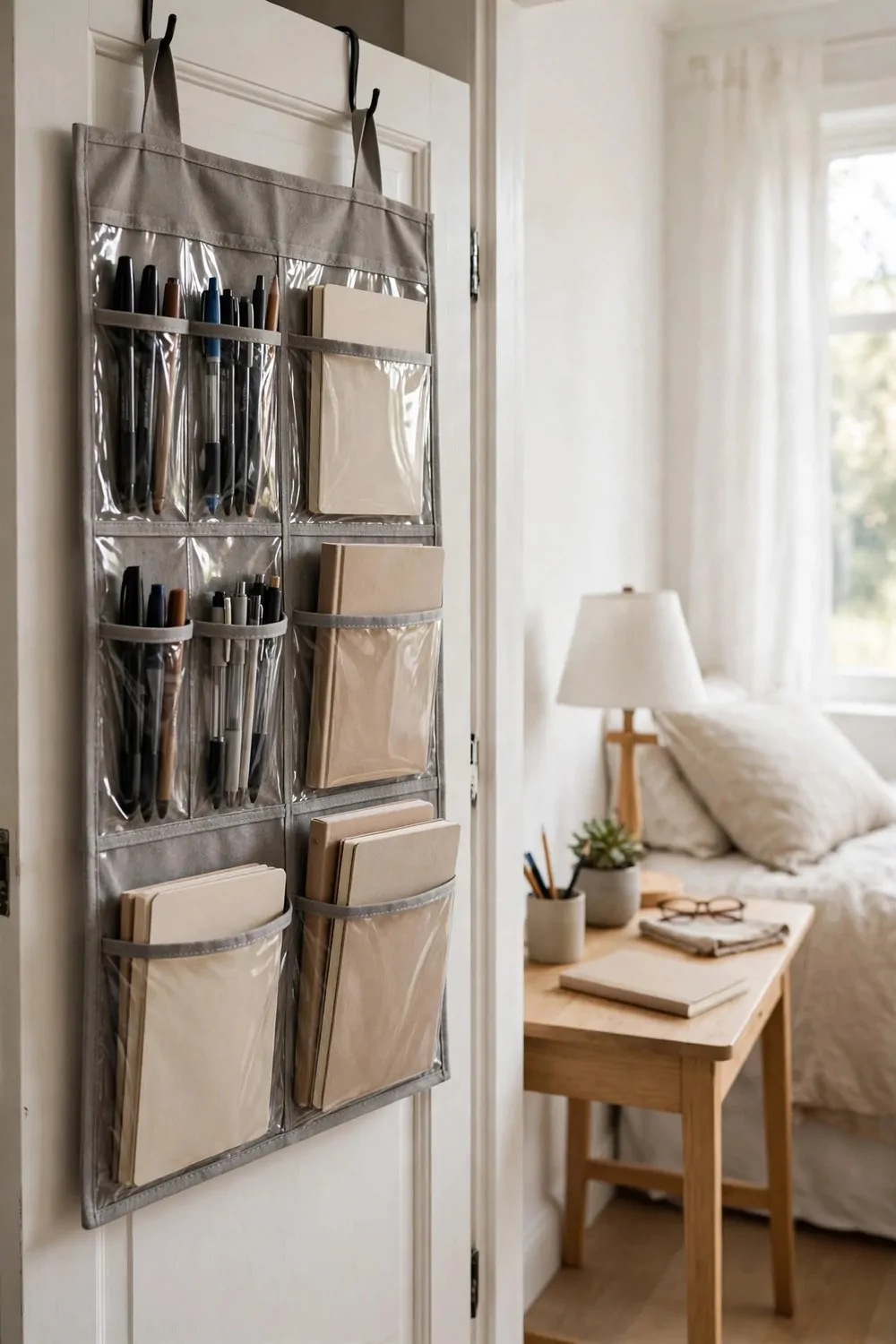
The inside of a closet door is a whole wall nobody uses. Pockets, hooks, and a small board on it can hold a full day of work supplies, and they cost almost nothing.
I put a hanging pocket organizer on the inside of my closet door. It has six clear pockets. One pocket holds pens. One holds chargers. One holds sticky notes. One holds my notebook. The door closes, and the whole office disappears.
Pick an organizer that fits your door. Measure the door first. An organizer made for a wide door will hang crooked on a narrow one, and a narrow one on a wide door leaves a gap.
Keep the heavy things low on the door. A pocket full of books hangs better near the bottom than near the top. Light things like pens and notes can go higher.
Here is what lives in my six door pockets.
- Top pocket: sticky notes and paper clips.
- Second pocket: pens and pencils.
- Third pocket: chargers and one cable.
- Fourth pocket: my notebook.
- Fifth pocket: headphones.
- Sixth pocket: nothing. The empty pocket is for tomorrow.
Do not hang more than the door can hold. A door full of heavy books will pull out of shape, and the door will not close right. Light supplies only.
Wipe the pockets out once a month. Dust gathers in pockets you never open, and a dusty pocket makes the whole door look tired. One quick wipe, and the door looks new again.
Try this one if your desk is covered in small things and your closet door is bare. Six pockets on the door, and the desk is clear again.
Put the Screen on the Wall
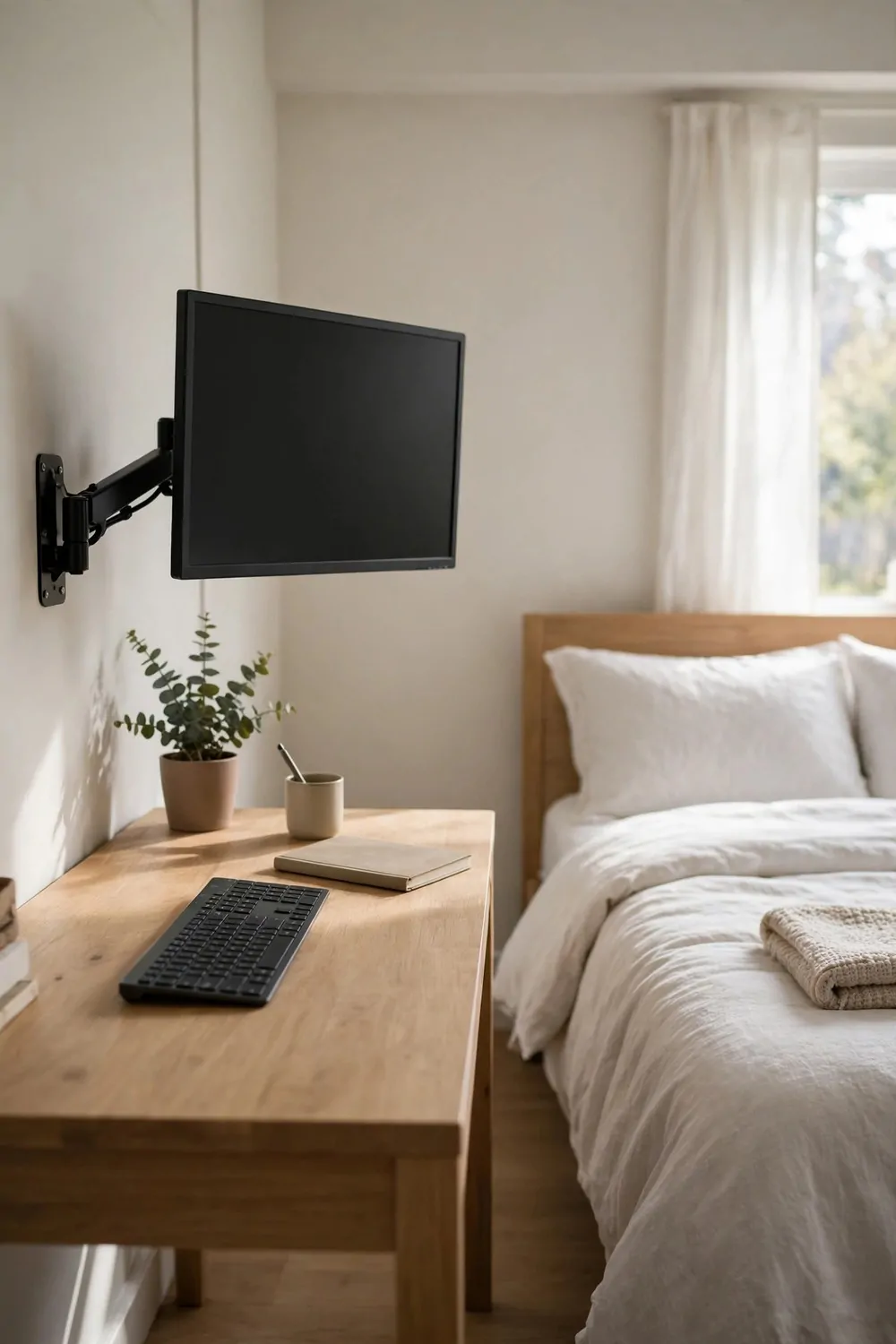
A laptop takes up half a desk. A screen on a wall arm takes up none. Mount the screen on the wall, and the whole desk top comes back to you.
My screen hangs on a small arm fixed to the wall above my desk. I pull it out when I work and push it back when I am done. The keyboard and the notebook are the only things left on the desk.
Fix the arm into solid wood inside the wall. A screen is heavier than it looks, and plaster screws will pull out over time. Find the stud first, and use the screws that came with the arm.
Set the screen at eye level when you sit down. A screen too high makes your neck ache by lunch. A screen too low makes you hunch over the desk. Eye level is the right height, and the arm lets you move it until it is right.
Run the cable down the wall in a small clip. A cable hanging loose behind a screen looks messy, and it pulls on the screen every time you move it. One clip keeps it neat.
Push the screen flat to the wall when the day ends. A screen flat against the wall turns the desk back into a plain table. A screen stuck out into the room keeps shouting that work is waiting.
A wall screen is best if you work on one screen and keep your papers in a drawer. If you need two screens side by side, the wall arm has to hold both, and that needs a stronger fixing.
Try this one if your desk is mostly screen and your notebook has nowhere to go. One arm on the wall, and the desk top is yours again.
The Nightstand That Becomes a Desk
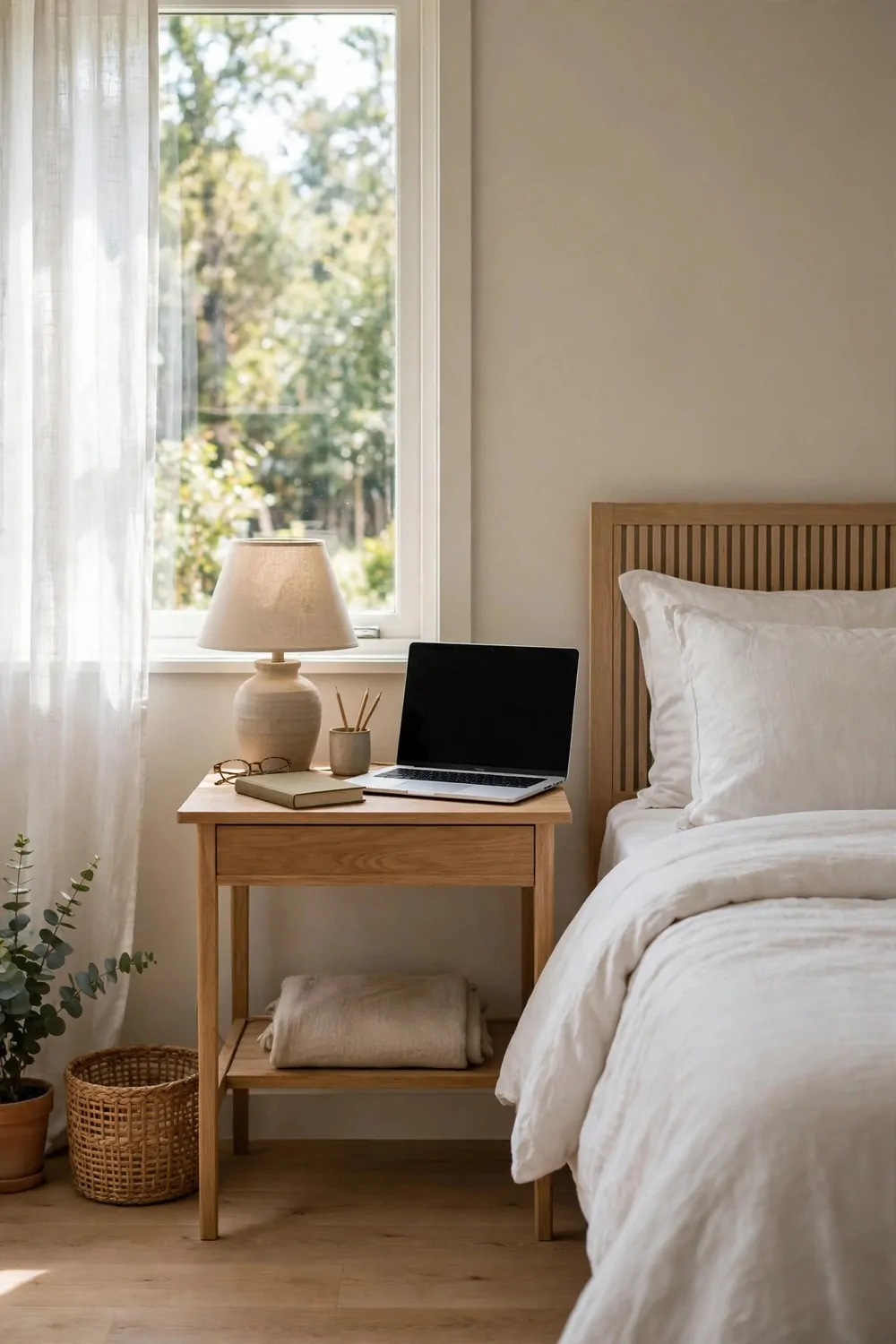
My old bedside table spent every night by the bed and every day doing nothing at all. Swap it for a small desk, and it becomes a full workstation without taking a single extra inch of floor.
My desk stands where the nightstand used to stand. It is about as wide as a bedside table and a little bit deeper. By day it holds my laptop. By night it holds my lamp and my book. The bed never noticed the swap.
Pick a desk about the same width as the nightstand it replaces. If the desk is wider, it crowds the bed. If it is narrower, it looks lost. Same width is the right width.
Keep one drawer in the desk for both jobs. Chargers and notebooks on one side, a book and a glass of water on the other. A shallow tray in that drawer keeps the work bits away from the sleep bits.
Put the lamp on the desk where you can reach it from the bed. It is the lamp you turn on for a chapter and turn off when your eyes close. If reaching it means climbing out of bed, it sits too far away.
Clear the desk between jobs. Two minutes in the morning, laptop out, book away. Two minutes in the evening, laptop away, book out. A desk that never gets cleared ends up doing no job well.
A nightstand desk is best if you work on a laptop and keep your papers in one drawer. If you need a big screen and two piles of paper, this desk is too small for the job.
Try this one if your bedroom has a nightstand and no desk. One swap, and the room gains an office without losing a thing.
A Headboard That Holds Your Office
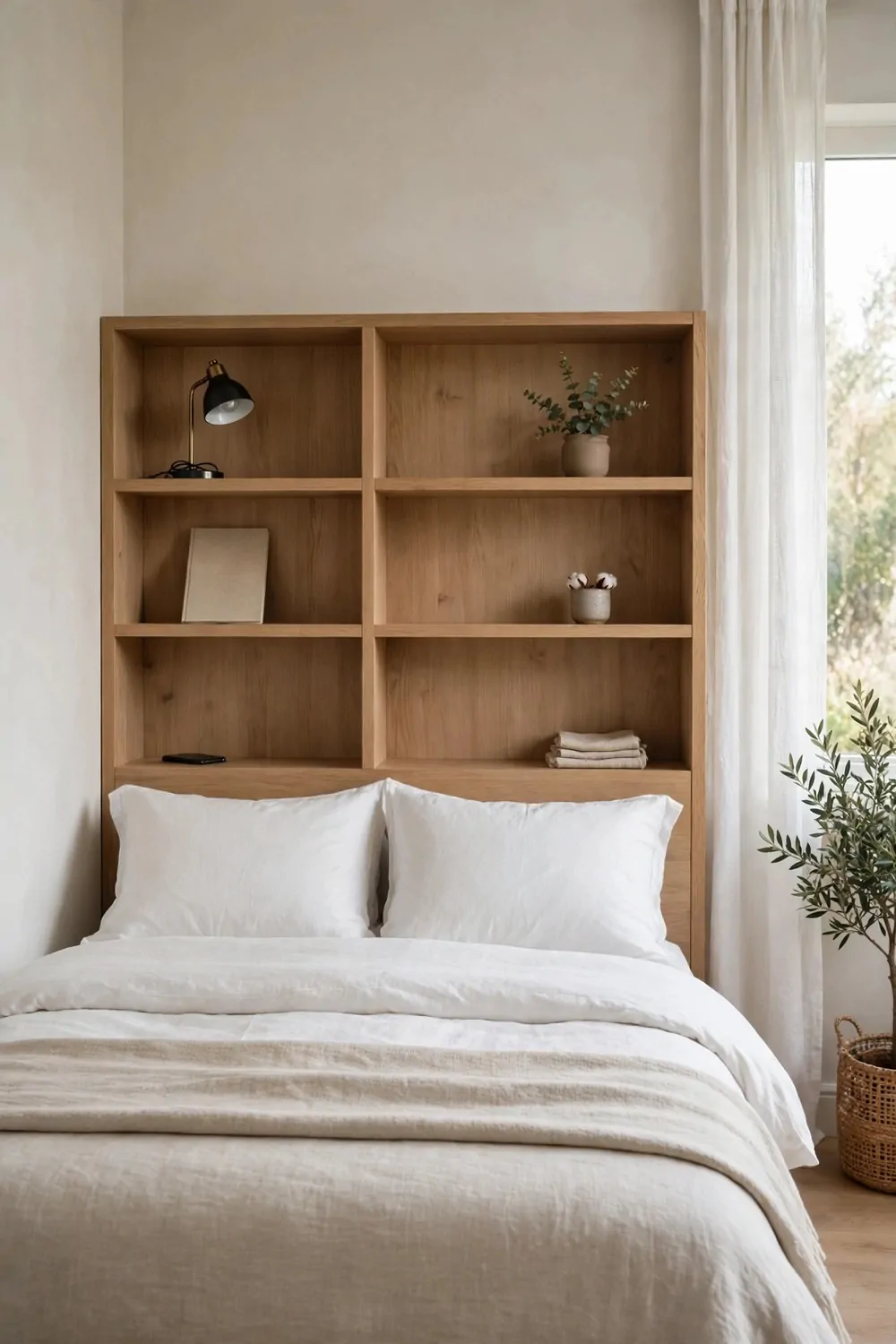
A headboard is a wall behind your bed that does nothing. Give it shelves and pockets, and it becomes office storage that takes up no floor at all.
My headboard has two small shelves built into it. One shelf holds my notebook and my pen. The other shelf holds my phone and my charger. I reach back from the bed and everything I need for work is right there.
Pick a headboard with shelves you can reach from the bed and from the desk. If the shelves are too high, you will never use them. If they are too low, they hide behind the pillows.
Keep the shelves shallow. A deep shelf behind a bed collects dust and lost things. A shallow shelf holds a notebook and a phone, and nothing else fits, which is exactly right.
Put a small lamp on the headboard shelf. A lamp on the headboard lights the bed for reading and lights the desk for work. One lamp, two jobs, and no floor space lost.
Do not load the headboard with heavy books. A headboard full of books pulls away from the wall over time. Light things only. Notebooks, a phone, a small lamp. Heavy books belong on a proper shelf.
Dust the shelves once a week when you make the bed. A dusty shelf behind a bed makes the whole room look tired. A clean shelf in good light looks like it was built yesterday.
Try this one if your bed sits against a bare wall with nothing behind it. One headboard with shelves, and the wall starts working.
A Curtain That Closes the Workday
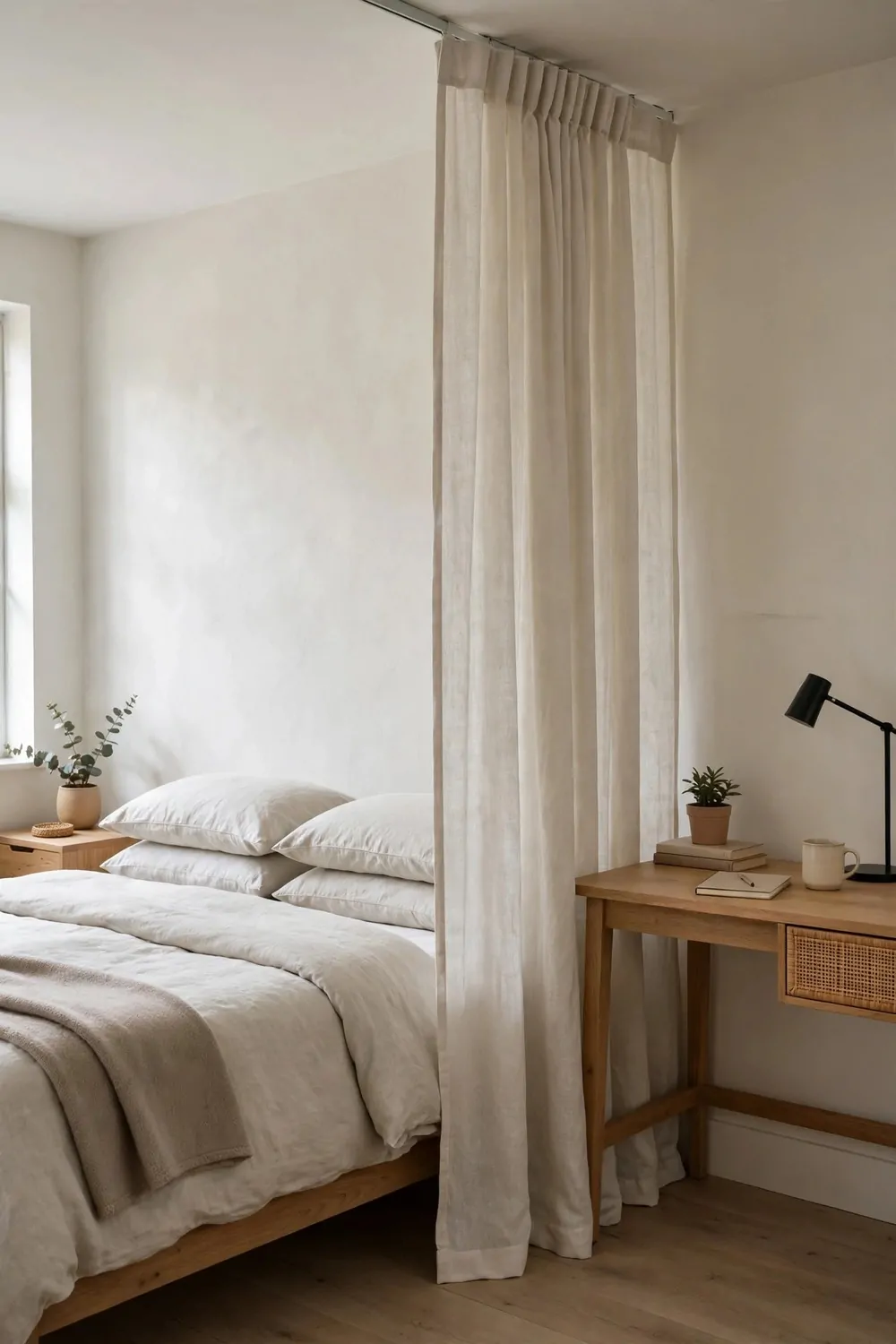
A curtain can split one room into two without building a wall. Pull it across in the evening, and the office disappears. Pull it back in the morning, and the office is there again.
My curtain hangs from a rail on the ceiling, right between the bed and the desk. At five in the evening I pull it across. The desk hides behind the cloth, and the room is a bedroom again. Nothing on show. No work staring back at me when I close my eyes.
Hang the rail on the ceiling, not on the wall. A ceiling rail holds the curtain straight, and the curtain falls all the way to the floor. A wall rail leaves a gap at the top, and the gap lets the work peek through.
Pick a curtain in a pale, plain colour. A heavy dark curtain makes the room feel smaller when it is closed. A pale curtain keeps the light soft, and the room still feels open behind it.
Keep the curtain light enough to pull with one hand. A curtain that needs two hands and a tug will stay open forever, and an open curtain is no curtain at all.
Wash the curtain when the season turns. Clean cloth smells lovely, and it drops softer once it has been washed. A room with a clean curtain feels cared for.
Keep a small hook on the wall for the curtain tie. A curtain tied back in the morning stays out of the way all day. A curtain left hanging loose drifts across the room and blocks the light.
Try this one if your desk stares at you all night and your sleep suffers for it. One curtain on a ceiling rail, and the workday ends when you say it ends.
Paper Lives on the Wall, Not the Desk
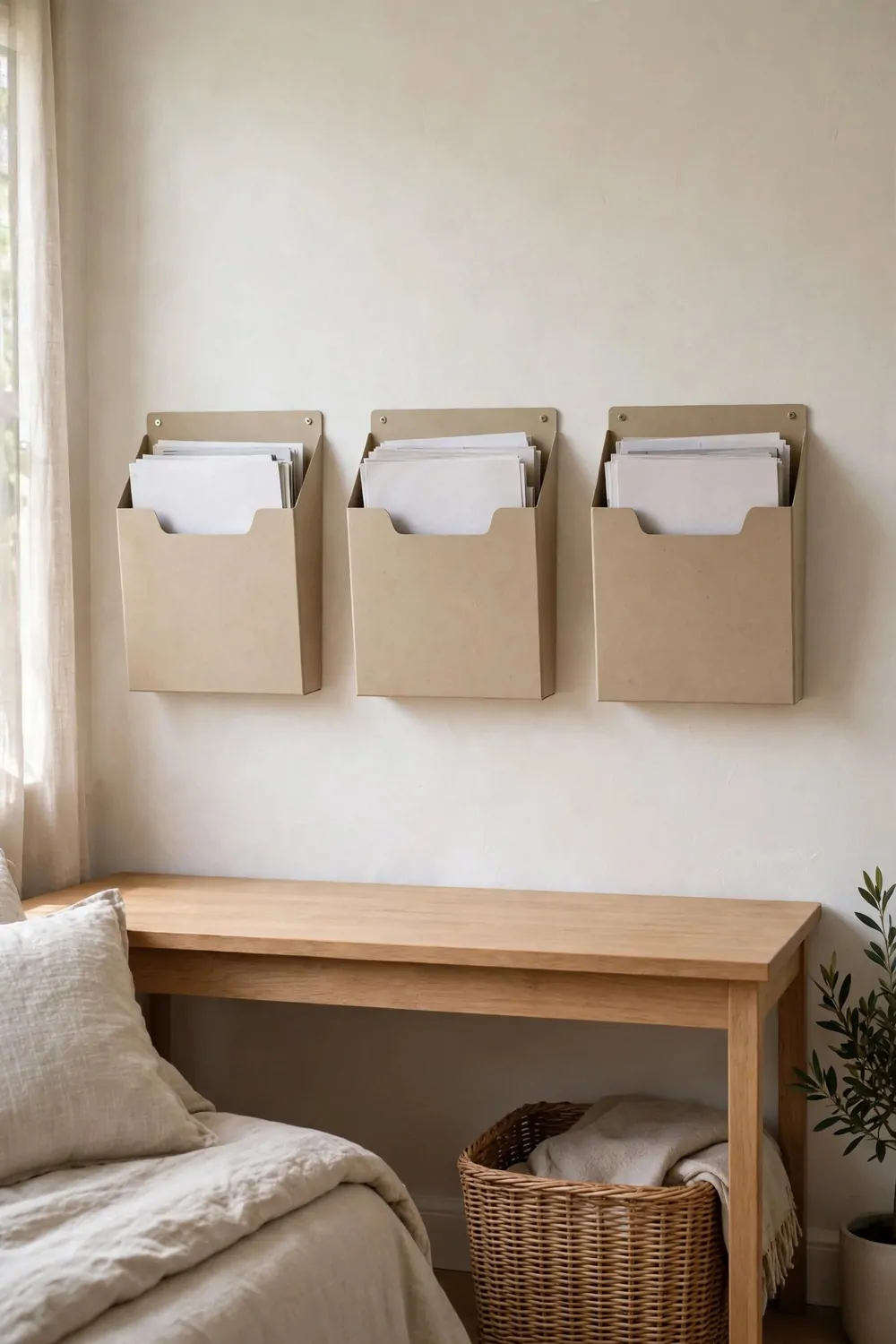
Paper is the thing that eats desks. One stack becomes two stacks, and two stacks become a pile you cannot see across. Put the paper on the wall, and the desk stays clear.
My wall holds three magazine files screwed to the wall above my desk. One file holds today’s papers. One file holds this week’s papers. One file holds papers to file away. When a paper comes in, it goes in a file on the wall. When the desk is clear, I can work.
Label each file on the front you can see from your chair. Today. This week. File away. Labels save you from opening all three files every time you need one paper.
Keep only three files on the wall. A wall full of files is just a desk standing upright. Three files hold a week of paper, and a week of paper is all a small desk should hold.
Empty the file-away file every Friday. Five minutes, and the papers go into the drawer or the bin. A file that never gets emptied becomes a pile on the wall instead of a pile on the desk.
Here is what lives in my three wall files.
- Today: the papers I am working on right now.
- This week: papers I need before Friday.
- File away: papers to keep, papers to throw out.
Put the files at arm’s reach from your chair. If you have to stand up to file a paper, you will not file it. You will drop it on the desk, and the pile starts again.
Try this one if your desk is covered in paper and you cannot find the top of it. Three files on the wall, and the desk is clear again.
Hang Storage From the Ceiling
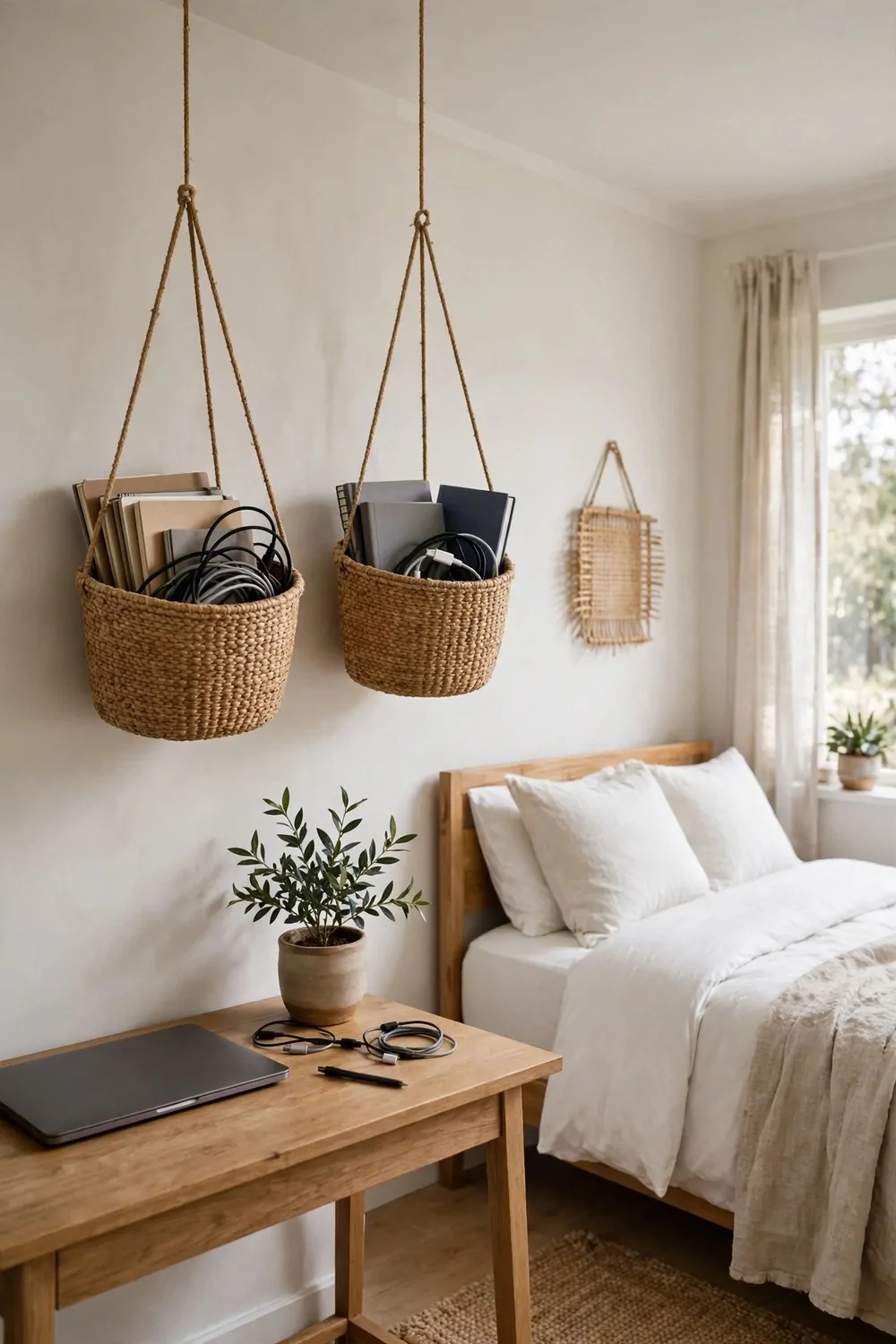
The ceiling is the last empty space in a small bedroom. Hooks in the ceiling can hold baskets, plants, and bags, and they take up no floor and no wall at all.
My ceiling holds two hanging baskets. One basket holds my chargers and cables. One basket holds my notebooks. They hang on short cords, just above eye level, and I reach up and grab what I need.
Fix the hooks into the solid wood above the ceiling, not just the plaster. A basket full of notebooks is heavier than it looks, and plaster hooks will pull out. Find the beam first, and use the right hook.
Keep the baskets light. Cables, notebooks, a small plant. Heavy books belong on a shelf, not in the air above your head. A basket that falls is a mess you do not want.
Hang the baskets where you can reach them from your chair. If they hang over the bed, you will bump them every morning. If they hang over the desk, they are right where your hands already are.
Keep the cords short. A basket on a long cord swings every time you walk past. A basket on a short cord stays still, and still is what you want above a desk.
Check the hooks once a month and give each one a small tug. A hook that moves needs a new screw before the basket gets heavy. One minute of checking saves a basket on the floor.
Try this one if your walls are full and your floor is full and the ceiling is still bare. Two baskets on short cords, and the room finds space it did not know it had.
Keep Reading
If you liked these bedroom office combo layout ideas, these bedroom office ideas will give you even more ways to make one small room do two jobs well.
- 15 Office in Bedroom Master Layouts That Feel Luxe
- 16 Guestroom Home Office Combo Setups That Save Space
- 17 Small Home Office Guest Room Layouts That Work for Both
A bedroom can hold a real office and still feel like a bedroom. Pick one layout from this list, try it this week, and let every inch of your room earn its keep.