17 Office in Bedroom Ideas Room Dividers Can Create in Minutes

For two years I worked at a desk pushed against my bedroom wall, and I told everyone it was fine. It was not fine.
Every night I climbed into bed and my eyes landed on the same three things. The laptop. The stack of papers. The little blinking light on my charger. My brain read that as work time, even at midnight. I slept badly and woke up tired, and for the longest time I blamed the mattress.
The mattress was innocent. The real problem was that my bedroom had no line between work and rest. No wall, no door, not even a curtain. My office just sat there in the corner, staring at me while I tried to sleep.
Then a friend visited and said something simple. She said, why not put something between the bed and the desk? Just a screen, a shelf, anything. I bought a cheap folding screen that same week. It took ten minutes to set up. That night I closed the screen and the office just went away. My sleep got better within days. I am not joking.
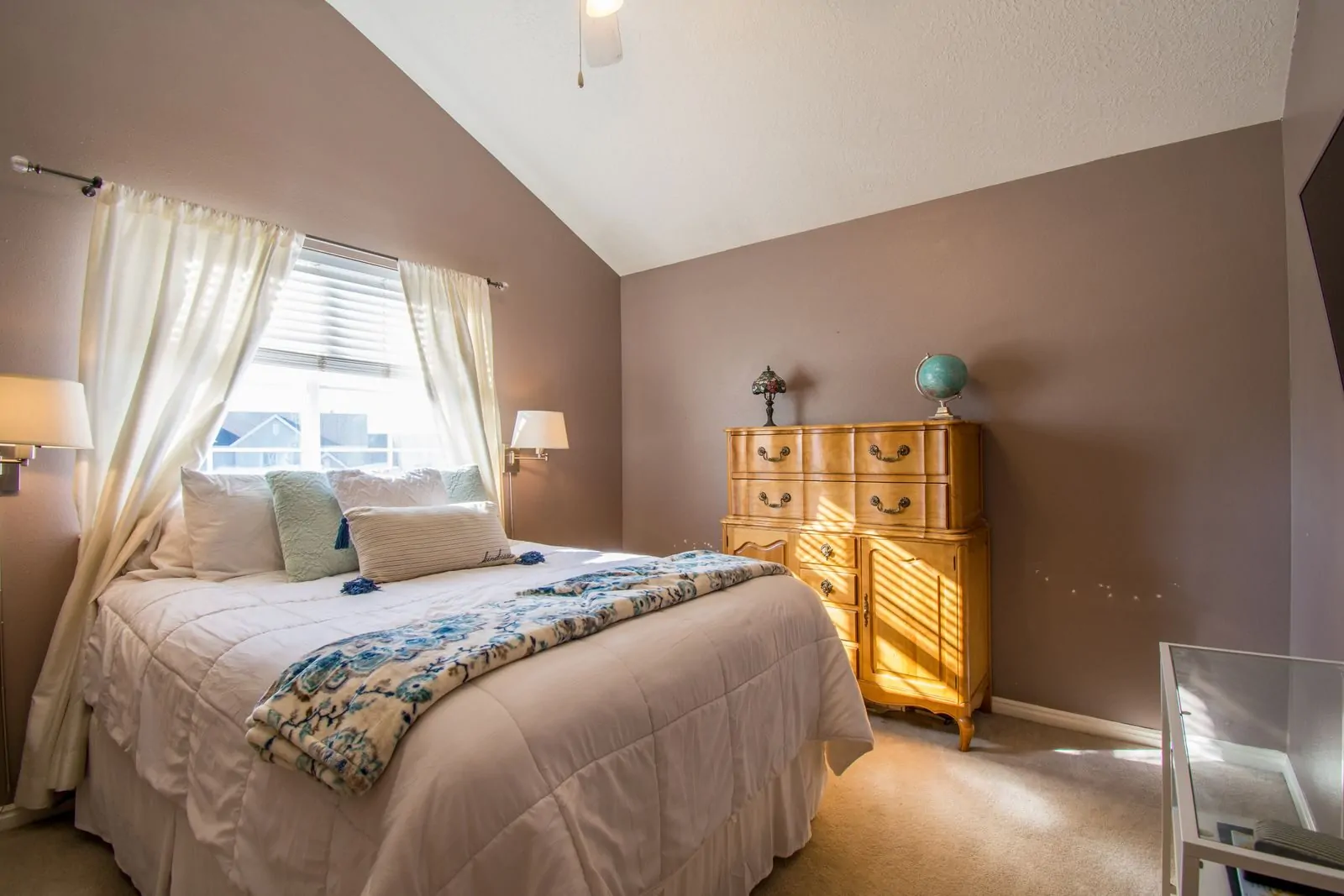
That is what room dividers do. They draw a line. Your bedroom stays a bedroom. Your office stays an office. And you can make that line in minutes, with no drilling and no landlord drama.
Here are 17 Office in Bedroom Ideas Room Dividers can create in minutes. Every one is cheap or free, renter friendly, and fast. Pick one today and try it this weekend.
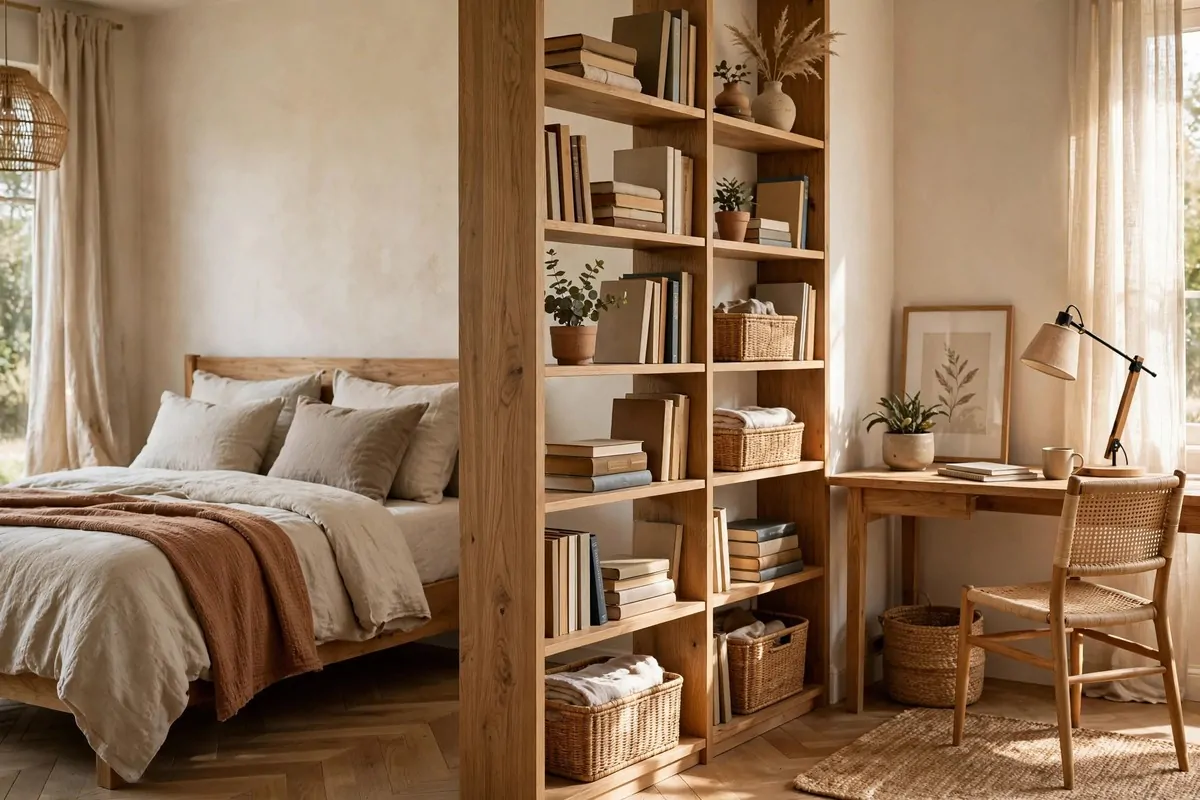
A Tall Open Bookshelf as a Divider

My favorite divider is also the hardest working one in this list.
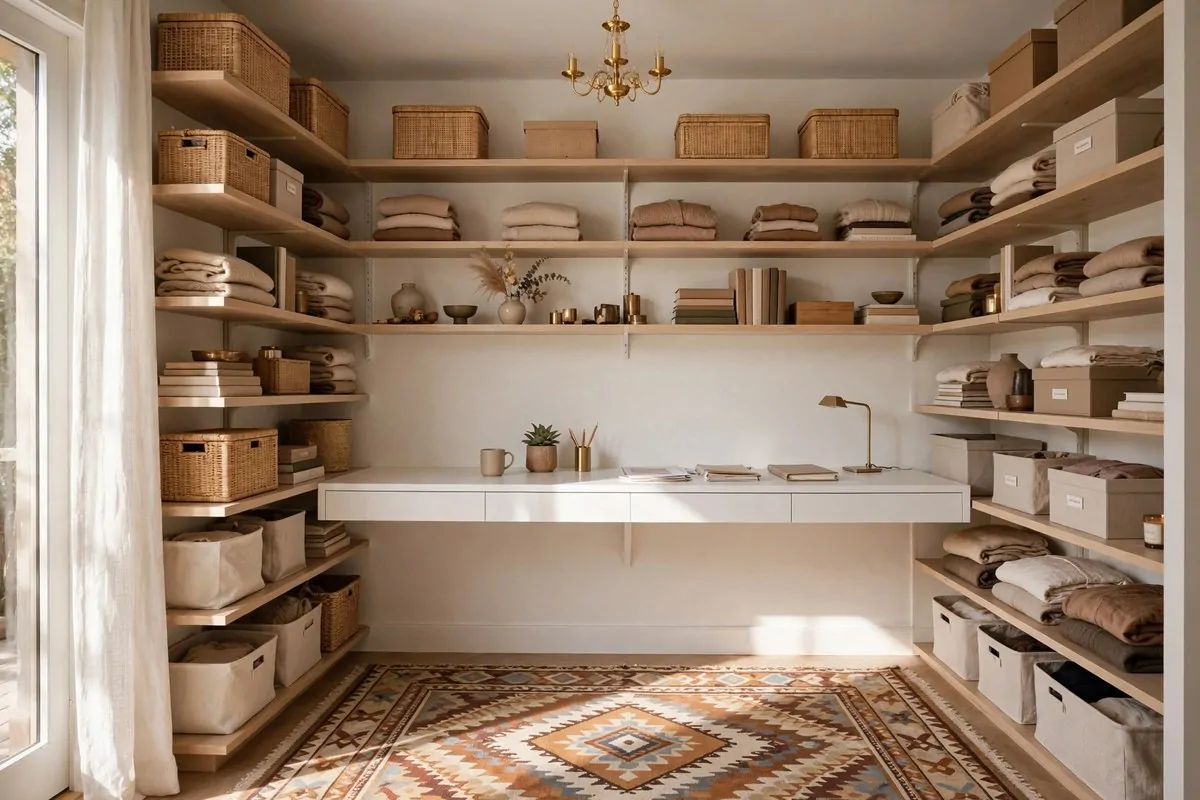
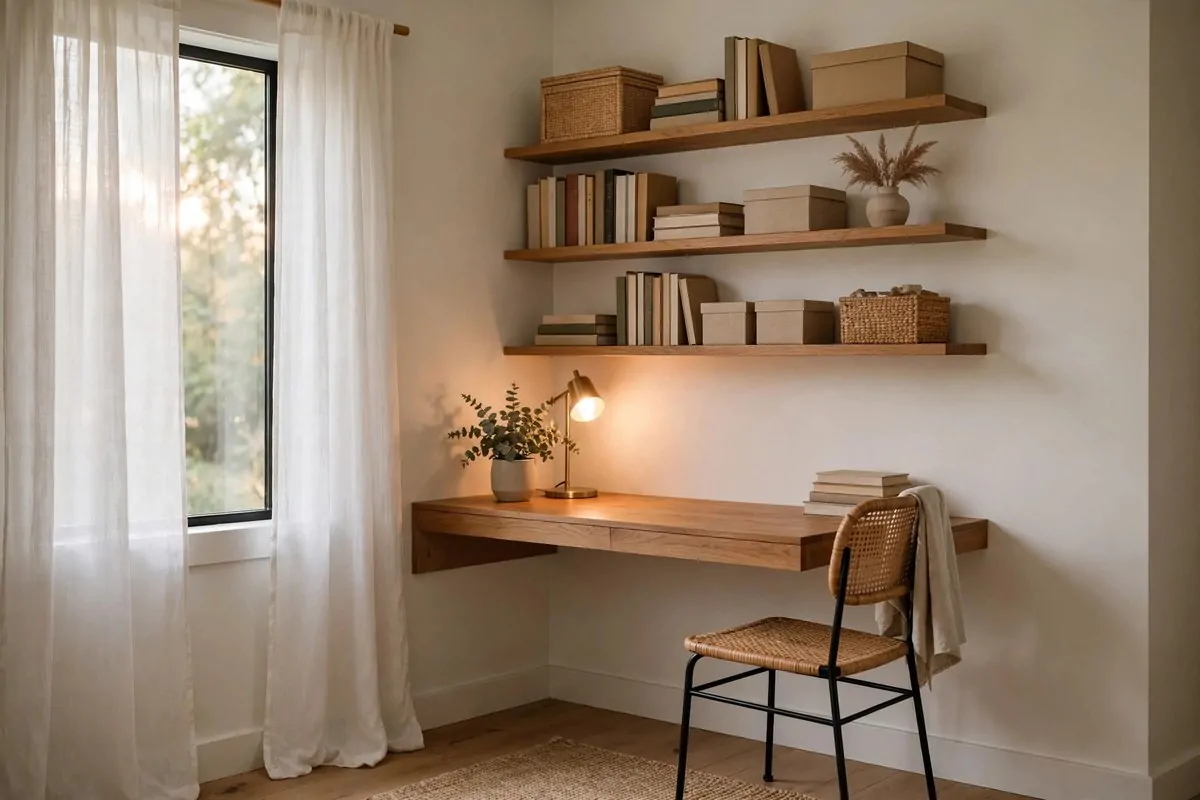
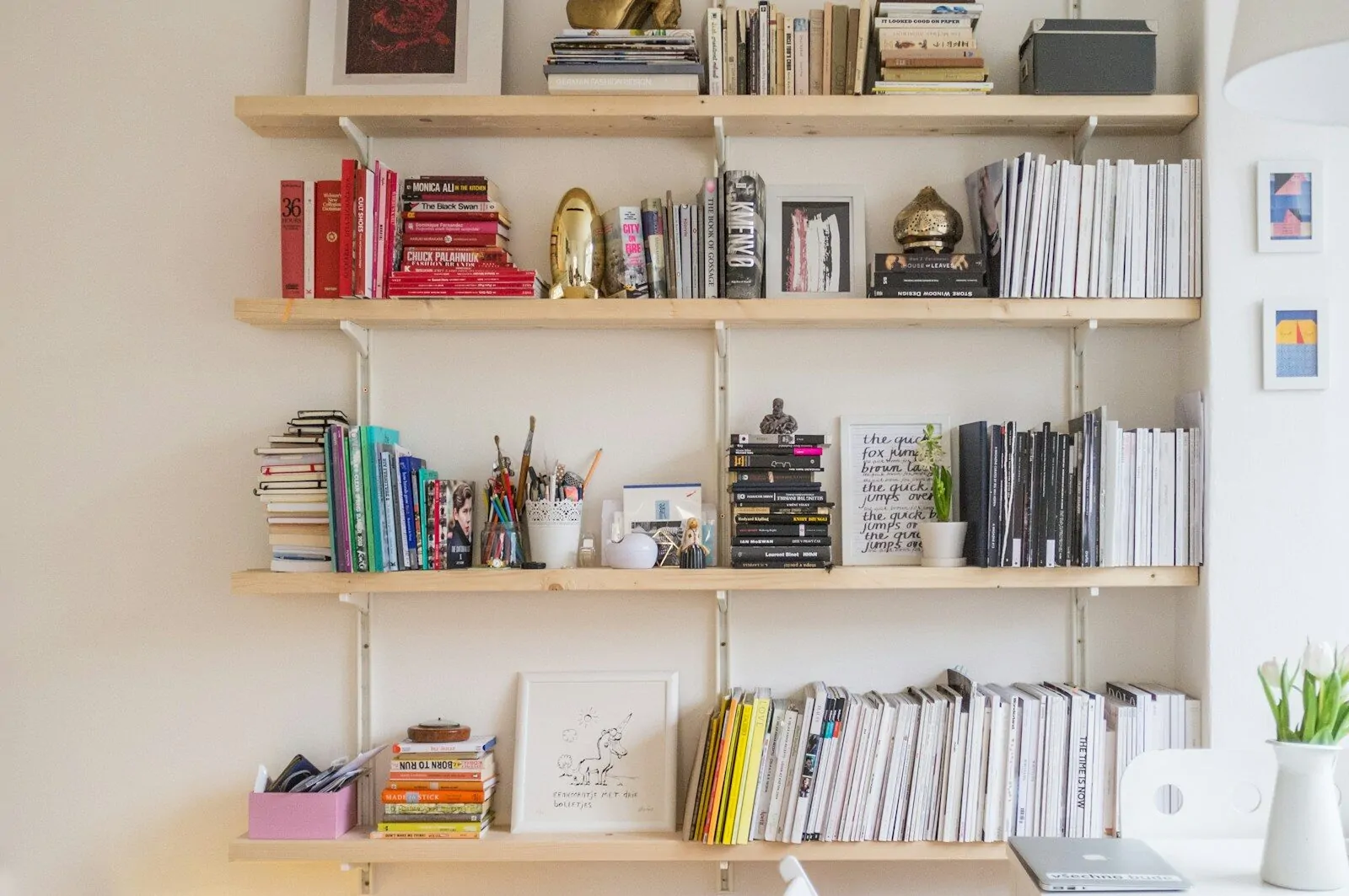
A tall open bookshelf gives you two things at once. It draws a line between your bed and your desk, and it holds all your stuff.
Place it so it stands out from the wall, like the letter T. The bed goes on one side. The desk goes on the other. You get a little wall that also stores books.
I like open shelves for this, not closed ones.
Closed shelves block the light and make the room feel small. Open shelves let daylight pass through, so the bedroom still feels like one bright room. You just stop seeing the desk from your pillow.
Put the pretty things on the bed side. Framed photos, a small plant, the books with nice covers.
Put the work things on the desk side. Binders, printer paper, the box of cables you pretend you will sort one day.
One tip I learned the hard way. Anchor the shelf to the wall if it is tall. A bookshelf falling over is not a divider, it is a disaster.
Good things to store on a divider shelf:
- A few baskets for the messy stuff you do not want to see
- Your notebooks and planners on the desk side
- A small lamp clipped to one shelf for evening work
- One plant on top, because green makes everything calmer
You can find a cheap tall shelf almost anywhere. Secondhand stores are full of them. I paid very little for mine and it has outlasted two apartments.
A Classic Three-Panel Folding Screen
This is the one that saved my sleep. The folding screen.
A three-panel screen stands on its own. No drilling. No screws. No asking the landlord for anything. You open it like a book and it stays put.
When I brought mine home I had it standing in ten minutes. I put it between my bed and my desk. That night I folded it shut after work and the office just disappeared. I slept like a rock.
Screens come in every style you can think of. Wooden ones with cutout patterns. Fabric ones with soft prints. Plain white ones that vanish into the wall.
Pick one that matches your bedroom, not your office. The bed side is the side you will look at most. It should make you feel calm.
The best part is how easy it is to move. Guests coming over? Fold it flat and slide it behind the door. Need it again on Monday? Open it back up.
It also hides clutter fast. Video call in five minutes and your desk is a mess? Pull the screen around the desk. Done. Nobody knows.
One small warning. Cheap screens can wobble on hard floors. Put little felt pads under the feet. It stops the wobble and it stops the scratching sound.
If you try only one idea from this list, try this one. It is the fastest line you can draw between work and rest.
Ceiling-Mounted Curtain Panels

Curtains make the softest divider of all. They feel like fabric walls, and you can open them or close them whenever you want.
A ceiling track is a thin rail that sticks to the ceiling with strong adhesive hooks. No drilling needed. The curtain panels hang down and slide along the rail.
Pull them closed when you work. Pull them open when you sleep. Your bedroom goes from one room to two rooms with one hand.
The fabric you pick changes everything. Sheer fabric lets light through and looks dreamy. Linen looks calm and a little fancy. A heavier fabric blocks the view completely and even softens sound a bit.
Here is a quick guide to picking the right fabric:
| Fabric | Light | Best for |
|---|---|---|
| Sheer voile | Lots of light passes | Small dark rooms |
| Linen blend | Soft filtered light | A calm, cozy look |
| Heavy cotton | Blocks most light | Real privacy at night |
Measure twice before you buy. Curtains should just kiss the floor. Too short looks sad. Too long collects dust.
Wash the panels before you hang them. New curtains often smell like the warehouse. One wash fixes it.
I love this idea for couples. One person can sleep while the other works late. The curtain softens the lamplight and the typing sounds.
It is also the cheapest full-height divider I know. A rail, some hooks, and two panels cost less than most screens.
A Tension Rod and a Simple Curtain
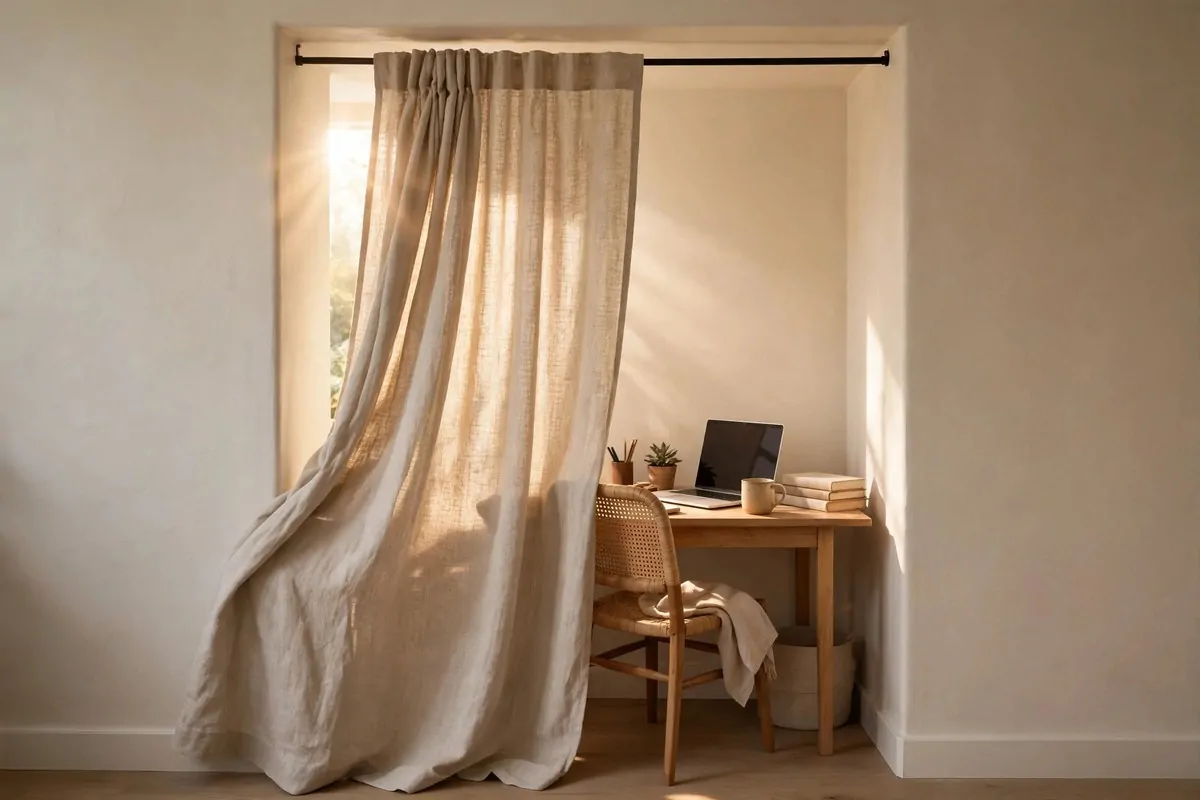
A tension rod is the renter’s best friend. It wedges between two walls with spring pressure. No holes. No marks. Nothing for the landlord to complain about.
If your bedroom has a little nook or alcove, this idea is made for you. Put the rod across the opening. Hang one curtain panel. Your desk sits behind it.
Close the curtain at the end of the day. The office vanishes. Open it in the morning and you are back at work.
Tension rods only work between two solid surfaces. Measure the gap first. Most rods tell you their range on the package.
Pick a rod that is a little stronger than you think you need. A curtain looks light but it has weight. A weak rod will slide down at 2 in the morning and scare you half to death. Ask me how I know.
The curtain itself can be anything. A flat bedsheet works in a pinch. A real curtain panel looks better and hangs straighter.
This is also great if your nook holds a closet. Hang the curtain in front of the whole space and your desk and your storage both hide behind one panel.
Total cost? A rod and a panel. Often under twenty dollars. Total time? Five minutes, and most of that is deciding which curtain to buy.
A Row of Tall Green Plants

Plants make the happiest divider I know. They do not feel like a wall. They feel like a little garden that happens to sit between your bed and your desk.
Line up three to five tall plants in a row. Fiddle leaf figs, snake plants, and parlor palms all work well. Put them in matching pots so the row reads as one thing.
The green wall softens the whole room. It also cleans the air a little, which your brain will thank you for during long work days.
You do not need a green thumb. Snake plants survive almost anything. I forgot to water mine for a month once and it just kept growing like nothing happened.
Keep the plants on the bed side of the line if you can. That way you see leaves from your pillow, not your monitor.
A few practical notes:
- Use pots with drainage trays so water does not reach the floor
- Turn each plant a quarter turn every month so it grows straight
- Dust the leaves now and then, dusty leaves cannot breathe well
- Start with three plants, add more later if you like the look
This divider takes up almost no floor space. The pots sit in a line about as wide as one bookshelf.
The only real cost is the plants themselves. Buy small ones and let them grow. In a year they will be tall enough to do the job properly.
Hanging Plants at Different Heights

If floor space is tight, go up instead. Hanging plants divide a room without touching the floor at all.
Hang pothos or spider plants in macrame hangers from a wooden rod or a row of ceiling hooks. Stagger them at different heights. The leaves trail down and form a soft green curtain.
Light still passes through. Air still moves. But your eye stops at the green, and the desk behind it fades away.
This works best right beside the desk, not in front of it. You want the green at the edge of your vision while you work. It feels like working next to a garden wall.
Pothos is the easiest plant for this. It grows fast, it forgives missed waterings, and it trails beautifully. One plant can give you cuttings for three more pots within a year.
Use strong hooks. A hanging plant with wet soil is heavier than it looks. Ceiling hooks rated for plants are cheap and they hold.
Water over the sink if you can. Carry the plant, water it, let it drain, hang it back. No drips on your desk or your floor.
I love how this idea changes through the year. In spring the vines grow fast and the divider gets thicker. It feels alive in a way no screen ever will.
A Cube Storage Organizer as a Half Wall
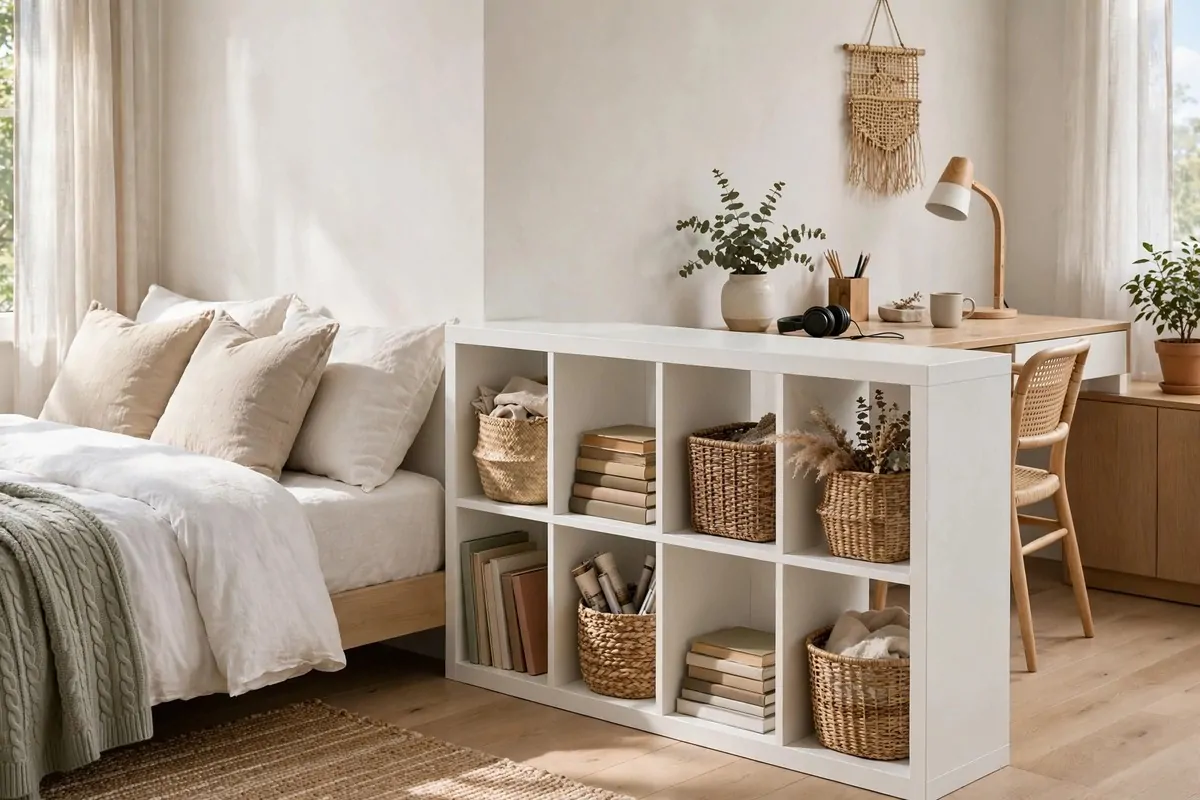
Sometimes you do not need a full wall. A half wall does the job, and a cube organizer is the easiest half wall you can buy.
These organizers are the square cubbies you see everywhere. Put one sideways so it sits low, like a bench. Slide it between your bed and your desk.
From your pillow you see baskets and books, not your monitor. From your chair you see your work, not your unmade bed. Both sides win.
The cubes swallow clutter. Papers, chargers, notebooks, the random things that pile up on a desk. Put them in fabric boxes and the whole thing looks tidy even when it is not.
A low divider keeps the room feeling open. Light flows over the top. You can still talk across the room. It divides without closing you in.
Style the top surface like a shelf. A small lamp. A framed photo. Maybe a candle you never light but love looking at.
This is also extra seating in a pinch. The top is strong enough to sit on while you tie your shoes.
Measure your space before you buy. These organizers come in 2×2, 2×4, and bigger. A 2×4 laid sideways is the perfect divider length for most bedrooms.
Floating Your Desk Perpendicular to the Wall
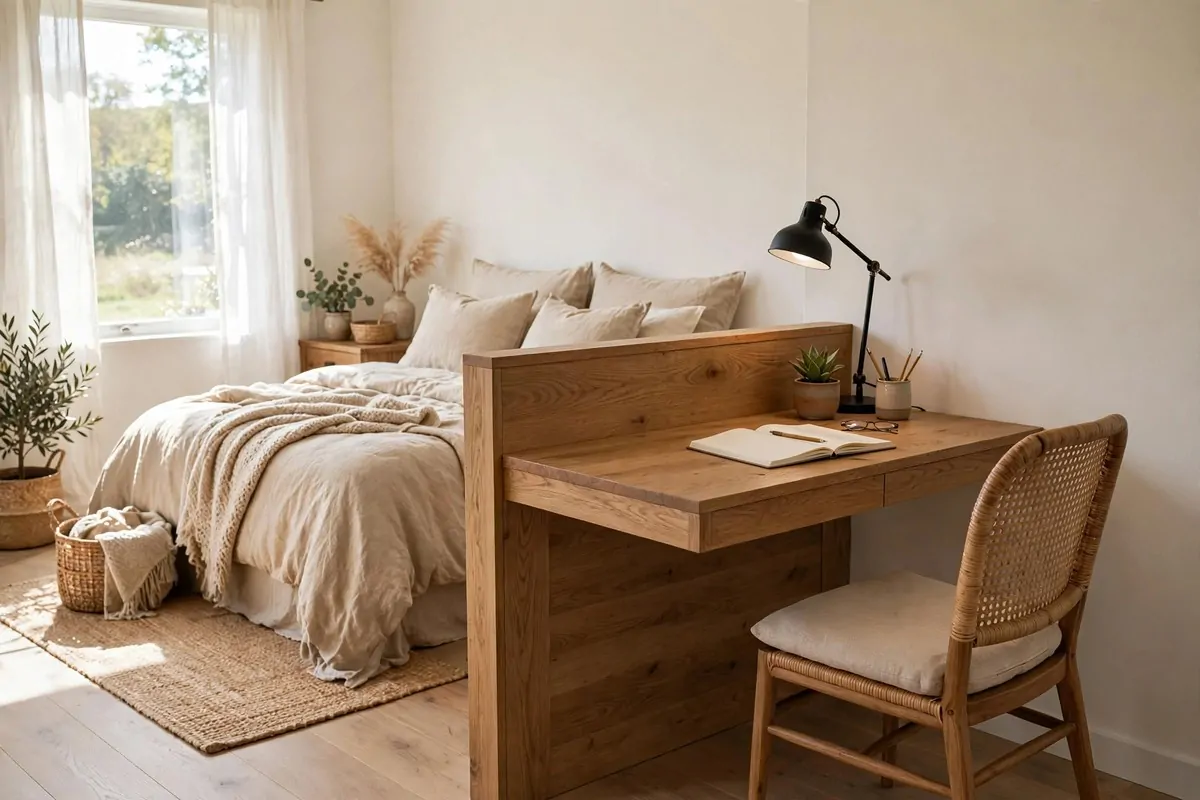
This idea costs nothing. You already own the desk. You just need to turn it.
Most people push their desk flat against the wall. That wastes its best trick. Pull it out and turn it so it sticks out into the room at a right angle.
Now the back of the desk becomes a boundary. The bed side sees a neat wooden back. The work side holds your screen, your keyboard, your coffee.
Your brain reads this as two zones. Desk zone. Bed zone. The line is invisible but you feel it every time you sit down.
This works best with a desk that looks good from behind. A solid wood desk or one with a finished back panel is perfect. A desk with a messy tangle of cables showing is less perfect.
Fix the cables first. A cable tray under the desk hides the mess. It takes fifteen minutes and it changes everything.
Put a rug under the desk to mark the zone even more clearly. We will talk about rugs later in this list.
One more benefit. With the desk out from the wall, you can sit facing the room instead of facing a blank wall. Looking up and seeing your whole bedroom feels better than staring at paint.
Sliding Panels on a Ceiling Track
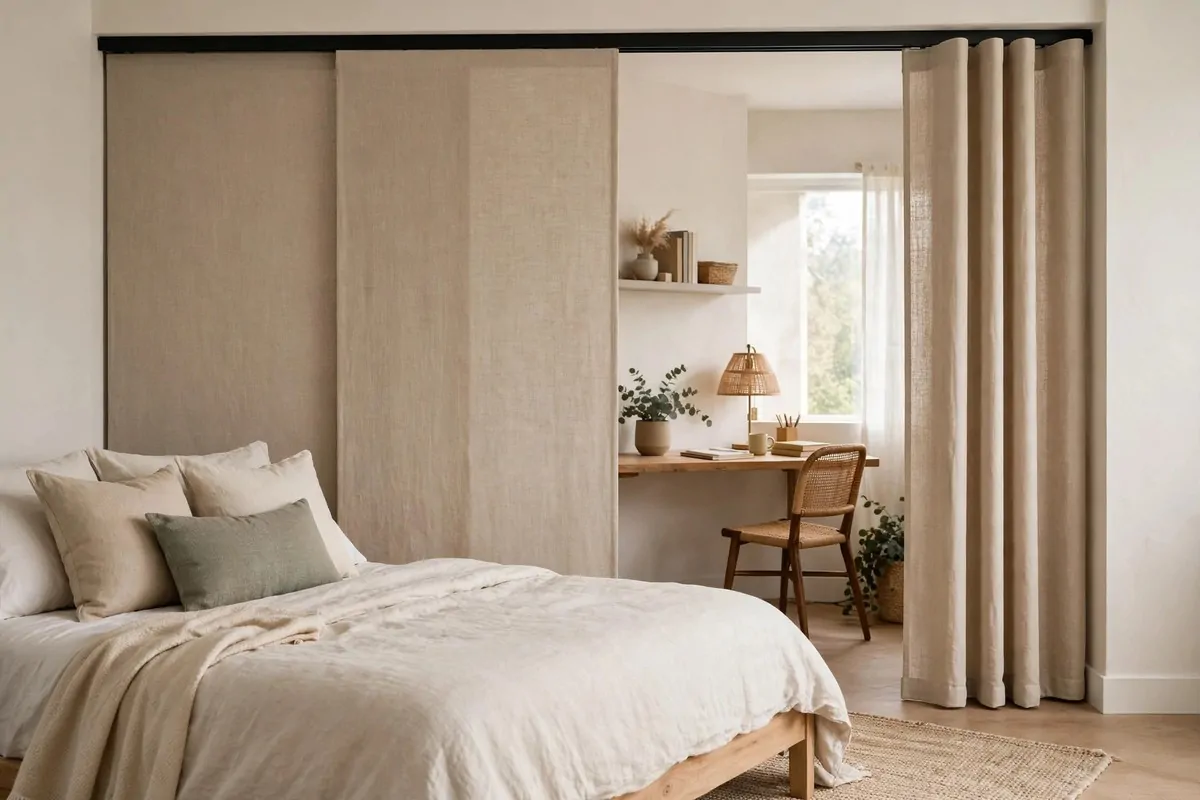
Sliding panels look like something from a fancy hotel. They are really just flat pieces of fabric on a track.
The panels hang from a slim rail on the ceiling. You slide them left or right with your hand. They stack over each other when open and spread out when closed.
Unlike curtains, they always look neat. No bunching, no wrinkles. Just clean flat lines.
You can mix panel colors. Two white panels and one in a soft color looks designed, like you hired someone. You did not. You just picked three panels.
These work well in wider rooms where a screen would look too small. One track can span the whole width of your work corner.
Adhesive ceiling mounts make this renter friendly. The track is light and the panels are light. Strong adhesive hooks hold them fine.
Cleaning is easy too. Most panels pop off the track. Toss them in the wash, hang them back up, done.
The one downside is the look when open. The stacked panels sit at one end of the track. Plan for that. Put the stack on the side where it bothers you least.
If you love a modern, minimal bedroom, this is your divider. It is quiet, clean, and it moves like a dream.
A Boho Macramé Divider

If your bedroom leans boho, this divider was made for you.
A big macrame wall hanging on a wooden rod creates the softest separation. The knots let light and air pass through. It feels like a doorway made of texture instead of a wall.
Hang it from a curtain rod or two strong hooks. It should hang wide enough to block the view of your desk from the bed. Floor length works best.
You can buy one ready made or make one yourself. Making macrame is slow, cozy work. A simple piece takes one weekend and some cotton cord.
Clip little things to it to make it yours. Photos, dried flowers, small air plants in wire holders. It becomes part divider, part art.
This divider does not block sound or hide much. It is honest about that. What it does is tell your brain that the work corner is a separate place.
It pairs beautifully with a rattan chair and warm wood. The whole corner starts to feel like a little studio apartment inside your bedroom.
Dust it now and then with a soft brush. Cotton cord collects dust the way sweaters do.
One caution. Keep it away from space heaters. Cotton and heat are not friends.
A Black-Framed Glass Partition
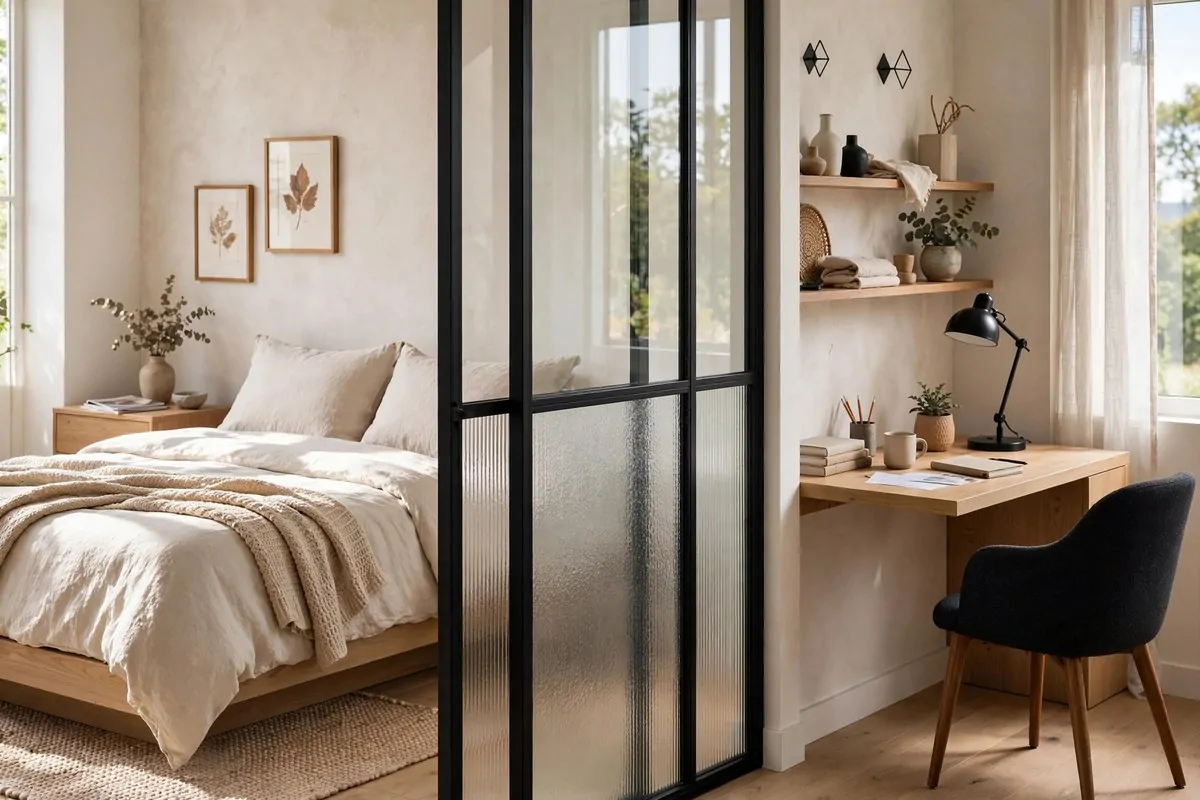
Glass dividers are for people who want separation without losing light.
A black-framed glass panel stands between your bed and your desk. You can still see through it, but your brain registers a boundary. It feels modern and clean.
Frosted or reeded glass gives more privacy than clear glass. The lower half frosted and the upper half clear is a popular mix. You get privacy where it counts and light where you need it.
These panels look expensive. Many are not. A single freestanding glass partition costs less than most people guess.
They are also easy to clean. One wipe with glass cleaner and it looks new again. Try that with a fabric screen.
The frame color matters. Black frames suit modern rooms. Wood frames suit warm, cozy rooms. White frames almost disappear.
One thing to watch. Glass shows fingerprints fast. If you have kids or pets, pick frosted glass. It hides everything.
This is my pick for small modern bedrooms. It draws the line without shrinking the room. The bedroom still feels like one bright space, just with better manners.
A Rolling Shelf on Wheels
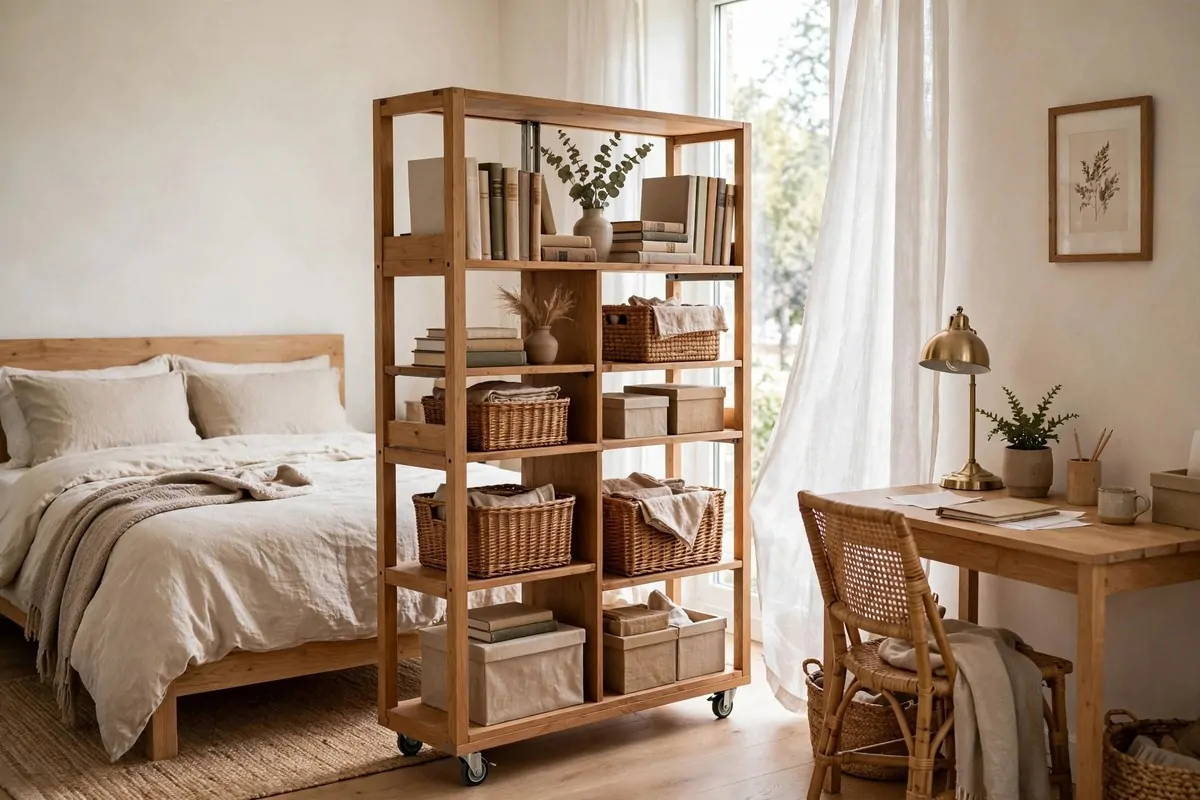
A divider you can roll away is a divider you will actually use.
Put a low shelf unit on small caster wheels. Roll it between your bed and your desk during work hours. Roll it against the wall when you want the room open.
This is perfect for tiny bedrooms. Some days you need the divider. Some days you need the floor space. Wheels give you both.
Locking casters are worth the extra cost. Lock them when the shelf is in place. A divider that drifts across the room at night is funny exactly once.
Load the shelf with things you use daily. Notebooks, the printer, a basket for mail. It becomes your office storage and your wall in one piece.
The top makes a great landing spot. Keys, phone, tomorrow’s to-do list. Everything you need within arm’s reach of both the bed and the desk.
Pick a shelf that is sturdy, not flimsy. A wobbly shelf on wheels is a spill waiting to happen.
I love this for people who share a bedroom. Your partner can roll the divider aside in the evening and the room feels whole again. In the morning it rolls back and your office is open for business.
Old Doors or Window Frames as a Divider
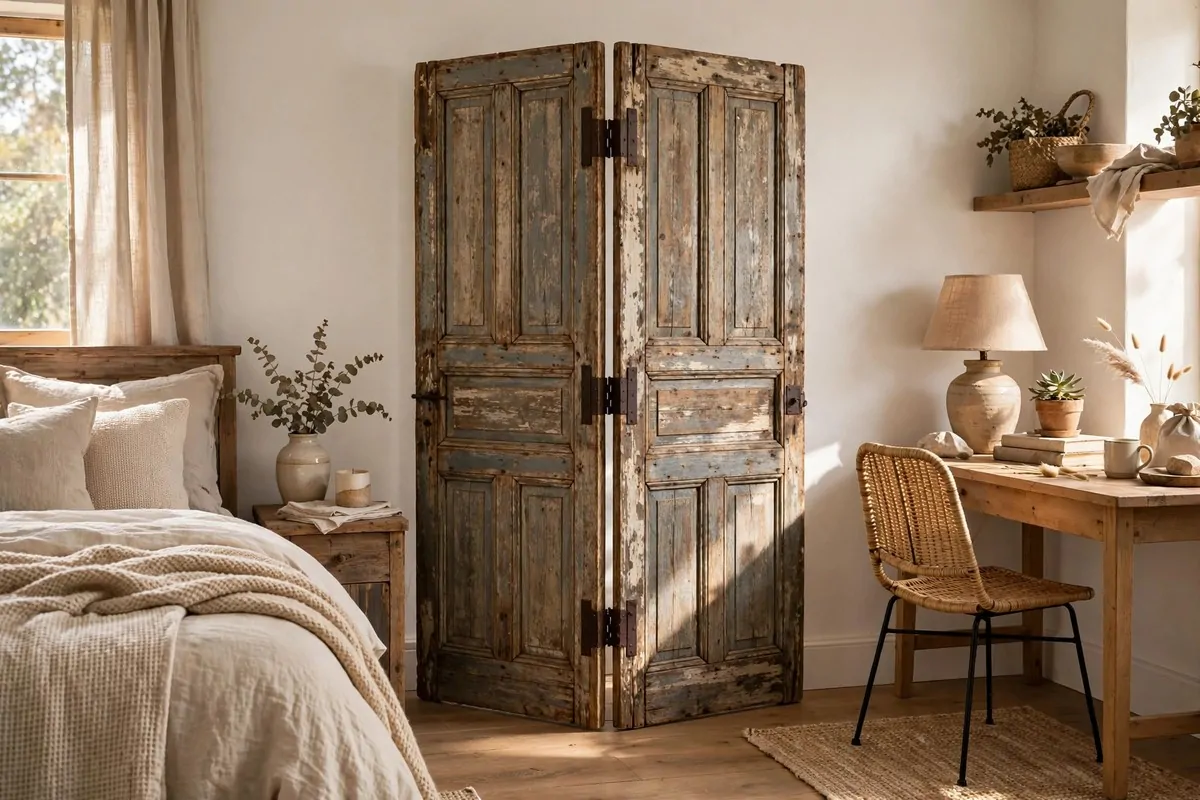
This one is for the treasure hunters.
Old doors and window frames make wonderful dividers. They have character that new furniture cannot copy. Scratches, old paint, little dents that tell a story.
Hinge two or three doors together and they stand on their own. A pair of hinges and a screwdriver is all the skill you need.
Check secondhand stores, salvage yards, and online marketplaces. People give old doors away for almost nothing when they renovate.
You can leave them as they are for a rustic look. Or paint them one color for a cleaner feel. White paint over old wood looks surprisingly fresh.
Window frames with glass panes are lovely too. They divide like a glass partition but with vintage charm. The small panes break up the view in a pretty way.
Sand rough edges before you bring them inside. Old wood can have splinters. A quick sand and a coat of wax makes them safe and smooth.
This divider becomes a talking point. Guests always ask about it. Nobody asks about a plain white screen.
A Garment Rack Divider

Your clothes can be the divider. Really.
A freestanding garment rack does double duty. It holds your outfits and it blocks the view of your desk. Two problems, one piece of furniture.
Style the rack on purpose. Hang clothes in a loose color order. Leave some space between pieces. It should look like a little boutique, not a laundry pile.
A brass or wooden rack looks warm and pretty. A black metal rack looks modern. Pick the one that fits your bedroom.
This works best in bedrooms with small closets. Your clothes get breathing room and your office gets a wall. Everybody is happy.
Keep the hung clothes tidy. A messy rack is worse than no divider at all. If you tend to pile clothes, this idea is not for you. Be honest with yourself.
Add a few empty hangers at the end for tomorrow’s outfit. It makes mornings smoother.
The rack also catches good light for getting dressed. Stand in front of it and you can actually see what you are wearing.
An Area Rug Under the Desk
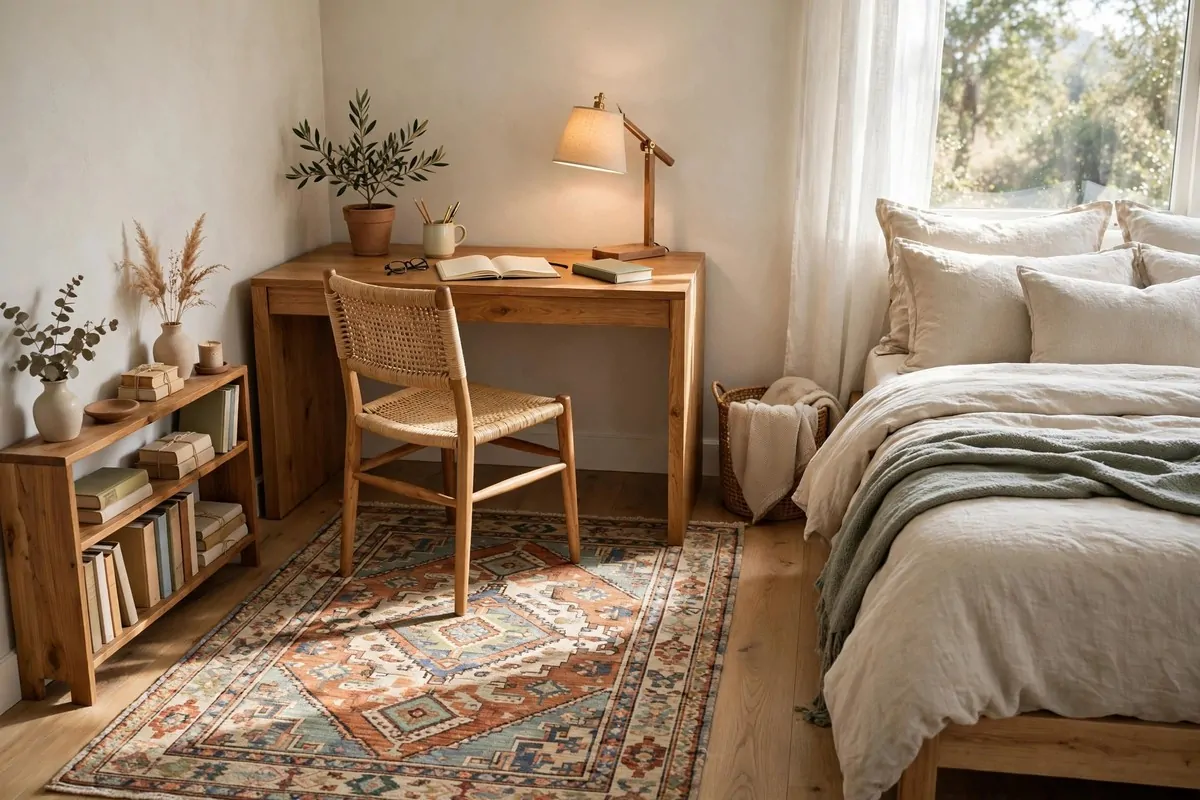
Not every divider stands up. Some of them lie flat.
An area rug under your desk tells your brain where the office starts. Step onto the rug and you are at work. Step off it and you are home.
Designers call this grounding. I call it magic. It works even though there is no wall at all.
Pick a rug big enough for the desk and the chair. The chair should stay on the rug when you push back. Measure before you buy.
A patterned rug hides crumbs and marks better than a plain one. A flat weave is easier for chair wheels than a thick shag.
The rug also protects your floor. Chair wheels scratch wood floors fast. A rug stops that completely.
This pairs well with almost every other idea in this list. Rug plus screen is a full room. Rug plus plants is a garden office.
Washable rugs are worth looking for. A rug you can toss in the machine stays fresh for years.
Layered Lighting to Mark the Zones
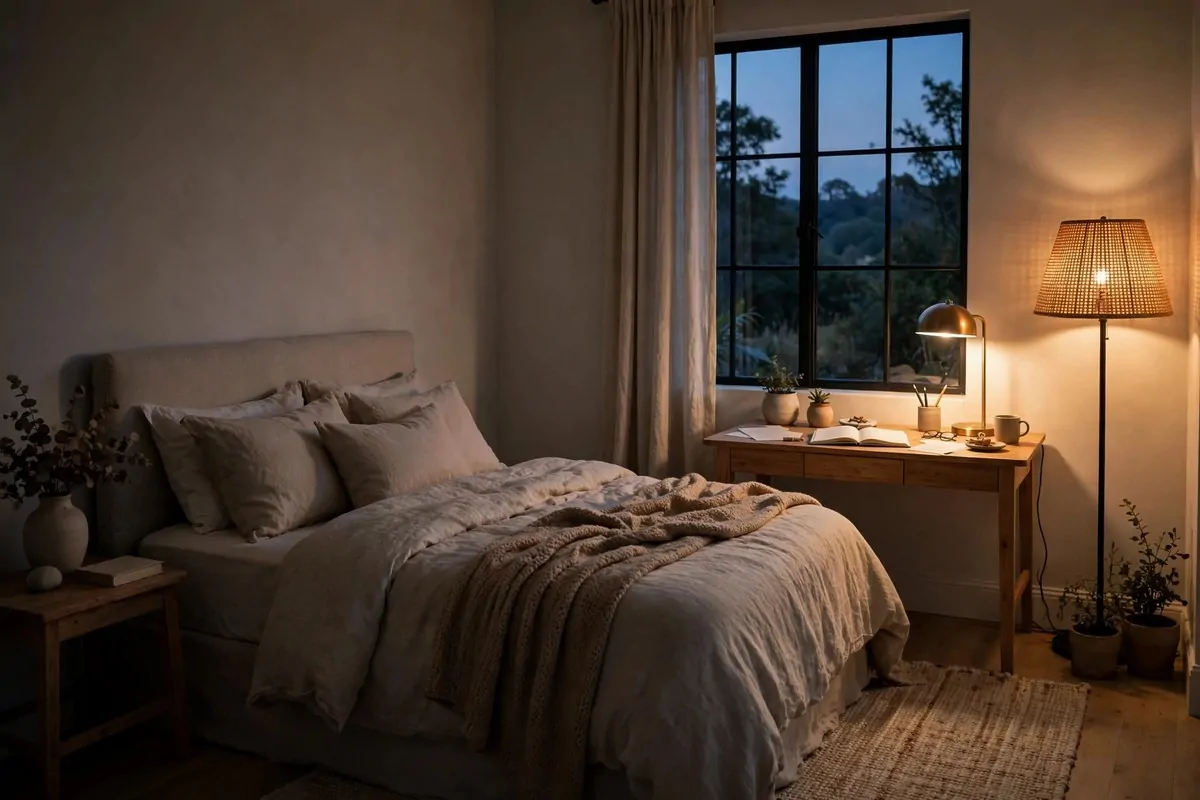
Light can draw a line just as well as furniture.
Give your desk its own lighting. A warm desk lamp for work. A floor lamp beside the chair. When those lights are on, the corner glows and the rest of the room fades.
At night the effect is strong. The office corner feels like a little lit stage. The bed sits in soft shadow, calm and sleepy.
Keep the desk lights warm, not white. Warm light feels like evening at home. White light feels like a hospital. Your bedroom deserves warm.
Put the desk lamp and the bedside lamp on separate switches. Better yet, use smart bulbs. One tap and the office turns off while the bedroom stays cozy.
This divider costs almost nothing if you already own a lamp. It also makes video calls look better. Good light on your face beats any background.
Combine lighting with one physical divider for the full effect. Light plus a screen at night is the coziest office I know.
And here is a small habit that makes it all work. When the workday ends, switch the desk lamp off with one click. That little click tells your brain the office is closed, even though it is still right there in the room.
A Wallpapered Folding Screen as Art
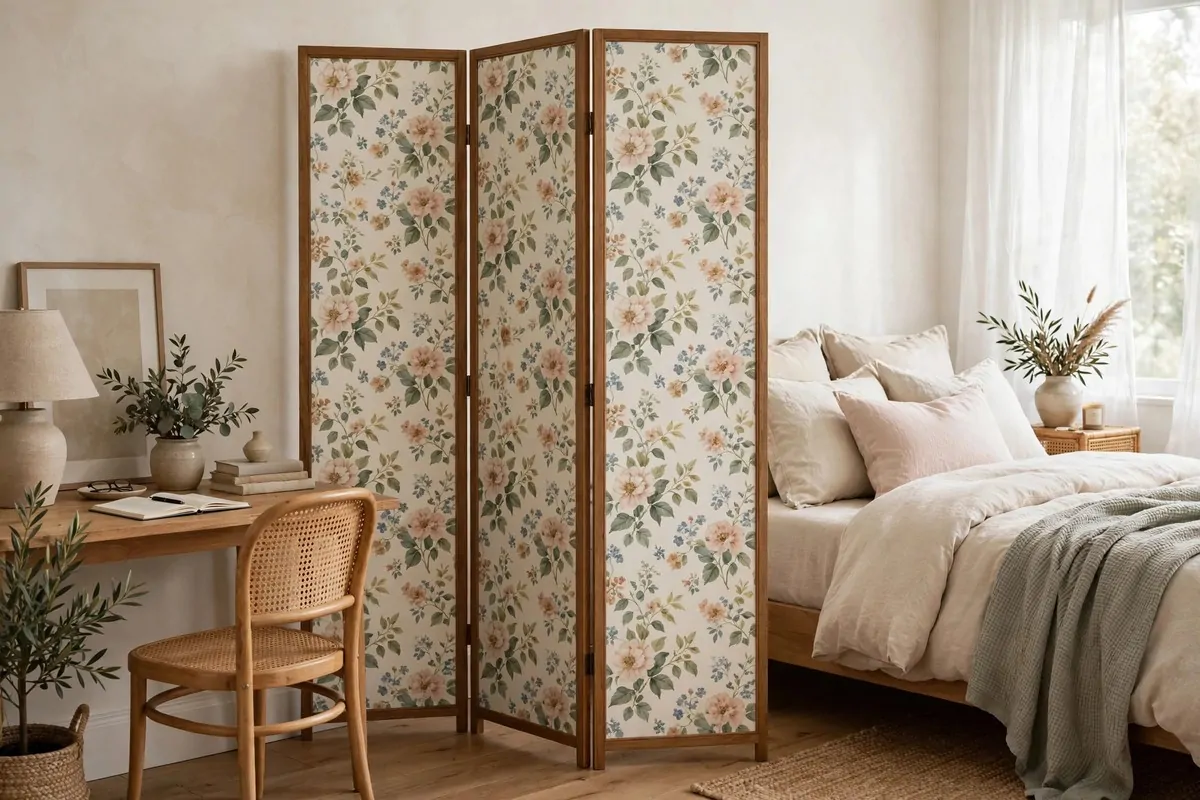
Last idea, and it is a pretty one.
Take a plain folding screen and cover the panels with wallpaper. Peel and stick wallpaper makes this easy. No paste, no mess, no commitment.
The screen becomes art and architecture at the same time. From the bed you see a beautiful patterned wall. Behind it hides your office.
Pick a wallpaper you love looking at. Floral, geometric, soft stripes. This is the view you will fall asleep facing.
This is also the cheapest way to get a designer screen. Plain screens cost little. A roll of peel and stick wallpaper covers all the panels.
Change it when you get bored. Peel off the old paper, stick on a new pattern. New room in an afternoon.
If wallpapering feels like too much, use wrapping paper or fabric with spray adhesive. Same idea, even cheaper.
Stand back and look when you finish. It is hard to believe this started as a plain screen from a discount store.
That is the whole list. Seventeen ways to draw a line between your bed and your desk, and every one takes minutes, not weekends. Your bedroom can be a bedroom again. Your office can be an office. Pick the divider that fits your room and your budget, set it up today, and sleep better tonight.