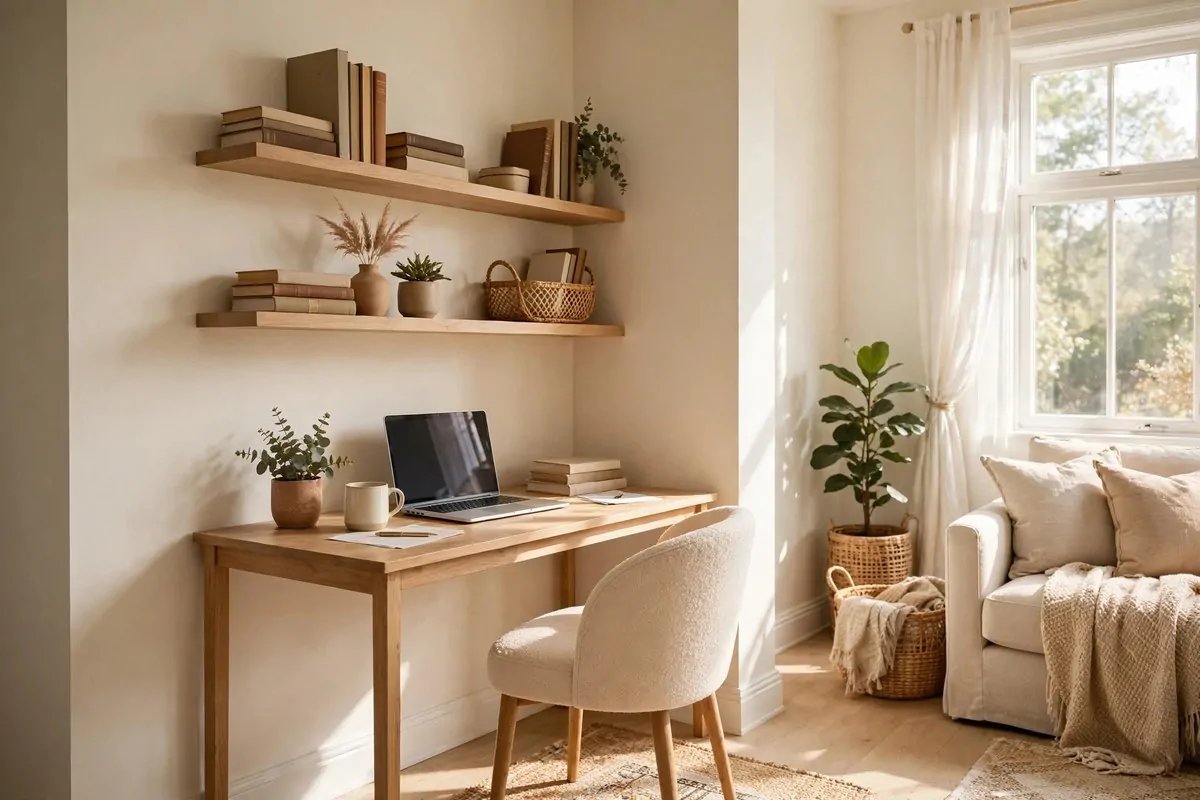
26 Shared Kids Bedroom Ideas That Give Everyone Space

My two kids used to argue about whose side of the room was whose. It happened almost every night. I got tired of hearing it.
One wanted the bed near the window. The other wanted the same bed. The toys ended up in the middle. The clothes ended up on the floor.
I knew the room was not too small. It just had no plan. Each child needed a spot that felt like theirs. They also needed room to share.
So I started to change small things. I moved the beds first. Then I gave each child one shelf and one bin. It made a big change fast.
You do not need a big room for this to work. You need clear spots for sleep, play, and homework. You need a place for each child’s stuff.
I tried a lot of these ideas in my own home. Some cost almost nothing. Some took one weekend. All of them helped my kids get along better.
In this one post you will find all 26 ideas for a shared kids bedroom. I put them all here for you. You can pick the ones that fit your room and your kids.
1. Two Twin Beds Side by Side
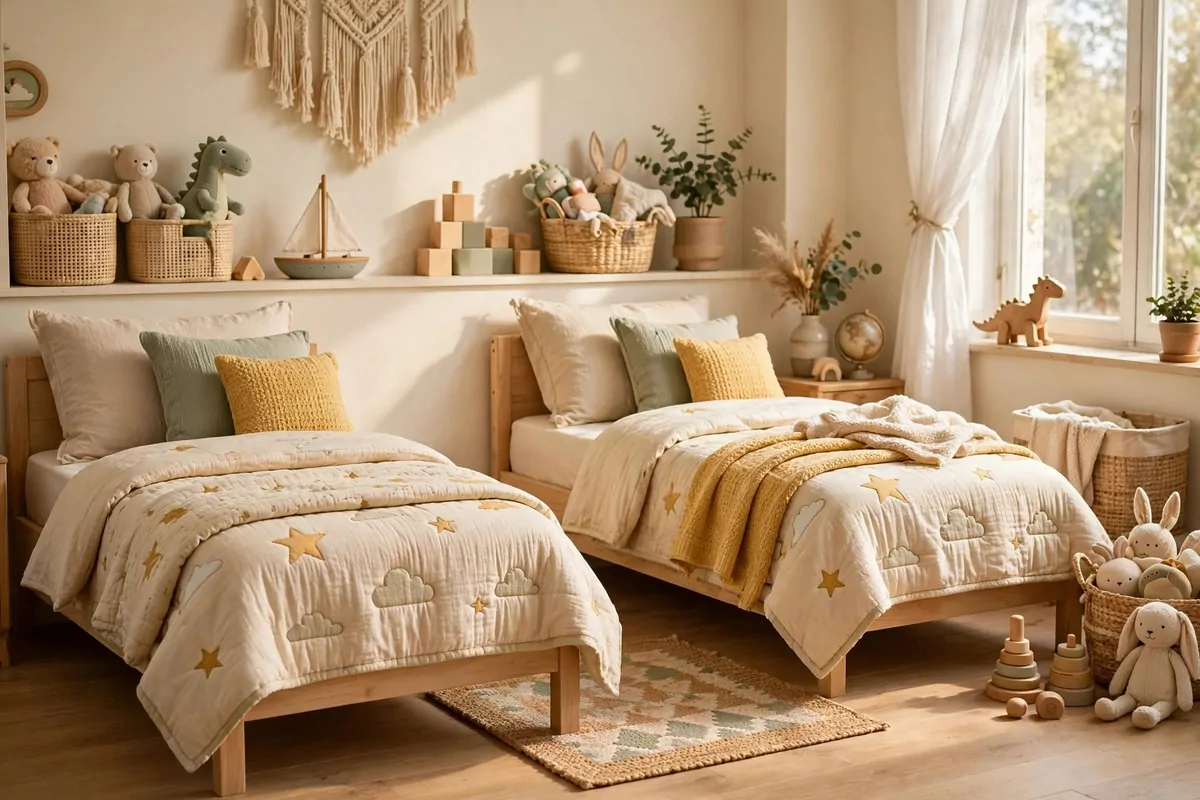
Two twin beds side by side is the simplest way to start. Each child gets a bed of their own. No one has to climb up or down.
I put a small gap between the beds in my kids room. It gives each child a little space. It also stops them from kicking each other at night.
You can push the beds against one wall. That leaves the rest of the floor free for play. It works well in a long room.
Or you can put one bed on each wall. That gives each child a corner of their own. It feels more fair to them.
Keep the beds the same size. Kids notice when one bed looks bigger. Same size beds stop a lot of fights.
Give each child their own pillow and blanket. Let them pick the colour they like. It makes the bed feel like theirs.
A small rug between the beds can help too. It marks the middle of the room. It gives them a soft spot to sit and play.
This setup costs less than most other ideas. You just need two beds and two sets of bedding. You can add the rest later.
If your kids are young, this is where I would start. It is easy to change later. It gives them both a fair start.
2. A Bunk Bed That Saves Floor Space
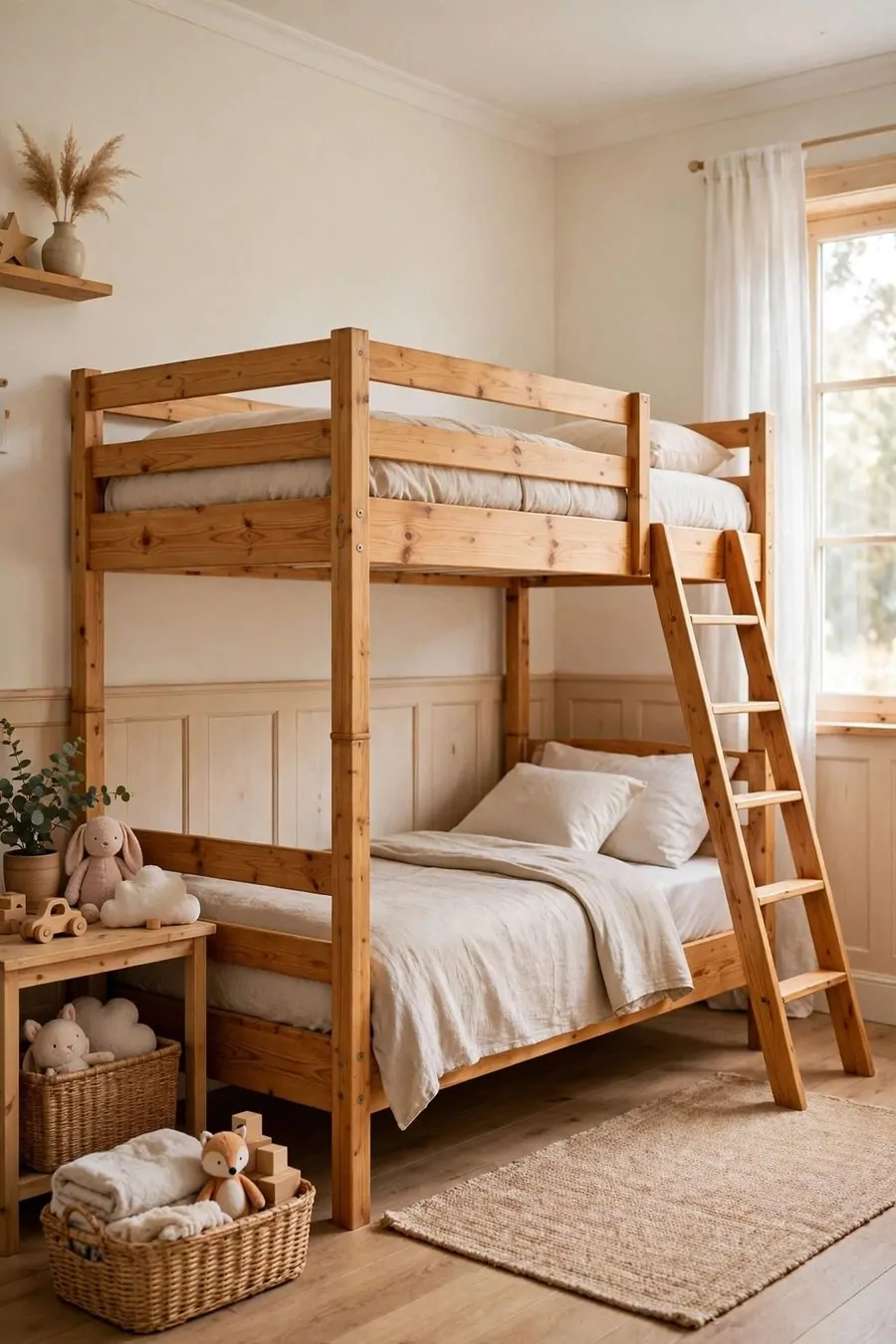
A bunk bed can save a lot of floor space. One bed sits on top of the other. You get two beds in the space of one.
My kids loved the top bunk at first. Then they argued about who got it. So we made a simple rule. They swap every week.
A standard twin bunk is the most common type. It is a good pick for a small room. A standard twin bunk has a typical cost of $150 to $400.
A twin over full bunk gives the bottom child more room. It works well if one child is older. A twin over full bunk has a typical cost of $250 to $600.
Some bunk beds have storage stairs instead of a ladder. The stairs are safer for little feet. They also hold books and toys. A bunk with storage stairs has a typical cost of $400 to $900.
You can also get a bunk with a desk below. The bottom space becomes a work spot. It is smart if the room has no space for a desk. A bunk with a desk below has a typical cost of $350 to $800.
Check the safety rails before you buy. The top bunk needs a strong rail. The ladder needs to feel steady when you climb it.
Keep the ceiling height in mind too. Your child should be able to sit up on the top bunk. Leave space above their head.
A bunk bed is not right for very young kids. Wait till your child can climb safely. Then it can be a fun and smart pick.
| Bunk Bed Type | Typical cost |
|---|---|
| Standard twin bunk | $150 to $400 |
| Twin over full bunk | $250 to $600 |
| Bunk with storage stairs | $400 to $900 |
| Bunk with a desk below | $350 to $800 |
3. A Loft Bed with a Desk Below
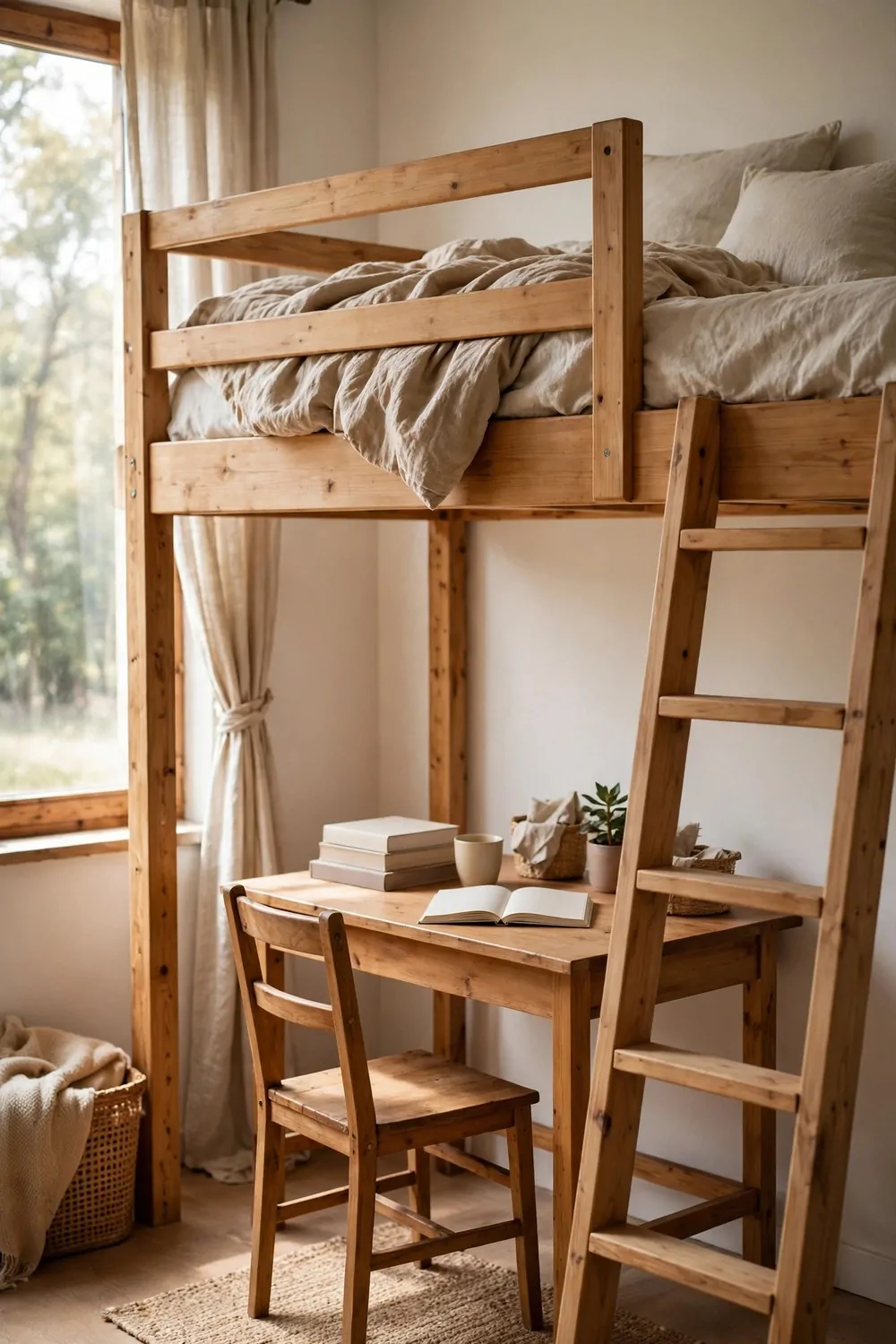
A loft bed lifts one bed up high. The space below stays free. You can use it for a desk or a play spot.
This works well when only one child needs a high bed. The other child can sleep in a low bed. It gives the room two levels.
I like a loft bed with a desk below. Your child can do homework in their own spot. They do not need to sit at the kitchen table.
Make sure the desk gets good light. A small lamp helps a lot. Your child will use the desk more if it feels bright.
You can also put a small reading chair below. Add a soft cushion and a basket of books. It becomes a quiet corner.
Some loft beds have shelves built in. That helps with books and school stuff. It keeps the desk clear.
The ladder or stairs need to be easy to climb. Test it yourself first. If it feels wobbly, pick a different one.
This idea is best for an older child. Little kids can find the climb hard at night. Wait till they are ready.
A loft bed can make a small room feel bigger. The floor stays open. Your kids get more room to play and move.
4. Matching Bedding in Two Colours
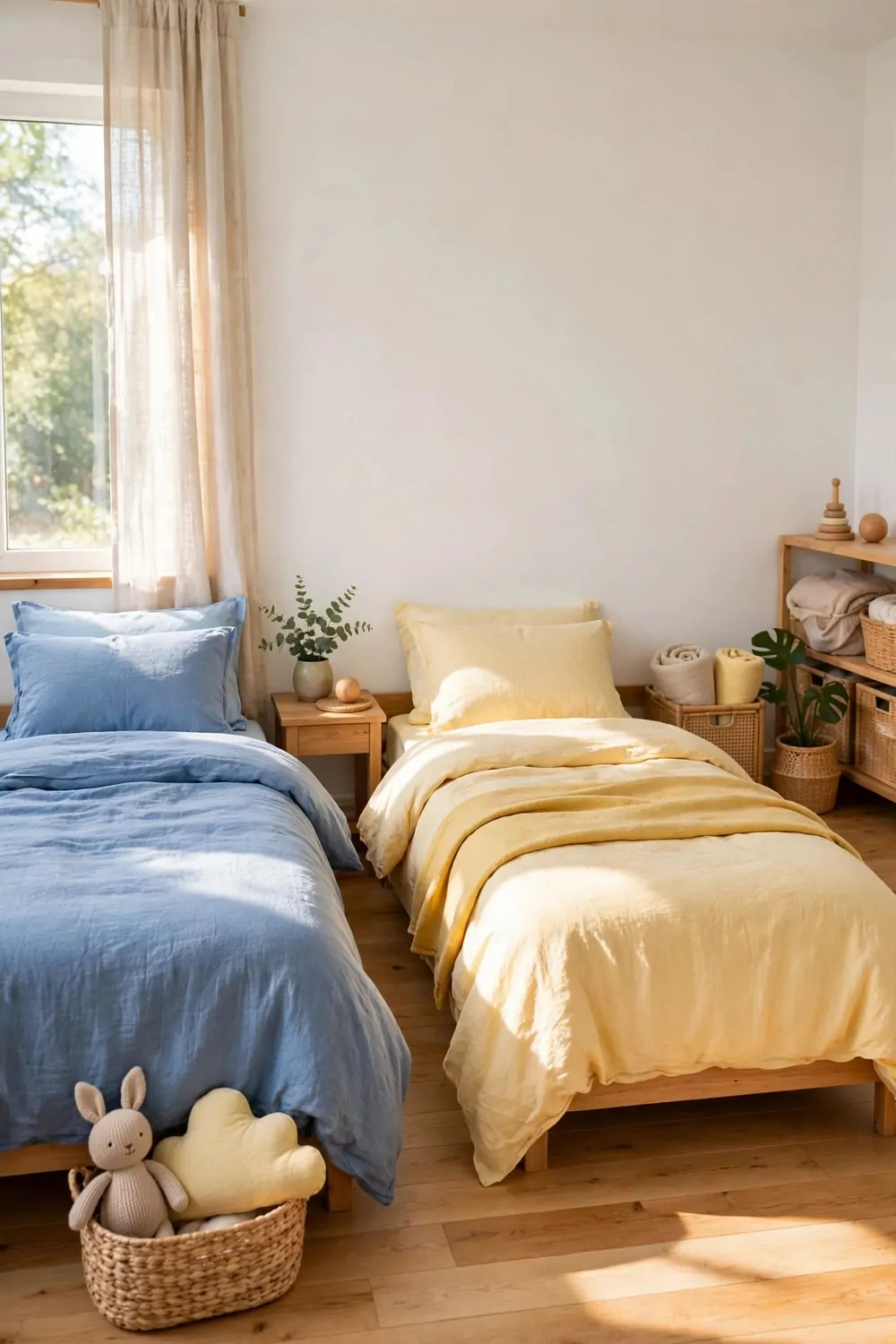
Matching bedding can make two beds look like a pair. It pulls the room together. It looks neat even when the room is messy.
Pick two colours that go well together. I like blue and white. You can also try green and cream.
Let each child pick one of the two colours. That way they both get a say. No one feels left out.
Keep the pattern simple. Stripes or dots work well. Busy patterns can make the room look loud.
You can use the same pillow covers for both beds. Then add one pillow in each child’s colour. It is a small touch that kids love.
Wash the bedding often. Kids spill things. Clean bedding makes the room smell fresh.
This is a cheap way to change the room. You do not need new beds. You just need new covers.
Try to buy the same brand for both beds. The colours will match better. The size will fit the same.
Matching bedding also helps in photos. The room looks calm and tidy. Your kids will feel proud of it.
5. A Divider Curtain Between the Beds
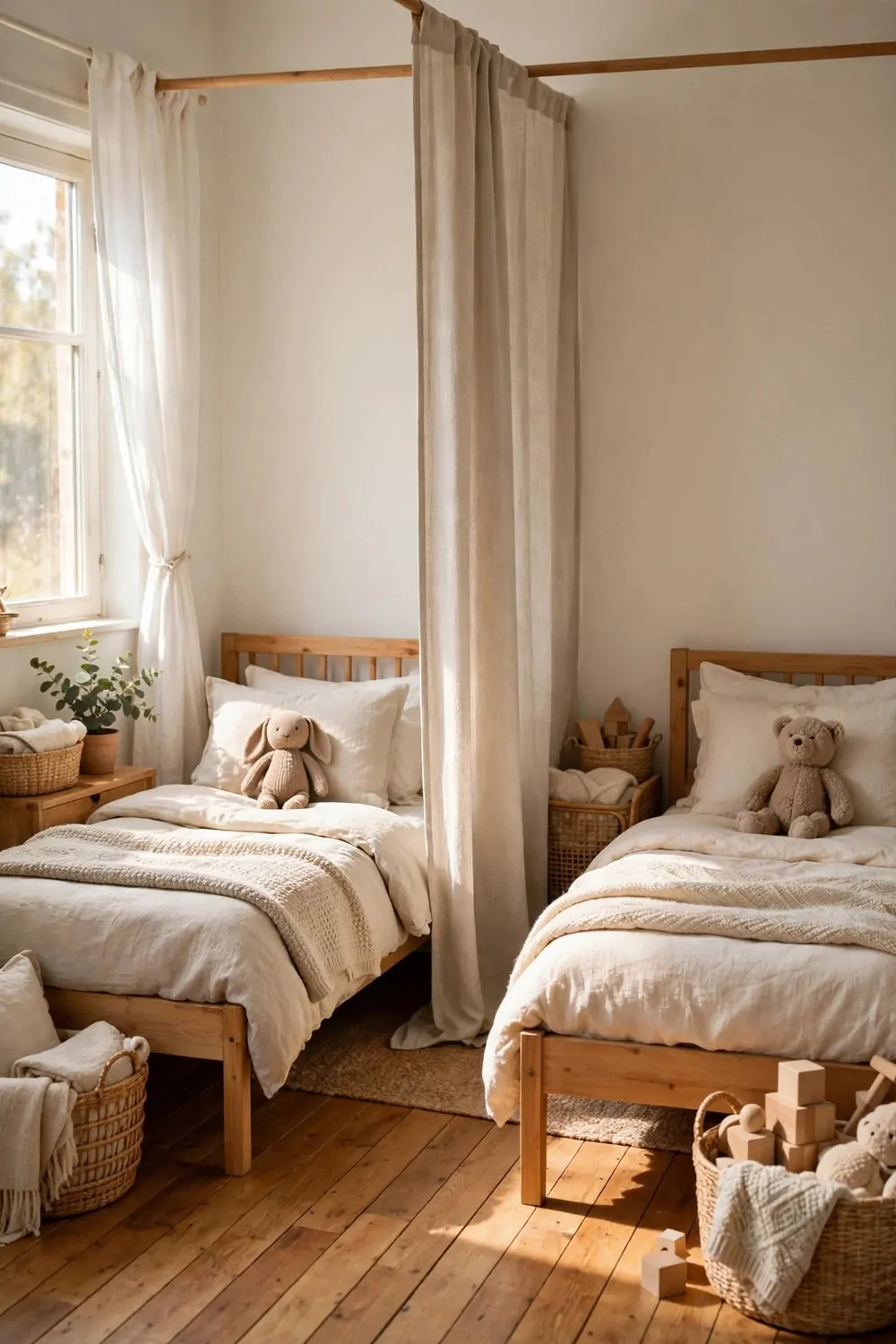
A divider curtain gives each child a little privacy. It hangs between the beds. It is not a wall, but it helps.
I hung a curtain rod from the ceiling. It took me less than one hour. The curtain slides open and closed.
Let each child pick their side of the curtain. One side can be blue. The other side can be green. It makes the split clear.
Pick a curtain that lets some light through. A very dark curtain can make the bed feel closed in. Light fabric is better.
Your kids can close the curtain when they want quiet time. They can open it when they want to talk. It gives them a choice.
Make sure the curtain is not too long. It should not touch the floor. Long fabric can trip little feet.
You can wash the curtain when it gets dusty. Pick a fabric that is easy to clean. Kids touch it a lot.
A curtain is cheaper than building a wall. It is also easy to take down. You can change it as your kids grow.
This idea works best in a room with two beds. It gives each child a small world of their own. It still keeps them close.
6. One Shared Bookshelf with Two Shelves
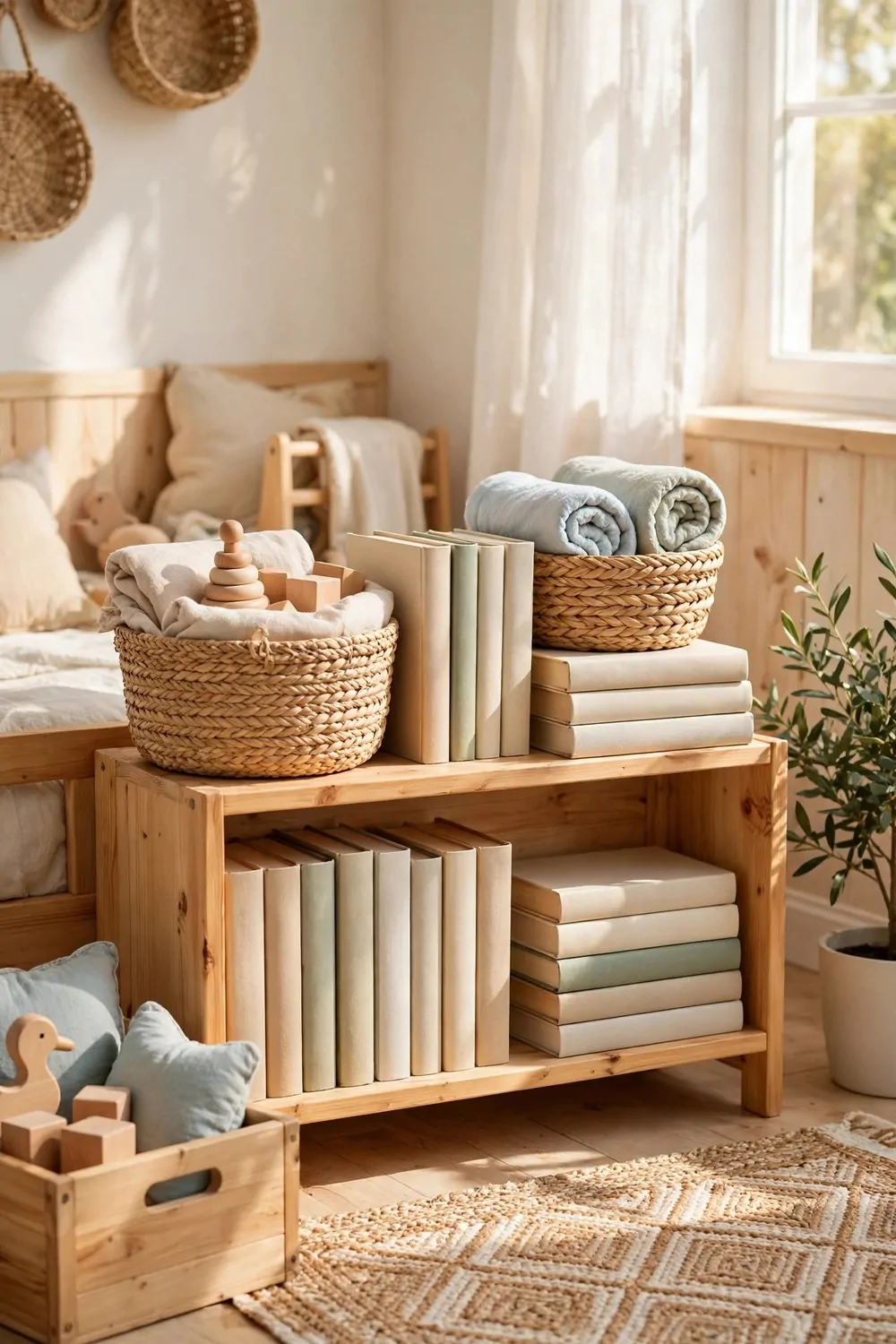
One shared bookshelf can hold books for both kids. Give each child one shelf. That keeps it fair.
Put the younger child’s books on the low shelf. They can reach them on their own. Put the older child’s books up higher.
I put a small label on each shelf. One label has my son’s name. The other has my daughter’s name. It stops most fights.
Keep the books facing out if you can. Kids pick books by the cover. It makes them want to read more.
Leave some space on each shelf. A full shelf looks messy. A little space makes it easy to put books back.
Add a small basket on the bottom shelf. It can hold small books and comics. It keeps them from falling over.
Place the bookshelf where both kids can reach it. Do not hide it in a corner. It should be easy to use every day.
Check the shelf often and clear old books. Kids grow fast. Their books should grow with them.
A shared bookshelf teaches kids to share. They learn to take care of books. They learn to put things back.
7. Two Small Nightstands, One Per Child
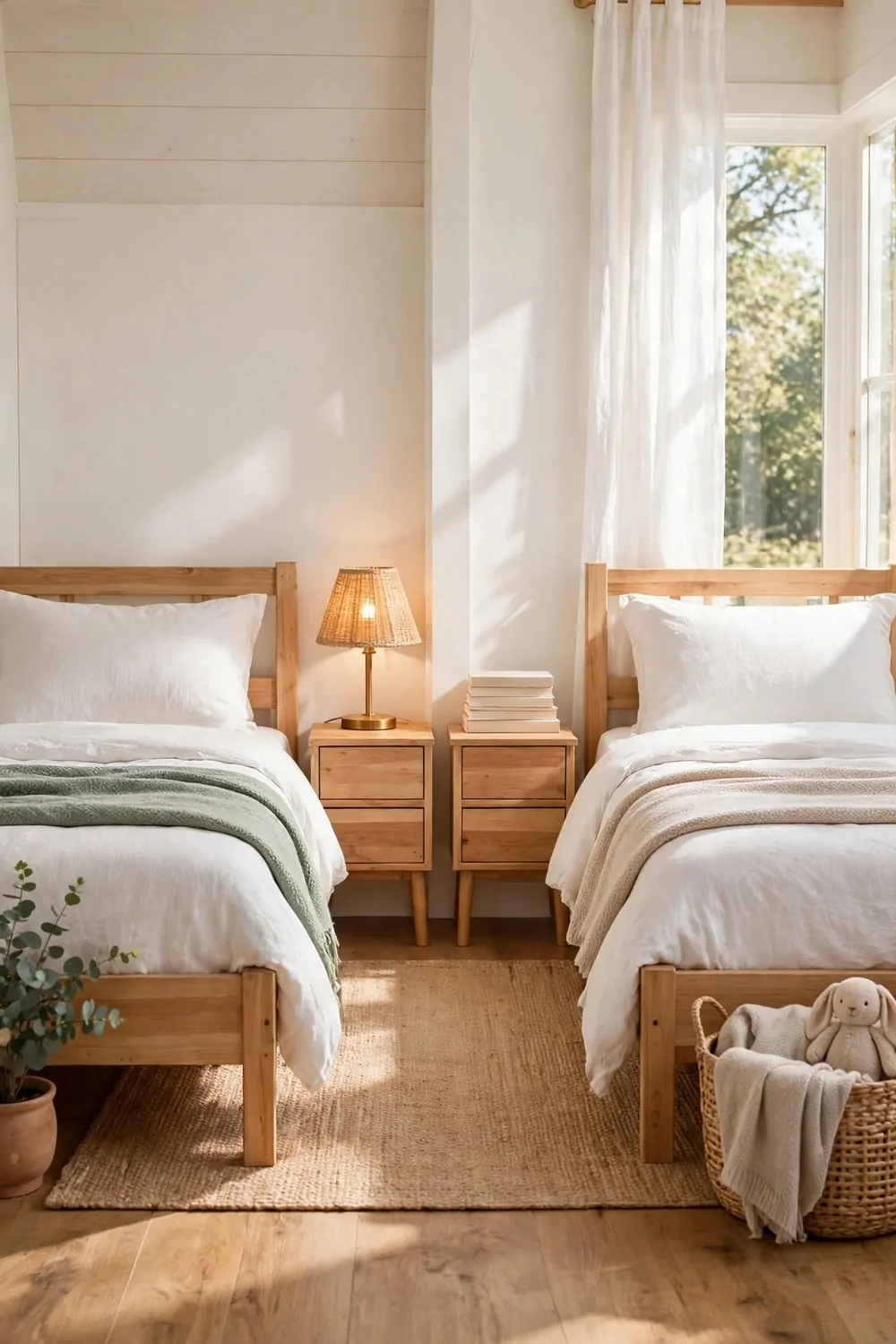
Two small nightstands give each child a spot by the bed. One per child is the rule. No one has to share.
Each nightstand can hold a lamp and a book. It can also hold a glass of water. That is all a child needs at night.
Keep the nightstands the same size if you can. Kids notice when one is bigger. Same size feels fair.
Let each child pick what goes in their drawer. One may keep crayons. The other may keep small toys. It is their space.
A nightstand with a drawer is best. It hides the mess. The top stays clear for a lamp.
Do not put too much on top. A lamp and one book is enough. Too much stuff falls off at night.
Place the nightstand close to the bed. Your child should reach it without getting up. That matters when they wake up at night.
You can find small nightstands at a low price. You do not need a big one. A small one fits a kids room better.
This small change makes bedtime easier. Each child has what they need. They do not need to call you for a book or water.
8. A Shared Closet Split Down the Middle
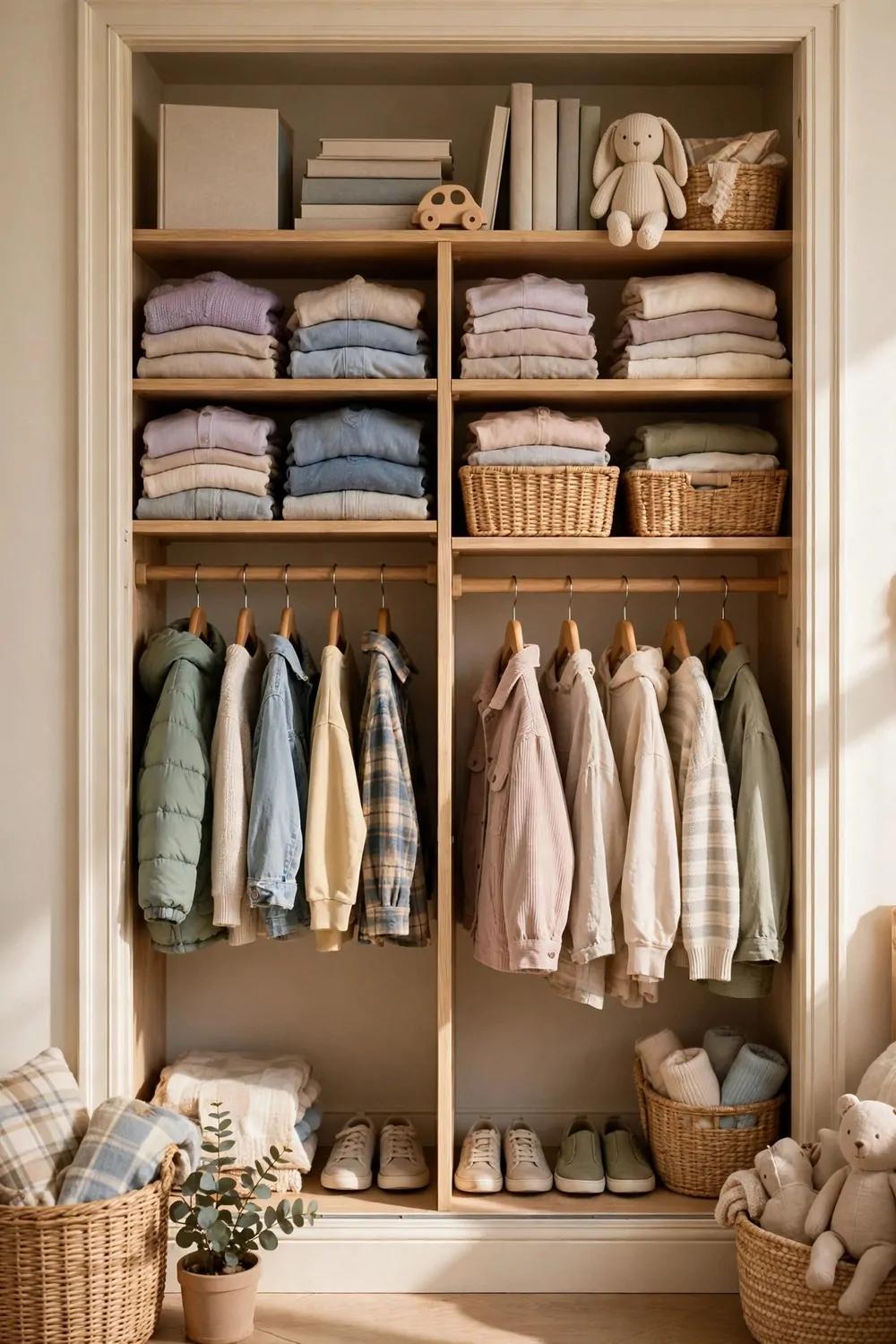
A shared closet works best when you split it down the middle. One side is for one child. The other side is for the other child.
Start with a middle divider shelf unit. It makes a clear line in the closet. A middle divider shelf unit has a typical cost of $80 to $200.
Give each child their own hanging rod. One rod on the left and one on the right. Two hanging rods, one per side, have a typical cost of $40 to $120.
Put low rods for the younger child. They can reach their own clothes. That helps them learn to dress on their own.
Add two sets of drawers inside the closet. One set for each child. Two sets of drawers inside have a typical cost of $120 to $300.
Use labelled bins on each side for socks and small things. It keeps the closet tidy. Labelled bins on each side have a typical cost of $30 to $80.
Put each child’s name on their side. A small sign works well. It stops them from mixing up clothes.
Clean the closet out every few months. Kids grow fast. Clothes that are too small should go to a new home.
A split closet saves a lot of morning time. Each child knows where their clothes are. They can get ready with less help.
| Closet Split Option | Typical cost |
|---|---|
| Middle divider shelf unit | $80 to $200 |
| Two hanging rods, one per side | $40 to $120 |
| Two sets of drawers inside | $120 to $300 |
| Labelled bins on each side | $30 to $80 |
9. Colour-Coded Storage Bins for Each Child
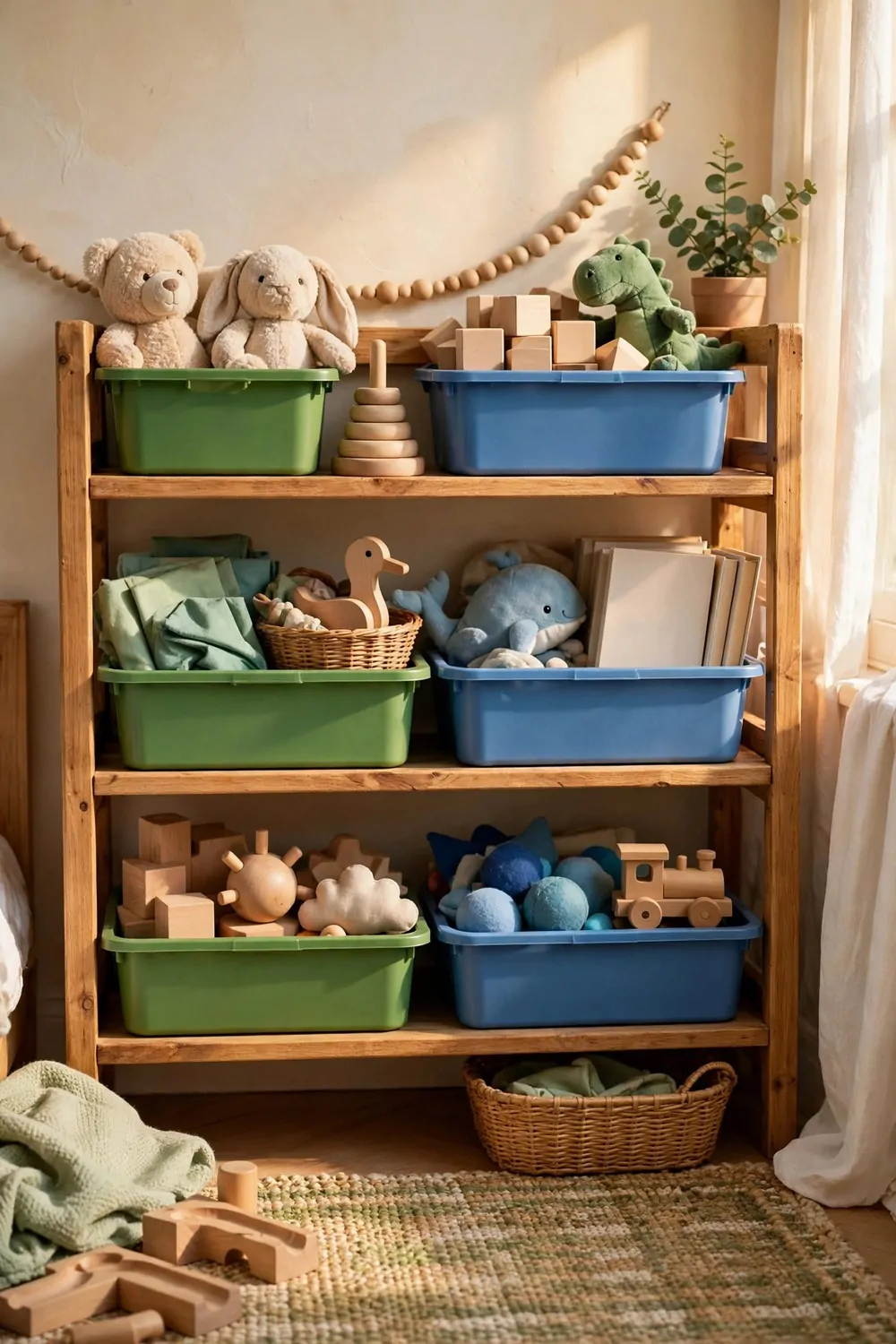
Colour-coded bins make clean up easy. Each child gets one colour. They know which bin is theirs.
I gave my son blue bins. I gave my daughter green bins. They never mix them up now. It is that simple.
Put the bins low where kids can reach them. High bins do not get used. Low bins get used every day.
Use one bin for toys and one for books. Do not mix them. It is easier to find things that way.
Put a picture label on each bin. Little kids can not read well yet. A picture of a toy tells them what goes inside.
Keep the bins the same size. It looks neat on a shelf. It also stops fights about who has the bigger bin.
Clean out the bins once a month. Take out broken toys. Give away toys they do not play with.
You can buy bins in many colours. Pick colours your kids like. They will use bins they picked themselves.
This idea works in any room. It is cheap and simple. It makes clean up a game, not a chore.
10. A Big Shared Rug in the Middle
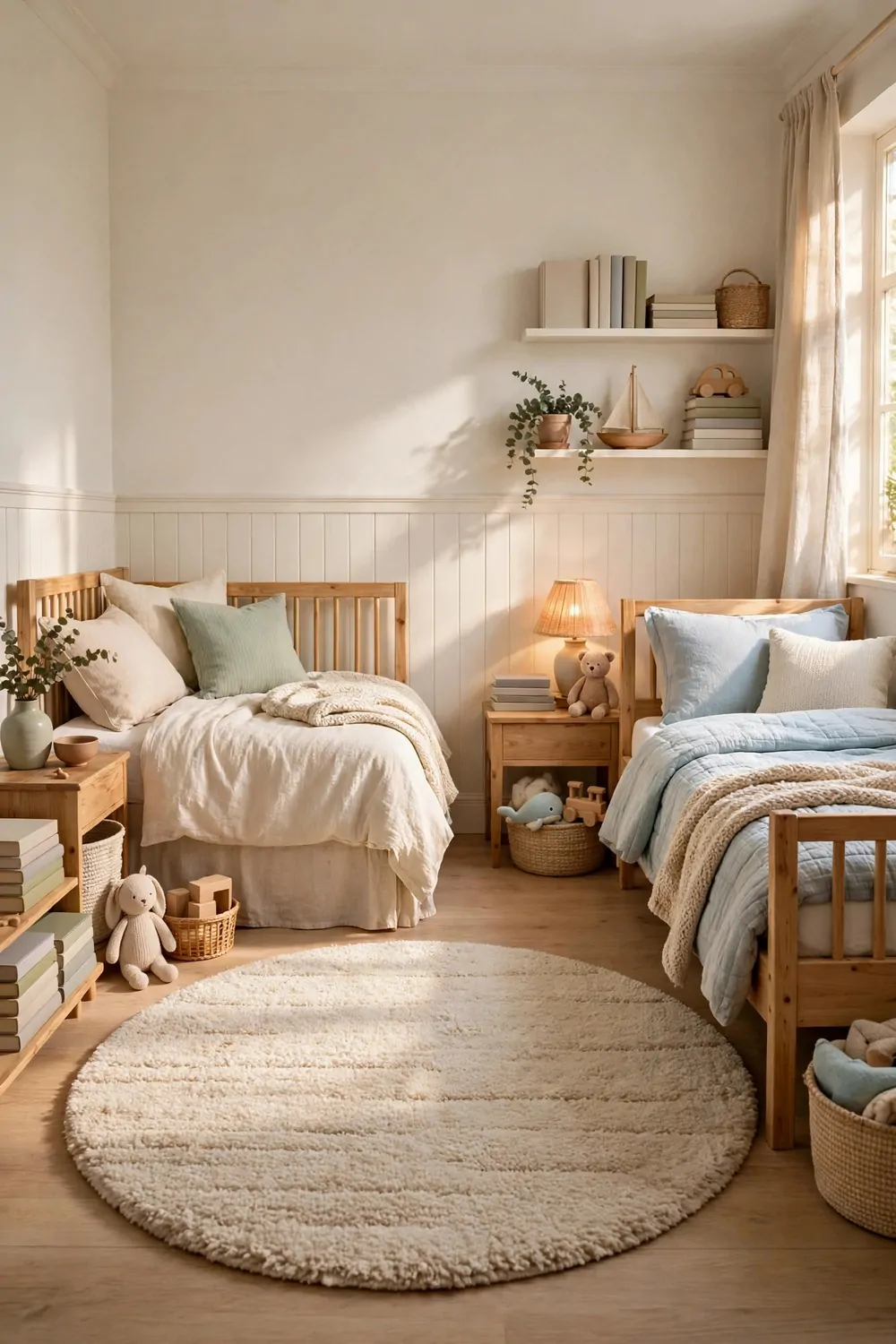
A big shared rug gives your kids a place to play. It sits in the middle of the room. Both kids can use it at the same time.
Pick a rug that is soft and thick. Kids sit on the floor a lot. A thin rug will not feel good.
Make sure the rug is big enough for two kids. It should fit toys and books too. A small rug will not work.
I like rugs with a simple pattern. A plain rug hides small stains better. A busy rug can look messy fast.
Put the rug where both beds can see it. That makes it the centre of the room. It becomes the play spot.
Clean the rug often. Shake it outside if you can. Vacuum it at least once a week.
A rug also makes the room feel warm. Cold floors are hard on bare feet. A rug fixes that fast.
Let your kids pick the colour with you. They will love a rug they helped pick. It makes the room feel like theirs.
A shared rug brings kids together. They play on it side by side. It is a simple way to share space.
11. Two Reading Lights, One Per Bed
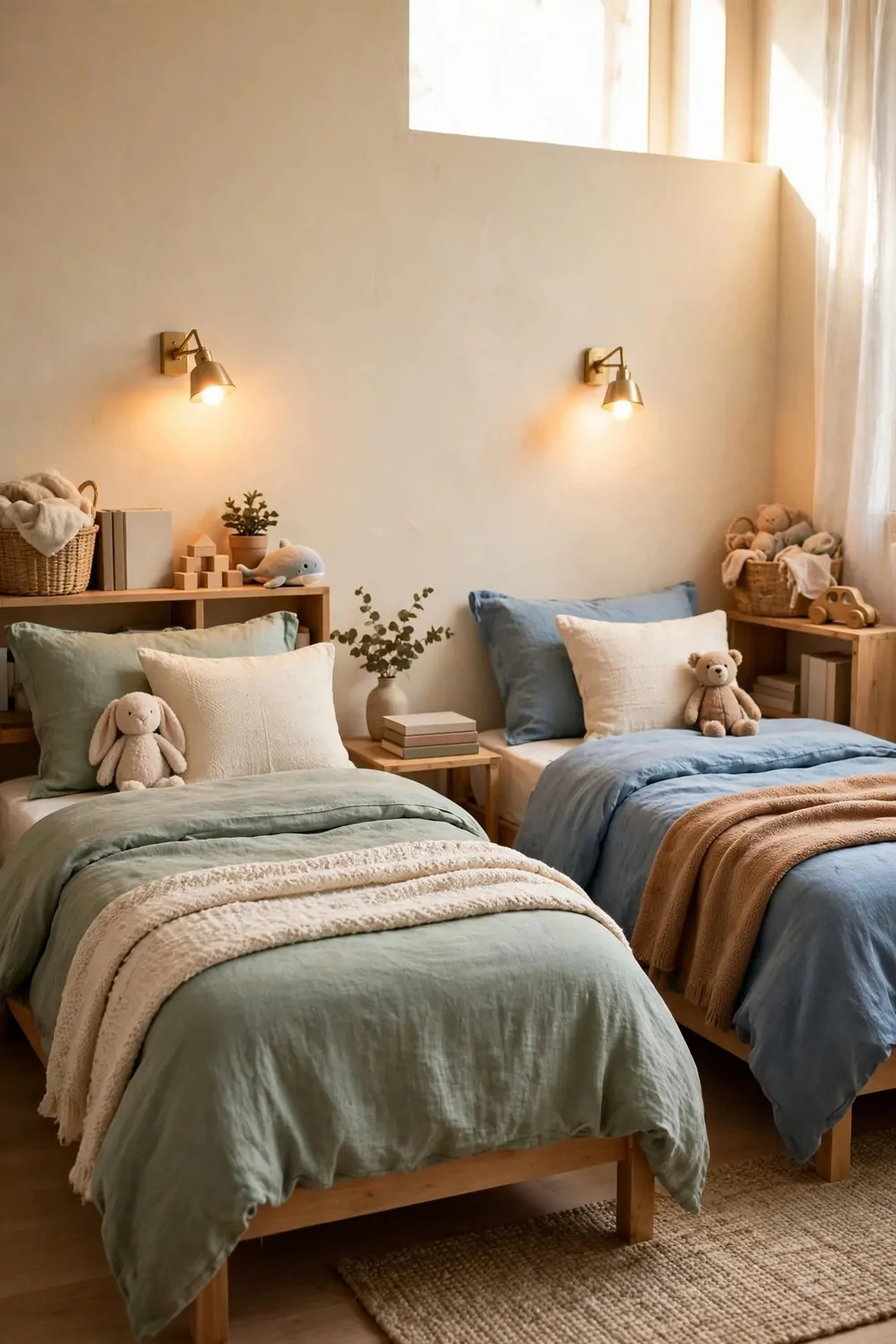
Two reading lights mean each child can read in bed. One light per bed is the rule. No one has to share a light.
A clip-on light works well for a bunk bed. It clips to the rail or the shelf. It stays out of the way.
A small lamp on the nightstand works well too. It gives soft light for reading. It also helps your child fall asleep.
Pick a light that is not too bright. Bright light can keep kids awake. Soft warm light is better at night.
Let each child turn their own light on and off. It gives them control. It also helps them learn bedtime habits.
Make sure the light is safe to touch. It should not get hot. Test it yourself before you give it to your child.
Keep the light close to the bed. Your child should not have to get up to reach it. That makes reading easy.
A reading light also helps with homework in bed. Some kids like to read school books at night. A good light helps them see.
This is a small and cheap idea. It makes a big change at bedtime. Each child gets their own quiet reading time.
12. A Shared Homework Desk for Two
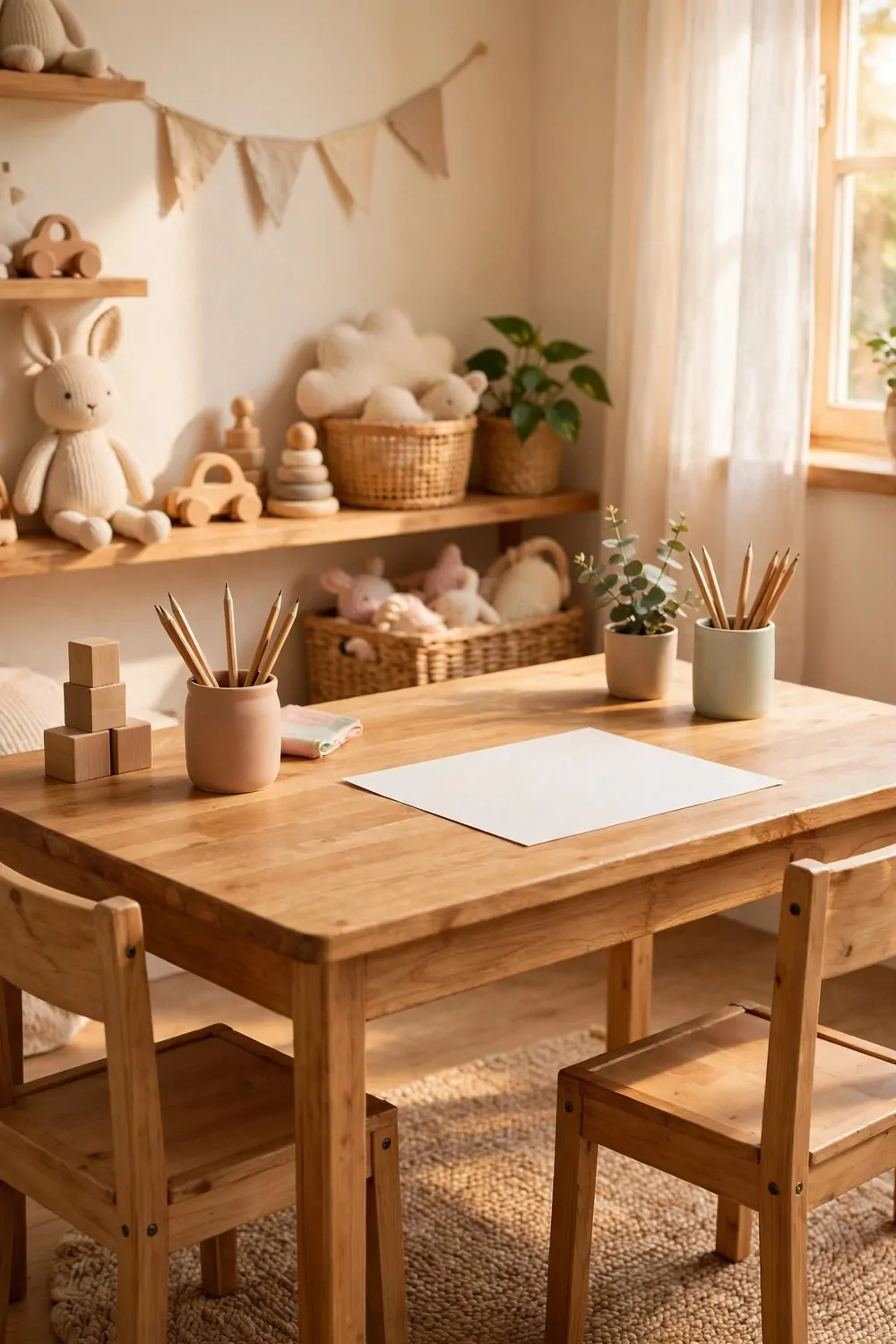
A shared homework desk for two lets both kids work at once. It needs to be long enough for two chairs. It should not feel cramped.
Put the desk near a window if you can. Good light helps kids focus. It also makes the desk feel nice.
Give each child one side of the desk. Mark the middle with a small tray. That keeps their stuff apart.
Each child needs their own chair. Pick chairs that fit their height. Feet should touch the floor.
Keep school supplies in small cups on the desk. One cup for pens and one for pencils. It stops things from rolling away.
Put a shelf above the desk for books. It keeps the desk top clear. Kids can reach their books fast.
Make a simple rule for desk time. Quiet voices only. No toys on the desk during homework.
Clean the desk each night. A clear desk is ready for the next day. It takes only two minutes.
A shared desk teaches kids to work side by side. They can help each other. They learn to focus even when someone is near.
13. Personal Wall Space for Each Child
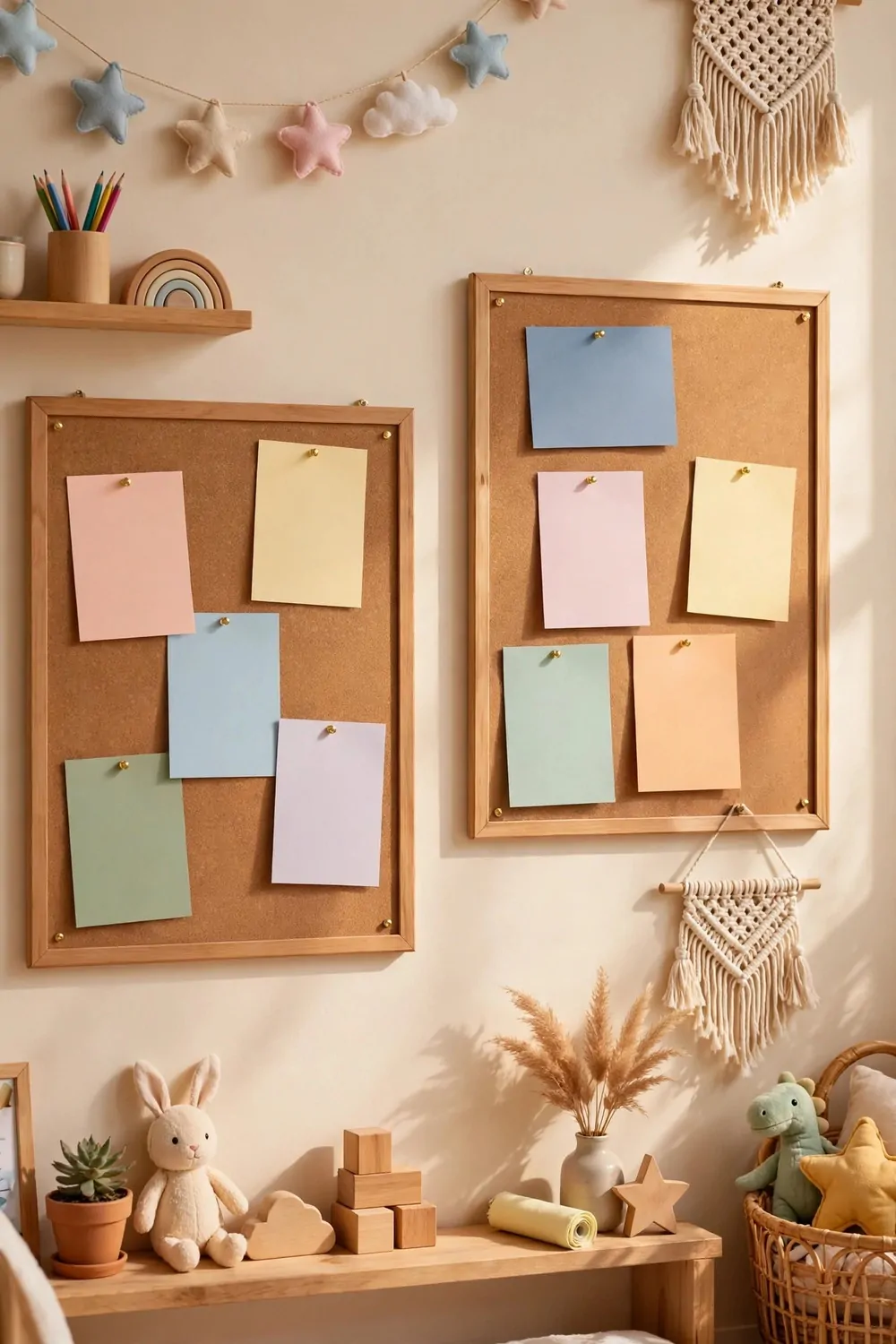
Personal wall space gives each child a spot to show their work. One wall area per child is fair. It makes them feel proud.
Pick a spot near each child’s bed. It should be easy for them to reach. They can pin up art on their own.
Use a cork board or a simple frame. It keeps the wall clean. It also makes it easy to change the art.
Let each child pick what goes on their wall. One may pick drawings. The other may pick photos of family trips.
Do not mix their wall spaces. Keep them apart. Each child should know which space is theirs.
Change the art often. Take down old drawings. Put up new ones. It keeps the wall fresh and fun.
Keep the wall space small. A big wall can feel empty. A small board is easy to fill.
This idea costs very little. A board and some pins are enough. It makes a big change in how the room feels.
Personal wall space tells your child they matter. Their work has a place. Their room shows who they are.
14. A Trundle Bed for Sleepovers
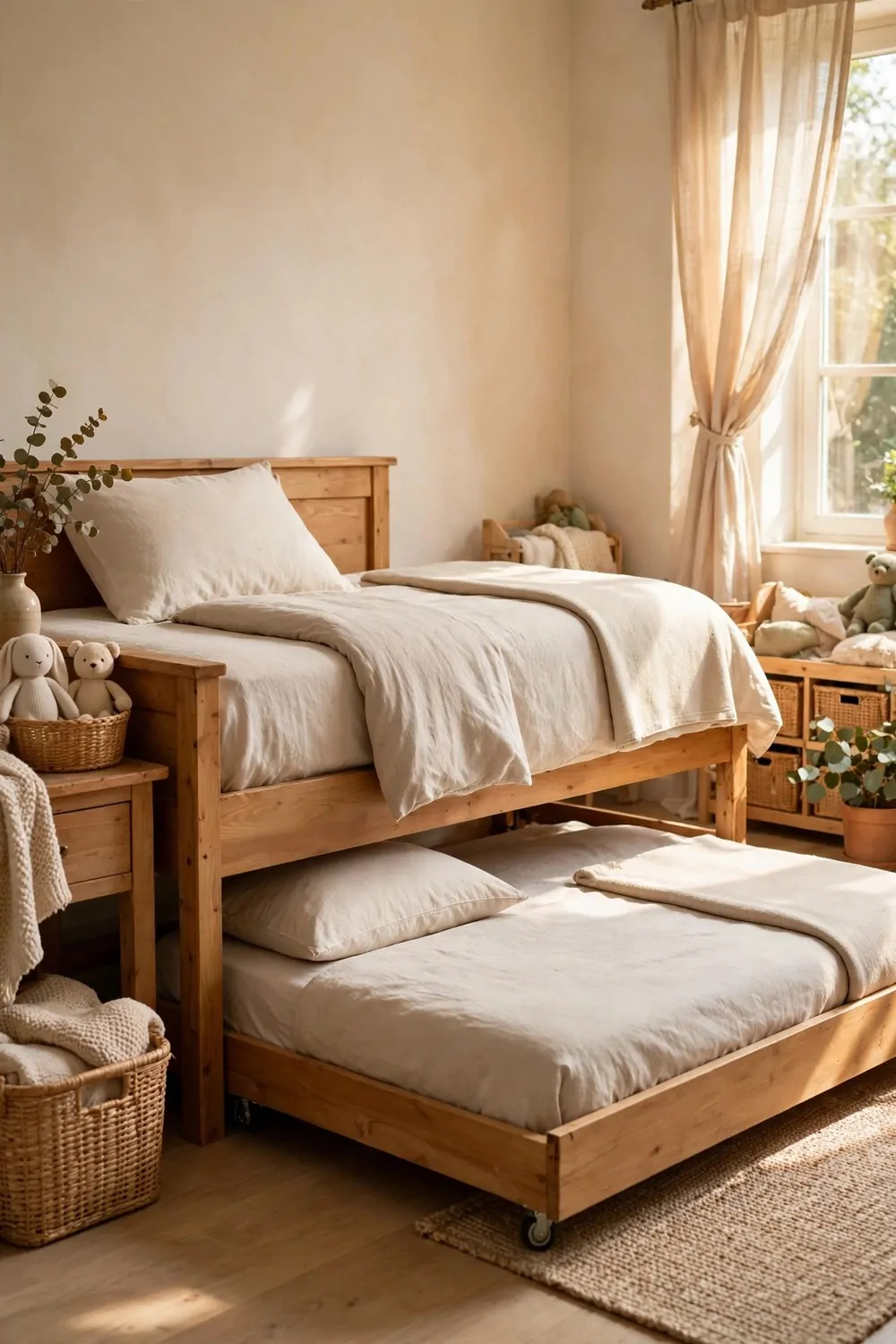
I love a trundle bed in a shared room. It hides a second bed right under the first one.
You pull it out at night. You push it back in the morning.
Your kids get extra sleep space without a second big bed taking up the floor all day.
Sleepovers get so much easier with a trundle. A friend can stay over and still have a real bed.
I like to keep clean sheets and a spare pillow in the trundle drawer or in a basket close by. Then you are ready in two minutes.
Let each child pick their own bedding for their bed. It makes the shared room feel fair.
A trundle works best on a hard floor or a flat rug. Thick rugs can make it hard to pull out.
Check the size before you buy one. Measure the space under the bed and the space in front of it.
If your room is small, a trundle is one of the best buys you can make. It gives you two beds in the space of one.
15. Matching Toy Baskets in Two Colours
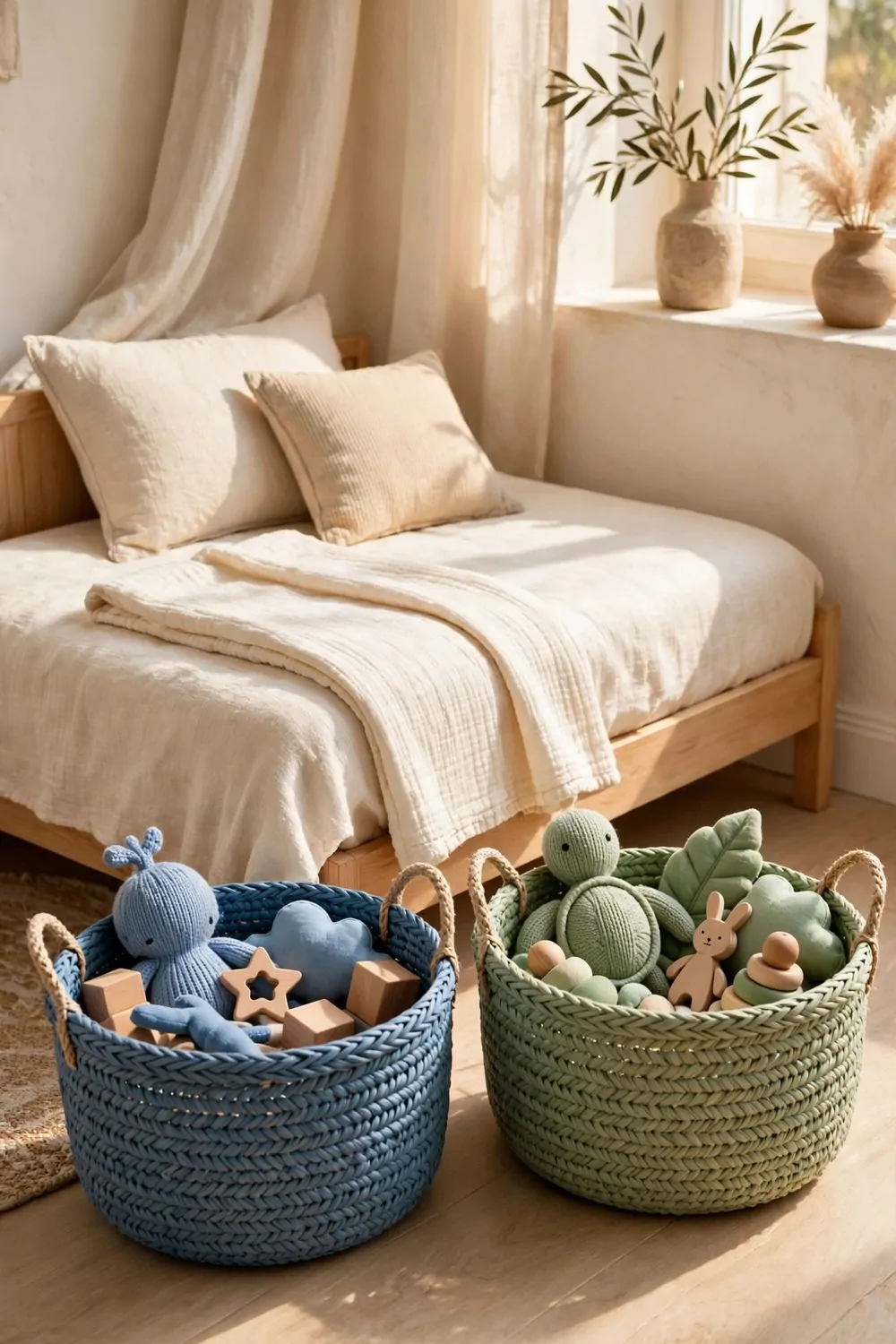
Matching toy baskets sound small. But they change a shared room a lot.
I use two baskets in two colours. One colour for each child.
Your kids always know which basket is theirs. That stops a lot of little fights.
Pick baskets that are strong and easy to carry. Soft fabric ones work well for small kids.
Put a name tag on each basket if your kids are still learning colours. A simple label helps a lot.
Keep the baskets on the floor or on a low shelf. Kids will not tidy up if the basket is too high.
I like to sort toys by type too. Blocks in one basket and soft toys in the other can work if that fits your kids better.
Wash fabric baskets now and then. They pick up dust fast in a kids room.
Two matching baskets look tidy even when the room is not perfect. And that is a win in my book.
16. A Shared Dresser with Labelled Drawers
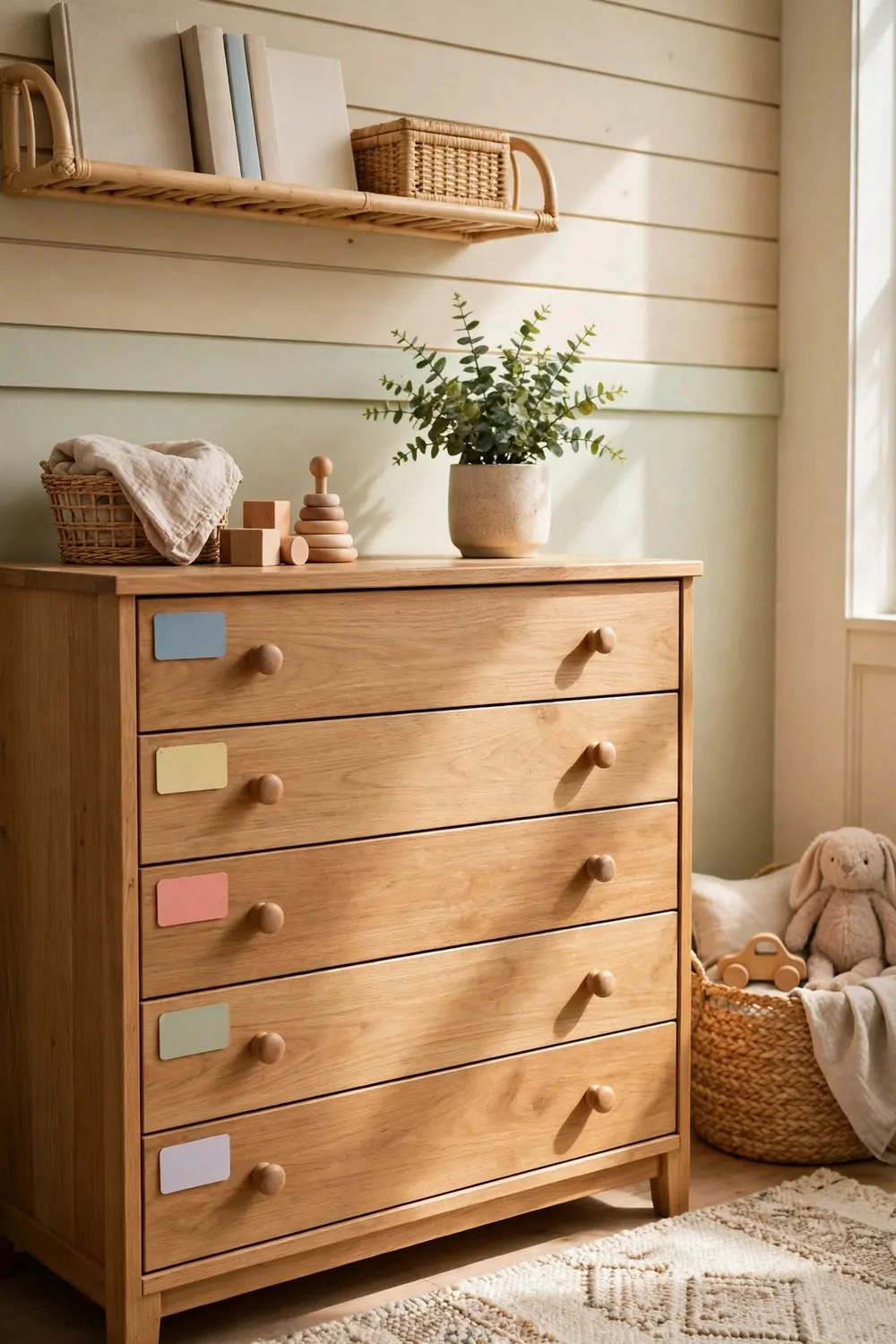
A shared dresser can work well if you plan it right. The trick is labels.
I give each child their own drawers. Top two for one child and bottom two for the other, for example.
Label each drawer with words or pictures. Pictures help a lot if your kids cannot read yet.
You can use small chalk labels or sticky labels. Both are cheap and easy to change.
Keep everyday clothes in the top drawers. Keep spare clothes and out of season stuff lower down or higher up.
Let your kids help pick what goes where. They are more likely to put things back if they helped decide.
A dresser with wide drawers is better than one with narrow drawers. Clothes fit better and you can see them all.
I fold shirts in small rolls so I can see each one. It takes a bit longer but mornings go faster.
A labelled dresser teaches your kids to look after their own things. And it saves you time every single day.
17. A Bunk Bed with a Curtain for Privacy
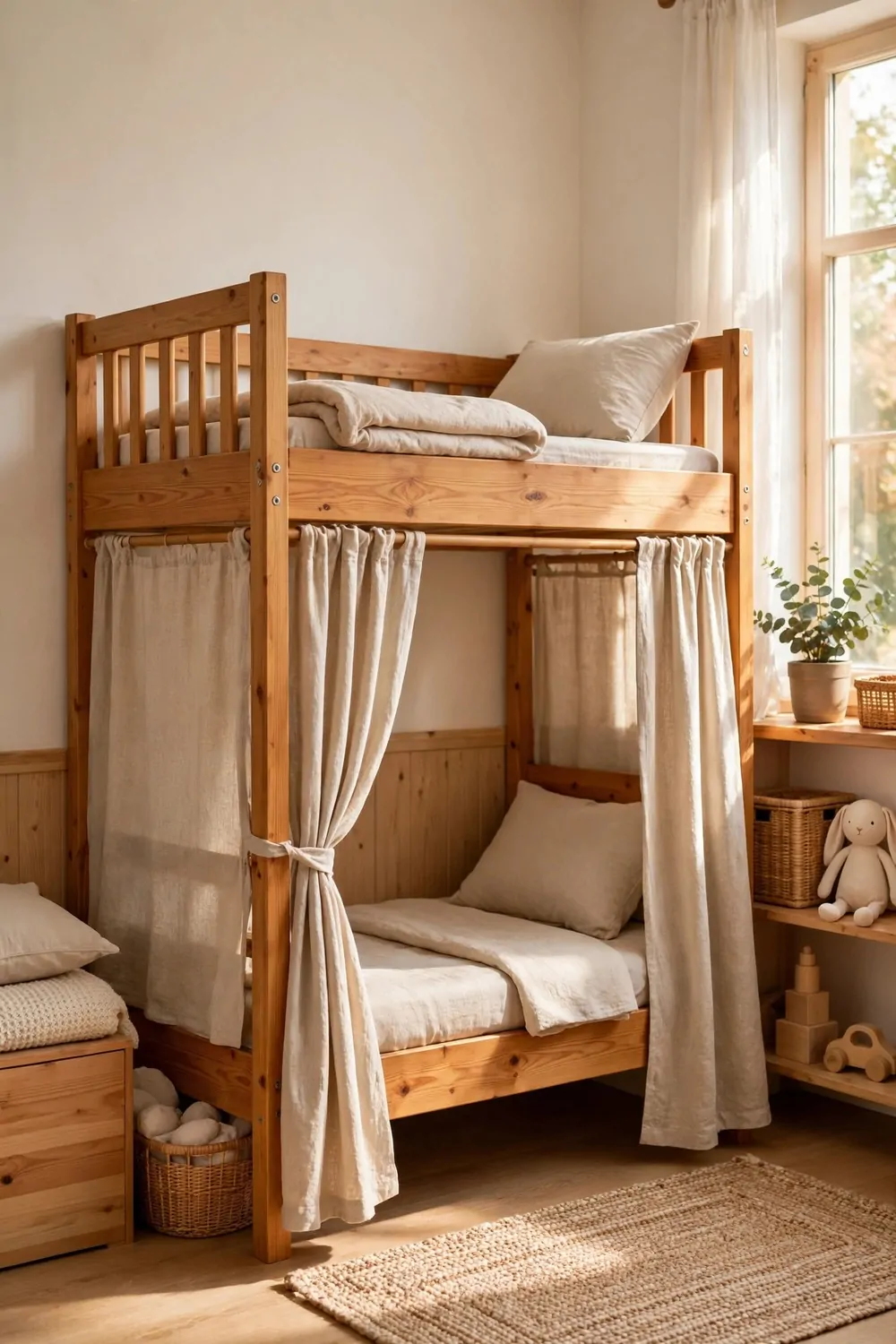
A bunk bed saves so much floor space. But sometimes kids want a bit of time alone.
A simple curtain on the bunk bed gives them that. It is a small change with a big feel.
You can hang a curtain rod on the side of the bed. Or you can use a tension rod if you do not want to drill holes.
Let each child pick their own curtain colour or pattern. It makes their bunk feel like their own little room.
I like light fabric for bunk curtains. Heavy fabric can make the bed feel dark and stuffy.
Make sure the curtain does not block the ladder. Your kids need to climb in and out safely.
Tie the curtain back in the day if you want more light in the room. It takes two seconds.
A curtain also helps at bedtime. It blocks a bit of light and helps your child settle down.
If your kids share a bunk, try the curtain for a week. Most kids love it and ask to keep it.
18. Two Small Chairs and a Table for Play
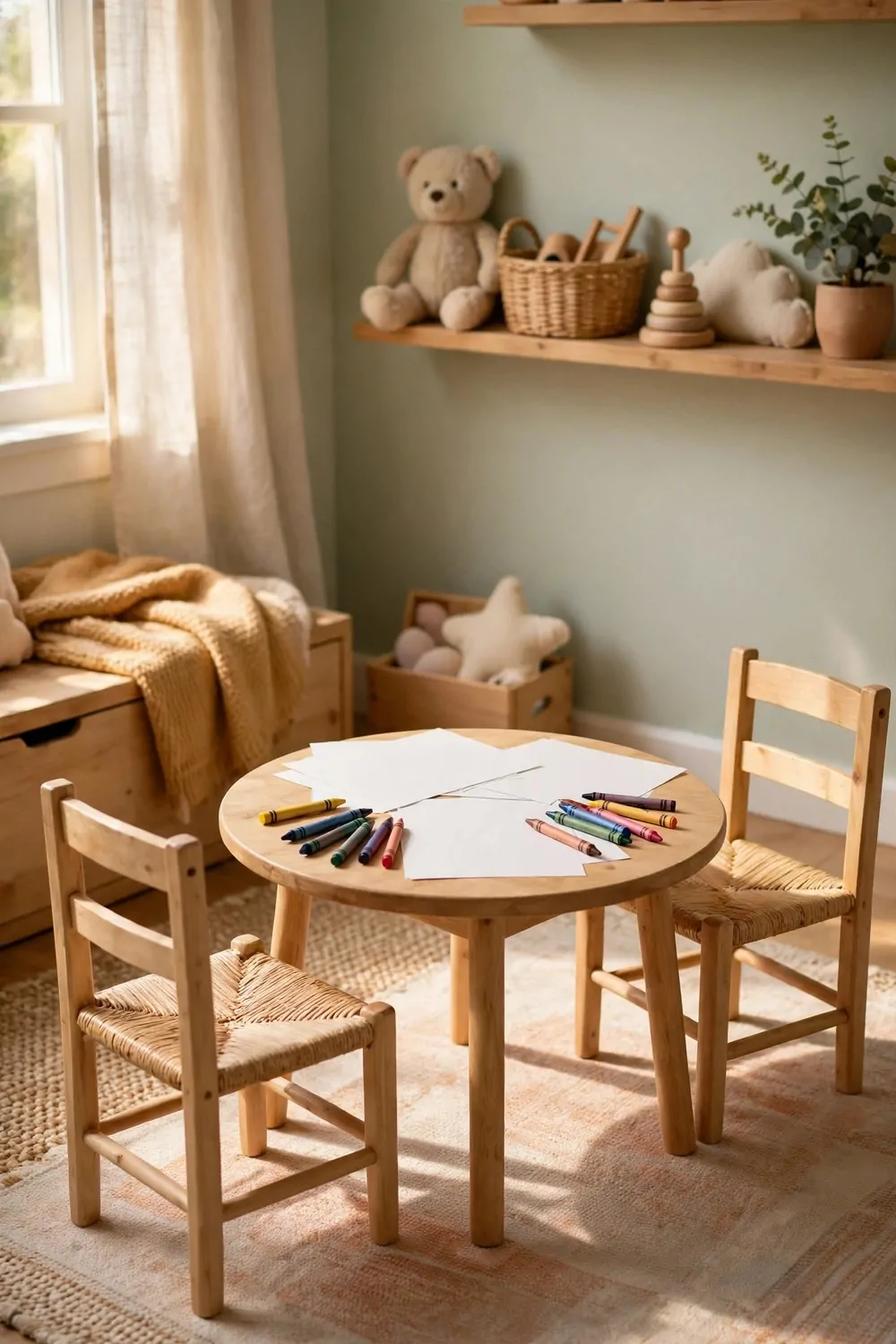
Two small chairs and a table give your kids a place of their own. They can draw, build, and play without using your big table.
I like a table that fits both kids at once. It should be low enough for their feet to touch the floor.
A small wooden set is a solid choice. Typical cost is $40 to $90 for a table and two chairs.
A plastic set is light and easy to wipe clean. Typical cost is $25 to $70 for a table and two chairs.
A foldable set is handy if your room is small. You can fold it away when play time is done, and typical cost is $60 to $120 for a table and two chairs.
| Set type | Good for | Typical cost |
|---|---|---|
| Small wooden table and two chairs | Everyday drawing and play | $40 to $90 |
| Plastic table and two chairs | Easy cleaning and outdoor use | $25 to $70 |
| Foldable table and two chairs | Small rooms and saving space | $60 to $120 |
Put the table near a window if you can. Natural light makes drawing and reading much nicer.
Keep a small box of pencils, paper, and crayons on the table. Your kids will use it more if the supplies are right there.
Pick chairs that are strong and do not tip over easy. Test them yourself before your kids use them.
A little table in a shared room gives each child their own spot to sit. And it keeps the mess in one place too.
19. A Growth Chart on the Wall for Both Kids
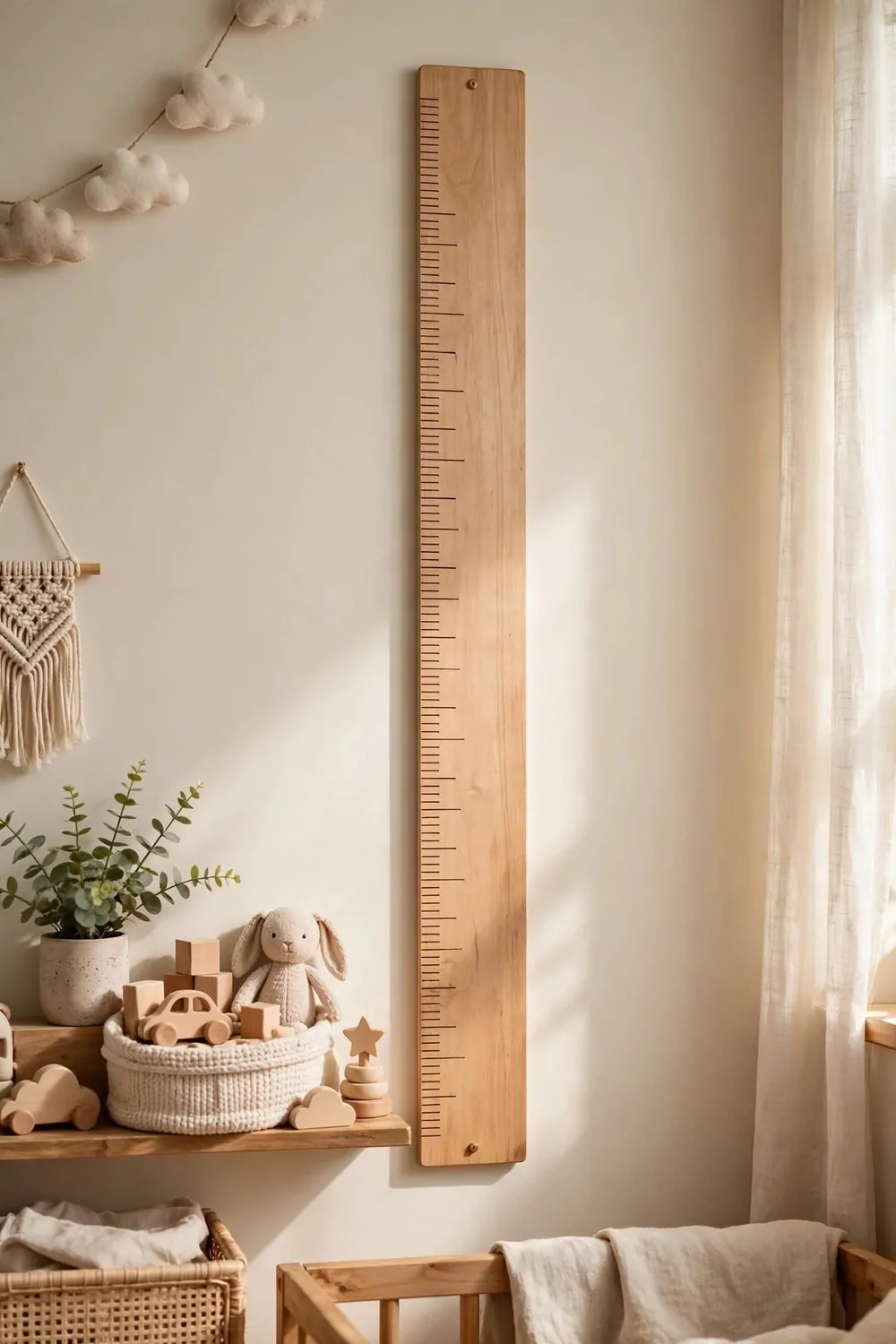
A growth chart on the wall is such a fun idea. Your kids can watch themselves grow up right there in their room.
I use one chart for both kids. Each child gets their own colour pen to mark their height.
Mark the height on the same day each month. Or just do it on birthdays if that is easier for you.
Write the date next to each mark. Your kids will love looking back at how small they were.
Put the chart at a spot both kids can reach. Low on the wall near the door works well.
You can buy a wooden ruler chart or a sticker chart. Both are easy to put up.
Let your kids stand straight against the wall when you measure them. Feet flat and head up.
A shared chart can turn into a fun little contest. Just keep it kind and remind them that everyone grows at their own speed.
I love how a growth chart makes a shared room feel personal. It is their story on the wall.
20. Shared Wall Art with Two Frames
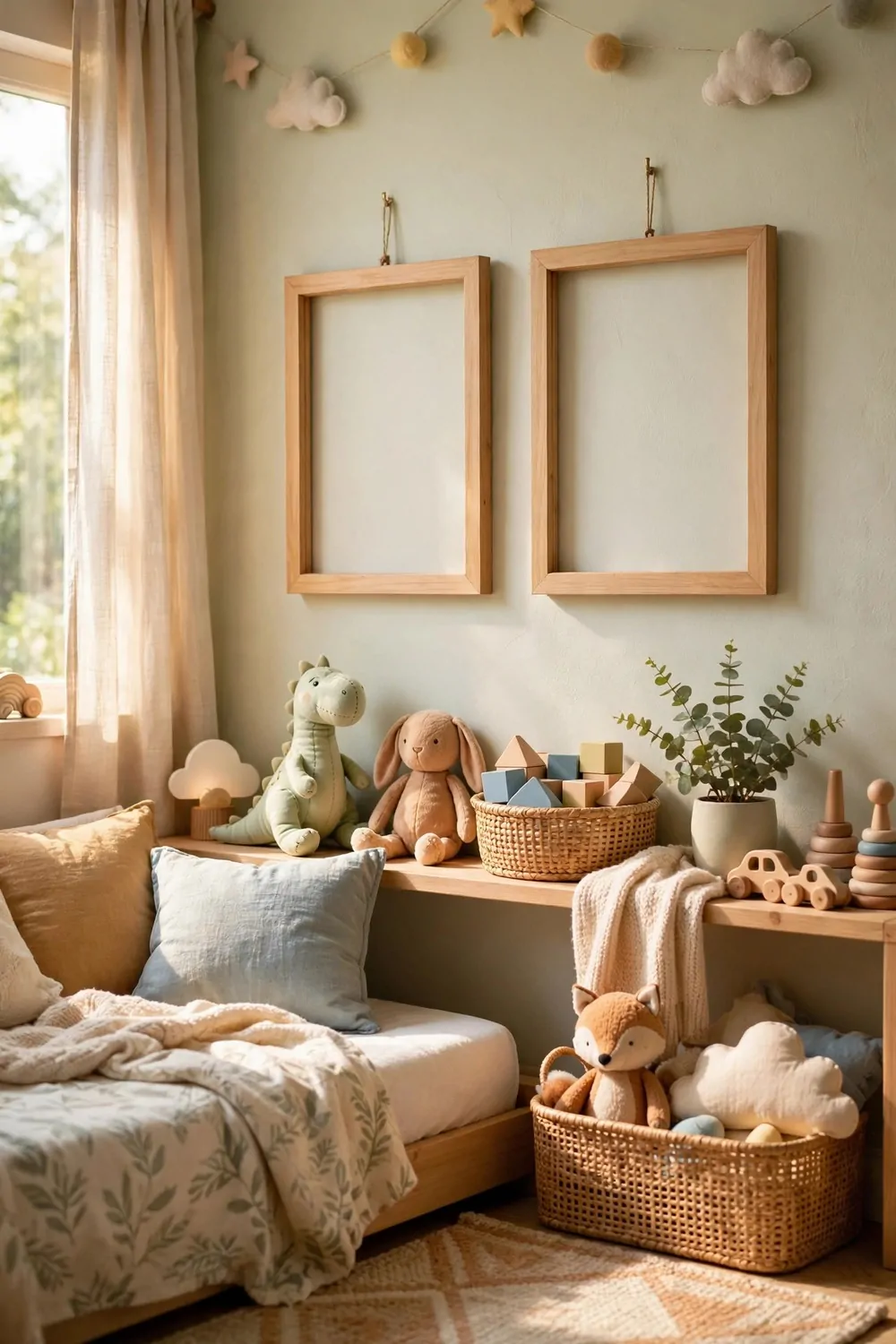
Two frames on the wall can tie a shared room together. One frame for each child.
I like to use the same size frames for both kids. It looks neat and fair.
Let each child pick what goes in their frame. A drawing, a photo, or a picture they love.
Hang the frames side by side at the same height. That small detail makes the wall look planned.
You can swap the art now and then. Kids change their minds a lot, and new art keeps the room fresh.
Use frames with glass or clear plastic fronts. They keep the art clean and safe from little hands.
Put the frames where both kids can see them from their beds. It makes the room feel like theirs.
If your kids made the art themselves, even better. They feel so proud when their work is on the wall.
Two frames cost very little but they add a lot of heart to a room. Try it this weekend.
21. A Bedtime Routine Chart on the Wall
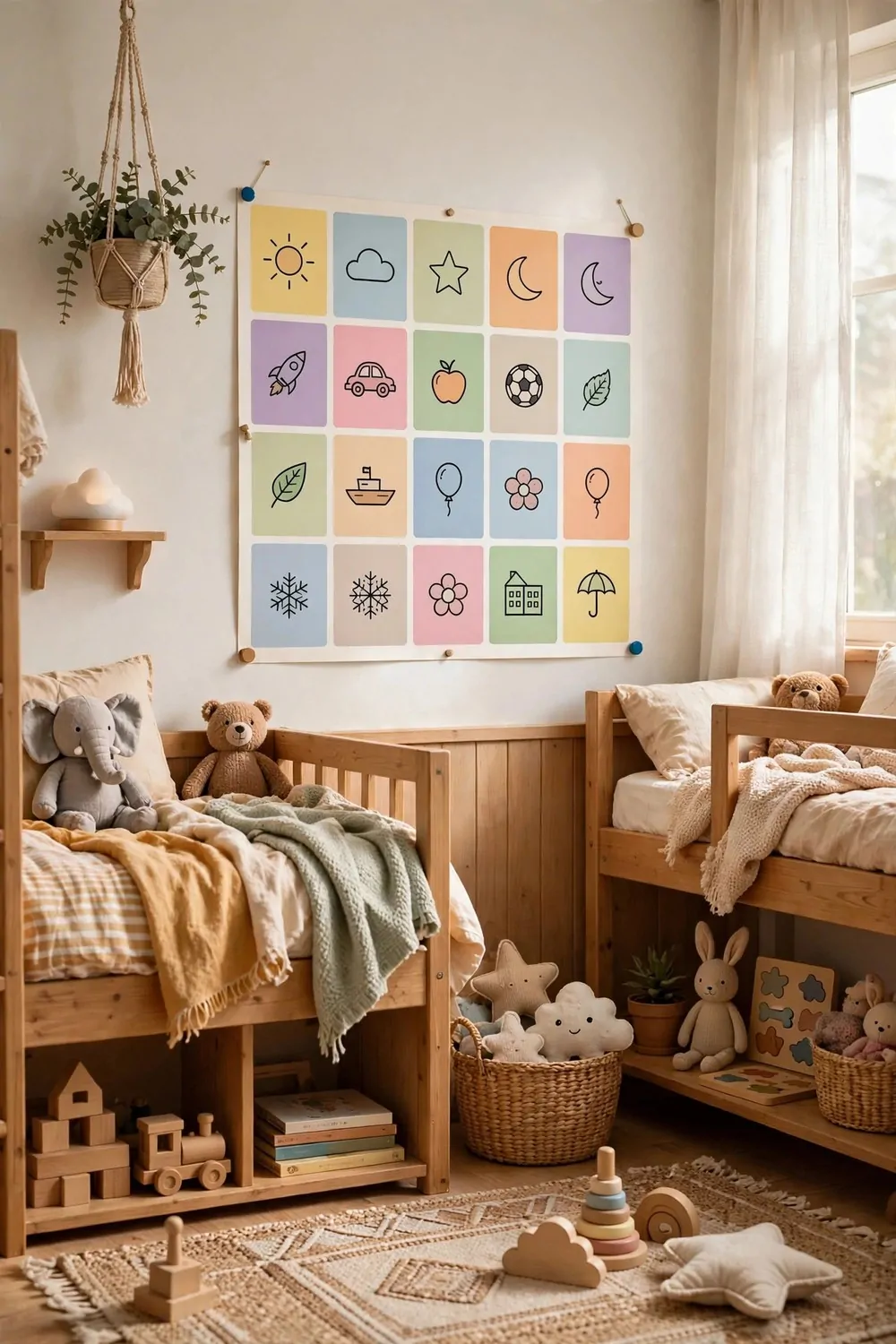
A bedtime routine chart helps a lot in a shared room. Kids know what comes next without you telling them ten times.
I put pictures for each step on the chart. Bath, brush teeth, pyjamas, story, lights out.
Put the chart at your kids eye level. They need to see it and point at each step.
Let your kids tick off each step as they do it. A small tick or a star sticker works well.
Keep the steps the same every night. Kids feel safe when bedtime looks the same each day.
You can make the chart with paper and markers. It does not need to be fancy to work.
A routine chart also stops bedtime talks going on too long. The chart says story time is done, not you.
If one child finishes early, they can read quietly while the other finishes. That keeps the room calm.
I think a bedtime chart is one of the easiest wins for a shared room. Try it for a week and see how bedtime feels.
22. Two Laundry Hampers, One Per Child
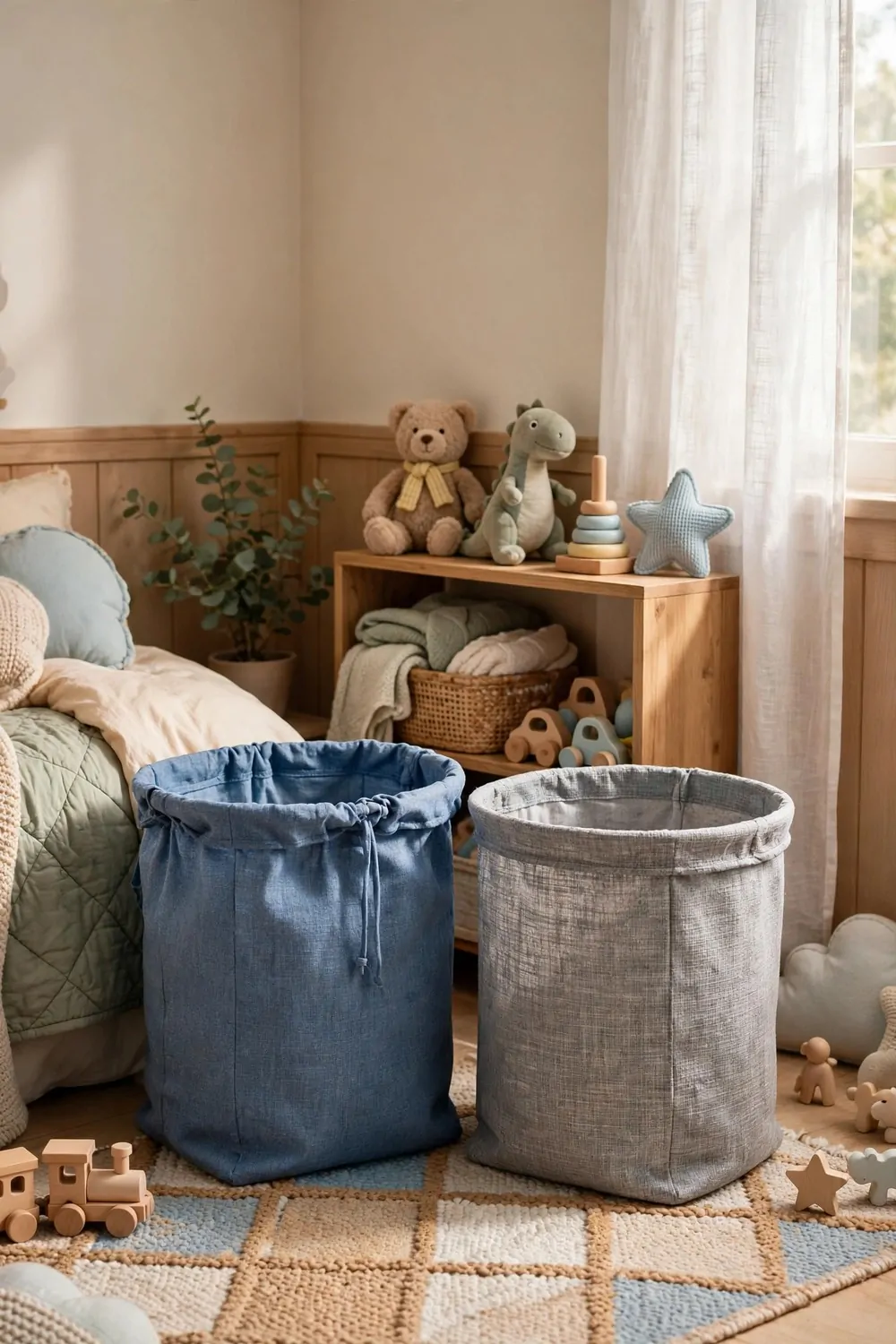
Two laundry hampers sounds like a small thing. But it saves you a lot of sorting later.
I give each child their own hamper. One per child, right in their room.
Label each hamper with a name or a colour. Your kids will learn fast which one is theirs.
Put the hampers where your kids get changed. Near the dresser or near the bed works well.
Teach your kids to put dirty clothes straight in the hamper. It takes a week or two but it sticks.
Pick hampers that are light enough for kids to carry. You do not want a heavy basket they cannot lift.
I wash one hamper at a time so I know whose clothes are whose. It makes folding much faster.
A hamper with a lid keeps smells in and the room looking tidy. Open baskets are fine too if you wash often.
Two hampers, one per child, is a simple system. And simple systems are the ones that last.
23. A Shared Toy Shelf at Kid Height
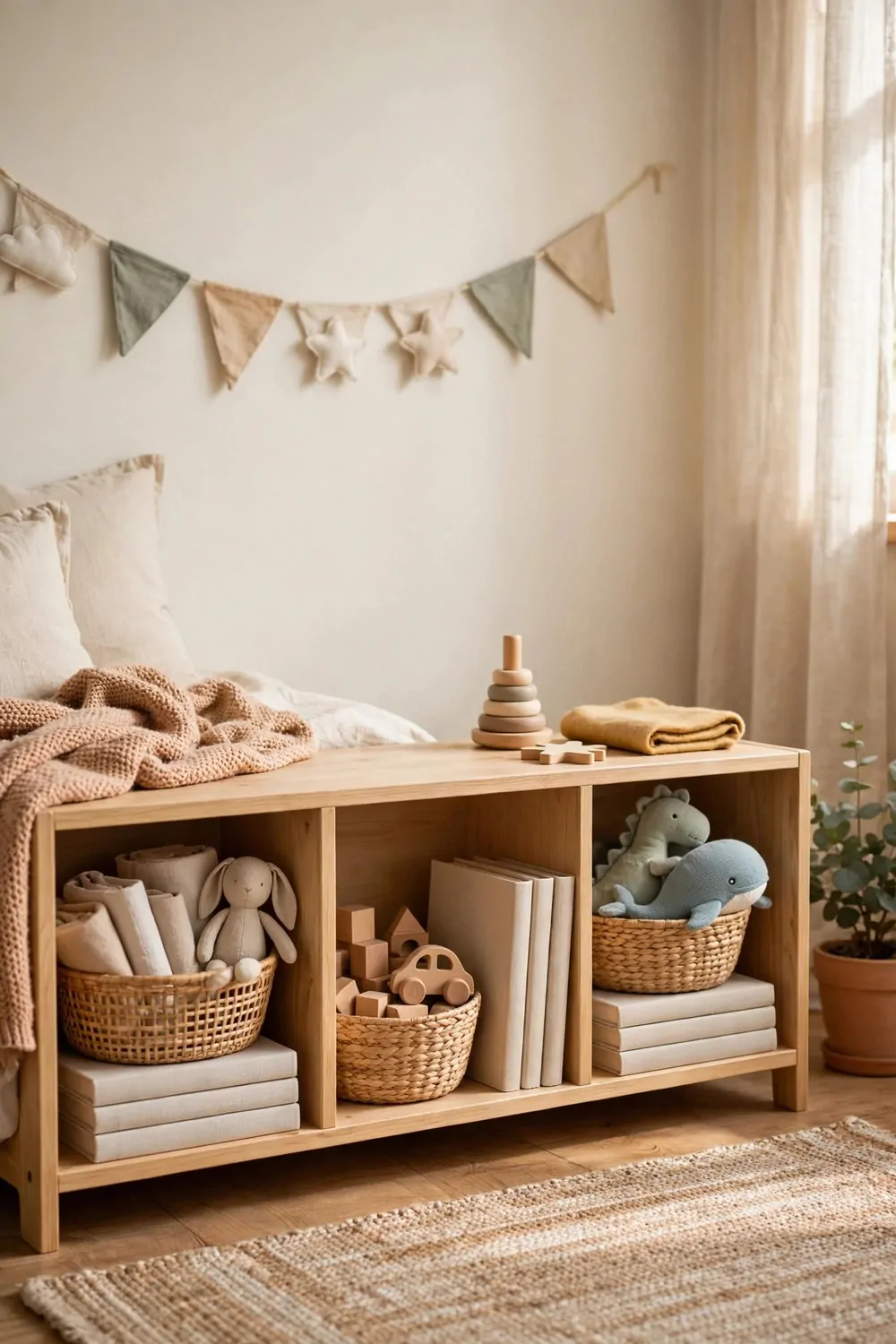
A toy shelf at kid height is a must in a shared room. If kids cannot reach it, they will not use it.
I like a low shelf with open boxes or baskets. Your kids can see their toys and grab what they want.
Keep the toys they use most on the middle shelf. Keep the ones they use less on the top shelf.
Do not fill every inch of the shelf. A bit of empty space makes it easier to put toys back.
Let each child have their own shelf or their own box. It stops the “that is mine” fights a bit.
Fix the shelf to the wall so it cannot tip over. This is really important for safety.
I rotate toys every few weeks. I put some away and bring out others, and it feels like new toys to my kids.
A low shelf also helps your kids learn to tidy up on their own. They can reach it, so they can do it.
You do not need a big shelf to make this work. A small low shelf in the right spot does the job.
24. A Cosy Reading Corner with Two Cushions
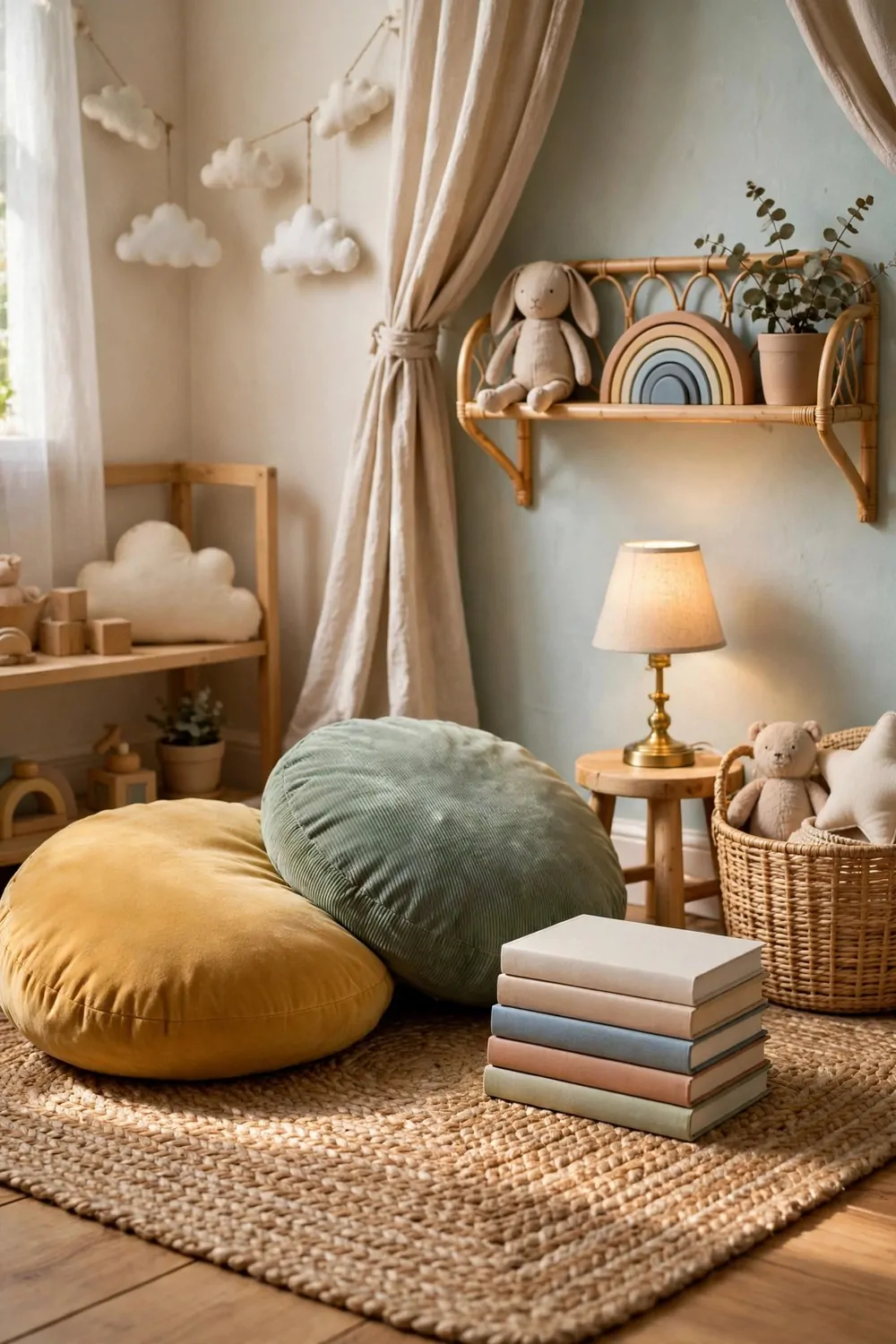
A cosy reading corner needs very little. Two cushions and a good spot by the wall is enough.
I put two cushions side by side so each child has their own seat. No one has to fight for the comfy spot.
Add a small basket of books next to the cushions. Your kids will reach for a book more if it is right there.
Pick cushions that are soft but firm enough to sit on. Flat cushions slide around too much.
A small rug under the cushions makes the corner feel warm. It also marks the reading spot in the room.
Let each child pick their own cushion colour. It makes the corner feel fair and personal.
Keep the books at kid height in the corner. A low basket or a small box works fine.
I like to sit there with my kids sometimes too. A short story before bed in that corner feels special.
A reading corner with two cushions gives both kids a quiet place to rest. And quiet time in a shared room is gold.
25. Blackout Curtains for Better Sleep
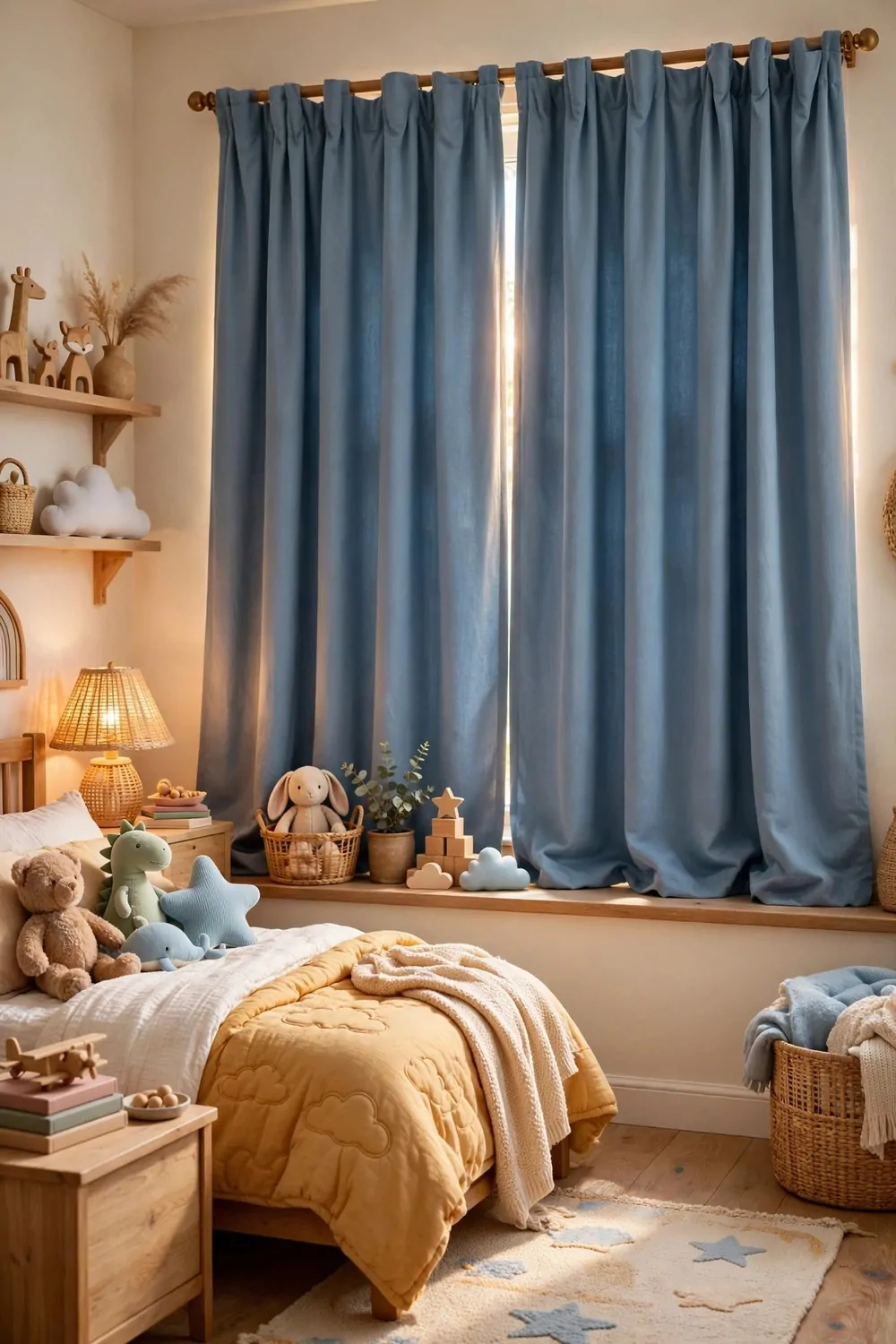
Blackout curtains make a real difference to sleep. They block out street light and early morning sun.
I put them up in my kids room and bedtime got easier in the first week. They fell asleep faster.
Pick curtains that cover the whole window. Light sneaks in from the sides if they are too small.
You can hang blackout curtains on a normal rod. You do not need any special fixings.
Dark curtains also help with naps in the day. The room stays dark and cool.
Let your kids help pick the colour. They are more likely to like the curtains if they chose them.
Wash the curtains now and then. Dust builds up fast on thick fabric.
If you rent your home, use a tension rod or clip rings. You can take them down without marks on the wall.
Good sleep helps your kids feel better all day. Blackout curtains are a simple way to help them get it.
26. A Weekly Clean-Up Routine for the Shared Room
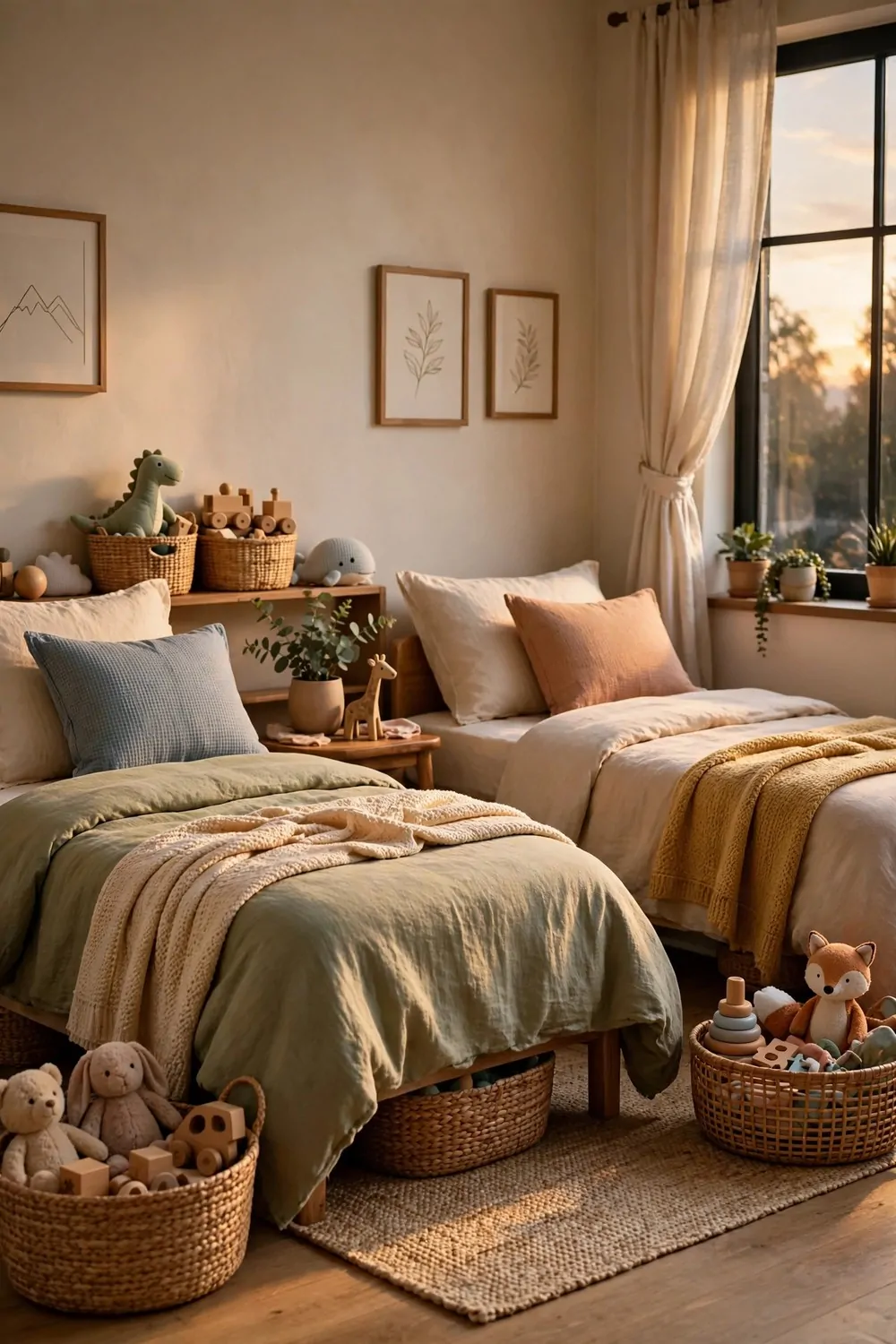
A weekly clean up routine keeps a shared room from getting out of hand. I do it every Saturday morning.
I set a timer for ten minutes. Short and fast works much better than a long tidy up.
Give each child a clear job. One picks up blocks and the other picks up books, for example.
Play music while you tidy up together. It makes the job feel less like a chore.
Put a small reward at the end, like a story or a game together. Your kids will look forward to clean up day.
I keep three boxes for the weekly tidy. One for toys, one for clothes, and one for things that belong in another room.
Check under the beds and behind the door too. That is where the missing socks and toys always hide.
Let your kids decide what to keep and what to pass on. It teaches them to let go of things they do not use.
A weekly routine takes ten minutes but it saves you hours of mess later. Start this week and see how it feels.
Keep Reading
If you liked these ideas, you will love these posts too.
- 21 Kids Desk Ideas for Homework and Play
- 30 Kids Bookshelf Ideas That Make Reading Easy and Fun
- 23 Kids Closet Organization Ideas That Make Mornings Easy
- 27 Playroom Organization Ideas That Keep Toys in Check
- 34 Toy Storage Ideas That Make Clean-Up Fast and Fun
- 24 Entryway Rug Ideas That Handle Mud and Look Good
Pick one idea from this list and try it this week. A small change in a shared bedroom can make mornings calmer and bedtime easier for everyone.