How to Create a Yearly Life Plan That Actually Works

Every January, I used to make a big list. Run every day. Save a lot of money. Read 50 books. Learn to cook. Clean the whole house. By March, that list was lost in a drawer. And I felt bad, like I had failed.
But here is the thing I learned. The list was not the problem. The way I made it was the problem. I wrote down what I wished my life could be. I did not look at how my life really was.
That is why so many yearly plans turn into a list of goals that no one could reach. They are made on one hopeful day. Then real life shows up, with work, kids, bills, colds, and bad weeks.
A yearly life plan is not the same as a New Year’s resolution. A resolution is one wish, like “I will get fit.” A life plan is a whole system. It links your big goals to the small stuff you do each day and each week.
A good plan also bends. Life will change this year. You may get a new job, move, get sick, or have a baby. Your plan should be able to change with you, and not fall apart.
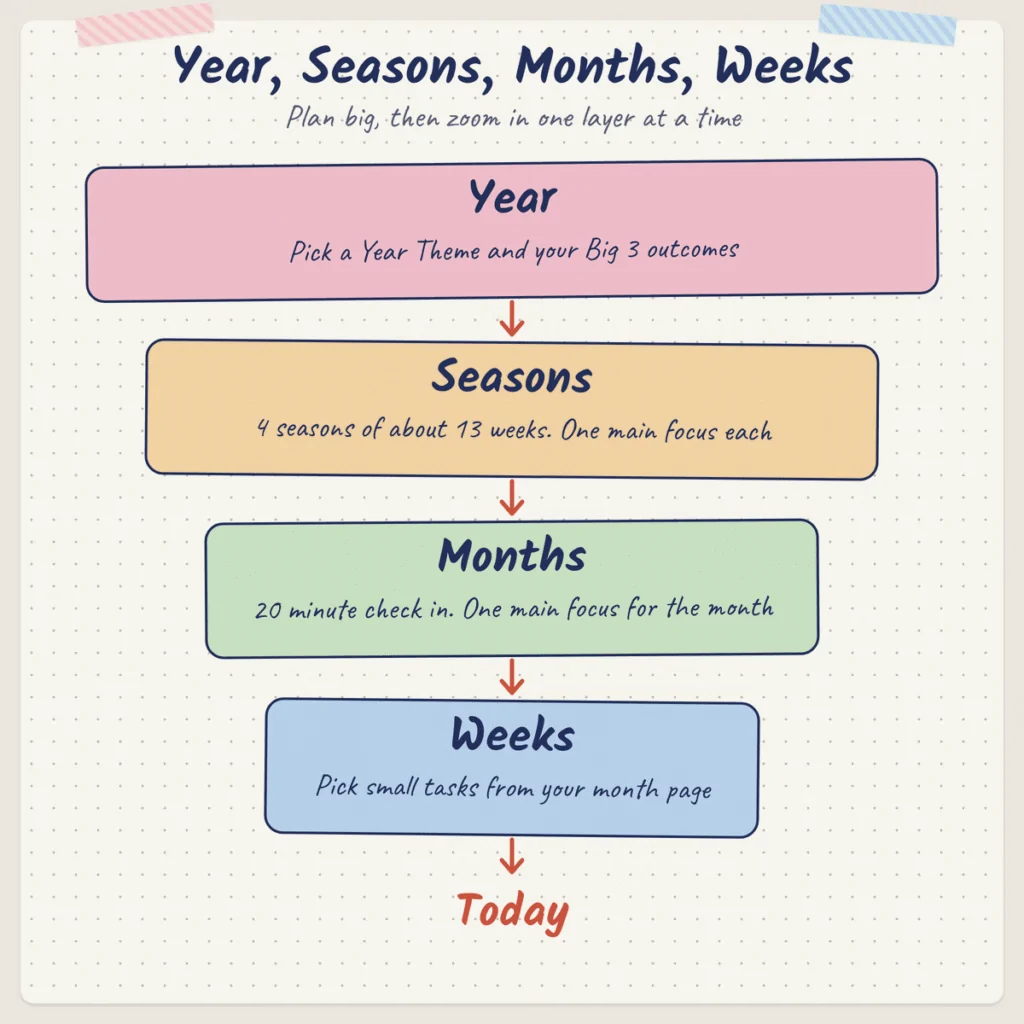
In this post, I will show you the simple system I use. I call it Year, Seasons, Months, Weeks. You pick a few big things for the year. You split them into four seasons. Then you plan each month, and each week, in small steps. It is easy, and it works.
What Is a Yearly Life Plan?
A yearly life plan is a short map of the year ahead. It shows what you want to get done, what you need to keep up with, and how you want to live.
It should hold three kinds of things. They are not the same, so it helps to know the difference.
- Goals: things you want to finish. Like “pay off my card” or “move to a new home.”
- Responsibilities: things you must keep doing. Like pay rent, take the kids to school, or go to work.
- Lifestyle changes: new ways you want to live. Like “go to bed by ten” or “eat more home food.”
What should it not hold? It should not hold every wish you have ever had. It should not be a list of what other people think you should do. And it should not plan each hour of the year. That is too much.
Why not 50 goals? Because you only have so much time and so much energy. Each goal needs some of both. If you have 50 goals, each one gets a tiny bit. So none of them get done. With a few goals, each one gets real care.
I like to think of it like a plate of food. You can only fit so much on one plate. If you pile on too much, it all falls off.
Start With a “Year From Now” Snapshot
Before you set goals, try this. Close your eyes and think about your life one year from now. Not a dream life. A real, good life that you could have.
Now ask yourself some easy questions. Write down what comes to mind.
- Where do I spend most of my time?
- What does my home look like and feel like?
- What is my work or school like?
- How do I feel about money?
- Who do I spend time with?
- What am I learning or getting better at?
- What do I do in my free time?
- What do my days look like, from the time I wake up to bed time?
This is your snapshot. It is a picture of where you want to be.
Try the “Ordinary Tuesday” Test
Here is one of my most loved tricks. Most people think about big days when they plan. A trip, a new job, a party. But most of life is not big days. Most of life is plain days.
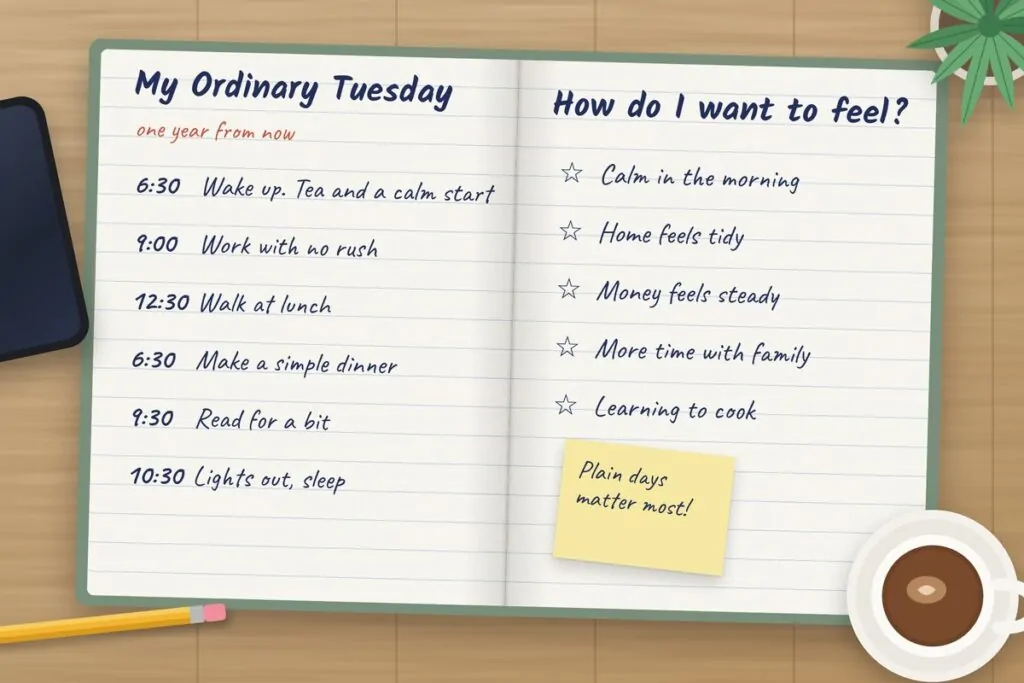
So I ask: what does a plain Tuesday look like one year from now?
Write it out, from morning to night. What time do you wake up? What do you eat? How do you get to work? How do you feel at 3 PM? What do you do after dinner? When do you go to bed?
Here is mine, as a sample. “I wake up at 6:30. I have tea and a calm start. I work with no rush. I take a walk at lunch. I make a simple dinner. I read for a bit, and I sleep by 10:30.”
This test is so good because it shows you what really matters to you. It is not about one big win. It is about how your days feel. And you build that one plain day at a time.
Review the Year You’re Leaving Behind
You can’t plan well if you don’t look back first. The past year has so many clues in it. It shows you what works for you and what does not.
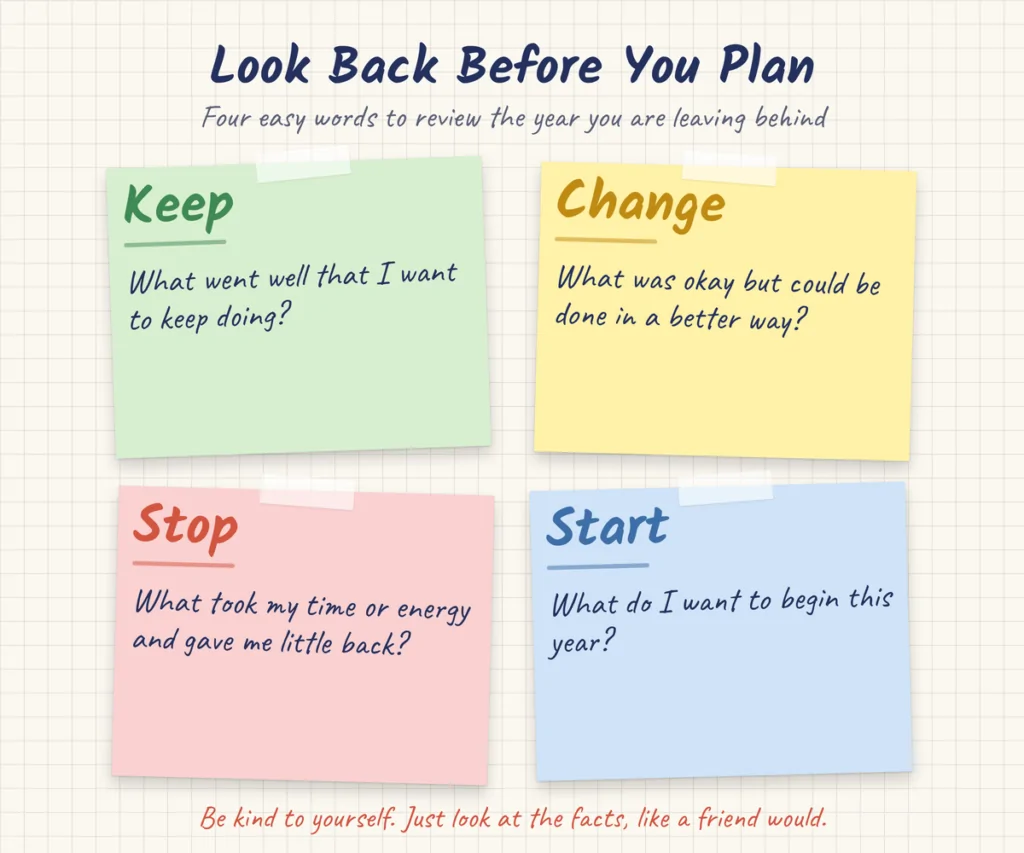
I use four easy words for this: Keep, Change, Stop, Start.
- Keep: What went well that I want to keep doing?
- Change: What was okay but could be done in a better way?
- Stop: What took my time or energy and gave me little back?
- Start: What do I want to begin this year?
Then I ask a few more questions. These dig a bit deeper.
- What took up too much of my time?
- What worked much better than I thought it would?
- What did I keep putting off, again and again?
- What problems kept coming back?
Be kind to yourself here. This is not a test. You are just looking at the facts, like a friend would.
If a goal kept getting pushed back all year, ask why. Maybe it was too big. Maybe it was not that important to you. Or maybe you did not have the time. All of these are fine answers. They help you plan better now.
Choose Your 5 to 7 Life Areas
Life has many parts. To make a plan easy, I split my life into a few areas. Five to seven is a good number. More than that, and it gets messy.
Here are the ones I use. You can change them to fit your life.
- Work or career: your job, your school, or your own business.
- Money: bills, savings, debt, and spending.
- Home: where you live, how it looks, and how it runs.
- Health and routines: sleep, food, moving your body, and daily habits.
- Relationships: family, friends, and your partner.
- Learning: new skills, books, and classes.
- Personal time: rest, fun, hobbies, and time just for you.
Now here is a big tip. Not every area needs a big goal. Some areas just need to keep going as they are.
Say your home is fine right now. Great. Then your plan for home is just “keep it clean and fix things when they break.” That is enough.
This saves you so much stress. You get to put your energy where it is most needed, and let the rest stay calm.
Decide What This Year Is Actually About
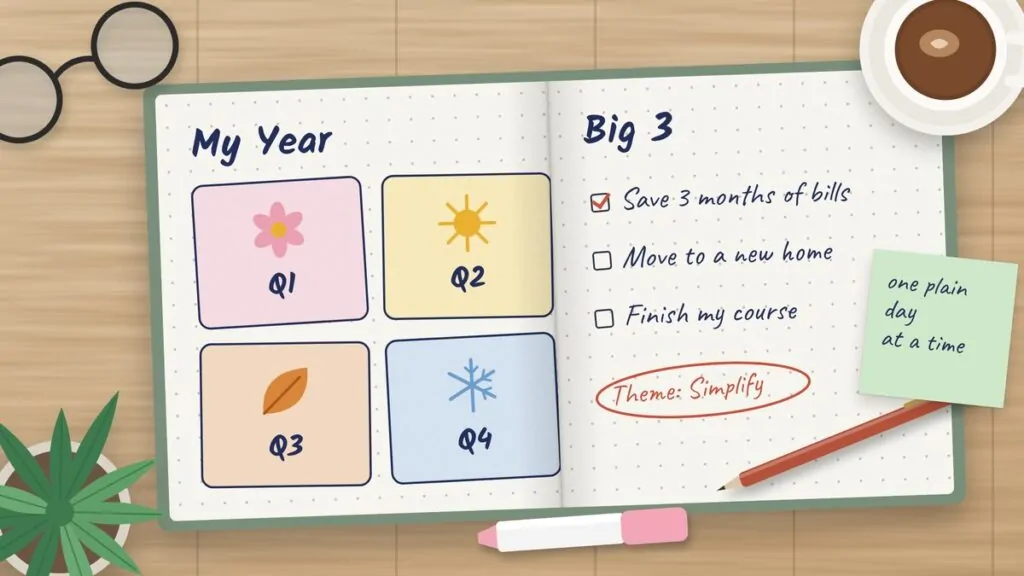
This is my most loved part. I pick one word for the year. I call it my Year Theme.
A theme is like a guide. It tells you what this year is about. Here are some ideas:
- Simplify: a year to have less, do less, and clear things out.
- Build: a year to grow something, like savings or a new skill.
- Recover: a year to heal and rest after a hard time.
- Explore: a year to try new things and see what you like.
- Stabilize: a year to make life calm and steady.
- Learn: a year to study and get better at things.
- Prepare: a year to get ready for a big change that is on the way.
Why does this help? Because some days, two things will fight for your time. And you will need to pick one.
Say your theme is Recover. A friend asks you to join a big new project. It sounds fun. But your theme says this year is for rest. So you can say no, and feel good about it.
Or say your theme is Explore. Then you might say yes to that same project, since it fits the year.
One word. It makes hard choices so much more clear.
Choose Your “Big 3” Outcomes
Now pick three big things you want to have done by the end of the year. Just three. I call these my Big 3.
An outcome is a result. It is something that is done, and you can see that it is done. Like:
- Save enough to cover three months of bills.
- Move into a new home.
- Finish my online course and get the paper that shows it.
For each one, write what “done” looks like. This part is key. “Get in shape” is not clear. When is it done? But “walk a 5K race in the fall” is clear. You know when you did it.
Also, keep outcomes and habits apart. They are not the same.
- An outcome is the end result. “Pay off my $2,000 card.”
- A habit is what you do over and over to get there. “Put $200 on the card each month.”
Write the outcome as the goal. Then write the habit as the way to reach it. That way you know both where you are going and how you will get there.
Turn Big Goals Into Seasonal Projects
A year is long. Too long to plan in one go. So I split it into four seasons, or quarters.
- Season 1: Jan to Mar
- Season 2: Apr to Jun
- Season 3: Jul to Sep
- Season 4: Oct to Dec
Each season is about 13 weeks. That is long enough to get real work done. But short enough that the end feels close.
For each season, I write three things:
- One main focus. The one big thing I want to move ahead this season.
- Support tasks. The small jobs that help that focus.
- One thing I will ignore on purpose. Yes, on purpose.
Let me give you a sample. Say one of my Big 3 is “move into a new home.” Then:
- Jan to Mar: save for the move and sort out what to sell.
- Apr to Jun: look at homes and pick one.
- Jul to Sep: pack, move, and unpack.
- Oct to Dec: set up the new home and make it cozy.
Make a “Not This Season” List
This list is a big help. It is a list of good things you will not do right now.
When a new idea pops up, I don’t just drop it. I write it on my Not This Season list. That way, I don’t lose it. But I also don’t let it pull me off track.
It feels so good. Your brain can stop holding on to it. You know it is safe on paper, and you can look at it next season.
Some of my past items: “Paint the hall.” “Start a side hustle.” “Learn to sew.” All good ideas. Just not for that season.
Give Every Goal a Deadline That Makes Sense
A goal with no end date tends to drift. But not all deadlines are the same. I use four kinds.
- Fixed deadline: a date that can’t move. Like a tax date, a test, or a lease that ends.
- Flexible deadline: a date you pick, but you can shift it if you need to. Like “finish the closet by May.”
- Recurring deadline: a date that comes back over and over. Like “pay the bills on the 1st of each month.”
- Event-based deadline: a date tied to some event. Like “get my suit fixed before the wedding” or “get the car checked before the road trip.”
Know which kind each goal has. Then you know which ones to guard and which ones can bend.
A fixed date always comes first. A flexible one can wait a bit if life gets busy. That is not a fail. That is smart planning.
Build Your Monthly Planning Layer
Now we zoom in from the season to the month. At the start of each month, I sit down for about 20 minutes. I ask myself five easy questions.
- What is my main focus this month? Just one thing, tied to my season focus.
- What must happen? The things that can’t be skipped, like bills, dates, and deadlines.
- What can wait? The things I can push to next month with no harm.
- What needs prep? The things coming up that I need to get ready for, like a trip or a big talk.
- What should I stop? Things that take time but don’t help me right now.
I write the answers on one page. Then each week, I look at that page and pick my tasks from it.
That is how the big plan gets into real life. Year to season. Season to month. Month to week. Week to today.
Add Life Maintenance to Your Yearly Plan
Here is a part most plans forget. Life has a lot of small jobs that come up each year. If you don’t plan for them, they sneak up on you.
I call this life maintenance. It is the stuff that keeps your life running well. Add these to your yearly plan:
- Renewals: your ID, car tags, home or car cover, and any licenses.
- Appointments: yearly check ups with the doctor, the dentist, and the eye doctor.
- Important dates: birthdays, anniversaries, and school dates.
- Home upkeep: clean the gutters, change air filters, check the smoke alarms.
- Money reviews: look at your budget, your savings, and your bills.
- Travel prep: book trips early and check that your passport is still good.
- Seasonal tasks: swap out winter and summer clothes, get the car ready for the cold.
- Digital cleanup: clear out old files, photos, apps, and emails.
I put all of these on a calendar at the start of the year. Then I don’t have to keep them in my head. When the date comes, I get a reminder, and I just do it.
This one step has saved me from so many late fees and last-minute panics. Trust me on this one.
Create a “Low-Energy Version” of Your Yearly Plan
Some months will be hard. You will get sick. Work will get crazy. Someone you love will need you. That is life.
So I make a low-energy plan too. It is the plan I use when I just can’t do it all.
I sort my goals into three groups:
- Essential: things I must keep doing, no matter what. Like paying bills and taking care of my kids.
- Optional: things that are nice, but I can skip for a while. Like a new hobby.
- Pausable: things I can put on hold and pick back up later. Like a home project or a course.
When a hard month comes, I look at this list. I keep the essentials. I let go of the rest for now, with no guilt.
This is not giving up. It is how you keep going over a whole year. A plan that only works on good days is not a real plan.
Review Your Plan Without Starting Over
A lot of people make a plan, fall off, and then throw the whole plan out. Please don’t do that. You don’t need a new plan. You just need to check in and fix it.
Once a month, I ask:
- What did I get done?
- What did not get done, and why?
- Is my focus for next month still right?
Once a season, I ask bigger ones:
- Am I still on track for my Big 3?
- Does my Year Theme still fit?
- Has my life changed in a way that means my plan must change too?
Then I use four words: Continue, Correct, Cancel, Create.
- Continue: it is working, so keep going.
- Correct: it is close, but needs a small fix.
- Cancel: it no longer fits, so let it go.
- Create: something new came up that needs a spot in the plan.
It is fine to cancel a goal. Things change. A goal that made sense in January may not make sense in July. Letting it go makes room for what matters now.
Yearly Life Plan Template
Here is a simple template you can copy. Fill it in on paper, or in a doc. It fits on one or two
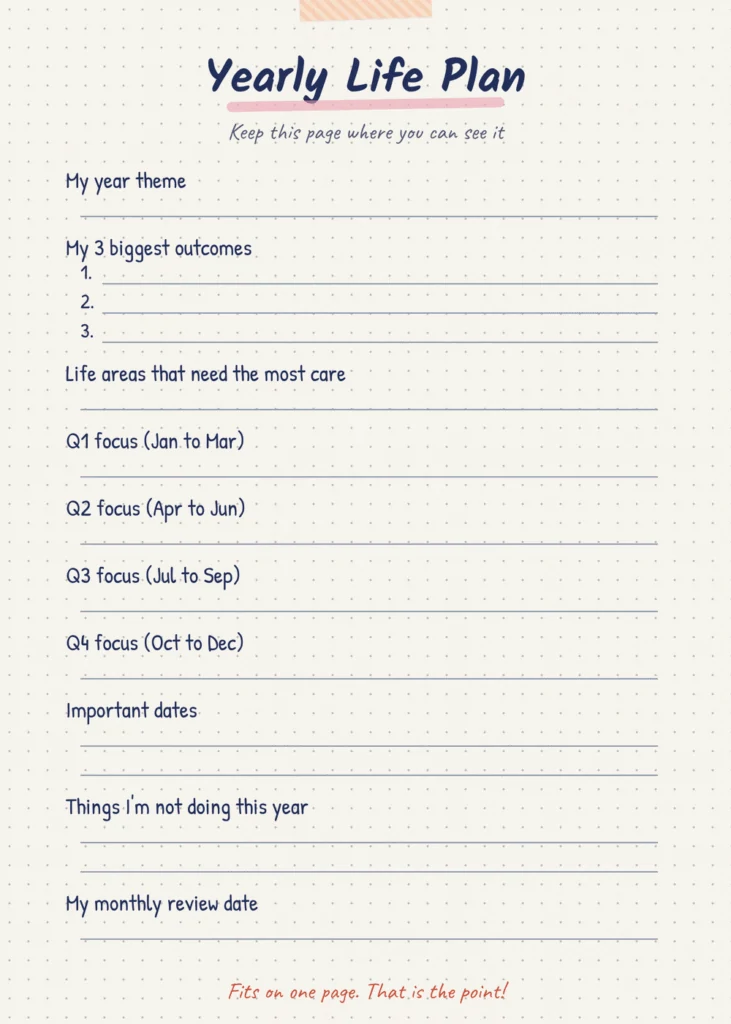
pages, and that is the point.
| Part of the Plan | My Answer |
|---|---|
| My year theme | |
| My 3 biggest outcomes | 1. 2. 3. |
| Life areas that need the most care | |
| Q1 focus (Jan to Mar) | |
| Q2 focus (Apr to Jun) | |
| Q3 focus (Jul to Sep) | |
| Q4 focus (Oct to Dec) | |
| Important dates | |
| Things I’m not doing this year | |
| My monthly review date |
Keep this page where you can see it. I put mine at the front of my notebook. Some people tape it to the fridge. Do what works for you.
Common Yearly Planning Mistakes
I have made all of these. So please don’t feel bad if you have too. Just watch out for them this year.
1. Planning for a pretend version of you. We plan as if we will wake up at 5, never get tired, and have lots of free time. But that is not who we are. Plan for the real you, on a normal day.
2. Too many goals. This is the big one. More goals does not mean more gets done. It means less. Stick to your Big 3.
3. No room for surprises. Things will go wrong. A car breaks. A kid gets sick. If your plan is packed full, one surprise can knock it all down. Leave some space.
4. Mixing up habits and outcomes. “Run 3 times a week” is a habit. “Run a 10K” is an outcome. Both are good, but know which is which.
5. Never looking at the plan again. A plan you write once and put away does not help. Set a monthly review date and keep it, like a date with a friend.
6. Making every month just as hard. Not every month should be a big push. Some months have holidays, trips, or busy work. Plan light months on purpose. You will thank yourself.
FAQs
How do I plan my whole year?
Start by looking back at last year. Then picture a plain day one year from now. Pick a Year Theme and your Big 3 outcomes. Split them into four seasons. Then plan each month and each week in small steps. Check in once a month to stay on track.
What should be in a yearly life plan?
A good plan has your year theme, your top three outcomes, your main life areas, a focus for each season, key dates, and a list of things you won’t do this year. It should also have life upkeep, like renewals and check ups, and a set day to review it.
How many goals should I have for a year?
I say three big ones. You can have small habits on the side. But three main outcomes is a number most people can really handle. Fewer goals means each one gets more of your time and care.
How do I make a yearly plan realistic?
Plan for the real you, not a perfect you. Look at how much free time you really have. Leave space for surprises. Make a low-energy version for hard months. And use deadlines that make sense, not ones that stress you out.
How often should I review my yearly plan?
Do a short check once a month, about 20 minutes. Then do a deeper review once a season, every three months. That is enough to keep the plan fresh without taking up too much of your time.
That’s it. You don’t need a fancy app or a perfect planner. Just a few pages, a few goals, and a habit of looking back at them. Start sm/imageall, be kind to yourself, and let your plan grow with you this year.