21 Second Bedroom Office Ideas That Make the Space Work Harder

Here is what nobody tells you about a second bedroom. Nobody sleeps in it.
Mine sat empty for two years. I had a nice bed in there. Clean sheets. A little lamp on the nightstand. And guests came maybe five nights in two whole years. The rest of the time that room was just a quiet box I paid rent for.
Then I started working from home. My laptop lived on the kitchen table. My papers lived on the couch. My back lived in pain. One Saturday I dragged my desk into that empty second bedroom, and I wondered why I had waited so long.
A second bedroom is the best office you will ever have. It has a door. That door is the whole point. You open it in the morning and you are at work. You close it at night and work is gone.
This list is 21 Second Bedroom Office Ideas that make the space work harder. Not just an office. A room that also hosts guests, holds your stuff, and still looks like it belongs in your home. Every idea below is real. I have tried most of them myself or seen them work in friends homes.
Pick the ones that fit your room. You do not need all 21. Three or four done well will change how your whole house feels.
1. Give the Room a Door You Can Close
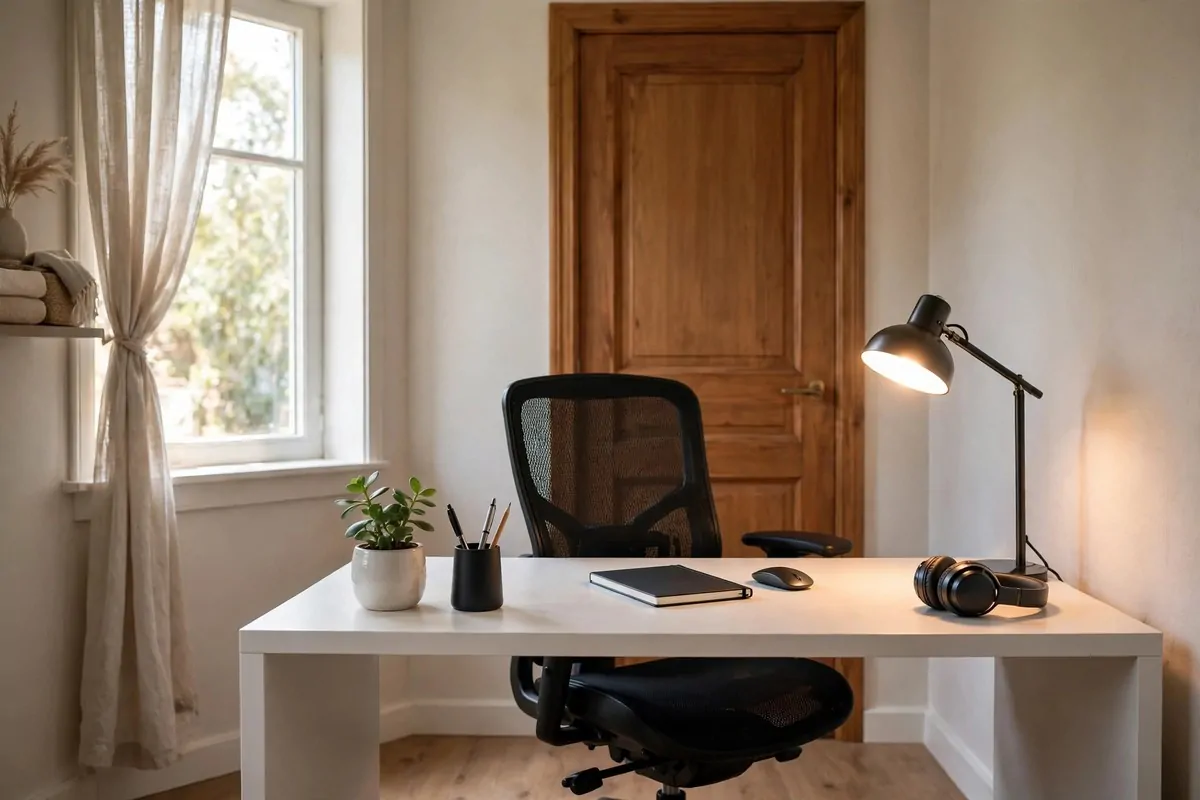
The door is the whole reason this works. I say it first because it is the one thing a kitchen table or a living room corner can never give you.
When you work from home without a door, work leaks everywhere. Your laptop follows you to the couch. Your stress follows you to dinner. The line between your day and your evening gets blurry and tired.
A second bedroom fixes this with one swing of a door. You walk in and your brain knows it is work time. You walk out and it knows it is home time. That is not a small thing. It changes how you sleep.
If your second bedroom door is missing or broken, put one back before you buy any furniture. A cheap hollow door from a hardware store is fine. A curtain on a rod works in a pinch. The point is a real barrier you can close.
Sound matters too. A closed door does not make the room silent, but it cuts the noise of the TV and the kitchen by half. I keep a cheap draft stopper under mine. It cost almost nothing and my calls got so much clearer.
Here is a mistake I made. I left my office door open for the first month because it felt friendlier. Everyone in the house kept popping in. My workday stretched two hours longer. Closed door, closed day. That is my rule now.
Your guests benefit from the door too. When someone sleeps over, they get real privacy. A room with a door feels like a guest room, not a corner with a bed in it.
Keep the door color simple. White or the same color as your trim. It should fade into the wall, not shout.
One last thing. Put a little hook on the back of the door for your bag or jacket. It keeps the floor clear and your workday starts the second you hang it up.
2. Run a Desk From Wall to Wall
Most desks are too small for real work. You get a 48 inch desk, and by Tuesday your laptop, your notebook, your coffee, and your papers are fighting for space.
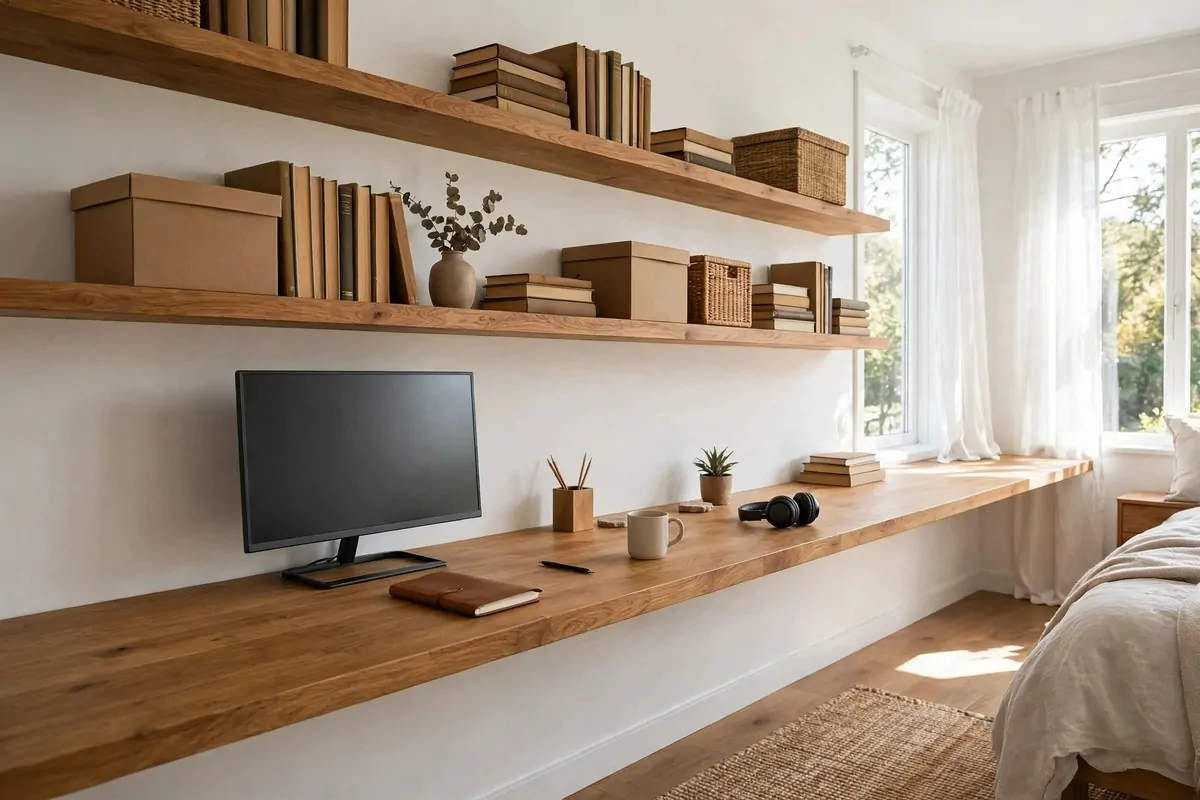
Here is the trick. Buy a long countertop or a butcher block slab and run it from one wall to the other. No legs in the middle. Just the full width of the room. Suddenly you have six or seven feet of desk.
I did this with a kitchen countertop from a big box store. It cost less than a fancy desk. Two drawer units hold it up at the ends. The drawers give me storage. The top gives me room to breathe.
A wall to wall desk looks built in. It reads as custom even though every piece came in a flat box. Guests walk in and think you hired someone. You did not.
The long surface solves the guest problem too. When someone visits, you clear one end and it becomes their dresser. Their suitcase goes under it. Their chargers get the far corner. Nobody is living out of a bag on the floor.
Cable management is easier on a long desk. Everything runs along the back edge in one line. One power strip. One cable tray. Done.
Measure twice before you buy the slab. Leave half an inch of gap on each side. Rooms are never perfectly square, and a slab that is too tight will not fit.
If your room is very narrow, go deeper instead of longer. A 30 inch deep desk gives you space to push the monitor back and still write in front of it.
The best part is the feeling. A big empty desk makes your brain feel calm. Cluttered small desks make your brain feel cluttered. Space is a gift you give yourself every morning.
3. Claim the Corner
Corners are the most wasted inches in a small room. We push furniture against walls and the corners just sit there collecting dust and dead spiders.
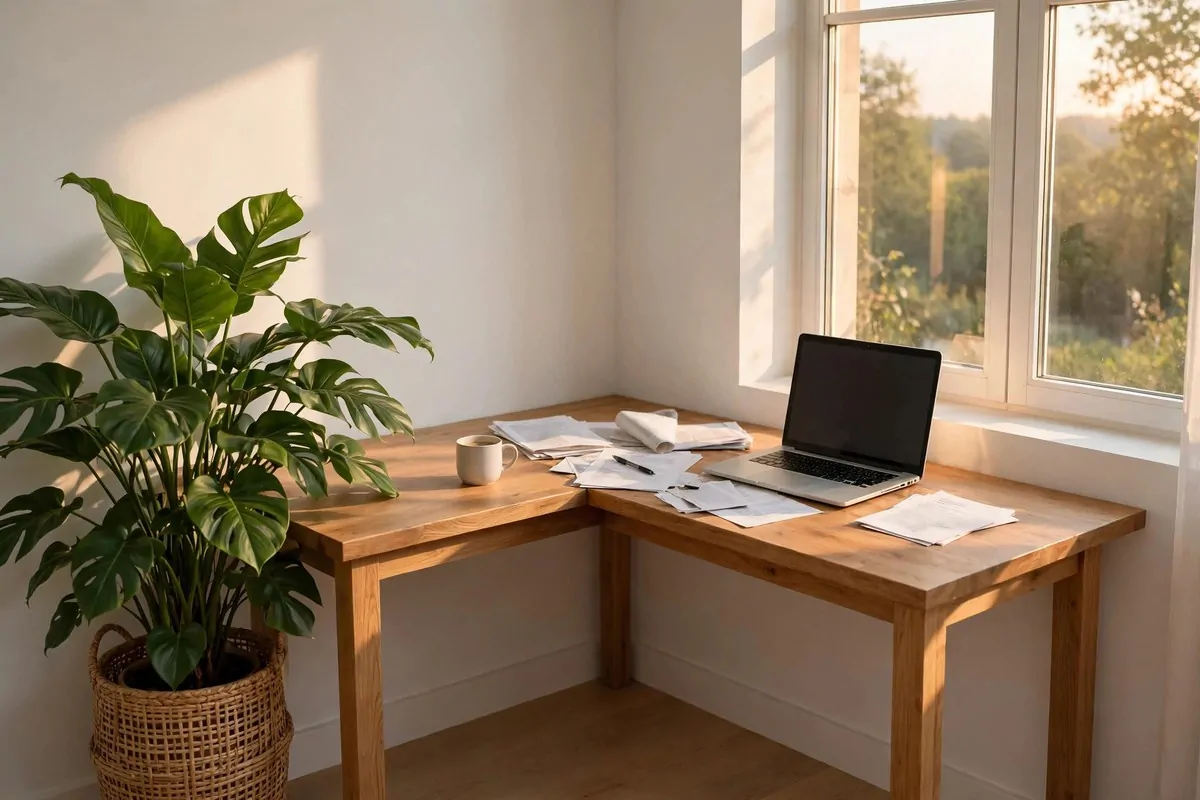
An L-shaped desk turns a dead corner into the busiest spot in the room. You get two work surfaces. One for the computer. One for writing, sketching, or spreading papers out. You swivel between them and everything stays within reach.
I used a corner desk for three years. The trick is to face out of the corner, not into it. Sit with your back to the corner and the room opens up in front of you. You feel like you have space. Face into the corner and you feel like you are being punished.
Put the corner near a window if you can. The side light is soft and flattering on video calls. Front light from a window behind you turns you into a dark shadow. Side light is the secret.
The dead space behind the monitor in the corner is perfect for a small printer or a stack of trays. Stuff you need but do not want in your face all day.
A corner desk leaves the rest of the room open. That matters in a second bedroom because the room still needs to breathe. A big desk in the middle of the room makes the whole place feel crowded.
Add a small plant in the very corner where the two desk pieces meet. It softens the angle. It gives your eyes something green to rest on when you look up from the screen.
If you buy a cheap L-shaped desk, check that both wings are deep enough. Some are only 18 inches deep on the short side. That is a shelf, not a desk. You want at least 24 inches.
4. Add a Daybed That Doubles as Your Sofa
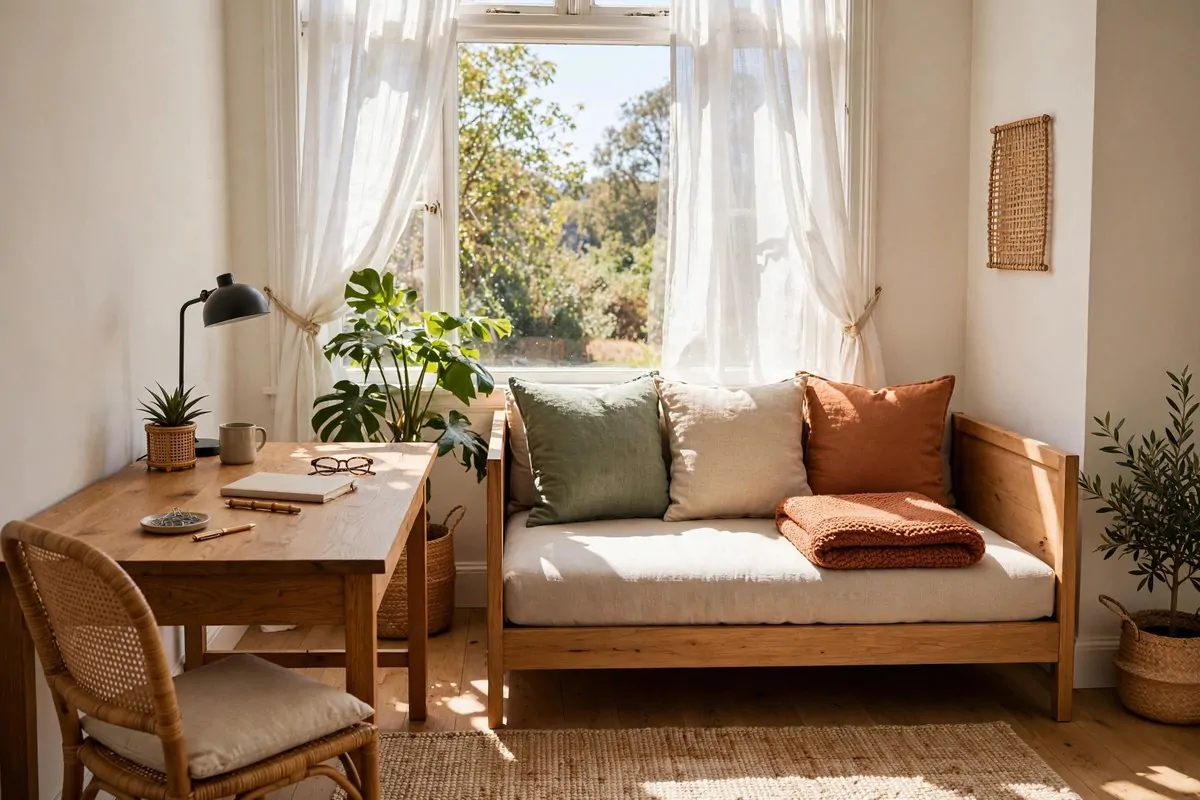
A second bedroom office still needs to sleep people. That is the whole deal with this room. But a full bed eats the room alive and makes it feel like an office that apologizes for being in a bedroom.
A daybed is the answer. Against the wall, dressed with pillows and a throw, it reads as a sofa during the day. At night you pull the throw back and it is a real bed with a real mattress. Nobody feels like they are sleeping on office furniture.
Get a twin or a twin XL if you have tall guests. A real mattress, not a thin sofa cushion. Your guests will notice the difference on their backs the next morning. I learned this the hard way after my sister visited and slept on a four inch pad. She was polite. Her back was not.
Style the daybed like a couch, not a bed. Square pillows in front. A folded throw across one corner. During the day you will sit on it for calls, for reading, for lunch. It becomes your office couch. That is a lovely thing to have.
Put the daybed against the longest wall. Leave the middle of the room open for the desk and the chair. The room should flow from door to desk to daybed without squeezing.
Underneath, daybeds hide things well. Slide flat storage boxes under there for guest sheets, office paper, or the stuff you are hiding from your mother-in-law.
One warning. A daybed is very comfortable at 2 in the afternoon. I have lost many productive hours to “just resting my eyes.” If this is you, put the daybed behind your chair where you cannot see it while you work.
5. Hide the Bed Inside the Wall
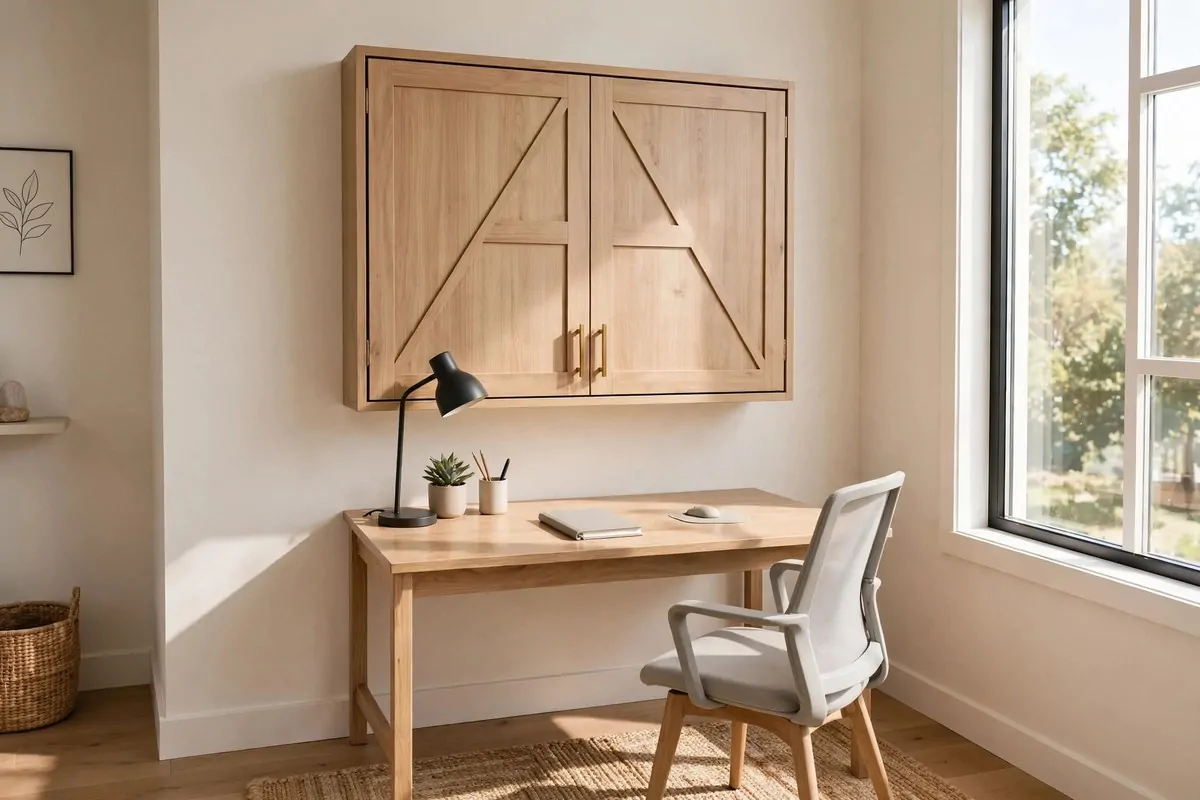
This one sounds dramatic. It kind of is. A Murphy bed folds up into a cabinet on the wall, and the whole room becomes a full office by day and a real bedroom by night.
The magic is the floor space. When the bed is up, you get back about 30 square feet. In a small second bedroom that is the difference between a cramped corner office and a room you can actually walk around in.
Modern Murphy beds are not the rickety things from old movies. Good hardware locks flat against the wall. The mattress straps in. You can leave the bedding on when you fold it up. Morning routine takes forty seconds.
Some Murphy beds have a desk built onto the face. The desk stays level as the bed folds down. You never clear your desk. That is the dream setup if your budget allows it. It costs more, but think of what it replaces.
Installation matters. These beds are heavy and they bolt to wall studs. If your wall is drywall over nothing, you need a pro. I watched a friend skip this step. I will not describe what happened. Just get it mounted right.
When guests are not there, the closed cabinet looks like a nice wardrobe. Put two cabinets side by side and add bookshelves around them. The whole wall becomes storage that happens to turn into a bed.
One tip. Practice folding it down before guests arrive. The first time is always awkward. The tenth time is smooth. You do not want your first try to be at 10 at night with tired visitors watching.
A Murphy bed tells your room it is allowed to be two rooms. Office by day. Bedroom by night. Neither one apologizing to the other.
6. Use a Desk That Folds Away
Not everyone wants a wall bed. Some of us just need the desk to vanish when the room has a different job to do.
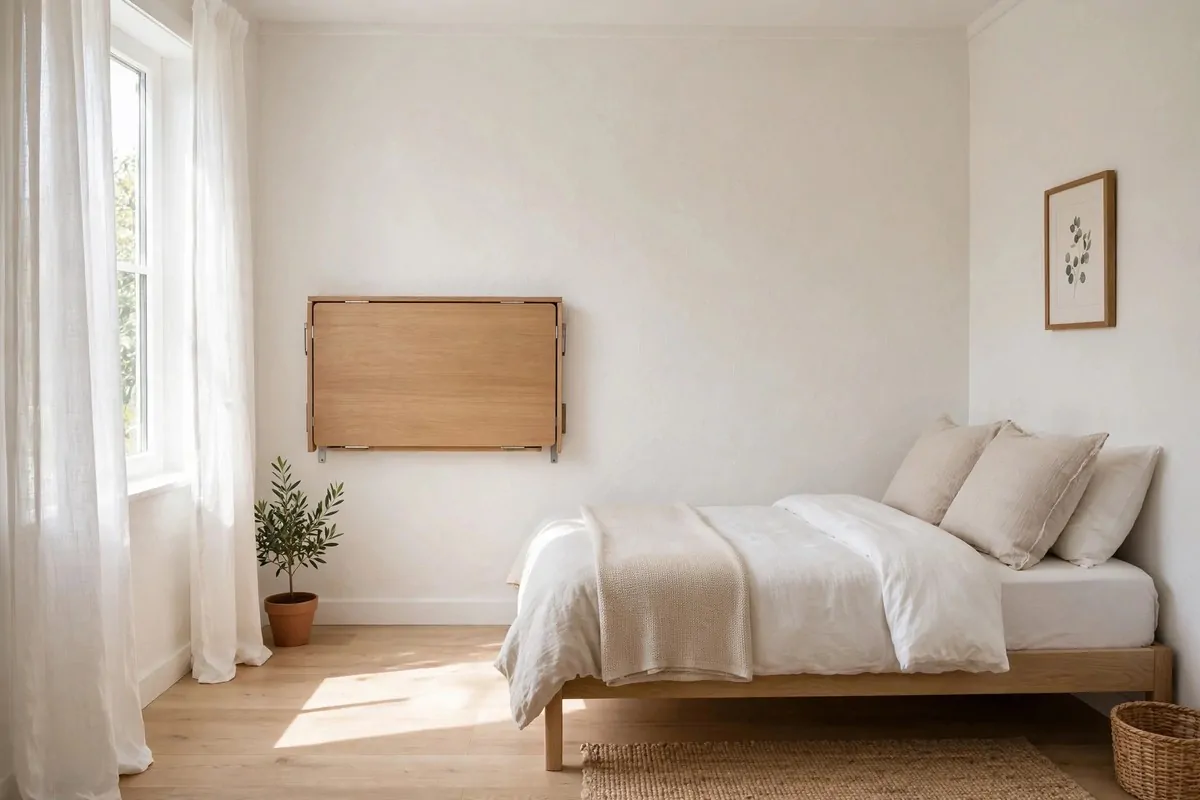
A wall-mounted fold-down desk does exactly that. It hinges down for work and folds flat against the wall when guests arrive. The room goes from office to guest room in ten seconds.
I used one in a tiny apartment for a year. Down in the morning, up at night. The ritual itself was nice. Folding the desk up was my way of telling my brain the workday was over.
Get one with a lip on the edge. That little raised edge keeps your pens from rolling off. Without it you will chase a pen across the room every single day.
Mount it at the right height. Standard desk height is 29 to 30 inches. Sit in your chair, put your hands where they would type, and mark the wall. Too high and your shoulders climb to your ears. Too low and your back rounds.
The wall underneath the folded desk is free real estate. Hang a small shelf there for a lamp. When the desk is down the shelf sits just above it. When the desk is up the shelf stays put. It looks intentional.
These desks are cheap. You can find a good one for the price of two takeout dinners. For a second bedroom that needs to change jobs fast, it is the best money you can spend.
Keep the desk surface clear at the end of the day. A fold-down desk that cannot fold because of clutter is just a regular desk with extra steps.
7. Split the Room With a Bookshelf
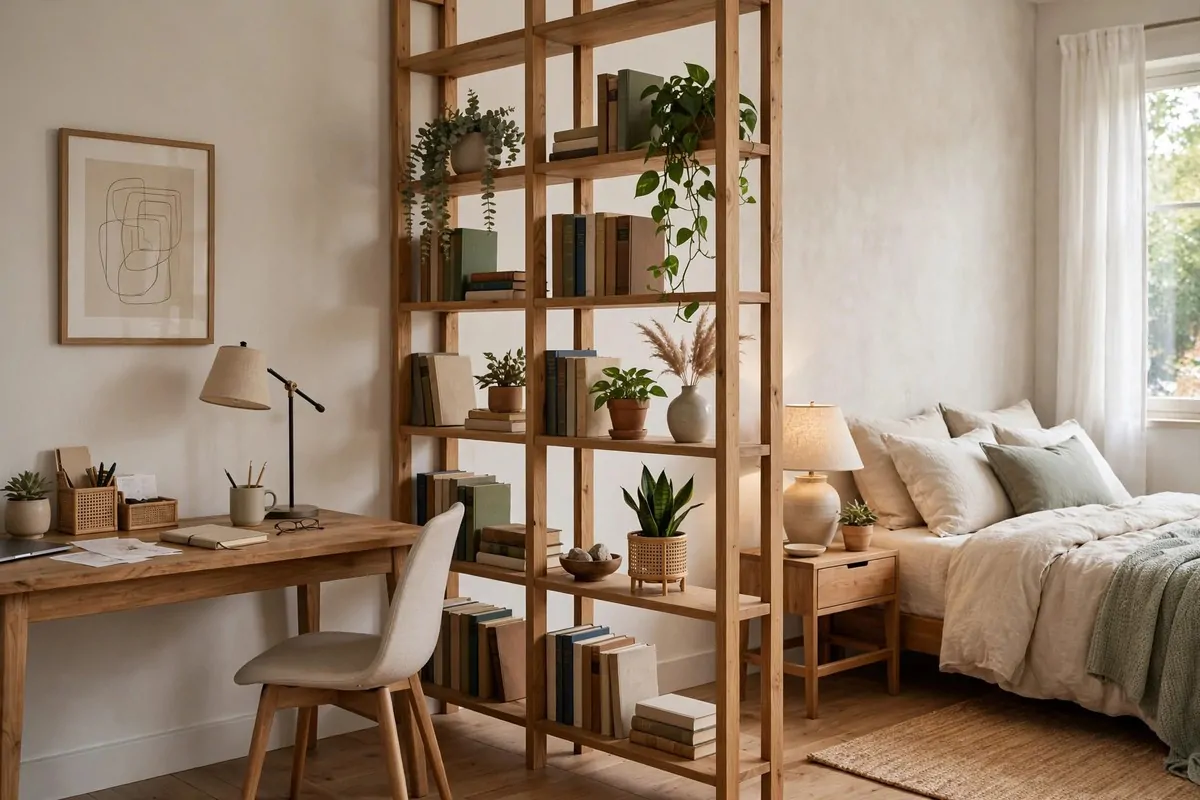
A second bedroom office has an identity problem. Is it a bedroom or an office? A bookshelf down the middle answers the question. Both. At once. Neatly divided.
Place a low open bookcase perpendicular to the wall, splitting the desk zone from the sleeping zone. You get a visual wall without building a wall. Light still passes through. Air still moves. But your eyes see two rooms.
I love this trick because it works on video calls too. Your camera sees books and plants. It does not see an unmade bed. Your coworkers think you have a study. They do not need to know the bed is three feet behind the shelf.
Use the shelf from both sides. Office supplies and binders face the desk. Guest books, a water carafe, and a small clock face the bed side. One piece of furniture doing two jobs.
Keep the shelves tidy on camera. Nobody zooms in, but a messy shelf reads as a messy worker. Pretty boxes hide the ugly stuff. I keep printer paper and cables in matching boxes and nobody suspects a thing.
A cube-style shelf works best. The square openings look neat from both sides. A tall bookcase blocks light. A low one, about waist height, divides without darkening.
Anchor it to the wall. Seriously. A freestanding shelf in the middle of a room is a tipping hazard, especially with kids or a clumsy spouse. Two brackets into a stud and it will never move.
This divider trick also gives guests privacy. They can read in bed without staring at your monitor. Small rooms need these little kindnesses.
8. Build a Reading Nook for Thinking Time
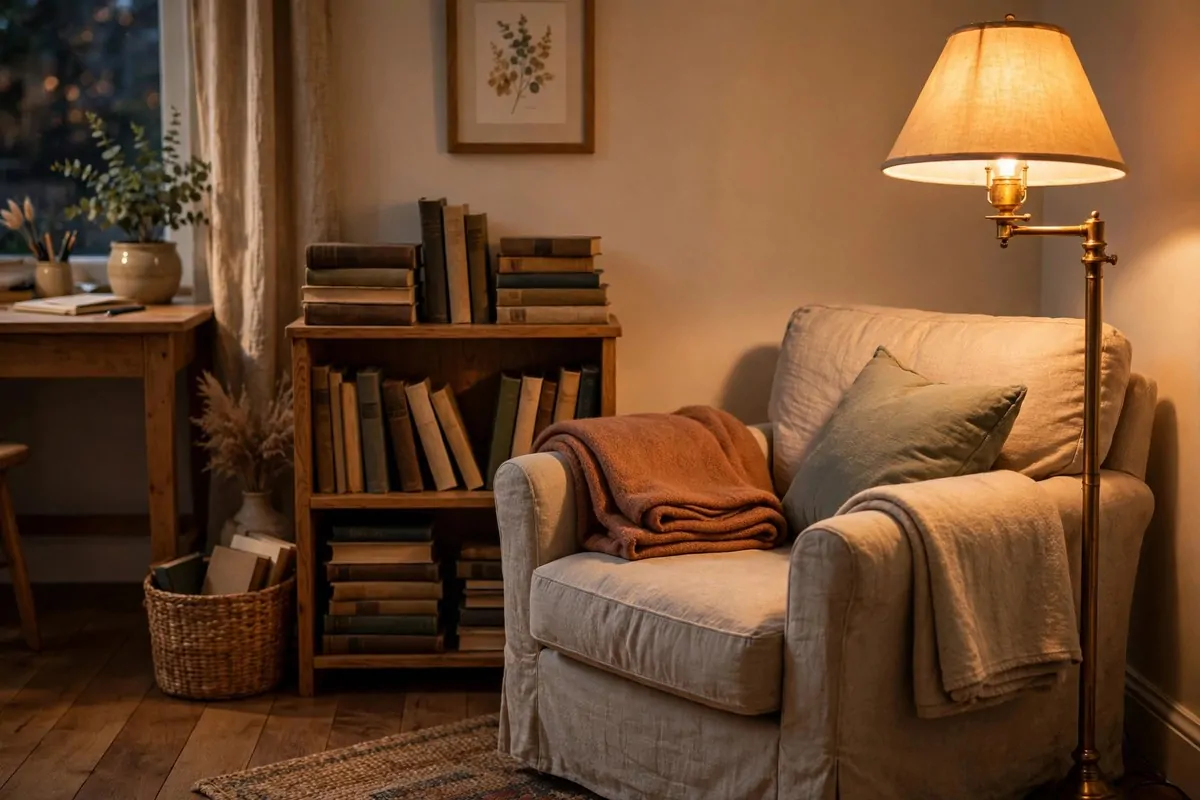
An office is not just a desk. Your best thinking does not happen while you stare at a screen. It happens in a chair with a window and a quiet room.
Carve a small reading corner into your second bedroom office. One armchair. One floor lamp. One small side table. That is all it takes. Three feet by three feet in a corner and you have a thinking spot.
I read contracts in my nook. I plan my week there. Sometimes I just sit and look out the window for ten minutes when a problem feels stuck. The change of seat tells my brain to change gears.
The chair matters. It should be comfortable enough for an hour but not so deep you fall asleep. A snug armchair with good back support. Add a throw for cold mornings. The throw makes it feel like a reward, not a workstation.
Light the nook with a warm floor lamp. Not the cold white of office lighting. Warm light tells your body it is okay to slow down. I use a 2700K bulb. It is the color of late afternoon sun and it makes everything feel calm.
Put a small bookshelf or a stack of books within reach. Work books. Notebooks. The things you want to read but never do at your desk. Out of sight is out of mind, so keep them in sight here.
Guests love a reading nook. It gives them somewhere to sit that is not your office chair or the bed. A guest who can curl up with a book feels like they have a real room, not a borrowed corner.
Keep the nook clear of work stuff. No laptop on the side table. No papers on the chair. The moment work moves in, the nook stops being a rest. Guard it like a tiny peaceful country.
9. Put Your Desk Under the Window
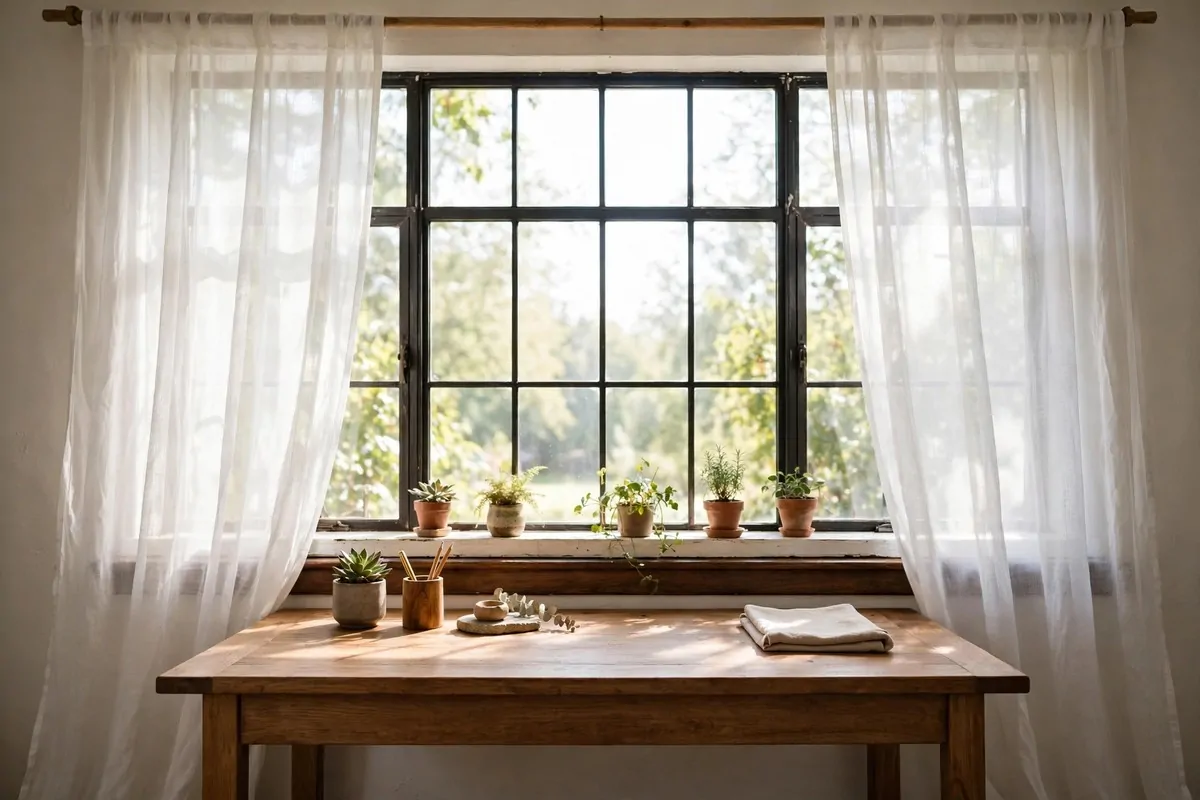
There is a reason every home office photo on the internet has a window desk. It is not just pretty. It works better.
Natural light keeps you awake. Studies keep saying it, and my own afternoons agree. The days I sit under the window I do not hit that 3 pm wall as hard. The days I sit in a dark corner I am reaching for coffee by two.
Face the window or sit beside it. Do not put your back to it on video calls, or you will be a dark shape with a bright halo. Side light is flattering. Face the light if you want to look your best. Your face lit softly from the front is the whole secret of good video calls.
Keep the sill simple. Two small plants. Maybe a stone or a photo frame. Not a jungle. A crowded sill blocks the light you moved there for.
Watch the glare. If the sun hits your screen at noon, you will be squinting and tilting. Sheer curtains fix this. They soften the light without killing it. I bought mine for very little and they changed the whole room.
A window desk also gives guests a view. Waking up next to a window with morning light is one of the small luxuries of staying over. Your second bedroom already has this. Use it.
In winter the window gets cold. A drafty window behind your desk will chill you all day. Check for drafts before you commit the desk there. A bit of weather stripping is cheap and makes the spot cozy year round.
One more thing. Open the window sometimes. Fresh air in a small office is magic. Five minutes of open window resets a stuffy room completely.
10. Fit Two Desks for Two People
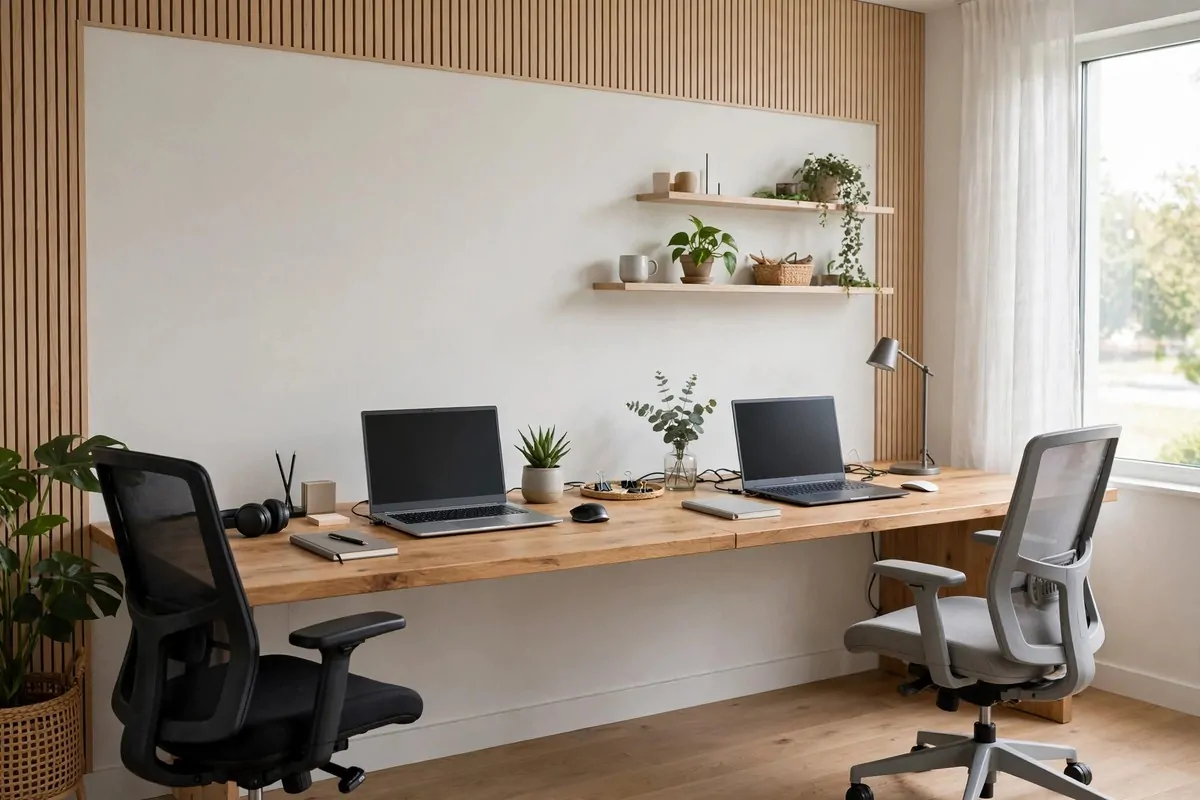
Some second bedrooms serve two workers. A couple. A parent and a teen. Two roommates splitting the room. One desk will not cut it.
A long shared desk is better than two small desks. Two small desks in a small room eat every walkway. One long desk along one wall leaves the rest of the room free.
Give each person their own zone. A desk pad marks the border. Headphones mark the sound border. I shared a room office with my husband for a year and the headphone rule saved our marriage. Mostly.
Face the same direction. Side by side along the wall works better than facing each other. Facing each other means staring at each other all day. Side by side means you both face the wall and the room feels bigger behind you.
Storage needs to double. Two people means two sets of stuff. Use the vertical wall above the desk. Two shelves, one per person. Label them if you must. My husband labels his. I pretend I do not need to.
Calls are the hard part. Two people on calls at once in one small room is chaos. Make a rule. One person takes calls in the room, the other steps out or uses the kitchen. Alternate days if you both have heavy call loads.
Chairs matter twice as much now. Two cheap chairs in a small room look messy and feel bad. Two decent chairs that tuck fully under the desk keep the room looking neat when work ends.
When guests come, one worker moves out for the night. The shared desk clears in minutes. The guest gets the bed, the room, and the quiet. It is a fair trade for one night.
11. Turn the Closet Into a Supply Cabinet
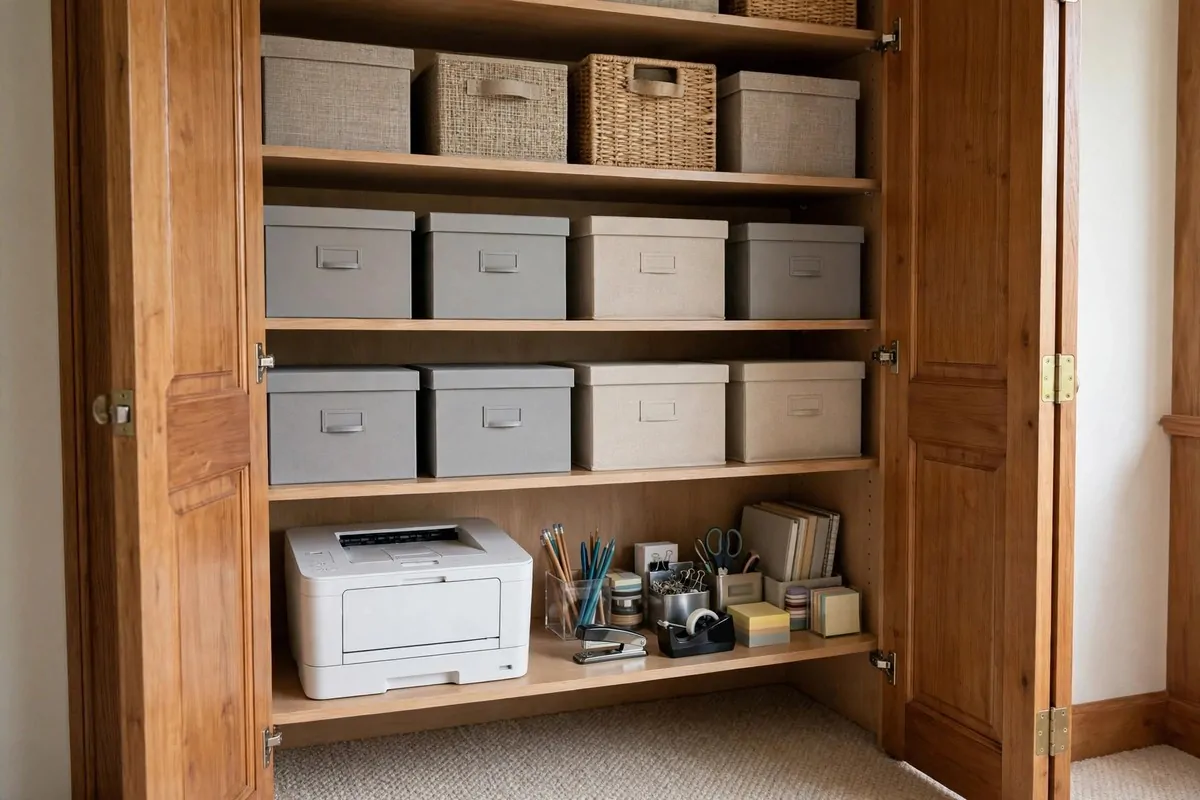
Almost every second bedroom has a closet. Almost nobody uses it well. It becomes a graveyard of old coats and boxes you are afraid to open.
Clean it out. All of it. The closet in your second bedroom office is the best storage in the house, and it should work for the room it is in.
Set it up as a supply cabinet. Shelves for paper and ink. A spot for the printer. Boxes for cables, chargers, and the manuals you will never read but cannot throw away. Close the doors and it all disappears.
I put my printer in the closet on a low shelf. It is ugly. It is noisy. Now I never see it and I barely hear it. The closet doors muffle the sound. This one change made my office feel twice as calm.
Use the closet door backs too. Hang a small organizer for envelopes, stamps, and sticky notes. Hang a whiteboard for lists. Door backs are free wall space most people ignore.
Lighting inside the closet is a small upgrade with a big payoff. A stick-on motion light costs little and turns on when you open the door. No more digging in the dark for the good stapler.
Leave some closet space for guests. One shelf and five hangers. That is all a guest needs. Clear a small section before anyone arrives. A guest with nowhere to hang a shirt feels like an intruder.
Label the boxes. Not cute labels. Honest labels. “Cables.” “Tax stuff.” “Printer things.” Future you will be grateful, and guests will not open the wrong box looking for a towel.
The closet is the room’s secret. Everything ugly lives in there. Everything pretty lives outside. That is how small rooms stay beautiful.
12. Hang a Gallery Wall for Your Calls
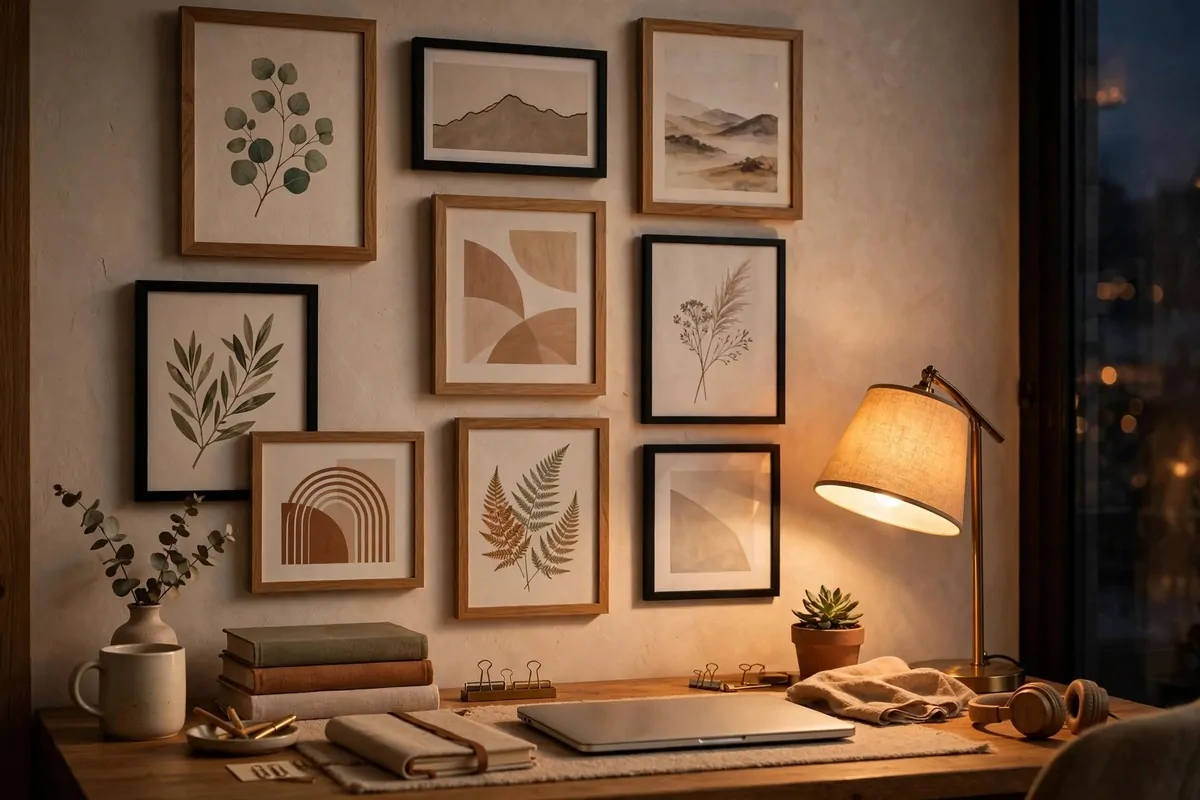
Your video call background is your office’s public face. A blank wall looks unfinished. A messy shelf looks chaotic. A gallery wall looks like you have your life together.
Pick a wall behind your desk. Hang five to nine frames. Mix art prints, a photo or two, maybe a small mirror. Keep the frames the same color. Black or wood. Matching frames make random art look curated.
You do not need expensive art. I printed free museum images at a copy shop for very little. Old maps. Botanical drawings. A quote I liked. Total cost was less than a pizza, and my background gets compliments weekly.
Hang them before you position the desk. Sit in your chair, have someone hold a frame up, and check the camera view. Art that sits too high shows as blank wall on camera. Art too low gets cut off. Test it.
Keep the center of the camera view simple. One strong piece right behind your head. The busy stuff goes to the sides. You want people to see you, not read your wall.
A gallery wall also helps guests. A bare office bedroom feels cold. Art makes it feel like a real room someone cares about. Your guests will feel more welcome before you even say hello.
Change one piece with the seasons. I swap a print every few months. It keeps the room feeling fresh and gives me a tiny creative moment in a workday. Small rituals keep a home office human.
Do not hang anything you would not want a client to read. That funny poster is great for friends. For work calls, keep it neutral and warm. Your background is part of your work clothes now.
13. Park a Rolling Cart Beside the Desk
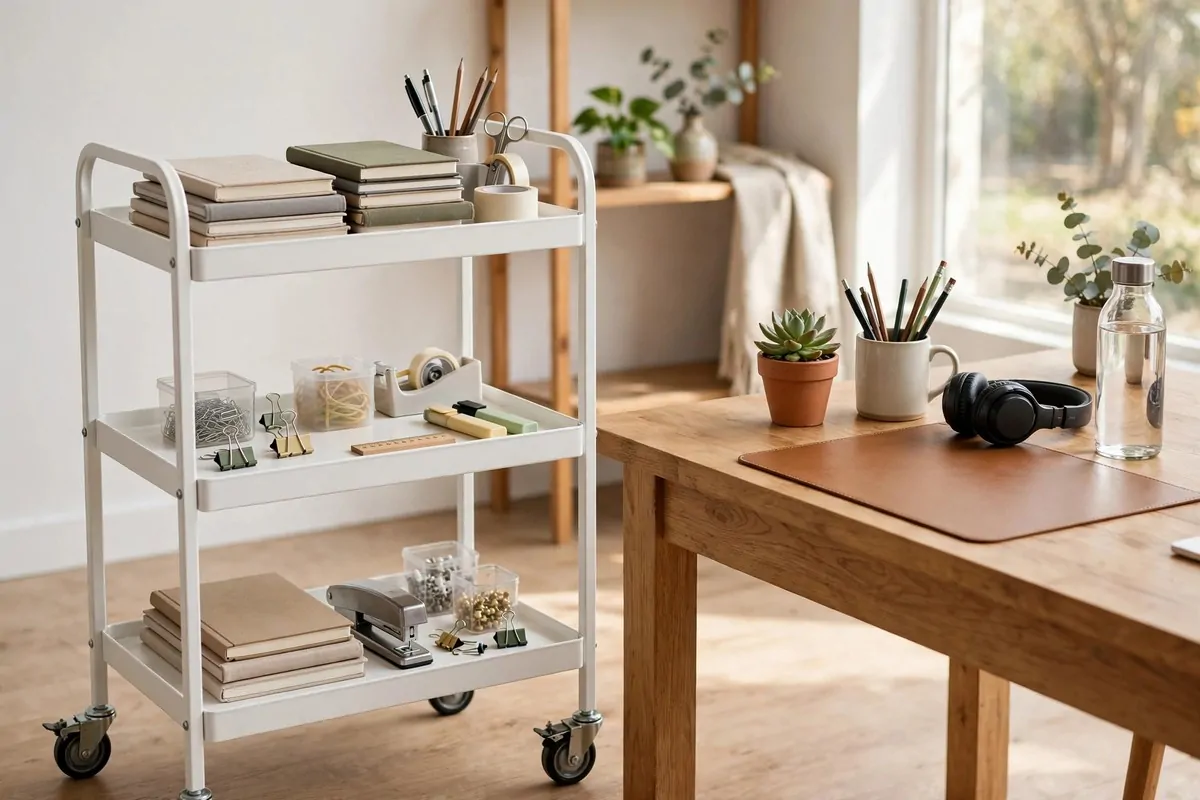
Desks collect clutter. It is a law of nature. Papers land. Pens multiply. Within a week your clean desk looks like a paper factory exploded.
A rolling cart stops the spread. It sits beside your desk and holds the stuff that used to live on your desk. Notebooks on the top tier. Supplies in the middle. The printer paper and spare cables on the bottom.
The wheels are the point. When guests arrive, you roll the whole cart into the closet. Ten seconds and your office disappears. The room is a guest room again. No packing boxes. No drama.
Get the three-tier metal kind. They are cheap, sturdy, and the tiers lift out for cleaning. I have had mine for years. It has survived two moves and one toddler.
Assign each tier a job. Top tier is daily stuff. Middle tier is weekly stuff. Bottom tier is storage. When the top tier overflows, you know it is time to file things, not buy a bigger cart.
Roll it to the reading nook when you plan your week. Roll it to the window when you want to write by daylight. A desk cannot move. A cart can. That flexibility is gold in a small room.
Guests can use the cart too. Put guest towels on the top tier and a little note. Roll it next to the daybed. It becomes a nightstand. Your guest has everything within reach and you did not buy a single new thing.
The cart is the hardest working small item in my office. It costs little, moves anywhere, and hides in a closet. If you buy one thing from this list, make it this one.
14. Paint It a Calm Color
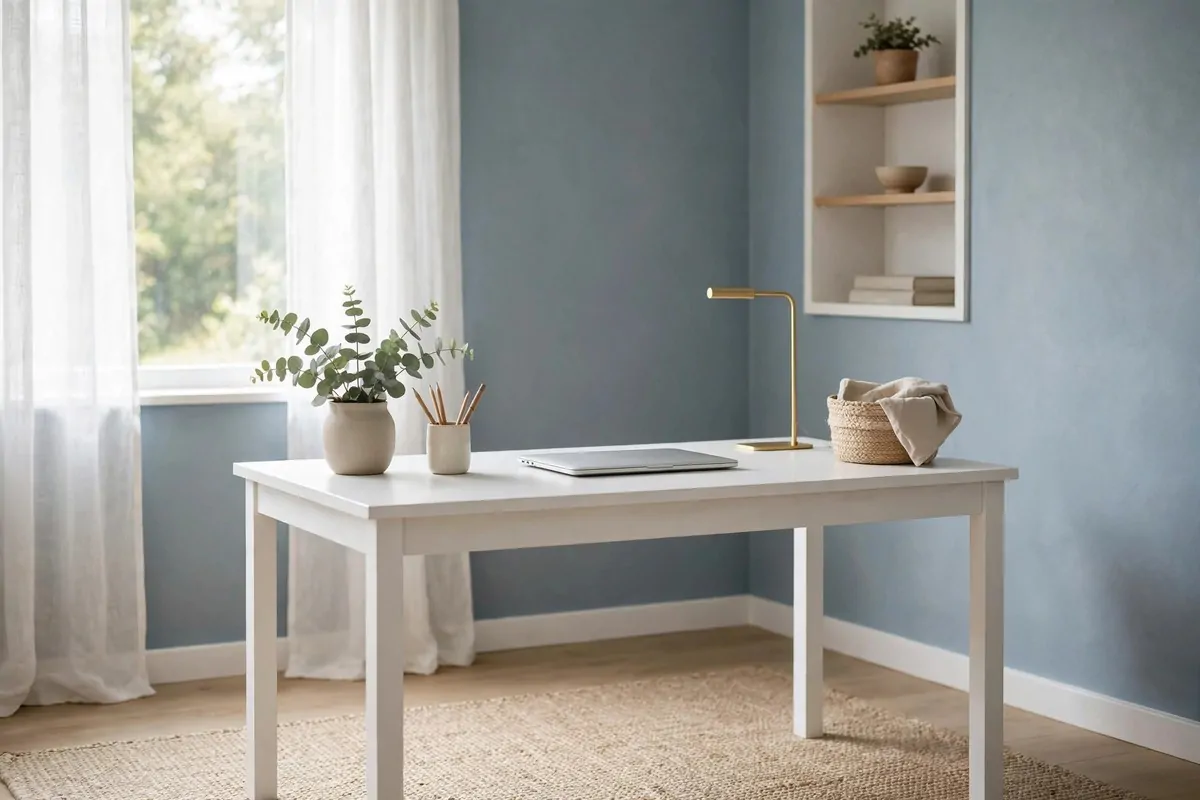
Paint is the cheapest room makeover on earth. One weekend, two cans, and your second bedroom feels like a different house.
For an office, pick calm. Soft blues. Warm grays. Pale sage green. These colors lower your heart rate a little. They make a small room feel bigger. They look good on camera too.
Avoid bright red or orange on all four walls. They are exciting for about a week. Then they are exhausting. If you love bold color, put it on one accent wall or in the accessories. Your nervous system will thank you.
Here is a quick guide I wish someone had given me before I painted my office the color of a swimming pool:
| Color | Mood it gives | Best for |
|---|---|---|
| Soft blue | Calm and focused | Deep work, long hours |
| Warm white | Clean and bright | Small dark rooms |
| Sage green | Grounded and easy | Creative work, reading |
| Soft gray | Neutral and tidy | Video calls, shared rooms |
Paint the ceiling white if it is not already. A white ceiling bounces light down and makes the room feel taller. It is a small job when you are already painting.
Test the color on the wall first. Paint a big square and look at it morning, noon, and night. Colors change with light. The perfect gray at noon can look purple at dusk. Ask me how I know.
Guests notice paint more than furniture. A freshly painted room feels clean and cared for even with simple furniture. If your second bedroom looks tired, paint is the fastest fix.
One wall is enough if you are short on time. The wall behind the desk. It frames your work zone and your video background in one move.
15. Grow a Plant Shelf Above the Desk
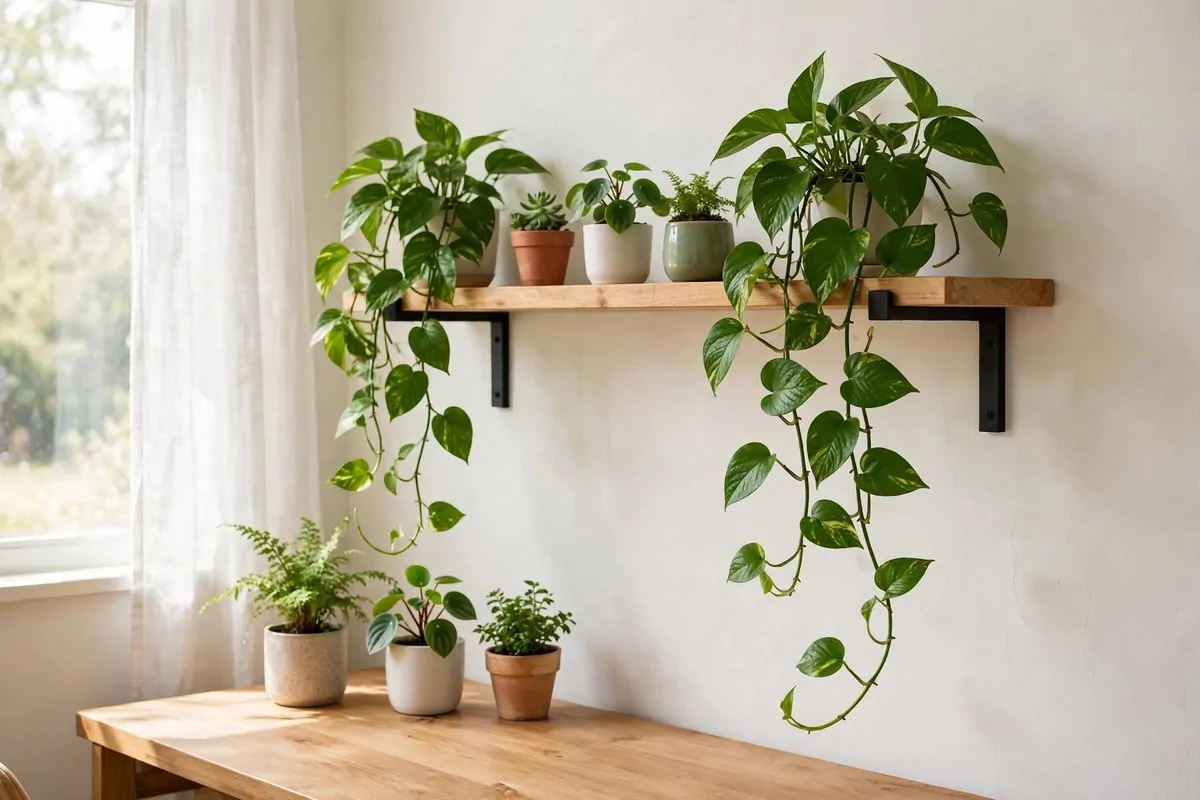
Plants are the cheapest coworkers you will ever have. They do not talk. They do not send emails. They just sit there being green and making your office feel alive.
A shelf above the desk is the best spot for them. It keeps plants off your work surface. It puts green right in your line of sight when you look up. And trailing plants hanging down soften the hard edges of shelves and monitors.
Pick plants that forgive you. Pothos. Snake plant. ZZ plant. These survive low light, missed waterings, and general neglect. I have killed fancier plants. These three have survived everything, including a two week holiday.
The shelf should be shallow. Eight to ten inches deep. Deep enough for pots, not so deep it hangs over your head. Mount it into studs. Wet soil is heavy, and a shelf of plants falling on your keyboard is a bad Monday.
Water on a schedule. I water mine every Sunday. Same day, same routine. Plants die from random love more than from neglect. Pick a day and stick to it.
Guests like plants too. A room with living green feels cared for. A room with dead brown plants feels sad. If you cannot keep them alive, good fake plants are fine. Nobody will check.
Keep leaves off your papers. Trailing vines are pretty until they knock your coffee over. Trim them. A little haircut every month keeps the shelf neat and the plants bushy.
One plant is fine. Three is lovely. Ten is a hobby. Know which one you are signing up for.
16. Layer Three Kinds of Light
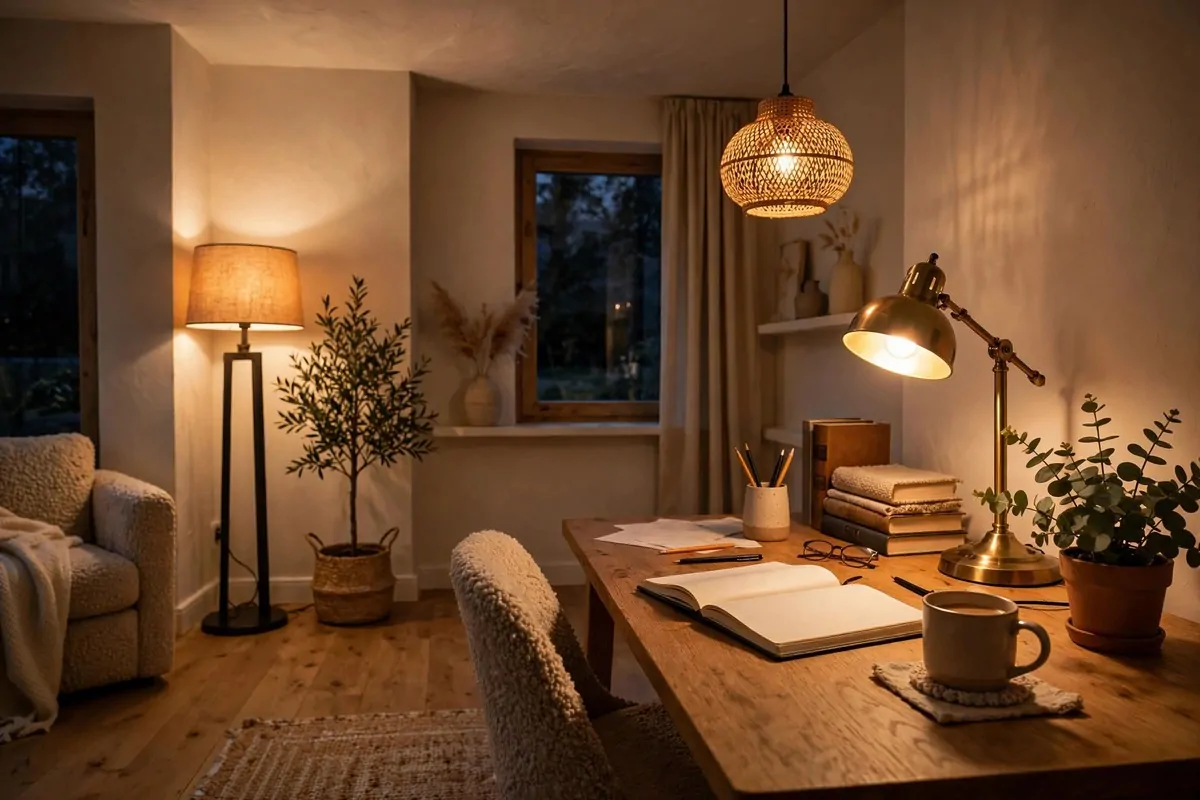
One overhead light is the enemy of a good office. It is flat. It is harsh. It makes you look tired on camera and feel tired in real life.
You need three layers. Overhead for general light. A desk lamp for task light. A floor lamp or wall light for warm ambient glow. Together they make a small room feel deep and comfortable.
The desk lamp is the workhorse. Get one with an adjustable arm. Aim it at your work, not at your face. A lamp with warm white light, around 3000K, is easy on the eyes for long days.
The floor lamp is the mood maker. Put it in a corner behind you or beside the reading nook. Turn it on in the late afternoon. That warm pool of light tells your body the day is winding down even while you finish up.
Overhead light should be the one you use least. If your ceiling light is a harsh white panel, swap the bulb for a warm one. Or put it on a dimmer. A dimmer switch costs little and changes everything.
Guests need the layers too. A guest reading in bed wants the warm lamp, not the interrogation light from the ceiling. Give them a bedside lamp with its own switch. They will feel at home faster.
Check your lighting on camera. Sit at your desk and look at your video preview. If your face is half dark, move the desk lamp closer to your face side. Good lighting on calls is not vanity. It is clarity.
I run my lights on a smart plug schedule. Desk lamp on at 8. Floor lamp on at 4. All off at 7. The room manages itself and my evenings feel like evenings.
17. Lay a Rug to Split the Room
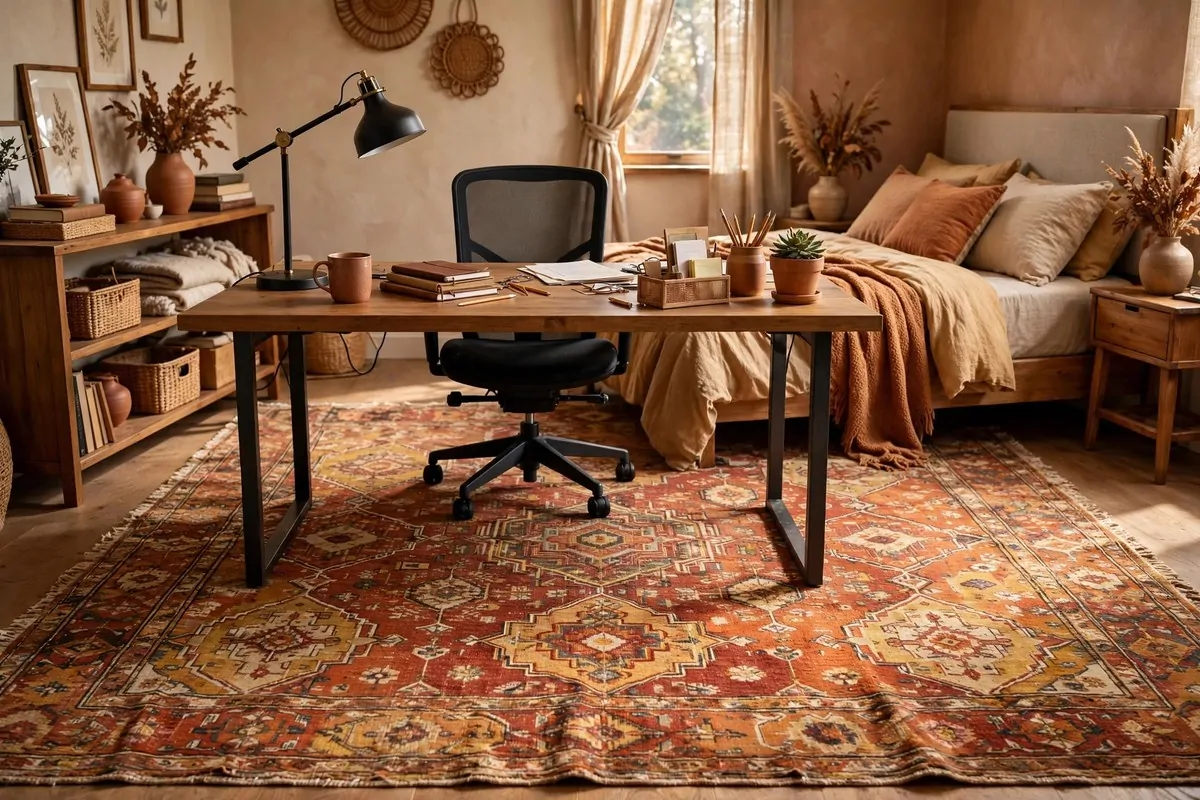
A rug is a room divider you can roll up. In a second bedroom office, it draws the line between work and rest without a single wall.
Put a large rug under the desk and chair. The work zone now has a border. Your chair rolls on the rug. Your feet land on soft instead of cold floor. When you step off the rug, you have left work. It is a small ritual, but rituals work.
Size matters. The rug should be big enough for the desk and the chair to sit on fully, even when you push the chair back. A rug that is too small looks like a bath mat lost in a bedroom. Go bigger than you think.
A rug also eats sound. Hard floors bounce noise around a small room. A thick rug soaks it up. Your calls sound better. Your footsteps do not echo. Guests sleeping over hear less of the house.
Pick a pattern that hides life. A flat light rug in an office shows every crumb and pen mark. A patterned rug in warm tones hides the small messes of daily work. I learned this after a year with a white rug. Never again.
Low pile is better for office chairs. Thick shag grabs chair wheels and makes every push a workout. A flat weave or low pile rug lets the chair glide.
The rug also warms the room for guests. Bare floors feel cold at night. A rug underfoot when they get out of bed is a small kindness they will remember.
Wash it or shake it out twice a year. Office rugs collect dust fast. A clean rug makes the whole room smell and feel fresher.
18. Build Storage Up to the Ceiling
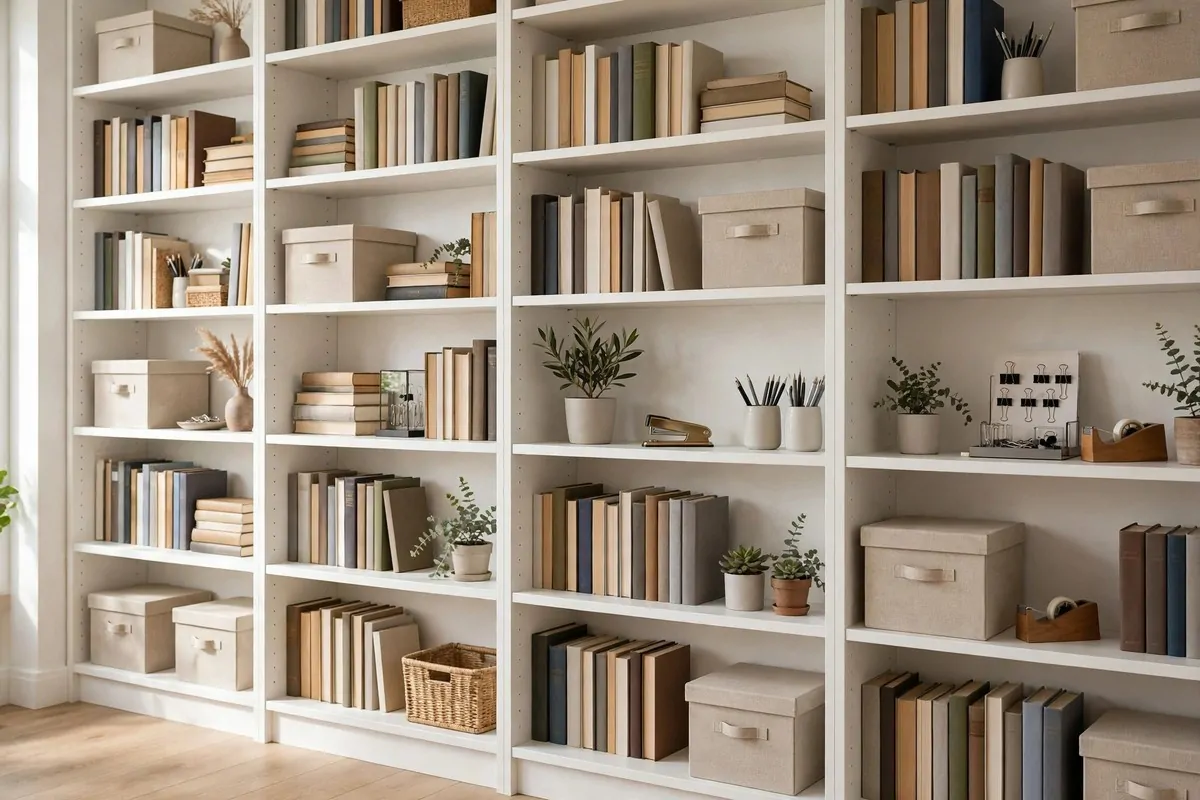
The walls are the biggest unused space in a small room. Floor space is precious. Wall space is free. Use it all the way up.
Floor to ceiling shelves turn one wall into a storage tower. Books. Boxes. Files. The printer paper. Guest linens on the top shelf. Everything has a place and the floor stays clear for living and working.
I built mine from two tall bookcases side by side. Same color, same height. They read as one built in unit. The top shelf holds things I touch twice a year. The middle shelves hold daily stuff at arm’s reach.
Put the heavy stuff low. Books on the bottom shelves. Light boxes up top. A top heavy shelf is a tipping risk. Anchor every tall unit to the wall. This is not optional with kids or earthquakes or clumsy adults.
Use matching boxes on the open shelves. Cardboard is fine if it matches. Ten matching boxes look intentional. Ten random boxes look like a storage unit. I bought a pack of same size boxes and my shelves went from chaos to calm in an hour.
Label the fronts. Small labels, honest words. When guests need a towel, they can find the towel box without asking you at midnight. Independence is a gift to your guests.
Leave some breathing room. Do not pack every shelf edge to edge. A little empty space makes shelves look styled instead of stuffed. The rule I use is one empty spot per shelf. It gives the eye a rest.
The very top is for the beautiful and the rarely used. A basket. A plant that likes being high. The holiday decorations. Out of the way but not forgotten.
19. Let the Guest Bed Be Your Lunch Sofa
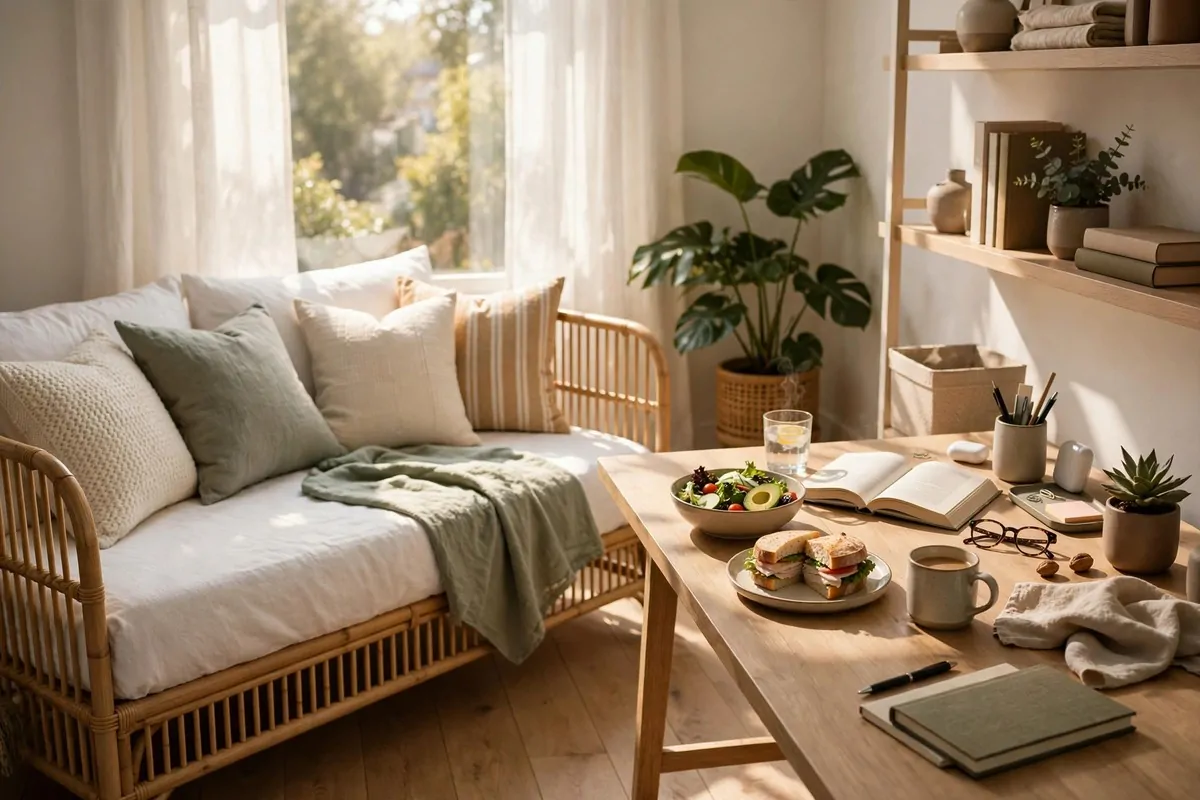
Here is a confession. I eat lunch on my guest bed almost every day. And it is wonderful.
A daybed dressed like a sofa is the best lunch spot in the house. You leave the desk. You sit somewhere soft. You look out the window instead of at a screen. Twenty minutes there and the afternoon feels new.
This is why the daybed earns its place in a working office. It is not just for guests. It is your break room. Your thinking couch. Your phone call spot when you want to pace without pacing.
Keep a small tray on the daybed for lunch. A tray protects the bedding from crumbs and spills. It also makes the moment feel intentional. You are having lunch. Not just eating at a desk sideways.
Change the throw with the seasons. Light cotton in summer. Chunky knit in winter. It takes two minutes and the room feels new. Guests notice fresh textiles. It signals that someone cares about this room.
The daybed is also where you read the long stuff. Reports. Books. The article you saved three weeks ago. Sitting upright at a desk, long reading feels like work. Curled on a daybed, it feels like learning.
Keep work off the bed during work hours. This is the rule that makes it work. The bed is for breaks and for guests. If you start working from the bed, the whole system collapses and your back will file a complaint.
When guests arrive, strip the lunch crumbs, shake the throw, and add the good pillows. The bed goes from your break room to their bedroom in five minutes. That is a room working hard.
20. Tame the Cables for Good
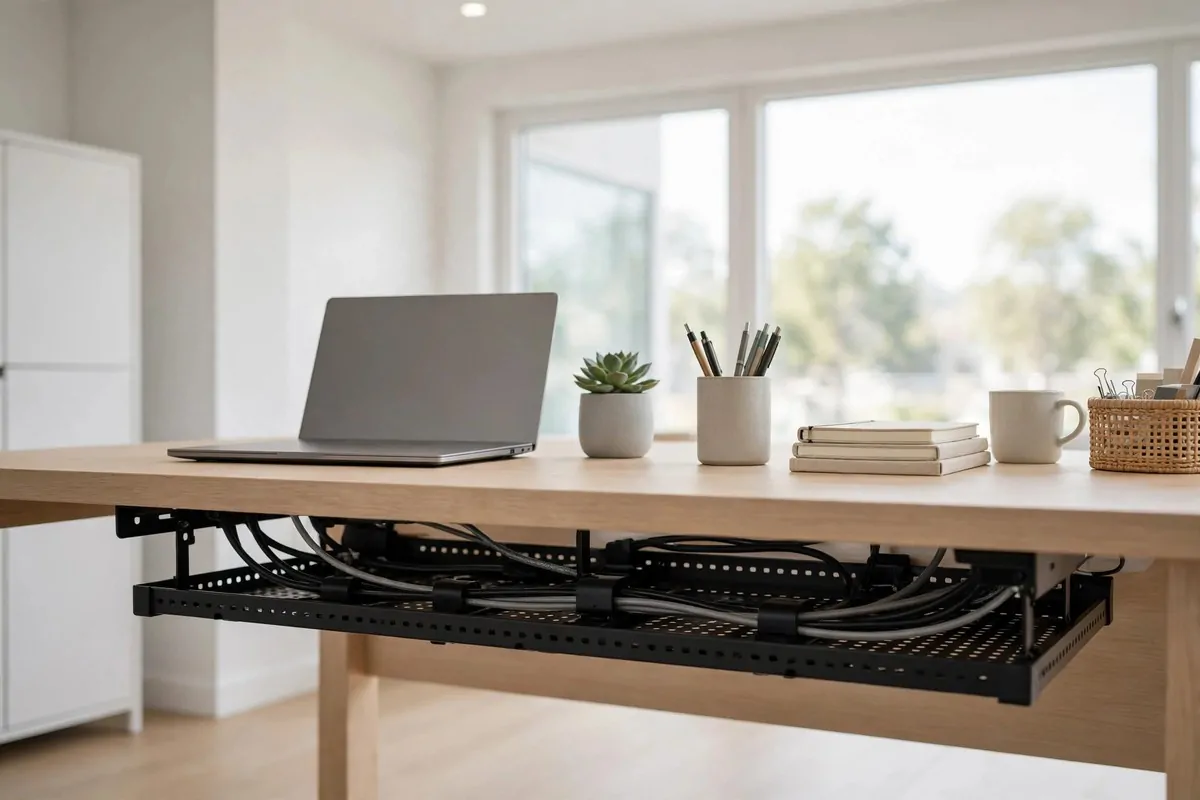
Cables are the visual noise of a home office. You do not notice them until they are gone. Then the room feels twice as clean.
Start with a cable tray under the desk. It screws to the underside and holds the power strip, the chargers, and the loops of extra wire. Everything hangs under the desk instead of pooling on the floor.
I did mine on a Sunday afternoon. It took an hour. I unplugged everything, routed it neatly, and plugged it back. The before and after felt like a magic trick. The floor under my desk went from spaghetti to empty.
Use velcro ties, not zip ties. Velcro lets you add or remove a cable later. Zip ties have to be cut. You will change something within a month. Everyone does.
Label both ends of each cable. Little tags that say “monitor” and “lamp.” When something stops working at 9 pm, you will thank yourself. Tracing mystery cables in the dark is a special kind of misery.
Run one cable down to the wall outlet. Just one visible line. Use a cable cover that sticks to the wall or the desk leg. Paint it the wall color. It disappears.
Guests trip on cables. This is a safety thing, not just a looks thing. A guest walking to the bathroom at night should not navigate a wire maze. Tidy cables are hospitality.
Charge your devices in the closet or on the cart, not across the floor. Every cable that crosses open floor is a future accident. Keep the walkways clean and the room feels bigger and safer.
Once a year, unplug everything and redo it. Cables creep. New devices arrive. An annual reset keeps the system working. Put it on the calendar for spring cleaning.
21. Add Small Things That Feel Like You
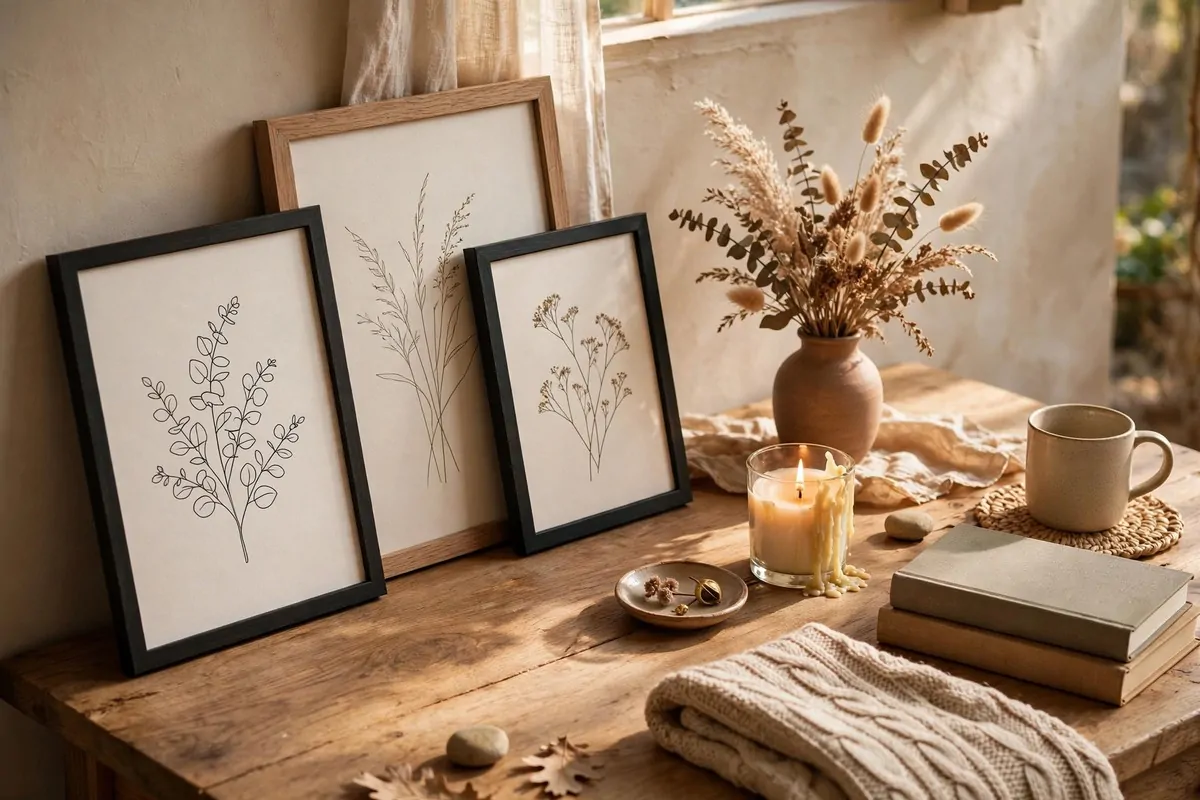
An office can be perfect and still feel dead. The difference between a workspace and your workspace is the small personal stuff.
A framed photo of people you love. A weird souvenir from a trip. A candle you light when the day is done. These things are not decoration. They are reminders of why you work.
I keep a small stone on my desk from a beach trip. It does nothing. It holds no papers. But when a hard email lands, I pick it up for a second. It grounds me. Everyone needs a grounding object.
Do not overdo it. Five personal items is plenty. Ten is clutter. Pick the ones that make you smile without thinking. If you have to explain why it is there, it might not belong on the desk.
Rotate them. Swap a photo every few months. Put the summer souvenir away in winter. Fresh small things keep the desk feeling alive. It is a tiny ritual that costs nothing.
Guests read your personal things. A photo of your family makes a guest feel they are in a home, not a hotel. A guest room with zero personal touches feels like an Airbnb. Yours should feel like you live here, because you do.
Keep the personal stuff off the camera background if it is very private. A photo of your kids is lovely in person. On a work call with strangers, maybe angle it away. You get to choose what the world sees.
The last thing I added to my office was a small plant my friend gave me. It is not fancy. But every time I water it I think of her. That is what a room should do. Hold your life, not just your laptop.