19 Tiny Bedroom Office Ideas That Fit Even the Smallest Room

Every morning I wake up in a bedroom so small that the door bumps against the foot of my bed when I open it.
The room is barely bigger than the bed itself. For years I worked at my kitchen table because I was sure my bedroom could never hold a real office.
The kitchen table meant cold coffee, a sore back, and my laptop sliding toward the edge every time someone opened the fridge. It was not working.
Then one Saturday I measured the strip of floor between my bed and the wall. It was 28 inches wide. That tiny strip changed everything.
I started hunting for tiny bedroom office ideas with new eyes. Not as pretty pictures. As real plans for real rooms like mine.
This list is what I found. Nineteen ideas that fit a working office into even the smallest bedroom. I tested most of them in my own shoebox of a room. Every one of them costs less than you think, and most of them take an afternoon or less.
Let us start with the one that changed my room first.
1. The Wall-Mounted Desk That Disappears at Bedtime
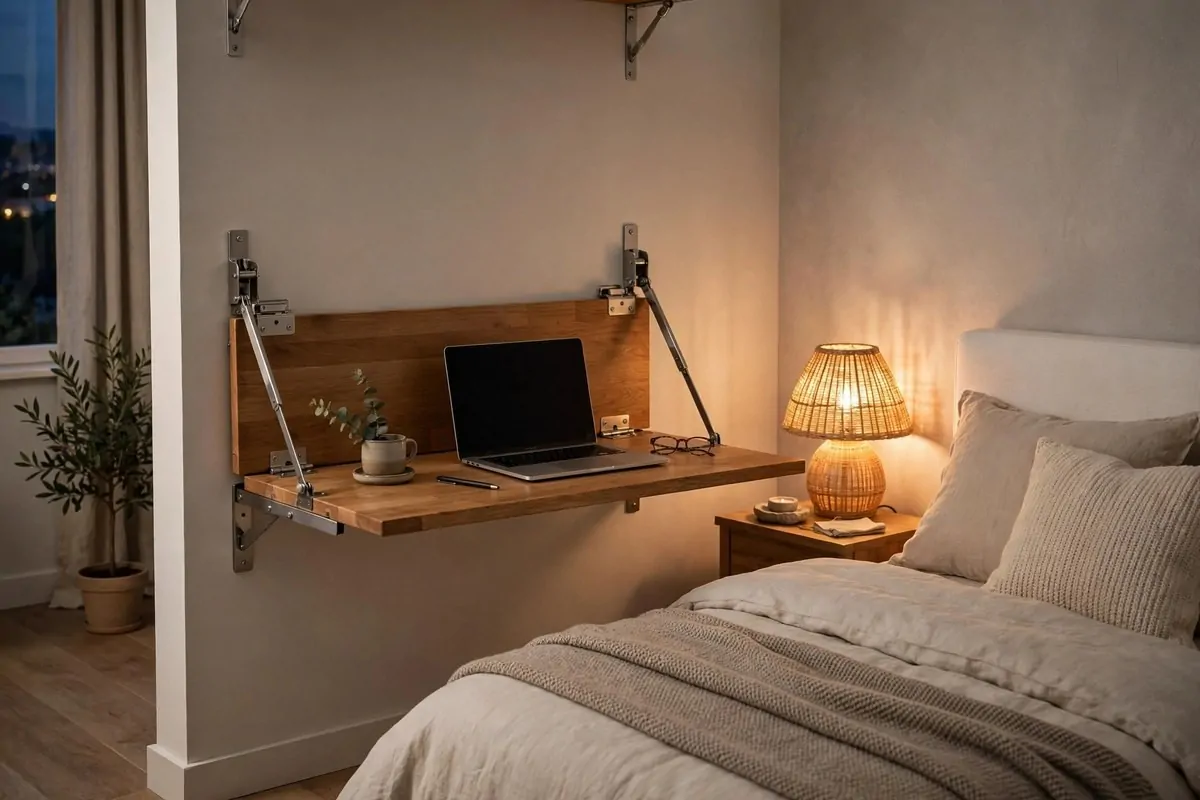
A fold-down desk is a flat board on hinges. You pull it down in the morning and fold it flat against the wall at night.
Mine is 24 inches wide. It holds my laptop, a notebook, and a mug. That is all I need for a full workday.
When I fold it up, the bedroom looks like a bedroom again. No desk staring at me while I try to sleep.
This is the single best trick for rooms under 100 square feet. It gives you a real desk and takes zero floor space.
You can buy one ready made, or you can make one from a shelf board and two strong brackets. The brackets matter more than the board.
- Measure your wall space first. Most boards come in 20 to 32 inch widths.
- Pick brackets rated for at least 50 pounds. Your elbows lean on this desk all day.
- Mount it at elbow height when you sit. For most people that is 28 to 30 inches from the floor.
- Add one small wall lamp above it. You do not want a desk lamp eating your tiny desk.
I worried mine would feel wobbly. It does not. The brackets hold firm and the board stays level.
The best part is the feeling at night. You fold it up with one push, and work is over. Your brain gets the message.
If your landlord hates holes in the wall, look for a folding table that hooks over a door instead. Same idea, no drilling.
It costs less than a cheap chair. Honestly, if you only try one idea from this list, make it this one.
2. The Corner Nobody Wanted
Every small bedroom has one corner that collects dust. A dead corner, where nothing fits and nothing happens.
That corner is your office. Seriously.
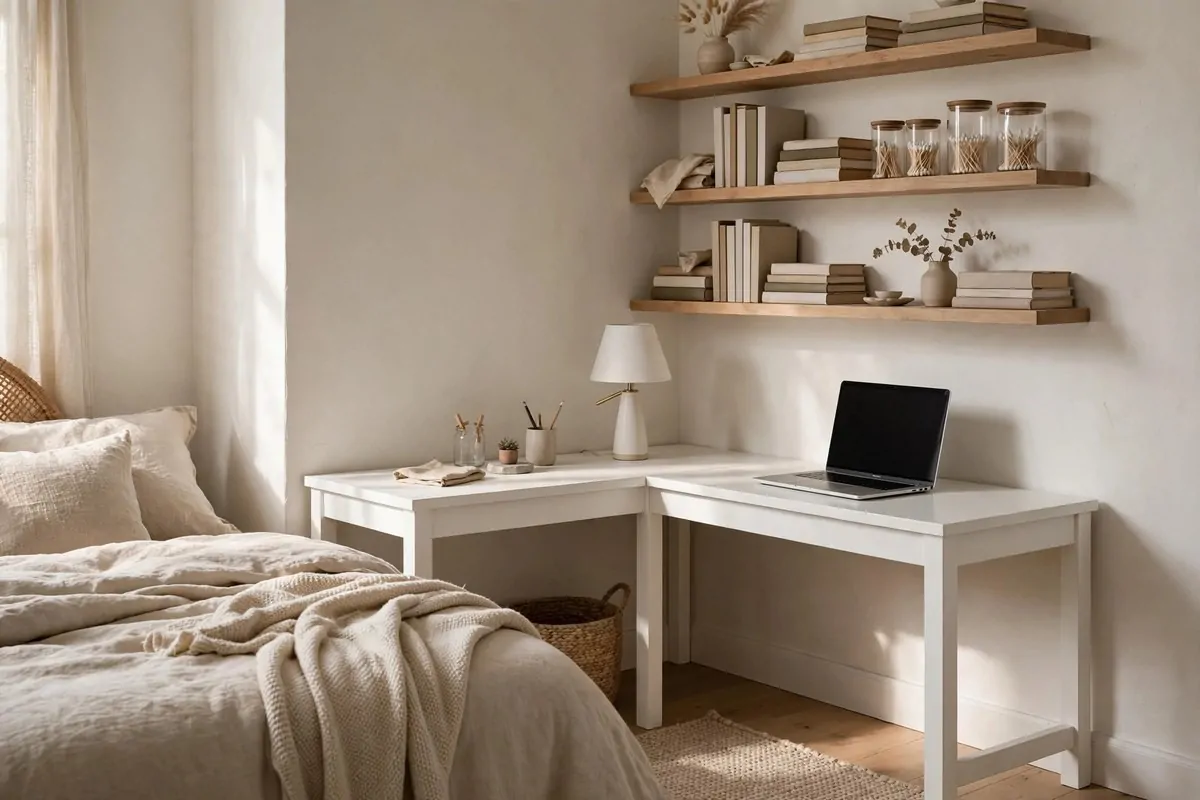
A small corner desk slides into a 90 degree angle and uses space that was doing nothing. It feels bigger than a straight desk because you get two surfaces.
I put my laptop on one side and my papers on the other. It is like having a big desk in half the room.
Corner desks work best near a window. You get light from two directions and the corner stops feeling dark.
- Look for desks made for corners, not straight desks pushed sideways. The shape matters.
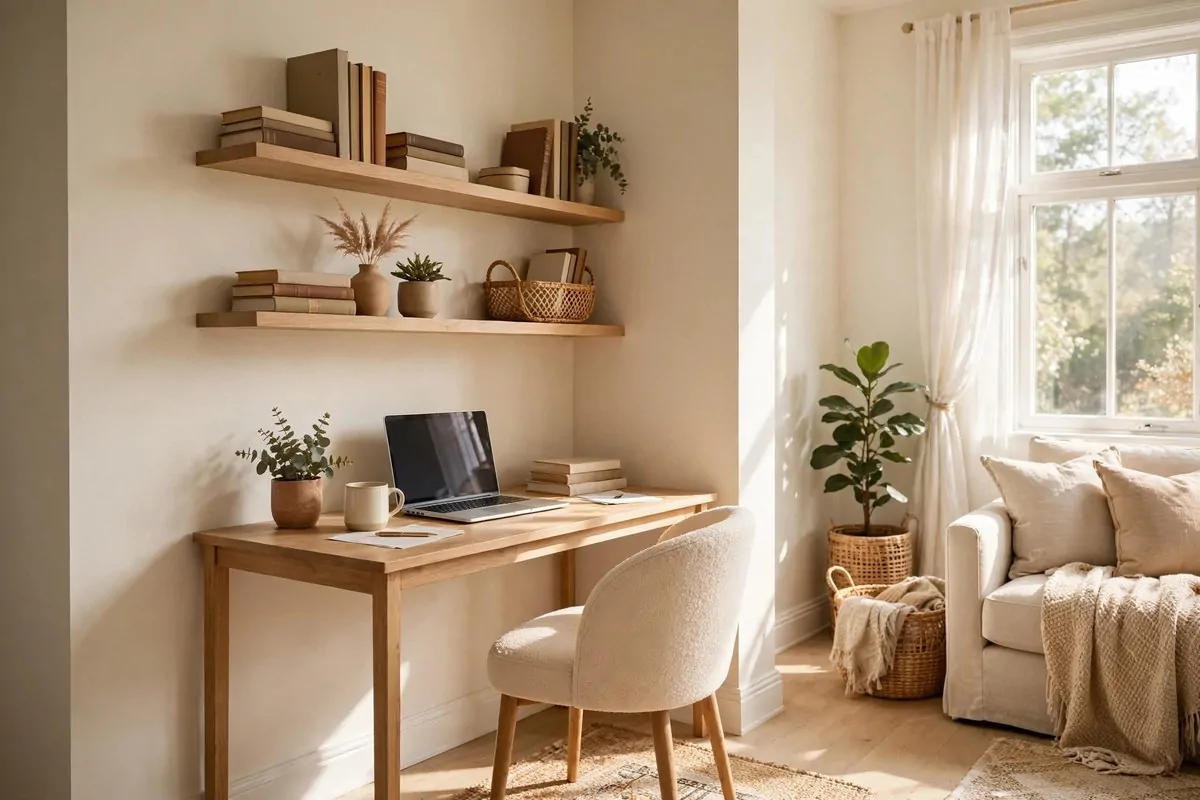
- Add floating shelves on both walls above it. That corner has a lot of vertical room.
- Keep the chair small. A big office chair in a corner gets stuck on everything.
- Tuck a power strip behind the desk leg. Cables in a corner stay hidden almost by themselves.
My corner used to hold a plant I forgot to water. Now it holds my whole workday.
The funny thing is how it changed my focus. When I sit in the corner, I face the wall. Fewer things to look at. More work gets done.
If your corner is really tight, a wall mounted triangle shelf works as a desk. Two boards, one on each wall, meeting in the middle.
Measure the corner before you buy. Corners in old houses are never perfectly square, and I learned that the fun way.
3. A Desk That Pulls Double Duty as Your Nightstand
Your bedroom already has a nightstand. It holds a lamp, a phone, and a glass of water.
That nightstand is also a desk waiting to happen.
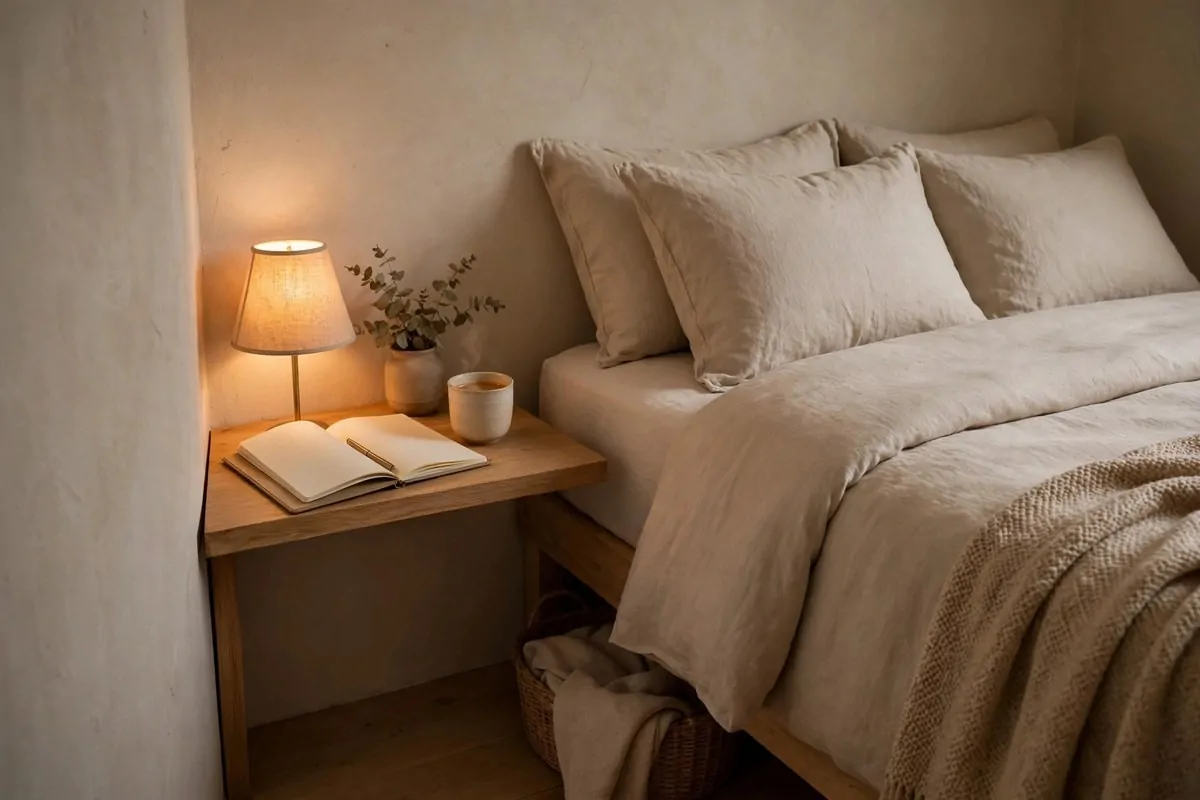
I swapped my old nightstand for a narrow desk, 16 inches deep and 30 inches wide. At night it holds my lamp and my book. In the morning I slide a chair up and it becomes my office.
You do not need two pieces of furniture when one can do both jobs. That is the whole rule of small rooms.
Pick a desk with a drawer. Your bedtime stuff goes in the drawer at 8 in the morning, and your work stuff comes out.
- A 16 inch depth is the sweet spot. Deep enough for a laptop, shallow enough to hug the wall.
- Put your lamp on the far edge. You need the near edge for your hands.
- Add a small tray for your glasses and phone. It keeps night things and work things from mixing.
- If the desk has open shelves, use one shelf for books and one for work supplies.
My room gained back almost three square feet of floor. That sounds small. In a tiny bedroom it feels huge.
Guests never notice it is a desk. It just looks like a nice nightstand with a lamp on it.
The only rule is tidiness. A nightstand can hold a messy pile of books. A desk cannot hold a messy pile of anything. I keep a small box for the daily clutter.
At 10 at night I slide the chair away, put the lamp back in the middle, and it is a nightstand again. Two seconds. Done.
4. Shelves That Climb the Wall
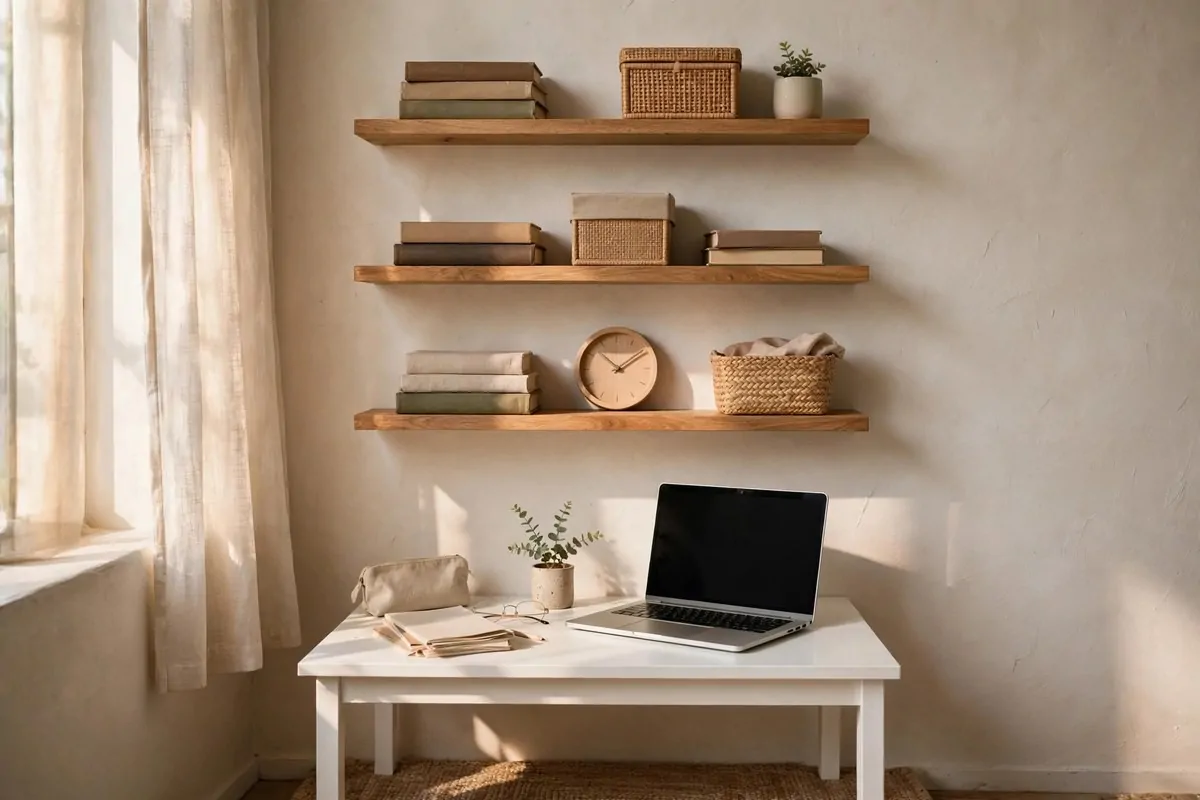
In a tiny bedroom, the floor is full. The walls are empty. That math is easy.
Three floating shelves above my desk hold everything my old bookcase used to hold. Books, folders, a small plant, and a box of pens.
They take up zero floor space. Zero. That is the magic.
Shelves draw your eye up, which makes the whole room feel taller. It is the cheapest way to fake a bigger room.
- Hang the lowest shelf about 18 inches above the desk. You need room for your head and your monitor.
- Space shelves 12 inches apart. That fits most books and boxes.
- Use closed boxes on the shelves, not open piles. Open piles look messy fast in a small room.
- Put the pretty stuff on the top shelf and the daily stuff on the bottom one.
I keep my printer paper, my notebooks, and my spare charger on the middle shelf. Everything else lives higher.
The shelves cost me less than one pizza. A few boards, a few brackets, one afternoon.
One warning. Do not overload them. Floating shelves sag if you stack too many books on one board. Spread the heavy stuff out.
My favorite shelf is the top one. It holds a tiny plant and a framed photo. It makes the office corner feel like mine, not like a cubicle.
When your floor is full, build up. The wall is free real estate.
5. A Pegboard That Replaces a Whole Drawer Unit
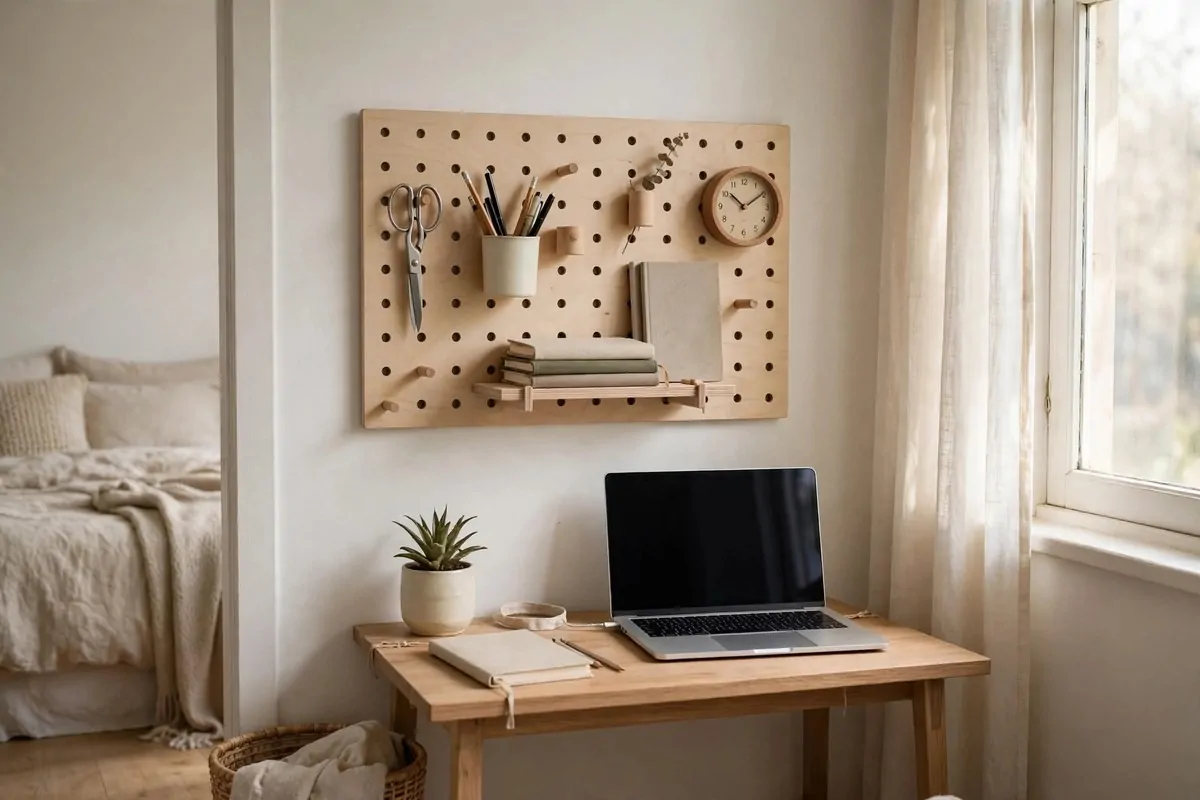
A drawer unit is 18 inches deep and eats floor space. A pegboard is half an inch thick and eats wall space.
That trade is a win in every tiny bedroom.
My pegboard hangs right above my desk. It holds my scissors, my pens, my headphones, a small shelf for notebooks, and a clip for my to-do list.
Everything is visible and within reach. I never dig through drawers anymore.
- Get a board at least 24 inches wide. Small boards fill up fast.
- Buy a hook kit with cups, clips, and small shelves. The board alone is not enough.
- Arrange it like a map. Things you grab daily go in the middle, rare things go on the edges.
- Paint it the same color as your wall. It blends in and looks calm instead of busy.
I rearranged mine three times in the first week. That is the point. It is not fixed furniture. It changes with your needs.
The board also works as decor. Mine has a little photo, a dried flower, and a funny postcard. It looks like a Pinterest board made of real things.
Cost is tiny. A board and hooks run less than a drawer unit, and you can take it down when you move.
If you share the room, a pegboard is polite. It keeps your stuff on your wall, not spilling onto shared surfaces.
I wish I had done this years ago. My desk drawers are almost empty now, and my desk finally stays clear.
6. The Window Desk With Free Light All Day
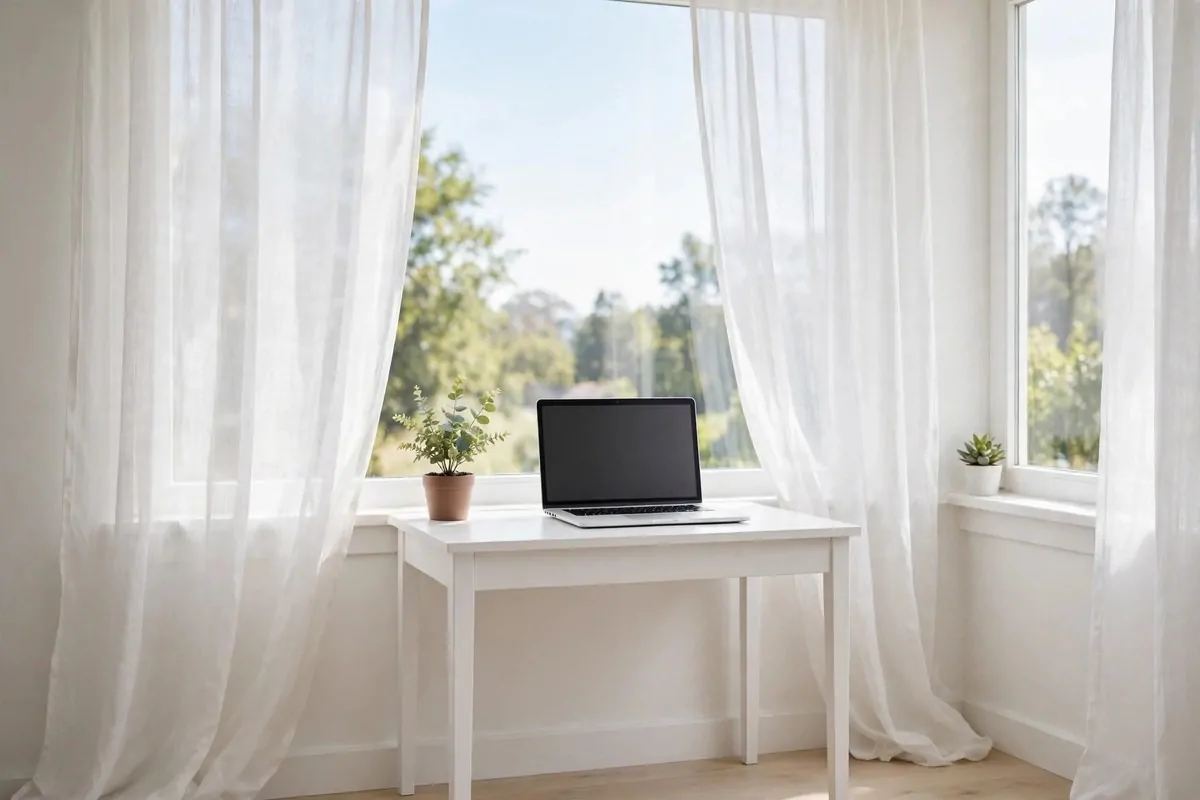
A desk under a window gets the best light in the house for free. No lamp needed until evening.
I moved my desk to the window wall last spring. My eyes stopped hurting by 3 in the afternoon. The screen glare went down too.
Natural light keeps you awake better than coffee. That is not a quote from a poster. It is what happened to me.
The trick is facing the window, not sitting with your back to it. Your face gets the light and your screen stays readable.
- Put the desk as close to the window as the wall allows. Every inch closer means more light.
- Add sheer curtains. They soften harsh sun without making the room dark.
- Keep the windowsill clear. It becomes bonus desk space for your plant or your tea.
- Watch for afternoon glare in summer. A cheap blind fixes it in five minutes.
My window desk is the prettiest spot in my room now. Rain on the glass, sun in the morning, and I get all of it while I work.
One small problem. Windows can be cold in winter. I put a draft stopper along the bottom of the frame and it stopped.
If your window is high, raise the desk on blocks or use a stool. Do not hunch down to a low desk all day.
This idea costs nothing if you already have a desk. You just slide it over. Free ideas are my favorite kind.
7. A Curtain That Splits the Room in Two
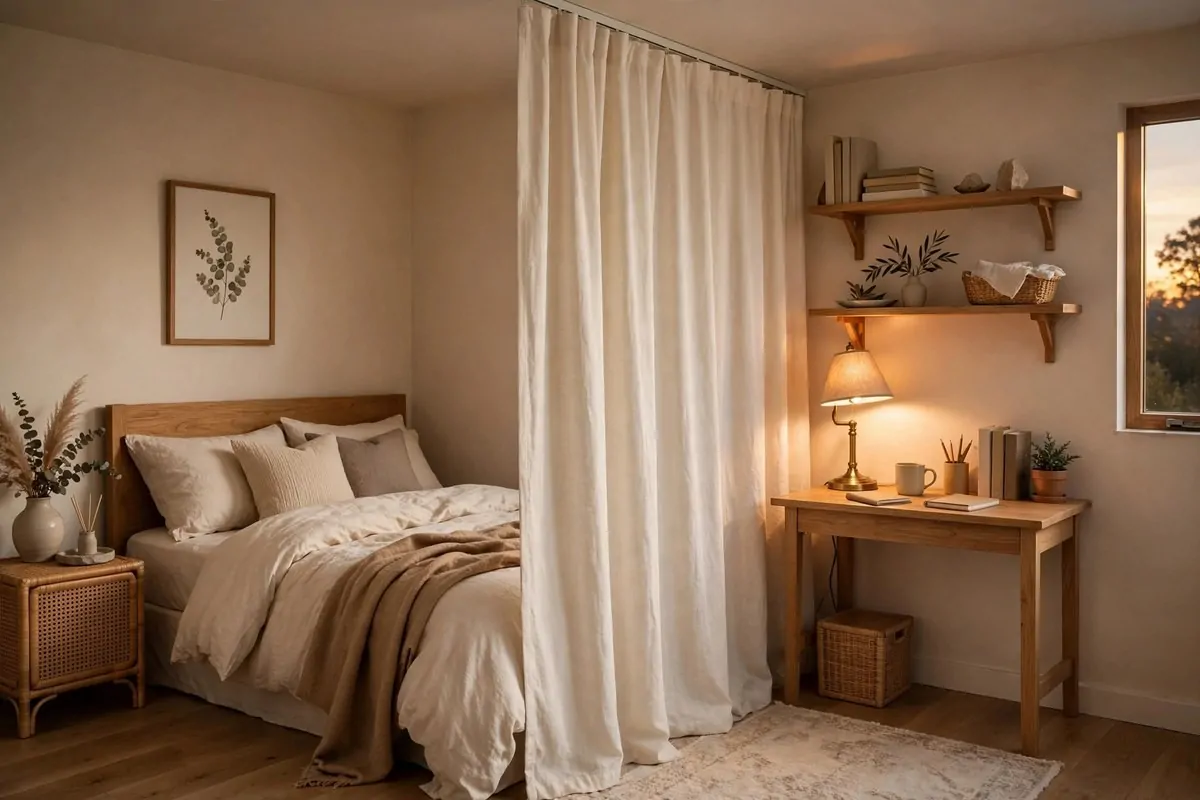
Working where you sleep is hard. Your brain sees the bed and wants a nap. Your brain sees the desk and thinks about email at midnight.
A curtain fixes this. It is a wall you can open and close.
I hung a ceiling track and a cream curtain between my bed and my desk. At 9 in the morning I pull it open. At 6 in the evening I pull it shut.
That one pull tells my brain the workday is over. It sounds silly. It works.
- Use a ceiling track, not a tension rod. Tracks glide smooth and hold heavier fabric.
- Pick a light fabric. Heavy curtains make a small room feel like a cave.
- Hang it as close to the ceiling as you can. It makes the ceiling look higher.
- Leave a small gap at the bottom. It lets air move and keeps the room fresh.
The curtain also hides my desk mess on weekends. Guests see a clean bedroom. They never know an office hides behind the fabric.
It doubles as a photo backdrop for video calls. Plain cream fabric looks professional on camera.
I paid less for the track and curtain than for one month of coffee shop work. And I use it every single day.
If you cannot drill into the ceiling, a freestanding clothing rack works. Hang the curtain from the rack. Same effect, no holes.
This is the closest thing to having two rooms. I recommend it to everyone with a bedroom office.
8. A Rug That Draws the Office Line
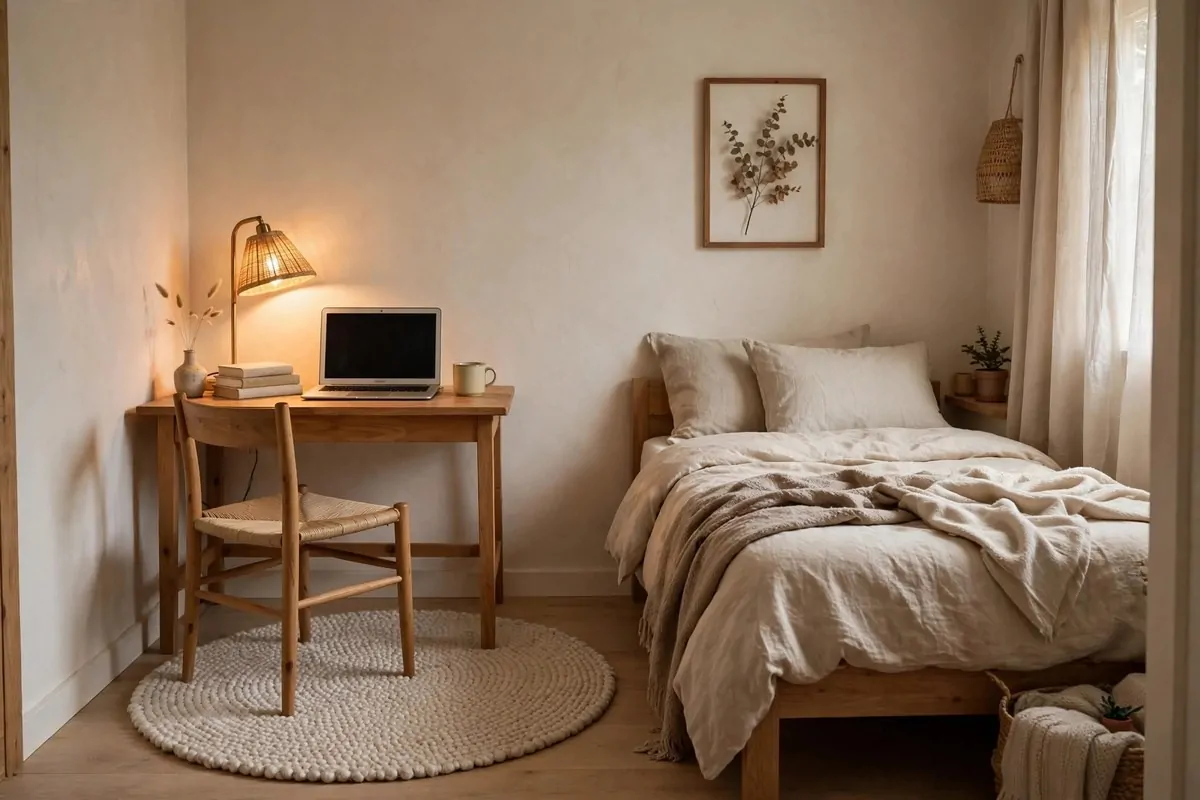
You do not need a wall to separate work from rest. A rug does the job.
My office rug is round, about four feet across. It sits under my desk and my chair. When my chair rolls onto the rug, I am at work. When I step off it, I am home.
That sounds like a game. It kind of is. And my brain plays along.
Rugs also warm up the room. Bare floors in a bedroom office feel cold and loud. A rug softens the sound and the mood.
- Pick a rug big enough for the chair to roll on. Measure your chair plus one foot on each side.
- Low pile works best. Thick rugs eat chair wheels.
- Choose a different color from your bedroom rug or bedding. The contrast marks the zone.
- Washable rugs are worth it. Office zones collect crumbs and coffee drips.
Mine is a flat weave in a warm pattern. It cost little and it changed how the room feels.
The rug also protects the floor. Chair wheels scratch wood floors fast. A rug stops that completely.
I vacuum it on Sundays. Two minutes. It keeps the work zone feeling fresh for the new week.
If your floor is carpet, use a flat mat instead of a rug. A thin desk mat marks the zone just as well.
Small rooms run on visual tricks. This is one of the easiest ones you will ever try.
9. A Bed With Drawers That Swallow the Mess
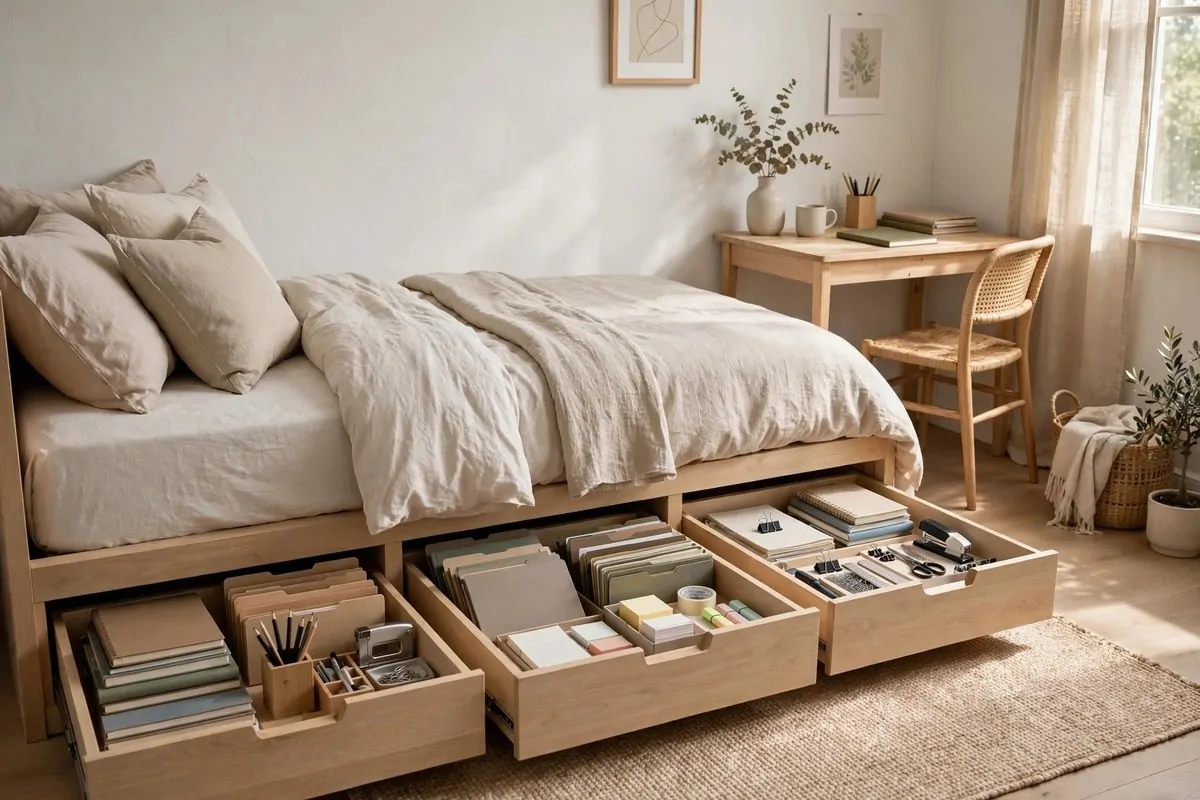
A bedroom office has one big enemy. Clutter. Papers, cables, chargers, and notebooks pile up fast in a small room.
Under bed drawers eat all of it.
My bed has four deep drawers. Two hold clothes. Two hold office stuff. The office drawers are my filing cabinet, my supply closet, and my junk drawer, all hidden under the mattress.
Nobody sees them. The room always looks clean.
- Use drawer dividers or small boxes inside. Deep drawers turn into black holes without dividers.
- Label one drawer for daily supplies and one for archives. You will thank yourself later.
- Keep a small caddy on the desk for the day’s stuff. Refill it from the drawers each morning.
- Vacuum under the bed monthly. Dust loves drawer beds.
If your bed has no drawers, rolling under bed boxes work the same way. They slide in and out and cost very little.
I keep my tax papers, my spare cables, and my old notebooks under there. Things I need sometimes but not daily.
The best part is the evening reset. I sweep everything off the desk into the drawers, and the office disappears in two minutes.
Small rooms punish clutter. Big drawers forgive it. Get the drawers.
One tip. Do not store heavy things in the middle drawers. They get hard to pull out when the bed sags in the middle.
10. The Daybed That Works Like a Sofa
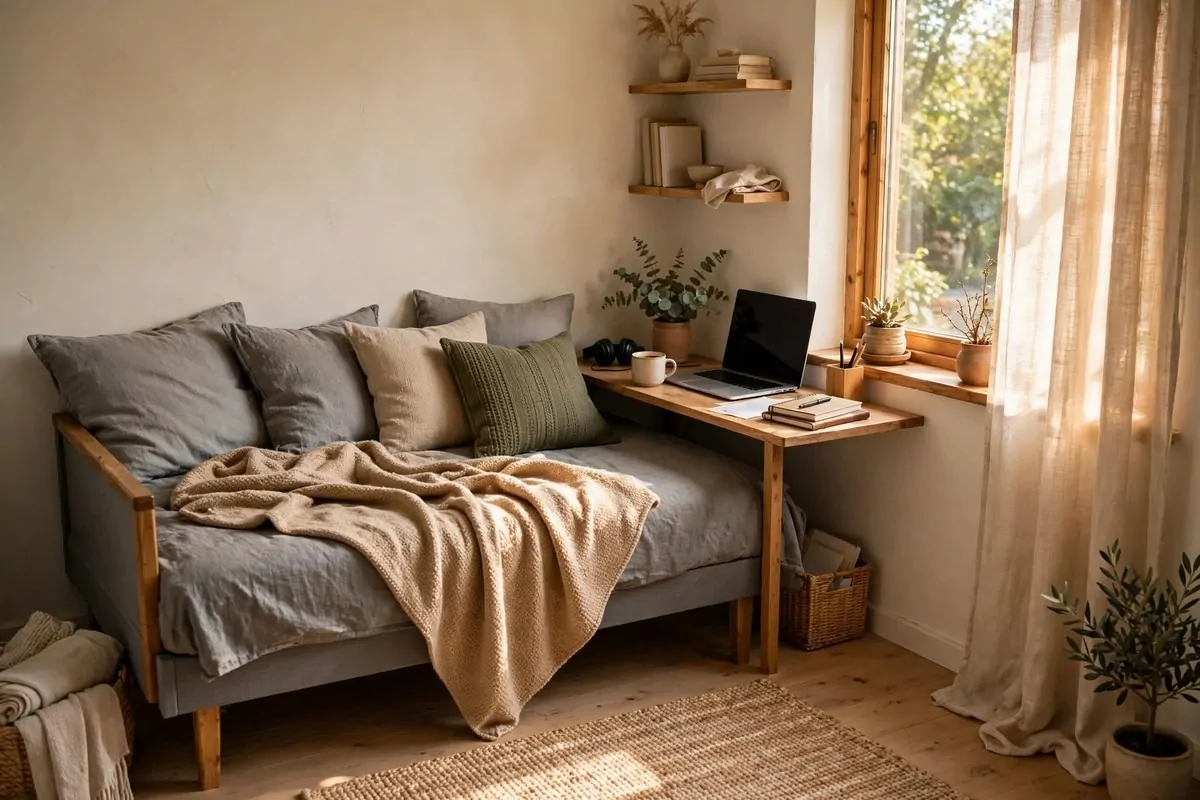
A daybed is a bed that looks like a sofa. By day you sit on it. By night you sleep on it.
For a bedroom office, that is perfect. It is your chair, your reading spot, and your bed in one piece of furniture.
I worked from my daybed for a month with a lap desk. Then I added a small side desk for serious work. Now the daybed is my thinking spot.
When I need to read or plan, I sit on the daybed with my notebook. When I need to type, I move to the desk. Two work spots in one tiny room.
- Dress it like a sofa, not a bed. Throw pillows and a folded blanket change the whole look.
- Add a small side table for your tea and your phone. It makes the spot feel finished.
- Use a firm mattress. Soft ones wreck your back during long reading sessions.
- Keep one end clear for sitting up. Do not pile all the pillows on one side.
Daybeds are also great for video calls. You sit up against the pillows and the background looks neat and styled.
My daybed is where I do my best thinking. Something about sitting sideways with my feet up helps ideas come.
If a daybed is too big for your room, a twin bed pushed against the wall does the same job. Push it into the corner and pile the pillows along the wall.
This idea is for people who think in more than one position. Desk for doing, daybed for dreaming. Both in the same small room.
11. A Rolling Cart Office That Parks Anywhere
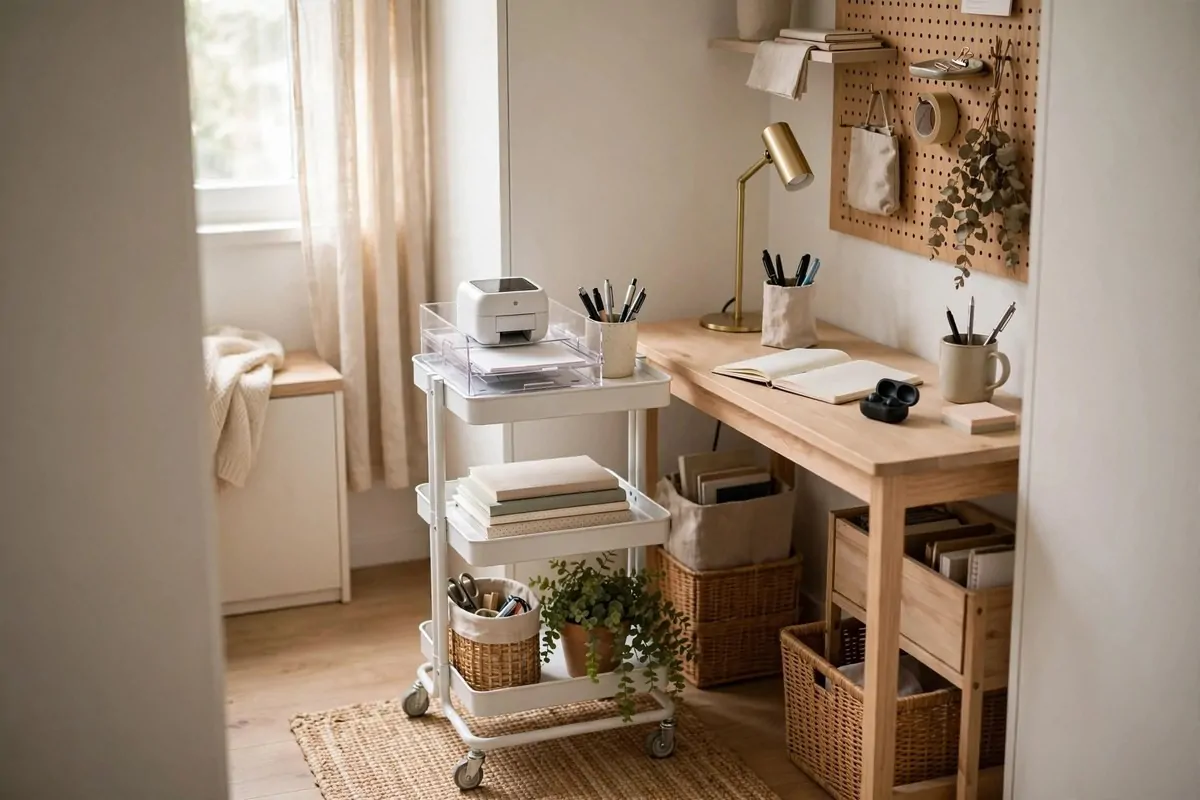
Some days I work at the desk. Some days I work in bed. Some days I work by the window with my feet on the radiator.
A rolling cart follows me everywhere.
My cart has three tiers. The top holds my laptop stand and my current notebook. The middle holds pens, chargers, and sticky notes. The bottom holds my files and my headphones.
When I sit at the desk, the cart parks beside it. When I move, it rolls with me. My whole office has wheels.
- A three tier cart is the standard size. It fits in almost any corner.
- Put the heavy stuff on the bottom tier. It keeps the cart from tipping.
- Add small cups and trays on each tier. Loose items fall off when you roll.
- Lock the wheels when you park. A rolling office is funny until it rolls away mid call.
The cart cost me less than a desk lamp. It is the cheapest office upgrade I own.
It also works as a side table, a nightstand, and a snack station. I have used it for all three in one day.
When guests come, I roll the cart into the closet. The office vanishes. The room looks like a normal bedroom.
If your room is carpeted, get a cart with bigger wheels. Small wheels get stuck on thick carpet.
I call it my office on wheels. It is the most useful piece of furniture I own, and it fits in a space smaller than a laundry basket.
12. The Slim Console Desk Behind Your Headboard
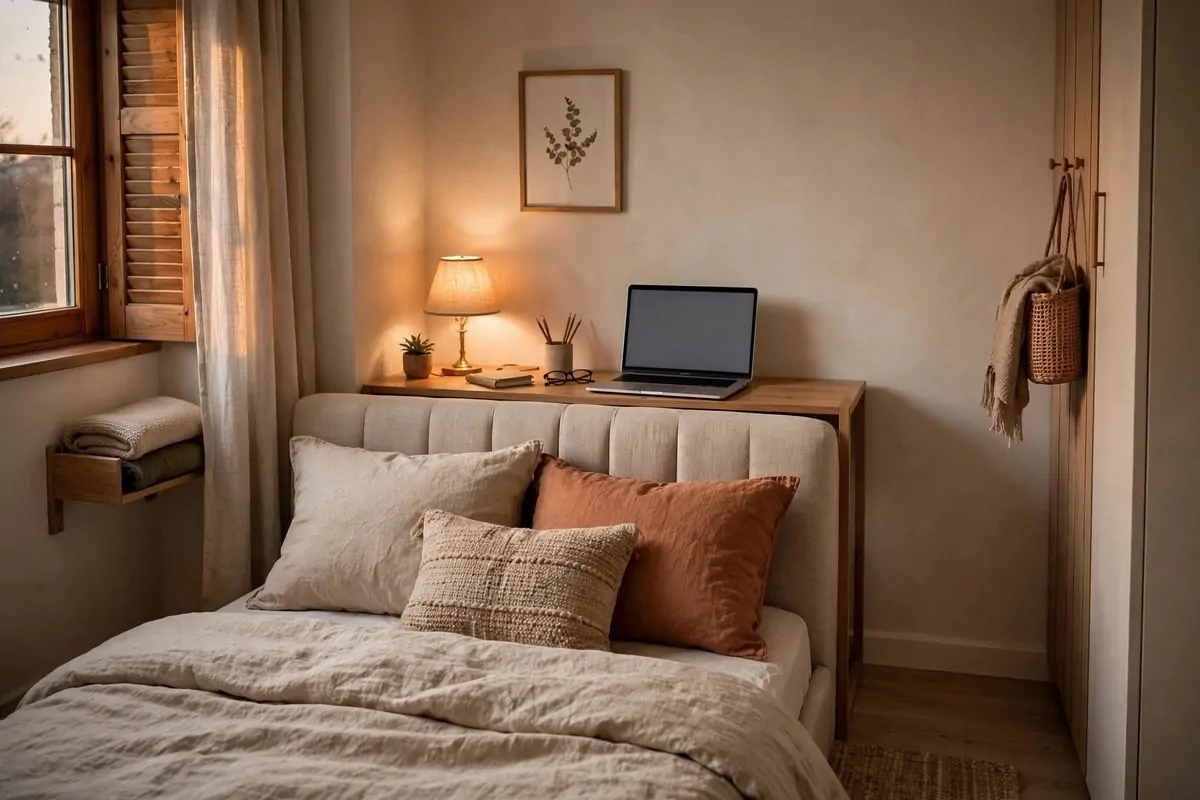
The space behind your headboard is dead space. Nobody sees it. Nobody uses it.
I put a slim console table there, 10 inches deep. It runs the width of my bed. It is my standing desk, my bookshelf top, and my charging station.
I stand at it for short tasks. Emails, quick calls, sorting mail. It keeps me off the chair for part of the day.
- A 10 to 12 inch depth is enough for a laptop and a mug. Deeper tables waste the space.
- Add a power strip along the back edge. It becomes the charging spot for the whole room.
- Use the surface for things you grab standing up. Keys, wallet, tomorrow’s bag.
- Keep a small stool nearby if you want to sit sometimes. Perching counts as sitting.
My headboard is low, so the table peeks over it a little. It looks like a shelf behind the bed. Nobody guesses it is a desk.
This is the best idea for people who work in short bursts. You walk up, you do the thing, you walk away.
The table also holds my alarm clock, my water, and my book at night. It is a nightstand and a desk and a shelf in one.
Cost is low. Console tables are everywhere, new and used. Mine came from a thrift store for almost nothing.
If your bed is against the wall, this trick does not work. But if you have even six inches behind the headboard, try it. It is free space you already own.
13. A Tall Bookcase That Acts as a Divider
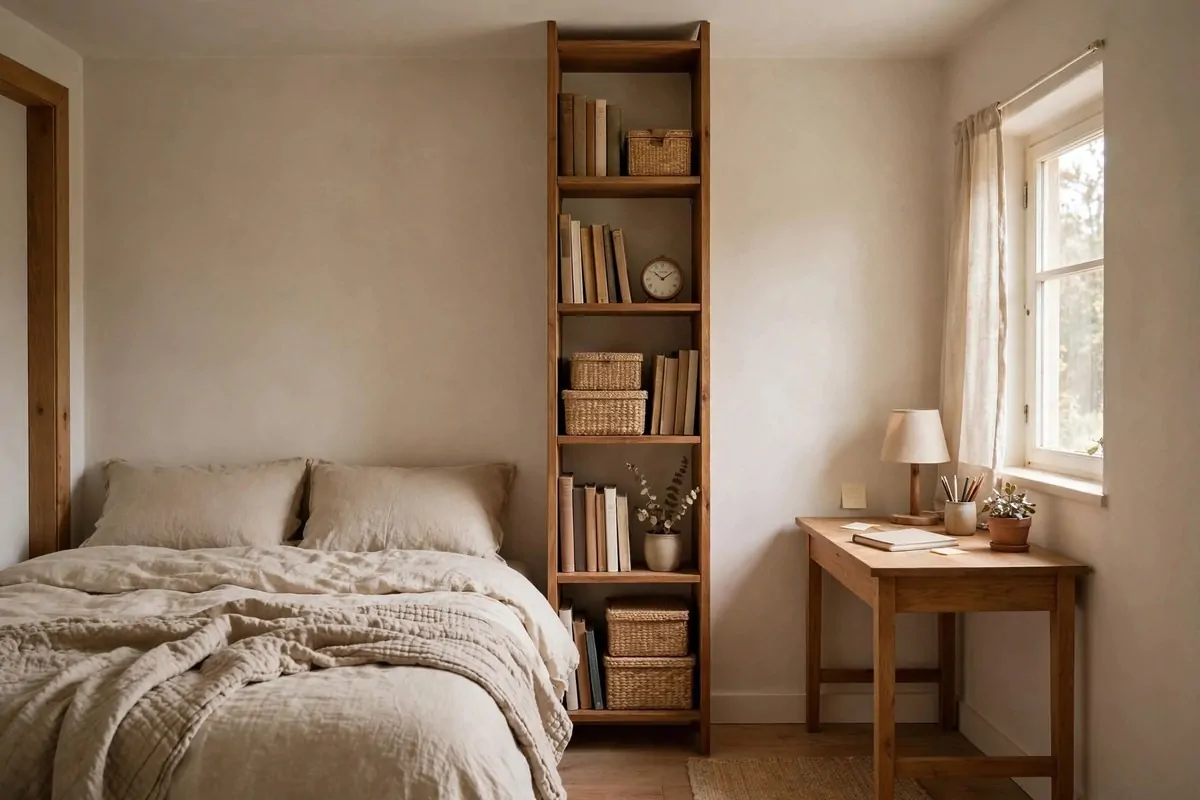
A tall narrow bookcase does two jobs at once. It stores your stuff and it splits the room.
I placed mine between my bed and my desk, sticking out from the wall like a little wall. It is only 12 inches deep, so it barely takes any floor.
Now my desk feels like its own room. The bookcase blocks the view of the bed while I work.
- A 5 shelf narrow bookcase is the classic size. Tall enough to divide, slim enough to fit.
- Face the shelves toward the desk side. Your work stuff stays in reach while you work.
- Anchor it to the wall. Tall bookcases tip, and a tipping bookcase is dangerous.
- Put pretty things on the bedroom side and work things on the desk side. Each side gets its own look.
The bedroom side of mine holds plants and books. The desk side holds folders and office supplies. Same bookcase, two personalities.
It also blocks light from the desk lamp at night. My partner sleeps better because the bookcase catches the glow.
If the bookcase is open on both sides, use boxes on the middle shelves. You get storage without the messy look from either side.
This costs more than a curtain but less than real furniture. Mine was flat pack and took one evening to build.
A bookcase divider is the grown up version of the curtain trick. It is sturdier, it stores things, and it looks like real furniture.
14. A Monitor Arm That Frees Your Tiny Desktop
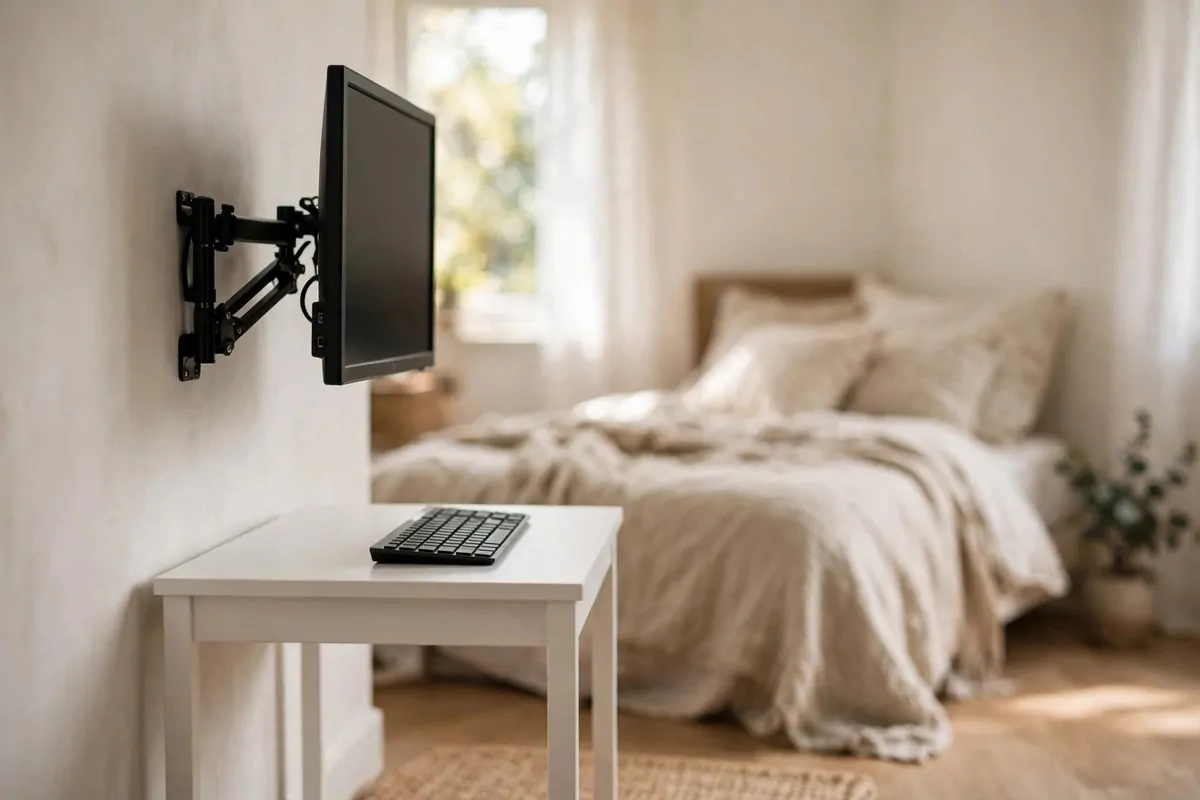
A monitor on a stand eats a third of a small desk. The stand is big, the base is wide, and your keyboard gets pushed to the edge.
A monitor arm bolts the screen to the wall or the desk edge. The whole desktop underneath becomes free.
My desk went from cramped to calm in one afternoon. The keyboard moved to the center. My notebook finally had a spot. The mug stopped living in danger.
- Clamp arms fit desks up to 3 inches thick. Check your desk edge before you buy.
- Wall mount arms work if your desk touches the wall. They free even more space.
- Get one with smooth movement. You will adjust it more than you think.
- Route the cables along the arm. Most arms have clips for this.
The arm also lets me push the screen back when I want to write by hand. I swing it aside and the whole desk opens up.
My neck thanks me too. The screen sits at eye level now, not hunched down on a low stand.
This is a small purchase with a big payoff. My desk feels twice as big and I did not buy a new desk.
If you use a laptop, a laptop arm or a simple stand does the same trick. Lift the screen, free the space below.
Small desks need every inch. Stop giving a third of them to a monitor stand.
15. Lamp Light That Makes the Corner Feel Warm
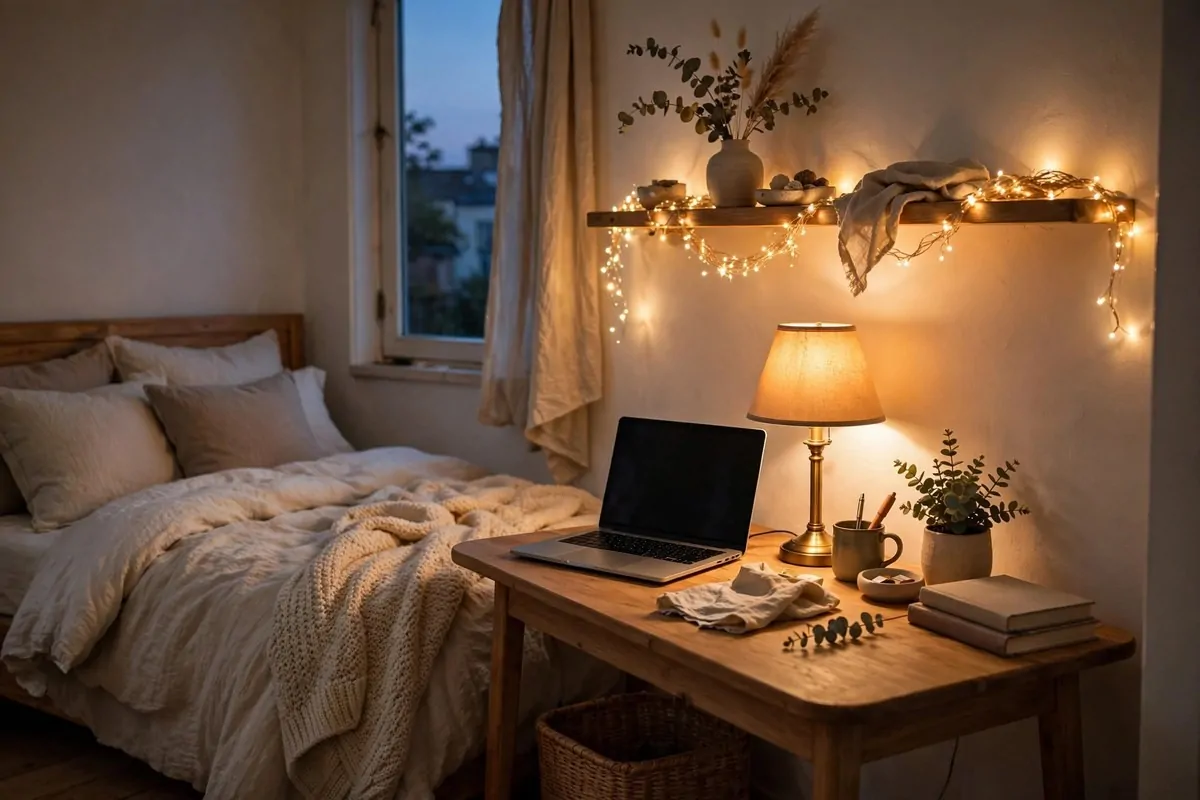
Overhead lights are the enemy of cozy. They are bright, cold, and they make every small room feel like an office basement.
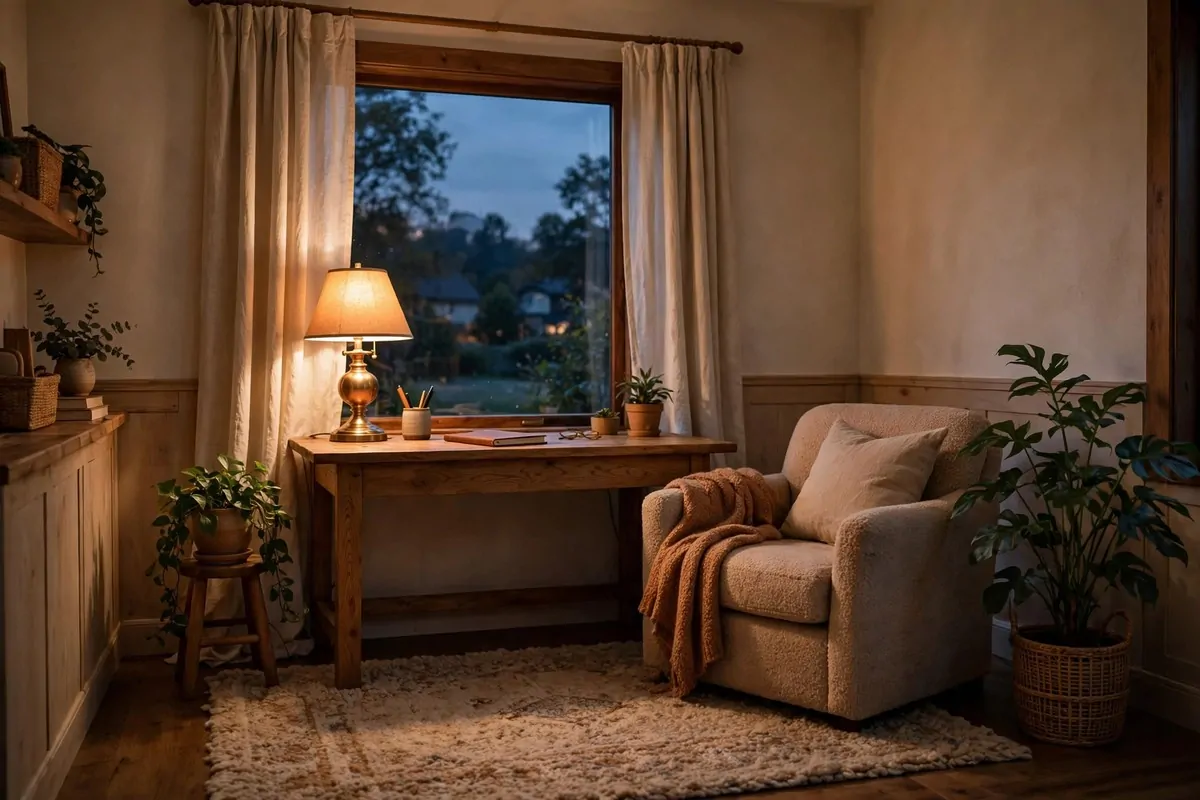
My desk corner has two warm lights. A small table lamp and a string of fairy lights along the shelf. That is all.
At 5 in the evening I turn them on and the corner glows. It feels like a cafe, not a cubicle.
- Pick warm white bulbs, 2700K on the box. Cool white looks blue and harsh.
- Put the lamp on the opposite side from your writing hand. No shadows on your work.
- Fairy lights along a shelf give glow without glare. They are the cheapest mood upgrade.
- A lamp with a fabric shade spreads light softly. Metal shades make hot spots.
Warm light also helps me sleep better. I turn off the big overhead light at 6 and work under the lamps. My brain gets the evening signal.
The lamp was a thrift find. The fairy lights cost almost nothing. The whole setup is under twenty dollars.
I also keep a candle on the shelf. I rarely light it. It just looks nice sitting there, waiting.
If your room has no overhead light, this matters even more. Two small lamps beat one big harsh one every time.
Light is the cheapest designer in the world. Hire the warm ones.
16. One Real Plant on the Desk
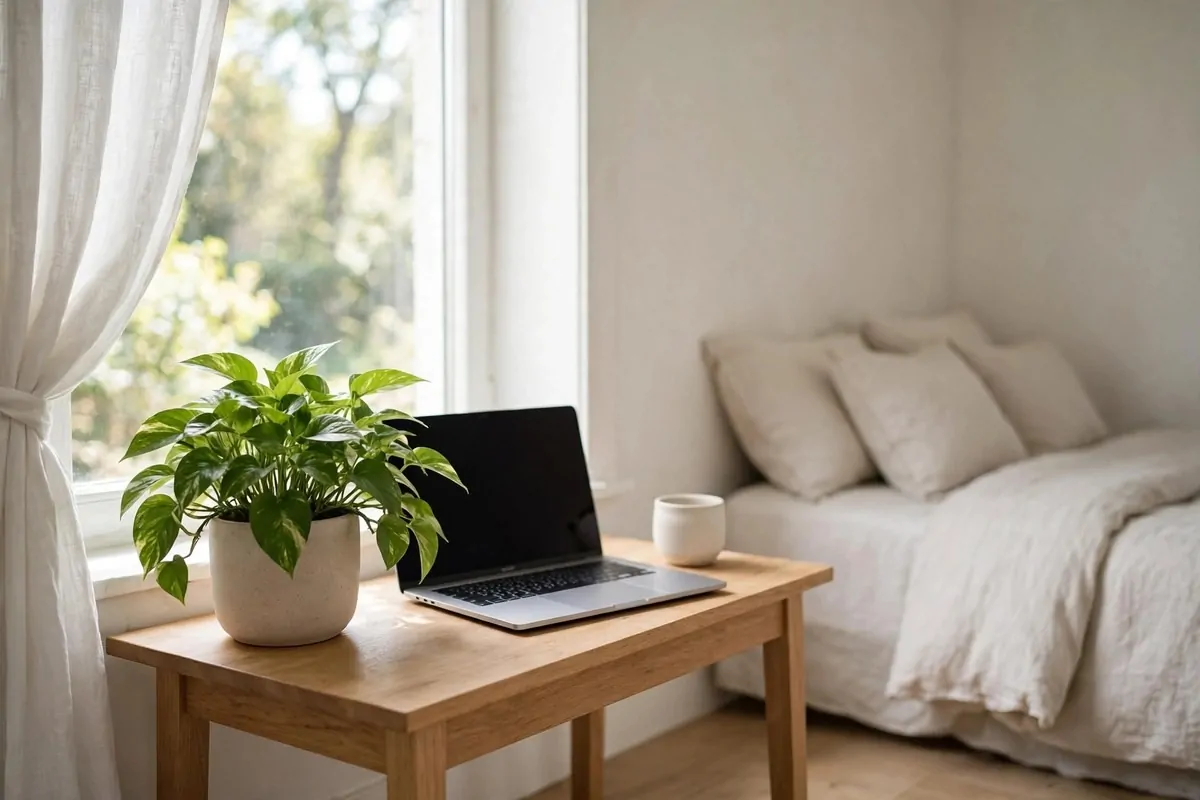
A tiny bedroom office can feel stale. Same air, same walls, same screen all day.
One real plant fixes that. It is alive, it is green, and it makes the air feel fresher.
Mine is a small pothos in a white pot. It sits in the corner of my desk. It needs water once a week and almost no light.
Studies say plants help focus. I cannot prove that. I can say my desk feels less like a machine and more like a place I want to sit.
| Plant | Light needed | Water | Why it works on a desk |
|---|---|---|---|
| Pothos | Low | Weekly | Trails nicely, almost unkillable |
| Snake plant | Low | Every 2 weeks | Stands tall, great for corners |
| Spider plant | Medium | Weekly | Fun shape, makes baby plants |
| Succulent | Bright | Monthly | Tiny, cute, needs a sunny spot |
Pick one that matches your light. A dark corner plant dies fast and that feels worse than no plant.
- Keep the pot small, 4 to 6 inches. Big pots eat desk space.
- Use a saucer under the pot. Water rings ruin wood desks.
- Wipe the leaves monthly. Dusty leaves cannot breathe well.
- If you travel a lot, get a snake plant. It forgives neglect like a friend.
My pothos has grown three feet of vines. I trim it and give cuttings to friends. It is the only coworker I have never argued with.
Fake plants are fine if you truly kill everything. But real ones smell like soil and grow new leaves. That little bit of life matters in a small room.
One plant. Small pot. Weekly water. Your desk will thank you.
17. A Mirror That Doubles Your Light
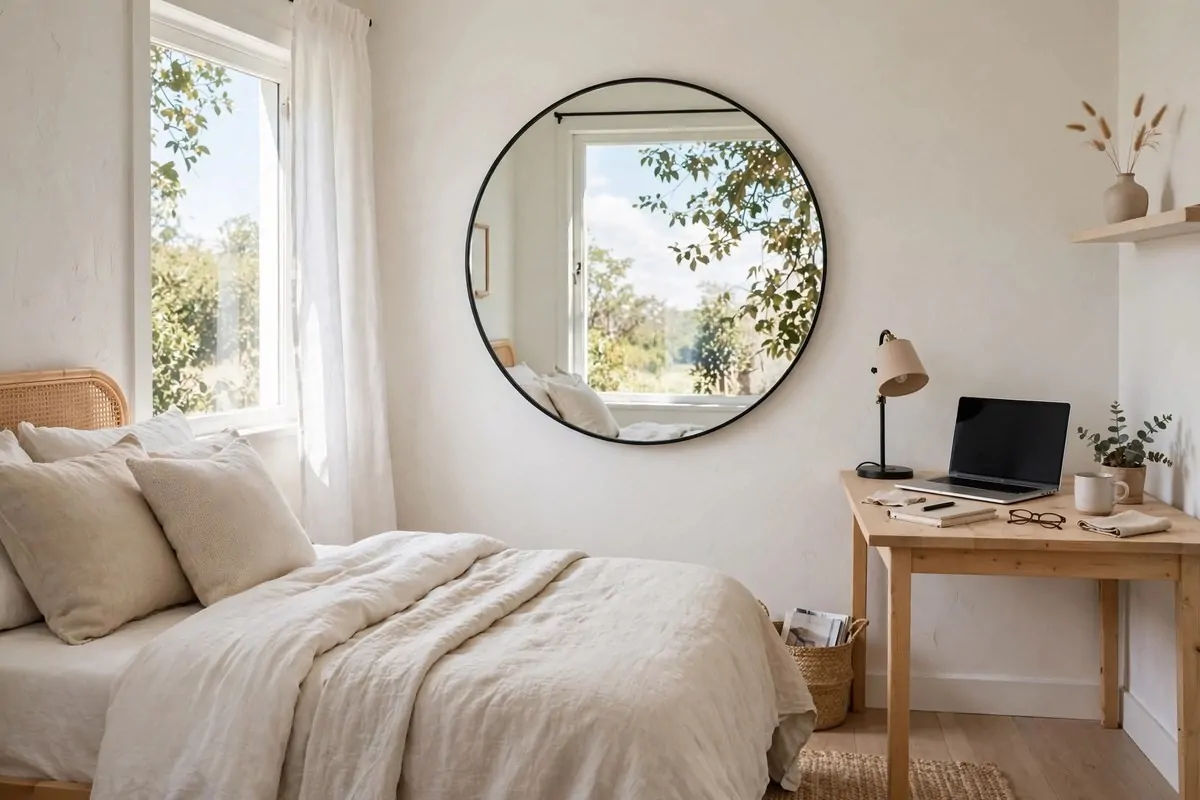
Small rooms feel dark. Dark rooms feel smaller. It is a loop, and a mirror breaks it.
I hung a round mirror on the wall beside my desk, facing the window. It bounces daylight deep into the room.
The effect is instant. The corner that used to be dim now glows. The room feels twice as wide because you see the reflection of the space.
- Hang the mirror where it reflects the window, not the bed. You want light, not a view of laundry.
- A 20 to 24 inch round mirror is the sweet spot for a small room. Big enough to matter, small enough to hang anywhere.
- Tilt it slightly down if it catches too much sky glare. A tiny tilt changes everything.
- Clean it monthly. A dusty mirror bounces gray light, not bright light.
Mine also works as a quick check before video calls. One glance and I know my hair is fine.
If you cannot hang things on the wall, lean a tall mirror against the wall behind the desk. Leaning mirrors look stylish and need no holes.
The mirror cost less than my lamp. It gives more light than my lamp. Think about that.
One caution. Do not put the mirror where it reflects your screen. Screen glare in a mirror is distracting and weird on calls.
Light is the one thing small rooms lack most. A mirror manufactures more of it for free.
18. The Drop-Leaf Table That Grows on Demand
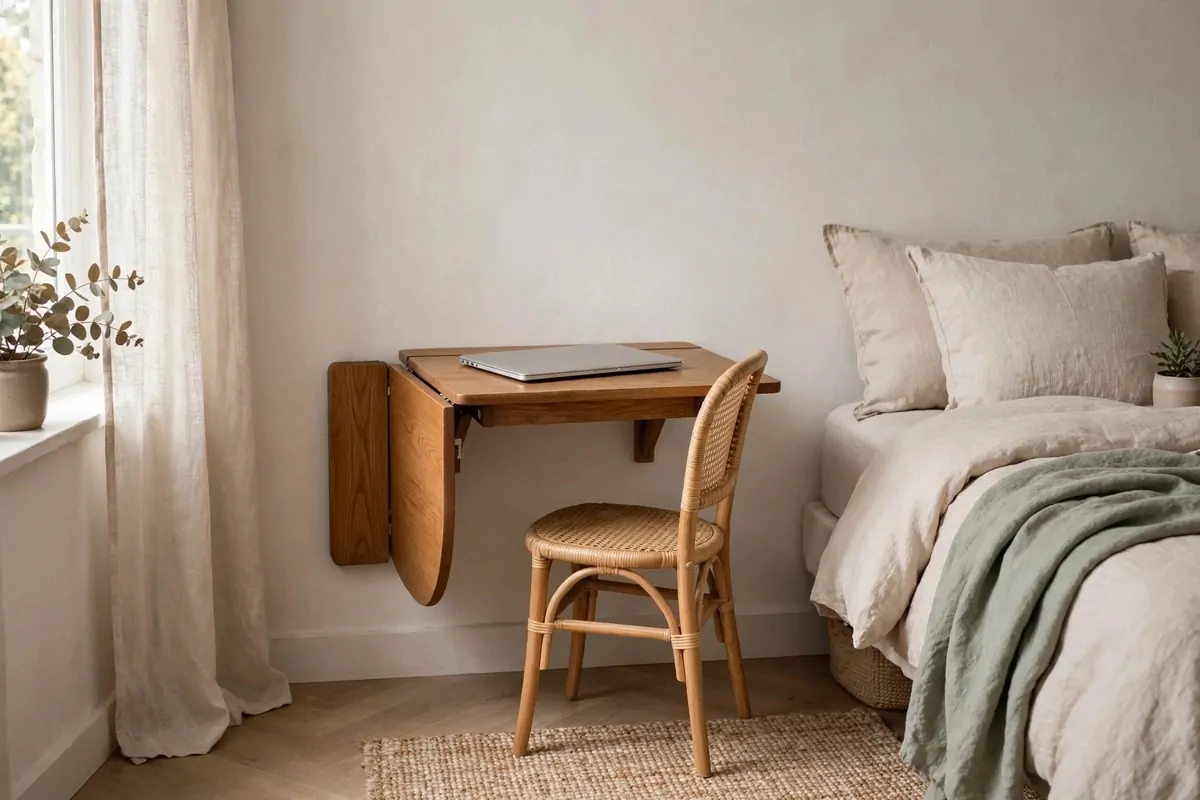
A drop-leaf table is a narrow table with sides that flip up. Folded down, it is 10 inches deep. Flipped up, it is 30 inches deep.
It is a hallway table on Monday and a full desk on Tuesday.
I keep mine against the wall with one leaf up. That gives me a 20 inch desk for daily work. When I need the full surface for a big project, I flip up the second leaf.
- One leaf up is the daily setup. It takes almost no room.
- Two leaves up is project mode. Clear the wall side first.
- Lock the leaves before you lean on them. An unlocked leaf folds at the worst moment.
- Put felt pads under the legs. You will move this table more than you think.
This beats a folding card table because it looks like real furniture. Mine is solid wood and guests think it is a console table.
The table also works as a dining spot, a craft table, and a gift wrapping station. I have used it for all three.
| Table type | Folded size | Open size | Best for |
|---|---|---|---|
| Drop-leaf | 10 inches deep | 30 inches deep | Daily desk plus big projects |
| Wall fold-down | Flat to wall | 24 inches deep | Smallest rooms, vanishes nightly |
| Folded size | Flat to wall | Daily desk plus big projects |
If you buy used, check the hinges. Wobbly hinges mean a wobbly desk. Good hinges last decades.
This is the furniture version of a Swiss army knife. Small, clever, and ready when you are.
19. The Five-Minute Evening Reset
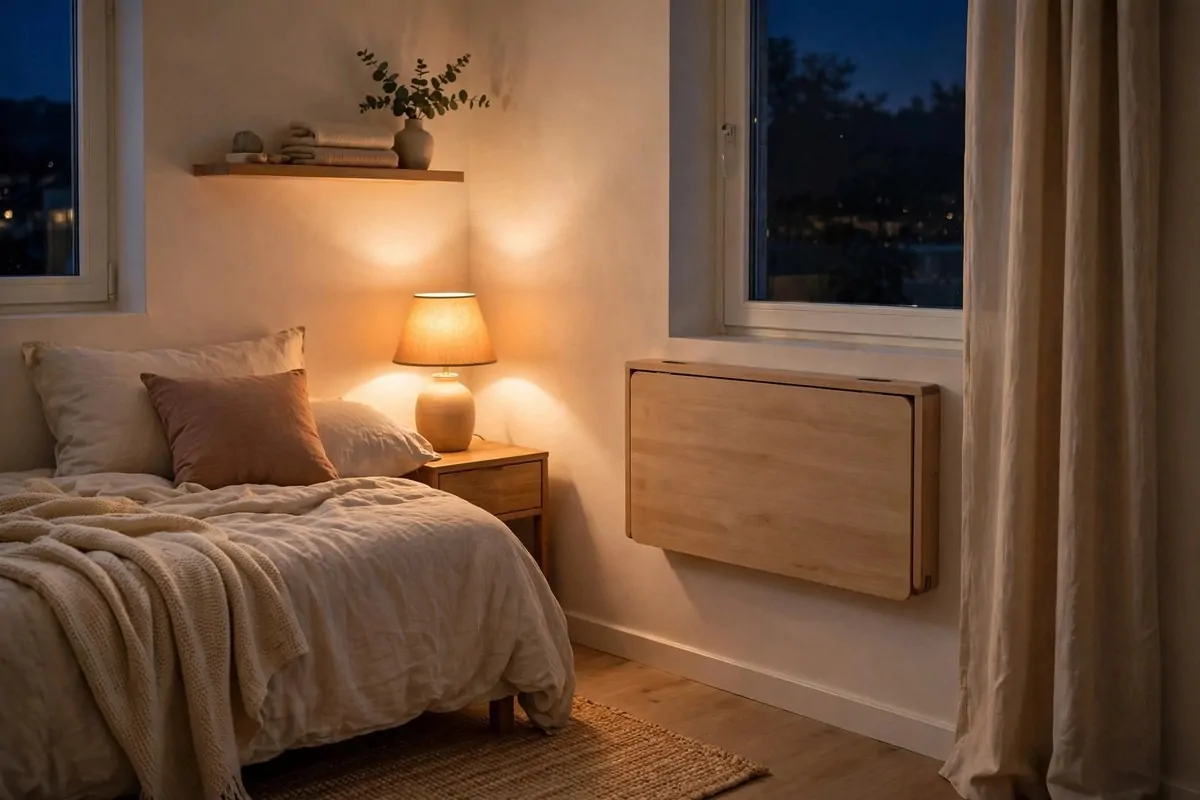
This last idea is not furniture. It is a habit. And it might matter more than all the furniture.
Every evening at 6, I spend five minutes turning my office back into a bedroom. Laptop closed. Papers in the drawer. Mug to the kitchen. Chair pushed in.
The room exhales. I exhale with it.
When the desk stares at you all night, your brain keeps working. You see the laptop and think about email. You see the papers and think about tomorrow.
The reset breaks that loop. Out of sight, out of mind, and sleep comes easier.
- Set a daily alarm for your reset time. The alarm does the remembering for you.
- Keep a small box on the desk. Sweep everything into the box, sort it tomorrow.
- Close the laptop fully. Sleep mode still glows. Closed is closed.
- End with the curtain or the fold-up desk if you have one. The final close feels good.
I do this while my evening tea brews. Five minutes, same time, every day. It is the smallest routine I have and the one I would miss most.
My mornings start better too. I walk into a clean bedroom, pull out the laptop, and the office appears fresh.
Nineteen ideas, and this is the one that costs nothing and changes everything.
Your tiny bedroom is not too small for an office. It just needs an office that knows how to disappear. Pick one idea from this list and try it this week. Your room, and your workday, will feel brand new.