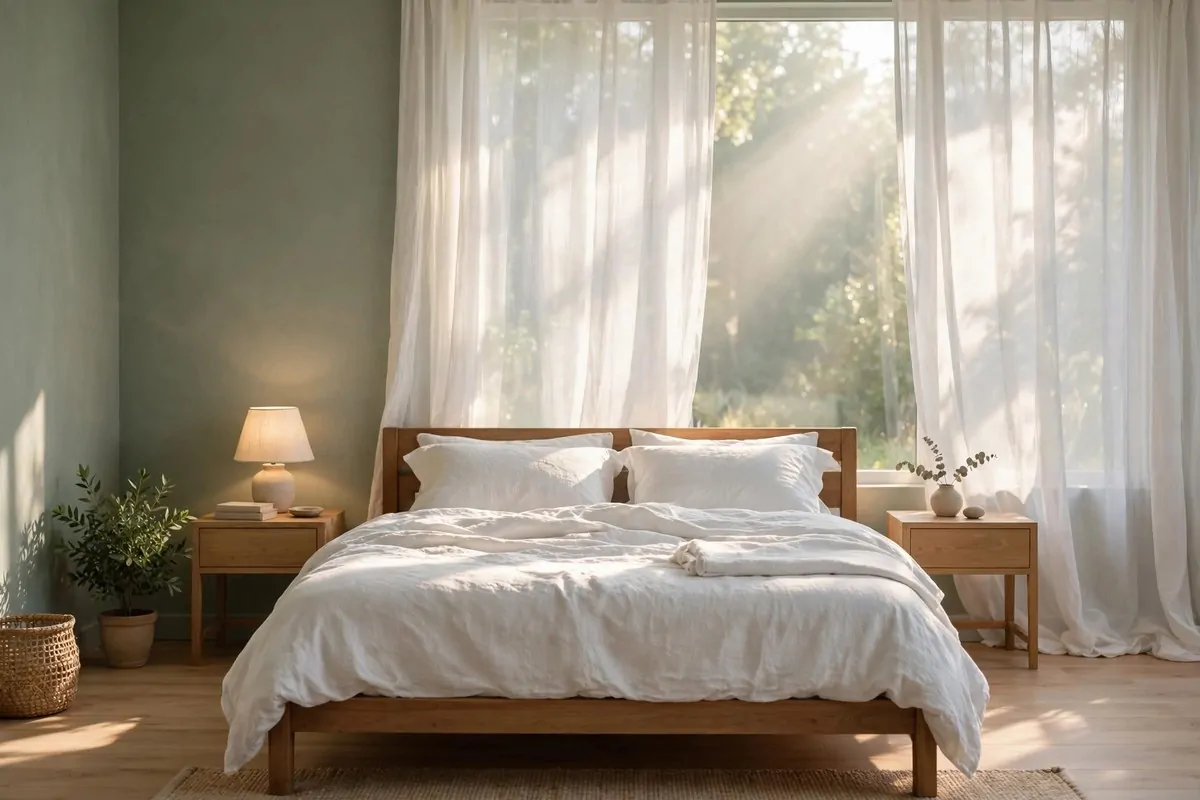
35 Hidden Closet Storage Ideas That Maximize Every Inch

Your closet has more space than you think. It is just hiding it from you.
Most of us look at a full closet and think we need a bigger one. I used to think the same thing, and then I started looking at the spots I never used. The back of the door. The strip of wall above the frame. The dark gap under my hanging clothes. Those little dead spots added up to a whole extra closet, and I had walked past them every single day without seeing them.
That is what this list is about. Not bigger closets. Hidden ones. Little secret spots that hold a lot and show nothing, so your closet looks calm and simple from the outside while doing twice the work on the inside.
Here are 35 hidden closet storage ideas that make every inch count. Start with one or two that fit your closet, and you will feel the difference by tomorrow morning.
The Back of the Door Is Free Storage
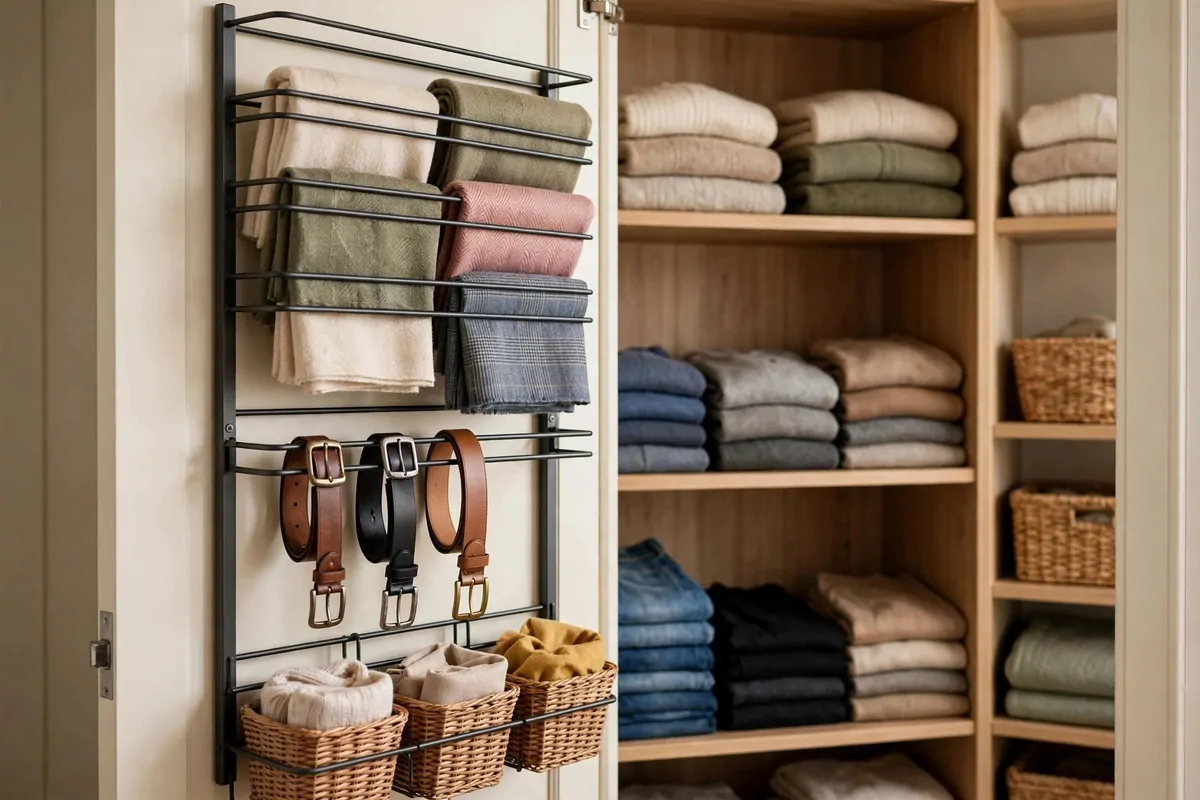
The back of your closet door is the easiest win on this whole list. It is a flat wall that does nothing all day, and it is just waiting for a job.
I put a simple over the door rack on mine, and it changed my mornings right away. Scarves, belts and a small basket for gloves all live there now. They are out of the way but I can still grab them in two seconds.
You do not need to drill a single hole for this. Most door racks just hook over the top edge. If you rent your home, that matters a lot, because you can take the whole thing down when you move and leave no marks behind.
The trick is to keep it light. A door that holds too much weight will swing funny and the rack will slide around. Pick the few things you reach for most and let the rest live somewhere else.
Thin wire baskets work best here. They hold a lot without adding much weight, and you can see what is inside without digging. I use one for my everyday scarves and one for the little things that always get lost, like hair ties and spare buttons.
If your door is a sliding door, you can still use this idea. A slim adhesive rack or a few strong hooks on the inside panel will do the same job. Just check the weight limit before you load it up.
The best part is how it looks from the outside. Nothing shows. Your closet still looks plain and tidy when the door is closed. Open it and everything you need is right there, hanging quietly where nobody would think to look.
One small warning from my own mistake. Do not hang anything long on the door rack if your door opens inward. I once hung a long scarf that caught on the frame every time I closed the door, and it drove me mad for a week before I moved it.
Measure the gap between your door and the frame before you buy anything. Most racks are thin, but a chunky one can stop the door from closing all the way, and then you have a new problem.
A Shelf Above the Door Frame
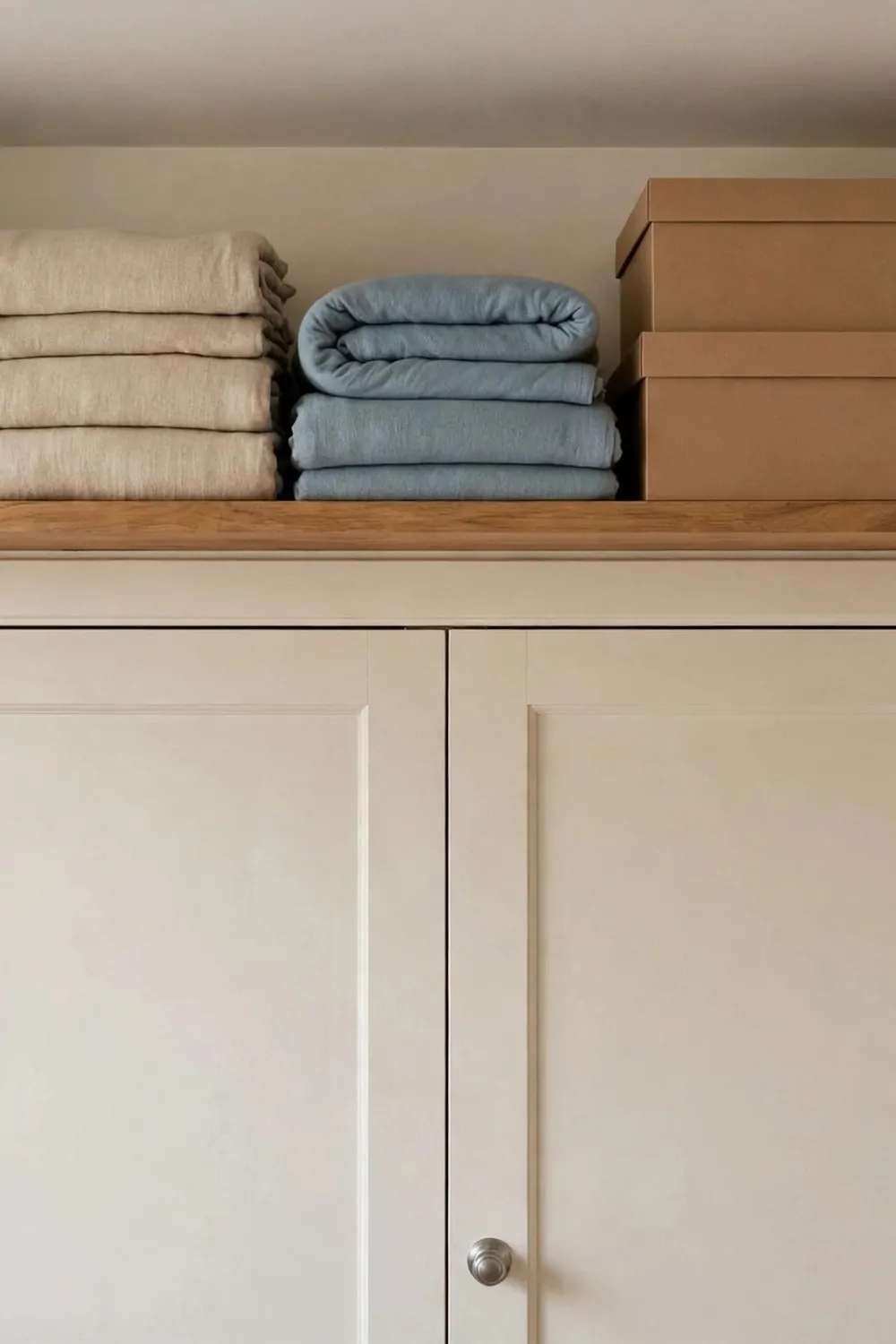
There is a strip of wall above your closet door that almost nobody uses. It is high, it is out of the way, and it is perfect for the things you only touch a few times a year.
I had a shelf put up there for my spare blankets. They sat in a pile on my bedroom floor for years before that, and now they are gone from sight. The shelf holds three folded blankets in a neat stack, and I only climb up to reach them when the cold nights come.
This spot works because high storage is honest about how it works. You will not grab something from up there every day. That is fine. It is made for the slow stuff, like out of season clothes and extra bedding.
Keep the shelf shallow so things do not get pushed too far back. About ten inches deep is plenty. Anything deeper and you will lose things in the back and forget they exist, which defeats the whole point.
A matching basket on the shelf makes it look neat from below. From the floor you just see one tidy box, not a stack of folded things. Pick a basket with a lid if you want it to look even cleaner.
If your ceilings are tall, this shelf can hold a whole second row of storage. I know a friend who has two shelves stacked above her door, and they hold all her winter coats in summer and all her summer clothes in winter. She swaps them twice a year and her closet never feels full.
The one thing to watch is weight. A shelf above a door is held by brackets, so keep it to light things. Blankets, folded sweaters and spare pillows are perfect. Heavy boxes full of books are not.
Put a small step stool nearby and this spot becomes easy to use. I keep a folding stool in the corner of my closet just for this shelf. It folds flat and leans against the wall, and I grab it whenever I need the top shelf.
The best part is that guests never notice it. Your closet looks the same as always from the door. Only you know there is a whole shelf of storage hiding just above your head.
Pull-Out Drawers Under Your Hanging Clothes
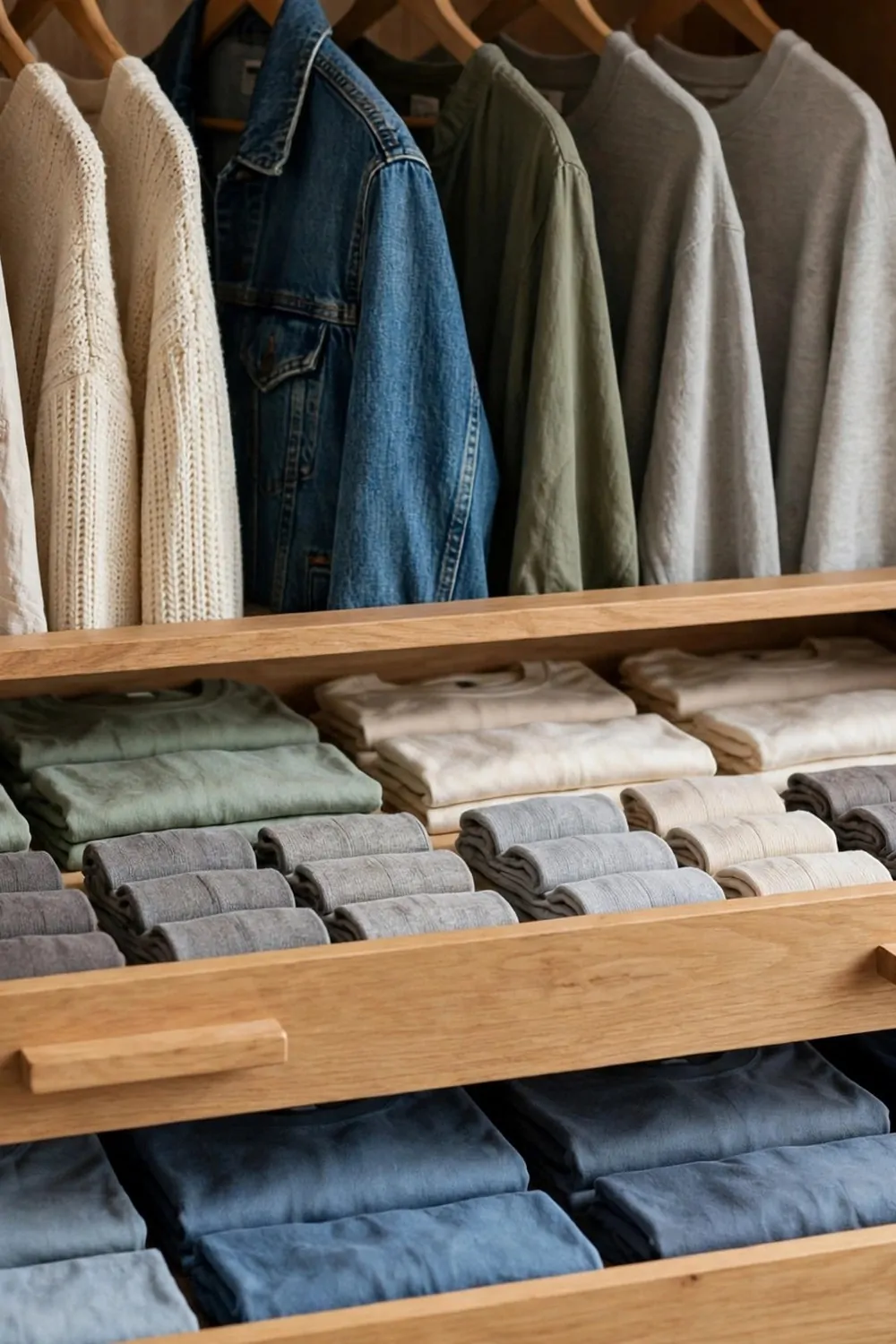
Look under your hanging clothes right now. There is probably a gap of empty floor that is doing nothing at all. That gap is a drawer waiting to happen.
Pull-out drawers fit right under your shirts and trousers, and they slide out when you need them. I keep my folded jumpers in mine, and it feels like I gained a whole chest of drawers without buying one.
The reason this works so well is that hanging clothes leave a natural space below them. Your shirts hang down to about waist height. Everything below that is free, and a low drawer unit fills it perfectly.
Measure before you buy. You need enough room for the drawer to slide out without hitting the door, and you need the top of the unit to clear the bottom of your hanging clothes. A few inches of space makes all the difference.
Stack two or three shallow drawers instead of one deep one. Shallow drawers are easier to dig through, and you can see everything at a glance. Deep drawers just become a pile where things vanish.
I label the front of each drawer with a small tag. One says jumpers, one says gym clothes, one says socks and small things. It sounds fussy but it saves me from opening three drawers every morning.
If you do not want to buy a drawer unit, a set of fabric drawers on a simple frame does the same job for less money. They are light, they fold flat when you move, and they look soft and tidy behind a closed door.
The drawers also stop that messy pile problem. Before I had them, folded clothes lived in a stack on the closet floor. The stack fell over. The bottom jumper got wrinkled. Now everything has a drawer and the floor stays clear.
One more tip. Leave a little space at the front of the drawers for your feet. If the unit sits too close to the door, you will stand sideways every time you open a drawer, and that gets old fast.
Under-Shelf Baskets That Hang in Thin Air
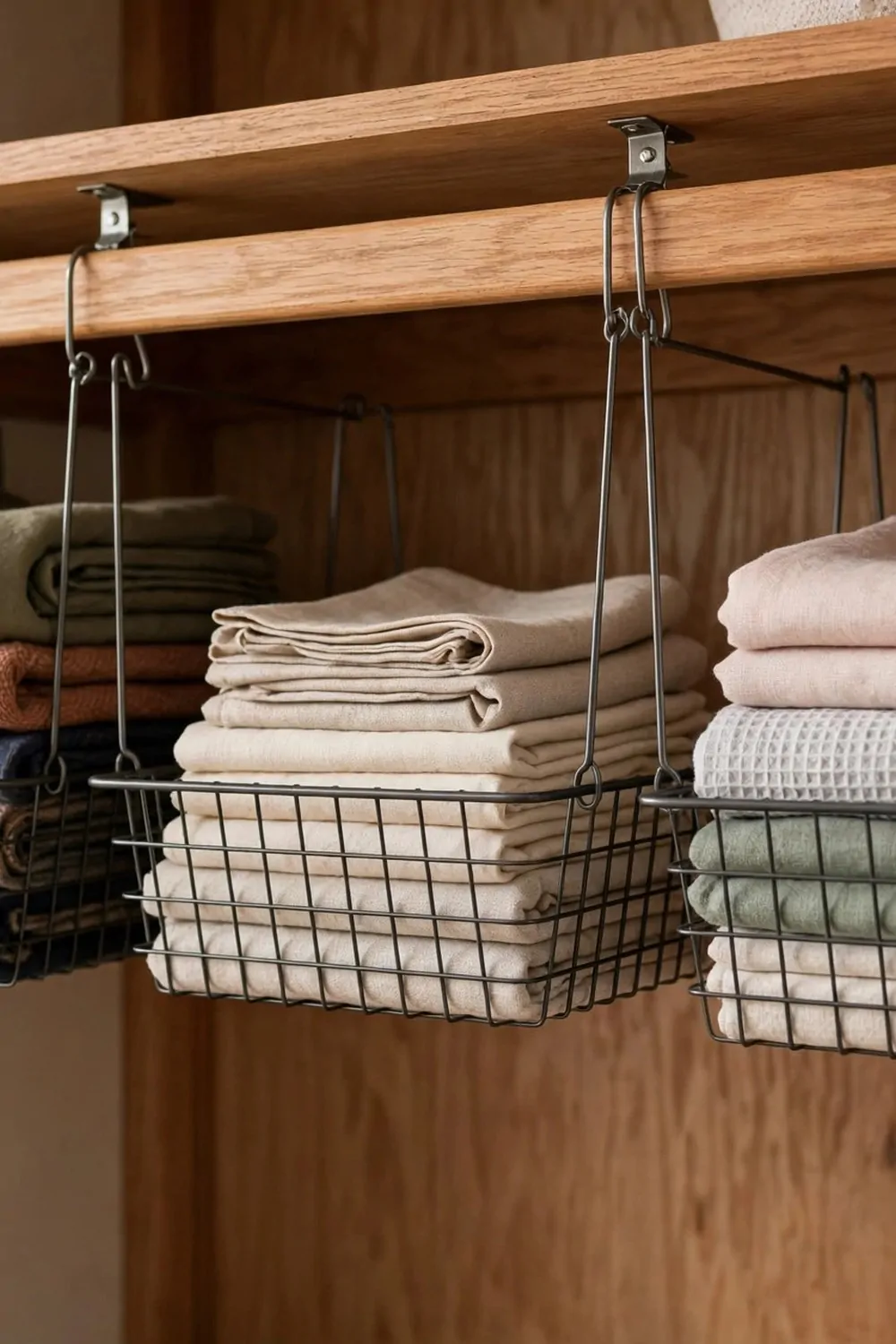
There is a trick I love because it feels like cheating. You slide a wire basket under a shelf you already have, and it hangs there in thin air, holding things in space that was empty before.
These baskets hook onto the shelf above them. No screws, no tools, no damage. They just clip on and stay put, and they turn the dead gap under a shelf into a whole extra storage spot.
I use one for my socks and one for my scarves. They are the two things I always lose, and now they live right under the shelf where I fold my jumpers. I open the closet, pull the basket out a little, and grab what I need.
The baskets work best for light things. Socks, underwear, scarves, gloves and small accessories are perfect. Heavy things will make the basket sag, and a sagging basket is worse than no basket at all.
Pick a basket that is narrower than the shelf above it. If it sticks out past the shelf edge, it will catch on your clothes every time you reach past it. A basket that sits flush looks neat and stays out of the way.
You can stack this idea with other storage too. I have a shelf with folded jumpers on top, a hanging basket underneath, and my hanging clothes beside it. One shelf is doing three jobs, and the closet still looks calm.
The best part is the price. These baskets cost very little, and you can move them in seconds. If you rearrange your closet next month, the basket moves with you. No holes to fill, no brackets to unscrew.
One thing I learned the hard way. Do not overload them. I once stuffed a basket full of heavy belts and it slid off the shelf in the middle of the night. It scared me half to death and made a terrible noise.
Keep them light, keep them tidy, and they will quietly hold a surprising amount of stuff in space you thought was useless.
A Slim Pull-Out Tower in the Gap Beside the Wardrobe
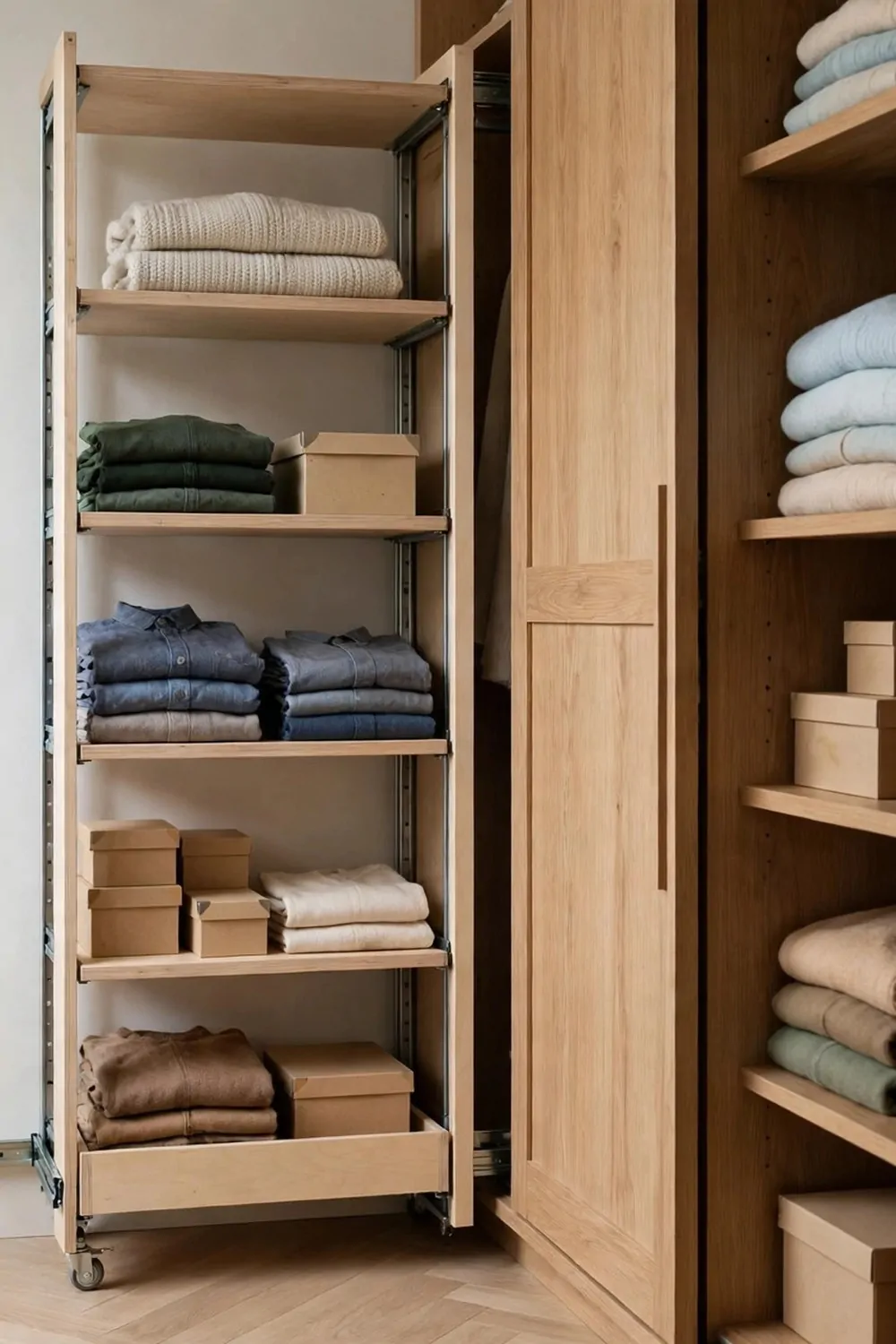
Every closet has a gap. It is that narrow strip of space beside the wardrobe or between the wall and the shelf, too thin for a box and too wide to ignore. That gap is a pull-out tower waiting to happen.
A pull-out tower is a tall, skinny shelf on wheels or rails that slides out like a drawer. It fits into gaps as narrow as six inches, and it holds a shocking amount of stuff in that thin space.
Mine holds my rolled belts, my spare scarves and a few small boxes of accessories. It slides out smoothly, I grab what I need, and I push it back in. From the front you see nothing but a thin edge, like a secret panel in the wall.
The trick is to measure the gap before you order one. Gaps are never the size you guess. Mine was two inches narrower than I thought, and I had to send the first tower back. Measure twice, then measure once more for luck.
Tall and narrow works best for things you can roll or stack. Rolled scarves, belts, ties and small folded items fit perfectly. Big bulky things will jam, so keep those somewhere else.
Put the things you use most at the top of the tower. The top shelf is the easiest to reach, so it should hold your everyday items. The bottom shelves are for the things you only need once in a while.
If the gap is beside a wardrobe, the tower can hide the seam between two pieces of furniture. It fills the awkward space and makes the whole wall look finished, like it was planned that way from the start.
I like that the tower keeps things upright and visible. Nothing gets buried at the bottom of a pile. You slide it out and everything is lined up in a neat row, easy to see and easy to grab.
One small warning. Make sure the tower has a stopper or a rail that keeps it from sliding all the way out. Mine once came right out and tipped forward, and I had scarves all over the floor. A simple stopper fixed it for good.
Hooks Hidden Behind the Door
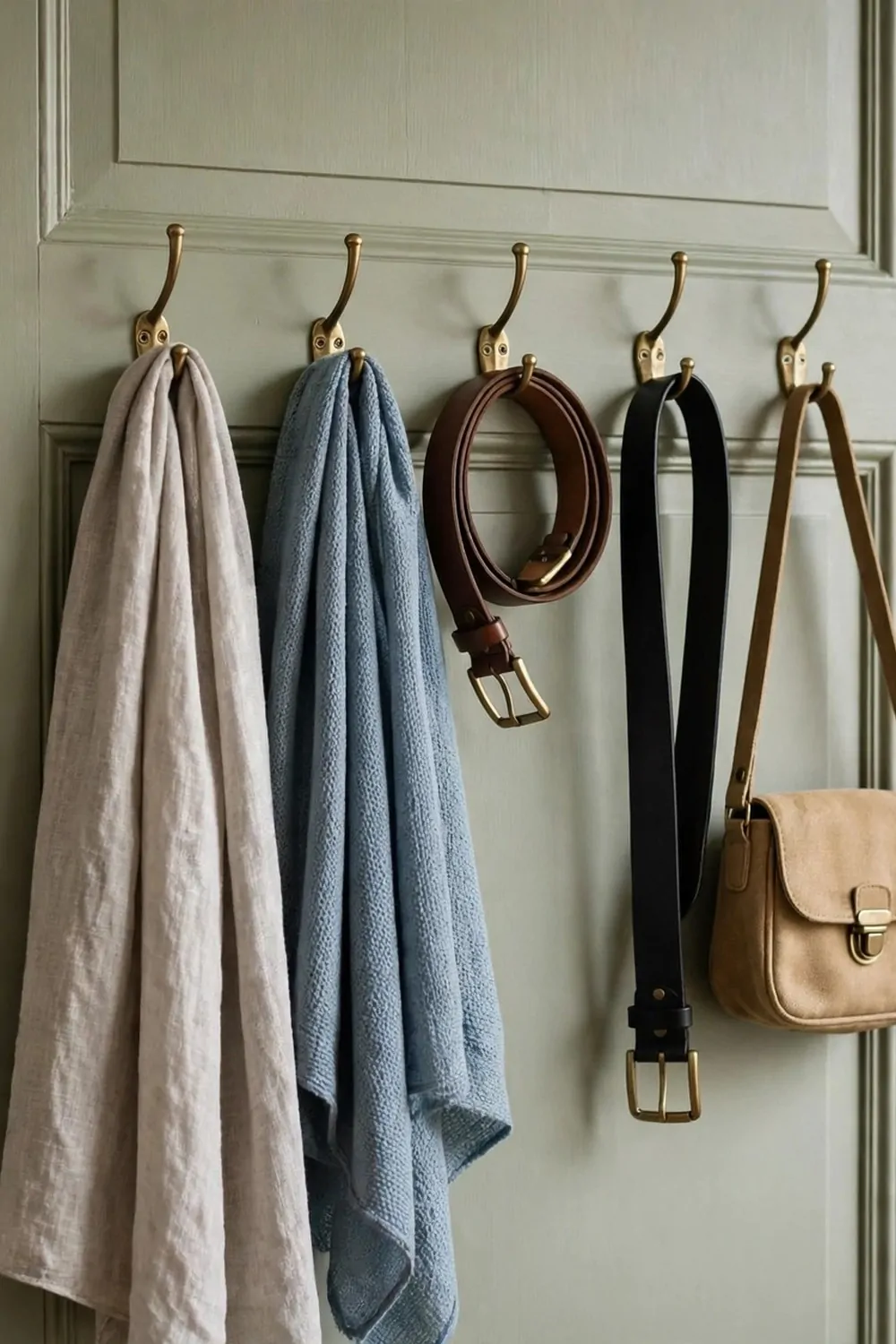
Hooks are the smallest storage tool in this list, and they might be the most useful. A few hooks hidden behind the closet door can hold a whole week of outfits, bags and belts without anyone ever seeing them.
The idea is simple. You fix a row of small hooks on the inside of the door or on the wall just behind it, and they become a private hanging spot for the things you use every day. When the door closes, they vanish.
I keep tomorrow’s outfit on two hooks behind my door. It hangs there overnight, ready to go, and I do not have to dig through the rail in the morning. It saves me five minutes every single day, and that adds up fast.
Hooks are perfect for things that do not fold well. Hats, bags, belts and necklaces all hang better than they sit in a drawer. A hook keeps them in shape and keeps them easy to grab.
Space the hooks out a little wider than you think you need. If they are too close together, everything overlaps and turns into a tangled mess. A few inches of air between hooks keeps each thing separate and easy to lift off.
Adhesive hooks work well if you rent or do not want holes. The strong ones hold a surprising amount of weight, and they come off clean when you move. Just check the weight limit on the packet before you trust it with your heavy bag.
Put the hooks at different heights if you hang different things. High hooks for bags, low hooks for belts and scarves. It looks a little odd at first, but it uses the space much better than a straight row.
The hidden part is what makes this idea so good. Hooks on the outside of a closet look messy. Hooks behind the door are invisible when the door is closed, so your room stays calm and your storage stays secret.
One more use I love. I keep a hook just for my dressing gown. It hangs behind the door, out of sight, and it is always warm and ready when I need it. Small thing, big comfort.
| Hidden spot | What it holds | Why it works |
|---|---|---|
| Back of the door | Scarves, belts and small baskets | It uses space that was doing nothing at all |
| Above the door frame | Blankets and out of season clothes | High space is perfect for things you rarely grab |
| Under hanging clothes | Drawers and rolling bins | The floor space under clothes is almost always empty |
A False Bottom Drawer for the Things You Want to Keep Private
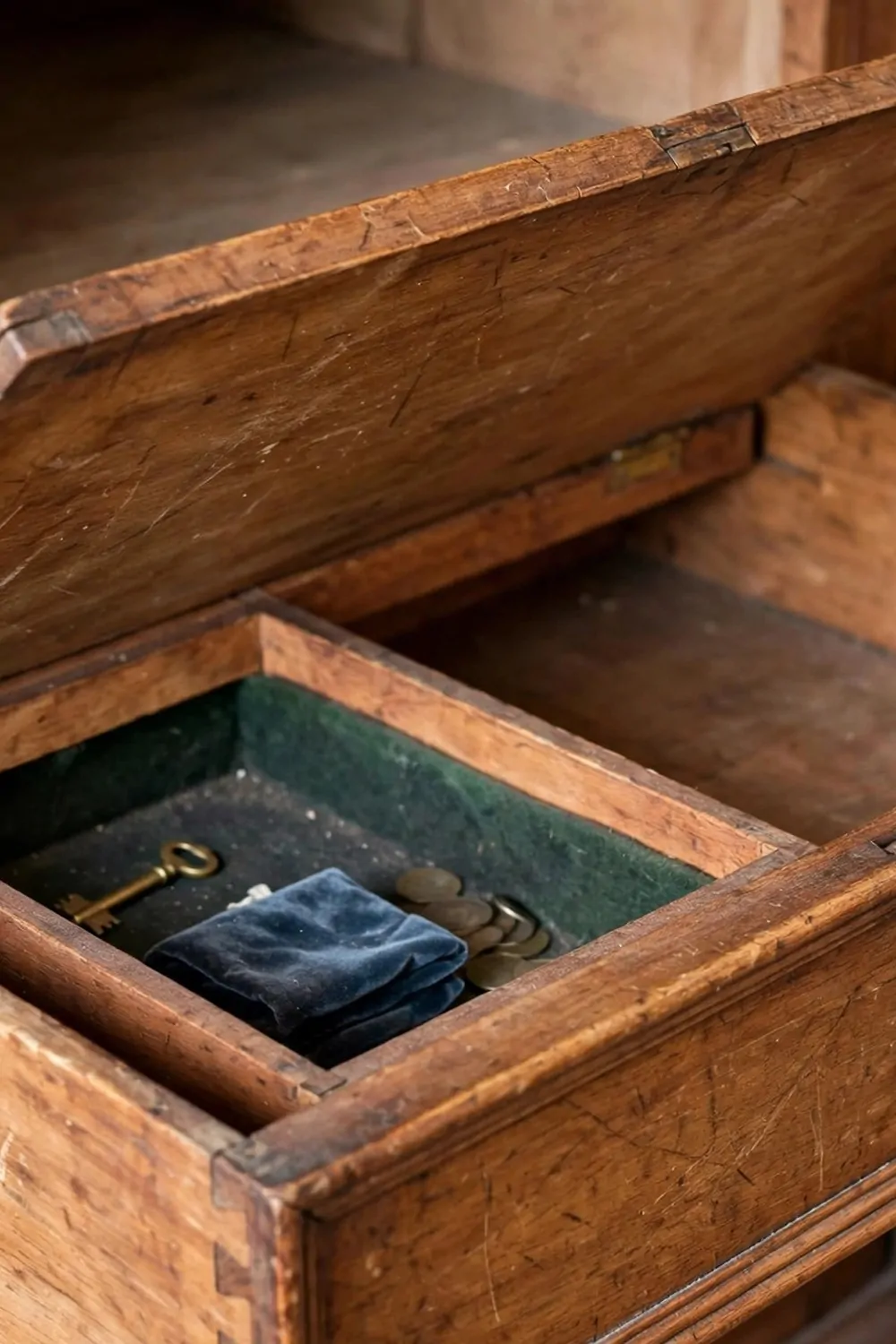
Every closet has a few things that need a little extra privacy. Letters, a small keepsake box, a spare key, or a little cash for emergencies. A false bottom drawer hides them in plain sight.
A false bottom is a second floor inside a drawer. It looks like a normal drawer from above, but lift the thin panel and there is a secret space underneath. Nobody would ever guess it is there.
You can buy a drawer with a false bottom, or you can make one with a thin piece of board cut to fit inside an existing drawer. It just needs to sit a little lower than the real bottom, leaving a shallow hidden gap.
The key is to keep the top layer looking normal. Put your everyday things on top, like socks or scarves, and the hidden layer stays invisible. If the drawer looks full and boring, nobody will ever dig deeper.
Do not hide anything you need every day down there. The false bottom is for the things you touch once in a while. If you lift the panel every morning, it stops being a secret and starts being a chore.
Keep the hidden space shallow. An inch or two is plenty for flat things like papers, photos and small flat boxes. A deep hidden space makes the drawer look wrong, because the top layer sits too low and the drawer feels oddly light.
I keep a small envelope of emergency cash in mine, along with a little notebook where I write down ideas. It is not about big secrets. It is about having one quiet spot in the house that is just mine.
Make sure the panel fits snugly so it does not rattle when you open the drawer. A rattling drawer gives the game away. A tiny bit of felt on the edges keeps it quiet and keeps it from sliding around.
The best part is how ordinary it looks. Your closet still looks like a closet. Your drawer still looks like a drawer. Only you know there is a little hidden world right under your socks.
Hanging Organizers Tucked Behind Your Clothes
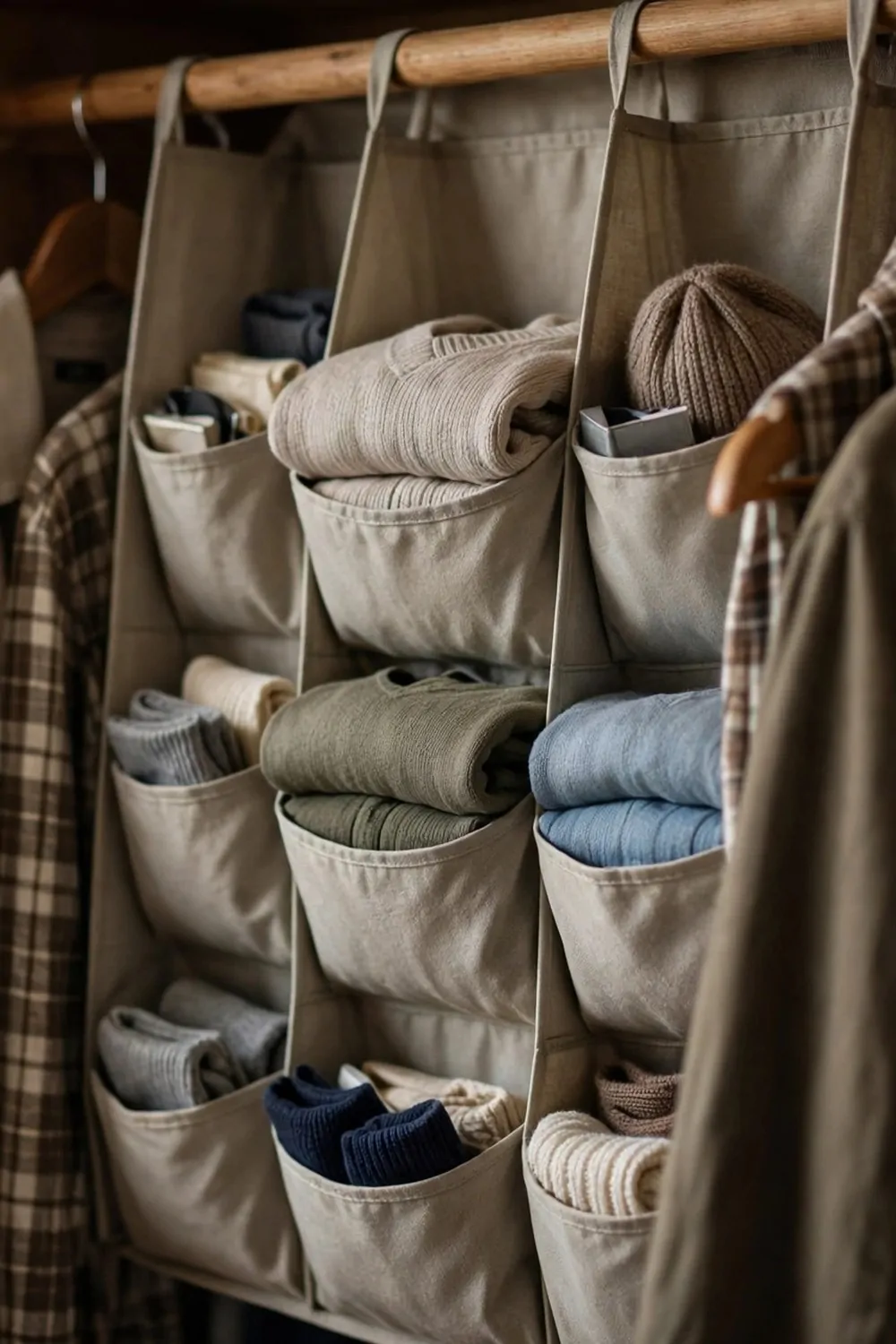
A hanging organizer is a row of fabric shelves that hangs from your closet rail. Most people hang them at the front where everyone can see them. Tuck yours behind your clothes instead, and it becomes secret storage.
The trick is placement. Hang the organizer at the back of the rail, behind your longest clothes, and it disappears. Your shirts and dresses hang in front of it like a curtain, and the shelves behind hold all the stuff you do not want on show.
I use mine for folded t-shirts, workout clothes and spare bedding. The shelves are soft and light, and they hold a surprising amount without making the rail sag.
Keep the organizer narrow so it does not push your clothes too far forward. A slim one that is about a foot wide fits behind most hanging clothes without crowding them. A wide one will shove your shirts out and make the closet look stuffed.
Label each shelf with a small tag if you want to find things fast. I did not bother at first, and I spent a week opening the wrong shelf every time. A tiny label fixed it in five minutes.
These organizers are cheap and they fold flat when you move house. That makes them a good first step if you are not ready to buy furniture. You can try the idea for almost no money and see if it works for you.
One thing to watch is weight. A hanging organizer full of heavy jumpers will pull on the rail and make it bow. Keep the heavy things low, near the bottom shelf, and the light things up top. Your rail will thank you.
The hidden placement also keeps dust off your folded clothes. The clothes in front act like a shield, and the shelves behind stay much cleaner than open shelves would. Less dusting is always a win in my book.
My favorite use is for the in-between clothes. The jumpers that are too warm for today but too good to pack away. They live on the hidden shelves, out of sight, until the weather changes and I need them again.
Boxes on the Top Shelf With Plain Labels
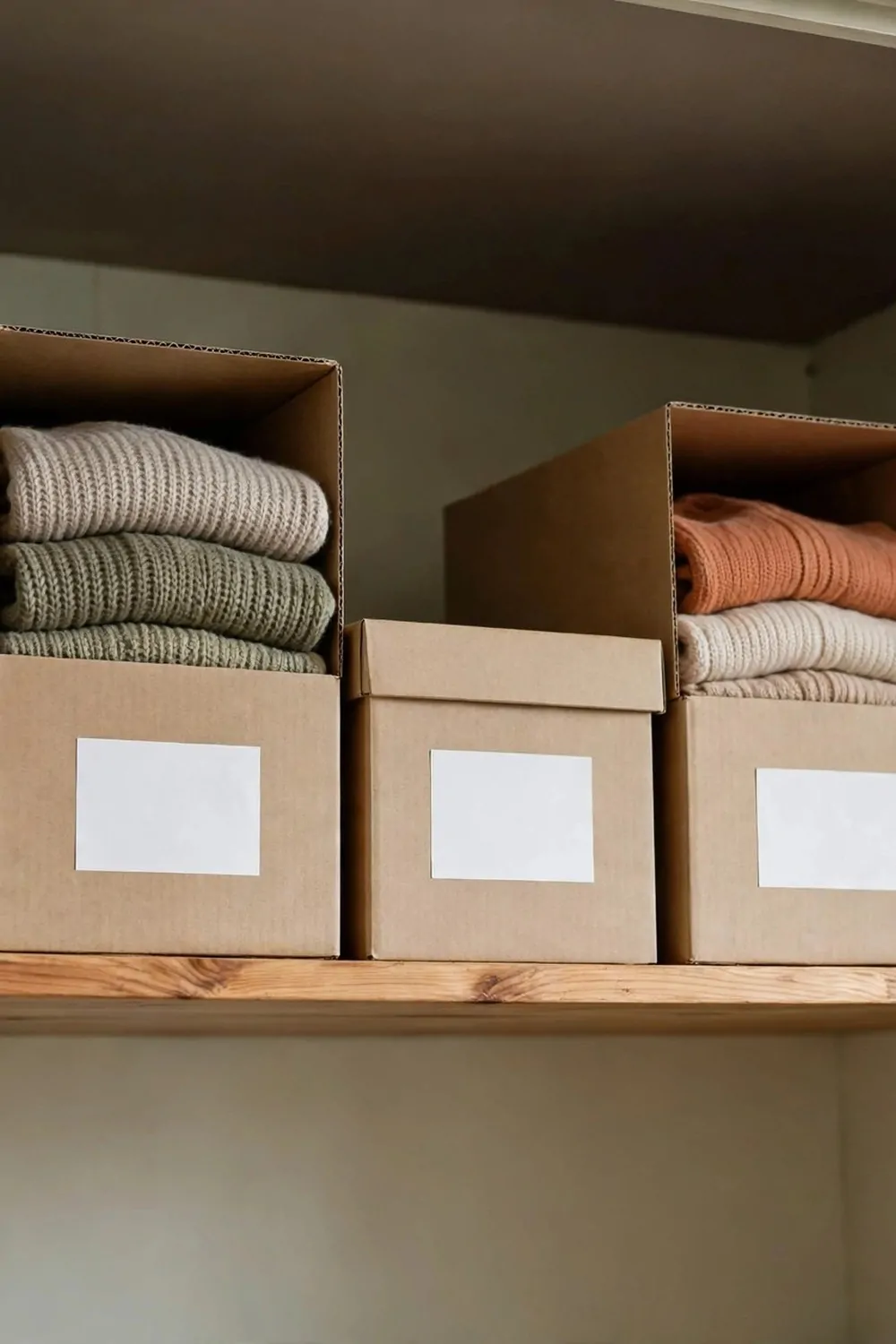
The top shelf of a closet is often the messiest spot in the whole house. Things get tossed up there and forgotten, and soon it is a jumble of bags and boxes with no order at all. Plain labeled boxes fix that in one afternoon.
The idea is simple. Put everything on the top shelf into matching boxes, and write a plain label on each one. From the floor you see a neat row of boxes, not a pile of stuff. The mess is still there, but it is hidden inside tidy boxes.
Use boxes that are all the same size and color if you can. Matching boxes look calm and planned, even when the things inside are a mess. Mixed boxes in different colors look like a jumble, even when they are perfectly organized inside.
Keep the labels short and honest. “Winter scarves” is better than “Stuff”. “Spare bedding” is better than “Misc”. A label you cannot read fast is a label you will ignore, and then you are back to digging through boxes.
Put the things you use least on the top shelf. That shelf is hard to reach, so it should hold the slow stuff. Seasonal clothes, spare blankets and old photo albums are perfect up there.
Leave a little gap between the boxes and the ceiling. If the boxes touch the ceiling, you cannot lift the lid without pulling the whole box down. A few inches of air makes it easy to open a box while it is still on the shelf.
I use boxes with lids, not open baskets, for the top shelf. Lids keep dust out, and dust is the enemy of anything stored high up. An open basket on the top shelf will be full of dust in a month.
The best part is how it changes the feel of the closet. You open the door and the top shelf looks neat and quiet. Nobody would guess it holds a whole season of clothes and half your spare bedding.
One last tip. Write the label on the front and the side of each box. When you pull a box down you can read it from any angle, and when you put it back you do not have to turn it around to face the right way.
Rolling Bins Under the Hanging Clothes
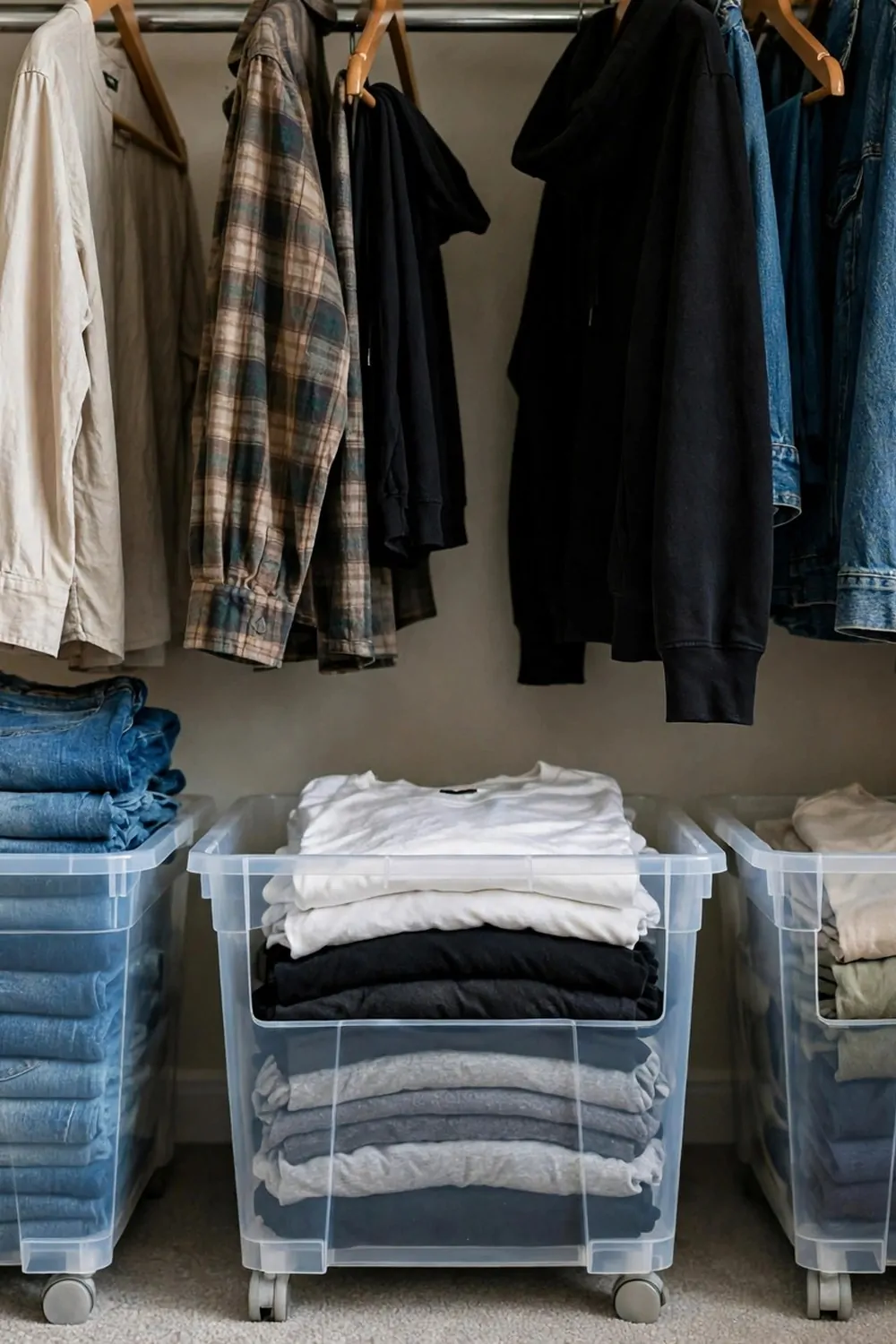
Rolling bins are the quiet heroes of closet storage. They slide under your hanging clothes, they roll out when you need them, and they roll back in when you are done. No lifting, no dragging, no fuss.
The floor under hanging clothes is usually empty, and a low bin on wheels fills it perfectly. I keep my out of season shoes in one bin and my spare bags in another. They roll out smoothly and I can see everything inside at a glance.
Pick bins with lids if you want to keep dust out. Shoes and bags collect dust fast on a closet floor, and a lid keeps them clean. Clear bins are even better, because you can see what is inside without opening the lid.
Measure the height before you buy. The bin has to fit under your shortest hanging clothes with a little room to spare. If it is too tall, it will push your clothes up and wrinkle them. A bin that is six to eight inches tall works in most closets.
Wheels matter more than you think. Cheap bins have tiny wheels that stick on carpet and wobble on hard floors. Spend a little more on bins with smooth rolling wheels, and you will use them ten times more often.
Keep one bin for the things you grab often and one for the things you store. The everyday bin should roll out easily and sit near the front. The storage bin can live at the back, because you only need it a few times a year.
I label my bins with a small tag on the front edge. It takes two minutes and it stops me from pulling out the wrong bin every time. A bin full of shoes is heavy, and I do not want to roll it out by mistake.
The hidden magic is that the bins disappear under your clothes. From the doorway you see hanging clothes and a clean floor. The bins are there, doing their job, but they are tucked away where nobody looks.
One warning from experience. Do not overload a bin so much that the lid will not close. An open bin under hanging clothes catches dust and looks messy. If the lid will not sit flat, it is time to move something out.
A Hamper Hidden Behind a Cabinet Panel
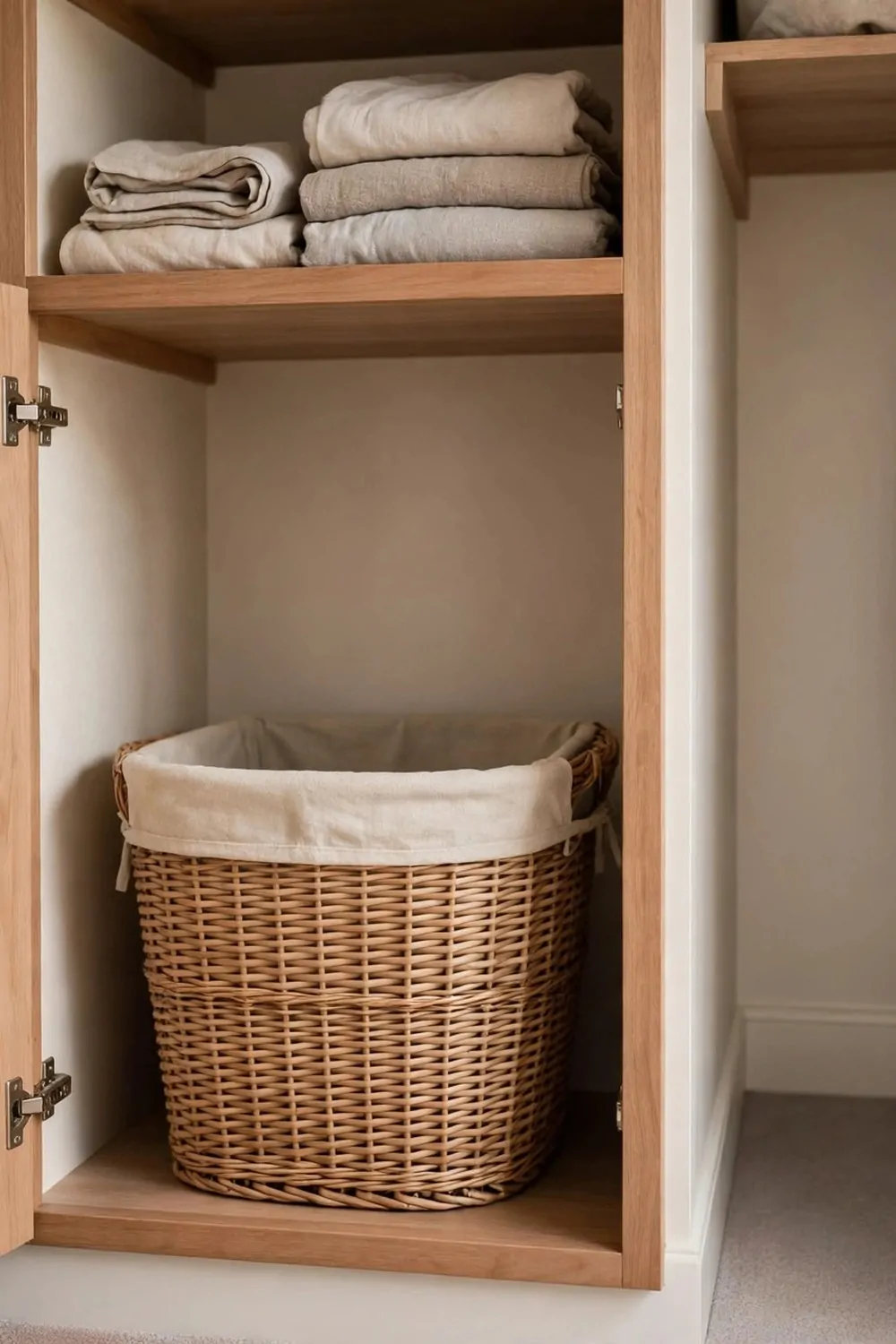
A laundry hamper is one of those things every home needs and nobody wants to look at. It sits in the corner, it smells a little, and it always looks messy. Hiding it behind a cabinet panel solves all of that at once.
The idea is to build or buy a slim cabinet with a panel front that opens, and put the hamper inside it. From the outside it looks like a plain piece of closet furniture. Open the panel and the hamper is right there, ready for dirty clothes.
I love this because it keeps the laundry out of sight and out of smell range. A hamper behind a closed panel does not let the smell drift into the bedroom the way an open basket does. It is a small thing, but it makes the room feel fresher.
Use a hamper with a removable bag if you can. When laundry day comes, you lift the bag out and carry it to the machine. You never have to drag the whole hamper out of the cabinet, which saves your back and your patience.
Put a small vent or a few holes in the back of the cabinet. Dirty clothes need a little air, or they get damp and musty. A few small holes you cannot see will keep the air moving without letting the smell out.
The panel front should be easy to open with one hand, because you will often have an armful of clothes. A simple pull handle or a push-to-open latch works best. A fiddly latch will make you hate the whole setup in a week.
Match the panel to the rest of your closet so it blends in. Same color, same finish, same style. If it matches, your eye slides right past it and the hamper stays a secret. If it clashes, it draws attention to the very thing you wanted to hide.
I keep a small scented sachet inside the cabinet, tucked behind the hamper. It keeps the inside smelling fresh without being strong. One sachet lasts for months and costs almost nothing.
The best part is laundry day. I open the panel, lift out the bag, and close the panel again. The closet looks exactly the same as before. No basket in the corner, no pile of clothes on the floor, no mess at all.
A Slide-Out Rack for Belts and Ties
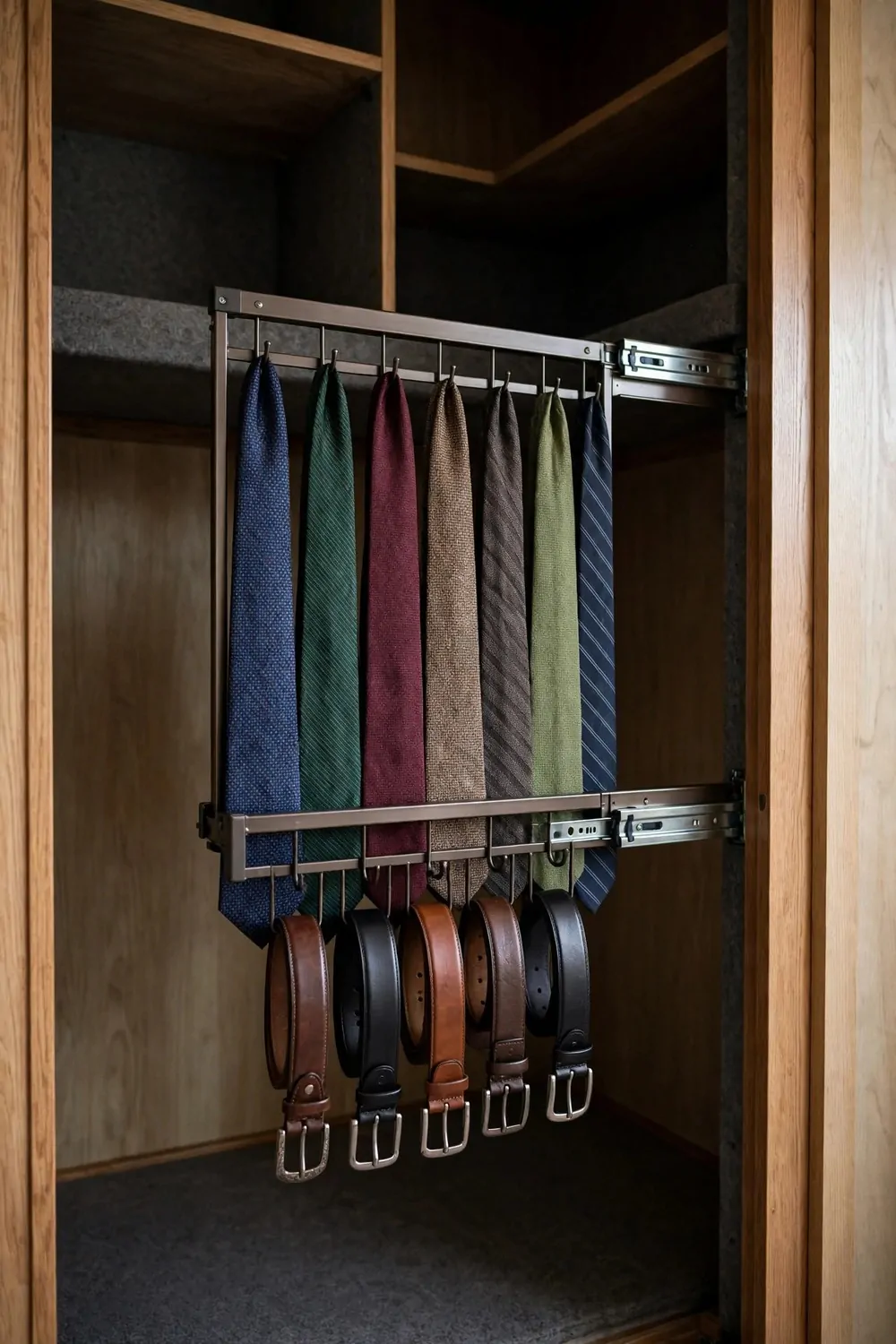
Belts and ties are small, but they are masters of making a mess. Toss them in a drawer and they tangle. Hang them on a hook and they slide off. A slide-out rack gives each one its own little spot, hidden away until you need it.
A slide-out rack is a slim bar with hooks or pegs that pulls out from inside the closet like a drawer. It mounts under a shelf or inside a cabinet, and it slides back in when you are done. From the front you see nothing at all.
Mine holds eight belts and six ties, each on its own hook. I pull the rack out, pick the one I want, and push it back in. It takes three seconds, and my belts never tangle anymore.
The rack works because it uses a thin slice of space that would otherwise be wasted. It mounts under a shelf, in the gap between the shelf and the clothes below it. That gap is usually empty, and the rack fills it without taking room from anything else.
Keep the rack at a comfortable height. If it is too high, you will need a step stool to reach it. If it is too low, it will bump into the clothes below. Chest height is about right for most people.
Space the hooks wide enough that belts do not overlap. Belts are thick, and if they hang too close together they press against each other and get creased. A little air between them keeps them smooth and easy to grab.
Ties need a different kind of hook than belts. A tie hook is usually a small peg or a loop that holds the tie without creasing it. If your rack has both kinds of hooks, it can hold both belts and ties in the same slim space.
I like that the rack keeps everything visible at a glance. You pull it out and you can see every belt and tie in one row. No digging, no untangling, no guessing what is at the bottom of the pile.
One tip from my own closet. Do not hang heavy buckles on the same hook as a light tie. The buckle will slide the tie off and you will find it on the floor in the morning. Give the heavy things their own hooks.
A Jewelry Drawer With Hidden Compartments
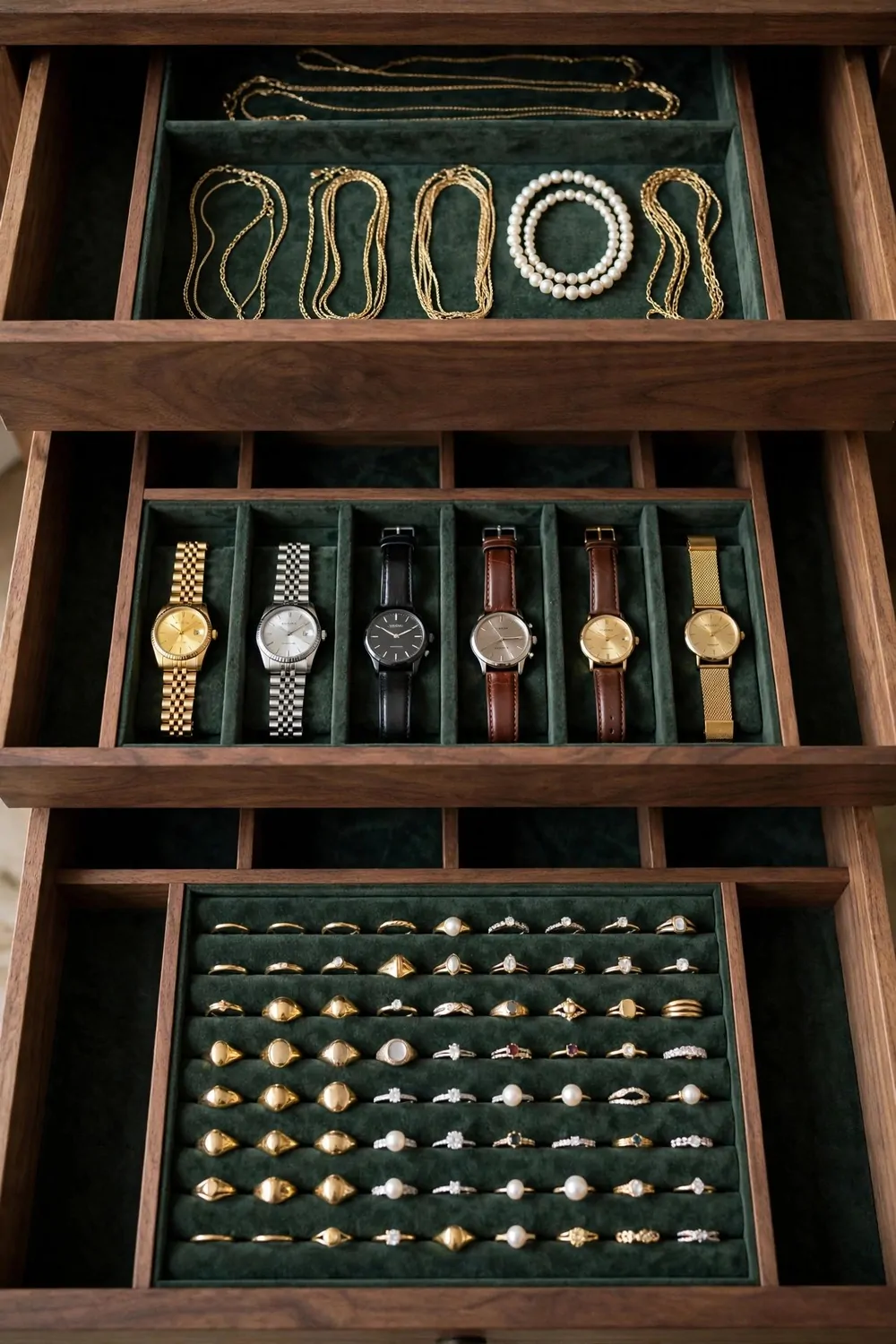
Jewelry is small, precious and very easy to lose. A normal drawer just lets it slide around and tangle. A jewelry drawer with hidden compartments keeps every piece in its own little home, out of sight and safe.
The drawer looks plain from the outside, like any other drawer in your closet. Open it and you see a tray with small sections for rings, earrings and necklaces. Lift the tray and there is a second hidden layer underneath for the pieces you wear less often.
I keep my everyday jewelry in the top tray. Rings in one section, earrings in another, my watch in its own little slot. Everything is visible at a glance, and I can grab what I need in the morning without thinking.
The hidden layer underneath holds the special pieces. The necklace from my mother, the bracelet I only wear on big days, the earrings I save for evenings out. They are safe, they are out of sight, and they are still easy to reach when I want them.
Felt lining is the secret to a good jewelry drawer. It stops pieces from sliding around, it stops metal from scratching metal, and it makes the drawer feel soft and quiet when you open it. A drawer without felt sounds like a cutlery drawer, and that is not the feeling you want.
Keep necklaces in their own long section, laid flat and not tangled. A necklace that is tossed into a pile will knot itself in a day. A long shallow section keeps it straight and ready to wear.
Small compartments matter more than big ones. A drawer with a few big sections just becomes a pile again. A drawer with lots of tiny sections forces you to give each piece a home, and that is what keeps it tidy.
The hidden layer is also a nice safety trick. If someone opens your closet drawer quickly, they see the everyday tray and nothing more. The special pieces sit quietly underneath, out of sight and out of mind.
One more idea. Put a tiny sachet of lavender in the drawer. It keeps the inside smelling fresh, and it is a small luxury that makes opening the drawer feel like a treat every morning.
Shoe Storage Behind a Plain Panel
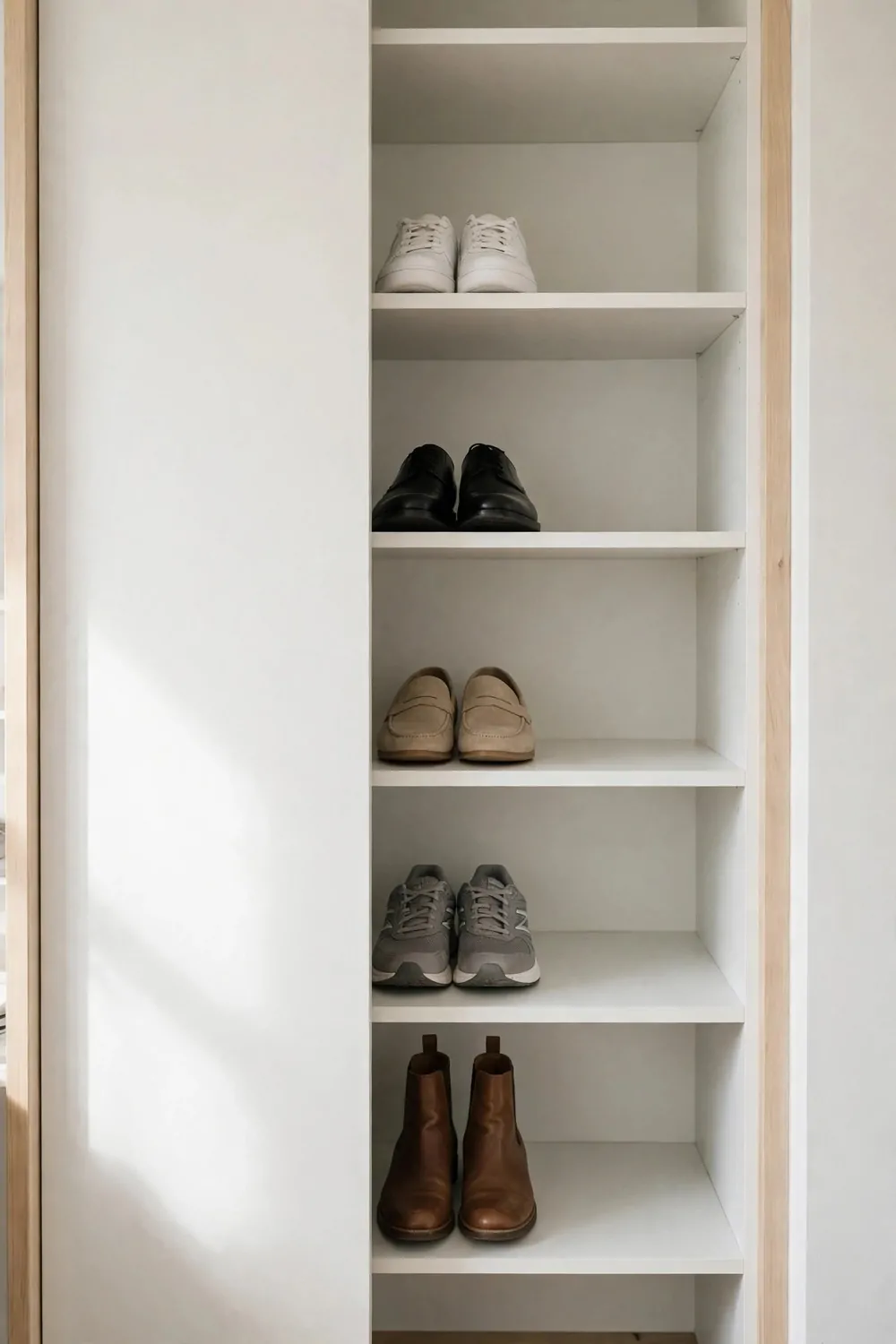
Shoes are the hardest thing to store neatly. They are bulky, they are dirty, and they always seem to multiply. A plain panel that hides shoe shelves behind it turns a messy pile into a secret shoe room.
The idea is simple. You build shallow shelves on a wall or inside a cabinet, and you cover them with a plain panel that looks like part of the closet. Open the panel and your shoes are lined up in neat rows. Close it and the shoes vanish.
I have twelve pairs behind my panel, and nobody would ever guess. The panel is the same color as the closet wall, with no handle and no sign that it opens. You push it gently and it swings open on hidden hinges. It feels like a secret door in a storybook.
Shallow shelves work best for shoes. You only need about ten inches of depth for most pairs, and shallow shelves let you fit more rows into the same space. Deep shelves just waste room behind the shoes you can already see.
Angle the shelves slightly so you can see each pair at a glance. A flat shelf hides the shoes at the back. A shelf tilted just a little lets you see every pair, and it looks much neater too.
Keep the shoes you wear most at eye level. The everyday pairs should be the easiest to grab. The occasion shoes, the ones you wear twice a year, can live on the top or bottom shelves where you do not mind reaching.
Put a small tray at the bottom for the shoes you just wore. They need a place to air out before they go back on the shelf, and a tray keeps any dirt off your clean floor. I wipe the tray once a week and it takes thirty seconds.
The panel also keeps dust off your shoes. Open shelves collect dust fast, and dusty shoes look old even when they are new. Behind a closed panel, your shoes stay clean and ready to wear.
One warning. Make sure the panel has a soft close or a magnetic catch. A panel that slams shut will shake the shelves and knock shoes over. A gentle catch keeps everything quiet and in place.
A Bench Seat That Opens Up for Storage
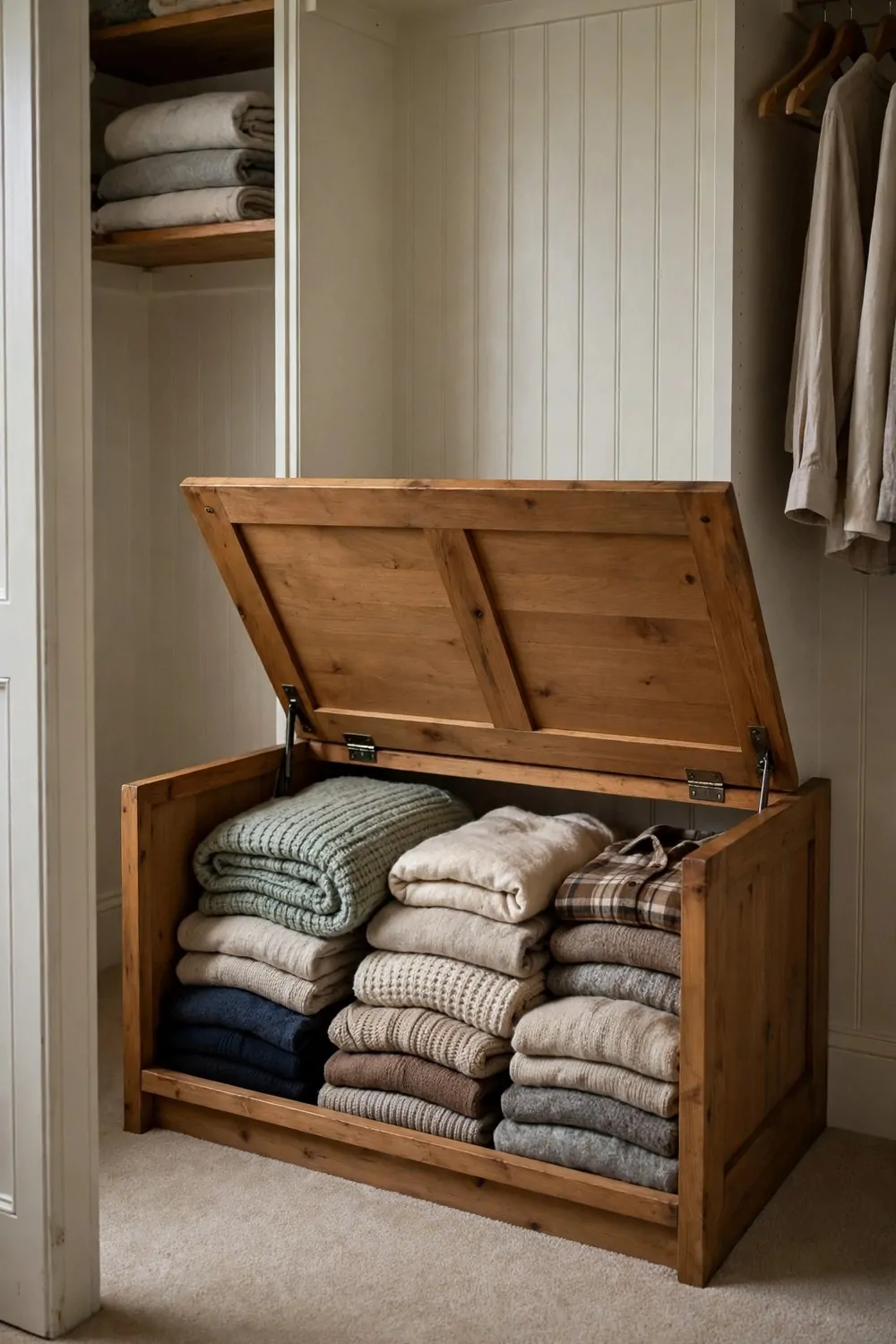
A bench in a closet sounds like a luxury, but it is really a storage box with a cushion on top. It gives you a place to sit while you put your shoes on, and it hides a surprising amount of stuff inside.
The bench is a simple box with a hinged lid. Lift the lid and there is a deep space inside for the things you do not need every day. Close the lid and it is a seat again. Nobody would guess it is storage at all.
I keep my spare handbags in my bench, along with a few folded blankets and the shoe care kit. The bags stay in shape because they are not squashed in a pile, and the blankets stay clean because the lid keeps dust out.
Put the bench near the closet door so you can sit down to put your shoes on. That is the moment you will use it most, and it is nice to have a seat right where you need it. A bench at the back of the closet is harder to reach and gets used less.
A cushion on top makes the bench comfortable and makes it look like furniture instead of a box. Pick a cushion in a color that matches your room, and the bench will look like it belongs there. A bare wooden lid looks like a storage box, and that gives the secret away.
The inside of the bench is best for soft things. Bags, blankets, scarves and folded clothes fit well and will not get damaged. Hard or heavy things can damage the inside of the lid, so keep those somewhere else.
Add a small gas strut or a soft hinge if you can. It holds the lid open while you look inside, so you do not have to hold it up with one hand while you dig with the other. It is a small detail that makes the bench much easier to use.
I also use the bench as a staging spot. When I am packing for a trip, I lay out my clothes on the bench before they go into the suitcase. When I am sorting out the closet, the bench holds the pile I am working through. It is a seat, a table and a storage box all in one.
The best part is how it looks. Guests see a pretty bench with a cushion. They do not see the handbags and blankets hiding inside. Your closet gains a whole extra storage box, and the room gains a place to sit.
A Mirror That Hides Shelves Behind It
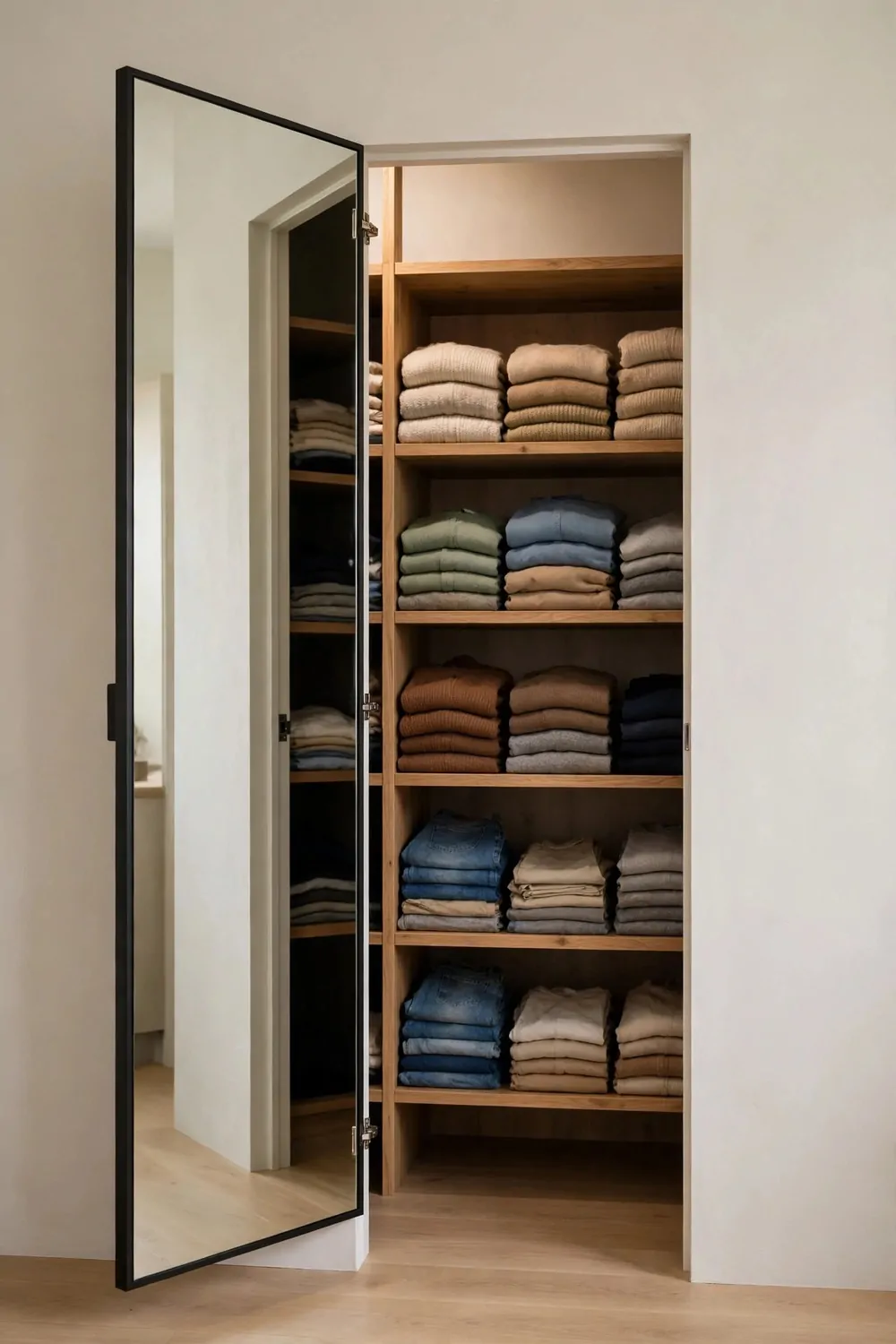
A full length mirror is something every closet needs, and it is also the perfect cover for hidden shelves. Mount the mirror on a hinged panel, and behind it you have a secret cabinet that nobody would ever find.
The idea is simple. The mirror looks like a normal mirror on the closet wall or door. But it swings open on hidden hinges, and behind it are narrow shelves for the small things that always clutter up a closet. Perfume, small boxes, spare buttons and all the little bits that have no home.
I keep my perfume and my small accessories behind my mirror. They are things I use every day, but I do not want them sitting out on a shelf where they collect dust and look messy. Behind the mirror they are safe, clean and easy to grab.
Narrow shelves work best behind a mirror. The space is not deep, maybe three or four inches, so it suits small flat things. Tall bottles will not fit, but small perfume bottles, jewelry boxes and little tins fit perfectly.
Put a small light inside if you can. A tiny battery light stuck to the inside of the mirror frame makes it easy to see the shelves, even in a dark closet. Without light, the back shelves can be hard to see, and you will stop using them.
The mirror should be full length so it is useful for checking your outfit. A small mirror that hides shelves is a nice trick, but a full length one does two jobs at once. You check your outfit, then you open it and grab your perfume. That is good design.
Make sure the hinges are strong enough to hold the mirror and the shelves. A mirror is heavy, and cheap hinges will sag over time. Good hinges keep the mirror straight and keep it closing properly for years.
I love the secret feeling of this one. You stand in front of the mirror, you check your outfit, and then you swing it open like a secret door. It feels a little bit magical every time, even after months of using it.
One tip. Keep the shelves tidy, because you will see them every day when you open the mirror. If they get messy, the trick loses its charm. A quick tidy once a week keeps the secret shelves looking as neat as the mirror itself.
A Fold-Down Shelf That Vanishes When You Are Done
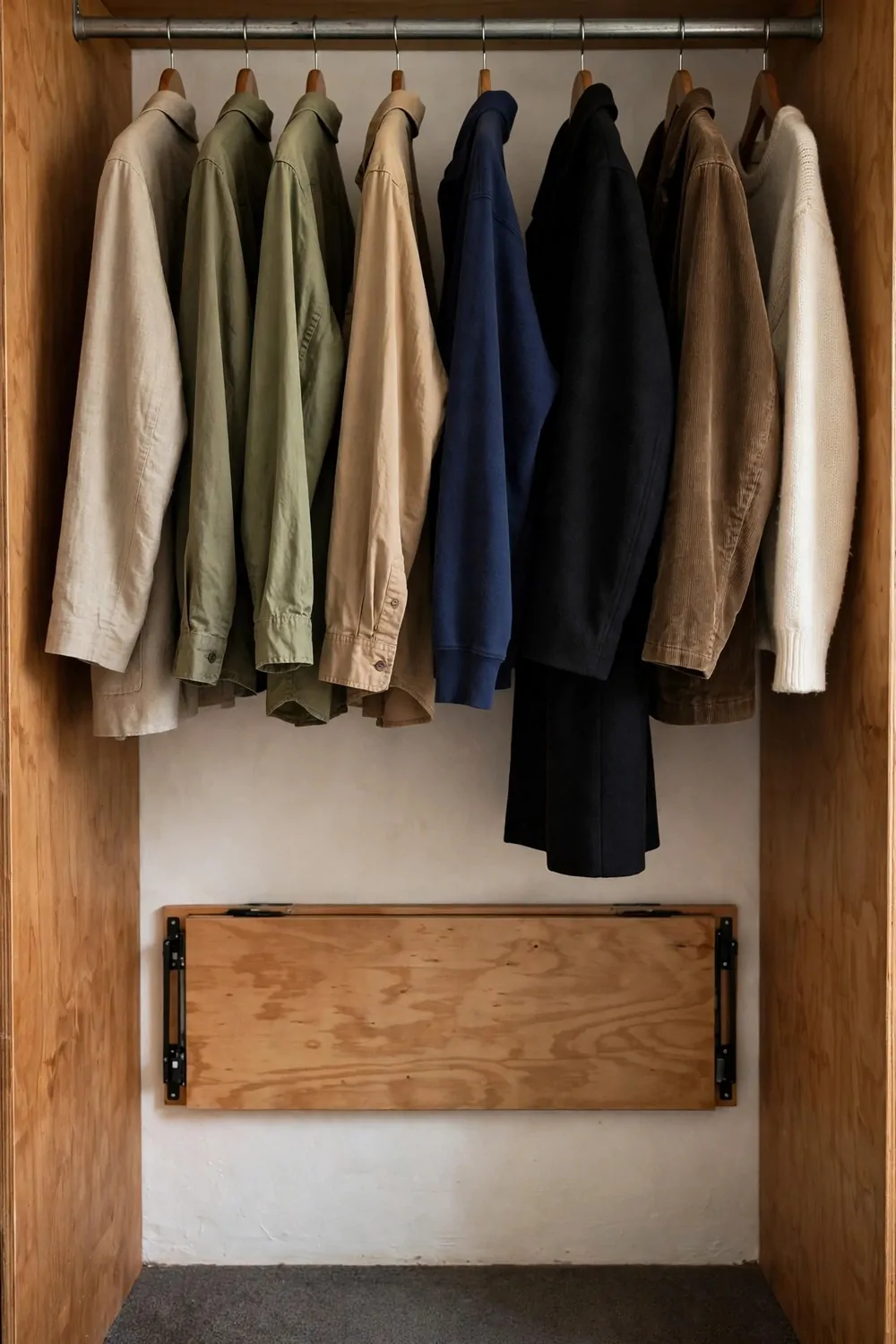
Some closet jobs need a shelf for ten minutes and then never again. Folding clothes, sorting out a pile, packing a bag. A fold-down shelf gives you that surface when you need it, and then it vanishes flat against the wall when you are done.
The shelf is hinged to the wall and folds up or down. When it is down, it is a flat work surface at waist height. When it is up, it sits flat against the wall like a thin panel, and you would never know it was a shelf at all.
I use mine for folding laundry. I pull the shelf down, fold a pile of clothes on it, and then fold it back up. Before I had it, I folded clothes on the bed and they ended up in a pile on the floor. Now the folding happens right in the closet, where the clothes live.
The shelf should be strong enough to hold a pile of clothes, but it does not need to hold heavy things. A simple bracket that locks when the shelf is down will keep it steady. A wobbly shelf is worse than no shelf, because you will not trust it.
Put the shelf at a height that feels natural for folding. Waist height is about right for most people. Too high and your arms get tired. Too low and your back hurts. Stand in front of the wall and let your hands fall to where they rest naturally. That is the right height.
Keep the wall space above the folded shelf free. When the shelf folds up, it needs a clear spot on the wall to sit flat. If there is a hook or a picture in the way, the shelf will not close properly and it will stick out.
I like that the shelf leaves the floor clear when it is folded away. A fixed shelf or a table in a closet takes up space all the time, even when you are not using it. A fold-down shelf only takes space for the ten minutes you need it.
One more use I love. When I am packing for a trip, I fold the shelf down and use it as a packing station. I lay out my clothes, I roll them, and they go straight into the suitcase. The suitcase sits on the floor below, and everything is in one tidy spot.
The best part is the vanishing act. Fold it up, and the closet looks exactly like it did before. No table, no shelf, no clutter. Just a flat wall and a whole lot of hidden storage doing its quiet job.
Corner Shelves That Use the Dead Space
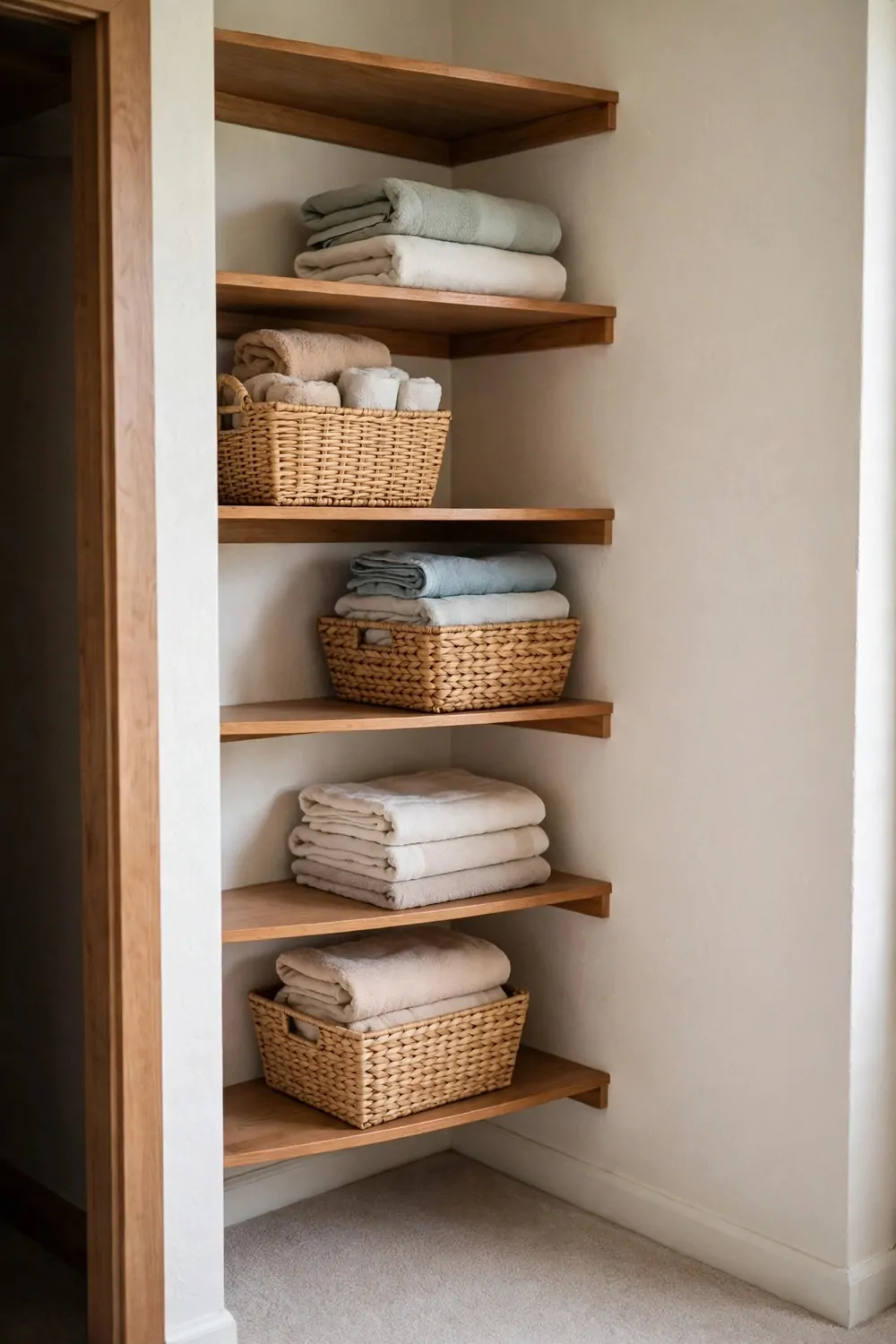
Corners are the most wasted space in any closet. Things get pushed into the corner and forgotten, and the corner itself just sits there, dark and empty. Corner shelves turn that dead space into useful storage.
Corner shelves are shelves cut to fit into the corner, usually in a triangle or a curved shape. They use the space where two walls meet, and they hold the things that do not fit well anywhere else.
I have three corner shelves in my closet, stacked one above the other. They hold my small bags, my folded scarves and a few little boxes of accessories. Things that would get lost on a big shelf stay neat and visible on a small corner shelf.
The shelves work because they use space that is hard to reach any other way. The corner is too deep for a normal shelf and too awkward for hanging clothes. A corner shelf fits the shape of the space instead of fighting it.
Keep the shelves small and shallow. A corner shelf that is too deep will hide things at the back, and you will forget what is there. A shallow shelf keeps everything visible, and you can reach it all without stretching.
Put the things you use most on the middle shelf. The middle is the easiest to reach, so it should hold your everyday items. The top shelf is for the things you use less often, and the bottom shelf is for the things you grab on your way out.
I like to use the corner shelves for the odd shaped things. A small round bag, a hat that will not fold, a box that is too wide for the normal shelves. Corners are good at holding the things that do not fit in neat rows anywhere else.
The shelves also stop the corner from becoming a dumping ground. Before I had them, the corner of my closet was where things went to be forgotten. Now it is one of the tidiest spots in the whole closet, because everything there has a shelf and a place.
One tip from my own mistake. Do not put heavy things on a corner shelf unless it is fixed to both walls. A shelf held by one wall will sag over time, and a sagging corner shelf looks terrible. Fix it to both walls and it will stay strong for years.
The best part is how much space you gain without changing anything else. The corner was doing nothing. Now it holds three shelves of storage, and the closet still looks the same from the door. That is what hidden storage is all about.
A Locked Drawer for Your Most Loved Things
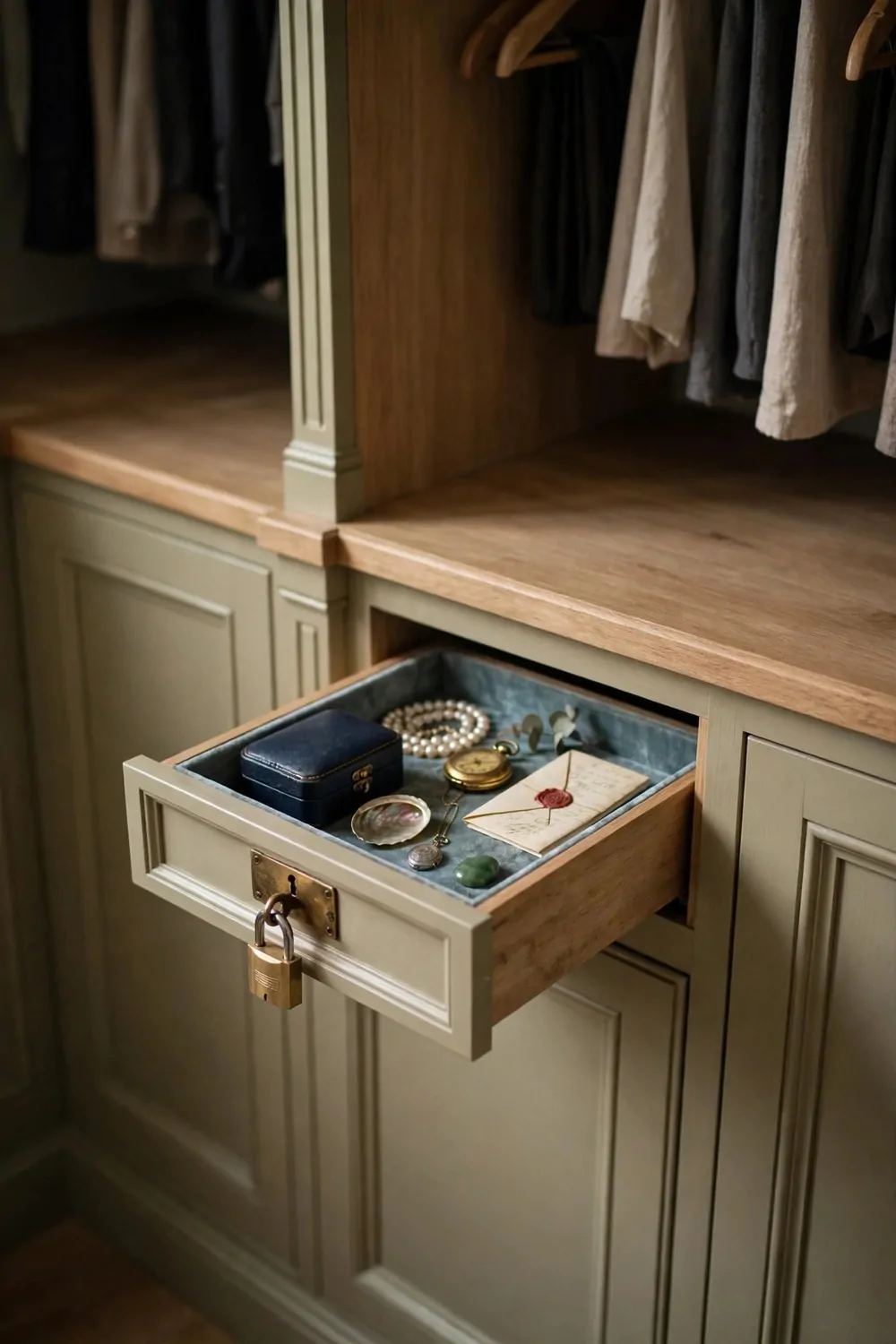
Every closet needs one small place that is just for you. A locked drawer is that place.
I keep my favorite things in mine. My best jewelry, my little notes, and the scarf my mom gave me all live there.
You do not need a big drawer for this. A small one tucked into the back of the closet works great.
The lock can be simple. A little key lock or a tiny code lock is more than enough.
I like knowing that my most loved things are safe and out of sight. It makes me feel calm when I open the closet.
Put the drawer low so it is easy to reach. You want to grab your things fast, not climb up for them.
Inside the drawer, use small boxes or little trays. They keep things from sliding around and getting mixed up.
You can line the drawer with a soft cloth. It stops your jewelry from getting scratched and it looks pretty too.
Only you need to know what is inside. That is the whole point of a hidden drawer.
I check mine once a month just to smile at the things I love. It takes two minutes and it always makes my day better.
Vacuum Bags on the Highest Shelf
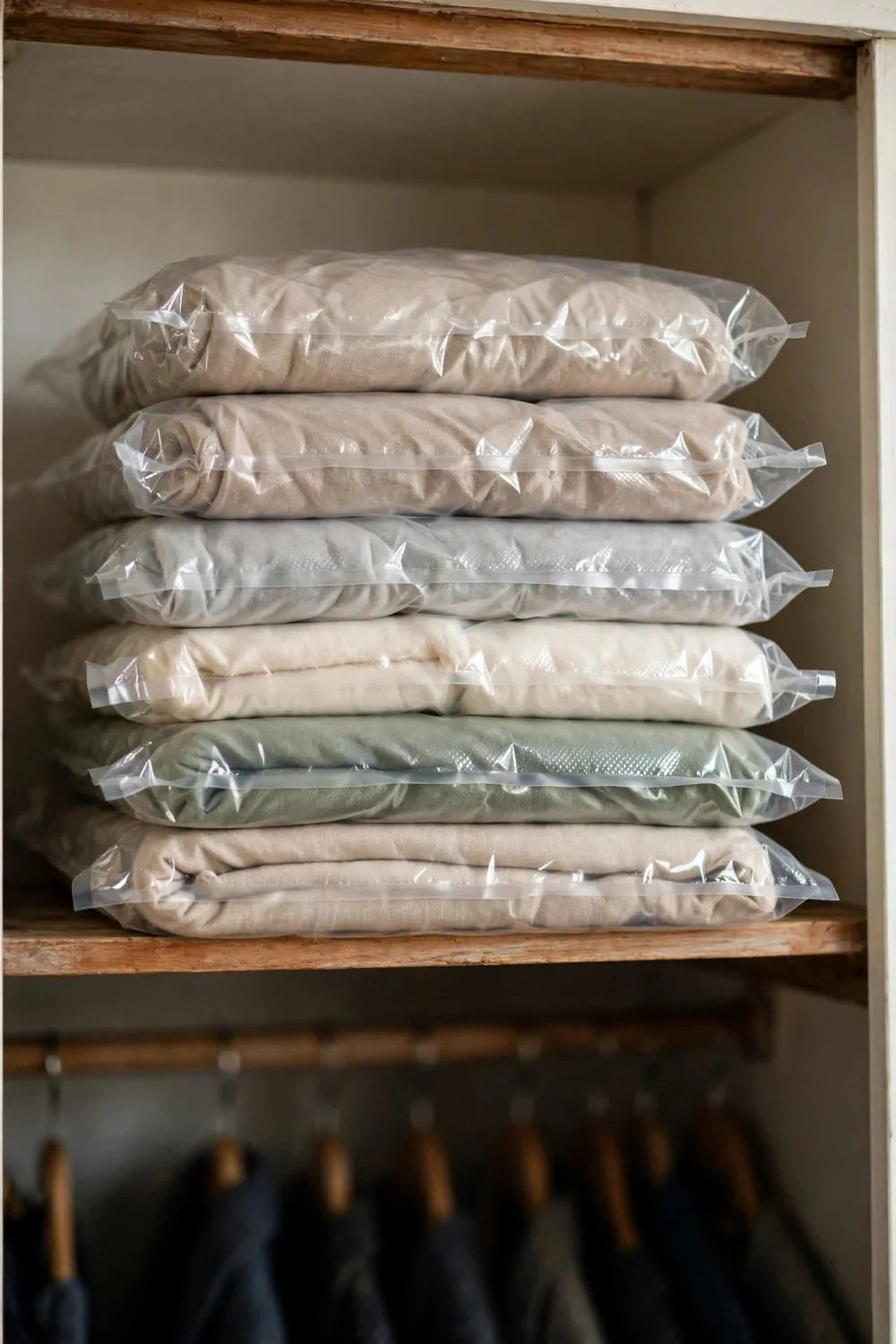
The top shelf is the hardest spot to reach. That makes it the best spot for things you barely use.
Vacuum bags squeeze your bulky clothes flat. A big puffy jacket turns into a thin flat bag in seconds.
I put my winter coats in vacuum bags every spring. They sit up top until I need them again.
You need a vacuum to suck the air out. It is a little loud for one minute and then it is done.
Label each bag with a piece of tape. Write what is inside so you never have to open it to check.
Keep the bags flat and stack them neat. Two or three bags fit where one big coat used to sit.
I put a small step stool in the corner of my closet. It helps me reach the top shelf without asking anyone for help.
Do not store your everyday clothes in vacuum bags. You need those where you can grab them fast.
These bags are perfect for heavy blankets and thick sweaters too. They take up half the space once the air is out.
Try one bag first and see how much room you save. You will be shocked at how much space was hiding up there.
Shoe Pockets on the Inside Wall
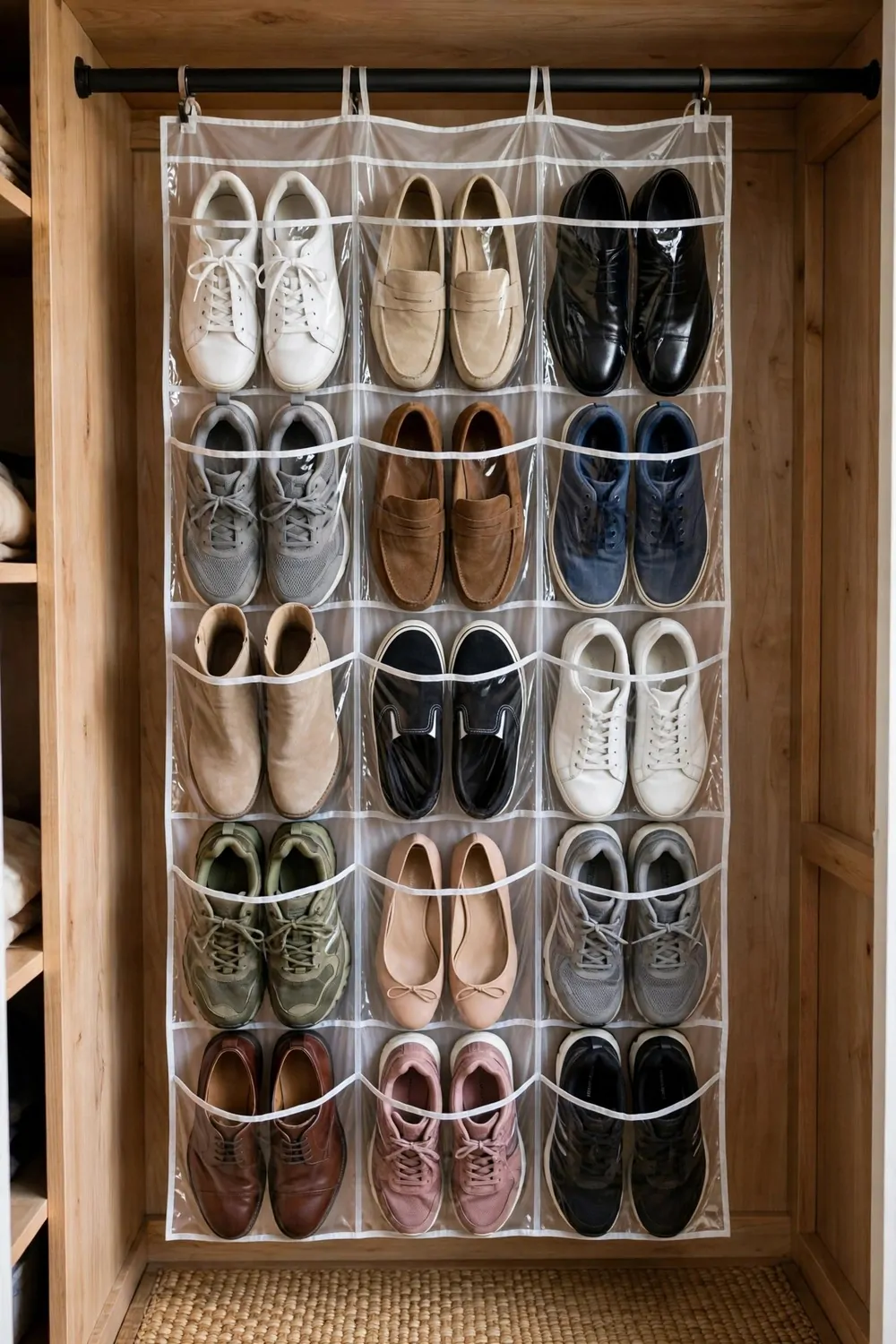
The inside of the closet wall is wasted space in most homes. Shoe pockets turn it into real storage.
You can hang a pocket organizer on the inside wall or the inside of the door. It holds way more than you think.
I use mine for shoes that I wear all the time. Flats, sandals, and sneakers all fit in the pockets.
But you do not have to use it for shoes only. Scarves, belts, and small bags fit in there too.
Pick a clear organizer if you like to see everything at a glance. Pick a fabric one if you want it to look soft and neat.
Make sure the pockets are strong. Cheap ones rip fast when you stuff heavy shoes inside.
Hang it at a height you can reach without bending too much. Your favorite shoes should sit at eye level.
I keep one pocket just for my walking shoes. I grab them every morning without thinking twice.
If the organizer starts to sag, add one small hook at the bottom. It holds it flat against the wall.
This trick costs very little and takes five minutes to hang. Your floor will look so much cleaner after.
A Narrow Pull-Out Shelf for Accessories
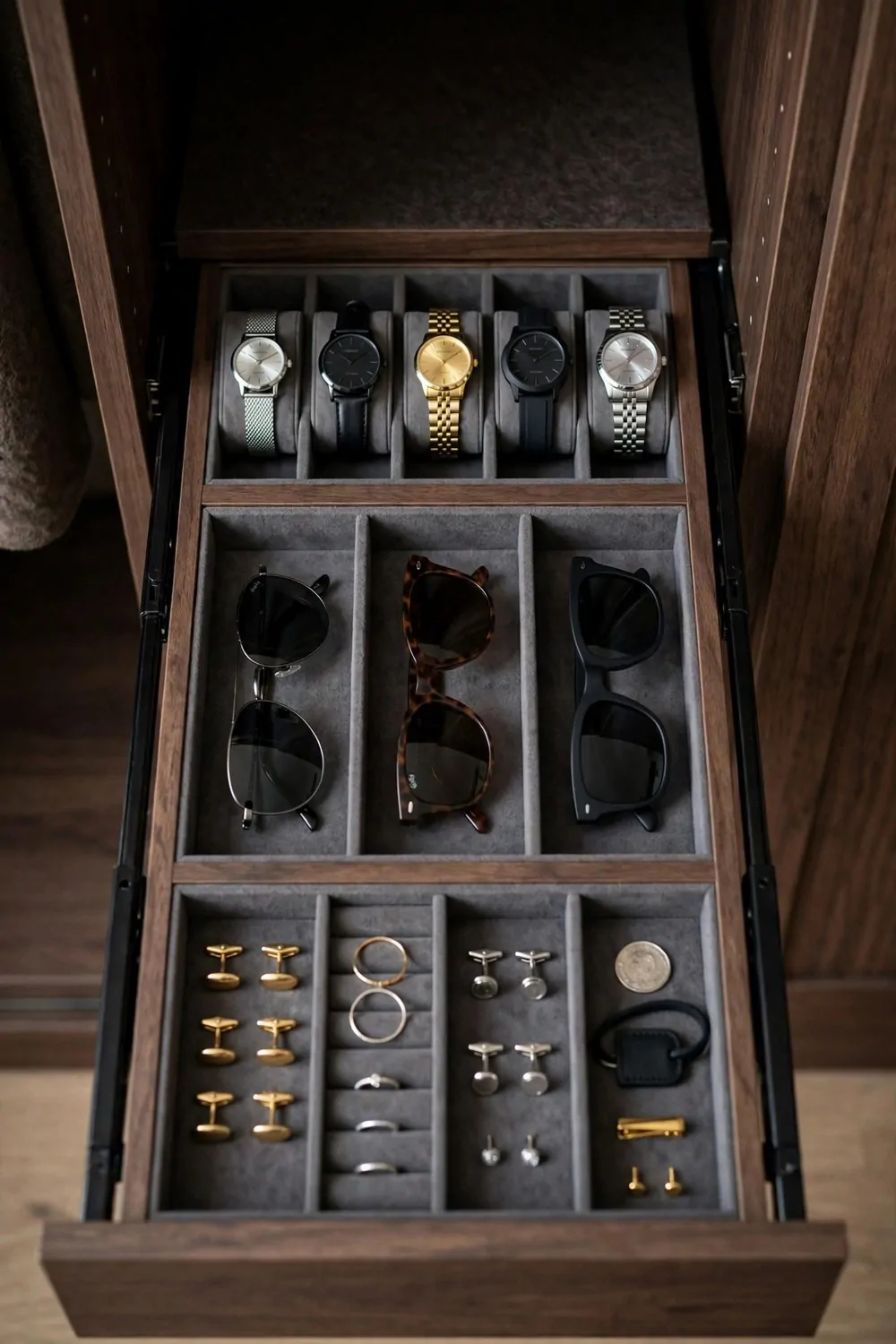
Accessories are the hardest things to keep neat. They are small and they wander all over the closet.
A narrow pull-out shelf fixes that. It slides out when you need it and hides away when you do not.
I keep my belts rolled up on mine. They sit in a neat row and I can see every color at once.
Sunglasses fit great on a pull-out shelf too. Lay them flat in a line and they will not get scratched.
You can fit a shelf like this in a gap as small as a few inches wide. That is why it works so well.
Add little dividers to the shelf. They keep your watches, rings, and bracelets from mixing together.
I pull mine out every morning while I get dressed. It feels like a little shop display made just for me.
Put the shelf at waist height if you can. That way you can see everything without bending down.
Do not overload it with heavy things. Light accessories are the best fit for a narrow shelf.
If you only add one hidden trick this month, make it this one. You will use it every single day.
| Closet size | Best hidden trick | Start with this |
|---|---|---|
| Tiny reach-in closet | Back of the door and under-shelf baskets | One over-door rack |
| Walk-in closet | Hidden drawers and a bench with storage | Rolling bins under the rails |
| Shared closet | Labeled boxes and one side each | Plain labels on every shelf |
The Ceiling Shelf You Forgot You Had
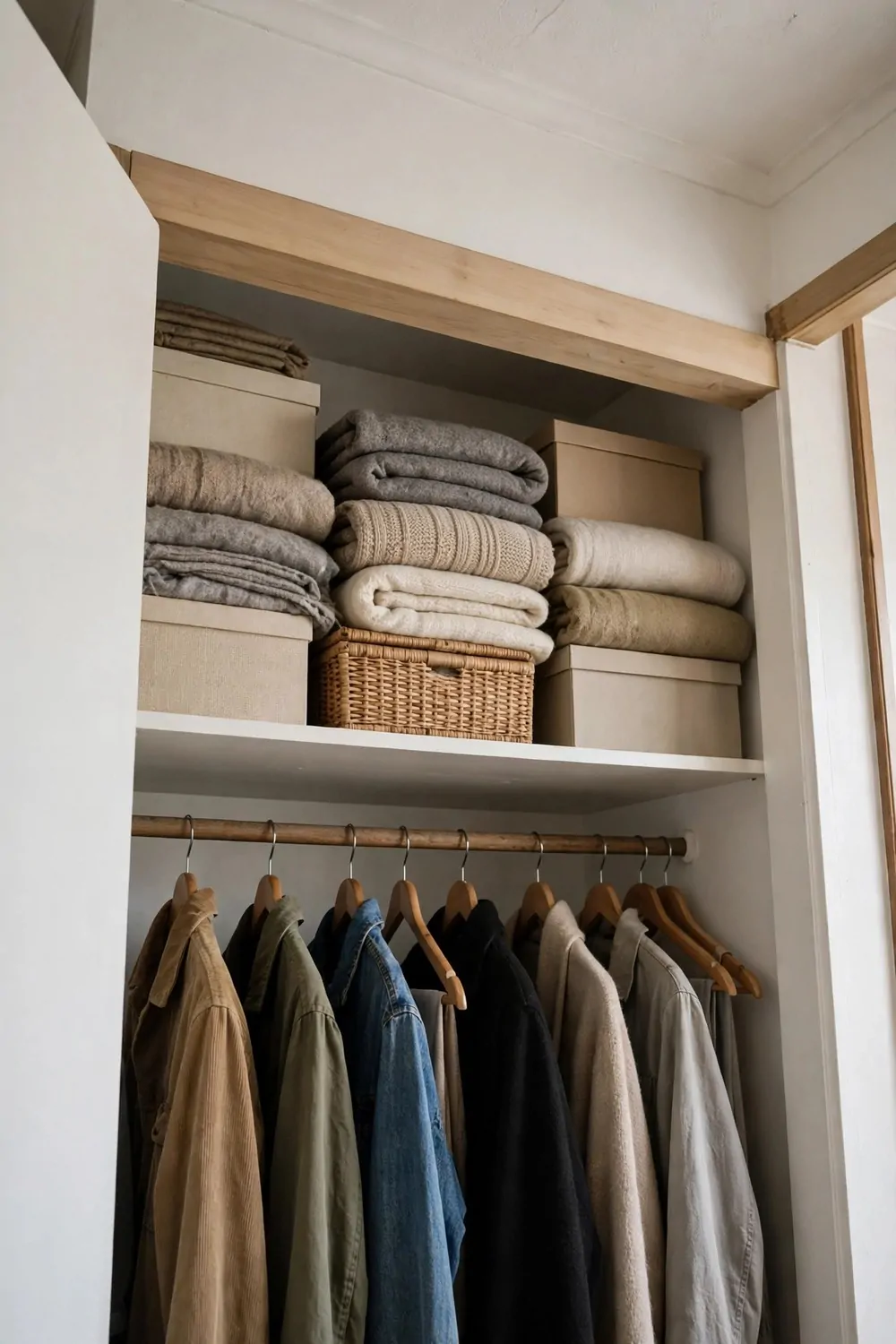
Look up the next time you open your closet. There is space above the top shelf that most people never use.
A ceiling shelf sits right up there. It is perfect for things you only need once or twice a year.
I store my holiday decorations in boxes on my ceiling shelf. They stay out of the way until I want them.
You need a small step stool to reach it. Keep one in the closet so you never have to go looking for it.
Use light boxes up there, not heavy ones. You do not want a heavy box tipping down on you.
Label the front of every box in big letters. From the floor you can still read what is inside.
I keep my old photo albums up there too. They are safe from dust and they do not take up space I use every day.
This shelf is not for everyday clothes. It is for the things you love but do not need right now.
If your closet is tall, this one shelf can hold a whole season of clothes. That is a lot of space you were wasting.
Start with one box and see how it feels. You will wonder why you never looked up before.
Hidden Hooks Under the Shelves for Scarves
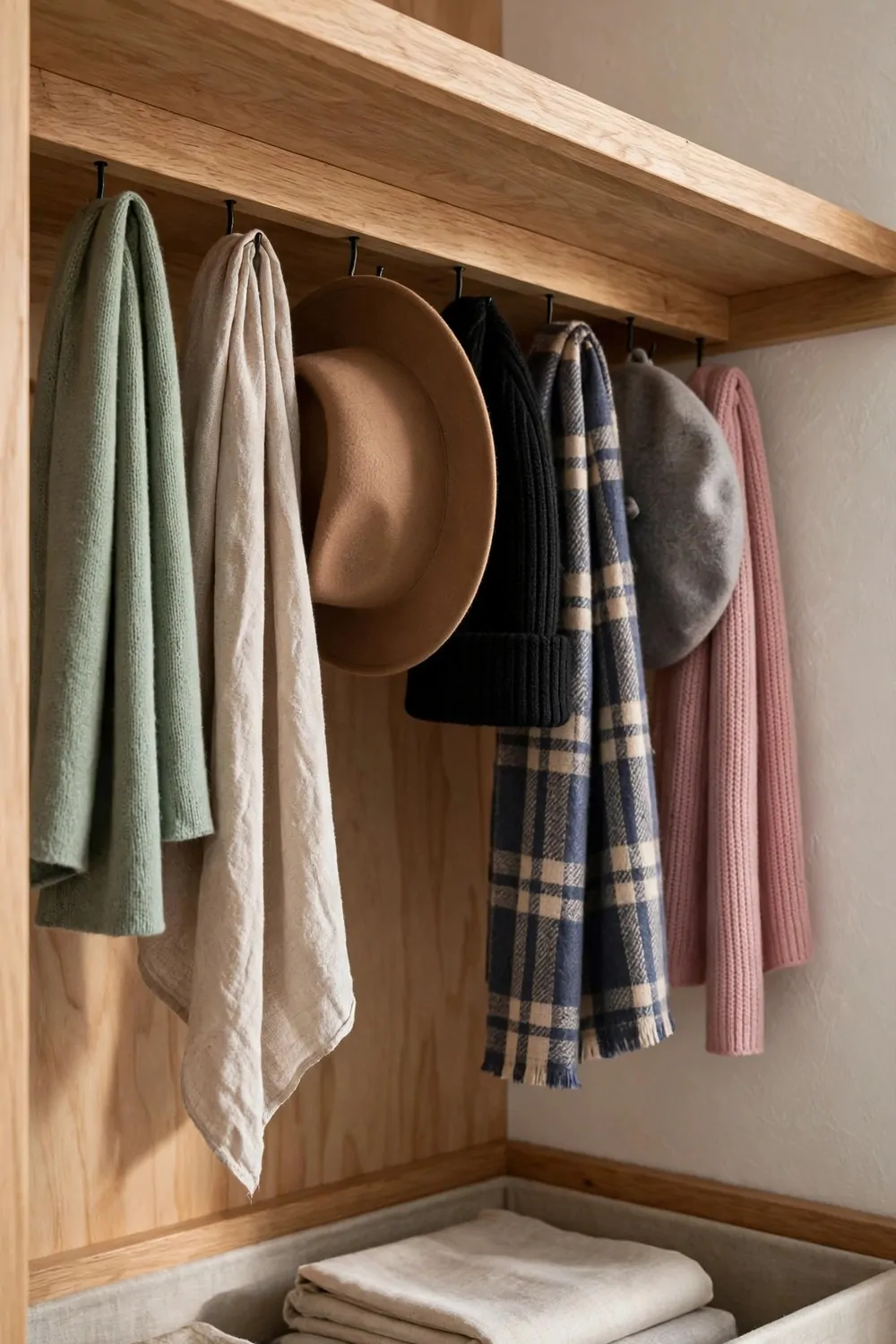
Scarves are light and soft, but they make a mess fast. They slide off shelves and end up in a pile.
Hidden hooks under a shelf solve this in one move. The scarves hang down and stay neat.
I screw small hooks right under the shelf edge. You can barely see them when the closet door is open.
Each scarf gets its own hook. I can see all my colors in one row and pick one in seconds.
You can use the same hooks for belts and thin necklaces too. They hang straight and never tangle.
Space the hooks a few inches apart. If they are too close, the scarves bunch up and look messy.
I keep my favorite silk scarf on the first hook. It is the one I reach for on cold mornings.
These hooks cost almost nothing at the store. A pack of ten is enough for a whole shelf.
Make sure the screws are short so they do not poke through the shelf. That is the only tricky part.
Once you try this, your scarves will never live in a pile again. They will hang pretty and stay ready.
A False Back Panel With Secret Storage
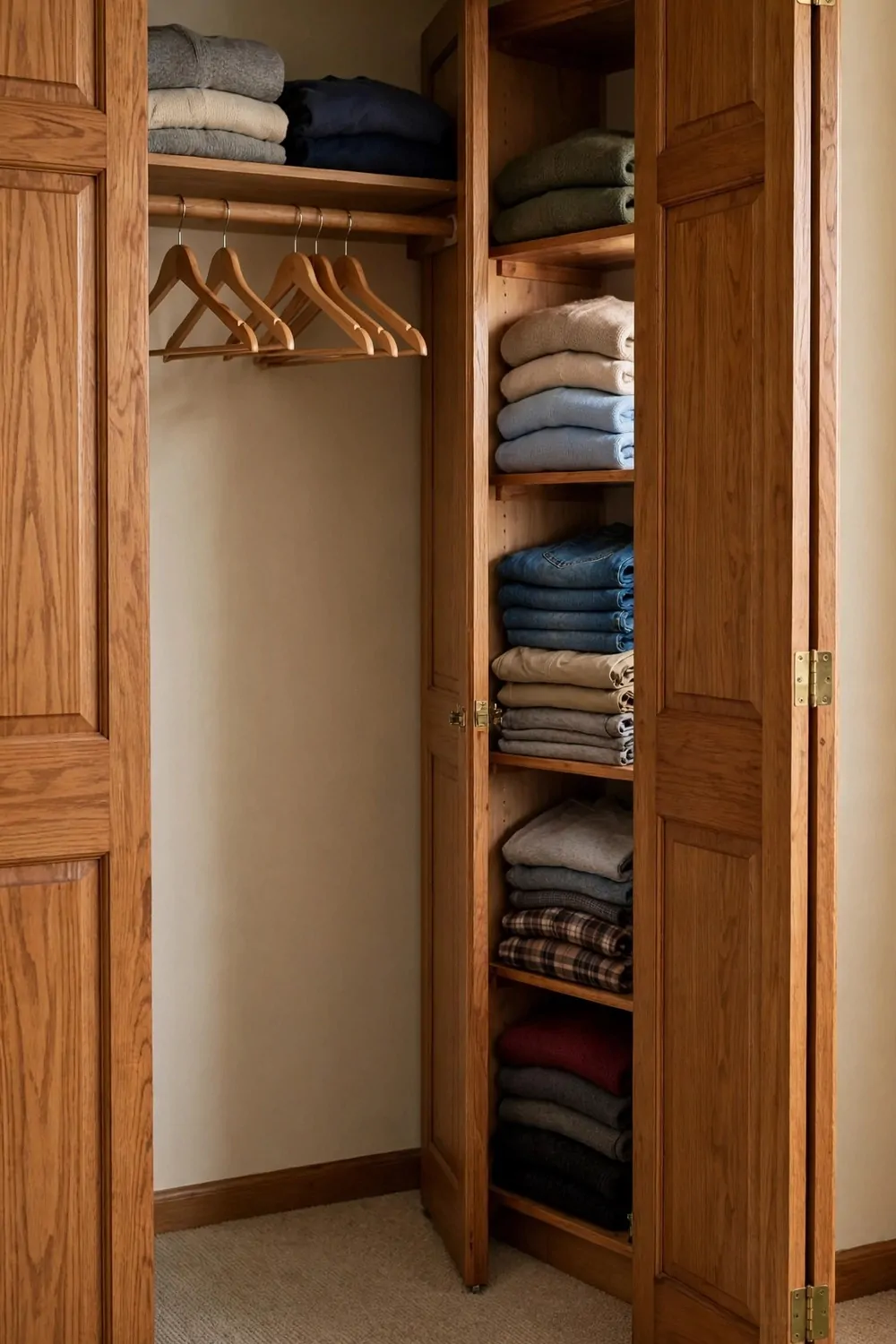
This trick sounds like something from a spy movie. But it is just a smart way to use the back of your closet.
A false back panel is a thin board that sits a few inches in front of the real wall. The gap behind it is your secret spot.
I keep my flat things back there. Old letters, a small photo frame, and my spare keys fit perfectly.
You can make the panel from thin wood or even a light board. Paint it the same color as the closet so it blends in.
Add a small finger hole or a tiny handle to pull it open. No one will guess it moves.
The best part is that it looks like a normal wall. Your guests will never know it hides anything.
Do not store anything heavy behind the panel. Flat and light things are the safest fit.
I put my emergency cash in a small envelope back there. It is the last place anyone would look.
Measure the gap before you start. Even two inches is enough for papers and thin boxes.
This is my favorite secret in the whole closet. It makes me smile every time I slide the panel open.
Slim Bins Squeezed Between Hanging Sections
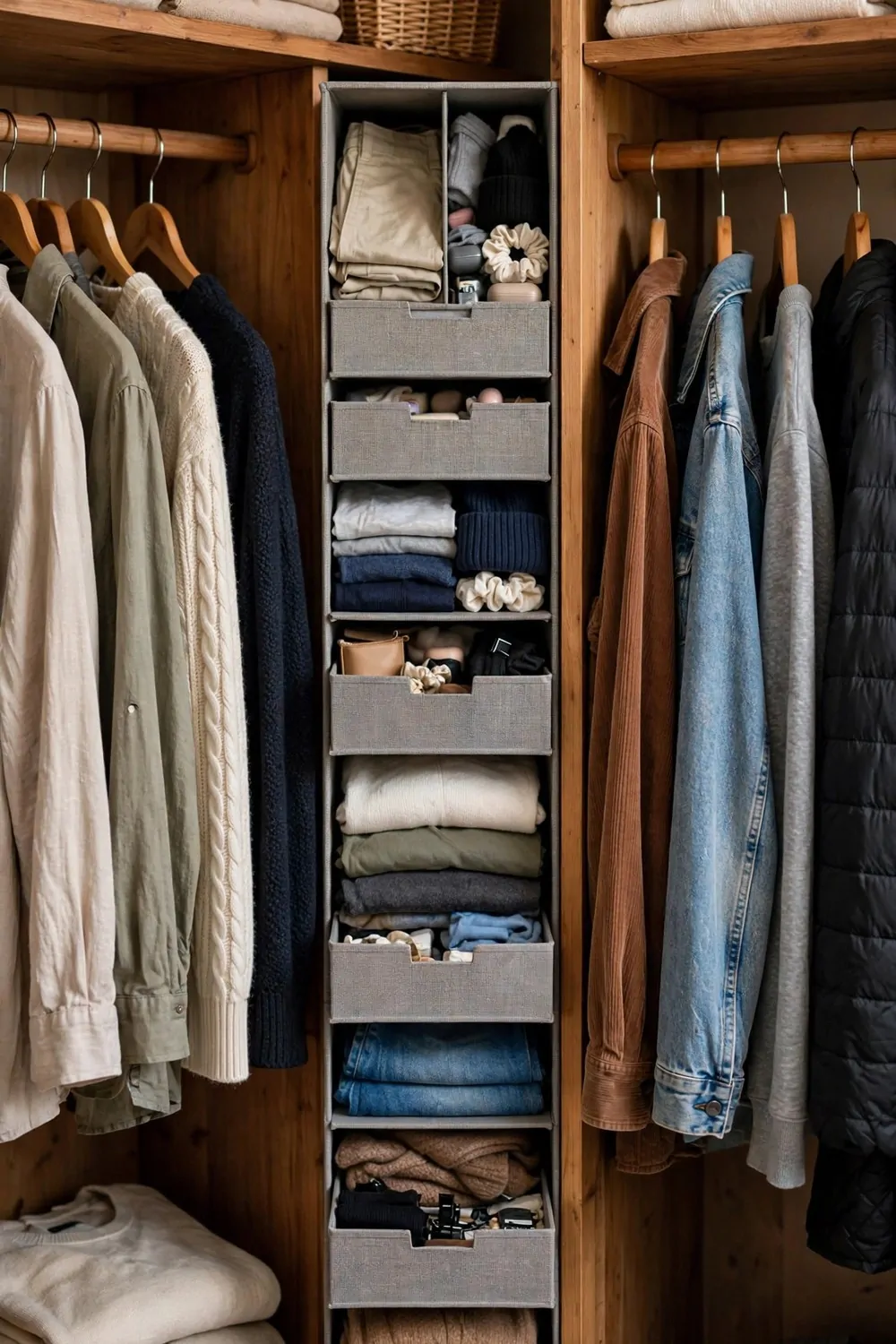
Between two rows of hanging clothes there is always a thin gap. Slim bins slide right into it.
These bins are made to be narrow. They fit where a normal box never could.
I use mine for socks and small underwear. They sit between my shirts and my pants and nobody sees them.
Pick bins with handles on the front. You can pull them out like a drawer without moving your clothes.
Label the front of each bin with a small sticker. I write “socks” and “scarves” so I never grab the wrong one.
The bins keep small things from falling to the floor. That is the biggest win with this trick.
You can stack two slim bins in one gap if the gap is tall enough. That doubles your hidden space.
Choose bins that match your closet color. They will blend in and look like part of the closet.
I check my bins once a week and refold anything messy. It takes three minutes and keeps them neat.
This is one of those ideas that looks too simple to work. Then you try it and wonder how you lived without it.
A Laundry Chute Hidden in the Closet Wall
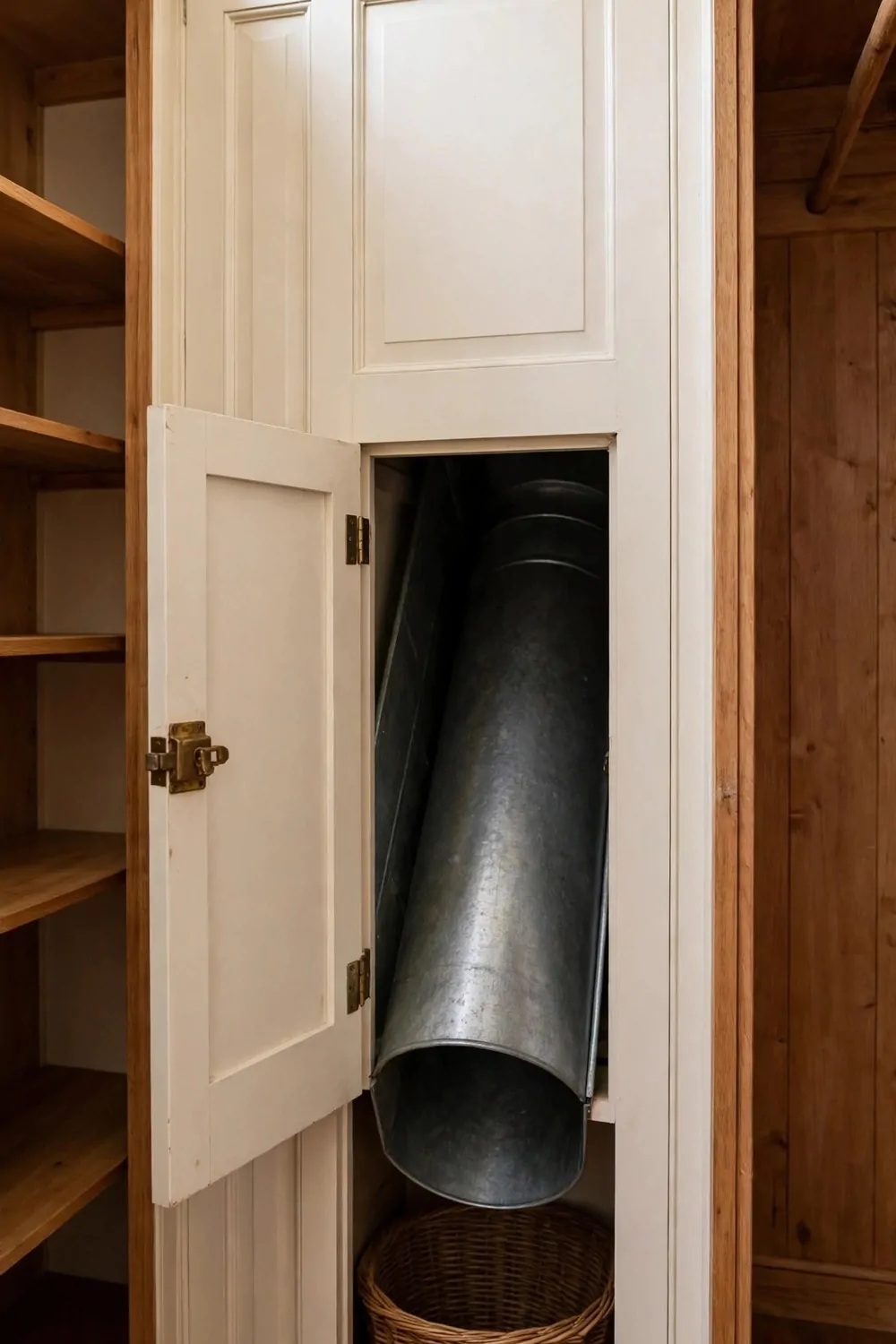
Dirty clothes pile up on the closet floor when there is no place for them. A laundry chute fixes that for good.
A chute is a small opening in the closet wall that drops clothes down to the laundry room below. It hides the mess completely.
I toss my dirty clothes in the chute every night. The floor stays clean and I never trip over a shirt again.
You need a laundry room right below the closet for this to work. If you have one, this trick is gold.
Put a small door or flap over the opening. It keeps smells in and looks neat when it is closed.
Use a basket at the bottom to catch everything. I empty mine every two days so it never overflows.
Kids love a laundry chute. It turns a boring chore into something fun for them.
If you cannot cut a hole in the wall, a tall slim hamper in the same spot works almost as well. Hide it behind your hanging clothes.
I keep a small air freshener near the chute. It keeps the closet smelling fresh all week.
This one takes a bit more work to set up. But once it is in, you will never go back to a floor pile.
A Turntable in the Corner Closet
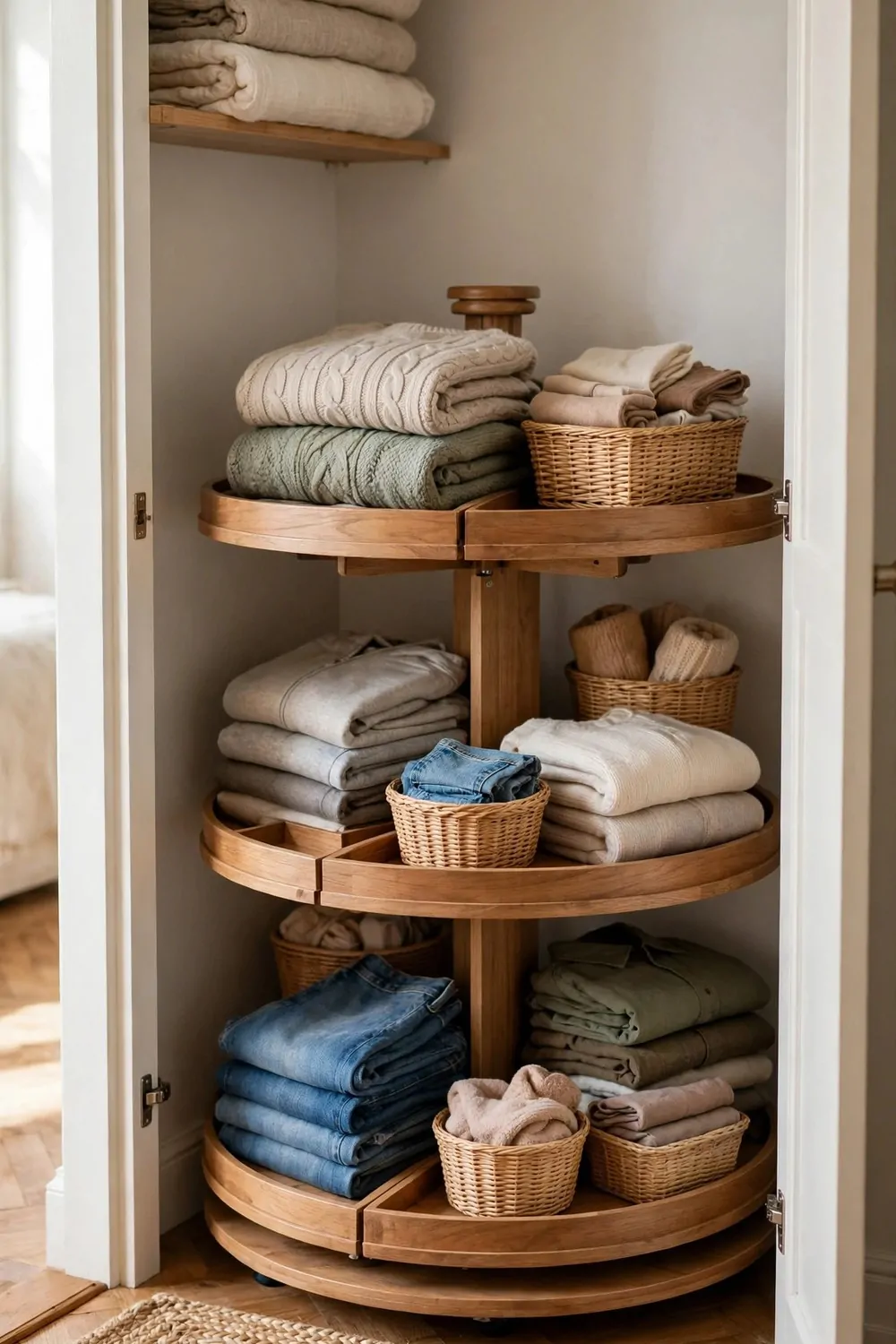
Corners are the hardest part of any closet. Things get lost back there and you forget they exist.
A turntable fixes that. It spins around so you can reach everything in the corner with one hand.
I put my perfumes and small bottles on mine. A quick spin shows me every bottle I own.
You can use a turntable for belts and rolled scarves too. They sit in a circle and stay easy to grab.
Pick a turntable that fits your shelf. Measure first so it spins without hitting the sides.
I keep my nail polish and small makeup on a second turntable. It saves me from digging through a drawer.
The best part is that nothing hides in the back anymore. One spin brings the back to the front.
Clean the turntable once a month with a damp cloth. Dust builds up fast in corners.
Do not overload it with heavy jars. Light things spin best and last longer.
If your corner has been a black hole for years, this is the fix. You will finally use what you already own.
A Secret Drawer Under the Bench
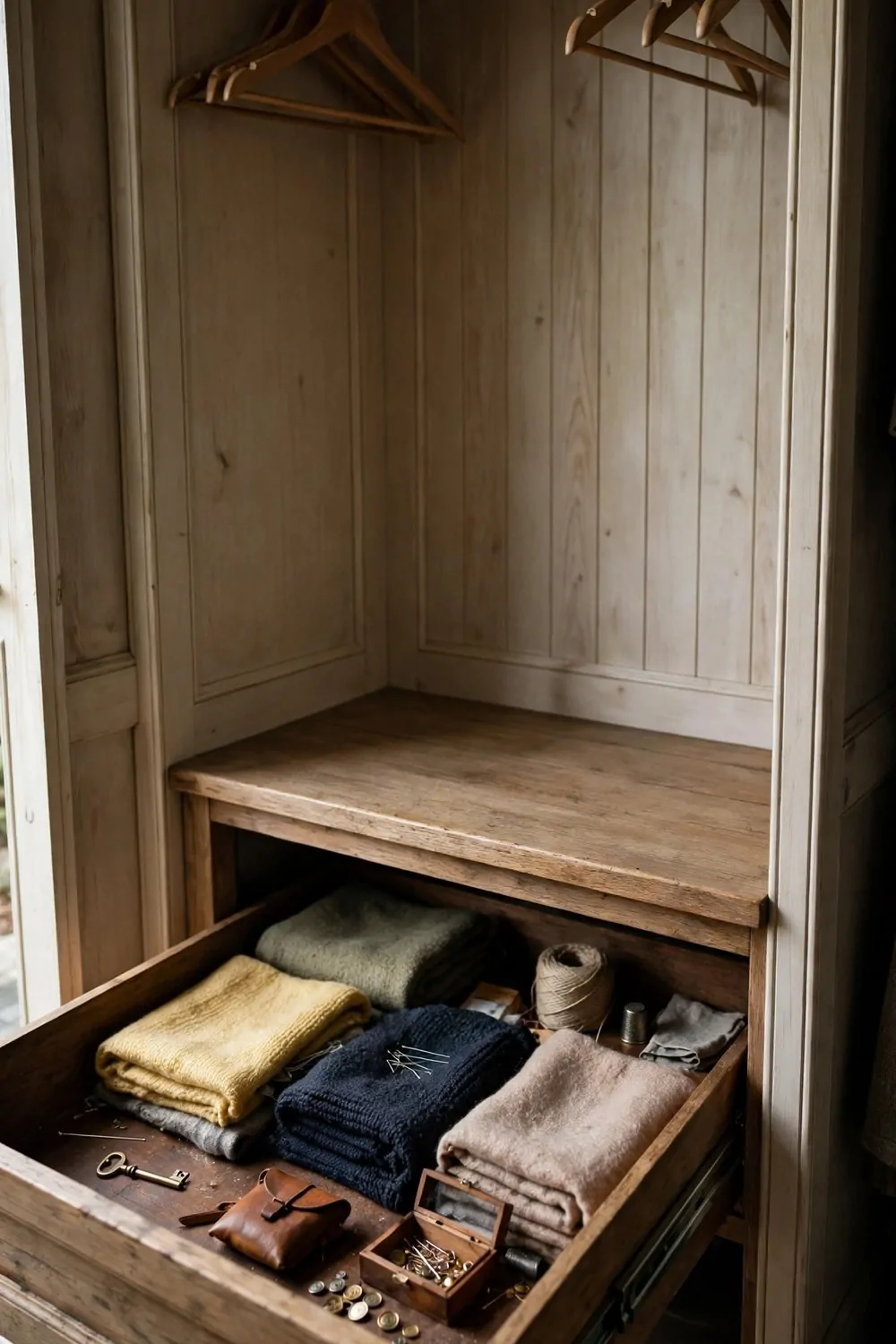
A bench in the closet is nice for sitting down. A bench with a secret drawer is even better.
The drawer hides under the seat. You lift the seat or pull the front and your storage appears.
I keep my out-of-season shoes in mine. They stay clean and out of sight until the weather changes.
You can store blankets and thick sweaters in there too. The space under a bench is bigger than it looks.
Add a soft cushion on top of the bench. It makes sitting comfy and hides the drawer line even more.
I sit on my bench every morning to put my shoes on. It is my favorite little routine in the house.
Keep the drawer shallow so it slides smooth. Deep drawers get heavy and hard to pull.
Put a small label inside the drawer so you remember what you stored. I write the season on a piece of tape.
This drawer is great for things you want close but not visible. It keeps the closet looking calm.
If you already have a bench, check if a drawer can fit under it. You might be sitting on free storage right now.
| Weekly job | Takes | What it fixes |
|---|---|---|
| Put one thing back in its hidden home | Two minutes | Stops the slow pile-up on the floor |
| Refold one stack | Five minutes | Keeps shelves neat without a big clean-out |
| Check the top shelf boxes | Five minutes | You remember what you stored up there |
Hanging Cubes That Stack Out of Sight
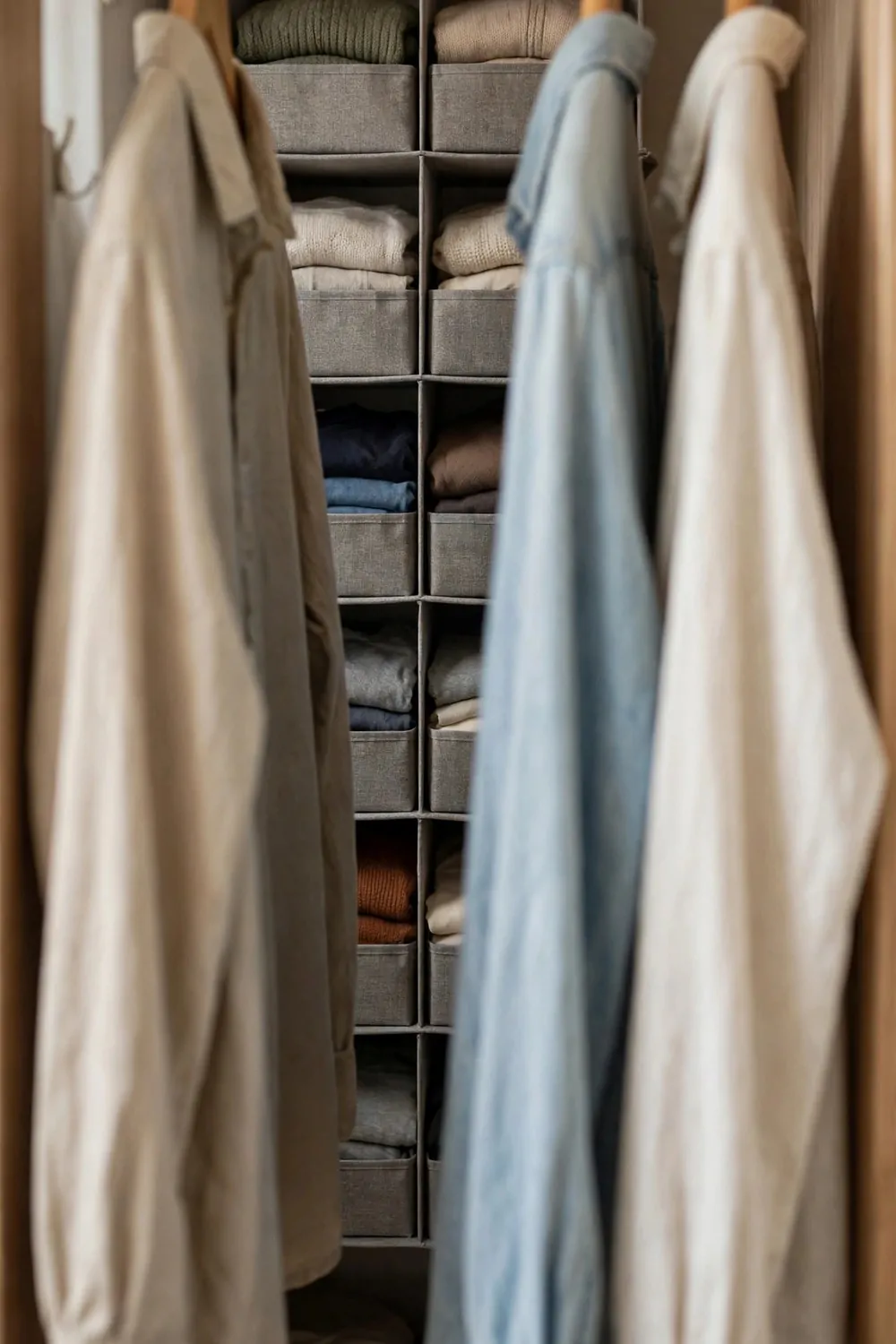
Hanging cubes are soft fabric boxes that hang from the closet rod. They stack up and hide behind your clothes.
I hang mine at the far end of the rod. My shirts cover the front so nobody sees the cubes at all.
Each cube holds one type of thing. One for t-shirts, one for pajamas, and one for workout clothes.
They fold flat when you do not need them. That makes them easy to store or move to another closet.
Pick cubes in a plain color that matches your closet. They will blend in and look neat.
I label the front edge of each cube with a small tag. It takes the guessing out of my morning routine.
These cubes are great for kids closets too. Kids can toss their clothes in without folding perfectly.
Do not stuff the cubes too full. They sag when they are heavy and look messy from the side.
Wash the cubes once in a while if they get dusty. Most of them can go right in the washing machine.
This is a cheap trick that adds a lot of storage. Your closet will hold more without looking fuller.
A Hidden Rod for Tomorrow’s Outfit
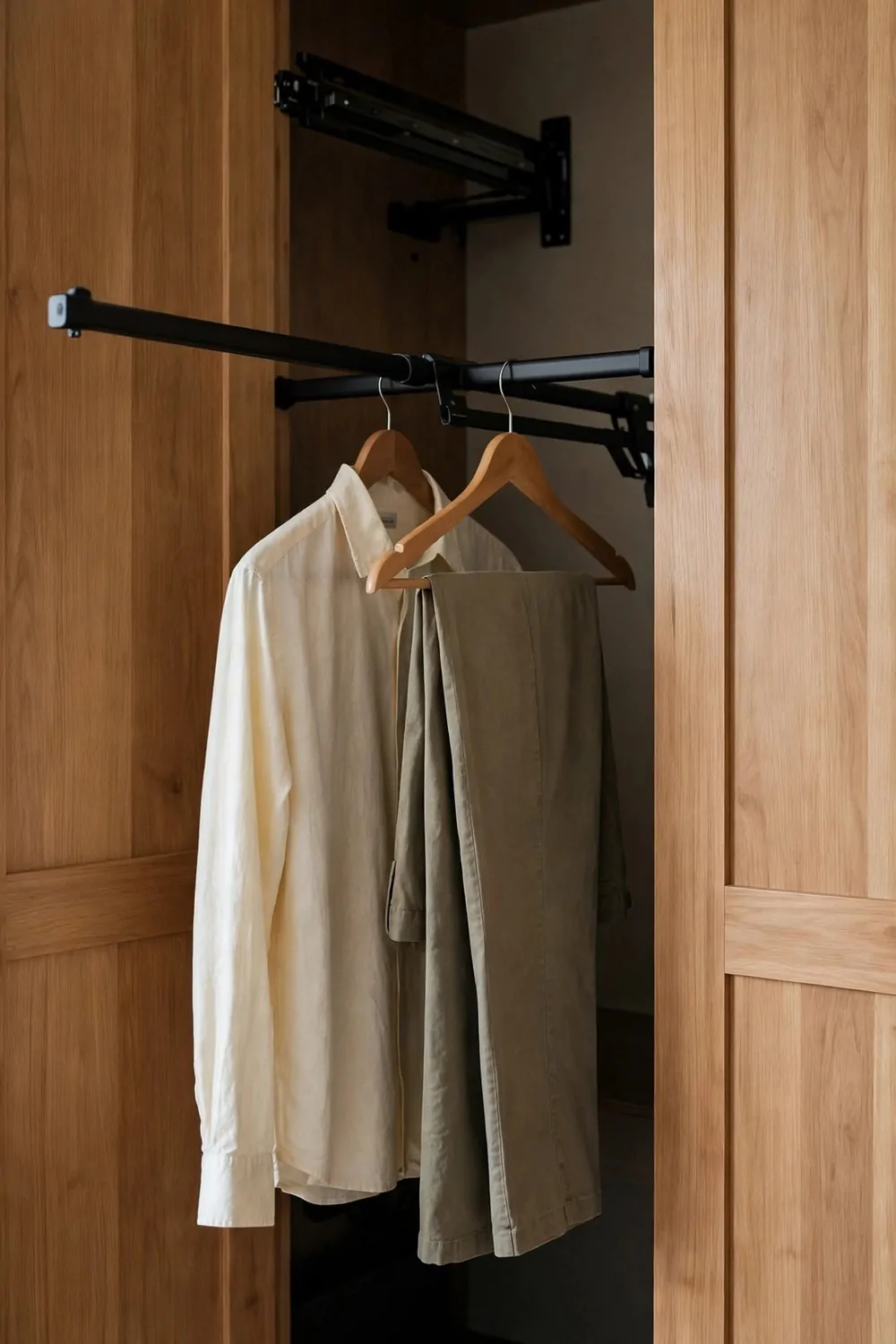
Picking clothes in the morning takes too long when you are half asleep. A hidden rod for tomorrow’s outfit saves you every day.
The rod is short and sits in a quiet corner of the closet. You hang tomorrow’s clothes on it the night before.
I set mine out every evening after dinner. It takes two minutes and my morning feels so much calmer.
You can mount the rod on the side wall or under a shelf. It stays out of the way until you need it.
I hang my full outfit on it, shoes and all. In the morning I just grab it and get dressed.
This rod is also great for clothes you need to air out. Hang a jacket on it after a long day and it freshens up overnight.
Keep the rod short so it only holds one outfit. That is the whole idea, one outfit ready to go.
I taught my kids to use one too. Their school mornings are much less rushed now.
If you have a big event tomorrow, lay the outfit out the night before. You will sleep better knowing it is ready.
Try this for one week and see how your mornings change. You will never go back to picking clothes half asleep.
Storage in the Gap Under the Lowest Shelf
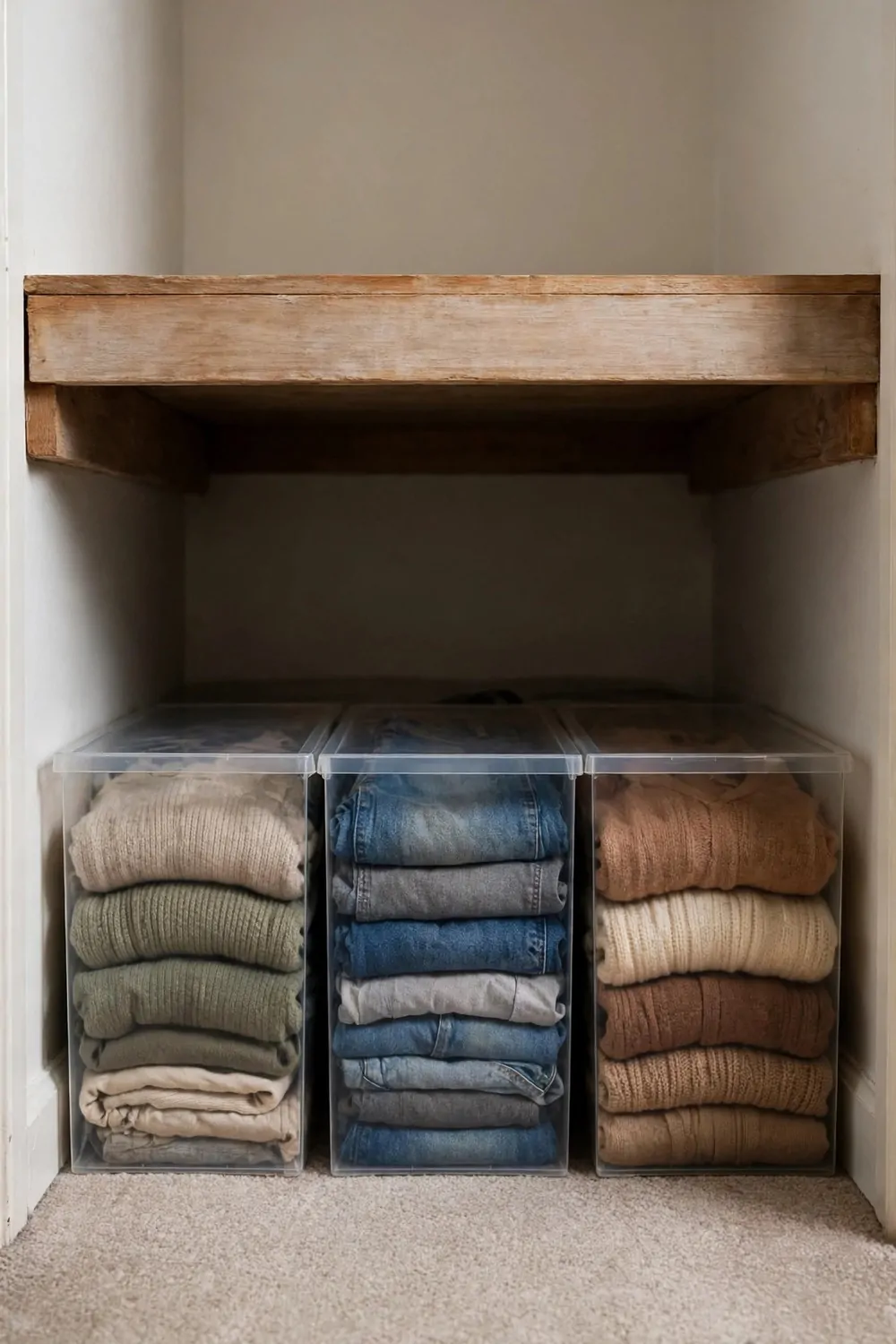
There is a thin gap under the lowest shelf that most people ignore. It is perfect for flat storage.
I slide low boxes into that gap. They hold my extra belts and thin scarves.
Rolling trays work great down there too. You pull the tray out like a drawer and slide it back when you are done.
Measure the gap before you buy anything. Even three inches is enough for flat boxes.
I keep my flat sandals in a tray under my lowest shelf. They stay clean and I can reach them without bending far.
This spot is also good for photo albums and flat keepsakes. They stay safe and out of sight.
Dust can build up down low, so wipe the boxes once a week. It only takes a minute.
Use boxes with lids if you can. Lids keep dust off your things and make the stack look tidy.
Do not put anything heavy down there. Light and flat things are the best fit for this gap.
Look at your lowest shelf today and check the gap under it. You are probably standing on free storage.
A Hidden Rack for Hats on the Inside Wall
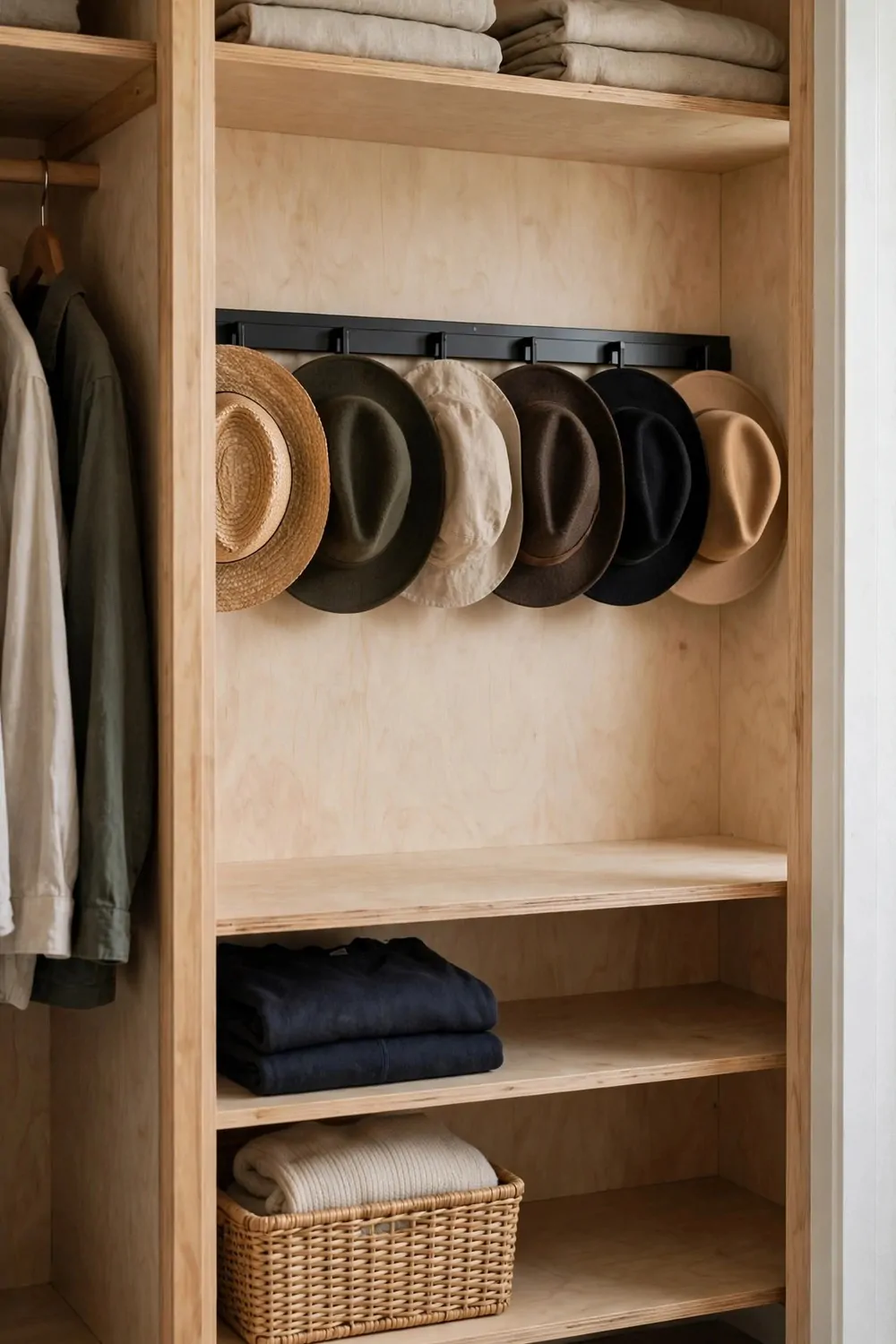
Hats lose their shape when you stack them on a shelf. A hidden rack on the inside wall keeps them perfect.
I hang small hooks or pegs in a row on the inside wall. Each hat gets its own spot.
The door covers the rack when it is closed. Nobody sees your hats until you open the closet.
Put the rack at eye level so you can see every hat at once. I pick mine in seconds now.
This works for caps, sun hats, and wide brim hats. Just space the pegs far enough apart so the brims do not crush each other.
I keep my favorite sun hat on the first peg. It is the one I grab on bright days.
You can use small clips instead of pegs for soft caps. They hold the cap by the back and keep the shape nice.
Do not hang wet hats on the rack. Let them dry first so they do not get a funny smell.
This rack costs very little and takes ten minutes to hang. Your hats will thank you for it.
Once your hats have their own home, they stop getting squashed. They will look new for years.
A Hidden Drawer for Out-of-Season Shoes
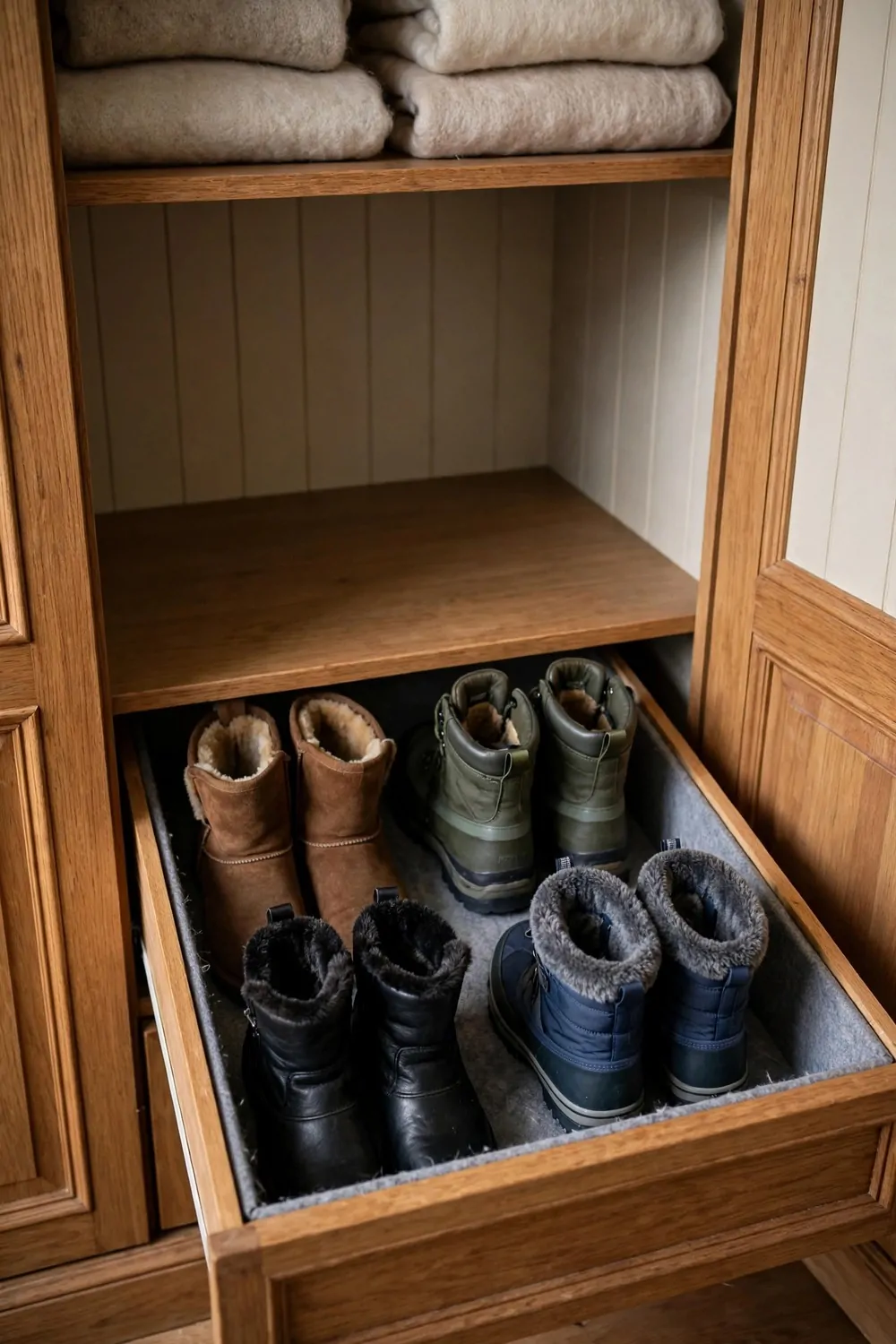
Shoes from last season take up space you need right now. A hidden drawer for them clears the floor fast.
I keep my winter boots in a drawer under my closet shelf all summer. They wait there until the cold comes back.
The drawer slides out when you need it and pushes back in when you do not. It stays out of sight all season.
Put a little bag of baking soda in the drawer. It keeps the shoes smelling fresh while they wait.
Clean your shoes before you store them. Wipe off the dirt so they are ready when the season turns.
I label the drawer with the season inside. It sounds silly but it saves me from opening the wrong drawer.
You can use a low rolling drawer under the lowest shelf. It fits in a spot you were not using anyway.
Do not pack the shoes too tight. They need a little air so they keep their shape.
Check the drawer when the seasons change. Swap the shoes out and your closet is ready in minutes.
This is one of the easiest ways to free up floor space. Your everyday shoes will finally have room to breathe.
One Last Look: Make Every Hidden Spot Earn Its Place
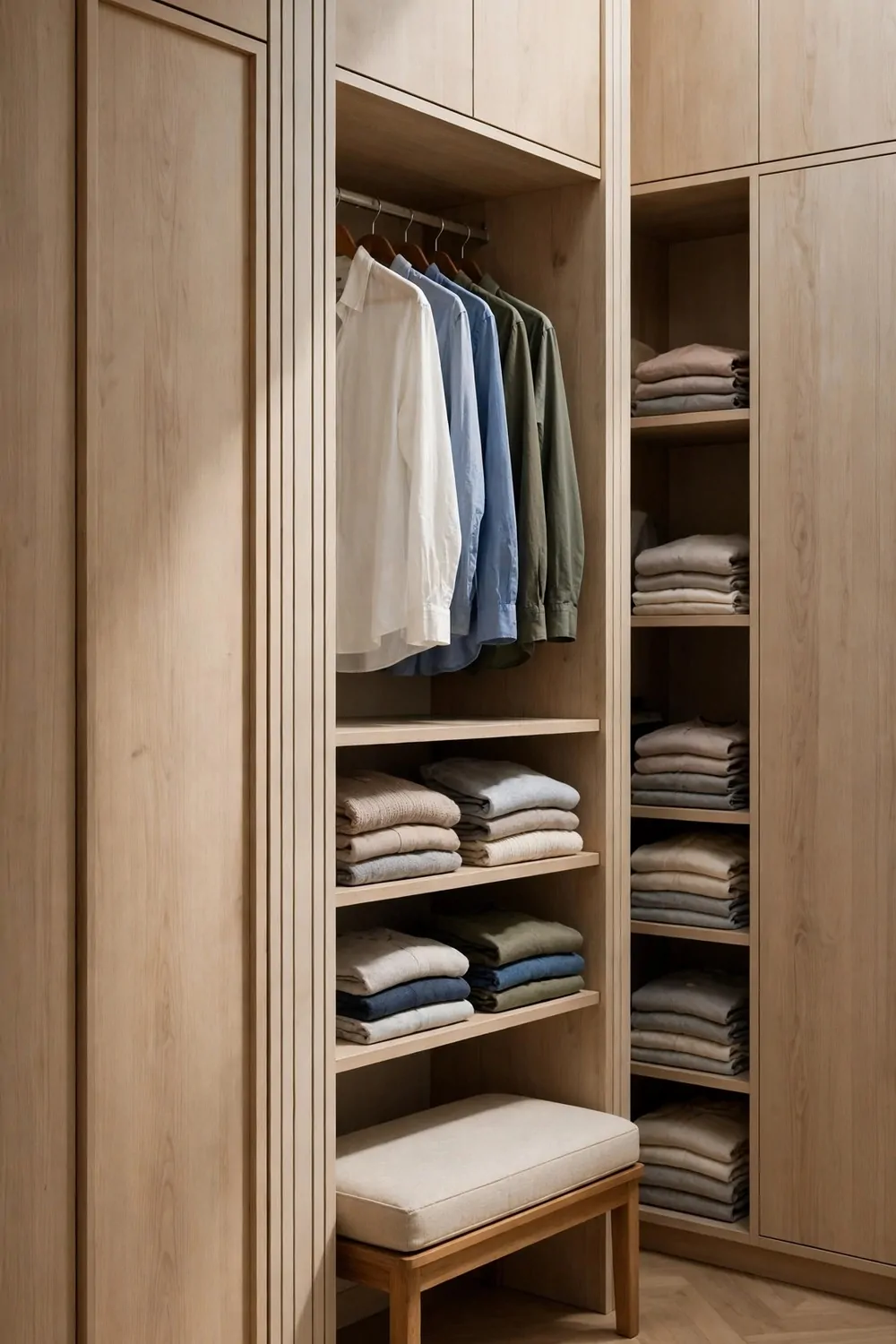
You have seen a lot of hidden spots in this list. Now it is time to step back and look at your whole closet.
Walk up to your closet and open the door slowly. Look at every shelf, every hook, and every corner with fresh eyes.
I do this once a month. I always find one spot I forgot about or one thing that does not belong anymore.
Ask yourself one question for each hidden spot. Is this spot helping me, or is it just holding stuff I forgot?
If a spot is not earning its place, clear it out. Move those things somewhere better or let them go.
Your closet should feel calm when you open it. If it feels crowded, one hidden spot is probably doing too much.
Start small when you fix things. Pick one spot this week and make it work better.
I fixed my top shelf last month and it changed my whole morning. One small win leads to the next one.
Remember that hidden storage is not about hiding clutter. It is about giving every thing a real home.
Your closet is ready now. Go pick your favorite idea from this list and start today.
Keep Reading
If you liked these hidden storage ideas, there is more waiting for you. Our other posts are full of simple ways to make your closet feel neat and pretty without a big rebuild.
Take your time and read through them when you have a quiet moment. Each one is written the same simple way, with ideas you can try right away.
- 31 Luxury Walk-In Closet Ideas With Custom Built-In Storage
- 26 Walk-In Closet Island Ideas That Make Dressing Rooms Look Expensive
- 19 Girl Closet Ideas for a Neat Pretty Space
- 41 Custom Kitchen Cabinet Organization Ideas Worth Stealing
Pick one hidden spot from this list and start this week. Even a small change, like a hook behind the door or a bin under the rail, can make your closet feel twice as big.