19 Small Home Library Room Layouts That Feel Grand

Last month I stood in our spare room with a tape measure and a silly hope. The room is tiny. It had been a dumping ground for years, full of boxes and a broken exercise bike nobody wanted to admit was broken. I stretched the tape from wall to wall and read the number out loud.
Eight feet by nine feet. That is barely bigger than a parking space.
I stood there doing math in my head. A bookshelf is one foot deep. A chair needs three feet. If the shelves go on two walls and the chair sits in the middle, there is still room to walk. I measured again, slower this time. Then I laughed out loud, alone in that dusty little room, because the numbers said yes. A library could actually fit in here.
That is the thing about small rooms. We look at them and see what is missing. We never see what they could hold. But a small home library room has a secret advantage. Small rooms feel cozy on their own. You do not have to work to make them intimate. You just have to be smart about the layout.
These 19 layouts are all built for real small rooms. Every one of them makes a tiny space feel grand, like a proper old library instead of a closet with books. Measure your room, pick a layout, and start building.
1. The One-Wall Book Wall
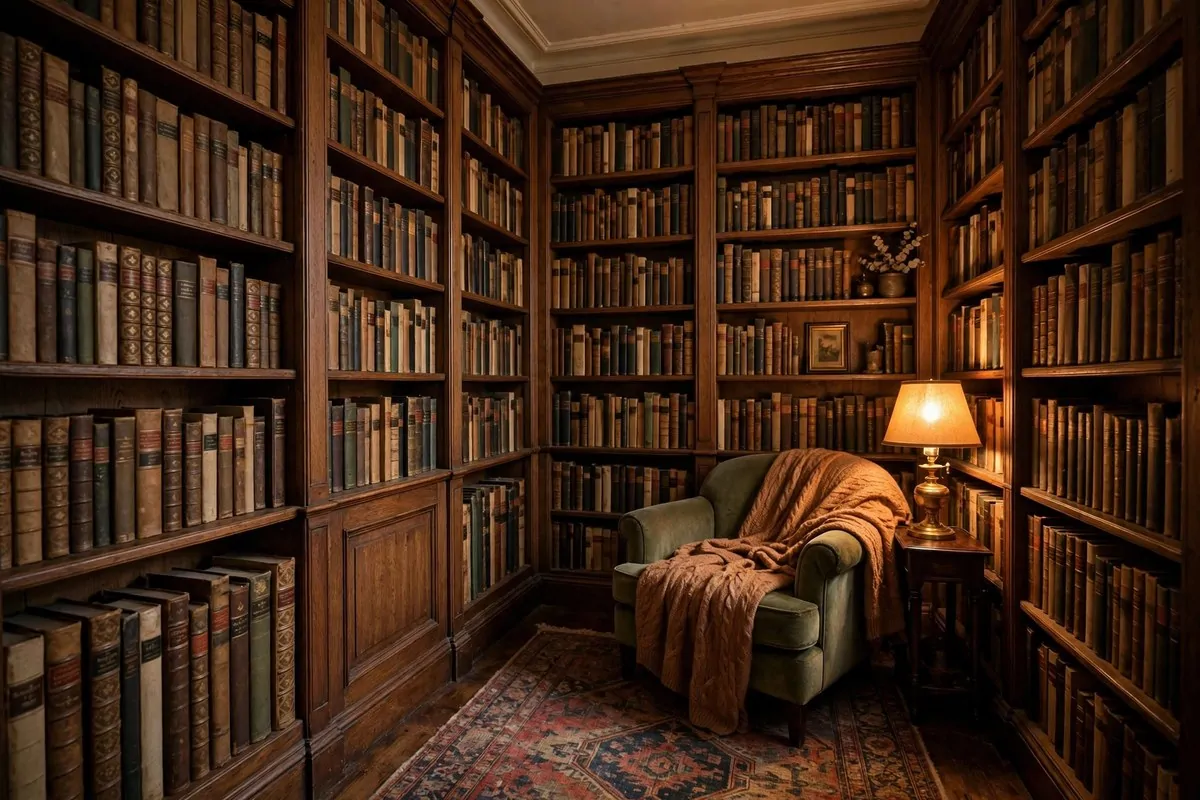
The simplest grand layout there is. Take one wall, just one, and cover it floor to ceiling with bookshelves. Leave the other three walls open. It sounds too simple to work, but it is the layout designers reach for first.
Here is why it feels grand instead of cramped. One full wall of books reads as architecture, not furniture. It looks like the room was built around the books. Your eye travels up the tall shelves and the ceiling feels higher. The wall becomes a feature, not a storage unit.
Keep the shelves slim, eight to ten inches deep. In a small room, every inch of floor matters, and slim shelves steal the least. Most books fit fine. Save your oversized art books for a different spot or lay them flat on the bottom shelf.
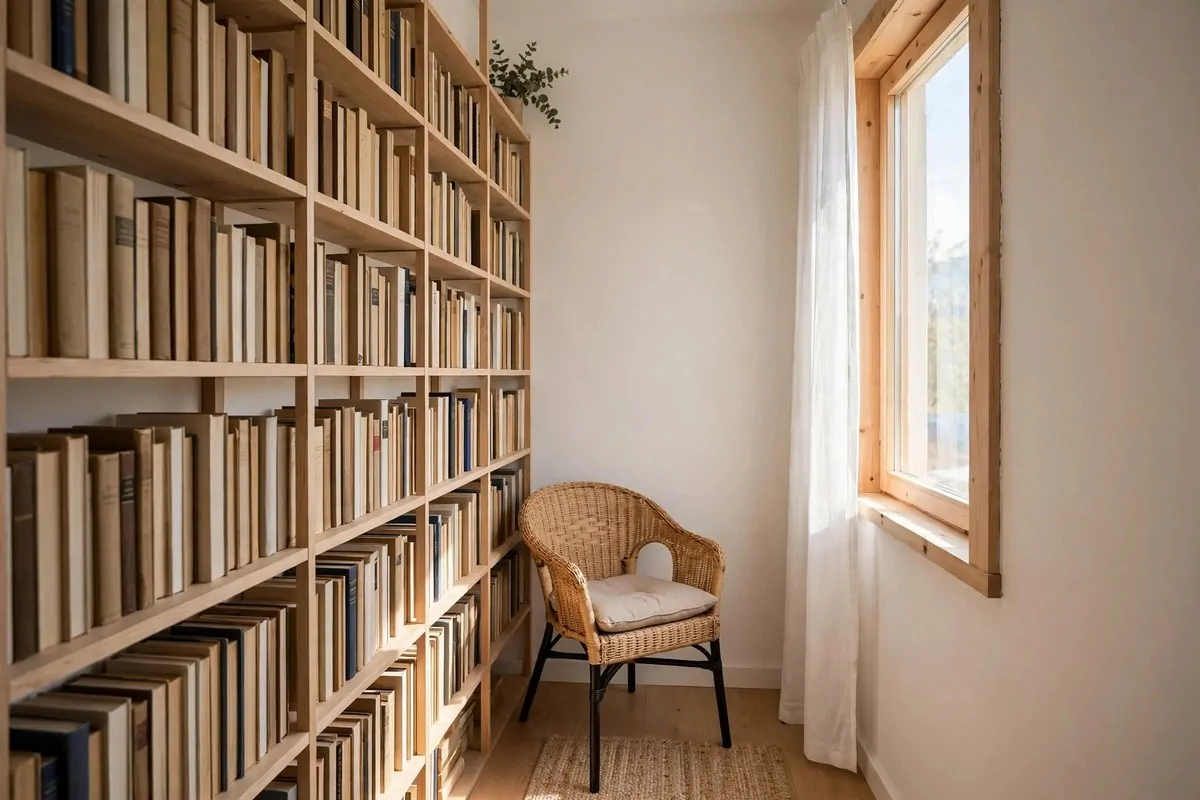
Paint the shelves a light color or use light wood. Dark shelves on a full wall can feel heavy in a small room. White, cream, or pale oak keeps the wall bright and makes the room feel bigger than it is.
Put your reading chair opposite the book wall, facing it. This is important. You sit down, look up, and see a wall of books. It feels like a private library in a mansion, except the mansion is eight feet wide. I never get tired of that view.
Leave the wall beside the door mostly empty. You need a clear path in and out, and an empty wall gives your eyes somewhere to rest. A full book wall plus three plain walls is the right balance. All four walls covered would feel like a cave.
Run a strip of LED lights along the top of the book wall, hidden behind a thin trim. The light washes down over the spines and the whole wall glows.
Keep a small step stool tucked at one end of the wall. Even with slim shelves, the top row is easier with a boost.
2. Shelves That Frame the Doorway
This layout makes the doorway part of the library instead of just a hole in the wall. Bookshelves wrap around the door on both sides and across the top, so you walk through books to enter the room. It feels like a secret entrance.
The grand feeling comes from the framing effect. A doorway wrapped in shelves looks like the entrance to an old study. It gives the small room a sense of occasion. You are not walking into a spare bedroom. You are entering the library.
Measure the wall space on both sides of the door first. You need at least a foot on each side for narrow bookcases. The shelf above the door can be a simple wide board on brackets. It holds books you do not grab daily, and it completes the frame.
Anchor every piece to the wall. Shelves near a doorway get brushed by shoulders and elbows. A few brackets into the studs keep everything solid. This is a safety thing, not just a looks thing. Books are heavy.
Inside the room, keep the layout simple since the doorway already makes a statement. One chair, one lamp, one small table. Let the framed entrance be the star. Too much furniture plus the dramatic doorway will crowd a small room fast.
I love how this layout surprises guests. They walk through a normal hallway, pass through a doorway wrapped in books, and step into a cozy library. The contrast makes the small room feel like a hidden world. First impressions matter, even for rooms.
Paint the inside of the door frame a warm color to match the shelves. It ties the whole entrance together and looks custom.
Hang a small framed quote above the door on the inside. It is the first thing you see when you enter your library.
3. The Window Between Two Shelves
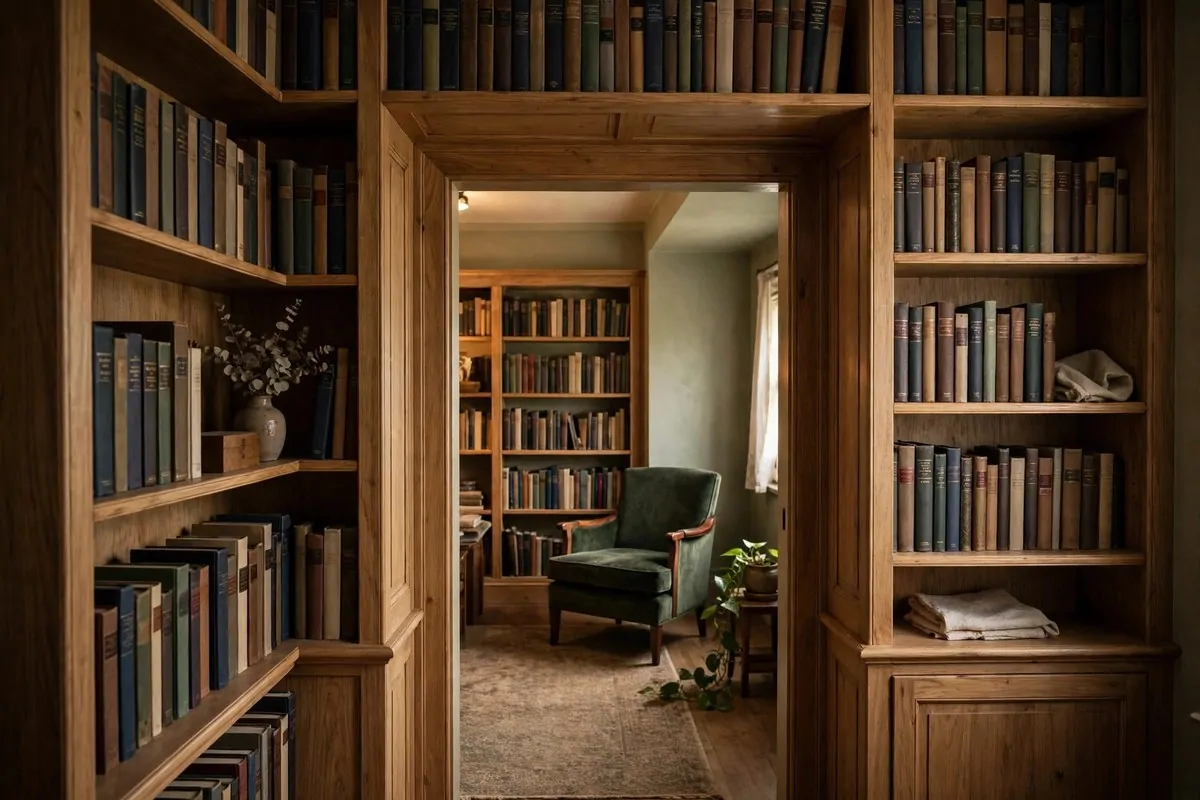
If your small room has a window, build the whole layout around it. Put a tall bookcase on each side of the window and a reading chair right under it. The window becomes the centerpiece, framed in books like a painting.
This layout feels grand because it is symmetrical. Symmetry tricks our brains into seeing order and importance. Two matching bookcases, one centered window, one chair in the middle. It looks planned and formal, like a room in an old house, even if the room is tiny.
Natural light is the best reading light ever made, and this layout puts you right in it. Morning readers get soft eastern light. Afternoon readers get warm western glow. On gray days, the window light is still brighter and kinder than any lamp.
Keep the window treatments simple. Sheer curtains or a simple blind. Heavy drapes would block the light you built the whole layout around, and they eat visual space. You want the window to feel open and bright.
The chair under the window should be comfortable enough for long reads but not so big it blocks the bookcases. A classic armchair or even a wide accent chair works. Add a small side table on one side for tea. The other side can hold a floor lamp for evening reading.
Style the tops of the two bookcases as a pair. Matching plants, matching frames, or matching lamps. The symmetry is what makes this layout feel grand, so carry it through the details. When both sides match, the whole room feels calm and finished.
Clean the window inside and out twice a year. This layout is all about the light, and dirty glass steals it.
If the sill is deep enough, add a narrow cushion on it. Even a slim sill becomes a perch for a plant or a sunny spot for a cat.
4. The Rolling Ladder Layout
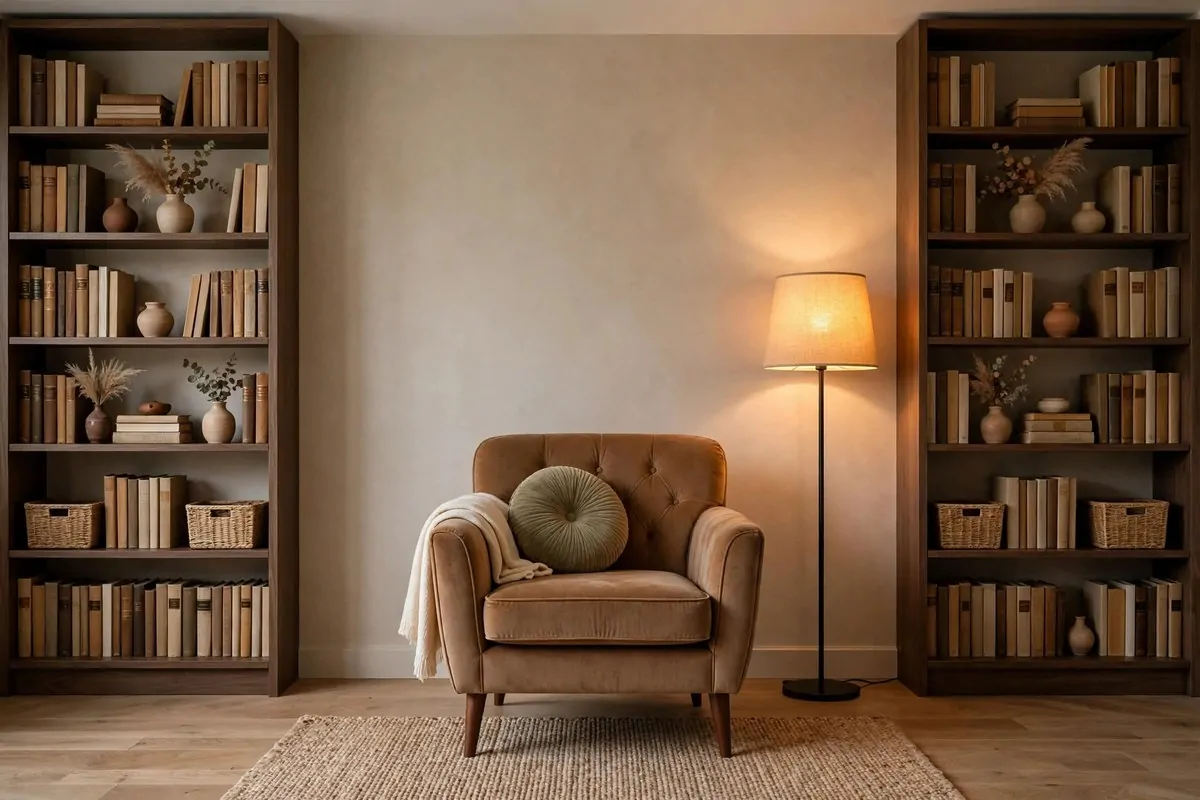
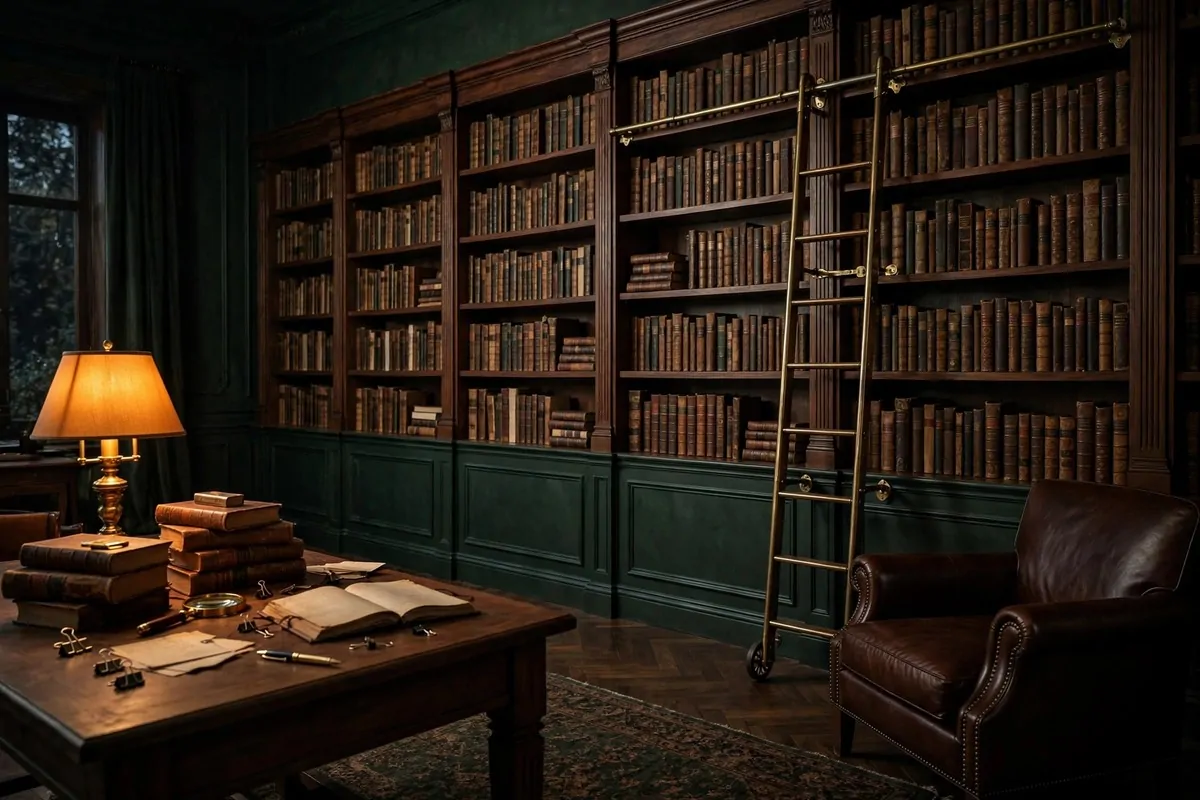
Nothing says grand library like a ladder. A rolling ladder on a rail turns even a small room into something out of an old movie. And it is practical too, because it lets you use every inch of wall height safely.
The classic setup is a horizontal rail mounted near the top of tall shelves, with a ladder that hooks on and rolls sideways. You pull it along the wall to reach any shelf. It sounds fancy, but ladder rail kits are sold online and install with basic tools.
If a full rolling system is too much, a simple leaning ladder works too. A wooden library ladder or even a nice step ladder leaned against tall shelves gives the same look for much less money. I used a wooden step ladder for a year before upgrading, and nobody knew the difference.
Tall shelves are the whole point of this layout. Go all the way to the ceiling. In a small room, height is your best friend. The ladder makes the height usable instead of decorative, and it becomes a beautiful object in the room even when you are not climbing it.
Keep the floor in front of the shelves clear. The ladder needs room to lean and roll. Do not put the chair right against the book wall. Pull it into the middle of the room so the ladder has space to move behind it.
Safety first with any ladder. Make sure it is stable before you climb. Keep one hand on the shelf. Do not overreach sideways. A library ladder is charming, but a fall off one is not. My rule is simple. If I have to stretch, I move the ladder instead.
Oil the rail wheels once a year with a drop of household oil. A silent, smooth-rolling ladder feels expensive.
Teach kids that the ladder is for reaching books, not for swinging. Set the rule early and the ladder stays safe and fun.
5. The Corner L
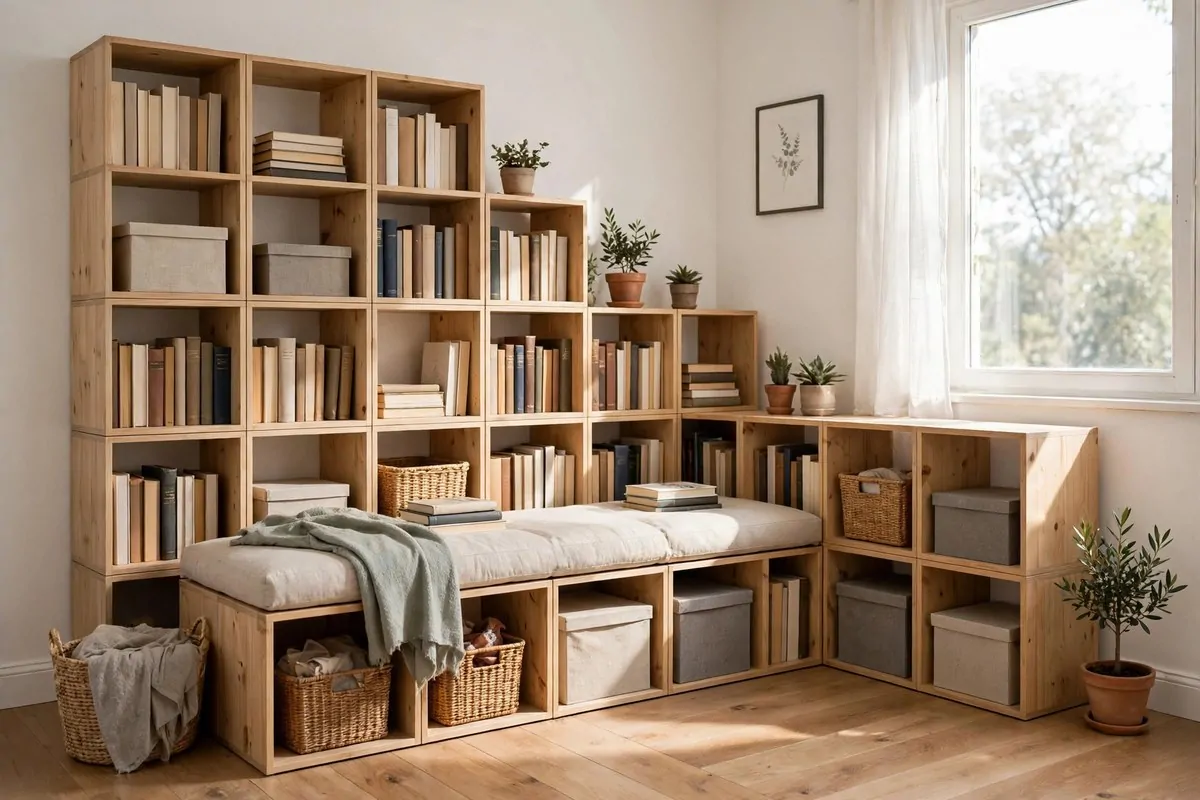
Two walls meet in every corner, and most corners sit empty. This layout fills both walls with shelves in an L shape and tucks the reading chair right into the angle. The corner wraps around you like the room is reading with you.
The L shape is brilliant for small rooms because it uses the walls that are hardest to furnish. Corners are awkward for most furniture, but they are perfect for bookshelves. Two bookcases meeting at a right angle look built-in and intentional.
Put the chair at a 45-degree angle in the corner, facing out into the room. This gives you books on both sides within arm’s reach. Left hand grabs from the left wall, right hand grabs from the right. It is the most efficient reading position I know.
A corner can feel dark, so light it well. A floor lamp behind the chair shines over your shoulder onto the book. Or mount a small wall light on one of the shelves. Two light sources are better than one in a corner, because corners swallow light.
The grand feeling here comes from abundance. Books on two sides, floor to ceiling, wrapping around you. Sitting in the middle of an L of books feels like sitting inside a library, not next to one. It is immersive in the best way.
This layout leaves the rest of the room open, which is perfect if the small room has another job. A corner library plus a desk, or a corner library plus a guest bed. The L stays in its corner and minds its own business while the room does other things.
Put a small round rug in the corner under the chair. It softens the angle and makes the corner feel like a deliberate nook.
Mount a tiny shelf on the wall right beside the chair for your tea. Corner chairs sit far from tables, so bring the table to the chair.
6. Modular Cubes You Can Rearrange
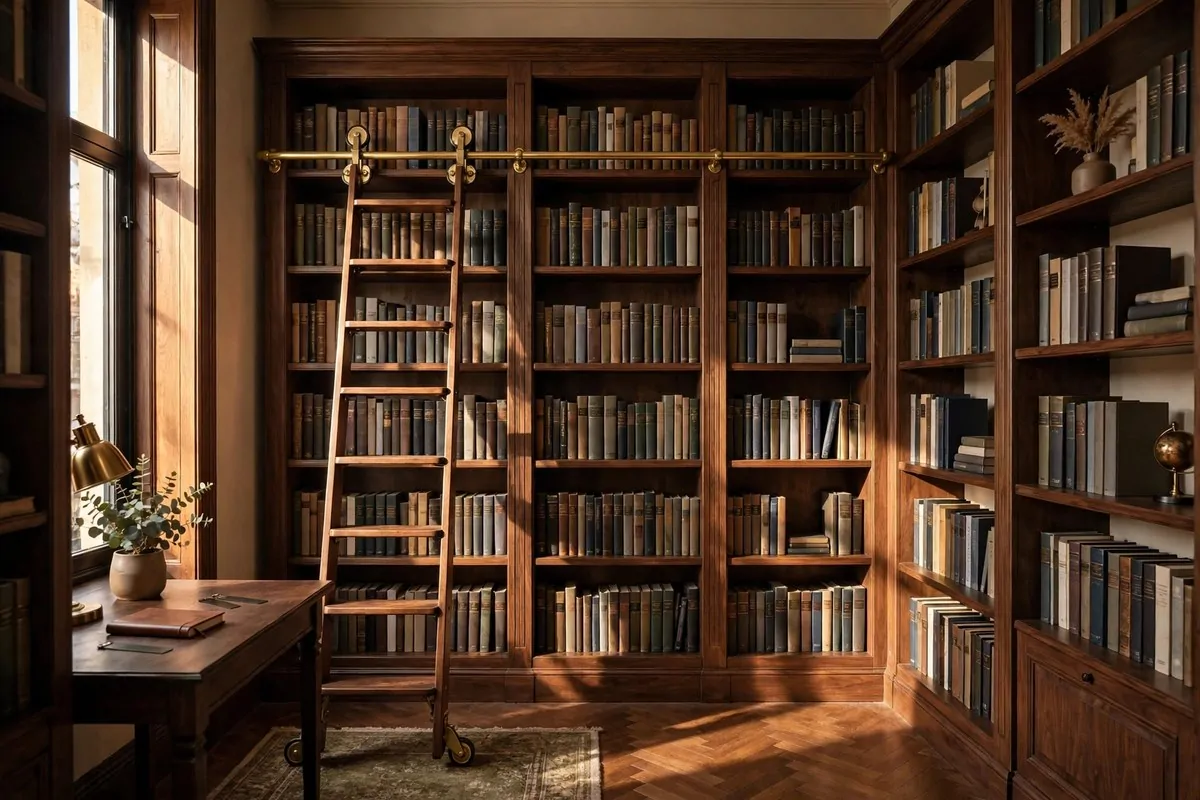
Small rooms change. Today it is a library. Next year it might be a nursery, an office, or a guest room. Modular cube shelving rolls with those changes because you can take it apart and rebuild it any way you like.
Cube units are the square shelves that stack and connect. You can build them into a tall tower, a long low bench, an L shape, or two separate small shelves. When your needs change, you just rebuild. No new furniture required.
The grand trick with cubes is to build them big. A full wall of cubes, floor to ceiling, looks impressive and holds a huge number of books. Mix the cubes up. Some hold books standing up, some hold books stacked flat, some hold baskets, some stay empty for decor. The variety looks designed, not random.
Use some cubes as hidden storage. Fabric boxes that slide into the cubes hide clutter beautifully. Chargers, notebooks, the books you are not proud of. Out of sight, but right there when you need them. I label mine so I can find things.
A low cube unit doubles as a bench. Build it two cubes high along one wall, put a cushion on top, and you have seating plus storage underneath. In a small room, furniture that does two jobs is worth its weight in gold.
Anchor tall cube towers to the wall. Cubes are light, which is great for rearranging and bad for stability. A tall tower of cubes full of books can tip if it is not attached. Two brackets into a stud, and you never have to think about it again.
Buy a few extra cubes when you start. Running out mid-build is frustrating, and matching colors get discontinued.
Mark the back of each cube lightly with a pencil when you rebuild. It sounds silly, but it makes the next rebuild twice as fast.
7. The Reading Chair Against the Back Wall
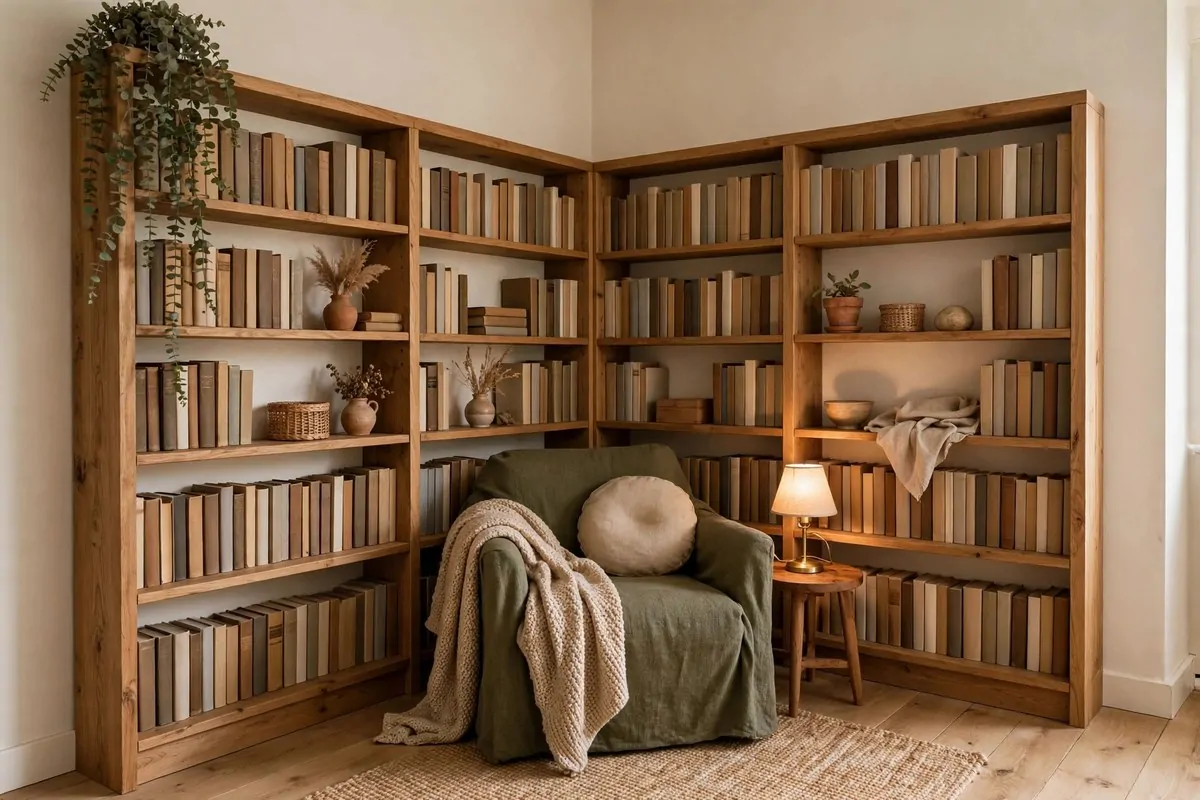
This is the most formal layout on the list, and formality is what makes small rooms feel grand. Center your reading chair on the back wall, put matching bookshelves on both sides of it, and the room suddenly has the symmetry of a classic study.
Think of old portraits of libraries. The chair in the middle, shelves rising on both sides, a lamp glowing. That image is burned into our brains as what a library should look like. This layout copies that image in miniature, and our brains read it as grand instantly.
The two bookshelves should match. Same height, same color, same style. Mismatched shelves ruin the symmetry that makes this layout work. Check secondhand stores for pairs. People sell matching bookcases all the time when they move.
Center everything carefully. Measure the wall, find the middle, and put the chair there. Then place one shelf on each side with equal gaps. It takes ten extra minutes with a tape measure, and the result looks ten times more expensive. Crooked symmetry looks worse than no symmetry at all.
A small round rug under the chair marks the center of the room and softens the formality a little. Without the rug, the layout can feel stiff. With it, the room feels welcoming. Choose a rug that picks up a color from your book spines or your chair fabric.
Hang one piece of art above the chair, centered. A framed print, a small mirror, or a literary quote. It fills the wall space between the tops of the shelves and gives your eyes a resting place. Keep it simple. The shelves are already busy enough.
Center a small rug under the chair, not under the shelves. The rug belongs to the reader, and it anchors the middle of the arrangement.
Dust the tops of both shelves in one go with a long duster. Matching shelves should stay equally clean or the symmetry breaks.
8. The Loveseat and Ottoman Layout
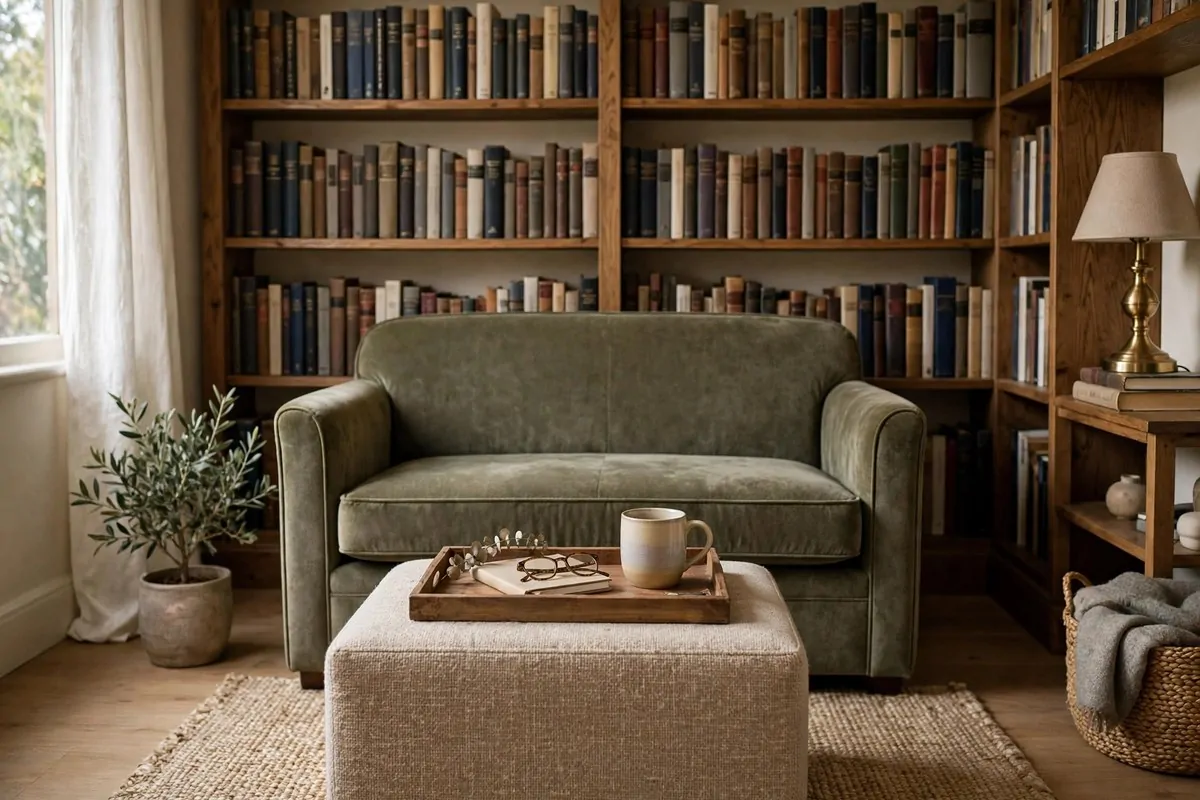
A library for two is twice as nice. This layout fits a small loveseat instead of a single chair, so you can read side by side with someone you love. It turns the small library room into the coziest spot in the house for couples, friends, or a parent and child.
A loveseat sounds big for a small room, but compact loveseats exist. Look for one around four feet wide. That is only a foot wider than a big armchair, and it seats two people. Measure your room and do the math. You will be surprised how often it fits.
The ottoman is the secret weapon of this layout. It works as a footrest, extra seating, and a coffee table all at once. Put a wooden tray on top and it holds two mugs of tea and a small lamp. Take the tray off and it is a footrest. Get one with storage inside and it hides blankets too.
Place the loveseat against one wall with bookshelves on the wall opposite. You sit and face your books, which is the best view a reader can have. The ottoman floats in the middle where both readers can reach it.
This layout feels grand because it feels generous. A room that seats two feels like a real library, not a reading closet. It says this room is for lingering, for long conversations about books, for Sunday afternoons that disappear.
Keep the walkway clear on at least one side of the loveseat. You need to get in and out without climbing over the ottoman. In a very small room, push the loveseat against the wall and let the ottoman be the only thing floating. It still works beautifully.
Keep a folded blanket on the loveseat, one for each reader. Sharing a loveseat is better when nobody fights over the blanket.
Choose an ottoman with a flat, sturdy top. A wobbly tray spills tea, and tea on books is a small tragedy.
9. The Under-Stairs Library Room
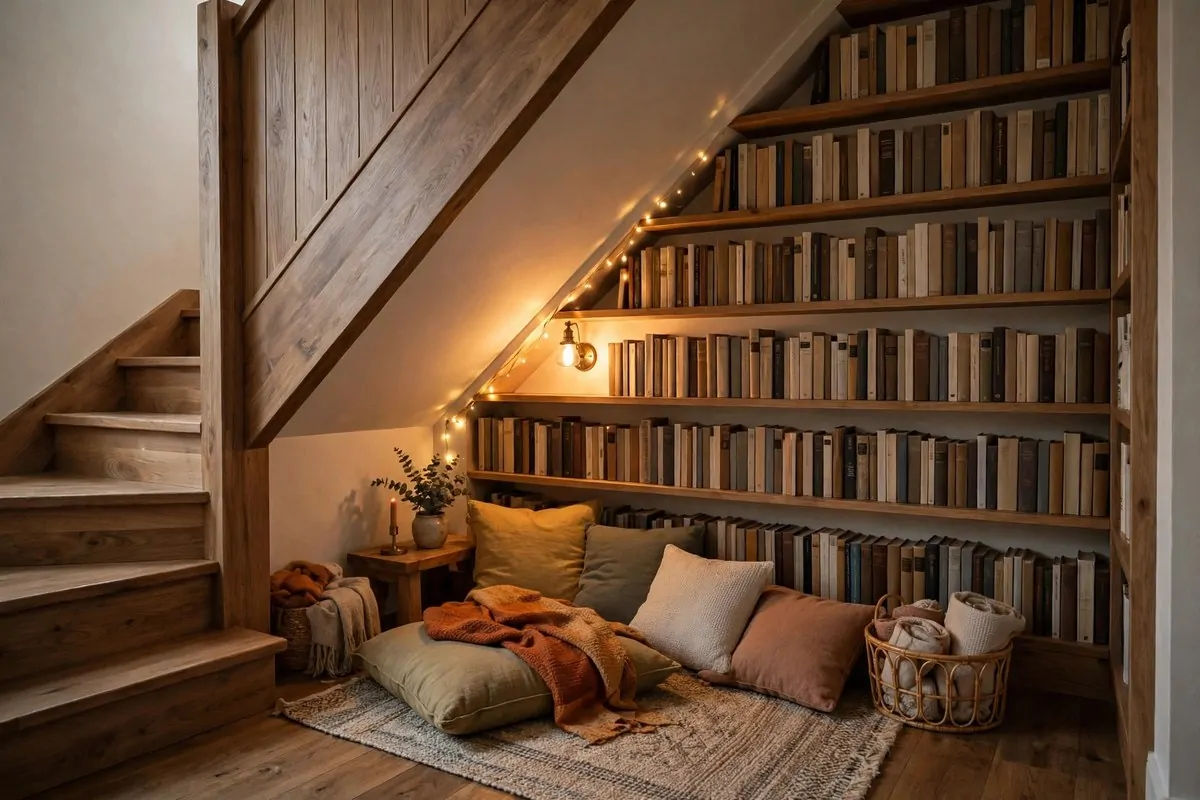
The space under a staircase is often big enough to be a whole room, just a room with a slanted ceiling. This layout treats it as one. Shelves on the walls, cushions on the floor, and suddenly the dead space under your stairs is the most charming library in the house.
The slanted ceiling is your friend here. It makes the space feel enclosed and secret, like a hideout. Low ceilings read as cozy, not cramped, when the space is small on purpose. Lean into it. This is a nook, not a ballroom.
Fit shelves to the slope. Tall shelves where the ceiling is high, short shelves where it dips down. Custom-cut shelves sound expensive, but you can fake it with a few different heights of bookcases. The stepped look actually adds charm.
Floor seating works best under stairs because of the low ceiling. Thick floor cushions, a low futon mattress, or a pile of pillows. You cannot stand up straight in the low part anyway, so do not try. Design for sitting and lounging.
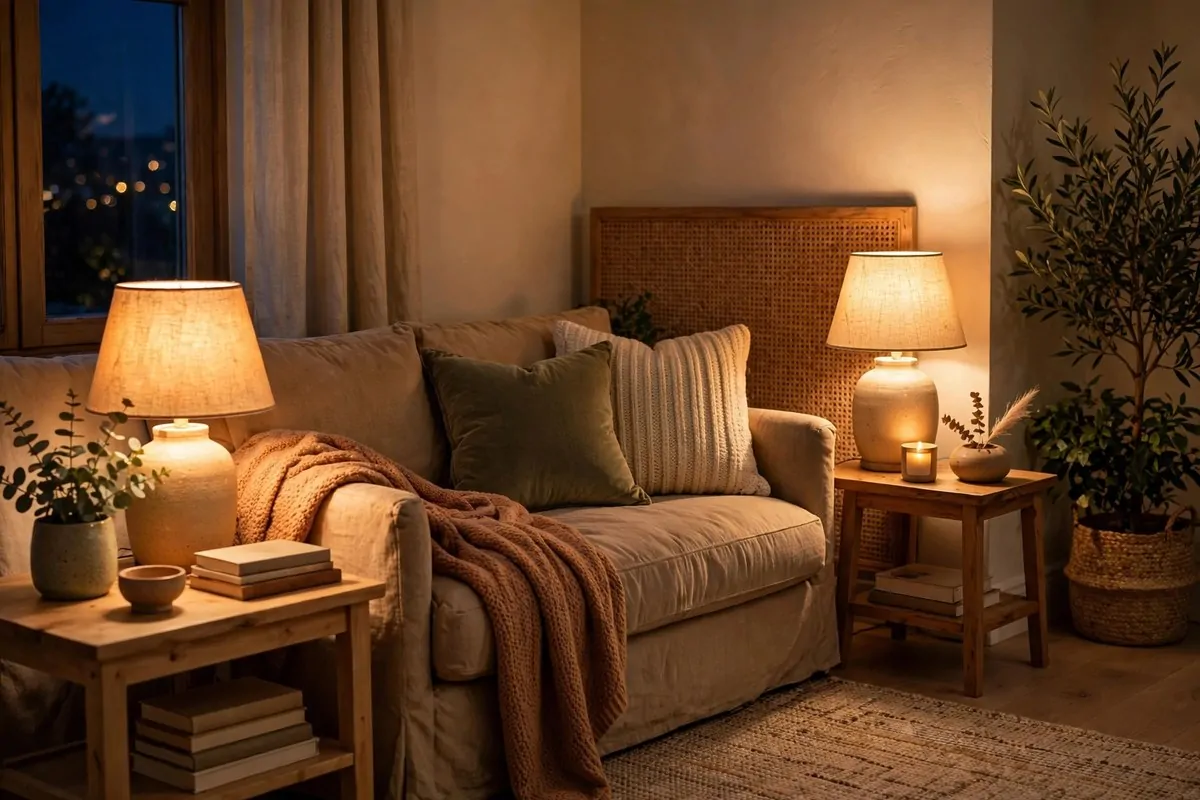
Light this space warmly. Under-stair areas get almost no natural light, so you create the mood yourself. A string of warm fairy lights along the shelves plus one small lamp is enough. The goal is a glowing cave of books, not a bright office.
Ventilation matters in enclosed spaces. If your under-stairs area has a door, leave it open or replace it with a curtain. Stuffy air ruins a reading session fast. A small fan tucked on a shelf keeps the air moving on warm days.
Kids will claim this library as their own. That is fine. Build a second cushion pile and join them. Some of my favorite reading memories are squeezed into small spaces with small people and big books.
Add a battery-powered motion light at the entrance. It clicks on when you duck in, so you never fumble for a switch in the dark.
10. The Closet Turned Library
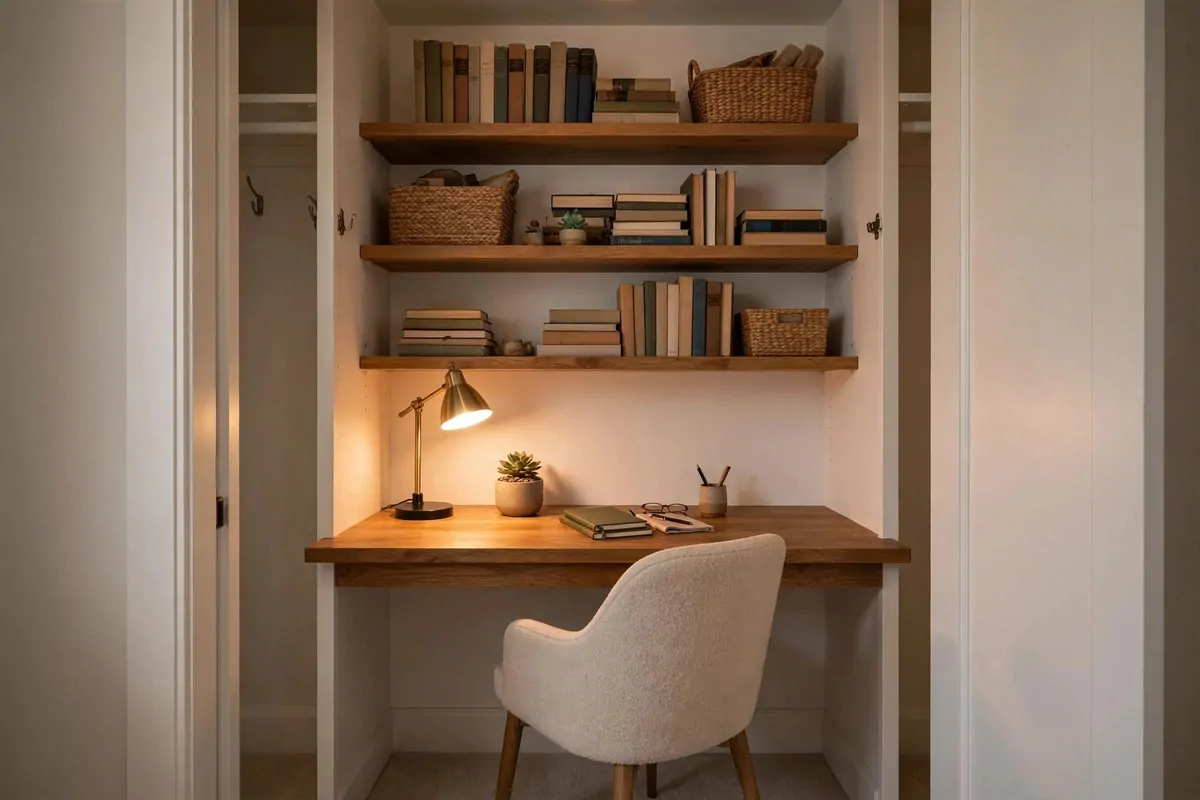
A spare closet is a small room that is already built. Take off the doors, and you have a library alcove with walls on three sides. It is the smallest room on this list, and somehow one of the grandest feeling.
Three walls of shelves in a tiny space creates total immersion. Books surround you on every side. It feels like stepping inside a book. The smallness becomes the point. This is not a room with books in it. This is a room made of books.
Build a bench across the bottom of the closet. It should be deep enough to sit on and strong enough to hold you. Store blankets or magazines inside. The bench turns the closet from a storage box into a sitting room.
Shelve all three walls above the bench. Because the closet is narrow, even shallow shelves hold plenty. Go as high as you can. The top shelves are perfect for books you love but rarely reread. They are still part of the view, which is what matters.
Paint the inside of the closet a warm, light color. White, cream, or pale yellow. Dark colors in a closet-sized space feel like a cave in a bad way. Light colors bounce the lamp light around and make the tiny room glow.
A curtain across the opening is the finishing touch. Pull it closed and the world disappears. Pull it open and the closet becomes part of the room. A simple curtain rod and a linen curtain cost very little and add so much drama.
I know someone who did this in a coat closet by her front door. Guests open it expecting coats and find a tiny glowing library instead. It is the best surprise in her whole house.
Stick a small thermometer in there for the first week. Tiny spaces warm up fast with a lamp on, and you want to know before it gets stuffy.
11. Moody Walls, Bright Light
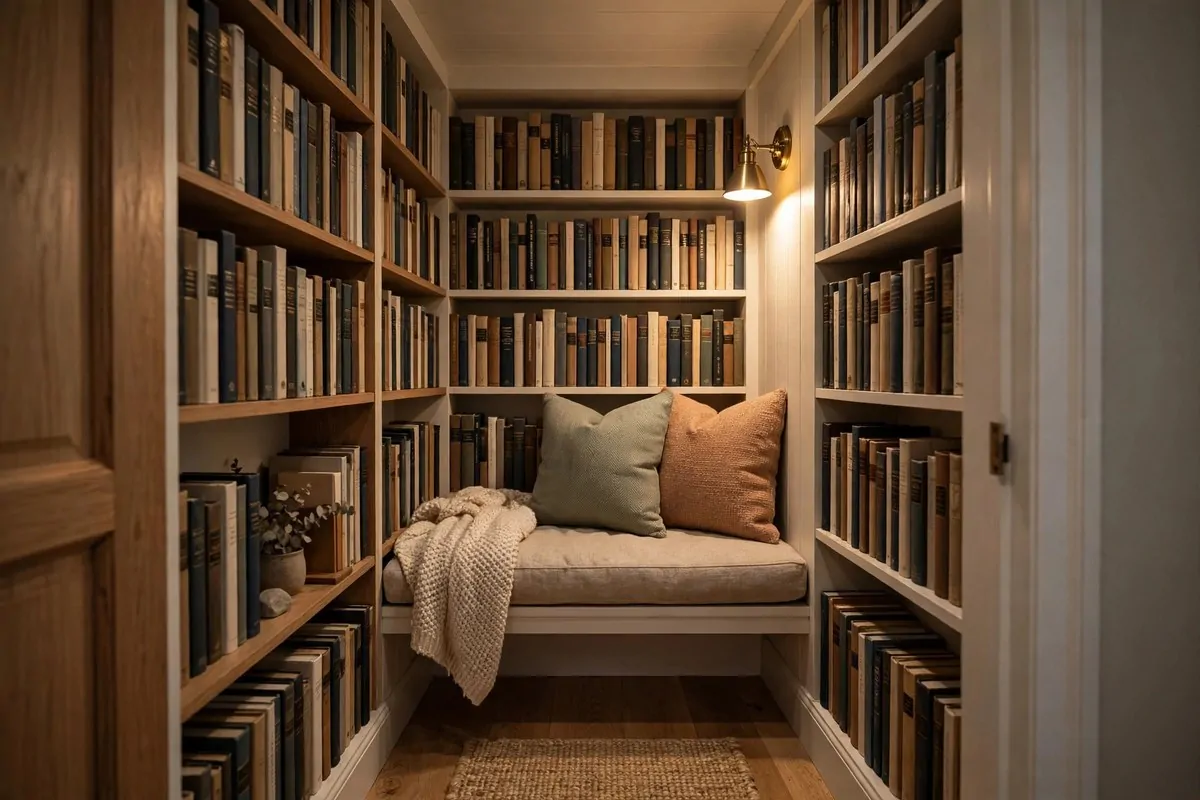
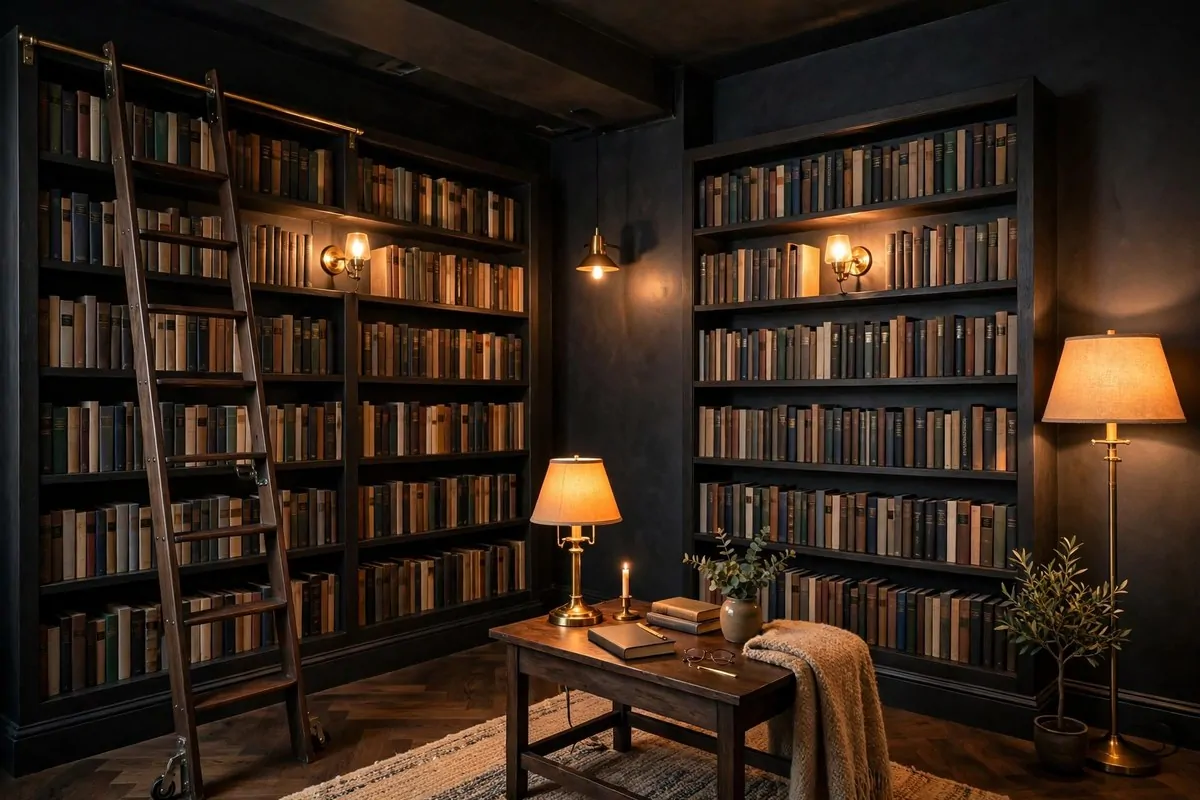
Dark walls in a small room sound wrong, but in a library they are exactly right. Deep charcoal, forest green, or navy walls make a small room feel like an old private club. The trick is pairing the dark walls with plenty of warm light.
Here is the science of it, simple version. Dark walls absorb light, which makes the edges of the room disappear. When you cannot see where the walls end, the room feels bigger and more mysterious. It is the same trick theaters use. Dark room, bright stage. Your books are the stage.
But dark without light is just a cave. You need more lamps than you think. Aim for at least three warm light sources in a small dark library. A floor lamp by the chair, a table lamp on a shelf, and a picture light over the books. Each one creates a pool of warm glow against the dark walls.
Use dimmers on everything. Dark rooms are all about control. Bright when you are shelving books, low when you are reading, nearly off for atmosphere. A five-dollar dimmer plug turns any lamp into a mood machine.
Keep the ceiling light. Paint it the same dark color as the walls so it disappears. Then never turn it on. It is just there for emergencies, like finding a lost earring. Your lamps do the real work.
The grand feeling comes from contrast. Dark walls plus warm golden light plus rows of books equals old-world luxury. It is the library equivalent of candlelight dinner. Everything looks better, including you.
One caution. Test your dark color with a sample first. Paint a big piece of cardboard and live with it for two days. Colors look different in small rooms with lamp light. What looks like rich charcoal in the store can look purple or blue at home.
Keep a lighter throw on the chair in a dark room. A cream or rust blanket pops against charcoal walls and stops the chair from disappearing into the dark.
12. The Mirror Trick
A large mirror is the cheapest way to double a small room. It bounces light around, reflects your beautiful bookshelves, and tricks your eyes into seeing twice the space. In a small library, one big mirror changes everything.
Placement is everything. Put the mirror opposite the window if you have one. It catches the daylight and throws it back into the room. A dark corner suddenly gets light it never had. The room feels brighter without any new lamps.
No window? Put the mirror opposite your bookshelves. Now you see two walls of books instead of one. The reflection doubles your library visually, and it is deeply satisfying to glance up and see books behind you too.
Go big with the mirror. A small mirror just looks like decor. A large mirror, at least half the height of the wall, actually changes how the room feels. Lean a full-length mirror against the wall or hang a big one securely. Bigger is better here.
Frame the mirror simply. A thin wood or black frame keeps the focus on the reflection, not the frame. An ornate gold frame can work in a dark academia style library, but in most small rooms, simple wins.
Angle matters. Tilt the mirror slightly so it reflects the prettiest part of the room, not the door or a blank wall. Stand where you sit to read and check what the mirror shows from there. You want books and light in the reflection, not clutter.
I put a tall mirror opposite my bookshelf wall and my six-foot room suddenly felt like twelve feet. Guests always ask if I knocked down a wall. Nope. Just a mirror and a little bit of optical trickery.
Clean the mirror with vinegar and newspaper once a month. A streaky mirror ruins the illusion, but a spotless one doubles your room perfectly.
13. Light Shelves in a Light Room
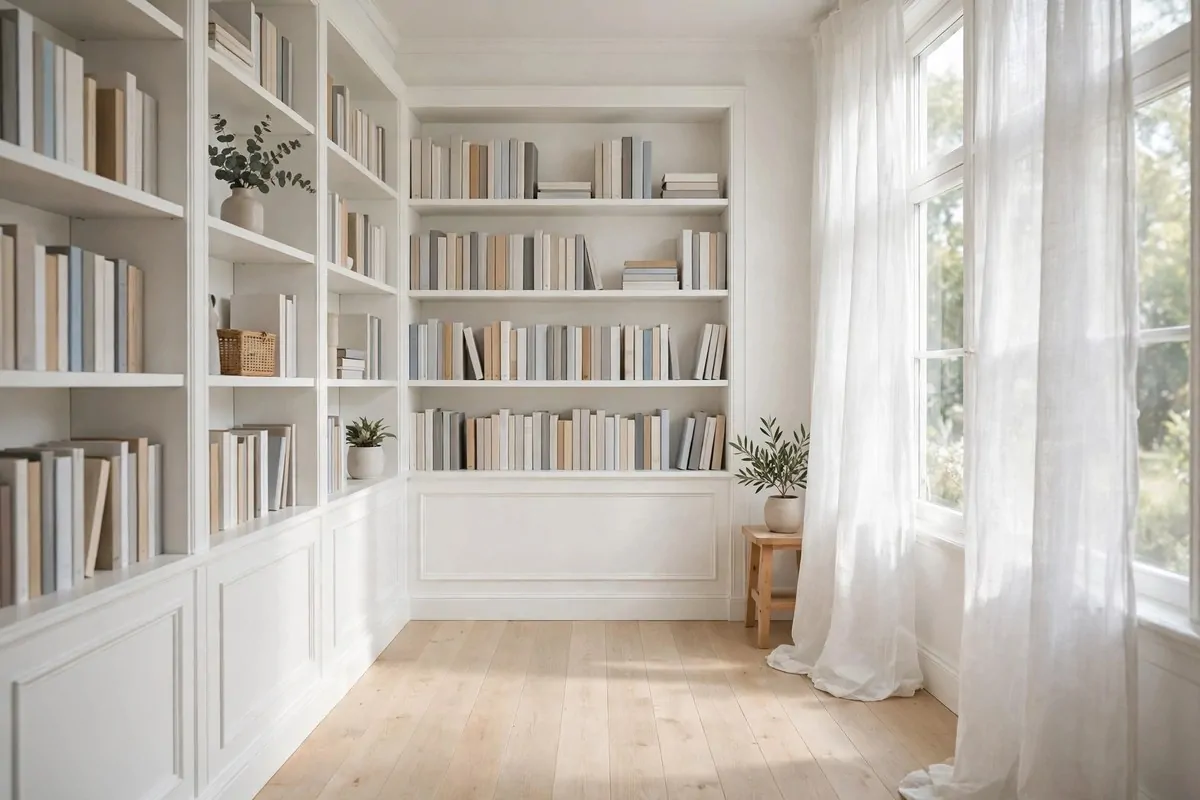
The opposite of the moody dark library, and just as grand. White shelves, pale walls, light wood floors, sheer curtains. Everything bright and airy. This layout makes a small room feel like a sunlit library in a Scandinavian novel.
White bookshelves are the foundation. They reflect light instead of absorbing it, so the whole room glows. Books provide all the color you need. A white shelf full of colorful book spines looks like art. The shelves disappear and the books float.
Keep the wall color light too. White, cream, or the palest gray. Dark walls need lots of lamps to work. Light walls work with just the sun. If your small room has a good window, this layout lets the daylight do all the heavy lifting.
Pale wood floors or a light rug keep the brightness going all the way down. Dark floors in a white room create a harsh line that chops the space in half visually. Light floors let your eyes glide across the whole room uninterrupted.
Here is a simple comparison to help you choose between light and dark for your small library:
| Pick this | If you want | You will need |
|---|---|---|
| Light shelves, light walls | Airy, bright, bigger feeling | A decent window, sheer curtains |
| Dark walls, warm lamps | Moody, dramatic, club-like | Three or more warm lamps, dimmers |
| Natural wood shelves | Warm, classic, timeless | Works with any light you have |
Add plants to a light library. Green leaves against white shelves look fresh and alive. A trailing pothos on the top shelf, a small fern beside the chair. Plants love bright rooms, so they will actually thrive here, unlike in a dark moody library.
The grand feeling in a light library comes from clarity. Everything is visible, everything is calm, everything has room to breathe. It feels like the reading room of a fancy hotel. Clean, bright, and quietly luxurious.
Wipe the white shelves with a damp cloth every few weeks. White shows dust fast, but it also rewards you by looking brand new after a quick wipe.
14. Symmetry Around a Centerpiece
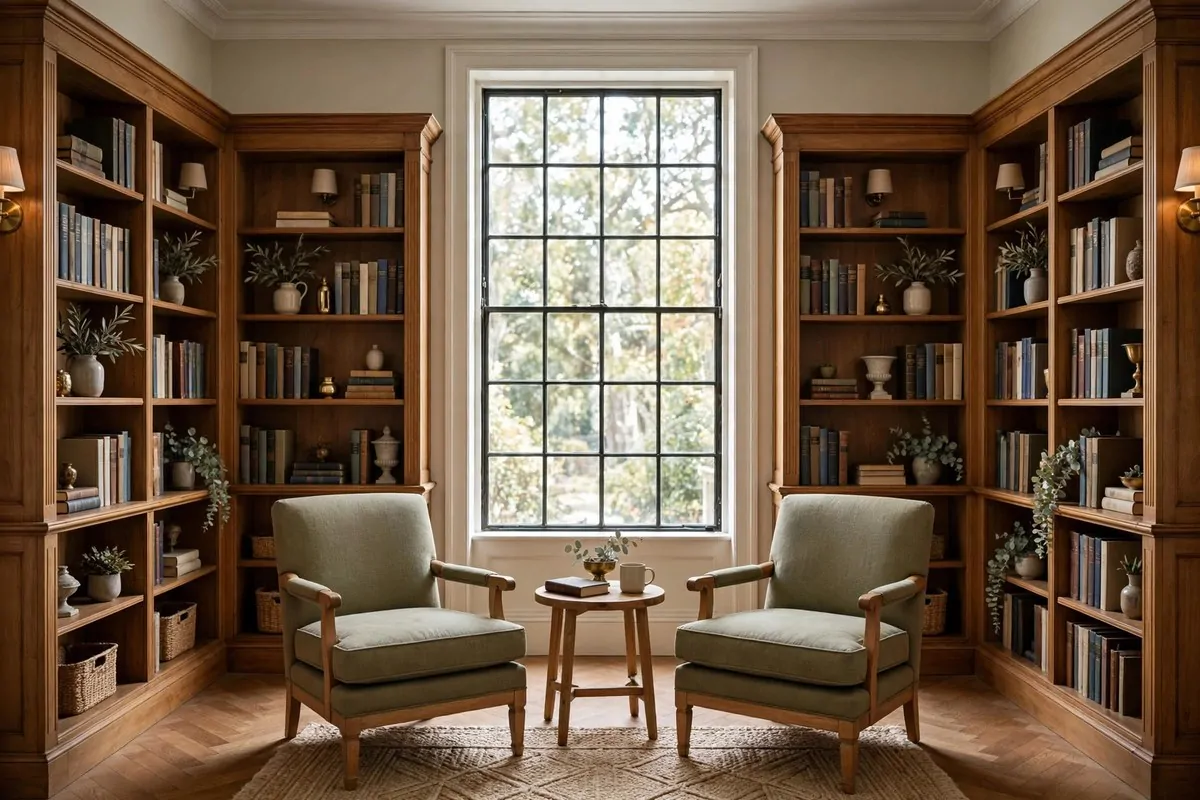
Grand rooms are almost always symmetrical. Palaces, old libraries, fancy hotels. Two matching sides with something important in the middle. You can steal that trick for a small room, and it works just as well at eight feet wide as it does at eighty.
Pick your centerpiece. A window is ideal. A fireplace is even better if you have one. No fireplace or good window? A large piece of art, a mirror, or even your reading chair can be the center. The centerpiece is the anchor everything else lines up around.
Flank it with matching bookshelves. Same height, same width, same color. Place them at equal distances from the center. Measure twice. The human eye is ruthless about spotting uneven gaps, and uneven symmetry looks like a mistake.
Match the details on both sides too. If there is a plant on top of the left shelf, put one on the right. A lamp on the left side table gets a twin on the right. This mirroring is what makes the room feel formal and grand instead of just furnished.
Keep the center of the room clear. Symmetry needs space to breathe. Do not push the chair right up against the centerpiece. Pull it back a little so you can see the whole balanced arrangement when you sit down. The view is the point.
This layout photographs beautifully, by the way. If you ever want to show off your library, symmetry does the work for you. One photo straight on, and everyone thinks you hired a designer. You did not. You just used a tape measure and some patience.
The feeling this layout creates is calm and order. Everything has a place and a partner. In a small room, that order feels luxurious. It says someone cared about this room, and that someone was you.
Take a photo of the room from the doorway after arranging it. The camera catches crooked lines your eyes miss, and you can fix them in minutes.
15. The Reading Bench Under the Window
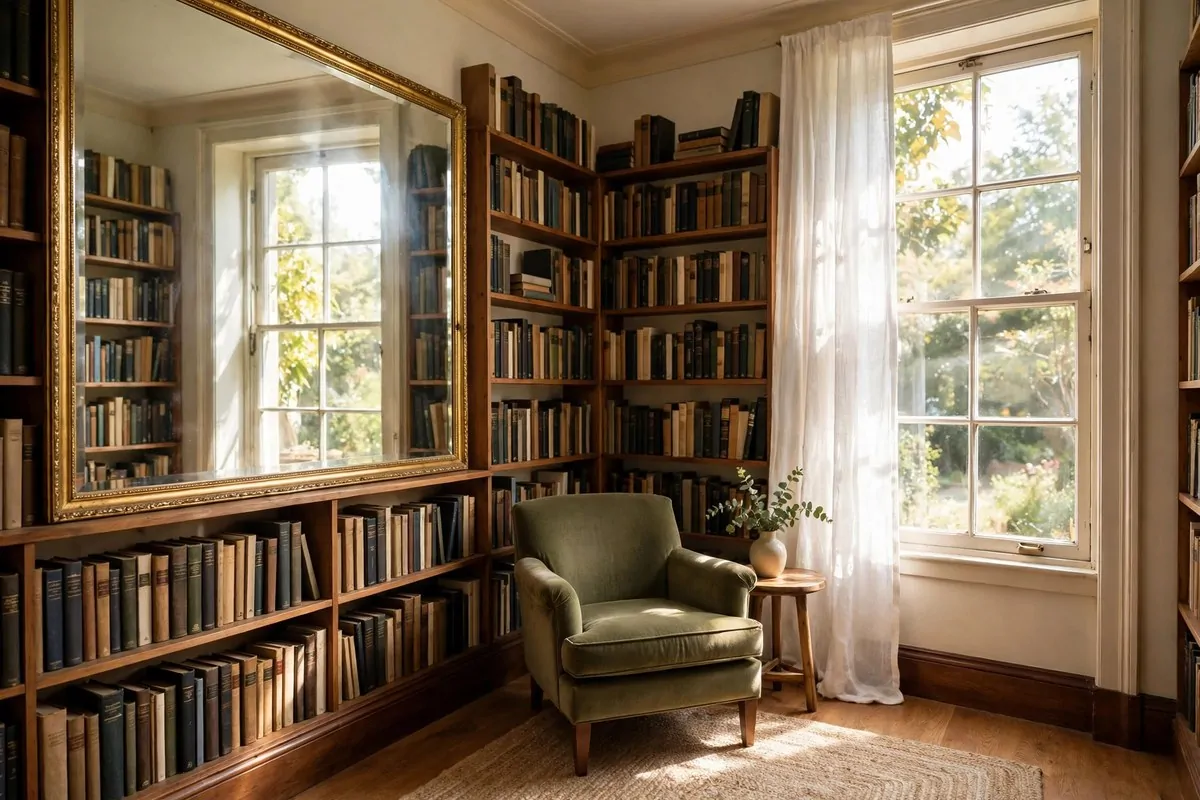
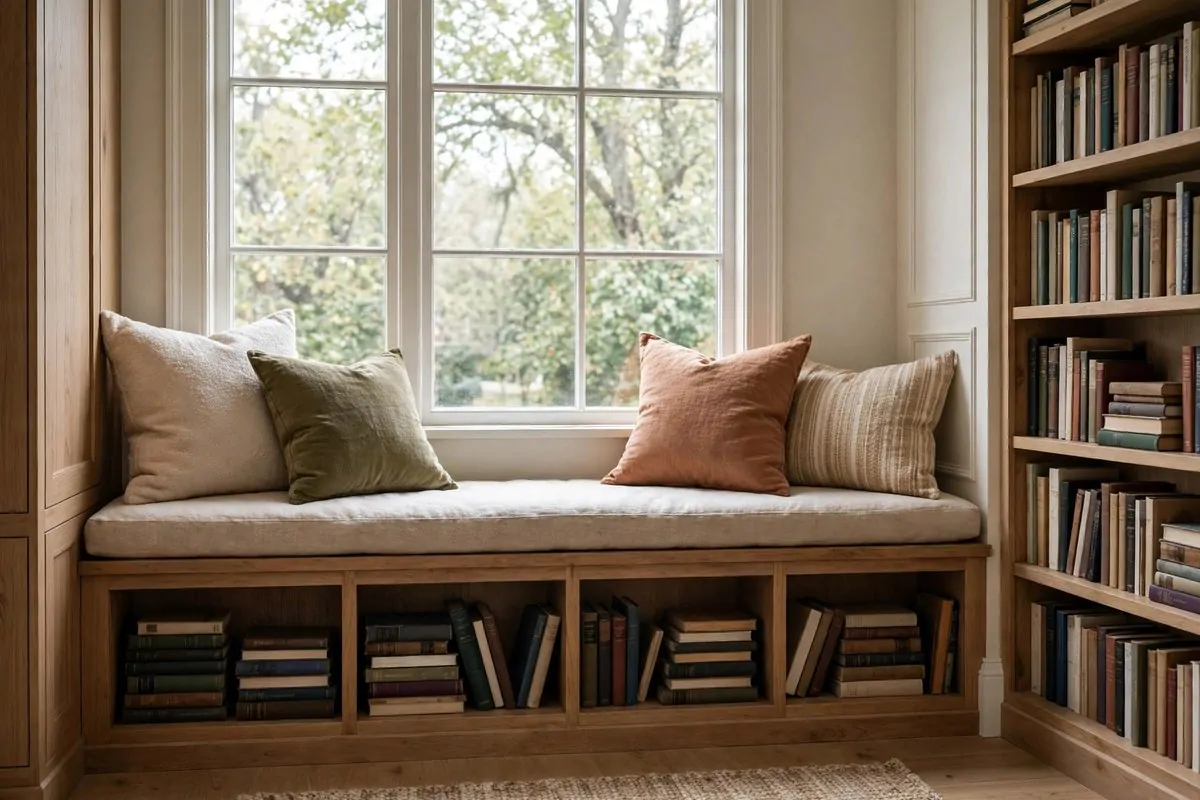
A window bench with book storage underneath is three pieces of furniture in one. Seating, shelving, and a sunny reading spot. In a small library room, that kind of multitasking is pure gold.
Build the bench as wide as the window, or as wide as the wall allows. It should be about eighteen inches deep and eighteen inches high, which is standard seat height. Any lower and your knees complain. Any higher and your feet dangle.
The storage underneath is where the magic happens. Cubbies for books you are reading now. Deep drawers for blankets. Open bins for magazines. Everything a reader needs, hidden right under the seat. I keep my current five books in the cubby nearest my favorite sitting spot.
Top it with a thick cushion and lots of pillows. The cushion should be at least four inches thick. Anything thinner goes flat in a month and feels like sitting on wood. Which, to be fair, you are. The cushion is doing important work.
Flank the window with bookshelves if you have the wall space. The bench plus two shelves creates a U of books around the window. You sit in the middle of the U with daylight pouring in. It is the reading equivalent of a warm bath.
This layout feels grand because built-ins always look expensive. A bench that fits the window exactly looks custom, even if you built it from stock cabinets and a cushion. Built-in furniture tells the room it was designed, not just decorated.
On sunny days, this bench will be the most fought-over seat in the house. Fair warning. You may need to set visiting hours. Or build a second bench. Honestly, a second bench is the better solution.
Air the bench storage out once a season. Closed benches trap musty smells, and your blankets will thank you for the fresh air.
16. Open Shelves With Breathing Room
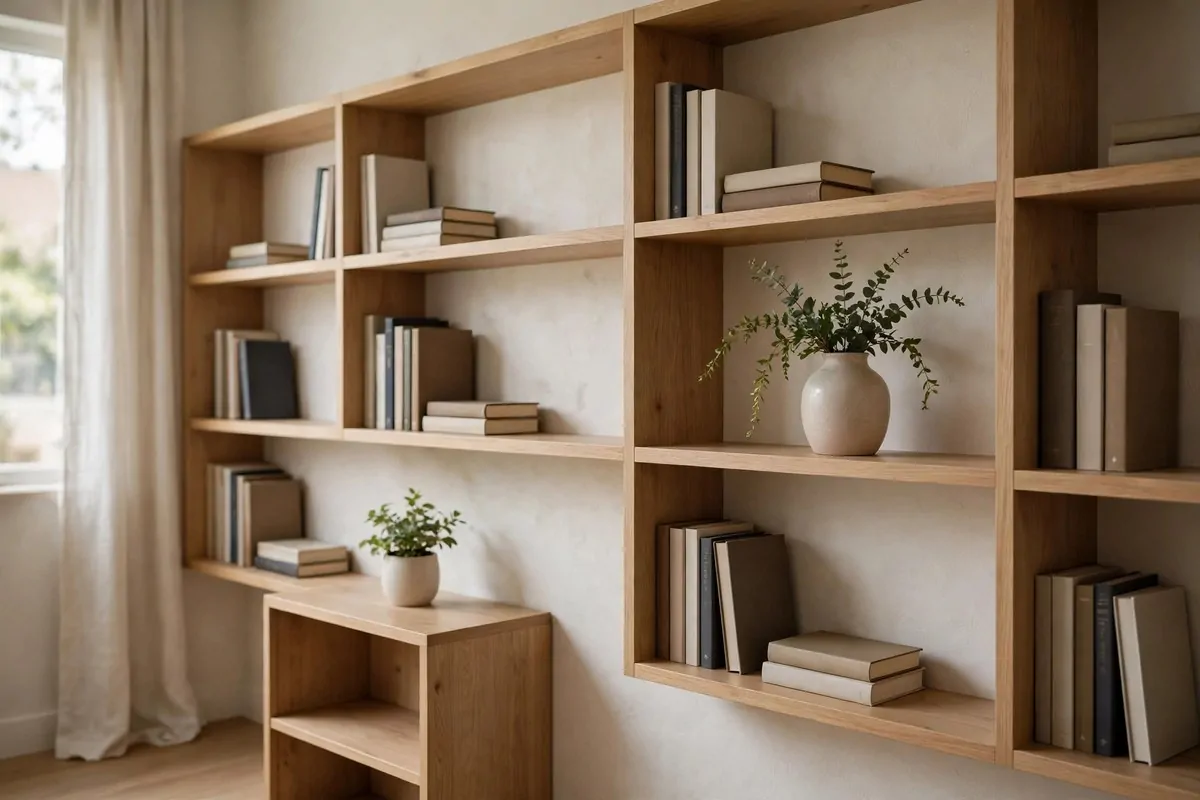
Most small libraries fail for one reason. Too many books, crammed too tight, on every inch of every shelf. It looks like a storage unit, not a library. This layout fixes that with one rule. Leave breathing room.
Breathing room means empty space on your shelves. Not a lot. Just enough that the books do not look stuffed in. Aim for about a quarter of each shelf to hold decor or nothing at all. The empty space makes the books look chosen, not hoarded.
Style the gaps with simple objects. A small vase. A framed photo. A plant. A stack of two books laid flat with a candle on top. These little moments give your eyes a rest and make the shelves look decorated by a person, not filled by a machine.
This takes discipline, I will not lie. When you love books, every empty inch of shelf screams to be filled. But a shelf with room to breathe shows off your books better. Each spine gets noticed. Your favorites stand out instead of drowning in a sea of spines.
Rotate your display with the seasons. In spring, put a small vase of flowers on the empty shelf. In winter, a candle. In fall, a little pumpkin. These tiny changes keep the library feeling alive and give you a reason to touch your shelves regularly.
The grand feeling here is restraint. Fancy libraries are not stuffed. They are curated, which is just a careful word for choosing what to show. A small room with breathing room feels confident. It does not need to prove how many books it holds.
If you truly have more books than shelf space, store the overflow elsewhere. A closet, under the bed, a storage box. Keep only the books you love most on display. Your library will look better, and you will enjoy the books you see every day more.
Here is a quick styling formula that never fails:
- One shelf in three stays partly empty
- Group books in odd numbers when stacking flat
- Mix one natural item, like wood or a plant, per shelf
- Keep the top shelf simple, with just two or three objects
- Step back and look from the doorway before you call it done
17. The Narrow Room, Two Slim Walls
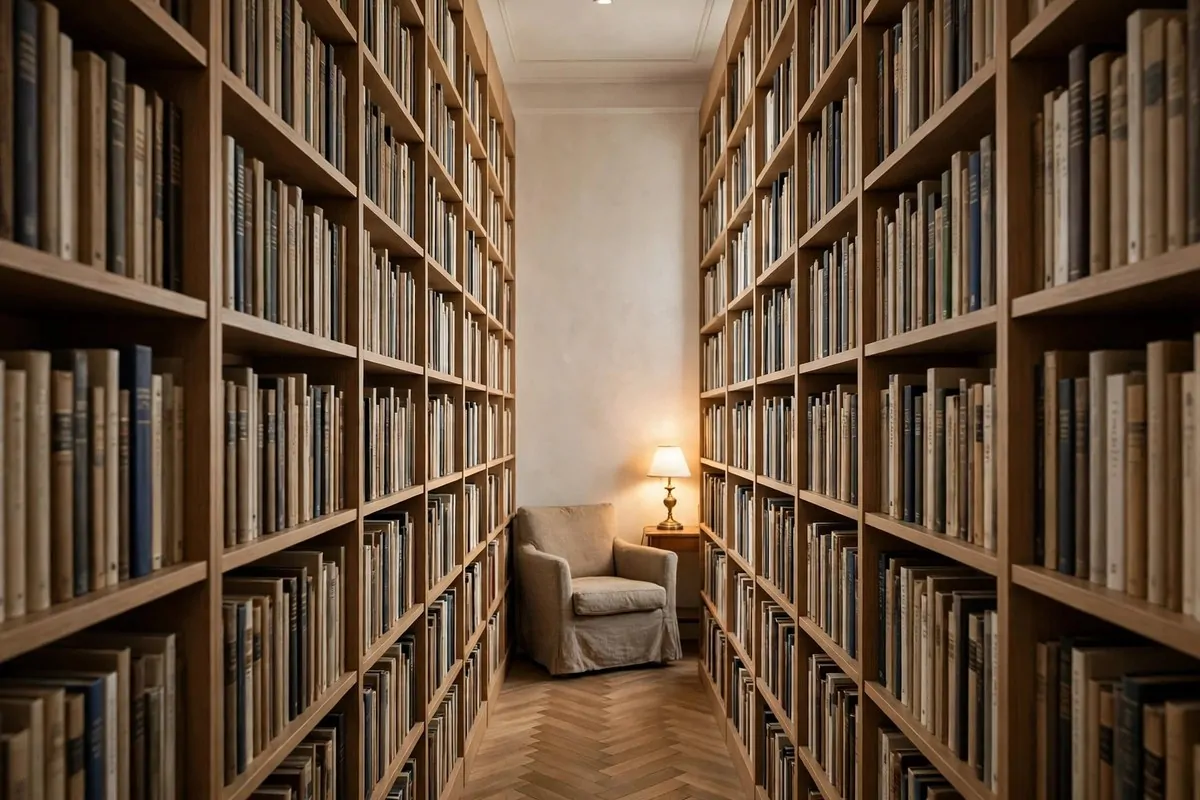
Some small rooms are not square. They are long and narrow, like a hallway with a door. This layout owns that shape. Slim shelves on both long walls turn a tunnel-like room into a corridor of books that feels like a private gallery.
Slim is non-negotiable here. Eight-inch-deep shelves on both sides of a narrow room still leave walking space. Ten-inch shelves might not. Measure your room’s width, subtract sixteen inches for two rows of shelves, and make sure at least two feet of walkway remains.
The gallery feeling is what makes this grand. Walking between two walls of books feels like a museum exhibit. Your books become the art. Line the shelves with the spines facing out and let the colors and titles do the decorating.
Light the length of the room evenly. One lamp at the end leaves the middle dark. Instead, use a few small lights spread along the shelves. Picture lights every few feet, or a string of warm lights along the top shelf. Even light keeps the tunnel feeling bright, not creepy.
Put the reading chair at the far end of the room, under a lamp. It becomes the destination at the end of the book corridor. Walking past all your books to reach your chair is a lovely daily ritual. It is like the shelves are applauding you on your way to read.
Keep the floor simple. A long runner rug down the middle softens footsteps and adds warmth. It also guides the eye down the length of the room, which makes the space feel longer and more dramatic. Choose a rug with a simple pattern so it does not fight with the busy bookshelves.
This layout is perfect for that weird narrow spare room nobody knows what to do with. You know the one. Too skinny for a bedroom, too small for an office. It was born to be a library corridor.
Alternate the direction of book spines on facing shelves for a subtle pattern. It is a tiny detail, but it makes the corridor feel designed.
18. Wall Sconces Instead of Floor Lamps
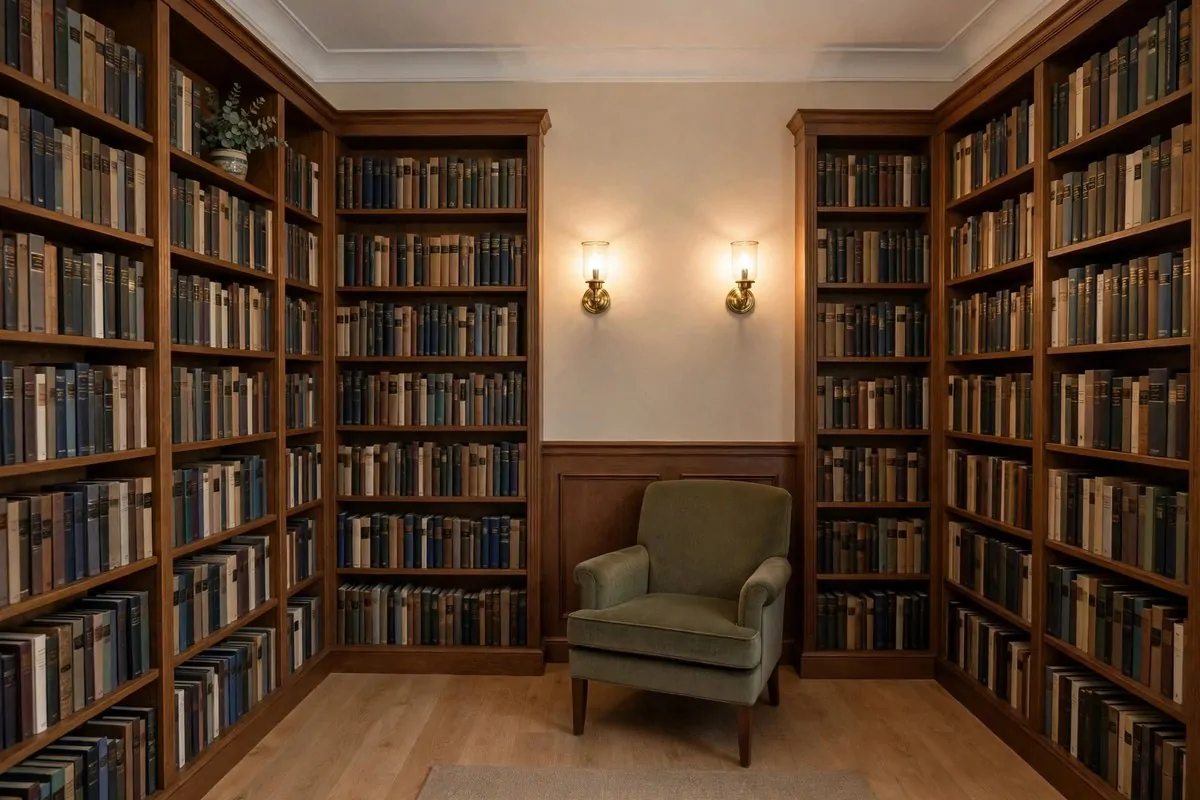
Floor lamps eat floor space. In a small library room, the few square feet a lamp base occupies might be the difference between comfortable and cramped. Wall sconces solve this by moving the light onto the wall where it costs zero floor space.
Sconces beside or above your reading chair put light exactly where you need it. Mount them at about eye level when you are seated, slightly behind or beside the chair. The light falls over your shoulder onto your book, which is the ideal reading angle.
Plug-in sconces are renter friendly. They mount with two small screws and plug into a nearby outlet, with the cord hidden behind the chair or run down the wall in a cord cover. No electrician needed. I installed two in an afternoon with nothing but a screwdriver.
Hardwired sconces look cleaner, with no cords at all. If you own your home and are comfortable with basic wiring, or you hire an electrician for an hour, the result is seamless. Either way, the floor stays completely clear.
This layout feels grand because sconces feel intentional and a little bit fancy. They are the lighting of old libraries and nice hotels. A small room lit by sconces instead of a floor lamp from a big box store instantly feels more designed.
Pair sconces with a dimmer for full control. Bright for finding books, low for reading, barely on for mood. A plug-in dimmer switch costs a few dollars and works with most plug-in sconces. It is the cheapest upgrade on this whole list.
Keep the chair pulled slightly away from the wall so the sconce light is not blocked by your head. Six to twelve inches of gap is enough. It also gives the chair a more relaxed, floated feeling instead of being shoved against the wall.
Choose sconce shades that direct light downward. Upward light wastes itself on the ceiling, but downward light lands right on your pages.
19. The Rug-First Layout
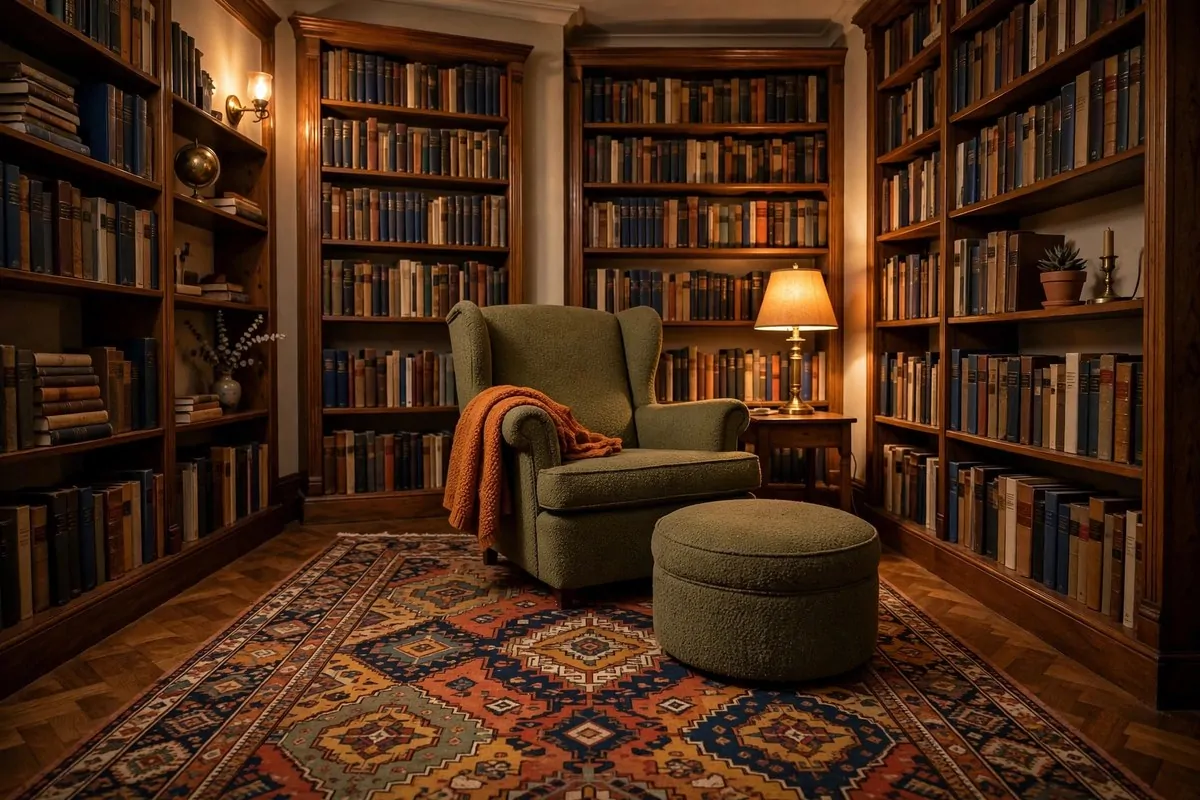
Start with the rug, not the shelves. This layout flips the usual order and it changes everything. Lay down a beautiful rug first, then arrange the whole library around it. The rug becomes the heart of the room.
A rug defines space in a way furniture cannot. In a small room, one large rug under the reading chair marks the spot as important. It says this is where the reading happens. Everything else in the room orients around it.
Go as big as the room allows. A rug that nearly touches the walls makes a small room feel larger, which sounds backwards but works. Small rugs chop a room into pieces. One big rug unifies it. Leave just a few inches of floor showing around the edges.
Choose a rug with pattern and color. Your bookshelves will be busy with book spines, so the rug can be bold. A Persian-style pattern, a rich color, something with personality. The rug is the jewelry of the room. Let it shine.
Place the chair and ottoman fully on the rug, with the front legs of the bookshelves just touching its edge. This connects the furniture into one grouping. Without the rug tying them together, a chair and shelves in a small room can feel like random pieces. With it, they feel like a set.
The grand feeling comes from the rug’s richness. A beautiful rug underfoot makes any room feel luxurious. It is the oldest decorating trick there is. Palaces have rugs. Fancy libraries have rugs. Your small room can have one too, and it will do the same work.
Layer a smaller rug over a bigger one if you want extra coziness. A sheepskin or a small patterned rug on top of the main rug, right under the chair. It is a little bit extra, and that is exactly the point. Grand rooms are allowed to be a little bit extra.
And there it is. Nineteen layouts for a small home library room that feels grand. From book walls to ladders to mirrors to rugs, every one of these works in a real tiny room.
Remember my tape measure story. Eight feet by nine feet. That little room is a library now. It has shelves on two walls, a chair I love, and a lamp that makes the whole room glow gold in the evening. It is the smallest room in my house and my favorite one.
Your room can be next. Measure it. Pick a layout. Start with one wall. A small room does not need to stay a dumping ground. It just needs someone to see what it could be. That someone is you.