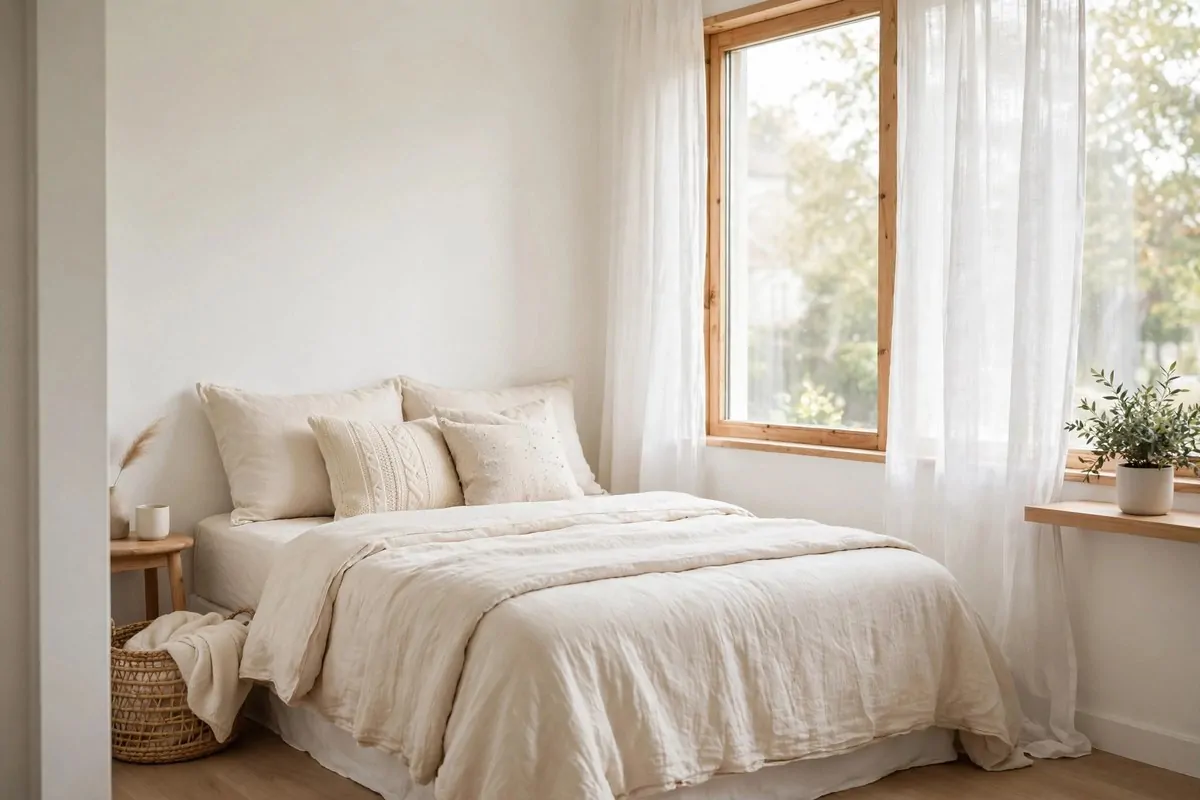
18 Therapy Office Inspiration Ideas That Feel Calm and Welcoming

Think of the calmest room you have ever sat in. Maybe it was a quiet corner of a library, with the smell of old pages and soft light. Or a spa waiting room where the music was low and the chairs hugged you a little.
Maybe it was a friend’s sitting room on a slow afternoon. The sun came through the window and nobody was in a hurry.
That feeling you remember is not an accident. A therapy office is built to be exactly that room. Every color, every light, every chair is chosen so a person can walk in stressed and slowly let their shoulders drop.
I think that is a wonderful thing to copy. You do not need a practice to use these tricks. These 18 Therapy Office Inspiration ideas work in a bedroom, a home office, a reading corner, anywhere you want to feel calm and welcome.
1. A Soft Beige Waiting Corner
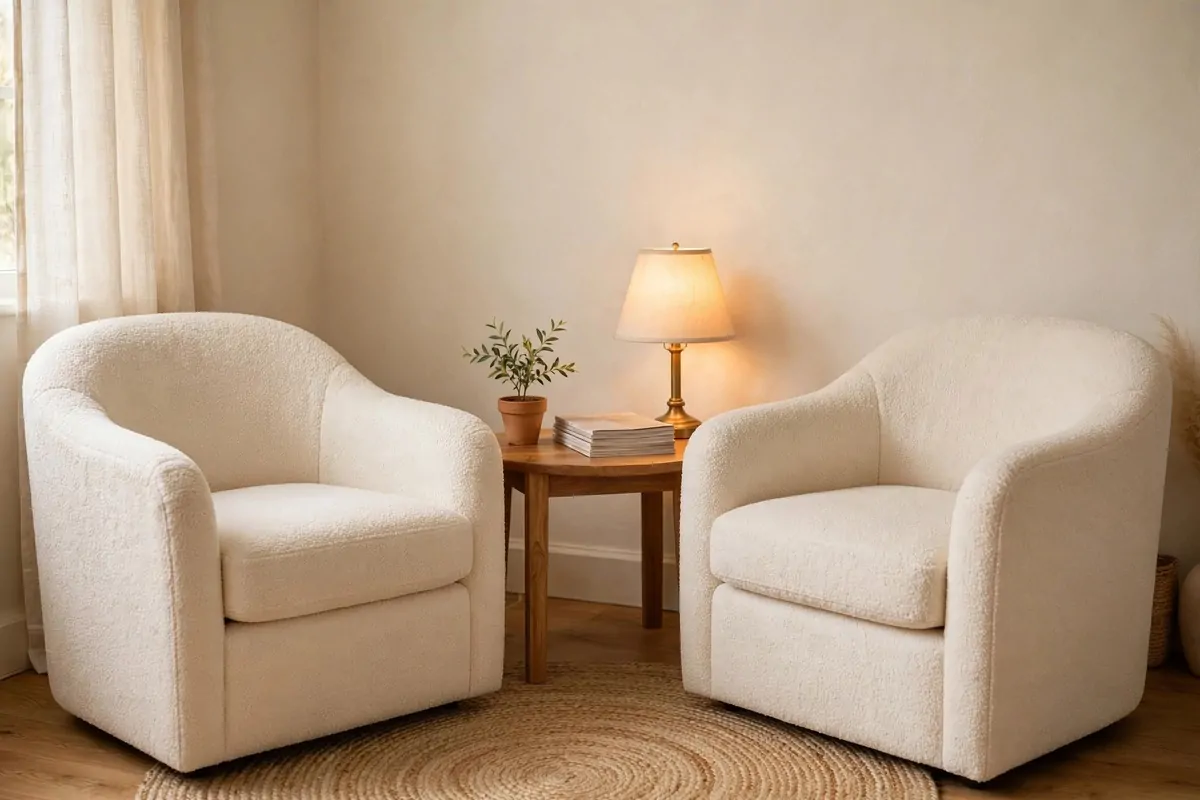
The first thing a person meets in a therapy office is the waiting corner. It is small. It is quiet. And it tells you everything about how the rest of the visit will feel.
A beige corner works because beige asks nothing of you. It is not loud like red. It is not cold like gray. It just sits there and says come in.
I like two small chairs with a tiny table between them. On the table you can put a little stack of magazines or a small plant. That is enough.
Keep the wall behind it plain or soft cream. No busy posters here. This corner is the hello of the whole room, so keep it gentle.
A round rug under the chairs ties it together. Even a cheap one does the job if the color is soft.
Add one warm lamp instead of using the ceiling light. Overhead lights feel like a clinic. A lamp feels like a home.
This is the easiest idea on the list. A corner, two chairs, one lamp, done.
2. Sage Green Walls
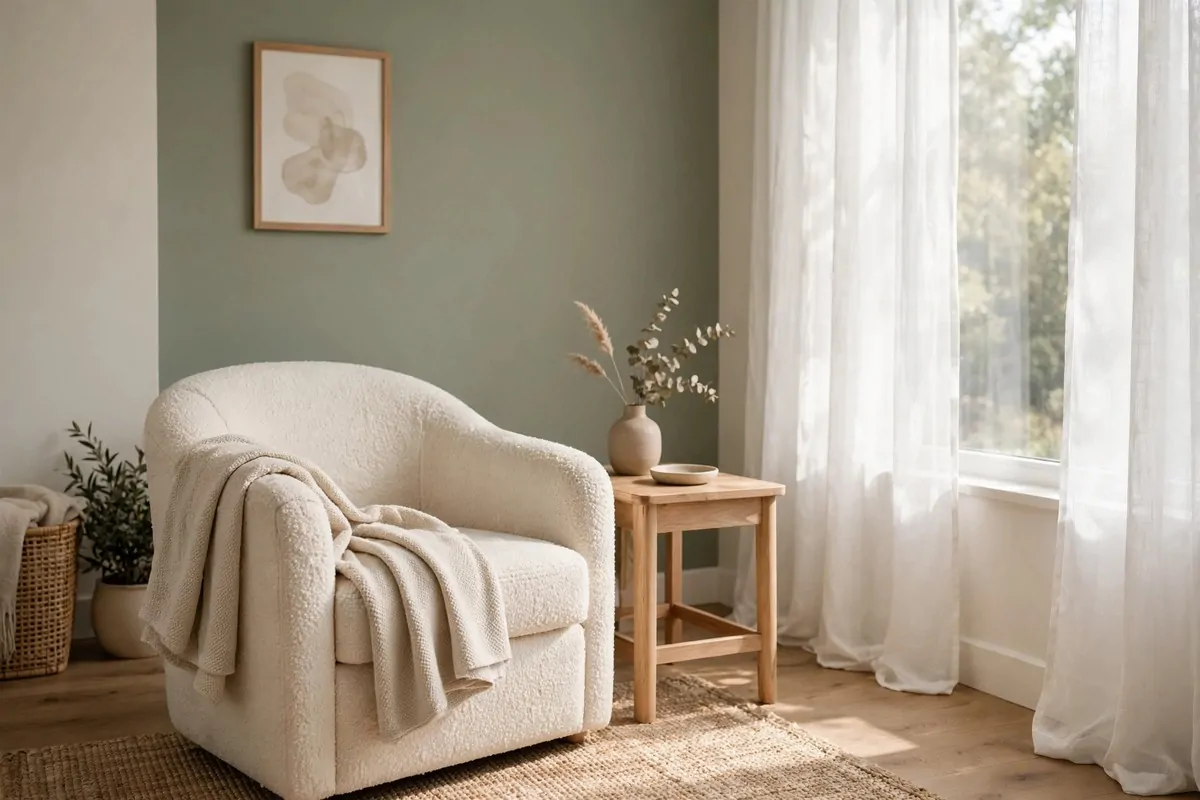
Sage green is the color everyone reaches for when they want calm. It is green that went quiet. Soft, dusty, a little gray.
I painted one wall of my study sage last year. Just one wall, not all four. That is the trick the therapists use too.
One accent wall gives you the whole feeling. Four walls can feel like you are inside a plant, and not in a good way.
Sage reminds your brain of leaves and quiet gardens. Colors like this can lower your heart rate a little. Sounds small, but it matters when you want to relax.
Pair it with cream curtains and warm wood. The combo looks expensive even when it is not.
If you rent and cannot paint, try it another way. A big sage throw, sage cushions, or a sage canvas can give the same vibe.
Paint is cheap too. One can covers one wall in an afternoon. I did mine on a Saturday and sat staring at it all evening like it was a new pet.
3. Warm Wood Tones
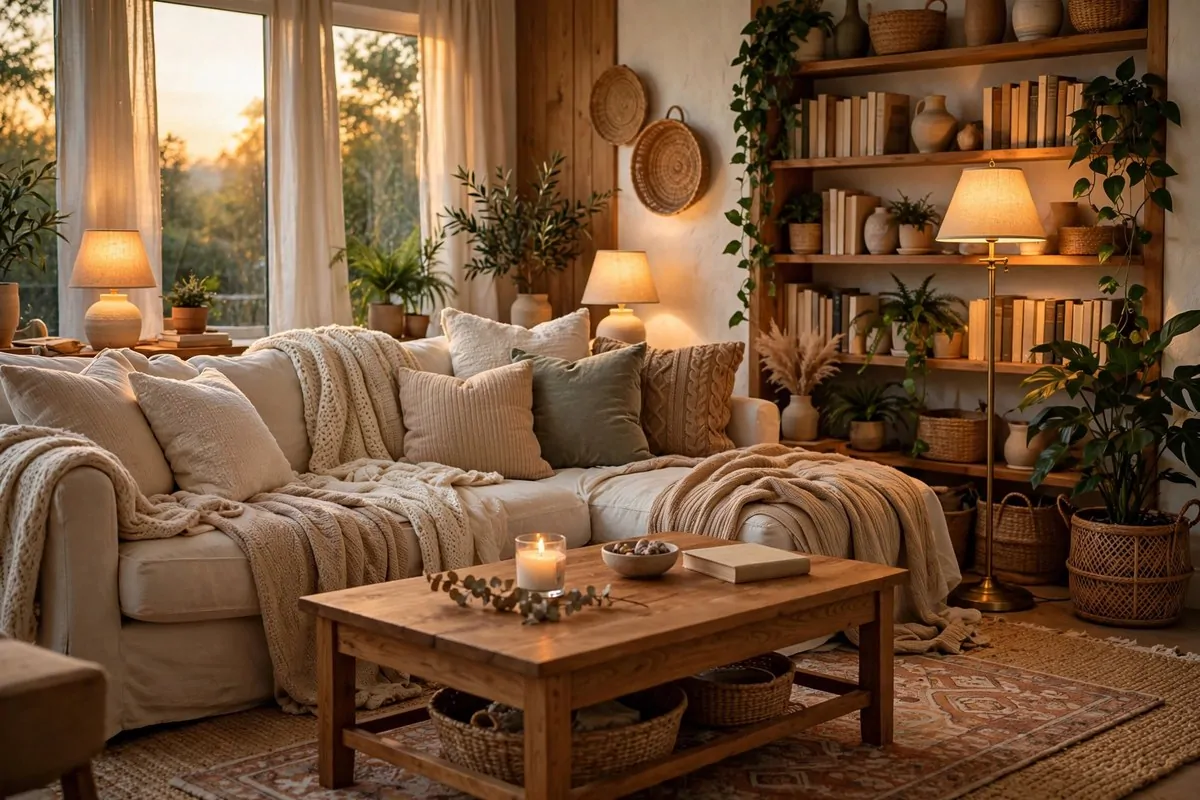
Wood makes a room feel human. Metal feels like an office. Plastic feels like a waiting room at the dentist. Wood feels like someone lives there.
Light oak is the favorite in therapy offices. It is not dark and heavy. It lets the room breathe and keeps everything feeling open.
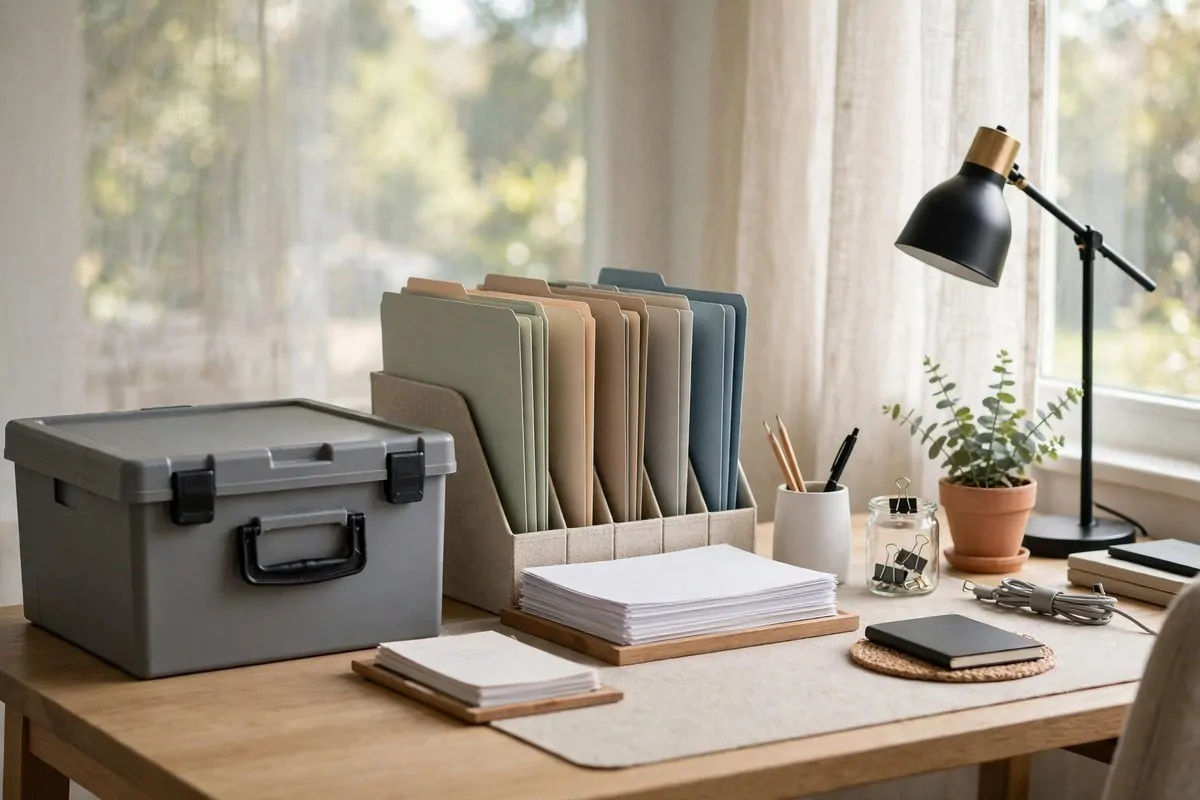
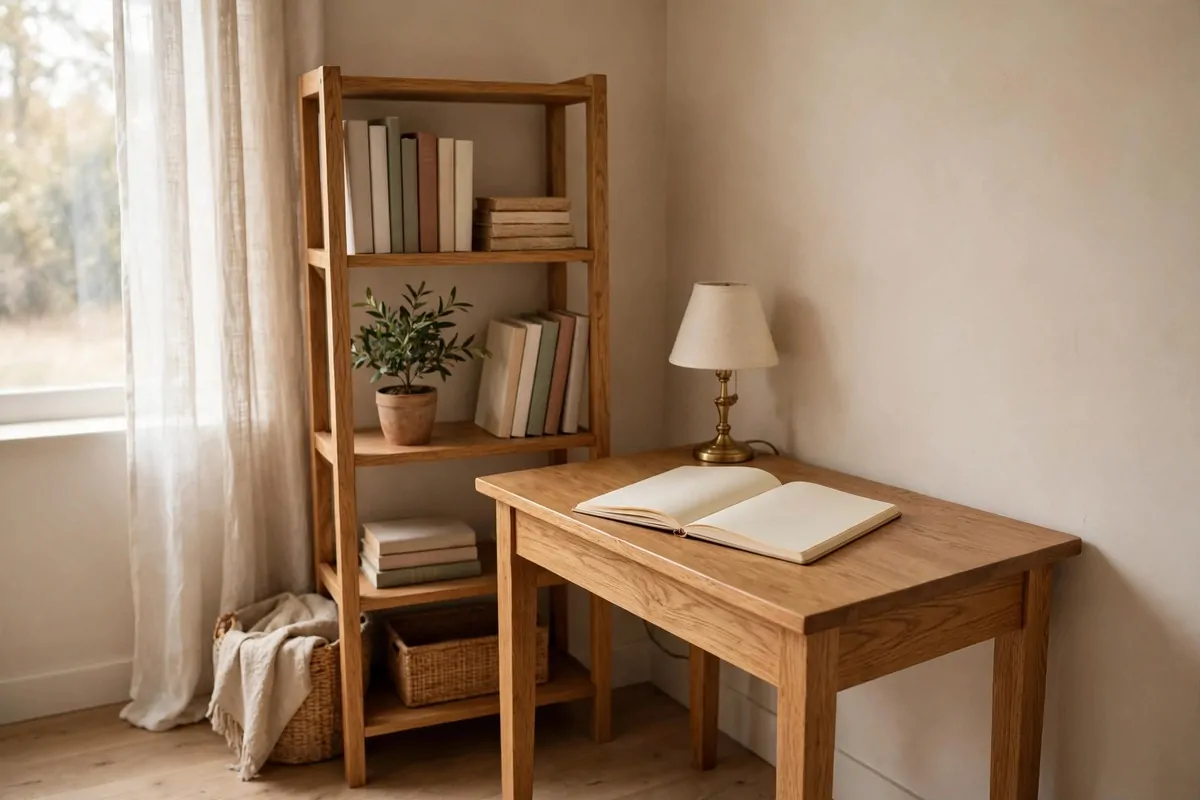
A small oak desk tucked to the side works great. Not a big boss desk in the middle of the room. That feels like a wall between two people.
Keep the desk simple. A notebook, a small lamp, maybe one little plant. When a desk is clean, the whole room feels clean.
Wood frames, wood side tables, wood bookcases. Repeat the tone three times and your room will feel pulled together.
I have a small oak stool that has followed me through three homes. It goes with everything. Wood is like that.
If new wood is out of budget, look at thrift shops. Wood can be sanded and oiled back to life. I once saved a side table that looked like it belonged in a fire, and now it is my favorite piece.
Here is a quick guide to wood tones that work best:
| Wood tone | Feeling it gives | Best used for |
|---|---|---|
| Light oak | Open, airy, fresh | Desks and shelves |
| Warm walnut | Cozy, grounded, rich | Side tables and frames |
| Pale beech | Soft, calm, simple | Small stools and trays |
4. A Pair of Low Armchairs
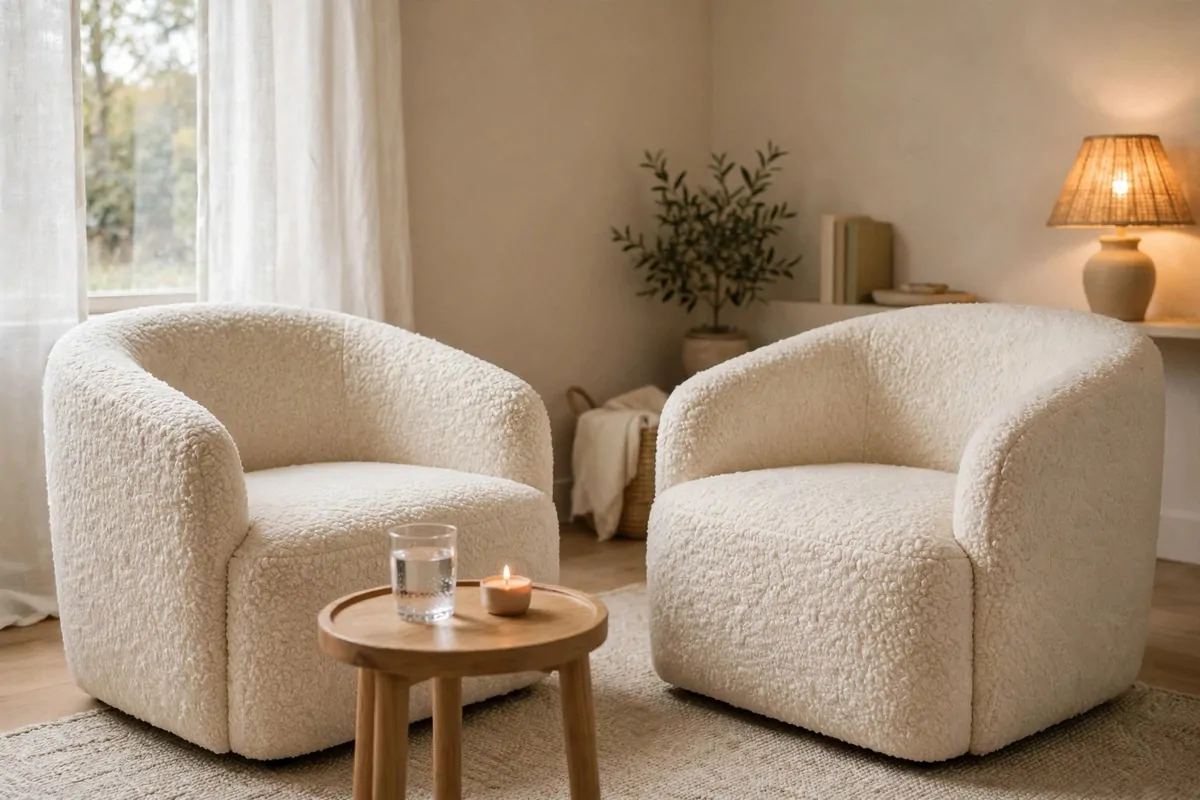
Big chairs swallow people. Low chairs meet them where they are.
Therapists pick chairs that are soft, low, and a little bit sinky. Not so sinky that you cannot get up. Just enough that your body knows it can stop holding tension.
Two matching chairs look balanced. The room feels even and steady. It is like the furniture is saying we are in this together.
Boucle fabric is a dream for this. That nubby white or oatmeal texture looks soft even from across the room. It is like a chair made of clouds.
Pick linen or cotton if boucle is too pricey. The key is soft to the touch. Nobody relaxes on scratchy chairs.
Put a small table between the chairs. It gives hands something to reach for. A glass of water, a tissue box, a little candle.
Angle the chairs a little, not straight across from each other. Straight across can feel like an interview. A soft angle feels like a real talk.
I tested this in my own living room. Moved the chairs from face to face to a slight angle. Conversations got longer the same week. Funny how that works.
5. A Round Jute Rug
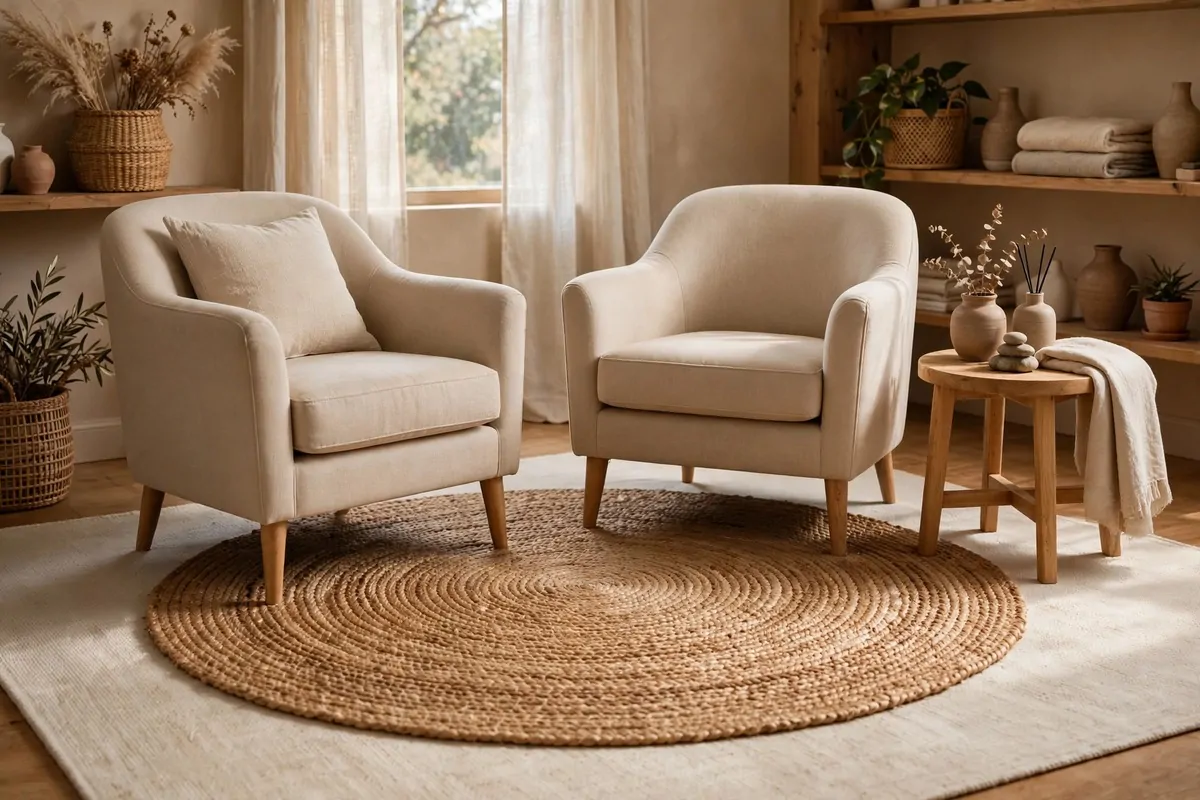
Floors are louder than you think. Hard floors bounce every sound around the room. That echo keeps your brain on alert.
A rug fixes it fast. It drinks up the noise and softens every step. The room goes quiet in a way you can feel.
Jute is my pick for therapy style. It is natural, earthy, and warm under your feet. It also hides a lot of life, crumbs, dust, pet hair. Nobody will ever know.
Round rugs work best under two chairs. The circle pulls the chairs together like a little island of calm.
Layering is a trick worth stealing too. A big flat rug under a smaller round one adds depth. It looks designed without trying too hard.
Stick to warm neutrals. Sand, wheat, oatmeal. Bright rug colors shout, and we want a whisper here.
Make sure the rug is big enough for both chairs to sit on. Little rugs floating in the middle look lost.
I bought my jute rug on sale and it changed the whole feeling of my study. Before, my chair legs scraped and echoed. Now everything lands soft.
- Choose flat weave if you hate vacuuming deep pile.
- Go a size bigger than you think. Small rugs shrink a room.
- Natural jute smells faintly earthy at first. It fades in a week.
6. A Warm Floor Lamp
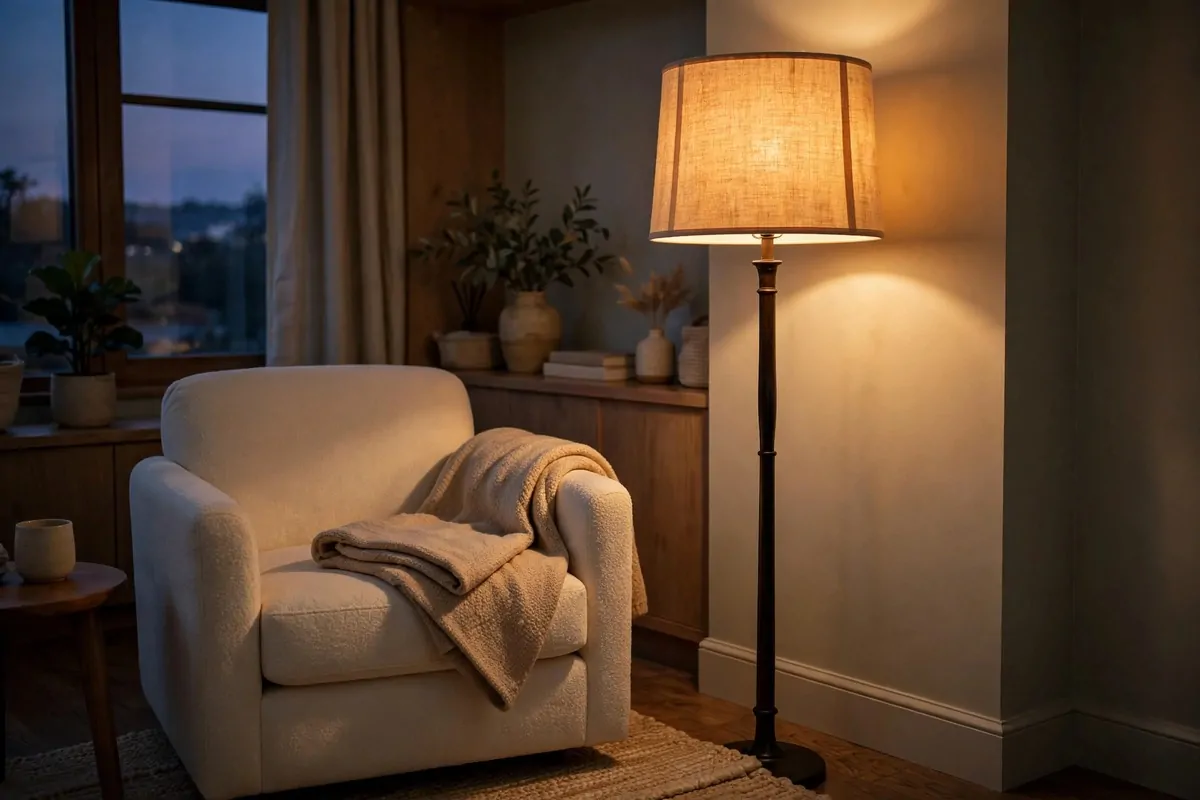
Overhead lights are the enemy of calm. They are bright, flat, and a little bit cold. They make every room feel like a clinic.
Therapy offices run on lamps. A floor lamp in the corner, a small table lamp near the chairs. That is the whole lighting plan, and it works.
Warm bulbs matter more than the lamp shape. Look for 2700K on the box. That number means golden, sunset kind of light. Anything above 4000K starts feeling blue and officey.
A tall arc lamp over a chair makes a perfect reading spot. A slim tripod lamp keeps the look modern. A fabric shade softens everything.
I keep my floor lamp on a timer. It clicks on at sunset. Walking into a room that is already glowing feels like the house is waiting for me.
Put the lamp where you will actually sit. Light should land on you like a warm hand, not blast from the ceiling.
Two lamps beat one bright bulb every time. Spread the glow around and the room feels bigger and softer.
Dimmer switches are a cheap upgrade. I added one plug in dimmer for eight dollars. Best eight dollars I spent on my room.
7. Sheer Linen Curtains
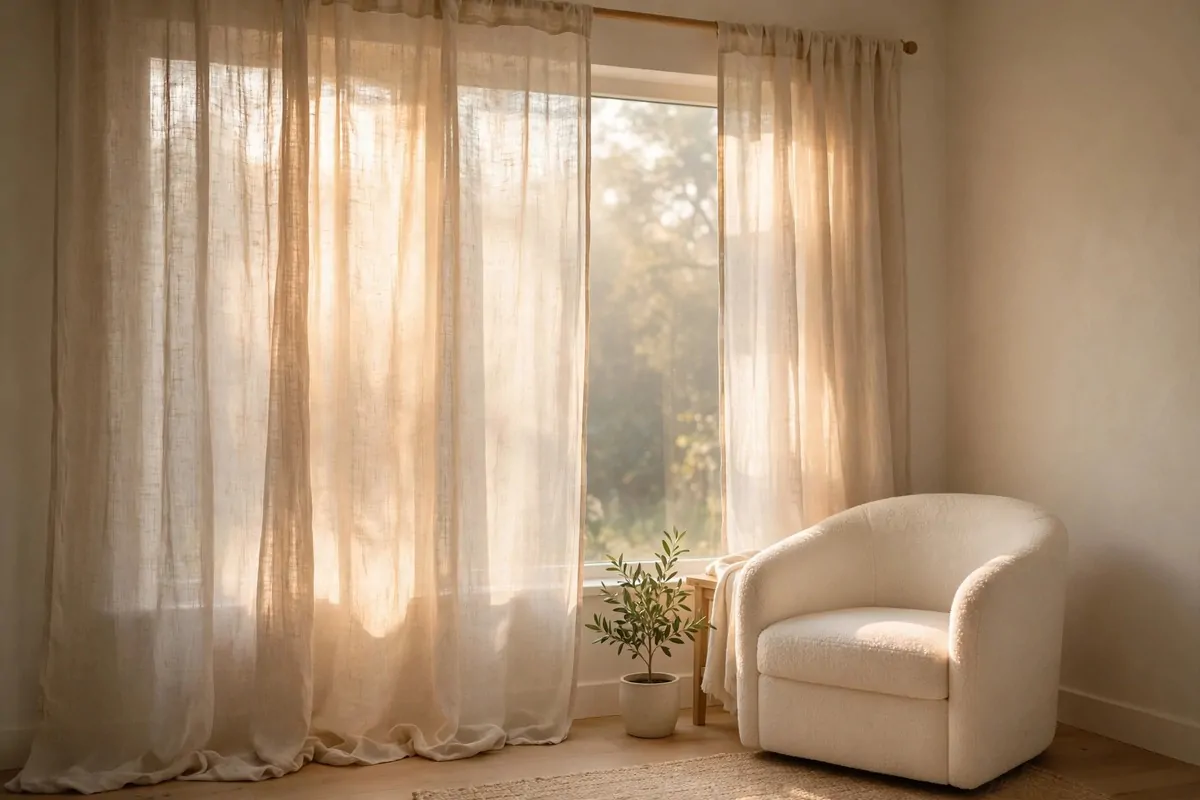
Heavy curtains say closed. Sheer curtains say breathe.
Linen curtains filter sunlight into something soft and glowy. The whole room looks like a slow Sunday morning, even on a Tuesday.
Therapists love natural light, and so should you. Sunlight lifts mood in a way no lamp can copy. Sheers let it in without the glare.
Hang them high and wide. Rod goes near the ceiling, panels wider than the window. This makes the window look bigger and the ceiling taller.
White or natural flax is the safest color. It goes with every wall paint you will ever pick.
Linen wrinkles a little. That is fine. Perfect curtains look stiff. Linen looks alive.
I wash mine twice a year and they get softer every time. Real linen ages like a good friend.
No curtain rod budget? A tension rod inside the window frame works. Cheap, no holes, takes five minutes.
Keep them closed during the harsh midday sun if your window faces west. Open them wide in the morning and evening when the light is gold.
8. Nature Artwork on the Walls
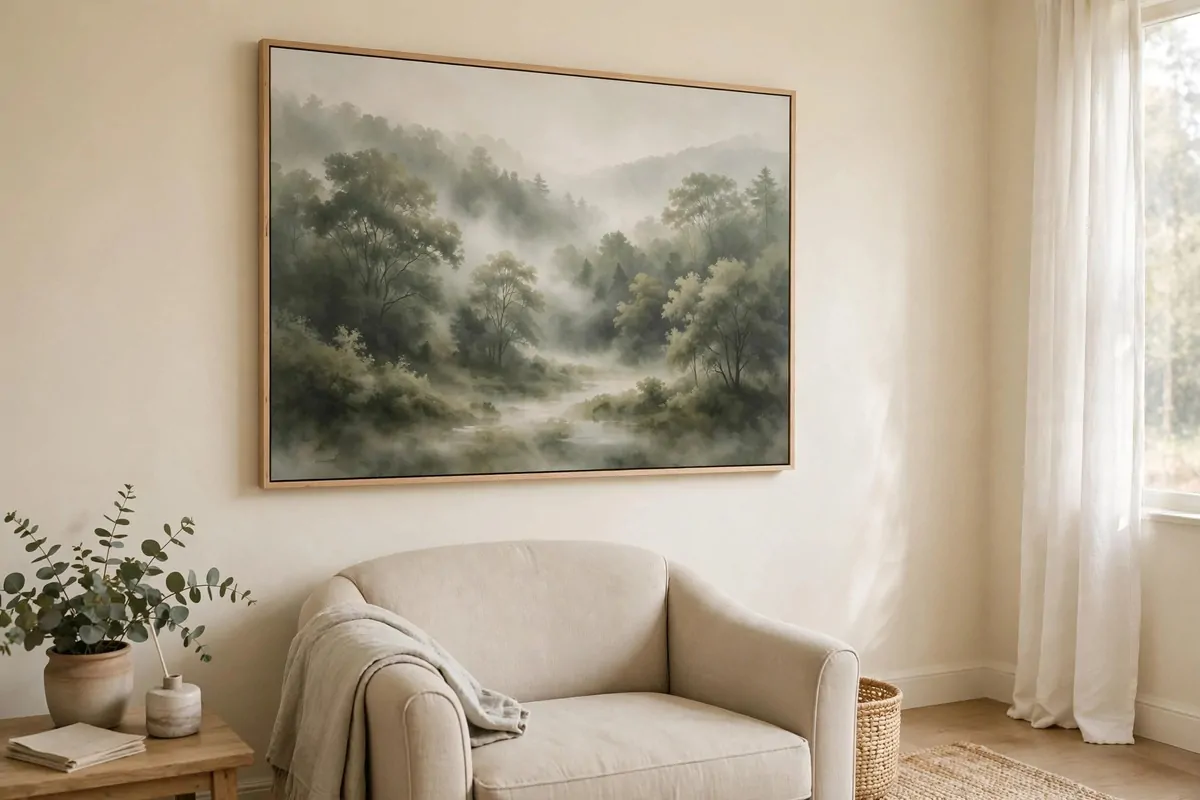
Blank walls make a room feel unfinished. Busy walls make it feel loud. Nature art sits right in the sweet spot.
Soft landscapes work best. Rivers, foggy forests, quiet beaches, rolling hills. Places your eyes want to rest on.
Therapists skip art with people in it. Faces carry stories, and a stranger’s face on the wall can feel odd when you are trying to relax. Keep it to land, water, sky.
Abstract art in calm tones works too. Muted blues, soft greens, warm sands. Nothing with sharp red spikes or wild black lines.
One medium piece beats ten tiny ones. A single calm painting gives the eye a place to land. A wall of clutter gives the eye homework.
Frames matter. Thin wood or simple white frames disappear and let the art speak. Chunky gold frames shout, and we do not want shouting here.
Print shops online sell beautiful nature prints for very little. I framed a ten dollar print in a thrifted frame and guests always ask about it.
Hang art at eye level when you are sitting down. In a calm room, people sit more than they stand. Meet their eyes where they are.
- Foggy forest scenes are the most calming, in my experience.
- Avoid city skylines and busy streets. They wake the brain up.
- Water scenes, lakes, rivers, slow waves, work like a visual deep breath.
9. A Small Tabletop Fountain
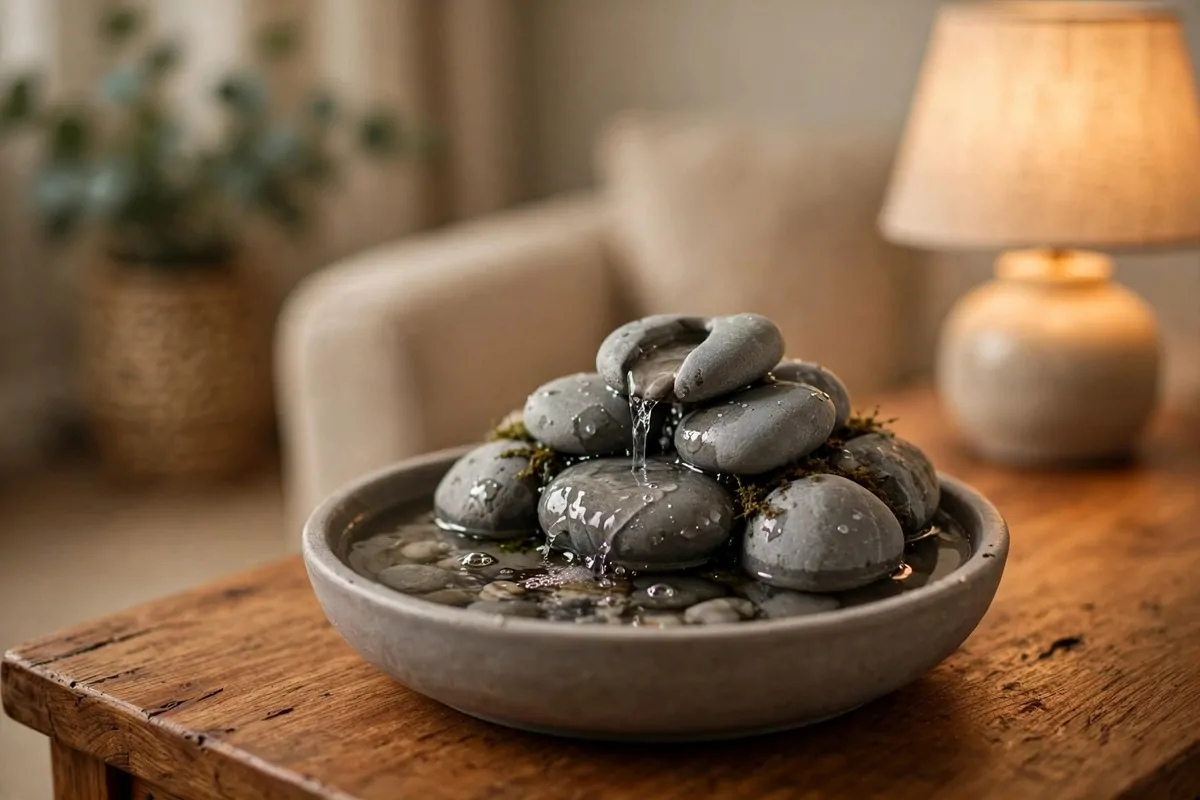
Sound is a room’s secret mood setter. A fountain gives you water sounds on demand.
That soft trickle tells your nervous system that everything is fine. Flowing water means life, safety, no danger. Your body knows this before your brain does.
Tabletop fountains are small, cheap, and plug into a normal outlet. Put one on a side table or a bookshelf corner.
The pump hums very quietly. The water does the rest. It masks street noise, ticking clocks, and that hum your fridge makes at night.
Keep the water clean. Change it once a week. A slimy fountain is not calm, it is a science project.
A bowl of smooth stones around the base makes it look styled. Gray river stones, nothing fancy. I found mine at a garden center for three dollars.
Not a fountain person? A small white noise machine gives a similar masking effect. Rain sounds or soft static work best.
I turn mine on when I read. Ten minutes in, I notice my jaw has unclenched. I did not even know it was clenched.
Place it away from papers and books. Splashes happen. Wood furniture appreciates a little cork mat underneath.
10. A Snake Plant and a Pothos
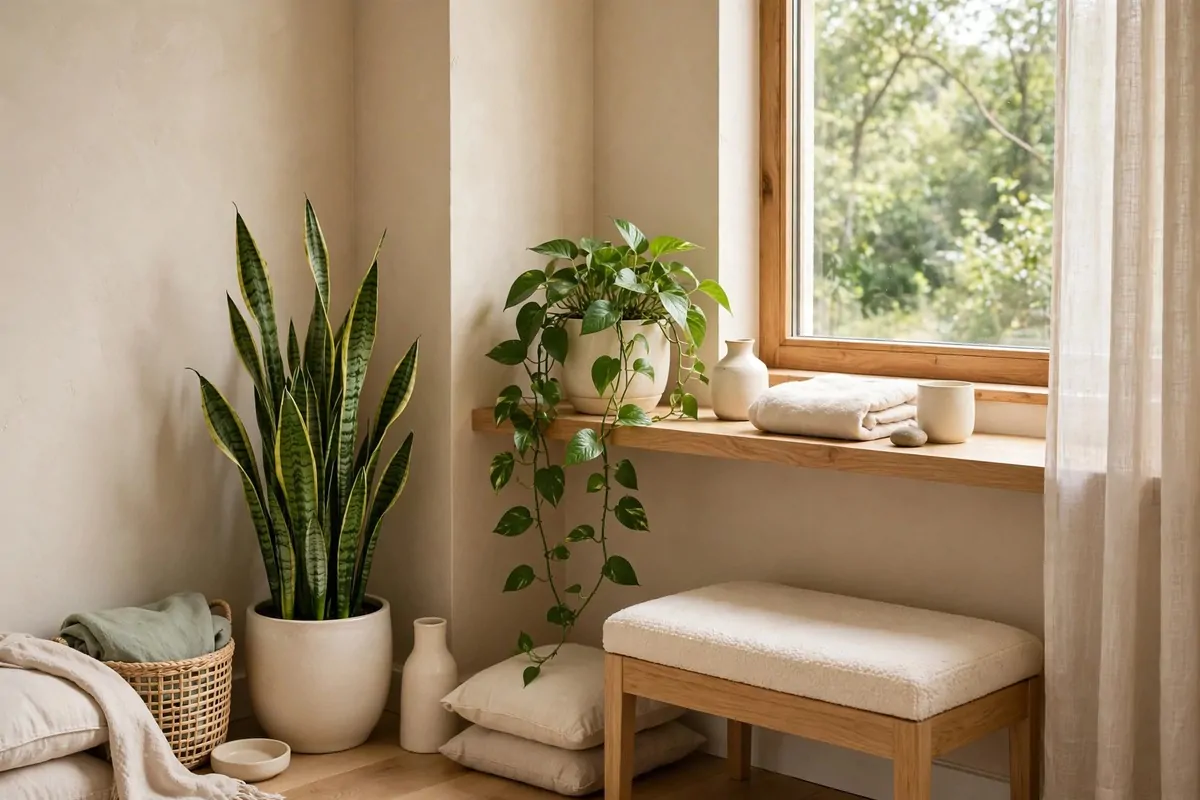
Every calm room needs something alive in it. Plants are the easiest life you can add.
A snake plant is nearly impossible to kill. I have forgotten mine for a month and it just stood there, unbothered, looking great.
Pothos trails down like a green waterfall. Put it on a shelf and let it do its thing. It forgives low light and irregular watering.
Two plants are enough to change a room. One tall, one trailing. That mix fills a corner without filling the space.
Green does something to a room that no paint can do. It breathes. It moves a little when the air moves. It reminds you that growing is happening, quietly.
Ceramic pots in white, cream, or terracotta keep the calm palette. Skip the bright plastic nursery pots. They look like a waiting room.
If you travel a lot, get a self watering pot. I have one that keeps my pothos happy for two weeks. No plant sitter needed.
Fake plants are okay if real ones keep dying on you. Get a good fake one though. Cheap fakes look cheap, and you will notice it every day.
Put one plant where you can see it from your favorite chair. That green spot becomes your eyes’ resting place. Mine sits by the window and I look at it when I need to think.
- Snake plant: tall, sculptural, survives neglect.
- Pothos: trailing, fast growing, loves a shelf.
- Both are cheap at any garden center or supermarket.
11. A Bookshelf With Calm Titles
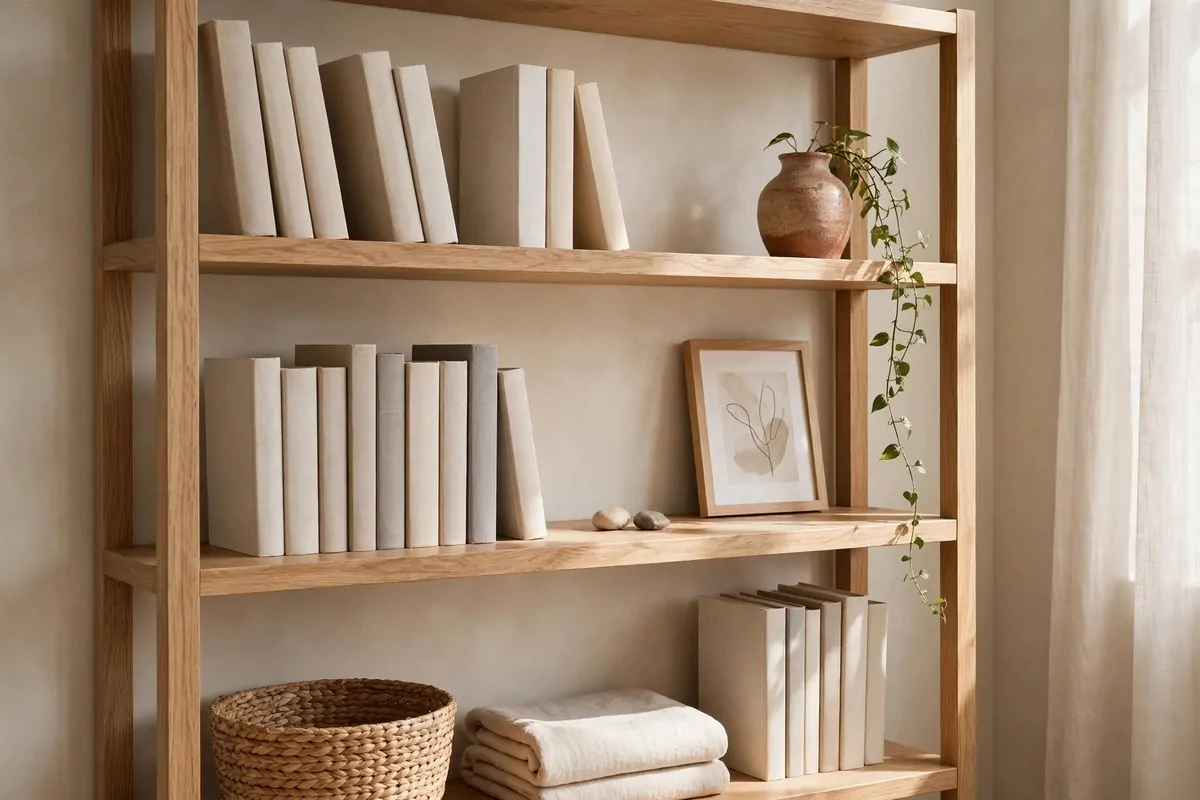
A bookshelf tells people what kind of mind lives in the room. Calm books say calm mind.
Therapists keep shelves of gentle titles. Poetry, nature essays, slow living books, art books. Nothing with screaming covers or scary titles.
Style the shelf like this. Sixty percent books, forty percent breathing room. A little vase here, a small plant there, one framed print leaning against the back.
A crowded shelf feels like homework. Space between objects feels like rest.
Light wood shelves keep things airy. Dark heavy shelves can loom over a small room. If yours is dark, paint it cream and watch the room change.
Organize by color or by size, whichever makes you happy. There is no rule. A calm shelf is one that looks peaceful to your eyes.
I keep a little basket on my lowest shelf for the books I am reading right now. It stops the stack of books from taking over my side table.
Dust the shelf once a month. Dusty books look sad. A quick wipe keeps everything feeling cared for.
Add one personal object that is not a book. A smooth stone from a trip. A tiny ceramic bird. Something with a story only you know.
That one object makes the shelf feel like yours. And rooms that feel lived in are always calmer than rooms that feel staged.
12. A Herbal Tea Station
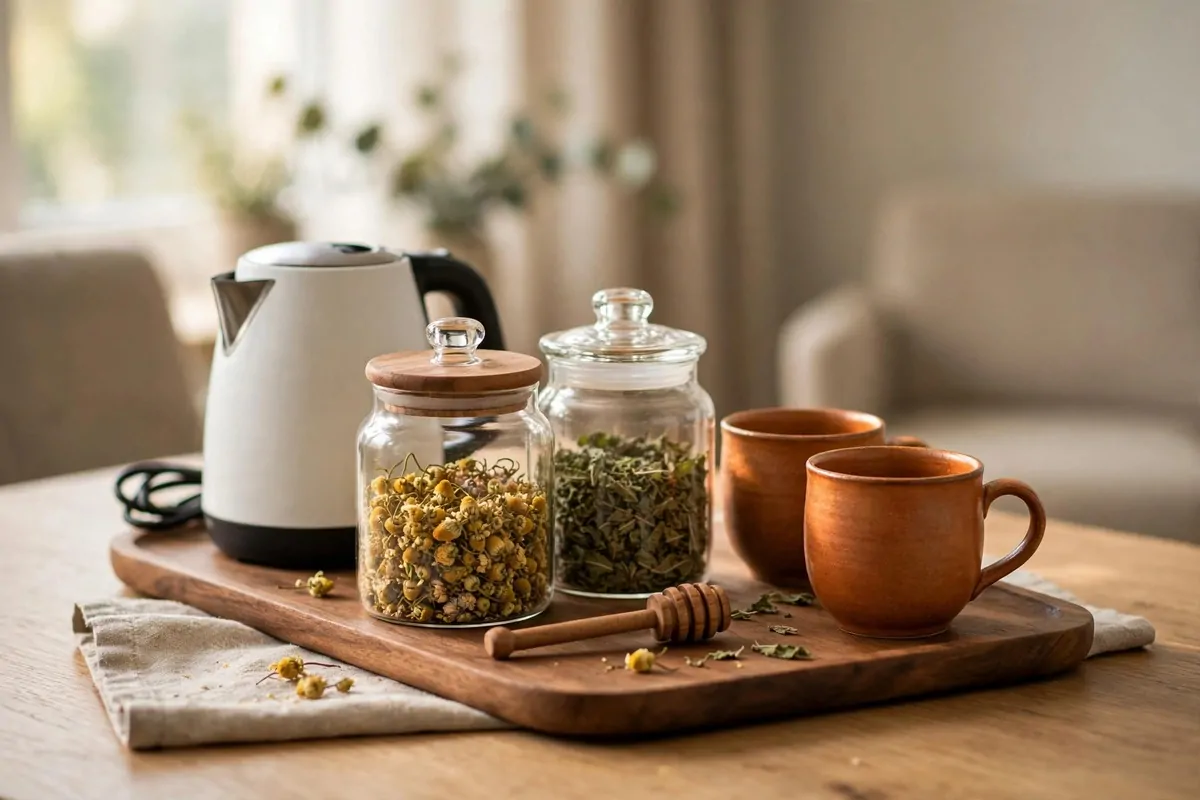
Holding a warm cup slows you down. It is simple physics. Your hands are busy, your body is warm, your mind follows.
A tea station needs almost nothing. A small tray, an electric kettle, a few jars of tea, two mugs. That is the whole setup.
Glass jars look beautiful and keep tea fresh. Chamomile, peppermint, lemon balm. Soft flavors, nothing bitter or strong.
Put the station on a side table or a low dresser. Near the chairs, not across the room. Warm tea should be an arm’s reach away.
Ceramic mugs in warm colors feel better than paper cups. Heavy mugs feel like a hug for your hands.
I started making tea when I read at night. Now the kettle clicking on is my brain’s signal to slow down. Rituals are powerful like that.
Keep honey nearby if you like it sweet. A little wooden dipper makes even cheap honey feel special.
Clean the kettle monthly with a splash of vinegar and water. A clean kettle boils faster and the tea tastes better.
This station costs less than a dinner out. A tray, a kettle, some jars. But it makes the whole corner feel like it is taking care of you.
13. Weighted Throw Blankets
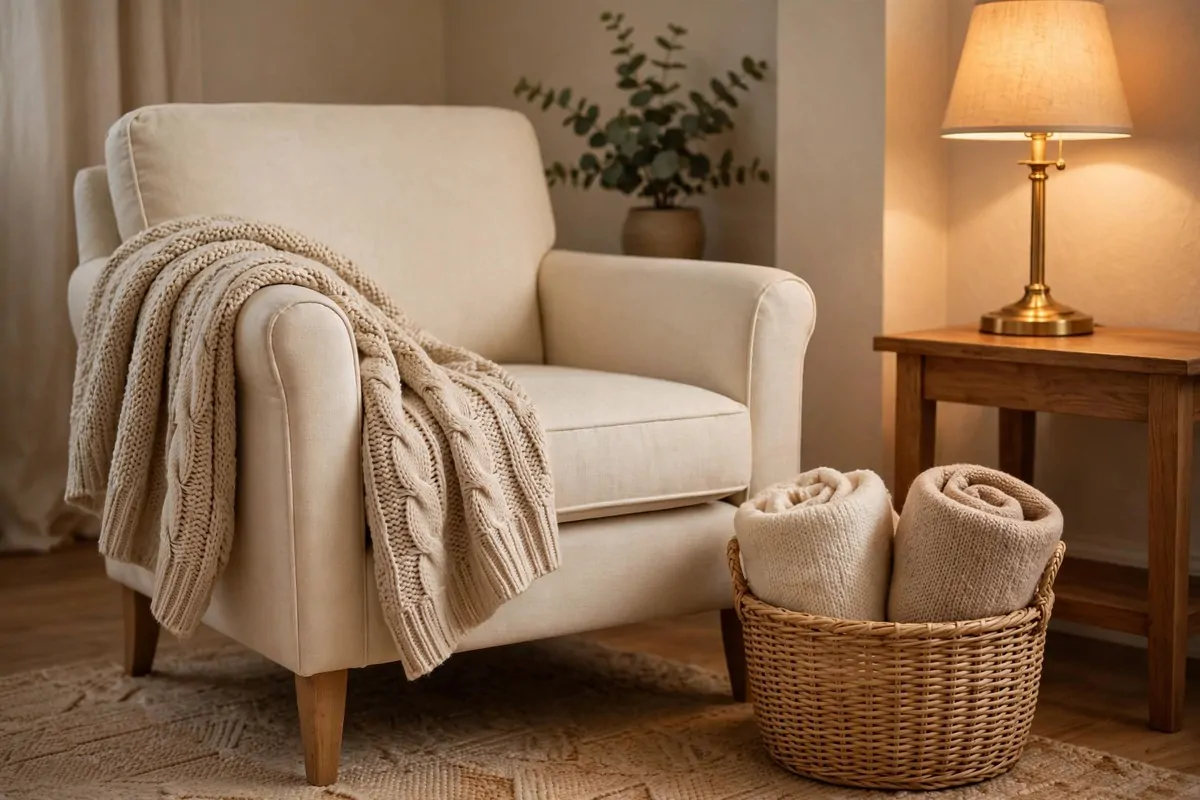
There is a reason kids love heavy blankets. Weight tells the body it is safe. It is like being held.
Therapy offices keep soft throws within arm’s reach. Not locked in a closet. Right there, on the chair arm or in a basket.
A weighted throw is heavier than a normal blanket. That gentle pressure can ease restless hands and busy minds. I reach for mine when the day has been loud.
You do not need the heaviest one. Even a chunky knit throw gives some of that grounded feeling. Start with what feels good.
Drape one over each chair arm. Folded, neat, inviting. A thrown blanket looks messy. A folded one looks like an offer.
Basket by the chair is another good spot. Rolled throws in a woven basket look cozy and keep them off the floor.
Wash them the way the label says. Some weighted blankets are spot clean only. I learned this the hard way with a lumpy dryer disaster.
Colors should stay soft. Cream, oatmeal, dusty rose, sage. One warm color repeated twice ties the room together.
Keep a throw in your reading spot at home too. This trick works anywhere, not just in offices.
- Drape, do not toss. Folded looks like care.
- Keep within arm’s reach of every seat.
- Wash per the label, or regret it like I did.
14. A Lavender Diffuser
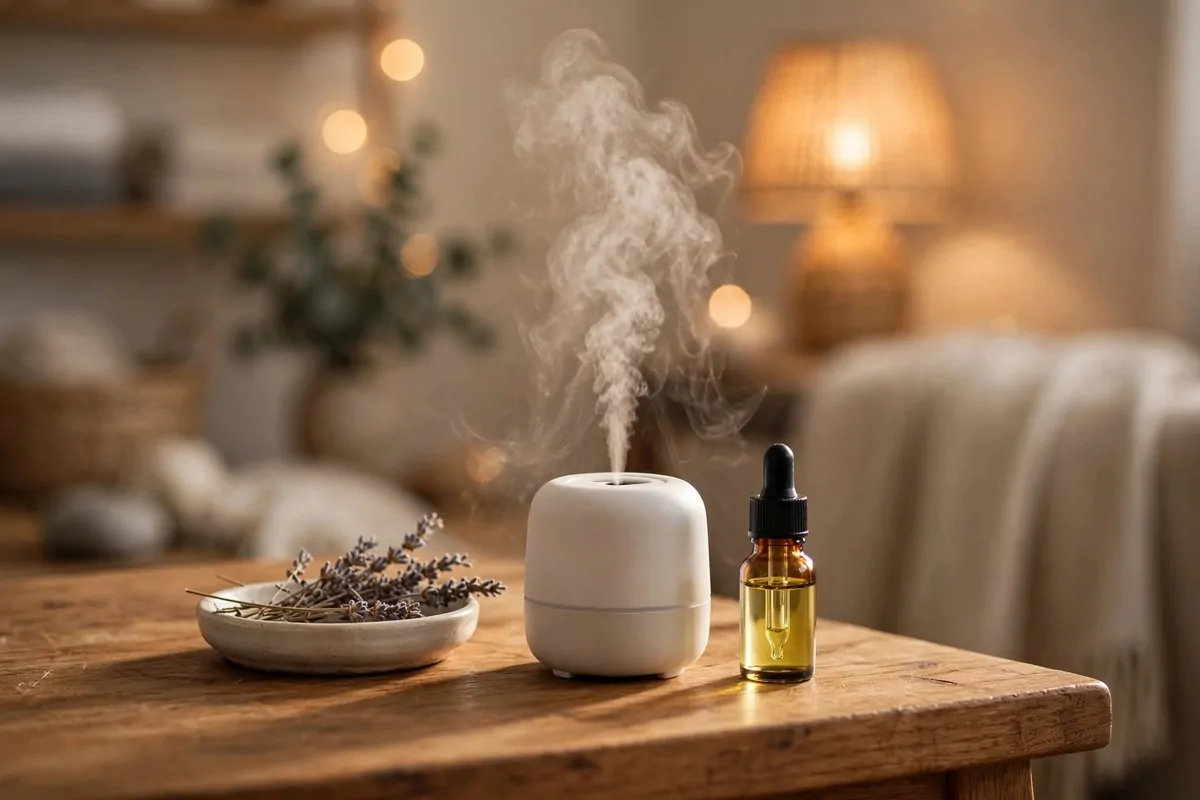
Smell hits your brain faster than sight. One breath of lavender and your shoulders drop before you even notice.
A diffuser is the cleanest way to scent a room. No open flame, no smoke. Just a cool mist and a soft glow.
Lavender is the classic calm scent. It has been used for sleep and rest for hundreds of years. Your nose already trusts it.
Keep it subtle. Two or three drops in the water is plenty. A room that smells like a perfume counter is not calm, it is a headache.
Place the diffuser on a side table, away from papers. The mist is fine but damp papers are sad papers.
Ultrasonic diffusers are cheap and quiet. Mine cost less than a pizza and has run every evening for a year.
Other calm scents to try:
| Scent | Mood it brings |
|---|---|
| Lavender | Deep rest, sleepy calm |
| Cedarwood | Warm, grounded, woody |
| Bergamot | Soft, sunny, gentle lift |
| Eucalyptus | Clear, fresh, open air |
Run it for an hour before you sit down. The room will smell ready, like it was waiting for you.
15. Fabric Acoustic Panels
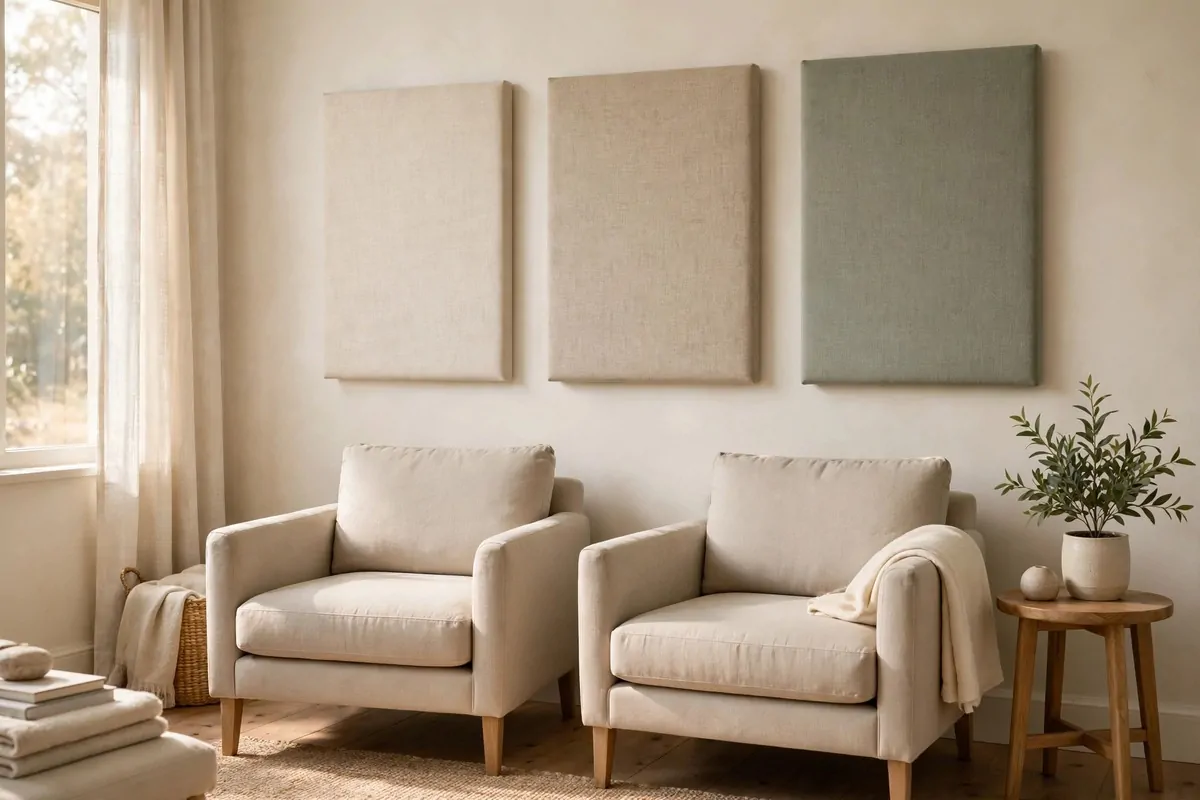
Echo is stress you can hear. Every hard wall bounces sound back at you. Your brain stays busy processing it all.
Fabric panels drink that echo up. The room goes quiet in a way that feels like a blanket over your ears.
Modern panels look like art. Soft rectangles in linen, wool, or felt. Beige, cream, sage, dusty blue. They hang like quiet paintings.
Place them on the wall behind the chairs. That is where voices bounce the most. Two or three panels make a real difference.
They are light and easy to hang. Most come with simple strips. No drilling, no heavy tools. Renters can use these.
DIY works too. Wrap thick fabric around a wooden frame. I made two from old moving blankets and linen, and nobody believes they cost me almost nothing.
Panels also add texture to plain walls. A flat white wall looks better with three soft rectangles breaking it up.
Thick curtains and rugs help with sound too. Combine all three and your room will feel like a recording studio for calm.
If your room echoes when you clap once, you need softening. Clap in the middle of the room. Hear that bounce? That is what your brain hears all day.
This is one of those invisible upgrades. Guests will not name it. They will just say your room feels peaceful.
16. A Round Coffee Table
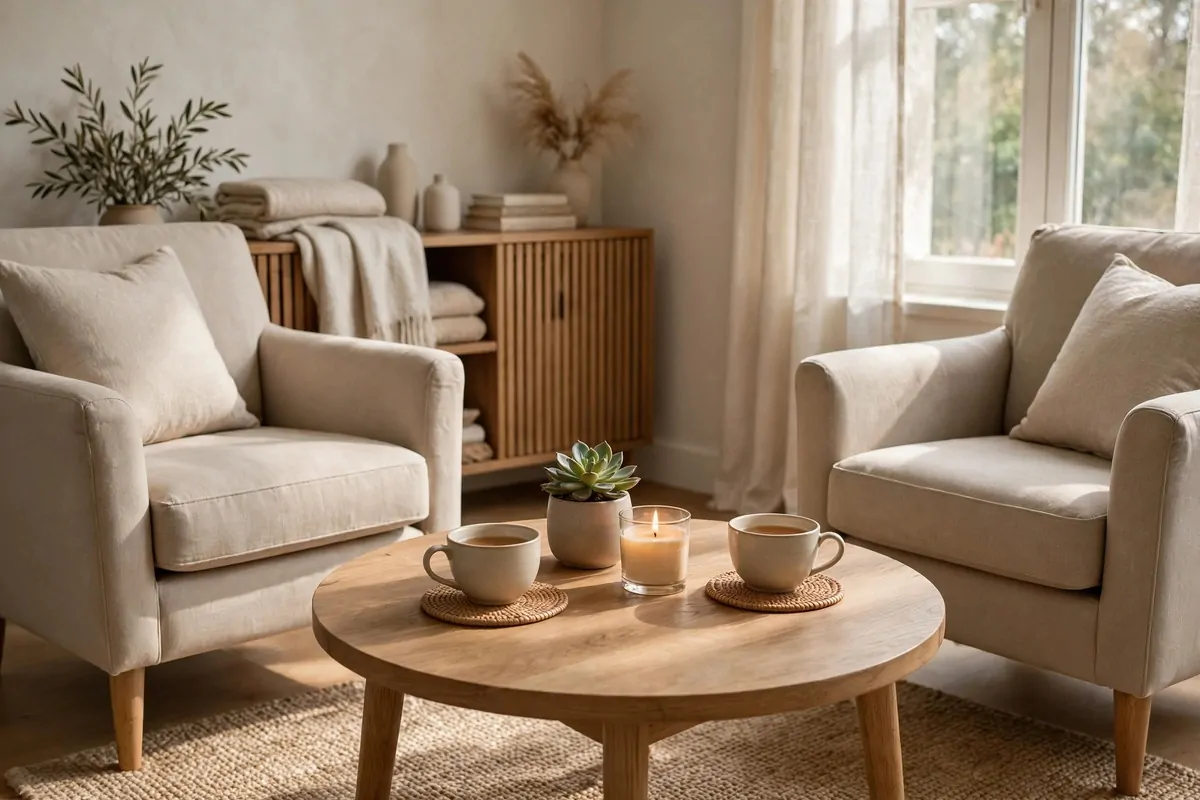
Sharp corners feel a little bit tense. Round shapes feel safe. Our brains relax around curves.
That is why therapy offices love round coffee tables. No hard edges pointing at anyone. Just a soft circle holding the space together.
A round table between two chairs makes the seating area feel complete. It is the anchor. Everything else orbits around it.
Light wood or a soft stone top keeps it calm. Glass tops can feel cold and show every fingerprint. Save glass for another room.
Style it simply. A small plant, a candle, two coasters. Leave empty space. A crowded table feels like a crowded mind.
Round tables are kinder to small rooms too. You can walk around them without doing the sideways shuffle. Every inch counts in a small space.
I swapped my square table for a round one last spring. The room instantly felt friendlier. My shins thanked me as well.
Size matters. The table should sit about an arm’s length from each chair. Close enough to reach your tea, far enough to stretch your legs.
A lower table feels calmer than a tall one. Knee height or a little below. High tables feel like a desk, and desks feel like work.
Keep one book on it that you love. Not a coffee table book for show. A real one, with bent pages. It makes the room feel honest.
17. A Two-Chair Talk Setup
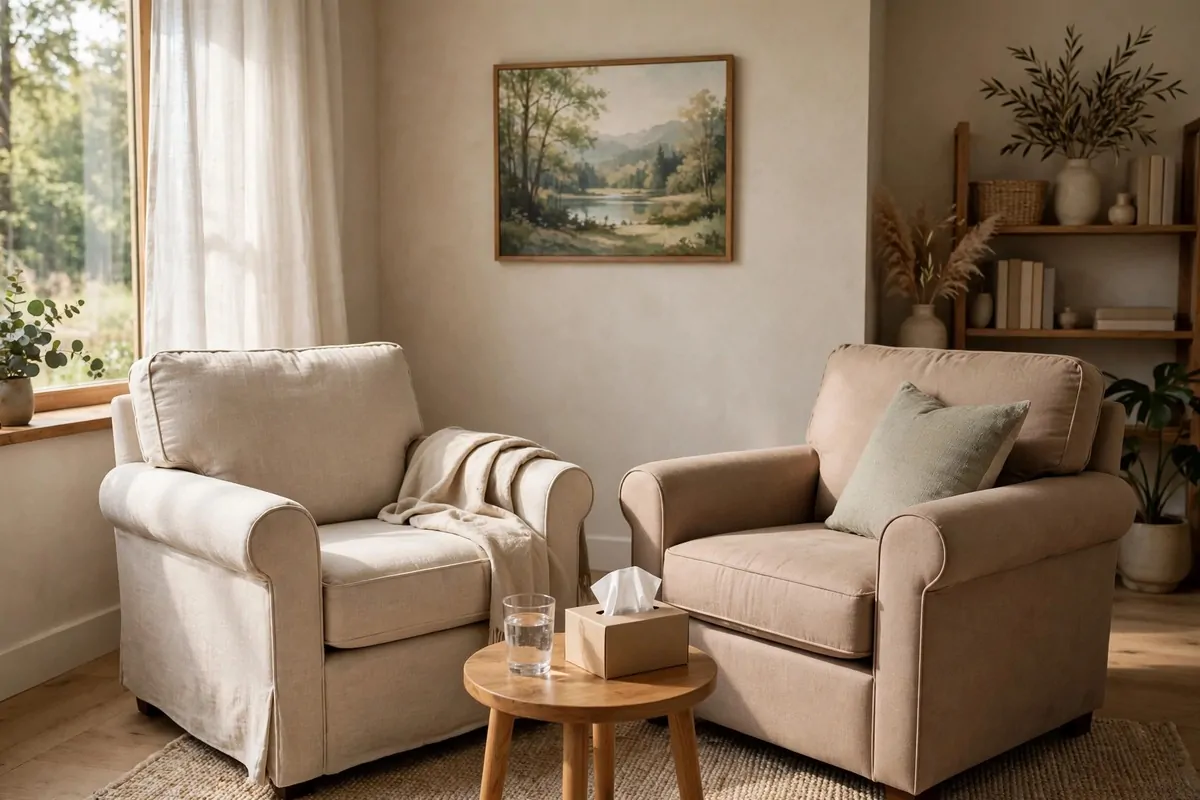
Two chairs facing straight at each other feels like an interview. Two chairs at a soft angle feels like a real conversation.
Therapists set chairs at about ninety to one hundred twenty degrees. Close enough to connect, angled enough to breathe. Nobody feels stared at.
Try it in your living room. Pull your two favorite chairs into a loose V shape. Sit down and talk to someone. Notice how much easier it feels.
Leave a little space between them. Not touching, not far apart. About two feet of air. Close enough for quiet voices.
The small table goes in the V, between the chairs. Water, tea, tissues. Everything a good talk needs sits right there.
This setup works for hard talks and happy ones. It is how I arrange chairs when a friend needs to vent. The room does half the work for me.
Keep the path to the chairs open. Nobody should have to climb over a rug edge or squeeze past a plant to sit down. Easy entry means easy settling.
Face the chairs toward something pleasant. A window, a plant, a calm painting. Not toward a blank wall or a messy desk.
I think every home needs one talk corner like this. Not a big living room built for TV. A small spot built for two people and honest words.
18. A Garden-View Window Seat
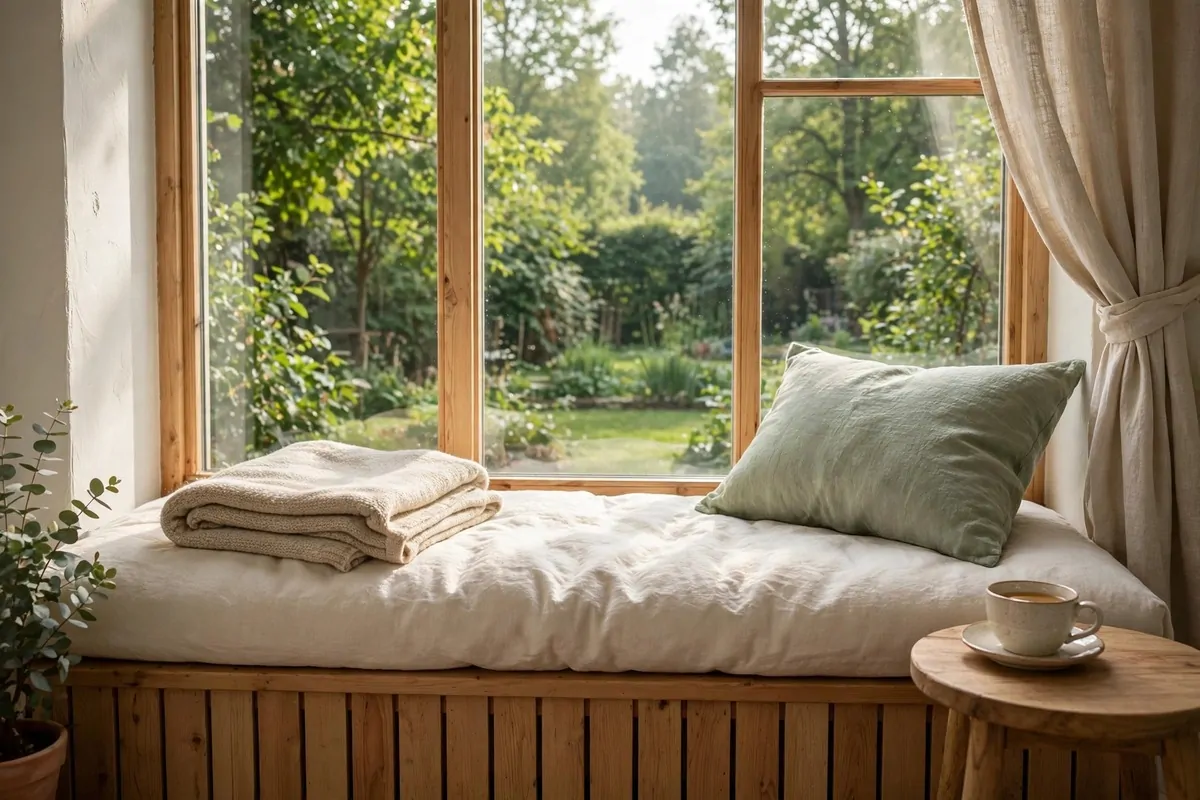
If your window looks at green, you have the best art in the world. Trees do the decorating for you.
A window seat turns that view into a destination. A cushion, a throw, a little pillow. Now the window is a place, not just a hole in the wall.
Therapists fight for rooms with windows. Natural light and a living view do more for calm than any decor trick. If you have one, honor it.
Build the seat simple. A sturdy bench or a deep windowsill with a thick cushion. Comfort first, looks second.
Add a soft throw and one good pillow. Not five pillows. One. This is a seat for watching the world, not a pillow store.
Keep the glass clean. A smudged window ruins the whole effect. I wipe mine on the first Saturday of every month. Takes five minutes.
A small side table next to the seat holds tea or a book. Everything you need for a slow half hour sits within reach.
Morning light here is magic. I drink my first tea of the day in my window spot. The day feels different when it starts with green leaves and quiet.
No garden view? A bird feeder on the outside sill brings the green to you. Birds, leaves moving, sky changing. Nature finds a way in.
This is my favorite idea on the whole list. A window seat costs almost nothing. But it gives you a daily appointment with calm, and that is worth everything.