25 Essential Life Skills for Kids Every Parent Should Teach

Picture this. Your kid is 19, away at college, and they call you in a mild panic because they don’t know how to boil an egg. Or they got their first paycheck and spent it all in three days. Or they had a fight with a roommate and had no idea how to talk it out without it turning into a big thing.
It’s not that they’re not smart. It’s just that nobody sat down and actually taught them these things.
That’s the quiet worry a lot of parents carry. You’re busy. Life is busy. And somewhere between homework and school pickups and after-school clubs, the basic stuff, the real life stuff, gets pushed to “we’ll get to that later.”
But here’s the thing. Later comes fast.
Kids who grow up with real life skills aren’t just more capable. They’re more calm. They feel ready. That quiet confidence of knowing how to handle small problems before they turn into big ones, that’s something no grade or test can give them.
So let’s go through 25 skills worth teaching, in a way that’s honest, simple, and doable for real families.
Why Life Skills Matter More Than Grades
Most schools are good at teaching kids what to think. Very few are good at teaching them how to live.
That gap is real, and research backs it up. A 2022 survey from the National Endowment for Financial Education found that over 60% of young adults felt unprepared for basic money decisions after leaving home. And that’s just one category.
The goal here isn’t to build a super-kid or check off a list. It’s to give children small, real tools that make adult life feel less scary when it arrives.
- Life skills build self-trust, not just ability
- Kids who learn early make fewer panic calls at 19
- Most of these skills take 10 to 20 minutes to teach
- You don’t need to be an expert, just willing to show them
1. How to Cook a Simple Meal
Start simple. Real simple.
Scrambled eggs. Pasta with sauce from a jar. A grilled cheese. Toast. These are not gourmet meals. But they are meals, and knowing how to make even three or four of them is the difference between a young adult who eats well and one who survives on chips and takeout.
Most kids love being in the kitchen when they’re young. Around ages 4 to 6, they want to pour, stir, and help. That’s the window. Use it.
By 10 or 11, a child can learn to use the stove with supervision. By 13, most kids can make a full simple meal from start to finish. By 16, they should know how to plan a weekly dinner or two.
The bigger gift here isn’t cooking. It’s the habit of feeding yourself with care. That matters for life.
Pro Tip: Let your child pick one meal per week that they’re in charge of. Even if it’s just sandwiches on Tuesday, that ownership teaches more than a cooking class will.
- Start with recipes that have five items or less
- Teach them to read a recipe all the way through before they start
- Show them how to clean up as they go, not just at the end
- Let them fail a little, burnt toast is not the end of the world
2. Managing Money Without Losing It All
| Age Range | Money Skill to Introduce |
|---|---|
| 4 to 6 | Coins have value, saving in a jar |
| 7 to 10 | Needs vs. wants, small budgets |
| 11 to 13 | Bank accounts, saving goals |
| 14 to 16 | Earning, spending logs, giving |
| 17 and up | Bills, taxes, basic investing |
Money is one of the most avoided topics in family life. Either there’s not much of it and it feels tense to talk about, or there’s enough and it feels like kids don’t need to know.
Both of those are worth rethinking.
Kids who grow up understanding money don’t just manage it better. They worry less about it. They don’t tie their worth to it. They see it as a tool, not a source of stress or status.
Give a young child a small amount of money for small tasks. Let them make choices. Let them feel the sting of spending it all and then wanting something they can’t buy. That sting, felt at 8, is far less painful than the same lesson at 28.
IMP: Avoid giving kids money with no context. “Here’s your allowance” without any conversation about what it’s for teaches spending, not thinking. A short weekly chat about what they plan to do with it makes the difference.
3. Talking to Adults Without Freezing Up
A lot of kids are great at talking to friends and completely silent around adults they don’t know well. That’s normal. It’s also worth gently working on.
Not because children need to perform confidence. But because being able to order their own food at a restaurant, ask a teacher a question, or shake someone’s hand and say their name, these are small moments that add up to a feeling of being capable in the world.
Role-play helps. Practice answering the phone. Practice introducing themselves. Practice saying “excuse me” and asking for help in a store.
It sounds silly until you see a 17-year-old freeze during a job interview for something they could clearly do because they’ve never practiced speaking up.
- Encourage eye contact from a young age
- Let them order their own food at restaurants
- Have them make simple phone calls (doctor, library, etc.)
- Praise the try, not just the outcome
4. Basic First Aid
Every child over 8 should know these five things:
- How to call for help and what to say
- How to clean and cover a small cut
- What to do if someone is choking
- How to stay calm when something feels scary
- Where the first aid kit is at home
That last one sounds obvious. It isn’t. A quick check: does your child know where the bandages are? Do they know when to use ice? Do they know what an emergency is versus what’s just uncomfortable?
Teaching first aid is also a way to teach calm under pressure. That’s a skill with no ceiling.
Important Note: The American Red Cross offers first aid and CPR courses for kids as young as 9. Many libraries and community centers offer free or low-cost versions. It’s worth a Saturday morning.
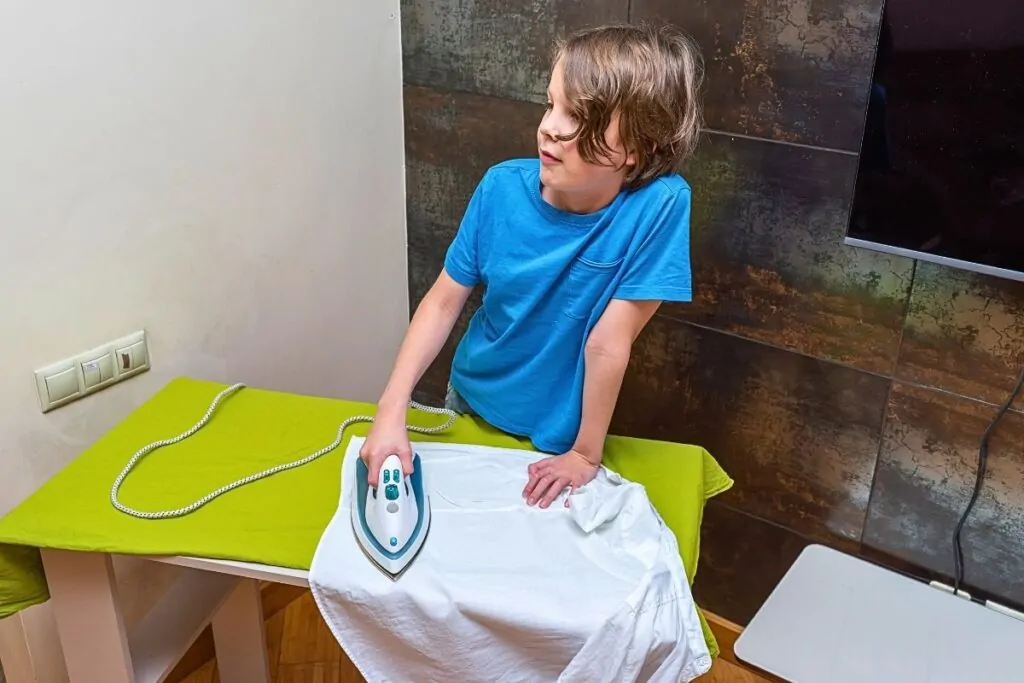
5. Doing Laundry Start to Finish
Here’s a skill that causes actual conflict in college dorms. Pink socks. Shrunken sweaters. Clothes that smell because they sat wet in the machine for two days.
None of it is hard to avoid. But someone has to show them.
Teach them to sort colors. Show them where the settings are and what they mean. Walk them through how much soap is “enough.” Show them how to check the tag on a shirt before throwing it in.
By age 12, most kids can do a full load with minimal help. By 14, they can be fully responsible for their own clothes.
The deeper lesson: taking care of your things is a form of self-respect. That idea, taught through laundry, sticks.
The Emotional Side of Growing Up
Before going further into the practical stuff, it’s worth pausing here. Because life skills aren’t just about doing things. They’re about handling feelings while doing things.
A child who can cook but falls apart when the meal goes wrong hasn’t fully learned the skill. A child who manages money but feels sick with shame when they make a mistake hasn’t really learned it either.
Emotional skills run underneath everything else on this list. They’re not soft. They’re foundational.
6. Handling Frustration Without Blowing Up
Kids melt down. That’s normal. The goal isn’t to stop all meltdowns. The goal is to slowly, over years, help them build the ability to feel a hard feeling without being completely taken over by it.
Name feelings out loud. “You seem really frustrated right now.” That simple act of naming, research from Marc Brackett at Yale’s Center for Emotional Intelligence shows, reduces the intensity of the emotion. It helps kids feel seen, and it teaches them a vocabulary.
Then give them tools. Deep breaths. Walking away for a minute. Saying “can we talk about this in five minutes?”
These tools feel simple. But most adults don’t use them well because nobody taught them at the right age.
- Validate first, problem-solve second
- Avoid “calm down,” it almost never helps
- Model what handling frustration looks like yourself
- Celebrate when they catch themselves before blowing up
7. Setting Simple Goals and Following Through
| Type of Goal | What to Teach |
|---|---|
| Short-term | This week, this month |
| Medium-term | This school year, next birthday |
| Long-term | Before I leave home |
Goal-setting doesn’t need to be a big formal thing. It can be as simple as “what do you want to learn to do this summer?”
The skill here isn’t the goal. It’s the follow-through. That’s what most kids, and honestly most adults, struggle with.
Help them break goals into small steps. Check in. Celebrate small wins. Let them feel what it’s like to say they’d do something and then actually do it.
That feeling of finishing what you started is one of the most useful things a person can feel. It teaches them they can trust themselves.
8. Saying Sorry and Meaning It
A genuine apology has three parts: what happened, why it was wrong, and what they’ll do differently. Most apologies kids give are just the first part. “Sorry.” Done.
That’s a start. But it’s worth going further.
When a child learns to say “I was wrong to take your thing without asking, that wasn’t fair, next time I’ll ask first,” they’re not just apologizing. They’re practicing accountability, empathy, and self-awareness in one move.
Don’t force rushed apologies. A meaningful sorry said ten minutes later is worth more than a hollow one said right away.
Pro Tip: Apologies work better when adults model them too. Saying sorry to your child when you lose your temper or get it wrong teaches more than any lesson will.
9. Basic Home Care and Cleaning
A quick checklist every child should master before leaving home:
- Sweep and mop a floor
- Clean a bathroom sink and toilet
- Do the dishes or load a dishwasher
- Take out the trash and replace the bag
- Wipe down counters after cooking
- Vacuum a room
None of this is complicated. All of it gets ignored until it’s suddenly someone’s problem.
Assign age-appropriate chores early. Not as punishment. As participation. “This is our home and we all take care of it” is a message worth sending from the start.
Kids who grow up doing chores tend to be more organized, more responsible, and honestly more pleasant to live with. The research on this is remarkably consistent.
10. How to Be a Good Friend
Friendship skills are life skills. They’re just harder to put on a chore chart.
What does being a good friend actually look like? Listening without waiting for your turn to talk. Showing up when things are hard. Being honest even when it’s not what someone wants to hear. Not dropping people when something better comes along.
These aren’t things kids naturally know. They learn them by watching, by messing up, by seeing how friendships break and sometimes heal.
Talk about friendship the way you’d talk about anything else. Ask questions. “How do you think your friend felt?” “What would you want them to do if it were you?”
The goal isn’t perfect friendships. It’s the habit of thinking about other people.
- Teach them to notice when a friend seems off
- Help them practice listening without fixing
- Talk about what loyalty means in real terms
- Let them work through friendship problems, step in only when needed
Skills That Most Schools Skip
There’s a whole category of practical life skills that are shockingly absent from most school curriculums. Not because teachers don’t care. Just because there’s so much else to cover.
These are the ones worth making sure happen at home.
11. Reading a Map and Finding Their Way
GPS is great. Also, GPS fails. Phones die. Signals drop.
More than the tech backup though, knowing how to read a map, how to think spatially, how to figure out where north is based on the sun or a landmark, that’s a way of thinking that helps in ways beyond navigation.
Start with simple things. Walk somewhere new and let them lead. Look at a paper map together. Talk about how cities are laid out and why.
Kids who can find their way around without a screen tend to be more confident in unfamiliar situations. That quiet orientation, knowing roughly where you are, is worth building.
12. How to Ask for Help Without Shame
This one is quiet but big.
A lot of kids, especially high-achieving ones, grow up with the idea that needing help means something is wrong with them. That’s worth interrupting early.
Asking for help is a skill. Knowing when you’re stuck and naming it, finding the right person to ask, being clear about what you need, none of that comes automatically.
Normalize it at home. “Can you help me with this?” should be a sentence kids hear adults say too. Not just to each other, but to them.
- Praise asking for help as much as figuring it out alone
- Show them how to ask a teacher or adult a clear question
- Let them see you ask for help when you need it
- Talk about the difference between giving up and knowing your limits
13. Basic Sewing and Fixing Things
A button falls off. A seam comes apart. A zipper gets stuck.
None of these need to be disasters. A needle, thread, and ten minutes is enough. But only if someone showed them how.
This isn’t about becoming a tailor. It’s about the mindset of fixing things rather than throwing them away. That mindset, applied broadly, is incredibly useful.
Same goes for other small repairs. How to tighten a screw. How to unclog a drain. How to change a light bulb. These feel like tiny things, but they add up to someone who feels capable at home.
Important Note: YouTube is actually excellent for this. Teaching a teen to search “how to fix a running toilet” and then actually do it is a real skill in itself.
14. Grocery Shopping on a Budget
Here’s a skill most young adults wish they’d learned earlier.
Take your child grocery shopping with a list and a budget. Give them a small amount and let them try to get everything on it. Watch what happens.
They’ll quickly learn that name brands cost more. That buying in bulk sometimes saves money and sometimes wastes it. That fresh food needs to be used before it goes bad.
These are lessons that stick because they’re real. The math is real. The choices are real. The result, dinner, is real.
| Item | Skills It Teaches |
|---|---|
| Making a list | Planning and prep |
| Comparing prices | Basic math and value thinking |
| Sticking to a budget | Discipline and priorities |
| Checking dates | Food safety and waste |
15. Time Management That Actually Works
Kids who can manage their time aren’t born that way. They were taught, mostly through small systems and a lot of practice.
A planner. A simple schedule. The habit of asking “what’s due this week?” These tools sound basic because they are. But most adults who struggle with time management never built these habits young.
Help them estimate how long things take. That’s the hardest part. Most kids think homework takes 20 minutes. It takes 45. Once they see that gap, they start planning more honestly.
- Teach them to work backward from a deadline
- Help them build a weekly routine, not a perfect one, just a useful one
- Talk about the difference between busy and productive
- Let natural deadlines teach natural consequences sometimes
The Skills Nobody Talks About
Some skills are so basic they feel too obvious to teach. Those are often the ones most worth talking about.
16. How to Disagree Without It Getting Ugly
This one takes a long time to learn. Most adults are still working on it.
But the foundation can be laid early. When a child learns that they can say “I don’t agree” without it meaning war, something important shifts. They stop either going silent or going loud. They find a middle way.
Teach them phrases. “Can you help me understand why you think that?” “Here’s what I see from where I stand.” “We might just see this differently.”
These aren’t magic words. But they’re a starting point for the kind of disagreement that stays a conversation instead of becoming a fight.
17. How to Handle Failure
Failure is coming. That’s not pessimistic. That’s just accurate.
The question isn’t whether your child will fail at something. It’s whether they’ll know what to do when it happens.
Kids who’ve only ever succeeded are often the ones who unravel the fastest when something doesn’t work out. The ones who’ve been allowed to fail small, and been helped to get back up, they tend to handle it better.
Don’t rescue every hard moment. Let the test grade sting a little. Let the lost game be a real loss. Then be there to help them think through it.
Warning Box: Protecting kids from all failure doesn’t build confidence. It builds fragility. Small failures early are far better than big ones with no practice at recovering.
18. Writing a Simple Professional Message
Email. Text. A note to a teacher. A message to a potential employer.
Professional writing is different from how kids talk to friends. And nobody really teaches the difference.
Show them what a good email looks like. Subject line. Brief. Clear. Polite close. That’s it.
Then let them write their own and review it together. Not to correct grammar, but to ask: “Does this say what you mean? Is it respectful? Is it clear?”
Kids who can write a clean, clear message in a professional tone have a huge advantage by the time they’re job-hunting.
19. Respecting Other People’s Space and Stuff
This sounds basic. It is basic. And yet.
Respecting other people’s things, asking before borrowing, returning what you borrow, not going through someone’s stuff without asking, not showing up at someone’s house unannounced, these are all social skills that require actual teaching.
The same goes for digital space. Private messages. Photos. Sharing things online that belong to someone else.
Talk about it early. Make it a normal conversation, not a lecture.
- Teach them to ask before they take or touch
- Talk about why privacy matters for everyone
- Model knocking before entering, even their room
- Discuss the digital version of these same rules
20. How to Stay Safe Online
This could be a whole article on its own. But the basics are:
- Not everything online is true
- Not everyone online is who they say they are
- Once something is posted, it’s very hard to undo
- Personal information stays personal
Have these conversations early and often. Not as warnings that make kids feel scared. As practical information they need to move through the world.
The goal is critical thinking online. That’s something they’ll use every single day for the rest of their lives.
The Bigger Picture
Somewhere around skill 15 or so, a pattern starts to show up. Almost every life skill on this list comes down to the same few things: awareness, honesty, patience, and care.
Care for yourself. Care for others. Care for the spaces you live in and the people you share them with.
That’s not religious. That’s not political. It’s just what it looks like to be a person who functions well in the world.
21. Reading for Pleasure and Information
Reading builds everything. Vocabulary. Focus. Empathy. World-knowledge. The ability to sit with a thought long enough to understand it.
Kids who read for fun tend to write better, think more clearly, and handle new information more comfortably. That’s not a coincidence.
But it’s not about forcing it. It’s about making it available. Books around the house. Ten minutes of reading before bed. Letting them pick books that aren’t educational if that’s what gets them reading.
The habit matters more than the title.
22. How to Rest and Actually Recover
Rest is a skill. That’s not a metaphor.
Knowing when you’re tired. Knowing how to wind down. Knowing the difference between rest and distraction. These are things many adults haven’t figured out.
Kids need to see rest modeled as something valuable, not as laziness. They need permission to be bored sometimes. Boredom is where creativity lives.
Put down the screens. Sit outside. Read. Draw. Do nothing for a little while. That’s not wasted time. That’s recovery. And recovery is how people stay capable over time.
23. How to Make a Decision When Things Are Unclear
Not every decision is obvious. Sometimes there are two good choices. Sometimes there are no good choices. Sometimes there’s just not enough information.
Teaching kids to make decisions in those murky situations is one of the most useful things a parent can do.
Walk them through it. What do they know? What don’t they know? What happens if they choose option A? Option B? How will they feel about this choice in a week?
You’re not teaching them to always get it right. You’re teaching them how to think through hard things without freezing.
24. How to Contribute to a Home
This is different from chores. Chores are tasks. Contributing is a mindset.
A child who contributes to a home notices when something needs doing and does it without being asked. They think about what everyone needs, not just what they need. They feel part of something they help maintain.
That mindset, learned at home, shows up later in workplaces, in relationships, in communities.
Start small. Notice when your child does something helpful unprompted. Name it. “You noticed the trash was full and took it out without being asked. That’s the kind of thing that matters.”
25. Knowing How to Ask Good Questions
Last one, and maybe the most important.
The ability to ask a good question is underrated. It’s how people learn. It’s how people connect. It’s how people solve problems, avoid mistakes, and help others feel understood.
Teach your child to be curious. Teach them that saying “I don’t know, can you explain that?” is something to be proud of, not ashamed of.
A child who asks good questions will always find their way. Because they know how to learn what they don’t yet know.
Key Takeaways
- Most life skills are not taught in school, they have to be taught at home, in real life, through real moments
- The best time to teach most of these is earlier than feels necessary
- Life skills build not just ability but confidence, the feeling of being ready for what comes
- Every skill on this list can be taught in small, normal, daily moments, no special program needed
- Kids learn more from watching than from being told
Conclusion
Parenthood that tries to protect kids from every hard thing. And there’s a version that slowly, carefully, hands them tools so they can handle hard things themselves.
The second one is harder in the moment. It means letting them fail the egg. Letting them spend their money and feel the sting. Letting them work through the fight with their friend.
But that version produces people who feel ready. People who call home not in panic, but to share how they handled something well.
That’s the goal. Not perfect kids. Ready ones.
Frequently Asked Questions
What age should I start teaching life skills?
Earlier than you think. Simple things like tidying up, helping with groceries, and naming feelings can start as young as 3 or 4. The skills grow with the child.
What if my child resists doing chores or learning these things?
That’s normal. Keep it low-pressure and make it a regular part of life rather than a big lesson. Kids resist less when skills are just part of how your family works.
Do I need to teach all 25 of these?
No. Pick the ones most relevant to where your child is right now. Come back to others later. There’s no perfect order.
What if I never learned some of these skills myself?
That’s more common than people admit. Learning alongside your child is completely valid and often more meaningful than already knowing everything. “Let’s figure this out together” is a powerful thing to say.
How do I make sure these lessons stick?
Repetition and real use. Skills taught once and never practiced fade. Build them into daily life and they become second nature over time.