Pomodoro Technique Explained: How 25 Minutes Can Change Your Entire Life

Some products shown here are affiliate links. Clicking them won’t cost you anything extra. For full details, see our Affiliate Disclosure.

There is a particular kind of tiredness that doesn’t come from doing too much, but from never quite doing anything. You sit down with good intentions, a task open in front of you, and time passes anyway. An hour slips. Then another. You’ve been “busy,” technically, but nothing has moved. The day ends with that quiet disappointment you don’t talk about much.
I used to think this was a problem of discipline. Or motivation. Or personality. I tried to solve it with bigger plans, stricter schedules, louder promises to myself. None of it stuck. What finally shifted things for me was not a grand system or a heroic mindset, but a very small boundary around time. Twenty five minutes, to be exact.
At first, it felt almost insulting. As if my work, or my life, deserved more seriousness than a kitchen timer. But over time, I began to notice something subtle happening in those short spans. Something that had less to do with productivity and more to do with how I related to my own attention.
👉 Best Pomodoro products, find and grab the best one it on Amazon!
The quiet exhaustion of endless time
When a task has no edges, it becomes heavy. We tell ourselves we have the whole afternoon, the entire evening, the rest of the week. Time stretches out, and with it, the weight of expectation. The work starts to carry everything we think it says about us. Our intelligence. Our competence. Our future.
I’ve noticed that this is when avoidance creeps in. Not because we’re lazy, but because the task has grown too large to touch. We check messages. We reread the same paragraph. We reorganize files that don’t need reorganizing. It looks like procrastination from the outside, but inside it feels more like self protection.
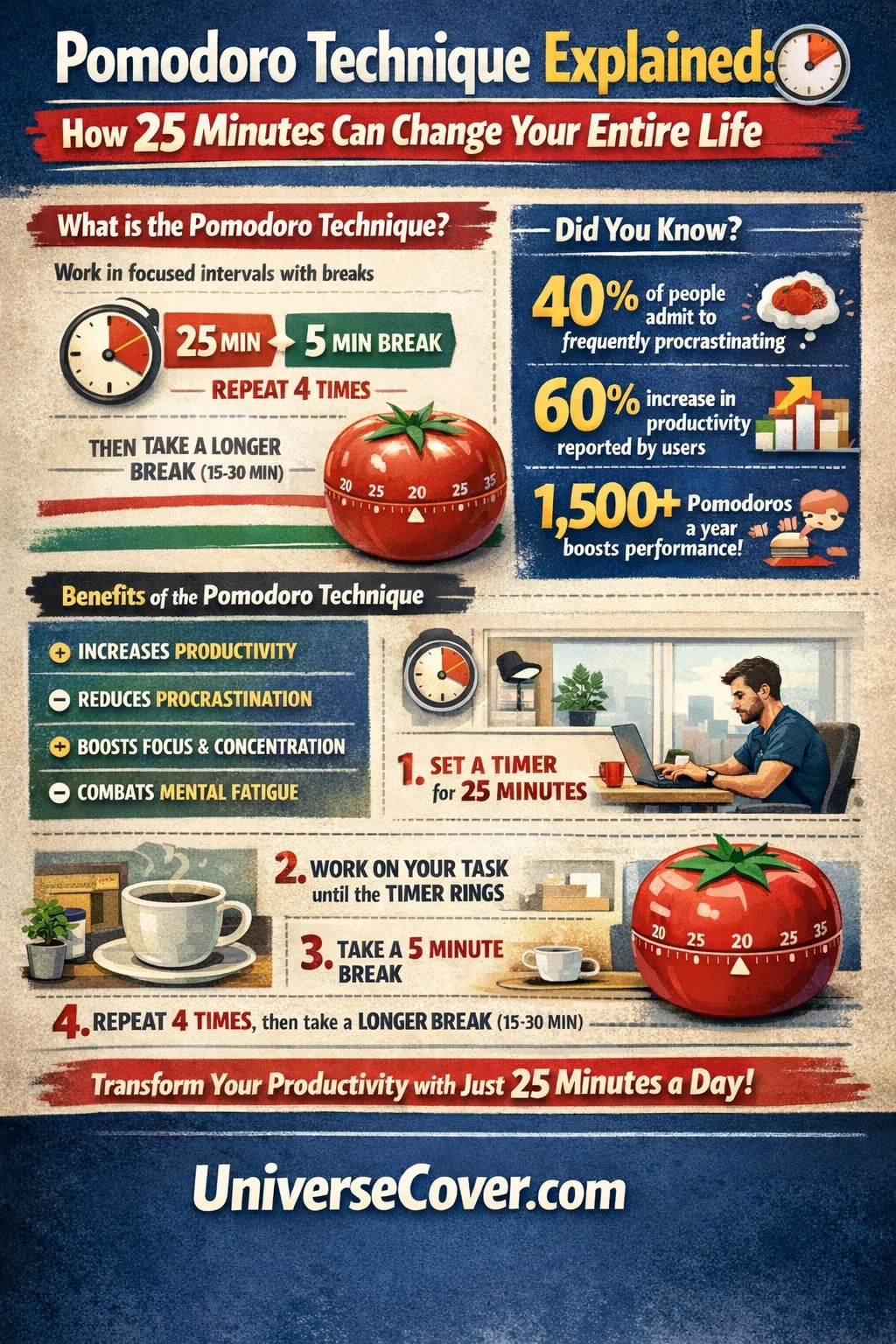
The Pomodoro Technique, in its plainest form, interrupts this pattern. You work for twenty-five minutes. You stop. You rest briefly. Then you return, or you don’t. That’s it. No drama. No philosophy attached.
What surprised me was how much relief there is in knowing something will end soon. A bounded stretch of time asks less of you. It doesn’t demand brilliance or endurance. It just asks for presence. You can tolerate almost anything for twenty five minutes, including your own resistance.
There’s a reason this feels different psychologically. Research on attention and cognitive load suggests that our minds handle focused effort better in shorter, clearly defined intervals. But even without the science, you can feel it. The work becomes smaller. And when the work becomes smaller, you can finally begin.
What twenty-five minutes really does to your mind
At some point, I realized the Pomodoro Technique wasn’t changing my output as much as it was changing my internal conversation. When the timer starts, there’s an unspoken agreement. You’re not committing to finishing. You’re not promising results. You’re simply showing up for a short while.
This removes a surprising amount of pressure. Perfection has less room to operate. So does fear. The voice that says, “If you start, you’d better do it well,” quiets down because the stakes are lower. You’re not writing the whole chapter. You’re just staying with the page for a bit.
I’ve found that this is often when momentum appears, not as a burst of motivation, but as a gentle settling. About ten minutes in, something shifts. The noise fades. The task becomes less abstract and more physical. Words appear. Problems soften. You’re inside the work instead of circling it.
And when the timer ends, stopping feels oddly respectful. You’re honoring your limits instead of pushing past them. That pause, even if it’s only five minutes, teaches your nervous system that effort does not equal depletion. Over time, this matters more than we admit.
There’s also a trust that builds here. You begin to believe that you’ll come back. That you don’t need to cling to the work out of fear you’ll abandon it. That belief alone can change how safe it feels to start.
Why it often works when everything else hasn’t
Many systems fail because they ask for a version of you that only exists on good days. The perfectly motivated, well rested, clear headed version. The Pomodoro Technique, at least as I’ve lived it, works precisely because it doesn’t assume that version is available.
On days when you feel scattered, twenty five minutes is still manageable. On days when you feel confident, it doesn’t get in the way. It scales quietly with your energy instead of fighting it.
There’s also something important about the repetition. One session doesn’t change much. But a series of them, spread across days and weeks, begins to reshape how you see effort. Work stops being an all or nothing event and becomes a rhythm. Show up. Rest. Return.
I’ve noticed this rhythm spilling into other areas of life. Conversations feel more attentive when I’m not mentally rushing ahead. Rest feels more earned when it’s intentional. Even difficult emotions become easier to sit with when I remind myself they don’t require endless endurance.
The technique gets credit for improving focus, but I think its deeper value is in restoring a sense of agency. You’re not at the mercy of your moods or your schedule. You’re choosing a small window and inhabiting it fully.
When the technique reveals more than productivity
There were days when I set the timer and couldn’t bring myself to start. I used to see this as failure. Now I see it as information. If twenty five minutes feels impossible, something else is going on. Fatigue. Fear. Misalignment. Ignoring that signal doesn’t make it disappear.
In this way, the Pomodoro Technique becomes a mirror. It shows you where your resistance lives, without judgment. It also shows you how often you underestimate what you can do when the demand is reasonable.
I’ve had sessions where almost nothing got done, and others where the work carried me beyond the timer. Both were useful. The point was never to extract maximum output, but to stay in honest contact with my attention.
There’s a humility baked into this approach. You’re not trying to dominate time. You’re cooperating with it. You’re acknowledging that your mind works in pulses, not marathons.
That realization alone can soften the way you treat yourself. And that softness, paradoxically, is often what allows consistent effort to return.
A few things that tend to surface over time
• Large tasks often hide a fear of beginning, not a lack of ability
• Focus improves when the end is visible
• Rest feels different when it’s planned, not stolen
• Consistency is quieter than motivation
• Attention, once respected, tends to come back on its own
Sitting with the larger meaning
I don’t think twenty five minutes is magic. It’s arbitrary, really. What matters is the boundary. The permission to work without overreaching. The acceptance that progress doesn’t need to be dramatic to be real.
There’s a line often attributed to Annie Dillard, about how we spend our days being how we spend our lives. I’ve found that these small, contained stretches of attention add up in ways that aren’t immediately obvious. Not because they make you more impressive, but because they make you more present.
If there’s a change here, it’s not that your entire life transforms in a sudden burst. It’s that you begin to trust your capacity to meet moments as they are, one bounded interval at a time. And that trust, once established, tends to quietly spread.