Can Money Buy Happiness? Here’s What Research Says

A bigger home. A new car. A trip you saw on someone’s feed. That calm fades fast, and you are back to wanting more.
This cycle is not a flaw in your mind. It is a pattern that shows up in study after study, in rich towns and poor ones, in old age and young. Money does change how you feel. But not in the way most people think, and not for the reason most people guess.
This piece looks at what data, real life, and quiet human habit teach us about cash and joy. No hype. No easy answer. Just a clear look at a topic that touches every single person alive today.
What Do We Even Mean By Happiness?
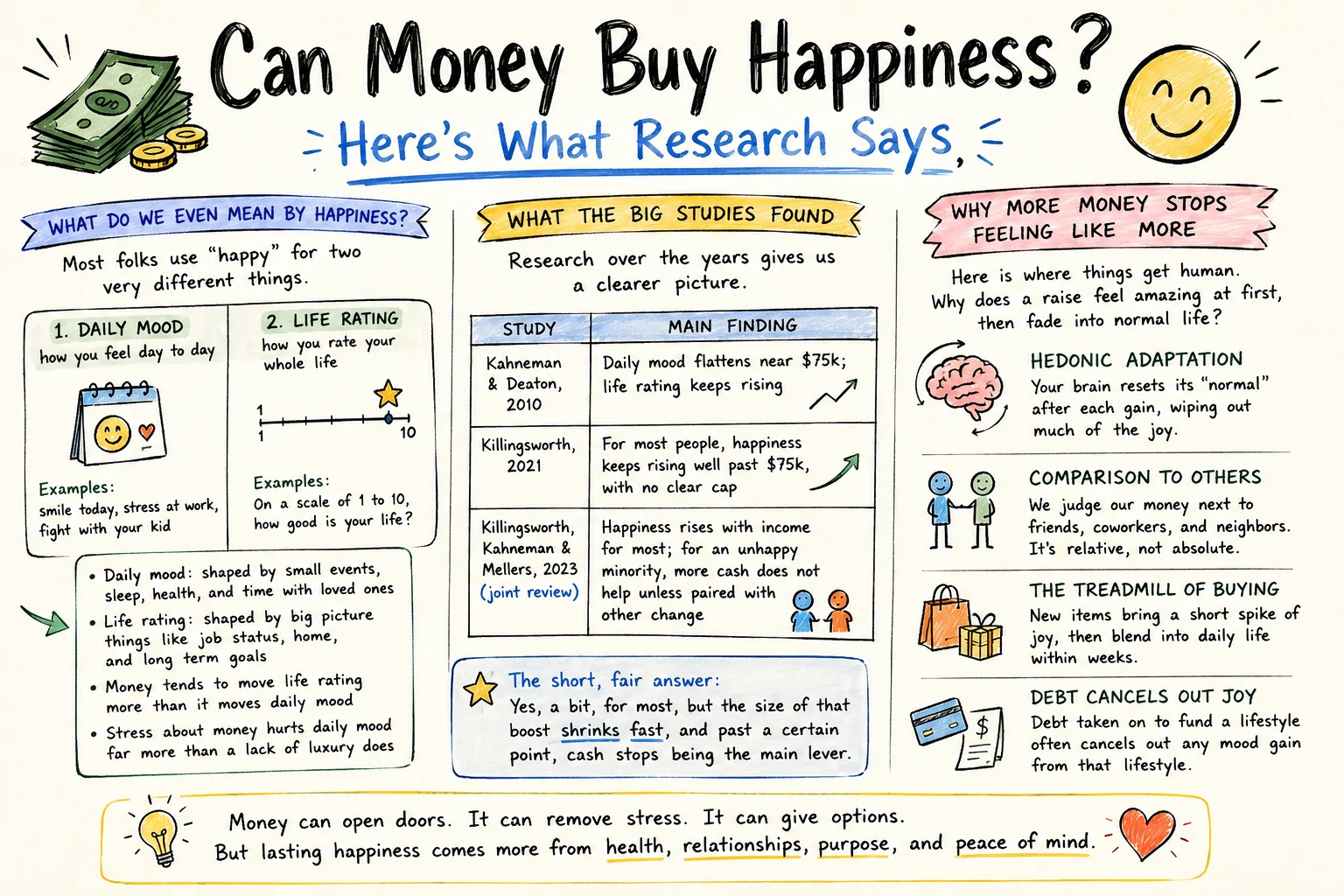
Before we ask if money buys joy, we need to know what joy even means. Most folks use the word “happy” for two very different things, and mixing them up causes a lot of the debate.
The first kind is how you feel day to day. Did you smile today? Did you feel stress at work? Did a fight with your kid ruin your mood? This is called mood or daily feeling.
The second kind is how you rate your whole life when you step back and think about it. If someone asked, “On a scale of one to ten, how good is your life?” that is a totally different question than “How do you feel right now?”
- Daily mood: shaped by small events, sleep, health, and time with loved ones
- Life rating: shaped by big picture things like job status, home, and long term goals
- Money tends to move life rating more than it moves daily mood
- Stress about money hurts daily mood far more than a lack of luxury does
Once you split these two, the whole money and joy topic gets much clearer.
What The Big Studies Found
In 2010, two well known researchers, Daniel Kahneman and Angus Deaton, ran a large study using data from thousands of adults in the US. They found that daily mood kept rising with income, but only up to a point near seventy five thousand dollars a year. Past that point, more cash barely moved daily mood at all. Life rating, though, kept climbing well past that number.
For over a decade, that seventy five thousand mark became a kind of folk fact. People quoted it at dinner parties as proof that money stops mattering after a modest income. But newer work told a fuller story.
| Study | Main Finding |
|---|---|
| Kahneman & Deaton, 2010 | Daily mood flattens near $75k; life rating keeps rising |
| Killingsworth, 2021 | For most people, happiness keeps rising well past $75k, with no clear cap |
| Killingsworth, Kahneman & Mellers, 2023 (joint review) | Happiness rises with income for most; for an unhappy minority, more cash does not help unless paired with other change |
That last study matters most, since it brought two rival camps together. The joint finding was simple and honest: for most of us, money helps our mood keep rising, slowly, with no hard stop. But for a smaller group already stuck in deep low mood, extra cash alone does very little. Something else has to shift too, like health, work stress, or a broken bond with someone close.
So the short, fair answer to “does money buy happiness” is: yes, a bit, for most, but the size of that boost shrinks fast, and past a certain point, cash stops being the main lever.
Why More Money Stops Feeling Like More
Here is where things get human. Why does a raise feel amazing at first, then fade into normal life within a few months?
Part of the answer sits in a well known idea called hedonic adaptation. Your mind is built to notice change, not to sit still and enjoy a fixed state. A pay rise feels great the week it lands. Then your brain resets its baseline, treats the new pay as normal, and starts looking for the next thing to want.
There is also a social piece to this. Humans do not judge their money in a vacuum. They judge it next to friends, coworkers, and neighbors. A study on lottery winners in the UK found that even big cash prizes did not raise long term life rating much if the winner’s social circle stayed at the same income level. What changed the most was how the winner felt compared to people close to them, not the raw number in their account.
Add to that the treadmill of buying things. New items bring a short spike of joy, then blend into daily life within weeks. Psychologists call this the hedonic treadmill, and it explains why a closet full of new clothes rarely feels as good six months later as it did on day one.
- The brain resets its “normal” after each gain, wiping out much of the joy
- Comparison to peers often matters more than the raw dollar figure
- New items lose their shine fast, usually within a few weeks
- Debt taken on to fund a lifestyle often cancels out any mood gain from that lifestyle
None of this means money is fake or useless. It means the joy from money fades unless it is spent in ways that fight against these habits of mind.
The Hidden Cost Of Chasing Money Too Hard
There is a quiet cost that rarely gets named in money talk: the cost of the chase itself.
People who spend years chasing a bigger income often trade something away without noticing. Long hours at work eat into sleep, meals with family, and quiet time alone. A 2014 review in a major psychology journal found that people who place very high value on wealth, more than on things like health or close bonds, tend to score lower on overall well being, even when their income is solid. The chase itself, not just the lack of cash, seems to wear people down.
There is also a strange twist called the Easterlin Paradox, named after economist Richard Easterlin. He found that within one country, richer people tend to report more joy than poorer people at the same point in time. But over long stretches of years, as a whole nation grows richer, average joy levels barely move. Growth in income does not always translate to growth in national mood, since the goalposts for “enough” keep moving with the average.
This paradox tells us something important: your joy is not just about how much you have. It is about how much you have compared to what you expected, and compared to those around you.
Chasing more, without a clear stop point, can trap a person on a road with no finish line. That is the hidden cost few talk about at parties or on social feeds.
What Actually Moves The Happiness Needle
If raw income has limits, what else pulls real weight? Research across many countries points to a short, fairly steady list.
- Close bonds: strong ties with family and friends rank at or near the top in almost every major well being study.
- Health: both body and mind. Chronic pain or ongoing anxiety can flatten joy no matter how full a bank account is.
- A sense of purpose: work or daily tasks that feel meaningful, not just tasks done for a paycheck.
- Free time control: having a say over how your hours are spent matters more than most people guess.
- Gratitude and contentment: a steady habit of noticing what is already good, rather than always chasing what is missing.
A large well being survey run across dozens of nations found that once basic needs like food, shelter, and safety are met, these five factors explain far more of the gap in reported joy than income alone. Money helps clear the path to some of these (health care, free time, safety), but it cannot buy the bonds, the purpose, or the quiet habit of gratitude directly.
How You Spend Matters More Than How Much You Earn
Here is a fact that surprises most people: the way cash gets spent shapes joy far more than the total amount earned.
Researchers Elizabeth Dunn and Michael Norton studied this closely and found a clear split between two spending styles.
Spending on things tends to bring a short spike, then fade fast, since a new item quickly becomes the new normal. Spending on shared moments, trips, meals out, or time with loved ones tends to hold its glow much longer, since memories keep getting reshaped in a warm light over time, even if the event itself had rough patches.
Giving also plays a strong role. Studies across many countries, rich and poor, found that spending a small share of income on others, through gifts or acts of kindness, tends to lift mood more than spending the same sum on oneself. This holds true even for people with very little to spare.
- Buying an object: joy fades within weeks as the item becomes routine
- Buying a shared trip or meal: joy tends to hold or even grow with time, thanks to memory
- Giving to others: often lifts mood more than a same size gift to self
- Buying time (hiring help for chores you hate): tied to higher daily mood across income levels
That last point deserves a pause. A 2017 study found that people who paid others to do tasks they disliked, cleaning, yard work, long commutes, reported higher daily mood than those who spent the same cash on items instead. Time, once freed, seems to matter more than things once bought.
Money As A Tool, Not A Final Goal
Maybe the clearest way to frame this whole topic is through one small shift in view: treat money as a tool, not as the finish line.
A tool exists to build something else. A hammer is not the point of a house; it helps build the house. In the same way, cash is not the point of a good life; it helps build the parts of a good life that actually carry weight, safety, health, time, and bonds with others.
People who hold this view tend to spend with more calm and less panic. They save with a clear aim in mind, not just out of vague fear. They give a portion away without feeling robbed, since giving fits into a life built on more than just growth of a number on a screen.
There is an old and steady thread of wisdom, found across cultures and eras, that warns against the trap of always wanting more. Contentment with what is already present, paired with steady, honest effort to grow, tends to serve people far better than an endless chase with no clear stop point. Patience with slow gains, thanks for small wins, and care for those close to you: these habits show up again and again as markers of a full life, far more than the size of a bank account ever does.
None of this means ambition is bad. It means ambition without a clear sense of “enough” tends to burn people out long before it brings the joy they were chasing.
A Simple Way To Think About “Enough”
Try this small exercise. Picture your life exactly as it stands today, but freeze your income where it is right now for the next ten years. Ask yourself: what would still feel worth doing? Who would you still want close to you? What daily habit would you still keep?
The things that stay on that list, after the freeze, tend to be the real core of a good life. The things that fall off the list were likely never about joy at all; they were about status, comparison, or fear of missing out.
This is not a call to stop earning or stop growing. It is a small check that helps sort real needs from noisy wants, a habit that tends to bring far more calm than any raise ever could.
Key Takeaways
- Money raises mood, but the boost shrinks fast past a certain point
- Daily feeling and overall life rating respond to cash in different ways
- Comparing yourself to peers often shapes mood more than the raw number in your account
- Spending on shared moments and giving to others tends to bring longer lasting joy than buying things
- Health, close bonds, and a sense of purpose outweigh income once basic needs are met
- Chasing wealth without a clear stop point often costs more in time and peace than it gives back
A Final Thought
Money does buy a slice of joy. It clears fear, opens doors, and buys back hours that would otherwise go to stress or hard labor. But past a certain point, the slice gets thinner no matter how much more gets added.
The writer Henry David Thoreau once put it simply: a man is rich in proportion to the number of things he can afford to let alone. That line has aged well, since it points at the real shift most people eventually make, not away from money, but toward a quieter, steadier way of holding it.
Maybe the real question was never “can money buy happiness.” Maybe it was always “what is still being chased, and does it still deserve the chase.”