Business Professor Says These 5 Skills to Learn Before Starting a Business


Real moment that every new business owner hits. It usually comes around week six. The idea still feels good. The name is set. The first few sales trickle in. And then, out of nowhere, things start to crack. A deal falls through.
A cost was missed. A key person stops showing up. And the owner stands there thinking: “No one told me about this part.”
That gap between the dream and the daily grind is not filled by more money or a better idea. It is filled by skill. Boring, quiet, very learnable skill.
A well-known business school teacher once put it in a way that is hard to forget. He said: “Most people walk into business carrying the wrong tools. Not because they are not smart. But because no one told them which tools to carry.” That single line explains why so many new businesses close in their first two years, not from bad luck, but from a skill gap that was never closed.
This piece breaks down the five skills that real business experts say every new owner needs before they start. Not after. Before.
Skill 1: How to Sell (Without Feeling Like You Are Pushing)
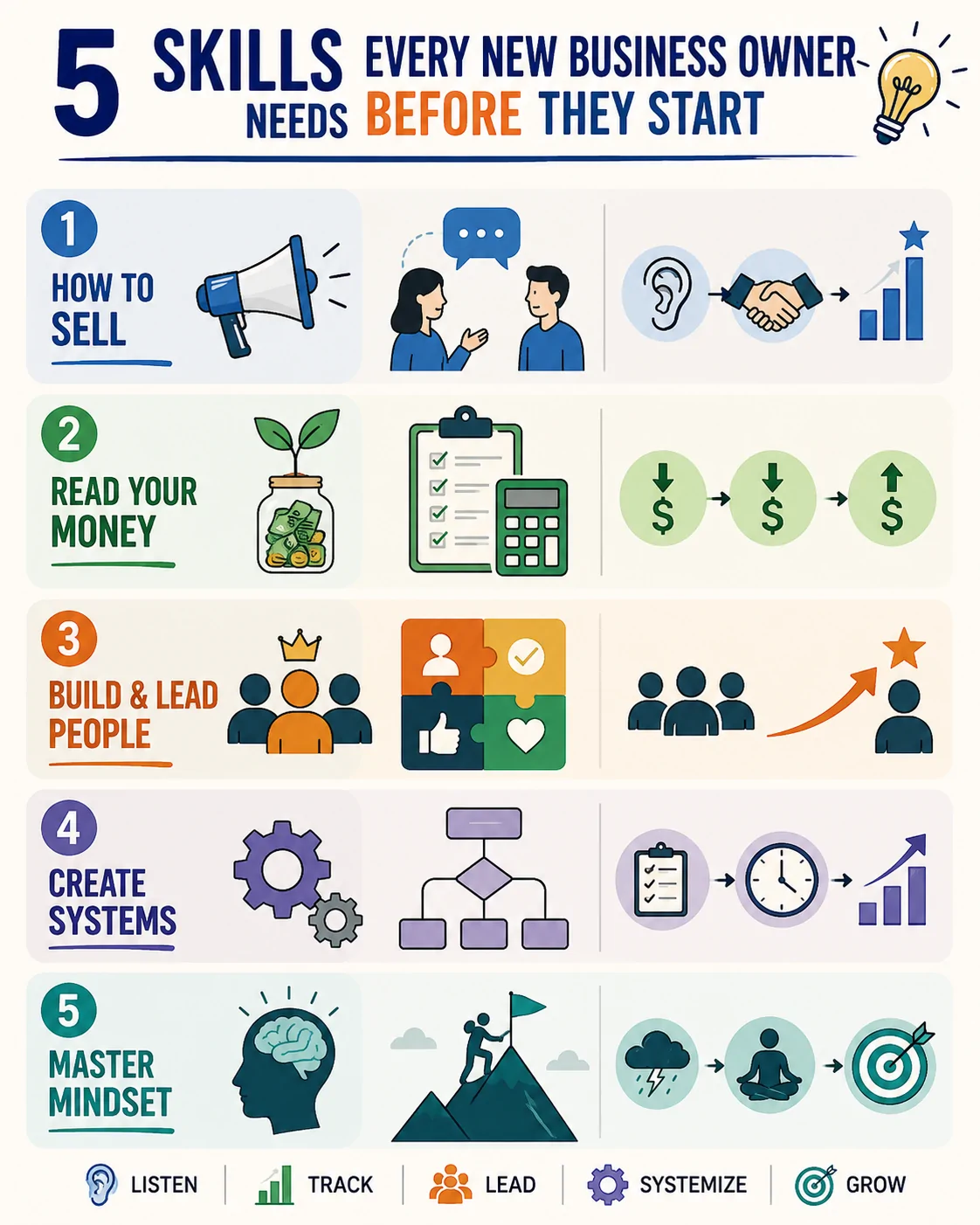
Why Most People Get This One Wrong First
The word “sales” makes a lot of people uncomfortable. It brings up the image of a loud, fast-talking person who will say anything to close a deal. That kind of selling is not just annoying. It does not work anymore, and most buyers can smell it from a mile away.
Real selling is something else. It is the act of helping a person solve a real problem they already have. The job of a seller is not to convince someone to want something. It is to help them see that what they already want is sitting right there in front of them.
A 2022 HubSpot Sales Report found that 82% of top-rated sellers name active listening as the single most important part of their skill set. Not pitching. Not product knowledge. Not charm. Listening. The kind of listening where you actually stop talking and pay attention to what the other person is really saying.
Here is a list of mistakes most new business owners make when they try to sell:
- They talk about what they sell instead of what the buyer gains.
- They set prices too low out of fear, not based on the value they offer.
- They quit after one “no,” when most buyers say no two or three times before they say yes.
- They never follow up. One email goes out and then silence.
These are not personality flaws. They are skill gaps. And skill gaps can be closed.
How to Actually Build the Skill of Selling
The fastest way to learn to sell is not through a book. It is through a real conversation with a real person who has a real problem. Offer help to someone for free. See what comes back. Notice what they say, what they skip, what they react to. That feedback from a live human will teach more in one week than most online courses do in a year.
There is also a mindset shift worth making early on. Selling is not about being bold or loud. Some of the best sellers in the world are quiet, calm, and very good at making the other person feel fully heard. That kind of trust is what turns a first-time buyer into a loyal one. And loyal buyers are worth far more than a hundred new ones.
One more piece that often gets skipped: learn to handle the “no” without taking it personally. A “no” is almost never about you. It is usually about timing, budget, or fear. Stay kind. Stay present. Follow up in two weeks. The sale that feels lost today often comes back later from the same person, but only if they still feel respected.
Skill 2: How to Read Your Own Money Before It Reads You
The Cash Flow Problem Nobody Warns You About
Here is a number that should stop most new owners cold: 82% of small business failures trace back to cash flow problems. That data comes from a U.S. Bank study and it has held steady for over two decades. The businesses did not run out of ideas. They ran out of money they never knew was missing.
The word “finance” scares a lot of people who are not from a numbers background. But the truth is, you do not need to be an accountant to run a business safely. You need to understand three basic things, and you need to understand them deeply:
| What You Need to Know | Why It Keeps You Safe |
|---|---|
| How much money comes in each month | Tells you if things are growing or shrinking |
| How much money goes out each month | Shows where the drain is hiding |
| What is left after all costs are paid | Tells you if the business can survive next month |
These three numbers, once known clearly and tracked consistently, will prevent more crises than any big marketing push or new product launch ever could.
The Habit That Saves Most Businesses Early
Most new owners mix their personal money with the business money. It seems easy at first. One account, one card, one pile. Then, six months in, they cannot figure out if the business is making money or if they are just spending their own savings to keep it alive.
The fix is simple: open a separate bank account for the business from day one. Not next month. Not when things get bigger. Day one. Track every single transaction. Know your numbers the way a pilot knows their fuel level. You do not fly a plane without knowing how much fuel is in the tank.
There is another trap worth knowing about: some financial deals on the market offer quick cash in exchange for a large cut of future sales or payments that grow over time with added costs. These deals often feel like a lifeline but they drain businesses slowly. Stick to deals based on fair, clear value. If a deal feels unclear or the numbers seem to change each time you read them, walk away. Clean money dealings are not just ethical. They are practical.
Skill 3: How to Talk So That People Trust You
The Difference Between Speaking and Communicating
Every single thing a business puts out into the world is a form of communication. The pitch email. The product page. The reply to a bad review. The tone in a phone call. All of it speaks on behalf of the business, even when the owner is not in the room.
Most new owners write the way they were taught in school. Long sentences. Complex words. Formal tone. But the people they are trying to reach do not talk that way. And most of the time, they do not respond well to it either.
Good business communication has a few things in common no matter what form it takes:
- It is clear. A reader knows what to do or how to feel within the first five seconds.
- It is honest. No stretched claims or promises that cannot be kept.
- It respects the reader’s time. Every word earns its place.
- It feels human. Not polished to the point of feeling robotic.
Peter Drucker, one of the most cited thinkers in modern business, said it plainly once: “The most important thing in communication is hearing what isn’t said.” That is a skill that takes time to grow. But it starts with being fully present in every conversation. Not thinking about the next thing to say, but actually taking in what the other person means, not just what they say.
Why Body Language and Tone Matter More Than the Words
There is research, often attributed to work done at UCLA, that suggests words alone carry a small part of the total meaning in a human conversation. Tone of voice and body language carry the rest. The exact percentages are debated, but the core point holds: people feel how you talk, not just what you say.
A voice that is calm and sure creates trust faster than a hundred polished lines. Practice this by recording a short sales pitch or explanation of your business. Play it back. Ask honestly: “Would this person trust me with money?” If the answer takes too long, keep practicing. This kind of self-honest check is what separates the owners who grow fast from the ones who stay stuck.
Skill 4: How to Plan Without Planning Too Much
What a Real Plan Actually Looks Like
Most new owners do one of two things. They write a long, detailed, beautifully formatted plan and never look at it again. Or they skip the plan entirely and run on gut and hope. Both paths lead to the same place: confusion when things go sideways.
A useful plan for a new business does not need to be long. It needs to be honest. It needs to answer five clear questions before a single dollar is spent:
- Who actually needs what you are selling?
- Why would they pick you over someone else with a similar offer?
- How will you reach those people in the next 30 to 90 days?
- What will it cost to run this business for 90 days with no income?
- What does “things are working” look like at the end of that time?
If those five questions cannot be answered in plain, short sentences, the plan is not ready yet. Not the business. The plan.
Research published in the Harvard Business Review found that businesses with a clear, written plan are 16% more likely to reach meaningful growth compared to those that do not write one. That is not a dramatic number. But 16% over time, compounded, is the difference between a business that lasts and one that fades out quietly.
The 90-Day Method That Business Teachers Actually Use
One of the most practical ideas that comes up again and again in business education is the 90-day planning cycle. Not yearly goals. Not five-year visions. Just the next 90 days.
A year is too far away to feel real. A week is too short to measure anything. But 90 days is close enough to feel urgent and long enough to see real patterns. Here is how most business teachers suggest using it:
| Time Block | Main Focus |
|---|---|
| Days 1 to 30 | Get the first five paying buyers, not leads, actual buyers |
| Days 31 to 60 | Learn what those buyers want more of and what frustrated them |
| Days 61 to 90 | Build a simple, repeatable way to make that sale happen again |
At the end of every 90 days, review honestly. What worked? What did not? Where was time wasted? Where did money go that it should not have? Then reset and run the next 90 days with that knowledge built in. This rhythm is what keeps a young business alive through the hard and uncertain early years.
Skill 5: How to Lead Yourself First (The Hardest One on This List)
Why the Owner Is Often the Biggest Risk in the Business
Every business expert, when pressed on this topic, tends to say the same thing eventually: the biggest risk in most new businesses is not the market. It is not the competition. It is not the economy. It is the person running the thing.
That is not a judgment. It is a pattern that shows up over and over. The owner who chases every new idea and never finishes one. The owner who works 90 hours a week for six months and then burns out completely. The owner who cannot say no to a bad deal because they are afraid of missing out. These are not character flaws. They are signs that self-leadership was never built as a skill.
Self-leadership means doing the right thing even when no one is watching. It means staying on track even when results are slow. It means making clear decisions even when the options feel hard. Here is what it looks like in the real daily life of a business owner:
- Doing the hard task first each morning, not the one that feels easy and safe.
- Saying no to a deal that feels off, even when money is tight.
- Taking time to learn something new when things feel slow, not only when things go well.
- Being honest about what is not working before it turns into a full crisis.
- Resting on purpose, not only when forced to stop.
Why Character Shows Up in Every Business Decision
Warren Buffett has said more than once that the best investment a person can ever make is in themselves. He is not talking about buying courses. He is talking about building clarity, discipline, and the kind of character that holds steady when things get hard.
The values a person holds in their personal life will show up in their business. How they treat a frustrated customer. Whether they keep their word when it costs something. How they handle a mistake made by a team member. These things add up. They build a name. And in business, a name built on honesty and consistency is worth more than any marketing budget.
There is also the matter of energy, not just time. Most new owners schedule their hours but never schedule their rest. They run at full speed for months and then wonder why they are making poor decisions, missing things they should have caught, or snapping at the very people they need on their side. Rest is not laziness. Rest is maintenance. A tired mind cannot lead anything well.
What Business Schools Often Forget to Teach
Most formal business programs are good at teaching market models, financial formulas, and case studies from large, old companies. Very few spend enough time on who you need to become before you can lead anything at all.
The five skills above are not extras. They are the floor. The foundation. Every other part of a business, the product, the brand, the team, the growth plan, sits on top of them. Build on sand, and everything above will shift. Build on something real, and even the hard seasons become something you can move through.
James Clear, the writer behind Atomic Habits, makes a point that lands hard here: small daily habits, done with intention, compound into large and lasting results over time. That is true for physical health. It is true for learning. And it is true for business. Every day that goes by where these five skills are practiced, even a little, is a day where something real and lasting is being built. Something no shortcut or quick launch strategy can replace.
Key Takeaways
- Most businesses do not fail from bad ideas. They fail from skill gaps that were ignored for too long.
- The best sellers listen more than they talk. The pitch matters far less than the question asked before it.
- Not knowing your cash flow numbers is not just a small mistake. It is the most common reason businesses close.
- Communication that earns trust is simple, honest, and feels like a human wrote it.
- A plan that answers five clear questions is worth more than a fifty-page document no one reads twice.
- The owner is almost always the first thing that needs to change before the business can change.
One Last Thought
Starting a business without these five skills is not impossible. People do it all the time. But most of those people end up spending years learning what they could have learned in months if they had slowed down and built the right base first.
The world does not need more great ideas sitting in someone’s head. It needs more people who know how to execute on an idea, how to talk to people with honesty, how to manage money with care, how to plan with clarity, and how to lead themselves on the hard days when no one is watching and no one is cheering.
A business is not a thing you build once and then walk away from. It is something you grow into slowly. And the person you become in that process, either steady and clear or scattered and reactive, will decide whether the work lasts or quietly fades.
That may be the most honest business lesson there is.