
Personal Development Plan: Achieve Goals, Build Skills, Transform Your Life

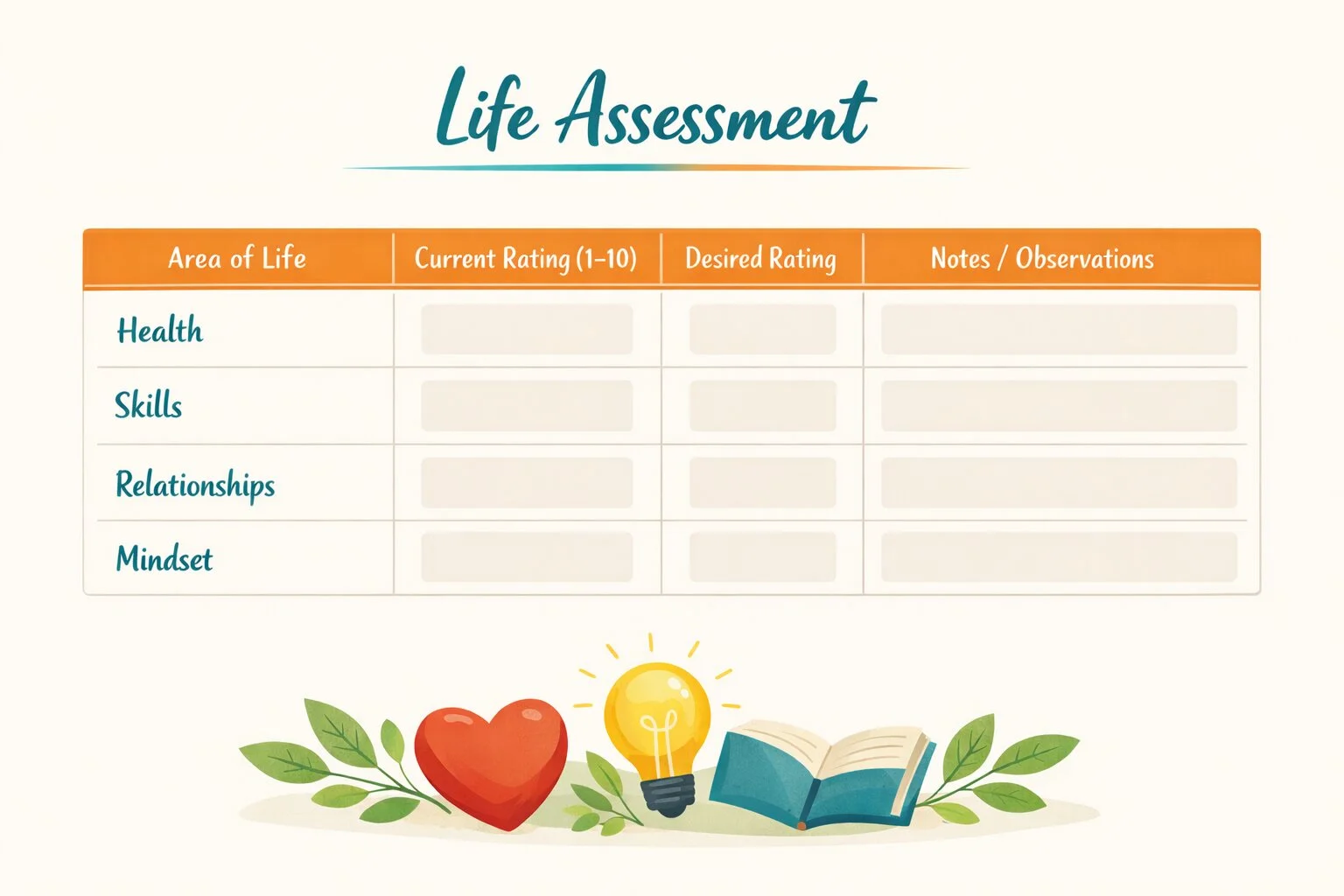
When life feels like a gentle drift rather than deliberate motion. You wake up, move through tasks, and look back at the week or the month and realize that your intentions, the ones that seemed vivid in quiet reflection, have slipped away.
This quietly creeps in, in the gaps between work and rest, ambition and habit. It is neither dramatic nor urgent; it is subtle.
Yet it signals something important: a need to pause, to notice, and to create a space where intention meets action.
Over time, these pauses are not wasted, but they are invitations. They invite a closer look at patterns we often ignore: the habits that sustain us, the ones that limit us, and the small, recurring desires we tend to dismiss. A personal development plan doesn’t erase uncertainty or complexity, but it allows us to map our inner terrain. It provides a gentle frame to reflect, refine, and quietly steer the life we already inhabit toward one that feels more aligned with who we hope to become.
Why is a Personal Development Plan Important and What is Its Purpose?
A personal development plan matters because it turns vague hope into quiet clarity. Its purpose is simple: to help you recognize your current patterns, clarify what you want to grow, and provide a flexible roadmap that transforms intention into tangible, meaningful action.
Why Every Personal Development Plan Should Be Different?
- Because no two lives move in the same direction, even if they look similar from the outside.
- Because your strengths, limits, fears, and ambitions are shaped by experiences that only you have lived.
- Because what feels growth to one person may feel pressure to another.
- Because timing matters, what you need at twenty is not what you need at forty.
- Because your energy, responsibilities, and values shift over time.
- Because copying someone else’s roadmap often leads to quiet frustration.
- Because real development begins with self-honesty, not comparison.
- Because progress feels sustainable only when it fits your personality and rhythm.
- Because growth is personal before it is practical.
- Because the goal is not to impress others, but to become more aligned with yourself.
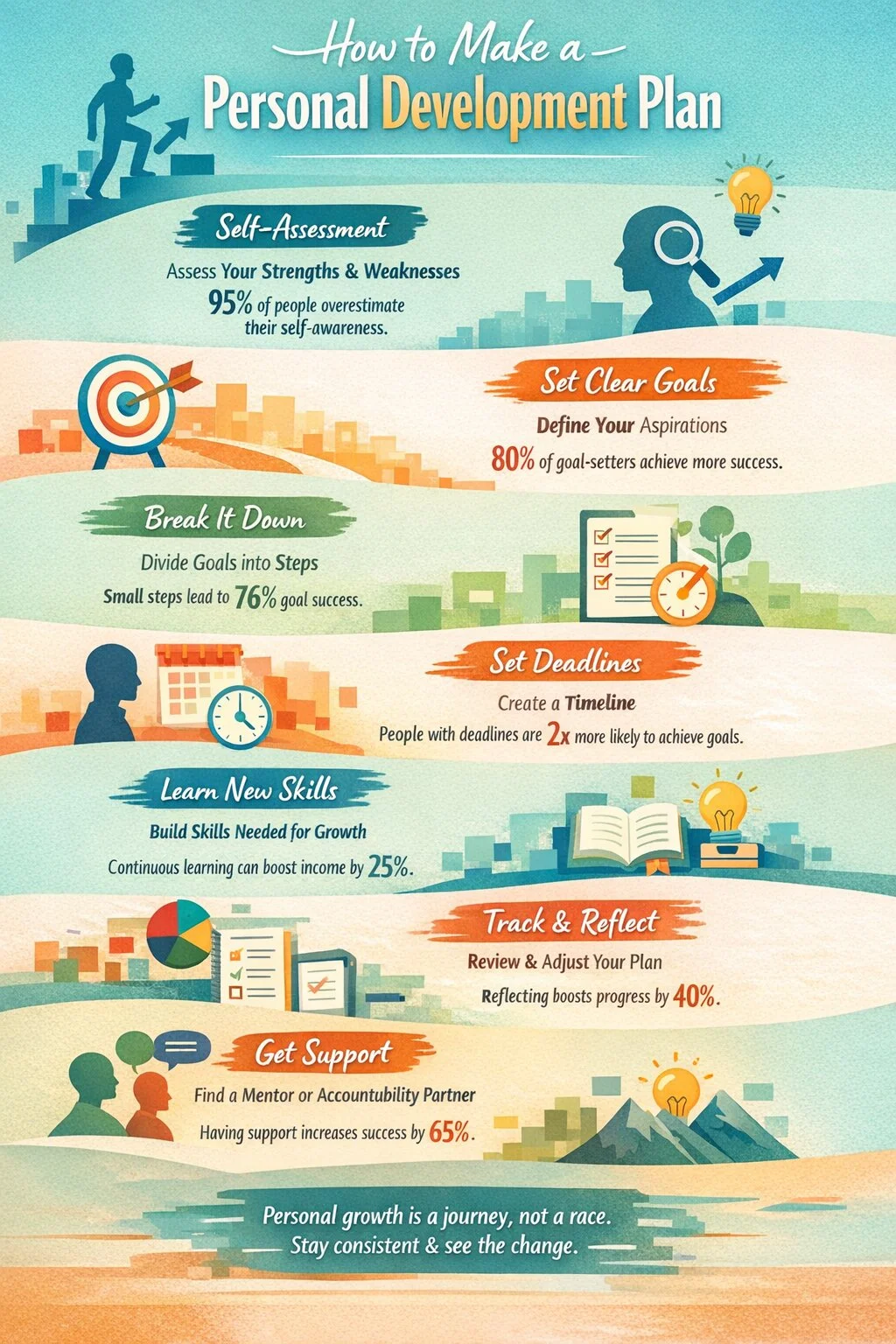
Making a Plan
The process of making a personal development plan unfolds in stages. It isn’t a checklist in the traditional sense—it is a reflective journey that helps you observe yourself and your life with clarity. Here’s how I’ve seen it take shape:
1. Take Stock of Where You Are
Before you imagine where you want to go, it’s worth observing where you stand. I often start by quietly reflecting on my routines, habits, and energy.
- Which moments leave you feeling fulfilled?
- Which habits quietly drain you?
- What recurring thoughts or interests keep nudging you forward?
In my experience, simply noticing these patterns can be revelatory. It often surfaces goals you weren’t aware you had, or clarifies that some ambitions are inherited rather than chosen. This stage is about honesty. Write down on papar everything you observe, without judgment or pressure.
2. Identify Meaningful Goals
Once the landscape is clear, the next step is to identify goals that resonate with your authentic self. I’ve found it helps to think in layers:
- Personal growth: Both skills and habits you want to develop for yourself.
- Professional development: knowledge or competencies that matter for your work or creative pursuits.
- Emotional and relational growth: ways to cultivate empathy, communication, or deeper connections.
These goals don’t need to be monumental. Most enduring growth often comes from small, deliberate intentions—learning a language, committing to weekly writing, or deepening a relationship.
3. Break Goals into Practical Steps
Big ambitions can feel heavy; the trick I’ve learned is to divide them into manageable, actionable steps. For example, instead of “be healthier,” narrow down and consider these:
- Exercise three times a week.
- Prepare meals at home four nights a week.
- Track sleep and energy patterns.
This stage is less about strict deadlines and more about creating a rhythm that keeps you connected to your goals. The steps should feel like companions, not chains.
4. Schedule Reflection and Adjustments
A plan is not static, but it is a conversation. I’ve learned to schedule regular check-ins with myself, perhaps weekly or monthly, to notice what’s working and what isn’t. A journal entry, a quiet walk, or even a mental review can reveal patterns and adjustments needed. The plan grows with you.
5. Build Accountability Without Pressure
Finally, a personal development plan benefits from gentle accountability. This could be sharing goals with a trusted friend, joining a group, or simply noting progress privately. Value isn’t in external judgment but in reinforcing your own observation and intention.
Personal Development Plan Checklist
| Goal/Intention | Skill to Develop | Action Steps | Timeframe | Reflection Notes |
|---|---|---|---|---|
| Learn a new language | Vocabulary & speaking fluency | 15 min daily practice, 1 conversation/week | 6 months | Note retention, pronunciation struggles |
| Improve public speaking | Confidence & clarity | Join speaking group, practice weekly | 3 months | Record sessions, observe nervousness patterns |
| Consistent writing | Focus & creativity | Write 500 words daily, weekly review | 1 year | Track flow and distraction moments |
| Enhance physical fitness | Strength & stamina | Gym 3x/week, track progress | 6 months | Observe energy and endurance changes |
| Deepen professional knowledge | Research & application | Read 2 articles/day, summarize insights | 3 months | Identify gaps and adjust reading habits |
Reflections on the Journey
One of the quieter truths is that a personal development plan is less about perfection and more about awareness.
Growth rarely follows a straight path. I’ve seen plans falter, goals shift, and unexpected discoveries emerge.
Moments of struggle often reveal what matters most: the areas where you are honest with yourself, the patterns you can’t ignore, the subtle impulses you might have dismissed.
I’ve also realized that progress isn’t always visible in traditional measures.
Sometimes, simply noticing how you respond to setbacks, how your curiosity shifts, or how your habits evolve quietly counts as transformation. The plan serves as a mirror, helping you see yourself more clearly and act more deliberately—not perfectly, but consciously.
Key Takeaways
- Small, consistent actions often lead to deeper transformation than dramatic efforts.
- Honest observation of patterns is more important than flawless execution.
- Reflection reveals priorities that ambition alone cannot uncover.
- Plans are living tools; they evolve as you do.
- Struggle and friction often indicate what matters most.
Conclusion
To conclude i only say that a personal development plan is not a map but a dialogue with your present self, your hopes, and your uncertainties.
As Anaïs Nin wrote, “We don’t see things as they are, we see them as we are.” and it is the greatest gift of a personal development plan that is not the destination, but the clarity it brings to the spaces between who we are and who we might become.