
How to Organize Your Life in a Notebook

Some products shown here are affiliate links. Clicking them won’t cost you anything extra. For full details, see our Affiliate Disclosure.
Your phone is full of reminders. Notes live in three different apps. Some things are written on sticky notes. Others exist only in your head. You remember half of what matters and forget the rest at inconvenient times.
Nothing feels completely lost, but nothing feels fully held together either.
At some point, many people return to something surprisingly simple: a notebook.
Not because it is trendy or aesthetic. Mostly because paper does something digital systems rarely do. It slows the mind down just enough to see what is actually going on.
Over the years, I have seen people try every kind of productivity system imaginable. Complex apps. Color-coded dashboards. Detailed planners.
And yet, again and again, the people who quietly regain clarity often do something much simpler. They organize their life inside a single notebook.
Not perfectly. Not rigidly. But intentionally.
The interesting thing is that organizing your life in a notebook is less about the notebook itself and more about learning how your life actually works. The pages simply make that visible.
If done well, one notebook can hold your tasks, ideas, plans, reflections, and decisions. It becomes a place where the scattered parts of life gather long enough to make sense.
Why a Notebook Works When Life Feels Disorganized
The modern mind is carrying far more information than it was designed to handle.
Psychologists who study cognitive load often point out that the brain is excellent at generating ideas but remarkably poor at storing them. Yet most of us try to use it as both processor and storage device.
That is usually where the friction begins.
Unfinished tasks float around mentally. Small responsibilities repeat in the background. A thought appears during a conversation, disappears, then returns later when it is no longer useful.
When everything lives inside your head, life starts to feel vaguely crowded.
A notebook changes that relationship.
Writing something down moves it out of working memory and into a visible space. Once it exists on paper, the mind no longer has to rehearse it constantly to avoid forgetting it.
This effect has been studied for decades. The Zeigarnik Effect, observed by psychologist Bluma Zeigarnik, describes how unfinished tasks occupy mental attention until they are recorded or completed.
A notebook acts as a trusted container for those unfinished pieces.
But there is another advantage that rarely gets discussed.
Paper encourages thinking rather than reacting.
Digital tools push speed. Notifications. Constant switching between tasks. A notebook moves at the pace of handwriting. That slower pace often leads to clearer decisions.
When people begin organizing their life in a notebook, something subtle happens.
They stop trying to remember everything.
Instead, they start noticing everything.
That shift alone can reduce a surprising amount of stress.
Choosing a Notebook That You Will Actually Use
This may sound trivial, but the success of a notebook system often begins with a simple question.
Will you actually want to open it?
Over the years I have seen people abandon beautifully designed planners because they felt too structured. Others bought minimalist notebooks that ended up feeling too blank and intimidating.
The best notebook is the one that quietly invites you back.
Some people prefer lined pages because it helps organize writing. Others like dotted or grid notebooks because they allow both lists and sketches. A few prefer completely blank pages because they feel less constrained.
None of these choices is objectively better.
What matters more is that the notebook feels approachable.
Size matters too, though people rarely talk about it. A notebook that is too large often stays on a desk. One that fits easily into a bag or jacket tends to travel with you. And a notebook that travels with you captures far more of your real life.
There is also something psychological about having a single place where everything goes.
When tasks live in one app, ideas in another, and goals somewhere else, your attention fragments. A notebook can become the opposite of that fragmentation.
One place.
One record.
One ongoing conversation with your own thinking.
Once that habit begins, the structure of the notebook slowly reveals itself.
The Five Core Sections That Organize a Life
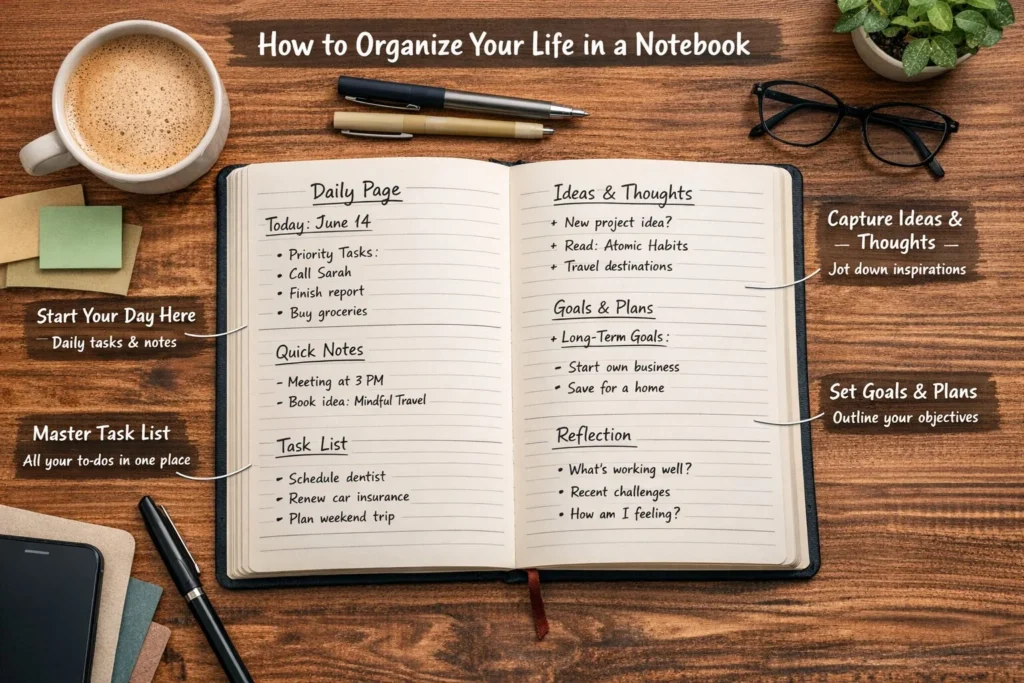
Eventually most people discover that a few simple sections make a notebook far more useful.
Not rigid categories, just gentle containers for different types of thinking.
Over time these sections tend to organize life naturally.
Daily Pages: Where the Day Becomes Visible
Daily pages are often the backbone of a life notebook.
Each day begins with a simple space where tasks, notes, and observations live together. Nothing elaborate. Just the date and whatever needs attention.
You might write three or four priorities for the day. A meeting note. A quick reminder. Something you noticed or learned.
The important thing is that the page reflects reality.
Many planners assume a day will unfold in a perfectly structured way. Life rarely cooperates with that assumption. Daily notebook pages are flexible enough to capture interruptions, new ideas, and shifting priorities.
Over time, flipping through daily pages reveals how your days actually unfold.
Not the imagined version.
The real one.
Task Lists: Holding the Things That Need Doing
Tasks are the most obvious reason people start organizing life in a notebook.
But the way tasks are recorded matters.
Instead of scattering tasks across multiple lists, it helps to maintain a single running task list that you review regularly. This becomes your external memory for responsibilities.
Some tasks are completed quickly. Others move forward slowly. A few eventually reveal themselves as unnecessary.
The notebook allows that natural filtering process to happen.
You begin noticing which tasks repeat often, which ones drain your energy, and which ones quietly matter more than you expected.
Ideas and Thoughts: Protecting Small Sparks
Ideas tend to arrive at inconvenient moments.
In the middle of a walk. During a conversation. Just before falling asleep.
Most of them disappear because there is nowhere immediate to capture them.
A dedicated space in your notebook for ideas changes that.
Writers, entrepreneurs, designers, and researchers have long relied on notebooks for this reason. Leonardo da Vinci filled thousands of pages with sketches, observations, and questions that later shaped entire inventions.
Most ideas will never become projects. That is normal.
But occasionally one grows into something meaningful.
The notebook gives those ideas a place to survive long enough to evolve.
Goals and Direction: A Place to Think About the Future
People often talk about goals as if they should be fixed and certain.
In reality, most meaningful goals evolve gradually.
A notebook provides a place to revisit questions about direction without pressure to finalize them immediately.
You might write about where you want your work to go. What kind of life feels meaningful. What changes seem necessary.
These reflections do not need to appear daily. Sometimes they return every few weeks or months.
But keeping them in the notebook ensures they remain part of the conversation.
Reflection Pages: Understanding What Is Actually Happening
Reflection is where the notebook becomes more than an organizational tool.
It becomes a thinking space.
Every so often it helps to pause and write about what has been happening lately. What feels heavy. What seems to be working. What patterns are repeating.
Many people discover that reflection pages reveal insights that were impossible to see while rushing through daily tasks.
Psychologists often refer to this as metacognition—thinking about thinking.
A notebook supports that process naturally.
Over time, those pages become a quiet record of growth, uncertainty, and change.
A Simple Method for Using Your Notebook Every Day
People often assume organizing life in a notebook requires a complicated system.
In practice, consistency matters far more than complexity.
A simple rhythm works surprisingly well.
At the beginning of the day, open a new page and write the date. Note the few tasks that matter most today. Not everything that could be done, just what realistically deserves attention.
Throughout the day, the page collects small fragments of life. Notes from a conversation. A thought worth remembering. Something unexpected that needs to be handled later.
In the evening, glance back at the page.
Some tasks are finished. Others remain. A few are no longer relevant.
This brief review closes the day mentally. It also prepares tomorrow’s page.
Over time, this rhythm becomes natural.
You stop trying to organize your life perfectly.
Instead, you simply record it consistently.
And surprisingly, that consistency creates order.
Common Mistakes People Make When Starting
When people first try organizing life in a notebook, they often expect immediate transformation.
That expectation can quietly sabotage the habit.
One common mistake is overdesigning the system before using it. Elaborate layouts, color codes, complicated tracking methods. These systems can look impressive but often collapse under real life.
Another mistake is expecting perfection.
People skip writing for a few days and assume the system has failed. In reality, notebooks work best when they are forgiving. You can leave them for a week and return without explanation.
A third mistake is separating life too rigidly.
Work in one notebook. Personal thoughts somewhere else. Ideas in a separate place entirely.
Fragmentation returns.
A single notebook works precisely because it reflects life as it actually happens: mixed, overlapping, occasionally messy.
The goal is not to create a perfect planner.
It is to create a reliable thinking space.
Key Takeaways
• Organizing your life in a notebook works because it reduces mental clutter and externalizes unfinished thoughts.
• A single notebook often works better than multiple digital tools because it keeps life visible in one place.
• Simple sections for daily pages, tasks, ideas, goals, and reflections naturally organize information over time.
• Consistency matters far more than elaborate systems or perfect layouts.
• A notebook gradually becomes a record of patterns, decisions, and personal growth.
Conclusion
When people imagine organizing their life, they often picture control.
Everything categorized. Everything scheduled. Nothing forgotten.
But real life rarely fits that image.
A notebook offers something quieter and far more useful.
It gives your thoughts a place to land. Your tasks a place to wait. Your questions a place to grow.
Over time, those pages begin to reveal patterns about how you work, what matters to you, and where your attention naturally returns.
The organization appears slowly.
Not because the notebook forced order onto life, but because it allowed life to be seen clearly.
As the writer Joan Didion once said, “I write entirely to find out what I’m thinking.”
In many ways, organizing your life in a notebook begins the same way.
You write things down.
And gradually, your life begins to make sense on the page.How to Organize Your Life in a Notebook