10 Best College Degrees for High-Paying Jobs in 2026


There’s a peculiar tension in choosing a college degree. On one hand, you want something that aligns with your mind and your curiosity. On the other, there’s the quiet, persistent awareness that some paths are simply less forgiving in the job market. People hesitate for years, weighing their passions against the demands of the world outside the classroom, circling course catalogs late at night, wondering which choice might leave a door open rather than closed.
The truth is that the degrees that matter aren’t always the most glamorous or exciting on the surface. They are the ones that quietly intersect with enduring human needs, whether in care, technology, or problem-solving. As 2026 approaches, this pattern becomes clearer, shaped by technology, demographics, and a gradually aging population that will need certain skills more than ever.
I don’t offer this as a prescription. I offer it as reflection. The degrees that open the most doors are those that promise opportunity, growth, and a kind of stability that allows meaningful work to take root.
1. Nursing: The Quiet Anchor of the Future
Nursing is often overlooked for its quiet dignity. It is not flashy, but it carries weight in a way that resonates with real human lives. People are living longer, and chronic conditions like diabetes and heart disease are increasing. Hospitals and care facilities are full, and each nurse maintains a rhythm, a quiet command of what matters during a day filled with challenges.
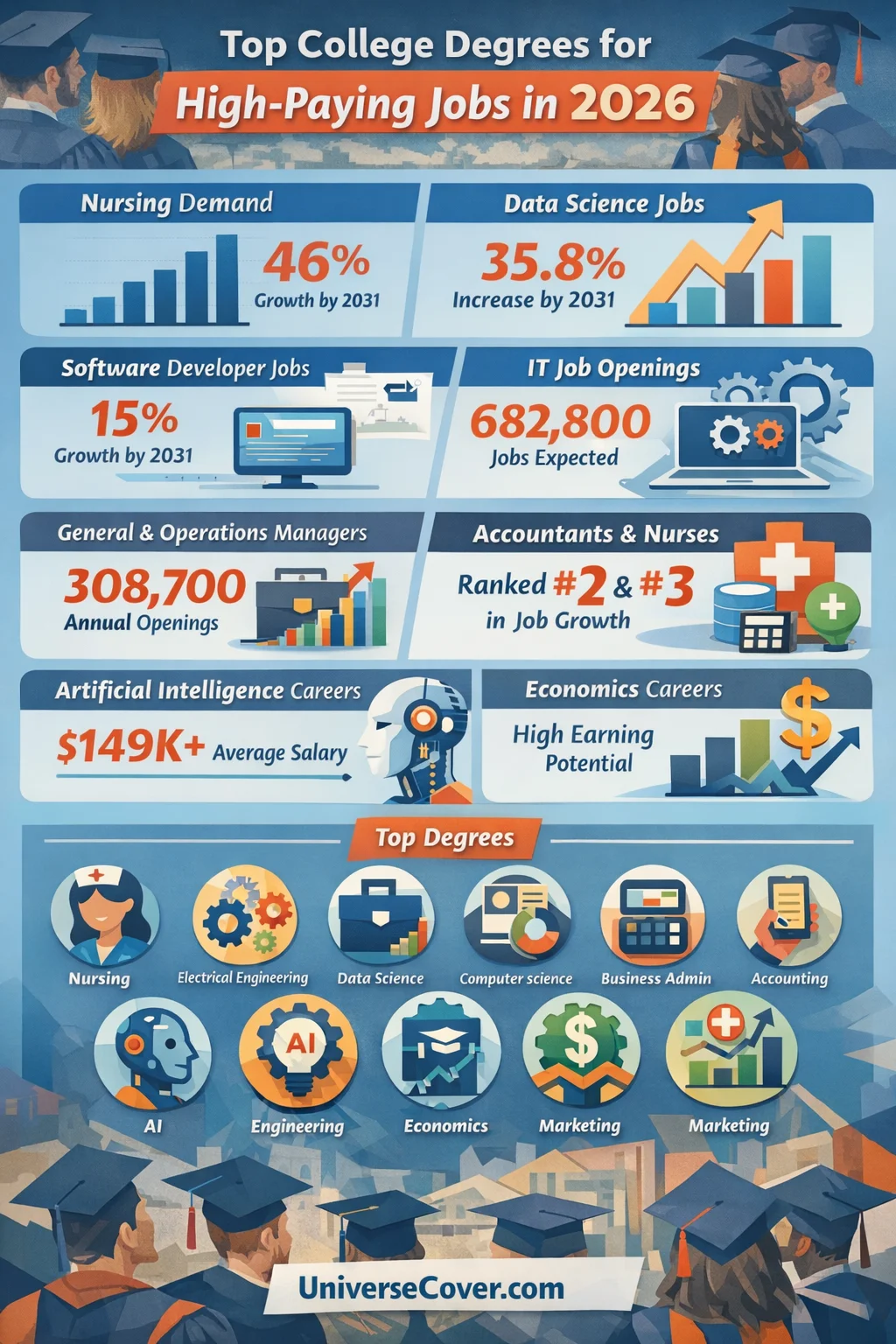
By 2031, demand for registered nurses is projected to grow nearly 46 percent. Beyond the numbers, it reflects an enduring human need rather than a market trend. Nursing offers a tangible way to engage with the world while providing a respectable salary, starting near $75,000 annually for entry-level roles. Specializations like critical care, ER nursing, and cardiac nursing open further opportunities, blending emotional intelligence with precise skill.
Nurses carry both responsibility and choice in shaping their careers. Hospitals, private practices, and telehealth services offer options, providing a rare intersection of demand and fulfillment for those seeking stability in meaningful work.
2. Electrical Engineering: Patterns Behind the Walls
Electrical engineering is often framed as purely technical, but it is a discipline about understanding patterns and anticipating consequences. Wiring a circuit, designing a system, or predicting component failures requires thinking ahead as much as technical skill.
The field spans biomedical, computer, chemical, and industrial applications. Engineers enjoy some of the lowest unemployment rates among STEM fields, with median starting salaries around $70,000. Those who thrive often share a patient, observant mindset, noticing patterns and stress points that others overlook. This ability to solve complex problems quietly ensures that demand remains strong, even as technology evolves.
Electrical engineers do more than work with machines. They develop a confidence in managing complexity that is rare in any field, a skill that carries value far beyond technical labs or offices.
3. Data Science: Making Sense of Everything
Data is everywhere, whether we notice it or not. Organizations drown in spreadsheets while insights remain hidden. Data scientists extract meaning from this noise, analyzing trends and creating actionable solutions.
Employment for data scientists is projected to grow more than 35 percent by 2031. While automation may reduce repetitive tasks, the subtlety of interpreting, connecting, and storytelling with data is still in human hands. The most effective data scientists develop the habit of asking the right questions, tracing patterns, and translating numbers into decisions that matter.
This is a field that blends curiosity, patience, and precision. Data science is not just a technical skill; it is a way of understanding the world and uncovering insights that shape industries quietly but powerfully.
4. Computer Science: The Architecture of Tomorrow
Computer science feels abstract, yet its consequences are profoundly tangible. Lines of code become systems that people rely on daily. Cybersecurity, application development, and AI are not just jobs—they influence how society functions.
Growth projections for computer science roles reach 15 percent by 2031, reflecting a steady demand. Success in the field comes not from memorizing syntax, but from curiosity and adaptability. Students who understand principles rather than just tasks often find doors open that were never listed in any course catalog.
The degree offers a sense of agency. Skills are portable and often global, and graduates learn to think at a scale most people never notice, shaping tools that shape lives.
5. Business Administration: The Degrees That Connect Everything
Business administration acts as a quiet glue in the economy. Graduates navigate corporate structures, launch startups, and lead non-profits. Its value lies in relevance across industries rather than flashiness.
Opportunities are broad, with projected openings in management, finance, and operations remaining high. Salaries climb rapidly, but the real advantage is understanding organizations, people, and strategy. The discipline teaches adaptability, reading signals, and operating in environments that are constantly evolving. That combination of insight and skill becomes a quiet form of security.
6. Accounting: Stability Wrapped in Complexity
Accounting is paradoxically creative. On the surface, it is numbers and rules. Beneath, it tells stories about resources, decisions, and consequences.
Demand for accountants is steady, with growth around 6–7 percent and salaries reaching six figures for senior positions. Success requires patience with precision and an ability to translate abstract numbers into meaningful insights. Those who thrive enjoy a quiet resilience, balancing meticulous work with understanding broader financial narratives.
7. Artificial Intelligence: Building Minds
AI merges present and future in a single field. Teams develop algorithms that anticipate behavior with uncanny accuracy, yet the work depends on understanding human behavior as much as technology.
Growth in AI roles is strong, with salaries often exceeding six figures. Beyond numbers, the degree develops a mindset for pattern recognition, anticipation, and working with uncertainty. Students learn to think critically about systems that influence society, blending technical skill with human insight.
9. Engineering: Systems That Bind
Engineering teaches elegance and precision. From designing circuits to optimizing networks, engineers develop a way of thinking that blends creativity with exacting standards.
Growth in most engineering disciplines remains strong. Salaries start high and climb with experience. More than technical skill, engineering instills patience, problem framing, and awareness of consequences—qualities that carry value beyond the workplace.
10. Economics: Understanding the Invisible Currents
Economics feels abstract until its effects are everywhere—from housing markets to public policy, finance to healthcare. Careers are varied: analysts, planners, policy advisors. Salaries are competitive, and the degree provides analytical literacy that illuminates complex systems.
It is less about money than perspective. Graduates learn to read the invisible currents that shape society, developing insight that informs decisions in any field.
11. Marketing and Advertising: The Human Signal
Marketing is intensely human work. It requires understanding perception, influence, and how ideas travel through networks. Digital marketing has amplified this need, and careers remain adaptable across sectors.
Success depends on empathy, creativity, and an awareness of consequence. Marketing teaches skills that extend beyond any single job, shaping communication, leadership, and entrepreneurship in subtle but meaningful ways.
Key Takeaways
- Degrees that endure are anchored in human need, systems thinking, or problem-solving.
- High-paying roles often intersect with demographic or technological shifts.
- Stability and opportunity arrive quietly, not through flashiness.
- Skills cultivated in one field often translate across careers.
- Observing the intersection of work and society reveals more than rankings or statistics.
Closing Reflection
The best degrees are chosen when curiosity meets the world’s persistent needs. As William Gibson wrote, “The future is already here, it’s just not evenly distributed.” In 2026, opportunity quietly gathers for those who can notice and act. Choosing a degree is less about betting on a single outcome than placing yourself where growth, demand, and purpose converge.