7 Reasons Living Below Your Means Builds Real Wealth

There’s a moment many people recognize but rarely talk about. You earn a little more than before, maybe for the first time in a while, and instead of relief, you feel a strange pressure. Expectations quietly rise. Spending stretches to meet them. Nothing is wrong, exactly, yet nothing feels settled either. I’ve been there. I’ve watched income grow while calm stayed stubbornly out of reach.
Living below your means is often described as a tactic, almost a trick. But over time, I’ve come to see it as something slower and more personal. Less about discipline, more about alignment. When it works, it doesn’t feel like a sacrifice. It feels like things are finally fitting together.
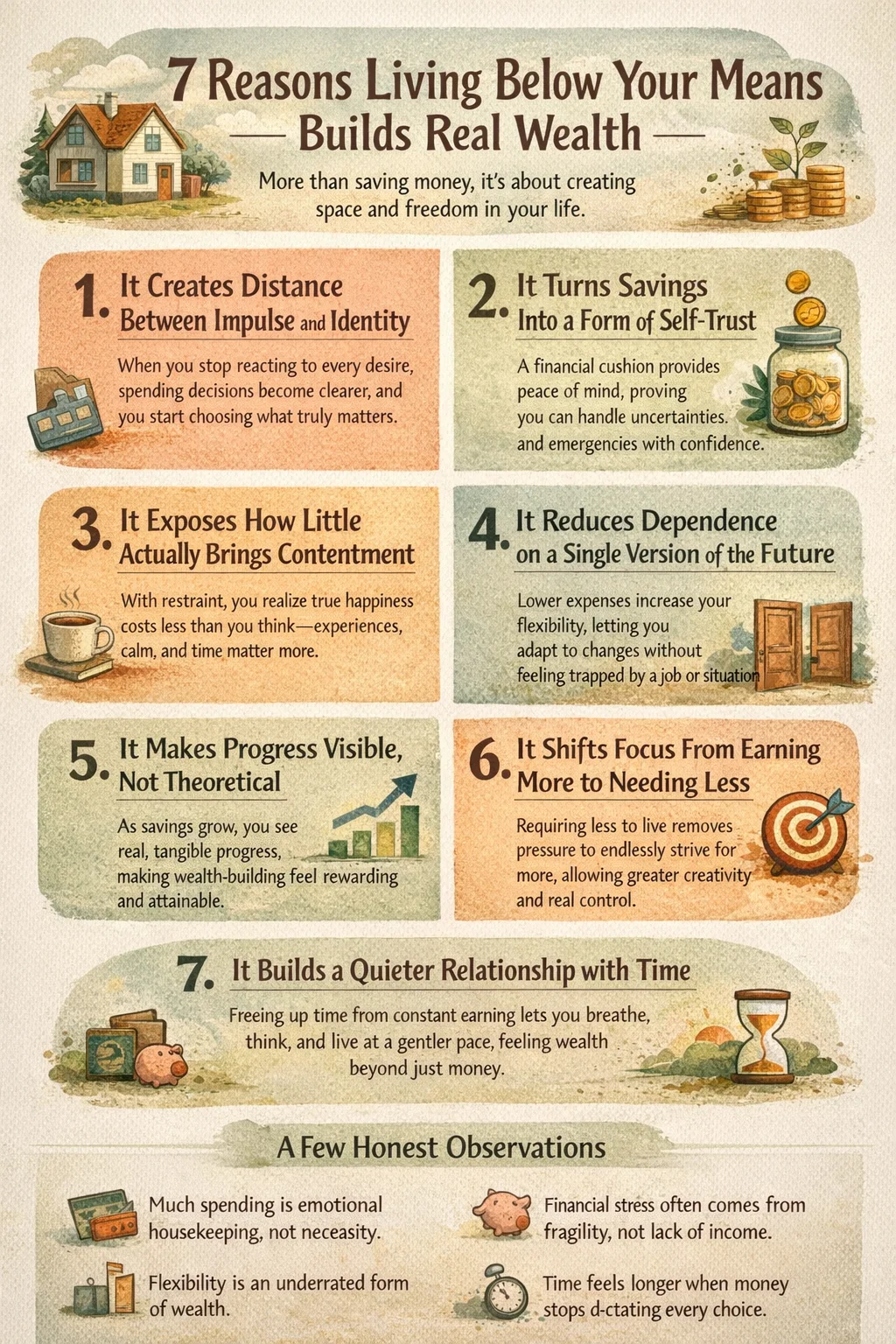
What follows aren’t rules. They’re patterns I’ve noticed, sometimes only in hindsight, about why this way of living tends to build real wealth. Not just money, but a steadier kind of security that doesn’t vanish when circumstances change.
1. It creates distance between impulse and identity
Most spending decisions happen quickly. Too quickly. A feeling rises, an object promises relief or status or comfort, and the gap between wanting and buying is barely there. When you live below your means, that gap widens. At first it feels awkward, even uncomfortable. But over time, something subtle shifts.
I’ve noticed that when money isn’t constantly spoken for, I don’t have to prove who I am through what I buy. The urge to keep up, to signal success, softens. You start to realize how much spending was about identity management rather than need. That realization alone changes behavior without effort. You’re no longer reacting. You’re choosing, and that choice carries quite a power.
2. It turns savings into a form of self-trust
Saving money is often framed as deprivation now for reward later. That framing never worked for me. What did work was noticing how savings changed the way I moved through ordinary days. With a buffer, small problems stayed small. A broken appliance didn’t become a crisis. A slow month didn’t trigger panic.
Living below your means makes savings inevitable, not heroic. And those savings become evidence. Proof that you can handle uncertainty.
3. It exposes how little actually brings contentment
There’s a strange honesty that comes from restraint. When you stop automatically upgrading your lifestyle with every increase in income, you begin to see which expenses actually improve your days and which ones simply decorate them. Some purchases quietly earn their place. Others fade into the background almost immediately.
In my experience, contentment has a surprisingly low price tag. Time, calm mornings, flexibility, a sense of control. None of these requires constant spending, but they do require a margin. Living below your means creates that margin and, in doing so, teaches you what you value without you having to articulate it.
4. It reduces dependence on a single version of the future
Many people live exactly at their means because they’re betting on continuity. The job will remain. Health will cooperate. Income will arrive on schedule. Usually it does, until it doesn’t. Living below your means introduces optionality. A concept borrowed from finance, but deeply human in practice.
When expenses are lower than income, you’re not locked into one narrow path. You can step away, slow down, change direction. I’ve seen how this flexibility alters decisions long before it’s ever used. You’re less likely to tolerate environments that drain you when you know you’re not trapped. That freedom is a form of wealth few spreadsheets capture.
5. It makes progress visible, not theoretical
Living at the edge of your income creates a strange illusion of motion. Money comes in, money goes out, and despite all the activity, nothing seems to move forward. When you live below your means, progress becomes visible. Balances grow. Options appear. Time horizons extend.
I’ve found that seeing progress, even modest progress, changes motivation in a quiet way. You don’t need constant encouragement when evidence accumulates naturally. Wealth, in this sense, isn’t a finish line. It’s the relief of knowing you’re no longer running in place.
6. It shifts focus from earning more to needing less
There’s nothing wrong with ambition. But there’s a hidden cost to believing more income is the only solution. It places all control outside yourself. Living below your means brings some of that control back. You realize how powerful it is to lower the bar of necessity rather than endlessly raise the bar of income.
In practice, this shift eases pressure. You still work, still grow, but the urgency softens. I’ve noticed creativity returns when survival is no longer the primary concern. Better decisions tend to follow, not because you’re trying harder, but because you’re less constrained by fear.
7. It builds a quieter relationship with time
Money and time are more connected than we like to admit. High expenses demand constant income, which demands constant availability. Living below your means loosens that loop. You reclaim small pieces of time. An afternoon without guilt. A morning without rush. These moments don’t announce themselves as wealth, but they feel like it when you’re living them.
Over years, this changes how life feels. Less compressed. Less frantic. People who live below their means often seem calmer, not because they’re detached from ambition, but because they’re no longer trading tomorrow’s peace for today’s appearance.
A few honest observations
- Much spending is emotional housekeeping, not necessity.
- Financial stress often comes from fragility, not lack of income.
- Flexibility is an underrated form of wealth.
- The gap between want and need is where clarity lives.
- Time feels longer when money stops dictating every choice.
End Words
In the end, living below your means isn’t about restriction. It’s about space. Space to think, to choose, to adapt. Real wealth, I’ve come to believe, isn’t loud. It doesn’t announce itself through upgrades or milestones. It shows up quietly, in the form of fewer worries and more room to breathe.