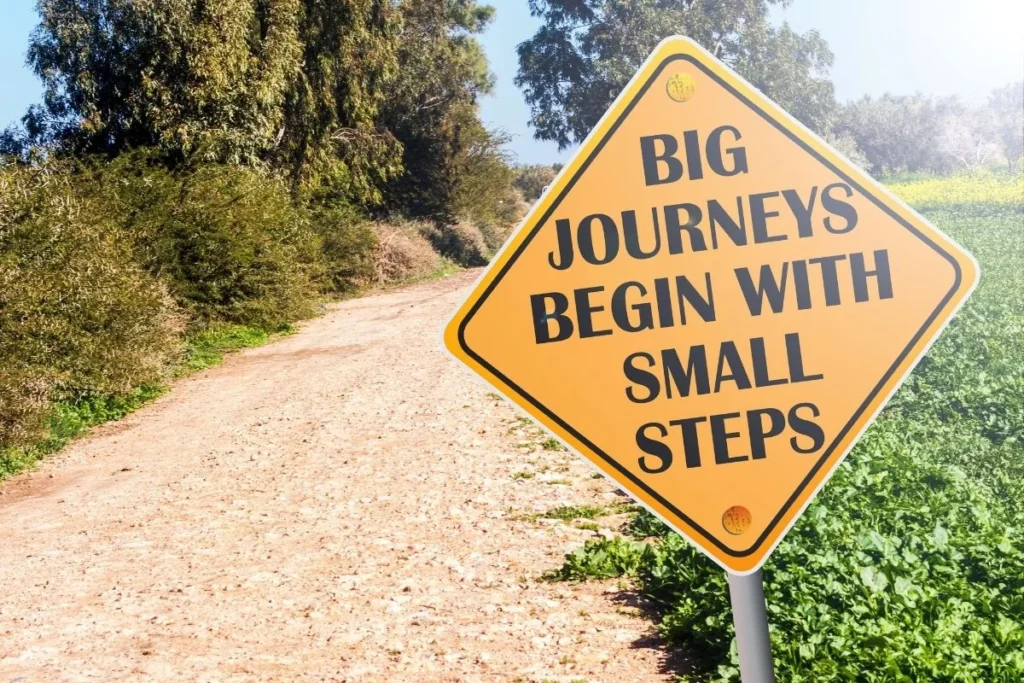
7 Reasons Big Changes Start With Small Steps In Real Life
People wait. They wait for the right day, the right mood, or some sign from the world that says: now is the time. They look at the big goal and feel a kind of weight come over them. Not lazy, not bad. Just heavy. Like the air got thick and the path got long before they even took the first step.
The gap between where a person is and where they want to be is real. It is wide. And most of the time, the only plan they have is to jump over it in one go. To make the big move. The bold call. The clean break. But that jump, almost every time, ends in the same place. Back where they started. A little more tired, and a little less sure of what they are made of.
What no one tells you, what gets lost in all the talk of big goals and bold plans, is this: the gap does not close by one big leap. It closes one small step at a time. Not as a nice idea, not as soft advice, but as a fact. A deep, quiet, real fact that lives in how the mind works, how the self holds its shape, and how change actually gets in without being kicked out.
There are seven reasons for this. Most are not said in the open. Most are not on any list of tips or in any plan. But they are true. And once you see them, you cannot unsee them.
Why the Mind Fights Big Change From the Start
Before the seven reasons are laid out, it helps to understand one thing. The mind is not a tool built to help you grow. Not first. The first job of the mind is to keep you safe. Not free. Not great. Safe.
This one fact changes how you read every act of will you have ever made and lost. It changes why New Year plans die in week two. Why big bold starts fade into old ways. Why people who want change badly still do not get it. Not from lack of care, but from how the mind greets what it sees as risk.
Change is risk. To the mind, any move from what is known to what is not known is a risk. That is just how it reads things. And when risk shows up, the mind puts up a wall. It does not care if the change is good for you in the long run. It only knows what is safe right now, and right now, the old way is safe and the new way is not.
This is where small steps come in. Not as a soft trick. As a real way past the wall.
Reason 1: Fear Lives in the Size of the Step, Not the Size of the Goal
Here is the first reason, and it is one that most experts never say out loud.
The brain does not fear big goals. It fears big moves. Those are not the same thing. A person can hold a big goal in their head and feel fine. It is far away. It is a dream. It has no threat yet. But the moment that goal turns into a real act, a real step, a real change in what is done today, the brain checks the size of that act and decides if it is safe.
Big act. Not safe. Wall goes up.
Small act. Too small to flag. Wall stays down.
This is not a small point. This is why two people can want the same thing and one of them gets it and one does not. It is not will. It is not how much they want it. It is whether the first move they tried to make was big or small. The one who went small slipped past the guard. The one who went big got stopped at the door.
The part of the brain that reads threat is old. Very old. It was shaped in a time when new was not a sign of hope. New was a sign of risk. New food might hurt. New path might lead to harm. New act might cost you your life. That part of the brain does not know you live in a safe house with food in the cold box. It still runs on old code.
So when you try to change your whole life in one week, that old code fires hard. It sends a signal, not as a loud voice but as a feeling. Dread. Tired. Bored. “This is not me.” A want to go back. All of that is the brain doing its job. Not your enemy. Just old code run in a new world.
One push up. One page. Five minutes of the new thing. That is what gets past the code. Not because it is wise in some soft way. But because it is below the line the brain checks. Too small to flag. Too safe to stop.
Over time, the small act gets done again. And again. The brain sees this is not a threat. It stops checking. The path gets clear. And then the small act grows, not by force, but by the brain letting it grow now that it knows this is safe. That is not a trick. That is the real door.
Reason 2: A New Self Cannot Be Pushed In, Only Grown Slow
This one is quiet and hard to name but it might be the most real of all.
Every person holds an image of who they are. Not just who they want to be, who they are right now. And this image is held deep. Not on the top of the mind where you can see and change it. Deep in the place where words do not reach so easy.
This image runs the show in ways that are hard to see. If the image says: this is a person who does not wake up early, then every plan to wake up early will hit a wall from the inside. Not from lack of want. From the image that says: that is not who this is.
Big changes ask this image to shift fast. To go from one thing to a very different thing in a short time. And the image does not like that. It fights it. Not with a voice. With a pull. A pull back to the old way, to the old self, to the one that feels real even when it is not the best.
Small steps work because they do not ask the image to change. Not at first. They just ask for one small act. And that act, if it is done, becomes a fact. The image can fight want. It can fight plans. But it has a hard time fighting what has already been done.
“I did this.” That is a fact. The image cannot undo a fact. It can try to say it was a one time thing. But if it keeps being done, day after day, the image starts to crack at the edge. Not from a push. From the weight of real truth.
This is what people mean when they say change comes from doing, not from thinking about doing. It is not just a nice line. It is how the self image gives way. Not to force. To the slow, quiet proof that something has already changed.
Most who try to change their lives try to fix the image first. They try to believe they are new before they have done anything new. And that does not work, because the mind knows the truth. It knows what has and has not been done. But start doing small things, real things, and the image has no choice but to start to catch up to what is true.
Reason 3: Small Wins Build a Loop the Mind Wants to Go Back To
The mind runs on a loop. This is not a new idea. It has been said by those who study the brain, those who study habit, those who study how humans act day after day. The loop is simple. A cue starts it. An act follows. A reward ends it. And the mind wants to run that same loop again.
This is not weak will. It is not a flaw. It is how the brain saves work. If it had to think about every small act from the start each time, it would tire out in an hour. So it builds loops. And once a loop is built, it runs with far less effort than the first time.
The problem with big goals is that the reward is far. The work is hard now, the win is later, and the brain does not do well with that gap. It needs the signal soon. Not weeks from now. Not when the whole plan is done. Soon. Or it will look for the signal somewhere else, somewhere easy and close, and that is where the old habit is waiting.
Small steps give small wins. Fast. Not huge wins. Just enough. Just the small feeling of: I did the thing. I said I would and I did. That feeling, even when tiny, is a real signal to the brain. “This path is good. Come back here.” And so it builds the loop.
Once the loop is built, it does not need will each day. It just runs. This is the point where change starts to feel easy, or at least easy enough. Not because the person got stronger. Because the loop took over.
Most people try to build a new life on will alone. Will is real, but it is also a thing that drains. It gets used up. By the end of a hard day, there is not much left. And that is when old loops win, because they do not need will. They just run.
Small steps build new loops. New loops do not need will to run. That is the trade. Not easy today for hard forever. Hard today, less hard next week, and then it just runs.
Reason 4: The Mind Treats Small Change as a Add, Not a Loss
Change is loss. This is the part that most plans ignore, and it is a big part of why they fail.
When a person changes, they do not just gain the new thing. They lose the old thing. The old habit. The old way of spending time. The old self that knew how to be in that life. And loss, even the idea of loss, hits the brain hard. Harder, in fact, than a gain of the same size. The mind weights loss more than it weights gain. This has been shown by those who study how people make choices, and it is felt by anyone who has tried to quit a bad habit and felt the pull of it long after the reason for quitting was clear.
Big plans ask for big loss. “Stop this. Give up that. Let go of this old part of your life.” And the mind sees all that loss at once. It grabs hold. It says no. Not with words, but with drag. With the kind of tired that shows up for no clear reason. With the want to go back.
Small steps ask for almost no loss. They are an add, not a take. One small new thing, added to the day. Nothing taken yet. The old life is still there, intact. The old self is not gone. Just, one small new act has been added to the mix.
This is how small steps get past loss fear. They do not ask the mind to give up anything. Not today. They just ask for one tiny add. And the mind, which fights loss hard, does not fight a small add. It lets it in.
Over time, the small adds stack up. They take space. And slowly, not all at once, the old things get crowded out. But by the time that happens, the new things are already real. Already looped. Already part of the self image. The mind never had to face a big loss. It only ever saw small adds. And that is how the whole life shifted.
Reason 5: Small Steps Lay Proof Before Doubt Can Argue Back
Self doubt is fast. It does not wait for facts. It runs ahead of you, far ahead, and fills in the end of the story before you have even started it. You will fail. You have done this before. You know how this ends. It says all of this in a quiet but firm voice, and it says it before any step has been taken.
The natural response is to argue back. To tell the voice it is wrong, to push it away, to find the right words to shut it up. But self doubt does not respond well to argument. It gets louder when pushed. It finds more proof. It brings up the last time and the time before that and the time before that. It is very good at its job.
The only real way to deal with self doubt is not to argue with it. It is to show it proof that it is wrong. Not with words. With acts. Small, real, done acts.
One walk. One page. One day of the new choice. These are not big wins. They will not end self doubt on their own. But they are facts. Real ones. And the voice of doubt cannot hold up to a long line of real facts. Not for long.
Each small step is one brick of proof. One alone does nothing. Two do a little. But lay them one by one, day after day, and a wall gets built. A wall of: look at what has already been done. And that wall is what doubt, over time, breaks on.
This is why those who go slow and small so often end up going further than those who go fast and big. The fast big start leaves no proof behind it, only the memory of how hard it was and how far there is to go. The slow small start leaves a long trail of real done acts. And that trail is the most real thing a person can point to when the doubt voice starts to speak.
Reason 6: Tiny Acts Give the New Self Time to Feel Real Before It Quits
Here is something that does not get said very often, but it is true and it matters.
When a person changes, even to something they want, it feels strange. Not bad, not wrong, just strange. Off. Like wearing new shoes that are the right size but still need a few days of use to stop feeling stiff. The new way of being in the world has not had time to settle. It sits on the outside, not yet worn in.
And if that strangeness comes on too fast, too big, too all at once, it is more than the mind can hold without a strong push back. The strange feeling gets read as: this is not me. This does not fit. Go back. And most of the time, back is where the person goes.
Big fast changes hit this wall hard. The shift is too much too fast. The new self has had no time to get used to the air. No time to try on small parts of the new way and see how they feel before the whole thing has to change at once.
Small steps give time. They let the new self show up in small bits. Try a little of the new way. See how it feels. Get used to it. Come back tomorrow and do it again. No shock. No big sudden shift that feels fake or unsafe. Just a slow, real grow.
This is why slow change holds. Not because slow people are more careful or more smart. But because the mind was given time to adjust. The new way got to feel real before it had to carry weight. The new self had time to find its feet before it had to run.
Fast change skips this step. It lands the new self in a new life with no warm up, no time to adjust, and the mind that is still trying to figure out if this is safe. And in that state, the first hard day, the first moment of doubt, the first time the old way calls, it wins. Because the new way has not had time to feel like home yet.
Small steps make the new way feel like home. One small bit at a time, over time.
Reason 7: Small Steps Move Below the Line the Mind Watches
This last one is the quietest. And in a way, the most clever, not by design but by nature.
The mind does not watch everything we do. It could not. There is too much. So it has a line. Acts that are big, new, or hard get watched. Get checked. Get meet with some level of push back or at least some level of note. Acts that are small, easy, or feel like nothing fly right past that line with no check at all.
Small steps live below that line. They feel like too little to count. Too small to log. Not worth the mind’s time to flag or fight. So they run. Day after day, with no wall, no alarm, no voice that says: this is change, this is risk, pay close note.
And then, one day, the small thing has been done so many times that it is just part of the day. Not a goal any more. Not an act of will. Just a thing that gets done, the way a cup of tea gets made in the morning. It was never announced. It never had a big start. It just slipped in under the line, got done day after day, and now it is part of the life.
This is the most secret move of all. Not because it is complex, but because it asks so little of the person doing it. Most change asks for a lot. This asks for just enough to be below the line. And in return, it gives the most durable kind of change there is. The kind that took root so quiet that even the self does not remember a time before it.
What All of This Adds Up To
Change does not fail because people do not want it. Most who fail want it badly. Change fails because of how the mind meets it. Too fast, too big, too much at once. Too much loss in sight. Too little win in hand. Too strange too soon. Too loud for the brain not to flag.
Small steps do not fight the mind. They work with it. They go past fear, past loss, past doubt, past strangeness, past the watch line. They build loops and proof and a slow new self image. They do all of this, and the mind does not even see it coming until it is already done.
That is not a trick. That is just how things change in real life.
Key Truths Worth Holding On To
- Fear is tied to the size of the act, not the size of the goal
- The self image fights big shift but lets small acts in
- The brain needs fast small wins or it will stop and go home
- Loss fear kills big plans before they leave the ground
- Proof is what beats doubt, but only when it is real and done
- New ways need time to feel true before they can last
- The best kind of change is the kind the mind does not see until it is already in
To End
There is an old idea that says the way to eat something big is one small bit at a time. That is true. But the real reason it works is not just that big things need parts. It is that the mind, the self, the whole of who a person is, only lets in what it feels is safe.
Small steps feel safe. So they get in. And once they are in, they grow.
There was a writer who said: a small daily task, if it be really daily, will beat the work of one who works only now and then. That man wrote more books in his life than most read in a decade. Not by one great day. By small ones. Done. Each day.
The door to change is small on purpose. Walk through it small. Grow on the other side.