
10 Time Management Techniques That Make You Successful in Less Time

There’s a quiet tension in watching the day slip past while your intentions sit untouched on a page. I’ve often found myself staring at the clock, wondering how hours dissolve into fragments of tasks and half-formed plans. Time management, I’ve realized, isn’t about forcing more into the day, it’s about noticing what already occupies it, what quietly drifts, and what deserves the small, sharp focus of attention. Over years of work, mistakes, and reflection, I’ve begun to see patterns in how some days stretch, and others vanish, and how some approaches allow you to move meaningfully without feeling rushed.
These ten practices are not commandments. They are observations drawn from living a life that often felt too busy and too scattered, yet eventually learned to bend toward clarity. Each one feels ordinary at first, but in its subtleties lies a kind of quiet leverage.
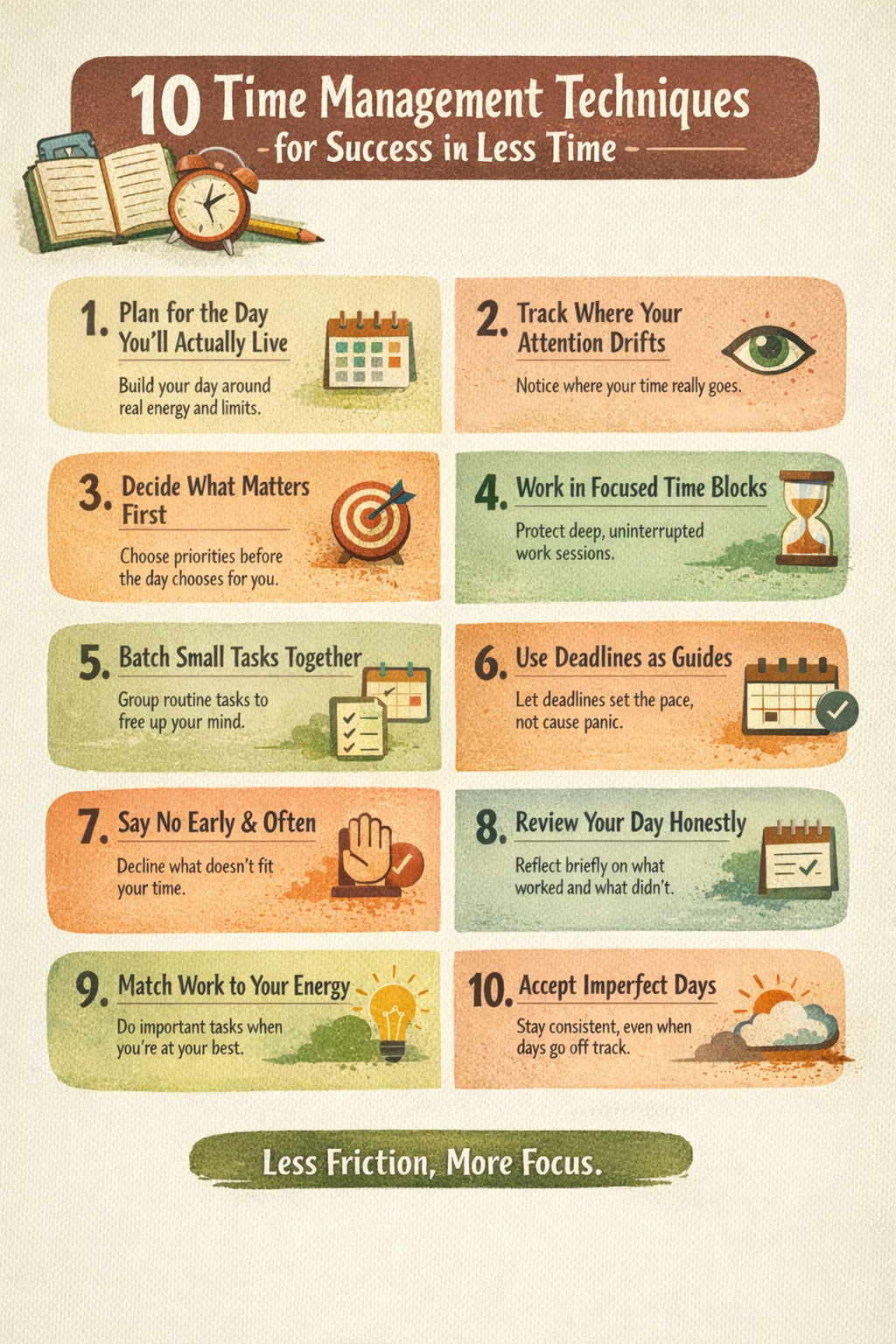
1. Begin With the Day You Actually Have
I used to plan mornings like I had no interruptions, no tiredness, no human frailty. But life rarely unfolds in perfect sequences. I noticed that the days I allowed for unpredictability, pauses for a child’s question, a forgotten email, a cup of tea gone cold, felt longer, fuller, less wasted. Accepting the day as it is, rather than as I wish it to be, slowly reshapes how I use its hours. There’s a gentle power in aligning intention with reality rather than wrestling with it.
2. Notice Where Your Attention Leaks
We all know distractions exist. But the more dangerous ones are invisible, small, tiny habits that siphon minutes without protest. Checking a phone “just once,” lingering in meetings that aren’t necessary, or letting email decide the rhythm of the morning quietly erodes energy. Simply noticing these leaks doesn’t require heroic self-discipline; it requires curiosity. I’ve kept a quiet log of these moments and, over weeks, discovered the invisible currents that shape my days far more than any plan ever could.
3. Give Importance a Shape
Not everything that is urgent deserves your focus. Early in my career, I equated movement with progress. The truth is, only a few tasks actually matter. I’ve learned to physically map priorities to see them on paper, in a notebook, or even on a small whiteboard and let the eyes linger on what’s truly consequential. Something about seeing it in space, rather than in the mind, makes decisions easier and energy less scattered.
4. Embrace the Quiet Blocks
I’ve tried filling every empty moment with work, thinking productivity was proportional to constant action. Yet, the days I carve out quiet blocks, sometimes just 20 minutes with nothing but a notebook, end up producing far more insight and momentum. These blocks aren’t breaks; they are the structural core of attention. They allow ideas to breathe, decisions to settle, and fatigue to dissipate. There’s a subtle paradox here: doing less in concentrated stretches often achieves more.
5. Say “No” Without Drama
It took me years to see how many hours I gave away to obligations that didn’t matter. Learning to decline, without guilt or elaborate explanation, is an understated technique. I’ve watched how saying “no” can protect the most fragile and valuable resource time for reflection, for creation, for the work that truly sustains you. It’s not heroic; it’s practical.
6. Track Time With Curiosity, Not Judgment
I’ve kept timers, logs, and notes, not to chastise myself but to understand rhythms. Some days surprised me with moments where work flowed easily; on others, hours passed in a blur, busy but strangely empty. Observing without judgment transforms frustration into insight. I no longer fight the clock; I study it, like an old acquaintance whose habits I want to understand.
7. Batch the Ordinary, Preserve the Exceptional
Routine tasks, emails, errands, and small administrative chores can easily dominate the mind. I’ve found that grouping them into single stretches rather than scattering them across the day preserves mental space for the work that matters. The extraordinary, unpredictable moments, the insights, the conversations, the bursts of creation deserve the full width of attention. Treating them as sacred doesn’t happen naturally; it’s a deliberate shaping of the day.
8. Let Deadlines Guide, Not Panic
Deadlines have always felt like both saviors and tyrants. I’ve noticed that when I treat them as gentle contours rather than urgent alarms, work flows more steadily and stress diminishes. A looming date can focus energy if seen as a guidepost, not a whip. The calm, deliberate pace of moving toward a known point often achieves more than frantic sprints of last-minute effort.
9. Reflect on the Day, Not Just the Task
Evenings have become a quiet ritual: a few minutes to notice what actually happened, not just what I hoped to do. I reflect on small victories, odd failures, and where attention wandered. These reflections don’t offer immediate fixes, but over months, they reveal patterns invisible in the daily rush. Time management isn’t a checklist; it’s a conversation with yourself about how life flows, where energy gathers, and where it leaks away.
10. Accept the Imperfect Flow
I’ve learned to recognize that no system is perfect. Some days will slip, some intentions will fail. There is freedom—and paradoxically, productivity in accepting this. Trying to impose rigid control often creates more friction than clarity. A gentle, human rhythm, attentive but forgiving, allows momentum to build naturally, without exhaustion or self-reproach.
Key Observations
- Real control comes from noticing your day, not from imposing rules on it.
- Attention is more precious than time itself; how it moves determines results.
- Quiet reflection often yields more clarity than constant action.
- Saying “no” is a signal of self-respect, not selfishness.
- Deadlines are useful when treated as guidance, not pressure.
Conclusion
Time, I’ve realized, isn’t something to conquer. It’s something to converse with, to understand quietly, and to shape without forcing. In the end, the techniques themselves are secondary to the act of noticing: noticing how life occupies hours, how energy rises and falls, how moments of stillness often hold the richest returns.
As Seneca once wrote, “It is not that we have a short time to live, but that we waste much of it.” Perhaps the greatest mastery lies not in filling every moment but in quietly tending the ones that matter most.