
Albert Einstein IQ Test: Take the Free Genius Intelligence Quiz
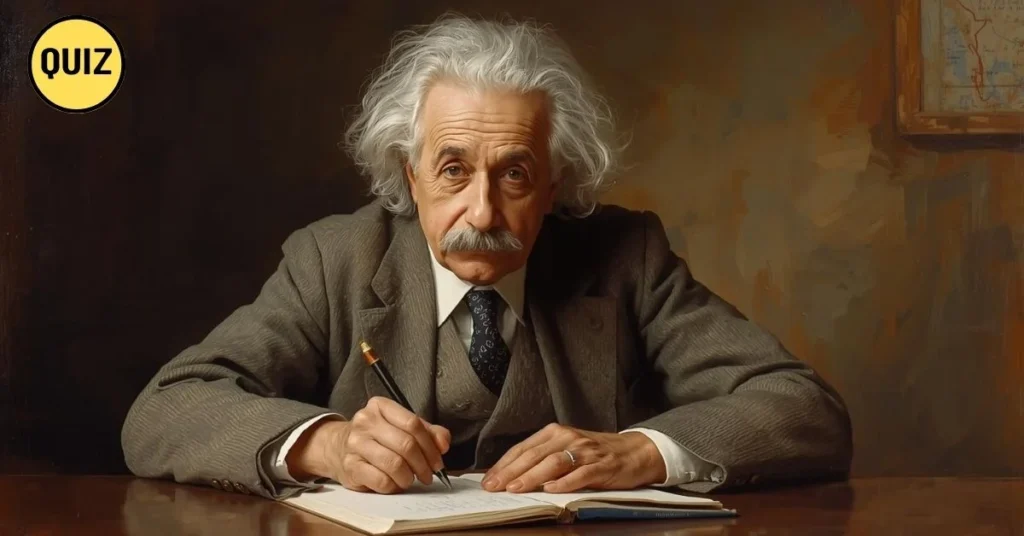
Albert Einstein IQ Test
This free Albert Einstein IQ test on UniverseCover.com is designed to measure your logical reasoning, abstract thinking, and problem-solving ability using modern principles of IQ testing.
👉 No signup. No tricks. Just a scientifically inspired intelligence test that has basic iq questions with answers and optical illusion images that trick your brain!
Albert Einstein: Life and Achievements
He was born in 1879 in Germany and lived for 76 years, passing away in 1955. Albert Einstein revolutionized our understanding of time, space, and physics. He developed the Theory of Relativity, formulated the famous equation E = mc², and won the Nobel Prize in Physics, earning worldwide recognition as a symbol of genius.
IQ Test of Albert Einstein – Core Facts
Although Einstein never took a formal IQ test and no scientific record exists, estimates of his intelligence vary widely. Popular sources often cite an iq of Albert Einstein of around 160, while historical estimates range from 150 to 207.
- IQ significance:
- IQ above 140 is generally considered genius level.
- Average adult IQ: 85–115.
- A score of 160 would place someone in the top 0.0032% of the population (1 in 31,250 people).
- Claims of an IQ of 400 are purely mythical.
IQ Comparison Table
| Person / Group | Estimated IQ | Notes / Context |
|---|---|---|
| Albert einstein iq score (popular press) | ~160 | Commonly cited, speculative; no formal test ever taken |
| Albert Einstein (historical estimates) | 150–207 | LIFE magazine 1945: 205; LIFE 1954: 192; Popular Mechanics 1962: 207; Moore & Frost 1986: 200; Cohen 2002: above 180; Gladwell 2008: 150 |
| Average adult | 85–115 | Standard IQ range for general population |
| Genius threshold | >140 | IQ generally considered “genius level” |
| Einstein’s population percentile (~160) | Top 0.0032% | 1 in 31,250 people |
| Historical geniuses (Darwin, Freud, Shaw, Pasteur) | 180–200 | Approximate comparisons based on historical estimates |
| Modern child prodigies (examples) | >160 | Includes Adhara Maite Pérez Sánchez, British Mensa prodigies; often cited by media |
| Mythical claims | 400+ | Impossible; no human has ever scored this high |
Understanding IQ (Intelligence Quotient)
IQ, full form Intelligence Quotient, is a measure of a person’s problem-solving, logical reasoning, and pattern recognition skills.
Historically, IQ was calculated using the formula: IQ=chronological agemental age×100
For example:
If your mental age is 10, then your iq is 100, and if 15 than your IQ is 150.
FAQs
What was Einstein’s iq?
There is no official record showing that Albert Einstein ever took a modern IQ test. The number often mentioned online, usually around 160, is only an estimate. During his lifetime, standardized IQ testing was not used as it is nowadays.
What is Albert Einstein famous for
Einstein became well known because of this equation, E = mc², which changed the way we understand energy, mass, space, and time. He is also well known for winning the Nobel Prize in Physics for his work on the photoelectric effect. Over time, Einstein became a global symbol of curiosity, intelligence, and intellectual brilliance.
Is this Einstein IQ test Accurate?
This test works in all ways, in accuracy, but in a fun way, improve your thinking ability, designed to measure logical reasoning, pattern recognition, and analytical thinking in a structured way. While it can give you a strong idea of your problem-solving ability, it is not a clinical or officially supervised IQ assessment. It works best as a cognitive challenge and a way to test your reasoning skills in an engaging format.
Why is this iq test better than other IQ tests?
This IQ test focuses on clear logic, structured reasoning, and carefully selected questions rather than random trivia or misleading puzzles. The goal is to challenge how you think, not to confuse you. It gives you a meaningful mental workout while keeping the experience enjoyable and easy to follow.
Resources
https://en.wikipedia.org/wiki/Albert_Einstein