5 Small Habits That Will Change Your Life in 30 Days

Well, here is something nobody told me for years.
Big life changes do not come from big dramatic moments.
They come from tiny habits repeated on boring ordinary days.
I used to wait for motivation to strike like lightning.
It never did, so I stayed exactly the same for years.
Then I tried an experiment that felt almost too small to matter.
Five tiny habits, thirty days, no excuses.
By day thirty I did not just feel different.
I was different, in ways my friends noticed before I did.
The short answer: Five small habits can change your life in thirty days: tidy for two minutes, read ten pages, walk twenty minutes, journal three lines, and keep your phone away for the first thirty minutes of the day.
1. Make Your Bed and Tidy for Two Minutes
This habit sounds silly until you try it for a week.
Your bed is the first thing you touch each morning.
Making it is your first finished task of the day.
That one win sets the tone for every win after it.
Then set a timer for two minutes and tidy one surface.
Your desk, the kitchen counter, or the bathroom sink.
Two minutes is too small to argue with.
You cannot say you have no time for two minutes.
A woman I know started with just this habit.
Within two weeks she had cleaned her whole flat in two-minute pieces.
She told me her mind felt quieter in tidy rooms.
Outer order really does calm inner chaos.
2. Read Ten Pages Every Day
Ten pages sounds like nothing, and that is the point.
Most people quit reading because they aim for one book a week.
Ten pages a day is three thousand six hundred fifty pages a year.
At an average of two hundred fifty pages per book, that is about fourteen books a year.
Fourteen books can teach you more than most college courses.
Read what helps your actual life right now.
Money, health, skills, or calm, pick your current battle.
Keep the book where you will trip over it.
On your pillow, by your coffee cup, or in your bag.
I read ten pages with my morning tea for the last year.
It added up to eleven books I would never have finished otherwise.
Small pages, big brain.
3. Walk Twenty Minutes After Lunch
The hour after lunch is when most people crash.
Your energy dips, your eyes get heavy, and your focus dies.
A twenty-minute walk fixes all three problems at once.
Sunlight tells your brain it is still daytime.
Movement wakes up your blood and your mood.
Fresh air clears the fog that food and screens create.
You do not need sportswear or a plan.
Just step outside and walk in any direction.
Leave your headphones at home twice a week.
Let your mind wander, because wandering minds solve problems.
Some of my best ideas arrived on boring walks around the block.
Twenty minutes is one short episode of a show.
Trade the episode for the walk and watch your afternoons change.
4. Write Three Lines in a Journal at Night
Journaling sounds heavy until you shrink it to three lines.
Line one: one good thing from today.
Line two: one hard thing from today.
Line three: one thing you want tomorrow.
That is the whole habit, and it takes three minutes.
Three lines force your brain to sort the day.
You stop carrying vague stress and start seeing clear facts.
Over thirty days those lines become a map of your life.
You will spot patterns you never noticed.
Maybe every bad day starts with no sleep, or every good day includes a walk.
A friend of mine found through journaling that his worst days always followed late heavy dinners.
He changed one meal and his evenings transformed.
Your journal knows things about you that you do not know yet.
5. Keep Your Phone Away for the First Thirty Minutes
The first thirty minutes of your day set your brain’s channel.
If you start with news and messages, you start in reaction mode.
Reaction mode means other people run your morning.
Charge your phone outside your bedroom tonight.
Buy a cheap alarm clock if you need one.
When you wake up, do not touch your phone for thirty minutes.
Drink water, stretch, make your bed, look out the window.
Let your own thoughts load before the world’s noise does.
Research on attention shows it can take over twenty minutes to fully refocus after a distraction.
Morning scrolling is not one distraction, it is fifty in a row.
No wonder phone-first mornings feel scattered by nine.
Guard your first thirty minutes like treasure.
They decide the quality of the next sixteen hours.
Your Thirty-Day Tracker
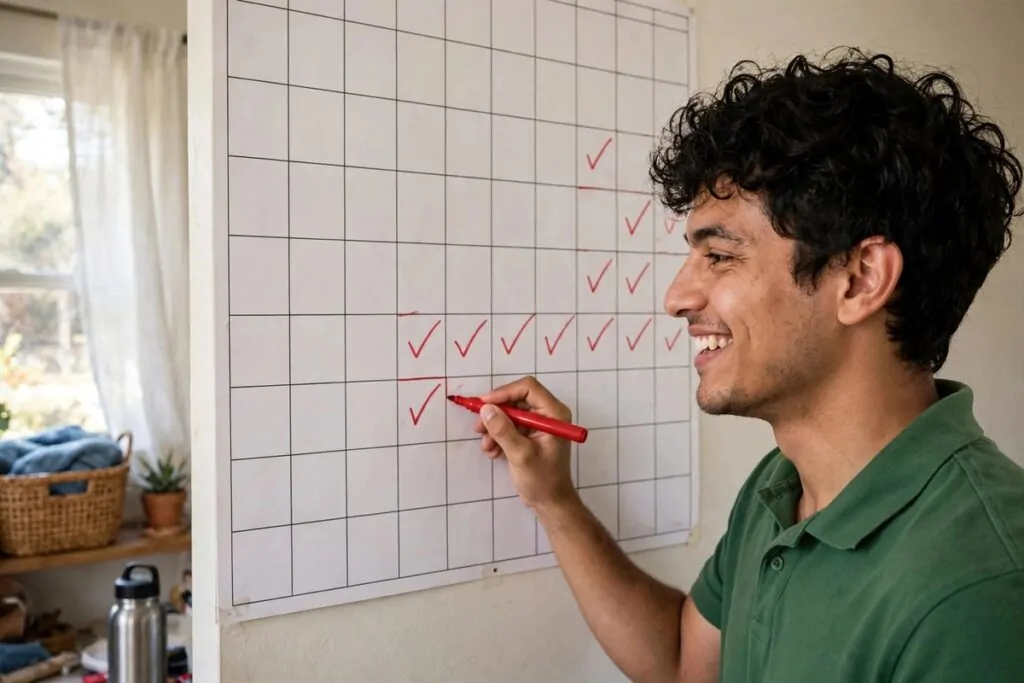
Print this table or copy it into a notebook.
Tick each habit daily and watch the rows fill up.
| Week | Focus | Daily check |
|---|---|---|
| Days 1 to 7 | Just start | Bed made, 10 pages, 20-min walk, 3 journal lines, 30 phone-free minutes |
| Days 8 to 14 | Find your rhythm | Same five, note which feels easiest and which feels hardest |
| Days 15 to 21 | Push through the dip | Same five, allow one miss per habit without guilt |
| Days 22 to 30 | Lock it in | Same five, write one line about what changed in you |
Thirty Days That Surprised Me
Let me tell you what really happened in my thirty days.
Days one to five felt easy and a little exciting.
Days six to ten were the worst, and I wanted to quit twice.
My brain kept saying these tiny habits could not matter.
On day eleven something small shifted.
I caught myself making the bed without thinking about it.
That is when I understood how habits really work.
They stop being chores and start being just who you are.
By day twenty my afternoons had real energy again.
By day thirty my journal showed a pattern I had missed for years.
I am sharper, kinder, and calmer on days I walk after lunch.
Thirty days did not give me a new life.
They gave me proof that I can build one.
FAQ
What if I miss a day in the thirty days?
Then you are human, so just start again the next morning.
One missed day changes nothing, but quitting changes everything.
Never miss twice in a row, that is the only real rule.
Can I add more habits to the five?
Not in the first thirty days, because focus is the whole trick.
Five small habits done daily beat ten habits done sometimes.
Add a sixth habit in month two if you want.
Do these habits really work in only thirty days?
Thirty days builds strong momentum, though full automatic habits take longer.
One well-known study found new habits take about sixty-six days on average to feel automatic.
Think of thirty days as the launch, not the landing.
Which habit should I start with if five feels like too many?
Start with the two-minute tidy, because it is the smallest.
Win there for one week, then add the walk.
Stack them slowly and they will all stick.
Day One Is Today
You do not need January first or a perfect Monday.
You need today, five tiny habits, and thirty days.
Make your bed right now.
That is day one, already started.