
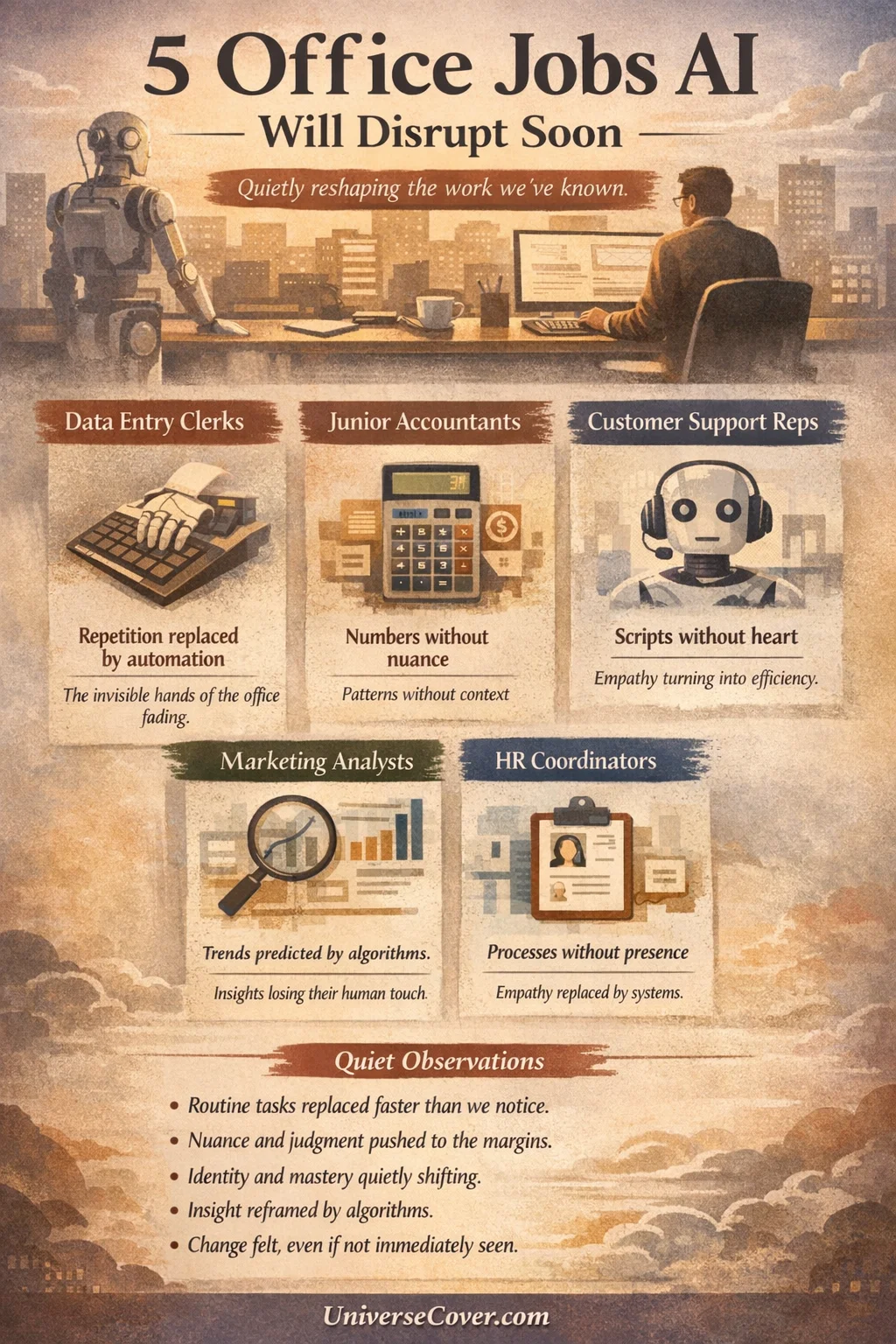
5 Office Jobs AI Will Disrupt Soon

There’s a quiet hum in most offices these days. It isn’t the clatter of keyboards or the low drone of fluorescent lights it’s something subtler, almost imperceptible, like the feeling that the routines we’ve relied on might not last forever. I’ve noticed it in small ways: a colleague pausing mid-email, a manager hesitating over a report, a shared glance in the break room that says, without words, “Is this still ours to do?” It’s strange to sit at a desk that feels both familiar and, at the same time, quietly uncertain.
The rhythm of office life for years, not as an outsider but from the inside, noticing patterns that only emerge after enough mornings spent staring at the same spreadsheets. Some of the work we take for granted tasks we consider unshakable pillars of daily business are the ones most fragile. And lately, the shadow hovering over these tasks has a name: AI. Not the dramatic, science-fiction kind, but the subtle, practical kind that slides into systems, automates, predicts, and eventually renders certain routines almost invisible.
It’s not an abrupt ending. It’s a slow, creeping awareness that some of the roles we thought defined us are changing in ways we can’t entirely control. You may have thought a lot about which roles might feel that shift first not because I want to warn anyone, but because I’ve seen it start, and I recognize the quiet human impact behind the algorithms. Here are five office jobs that, in my experience, are already feeling AI’s subtle reshaping.
1. Data Entry Clerks: The Invisible Hands
It’s easy to forget that for decades, data entry clerks were the silent backbone of almost every organization. Spent mornings watching rows of numbers, watching people type with a focus so intense it borders on meditation. There’s a rhythm to it, a cadence that feels almost human. And yet, what I’ve realized is that the very things that make this work steady repetition, predictability, rules also make it remarkably easy for a machine to replicate.
I remember a conversation with someone who had done data entry for over fifteen years. They spoke of the small satisfactions: catching a typo, recognizing patterns in the mess of numbers, feeling competent in a world that often overlooked them. Now, AI systems can parse forms, reconcile numbers, and even detect anomalies faster than any human ever could. The subtle skill of intuition in data handling once a quiet source of pride feels at risk of being absorbed into lines of code.
There’s a hidden truth here. It’s not just the job disappearing; it’s the sense of purpose tied to it. The clerk isn’t just typing they’re participating in the invisible machinery of a company. AI doesn’t participate; it executes. And for those who’ve built identity from these routines, the shift is more than practical it’s existential.
2. Junior Accountants: Pattern Without Context
I’ve sat beside young accountants early in their careers, watching them reconcile ledgers with a diligence that feels almost sacred. There’s an artistry in recognizing the anomalies, understanding why numbers behave the way they do, and knowing which small irregularities signal something bigger. But the truth I’ve come to notice is that many of these early-stage tasks routine reconciliations, reporting, basic forecasts are the easiest for AI to mimic.
I remember mentoring a junior accountant who spent hours balancing a complex set of transactions. We spoke about the satisfaction of getting it “just right,” a fleeting moment of control over chaos. AI doesn’t seek satisfaction. It doesn’t hesitate. It can reconcile hundreds of accounts in moments, flag exceptions, and generate reports that once took days. Watching it, I felt the peculiar unease of recognition: the craft we revered was quietly being rendered invisible.
It doesn’t hit all at once. For those willing to look deeper, there’s still value in context, judgment, and narrative. But the early work the work that teaches mastery becomes a training ground for machines rather than people. And I’ve realized that makes the human experience of learning, the slow accumulation of competence, something rarer, something more precious.
3. Customer Support Representatives: Scripts Without Heart
I’ve spent long hours listening to support calls, observing the delicate dance between empathy and efficiency. There’s a human skill in knowing when to intervene, when to apologize, when to hold a pause, and when to offer guidance. And yet, I’ve noticed AI encroaching quietly, not with fanfare, but with uncanny mimicry.
The first time I experienced it, it was almost imperceptible: a customer query answered by a chatbot that seemed to understand tone, anticipate frustration, and provide guidance almost too seamlessly. Later, I spoke to a support rep who admitted feeling strangely unneeded, even as their team expanded. AI doesn’t tire. It doesn’t argue. It can scale patience infinitely.
The subtle consequence is emotional. Human support carries connection, nuance, and occasional failure. Machines can imitate the mechanics but not the internal texture of care the fleeting instinct that comes from shared vulnerability. And yet, in the day-to-day, businesses increasingly value speed and consistency over human nuance. I’ve come to see that this isn’t just a technological shift it’s a quiet reshaping of what “helping someone” even means.
4. Marketing Analysts: Insights Without Intuition
Marketing used to feel like a mixture of art and detective work. I remember poring over spreadsheets and campaign reports with colleagues, tracing subtle signals, and celebrating small discoveries: why a particular headline worked, why one demographic responded differently than another. AI can replicate analysis faster than any human brain, and increasingly, it even predicts the next trend before we notice it ourselves.
I’ve seen marketing analysts experience the strange duality of relief and displacement. Relief that repetitive number-crunching can be offloaded, and displacement that the work that trained their instinct the nuance of human behavior is quietly being eaten by algorithms.
It’s a peculiar realization: the more machines learn, the more the analyst’s role shifts from exploring patterns to interpreting what the machine already predicts. I’ve watched colleagues wrestle with this. Some embrace the shift, finding new purpose; others are left with a hollow feeling, as if the intuitive spark that once defined their work has been smoothed over. The paradox of AI is that it amplifies insight and simultaneously renders the human capacity for noticing those insights less central.
5. HR Coordinators: Processes Without Presence
I’ve observed HR coordinators navigating hiring, onboarding, and employee queries with patience that often goes unnoticed. They are the quiet arbiters of organizational culture, the people who hold systems together with empathy and attentiveness. And yet, AI is moving into this space too, automating applicant screening, benefits management, and even preliminary interviews.
I recall a mid-level coordinator reflecting on how much of their daily work was “sorting, scheduling, and reminding.” Machines can do that, she admitted, with more speed and fewer errors. What struck me was the subtle tension in her voice: a recognition that while processes could be automated, the human judgment, the interpretation of personality, the intuition about fit and potential those were less tangible but far harder to replace.
There’s a quiet loss in realizing that even work grounded in empathy can be quantified, predicted, and optimized. It’s a reminder that presence, nuance, and patience qualities we often underestimate may define the human edge in the workplace, but they are fragile, easily overshadowed by efficiency.
Quiet Observations
- Tasks that are repetitive, structured, and rule-based are often the first to shift under AI.
- Human judgment, intuition, and emotional nuance remain valuable but increasingly harder to practice in early-stage roles.
- The subtle impact is not just on jobs but on identity, mastery, and daily satisfaction.
- AI doesn’t replace insight it reframes it, changing the human experience of learning and contributing.
- Awareness of change doesn’t prevent it, but it allows reflection, and reflection itself is a quiet form of agency.
Conclusion
It’s strange, sometimes, to sit back and notice the invisible hand of AI reshaping what we thought was steady. The roles themselves may linger, the desks remain, but the rhythm the intimacy of routine, the small satisfactions, the human failures and recoveries shifts beneath our fingers. I find myself returning to a quote from William Gibson: “The future is already here it’s just not evenly distributed.” In this context, it’s not just the future of work that is uneven; it’s the quiet reshaping of our human participation in it.
And perhaps that’s what lingers the most: the realization that our work, like ourselves, is not static, and that noticing the shift may be its own small act of presence.