
10 Stoic Rules for Life That Make People Respect and Prioritize You


There’s a moment many of us recognize, even if we don’t talk about it much. You’re reliable, thoughtful, and available. You listen. You help. And yet, somehow, you’re still the one waiting. Waiting for replies. Waiting to be chosen. Waiting to feel taken seriously.
For a long time, I thought this was a timing problem, or a confidence problem, or maybe just bad luck with people. It took years to notice something quieter and more uncomfortable. Respect is rarely demanded. And it’s almost never negotiated. It forms slowly, in the background, from patterns people can’t quite name but instinctively feel.
Stoicism came into my life not as a philosophy to adopt, but as a set of recognitions. Things I had already lived through, failed at, misunderstood. When I later encountered Marcus Aurelius or Epictetus, it felt less like learning and more like remembering. These rules aren’t about control or emotional distance. They’re about becoming solid enough that others naturally orient themselves around you.
Not because you ask them to. Because they sense you don’t need to.
Quiet Wisdom: 10 Stoic Quotes to Guide You
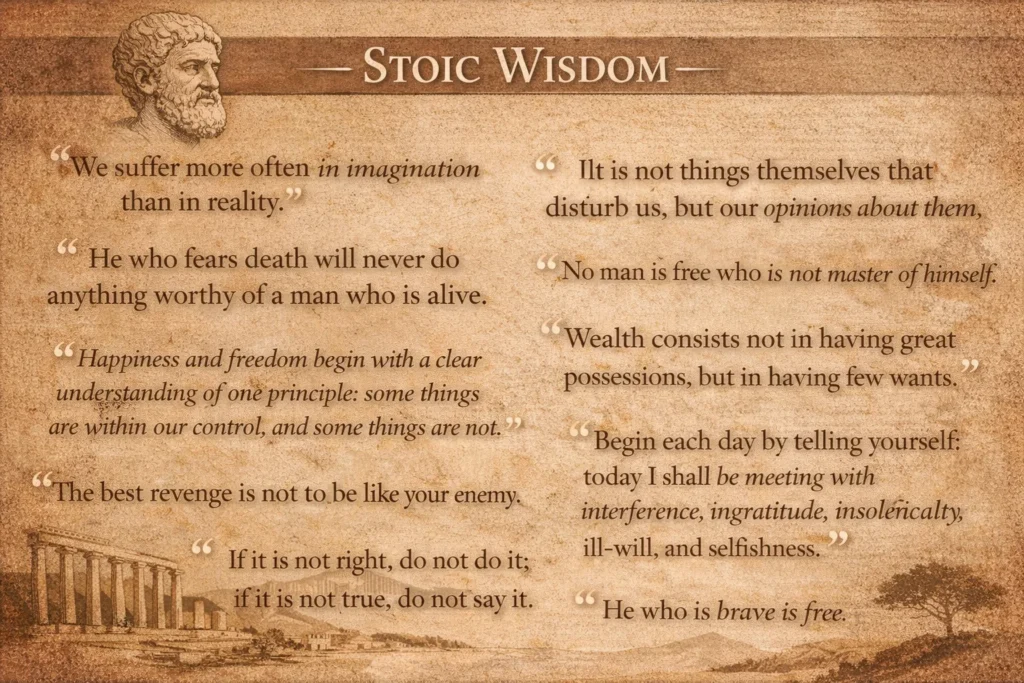
1. Decide What Is Yours to Carry and Drop the Rest
Most people are exhausted, but not from effort. They’re tired from carrying things that were never theirs. Other people’s moods. Other people’s expectations. Outcomes they can’t control but feel responsible for anyway.
I’ve noticed that when someone takes on too much emotional weight, they don’t become admirable. They become predictable. Useful, yes. Kind, often. But not deeply respected.
The Stoics were almost obsessive about this distinction. What is within your control and what isn’t. At first, it sounds abstract. Over time, it becomes painfully practical. You begin to see how often you react instead of choose. How often your day is shaped by someone else’s urgency.
There’s a subtle shift that happens when you stop explaining yourself for things that aren’t yours to manage. You still care. You still act with intention. But you no longer absorb the emotional debt of every room you enter.
People feel this immediately. They may not articulate it, but they sense a boundary. Not a wall. More like gravity. You’re present, but not pulled. Engaged, but not entangled.
Respect grows in that space. Because people trust what doesn’t wobble.
2. Speak Less Than You Know, Especially About Yourself
Early on, I believed clarity came from explaining. If people misunderstood me, I assumed I hadn’t said enough. So I filled the silence. Gave context. Justified motives. Smoothed edges before anyone asked.
What I didn’t see was how this diluted my presence.
The Stoics were sparing with words, not because they lacked thoughts, but because they understood something social before it was psychological. When you rush to define yourself, you remove the work from others. And people value what they have to pay attention to.
There’s a difference between sharing and spilling. Over time, I’ve found that restraint doesn’t make you invisible. It makes you legible.
When you speak with intention, when your words feel chosen rather than reactive, people listen differently. They pause. They weigh what you say. Silence begins to work in your favor instead of against you.
This isn’t about mystery as a tactic. It’s about self-trust. When you no longer feel compelled to manage how you’re perceived, perception often improves on its own.
3. Keep Your Emotional Center Off the Negotiating Table
Nothing erodes respect faster than emotional volatility that others must manage. Not emotions themselves, but the unspoken expectation that someone else should stabilize them.
I learned this the hard way. I mistook emotional honesty for emotional outsourcing. I thought closeness meant sharing every fluctuation, every doubt, every frustration in real time.
The Stoic view is calmer, and frankly kinder. Feel fully, but process privately. Not in isolation, but with discernment. Choose where your rawness belongs.
When your reactions are measured, people relax around you. They don’t brace. They don’t tiptoe. They don’t feel responsible for regulating the room.
Ironically, this creates more intimacy, not less. Because when you do share something difficult, it carries weight. It doesn’t feel like noise.
People prioritize those who feel emotionally safe to be around. Not because they’re distant, but because they’re steady.
4. Let Actions Finish the Sentences You Don’t Need to Say
There’s a temptation to announce values before living them. To signal integrity, ambition, loyalty. I’ve done it. Most of us have. It feels efficient.
But respect doesn’t come from stated principles. It comes from observed consistency.
The Stoics wrote for themselves, not for applause. Marcus Aurelius never intended his Meditations to be read. There’s something instructive in that. He was shaping his character, not his reputation.
When you stop performing your intentions, something interesting happens. People begin to watch instead of evaluate. They draw conclusions quietly, and those conclusions stick.
You don’t need to say you’re dependable if you are. You don’t need to declare boundaries if you keep them. Over time, this creates a sense of inevitability around you. People adjust their behavior because they know what to expect.
That’s a rare form of authority. And it doesn’t require persuasion.
5. Treat Your Time as a Moral Asset
Time reveals what you truly value. Not what you say matters, but what you consistently make room for.
For years, I treated my time as flexible, almost apologetically so. If someone needed me, I rearranged. If something mattered to me, I squeezed it in later.
The Stoics saw time as the one resource you cannot replenish. To waste it was not just impractical, but unethical. That framing changed something for me.
When you protect your time without defensiveness, people notice. They may not like it at first. But they respect it. Because boundaries around time signal self-respect, and self-respect is contagious.
You become someone whose attention feels earned, not assumed. Invitations feel intentional. Conversations feel sharper.
People prioritize those who clearly prioritize themselves. Not out of ego, but out of alignment.
6. Accept Discomfort Before It Becomes Inevitable
Avoidance has a cost. It compounds quietly until it presents itself as fate.
I’ve watched people delay hard conversations, difficult decisions, necessary endings. Often with good intentions. They want harmony. They want certainty.
Stoicism doesn’t rush discomfort, but it doesn’t postpone it either. There’s an understanding that pain faced early is usually smaller, cleaner. Pain delayed tends to spread.
When you demonstrate a willingness to sit with discomfort, to name what’s awkward without aggression, people trust your leadership. Even in personal relationships.
They know you won’t disappear when things get complicated. They know you won’t let resentment do the talking later.
Respect grows from this reliability. Not the loud kind. The kind that settles in and stays.
7. Stop Borrowing Your Worth From Other People’s Reactions
This one takes time. And failure. And usually a few years of confusing feedback.
If your sense of worth rises and falls with approval, people feel it. Even if you hide it well. Especially then.
The Stoics were clear about this, sometimes brutally so. External validation is unstable. It cannot be secured, only chased.
When you detach your self-regard from immediate reactions, you move differently. Compliments land, but don’t inflate. Criticism registers, but doesn’t collapse you.
People are drawn to this internal steadiness. It removes a subtle pressure from interactions. They don’t feel used as mirrors.
Paradoxically, approval comes more easily when you stop needing it.
8. Choose Long-Term Dignity Over Short-Term Relief
There are moments when saying less, walking away, or not defending yourself feels unbearable. The immediate relief of reaction is tempting.
I’ve taken that relief. It never lasts.
Stoicism asks a harder question. What will you respect yourself for later.
When you begin to answer that question honestly, your behavior changes. You pause more. You react less. You let some misunderstandings stand.
This isn’t passivity. It’s perspective. And people sense the difference.
Those who prioritize short-term relief often demand reassurance. Those who choose dignity project calm. And calm commands respect.
9. Be Predictable in Character, Not in Compliance
Predictability is often misunderstood. People think it means always saying yes, always accommodating, always agreeable.
The Stoics meant something else entirely. Be consistent in your principles, not your concessions.
When people know where you stand, even if they don’t always like it, trust forms. They don’t have to guess. They don’t test as much.
Uncertainty erodes respect faster than disagreement.
I’ve found that clarity, even firm clarity, is often received with relief. It simplifies relationships. It reduces negotiation.
People prioritize those who make interactions easier, not harder.
10. Live As Though You Are Already Being Watched by Your Future Self
This may be the most personal Stoic rule. And the quietest.
Marcus Aurelius wrote constantly about death, not morbidly, but orienting. Who are you becoming. Would you recognize yourself later.
When I started asking that question, some choices became simpler. Not easier. Simpler.
You stop trading long-term peace for short-term approval. You start acting in ways that feel coherent across time.
Others sense this integrity. It’s subtle, but powerful. You’re not chasing relevance. You’re anchored.
And people, almost instinctively, move toward what feels anchored.
A Few Things That Tend to Be True
• Respect often grows when explanation decreases
• Emotional steadiness feels rare because it is
• People prioritize those who don’t negotiate their self-worth
• Boundaries, held calmly, create trust more than distance
• Dignity compounds quietly over time
Conclusion
In the conclusion, Stoicism doesn’t make you impressive. It makes you clear. Clear about what you carry. Clear about what you release.
Epictetus once wrote that freedom is not achieved by satisfying desire, but by eliminating it. I’ve found something similar with respect. It arrives most reliably when you stop trying to earn it, and start living in a way that doesn’t depend on it.
That realization tends to come slowly. And once it does, it changes very little on the surface. But almost everything underneath.