
10 Quirky Habits That Quietly Predict Future Wealth

There’s a strange moment that comes with age when you start noticing patterns you couldn’t see before. Not the loud ones. Not the obvious success stories people like to post about. I mean the quieter patterns. The habits that didn’t look impressive at the time. The small, almost forgettable behaviors that only made sense years later, once outcomes had already settled.
Long time around people who ended up financially comfortable, and just as much time around people who stayed perpetually stuck despite being smart, hardworking, even talented. The difference rarely showed up in ambition or intelligence. It showed up in subtler places. In how they handled boredom. How they reacted to uncertainty. What they did when no one was watching and nothing was urgent.
We like to believe wealth is predicted by bold moves and dramatic decisions. In my experience, it’s more often foreshadowed by quiet habits that don’t look like “success” at all. Some of them even look odd. Unimpressive. Easy to overlook. Until one day, years later, they aren’t.
What follows aren’t rules or prescriptions. They’re observations. You may recognize yourself in a few of them. When that happens, there’s often a strange feeling of relief. Not excitement. Just a quiet sense of orientation, like realizing you’ve been walking in the right direction without needing to announce it.
1. They reread things instead of constantly seeking new ones
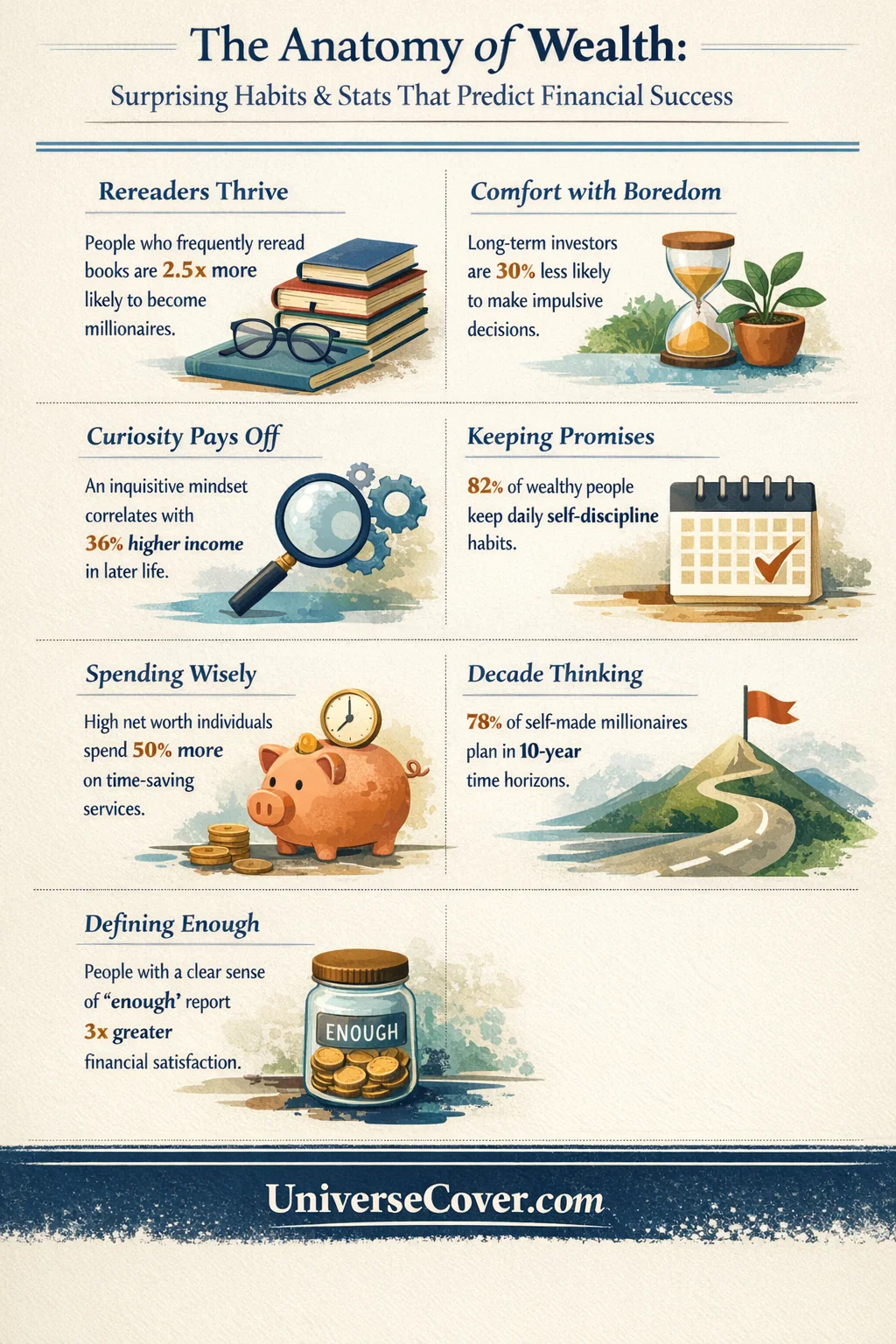
Studies shows that people who later become financially steady tend to revisit ideas more than they chase novelty. They reread books. They sit with old notes. They return to the same questions from different angles over the years. At first glance, this can look like stagnation. Like they aren’t “keeping up.”
But something else is happening beneath the surface. Rereading changes the relationship between knowledge and identity. The first time you read something, you’re usually collecting information. The second or third time, you’re testing yourself against it. Seeing what still resonates. Noticing what you’ve outgrown.
In my experience, people who build wealth tend to think in layers rather than in headlines. They don’t confuse exposure with understanding. They’re comfortable letting ideas mature slowly, even if it means missing out on the thrill of the new. That patience shows up later in how they handle money. Less impulsive. Less reactive. More grounded.
There’s also a subtle humility in rereading. It assumes you didn’t get everything the first time. That you’re still changing. This mindset quietly protects people from overconfidence, which is one of the most expensive traits a person can carry. Especially when money enters the picture.
I’ve watched people chase trends, strategies, and opportunities endlessly, mistaking movement for progress. And I’ve watched others sit with the same core principles for years, refining them quietly. The latter group often ends up with fewer dramatic stories, but more durable outcomes.
Wealth doesn’t reward those who know the most things. It tends to favor those who understand a few things deeply and apply them consistently, even when it feels boring.
2. They have a strange tolerance for being slightly underwhelmed
This one took me a long time to notice, because it hides behind personality. People who quietly build wealth often aren’t chasing constant stimulation. They don’t need every moment to feel optimized or exciting. They’re unusually comfortable with neutral days.
In a world trained to avoid boredom at all costs, this stands out. Most people feel uneasy when nothing is happening. They reach for distraction, spending, or drama to fill the space. Future wealthy individuals seem to do the opposite. They let the quiet stretch.
This isn’t laziness. It’s a kind of emotional regulation. Being able to sit with underwhelm means you’re less likely to make impulsive decisions just to feel something. Financially, that matters more than most spreadsheets will ever show.
I’ve seen people buy things they didn’t need because their afternoon felt flat. Change jobs not out of misalignment but out of restlessness. Say yes to opportunities that looked exciting but drained them long term. Meanwhile, the people who could tolerate a little dullness often waited long enough for better options to appear.
There’s also a connection here to long-term thinking. Wealth compounds slowly. It rarely delivers daily excitement. If you need constant emotional payoff, you’ll sabotage the very systems that could support you later.
The irony is that this tolerance for the ordinary often leads to extraordinary results. Not because they aimed for it, but because they didn’t panic when life felt unspectacular.
3. They ask oddly specific questions about how things work
Future wealth builders tend to ask questions that feel almost inconvenient. Not flashy questions. Practical ones. Questions like, “Where does the money actually go?” or “What happens if this breaks?” or “Who benefits if this scales?”
These questions aren’t driven by skepticism so much as curiosity paired with responsibility. They want to understand systems, not just outcomes. This habit shows up early, long before money is involved.
While others are focused on appearances or quick wins, these people are tracing cause and effect. They’re mapping incentives. They’re trying to see the whole machine, not just the polished exterior.
This matters because money flows through systems. If you don’t understand how systems behave under pressure, you’ll always be reacting instead of positioning yourself thoughtfully. People who ask better questions earlier tend to avoid costly misunderstandings later.
There’s also a quiet confidence in asking specific questions. It suggests the person isn’t afraid of seeming unsophisticated. They care more about clarity than image. Over time, that becomes a serious advantage.
I’ve seen very smart people lose money because they assumed understanding instead of checking it. And I’ve seen quieter, less flashy individuals build stability simply by refusing to move forward until things made sense to them.
Wealth doesn’t reward those who pretend to know. It tends to accumulate around those who are comfortable saying, “Wait, explain that part again.”
4. They keep personal promises even when no one notices
This habit is almost invisible, and maybe the most predictive of all. People who later build wealth tend to honor small commitments to themselves. They finish what they said they’d do. Not in a heroic way. Quietly. Consistently.
No one applauds this. There’s no external reward. That’s why it matters.
Keeping promises to yourself builds a kind of internal trust. Over time, that trust compounds. It shapes how you take risks, how you plan, how you recover from mistakes. When you trust yourself, you don’t overcorrect. You don’t panic as easily.
Financially, this shows up in subtle ways. Following through on saving plans. Staying with long-term strategies during boring stretches. Not abandoning systems just because they don’t produce immediate feedback.
I’ve noticed that people who struggle financially often struggle with self-trust. They constantly renegotiate with themselves. Tomorrow becomes next week. Plans dissolve under mild discomfort. This creates instability that no amount of income can fully fix.
By contrast, people who quietly do what they said they’d do build an internal consistency that money later amplifies rather than destabilizes.
It’s not discipline in the rigid sense. It’s reliability. And reliability, applied over years, is an underestimated form of wealth.
5. They’re oddly careful about who they envy
Everyone compares themselves. The difference is in what they do with that comparison. I’ve noticed that future wealthy individuals are selective about whose life they mentally sample.
They don’t envy indiscriminately. They look closely at the full picture. Not just the visible success, but the trade-offs attached to it. The schedule. The stress. The values compromised or preserved.
This doesn’t mean they lack ambition. It means they’re cautious about borrowing goals without borrowing context. They know that wanting someone’s results often means inheriting their lifestyle, for better or worse.
I’ve watched people chase income levels without realizing they were also chasing burnout, instability, or dependence on fragile systems. Meanwhile, others quietly opted for paths that matched their temperament, even if it meant slower growth.
That alignment tends to pay off long term. Sustainable wealth favors people who choose paths they can actually live with, not just tolerate temporarily.
Envy isn’t the enemy. Unexamined envy is. The habit of pausing and asking, “Do I really want their whole life?” saves people from expensive detours.
6. They spend money to reduce friction, not to signal success
This one is easy to miss because it doesn’t look aspirational. People who later become wealthy often spend money on things that make their lives smoother, not shinier.
They fix annoyances. They buy time. They simplify systems. Outsourcing stress before upgrading status.
Early on, this can look unimpressive. No flashy purchases. No visible rewards. But over time, reducing friction increases consistency. And consistency is where compounding actually happens.
I’ve noticed that people stuck financially often spend to feel successful. People building stability spend to function better. That difference echoes for years.
Reducing friction means fewer decisions. Fewer energy leaks. More bandwidth for meaningful work. It’s a quiet investment that rarely photographs well but pays reliably.
Money used this way becomes a tool, not a costume.
7. They are comfortable being misunderstood for long periods
This habit is emotionally difficult, which is why it’s rare. People who build wealth often make choices that don’t immediately make sense to others. Sometimes even to themselves.
They delay visible rewards. They turn down socially impressive options. They stick with paths that look unremarkable from the outside.
This requires a tolerance for being quietly questioned. For not being validated in real time. That emotional skill protects them from chasing approval-driven decisions, which are notoriously expensive.
I’ve seen people abandon solid long-term plans because they couldn’t stand looking behind schedule compared to peers. Others stayed the course, endured the awkward years, and crossed invisible thresholds later.
Wealth often arrives after a long stretch of looking average.
8. They revisit old mistakes without drama
People who build wealth don’t obsess over their mistakes, but they don’t avoid them either. They revisit them calmly. Almost clinically.
What went wrong. What assumptions failed. What was actually in their control.
This habit prevents repetition. And repetition of financial mistakes is devastating over time.
People who shame themselves tend to rush forward without learning. People who excuse themselves do the same. Quiet analysis sits in between.
That middle ground is where growth lives.
9. They maintain a private sense of enough
This one is deeply internal. Future wealth builders often have a personal definition of “enough” that isn’t easily influenced by trends.
This doesn’t cap their ambition. It stabilizes it.
Knowing what enough feels like prevents lifestyle creep from eroding progress. It also reduces fear-based decision making.
People without this anchor tend to feel perpetually behind, no matter how much they earn. And that feeling drives choices that undermine long-term security.
Enough is a psychological asset. Quiet, but powerful.
10. They think in decades without announcing it
Finally, there’s a temporal habit. People who end up wealthy often think long without saying so. They don’t constantly reference the future. They just behave as if it matters.
They make choices their future selves won’t resent. They avoid shortcuts that mortgage tomorrow for today.
This isn’t optimism. It’s respect for time.
And time, more than talent or luck, is what wealth quietly accumulates around.
A few quiet takeaways
- Wealth often reveals itself in temperament long before it shows up in numbers
- The habits that compound rarely look impressive in the moment
- Emotional regulation matters more than clever strategies
- Consistency outperforms intensity almost every time
- Many financial outcomes are decided years before money is involved
Conclusion
In the end, wealth isn’t just something people pursue. It’s something they grow into. Gradually. Often unknowingly. Through habits that feel small, sometimes strange, and mostly unremarkable at the time.
I’ve come to believe that the clearest signs aren’t found in ambition or hustle, but in how a person treats time, attention, and themselves when no one is watching.
Or as Warren Buffett once put it, with his usual understatement, “The chains of habit are too light to be felt until they are too heavy to be broken.”